What is the most important desire for customers in the future of luxurious individual mobility?
Mercedes found out that today’s customers are increasingly viewing luxury through the lens of values and benefitsthat extend beyond physical experiences. They are seeking priceless commodities such as time and want to show responsibility with their choices.
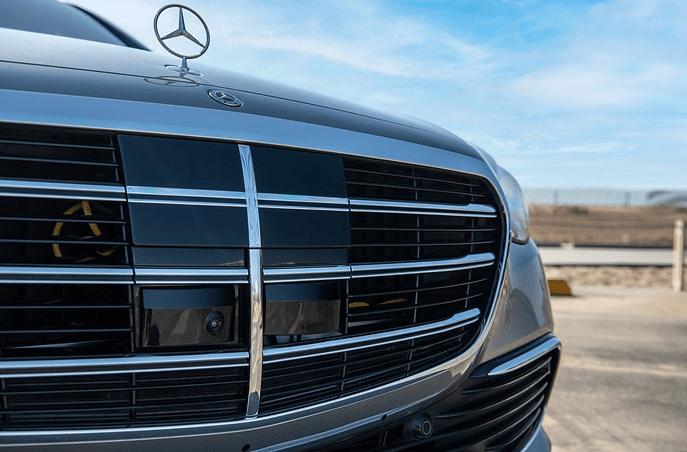
A LiDAR that sits in the radiator grille is essential for Mercedes-Benz for safe, conditionally automated driving.
As the leading luxury car brand, Mercedes-Benz is consistently driving the luxury experience to new levels. So it gives it new meaning for the electric and digital age – achieving more with less.
Driven by the innovative spirit firmly anchored in its brand DNA, and by its strategic goals of “Lead in electric” and “Lead in car software”, Mercedes-Benz is pioneering the electric and digital transformation of the global auto industry.
If the vehicle is in DRIVE PILOT mode, this is displayed in the instrument cluster with the corresponding assistance graphic.
The most recent proof of this is the Mercedes-Benz VISION EQXX. The most efficient Mercedes ever built is a blueprint for the future of efficiency of electric vehicles and also a masterclass in a radically new approach to the UI/UX driven by software and artificial intelligence.
If DRIVE PILOT is activated, the driver may take his hands off the steering wheel and turn to certain secondary activities.
With DRIVE PILOT, Mercedes-Benz became the first automotive manufacturer in the world to receive the world’s first internationally valid system approval for conditionally automated driving (SAE-Level 3).
Before DRIVE PILOT can be activated, the availability of the system is displayed via a white flashing in the control elements.
Mercedes recently released some photos about their latest research and already working solutions. We lift a glimpse here of this bold new future…
More (technical) and driving news soon from the brand with the iconic star!
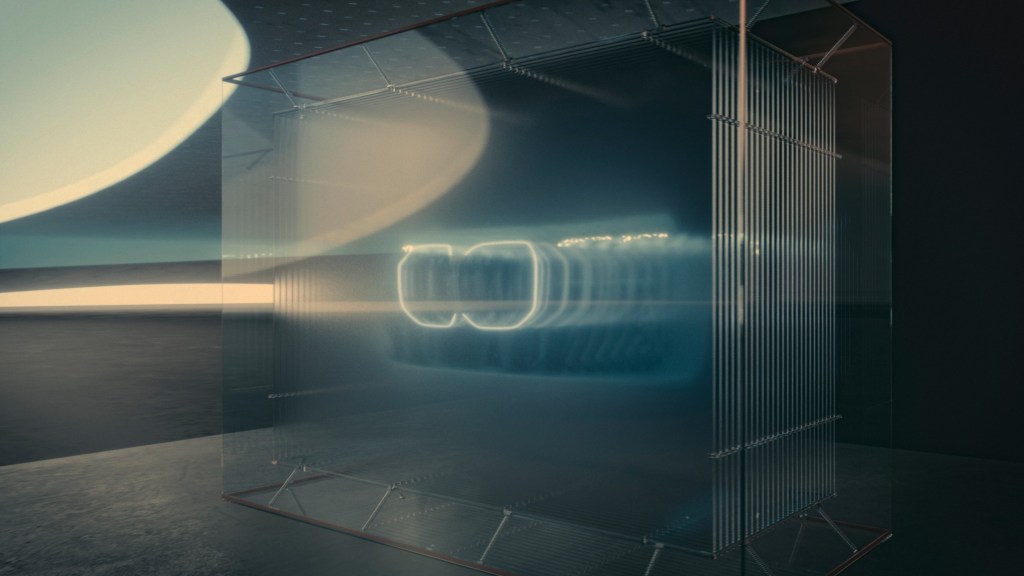
The distinctive grille of the new 7 series will get an extra light signature…
At the BMW Group Annual Conference held on March 16, Frank Weber, Member of the Board of Management of BMW AG for Development, presented the first details of the future BMW 7 Series.
The focus lies initially on technology highlights, a new front-end design based on hallmark BMW design features and a unique interior experience consisting of digital features and exclusive materials. In April, BMW will present the all-electric BMW i7, and with it the entire new BMW 7 Series.
In the BMW i7, the characteristic design elements of twin round headlights and BMW grille have been completely reinterpreted. Some of the special design statements are upper light elements made of exclusive crystal glass and the illuminated contour of the kidney grille.
BMW developed also a new “My Modes” and the latest generation of the iDrive operating system. My Modes enable the driver to precisely customise the car’s driving characteristics and interior ambience. In addition to the BMW Curved Display, a new type of light and function strip on the instrument panel and the doors provides a visual and haptic quality.
The BMW Interaction Bar is part of the ambient lighting and also features integrated control buttons. In addition, the newly developed Sky Lounge panoramic glass roof adds to the feeling of spaciousness.
Cinema entertainment for the rear passengers…
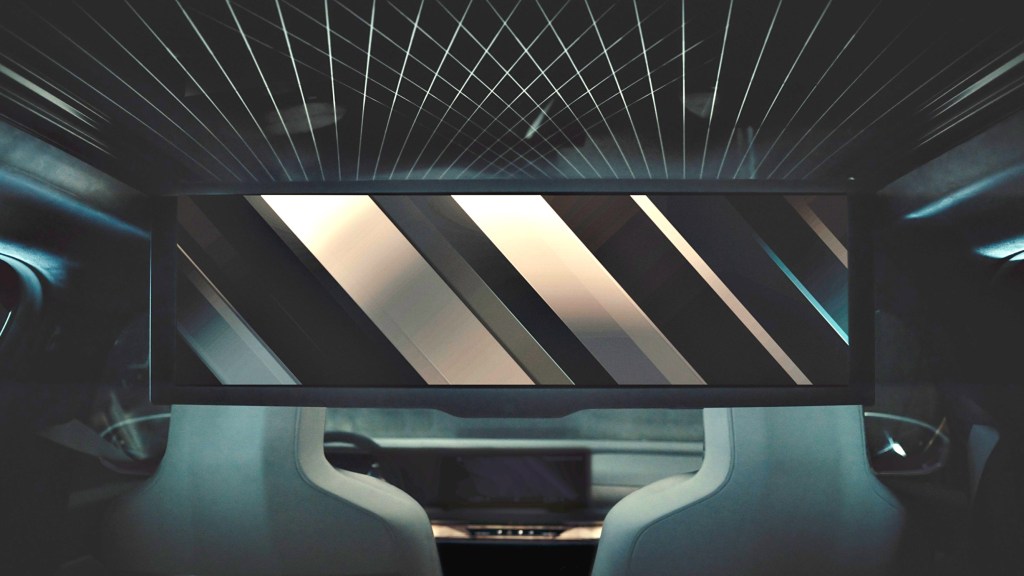
The rear of the BMW i7 sets new entertainment standards offering a unique cinematic experience. There is a BMW Theatre Screen, which moves out of the roof liner, an ultra-wide screen with a 31 inch screen, 32 : 9 panoramic display format and 8K streaming resolution. It transforms the rear seats into an exclusive, private cinema lounge where passengers can select their personal entertainment programme from a diverse range of streaming offers!
The Ioniq 5 is elegant with its retro-futuristic style…
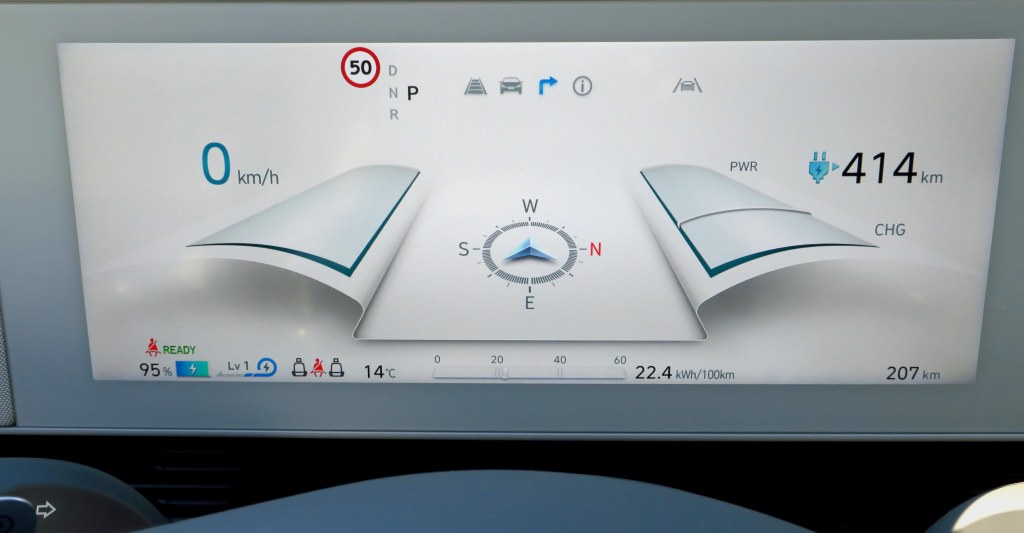
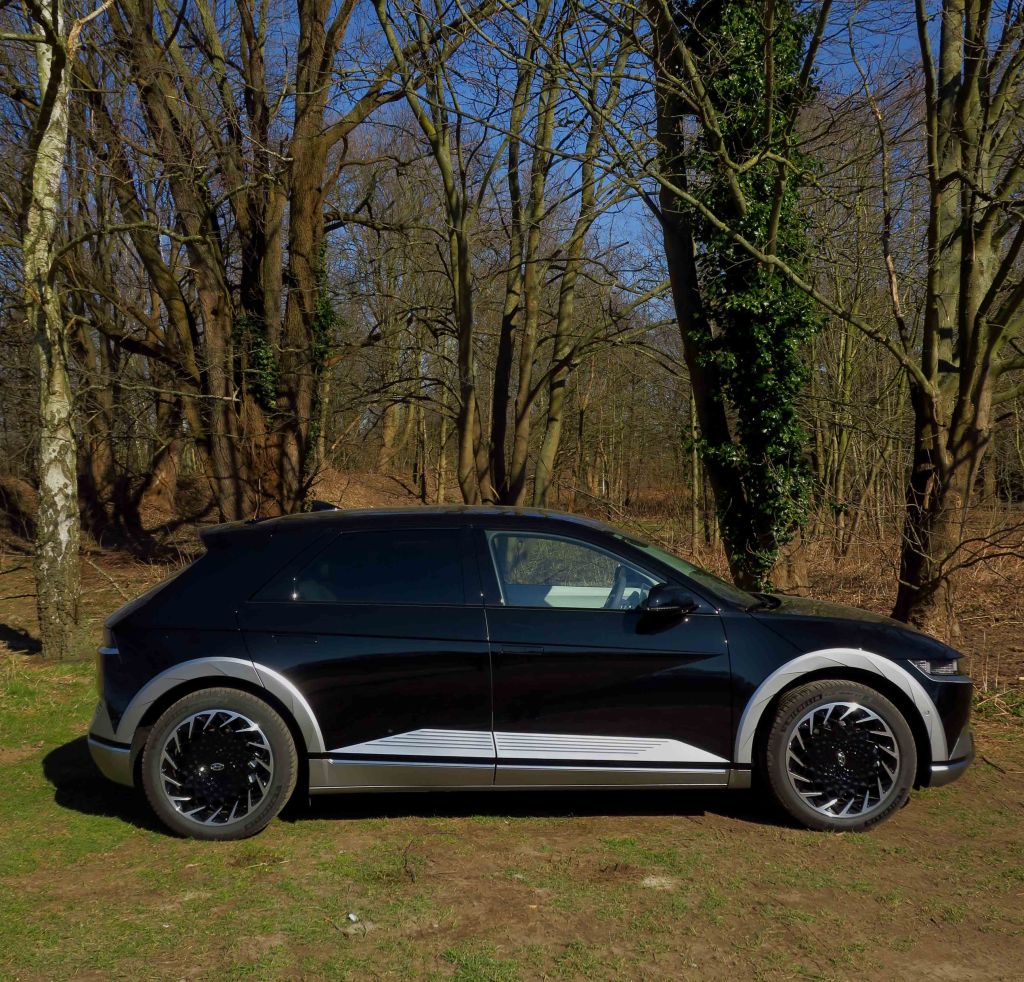
There are cars which make a mark in history. Such a car is certainly also the Ioniq 5. In the EV-segment, its retro-futuristic style make it really stand out. This also goes for the interior. Brimming with superb and clever solutions, the Ioniq 5 is nothing less than a game changer. It is the first car for me where you really get the feeling of driving a car of the future, and this is already by just looking at the graphics of the instruments in front of you.
Behind the wheel, the future smiles at you
And then we have said nothing about the way you sit in it, what space you have and how it drives, handles and performs…and how much it (only) costs. It moves boundaries, for sure. Just read on.
Hans Knol ten Bensel
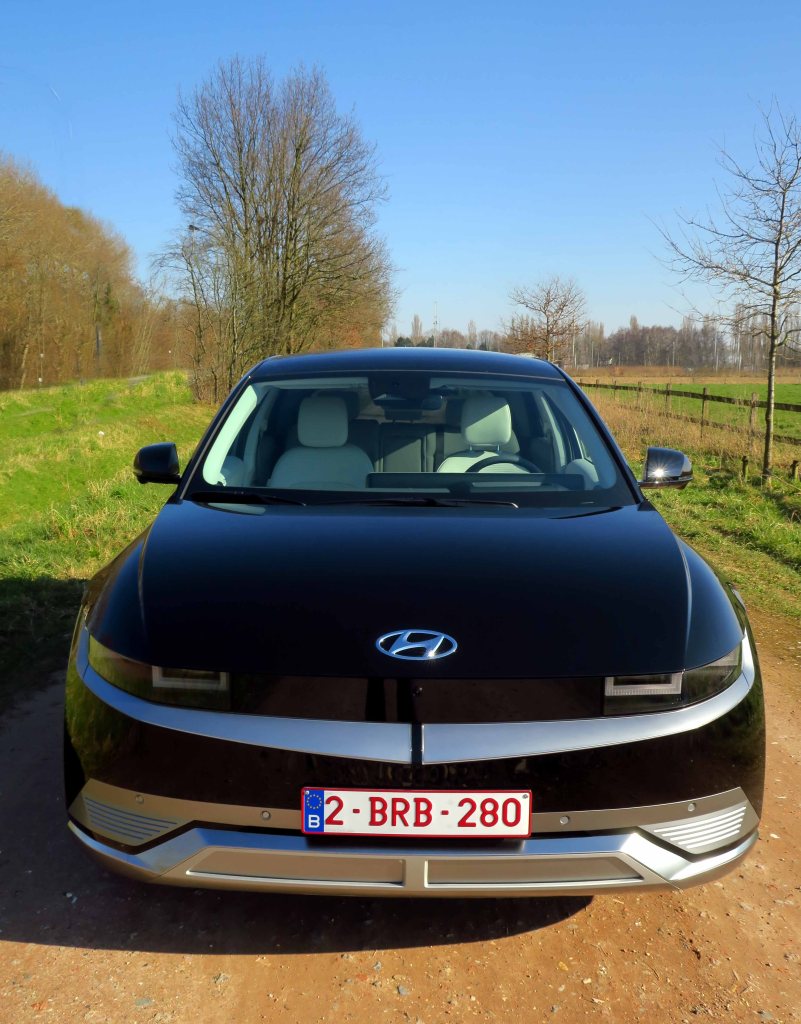
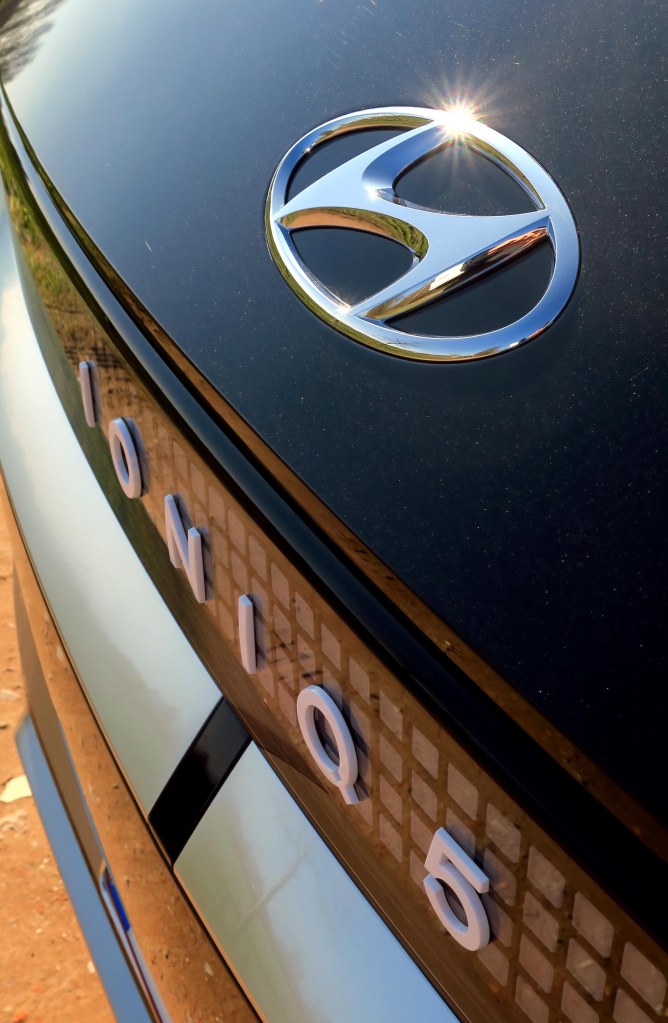
Hyundai created for its electric cars a proper sub-brand: Ioniq. Now it has created the car which can justifiably be called the iconic ambassador of this brand: de Ioniq 5. This uniquely styled car (we truly love it) is classified as a CUV, or Crossover Utility Vehicle.
It runs on a totally new, dedicated platform, which Hyundai has specially developed for its electric cars. The so-called Electric Global Modular Platform or E-GMP. This platform comprises the chassis of the vehicle including the battery, motor and power electric system, and its scalable wheelbase allows it to form the backbone of many different vehicles. Indeed, Hyundai has great plans with it: it will underpin the Ioniq 6, which will be launched in the middle of this year. This will be an electric sports limousine. Then followed in 2024 by the Ioniq 7, a “classic” large SUV.
When it comes to EV’s, Hyundai is ambitious. It wants to have a technological top position in the EV-market by 2025. All this doesn’t seem to be unrealistic. The Hyundai Kona already impresses with impressive EV efficiency.
The electronic architecture of this platform also sets new benchmarks. Its 800V charging capability enables super-fast charging. In just five minutes the battery can charge enough for a range of 100km, and that is one of the very strong points of this Ioniq. With a 350-kW charger, the IONIQ 5 can charge from 10% to 80% in just 18 minutes.
But there are more advantages offered by this platform. It enables total freedom in vehicle design. Designed exclusively for BEV’s, it has no transmission tunnel at all. A completely flat floor is an ideal playground for (interior) designers. So explains Vice President of design, Haksoo Ha: “The innovative platform means we can design for greater productivity in transit,” and “Seats reclining to a near-horizontal will provide a ‘zero gravity’ experience and will open up endless configuration opportunities.”
Indeed, the front seats convert into first class sleeping seats. Ideal when on a longer evening trip you can take a power nap when your Ioniq is quickly recharging to bring you home…
There is no transmission tunnel, the front centre console can be moved backward, so front legroom is also limitless sideways.
Also in the back there is ample legroom, last but not least because of the Ioniq’s long 3 meter wheelbase. With the absence of the transmission tunnel, it seats three grownups relatively comfortable at the rear. The back seat can also be inclined and moved fore and aft! Indeed, the well proportioned and elegant Ioniq is big. It is 4,64 meters long, and 1,89 meter wide. Its boot offers 531 l space in standard setup, and with the rear backrests down, a maximum space of 1591 l is available.
Under the front hood, above the electric motor, you find a neat box with its lid having the appearance of an engine cover. When you drive the two wheel version of the Ioniq 5, this box offers 57 liters, with the 4WD version this is “only” 24 liters.
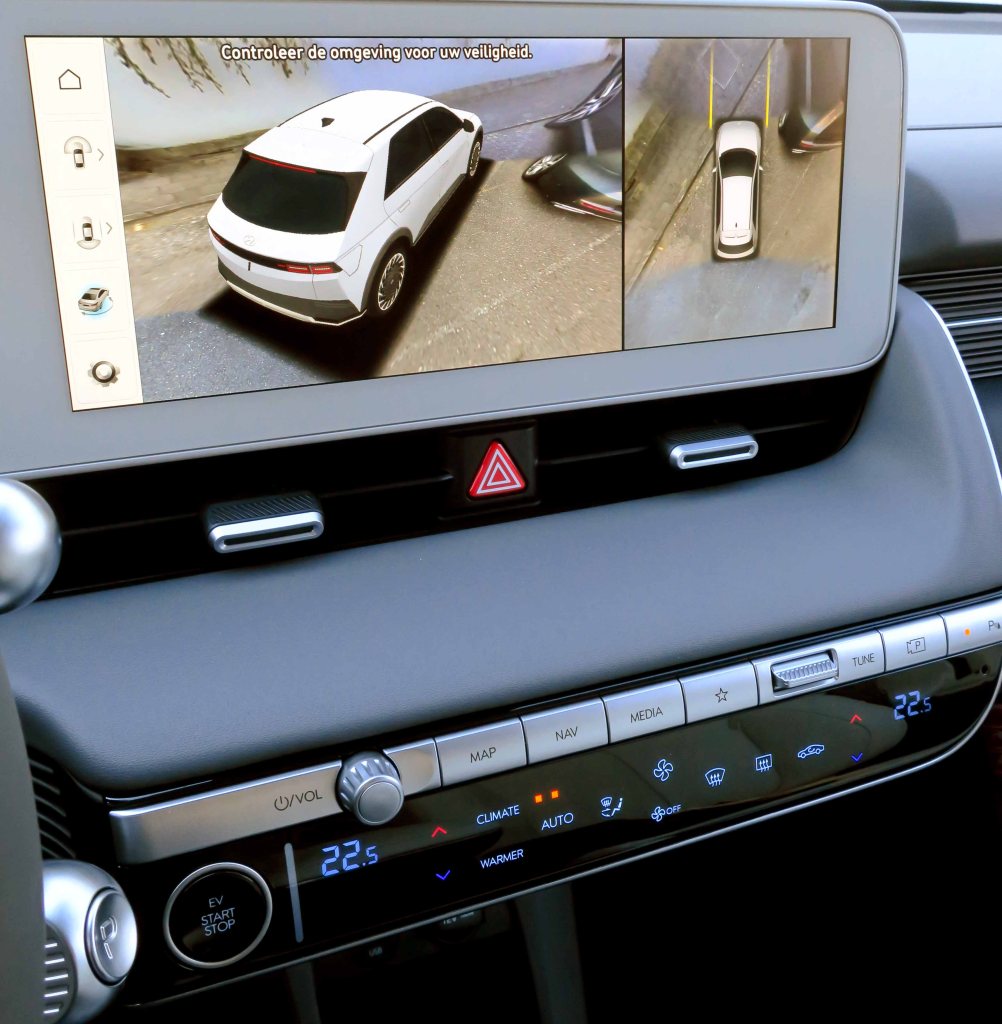
But let’s turn to the stylish dashboard. Notwithstanding its futuristic clean architecture with two wide screens, it is surprisingly intuitive to use, and you really don’t need an instruction manual to put all its functions to work. Beneath the central touchscreen you find the heating/ventilation functions, with classic buttons and controls.
Under the hood…
The E-GMP platform allows a wide choice of drivetrain combinations. The Ioniq 5 can be had with one or two electric motors, resulting in rear wheel drive or 4WD as the second motor drives the front wheels, and two battery capacities, 58 or 72,6 kW respectively.
Total available power ranges from 125 kW/170 HP to 225 kW/, with the top version accelerating from 0 to 100 km/h in 5,2 seconds. Top speed is for all the power versions limited to 185 km/h.
Our test car had the 160 kW/217 HP engine, developing 350 Nm of torque. This resulted in an acceleration from 0 to 100 km/h in 7,4 seconds, coupled with the 72,6 kW battery. Consumption according to WLTP standards is 16,8 kWh/100 km, with a range of some 481 km. Range anxiety is in the light of the fast recharging capacities a thing of the past…
On a 101 km triip with dense traffic at varying speeds, we clocked a consumption of 16,1 kWh…
The larger battery also allows you to tow greater loads, up to 1600 kg for our test car…
Did you know that the Ioniq 5 also has a 230 V external plug adapter? It’s so-called “V2L” function in the car can also supply up to 3.6 kW of power. So when you are out in the open, and want to charge your laptop or use a spot light or portable fridge or recharge the battery of your electric bike, the Ioniq 5 helps you out…
The Ioniq 5 has of course the usual driving modes, from Eco to sport, and you have also two paddles at the steering wheel which allow you to choose the degree of E-recuperation when you lift the throttle. During our test, we used mostly the level 3 position, which we felt delivered the right deceleration, and with some experience, we managed to drive around town and on the open road without ever touching the brake pad pedal at all…
Driving is (again) believing…
Driving with the Ioniq 5 is nothing short of delightful. Twist the ring on the selector stick a click forward in “D” and there you go. The Head-up-Display with Augmented-Reality-Function is ultra visible and shows what you need to know. Progress is silent and smooth. The suspension is also quite comfortable, and the Ioniq seems literally to float over the road surface. Body roll is virtually absent and the suspension is not too soft either, but copes rather well with potholes and ridges.
This is your ideal mount for long urban and/or Gran Turismo trips. Handling is also much more precise and nimble than one would expect from a two-tonne car, but the low gravity point of the battery package results in impeccable and stable cornering. We found also the lane assist functioning very smoothly, and we liked also the electronic displays of blind spots when you operate the left or right indicator. A wonderful solution!
The Ioniq 5 is large, but just be surprised with us, this Ioniq offers distance parking! Just press the symbol on the key, and the Ioniq 5 will sweetly drive itself into or out of a narrow parking space.
The superb smoothness and acoustic refinement of the Ioniq is further enhanced with a superb Bose audio system, and Classic Music and Jazz buffs as we are, our ears also enjoyed every ride…
Conclusion
Style, grace, space, this Ioniq has it all; add to this the panache in the design details of headlamps and rear lights, in ’80 retro futuristic fashion. It really stands out.
Also the 20 inch alloys are elegant and aerodynamically efficient. This Hyundai has been carefully thought out, is wonderfully designed with no detail being overlooked. Add to this the efficient motors, the impressive recharging capacity, the generous space, and you understand our enthusiasm. You will also be smiling when you see the price of the Ioniq 5 in whatever version you choose.
Hard to beat? We should think so. Except maybe by the Kia EV6, running on the same platform and using the same technology, which we are driving at the moment of writing, and of which you will also read our driving impressions soon!
In the stormy February days, the new Opel Grandland stood admirably its ground against the elements…
My love affair with Opel really dates a long time back. To 1968, to be exact. As a university student studying law and economics, I replaced my father on a press trip in the South of France to test the sleek Opel 1900 GT fastback two seater. It was designed by Opel stylist Erhard Schnell, who had taken the ’67 Corvette as a model, and had the 1,9 litre single overhead cam four cylinder under its long bonnet. I remember driving it with verve over the twisty roads of the Massif de l’Estérel, as I did now with the DS9. It was bullet fast and nimble to me, as I remember it.
The Opels then had already plenty of panache and character. Then came the Commodore GS Coupés, the Manta’s, even the big Admirals and V8 Diplomats. They were appealing, rock solid and fast. All this good qualities came back at the wheel of the Opel Grandland Hybrid.
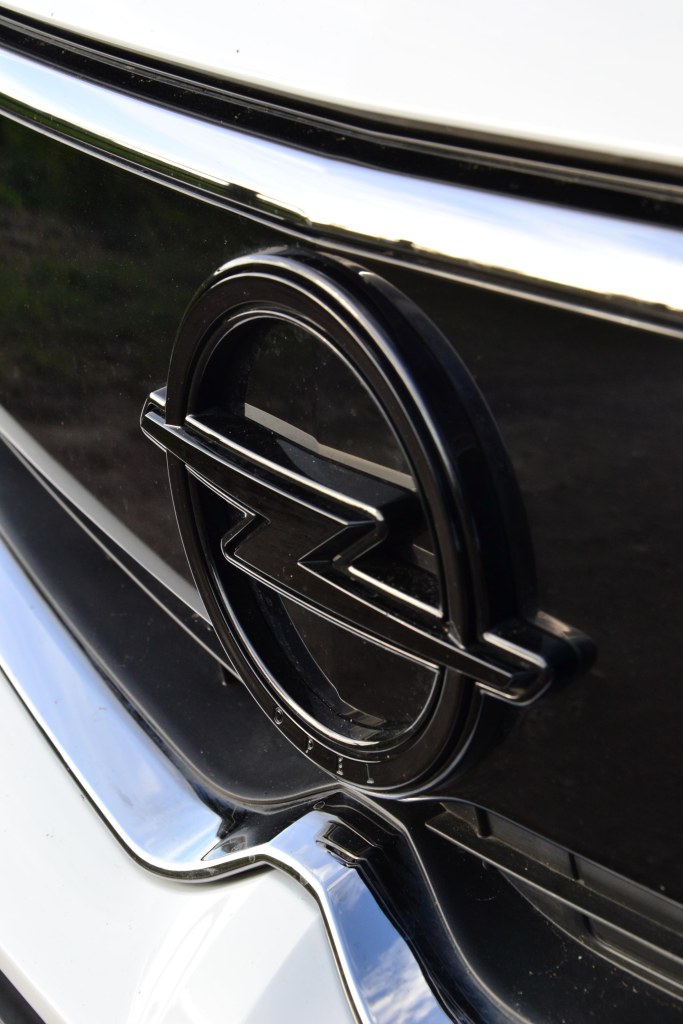
The “Blitz” or lightning still adorns the Opel emblem…
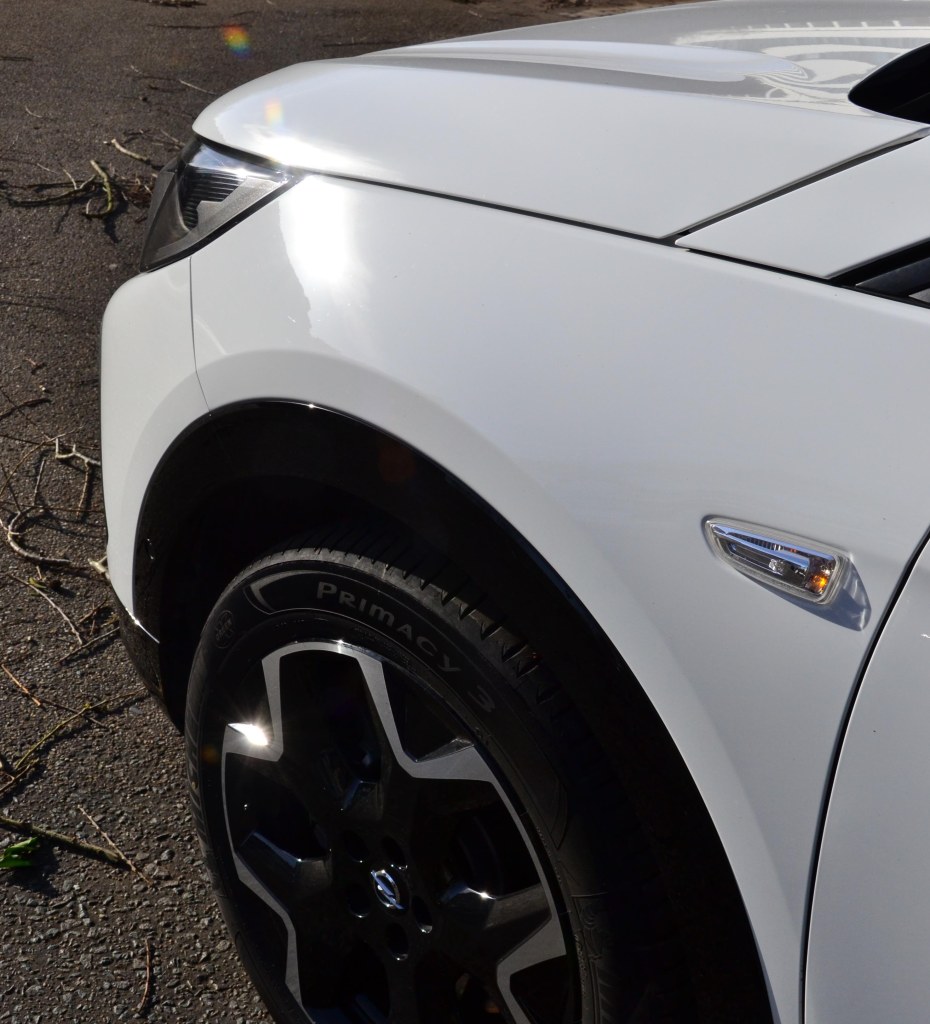
Stylish, with the new Opel Vizor front grille, the Opel has a distinctive and very clean, contemporary character. The dashboard and infotainment displays are an example of less is more, and indeed are just “right” for everyday driving. It also embodies the no nonsense approach of Opel. But it is mostly in the way this Grandland steers and drives that my good Opel memories came back. It invites you to adopt an active driving style, due to its overall responsiveness and handling. Again the car also feels solid and well built, for years to come, is roomy and has this unmistakable Opel “no nonsense” character. But just read further…
Hans Knol ten Bensel
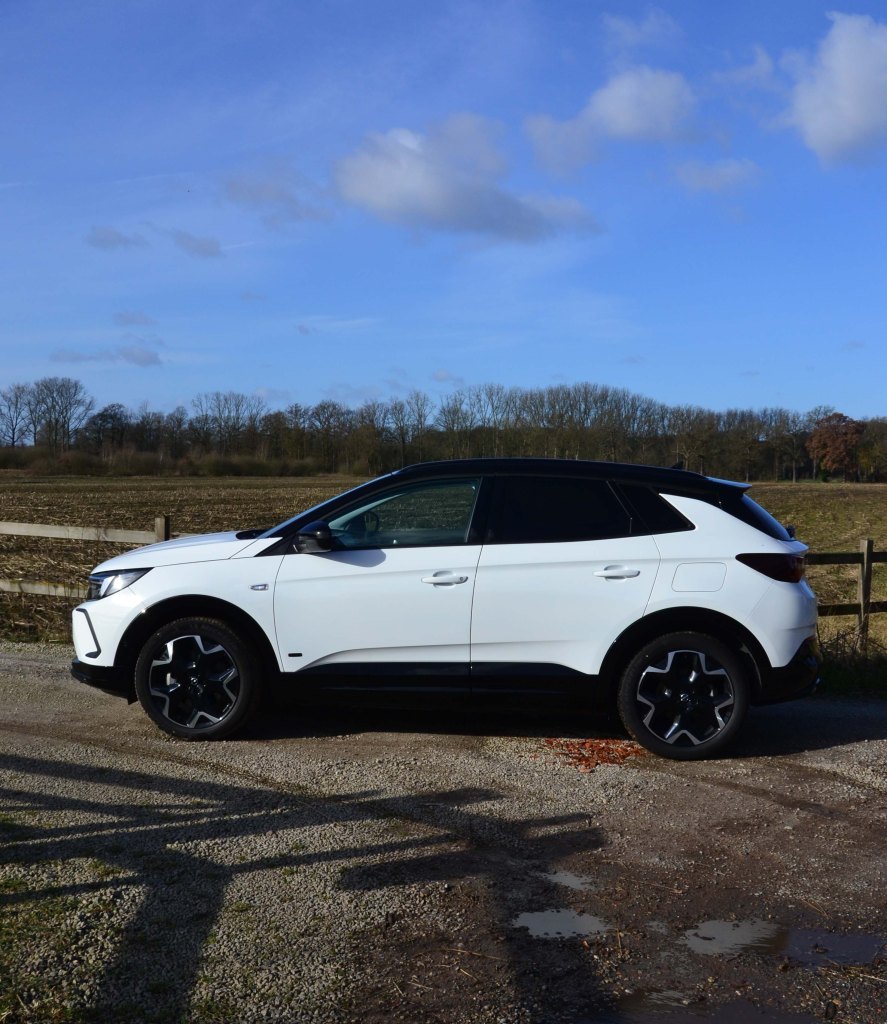
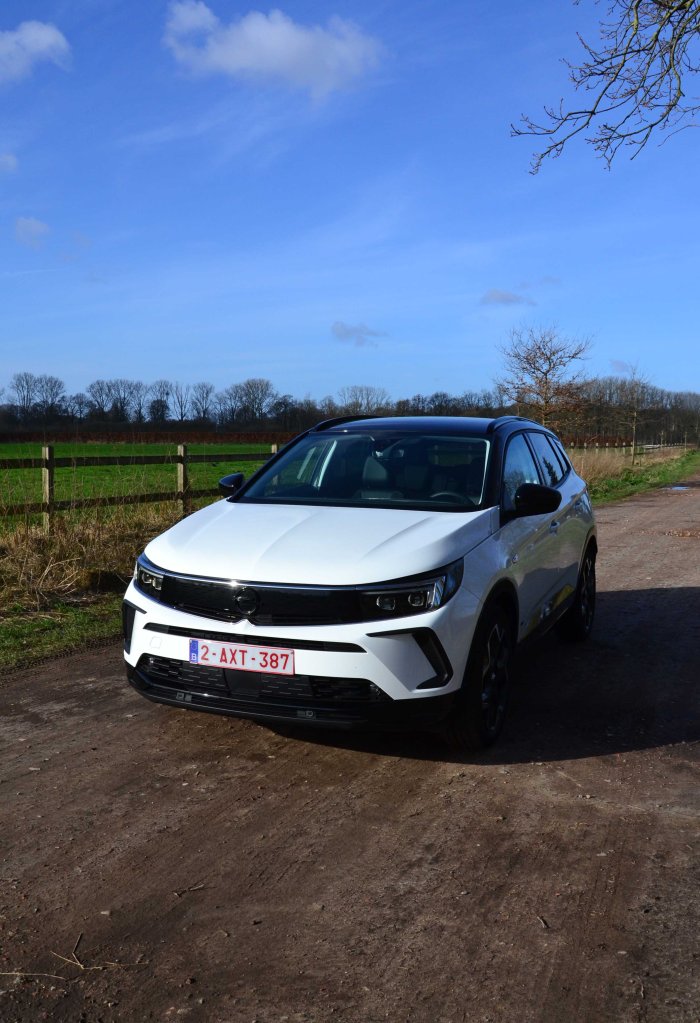
Dual tone paintwork and the glass panorama roof on our test car add panache…
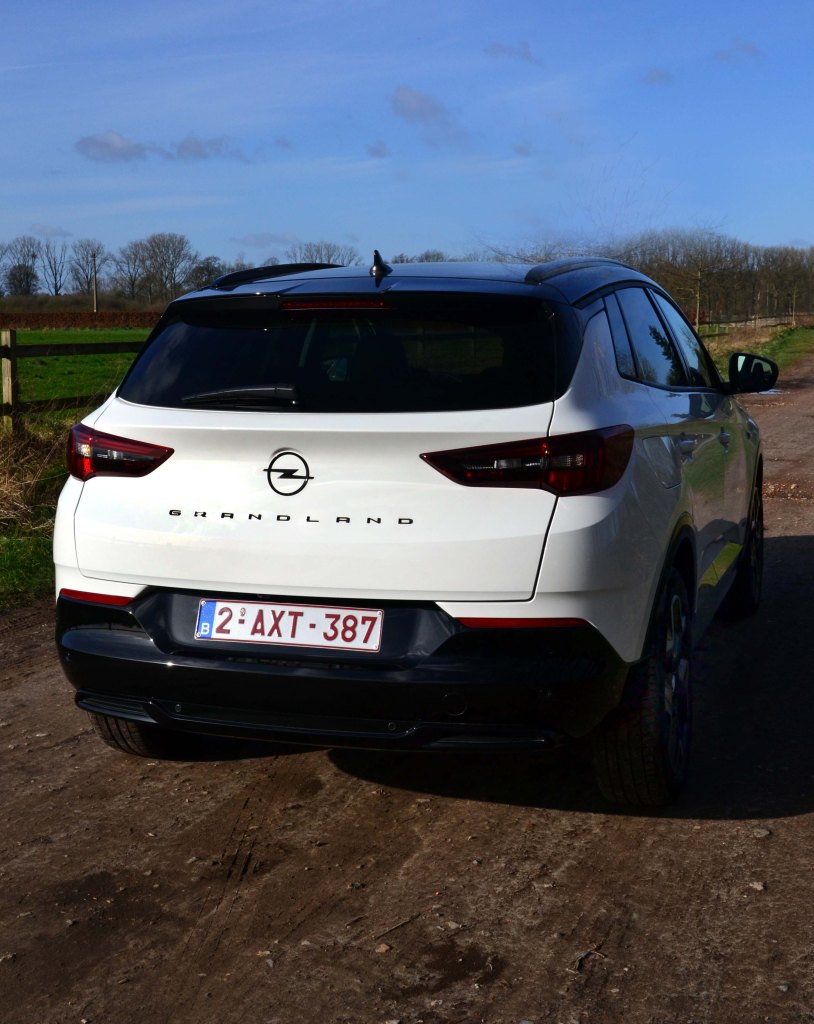
The elegant Grandland rolls of the Opel assembly lines in Eisenach, and certainly pleases from any angle. Your servant liked especially the dual tone paintwork, also a typical hallmark of the Grandland…
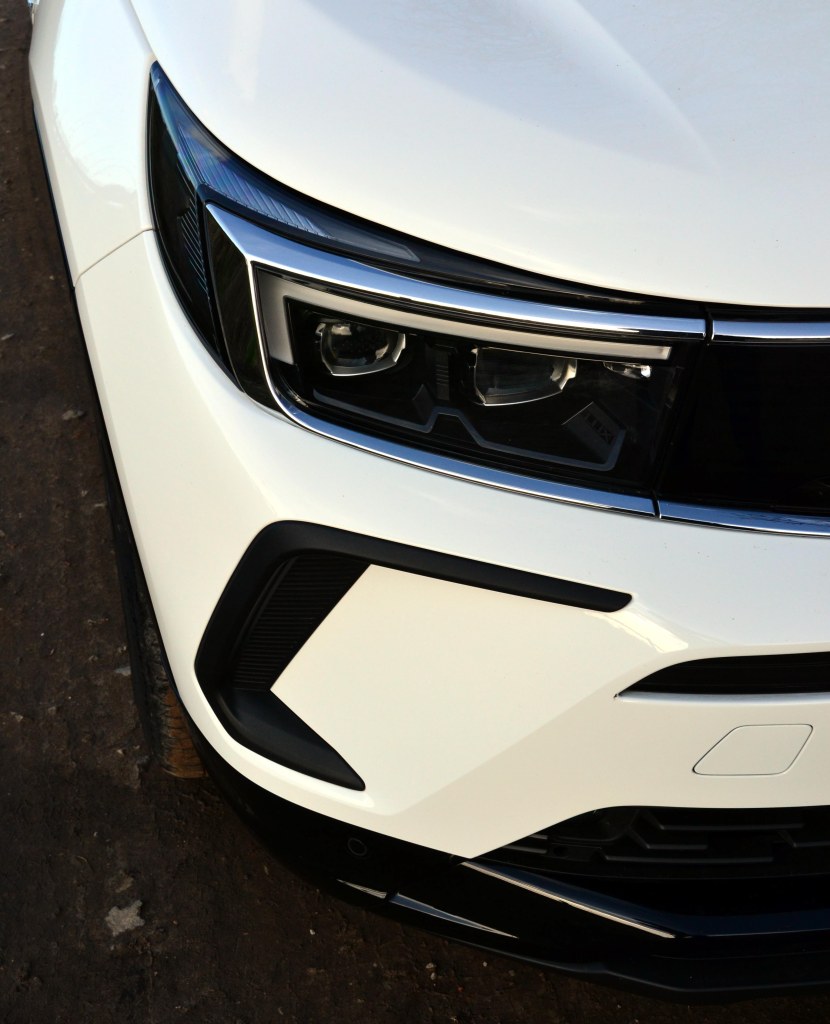
The stylish Vizor front grille houses high-tech, such as the adaptive IntelliLux LED® Pixel Light. The light focus is adapted to every bend and corner, the beam has always the optimum range and cuts out uncoming traffic in seconds. While we are talking about the electronic wizardry in this Opel, let’s continue a bit on this subject.
The Vizor front grille houses the adaptive IntelliLux LED® Pixel Light.
Indeed, this Opel also includes Night Vision. This system is found amongst others also on the DS4. The system’s infrared camera detects people and animals up to 100 metres ahead of the Grandland in the direction of travel, based on their temperature difference from the surroundings. Night Vision warns the driver and shows the position of pedestrians, for example, in the digital Driver Info Center in the new “Pure Panel.” See also how the system works on YouTube, link: https://www.youtube.com/watch?v=djieXHE9iBM&list=RDCMUCSr5PuKiJ5Zi00zfsiT-7jA&index=1
Also new in combination with 8-speed automatic transmission is Highway Integration Assist. The adaptive cruise control will brake to a standstill if necessary. Thanks to “Stop & Go”, the Grandland with Highway Integration Assist will also automatically resume driving from this standstill.
Intuitive and relaxing: The Opel Pure Panel cockpit.
The customizablescreen in front of the driver gives you to the point information…
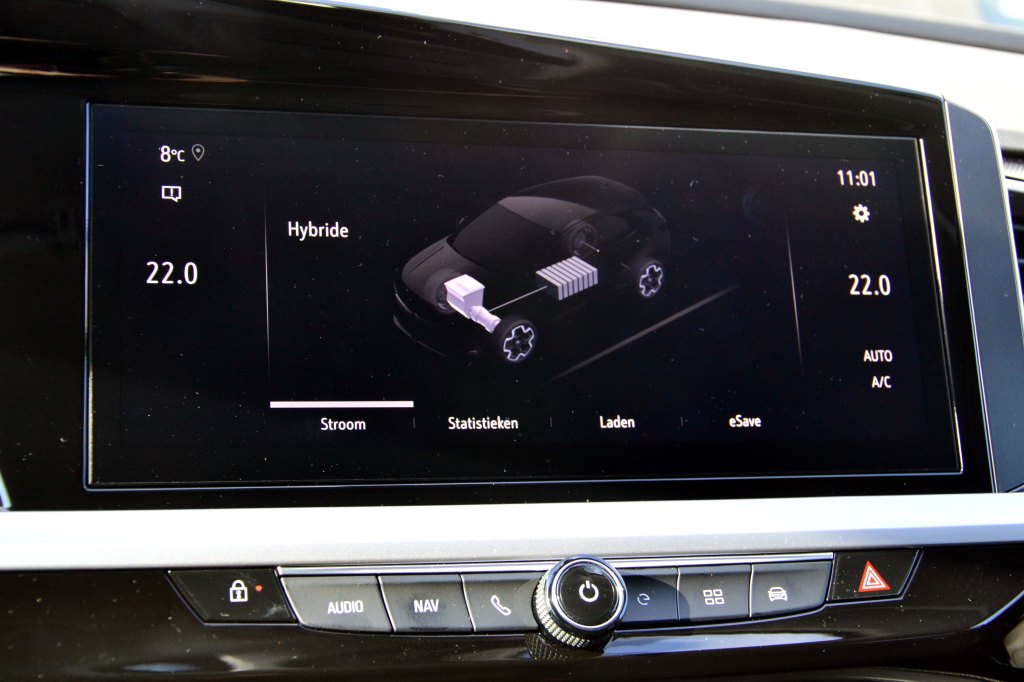
Two wide screens in a single unit form the Opel Pure Panel. There is the so called “Driver info Center”, a 12 inch screen right in front of you, and a 10 inch central touchscreen which is also turned towards the driver. Of course, the two screens can be personalized to your taste. In the driver’s central field of vision, there are now menu entries for the new Night Vision camera as well as for drowsiness warning, oil temperature and on-board computer settings.
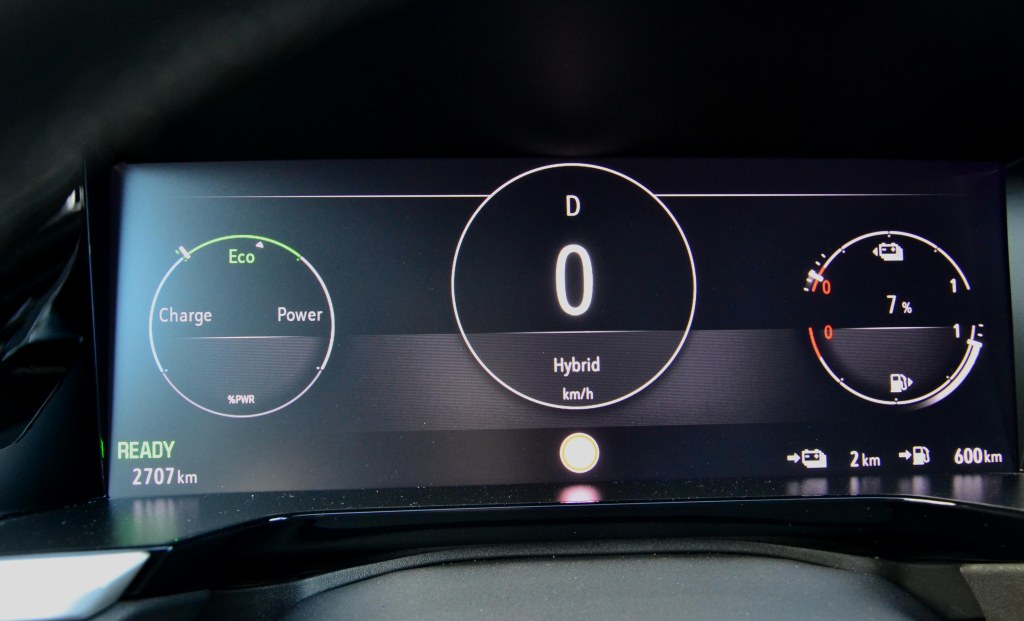
The centre display can show the energy flow, but also the eSave function and charging as well as consumption statistics…
Further details on audio or navigation, which were previously only displayed on the infotainment system monitor, can now also be selected via the Driver Info Center, and on the Hybrid version we tested, the display of the energy flow can also be seen on the display straight ahead of you.
Apple CarPlay and Android Auto compatible multimedia infotainment systems up to Multimedia Navi Pro is of course also available.
We loved the “less is more” approach in the screen layouts, and the intuitive way everything could be used.
Behind the wheel…
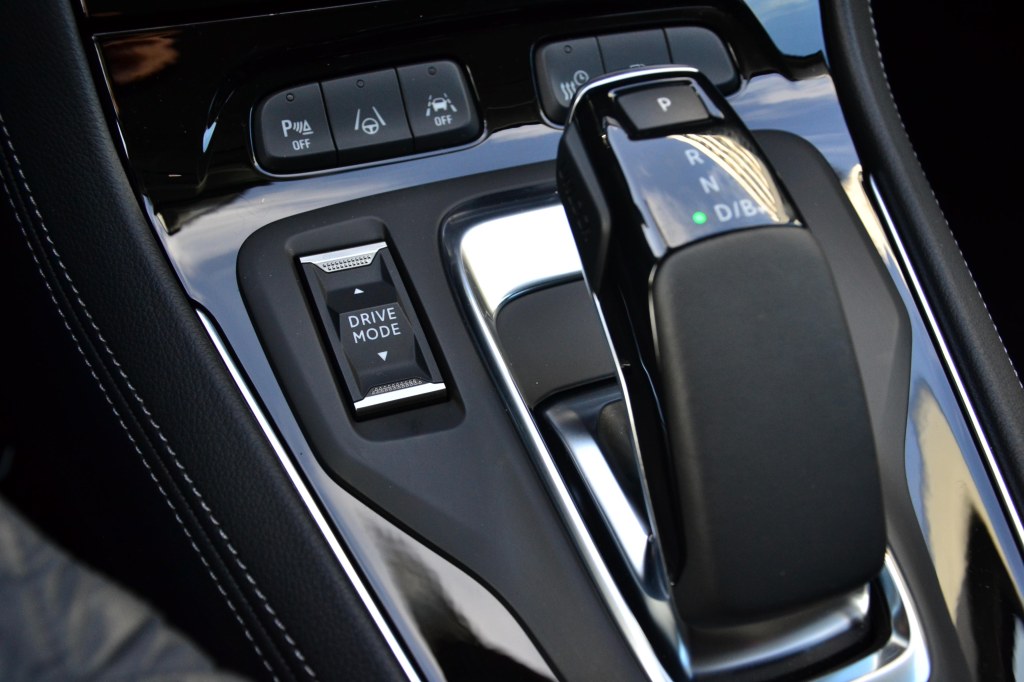
A smooth 8 speed auto box and the choice between three drive modes: “Electric”, “Hybrid”, “Sport”
Stepping into the Grandland SUV is a breeze as it sits a bit higher, and you are welcomed in ergonomic active seats for drivers and front passengers certified by the “Aktion Gesunder Rücken e.V.” (campaign for healthy backs). Indeed, they support you very well, and offer a wide range of adjustments, from electric seat tilt to electro-pneumatic lumbar support. They offer heating and in the leather trim even ventilation.
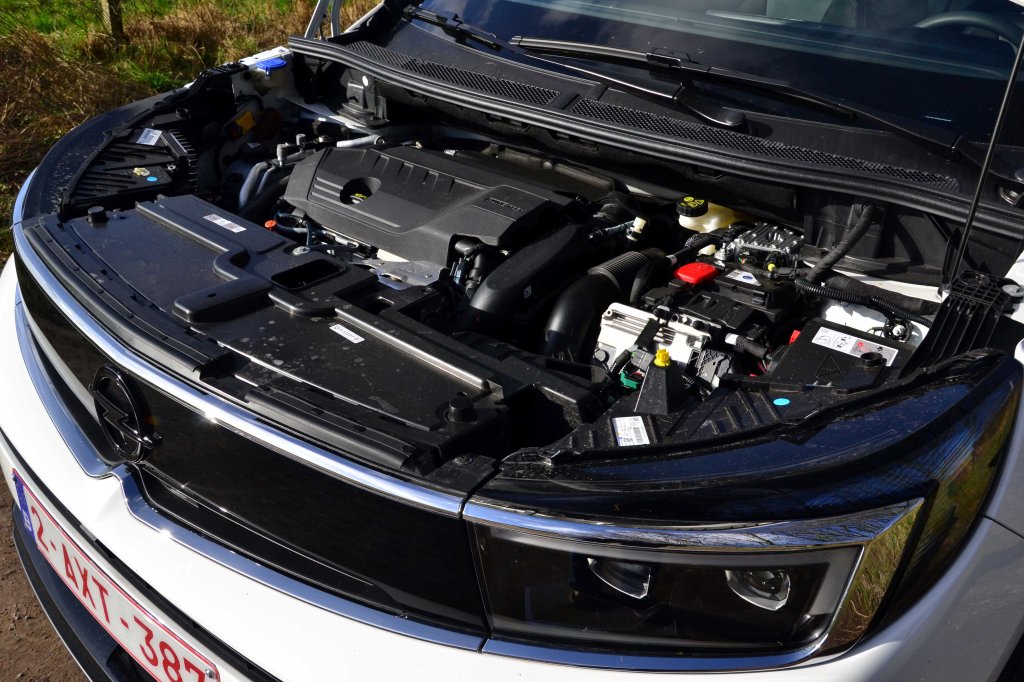
The Hybrid Grandland has, as we said, the same 8 speed auto box we find in the DS E-Tense versions for example, and this is a smooth one indeed. It is mated here to the also familiar four cylinder 1598 cc engine we find back in other Stellantis Group models, delivering here an impressive 133 kW/180 hp at a sporty 6000 rpm.
A total system power of 165 kW…
But of course, the Hybrid is assisted by an electric motor driving the front wheels, developing 81.2 kW/110 hp @ 2500 rpm. Total system power is 165 kW/224 hp, which is even 15 hp more than the 1964 3,4 litre six cylinder Jaguar Mk II which I now own for almost 40 years. You can understand that the performance is nothing short of exhilarating: 0 to 100 km/h is absolved in 8,9 seconds, top speed is 225 km/h, with 135 km/h reached on the electric motor alone.
Overall liveliness is however even more the result from the massive torque the Opel driver has at his or her disposal: the 1,6 litre direct injection turbo engine is already good for 300 Nm at 3000 rpm, but it is of course the electric motor developing 320 Nm over a broad range between 500 and 2500 rpm which makes all the difference. This pulling power is smoothly transferred to the front wheels by the automatic transmission, and this makes this Opel an absolute joy to drive, whether in tight urban traffic or on open winding roads. We rediscovered the Opel DNA, and absolutely loved it. The engine is barealy audible, only a subdued sporty roar is heard when one is pushing (very) hard.
Driving this 1,8 tonne car enthusiastically in “sport” mode costs energy, and therefore the test consumption suffered somewhat. Making rather dynamic (urban) errands cost us some 8 litres/100 km, topped with some extra kW’s in the process, but suffice to say that the consumption of a plug-in Hybrid depends greatly how you use it and recharge it, we said this already so many times. You can of course choose between different driving modes (“Electric”, “Hybrid”, “Sport”), and when you frequently recharge your Grandland, you will hardly consume any fuel at all. If the driver shifts the automatic transmission to drive mode B, this recuperation and the braking torque are further intensified, and there is also an “E-save” function which allows you to save the battery power to use it later when driving/entering in town areas. The function can be set via the colour touchscreen of the infotainment system.
According to WLTP, the fuel consumption is 1.8-1.3 l/100 km, kWh consumption lies between 17.5-15.0. The E-range varies between 64-53 km. CO2 emisisions vary between 41-29 g/km. The Hybrid version has a lithium-ion battery with 13.2 kWh capacity. Charging time at an AC household socket with mode 2 cable is some 7 h 30 min.
The suspension is taut without being uncomfortable, conveying this typical “German car” feel, or, shall we say “Opel” character? It is quite busy on our bad Belgian and Flemish roads, which manage to have much pore potholes, ridges and irregularities than (many) other European countries. The result of the rather firm setup is that this Opel steers precise, and invites you to a dynamic driving style. On motorways the Opel Grandland is masterfully stable, and really feels in its element.
Practical
Opels are made to excel in daily (family) use, and offer the roominess to do it. Boot capacity varies between 390-1528 litres. You can order a sensor-controlled tailgate that can be opened and closed by a movement of the foot under the rear bumper. Here, too, the unlocking settings and opening angle of the power tailgate can be customised via the corresponding menus in the colour touchscreen. Doorbins are large, and also the central console offers good stowaway possibilities.
The Opel Grandland is elegant with a clean, contemporary styling language…
Conclusion
The Grandland PHEV has all the good, iconic Opel qualities. Very practical and simple to use, it is inviting in its responsiveness and agility, giving you genuine driving pleasure every time you take the wheel. The performance is impressive, but altogether smooth and effortless. The Grandland feels taut and stable, the finish and quality of the materials used is impeccable, the car is practical, has this unique no nonsense character, and is on top of all that is very stylish indeed.
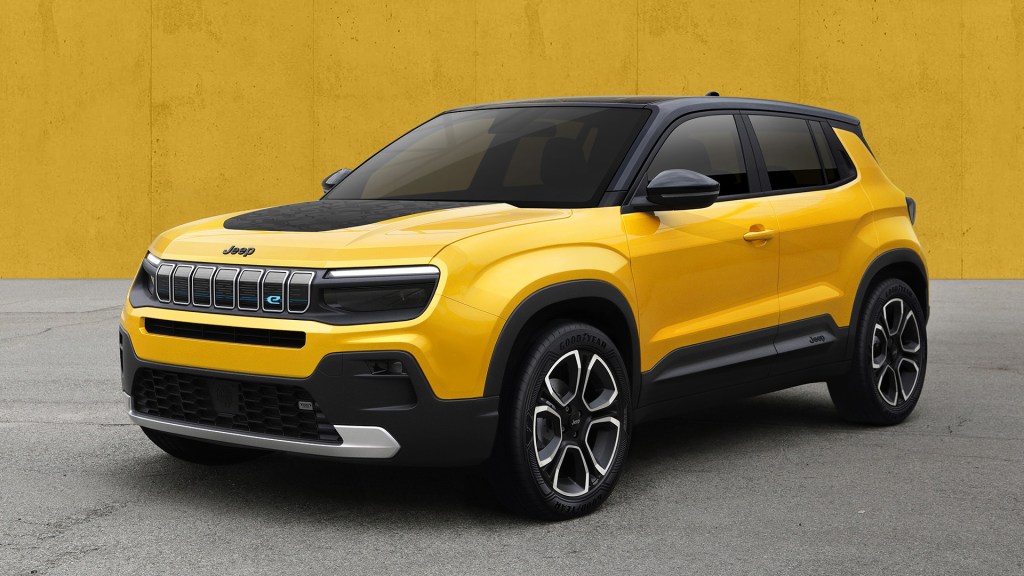
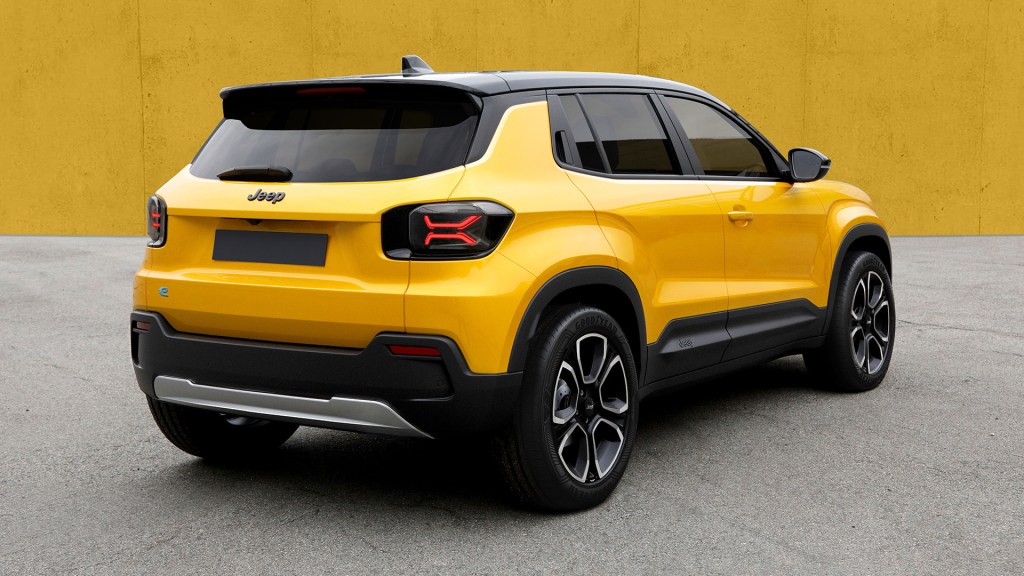
News from Stellantis comes thick and fast: Today, during Stellantis’ Dare Forward 2030 strategic plan presentation, Carlos Tavares, the chief executive officer (CEO) of Stellantis, revealed images of the first-ever 100% battery-electric Jeep SUV, as the brand continues its global initiatives toward the full electrification of its SUV portfolio.
This new fully electric Jeep vehicle will be launched early next year, expanding the brand reach and taking the next step to the achievement of Jeep brand’s vision of Zero Emission Freedom. More information on the Jeep BEV will be released in the coming months.
We will also bring a full report on the Dare Forward 2030 strategic plan presentation soon. Stay tuned!
Arriving late last night from Nice, we report you here immediately about the wonderful driving experience with the most powerful DS9, enjoying its pure GT talents over the winding roads around Grasse and the iconic Côte d’Azur. We will soon tell you more about it.
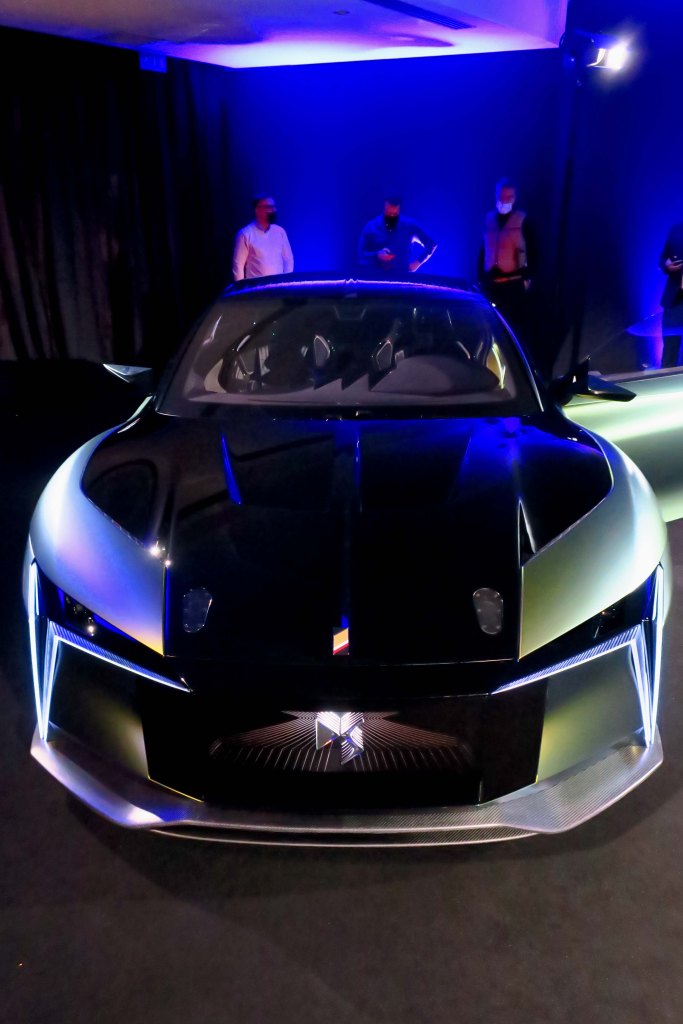
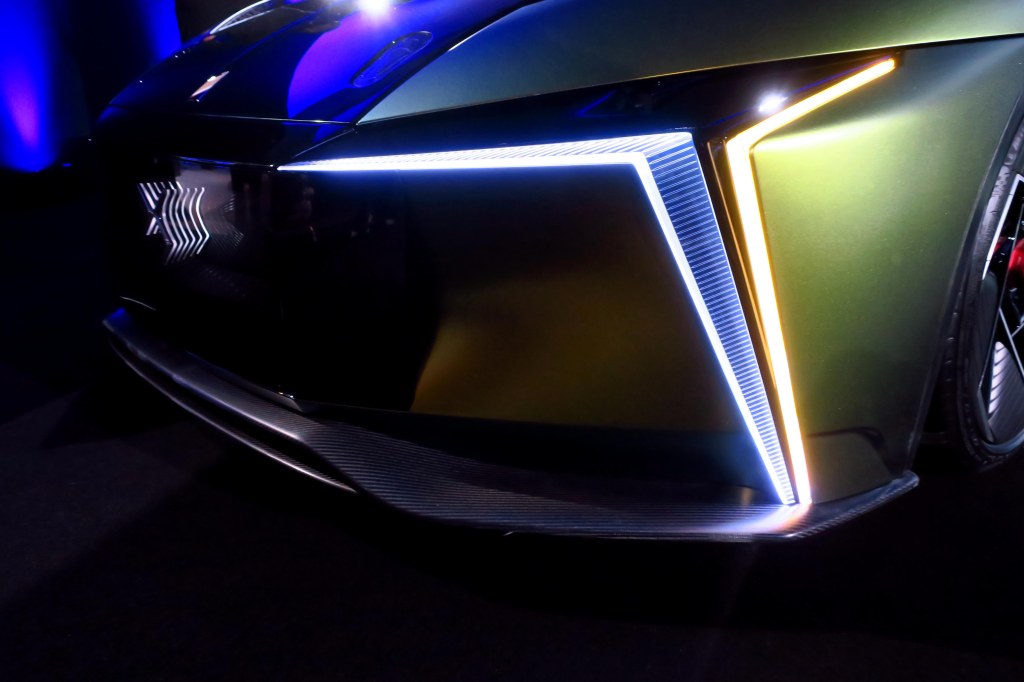
But the gentlemen of DS Automobiles did even more than just letting us have a drive in their flagship DS9, they also unveiled in the flesh at their press conference a wonderful Supercar, with absolutely stunning looks and performance.
DS Automobiles puts their E-Formula racing experience into practice on our roads… What to think of 815 HP or 600 kW, developed by two electric motors of 250 kW in the front, and 350 kW driving the rear wheels.
Acceleration from 0 to 100 km/h is done in a fantastic 2 seconds…and the car is a beauty too!
Much more about this superfast E-“bolide” and the impressive top-level DS9 soon on these pages!
Lexus has released a gallery of new pictures and animations of its possible next-generation BEV Sport, Sedan and SUV concepts. The models were first revealed on December 14, 2021, in the corporate battery electric vehicle (BEV) announcement made by Akio Toyoda, Toyota Motor Corporation President and Lexus Brand Holder. The new Sedan, Sport and SUV concepts are proposed to be part of a full line-up of BEVs Lexus recently unveiled under the collective vision known as “Lexus Electrified.”
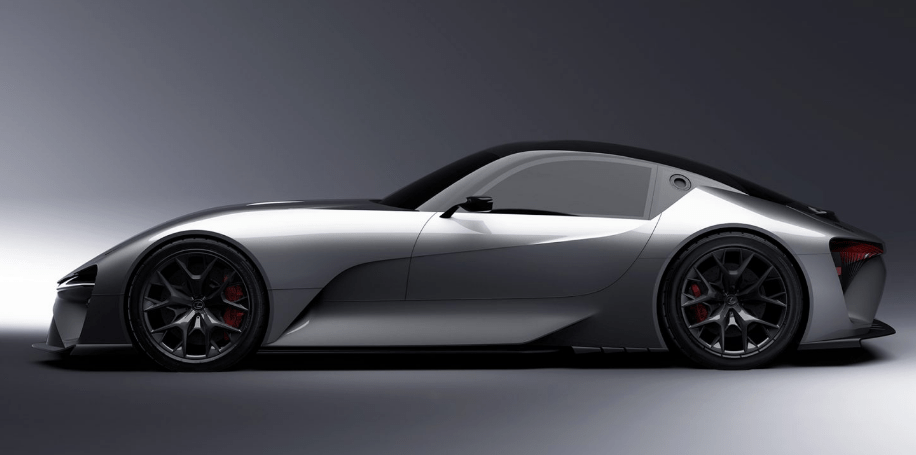
We show you here already some photos of the absolutely stunning all electric sports car…
It has bold proportions and low ride height, and of course all the sophisticated aerodynamics typical for a high-performance sports car.
According to Lexus, the Lexus BEV Sport concept symbolizes the future of the luxury brand, while also reviving the spirit of the iconic Lexus LFA.
The performance is nothing short of sensational. What to think of acceleration from 0-60 mph in the low two-seconds bracket, with at the same time a cruising distance which could exceed 430 miles, thanks to the possible use of solid-state batteries.
More news to come, also on the BEV Sedan an SUV Concept cars, but just admire already the breathtaking shape of this BEV Sport “Bolide”…
When testing the Arkana Hybrid, we already mentioned the clever way Renault sources know how and expertise across boundaries. With the electric age coming upon us, further cooperation is growing to develop and produce ever more efficient drivetrains, using ever less resources. The news came that Renault is now joining forces with Valeo and Siemens… interesting!
Indeed, Renault Group, Valeo and Valeo Siemens eAutomotive have signed on February 10th a memorandum of understanding to form a strategic partnership for the design, co-development and manufacture in France of a new-generation automotive electric motor, eliminating the use of rare earths.
Under this partnership, each of the three partners will contribute to the development and production of the two key parts of the electric motor: the rotor and the stator.
Overall architecture comes from Renault…
Renault will develop and produce the EESM (electrically excited synchronous motor) rotor technology, designed without the use of rare earths, it offers enhanced energy performance.
In addition to the supply of components based on each company’s best expertise, the overall architecture of the all-in-one motor for Renault Group will also be designed by Renault.
Valeo and Valeo Siemens eAutomotive will develop and produce the stator, which is based on Valeo’s technological expertise in copper wire assembly. Thanks to its unique know-how in this field, which allows it to use a higher density of copper in the stator, Valeo is able to generate more power without having to use more electrical energy.
Renault Group, Valeo and Valeo Siemens eAutomotive will be the first to mass produce a 200kW electric motor without using rare earths, starting in 2027. Production of the motor for the automaker’s own needs will be based at Renault Group’s Cléon plant in Normandy, France.
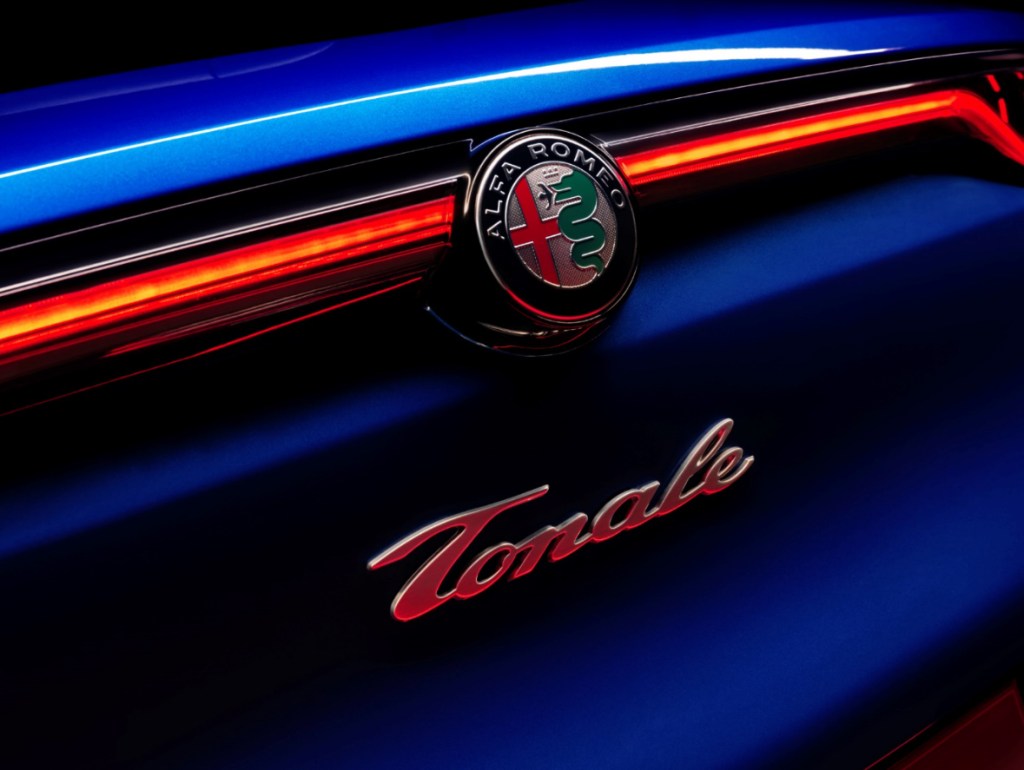
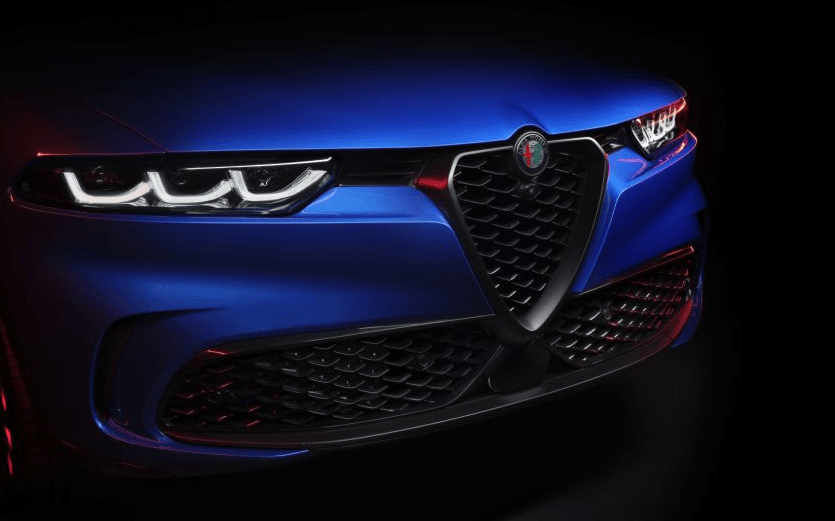
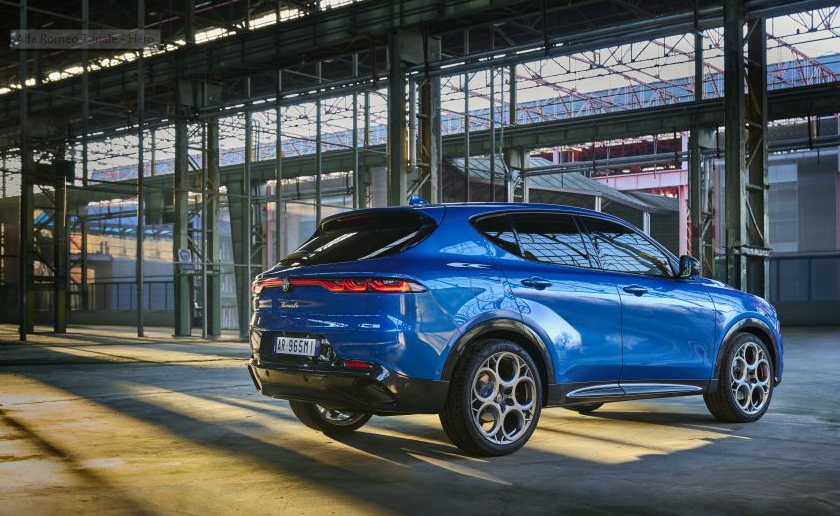
Alfa Romeo presented on February 8th its Tonale, the model that marks the Brand’s metamorphosis. Of course Alfa remains true to its DNA of noble Italian sportsmanship since 1910, but the Tonale a radical evolution is taking place at Alfa Romeo. It enters a new era of connectivity and electrification.
We bring you here in this first report the main points, of course, more will follow when we see the car ‘in the flesh’ at further presentations.
The Tonale breathes unique Italian design, being extraordinarily faithful to the concept model which you see here on the photo above, which we could admire feel and touch at the Centro Stile.
The car embodies state-of-the-art technology, Alfa says, with software and electrification systems enhancing the Brand’s DNA. With the launch of this car, Alfa also deploys a universe of innovative, customer-focused services. See more below…
The Tonale has a clear mission: reinventing sportiness for the 21st century. The name marks the evolutionary continuity with Stelvio, a fascinating new road that leads to a new destination: the future.
The car is made in Italy, at the revamped “Giambattista Vico” plant in Pomigliano d’Arco, according to Alfa one of the most advanced production plants in the automotive world, where a dedicated assembly line has been built with cutting-edge technology and high levels of automation.
The technology in the Tonale is aimed at enhancing the unique Alfa driving experience, but not only that: it also wants to bring the customer experience at another level and sets steps to protecting its residual value.
Indeed, in a a world exclusive, Tonale is the first car on the market equipped with a NFT (non-fungible token) digital certificate. Based on blockchain technology and uniquely linked, the Tonale NFT certifies the car upon purchase, then evolves to represent its use during the car’s life cycle, with major benefits in terms of protecting its residual value. With the customer’s consent, the NFT will record vehicle data, generating a certificate that can be used as a guarantee that the car has been properly maintained, with a positive impact on its residual value. On the pre-owned car market, NFT certification represents an additional source of credibility for owners or dealers to count on. In the meantime, buyers will be reassured in their choice of car.
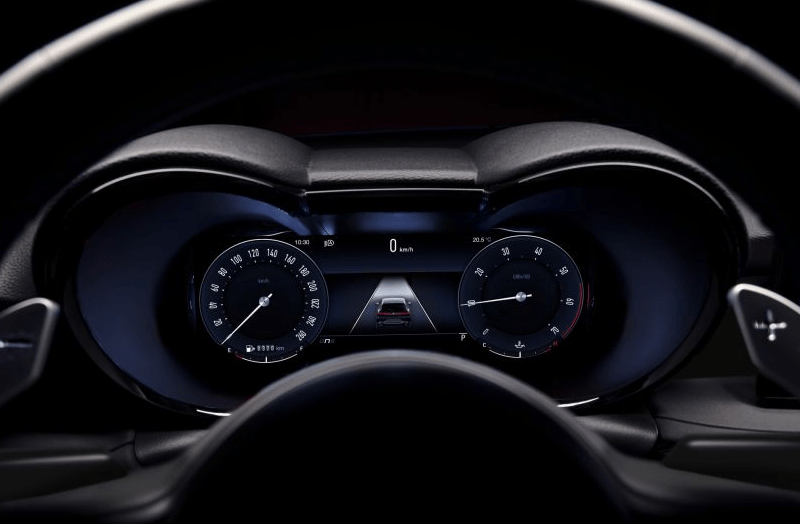
The Tonale also sports an all-new infotainment system. Totaling 22.5”, the two large Full TFT screens are installed.
The world of Amazon in your Alfa…
The infotainment system is designed to offer Over-the-Air updates and integration with Amazon Alexa.
There is a complete integration with Amazon: courtesy of the “Secure Delivery Service”, you can choose the Tonale as the place to deliver the packages you are expecting, by unlocking the doors and letting the courier leave them inside the car, all completely safely.
You can also receive constant updates on vehicle status from the comfort of your home, find out the level of charge and/or fuel, search for points of interest, find your car’s latest location, send remote locking and unlocking commands, and much more. “Alexa” can also be used to ask to add products to your shopping list, to search for a restaurant nearby or to adjust lights or heating connected to your home automation system, all while remaining focused on the road.
The technology is also focusing on safety, with level 2 ADAS systems.
Cabin comfort is of course not neglected. Alfa tells us that the cabin environment is designed for and around the occupants, with meticulous attention to detail, paired with a constant quest for the highest quality.
Two levels of electrification – Hybrid and Plug-in Hybrid Q4, developed by Alfa Romeo.
State-of-the-art electrification: this electrification serves the Brand and its DNA, with the mission of reinventing sportiness for the 21st century, Alfa announces.
The Tonale debuts the 160-hp Hybrid VGT (Variable-Geometry Turbo) engine, an exclusive for Alfa Romeo. Its variable-geometry turbocharger paired with 7-speed Alfa Romeo TCT dual-clutch transmission and the 48-volt 15-kW, 55-Nm “P2” electric motor makes it possible for the 1.5-liter gasoline engine to propel the wheels even when the internal combustion engine is turned off.
Alfa Romeo has opted for this technical solution to offer an authentic electrified experience. The transmission enables startup and travel in electric mode at low speeds and when parking and cruising. At launch, the 130-hp Hybrid version is also available, again paired with 7-speed Alfa Romeo TCT and 48-volt “P2” electric motor.
The 275-hp Plug-in Hybrid Q4 version with all-wheel drive is has an expected range in electric mode of up to 80 km in the city cycle. It is the most powerful and efficient version in the line-up.
To complete the engine range, there is also a new 1.6-liter, 130-hp diesel engine with 320 Nm of torque, paired with 6-speed Alfa Romeo TCT dual-clutch automatic transmission and front-wheel drive.
Customers at the center of the Alfa Romeo universe…
With Tonale, Alfa Romeo launches a series of new services, which redefine the customer experience and will cover the brand’s entire line-up.
A digital experience: the customer purchase experience can take place online from the comfort of home, in three simple steps, by accessing an interface identical to the one used in dealerships.
Extended warranty: Efforts to improve the quality of the end product have resulted in the availability of an innovative Alfa Romeo extended warranty, lengthening the protection of the vehicle’s main components to 5 years. The warranty for the batteries in the hybrid Tonale versions has also been extended to 8 years or 150,000 km traveled, becoming the best offer in the segment.
Alfa Romeo Certified is the dedicated to customers in the pre-owned car market. The aim is to ensure a shopping experience that is identical to that of buying a new vehicle. The main features of the service are as follows:
Warranty coverage equivalent to that of a new car.
“Satisfaction or your money back”, within 10 days or 1,000 km
No maintenance costs, for 15,000 km or 1 year
120 vehicle checks
Customized after-sales and financing services
Test drive
24/7 roadside assistance in Europe during the warranty period
Finally, Alfa Romeo Videocheck is the service dedicated to after-sales, created in consideration of the special relationship its customers have with their car. One sole aim: service quality and transparency for customers. When at a workshop, if a car is found to need more work than agreed with the customer, the technicians will be required to follow a procedure via mobile app to certify the work, with a video to accompany the related repair costs. The customer will then be free to partially or fully accept or reject the new quote.
Driving dynamics…
Rather impeccable, according to Alfa. It has the best weight distribution and the most direct steering in its segment (13.6), and the fact it is the only model in its class to be equipped with the Integrated Brake System (IBS). The adoption of fixed calipers by Brembo, with 4 pistons and self-ventilated discs at the front and full discs at the rear, contributes to the improved braking performance.
The Tonale opts for the fully independent MacPherson suspension system, with Frequency Selective Damping (FSD) shock absorbers. The new Tonale offers two drive solutions: Q4 all-wheel drive in the Plug-in Hybrid e-Q4 version, and front-wheel drive in the Hybrid and diesel versions. The latter are also equipped with Alfa Romeo electronic self-locking differential. The specifications are completed with a “Dual Stage Valve” active suspension with electronically controlled damping.
New line-up strategy
The Alfa Romeo Tonale introduces a new line-up strategy.
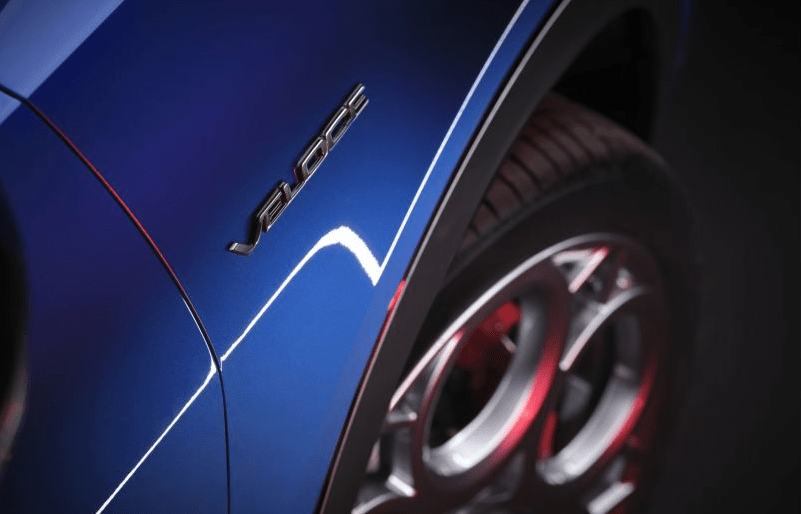
Two trim levels are available – Super and Ti, both with clearly defined specifications. The Super trim can be customized with the Sprint pack, which includes numerous options with a strong sporty connotation. Alternatively, the Ti trim can be added to with the Veloce pack, to reach the peak in terms of performance and sportiness.
Renault is a brand which moves boundaries now and then. It brought a new definition of a roomy and timeless city car with the Twingo, built the legendary 4L and the “Cinq”, its Espace brought nothing less than a revolution in car concepts and design: the “space” car was born.
Then we don’t forget the Avantime. A car which was truly totally ahead of its time. We drove it at its introduction in the streets of modern, united Berlin. When you saw it on the road, you would expect a V6 formula 1 turbo engine under the hood, running on hydrogen of course, with a sweet voice softly telling you what the history is of the street and buildings you driving through, in the language of your choice. That car made us dream. Its stylish panache and the promise it embodied still has to be equalled.
Then Renault embarked on the E-path, opening it up to the masses with the ZOE and recently also putting a very clever full hybrid on the road, culminating in the E-Tech family of cars. Affordable with a touch of genius. And then we don’t forget Dacia…
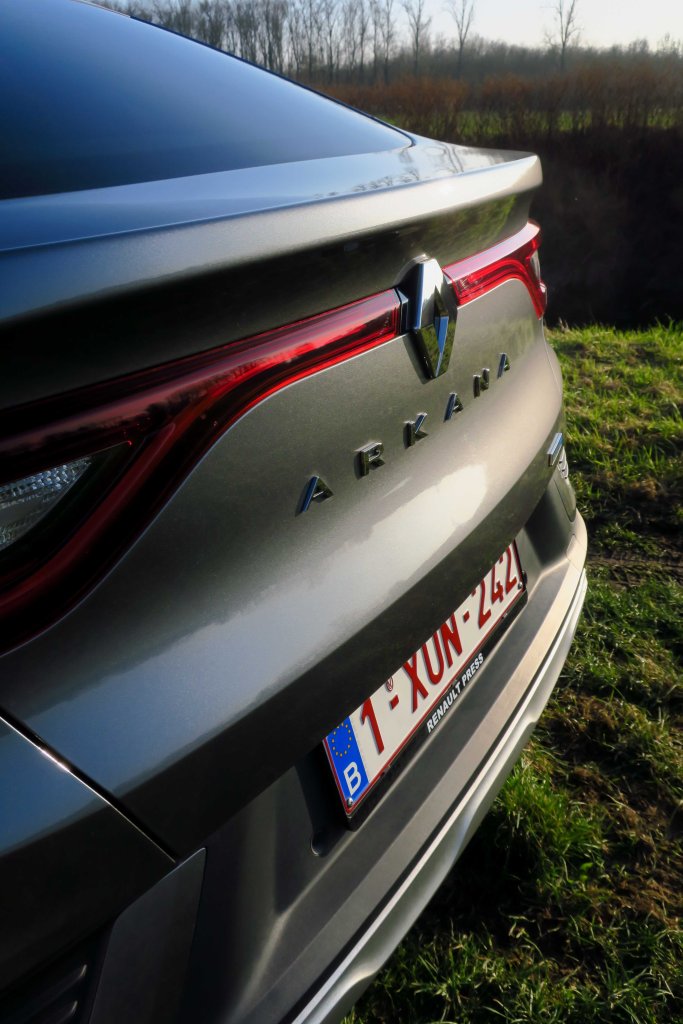
Now its talented designer Laurens van den Acker took a long hard look at the BMW 4X and brings the stylish silhouette of the iconic fastback SUV to the wider public. The Arkana, a name derived from the Latin Arcanum, meaning secret, first made its entry in the Russian market, based on the Dacia Duster B0 platform. This allows the Russian built Arkana to offer 4WD, a must for the Russian market.
But this is not the E-Tech Arkana we meet on our shores. Renault needed here a platform which allowed electrification. Just read further!
Hans Knol ten Bensel
So “our” Arkana started life in South Korea in January 2020 as the… Renault Samsung XM3, and we find this again a fascinating story in itself, showing how cleverly big groups are combining talents and allocating resources found in their world wide organisations. Showing that they are truly unifying the world, having learned to work, cooperate and thrive across boundaries.
So Renault Samsung Motors is a reality, and they build the Arkana for us in their South Korean factory in Busan.
Renault is maybe also teaching politicians a lesson nowadays: the “Russian” Arkana is built both in Moscow by Renault Russia as well as in… Ukraine, in Zaporizhzhia, in South eastern Ukraine, at ZAZ, the most important (former) Russian Automobile Manufacturer.
The European Arkana runs on the more modern CMF-B platform, which we find also for the Clio V and the Captur II.
Stylish
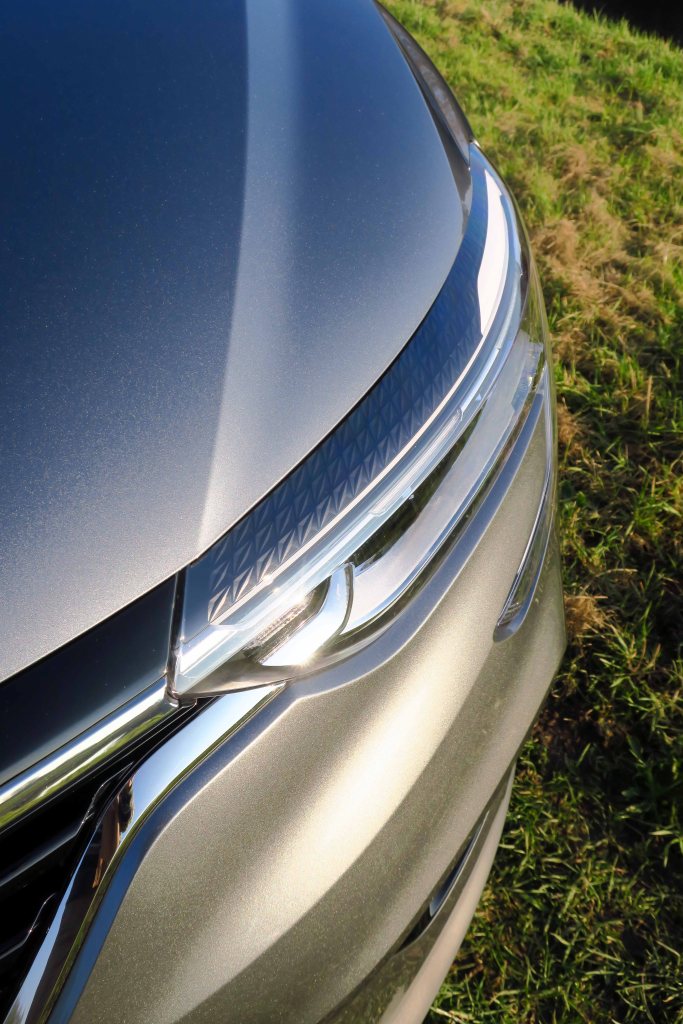
Approaching the Arkana and walking around it, one is pleased by its excellent proportions and shape, from any angle. We liked also that it stands boldly on its wheels, with a ground clearance of not less than 20 centimeters. This allows you to negotiate sleeping policemen’s with ease of mind, as their dimensions always differ greatly from borough to borough, if not from street to street. The fact that this is not unified on a European scale, let alone not even on a national scale is utterly ridiculous. But the Arkana copes with all that, marvelous!
We found also the level of finish and paint quality of the bodywork top notch. The same can be said of the fit, look and feel of the panels in dashboard and cabin.
The layout is similar to what we find in the ZOE and Clio. The seating position is excellent, everything is logically within reach. Also the infotainment system with the large screen on the centre console is a breeze to use, and quite intuitive. Of course instrumentation is digital, and you can have also the road indications right in line with your eyesight if you prefer this.
The Arkana E-Tech is frugal: on the open road merely 4,7 l/100 km…
The learning curve to get acquainted with infotainment in this car is wonderfully short, and it is also very practical and wise to let the heating/airco ventilation system be controlled through three big round manual knobs.
A fully fledged hybrid…
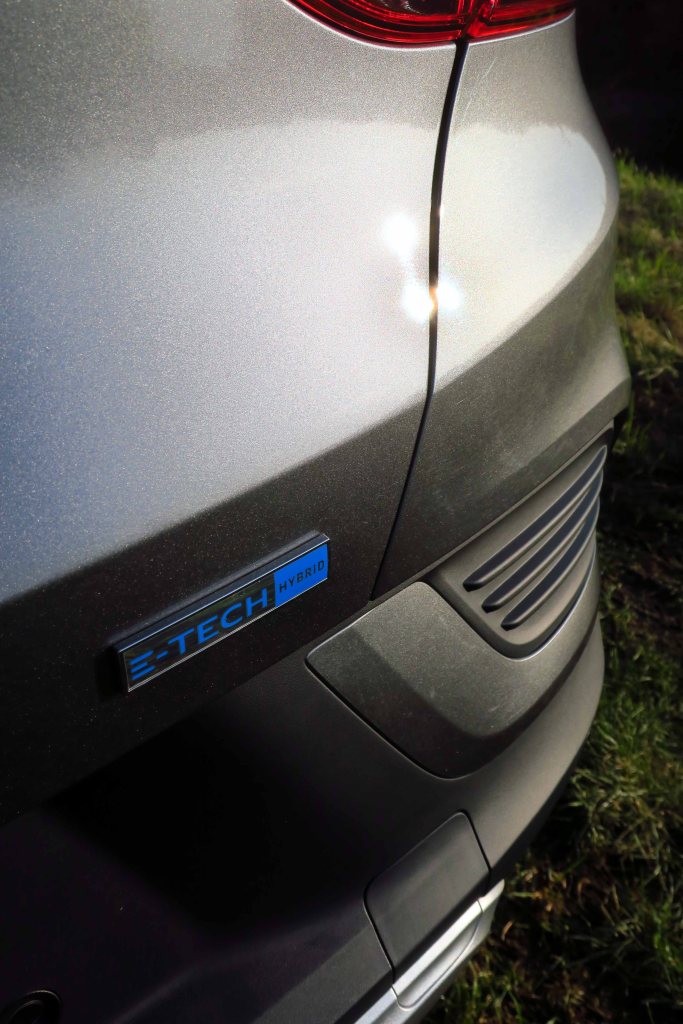
The Renault Arkana uses the Renault “E-Tech” hybrid solution, consisting of a petrol engine delivering 94 HP, a starter generator which delivers 20 HP or15 kW, and last but not least an electric motor incorporated in the transmission, which is good for another 49 HP or 36 kW.
The gearbox has four speeds in store for the combustion engine, and reserves two speeds for the electric motors. These are no synchro rings or clutches, the electric motor within the gearbox synchronises everything. This uniquely clever system is derived from Formula 1 technology, Renault says.
It works wonderfully. Driving away is always on E-power for the first meters at least, the electric motor in the gearbox with its close to 50 HP has more than sufficient zest for its task. If the small 1,2 kW battery runs out of power, the engine sets in smoothly, helps to power the car further forward, and also charges the battery. Total system power is 143 HP.
Depending on the chosen driving mode, the system will also keep the battery more or less constantly charged, and so it happens more than often that when having accelerated on E-power to say a cruising speed of 70 km/h, the petrol suddenly engine starts up and gets eagerly to work recharging the battery. It does this at relatively high revs, and the recharging time is therefore rather short.
The higher revs seem to be a bit out of place, but soon one gets used to it, even more so because everything happens smoothly as the revs between gearbox and engine are exactly matched and you understand why this is happening.
We noticed that in city driving the Arkana runs often on E-power, and indeed, the consumption during our test hovered around the 5 litres/100 km. Performance is more than adequate for everyday driving, with a 0 to 100 sprint in 10,8 seconds and a top speed of 178 km/h.
Comfortable and well balanced
The suspension of the Arkana has a rather firm undertone, but is very well balanced and comfortable, and will never show any hint of harshness. On winding roads, the car stays flat with very little body roll despite its 20 cm ground clearance. Steering is responsive and pleasant. Indeed, the Arkana is an excellent Gran Turismo with also very good urban qualities, and a pleasure to steer and drive.
There is sufficient head- and legroom for the rear passengers, and the E-Tech configuration only costs some 33 liters of luggage space, which remains at 480 to 1263 liters, more than adequate we would say. Living with the Arkana is truly nice…
Conclusion
A stylish, frugal, future oriented Renault, roomy, well finished, easy to use and pleasant to drive in everyday life. It offers good interior space despite its elegant coupé silhouette. Indeed, Renault sets again new standards in offering to many car buyers the panache and zest of a modern four dour coupé combined with some distinct SUV touches. And it can be had as a hybrid, which is a strong selling point for today’s environmentally conscious buyers…

























 Autoprova - for the Connaisseur