Volkswagen Group of America will provide a glimpse of the ID.7…

At the CES (Consumer Electronics Show) in Las Vegas between 5 and 8 January 2023, Volkswagen Group of America will showcase its first fully electric sedan based on the modular electric drive matrix (MEB). It will still be seen in a “smart” camouflage, which uses unique technology and multi-layered paintwork to create light effects on parts of the vehicle.

The ID. AERO3 concept vehicle initially presented in China already provided a preview of the new model, which embodies an aerodynamic design concept and is able to achieve ranges of up to 700 kilometers (WLTP).

After a six-year break, Volkswagen Group of America is returning to the CES – the world’s largest trade show for electronics – with a very special product…

With the new ID.7, VW is extending its electric model range into the upper segments. The ID.7 is one of ten new electric models that VW is planning to launch by 2026.

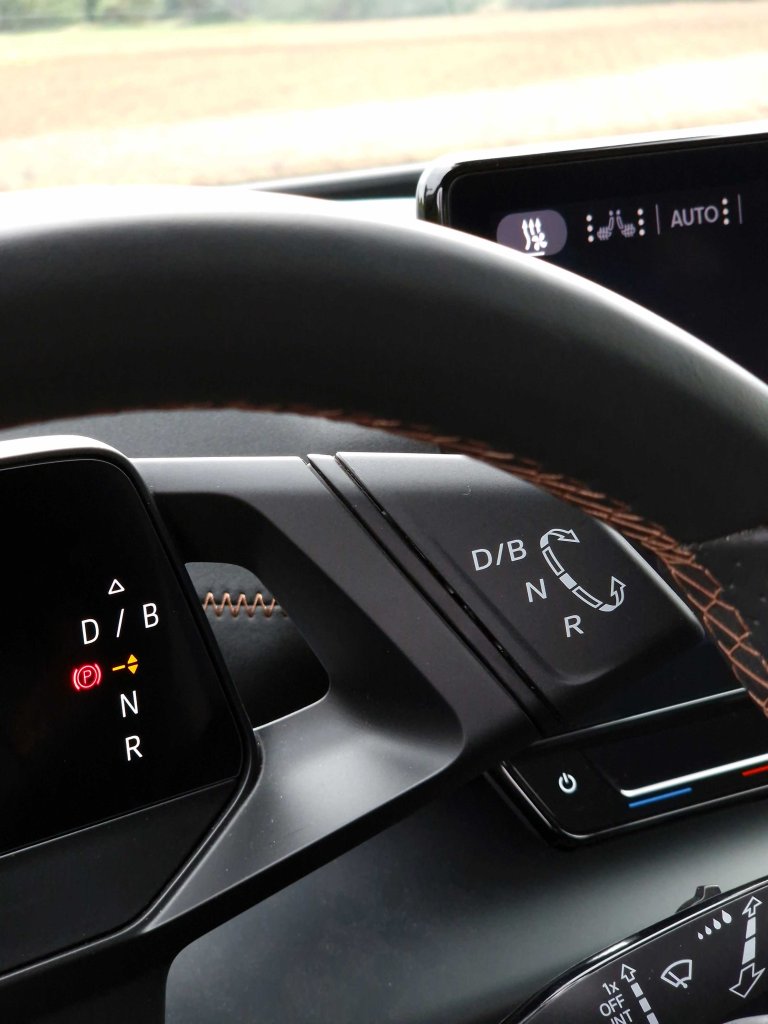
VW seems to have learned some lessons when it comes to the functionality of the various infotainment and dashboard commands. It ofeers a new display concept, an augmented reality head-up display, a 38-centimeter (15-inch) screen and new air conditioning controls integrated into the first level of the infotainment system. Now we also have illuminated touch sliders…

Like all other models in the ID. family, the ID.7 is based on the MEB of the Volkswagen Group. The advantages of the modular matrix with short overhangs and long wheelbase (2.97 meters) provide a large interior.

With its ID.7 sedan, Volkswagen is expanding its successful fully electric ID. family into the upper middle class of the high-volume segment and advancing its electric mobility campaign with the ACCELERATE strategy. VW has already reached a first milestone: Since the first ID.3 models were handed over to customers in September 2020, Volkswagen has delivered 500,000 vehicles from its ID. family worldwide through its subsidiaries – around one year earlier than planned and despite the ongoing difficulties in the supply chain.

After the ID.3, ID.4, ID.5 and ID.6 (only in China) models and the new ID. Buzz7, the ID.7 will be the sixth model from the ID. family and is Volkswagen’s second global car to be based on the MEB after the ID.4. It is planned to launch the electric sedan in the three primary markets of China, Europe and North America. The ID.7 for the European market will be produced at the Volkswagen Emden plant. After the ID.4, it will be the second model based on the modular electric drive matrix to be built in Emden.

More news soon!

Hans Knol ten Bensel

We drove the Kia Niro Hybrid: your smooth and stylish companion…

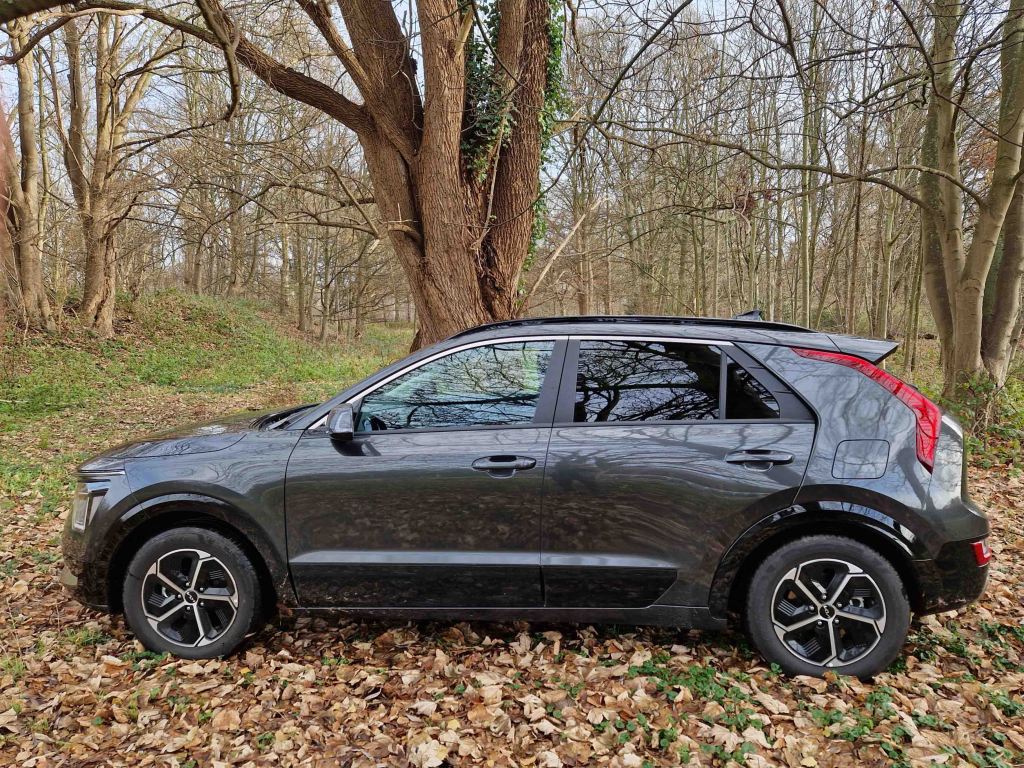
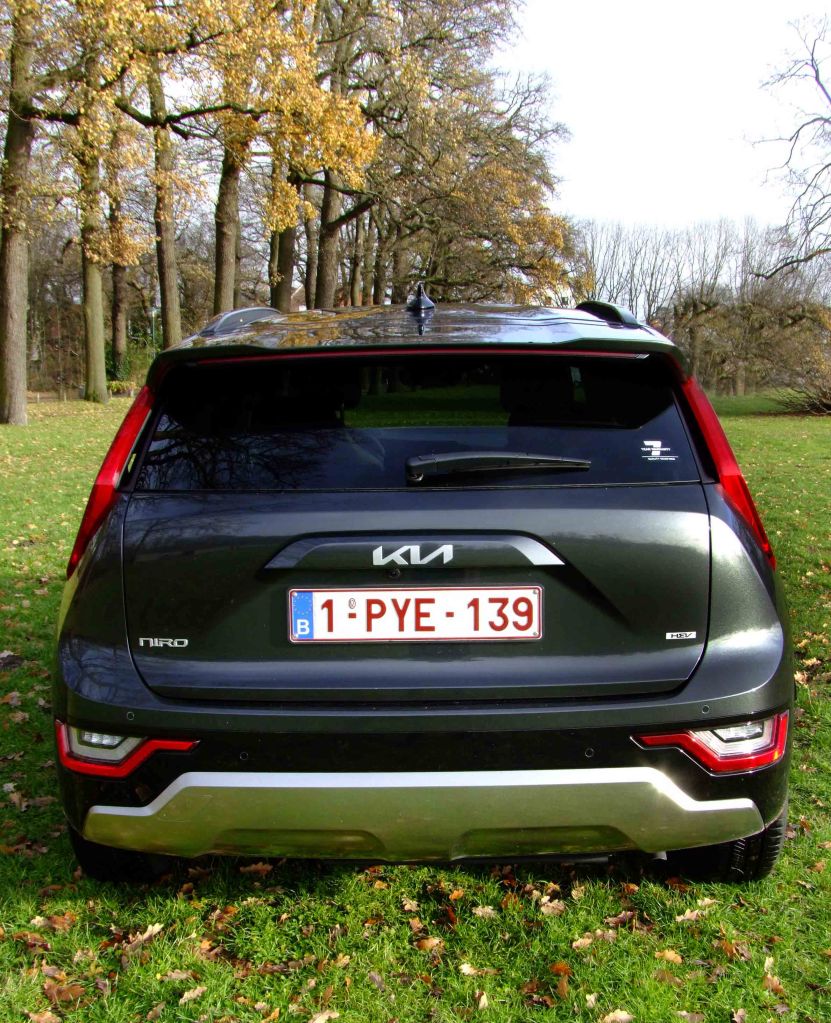
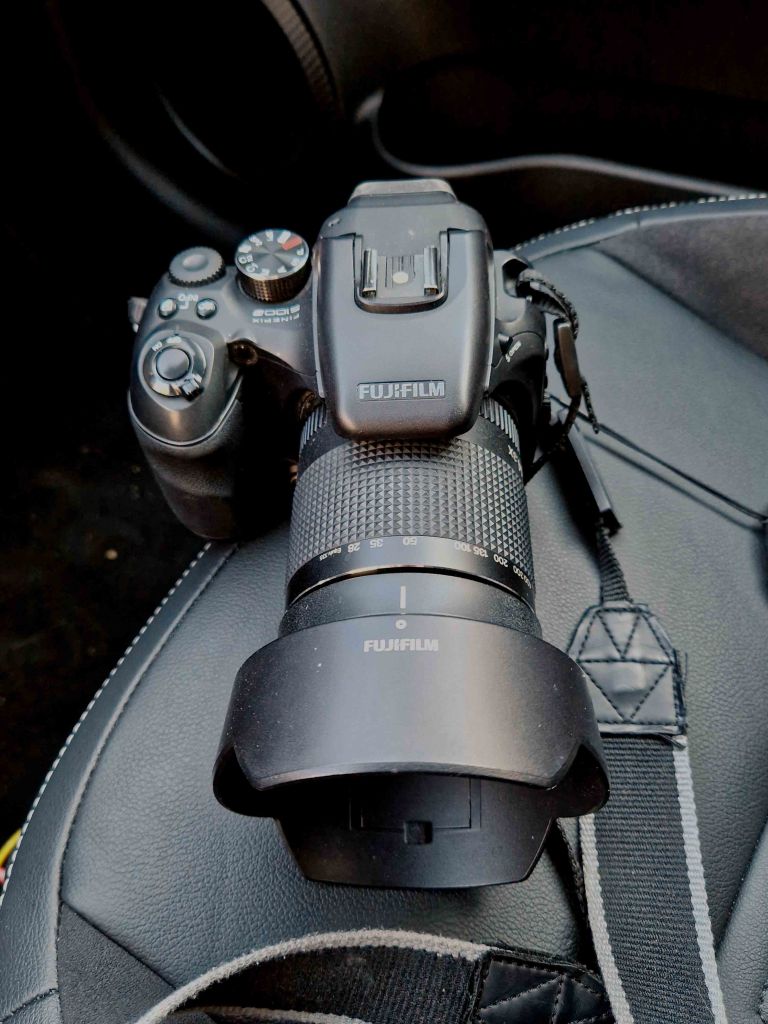
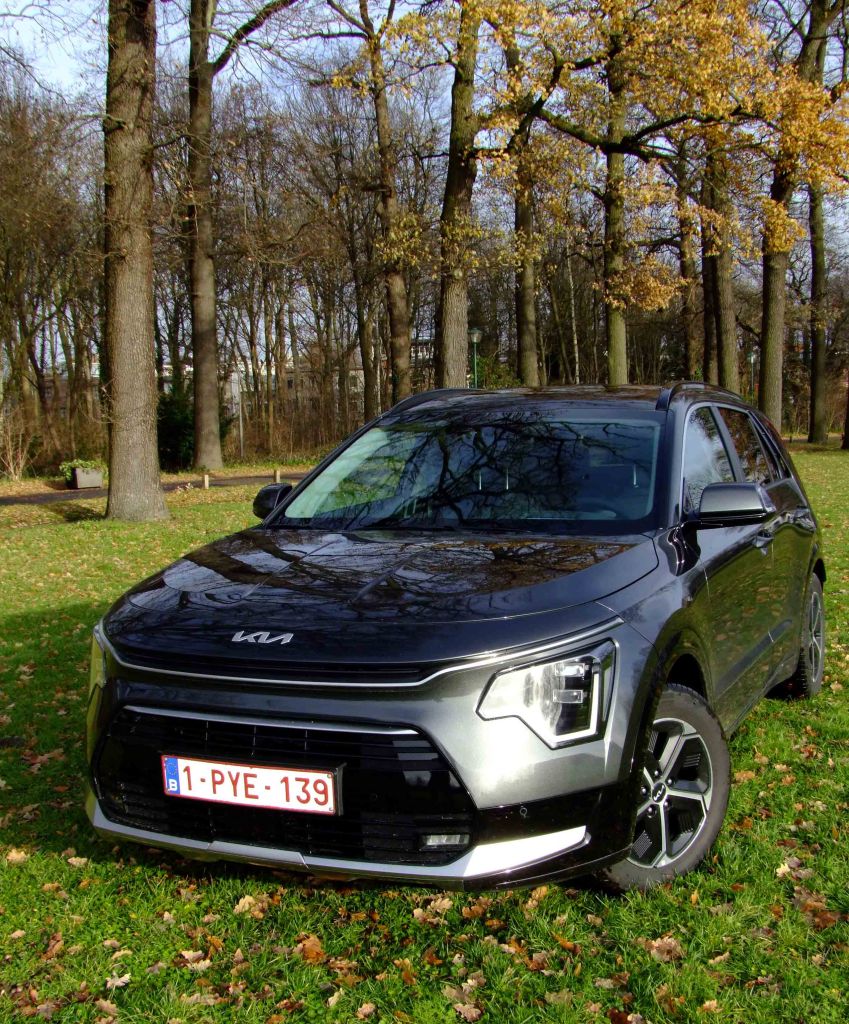
The second generation Kia Niro is succesfully restyled… Photo was taken here with the “vintage” Fujifilm Finepix 100fs: bought recently for merely 59 Euros…

With the second generation, the Kia Niro has decidedly come of age. It is altogether more stylish, and comes with all possible electrified drivetrain options: you can have it as a straightforward hybrid, like the Niro we tested here for you, or as a PHEV, and of course as a fully fledged EV. We impressed by the smoothness, space, comfort and user friendliness of this “pure” hybrid, which can be very frugal too… just read further.

Hans Knol ten Bensel

Indeed, the Niro has gained in style. The C Pillar ends with nicely sculpted rear lights, curved like we see on Volvo’s, with a passage between the bodywork and the lamp cluster, to improve air flow along the side of the car.

Photo taken again with the “vintage” Fujifilm Finepix… showing excellent colour balance.

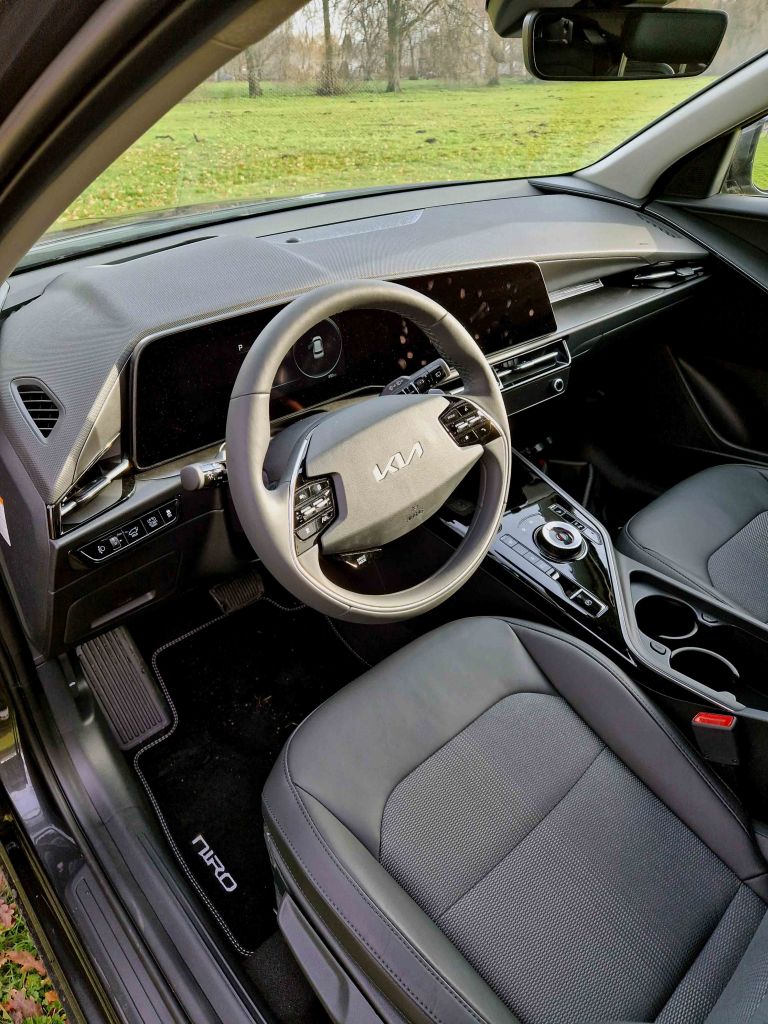
The C-pillar can also be had in contrasting colours. Also the front end has improved in stance and presence with a wide aluminium coloured rim around the hood and its big lights. The same goes for the interior. A sweeping design, good quality materials give you that premium feeling.

Photo here taken with the latest “flagship” Samsung S22 smartphone … wih heavy correction of colour balance and exposure.

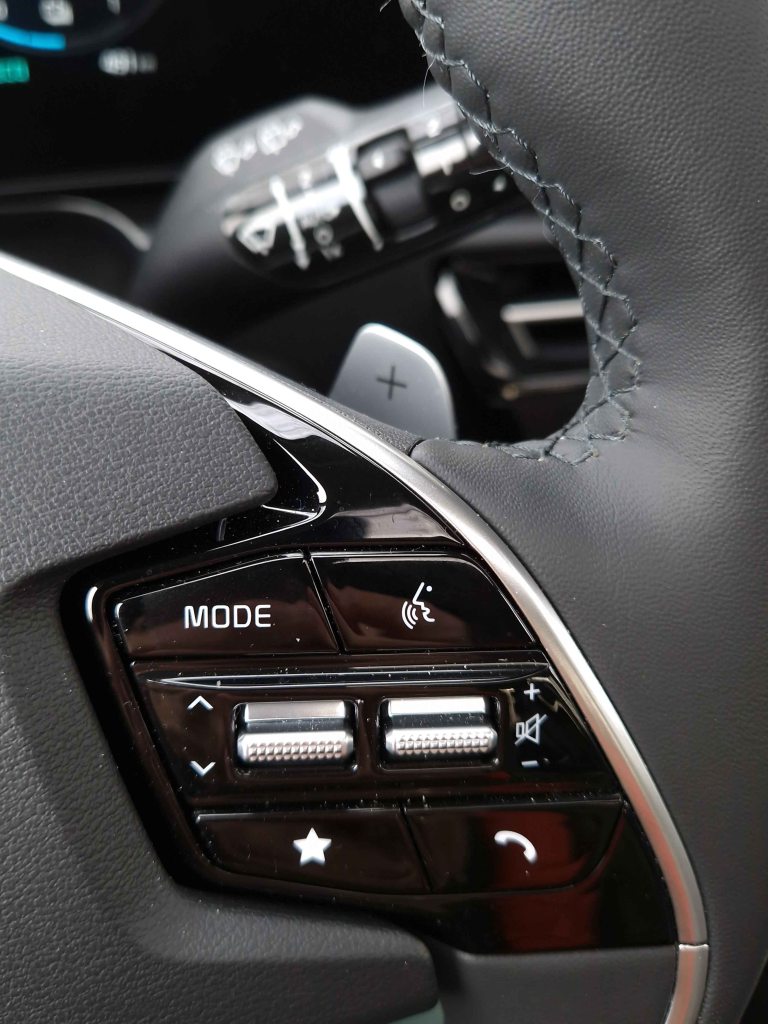
The screen layout is very good, nice to toggle between climate and screen controls to get you swiftly to the commands you want. We like the round control knob to switch between D, N and R, with the P button right on top of it, it’s all very ergonomic and you wouldn’t want it to be otherwise once you are at behind the wheel of this Kia. Many ergonomic solutions and knobs are similar to the flagship EV6, and that’s only to be applauded.

Photo here taken with the latest “flagship” Samsung S22 smartphone

The seats are good, with even a relax mode in the front seats depending on the equipment version you choose. There is plenty of storage, and leg and headroom is also quite decent in the rear. The floor in the rear is completely flat, so even three adults can reasonably sit in comfort. Boot space is excellent with a good 450 liters, and there is a separate tray for sundry like spare wheel equipment etc.

Drivetrain: smoothness and efficiency first…

Photo here taken with the latest “flagship” Samsung S22 smartphone

The hybrid Niro has a 1,6 litre Turbo under the hood, Kia calls it its Smartstream 1.6-litre GDI (Gasoline Direct Injection) gasoline engine. It is a 16 valve four cylinder, with a compression ratio of not less than 1:14, with Continuously Variable Intake and exhaust Valve Timing, or abbreviated CVVT. To improve torque and thermal efficiency in the mid rev range it is a long stroke unit, 72 x 97 mm, and you understand immediately that this is not the unit that likes to be trashed hard with corresponding high revs. Surprisingly however, it develops its maximum power of 105 PS @ a rather high 5,700 rpm, and its maximum torque of 147 Nm comes in @ 4,000 rpm.

Photo here taken with the latest “flagship” Samsung S22 smartphone. Not the frugal average consumption of 5 l/100 km.

But its torque curve is relatively flat, so indeed there is plenty of pulling power at low revs. It runs indeed very smoothly at low revs, remember, it runs on low-friction ball bearings(!) The hybrid version has a permanent magnet synchronous electric motor of 32 kW, but more importantly, developing a torque of 170 Nm, and that gives you the pleasant liveliness and delightful “EV feel” at low urban speeds. The Niro Hybrid is paired as standard with the brand’s second-generation six-speed dual-clutch automatic transmission (6DCT with gears optimized for transmission efficiency, and the removal of the reverse gear that saves a significant 2.3kg). This improves the overall consumption by 0.62%. Reverse drive comes indeed from the electric motor…

Photo here taken with the latest “flagship” Samsung S22 smartphone. When driving very slowly due to urban congestion, the hybrid relies on the electric motor, and shows its worth: merely 2,9 litres/100 km on the driven distance!

The Niro Hybrid shows its smooth qualities when driven with restraint and anticipation; the engine and transmission then behave supersmooth, and the Artifical Intelligence of the power train will choose the optimum balance between engine and battery power, and manages to achieve optimal efficiency, together with more than enough power combined with excellent acoustic comfort. Consumption even in the busiest of urban traffic will remain well below 6 litres/100 km, and that’s what it’s all about when we talk about environment conscious transport.

Photo taken with the Fujifilm Finepix S100fs again…

Of course, higher speeds on Autostradas will take their toll, but driving at the legal maximum speeds on our European motorways will not set you back unduly. Performance is all you could wish for: 0 to 100 km/h in 10,4 seconds, a top speed of 165 km/h, on 16 inch wheels… The manufacturer quotes an average fuel consumption between 4.4 – 4.7 litres/100 km, and CO2 emissions of 100-107 g/km according to the wheel dimension, i.e. 16 and 18 inch respectively. 

Photo here taken with the latest “flagship” Samsung S22 smartphone.

Predictable handling

The Niro uses Kia’s third-generation ‘K’ platform, conceived from the outset to support a mix of electrified powertrains and provide high levels of torsional rigidity. The Kia engineers have tuned the suspension and steering system with an eye to comfort, succeeding in also offering a responsive, confidence-inspiring driving experience.

Photo here taken with the latest “flagship” Samsung S22 smartphone.

State of the art driving aids and connectivity

The usual driving aids are found, like Lane Keeping Assist (LKA), Lane Following Assist (LFA), Highway Driving Assist (HDA), Driver Attention Warning (DAW), High Beam Assist (HBA), Navigation-based Smart Cruise Control-Curve (NSCC-C), Blind-Spot Collision-Avoidance Assist (BCA), Rear View Monitor (RVM) and Rear Cross-Traffic Collision-Avoidance Assist (RCCA). The Niro’s front view camera and in-built navigation system integrate to display the current speed limit. The Intelligent Speed Limit Assist (ISLA) system will display the current speed limit and automatically change the set speed (after confirmation by the driver) by using the information detected through the front view camera.

Last but not least, a clear 10-inch head-up display (HUD) system projects vital driving information, including speed, ADAS data and navigation indications onto the front windscreen, very readable indeed.

Photo here taken with the Fujifilm Finepix S100fs

Conclusion

The current Niro family is Kia’s third best-seller in Europe. Did you know that of the previous generation, Kia has sold 350,000 Niro models (54% HEV, 15% PHEV and 31% EV). So Kia took utmost car to hone this important car for them to another level. It is also reflected in the prices, but then it offers style and top notch technology. It will prove to be a very pleasant and smooth companion, as we said in the title of this report, when you drive it with respect for the environment and the law… indeed, as hybrid cars are meant to be driven to show their sublime qualities…

Hans Knol ten Bensel

Photographers’ notes: we used besides our state of the art Samsung S22 phone also the Fujifilm Finepix S100 fs, which proved a very creditable contender…

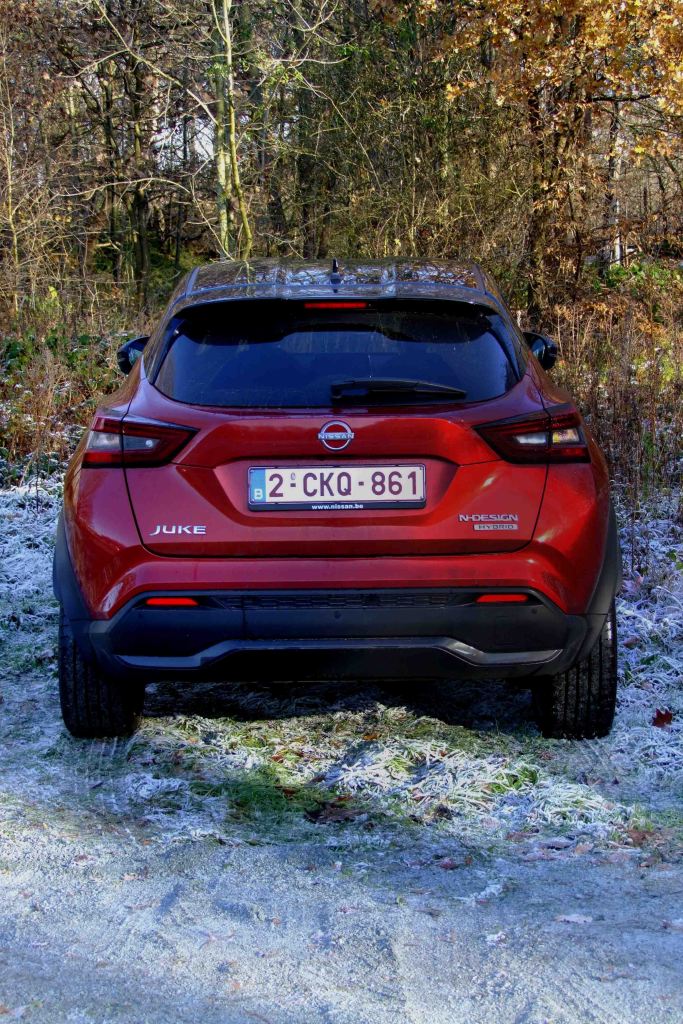
We drove the Nissan Juke 1,6 Hybrid: a very refined and stylish urban SUV…

The Juke has invented the compact, urban SUV and indeed has gained many faithful followers over the years. Times have changed, and the reduction of CO2 emissions is crucial now. So when the facelift of the Juke came along, it was time also to launch a hybrid version. Within the Renault group, the drivetrain of the Renault Captur was the obvious choice, and so here we are with a 1,6 litre petrol engine combined with an electric motor, delivering a system power of 105 kW or 143 HP. Nissan engineers have further honed Renault’s hybrid system, and we found it operating very refined indeed. The second generation Juke also underwent some styling changes for the better, but retained its iconic shape. Just read further…

Hans Knol ten Bensel
Pleasing…

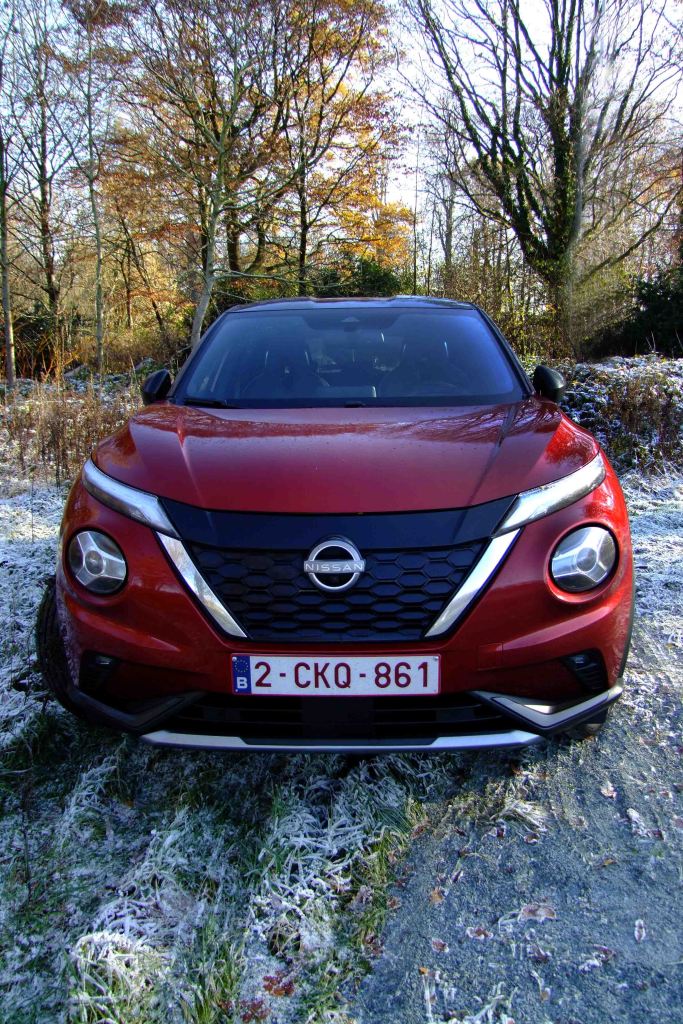
The front end of the Juke now features a honeycomb grille with also the headlamps elegantly integrated in the bodywork with the indicators and running lights stylishly elongated along the bonnet. We already tell you here that the headlamps feature already in the standard equipment full LED, as well as the rear lights.

The interior is also very well finished, with soft padding on the dashboard, door panels and centre console. We like the very readable round instruments, and the touch screen sits nicely high up on the centre of the dashboard. Everything is quite intuitive to handle, and one feels well at home in this cosy, rather dark interior, the latter as a (happy?) result of the typical styling of this SUV.

The steering wheel is eminently adjustable, and the front seats are very comfortable indeed. Thanks to its SUV character one sits pleasantly high, with the front seats being some 52 cm above street level. So getting in and out is a breeze.

Refined, at least when you drive it smoothly…

Driving a Hybrid is also an art, which you have to learn. Ok, the hybrid offers you thanks to its electric motor that added torque and immediate pulling power which is the very charm of EV driving. But the smoothness and silence of the drivetrain will please you even more when you drive it quietly, with anticipation and restraint.

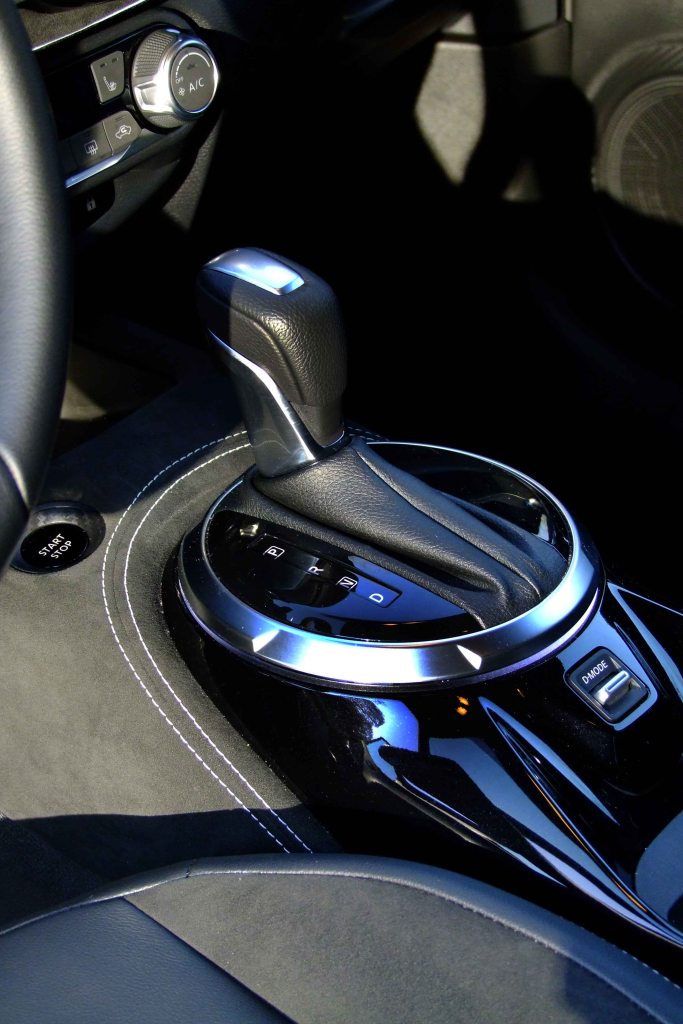
Then the clever (thanks to computer-age Artifical Intelligence) system will manage the power stream masterfully between E- and combustion power, the engine revs will not rise unduly and in urban traffic you will achieve anything between 5 and 5,5 litres/100 km. The hybrid Juke will also let you use the e-pedal function, so you can recuperate kinetic energy via the electric motor, which then acts as a generator. Of course, you set the drive selector on the centre console in “Eco” mode, and leave it there.

When you want more performance of the Juke, you can forget about any extra economy. Logically, as then the combustion engine has to do most, if not all the work, as it has also to maintain a minimum charge in the battery. Only the e-pedal will let you recuperate kinetic energy, so you can use the e-boost of the electric motor when re-accelerating. The engine revs high, one clearly hears that it’s there, and the transmission is very busy choosing the right gears with sometimes a hint of jerkiness.

This is also the reason why high cruising speeds on the motorway are also to be avoided if you want to see decent economy. Diesels can run at high speeds with consumptions remaining between 6 and 7 l/100 km, but NOT petrol engines. The Juke will then set you back with averages between 7,5 and 8 litres/100 km. No miracles, dear readers, just the laws of physics. The Nissan engineers also set the tone already, as the top speed of this Juke Hybrid is “only” 166 km/h. You shouldn’t be doing it, if you think about the earth. Enough zest though, as the Juke will sprint from 0 to 100 in 10,7 seconds.

The Hybrid Juke has a so-called “Multi-Mode” transmission, with 4 speeds for the petrol engine, and two speeds for the electric motor. AI chooses for you not less than 15 gear combinations! The engine is good for 94 HP and 148 Nm, additionally supported by a 15 kW starter/generator. The electric motor has 49 HP and 205 Nm of torque.

Our average test consumption stayed well below 6 litres/100 km, as indeed we drove the Juke Hybrid as it is engineered to be. CO2 emissions are set at 114 g/km according to WLTP standards.

When starting from cold, the engine will at least during the first few kilometers rev quite clearly, as it has to reach its operating temperature as fast as possible and also has to keep the battery (re)charged. When you use EV power extensively in (very) slow and quiet driving, every now and then, the engine will eagerly rev again, but then this is to recharge the battery. It does this even when you hardly touch the throttle or even not at all, which seems a bit unsettling at first, but soon you get used to this.

Enjoy the music…in comfort

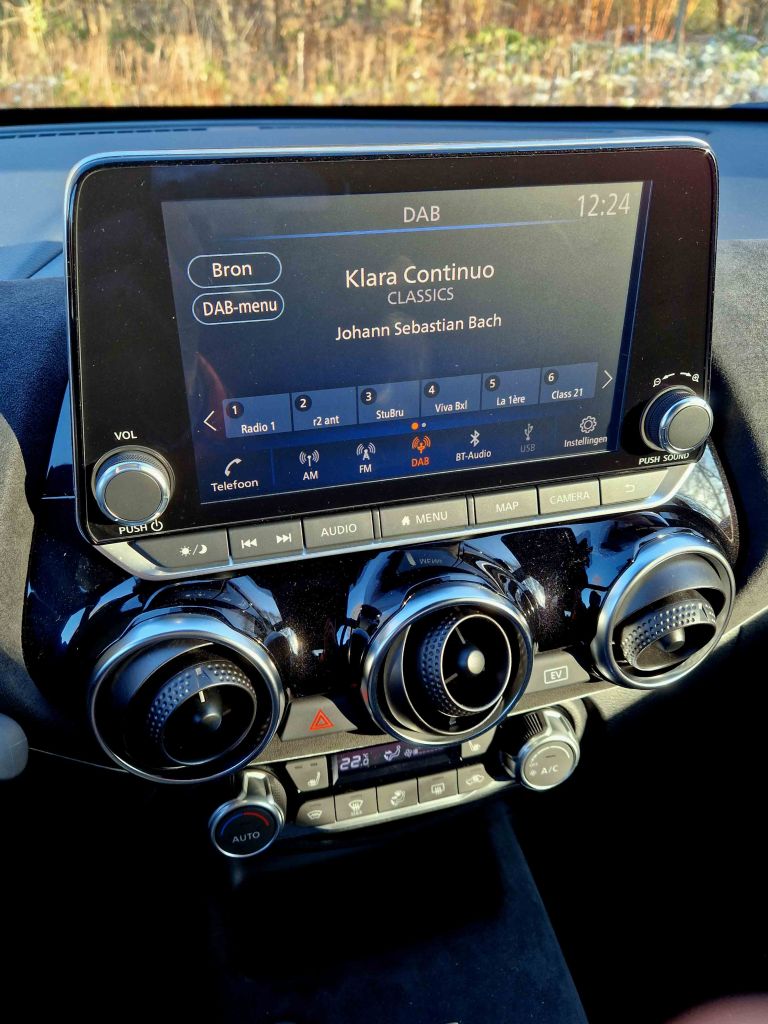
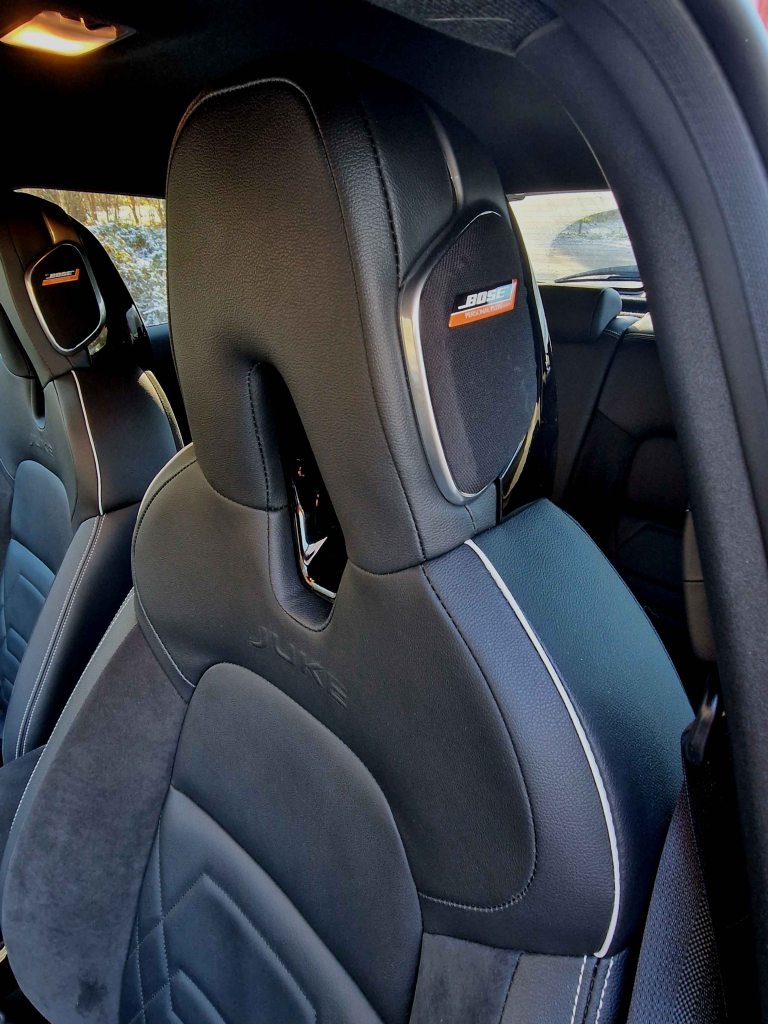
Driven in the right way, the Juke will seduce you with quietness, and this lets you enjoy the DAB+ radio and the excellent sound system. We had a Bose system with speakers integrated also in the headrests, and the sound experience was indeed wonderful. The suspension is comfortable, a bit firmish, but never harsh. Seating is excellent with more than enough headroom in the front. In the back, this is less generous, but legroom is very much OK. There is also enough room in door bins for even 1 litre bottles.

Connectivity is also top notch, with Apple Car play and Android Auto provided.

Stable and predictable handling

The Juke steers precise, has very good stability at speed and is predictable in corners. Even abruptly lifting the throttle in de midst of a curve will trigger the ESP and the Juke will maintain its course. The steering is reasonably direct (2,5 turns from lock to lock) as an urban compact befits. The Juke is quite safe, in the NCAP Crash test it achieved 94 pct of all the achievable points. Brake performance is very good, with the wider tires of course enhancing the deceleration.

Practical

Boot space is adequate for a compact SUV with 301 liters, and there is an under floor tray with an additional 90 l. With all seats folded there is 705 liters available when you load until the rear window base. One has to lift the luggage rather high into the opening however, some 78 cm.  

Conclusion

The Juke has its iconic looks further improved, and is certainly a smooth urban performer with its Hybrid layout. On the open road it is also a good travel companion, with high speeds letting the petrol engine work rather hard, which limits economy. But as said above, adopting the proper driving style will let you enjoy fully its “zen” qualities, for years to come…

Hans Knol ten Bensel
Photographer’s notes: we took most of the photos here with the bargain of the year: a still totally pristine Fujifilm Finepix S100fs, with a Fujinon 28-400 mm 35 mm equivalent lens, bought two weeks ago for almost the original price of its sun lens hood: 59 Euros!!

It proved to have excellent color and light balance, surpassing even the Samsung S22 state of the art flagship smartphone, which did not succeed in making a well color balanced photo of the e-pedal button on the centre console. The auto color balance got so completely out of line in the shadowy interior of the juke that I had to print here the photo in black and white here (see photo in the article above) instead of the exaggerated blue the S22 produced.

We drove the Seat Cupra Born…

The Spanish, more ardent version of the Volkswagen ID.3 is the Seat Cupra Born. More, sporting, more zesty, more panache, that’s what the VW group wants to offer here. And indeed, this Fully electric Cupra fills the bill, when it comes to looks, handling and performance. We put for you the 150 kW version through its paces, equipped with the 58 kWh battery. As you already well know, electric motors have formidable torque, and this Cupra surely delivers at the traffic light. It sprints from 0 to 100 km/h in 7,3 seconds, and so the beautiful EV story is again told, performance wise at least. But the Born has also other (dynamic) qualities, just read further…

Hans Knol ten Bensel
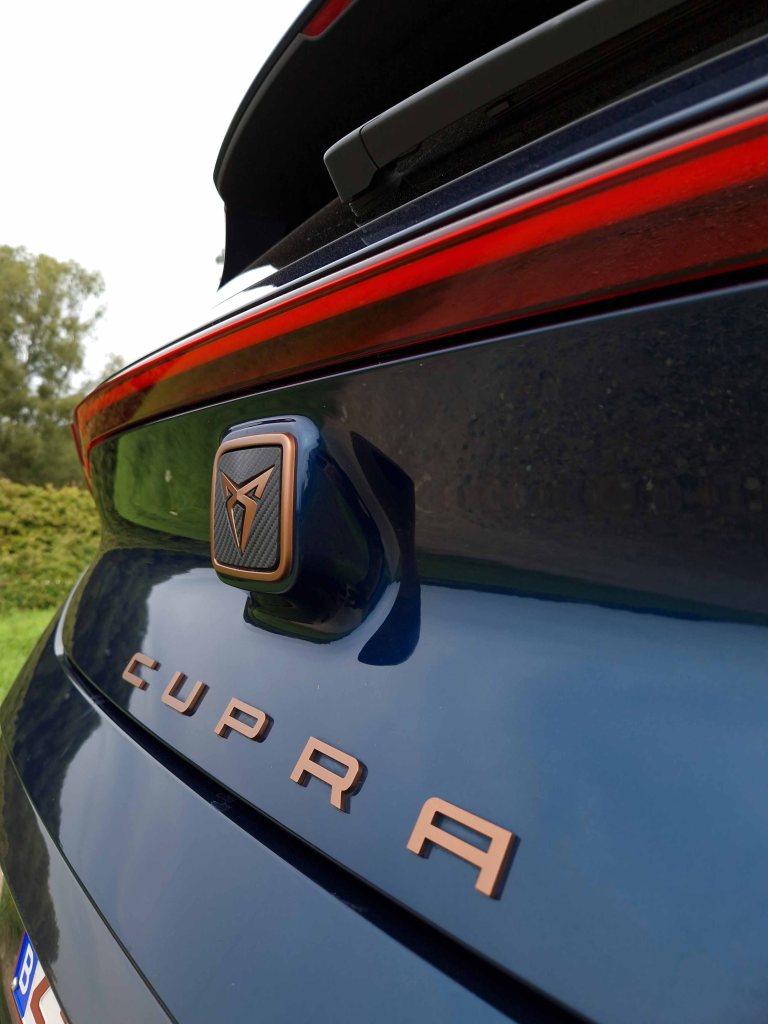
Looking at our Cupra test car, we liked its colour palette very much, and the external sporty styling elements. Also bystanders admired it, so yes it enhances clearly the personality of this car. I like the front end, the copper coloured badging, the big roof spoiler above the rear window, the nice streamlined alloys, the texture on the c pillar.

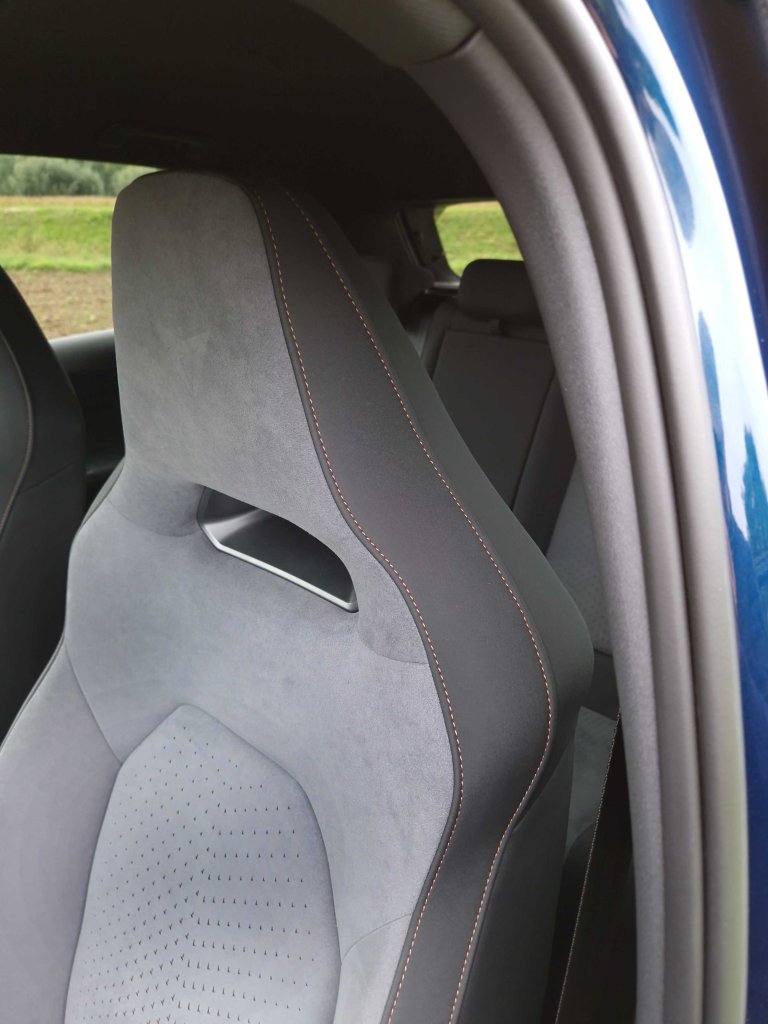
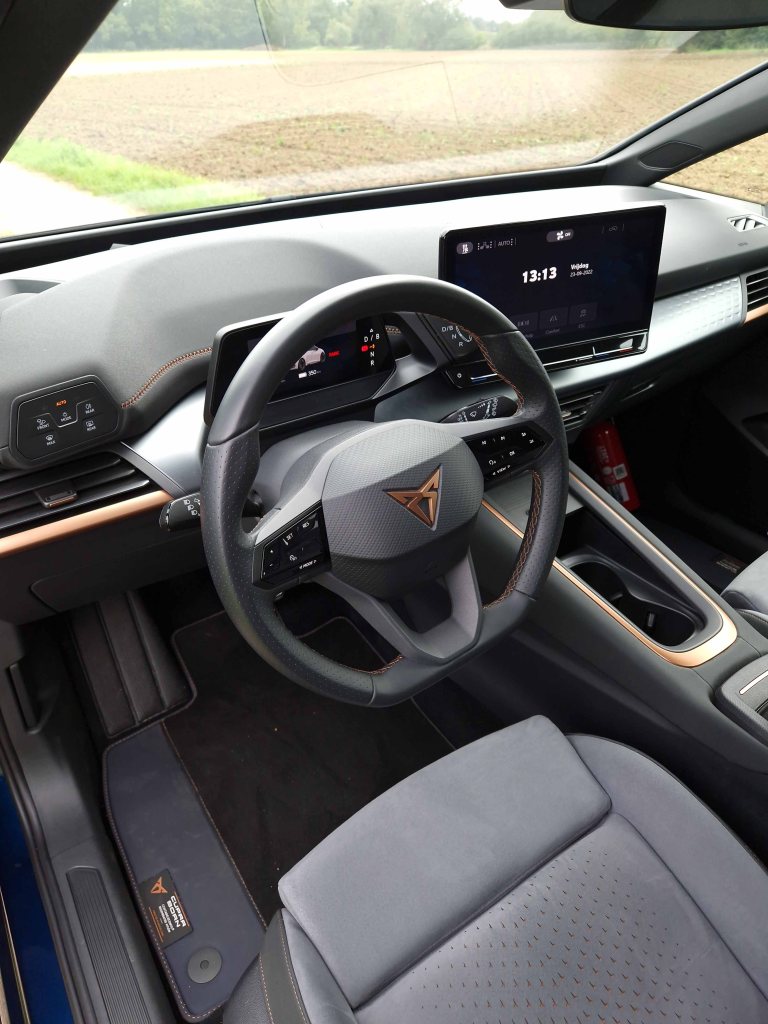
Also the interior breathes this flamboyant sportiness, although what screens, instrumentation and buttons are concerned, it is identical to the ID.3. The design of the dashboard surface does look a bit cooler though, with some added textures and copper coloured surroundings of the centre console for instance. Very nice are also the body hugging front seats.

On both sides of the steering column one finds buttons like a Formula 1 driver would use. The right button puts you immediately in the sports mode. Performance galore, but your range will soon dwindle, even more so in winter. With the left button you can click through the available driving modes, from eco to sports.

Given de immediacy and sheer amount of the available power, we found the “eco” mode more than enough for our needs, and it gave us also a more or less reasonable range. Our test car had the 58 kW battery, and this gives you a theoretical range of 425 kilometres. That supposes of course very fair weather and a driving style which even trucks find on the slow side. Under the same driving style, my Hybrid Lexus clocks then 3,9 liters/100 km… indeed, an EV rewards you with a sedate driving style in town, and very moderate cruising speeds up to max 100/110 km on the open road. Then things are truly fine. The simple truth is, the laws of physics apply everyday everywhere, for all EV’s too, miracles just don’t happen. By the way, the top speed of this Cupra is limited to 160 km/h. At higher speeds, you would spend exponentially more time at the charging stations, so there is no time gain and thus no point in going faster.

You can opt for a more powerful Cupra Born with a 170 HP motor and a bigger 77 kW battery, which would give you also a higher range of 550 km, but we found our test car totally sufficient, once you adhere to the philosophy of environmentally friendly EV driving, smooth and sedate, flow the traffic, drive with anticipation and make minimal use if the brakes, letting the electric motor recuperate the energy. We are totally convinced that this is the only way an EV should be driven. Everything else is rather absurd, given that an EV is meant to emit less and protect our world. The Cupra has also the nice “B” position on the drive selector, and that lets you use the regeneration fully so you can really drive and brake this car using one pedal only.

Smoothness is what you go for…

Refinement is your biggest reward when you choose an EV. The Born delivers here too, as you could expect. Utter silence, mechanical smoothness, it is unsurpassed. Abundant torque is always at your disposal, immediate response at the slightest blip of the throttle. Just wonderful.

The handling of the Born is also a notch better than the ID.3. The Born sits lower on its wheels, has wider tyres, bigger brakes, and steers more direct and precise. Just more fun behind the wheel here.

Otherwhis it runs on the same platform as the ID.3, the celebrated MEB platform of the VW group. By the way, it also comes from the same assembly lines as the ID.3…

The Born is well equipped, and has all you could wish for in terms of driver assistance systems and connectivity. The haptic slider controls of the ID.3 are also found on this Born. They take some getting used to, and the new ID.3 will undergo some changes, of which future Borns will also benefit of course. The annoying thing about their sensitivity is that one sometimes turns on the sound volume as you brush the steering heel spokes when taking a corner! The car is roomy enough for four, with plenty of leg and headroom in the back, due to the rather narrow bodywork it gets a bit cramped for three adults in the back. The door bins are large also in the back, and one gets also two USB connections for the rear passengers.

Boot space is adequate with some 385 liters, when you fold the rear seats down, there is still a ridge where you have to lift your luggage over. On the other hand, it prevents heavy luggage items to slide forward…

Fast charging

The Born is of course well geared for the future, and the 58 kW battery accepts fast charging of up to 120 kW. This means that you can charge from 10 to 80 pct in merely 35 minutes. When our infrastructure is up and running, this is good news. It will set you free to use the full EV power more often, provided the energy prices stay reasonable of course.

Conclusion

This Cupra Born has the extra panache which makes it even more attractive to some than the ID.3, which is build rather with a no nonsense futuristic flair, which we happen also to like by the way. Embedded into the VW group with its massive experience and know how, this Cupra will prove to be reliable and (very) long lived, so you will be able to enjoy it for many years to come, with a bit more zest added…

Hans Knol ten Bensel
Nissan press conference 2023: more than ever offering clever and future-oriented electrification with a renewed range…

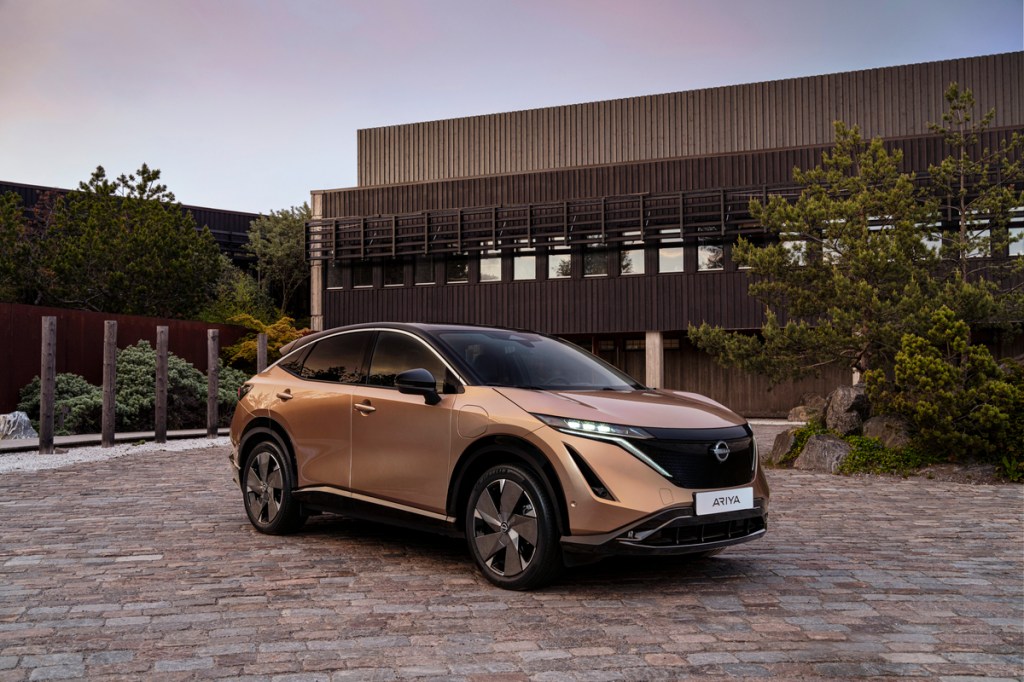
Nissan Belux was the first to hold a press conference prior to the Brussels Auto Show 2023, and organized it at the magnificent premises of Quartier Papier in Zaventem. On the photo below you see the Nissan Ariya, which according to Nissan, redefines E-Driving…

At the start of the conference, Jerôme Saigot, Managing Director of Nissan Belux, stated that with the Ariya, LEAF and Townstar EV models, Nissan has a very nice range of e-vehicles. But consumers are still not fully ready for a 100% electric range of cars. With the new Qashqai e-POWER and the X-Trail e-POWER, they can experience the pleasure of a 100% electric transmission without having to recharge the car via a socket, thanks to a second gasoline engine that produces electricity, he said. Indeed, Nissan goes a step further than the competition with new technologies such as e-POWER. So Nissan reaffirms its role in the fields of crossovers and electric cars. But read further…

Hans Knol ten Bensel

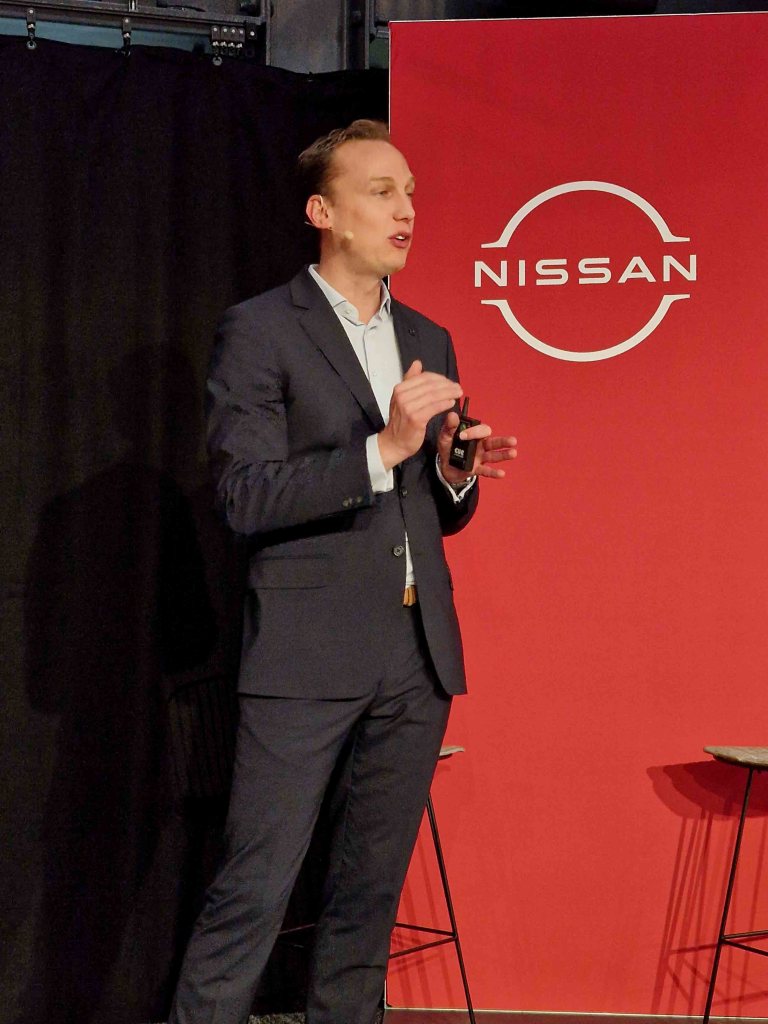
Jerôme Saigot, Managing Director of Nissan Belux, presented the new Nissan electrified range and the environmental strategy of the brand towards 2030…

Nissan’s green strategy for 2030…

Jerôme Saigot also stressed that sustainability is at the core of Nissan’s long-term vision, Ambition 2030. Responding to critical environmental, societal and customer needs, this strategy sets out to deliver electrified models and technological innovation in key markets globally, empowering mobility and beyond. Ambition 2030 supports Nissan’s goal which is to be carbon neutral across the life cycle of its products and operations by 2050. 

Nissan JUKE Hybrid: new advanced powertrain offers efficiency and responsive performance

Indeed Nissan is embarking further on the 100 % electrification of its range. We have the Juke, the popular compact crossover, offered with hybrid technology. Key to the driving pleasure at the heart of the Nissan JUKE Hybrid is an advanced low friction multi modal gearbox, using  dog clutches instead of conventional synchronizer rings to shift the 4 “ICE” gears and 2 “EV” gears. Additionally, to reduce friction, this gearbox does not use a clutch. All vehicle starts are 100% electric, and the 2 EV motors are used in combination to synchronize the gears, delivering smooth and responsive acceleration. We will be keen to drive a hybrid Juke soon, and tell you about our driving experience with it.

A car which will please many is the Nissan Qashqai  e-Power, said Mervin Keuter, Communications Director at Nissan Belux, offering 100 % electric power without the need for recharging externally. Indeed, a combustion engine coupled to a generator provides the electricity. The e-POWER system consists of a high-output battery, complemented by a variable compression ratio 1.5-litre three-cylinder turbo-charged petrol engine generating 156hp, a power generator, inverter and 140kW electric motor of similar size and power output as found in Nissan’s electric vehicles. The petrol engine generates electricity, which can be transmitted via the inverter to the battery pack, the electric motor or both, according to the driving scenario.

Melvin Keuter, Communications Director at Nissan Belux, highlighted the qualities of the Nissan Qashqai  e-Power…

What sets this powertrain apart is that the electric motor is the sole source of power for the wheels, so its response is instant and linear. Needless to say that also here we are looking forward to gets our hands on one to experience how all this actually works. It certainly is clever and responds certainly to what modern-day drivers want… we also want to see how economical and environment friendly all this still is.

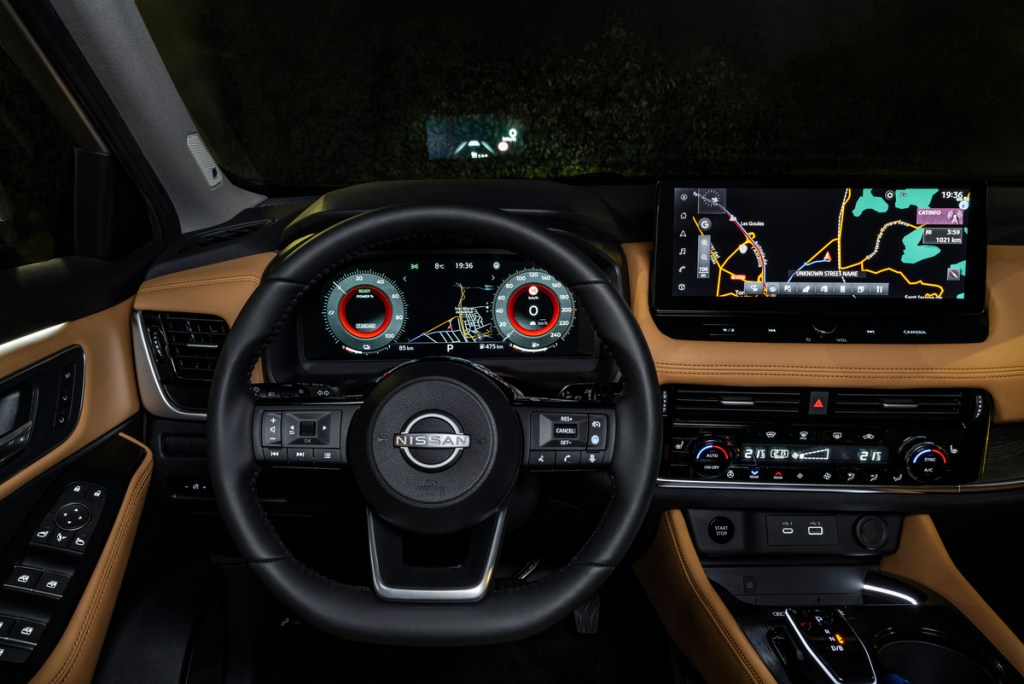
The dashboard of the new Nissan X-Trail with e-POWER and e-4ORCE…

Another important novelty for Nissan is the revamped X-Trail with its e-4ORCE  system on X-Trail and fully electric Ariya. The innovative e-4ORCE all-wheel drive system was conceived for use on either Nissan’s pure electric powertrains or with its e-POWER system, mentioned above. In both cases, the driven wheels are powered purely by electric motors fed by the battery.

In the case of the X-Trail, the dual e-motor system has a total output of 157kW (213PS) with a 150kW front motor and a rear 100kW motor. This generates lively acceleration from 0-100km/h in 7 seconds. Nissan proudly announces that a rear electric motor has its advantages: it has a 10,000 times faster rear torque response than a mechanical 4WD system(!).

Rémy Le Gall, Marketing Director of Nissan Belux, commented also on the electrified Nissan range and last but not least dealer organisation and client approach, of which more later in a separate report!

Now, on the X-trail, you can also opt for the turbocharged 1.5-litre variable compression ratio powering the wheels in the traditional fashion. Generating 120kW (163PS) and 300Nm of torque, it will be offered only in two-wheel drive configuration, with power to the wheels being transmitted via Xtronic stepped continuously variable transmission. In driving scenarios with relaxed driving and light acceleration, the engine switches to high compression ratio for optimised fuel efficiency, while in situations where more performance is needed, the compression ratio is adjusted to a low level.

The powertrain is also equipped with 12v mild hybrid technology. The system provides torque assist, extended idle stop, quick restart and coasting stop, with benefits to both fuel economy and CO2 output.

The Nissan X-Trail e-4ORCE offers 100 % electric power without the need for recharging externally…

Driving the future: the Ariya

Staying true to Nissan’s heritage of fun-to-drive, exciting vehicles, the Ariya is built on the all-new Alliance-developed CMF-EV platform that’s optimized to deliver unparalleled performance.

The Ariya’s all-electric platform combines excellent power delivery, charging capabilities and range, with a carefully tuned balance between ride comfort and handling agility. Available in three versions (Ariya 2WD 63kWh, Ariya 2WD 87kWh, Ariya e-4ORCE AWD 87kWh) and a range of up to 533 km, Ariya can confidently meet a variety of customer needs.

The Ariya 87kWh can recover up to 350 kilometres with a 30-minute quick charge using a CCS charging system. The battery pack sits at the base of the chassis to ensure 50/50 weight distribution on the e-4ORCE version and near-equal weight distribution on the 2WD versions. During benchmarking, engineers placed great emphasis on striking the ideal balance between handling agility, secure feeling and ride comfort, something not all EV rivals are known for.

Subtle regional differences exist for Ariya, as well. For example, European consumers demand responsive steering and high manoeuvrability, but also require additional stability at higher speeds, so damping forces were increased to improve body control. Nissan Europe engineers also adjusted spring rates and retuned steering feedback to increase on-centre definition at higher speeds.

A timeless Japanese design language…

Incorporating Nissan’s Japanese DNA, Ariya’s striking exterior and interior reimagines EV potential by embodying Nissan’s Timeless Japanese Futurism philosophy of powerful design that fuses aesthetics with functionality while creating an upscale, open atmosphere.

The all-new EV platform and compact nature of powertrain components made it possible for Nissan to position Ariya’s climate-control system under the hood. This allowed designers to use the whole length of the cabin and create a flat, open floor with a lounge-like space inspired by premium futurism.

For the LCV market: the new Townstar…

The Townstar EV builds on the success of the e-NV200. Built on a shared CMF-C platform, the new vehicle will be manufactured at the Alliance centre of excellence for small vans in Maubeuge, France.

The fully electric version of the all-new Townstar EV features a powertrain optimised with intelligent energy management and battery thermal cooling. The Townstar EV is able to achieve a superior range autonomy of up to 300km (WLTP cycle). Delivering 122 PS and 245Nm of torque, the Townstar EV’s  45kWh battery can accept AC charging (11 kW or 22 kW) or DC quick charging (CCS format). The latter of which enables users to charge the battery from 15% to 80% in as little as 37 minutes.

Lots of interesting news from Nissan, keep posted for further Nissan news and driving reports of their interesting new cars!

Hans Knol ten Bensel

The Alfa Romeo Tonale Plug-In Hybrid Q4: the full story of a modern, electrified thoroughbred…

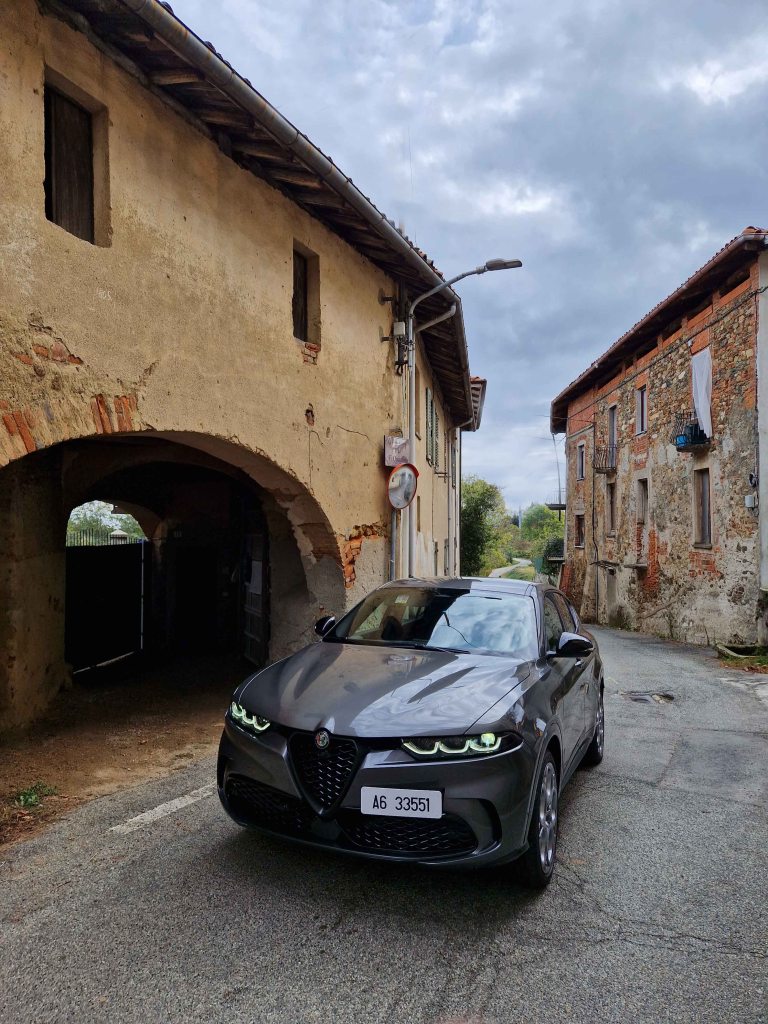
We drove the Alfa Romeo Plug-in Hybrid Q4 Veloce in the historic roads near Biella…

Alfa Romeo is at an important turning point of its long history. With the Tonale, this potent, 280 HP stylish compact SUV, it wants to make a fundamental transition. It is the first milestone on the way to zero emission(s) – within 5 years the brand wants to see all its Alfa’s electric. It makes us shiver, quite frankly, and hopefully not literally, when a cold winter will bite us all in conflict ridden Europe nowadays.

But indeed, a positive mind and hope should fulfill our hearts, and looking at the mechanics of this Tonale, there is still plenty to let it beat a bit faster.

Hans Knol ten Bensel
An excellent and very convincing thoroughbred hybrid.

The Tonale is conceived when the merger between FCA and PSA was not yet achieved, and this is one of the (main?) reasons we find a so-called FCA “GSE” or Global Small Engine, also marketed as Firefly, under the hood as its combustion engine. This is a family of engines produced by Fiat Chrysler Automobiles or (FCA) starting in 2016, and subsequently Stellantis.

The unit in the Alfa is also dubbed as the “FCA e-engine” and is to be seen in slightly different power versions now also in the Jeep Renegade 4xe, in the Jeep Compass 4xe. It is being produced in the Brazilian Betim plant, now the largest vehicle plant in Latin America and one of the largest in the world. It was the production unit with the largest capacity installed of the entire Fiat Chrysler Automobiles (FCA) group. The Tonale itself rolls of the production lines at the Stellantis plant in Italian Pomigliano d’Arco, a municipality of the Metropolitan City of Naples in Italy, located north of Mount Vesuvius.

Of course, this engine embodies the very latest state of the art technology. Indeed, this new generation MultiAir III, present in the GSE family, has even more flexible valve control. The new cam profile with pre-lift allows the opening of the suction valves during the exhaust phase, aiming at the realization of the internal EGR, with reduction of nitrogen oxides and increase of the efficiency of the engine in the partial load. Besides, the lifting profile of the MultiAir III intake valve is more extensive and makes it possible to manage the effective compression ratio of the engine, keeping the tendency to detonation under control regardless of the fuel used. Wow!

The unit produces 180 HP or 132 kW, and is coupled to a 6-speed automatic transmission, which provides traction to the front axle. We must say that the unit is not only smooth and very willing, it also produces the unmistakable, typical throb of a classic Alfa; the sound engineers did truly excellent work!

But then, this is a fully fledged hybrid, and this Tonale Q4 has an electric motor capable of supplying 90kW of max peak power and 250 Nm of torque to the rear axle.

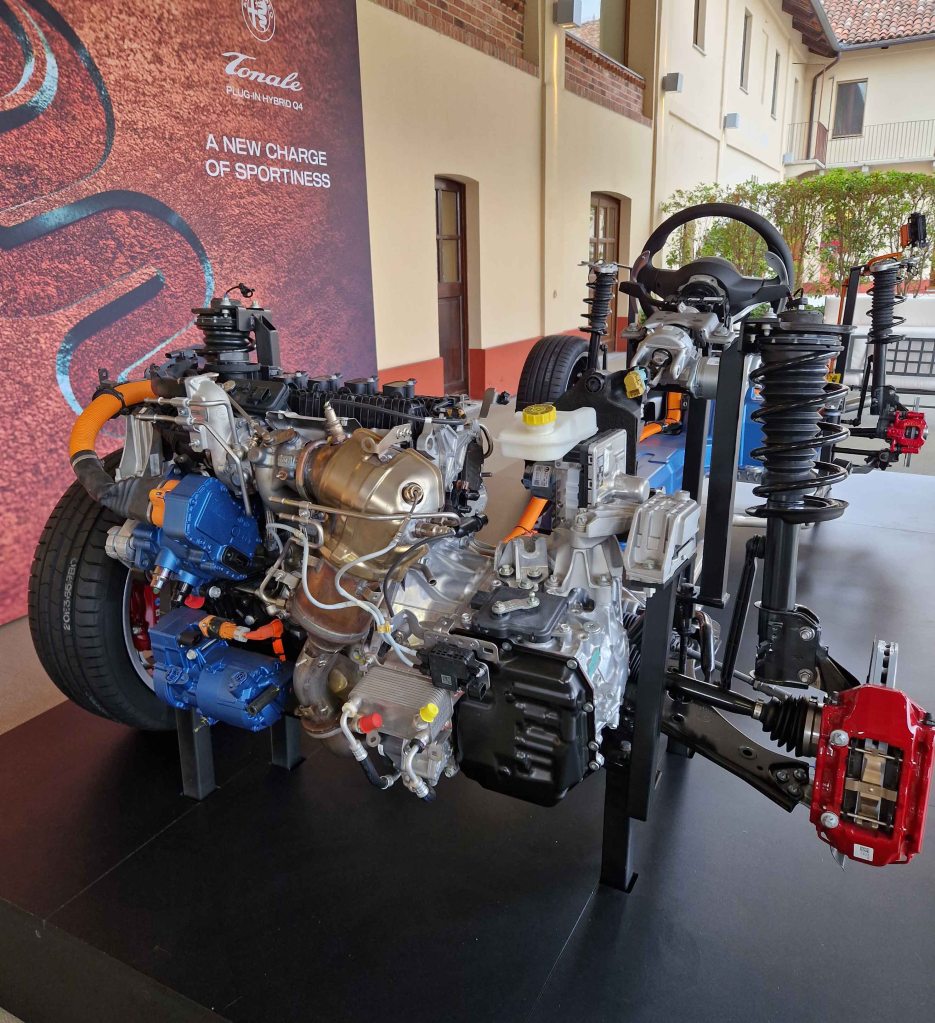
The battery at the centre and the electric motor and its battery junction control box at the rear warrant an excellent weight distribution…

The 306-volt, 15.5 kWh lithium-ion battery supplies an electric range of over 80 km in the urban cycle and more than 600 km of total range. It is also excellent in terms of sustainability thanks to the new hybrid drivetrain which reduces Co2 emissions to 26kg/km, bringing the range’s total emissions down by 40%. A reduction has also been made in fuel consumption, which has been brought down to 1.14 liters per 100 km in the WLTP cycle. Plus, with the aim of providing maximum efficiency, it takes less than 2.5 hours to fully charge the battery when the 7.4 kW onboard charger is in use.

Driving is believing…

We took the Tonale “Q4” -as we shorten its name here – on an interesting 102 km road circuit laid out by the Alfa people in the surroundings of the Balocco proving ground. It led us via an interesting picturesque city Ricetto di Candelo and its beautiful Castello di Castellengo towards Biella, then took us on a nice curvy stretch back to the Autostrada direction Balocco. Endearing is the precision of its steering, and the feedback of the road surface in your hands at the wheel. You can really place this Alfa on the ideal line and adopt some razor sharp driving, even in the “natural” or “N” mode. We found the steering a bit too light however, except in the “D” or Dynamic mode, where the steering is more direct, even more responsive and feels a bit heavier.

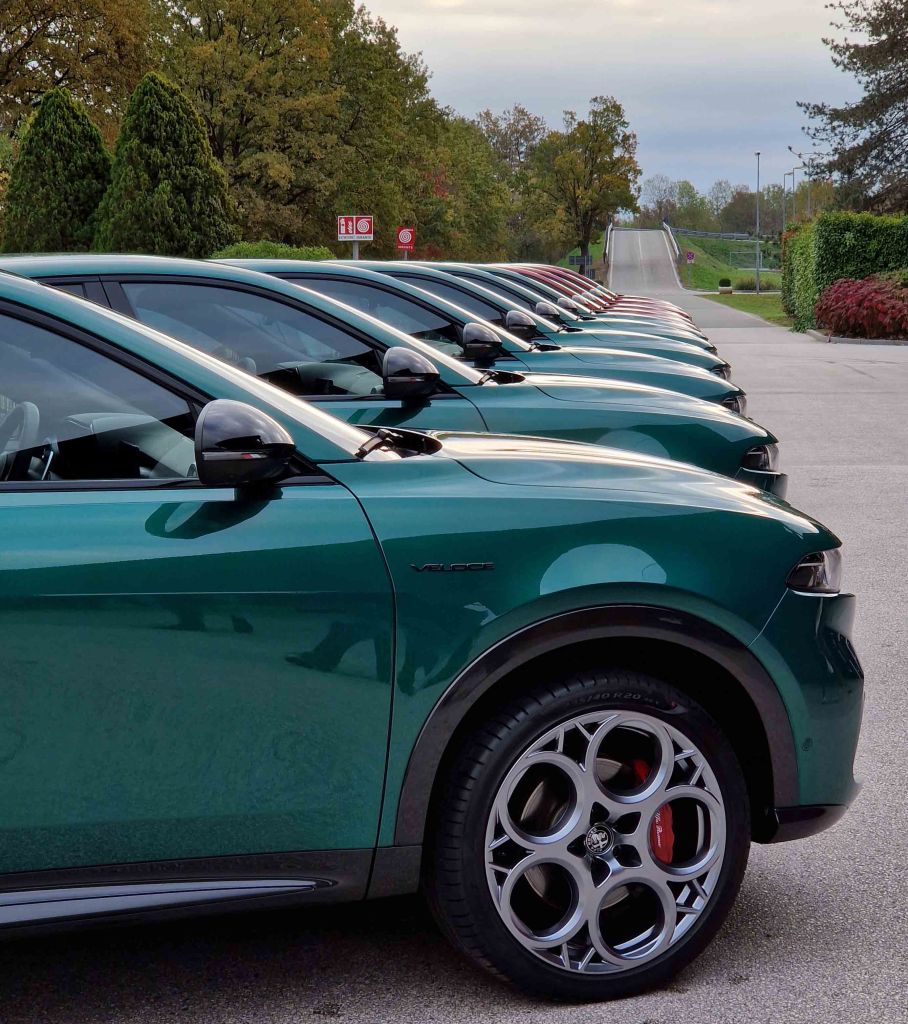
The gleaming row of Alfa’s ready for the road test, aligned in front of the Balocco Proving Ground headquarters…

But pleasure at the wheel is to be had every inch of the way, and we found the Alfa also display excellent neutral handling, also thanks to its ideal weight distribution. Icing on the cake was a stint on the curvy circuit section of the proving ground, behind a Giulia Quadrifoglio pace car. It gave us the opportunity to drive flat out and (safely) close to the limits of this endearing Tonale, and the car could prove its qualities masterfully. Remember, the four wheels are driven, the front wheels being powered by the internal combustion engine and the rear wheels driven by the electric motor. Your servant could thanks to the e-AWD system, enjoy the instantaneous deployment of 100% of available torque from the electric motor, with a rear axle responding as soon as one steps on the throttle, and this resulted in excellent and stable out of corner acceleration, truly exhilarating indeed!

The performance is of course nothing short of astonishing. On the short straights of the circuit speeds well over 170 km/h were easily achieved, with stopping power to match. The “Q4” Tonale shoots from 0 to 100 km/h in merely 6,2 seconds and hurtles further to a top speed of 206 km/h. On e-power alone, the Tonale can achieve 135 km/h.

The suspension is well calibrated. For technical buffs we tell you here that the Tonale, as a result of its development history, runs on the FCA Small Wide platform of the Jeep Compass of the second generation.

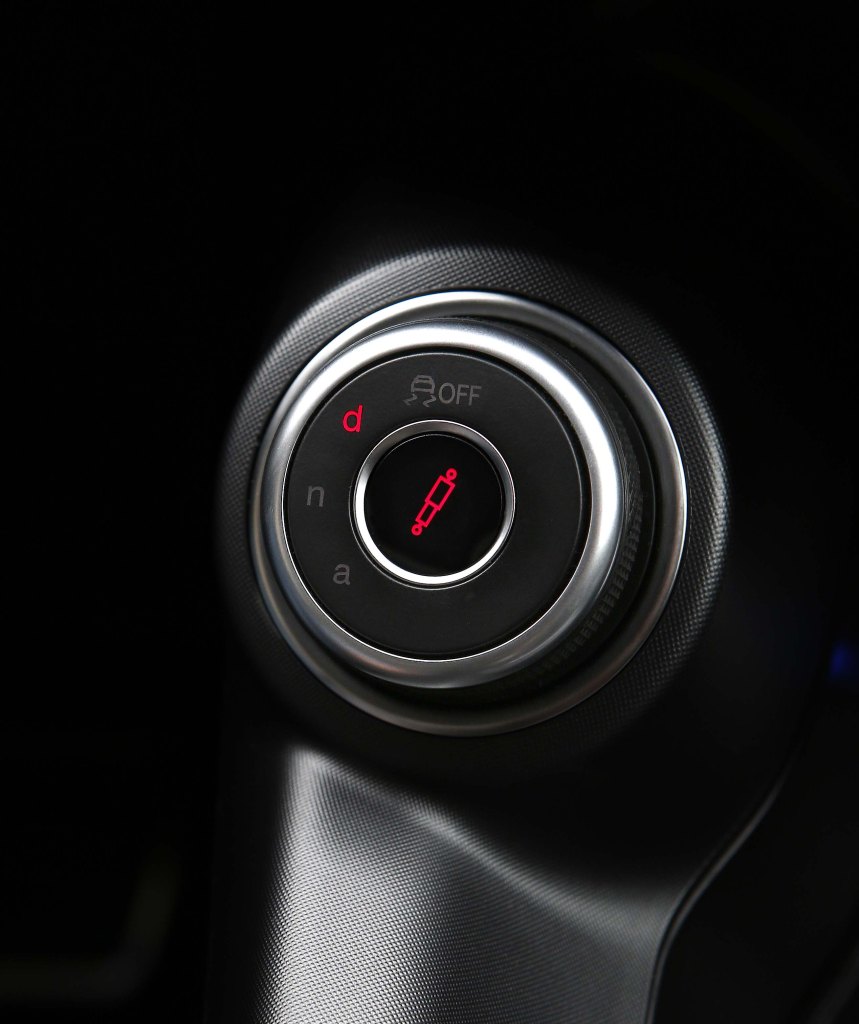
The D.N.A. selector at the centre of action…

You can drive this Alfa exactly how you feel. We already applauded its qualities in the Dynamic mode, and the subdued but sporting roar of the engine still rings in our ears. But then you can also enjoy the agility, responsiveness and nimbleness of the Alfa Tonale in a more refined, “zen” way, which Alfa calls “modern sportiness”. We do agree, as the transgression between engine and E-power is ever so smooth as to becoming completely imperceptible, and that is no small feat. So when you select “N” or “Natural” mode, it keeps hybrid driving to all-wheel drive to optimize performance. The use of combustion engine and electric motor is automatically managed and allows for energy and fuel savings without giving up on performance.

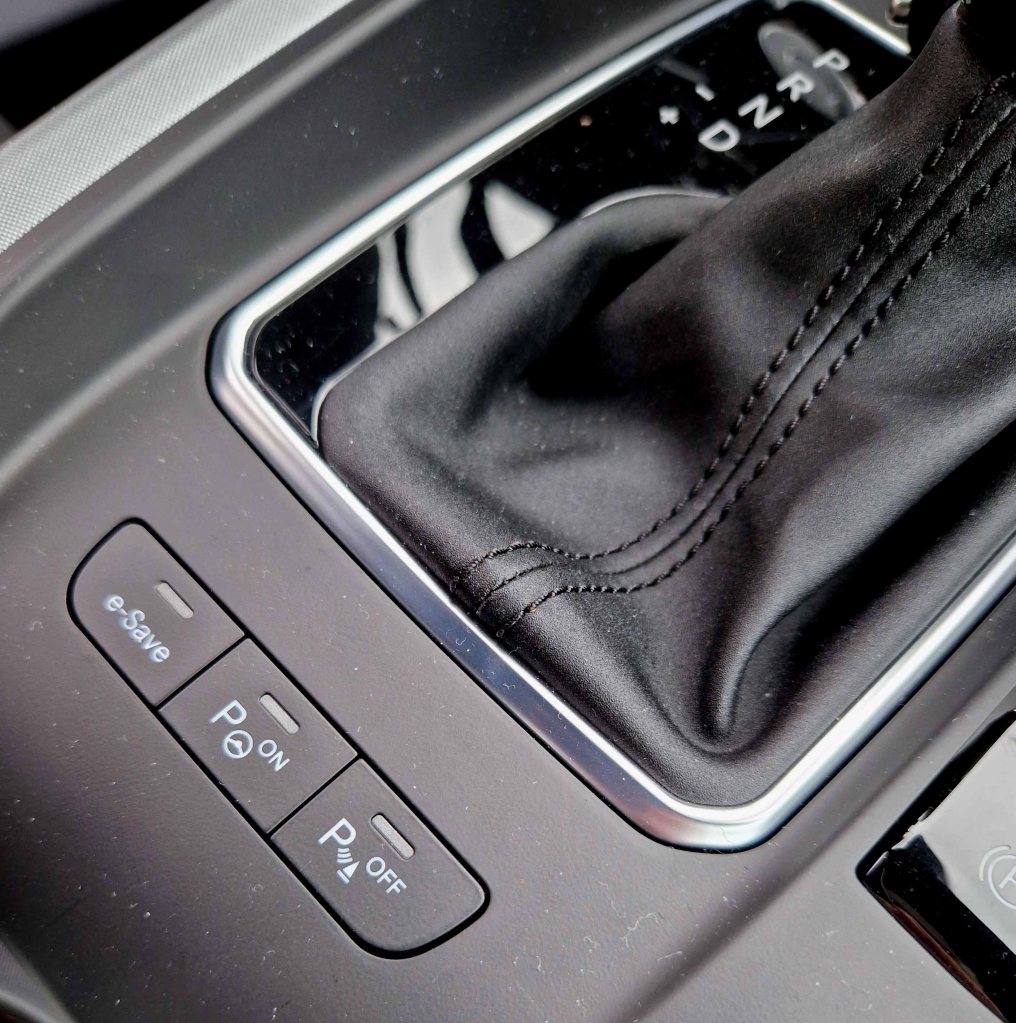
Last but not least there is the “Advance Efficiency” mode, calibrated to obtain maximum energy efficiency in full-electric driving mode. It is the ideal driving mode in urban traffic. When you lift the throttle, the car continues driving in “Sailing.” Meanwhile, when one is going downhill, the new eCoasting Descent Control is activated to maintain a constant speed of 50 km/h, which is however adjustable with a light dab on the throttle or brake. Specifically, “E-Save” allows one to recharge or maintain the battery level when the internal combustion engine is on, and there is also the regenerative braking system.

Premium comfort and safety

The Tonale is quite roomy, remember, it rolls on the second generation Jeep Compass platform. Sound insulation is also quite good, enhancing the “zen” driving experience. Moreover, on-board comfort is also ensured by dual-zone climate control, pleasing ambient light, a sophisticated Infotainment system, ventilated and heated front seats, and a 14-speaker Harman Kardon sound system.

It also includes ADAS systems for level 2 automatic driving, a hi-res camera which provides a 360° view of the car, a Blind-Spot Detector and Rear Cross-Path Detector, as well as superior structural and industrial quality which earned it a 5-star NCAP rating.

Software connectivity…

Amazon Alexa allows one to remain constantly updated on the state of the vehicle from the comfort of one’s home, as it provides useful information like the charge Tonale Plug-In’s battery. The built-in Infotainment system comes standard and offers contents, functionalities, and services which are constantly being updated via its customizable Android operating system and 4G connectivity with “Over The Air” (OTA) updates.

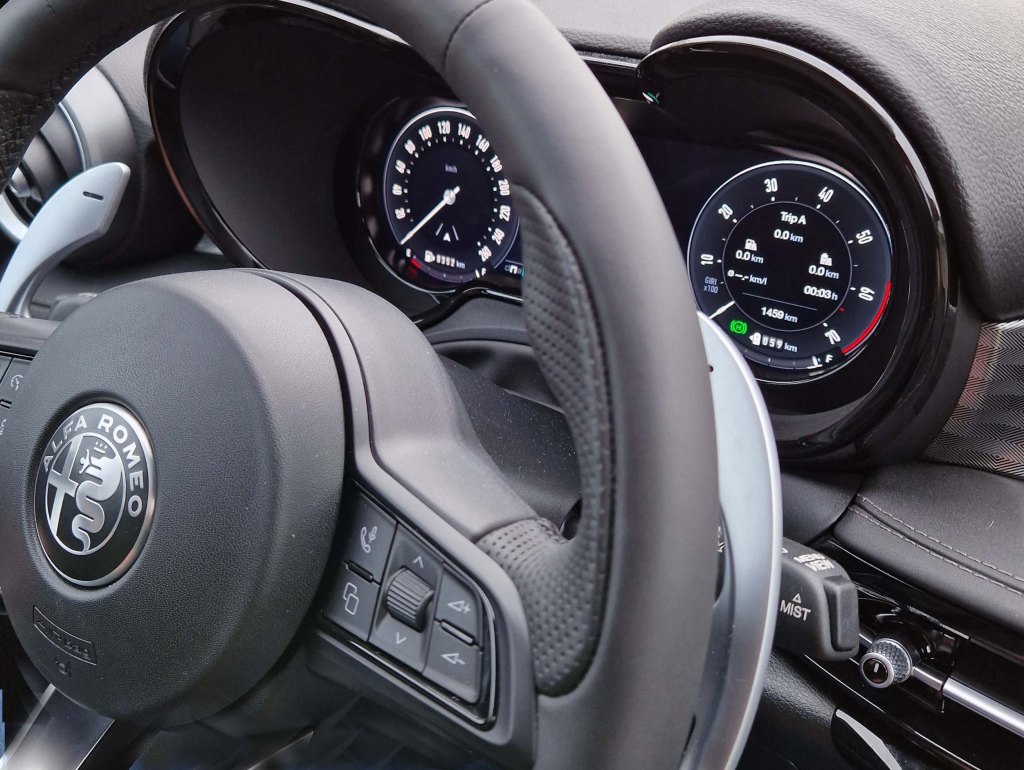
Thanks to a hi-res screen whose overall dimensions are 22.5”—a 12.3” totally digital screen and a 10.25” main touchscreen unit, the Tonale Plug-In ensures easy-to-use connection. The centre 10,25” screen is also seen by the way in the 500e. The Tonale Plug-in Hybrid Q4’s circular dials include ad-hoc upgrades like the electro-biscione in the lower part of the right dial which changes color based on the electric motor’s status (off, on, on and charging) and so provides all the information related to power and charging. Clever!

Four new functionalities of Alfa Connect Services make their debut on the Tonale Plug-in Hybrid Q4:

E-control: it allows the customer to control various functionalities based on the EV features—like charging and the climate control system—at a distance directly from the My Alfa Connect App, which you have to install on your phone.

Dynamic Range Mapping: it allows drivers to travel with peace of mind as it shows them the destination they can reach based on the battery charge both on the navigation system map and the My Alfa Connect app.

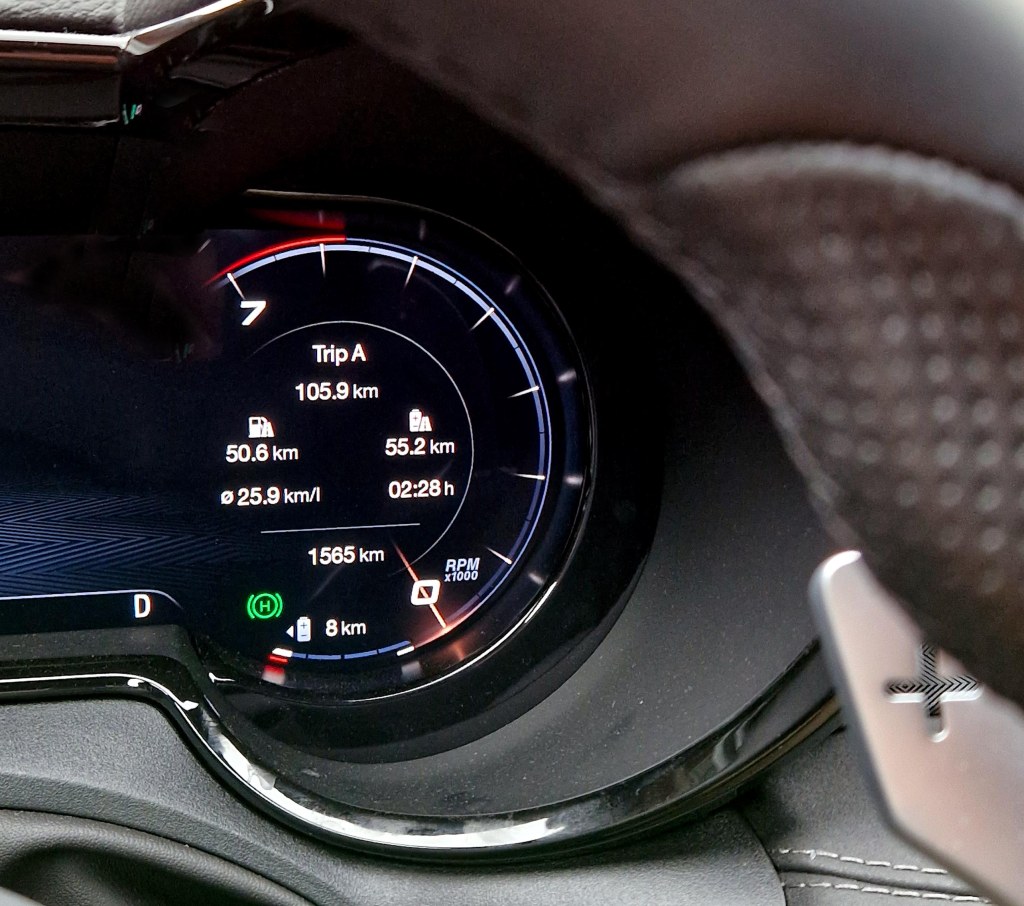
At the end of our 105,9 km road trip, the instruments tell the story: we drove 50,6 km on engine power, 55,2 km on batter e-power. This resulted in a consumption of 3,86 litres/100 km, but then with 8 km left in the battery, so we estimate some 14 kW consumed…

Charging Station Finder: it allows the customer to see the nearest public charging stations both on the navigation system map and the My Alfa Connect app.

My eCharge: it allows for the use of the My Alfa Connect app to directly access Free2Move eSolutions services to manage public and private charging. In fact, it is possible to locate the public charging stations, check the charging methods, make payments, visualize the charge history, manage one’s own Wallbox to decide how much electricity to use and even increase, decrease, suspend, and reactivate the charge.

Your Tonale has an NFT which lets you generate a certificate…

This means that specifically, based on the customer’s selection, the NFT generates a certificate which guarantees the identity and good maintenance of the vehicle, and thus supports its residual value. The NFT certificate provides a further source of credibility on the used car market and is even more valuable on the Tonale Plug-In Hybrid Q4 as it contains even more information.

A special “Edizione Speciale” at the launch…

The Tonale Plug-in Hybrid Q4 is the top-of-the-range model and is in line with the simplification and rationalization of Alfa Romeo’s lineup strategy. In fact, it can already be ordered in the exclusive EDIZIONE SPECIALE launch version and in the VELOCE trim which has been made to reach the most in terms of performance and sportiness.

The EDIZIONE SPECIALE offers inserts on the titanium body, a special badge on the fenders, and a “Tonale” black badge, 20” alloy wheels, metallic pedals, red Brembo brake calipers and aluminum shift paddles which are integrated into the steering column. Later on, customers will be able to order the Tonale Plug-In Hybrid Q4 in the Ti trim for a more elegant and distinctive character.

We have to wait a bit to get our hands on this remarkable Alfa for a more extended test, but stay tuned for more Alfa news soon!

Hans Knol ten Bensel

The iconic and ultra-exclusive Citroën My Ami Buggy in Brussels and Knokke…

The My Ami Buggy was presented to us at Brussels Tour & Taxis…

Friday 7 October we stood eye to eye in Tour & Taxis in Brussels with the “Buggy” version of Citroën’s celebrated My Ami. The original “Buggy” concept was presented in December 2021, and met right away with strong public demand. This led Citroën to produce a very small first series of merely 50 units.

It was originally only intended for the French market, and it was launched on June 21 via an online sales site. In 17 minutes 28 seconds, they were all sold out…

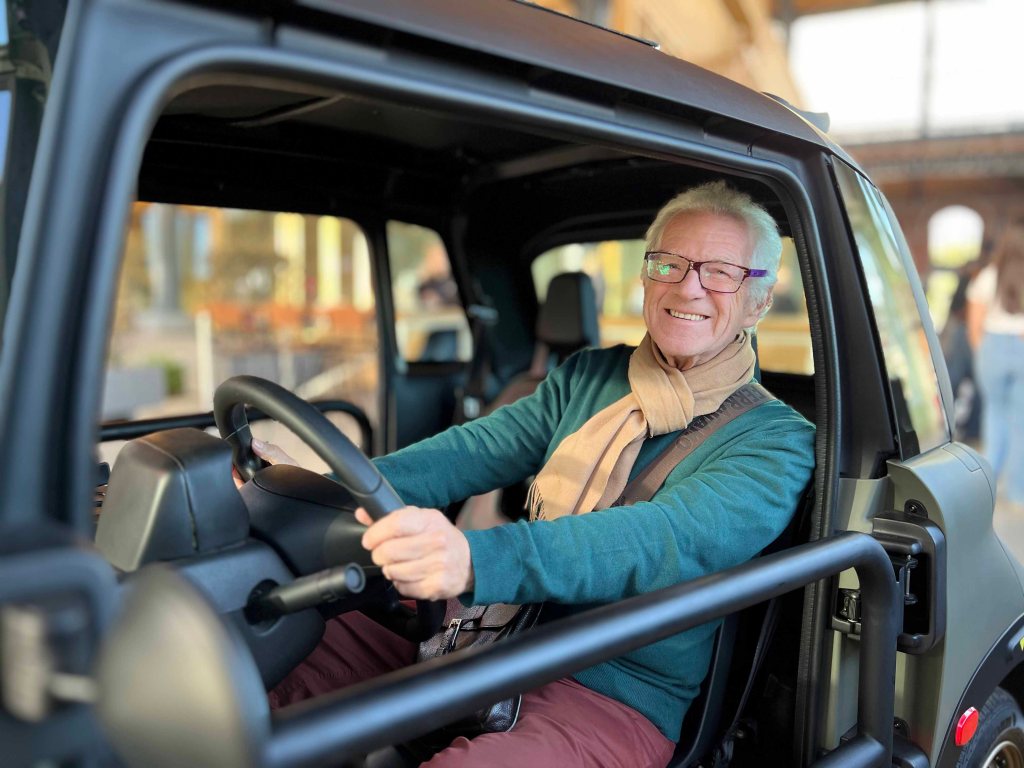
Your servant at the wheel of the Buggy…

We were therefore very pleased when Citroën Belux took the initiative to present this little gem to us at the premises of Tour & Taxis in Brussels,

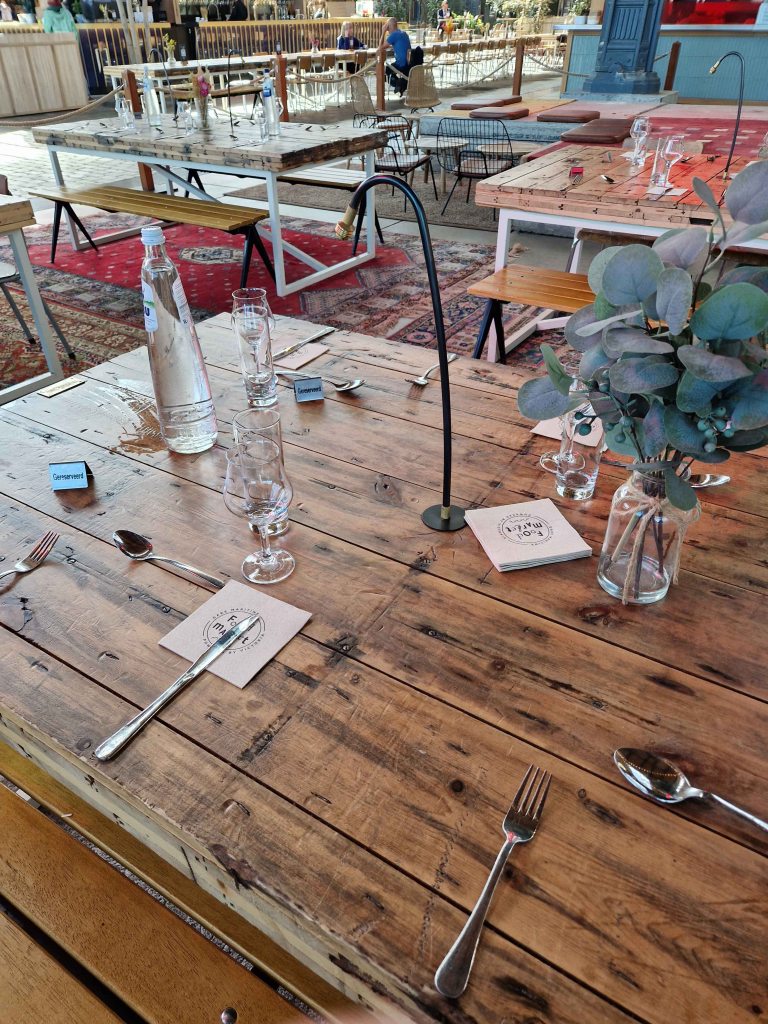
where they also treated us to culinary delights in the Gare Maritime Food Market. Indeed, there you can discover the Belgian terroir with 10 new street food concepts, in market style format, presented by 8 top chefs in an iconic venue with a unique bar experience.

The “sustainable” style tables will carry delicious dishes from star chefs for you to enjoy…

But there is more of the “Buggy” to see in Knokke…

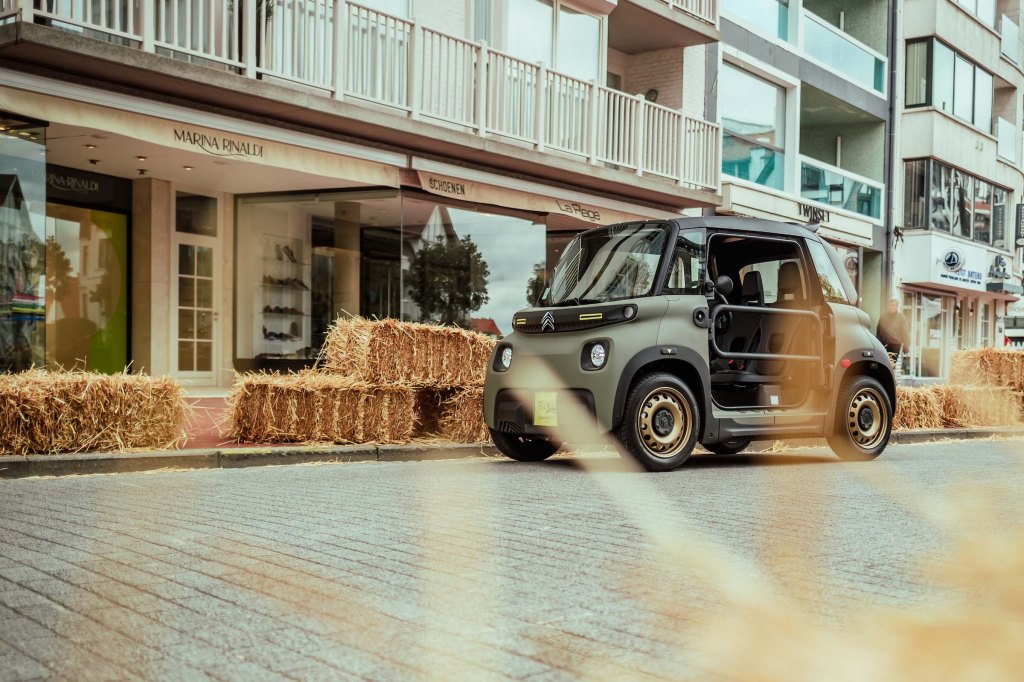
On the sidelines of the activities that will take place this weekend in the fashionable seaside resort of Knokke (Zoute Grand Prix, from October 6 to 9), the exclusive Citroën My Ami Buggy will, after a brief visit to Bruges at the beginning of the week, its first kilometers on our Belgian roads, to the delight of ‘carspotters’ always in search of original images.

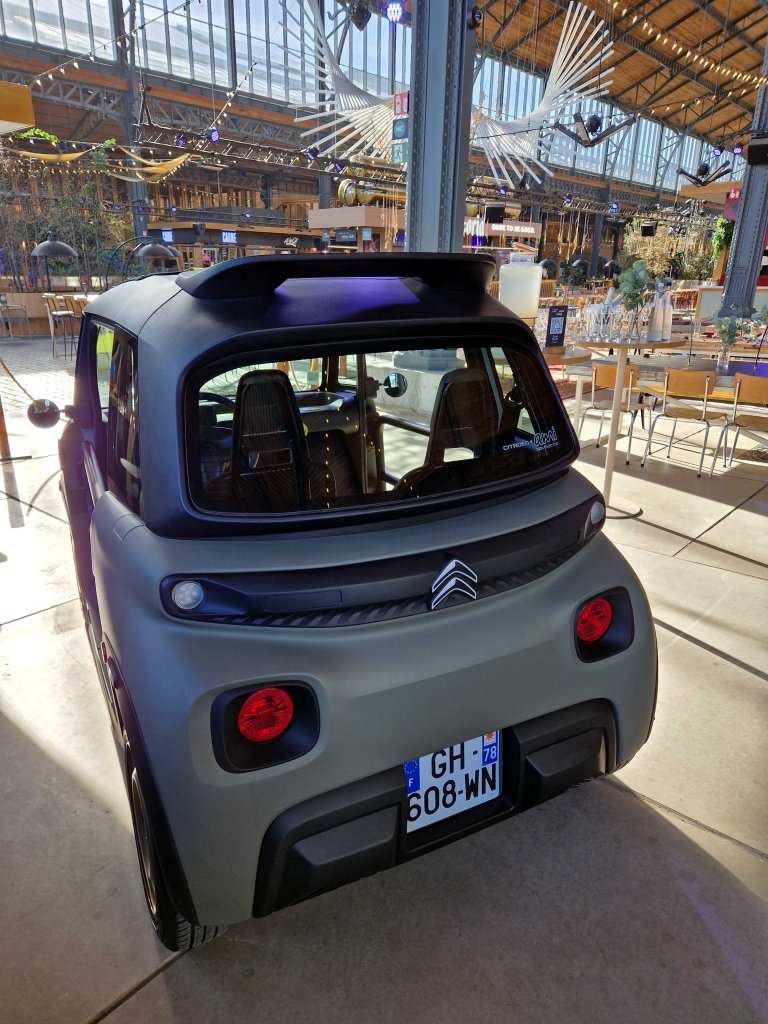
My Ami Buggy with its adventurous look embodies the liberty of mobility and the holiday spirit with its totally open interior. The doors are being replaced by tubular metal gates. The roof has also disappeared in favor of a removable canvas to make the most of the great outdoors.

It looks also quite adventurous with its Khaki bodywork, its fender flares, its front and rear bumpers, its golden rims. It’s also hard to resist its yellow accessories as they are so inviting to be used…

So see you this weekend, Saturday October 8, when the My Ami Buggy will make its bold appearance in Knokke…

Hans Knol ten Bensel
Citroën introduces a bold concept car for family electric mobility: less is more, thanks to the power of genius…

Right after having unveiled its new brand identity, Citroën stunned the international press last Friday, when it presented its OLI concept car in Paris.

You can judge yourself from the photos I took with my flagship Samsung S22 (I am getting increasingly used to it now) how completely groundbreaking the design and the whole concept of the car is actually.

I decided to bring the news of this concept car in different episodes, as thanks to the excellent PR people, I was able to have interviews with not only the CEO of Citroën, Vincent Cobée, but also with Laurence Hansen, Head of Citroën Product Development and Citroën’s Head of Design, Pierre Leclercq. I will bring this extensively in further reports, together with also a further interview with Laurent Barria, responsible for marketing.

So read on, and you can expect much more soon!

Hans Knol ten Bensel

The oli concept car focuses on how more can be achieved with less…says Citroën CEO Vincent Cobée

In the footsteps of the Ami…now for mobility of the whole family.

Citroën already showed with its Ami (in a few days, we will also attend in Brussels the introduction of the Ami Buggy) that it believes strongly in offering affordable mobility, and it builds further on this concept, taking ‘unconventional’ to a new level with this conceptual oli [all-ë].

The Citroën oli concept is designed to do the same for family mobility that Ami achieved for personal urban mobility. Significantly, oli acts as a precursor to the concepts and innovations that will be available in future Citroën electric models.

The oli concept car focuses on how more can be achieved with less, first and foremost with less weight, how the inventive use of responsible materials and a sustainable production process can lead to inexpensive yet desirable zero-emission vehicles that meet multiple lifestyles.

In his introduction speech, CEO Vincent Cobée  stated “Three societal conflicts are happening simultaneously – first is the value of and dependence on mobility, second is economic constraints and resource uncertainty, and third is our growing sense of desire for a responsible and optimistic future.”

Then he commented on the trend that cars are becoming bigger, heavier and more complex…

Styling language which is soon to be seen on new Citroën models…

“A typical mid-70s family car weighed around 800kg and was 3.7 m long and 1.6m wide.” He continued. Today’s equivalents have grown to more than 1200kg, are at least 4.3 m long and 1.8m wide. Some even weigh more than 2500kg. Legal and safety requirements have driven some of this, but if the trend continues and we carry on parking these vehicles 95% of each day and driving 80% of journeys with a single occupant, the conflict between the need to protect our planet and the future promise of sustainable, electrified mobility will not easily be resolved.”

He concluded: ““Citroën believes electrification should not mean extortion, and being eco-conscious should not be punitive by restricting our mobility or making vehicles less rewarding to live with.  We need to reverse the trends by making them lighter and less expensive and find inventive ways to maximize usage.”

So true we would say, and it is this unerring vision which inspired Citroën to build this concept car.

They focused instead on creating a pure, honest vehicle that is above all lighter, less complicated and truly affordable, as well as inventive and joyful.

With oli, Citroën is raising the stakes for future family mobility by re-thinking every detail to reduce resources and needed materials without compromising on quality or versatility.

A car conceived and built for a (very) long life

Laurence Hansen, Head of Citroën Product Development… now we choose a lifestyle, and the car which responds to it…

Who does not crave for a car which becomes your classic, beloved, (life)long companion? Well, that’s the beauty of it, the oli will be at your side, no matter what or how long. This conceptual multi-activity family vehicle has  sustainability at its heart and demonstrates how ‘best-in-class’ Life-Cycle-Assessment (LCA) can be achieved, from conception onwards with restrained, optimal use of lightweight and recycled materials, to sustainable production processes, and from durability for an extended ‘life in service’ to responsible end-of-life recyclability. The front and rear end parts can be easily changed, upgraded, customized, and the oli can within the family be passed from one generation to another…

 Thoughtful details…

Clever details are found throughout. The seats, for example, are simply constructed and use 80% less parts than a traditional seat. They are made of recycled materials and clever ‘mesh’ backrest designs enhance the natural light inside the vehicle.

They can also be easily upgraded or personalized to suit the taste of individual owners. It’s indeed the result of a chosen and adopted lifestyle, and the concept  car reflects that. Your servant also suggested to Citroën Head of Design Pierre Leclercq that in the aftermarket, a company like Ikea could offer their version of the seats to rejuvenate the interior after many years of use, for instance. Pierre Leclercq liked the idea…

Less weight means less power needed and more range…

 The oli offers reasonable, useable performance for many. Through the use of lightweight materials, oli can extend the range of the 40kWh battery on board to up to 248 miles between charges. Citroën has also limited the top speed of the oli to 68mph to maximise efficiency, while rapid charging capability ensures a charge from 20% to 80% takes just 23 minutes.

Extraordinary looks, harbinger of a total revolution…

The reasonable performance – read top speed – gave extra room for the designers to shape the concept car. Striking and clearly making a statement, oli’s unconventional stance and silhouette exude personality, productivity and positivity in a footprint similar to a compact SUV at 4.20m long, 1.65m high and 1.90m wide.

It defies traditional labelling. oli can be whatever it needs to be – family limo, urban explorer, adventure vehicle, workmate, or even an extension to the family home thanks to its ability to power everyday appliances.

The oli was presented in the stunning setting of a caserne de sapeurs pompiers in Paris…

Pierre Leclercq, believes oli embraces purity and geniality for families who don’t care for automotive status and stereotypes. I couldn’t agree more…

In the oli, the aesthetic approach has been deliberately exaggerated to reinforce functionality and versatility. And, like Ami, it is not afraid to show its simple and intuitive approach and distinguishes itself with its playful use of colour highlights, bright trim materials and vivacious patterns that advocate opportunities for personalisation.

Versatile

The oli truly threads new paths here. Oli’s flat bonnet, roof and rear ‘pick-up bed’ panels, as well as driving the vehicle’s unique silhouette, were chosen to meet the objectives for low weight, high strength and maximum durability.

Made from recycled corrugated cardboard formed into a honeycomb sandwich structure between fibreglass reinforcing panels, they have been co-created with partner BASF. They are coated in Elastoflex® Polyurethane resin covered in a protective layer of tough, textured Elastocoat®, which is often used on parking decks or loading ramps, and painted with innovative, waterborne BASF R-M Agilis® paint.

The panels are very rigid, light and strong – so strong that an adult can stand on them – and weight is reduced by 50 per cent when compared to an equivalent steel roof construction.

The roof is quite strong, as is amply demonstrated by Laurence Hansen, with Pierre Leclercq and CEO Vincent Cobée applauding…

Load carrying versatility is not compromised either, as roof rails each side of the roof panel allow owners to attach accessories like bicycle racks and roof boxes for family vacations, while below the bonnet panel are neatly detailed storage areas including compartments for charging cables plus personal and emergency items.

Not afraid to go vertical…

All of the key design elements on oli are perfectly horizontal or vertical, indeed, Citroën is looking for honesty and efficiency in the form language.

 The windscreen is vertical because it’s the shortest distance between top and bottom and uses the smallest amount of glass. As well as reducing weight and complexity, the smaller screen is less expensive to produce or replace.

To aid aerodynamic efficiency, oli features an experimental “Aero Duct” system between the front section of the bonnet and the flat top panel which blows air towards the screen, creating a curtain effect to smooth airflow over the roof.

The eye-catching windscreen frame is finished with a bright ‘infra-red’ wrap – a new signature colour Citroën will use in conjunction with its new brand identity.

The contrast between horizontal and vertical is evident in the rationally thought-through side panels and glass.

The front doors follow the example set by Ami and are identical on each side, though mounted differently. They are lighter, yet still strong, and much easier to make and assemble.

Reducing complexity and simplifying construction saves 20% in weight per door compared to a typical family hatchback. Half the number of components is required, and around 1.7kg per door is saved by the removal of the loudspeaker, soundproofing material and electrical wiring.

The external door panel is simpler to stamp and is designed to maximize interior storage. Gentle curvatures flow up the sides of the vehicle, and into the top of the side glass as it tumbles home to the roof.

Large, horizontal windows are tilted slightly towards the ground to help to reduce the effects of the sun, and manual, easy-to-operate “flip up” pantograph opening sections, similar to those used on Ami, provide fresh air ventilation.

The narrower rear doors are hinged at the rear of the vehicle and use vertical glass to give rear passengers more light and visibility. The change in form between the front and rear doors also gave an opportunity to add a passive air intake providing ventilation for rear seat passengers.

Access to the spacious cabin is wide, uncluttered and unhindered with both side doors open – ideal for when the driver needs to get straggling family members loaded efficiently.

Front and rear lighting modules are, again, uncomplicated but highly distinctive, and also play with the contrast between two horizontal lines and one vertical section. This approach will be evolved further as a distinctive Citroën lighting signature in future production vehicles.

A pick-up (load)bed in the boot…

Instead of a conventional boot, oli features an unexpected, inspired exercise in useful product design, and comes with a pick-up bed inside the boot for added practicality. The independent rear seat headrests pop up into the roof, the rear screen glass opens upwards, with the flat 994mm wide removable load bed expanding in length from 679mm to 1050mm.

The tailgate folds down and with the load bed panel removed there is up to 582 mm height between the vehicle floor and the rear glass. With the panel in place, 330 mm height of useful and secure trunk space is available below. The removable bed panel is light and flat, and made from the same recycled cardboard structure as the bonnet and roof panels.

But there is more, on the bodywork, the interior, the wheels and drivetrain. More soon!

Hans Knol ten Bensel

We drove the BMW ix3: the looks, the power and the range…

After the revolutionary and dedicated i3, BMW uses the popular bestseller X3 as a basis for an EV which will inspire many to take the step towards full electric mobility. Does it convince? It certainly does…

The i-version of the X3 saw light in China, where  production began in September 2020 at BMW’s factory in Dadong, China.  

Of course, the EV version doesn’t come exactly cheap, but then its major competitors, the Mercedes EQC, the Audi e-tron and the Jaguar F-pace also need a deeper pocket to call them your own. In Flanders,  these EV’s mostly appeal as business cars, also due to the simple fact that business cars in our country need to be EV’s in order to benefit from the fiscal advantages which make them interesting.

The problem with using EV’s überhaupt at the moment in our country lies with the abysmal charging infrastructure we encounter. Let it be said, this has nothing to do with the car. During our test however, we met further charging problems, which made us use the efficiency of the iX3 to the limit, and indeed we clocked an average EV consumption of 16,4 kWh, which is, considering the weight and size of the car, excellent. It resulted in a range of around 482 km, which is certainly no small feat.

Needless to say that in order to achieve these low consumption levels, one can only use merely 10 % of the available power, and you can imagine that we enjoyed during most of our test the acceleration performance and speed of a heavy truck…But then coasting along with the slower traffic was a very restful experience!

Powerful and “zen”.

Not that the iX3 lacks power. It has not less than 210 kW or 286 HP driving the rear wheels, and even for a 2,2 tonne car this means performance. It will sprint from 0 to 100 km/h in 6,8 seconds, and hurtle smoothly to a top speed of 180 km/h.

But sheer performance does not tell the whole story. The feeling that all this power is immediately available all the time at the slightest movement of your right foot is one of the beauties of EV driving, besides the utter smoothness and silence which adds to this unique “zen” feeling, which pervades you every moment you are behind the wheel, and this certainly so in urban driving conditions.

The iX3 driver has three modes at his/her disposal, “sport”, “comfort” and “eco pro”. Needless to say that given our charging situation we used the “eco pro” function virtually all the time.

The electric powertrain is BMW’s fifth-generation scalable electric drivetrain, and has a very compact layout with the electric motor, transmission, and power electrics grouped together in a single component. It does not use any rare-earth materials in its construction. The 80 kW Litrium Ion battery consists of 188 prismatic cells.

This BMW thinks with you…

If you use the navigation function together with the adaptive speed control, an intelligent interaction between the two systems unfolds. Indeed, navigation data and the sensors of the driving systems combine to slow the car at junctions or approaching bends.

When you are driving at fairly constant speeds with low traffic density, lifting your right foot will cause the car to coast, when you activate the direction indicators, the recuperation mode sets in immediately. Soo clever….

The front camera can even detect whether the traffic light jumps to green, so the recuperation mode is immediately interrupted.

Of course you can set the recuperation mode in three different intensities, to get that pleasant “one pedal” feel. We used it to the max.

A wide array of charging possibilities

The iX3 can be charged in AC mode up to 11 kW, in DC mode up to 150 kW. We had no experience of this as we were due to malfunctions unable to recharge the car during our test. At the maximum 150 kW level, one could recharge the BMW in about 30 minutes to 80 pct of its charge.  You can also enjoy the info of the digital service offered by BMW, dubbed Connected Charging, which helps you find public charging stations. Not of any use for us, as the BMW charge card malfunctions (or otherwise?) prevented us from charging the car during our test, as we said earlier.

By the way, over the last several years I live in the Antwerp (Wilrijk) urban area not one public charging has been added within reasonable walking distance from my home. At the moment, there are only three charging points, which are now almost permanently in use. This makes the regular use of an EV (still) a rather nervous affair with range anxiety setting in the minute you get behind the wheel.

Dynamic handling…

A BMW is and remains a BMW. The iX3 handles very well indeed. Of course, this EV version has standard adaptive damping and its centre of gravity has been lowered by some 7,5 centimetres. Aerodynamics have also been improved with the new closed grille and the special air slippery 19 inch alloys. The front and rear end has been restyled and this iX3 carries also a somewhat bolder light signature.

Revised cabin

The dashboard has been further modernized, as well as the array of knobs and functions, which all are logical and quite intuitive. We truly love the layout of the audio commands for instance. But there is the big central 12,3 inch control display, combined with the also 12,3 inch large instrument display. Of course, the plethora of available digital information, menus and functions take some good study, but are worth every minute you spend on learning them. By the way, many functions can be steered by voice control, called the BMW Intelligent Personal Assistant.

You are also engulfed at night with blue accent lighting while you enjoy the now standard sports seats in the front.

Assistance systems galore

Safety is also an important issue for BMW. In the iX3, you enjoy the support of their Driver Assistant Professional, with amongst others the active navigation guidance function.

Space

Their is enough space for five, with the three rear seat backrests foldable independently. Total boot volume is 510 litres, with all the backrests folded down, some 1.560 litres.

Two equipment levels

At the moment of writing, the iX3 is offered in two equipment levels, Inspiring and Impressive. The Inspiring level is already very complete with panoramic sunroof, electrically adjustable front seats, metallic paint, smartphone integration and DAB radio. We already applauded the active navigation. The inspiring level now sets you back some 71.000 Euros.

Conclusion

A well thought out EV, in a superb X3 body, inheriting all the good qualities of this model. The facelift is stylish and underlines the EV character of this SUV. It has impressive efficiency and range, combined with more than adequate performance. When you are looking for an EV, this is a very good choice indeed.

EV’s of this stature don’t come cheap, and their longevity and resale value will depend on battery life, the evolution in battery technology, and last but not least the venue of alternatives like Hydrogen. Will this source be practical and available for the masses?

Big oil companies are increasingly looking at the latter possibility, as they are familiar with the manufacturing, transport and storage of liquid molecular sources of energy. They plan on building big solar E-plants to manufacture Hydrogen and then transport and distribute it to the whole wide world. Also for individual cars? This remains to be seen in a more distant “green” future…

Hans Knol ten Bensel

Photographers’ notes

The Fujifilm X100F is the latest addition to our mirrorless digital camera fleet. It has a superb 35mm equiv. F2 lens. Inside, the camera has a new 24.3MP CMOS sensor along with an updated image processor , and it is a true gem. The photo conditions were very difficult here, strong sunlight and a black car, but the camera still managed to produce creditable results. You will see more photos with this camera with a unique precision feel…

We drove the new Citroën C5 Aircross: a SUV with added panache and superb comfort…

We drove the 225 HP plug-in hybrid version in the Alpes Maritimes around Cannes and Nice…

When the brand with the double chevron builds an SUV in the C segment, you can expect something very special. Indeed, after a long drive in the Alpes Maritimes around Grasse, on the immensely scenic Route Napoléon, the  Départementale 6085, we stepped out totally relaxed and surprised. This is a totally harmonious car, with very impressive qualities. First of all, the total comfort, which cars of many times its price (and size) can only mach at best. But that is not all.

There is also the perfect balance of this SUV. Its totally impeccable handling. Its unerring stability and precision, with total lack of body roll when you steer it with high speed in fast corners. Then comes the smooth drivetrain, with a silky stream of power, in the 225 HP Hybrid version we drove. We made this choice, because the plug-in hybrid version currently accounts for 41% of sales. Performance and pulling power galore, and on top of that all this is happening in vibrationless silence, with any road noise also well insulated . When you put the lever in “B”, the kinetic energy regeneration is optimal, and we drove quite long stretches of winding and hilly roads with zero average E- consumption, with the engine shut off!

The sedate driving style at the end of our trip resulted in an average total consumption of… 7,4 kW and 4,5 l/100 km.

Actually, in this paragraph, the whole story is told. Let’s now tell you more about the facelift features of this C-Segment SUV, which found since its introduction in 2018 already some 325.000 buyers worldwide…

More modern and imposing front end and announcing colour…

A more imposing front end…

Citroën introduces a new design language to its successful C-Class SUV. Tauter lines and a vertical so-called “stepped construction” contribute to visual widening the front end of C5 Aircross. The Brand logo now detaches itself from the daytime running lights. The chevrons now appear in black lacquer set off in chrome, and we liked it.

They extend visually via a set of increasingly tight chrome and black piano keys that gradually blend into LED daytime running lights, very subtle! Characteristic of the new Citroën identity, the V-shaped day time running lights LED signature carries a piano keys design.

More dynamism is also found at the rear in the new structured headlight lenses. Without changing size, the lamp unit is now fitted with dark and structured glass, highlighting the three LED lighting modules that constitute the light signature. The car also runs on new 18” diamond-cut PULSAR alloy wheels, and also the side panels have more structured lines and accents.

Four new Colour Packs, which allow C5 Aircross to assert its SUV character and its elegance: Glossy Black, Dark Chrome, Anodized Bronze and Energetic Blue. The new colours of the Colour Packs also feature on the front air intakes and the Airbump®.

Stylish and more upmarket cabin…

The C5 Aircross gets a new 10” touchscreen that appears to float on the dashboard, more in your line of vision. In addition, the fully customisable 12”3 digital display provides all essential and customisable information directly in the driver’s eye-line: navigation map report, information on active driver-assistance systems, information on the operating status of the hybrid engine, etc. We appreciated the simplicity of it. We noticed also a clever gimmick in the hybrid version we drove: the digital numbers indicating the speed are in blue when you are driving on E-power, and white when the combustion engine is doing the work.

Legendary seats…

Citroën Advanced Comfort® seats already present on C4 and C5 X are making their way also in the C5. They are made of high-density foam in the core of the seat, have an extra 15 mm layer of foam and of course a specific construction… and indeed, they offer a wonderful comfort and support. We already applauded the qualities of the Progressive Hydraulic Cushions® suspension.

Bolder rear lights…

The central console, has been modernised with a black leather-effect-fabric enhanced by chrome design lines. We have a new, e-Toggle gear selector, a new driving mode selection button incorporating the Grip Control function and, on the plug-in-hybrid versions, an intuitive choice of the driving mode (Electric, Hybrid or Sport). The central console also integrates a large storage trail regrouping the connectivity with 2 USB-ports and a wireless charger.

Citroëns have always been practical, and this C5 Aircross makes no exception: it’s the only SUV in the segment to offer three individual sliding, reclining and retractable rear seats. The boot volume goes from 580 L to 720 L in the petrol and diesel versions and from 460 L to 600 L for the hybrid version.

We enjoyed the utter quietness of the car, as we said above, and indeed it was equipped with the optional acoustic laminated front windows.

We ended our test with an even lower consumption of merely 4,5 litres/100 km…

The plug-in-hybrid version allows a driving in electric mode up to 135 km/h, and a  55 km E-range.

Users of the C5 Aircross Plug-In Hybrid also benefit from a range of services to facilitate charging: with management either directly in the vehicle or from their smartphone, as well as the possibility of programming charging times. Charging is fast, with a full charge completed in less than two hours on a Wall-box, says Citroën.

Of course we have 20 benchmark driver-assistance systems in the compact SUV segment. These include Highway Driver Assist, a level 2 autonomous driving system, combining Adaptive Cruise Control with a Stop & Go function and the Active Lane Departure Warning system.

Needless to say, the C5 Aircross impressed us greatly. We are keen to test this car soon, also in the petrol engined 130 HP version. But really, the plug-in version couldn’t be missed…

Hans Knol ten Bensel

Photographers’ notes:

We took our trusty Canon G9 X to  Nice. It’s wonderfully compact, has a cropped 20 megapixel sensor, 1.0 type back-illuminated CMOS, and a well performing 10,2 to 30,6 mm zoom lens, (35 mm equivalent: 28 – 84 mm.). It is of superb construction, with 8 elements in 6 groups (2 double sided aspherical UA lens, 1 single sided aspherical lens). It is fast too, with f/2.0 – f/4.9. We simply love this baby, and it has been for years our favorite. We mostly use it in AV mode (Aperture priority). Mind you, it has a built-in ND filter.