We drove the Hyundai Ioniq 5: an EV beyond your expectations…  

The Ioniq 5 is elegant with its retro-futuristic style…

There are cars which make a mark in history. Such a car is certainly also the Ioniq 5. In the EV-segment, its retro-futuristic style make it really stand out. This also goes for the interior. Brimming with superb and clever solutions, the Ioniq 5 is nothing less than a game changer. It is the first car for me where you really get the feeling of driving a car of the future, and this is already by just looking at the graphics of the instruments in front of you.

Behind the wheel, the future smiles at you

And then we have said nothing about the way you sit in it, what space you have and how it drives, handles and performs…and how much it (only) costs.  It moves boundaries, for sure. Just read on.

Hans Knol ten Bensel

Hyundai created for its electric cars a proper sub-brand: Ioniq. Now it has created the car which can justifiably be called the iconic ambassador of this brand: de Ioniq 5. This uniquely styled car (we truly love it) is classified as a CUV, or Crossover Utility Vehicle.

It runs on a totally new, dedicated platform, which Hyundai has specially developed for its electric cars. The so-called Electric Global Modular Platform or E-GMP. This platform comprises the chassis of the vehicle including the battery, motor and power electric system, and its scalable wheelbase allows it to form the backbone of many different vehicles. Indeed, Hyundai has great plans with it: it will underpin the Ioniq 6, which will be launched in the middle of this year. This will be an electric sports limousine. Then followed in 2024 by the Ioniq 7, a “classic” large SUV.

When it comes to EV’s, Hyundai is ambitious. It wants to have a technological top position in the EV-market by 2025. All this doesn’t seem to be unrealistic. The Hyundai Kona already impresses with impressive EV efficiency.

The electronic architecture of this platform also sets new benchmarks. Its 800V charging capability enables super-fast charging. In just five minutes the battery can charge enough for a range of 100km, and that is one of the very strong points of this Ioniq. With a 350-kW charger, the IONIQ 5 can charge from 10% to 80% in just 18 minutes.
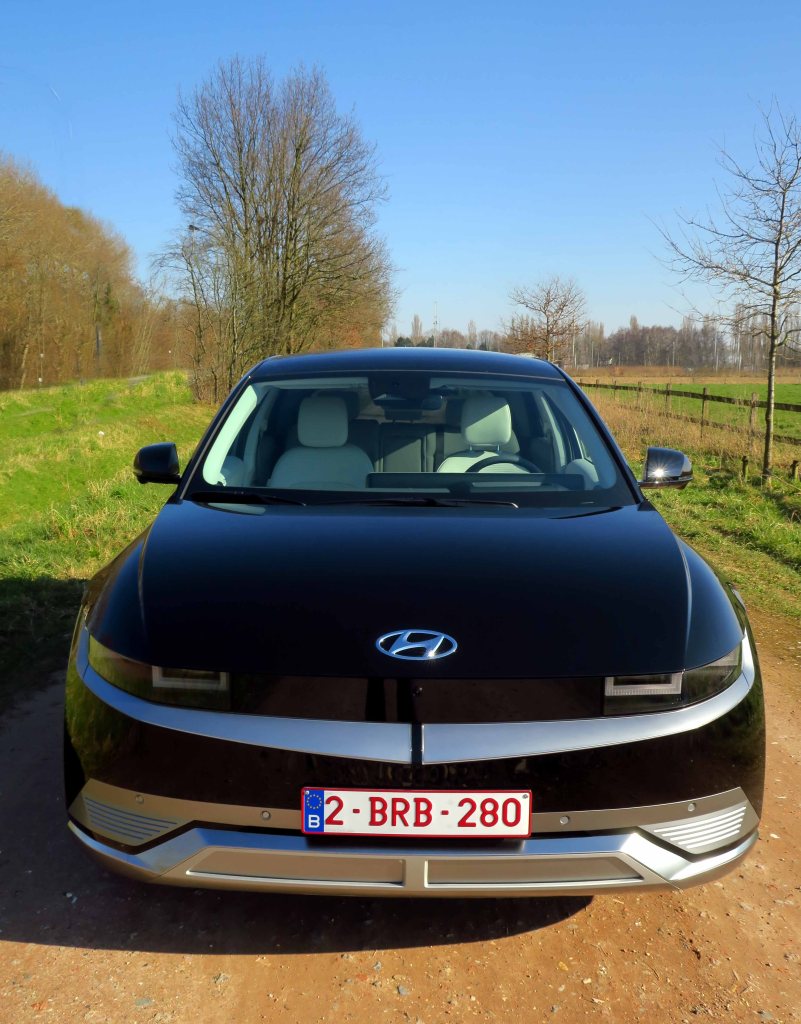
But there are more advantages offered by this platform. It enables total freedom in vehicle design. Designed exclusively for BEV’s, it has no transmission tunnel at all. A completely flat floor is an ideal playground for (interior) designers. So explains Vice President of design, Haksoo Ha: “The innovative platform means we can design for greater productivity in transit,” and “Seats reclining to a near-horizontal will provide a ‘zero gravity’ experience and will open up endless configuration opportunities.”

Indeed, the front seats convert into first class sleeping seats. Ideal when on a longer evening trip you can take a power nap when your Ioniq is quickly recharging to bring you home…  

There is no transmission tunnel, the front centre console can be moved backward, so front legroom is also limitless sideways.

Also in the back there is ample legroom, last but not least because of the Ioniq’s long 3 meter wheelbase. With the absence of the transmission tunnel, it seats three grownups relatively comfortable at the rear. The back seat can also be inclined and moved fore and aft! Indeed, the well proportioned and elegant Ioniq is big. It is 4,64 meters long, and 1,89 meter wide. Its boot offers 531 l space in standard setup, and with the rear backrests down, a maximum space of 1591 l is available.

Under the front hood, above the electric motor, you find a neat box with its lid having the appearance of an engine cover. When you drive the two wheel version of the Ioniq 5, this box offers 57 liters, with the 4WD version this is “only” 24 liters.
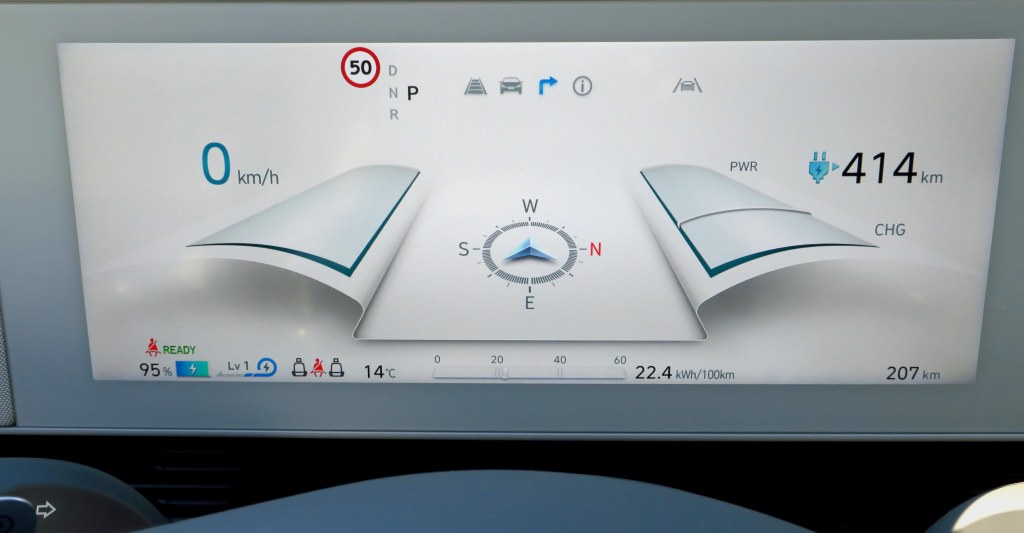
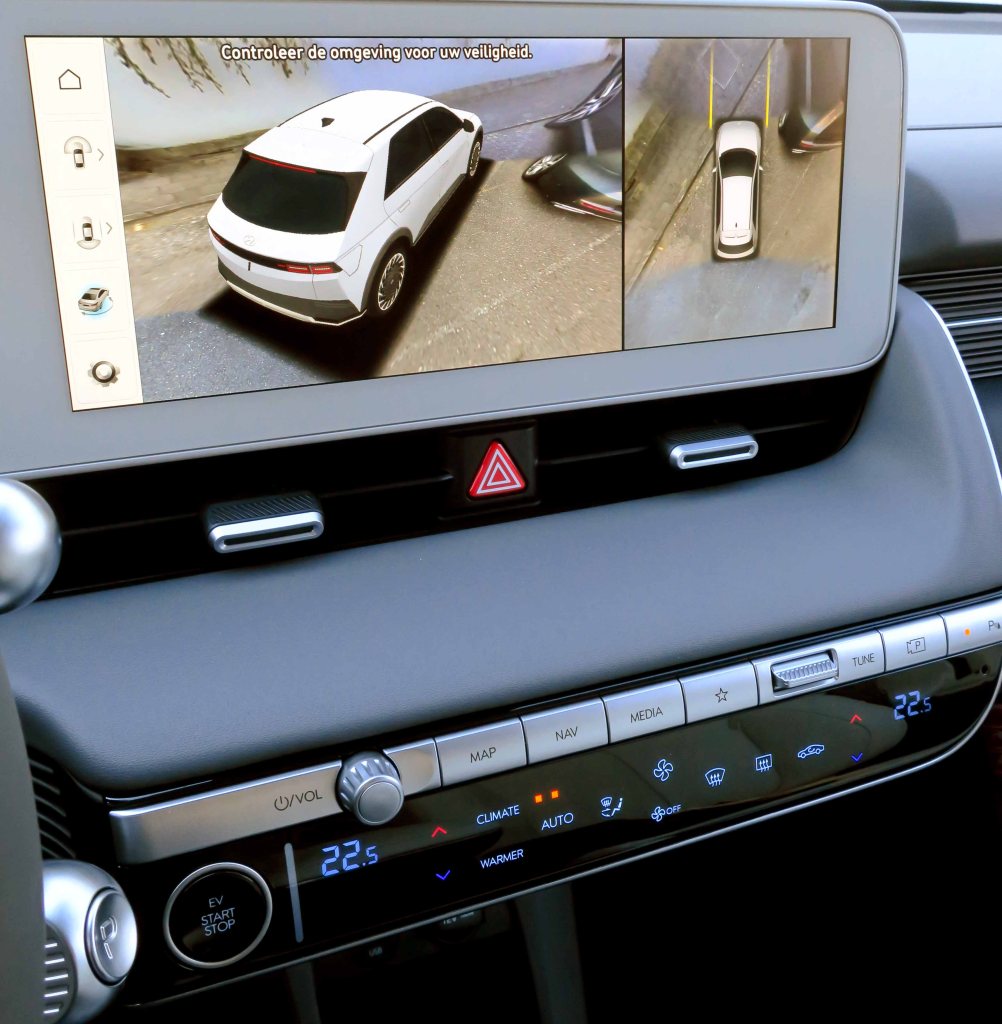
But let’s turn to the stylish dashboard. Notwithstanding its futuristic clean architecture with two wide screens, it is surprisingly intuitive to use, and you really don’t need an instruction manual to put all its functions to work. Beneath the central touchscreen you find the heating/ventilation functions, with classic buttons and controls.
Under the hood…

The E-GMP platform allows a wide choice of drivetrain combinations. The Ioniq 5 can be had with one or two electric motors, resulting in rear wheel drive or 4WD as the second motor drives the front wheels, and two battery capacities, 58 or 72,6 kW respectively.

Total available power ranges from 125 kW/170 HP to 225 kW/, with the top version accelerating from 0 to 100 km/h in 5,2 seconds. Top speed is for all the power versions limited to 185 km/h.

Our test car had the 160 kW/217 HP engine, developing 350 Nm of torque. This resulted in an acceleration from 0 to 100 km/h in 7,4 seconds, coupled with the 72,6 kW battery. Consumption according to WLTP standards is 16,8 kWh/100 km, with a range of some 481 km. Range anxiety is in the light of the fast recharging capacities a thing of the past…

On a 101 km triip with dense traffic at varying speeds, we clocked a consumption of 16,1 kWh…

The larger battery also allows you to tow greater loads, up to 1600 kg for our test car…

Did you know that the Ioniq 5 also has a 230 V external plug adapter? It’s so-called “V2L” function in the car can also supply up to 3.6 kW of power. So when you are out in the open, and want to charge your laptop or use a spot light or portable fridge or recharge the battery of your electric bike, the Ioniq 5 helps you out…

The Ioniq 5 has of course the usual driving modes, from Eco to sport, and you have also two paddles at the steering wheel which allow you to choose the degree of E-recuperation when you lift the throttle. During our test, we used mostly the level 3 position, which we felt delivered the right deceleration, and with some experience, we managed to drive around town and on the open road without ever touching the brake pad pedal at all…

Driving is (again) believing…

Driving with the Ioniq 5 is nothing short of delightful. Twist the ring on the selector stick a click forward in “D” and there you go. The Head-up-Display with Augmented-Reality-Function is ultra visible and shows what you need to know. Progress is silent and smooth. The suspension is also quite comfortable, and the Ioniq seems literally to float over the road surface. Body roll is virtually absent and the suspension is not too soft either, but copes rather well with potholes and ridges.
This is your ideal mount for long urban and/or Gran Turismo trips. Handling is also much more precise and nimble than one would expect from a two-tonne car, but the low gravity point of the battery package results in impeccable and stable cornering. We found also the lane assist functioning very smoothly, and we liked also the electronic displays of blind spots when you operate the left or right indicator. A wonderful solution!

The Ioniq 5 is large, but just be surprised with us, this Ioniq offers distance parking! Just press the symbol on the key, and the Ioniq 5 will sweetly drive itself into or out of a narrow parking space. 

The superb smoothness and acoustic refinement of the Ioniq is further enhanced with a superb Bose audio system, and Classic Music and Jazz buffs as we are, our ears also enjoyed every ride…

Conclusion

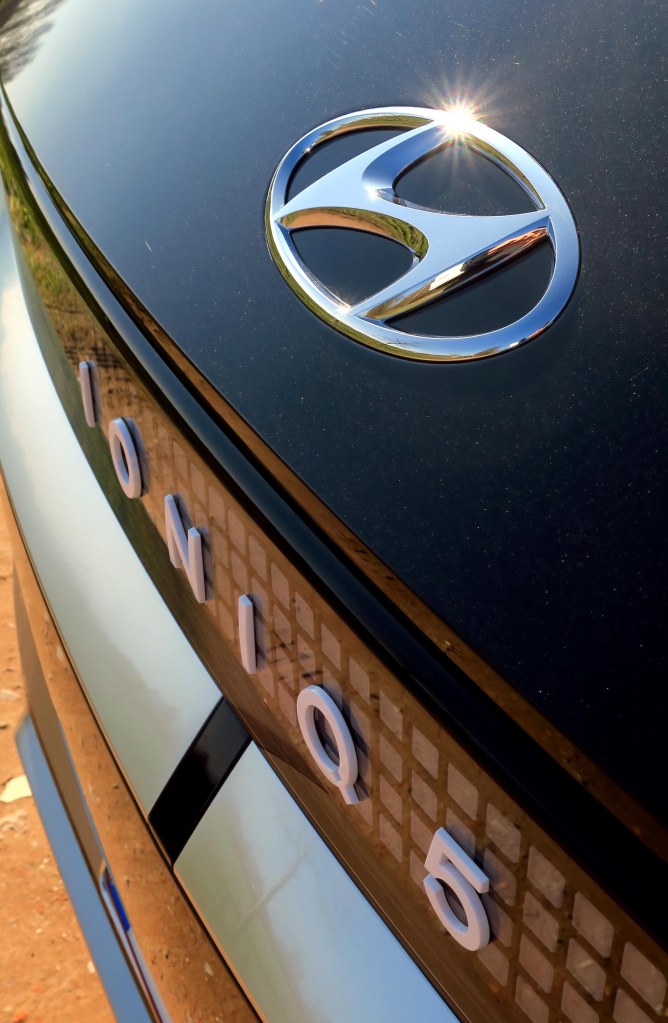
Style, grace, space, this Ioniq has it all; add to this the panache in the design details of headlamps and rear lights, in ’80 retro futuristic fashion. It really stands out.
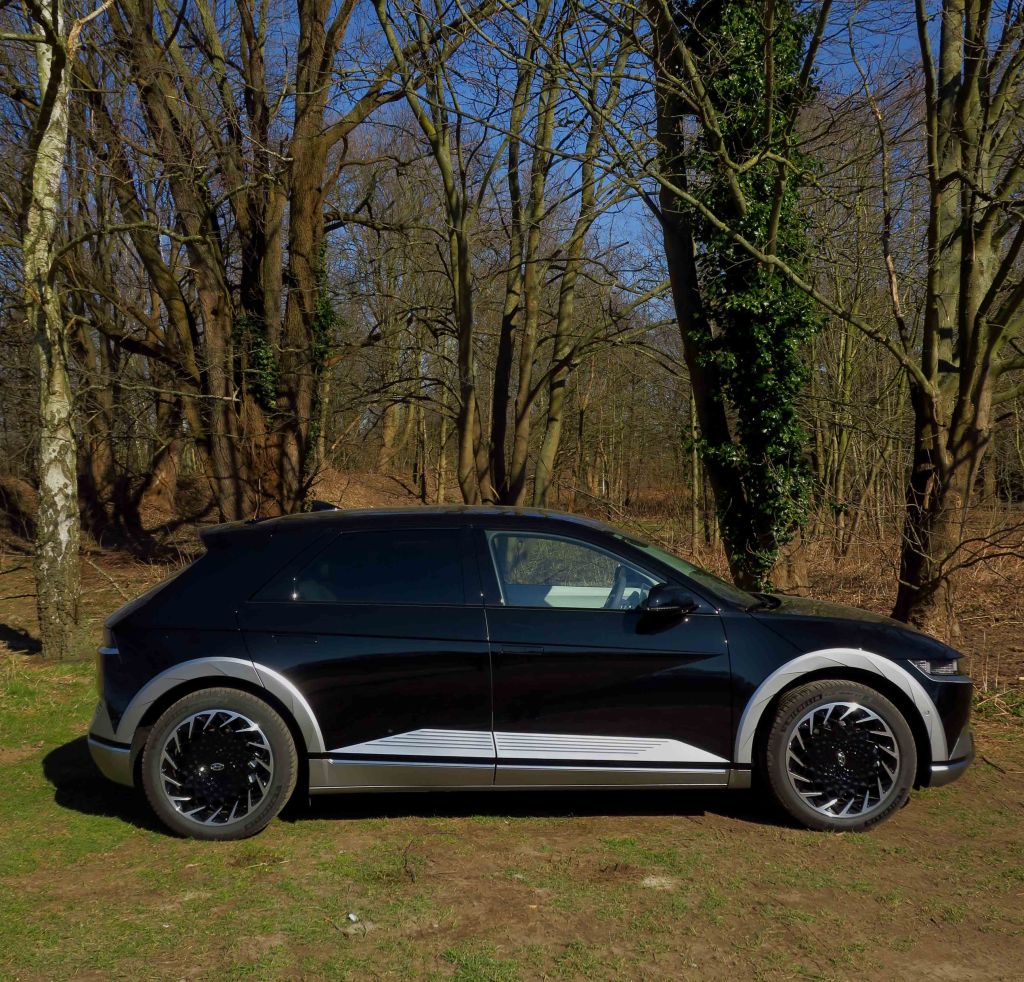
Also the 20 inch alloys are elegant and aerodynamically efficient. This Hyundai has been carefully thought out, is wonderfully designed with no detail being overlooked. Add to this the efficient motors, the impressive recharging capacity, the generous space, and you understand our enthusiasm. You will also be smiling when you see the price of the Ioniq 5 in whatever version you choose.

Hard to beat? We should think so. Except maybe by the Kia EV6, running on the same platform and using the same technology, which we are driving at the moment of writing, and of which you will also read our driving impressions soon!

Hans Knol ten Bensel    

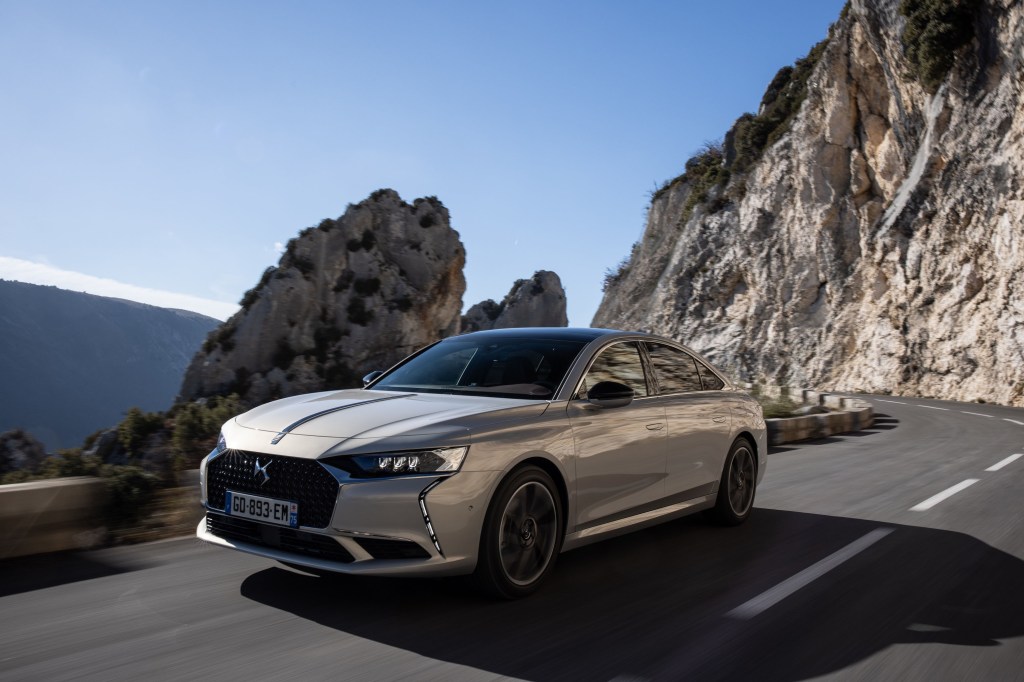
We drove the DS9 E-TENSE 4×4 360 in Nice: style, elegance and smooth high performance…

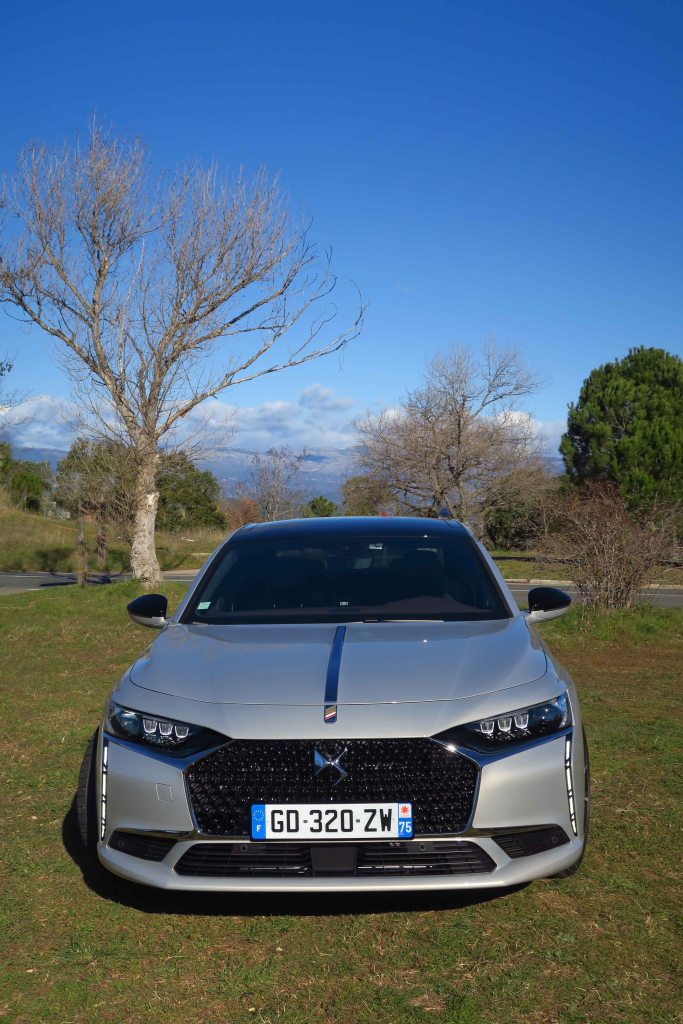
The French automakers have a unique tradition of building “Grandes Routières”, distinctive in style, comfort and performance. DS Automobiles takes this custom to new heights in this electronic times and age, putting also their vast experience gained over recent years in E-formula racing into their automobiles.

The result is the E-TENSE 4×4 360. A 4-cylinder 200 horsepower engine and two electric motors, one 110 horsepower (integrated with the gearbox at the front) and the other 113 horsepower (linked to the rear axle), are aided by intelligent four-wheel drive transmission. The 11.9 kWh battery features advanced management to save energy so as to handle different applications, says DS Automobiles.

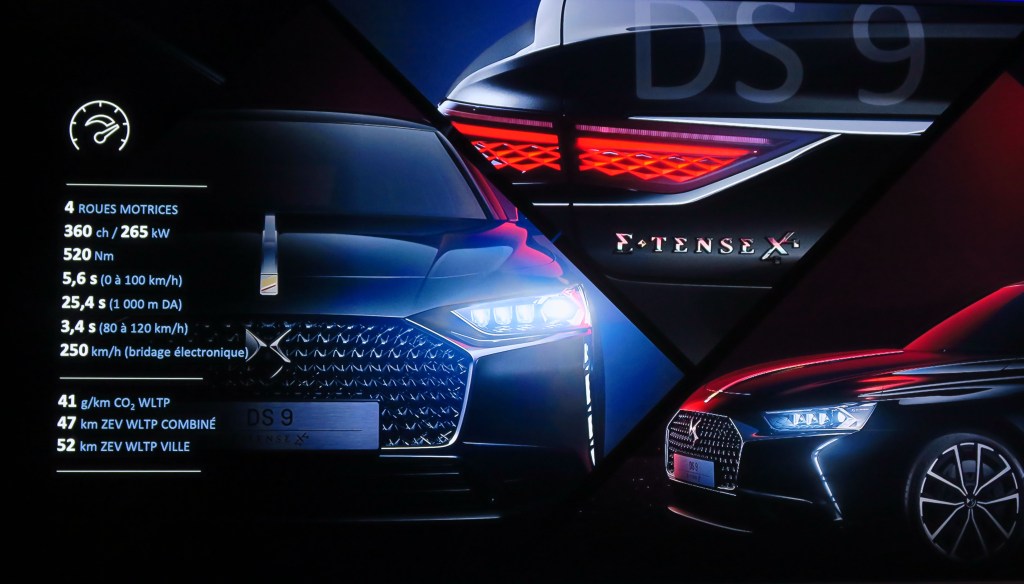
The result is of course breathtaking performance, not in the least thanks to the ample torque developed by the two electric motors. 0-100 km/h takes only 5.6 seconds, top speed is electronically limited to 250km/h, with the capability of reaching 140 km/h on electric power alone. Total torque, engine and E-motors combined is an impressive 520 Nm.

The figures displayed here at the press conference about the DS9 E-Tense 360 tell it all…

But there is more than just sophisticated power. It means also that the DS9 is designed to combine the virtues of E-power with combustion power to achieve the environmentally responsible footprint of a modern, electrified high end performance limousine.

At the morning press briefing before we took the cars on the road on a well chosen 148 course around Nice, Christophe Château of Product Communication DS Automobiles explained us a unique feature of the DS9, which put us in the footsteps of the E-formula racing pilots: the “Energy Coach”, an exclusive app installed on the DS9.

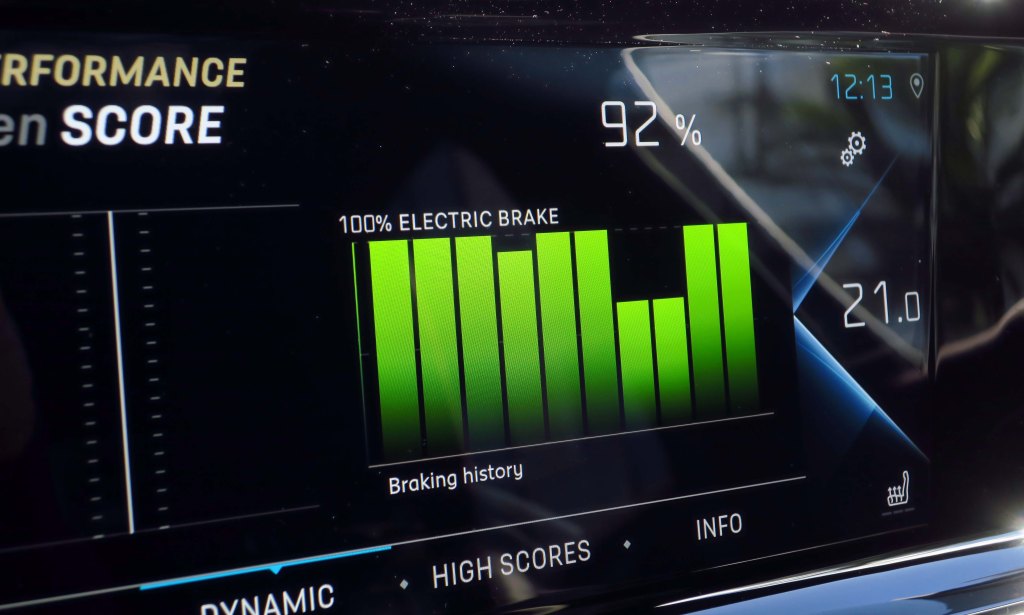
On the 148 km long varied test course, your servant managed a score of 92 % recuperation of kinetic energy!

Developed with DS Performance and double Formula E champion Jean-Éric Vergne, the DS ENERGY COACH app helps drivers to maximize energy regeneration during deceleration. Scores are shown on the central screen. The trick is to fine tune your pressure on the brake pedal, so that the brakes are not activated and all the kinetic energy is transformed again into E-energy. It takes clever anticipation to achieve this in all traffic situations. The Formula E-drivers have to do this too, to enable them to have sufficient battery power for these last extra fast laps in the final stages of the race…

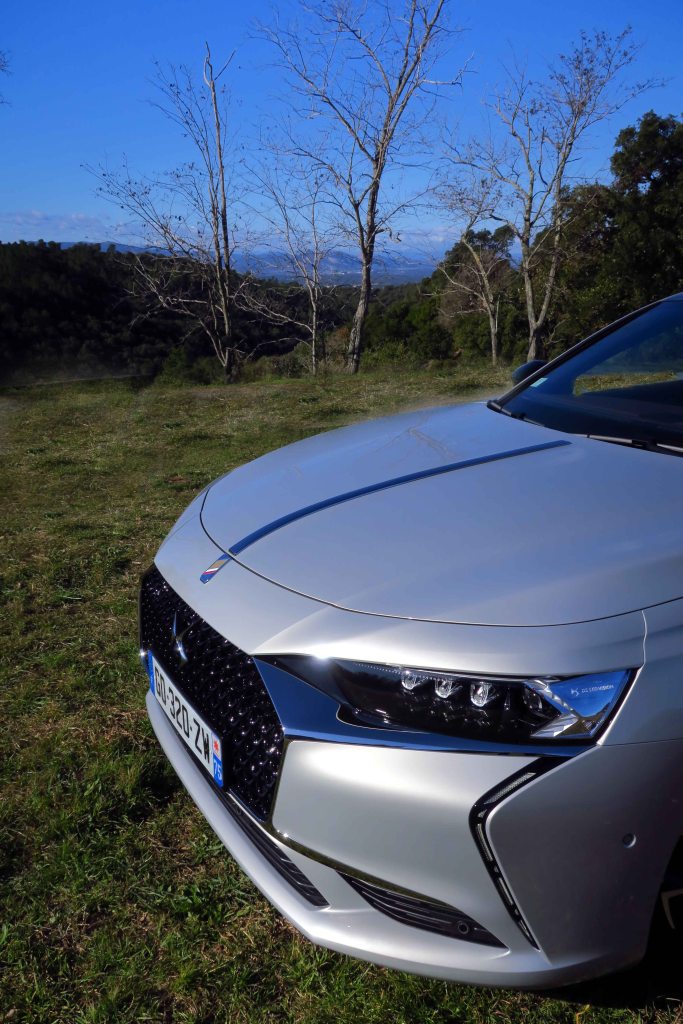
Your servant decided to have a go at this, and indeed, while being totally unfamiliar with a very mixed course comprising sharp bends on the corniches in the beautiful Estérel, the autoroutes and the city streets in Cannes and Nice, I managed a score of 92 %, meaning that 92 % of the kinetic energy in all my decelerations was transformed into E-energy. By doing this, we still maintained a rather brisk pace, as we had to respect the “moyenne” or average speed because we had to be back at the starting point of the course at 12.00 h to have lunch and attend the second press conference in the afternoon. I had to hurry even slightly more as I had to allow also some time to take some photos you see here.

So the DS9 was driven with verve over the winding roads on the cornices, and here I discovered again how well the comfortable suspension behaves in these conditions. We already applauded in our previous test of the DS9 225 the merits of the DS ACTIVE SCAN SUSPENSION, which scans the road ahead of you to fine tune the suspension to an ideal setting to cope with the road surface irregularities immediately in front of you. You can see a 1 minute You Tube film by DS automobiles on this system with the following link: https://www.youtube.com/watch?v=ZE-1MolcvAI

Indeed, remaining stable and predictable as on rails with virtually no body roll in corners, the DS9 remained utterly comfortable.

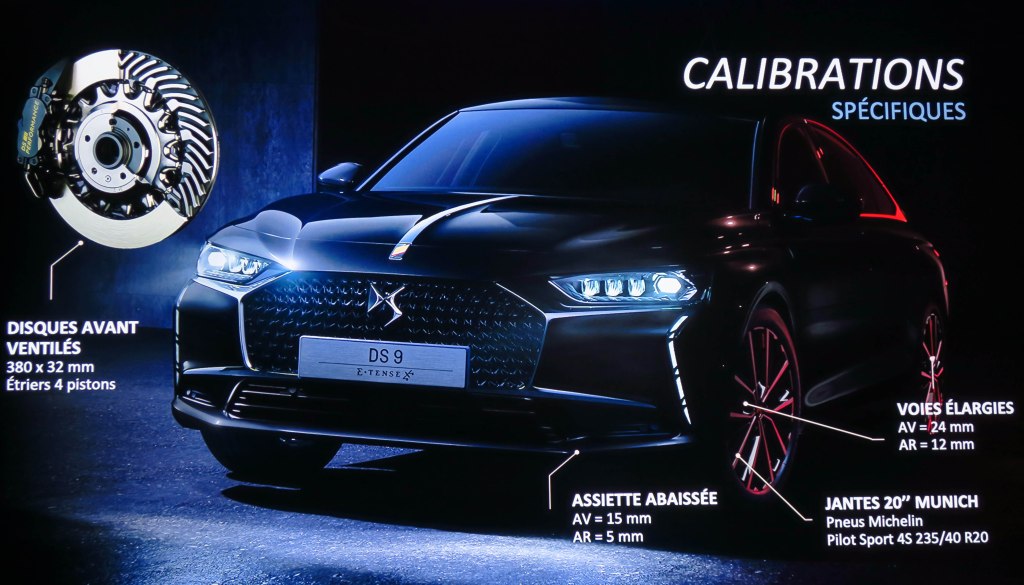
This slide shows the modifications made by DS Performance on the DS9 4 x 4 360…

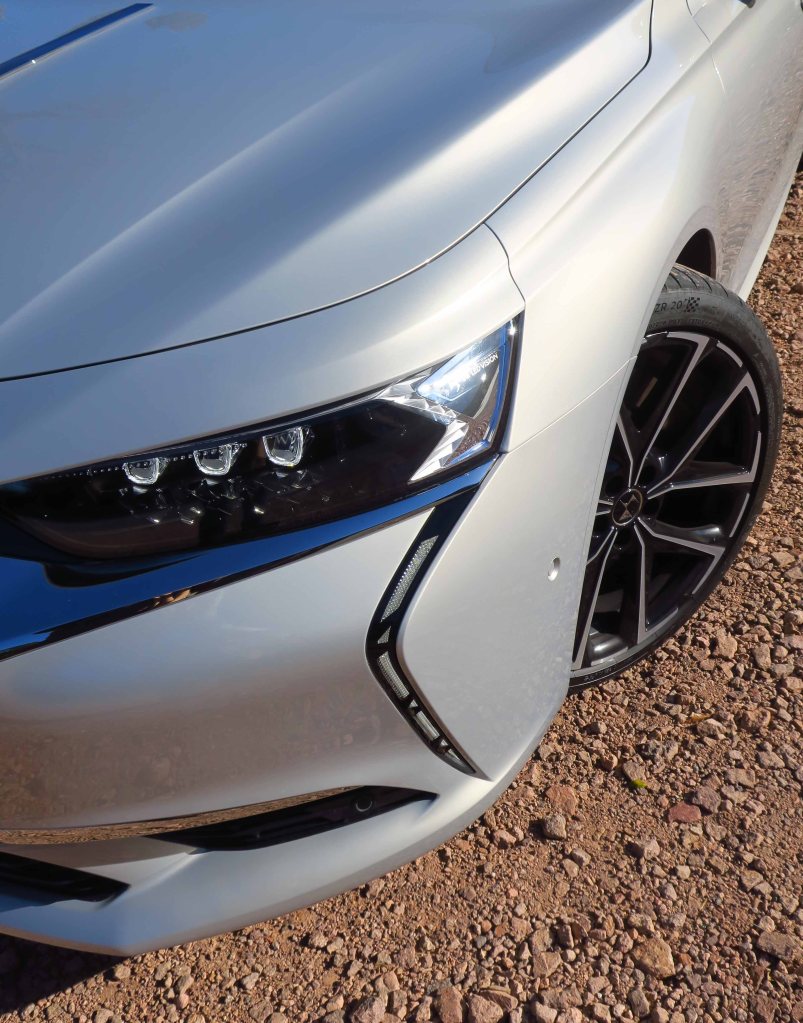
The DS 9 E-TENSE 4×4 360 uses special front and rear axles with a wider track. The braking system is uprated with four-piston calipers for better power distribution under heavy braking with 380 x 32 mm discs at the front (up by 50 x 2 mm compared with DS 9 E-TENSE 225) and 290 x 12 mm at the rear. 20 inch MUNICH alloys are used and the suspension is lowered.

We could not measure exactly due to time pressure our consumption on the trip, but suffice to say here that after 148 kilometers, only a quarter of the small 41 litre petrol tank was emptied…boiling down probably to a fuel consumption of some 7 litres/100 km, with also a good 15 % of the battery still remaining charged. 

In zero emissions mode, the DS 9 E-TENSE 4×4 360 covers 52 kilometres on the WLTP urban cycle or 47 kilometres on the WLTP combined cycle.

According to the WLTP Cycle, fuel consumption is restricted to 1.8 litre / 100km with homologated CO2 emissions of 41 g/km.

During our trip, we (re)discovered what an excellent GT this car really is, indeed a totally relaxing and an undisturbed joy to drive. The 1598 cm3 engine remains quiet, subdued and refined, aided by the smooth 8 speed automatic transmission. Last but not least we tell you here that the 360 is available in PERFORMANCE LINE + and RIVOLI + specifications.

The DS9 250…

With this car, we rediscovered the DS9 we tested earlier (see our report on https://autoprova.be/2022/01/29/we-drove-the-ds9-e-tense-225-french-elegance-and-panache/) with the total system power now raised to 250 HP. This DS has only front wheel drive, and somewhat lesser performance: 0 to 100 km/h (62mph) in 8.2 seconds, a maximum top speed of 149 mph (240 km/h). But it still remains a superb car, and in daily driving practice, apart from the delightful out-of-corner accelerations of the most powerful 360, driving impressions on the sunny dry road course at the Côte d’Azur were not radically different. Suffice to say that total torque, engine and electric motor combined, is here still some 360 Nm.

According to WLTP, fuel consumption is 1,5 l/100 km, the electric range on its 15.6 kWh (total capacity) battery is up to 61 kilometers on the WLTP combined cycle with an unchanged vehicle weight.

The DNA of DS…

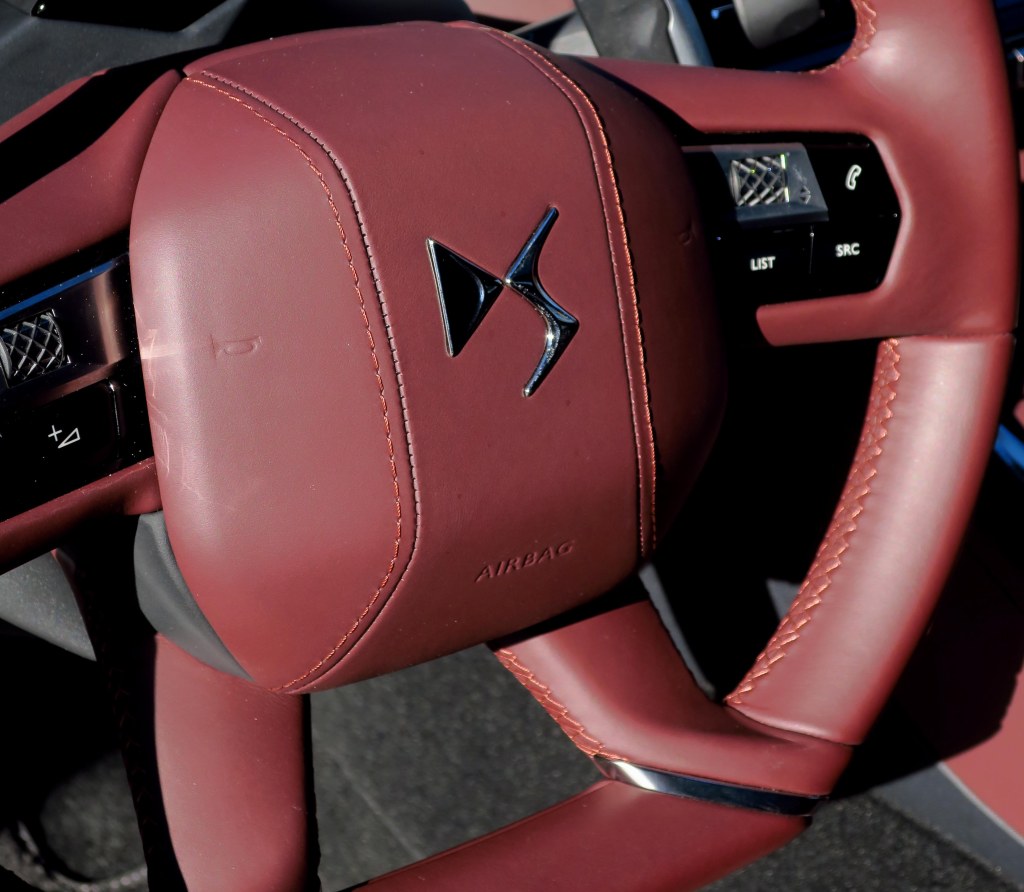
Superb quality of materials, intricate stitching and styling, is the DNA of DS Automobiles…

At the lunch, your servant had a very interesting conversation with Alexandre Stricher, (communication Brand and Prototype DS Performance), who applauded me on my achieved results on the ENERGY COACH app. “I wish every owner of the DS9 would adopt your driving style”, he complimented. Our conversation then drifted to the unique styling language which defines DS Automobiles, being a crucial element of their DNA. I remarked that the angular styling touches in the interior and instrumentation layout are reminiscent of the “art deco” styling language and rakish shapes found amongst others in Voisin automobiles.

Alexandre Stricher, (communication Brand and Prototype DS Performance), speaking at the afternoon press conference…

My conversation partner agreed. “A refined, elegant styling language and the use of unique materials and (stitching) patterns is what we are aiming for. We want to differentiate ourselves from the competition as a young, up market brand, combining a sense for refinement in styling and used materials with superb electrified technology,” he told me.

 “But there is more, much more, he said with a smile in his eyes. “What to think of 800 hp? an acceleration of 0 to 100 km/h in less than 2 seconds? 

And during the press conference, he revealed the E-Tense Supercar, of which much more in a separate report…

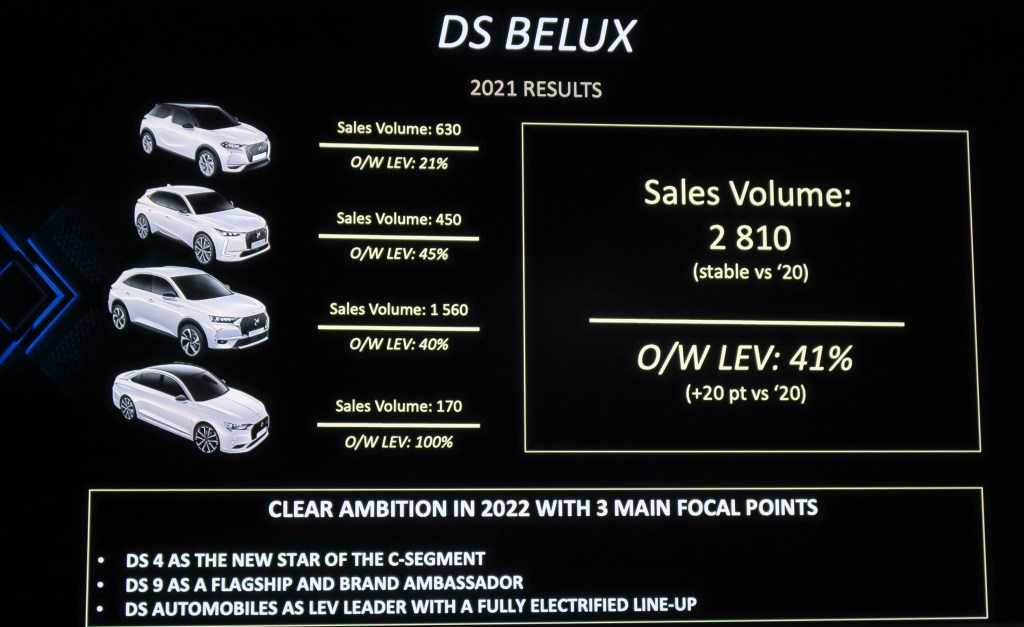
Last but not least, seen here on the photo above, Dominique Fontignies, PR & Communications director – Stellantis Belux, briefed us about the situation for DS Automobiles on the Belgian market.

We show you here the slide with the sales figures, which speak for themselves…

Stay tuned!

Hans Knol ten Bensel

We drove the 360 HP DS9 E-Tense 4×4 in Nice… and witnessed the launch of the DS Supercar!

Arriving late last night from Nice, we report you here immediately about the wonderful driving experience with the most powerful DS9, enjoying its pure GT talents over the winding roads around Grasse and the iconic Côte d’Azur. We will soon tell you more about it.

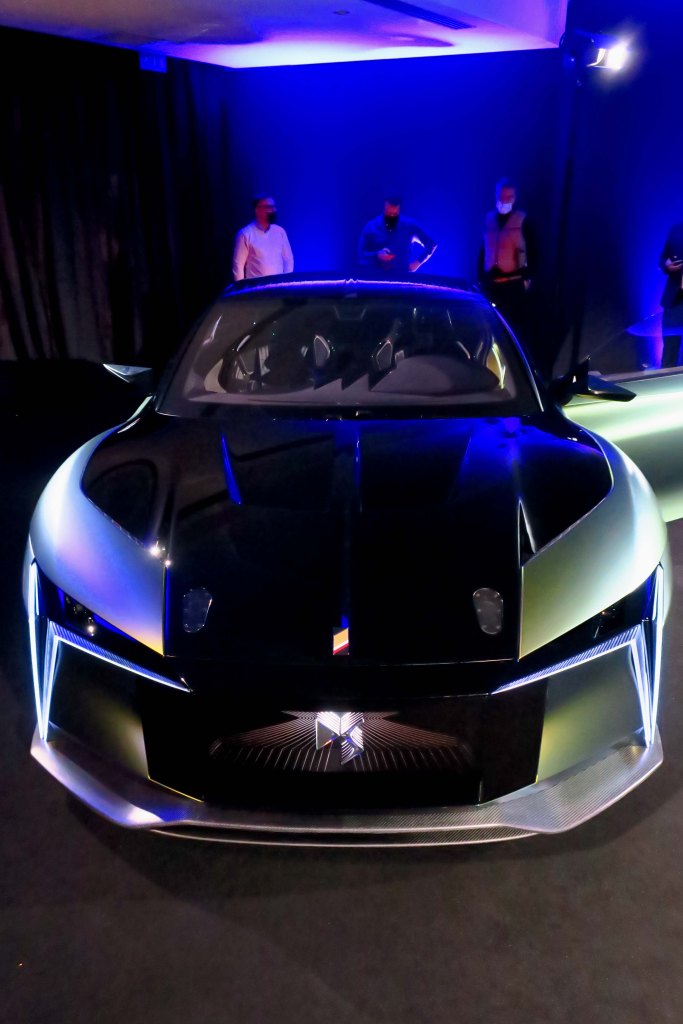
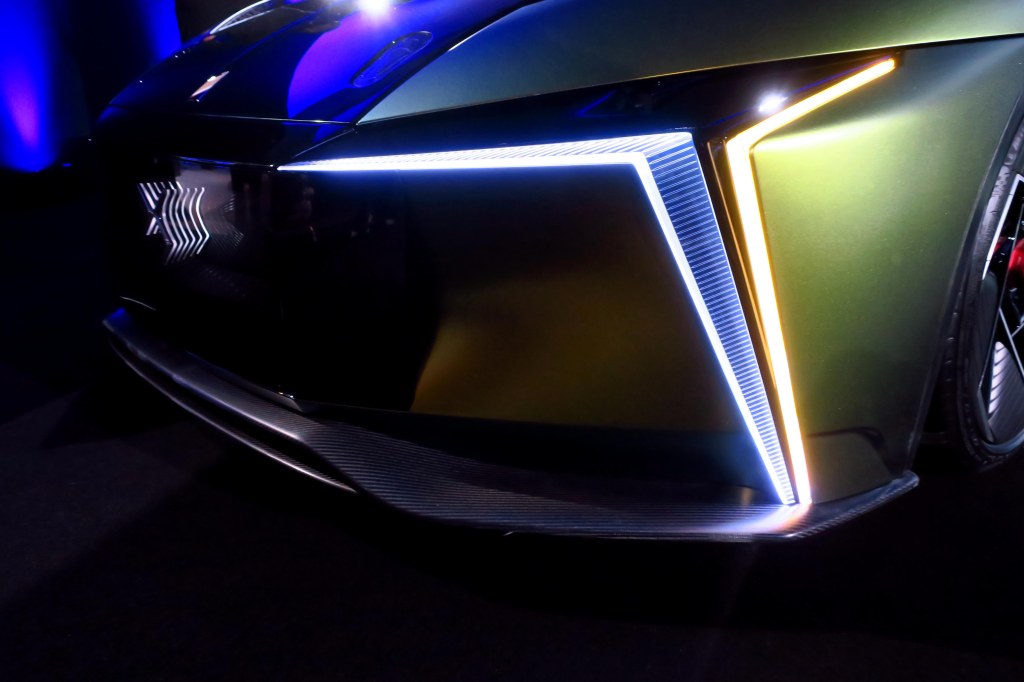
But the gentlemen of DS Automobiles did even more than just letting us have a drive in their flagship DS9, they also unveiled in the flesh at their press conference a wonderful Supercar, with absolutely stunning looks and performance.

DS Automobiles puts their E-Formula racing experience into practice on our roads… What to think of 815 HP or 600 kW, developed by two electric motors of 250 kW in the front, and 350 kW driving the rear wheels.

Acceleration from 0 to 100 km/h is done in a fantastic 2 seconds…and the car is a beauty too!

Much more about this superfast E-“bolide” and the impressive top-level DS9 soon on these pages!

Hans Knol ten Bensel    

Porsche launches the “T” version of its Macan: exclusive sportiness…

The letter T has represented a unique form of dynamic driving at Porsche since the 1960s. It stands for ‘Touring’ and identifies models that offer an especially authentic driving experience thanks to precise tuning, exclusive equipment and efficient engines.

It all started in ’68 with the Porsche 911 T. Lightweight and dynamic. Your servant vividly remembers being at the wheel of this “Ur” 911 T… I drove it full bore on the winding small roads along the Leie in the region of Deurle.

The same recipe maximizing agility is used for the Macan T.  Besides the sportier setup, it has a lightweight, two-litre turbo engine. This concept positions the Macan T between the Macan and the Macan S.

Lightweight, for an agile response

The two-litre, four-cylinder turbo engine of the Macan T combines, Porsche says, “great agility, low weight and a compact design to create a package that offers an ideal balance of weight and performance.”Compared to the 2.9-litre biturbo V6 engine in the Macan S and GTS models, the powertrain in the Macan T weighs 58.8 kg less on the front axle.

Power galore

The Macan T has an output of 195 kW (265 PS) and 400 Nm of torque. The engine is coupled with a seven-speed dual clutch transmission (PDK) and the Porsche Traction Management (PTM) all-wheel drive system. A broad spread of torque provides, according to Porsche, “responsive acceleration in all driving situations.” When fitted with the standard Sport Chrono Package including the mode switch and Sport Response button on the steering wheel, the Macan T accelerates from 0 to 100 km/h in 6.2 seconds and reaches a top speed of 232 km/h.

Specially tuned chassis lowered by 15 millimetres or more

The Macan T is the only Porsche model to feature steel suspension with Porsche Active Suspension Management (PASM) as standard, combined with the body being lowered by 15 mm. The anti-roll bars on the front axle are more rigid and the car’s chassis tuning has been optimized to create the perfect suspension for the vehicle and powertrain, resulting in very responsive steering behavior and agile handling.

Get the tail out sideways…

The Porsche Traction Management (PTM) has also been adapted to the driving demands of the Macan T and has been specially designed with a rear-wheel bias. Adding adaptive air suspension with PASM and lowering the body by a further 10 mm is also an option – a new feature for Macan models with four-cylinder engines. Porsche Torque Vectoring Plus (PTV Plus) can also be added: the system has been adapted to the dynamic characteristics of the T model and further sharpens the driving dynamics.

Exclusive details inside and out

Design elements painted in Agate Grey Metallic on the front, flank and rear of the Macan T differentiate the vehicle from other models in the series. The exclusive contrast colour can be seen on the painted front trim, exterior mirrors, side blades, roof spoiler and logos on the rear. Sports tailpipes and side window trims in Black (high gloss) are included as standard and the side blades feature the ‘Macan T’ logo in Black. Twenty-inch Macan S wheels, exclusively in dark titanium, come as standard. Customers can choose from a range of 13 plain, metallic and special colours for the exterior.

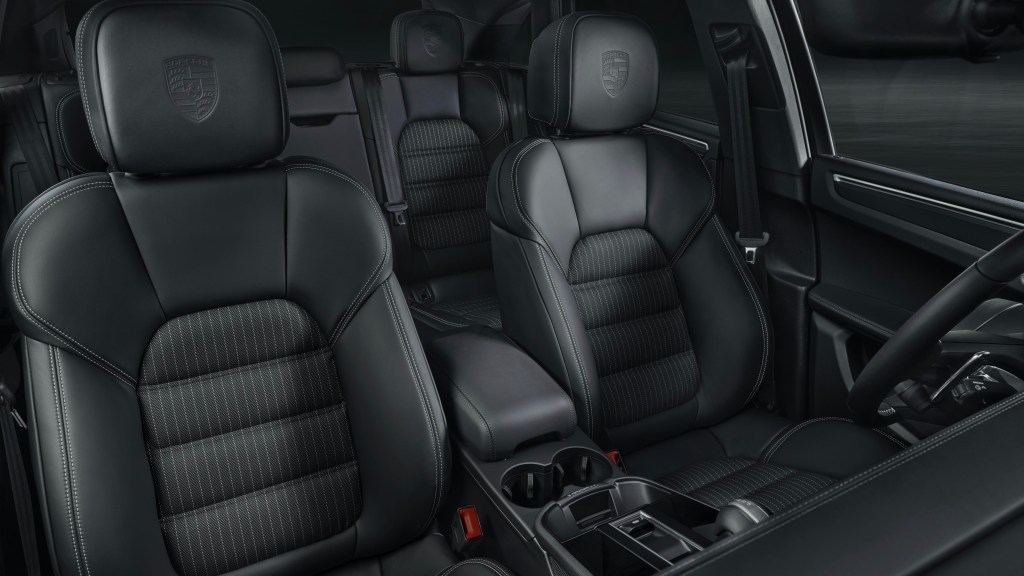
The interior of the Macan T has its own distinct ambience. The standard, eight-way electrically adjustable heated sports seats feature an upholstery based on the Black leather package. The centres of the front seats and the outer rear seats are delivered with the Sport-Tex Stripe pattern and the front headrests each have an embossed Porsche crest. The contrasting colour from the exterior continues inside the vehicle in the form of decorative silver stitching on the seats, headrests and steering wheel.

Porsche panache in the cabin

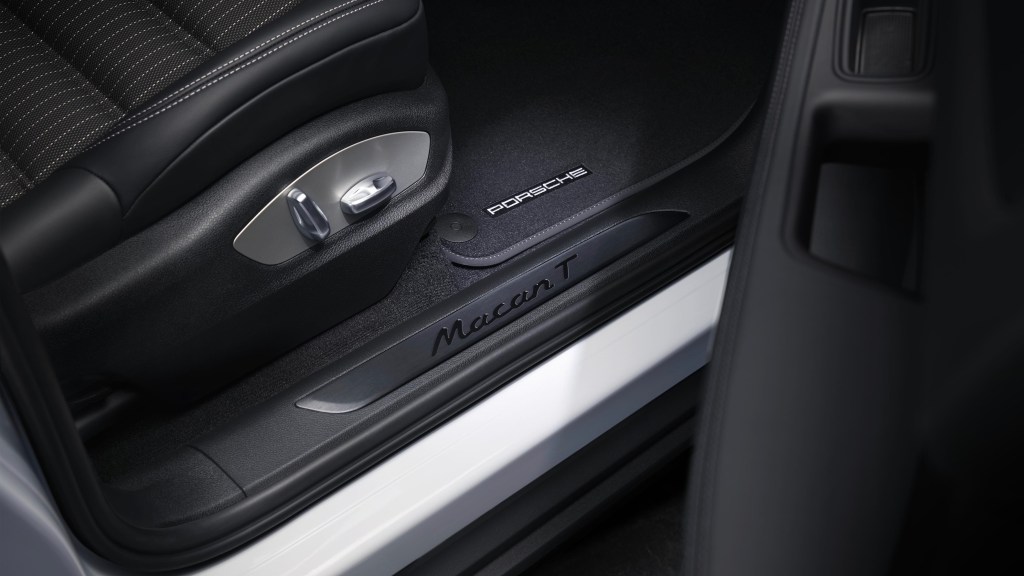
Standard equipment also includes a multifunction GT heated sports steering wheel and the Sport Chrono stopwatch in the upper part of the dashboard. The door entry guards come in black aluminium as standard and feature a Macan T logo. Optional features include the multifunction GT sports steering wheel in Race-Tex with carbon trims and an ioniser.

The Macan T also benefits from all of the new elements of the model generation revised in summer 2021, such as the new centre console with its sophisticated glass-look and touch-sensitive surface, as well as the fully networked Porsche Communication Management (PCM) system with a 10.9-inch touch screen and online navigation as standard.

Soon on our roads…

The new model is available to order now. Deliveries in Germany will commence in April 2022.

More Porsche news soon!

Hans Knol ten Bensel
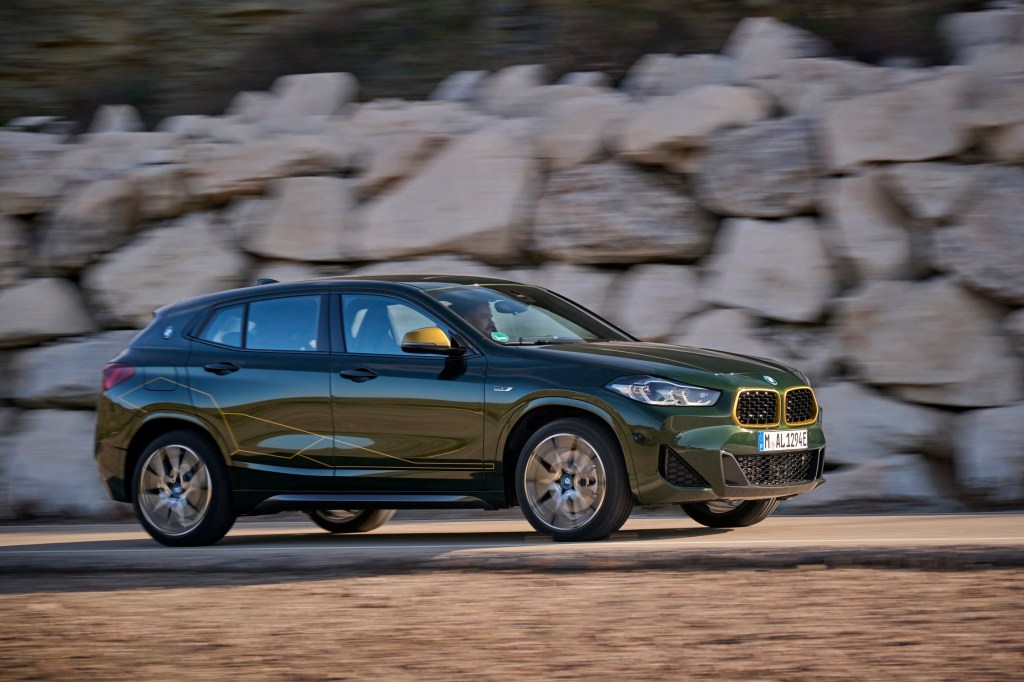
BMW launches visually appealing “Gold Play” edition for is X2…

The distinctive design of the BMW X2 projects a sense of athleticism that reflects the car’s sporty driving properties, according to BMW, and we can agree. Now the dynamic brand from Munich adds some additional zest to its X2 range.

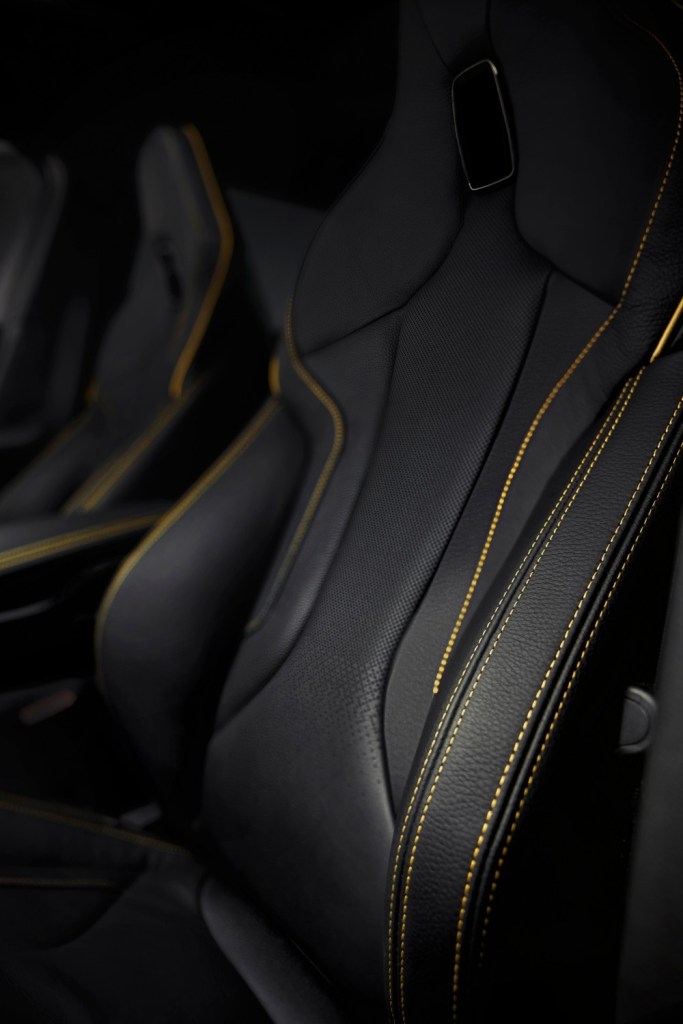
It launches a new special edition of the compact Sports Activity Coupé with visually more striking exterior touches and creates an interior ambience distilled to maximise driving pleasure.

The BMW X2 xDrive25e plug-in hybrid, super-sporting BMW X2 M35i and all other engine variants will be available in this special-edition form from March 2022.

The new special edition combines equipment highlights, such as the extended M High-gloss Shadow Line, the “X2” logo projection from the driver’s side mirror or the optionally available Adaptive LED Headlights including a four-segment matrix high-beam headlight function, turning lights and adaptive light distribution, with exclusive exterior details and special interior appointments.

More BMW news soon!

Hans Knol ten Bensel

Lexus lifts a veil of its BEV Sport Concept car: formidable!

Lexus has released a gallery of new pictures and animations of its possible next-generation BEV Sport, Sedan and SUV concepts. The models were first revealed on December 14, 2021, in the corporate battery electric vehicle (BEV) announcement made by Akio Toyoda, Toyota Motor Corporation President and Lexus Brand Holder. The new Sedan, Sport and SUV concepts are proposed to be part of a full line-up of BEVs Lexus recently unveiled under the collective vision known as “Lexus Electrified.”

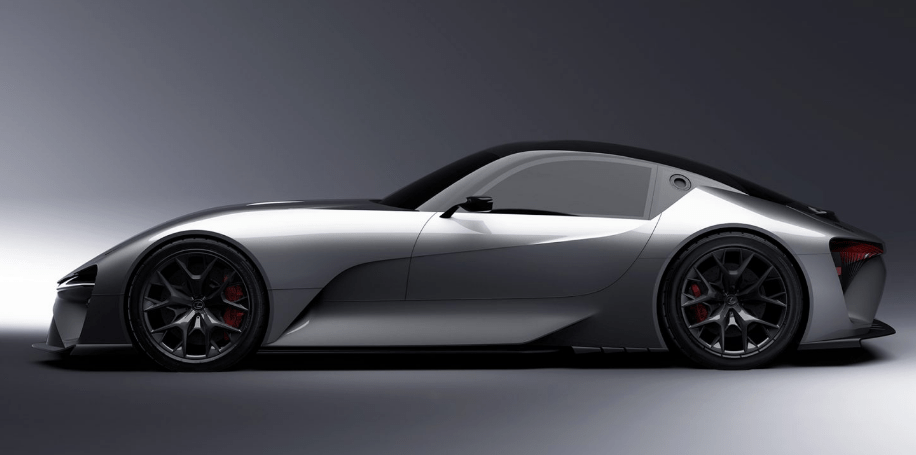
We show you here already some photos of the absolutely stunning all electric sports car…

It has bold proportions and low ride height, and of course all the sophisticated aerodynamics typical for a high-performance sports car.

According to Lexus, the Lexus BEV Sport concept symbolizes the future of the luxury brand, while also reviving the spirit of the iconic Lexus LFA.

The performance is nothing short of sensational. What to think of acceleration from 0-60 mph in the low two-seconds bracket, with at the same time a cruising distance which could exceed 430 miles, thanks to the possible use of solid-state batteries.

More news to come, also on the BEV Sedan an SUV Concept cars, but just admire already the breathtaking shape of this BEV Sport “Bolide”…

Hans Knol ten Bensel

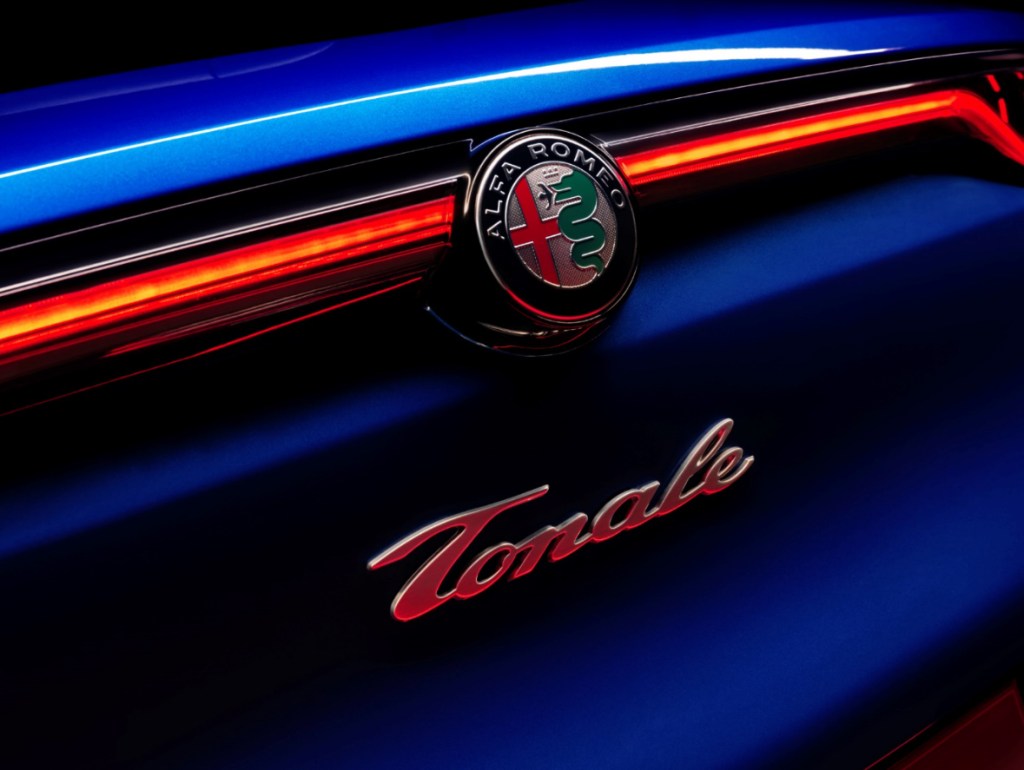
Alfa Romeo presents Tonale, bringing a metamorphosis of the brand…

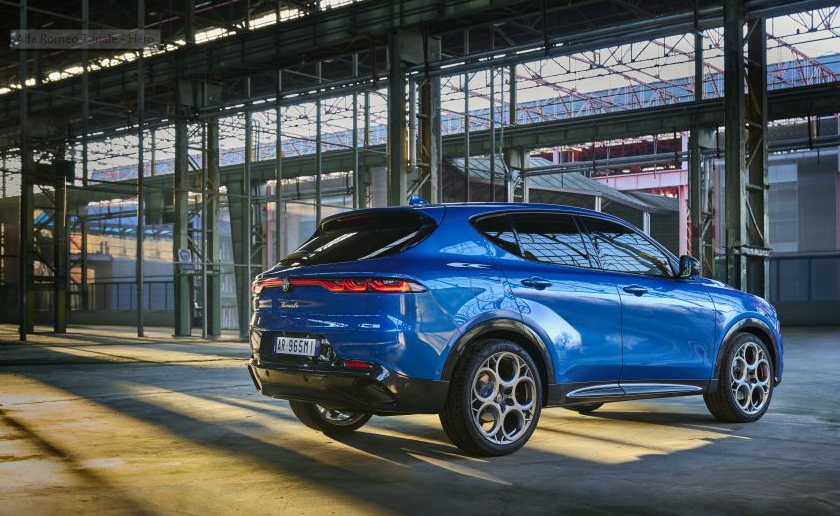
Alfa Romeo presented on February 8th its Tonale, the model that marks the Brand’s metamorphosis. Of course Alfa remains true to its DNA of noble Italian sportsmanship since 1910, but the Tonale a radical evolution is taking place at Alfa Romeo. It enters a new era of connectivity and electrification.

We bring you here in this first report the main points, of course, more will follow when we see the car ‘in the flesh’ at further presentations.

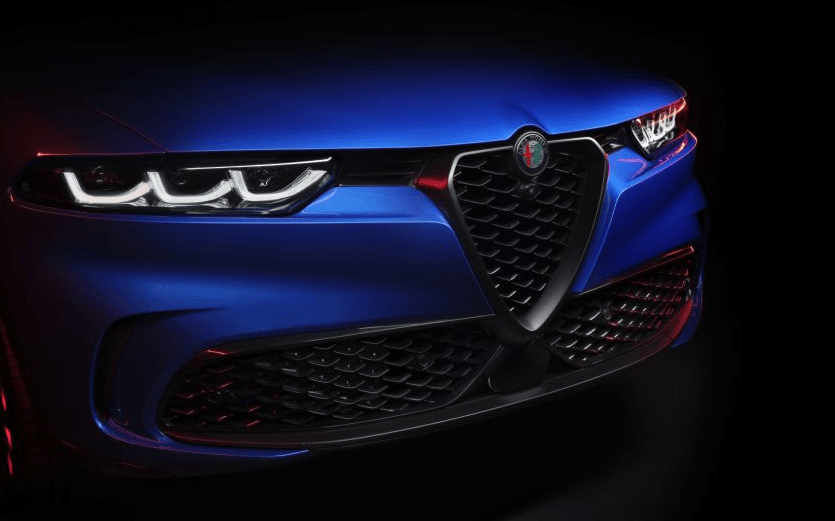
The Tonale breathes unique Italian design, being extraordinarily faithful to the concept model which you see here on the photo above, which we could admire feel and touch at the Centro Stile.

The car embodies state-of-the-art technology, Alfa says, with software and electrification systems enhancing the Brand’s DNA. With the launch of this car, Alfa also deploys a universe of innovative, customer-focused services. See more below…

The Tonale has a clear mission: reinventing sportiness for the 21st century. The name marks the evolutionary continuity with Stelvio, a fascinating new road that leads to a new destination: the future.

The car is made in Italy, at the revamped “Giambattista Vico” plant in Pomigliano d’Arco, according to Alfa one of the most advanced production plants in the automotive world, where a dedicated assembly line has been built with cutting-edge technology and high levels of automation.

The technology in the Tonale is aimed at enhancing the unique Alfa driving experience, but not only that: it also wants to bring the customer experience at another level and sets steps to protecting its residual value.

Indeed, in a a world exclusive, Tonale is the first car on the market equipped with a NFT (non-fungible token) digital certificate. Based on blockchain technology and uniquely linked, the Tonale NFT certifies the car upon purchase, then evolves to represent its use during the car’s life cycle, with major benefits in terms of protecting its residual value. With the customer’s consent, the NFT will record vehicle data, generating a certificate that can be used as a guarantee that the car has been properly maintained, with a positive impact on its residual value. On the pre-owned car market, NFT certification represents an additional source of credibility for owners or dealers to count on. In the meantime, buyers will be reassured in their choice of car.

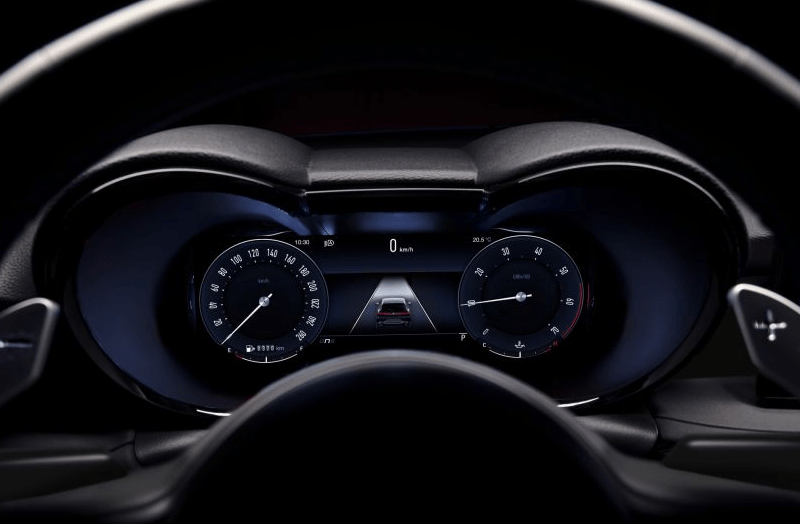
The Tonale also sports an all-new infotainment system. Totaling 22.5”, the two large Full TFT screens are installed.

The world of Amazon in your Alfa…

The infotainment system is designed to offer Over-the-Air updates and integration with Amazon Alexa.

There is a complete integration with Amazon: courtesy of the “Secure Delivery Service”, you can choose the Tonale as the place to deliver the packages you are expecting, by unlocking the doors and letting the courier leave them inside the car, all completely safely.

You can also receive constant updates on vehicle status from the comfort of your home, find out the level of charge and/or fuel, search for points of interest, find your car’s latest location, send remote locking and unlocking commands, and much more. “Alexa” can also be used to ask to add products to your shopping list, to search for a restaurant nearby or to adjust lights or heating connected to your home automation system, all while remaining focused on the road.  

The technology is also focusing on safety, with level 2 ADAS systems.

Cabin comfort is of course not neglected. Alfa tells us that the cabin environment is designed for and around the occupants, with meticulous attention to detail, paired with a constant quest for the highest quality.

Two levels of electrification – Hybrid and Plug-in Hybrid Q4, developed by Alfa Romeo.

State-of-the-art electrification: this electrification serves the Brand and its DNA, with the mission of reinventing sportiness for the 21st century, Alfa announces.

The Tonale debuts the 160-hp Hybrid VGT (Variable-Geometry Turbo) engine, an exclusive for Alfa Romeo. Its variable-geometry turbocharger paired with 7-speed Alfa Romeo TCT dual-clutch transmission and the 48-volt 15-kW, 55-Nm “P2” electric motor makes it possible for the 1.5-liter gasoline engine to propel the wheels even when the internal combustion engine is turned off.

Alfa Romeo has opted for this technical solution to offer an authentic electrified experience. The transmission enables startup and travel in electric mode at low speeds and when parking and cruising. At launch, the 130-hp Hybrid version is also available, again paired with 7-speed Alfa Romeo TCT and 48-volt “P2” electric motor.

The 275-hp Plug-in Hybrid Q4 version with all-wheel drive is has an expected range in electric mode of up to 80 km in the city cycle. It is the most powerful and efficient version in the line-up.

To complete the engine range, there is also a new 1.6-liter, 130-hp diesel engine with 320 Nm of torque, paired with 6-speed Alfa Romeo TCT dual-clutch automatic transmission and front-wheel drive.

Customers at the center of the Alfa Romeo universe…

With Tonale, Alfa Romeo launches a series of new services, which redefine the customer experience and will cover the brand’s entire line-up.

A digital experience:  the customer purchase experience can take place online from the comfort of home, in three simple steps, by accessing an interface identical to the one used in dealerships.

Extended warranty: Efforts to improve the quality of the end product have resulted in the availability of an innovative Alfa Romeo extended warranty, lengthening the protection of the vehicle’s main components to 5 years. The warranty for the batteries in the hybrid Tonale versions has also been extended to 8 years or 150,000 km traveled, becoming the best offer in the segment.

Alfa Romeo Certified is the dedicated to customers in the pre-owned car market. The aim is to ensure a shopping experience that is identical to that of buying a new vehicle. The main features of the service are as follows:

Warranty coverage equivalent to that of a new car.

 “Satisfaction or your money back”, within 10 days or 1,000 km

No maintenance costs, for 15,000 km or 1 year

120 vehicle checks

Customized after-sales and financing services

Test drive

24/7 roadside assistance in Europe during the warranty period

Finally, Alfa Romeo Videocheck is the service dedicated to after-sales, created in consideration of the special relationship its customers have with their car. One sole aim: service quality and transparency for customers. When at a workshop, if a car is found to need more work than agreed with the customer, the technicians will be required to follow a procedure via mobile app to certify the work, with a video to accompany the related repair costs. The customer will then be free to partially or fully accept or reject the new quote.

Driving dynamics…

Rather impeccable, according to Alfa. It has the best weight distribution and the most direct steering in its segment (13.6), and the fact it is the only model in its class to be equipped with the Integrated Brake System (IBS). The adoption of fixed calipers by Brembo, with 4 pistons and self-ventilated discs at the front and full discs at the rear, contributes to the improved braking performance.

The Tonale opts for the fully independent MacPherson suspension system, with Frequency Selective Damping (FSD) shock absorbers. The new Tonale offers two drive solutions: Q4 all-wheel drive in the Plug-in Hybrid e-Q4 version, and front-wheel drive in the Hybrid and diesel versions. The latter are also equipped with Alfa Romeo electronic self-locking differential. The specifications are completed with a “Dual Stage Valve” active suspension with electronically controlled damping.

New line-up strategy

The Alfa Romeo Tonale introduces a new line-up strategy.

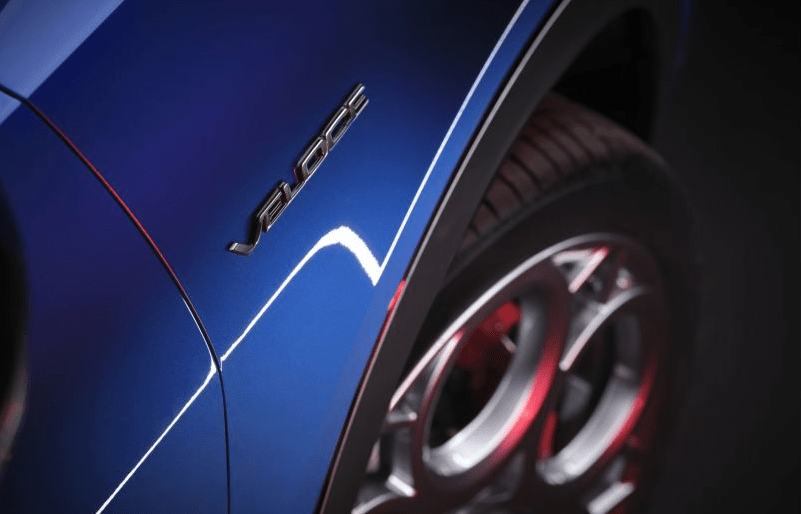
Two trim levels are available – Super and Ti, both with clearly defined specifications. The Super trim can be customized with the Sprint pack, which includes numerous options with a strong sporty connotation. Alternatively, the Ti trim can be added to with the Veloce pack, to reach the peak in terms of performance and sportiness.

More Alfa news soon!

Hans Knol ten Bensel

We drove the Renault Arkana E-Tech 145: when hybrid meets elegance…  

Renault is a brand which moves boundaries now and then. It brought a new definition of a roomy and timeless city car with the Twingo, built the legendary 4L and the “Cinq”, its Espace brought nothing less than a revolution in car concepts and design: the “space” car was born.

Then we don’t forget the Avantime. A car which was truly totally ahead of its time. We drove it at its introduction in the streets of modern, united Berlin. When you saw it on the road, you would expect a V6 formula 1 turbo engine under the hood, running on hydrogen of course, with a sweet voice softly telling you what the history is of the street and buildings you driving through, in the language of your choice. That car made us dream. Its stylish panache and the promise it embodied still has to be equalled.

Then Renault embarked on the E-path, opening it up to the masses with the ZOE and recently also putting a very clever full hybrid on the road, culminating in the E-Tech family of cars. Affordable with a touch of genius. And then we don’t forget Dacia…

Now its talented designer Laurens van den Acker took a long hard look at the BMW 4X and brings the stylish silhouette of the iconic fastback SUV to the wider public. The Arkana, a name derived from the Latin Arcanum, meaning secret, first made its entry in the Russian market, based on the Dacia Duster B0 platform. This allows the Russian built Arkana to offer 4WD, a must for the Russian market.

But this is not the E-Tech Arkana we meet on our shores. Renault needed here a platform which allowed electrification. Just read further!

Hans Knol ten Bensel

So “our” Arkana started life in South Korea in January 2020 as the… Renault Samsung XM3, and we find this again a fascinating story in itself, showing how cleverly big groups are combining talents and allocating resources found in their world wide organisations. Showing that they are truly unifying the world, having learned to work, cooperate and thrive across boundaries.

So Renault Samsung Motors is a reality, and they build the Arkana for us in their South Korean factory in Busan.

Renault is maybe also teaching politicians a lesson nowadays: the “Russian” Arkana is built both in Moscow by Renault Russia as well as in… Ukraine, in Zaporizhzhia, in South eastern Ukraine, at ZAZ, the most important (former) Russian Automobile Manufacturer.

The European Arkana runs on the more modern CMF-B platform, which we find also for the Clio V and the Captur II.

Stylish

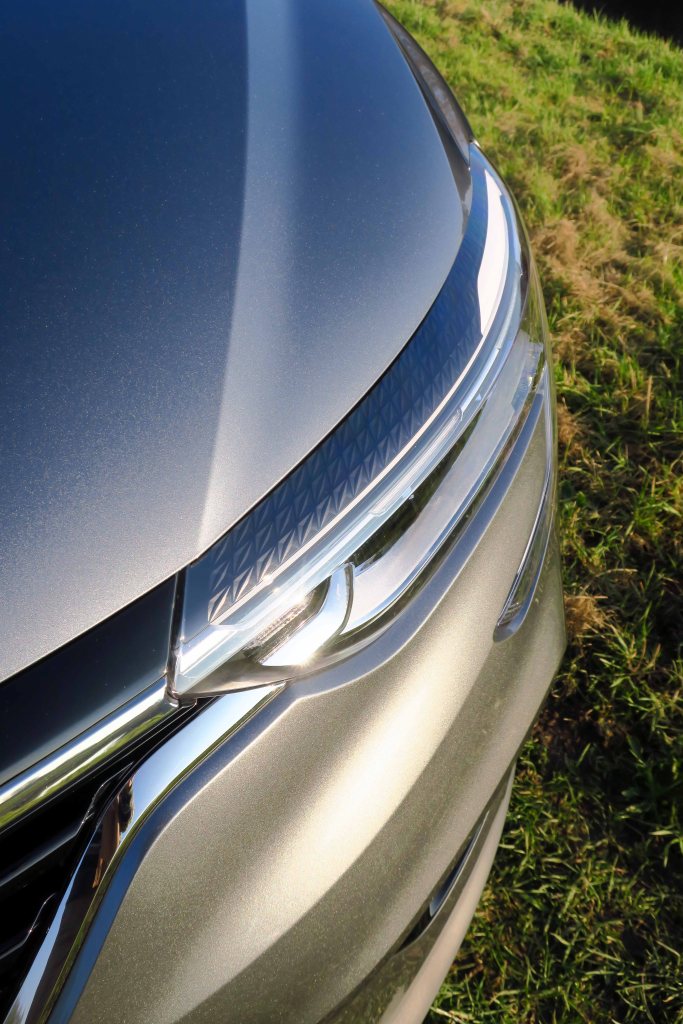
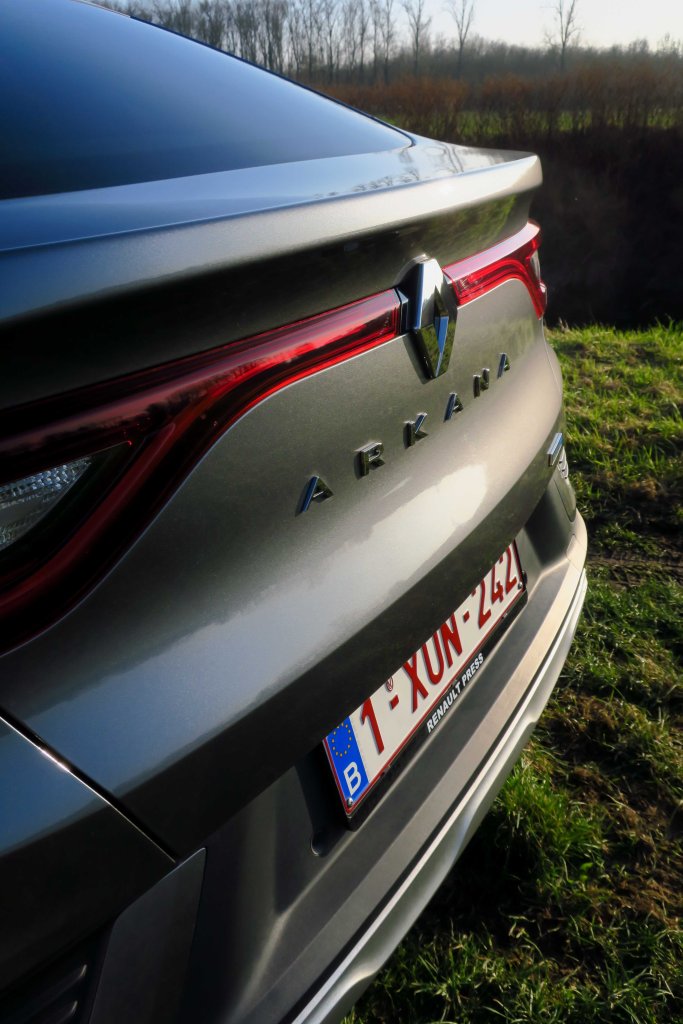
Approaching the Arkana and walking around it, one is pleased by its excellent proportions and shape, from any angle. We liked also that it stands boldly on its wheels, with a ground clearance of not less than 20 centimeters. This allows you to negotiate sleeping policemen’s with ease of mind, as their dimensions always differ greatly from borough to borough, if not from street to street. The fact that this is not unified on a European scale, let alone not even on a national scale is utterly ridiculous. But the Arkana copes with all that, marvelous!

We found also the level of finish and paint quality of the bodywork top notch. The same can be said of the fit, look and feel of the panels in dashboard and cabin.

The layout is similar to what we find in the ZOE and Clio. The seating position is excellent, everything is logically within reach. Also the infotainment system with the large screen on the centre console is a breeze to use, and quite intuitive. Of course instrumentation is digital, and you can have also the road indications right in line with your eyesight if you prefer this.

The Arkana E-Tech is frugal: on the open road merely 4,7 l/100 km…

The learning curve to get acquainted with infotainment in this car is wonderfully short, and it is also very practical and wise to let the heating/airco ventilation system be controlled through three big round manual knobs.

A fully fledged hybrid…

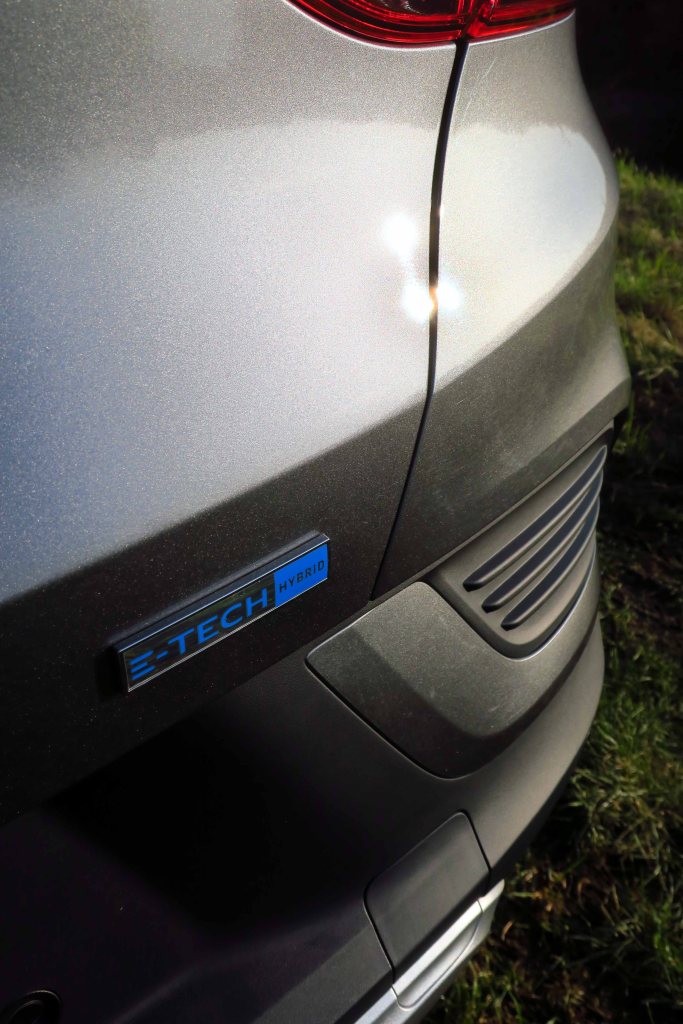
The Renault Arkana uses the Renault “E-Tech” hybrid solution, consisting of a petrol engine delivering 94 HP, a starter generator which delivers 20 HP or15 kW, and last but not least an electric motor incorporated in the transmission, which is good for another 49 HP or 36 kW.

The gearbox has four speeds in store for the combustion engine, and reserves two speeds for the electric motors. These are no synchro rings or clutches, the electric motor within the gearbox synchronises everything. This uniquely clever system is derived from Formula 1 technology, Renault says.

It works wonderfully. Driving away is always on E-power for the first meters at least, the electric motor in the gearbox with its close to 50 HP has more than sufficient zest for its task. If the small 1,2 kW battery runs out of power, the engine sets in smoothly, helps to power the car further forward, and also charges the battery. Total system power is 143 HP.

Depending on the chosen driving mode, the system will also keep the battery more or less constantly charged, and so it happens more than often that when having accelerated on E-power to say a cruising speed of 70 km/h, the petrol suddenly engine starts up and gets eagerly to work recharging the battery. It does this at relatively high revs, and the recharging time is therefore rather short.

The higher revs seem to be a bit out of place, but soon one gets used to it, even more so because everything happens smoothly as the revs between gearbox and engine are exactly matched and you understand why this is happening.

We noticed that in city driving the Arkana runs often on E-power, and indeed, the consumption during our test hovered around the 5 litres/100 km. Performance is more than adequate for everyday driving, with a 0 to 100 sprint in 10,8 seconds and a top speed of 178 km/h.

Comfortable and well balanced

The suspension of the Arkana has a rather firm undertone, but is very well balanced and comfortable, and will never show any hint of harshness. On winding roads, the car stays flat with very little body roll despite its 20 cm ground clearance. Steering is responsive and pleasant. Indeed, the Arkana is an excellent Gran Turismo with also very good urban qualities, and a pleasure to steer and drive.

There is sufficient head- and legroom for the rear passengers, and the E-Tech configuration only costs some 33 liters of luggage space, which remains at 480 to 1263 liters, more than adequate we would say. Living with the Arkana is truly nice…

Conclusion

A stylish, frugal, future oriented Renault, roomy, well finished, easy to use and pleasant to drive in everyday life. It offers good interior space despite its elegant coupé silhouette. Indeed, Renault sets again new standards in offering to many car buyers the panache and zest of a modern four dour coupé combined with some distinct SUV touches. And it can be had as a hybrid, which is a strong selling point for today’s environmentally conscious buyers…

Hans Knol ten Bensel

The new Škoda Enyaq iV Coupé virtually unveiled…

The new Enyaq Coupé in RS version will be first in the showrooms….

Also Škoda is convinced that the future is electric. On January 31st they presented for us the all electric Škoda Enyaq iV Coupé. It will be initially only available in the RS version, which promises to be rather formidable if one reads the figures: an acceleration form 0 to 100 km/h in 6,5 seconds, charging time from 10 to 80 % in under 30 minutes, a range of 545 km.

Oliver Stefani, Head of Design shows the sleek roofline of the new Skoda…

At the same time, this new version remains typically Škoda: spacious and practical. The luggage compartment is a massive 570 liters… and of course it has lots of “Simply Clever” features.

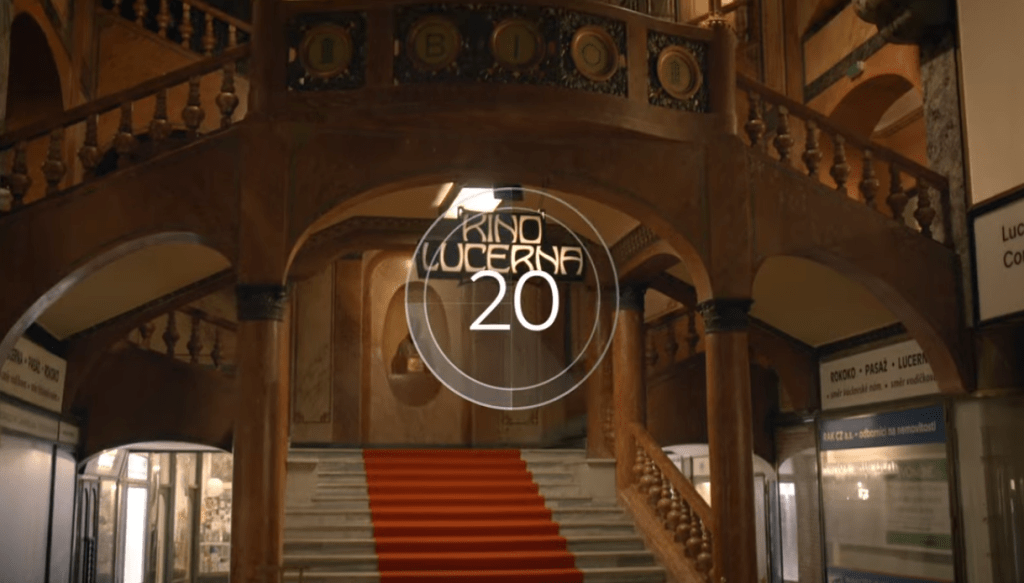
At the virtual presentation, we saw Jens Katemann, Head of Communications of Škoda Auto leading us into the Kino Lucerna,

the oldest still operating cinema theatre in the Czech Republic, and introducing us to the actress driving the Enyaq iV Coupé in the film, Ana Geislerova, and Thomas Schäfer, CEO of Škoda Auto. (Photo below, from left to right).

Jens Katemann, Head of Communications of Škoda Auto, Ana Geislerova, and Thomas Schäfer, CEO of Škoda Auto.

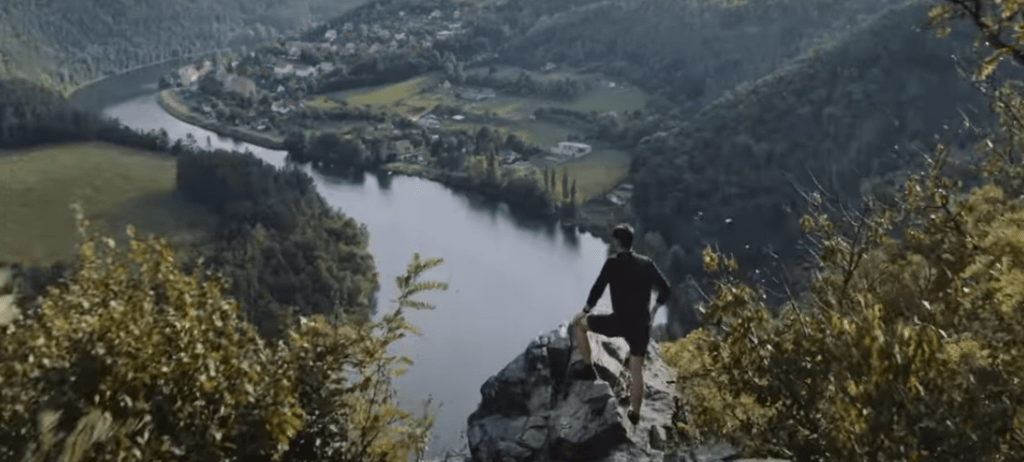
The film starts with the CEO Thomas Schäfer running in the woods towards a vantage point, embodying the will to go (ever) forward, and looking into the (electrical) future.

CEO Thomas Schäfer running

and looking out into the future…

Then we are introduced to Johannes Neft, board member Technical development, and further to Oliver Stefani, Head of Design.

Inspiration through perspective…Olivier Stefani, Head of Design.

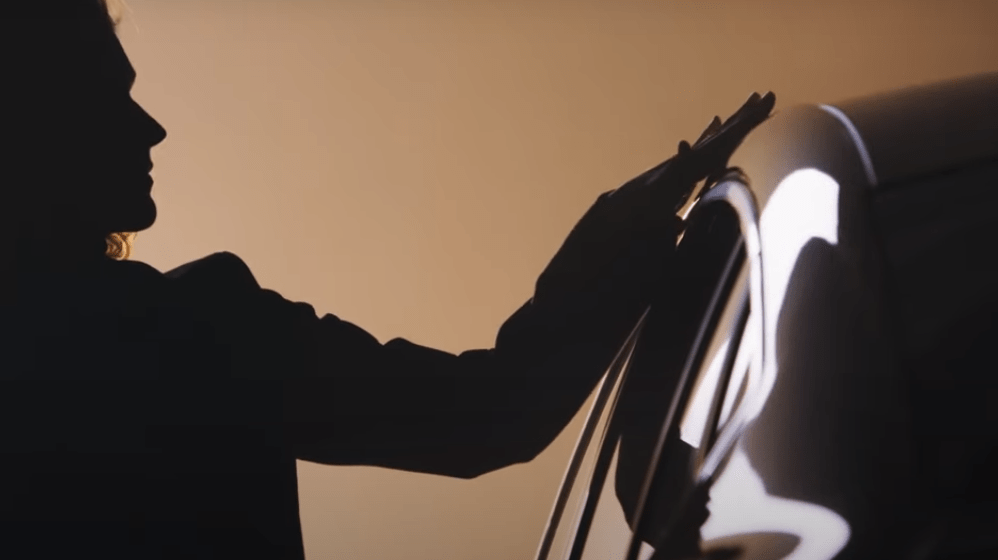
Actress Ana Geislerova then lovingly caresses the roofline of the sleek coupé,

and takes the wheel… for an exhilarating drive;

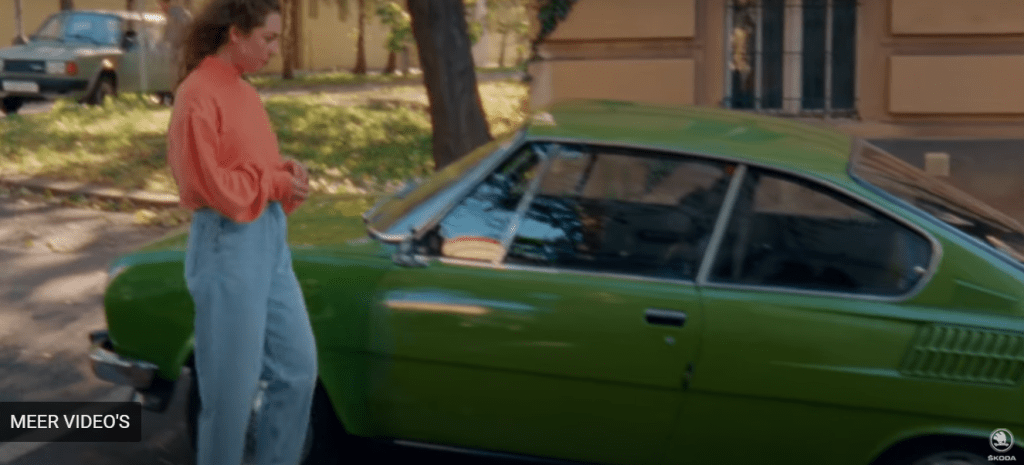
The second part of the film presents the RS version, which will be offered first to the eager customers, and it tells the story of a Czech teenage girl who drives the first RS Coupé, based on the rear engined MB 1000.

The person is now is some decades older, but remains in love wih life and freedom,

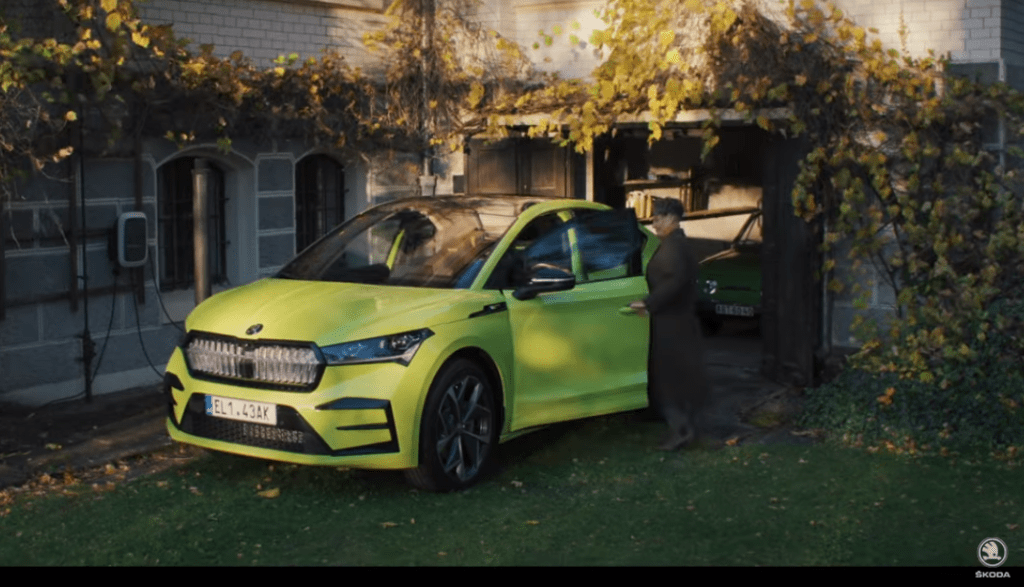
and of course drives now the new coupé…

I couldn’t resist showing you here some clips of this film…

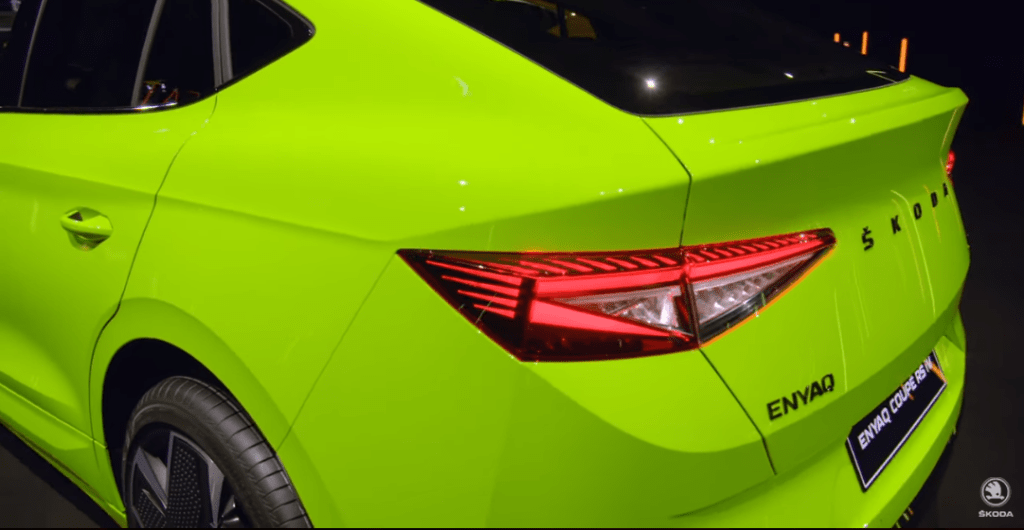
The bold green colour is exclusive to the RS version…

The cars themselves are then presented in more detail by CEO Thomas Schäfer and his team. We show you here also some clips, revealing the car more in detail…

More soon!

Hans Knol ten Bensel
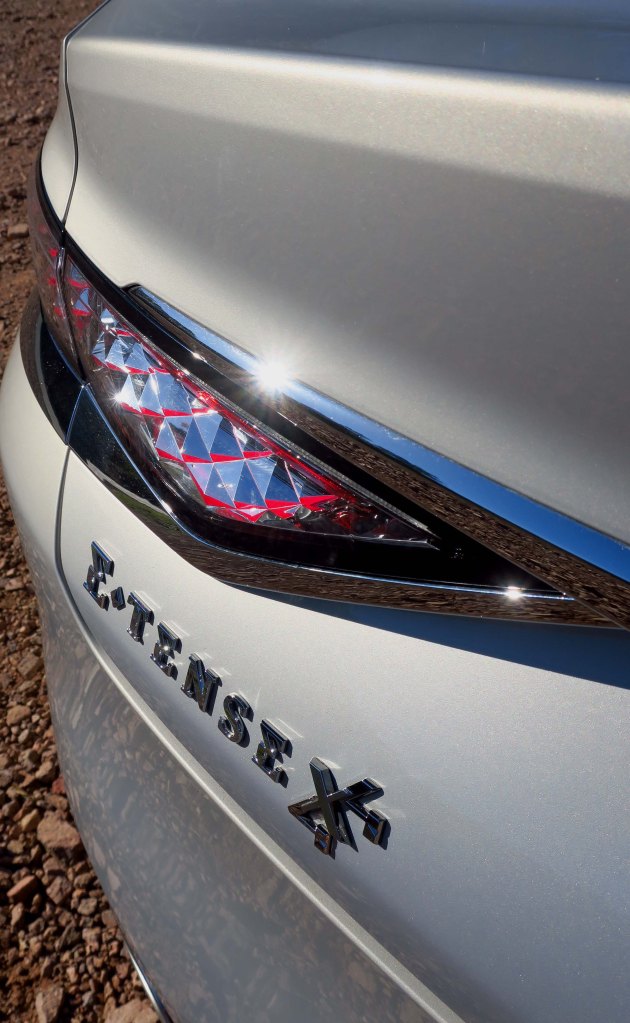
We drove the DS9 E-Tense 225: French elegance and panache…

In the hearts of many, the longing for a sleek, timelessly beautiful French limousine never fades. So when DS Automobiles was born, such a car was a must. The tradition of the original DS, serving as the true “voiture présidentielle” has also to be kept. So here she awakens again, as the noble “savoir vivre” alternative to the established German competition. The DS9. We tested the plug-in-hybrid version of course, fitting to this time and age…

Hans Knol ten Bensel

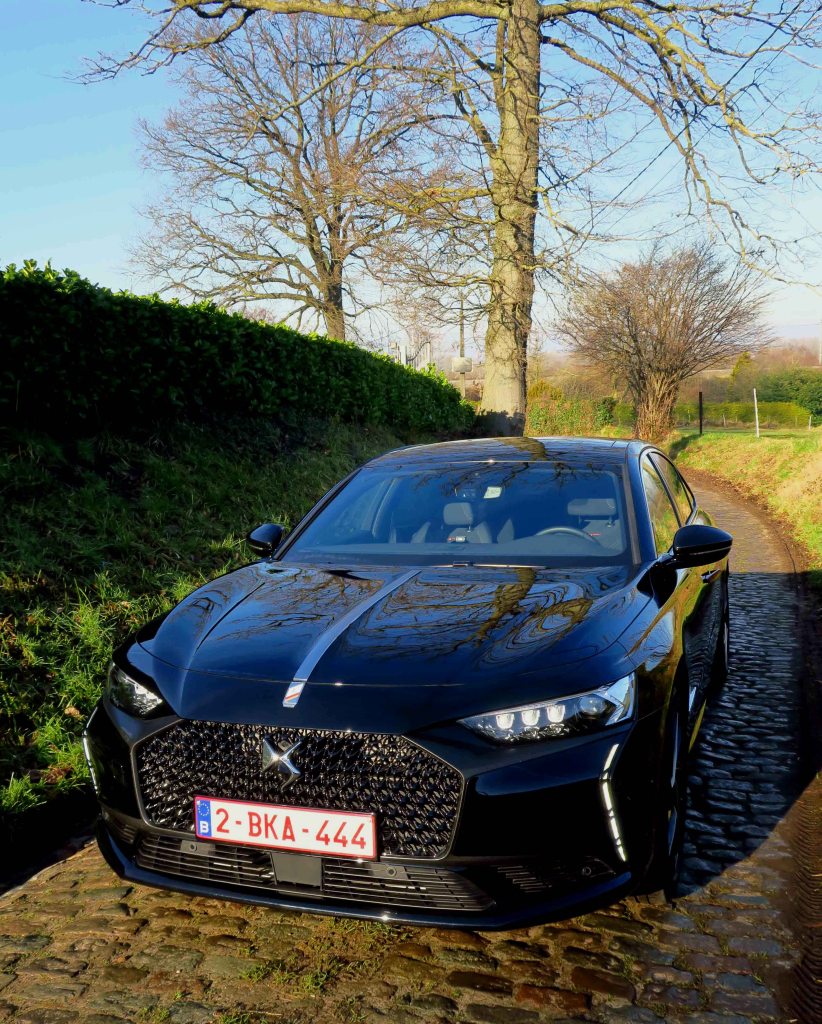
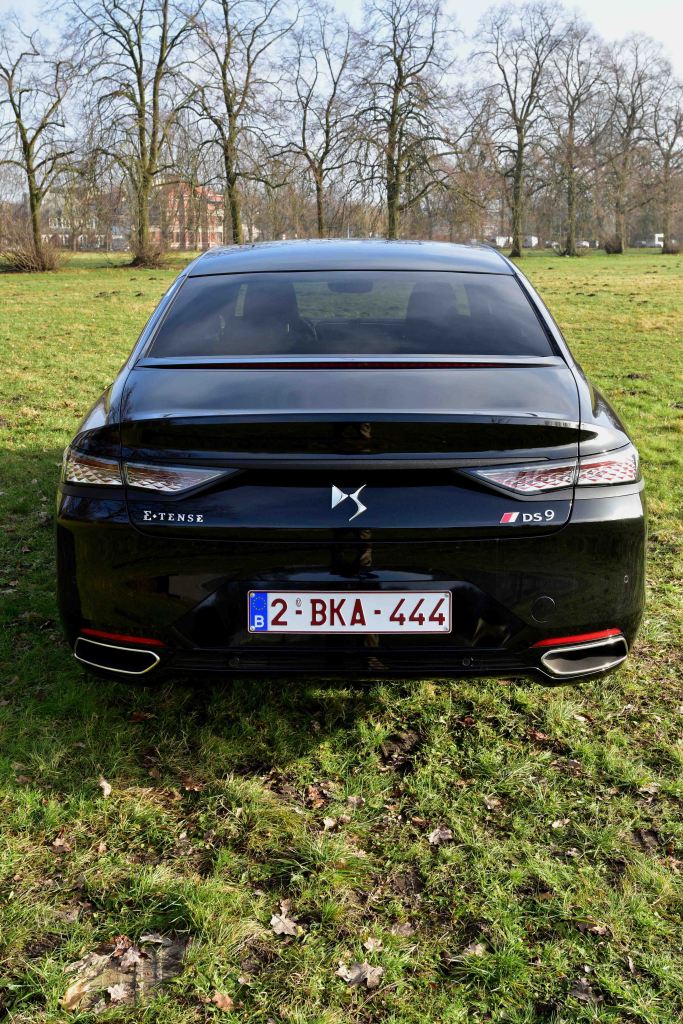
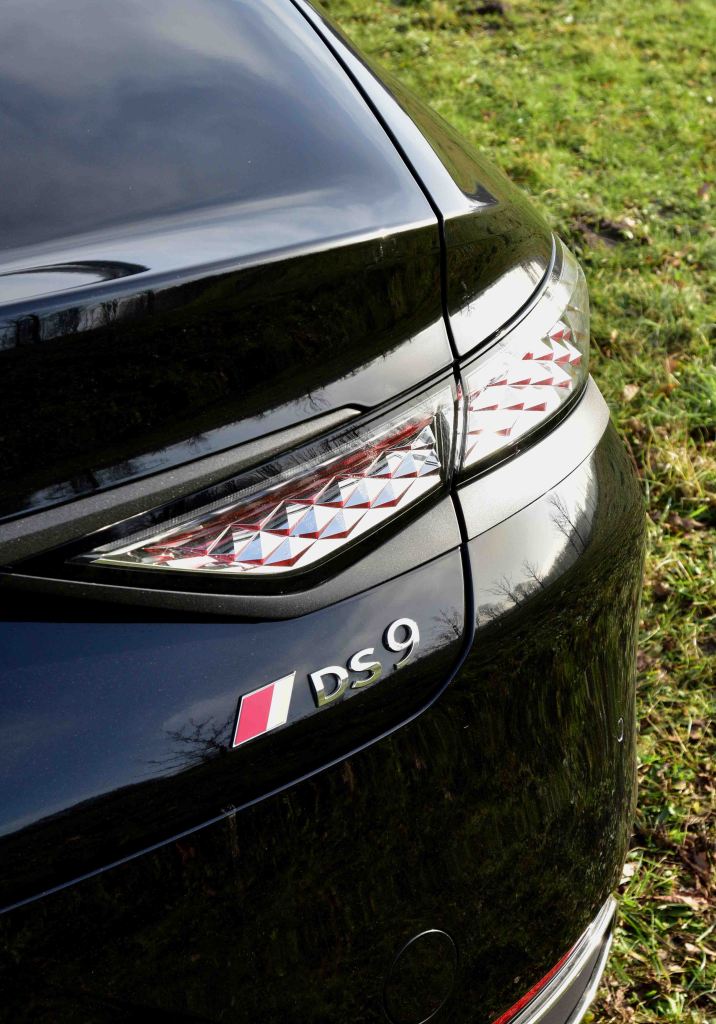
This DS9 is indeed elegant. With a regal wheelbase of 2,9 meters and a total length of 4,93 meters, the stylists were able to draw fluent lines and contours of an uncanny noblesse. The added details are reminiscent of its iconic predecessors, like the position lights close to the roof line.

This regal panache continues in the cabin. Noblesse oblige. Your eyes meet the superb clock in the middle of the dashboard, with the lozenge shaped start/stop button right below it.

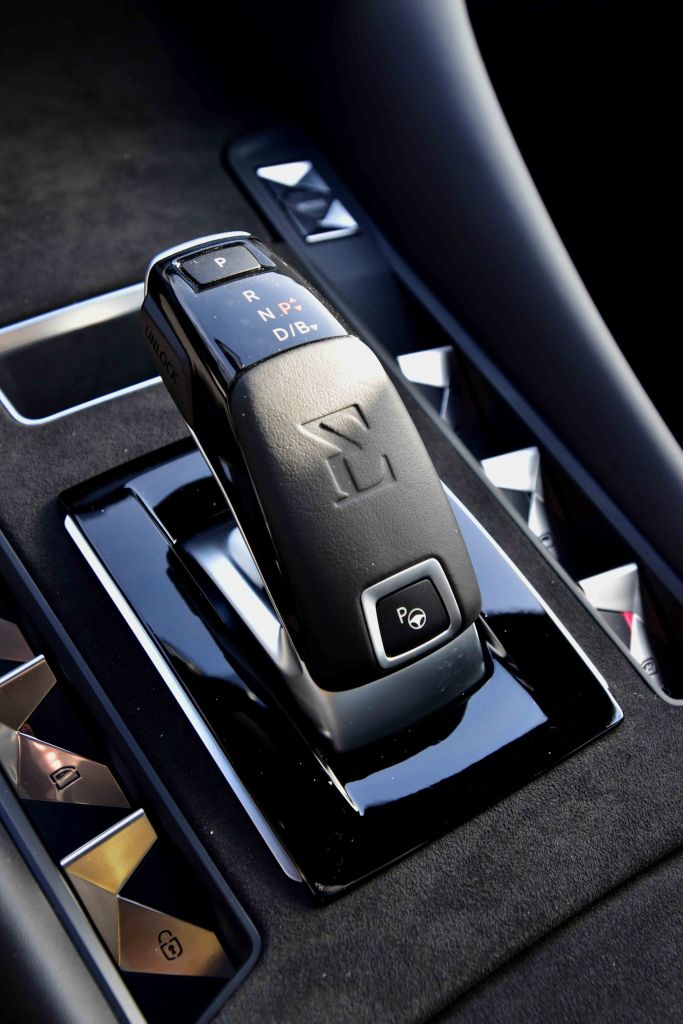
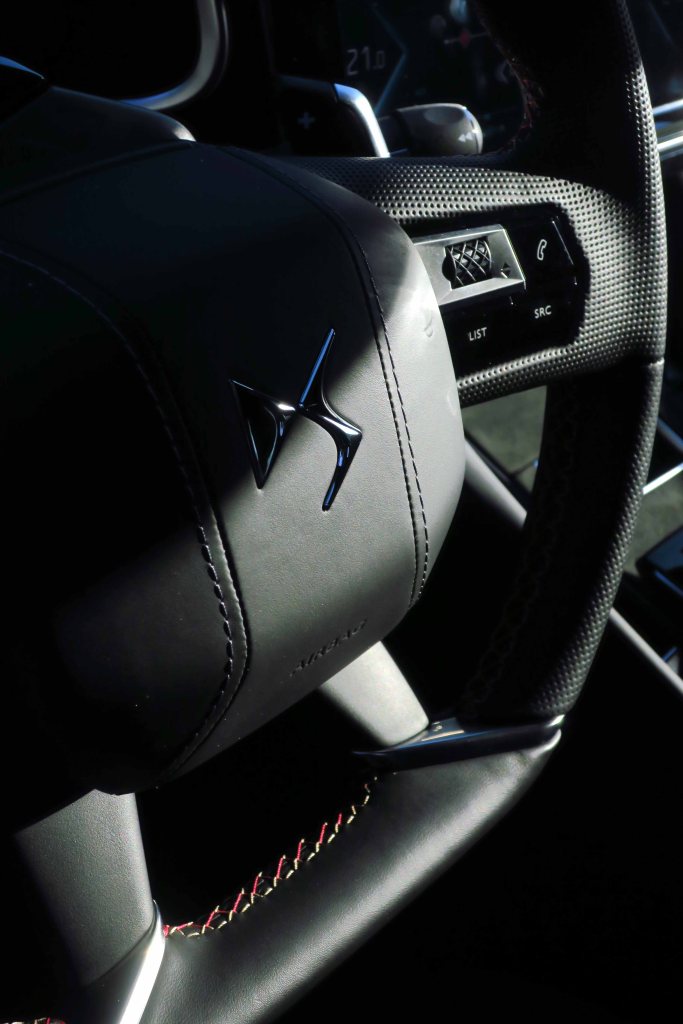
You can select also this lozenge theme for the dials in the electronic screen ahead of you, to add a bit of Art Déco atmosphere to it all. Your servant just loved this, as well as the finely chiseled surfaces of the rotating knobs on the steering wheel and the centre console. We love this tension between rounded shapes and rakish angularity. Voisin also used this in his magnificent automobiles.

The cabin is beautifully finished, with the seats not only looking opulent, but also cocooning you in soothing armchair comfort. Leg room at the rear is of course nothing short of presidential.

The infotainment is top notch, the expertise of the former PSA and now even larger Stellantis group sees to that. Embedded in this now world wide group, for DS automobiles, further future oriented electrification and revolutionary system/software platforms are in the cards. As one knows and has been written already in these columns, DS is very ambitious when it comes to future electrification.

Smooth hybrid power

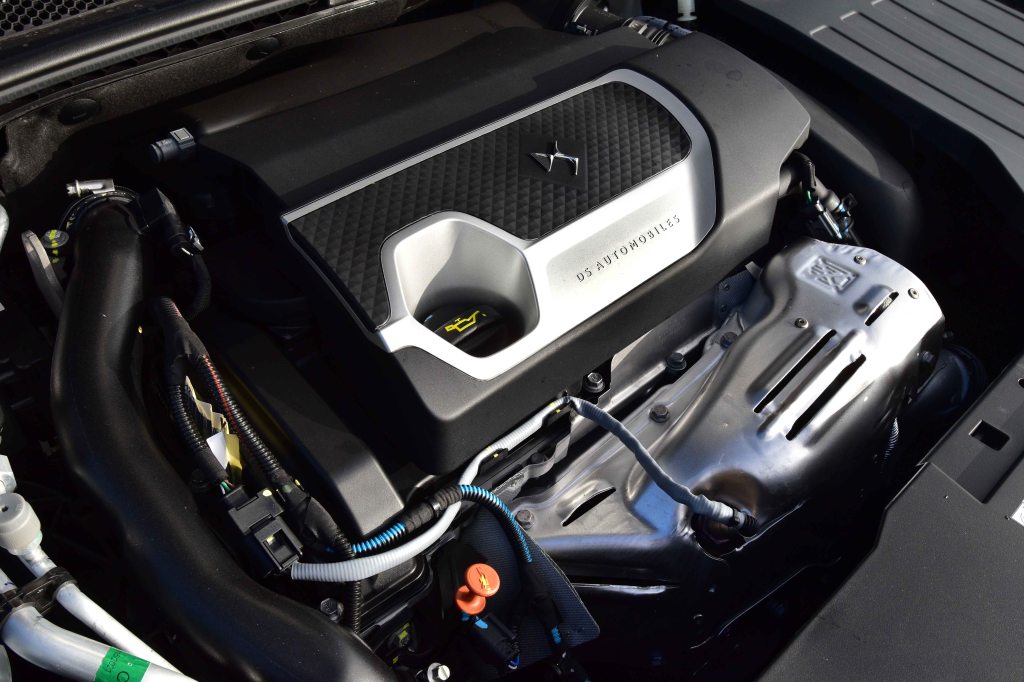
We tested the E-Tense 225 version, with the 181 HP 1,6 litre petrol engine coupled via an 8 speed automatic transmission to a 110 HP electric motor, resulting in a total system power of 225 HP. Sounds familiar? Indeed it does, as we found the same drivetrain on the DS4 E-Tense.

We already applauded the good qualities of this drivetrain, the prompt and vigorous accelerations, the overall smoothness. As the DS9 is somewhat heavier than the DS4 with its 1914 kg, the 0 to 100 km/h acceleration time is slighty slower, some 8,7 seconds, but on the other hand the top speed due to the more slippery limousine bodywork is a solid 240 km/h.

The DS9 will however rather invite you to some leisurely cruising, inspired as you are by the comfortable suspension which like in the higher end versions of the DS4 electronically scans the road surface ahead of you and adapts the active suspension accordingly. DS Automobiles calls it DS ACTIVE SCAN SUSPENSION, and we described it already in our columns.

Sound insulation is magnificent, remember that the doors have not less than three rubber seals to insulate the cabin from its surroundings, and double glazed windows. Needless to say that one truly enjoys the excellent sound system, and can listen delightfully to French chanson or baroque music.

Our test car had an electric radius of about 50 kilometers, thanks to its 11,9 kW battery. In our columns you could already read that there’s now a DS 9 E-TENSE 250 in the showrooms, featuring a 200 hp 4-cylinder PureTech engine, accompanied by the same 80 kW (110 hp) electric motor. The car has a new 15.6 kWh (total capacity) battery, with an unchanged number of cells, delivering now up to 70 kilometers on the WLTP city cycle (EAER City) or 61 kilometers on the WLTP combined cycle with an unchanged vehicle weight. The 7.4 kW on-board charger also allows charging from 0-100% in merely 2 hours and 23 minutes. See our article with the following link: https://autoprova.be/2021/12/03/the-ds-9-e-tense-gets-an-increased-e-range-and-extra-power/

Built in China…

I find it always fascinating to read how the present large automotive groups go about manufacturing their products on a global scale. The DS9 is also typical example. The DS9 runs on the EMP2 modular technical platform of the PSA group, and is built in the Chinese city of Shenzhen by the Baoneng group.

Related (bigger) cars built on this EMP2 platform are the Peugeot 508 and the… Donfeng FengshenA9, an executive sedan produced by the Dongfeng Motor Corporation under the Dongfeng Fengshen sub-brand, until 2019.

Citroën sells a new car named C6 in China on this platform since the end of 2016 and apparently until now, also as an executive saloon. All these cars have the same 2,9 meter wheelbase. This C6 is built in Wuhan, of all places…

Frugal… depending on how you use it.

With PHEV’s it is always the same story. Consumption depends on how you use it. Frequent recharging and short distances will enable you to run it on E-power, if you let the petrol engine do all the work, then it depends on the efficiency of the engine and your driving style. The manufacturer quotes a minimum consumption of 1,5 l/100 km and CO2 emissions of 34 g/km.

Practical

The DS9 is first of all a comfortable limousine, and your excellent companion on long distances or a posh urban drive to restaurant or opera. Boot space is sufficient with 355 litres, as you can fold the rear backrests back to enlarge cargo space to 825 litres.

For the rear passengers, there is a wide central armrest with lots of space for drinking glasses and sundry.

Conclusion

This sleek executive saloon makes a statement in the Executive segment, with its stylish panache and focus on ultimate comfort. It represents a true alternative in design and concept, and its lavish standard equipment makes it also stand out versus the competition.

So we repeat what we said about the DS4, if you want to take a different path in luxurious and refined motoring, grab the leather stitched wheel of this one…

Hans Knol ten Bensel