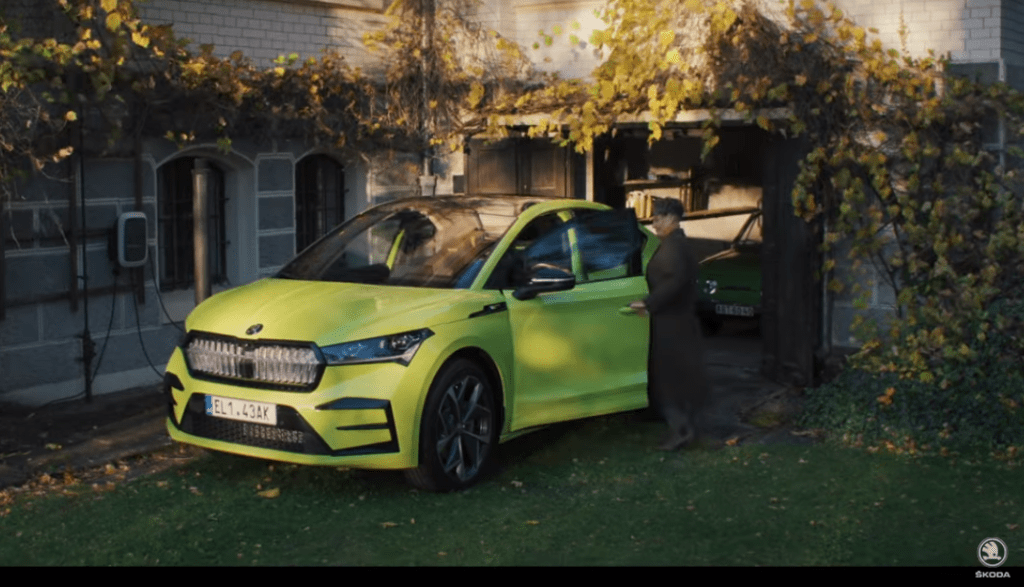
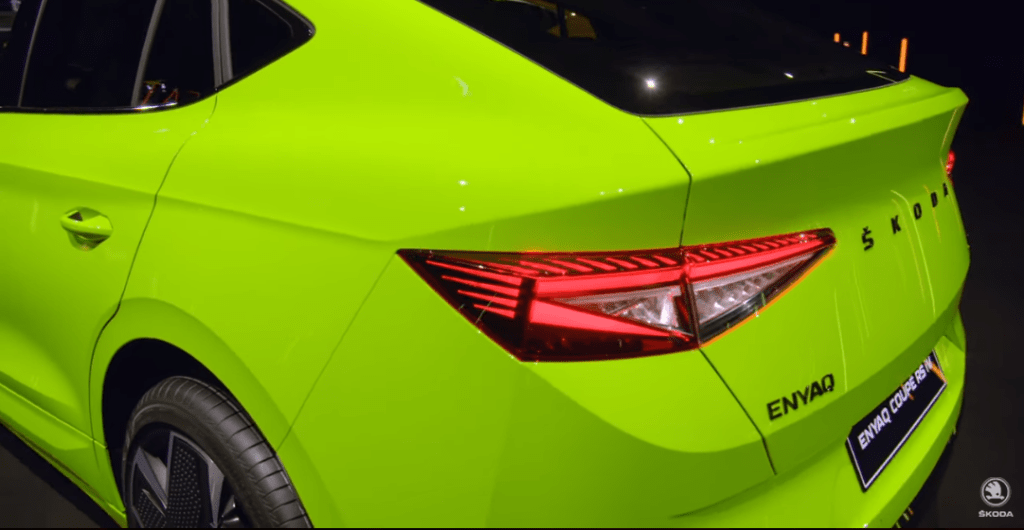
The new Enyaq Coupé in RS version will be first in the showrooms….
Also Škoda is convinced that the future is electric. On January 31st they presented for us the all electric Škoda Enyaq iV Coupé. It will be initially only available in the RS version, which promises to be rather formidable if one reads the figures: an acceleration form 0 to 100 km/h in 6,5 seconds, charging time from 10 to 80 % in under 30 minutes, a range of 545 km.
Oliver Stefani, Head of Designshows the sleek roofline of the new Skoda…
At the same time, this new version remains typically Škoda: spacious and practical. The luggage compartment is a massive 570 liters… and of course it has lots of “Simply Clever” features.
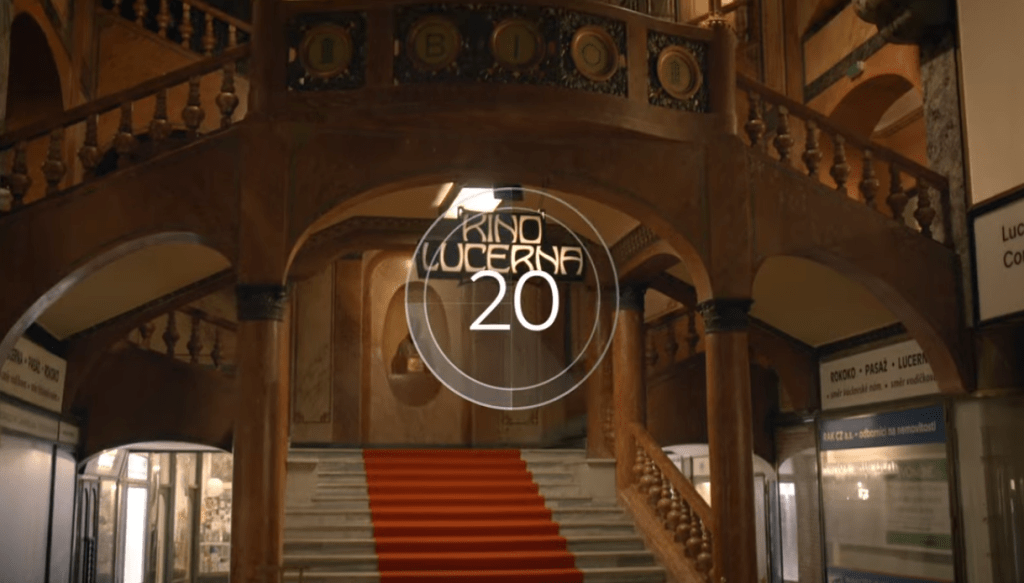
At the virtual presentation, we saw Jens Katemann, Head of Communications of Škoda Auto leading us into the Kino Lucerna,
the oldest still operating cinema theatre in the Czech Republic, and introducing us to the actress driving the Enyaq iV Coupé in the film, Ana Geislerova, and Thomas Schäfer, CEO of Škoda Auto. (Photo below, from left to right).
Jens Katemann, Head of Communications of Škoda Auto, Ana Geislerova, and Thomas Schäfer, CEO of Škoda Auto.
The film starts with the CEO Thomas Schäfer running in the woods towards a vantage point, embodying the will to go (ever) forward, and looking into the (electrical) future.
CEO Thomas Schäfer running…
and looking out into the future…
Then we are introduced to Johannes Neft, board member Technical development, and further to Oliver Stefani, Head of Design.
Inspiration through perspective…Olivier Stefani, Head of Design.
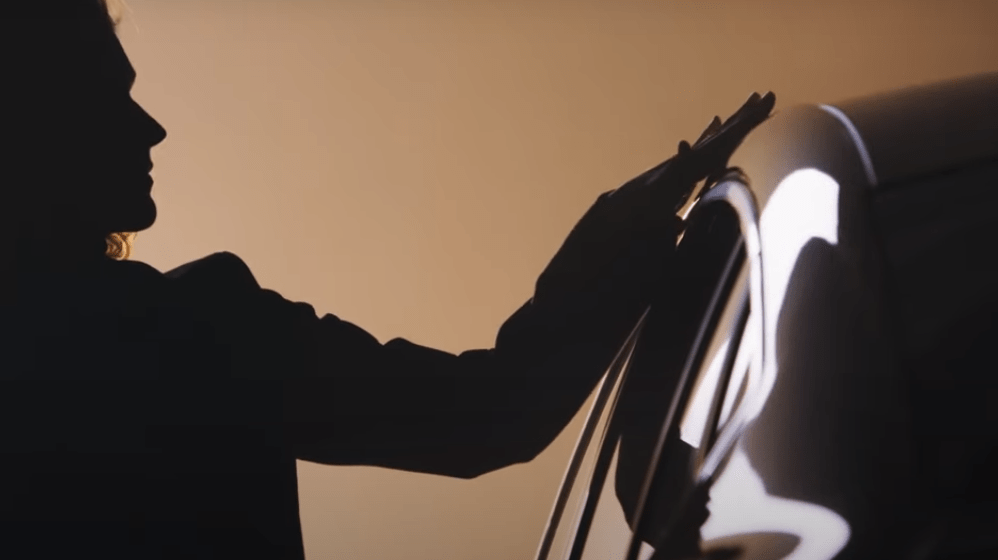
Actress Ana Geislerova then lovingly caresses the roofline of the sleek coupé,
and takes the wheel… for an exhilarating drive;
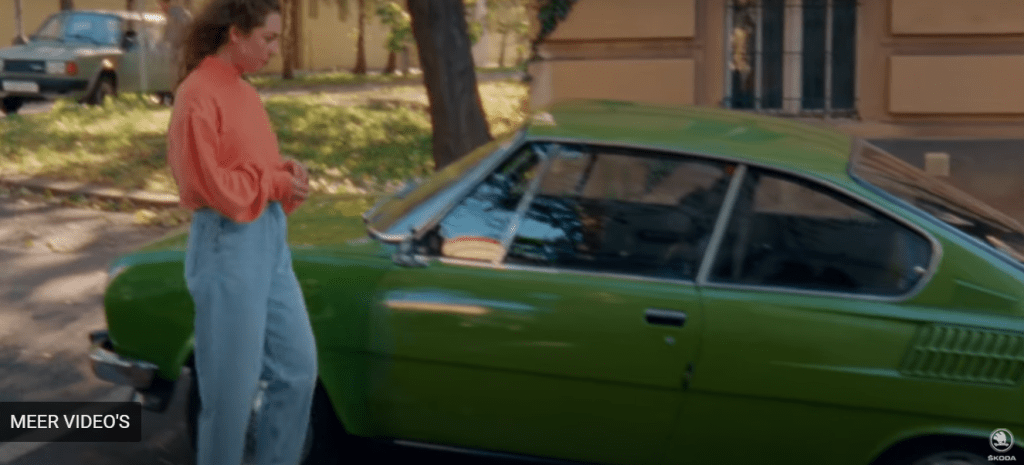
The second part of the film presents the RS version, which will be offered first to the eager customers, and it tells the story of a Czech teenage girl who drives the first RS Coupé, based on the rear engined MB 1000.
The person is now is some decades older, but remains in love wih life and freedom,
and of course drives now the new coupé…
I couldn’t resist showing you here some clips of this film…
The bold green colour is exclusive to the RS version…
The cars themselves are then presented in more detail by CEO Thomas Schäfer and his team. We show you here also some clips, revealing the car more in detail…
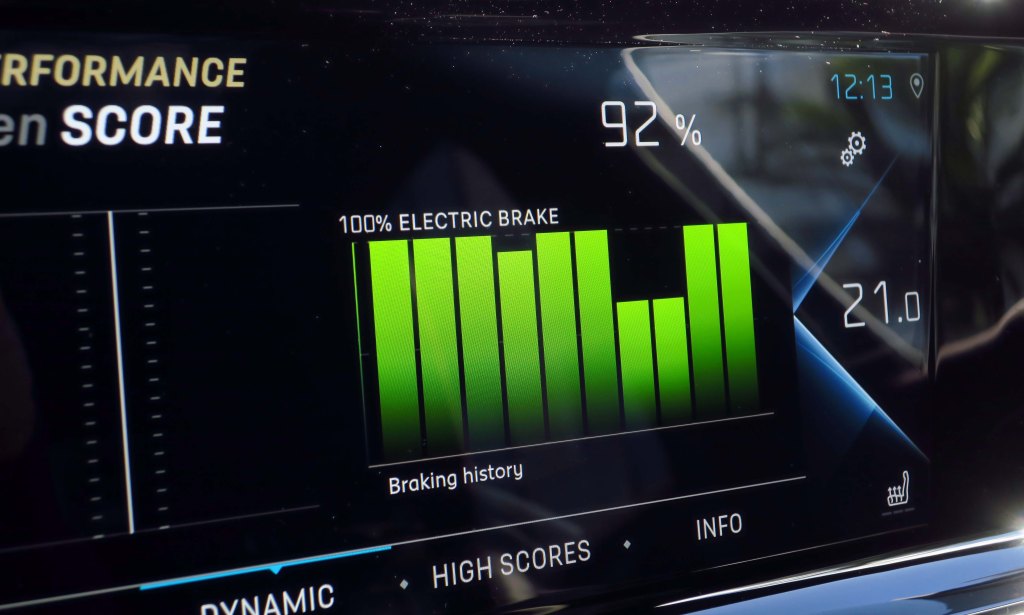
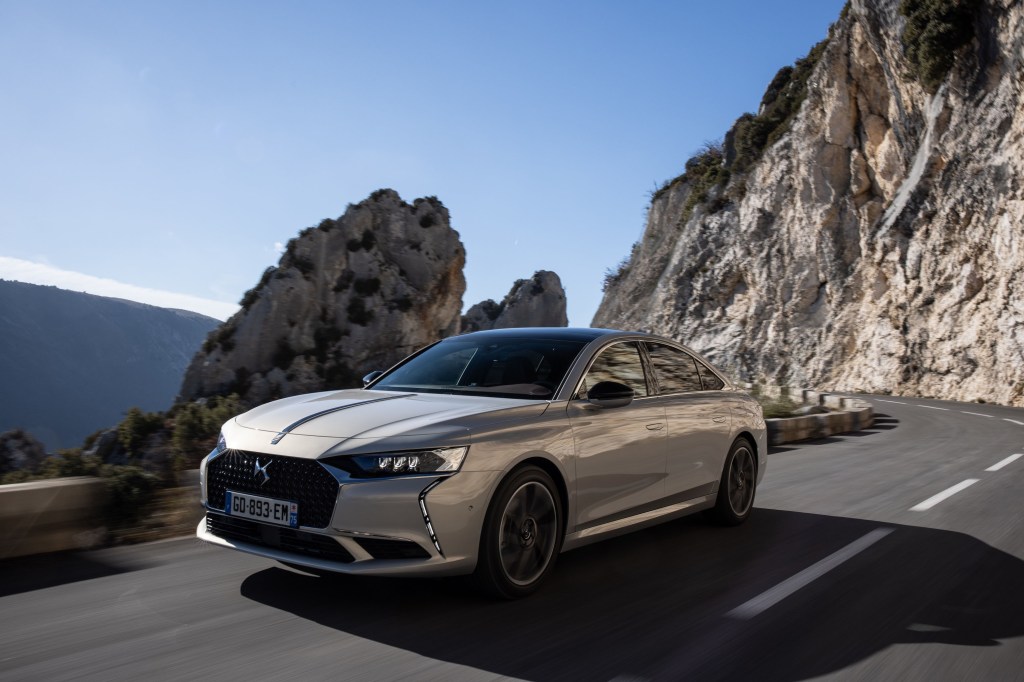
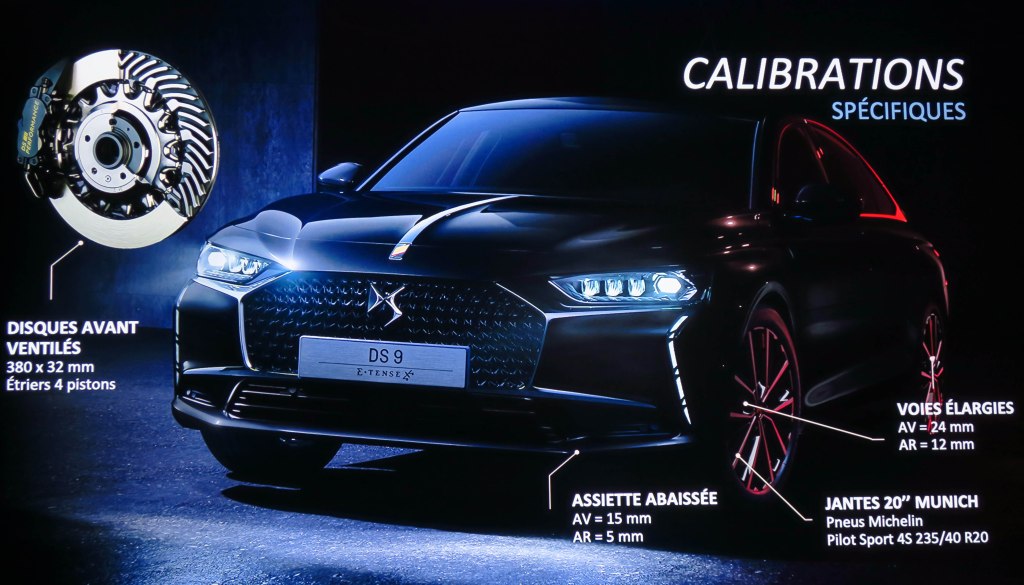
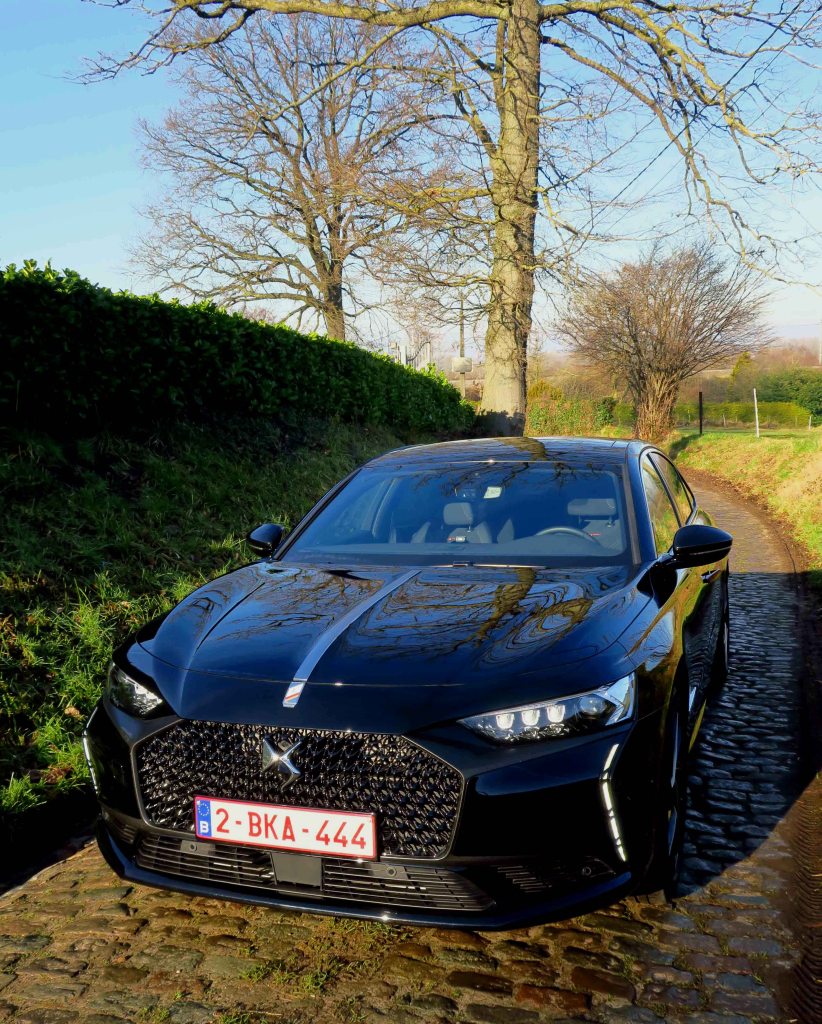
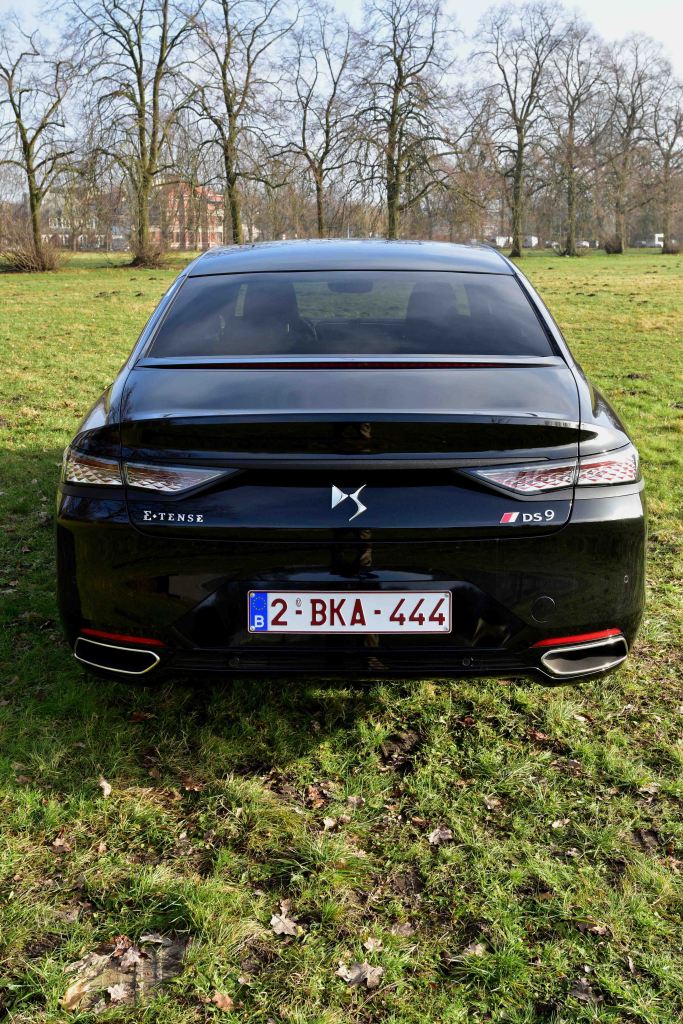
In the hearts of many, the longing for a sleek, timelessly beautiful French limousine never fades. So when DS Automobiles was born, such a car was a must. The tradition of the original DS, serving as the true “voiture présidentielle” has also to be kept. So here she awakens again, as the noble “savoir vivre” alternative to the established German competition. The DS9. We tested the plug-in-hybrid version of course, fitting to this time and age…
Hans Knol ten Bensel
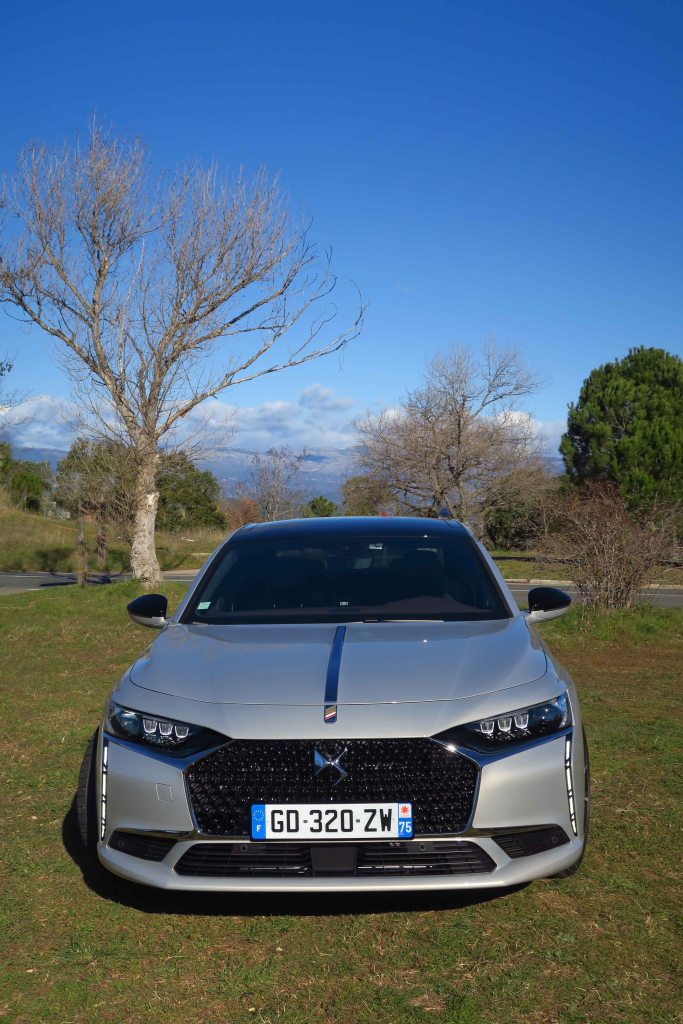
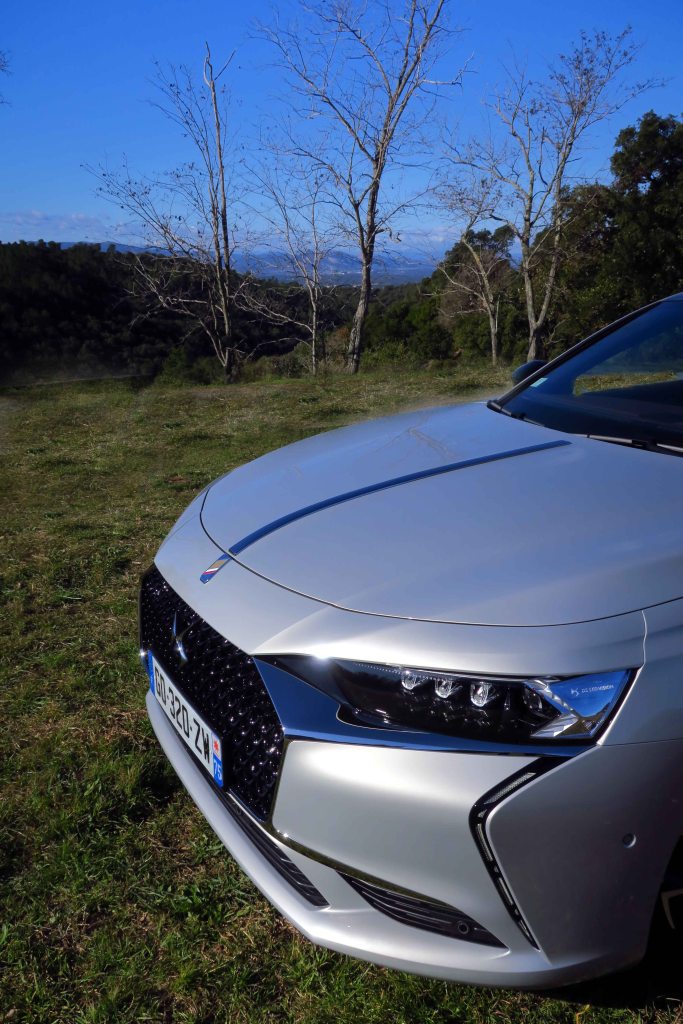
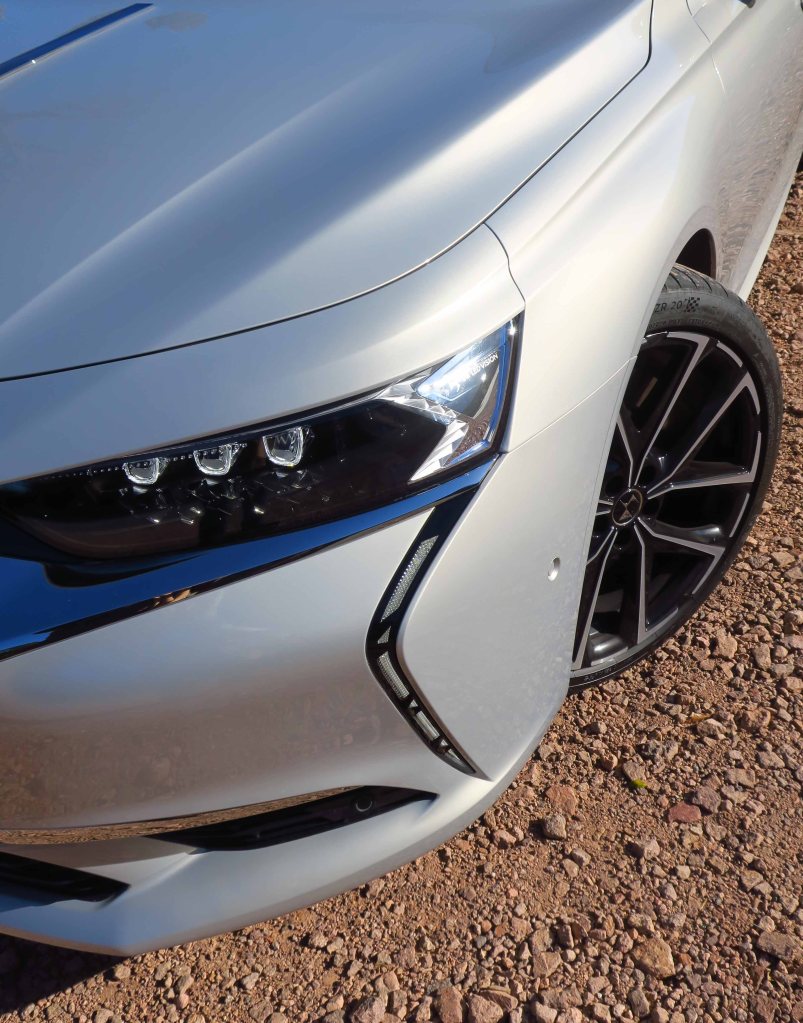
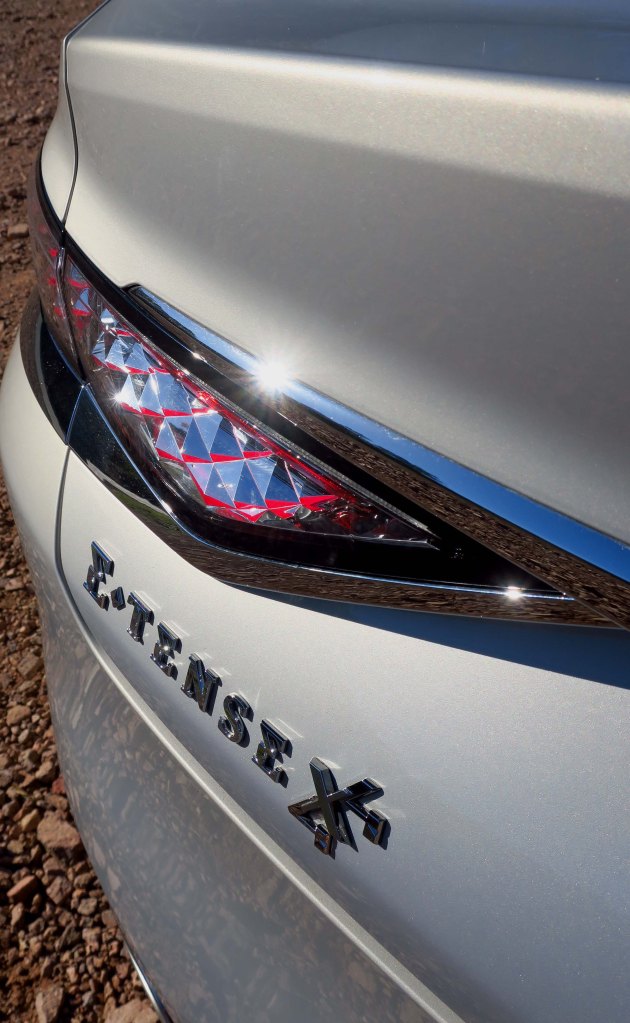
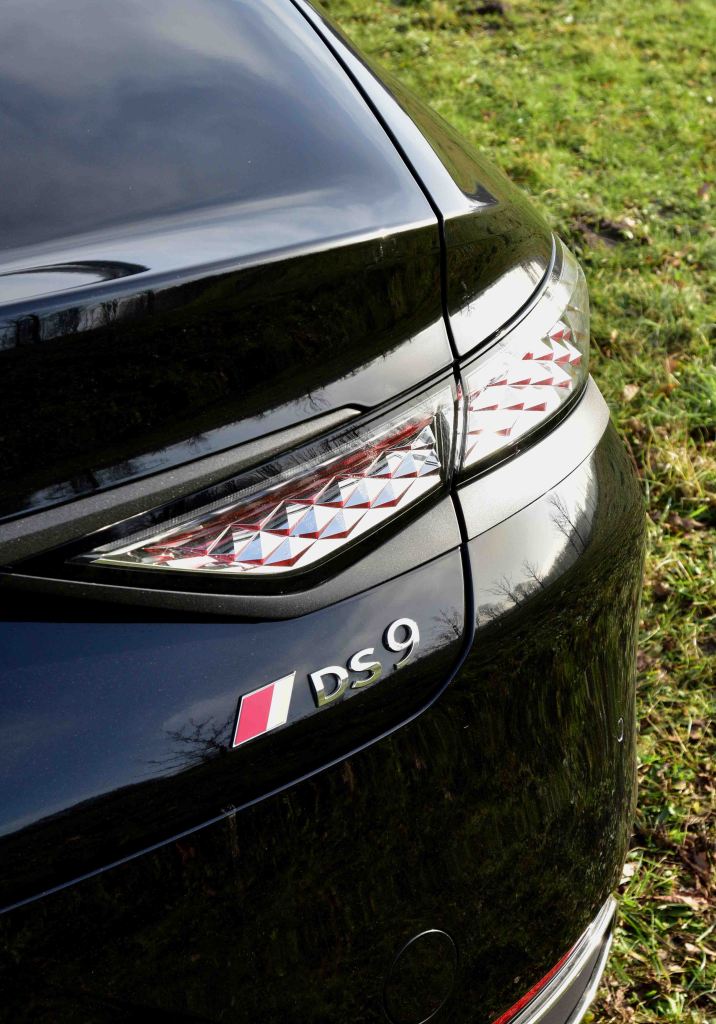
This DS9 is indeed elegant. With a regal wheelbase of 2,9 meters and a total length of 4,93 meters, the stylists were able to draw fluent lines and contours of an uncanny noblesse. The added details are reminiscent of its iconic predecessors, like the position lights close to the roof line.
This regal panache continues in the cabin. Noblesse oblige. Your eyes meet the superb clock in the middle of the dashboard, with the lozenge shaped start/stop button right below it.
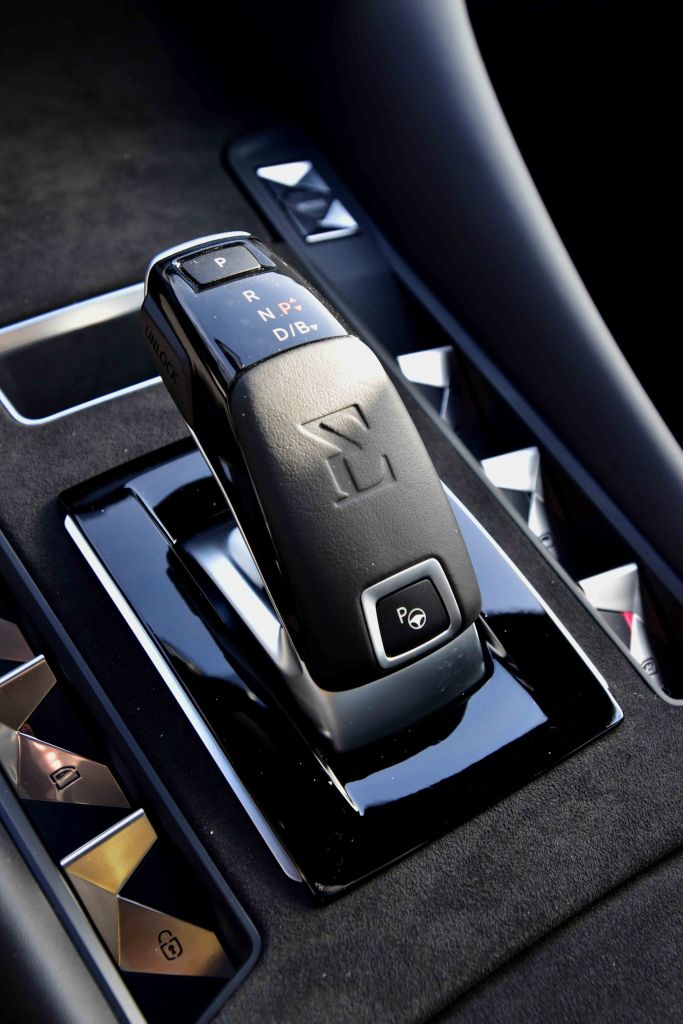
You can select also this lozenge theme for the dials in the electronic screen ahead of you, to add a bit of Art Déco atmosphere to it all. Your servant just loved this, as well as the finely chiseled surfaces of the rotating knobs on the steering wheel and the centre console. We love this tension between rounded shapes and rakish angularity. Voisin also used this in his magnificent automobiles.
The cabin is beautifully finished, with the seats not only looking opulent, but also cocooning you in soothing armchair comfort. Leg room at the rear is of course nothing short of presidential.
The infotainment is top notch, the expertise of the former PSA and now even larger Stellantis group sees to that. Embedded in this now world wide group, for DS automobiles, further future oriented electrification and revolutionary system/software platforms are in the cards. As one knows and has been written already in these columns, DS is very ambitious when it comes to future electrification.
Smooth hybrid power
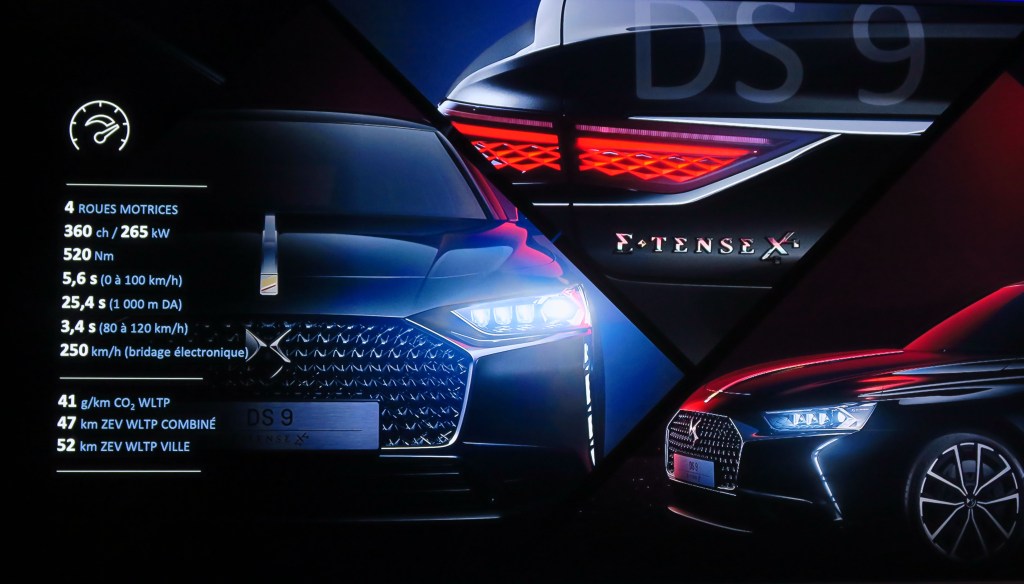
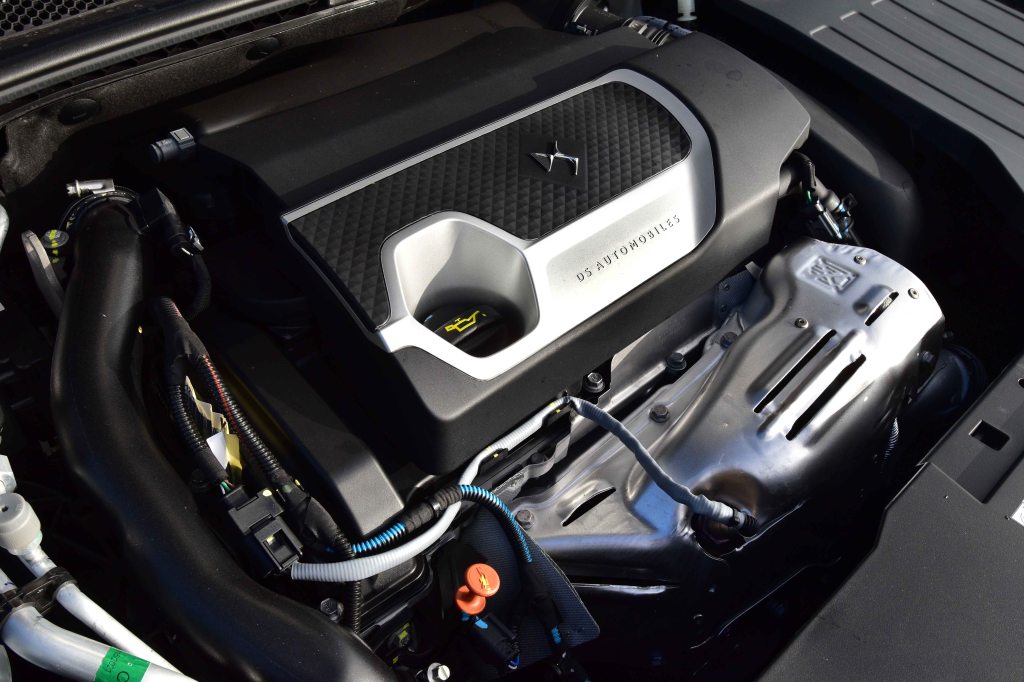
We tested the E-Tense 225 version, with the 181 HP 1,6 litre petrol engine coupled via an 8 speed automatic transmission to a 110 HP electric motor, resulting in a total system power of 225 HP. Sounds familiar? Indeed it does, as we found the same drivetrain on the DS4 E-Tense.
We already applauded the good qualities of this drivetrain, the prompt and vigorous accelerations, the overall smoothness. As the DS9 is somewhat heavier than the DS4 with its 1914 kg, the 0 to 100 km/h acceleration time is slighty slower, some 8,7 seconds, but on the other hand the top speed due to the more slippery limousine bodywork is a solid 240 km/h.
The DS9 will however rather invite you to some leisurely cruising, inspired as you are by the comfortable suspension which like in the higher end versions of the DS4 electronically scans the road surface ahead of you and adapts the active suspension accordingly. DS Automobiles calls it DS ACTIVE SCAN SUSPENSION, and we described it already in our columns.
Sound insulation is magnificent, remember that the doors have not less than three rubber seals to insulate the cabin from its surroundings, and double glazed windows. Needless to say that one truly enjoys the excellent sound system, and can listen delightfully to French chanson or baroque music.
Our test car had an electric radius of about 50 kilometers, thanks to its 11,9 kW battery. In our columns you could already read that there’s now a DS 9 E-TENSE 250 in the showrooms, featuring a 200 hp 4-cylinder PureTech engine, accompanied by the same 80 kW (110 hp) electric motor. The car has a new 15.6 kWh (total capacity) battery, with an unchanged number of cells, delivering now up to 70 kilometers on the WLTP city cycle (EAER City) or 61 kilometers on the WLTP combined cycle with an unchanged vehicle weight. The 7.4 kW on-board charger also allows charging from 0-100% in merely 2 hours and 23 minutes. See our article with the following link: https://autoprova.be/2021/12/03/the-ds-9-e-tense-gets-an-increased-e-range-and-extra-power/
Built in China…
I find it always fascinating to read how the present large automotive groups go about manufacturing their products on a global scale. The DS9 is also typical example. The DS9 runs on the EMP2 modular technical platform of the PSA group, and is built in the Chinese city of Shenzhen by the Baoneng group.
Related (bigger) cars built on this EMP2 platform are the Peugeot 508 and the… Donfeng FengshenA9, an executive sedan produced by the Dongfeng Motor Corporation under the Dongfeng Fengshen sub-brand, until 2019.
Citroën sells a new car named C6 in China on this platform since the end of 2016 and apparently until now, also as an executive saloon. All these cars have the same 2,9 meter wheelbase. This C6 is built in Wuhan, of all places…
Frugal… depending on how you use it.
With PHEV’s it is always the same story. Consumption depends on how you use it. Frequent recharging and short distances will enable you to run it on E-power, if you let the petrol engine do all the work, then it depends on the efficiency of the engine and your driving style. The manufacturer quotes a minimum consumption of 1,5 l/100 km and CO2 emissions of 34 g/km.
Practical
The DS9 is first of all a comfortable limousine, and your excellent companion on long distances or a posh urban drive to restaurant or opera. Boot space is sufficient with 355 litres, as you can fold the rear backrests back to enlarge cargo space to 825 litres.
For the rear passengers, there is a wide central armrest with lots of space for drinking glasses and sundry.
Conclusion
This sleek executive saloon makes a statement in the Executive segment, with its stylish panache and focus on ultimate comfort. It represents a true alternative in design and concept, and its lavish standard equipment makes it also stand out versus the competition.
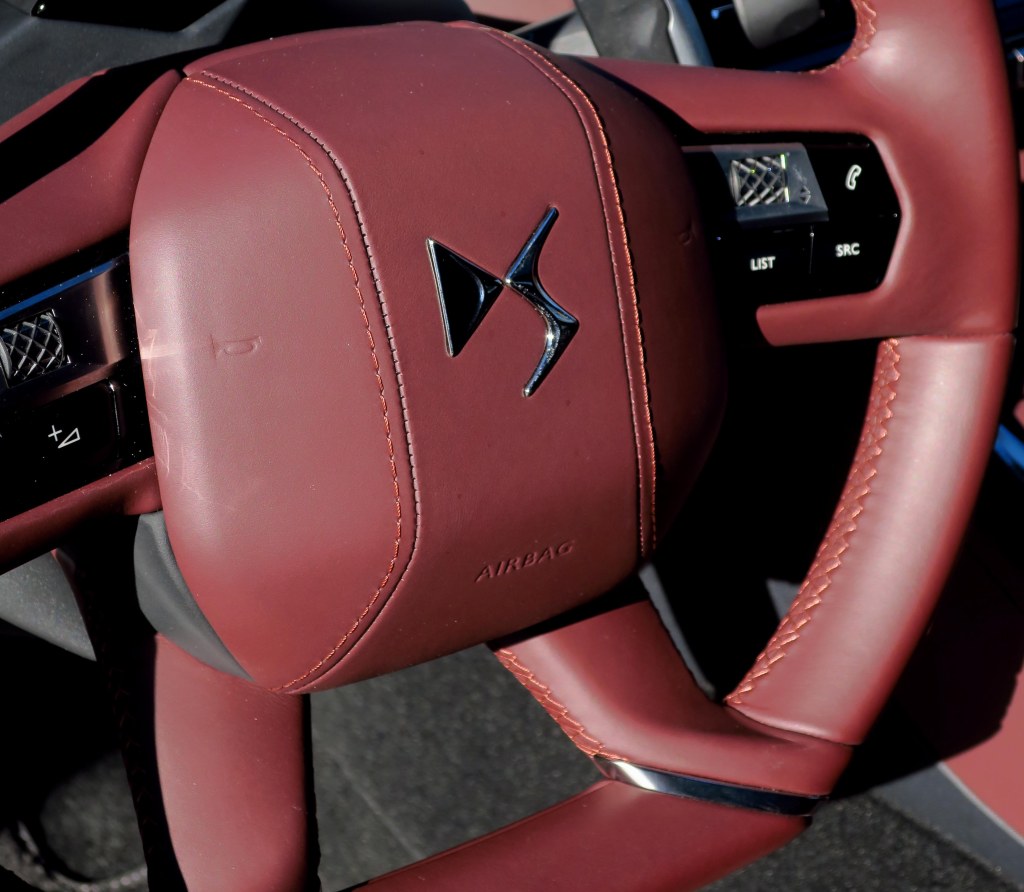
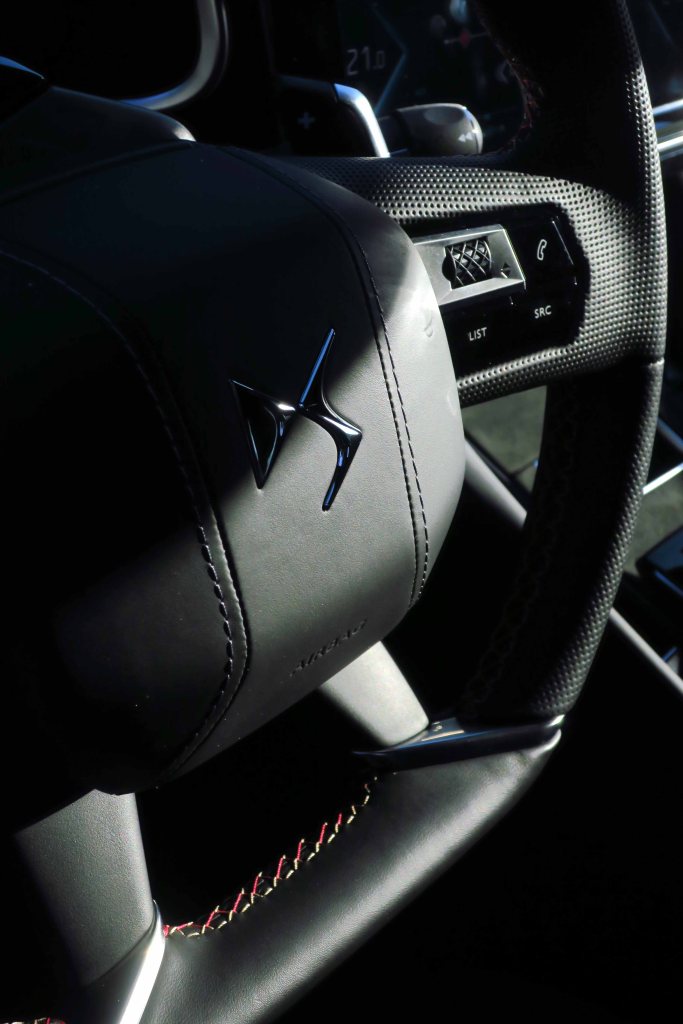
So we repeat what we said about the DS4, if you want to take a different path in luxurious and refined motoring, grab the leather stitched wheel of this one…
The new DS4 is styled to make its mark in the competitive C segment, to bring a touch of French refinement and panache in its class.
Already at the first presentation of the DS4 in Chantilly, we were impressed. We now had the chance to drive this elegant Crossover SUV on our roads for a longer test, and we must admit that it was a very convincing experience indeed. Just read further…
Hans Knol ten Bensel
Seeing the new DS4 and walking around it, one has to admit: this is a well proportioned, timelessly styled car, with unique contours and styling elements, clearly showing that its designer wanted this DS4 to really stand out.
The volumes are carefully balanced, front, side or rear, the DS4 shows character and elegance. The grille and sidelights at the front, the elegantly chiseled rear lights, the flush door handles, popping up when one approaches, the up to 20 inch wheels, this DS4 has the elegant and refined shapes which are appealing. The DS4 recently won also accolades for its styling…
This French couture-like “savoir faire” continues in the interior. Dashboard, centre console and seats breathe distinction, with styling never interfering with functionality.
The higher waistline of the whole car, being a crossover SUV, results also in cabin proportions which invariably invite you to cocoon in its interior, with the DS (and Citroën) extra thick foam-padded seats enveloping you.
The well finished panels of the dashboard and console awake your senses, and you invariably enjoy the refinement of it all, finding it a pleasure to touch and look at.
Take your time to familiarize yourself with its sculpted controls, from the lozenge shaped starting button to the writing pad above the gear selector, and of course the latest generation infotainment which the Stellantis group now offers in its cars.
Besides the clean and to the point driving information displayed by the instrument panel in front of the driver, our test car came in its posh Rivoli equipment level also with an informative and well to read overhead display with augmented reality.
Refined power…
The E-Tense PHEV drivetrain is nothing less than top notch. Shared with other brands and models within the Stellantis Group, it impresses with its smooth, feline power. Driving the front wheels through an 8 speed automatic is a 1,6 petrol engine combined with an electric motor. Total system power is more than enough, with not less than 165 kW/225 PS and maximum torque of 360 Nm. This results in very lively performance: accelerating from standstill is quite powerful, and 100 km/h is thanks to the assistance of the electric motor effortlessly reached in just 7,7 seconds.
Delightful indeed, and the fun doesn’t stop there, as this DS4 is also quite formidable on the motorway: it top speed is not less than 233 km/h.
But besides all this power, it is also the smoothness and the overall silence and refinement of the drivetrain which really stands out. Your servant also considers this to be far more important than outright performance in our modern everyday traffic, and found it a strong point that the DS4 also delivers in this respect.
The combination of performance with the refined charms of electrification and on top of that the absence of any lengthy refueling worries will make me opt for the hybrid solution for the time being, considering the present state of the charging infrastructure on our shores. The DS4 proved again to be a case in point.
DS Automobiles, or rather Stellantis Group for that matter, succeeded in developing a drivetrain with a very smooth and fluent power delivery, with imperceptible gear changes, instant responsiveness and overall very good mechanical quietness. Just when the battery is almost depleted and in kick-down situations, the pleasant roar of the high performance four cylinder is briefly heard, being not obtrusive at all.
Consumption of this PHEV is totally determined by how you use it. Frequent recharging of its 12,4 kW battery via plug-in and driving frequently short distances will of course let you drive with E-power most of the time, with fuel consumption consequently dropping below 2 litres/100 km. Driving briskly with a depleted battery will push the consumption to the other hand of the scale, as the petrol engine is doing almost all the work. Suffice to say that sitting snugly in the comfortable DS, driving with restraint and enjoying fully the good sound insulation of this refined car and its silent drivetrain, we achieved typically a consumption between 5 and 6 litres/100 km.
Divine comfort
The forte of the DS4 is of course its comfort. It will come as no surprise to you that we drove our test car in the comfort mode most of the time. The DS scans the road ahead for irregularities with a camera, and adapts the active suspension accordingly. Impressive to say the least, and we enjoyed the resulting comfort indeed. It is not so soft as the legendary hydropneumatic suspension of the DS 19, but it doesn’t have to be.
This is an active suspension, and it combines a more dynamic setup, necessary to contain the impressive power and torque, with nevertheless stunning “souplesse” and comfort, which makes this DS also the long legged cruiser able to maintain high speeds completely effortlessly on miserable, wet roads.
The steering is light, well insulated from road irregularities and the steering wheel is also a delight to touch, delicately covered by hand stitched leader. We saw one of the craftsmen at work at the DS4 inaugural presentation at Chantilly, and it was truly stunning to see.
I could not resist to show you a photo of this demonstration here. The DS philosophy behind it is right: the steering wheel is what your hands feel and touch; it is your main contact with the car, so it better be a work of art and craftsmanship…
Seating comfort is excellent fore and aft, (very) tall persons will find leg- and headroom in the rear somewhat restricted. If more limousine space is wanted, the DS lover can opt for the majestic DS9, which we drove too, and we will tell you our impressions also soon…
The DS4 will offer you all the thinkable driving aids, and of course also the necessary camera’s to safely maneuver the car. Boot space is still a useable 390 liters in the PHEV version, and of course the backrests of the rear seats can be folded back, so the trip to the “antiquaire” can be crowned with success.
Conclusion
The DS4 has all the endearing French style, character and panache to win your car loving heart. Well designed with lots of “génie Francais”, it is expertly built in German Rüsselsheim.
It has the soothing comfort and road manners of its iconic and legendary DS19 predecessor, which in my eyes makes it even more attractive. It is also timelessly styled, and will be your elegant companion for years to come.
So you want to make a statement in the C segment? Slide behind the hand stitched wheel of this electrified goddess…
The dashboard of the new Austral: a drawing by Damien DURAND
The Renault Design team completely redesigned the all-new Renault Austral’s passenger compartment down to the last detail – and it makes the most of OpenR technology, of with more soon in a separate report…
Spacious and modular…
The cabin design of the Austral has all the traditional SUV hallmarks. But the high and wide central console stands out. The dashboard’s architecture gives it a slim and wide look, and the connections to the door panels give front-seat passengers that distinct cockpit feeling. The fact that the door panels are high up also create a sense of safety. The overall design follows the angled lines that give the car its dynamic stance.
The passenger compartment is also modular. It has multiple storage areas, starting with a wide sliding armrest that can provide extra storage and makes using the OpenR Link multimedia system simpler. The console has two large storage areas and a nest to hold your smartphone – and induction-charge it at the same time if you want. Combined, the choice of nooks around All-new Renault Austral’s passenger compartment can fit more than 30 litres.
To make the cocoon effect perfect, a flecked fabric decks the entire roof and windscreen posts. Seat comfort also got special attention. At the front, each person has an ample, ergonomic and comfy area. The rear is also roomier because the transmission tunnel is gone. Versatile and multipurpose All-new Renault Austral has a sliding and folding rear bench, operated with a button in the boot. The seats are designed for chatting: as the front ones taper at the top, it’s easier for passengers in the front and rear to interact.
Agneta Dahlgren, Renault Design Project Director, sums it up for us.
“When we created All-new Renault Austral’s passenger compartment, the three recurring themes were the perception of space, edgy design and a protective feel. And all that based on high quality standards.”
Technology focused on the user…
Passengers also enjoy the large “OpenR” screen. This centrepiece in the passenger compartment is one of the largest screens on the market. Its L-shaped configuration sweeps across the central dashboard and the total display area spans 24.3 inches (774 sq. cm.). It is easy to look at, easy to reach, intuitive and connected. And it has controls for practically all of the car’s features – so the rest of the passenger compartment is considerably leaner.
This state-of-the-art technology runs on the Google Automotive Services system and is so bright and anti-reflective that it makes the visor over the dashboard superfluous. Besides its visual streamlining, the panel has inconspicuous built-in vertical air vents, and the ultra-fine contouring around the screen is perfectly flush. The steering wheel is squarer, and slightly flatter in the centre to enhance driving pleasure while providing the driver with an unobstructed view of the dashboard screen.
Packed with the latest connected and smart solutions, the OpenR Link interface includes Android Auto and Apple CarPlay, plus a Google search feature and Google Maps. A full 90% of the features you need every day are only one or two clicks away. The OpenR screen is as smooth and simple to use as a smartphone. And it’s one of Renault’s biggest breakthroughs in on-board technology in the past several years. We will tell you soon more about this “OpenR” screen architecture!
It all happens at Renault’s technocentre at Guyancourt… 3D sketching brings a revolution…
As some readers may know, your servant makes daily ink drawings of flowers on his Instagram account hanskrisjanknol and is an artist painter who has exhibited twice this year. Anything that has to do with drawing, painting or figurative art in general therefore has his keen interest. Needless to say that the drawing and sketching of car designers and stylists also take centre stage… so when Renault brings a news story about the status of 3D sketching in today’s electronic world, I have to share it with you, dear reader… just read on!
Hans Knol ten Bensel
All one needs to do 3D sketching is a VR headset, two controllers, and an internet connection
As is the case with film, video games, and landscape mapping, the past few decades has seen the automotive industry incorporate more technological advancements in 3D modelling to bring its projects to life. Nowadays, before a car can be sent to the production line, it must first be born in a 3D world. This mission is entrusted to designers, whose set of digital tools is constantly growing. One such tool involves 3D sketching – revolutionary technology that allows designers to draw with neither pencil nor drawing board. Welcome to the future!
It all happens at Renault’s technocentre at Guyancourt. A man, decked with a VR headset and a controller in each hand, stands in the middle of a room gesticulating wildly. He appears to be drawing invisible lines in the air around him. A curious scene that is clearly reminiscent of the world of virtual reality gaming. And yet, Udo – that’s the man’s name – is not a gamer… he is a designer! And he is hard at work. His latest gadget? A program for 3D sketching; a drawing method currently being rolled out at Renault Group’s Design division.
With 3D sketching, you are immersed in a space where there are neither constraints and limits. Udo, Chief Designer
What does 3D sketching involve?
3D sketching is a form of intuitive technology that enables you to ‘draw in thin air’ all around you.
Draw in thin air? Pablo Picasso was already carrying out such experiments in 1949. The famous Spanish artist replaced pencil with cigarette lighter to perform his ‘dancing light’ pieces. These ephemeral drawings were immortalised by photographer Gjon Mili, and the technique was known as light painting (or light drawing). It was an art form that, even back then, saw ideas come to life out of thin air.
Today, 3D sketching is much the same idea, though minus the lighter and camera. The technique requires the use of a VR headset (virtual reality headset). Invented 50 years ago, it became more widespread about ten years ago, with consumer models for video game use hitting the market.
With the headset firmly on and plugged in, the designer is immersed in an entirely virtual 360° drawing studio. Using two controllers (one in each hand), they can then choose colours from a palette, draw lines, create shapes, fill surfaces, and much more. A computer program models and records each and every movement.
All one needs to do 3D sketching is a VR headset, two controllers, and an internet connection
Digital creative freedom that is almost limitless
Near the end of the 1990s, the work of designers had already been through a first transformation with the popularisation of drawing on digital tablets. Today, 3D sketching takes it a step further where designers no longer need a tablet, pencil, mouse, or even a desktop to work. Design is entering a new era: one where digital tools sit at the heart of automotive design.
Renault Group has been harnessing digital tools for some time. Today marks the beginning of a new era for designers.
As the technology continues to improve, digitalisation gives designers a considerable amount of freedom tenfold and makes their projects even more accessible. It has never been easier to quickly whip up a 3D sketch, create perspective, model shapes – even on a 1:1 scale – or fill volumes. “It saves time,” says Udo. “It takes at least four weeks to run a scan or data file through a machine, while everything here is in real time. That’s a huge advantage.” In short, 3D sketching makes it far easier to experiment with new ideas as they are so readily brought to life.
Only drawbacks: eye strain, headaches, and other back and joint pain experienced by some designers after prolonged use. “Drawing in 360° means you have to be in good shape and take breaks every hour,” says Udo.
Engineers are already thinking about ways to make the experience more enjoyable and less restrictive. This includes making the headset lighter. For example, mixed reality headsets are being developed, so designers can draw in VR while still being able to see what is happening around them and interact with colleagues.
Collaboration 2.0: distances are no object anymore…
3D sketching adds another string to the designer’s bow: colleagues can now work together at the same time, on the same project, regardless of the distance between them.
“As long as you have an Internet connection, geographical limitations are a thing of the past. You can feel like you’re together even if you’re actually thousands of miles apart,” says Udo. Two designers can communicate with each other via the 3D sketching tool using earphones and a built-in microphone in the VR headset. They can then talk, share what they have each been doing on their own and even work together on joint projects. All without having to leave their home, offices, or wherever they may be in the world.
The outcome being that possibilities are endless, and people misunderstand each other far less often.
Thanks to VR that acts as a gateway to a world of 3D, we can express ourselves more precisely.
But that’s not all: the workflow has also been improved. First, models are made using 3D sketching before being exported as a digital file. The files can then be used by all those who are part of a vehicle’s design and production line. For example, designers can hand over a digital copy of their work to a modeler who makes a physical mock-up of the design or to an engineer who will estimate its feasibility. Much like digital modelling, 3D sketching removes obstacles that may arise from miscommunication and gradually breaks down barriers between professions.
The augmented designer’s new pencil
For some time now, digital drawing has offered those at the Design Department the power to produce more iterations of their work, to work faster, and to go further, right from the outset. This trend has been taken up a notch thanks to 3D sketching. In addition to reducing costs and manufacturing times, this new technology makes it easier to view and review working sketches.
In concrete terms, designers can now hone in on specific details of their drawing with greater precision, experiment with different surface types, work with mirroring tools to stretch a 2D shape into 3D object, attain a better finish on sketches and models, present projects in real time, and even give life to their drawings thanks to the compatible nature of 3D printers.
Modern designers harness the numerous advantages of such technology, along with new skills and a wide range of tools to express their ideas and thus evolve into augmented designers.
We will always need physical mock-ups of working designs because customers want to buy a real product, something they can touch and feel.
According to Udo, “While 3D sketching is yet another tool to be used, traditional methods still have a role to play.” Digital and physical techniques go hand in hand. They each play their part in the car making process. Modelers continue to use plasticine to make models. An ideal material to use when working on the silhouette of a new model, they are essential in determining the success a design during the final stages of the design process. Similarly, 3D sketching is not a substitute for the designer’s talent when it comes to drawing, a cornerstone of the design process.
3D sketching is already a crowd favorite in other industries
Renault Group designers aren’t the only ones to work with the new technology. Already used in many design schools, it is now used by designers working on motorcycles, sports shoes, bicycle helmets, and backpacks. It is fair to say that in the future it will be a key to the success of numerous projects in fields as varied as fashion, interior design, medicine, architecture, and video games…
Brave new world!
Stay tuned for more Renault news: next week I will be testing the Arkana E-TECH Hybrid…
Much more than a racing car, the PEUGEOT 9×8 has grown to become already an iconic object, an aesthetic and technical revolution, an ultimate design adventure.
The reason is simple: For the PEUGEOT 9X8 Hybrid Hypercar, the styling was not only dictated by the necessity to obtain maximum performance. Peugeot wanted it also to be a design object. Therefore, engineers and designers worked closely together to achieve a convergence between style and technology to create a competition vehicle. “The level of discussion was absolutely unprecedented,” said Matthias Hossann, PEUGEOT Style Director. “We had contact with the PEUGEOT Sport team and really worked hand in hand with them.”
Supercar photographer Agnieszka Doroszewiczphotographed the car in brutalist architecture…
A competition between the designers…
“To identify the theme for our future racing car, we first launched a competition between the designers. We received a lot of entries because this project sparked tremendous enthusiasm, with the prospect of one day seeing our creation compete against the world’s most prestigious brands on the most mythical circuits.”
Matthias Hossann continued: “Once the theme was chosen with the help of the PEUGEOT Sport engineers, we got to work together. Guided by performance that was never compromised, and under innovative regulations, the engineers left as much leeway as possible to give the designers the freedom of creativity to develop the design of the Hypercar. The PEUGEOT 9X8 was born along with the DNA of the new Hypercar Regulations (LMH) sought after by the Automobile Club de l’Ouest, the organizer of the 24 Hours of Le Mans and the Fédération Internationale de l’Automobile, and presents the basic features of a PEUGEOT. This car will be a milestone in the history of Endurance racing.”
The cabin echoes the brand’s signature i-Cockpit concept…
Another distinctive sign of PEUGEOT’s expertise and style is evident in the 9X8’s interior, which is based on the brand’s signature i-Cockpit concept. As with a series model project, the care for the interior design was matched only by the high demands placed on the exterior: the driver and fans in front of their screens should feel like they are inside a PEUGEOT, beyond any shadow of a doubt. In addition, the entire cockpit of the PEUGEOT 9X8 has been designed to offer the driver the highest degree of ergonomics and intuition.
A photo session before the endurance racing season…
PEUGEOT Design Director Matthias Hossann has placed it in brutalist architecture before starting the Endurance races in 2022. This was an opportunity for fashion and supercar photographer Agnieszka Doroszewicz to play with the light and contrasts of the concrete.
Her photos are a metaphor for the 24 Hours of Le Mans, a mythical race in which the light changes as the hours pass. We show you the stunning photos here, of indeed a beautiful racing car…
Subaru announces the availability of the Forester MY22. The versatile, compact SUV with standard four-wheel drive is not only getting a makeover, it now comes with an improved suspension, even more comfort, and the latest generation EyeSight safety system.
Bolder looks…
The front bumper was redesigned with a new grille, a revised design for the headlamps and fog lamps The new fog lamp housings (in chrome or black, depending on the trim level) are better integrated with the contours of the bumper and give the Forester extra character.
At the rear only some subtle changes were made to the rear bumper protection. The roof rails will now be given a silver color and the Premium version will be fitted with new 18-inch rims. Finally, the consumer can choose from three additional colours, namely Autumn Green Metallic, Cascade Green Silica and Brilliant Bronze Metallic.
Focus on safety and comfort…
The Forester now has the latest generation EyeSight that was previously introduced on the new Outback. Thanks to Subaru’s stereo camera collision prevention system, the Forester now has a wider viewing angle (almost double) and new image recognition software along with a number of safety features, including some new functions: Advanced Adaptive Cruise Control with Lane Centering function, Autonomous Emergency Steering, Lane Departure Prevention including recognition of dividing lines such as grass or road edges, Preceding Vehicle Adaptive Steering Control (following the center line of the vehicle in front of the vehicle in the lane) and Pre-Collision Braking System with comprehensive support for collision avoidance at intersections.
For even more comfort, the suspension has been further optimized, making rides even more comfortable in all conditions and on any surface. The possibilities of the X-MODE were also further refined. Once X-MODE is activated, it will automatically go into standby mode from 40 km/h and will automatically reactivate once the vehicle speed drops below 35 km/h.
Airco Gesture Control
From the Luxury version, an Airco Gesture Control is also added. Via two simple hand movements that are registered via the Driver Monitoring System, the driver can quickly and safely adjust the temperature of the air conditioning system to the desired temperature. This way the driver will not be distracted by pressing the buttons and/or looking at the screen.
The Forester MY22 is available immediately from all dealers in the Subaru network from €35,995 (€34,805 in Lux)
More news very soon to be expected, last but not least Subaru’s First Global All-Electric Vehicle SOLTERRA!
The new C5 pleases with a unique experience of on-board peace of mind, and the C5 Aircross adds to this a new attitude, expressing greater strength and more refinement. A benchmark in terms of comfort and modularity, especially in its plug-in hybrid version, C5 Aircross has now been redesigned to be more mature.
C5 Aircross introduces a new design language at the front, with curves giving way to more structured lines. This makeover of the front end gives a more vertical and modern face, a hi-tech and distinguished look which reinforces the perception of width and the character of a safe and imposing vehicle.
The move upmarket is also illustrated by a three-dimensional light signature at the rear, new 18” diamond-cut alloy wheel and new, more elegant and distinctive customization options. Inside, the new design of the 10” touchscreen and centre console reinforce the character of the passenger compartment.
Honouring its benchmark status for on-board comfort, the C5 Aircross offers Citroën Advanced Comfort® suspension, new Citroën Advanced Comfort® seats, already present on C4 and C5 X, space and modularity and driver assistance technologies such as Highway Driver Assist.
A NEW 10” TOUCHSCREEN
C5 Aircross gets a new 10” touchscreen that appears to float on the dashboard. This new, larger screen improves ergonomics by offering direct-access climate controls and a higher reading that allows you to keep your eyes on the road. The vents are now located below the screen and have been modernised with a new sharp, horizontal design. The new 10” touchscreen will be fitted to the petrol and diesel versions with navigation, and from the Feel version for hybrids.
In addition, the fully customisable 12”3 digital display provides all essential and customisable information directly in the driver’s eye-line: navigation map report, information on active driver-assistance systems, information on the operating status of the hybrid engine, etc. – ensuring that the driver’s eyes stay on the road for completely safe driving.
PLUG-IN HYBRID: A SMOOTH EXPERIENCE
The offer of a plug-in hybrid engine for mid-range versions further enhances on-board well-being, thanks to the benefits of electric driving for daily journeys up to 55 km and unlimited driving range for long journeys using the petrol engine.
The plug-in-hybrid motorisation allows a driving in silence and absence of vibrations in electric mode up to 135 km/h, offers an instant availability of 320 Nm of torque, ensuring permanent user comfort by guaranteeing dynamic pick-up at all times. With zero CO2 emissions it gives the freedom to access urban areas where petrol and diesel vehicles are banned.
Users of the C5 Aircross Plug-In Hybrid also benefit from a range of services to facilitate charging: with management either directly in the vehicle or from their smartphone, as well as the possibility of programming charging times. Charging is fast, with a full charge completed in less than two hours on a Wall-box.
We are keen to see the car in the flesh soon and gather driving impressions!
The gracious EV6 announces a new design and styling era for Kia
A strong wind of superb design is blowing through the model range of Kia, and the same is true for Hyundai. Indeed, their new designs are stunning, and therefore it is no surprise that they win international accolades.
Kia received two prestigious design awards for two of its latest models: the Kia EV6 electric crossover and the fourth-generation Kia Carnival MPV. They were awarded top awards in the “Transport” category in the annual GOOD DESIGN Awards.
Sleek and well balanced…
The EV6’s bold conceptual style encompasses Kia’s acclaimed new design philosophy, ‘Opposites United’, which draws inspiration from the contrasts of nature and humanity.
The all-new EV6 is Kia’s first battery-powered electric vehicle (BEV) and the first Kia to be based on the brand’s new Electric Global Modular Platform (E-GMP), with a driving range of 528 kilometers in real-world conditions and combines this with ultra-fast charging speeds.
Key exterior highlights include the sleek daytime running lights that are part of the ‘Digital Tiger Face’, a contemporary and aerodynamic side profile and the bold crossover silhouette. The interior benefits from the E-GMP platform, which enables a high-tech, spacious and inviting environment.
The Kia Carnival also earned accolades…
Karim Habib, Head of the Kia Design Center said: “These GOOD DESIGN Awards confirm the approach we have taken with the style of the Kia EV6 and Kia Carnival and pay tribute to the combined efforts of our talented international design team. It was really a pivotal year for us. We have launched our brand new design philosophy ‘Opposites United’, which is already transforming our cars today, and we are committed to ensuring that Kia continues to push the boundaries of car design.”
We are keen to drive the EV6 this year, and are looking forward to more elegant creations from their design tables…
The Qashqai is a very important car for Nissan, and it enters now its third generation. Consequently, the engineers and designers pulled all the stops. Keeping the car very recognisable as a Qashqai, the designers gave the car nevertheless a contemporary look with headlights stretching all to the sides, emphasising the familiar “V” pattern on the grille, putting some clean, sharp styling accents on the sides, and finishing it all in a very well proportioned rear end.
The suspension has also been redesigned and the drivetrains have been reworked too. You will not see a Diesel engine anymore in this Qashqai, only 1,3 liter petrol engines with mild electrification, awaiting a full hybrid version around the middle of this year.
We found this latest generation Qashqai elegant, refined, and convincing with nice upmarket touches, just read on…
Hans Knol ten Bensel
Gained in panache and elegance, but not so much in size…
The new Qashqai grew hardly bigger: it grew only 3,5 cm longer and a good 3 cm larger. But the wheelbase gained some 2 centimeters, which gives you more legroom in the rear. As we said, the elegant presence and stylish proportions of the car have been greatly improved. Luggage space varies between 436 and 504 liters, depending how you use the boot panels, which can make a level luggage floor,or not. Indeed, two panels are available to make a continuous flat floor, and these panels can also be used to divide up the luggage space to prevent things from sliding around. Nissan also lowered the luggage floor for easier loading.
Interior and dashboard with premium touches…
Instrumentation is fully digital in the top equipment version we tested, and the design of the dash with its curvacious stitched leather surfaces is decidedly elegant and upmarket. Also the seats in our test car had a premium look and feel with their nice stitching on the seat cushions and backrests.
One finds quite improved soft padding and materials in the dashboard and interior, and one is happy to see a good array of knobs, which make this Qashqai intuitive to use.
Indeed, the heating/ventilation can still be set with thse classic knobs, and below the touchscreen one finds a nice array of knobs too. Also the tactile feeling of these knobs and functions, indeed everything you feel and press, feels solid and well finished.
The infotainment system coming with the higher equipment levels is outstanding, also the digital instruments read well and are elegant. What to think of the 9 inch touchscreen, wireless Apple CarPlay, etc. There are also two sorts of USB ports for connectivity, USB C-type and the classic ones, and these are provided in the front as well as in the back.
The Qashqai has practical touches too: the rear doors open to almost 90 degrees actually, which is excellent for loading baby seats, toddlers…
We also liked very much the very legible head up display, and many will also appreciate that Google Assistant and Amazon Alexa can be connected to the Nissan system.
Map information can now also be updated “Over the Air”. Of course, all the usual assistance systems are on board. It even uses map information in the cruise control modus, and will slow you down in bends…
Smooth 1,3 litre petrol engines.
There are no diesel engines available anymore for the new Qashqai. Only supersmooth 1,3 litre petrol engines, developing 140 or 158 HP. Both engines are assisted by an integrated starter generator. The Qashqai is therefore a mild hybrid so to say. The Qashqai cannot move on pure electric power, but its engine is assisted by the starter/generator motor, and one feels clearly the extra push when driving away from standstill.
Only the 158 HP engine is offered when you opt for the X-Tronic automatic transmission. This is a CVT type box, but its artificial seven gears prevent the engine from revving too high under full throttle. Even under spirited driving, the Qashqai remains quiet and subdued. The electronic motor assistance sets in harmoniously from standstill, by the way. The drivetrain is very refined indeed, enhancing the premium feel of this Qashqai.
The revised suspension also pleased us. Comfortable, it coped quite well with uneven urban pavés, staying still a bit firm at slower speeds, but for an SUV quite comfortable nonetheless. The steering is light and also now more direct. This Qashqai is even more relaxing to drive than its predecessor.
Good performance
Performance is smooth and leaves nothing to be desired. 0 to 100 km/h is absolved in 9,2 seconds and top speed is 199 km/h. Driving leisurely with this 1468 kg Qashqai will let you reach consumption levels between 6 and 7 liters, but as soon as you move with more zest, the consumption goes up by one liter. According to WLTP norm, the average consumption is 6,4 liter/100 km.
Full hybrid “E-Power”fro the Qashqai will be expected around the middle of this year. Then a 154 HP 1,5 litre petrol engine will be coupled to a quite zesty 140 kW electric motor. The front wheels will exclusively be driven by this electric motor, the petrol engine will only generate the electricity.
This will allow the petrol engine to operate always in ideal conditions, and the Qashqai will accelerate and have the pleasant responsiveness of a “pure” EV. We will be keen to drive this car as soon as it arrives, of course…
Conclusion
The Qashqai has decidedly carved a nice niche for itself in the European compact SUV market. The third generation is even more mature, stylish and refined. The finish and the equipment in the higher level versions is decidedly upmarket, the infotainment is lavish and future proof. The Qashqai is comfortable, practical and also a lively performer, relaxing to drive and supersmooth. All the good qualities of a bestseller, which it will continue to be…