Stellantis Belux unveils cars and future plans in a multi-brand car show …  

Indeed, the  Management and PR team of Stellantis Belux, welcomed recently the Press and B2B to a, called ‘House of Innovation’.

A fitting initiative, set up in the absence of the Brussels Motor Shows, keeping the tradition in our country of a traditional show period and at the same time providing a platform for unveiling the latest innovations, concept cars and the future direction of the Stellantis brands.

Needless to say we were very keen to attend this event, giving your servant also the opportunity to have several interviews with the managers of several brands, which we will present soon on our columns. Here in this first report about this “Kickoff Press conference” we will focus on the future strategy of Stellantis and its plans for the Belux market. Just read further!

Hans Knol ten Bensel

The event started with an inspiring introduction by Florian Kraft, CEO of Stellantis Belux

…followed by interactive brand presentations and workshops. “This event symbolizes our continued pursuit of innovation and progress in the automotive world. We are excited to share our latest developments and our vision for the future with the press and our valued customers and partners,” said Florian Kraft, CEO.

Florian Kraft first pointed out the four core targets of the Stellantis “Dare Forward strategic plan 2030.” This plan will move Stellantis into a sustainable mobility tech company.

The first target is reducing its carbon footprint by 50 % in total CO2 emissions per vehicle compared with 2021, on the path to achieving carbon net zero in 2038. This then includes not only from well to wheel, but also throughout the entire supply chain. 
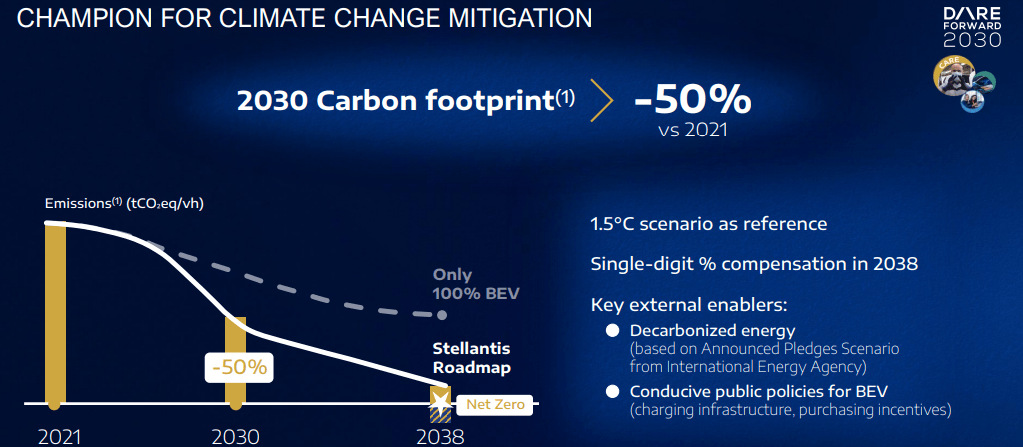
The second target is setting the course for 100% BEV sales in Europe and 50% in the United States in 2030. The third is achieving number one position in customer satisfaction. The fourth is doubling net revenues while transforming our business models and sustaining double-digit operating margins. How Stellantis will achieve this, will be the subject of a future report in our columns. Stay tuned!

Ambitions for 2024…

Looking ahead to 2024, Stellantis Belux has set itself several goals. In terms of network, the company aims to ensure a successful transition to the New Retailer Model using its existing network. Indeed, Stellantis is progressing at full speed in the execution of its Dare Forward 2030 Strategic Plan, with the ambition to be #1 in customer satisfaction in all markets, in products and services. Indeed, the customer experience will be at the core of this retailer model.

Customers will be able to take advantage of a multi-brand and multi-channel approach with a wider range of services. Dealers will have a new and efficient business model aimed at benefitting from Stellantis’ 14-brand portfolio, creating synergies, optimizing distribution costs and offering additional sustainable mobility solutions, says Stellantis. So far for the aims, let’s explain this further in more concrete terms.

In September last year, Stellantis launched the reorganization of its European dealer network, starting with four specific markets before extending it further across Europe in 2024. Stellantis announced it was ending its previous sales and services contracts with European dealers for its 14 brands and moving toward a new distribution framework based on an agency model. What is this agency model?

Under this model, the manufacturer becomes the retailer while the dealer remains the physical touchpoint with the customer. The agent/dealer receives a commission on each sale and no longer individually sets prices or discounts.

As the dealer does not have to purchase the cars from the manufacturers anymore, he does not carry significant commercial risks and has less administrative costs as billing and payment towards the customer is done by the manufacturer. It protects also the profitability of the retailer. Because, as everybody knows, profit margins on new car sales can fluctuate.

With the Lancia Pu+Ra HPE, the Lancia journey towards the future begins, drawing inspiration from the past

The advantage for the car manufacturer is a direct contact with the customer, which it did not have so far….

The manufacturer can now determine end-customer discounts themselves, in this way achieving price consistency and avoiding  competition between dealers of the same brand. They can optimize costs through centralization, and profit from the scale effect of transferring responsibilities from individual dealerships to the bigger sales organizations on national levels.

The new Alfa Romeo Stradale: the future is already a pur-sang reality…

It also is more in line with today’s consumer preferences, which would rather see fixed prices and an equally simple buying process as they experience in e-commerce.

Stellantis is moving towards this model in big steps now. In September last year, Stellantis announced that the revised retail model will be fully effective from Sept. 4, starting with Austria, Belgium, Luxembourg and the Netherlands. Stellantis is not the only one to prefer this agency sales model. BMW and Mercedes opt for it too…

The BEV line up at Peugeot: towards a leading position in the B and C segment…

Stellantis market position in Belux …

In terms of sales, Stellantis Belux aims to regain the lost market share in 2024 and further strengthen its position. In 2023, Stellantis Belux achieved a global market share of 17.2%, with more than 100,000 units sold. On the LEV (Low Emission Vehicles) market, Stellantis Belux occupies a fourth place with an 11.6% market share. The BEV (Battery Electric Vehicle) and the PHEV (Plug-in Hybrid Electric Vehicle) occupy a fourth place with respectively 10.5% and 12.8%.

Stellantis Belgium confirms its strong position with a pole position in the segment A and with not less than six models of Stellantis (Peugeot e-208, Peugeot e-2008, Opel Corsa Electric, Jeep Avenger, Opel Mokka Electric, DS3 E-tense) in the TOP 10 of the segment B (BEV), representative 66% of the part of the segment.
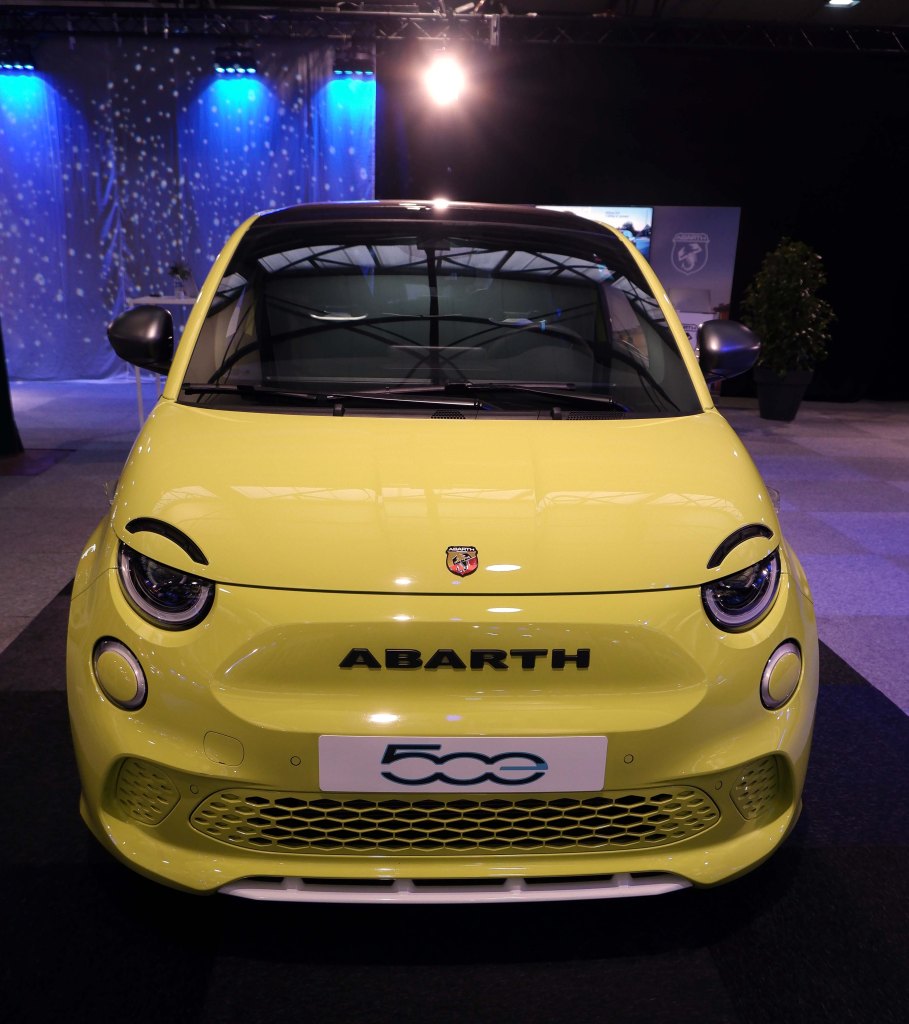
Introducing petrolheads to the joys of E-power: the Abarth 500 E, waiting for the imminent 240 HP 600 E…

Last but not least, Stellantis Belux is the leader in the segment of the LCV (Light Commercial Vehicle) with more than 30% of market share, of which more than 50% is electrified!

In terms of product innovation, Stellantis Belux will continue its electrification, where it currently leads in the A-B segment and LCV, and further expand it to the C segment with models such as the Opel Astra, Peugeot 308 and 3008 and Citroën C4.

As is tradition in January, the Stellantis brands start the year with super attractive “salon conditions” on their range. This applies to both private and professional customers and to electric and ‘thermal’ vehicles.

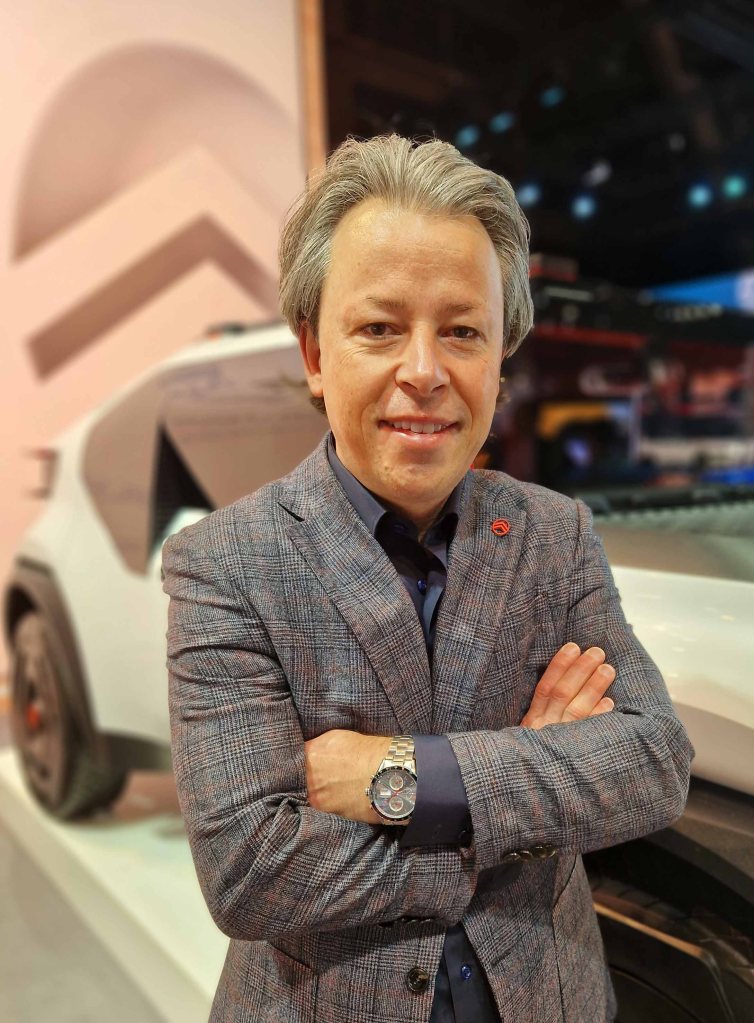
We made on this event interviews with Pierre Voineau, Managing Director Citroën Belgium & Luxemburg, (see photo here above), Asterio Perez, Managing Director of Fiat, Abarth and Fiat Professional in Belgium and Luxemburg, and last but not least Eric Laforge, Head of Jeep Brand Enlarged Europe.

This will be followed by a special report on the magnificent prototypes which were displayed amongst the 36 cars on this conference.

So stay tuned for (much) more soon!

Hans Knol ten Bensel

Unique historic Porsches to be seen at Brussels Autoworld…

Autoworld, the impressive car museum at the Brussels Cinquantenaire, holds now an exhibition ”Porsche, driven by dreams” celebrating the 75th anniversary of the brand. You can already read about it in our columns. Some 50 Porsches are displayed, many of them brought to the capital of Europe by the Stuttgart Porsche museum, with some of them never seen before on public display in Belgium.

It ranges from the 984 to the “Mission E” prototype, the latter which was a harbinger of the alternative future coming to us all.

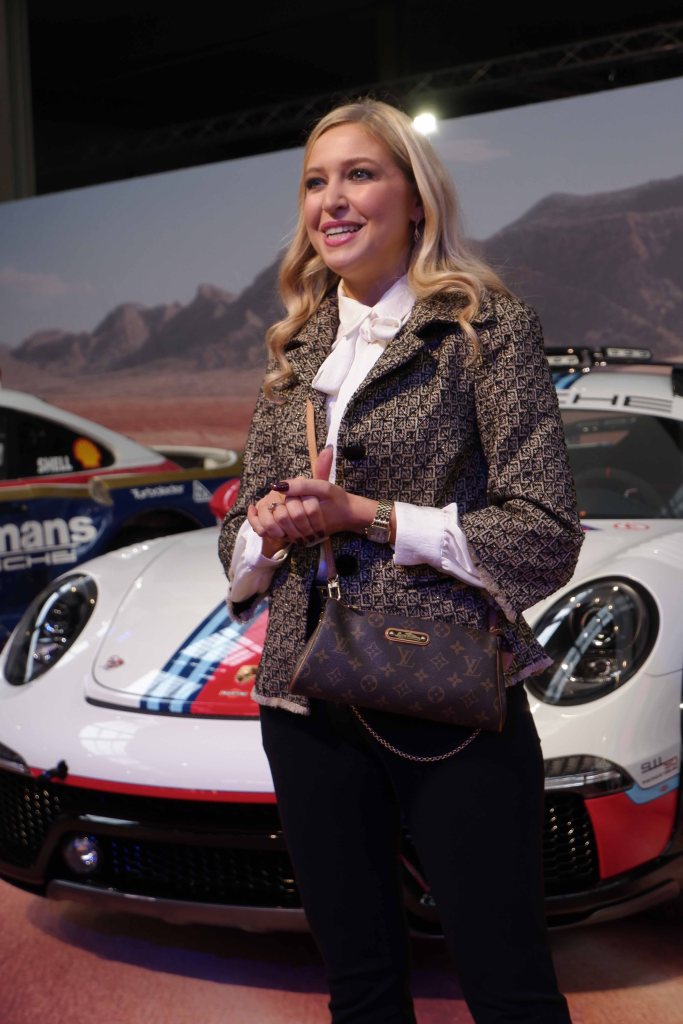
The show was presented by PR manager Porsche Belgium Liana Picard, General director Autoworld Sebastien de Baere and last but not least car expert and curator of Autoworld Leo Van Hoorick, who showed us around the exhibition and offered us his expert comments and insights. (See photo here and further in the article).

Hans Knol ten Bensel

The 911 is now already 60 years among us, and your servant still remembers driving these 911’s with sporting abandon in the early seventies. I just loved to take these genuine drivers’ cars to the limit, their handling needed an expert hand, but they never betrayed me and on the contrary, it was a pure delight to master them. The flat six engine was then still air cooled, and the echo of their roar and hiss at high revs still echoes in my ears. Just look a bit further in our columns, click the following link: https://autoprova.be/2021/03/27/some-early-photos-from-my-automotive-beginnings/


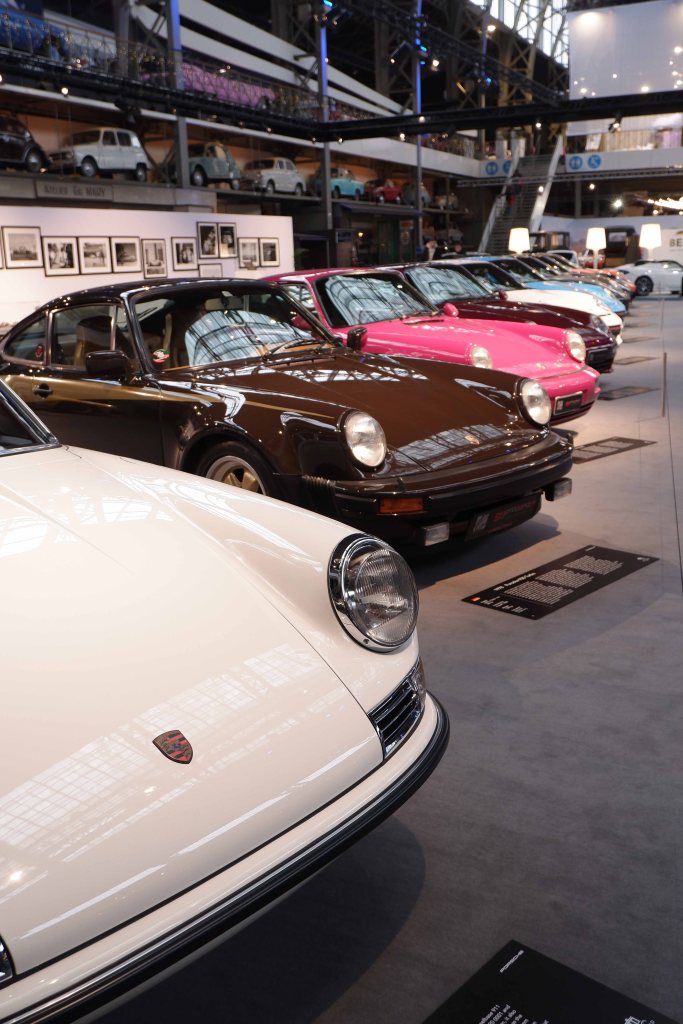
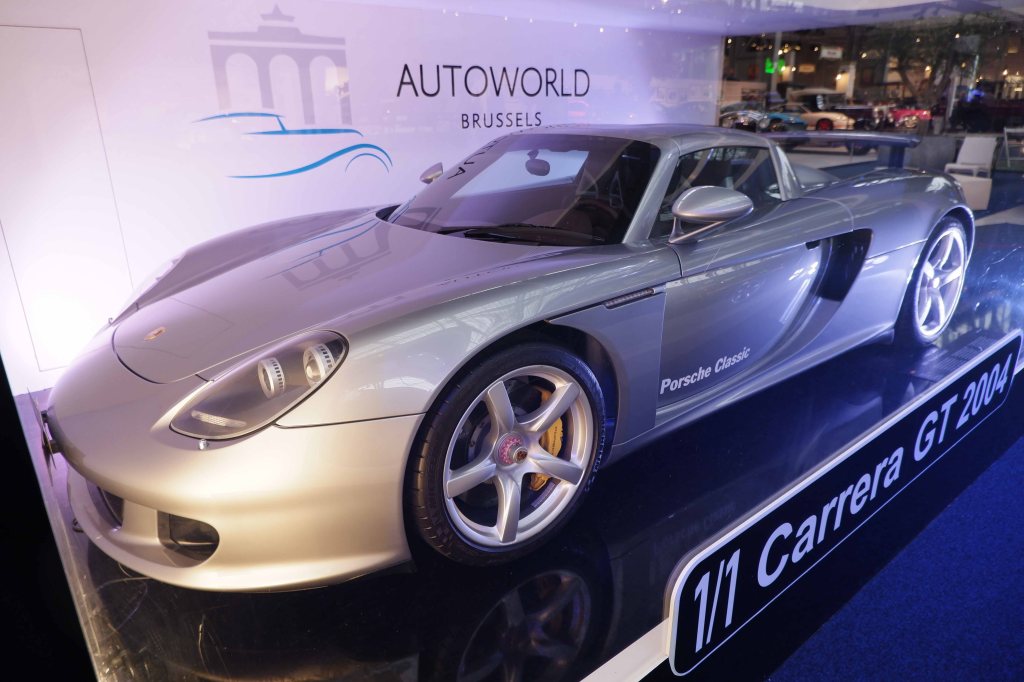
Besides the iconic 911, of which we still found an absolute classic early version in the Museum, on display outside the specific Porsche show, just look at the photo here  above, there were indeed some very dramatic Porsche Museum Cars, and the most stunning for me was the Carrera GT with its V10 engine.  It is a stylish classic sportscar, breathing the “Zeitgeist” of two decades ago, with its clean, fluent lines, inspired by the bolides at le Mans.

It’s a carbon-fibre, mid-engined super car, and made its debut at the 2003 Geneva International Motor Show. It came three years after its debut appearance at the Paris Motor Show in prototype form – an event itself which caused such an explosion of interest that Porsche knew their dream needed to be made a reality. The birth of what is today considered one of the greatest of modern classic sports cars, says Porsche. We can only agree…

Pushing technical boundaries 23 years ago…

The Carrera GT is a car that pushed technological boundaries beyond any supercar of that time. Its beautiful profile encompassed a staggeringly powerful 612PS V10 engine that was a direct descendant of the 10-cylinder race engine developed for the Le Mans 24-hours of 2000. The only modifications the race engine required were those to meet worldwide emissions and noise regulations for road legal cars. In keeping with its push for innovation, the Carrera GT also pioneered the use of pure carbon fibre for its monocoque and subframe.  Performance is – considering even today’s standards – quite impressive. It can reach 100km/h in just 3.9secs and roar on to 200km/h in 9.9secs. The top speed of the Carrera GT is officially 330km/h.

The racing engine needs of course a fair amount of cooling. The huge air intake along the car’s flanks, along with the three radiators are five times larger in area than that of the Porsche 911 Turbo of the time.

Then there are the purposeful contours of the Carrera GT. It was designed by a team headed up by legendary Dutch car designer, Harm Lagaay. He already worked since 1971 for Porsche, and designed the 924. He moved to BMW in 1985, and designed for them the BMW Z1. Also purposeful and elegant. This purposefulness is found also in this GT. He returned to Porsche in 1989 as head of the “Style Porsche” department in Weissach, and oversaw the design of the Porsches of the period – the 968, 989 (the stillborn four door Porsche), 993 (the 1993-1997 generation of the 911 for which Englishman Tony Hatter is also credited), Boxster, 996 (the all-new 911 of 1997), last but not least the Cayenne and one of his absolute masterpieces, the Carrera GT.

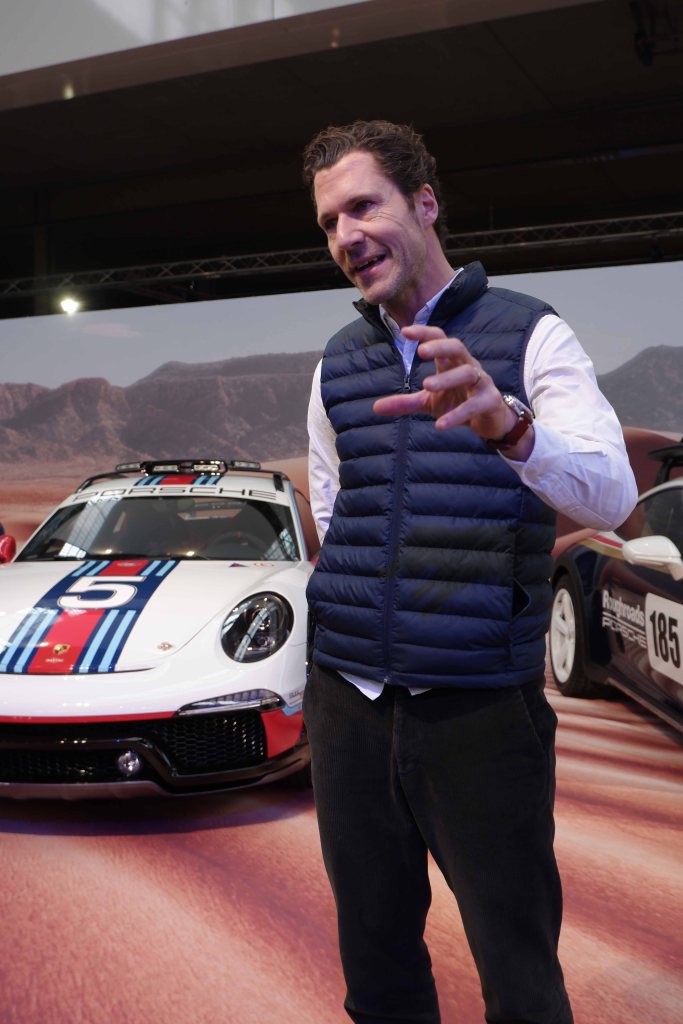
General director Autoworld Sebastien de Baere…

Some 1270 units of the Carrera GT were made in total over its production life (manufacture ended in May 2006). Today, the Carrera GT Type 980 is an official member of the Porsche Classic family, which means both owners and those Porsche Classic partners and Porsche Centres who maintain the cars have access to an extensive supply of genuine parts. As you might expect, many of them are still on our roads and retail at around the $1 million range for a reasonably good example… Mind you, it cost close to half a million Euros when new…

Italian blood: the Carrera Abarth

Can you believe, looking at the picture above, that this car was built in 1960? Three years before the 911, as the dust sheet was pulled back on this brand-new Porsche model at the 1963 Frankfurt International Motor Show. Looking in profile, it is quite reminiscent of the overall proportions of the 911. Just a bit more muscular, racier, more pur-sang even. It is officially called the Porsche 356 B 2000 GS Carrera GTL Abarth, and for me, it is one of the “purest” Porsche street cars.

We go back to the early sixties here. To remain competitive in Grand Touring (GT) racing, Porsche needed lightweight versions of the 356 B. They looked south for help, and found it in the Italian-Austrian sports car builder and Porsche representative Carlo Abarth. He has enjoyed a good relationship with Zuffenhausen since their collaboration with the Type 360 Cisitalia Grand Prix car in 1947. Abarth now commissions Ugo Zagato in Milan to build 20 lightweight coupés. The handcrafted aluminium bodies featuring the characteristic air scoop on the rear are compact and streamlined. It is a true beauty with wonderful proportions, in our opinion a forerunner of what the 911 was to be.

Gave us expert information about the Porsches in the exhibition, connaisseur and Autoworld curator Leo Van Hoorick…

. The 356 B Carrera GTL Abarth weighs almost 120 kilograms less than the standard 356 B. The “marriage” of the chassis and body takes place in Milan, with the GTL receiving its finishing touches at Abarth and Porsche. The list of successes of the 356 B Carrera GTL Abarth includes class victories at the Targa Florio – in 1960 with a 1.6-litre engine, 1961 with a 2-litre Carrera unit – plus outright victory at the Lyon-Charbonnières Rally of 1960 as well as class wins at Le Mans.

Driving the Abarth GTL, racing drivers such as Hans Herrmann, Herbert Linge, Edgar Barth and Paul Ernst Strähle win world championship titles in 1961 for Porsche for GT cars with a displacement of up to 2 litres. Further international titles in 1961 include Heini Walter’s fourth victory at the European Mountain Championship and Hans-Joachim Walter’s win at the European Rally Championship.

Even with the 1,588 cc flat four, developing 135 hp or 99 kW, the 778 kg Carrera was 220 km/h fast…

There is a lot more to see in this Porsche exhibition in Autoworld, and we will come back on this in following reports, where we will delve more in detail about the Porsche prototypes and the iconic Gmünd Coupé. Stay tuned!

Hans Knol ten Bensel

Renault unveils a tip of the veil of its cute 5 E-Tech electric ahead of Geneva Show…

Indeed, Renault will enrichen the world with its iconic full electric “Cinq”, reminiscent of its wonderful R5 which stole so many hearts decades ago. With this car, Renault wants to bring EV driving to the masses, affordable and with a distinct link to its glorious past.

The car will be a star on the 26 February at the Geneva International Motor Show, and it now starts gradually unveiling details of the car.

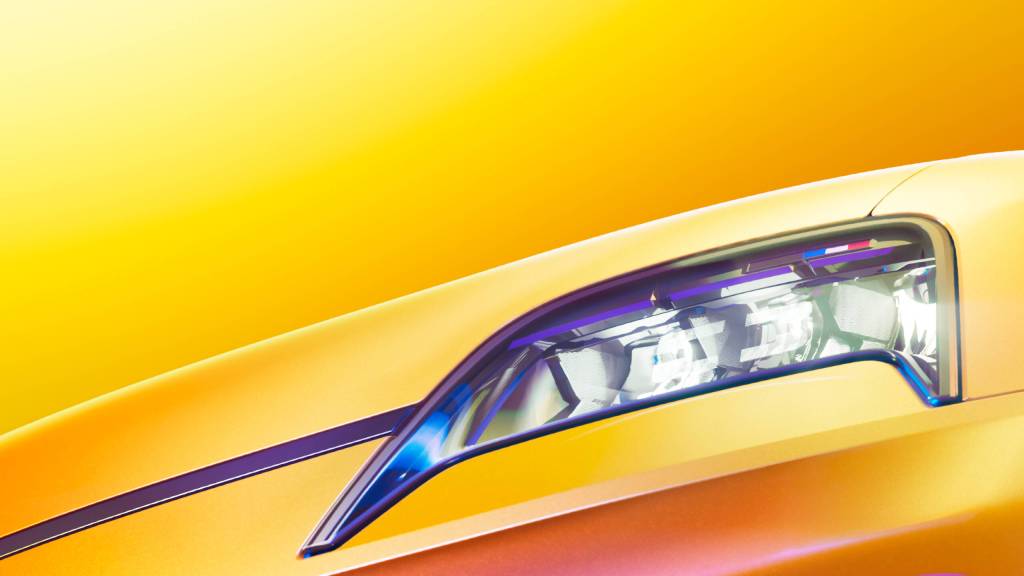
The headlights of R5 are a key design feature, making the front end instantly recognisable. It is not only their shape that sets them apart, but also the mark in the centre of the lens, resembling the pupil of the human eye.  This nod to the 1972 advert featuring “The Adventures of Supercar” gives the modern-day R5 a human-like expression.

At the front end, the air intake present on the bonnet of the historic model has disappeared. Clearly showing that Renault 5 E-Tech electric belongs to the world of electric vehicles, it has been replaced by a charge indicator light forming the iconic number “5” when the vehicle is fully charged.

The wheel arches create a broader stance, giving R5 the look of a compact car with real on-road presence. Their graphic design underlines a unique and instantly recognisable personality, reminiscent of R5 Turbo.

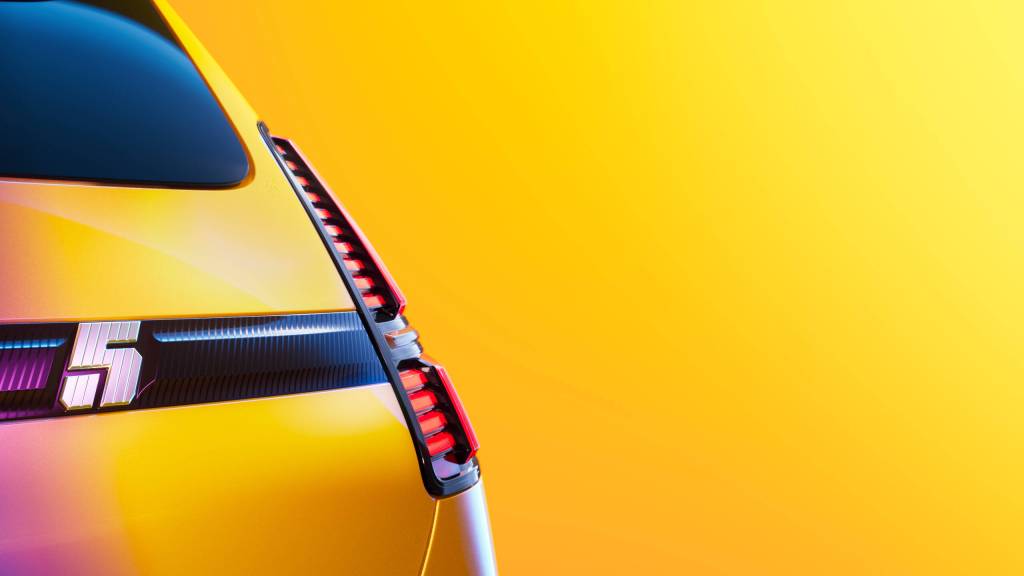
The vertical rear lights were a hallmark of the R5, and here they include a function extending the side panel.

R5 R Pass, a skip-the-line programme for online customers

At the end of last month, Renault is rolled out a unique experience for future customers: the R5 R Pass programme. R5 R Pass holders will be able to order the new iconic all-electric vehicle in the Renault network 10 days before orders open to the general public. Customers placing an order during this special period will be among the lucky first to take delivery of their vehicle from autumn 2024, with the ElectriCity plant in Douai, France, giving priority to their order on the production line. Holders of an R5 R Pass will receive a scale model of Renault 5 E- Tech electric after its reveal and will be the first to access content and events around Renault 5.

Available at a cost of €150, the R5 R Pass will be available from http://www.renault.fr/r5 and in the seven participating countries (France, Germany, Italy, Spain, United Kingdom, Belgium and the Netherlands).

An all-electric city icon…

Just 3.92m long, Renault 5 E-Tech electric is every inch a city car. Ideal for urban driving, this all-electric icon is also fit for the open road with its 52 kWh battery giving it a range of up to 400 km WLTP. This battery will be the first available when orders open. A second 40 kWh battery will become available at a later date.

Renault 5 E-Tech electric will be the first vehicle built on the new AmpR Small platform (formerly CMF-B EV), designed for true driving pleasure. The multi-link rear suspension, usually found only on vehicles further up the market, contributes to the excellent stability and roadholding.

Renault will gradually show more of its new all-electric baby. Stay tuned!

Hans Knol ten Bensel

Exclusive exhibition “Porsche, driven by dreams” at Brussels Autoworld

Porsche has been making people dream for 75 years, and Autoworld, the iconic automotive museum in Brussels, joins in on that dream with the end-of-year exhibition “Porsche, Driven By Dreams”.

The exhibition runs from December 8, 2023 to February 25, 2024.

After the exhibition ‘Porsche – Electric to Electric’ in 2013 and ‘Porsche 70 Years’ in 2018, Autoworld continues its successful collaboration with Porsche Belgium and the Porsche Museum in Stuttgart. With a never-before-seen collection of exclusive Porsches, collected thematically in a unique setting, you are taken into the overwhelming dream world of Porsche.

The storytelling goes much further than just the cars…

In addition to the beautiful cars, the exhibition also focuses on the people behind the brand. People who, just like Ferry Porsche, have always believed in their dreams, achieved great things and realized great ideas. The stories of international and Belgian personalities are highlighted in the various theme groups. Examples are Jacky Ickx, Johan Dirickx, Thierry Boutsen, Laurens Vanthoor, André Lotterer…

Unseen: from Concept to Model

Reality often starts with a dream, and every Porsche starts life as a concept. Autoworld collected 9 Porsche concept cars that have never before been exhibited in Belgium and shows them side by side with the production model.

From the 984 that would become the 914 to the prototype of the Taycan that dreams of an alternative future, via the 989 (the Panamera project), the 959 group B study, the 911 Vision Safari and many more models.

911  celebrates its 60th birthday…

Naturally, the 911 forms a separate theme within the exhibition “Porsche, Driven By Dreams” with another unique collection spanning 8 generations of the “Neunelfer.”

Art and Heritage

“Porsche, Driven By Dreams” is more than just presenting dream cars. The renowned Belgian street artist Vexx, known for his Porsche Vision Gran Turismo that can be viewed until January 8, 2024, will be present exclusively for Autoworld on December 7 and 8 with an animation about Porsche.

Another artist, renowned photographer Bart Kuykens, will exhibit his works, in which the Porsche 911 always plays a prominent role.

Ferdinand Porsche fulfilled his absolute dream 75 years ago by building his own dream car. His very first 356 ‘Gmund,’ built in a barn in the village of the same name in Austria, to other classics that helped turn Ferdinand Porsche’s dream into reality are on show.

Motorsport

The 991 RSR, 991 GT1, 919 Hybrid and Formula E Gen 3 are just some of the racing cars on display that have made Porsche the most successful racing car brand.

Of course, the Belgian contribution is not forgotten with racing cars driven by legendary drivers such as Jacky Ickx, Thierry Boutsen and Laurens Vanthoor.

The world of the Dakar Rally

It was Jacky Ickx who made Porsche dream of the famous Dakar rally. A dream that once again became reality with, among other things, the 959 with Rothmans colors.

Porsche honors the successful Dakar models with the recent 911 Dakar, the 911 GT3 Rally in D’Ieteren colors and the 953 Dakar. Autoworld honors Porsche’s successful Dakar past in a separate, sandy universe of the expo.

Kids Corner

The youngest visitors can attend workshops in the separate room where they can build the Porsche of their dreams. For inspiration, a life-size Porsche in Lego is on display. And who knows, the next Belgian Le Mans winner with Porsche will be discovered on our racing simulator.

Permanent collection

Autoworld’s permanent collection will continue to be admired during the three-month exhibition “Porsche, Driven By Dreams”. The ‘Bagnole’ restaurant will of course remain open to the public, as will the museum shop with an extensive Porsche collection, ideal for the holidays…

Autoworld is located in the beautiful Parc du Cinquantenaire (French) of Jubelpark (Dutch). Opening hours: Monday to Friday: 10-17 h,  Saturday and Sunday 10-18 h.

Hans Knol ten Bensel

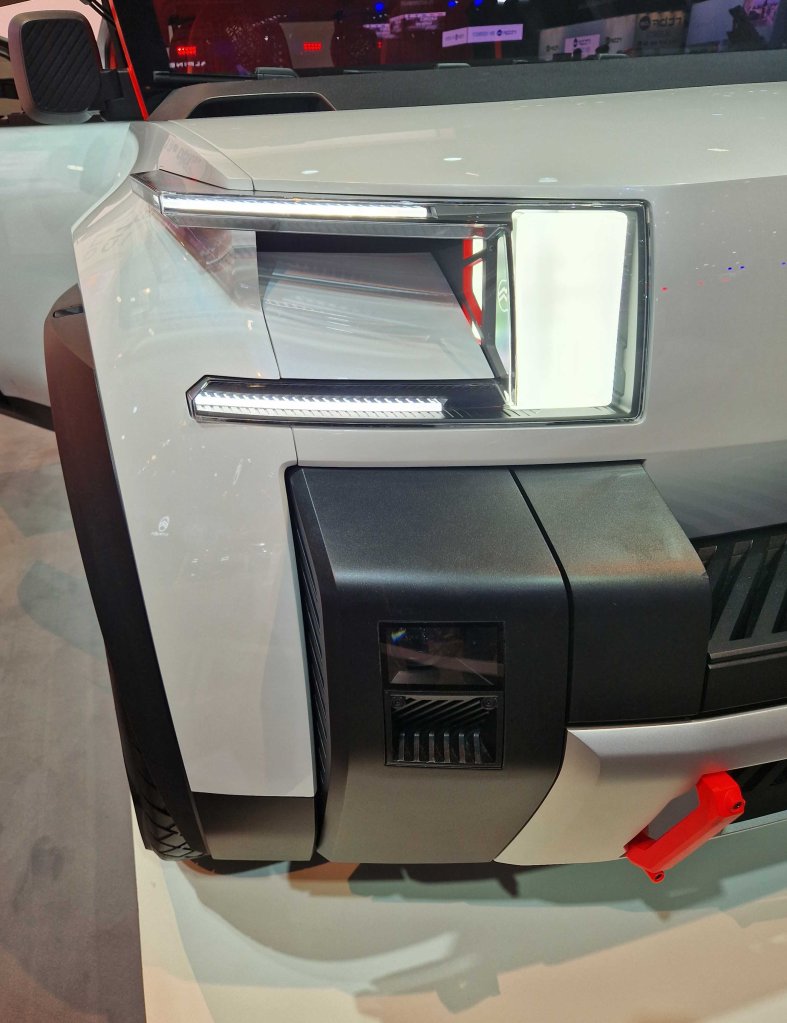
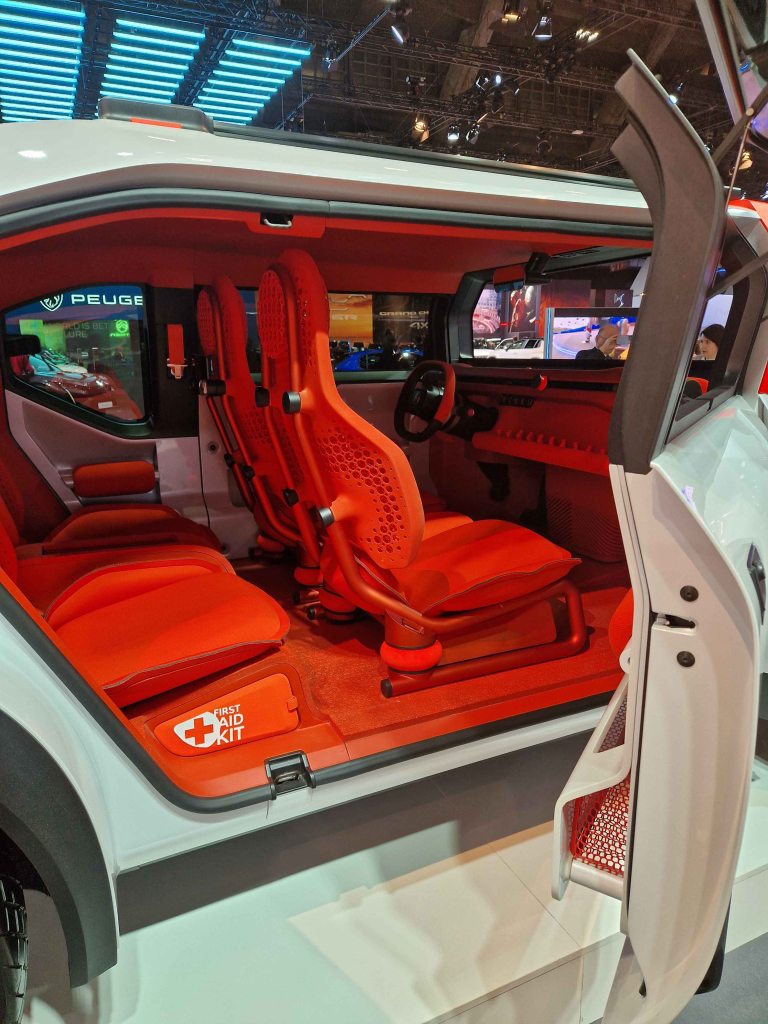
We spoke with Pierre Leclercq: “our Citroën Oli is not only style. It is French Design.”  

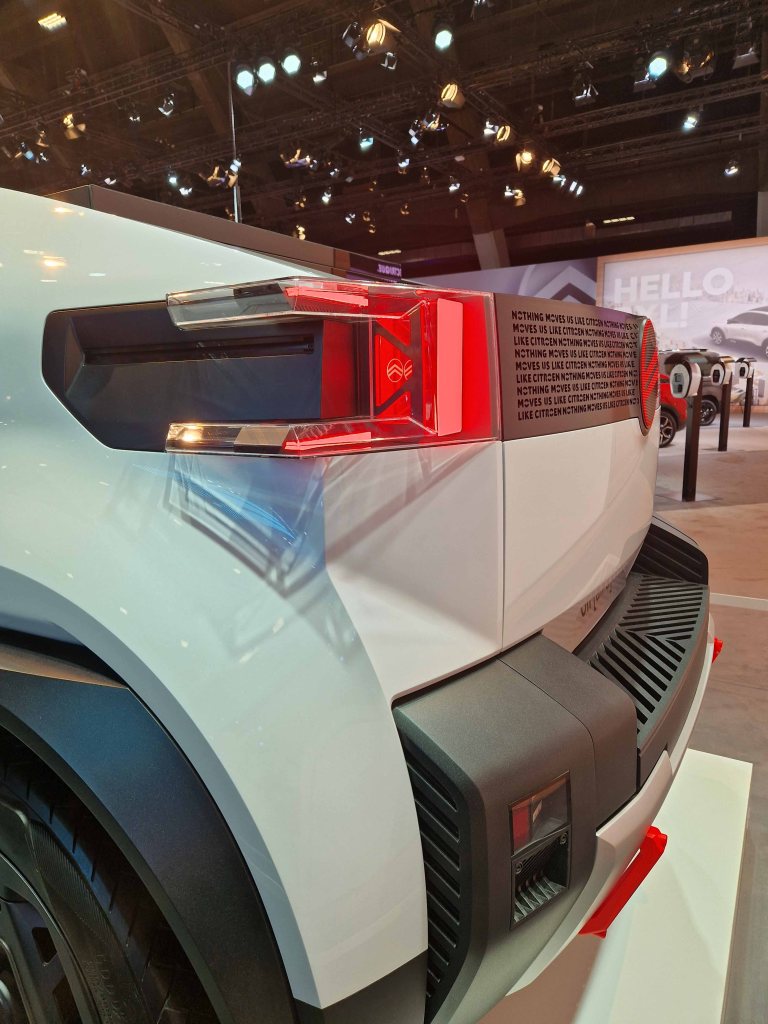
On the Brussels Salon, Citroën showed its already iconic Oli prototype, a harbinger of things to come in the Citroëns which will be in the showrooms already this and next year. Reason enough for your servant to have a talk with its head of design, Pierre Leclercq, about the design philosophy of the progressive brand with the “double chevron”, and so much more…

Hans Knol ten Bensel

I started this interview asking indeed about this new design philosophy of the brand, striving towards simplicity, practicality, lightness, durability and sustainability in a very bold and original package.

PL: “With the Oli, there are two things. First there is the brand identity, as we show with the Oli styling elements which we will bring to the market as soon as this year. The front end, the new logo, the head- and rear lamps, also the coherence between the front and rear end. The latter is a very important element in our brand identity. (We have seen this already in the Ami – editor’s note).

The form language, the simplicity of the edges and the curves will also be seen on our future production cars, but then also the contrasting vertical elements will be present. Our designers will deviate here from the strictly automotive styling which you see in the other brands of the group, we have a non-automotive touch which will be a distinctive element in our future styling.

The magic goals of French Design…

The second fact is that the Oli is not just a styling exercise. It is not only style. It is really French Design. We work together with our engineers to reduce weight, the cost, we are striving for intuitive and simple solutions.

For instance the seats. It’s very important, we work with a whole team to get a seat which is very distinctive, which we can put into production. We discovered with the Oli that our clients are ready for these things. We see that our clients are ready to take bold steps together with us, because we have an image that we will bring something more on the road than just a nice looking car.

HKtB: This translates also into the choice of the materials, the dialogue with the suppliers about the substance and texture of the elements and their surfaces, their unique touch and feel, the atmosphere and character this gives to the car…

PL: We will be a zero carbon company in 2038, and this has a huge impact on materials. Not so long ago, the choice of the materials came very late in the process of building a car. The exterior and interior, the colors, it was seen as pure decoration. Here and there, one started to use recycled materials for some items, but that was it. This process is now completely turned around at Citroën. We now ask first to tell us which materials we can use, as we want recycled materials, unpainted, and we will go from there and adopt them. This is most interesting. And I think that our clients are also ready for this.

HKtB: These elements and this approach we also see in the Ami. The French, as even Mr. Tavares recently put it, love their individual mobility. The Ami is fit for the (mega)city… will there be other models geared for a new City Mobility in the spirit of the Oli?

We always search for new solutions…

PL:  We have many projects running now. It’s a bit like a funnel. When there is one project hitting the road, we have already other proposals in the pipeline. We are always searching for new solutions. If you remember, two years ago, we showed a rather disruptive project of robotized platforms, which is an intelligent use of the present day autonomous technology, in controlled urban areas. But I imagine perfectly in 2030 and 2035 that these solutions will be used in our cities. The design will then focus on the interior of the cabins and structures rolling on these platforms, a very interesting evolution.

The Ami represented a big risk for us, indeed, we thought about the city, but in fact, we scrutinized the clients who bought the Ami, age, location, etc, and we noticed that the Ami is not only used in the cities. We have clients who buy the Ami for their children and grandchildren, remember that in France you can drive an Ami at the age of 14, and it is better than a scooter. And in a market where these vehicles cost between 12 and 15.000 Euros, ours is available for 6.000 Euros… No small feat, as we respect the profitability margins of our group! It is now on the market for two years, and it has grown more into a lifestyle than a car. This is also what the 2 CV has achieved. It is not easy to create the same phenomenon in this day and age…

HKtB: Can you tell a bit more about your Ami buyers?

We have also many clients who buy an Ami for their holiday homes. And as I said, of course grandparents who buy the Ami for their grandchildren. There are also clients who own a Ferrari and buy an Ami for their third or fourth car…

HKtB: We talked earlier in Paris about your open mindedness towards other designers, in other sectors, who could become involved in offering elements of the car during its life, for example, that in a further future one could offer replacement seats for Oli’s or Citroëns who after years of intensive use get a bit long in the teeth… or, rather, offer parts and items to customize the new Citroëns…

PL: It’s a philosophy I love very much. People more and more want an object which is really theirs. Design is not a luxury anymore. If you go for an Ikea kitchen, you can still choose the finish, styling and colors you want, to make it yours. This is now also true for cars. We have started this with the Ami.

HKtB: It is also true for Jeep. Mopar offers a wide array of accessories.

PL: Indeed, this trend is already more prominent in the States. But with the Ami we started off in Europe with the same trend. Not that we offer many accessories, but we created a desire with the customer to customize his car. It’s like Apple. They don’t offer many accessories themselves, but are produced by Belkin etc. It is a very interesting path for our cars in the future. This will give us for instance incredible interiors. I want the client to appropriate our geometries. Why not share our geometries on the internet Open Space and invite the developers to have fun with it?

Every brand has its own design team to embody its proper DNA

HKtB: What is your relationship or rather dialogue between your styling department and the suppliers? Do they come present you what is possible, or after having established a manifest for yourselves what you want to do in styling in the next five years, let’s say, you ask them to come up with new materials, possibilities?

PL: The dialogue goes both ways. But I want to stress here that the design has become very important. The suppliers are specialized in offering technology, for instance for the platforms we have conceived within the group, but over the last 30 years, what have we done? Instead of asking PininFarina or Bertone to style all the cars in the world, we have all established our design centers which carry truly our DNA, and every brand has its own equipe or team of designers. This is génial, because we have cars within the group which don’t resemble each other at all…

HKtB: With the new materials comes also repair friendliness, durability…

PL: Indeed, we want our cars to have a longer lifespan, and we will refresh them within our network. We need of course more control as nowadays we don’t see the car anymore after it has been produced. We have to control the recyclability of the car. Otherwise it’s no use to build the car with recyclable materials.

HKtB: It think it is necessary to tell the client that his car now has a long life and that you as the manufacturer will follow the car throughout its life.

PL: Indeed, a lifelong car, staying with you the rest of your life.

HKtB: Indeed, that as a brand policy you commit yourself to the clients that your Citroën model, Type A, B, or whatever, that you will always follow this car for decades to come…

PL: Ca serait génial, that would be a stroke of genius. It is our goal. It would be very interesting and it would completely change the idea of the automobile of today.

HKtB:  The youth is already there. They support and adopt the circular economy. I think Citroën is the right brand to do this. 

PL: Indeed, we push within the Stellantis group for these concepts, and I think that our clients are far more inclined to make these choices than the buyers of other brands.

HKtB: I thank you for this interview. Thinking out of the box is always interesting.

PL: I thank you, always lovely to exchange these ideas, thank you for the conversation. I also think that every car we build has to make the life of our clients better. These are not empty words. The Ami improves lives. We offered a new service; in Paris, people smiled when they saw the car. It takes something to convince a Parisien!

Hans Knol ten Bensel

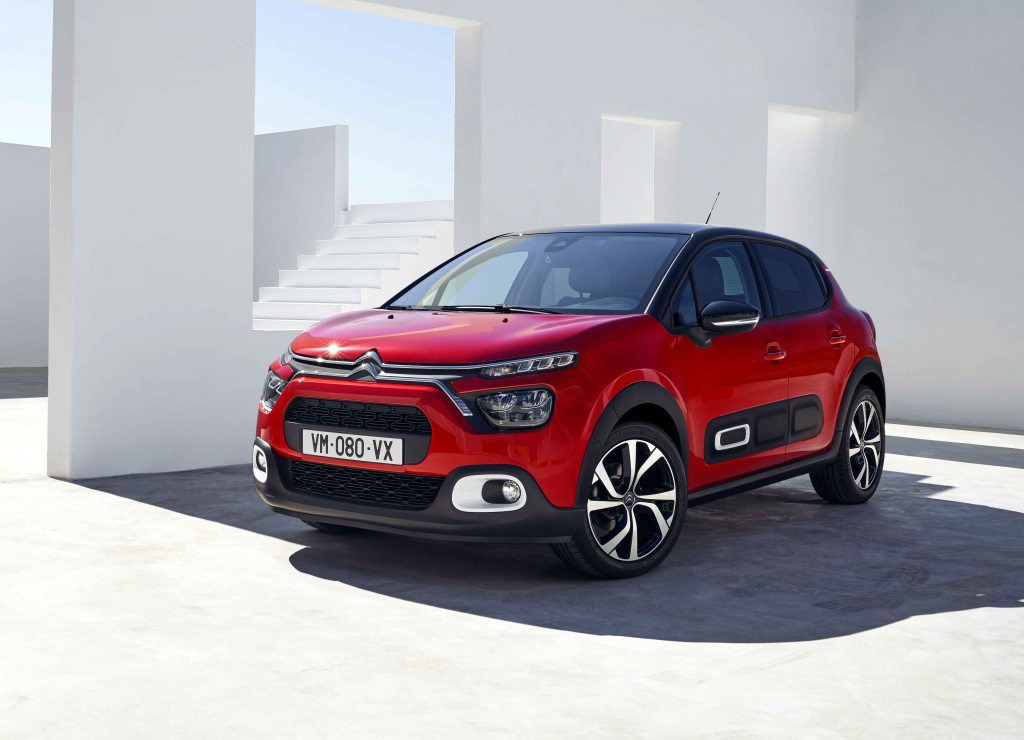
The Citroën C3 is the best-selling car in Belgium in 2022…

With 8,472 units registered in Belgium in 2022, the Citroën C3 is the most popular car in our country.  Citroën’s compact saloon is clearly very wanted for its pleasing size, which makes it easy to use in the city, its driving comfort and its original, empathetic design. Citroën’s compact sedan appeals to a large number of customers in Belgium, both individuals and companies.

“Citroën has always had a strong presence in Belgium,” says Damien Martin-Cocher, General Manager of the brand for the Belux market. “We are therefore pleased that our current range maintains this special connection with the Belgian public. The C3 is indeed very visible in the Belgian car landscape and we are very enthusiastic about it. We are on the eve of the 2023 Brussels Motor Show and we are convinced that we can use the success of the C3 to further strengthen Citroën’s position.”

Citroën builds further on is success and is planning a number of attractive offers for the Citroën C3 for the 2023 Brussels Motor Show. The C3 You! (e.g. equipped with air conditioning, BlueTooth radio and cruise control) is available from € 13,480 (€ 5,000 unconditional discount). More Citroën news soon!

Hans Knol ten Bensel

A look at Peugeot’s future products and electrification strategy with the INCEPTION CONCEPT…

Featuring a revolutionary exterior and interior design, including the next-generation PEUGEOT i-Cockpit® and innovative Hypersquare control system with steer-by-wire technology, the INCEPTION CONCEPT will inspire PEUGEOT’s future products from 2025 onwards. The better news is that Peugeot plans to bring most of its innovations to production (!)

Based on the STLA Large platform, the fully electric INCEPTION CONCEPT is powered by a 100kWh battery providing a range of 497 miles. With two electric motors, the INCEPTION CONCEPT produces almost 680hp and accelerates from 0-62mph in under three seconds. The model also features 800V technology, enabling it to add 93 miles of range in just five minutes, and is capable of wireless induction charging.

Linda Jackson, CEO of the PEUGEOT brand, said: “PEUGEOT is committed to the electrification of its range. In 2023, our entire line-up will be electrified and in the next two years, five new 100% electric models will be launched. Our ambition is simple: to make PEUGEOT the leading electric brand in Europe by 2030. This objective and ambitious vision pave the way for a radical transformation for the brand, as represented by the INCEPTION CONCEPT.”

Indeed, PEUGEOT will reduce its carbon footprint by more than 50% by 2030 in Europe and to become fully Carbon Net Zero by 2038.

Over the next two years, PEUGEOT will launch five new 100% electric models and by 2030, all PEUGEOT cars sold in Europe will be electric.

Dramatic design

The PEUGEOT INCEPTION CONCEPT introduces a new, simpler and more refined design language for the brand, which will be introduced on future models from 2025. At the front, it features an all-new light signature incorporating PEUGEOT’s distinctive claw design, which is merged with the front grille to create a single object that also houses the sensors. This is made up of a single piece of glass with the logo in the centre, magnified by the 3D luminescent effect.  The front grille and headlamps are in my opinion a bit reminiscent of the ‘70s 504… 

A TECH BAR runs horizontally through the door layer. This flush screen emits different messages to the outside of the car when the driver and passengers approach it. The artificial intelligence equipped on the PEUGEOT INCEPTION CONCEPT makes it possible to recognize the driver in order to set up the comfort settings (seat posture, temperature, driving mode and multimedia preferences) desired by each occupant. In addition, the TECH BAR also displays the battery charge level and houses many sensors and radars, leaving the bodywork completely smooth.

The INCEPTION CONCEPT’s bold design incorporates 7.25m2 of glazing to create a glass capsule for the passenger compartment that plunges to the driver and front passenger’s feet. All the glazing (windscreen, side windows and quarter windows) is made from glass designed for architecture. Adapted to the PEUGEOT INCEPTION CONCEPT, it retains its exceptional thermal qualities and benefits from a multi-chrome treatment (treatment with metal oxides), a process initially used for the visors of astronauts’ helmets by NASA.

Completing the car’s unique design is an exclusive body colour, which highlights the shapes in the bodywork and interacts, like the glazing, by tinting according to the external environment. The paint is single-coated, meaning far less energy is consumed during its application.

‘BEV-by-design’ platform

The INCEPTION CONCEPT has been given the silhouette of a low (1.34m) and efficient saloon and is 5m in length. It is based on the STLA Large platform, one of four future Stellantis Group “BEV-by-design” platforms. The arrival of this new range of platforms from 2023 will revolutionize the PEUGEOTs of tomorrow. Specifically created for electrification, they offer major differences in terms of architecture which enabled designers to completely reshape the PEUGEOT INCEPTION CONCEPT’s passenger compartment.

The new “BEV-by-design” native electric platforms will also introduce technological modules powered by artificial intelligence: STLA Brain, STLA SmartCockpit and STLA AutoDrive. Like the INCEPTION CONCEPT, future PEUGEOT models will be equipped with STLA Brain artificial intelligence and will be fully connected.

Powertrain

The 100% electric PEUGEOT INCEPTION CONCEPT is equipped with 800V technology. Its 100kWh battery enables it to travel 497 miles on a single charge, with extremely low consumption of just 12.5kWh per 100 km. The INCEPTION CONCEPT is capable of adding 19 miles of range in one minute, or 93 miles in five minutes, and can also be recharged wirelessly by induction.

Two compact electric motors, one at the front, the other at the rear, make the PEUGEOT INCEPTION CONCEPT a four-wheel drive vehicle. The combined power is close to 680hp (500kW), enabling it to accelerate from 0-62mph in under three seconds.

Next-generation i-Cockpit®

With its new Hypersquare control system, the PEUGEOT INCEPTION CONCEPT offers an agile driving experience and an all-new, more intuitive i-Cockpit®. Inspired by video games, the Hypersquare control system does away with the conventional steering wheel in favour of digital electric controls and steer-by-wire technology.

The centre of the Hypersquare is a tablet-type screen dedicated to the distribution of control information. The pictograms for the different features (air conditioning, radio volume, ADAS etc.) are displayed on the two side panels to facilitate access to the chosen control. The latter is located inside the circular recesses and can be accessed by moving the thumb only, without taking your hands off the steering control.

The next generation i-Cockpit also includes the Stellantis STLA SmartCockpit technology platform and STLA AutoDrive, enabling Level 4 autonomous driving. When driving is delegated, Hypersquare retracts and a large panoramic screen slides out from the floor to offer a new passenger compartment experience.

 PEUGEOT’s goal is to introduce the Hypersquare on a next generation vehicle in the range before the end of the decade.(!)

Interior

The PEUGEOT INCEPTION CONCEPT features a minimal cockpit dedicated to the driver alone, which does without a dashboard, crossbar and the bulkhead, providing a completely open view of the road.

Sustainable ‘moulded textiles’ are also used throughout the interior. Scraps of 100% polyester fabric from the design centre’s prototyping workshops or from suppliers are re-used to make load-bearing or trim parts. The seats are covered with a velvet made from 100% recycled polyester, which extends onto the floor and features 3D patterns to act as a floor mat.

More Peugeot news soon…

Hans Knol ten Bensel

BMW rides you into an enhanced real and virtual world at CES Las Vegas…

The BMW Group is sharing its vision of the future digital experience, both inside and outside the vehicle, at the Consumer Electronics Show (CES) 2023 in Las Vegas.

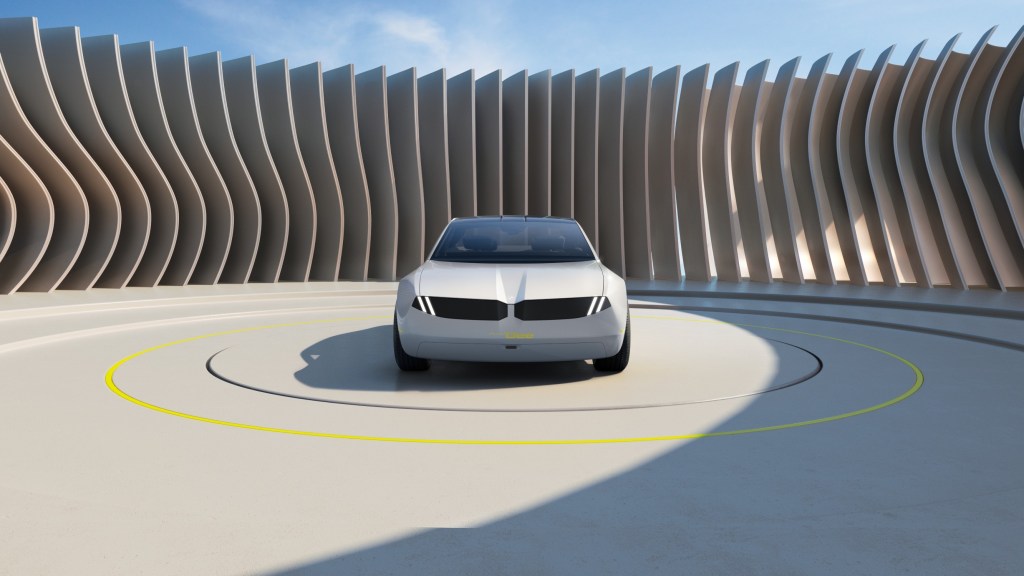
It presented the BMW i Vision Dee, a futuristic mid-size sedan with a new and pared-down design language. The name “Dee” stands for Digital Emotional Experience – and that is precisely its aim: to create an even stronger bond between people and their cars.

This car has future digital functions will go far beyond the level of voice control and driver assistance systems we are familiar with today.

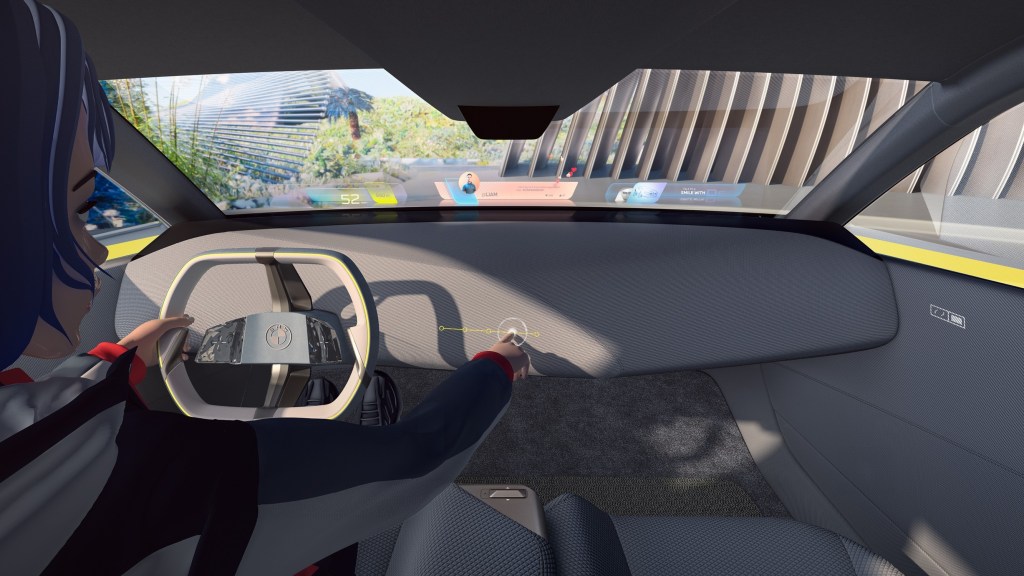
It starts all with a BMW Head-Up-Display extending across the full width of the windscreen, providing a glimpse of the next vehicle generation.

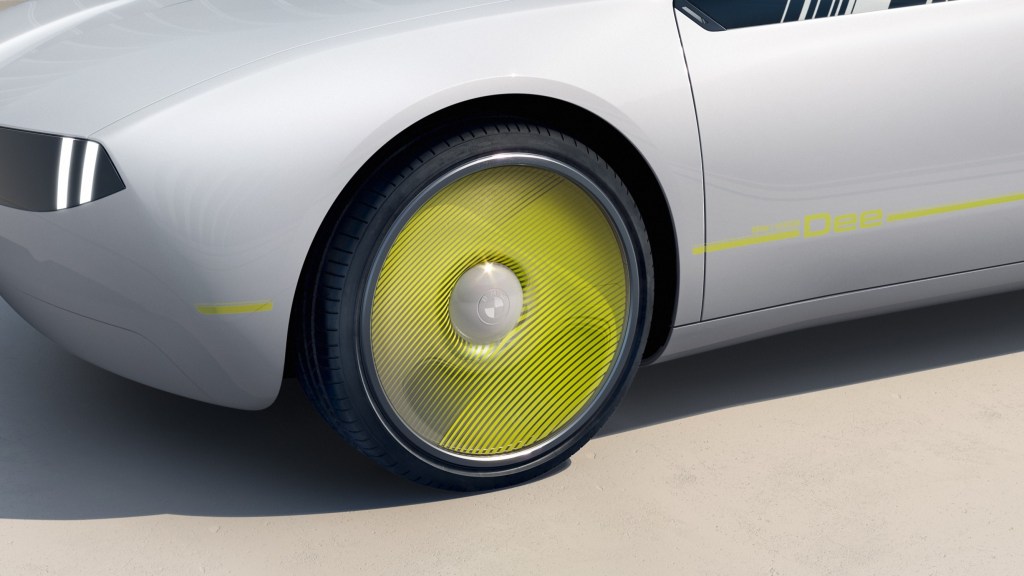
From 2025 onwards, this innovation will be available in the models of the NEUE KLASSE. The BMW Group has also refined its use of colour-change technology. Having unveiled the BMW iX Flow Featuring E Ink, with the ability to change from black to white, at the last CES, BMW i Vision Dee can now curate its exterior in up to 32 colours.

“With the BMW i Vision Dee, we are showcasing what is possible when hardware and software merge. In this way, we are able to exploit the full potential of digitalisation to transform the car into an intelligent companion. That is the future for automotive manufacturers – and, also, for BMW: the fusion of the virtual experience with genuine driving pleasure,” said Oliver Zipse, Chairman of the Board of Management of BMW AG. “At the same time, BMW i Vision Dee is another step on the road to the NEUE KLASSE. With this vision, we are looking far into the future and underlining the tremendous importance of digitalisation for our upcoming product generations.”

With its intelligent, almost human capabilities, BMW i Vision Dee accompanies drivers not only through real-life situations on the roads, but also in their digital environment.

“A BMW lives by its unparalleled digital performance. BMW i Vision Dee is about perfect integration of virtual and physical experiences,” said Frank Weber, member of the Board of Management of BMW AG responsible for Development. “Whoever excels at integrating the customer’s everyday digital worlds into the vehicle at all levels will succeed in mastering the future of car-building.”

BMW Mixed Reality Slider: into the virtual world in five steps

The BMW, in combination with the advanced Head-up Display, is the digital highlight and central operating control of BMW i Vision Dee. The completely virgin and simple dashboard panel shows just a line with dots. This is the Mixed Reality Slider. By using shy-tech sensors on the instrument panel, drivers can decide for themselves how much digital content they want to see on the advanced Head-Up Display. The five-step dot selection ranges from analogue, to driving-related information, to the contents of the communications system, to augmented-reality projection, right up to entry into virtual worlds. In parallel, dimmable windows can also be used to gradually fade out reality. Mixed reality can be experienced in BMW i Vision Dee in an immersive way that engages different senses without requiring any additional tools, creating a new dimension of driving pleasure for the user.

Advanced BMW Head-Up-Display: in NEUE KLASSE from 2025

The BMW Group is known in the automotive sector as a trailblazer for the Head-Up-Display and has systematically refined this technology over the past two decades. In BMW i Vision Dee, projection across the entire width of the windscreen allows information to be displayed on the largest possible surface – which only becomes recognisable as a display once it is activated. In this way, the BMW Group demonstrates the huge potential of projection technology and BMW i Vision Dee visualizes how a advanced Head-Up-Display could also be utilized in the future for the display and operating concept. The standard-production version of the BMW Head-up-Display extending across the full width of the windscreen will be used in the models of the NEUE KLASSE from 2025 onwards.

Welcome scenario with voice and phygital icons

The digital experience already begins outside the vehicle, with a personalized welcome scenario that combines graphical elements, light and sound effects. Natural language serves as the simplest, most intuitive form of interaction, enabling perfect understanding between humans and their vehicles. The headlights and the closed BMW kidney grille also form a common phygital (fusion of physical and digital) icon on a uniform surface, allowing the vehicle to produce different facial expressions. This means BMW i Vision Dee can talk to people and, at the same time, express moods such as joy, astonishment or approval visually. BMW i Vision Dee can also project an image of the driver’s avatar onto the side window to further personalize the welcome scenario.

World premiere for full-colour E Ink technology

Following the spectacular debut of the BMW iX Flow Featuring E Ink at CES 2022, the BMW Group is now unveiling a full-colour version of the E Ink technology in BMW i Vision Dee that will be used as the outer skin of the vehicle for the first time worldwide.

BMW i Vision Dee, rather than simply alternating between black and white, now showcases a multi-coloured, fully variable and individually configurable exterior. An ePaper film from the BMW Group’s cooperation partner, E Ink, is applied to the body to create this magical display of colour. Up to 32 colours can be displayed.

The body surface of the BMW i Vision Dee is divided into 240 E Ink segments, each of which is controlled individually. This allows an almost infinite variety of patterns to be generated and varied within seconds. The laser cutting process used to trim the films and the electronic control design were developed in partnership with E Ink. The adaptation of this technology for curved surfaces and the programming of the animations, were developed by BMW Group’s in-house engineers – enabling a form enabling a form of customisation that is unique throughout the automotive sector worldwide.

Reductive design – inside and out

The design of BMW i Vision Dee has been deliberately pared down to focus attention on the digital experience and the DNA of the BMW brand. The exterior is defined by the classic three-box sedan design that forms the core of the BMW brand. Traditional design elements, like the BMW kidney grille, twin circular headlights and the Hofmeister kink, are reimagined, with phygital icons replacing analogue elements. This gives BMW i Vision Dee its own digital, but human, character.

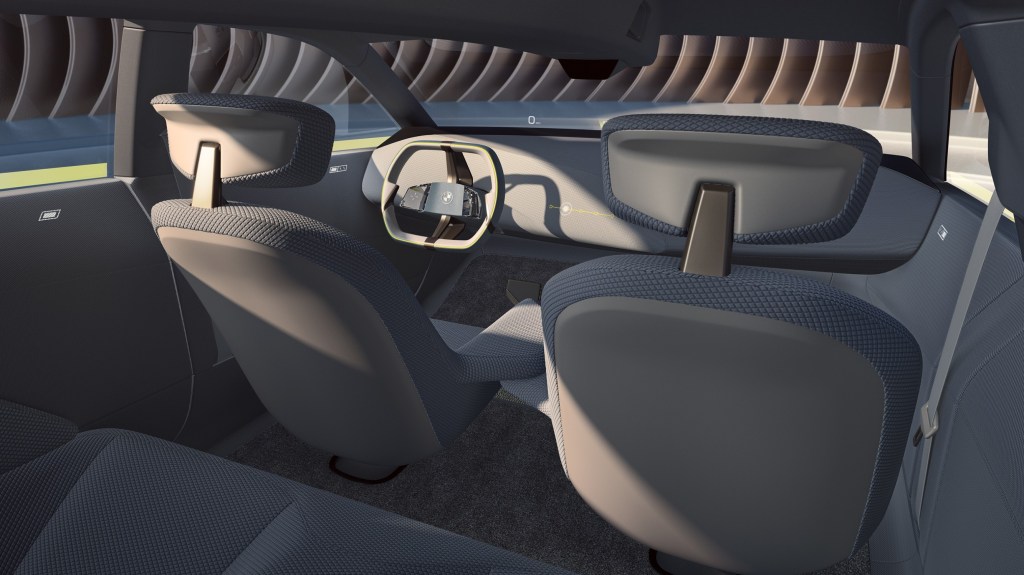
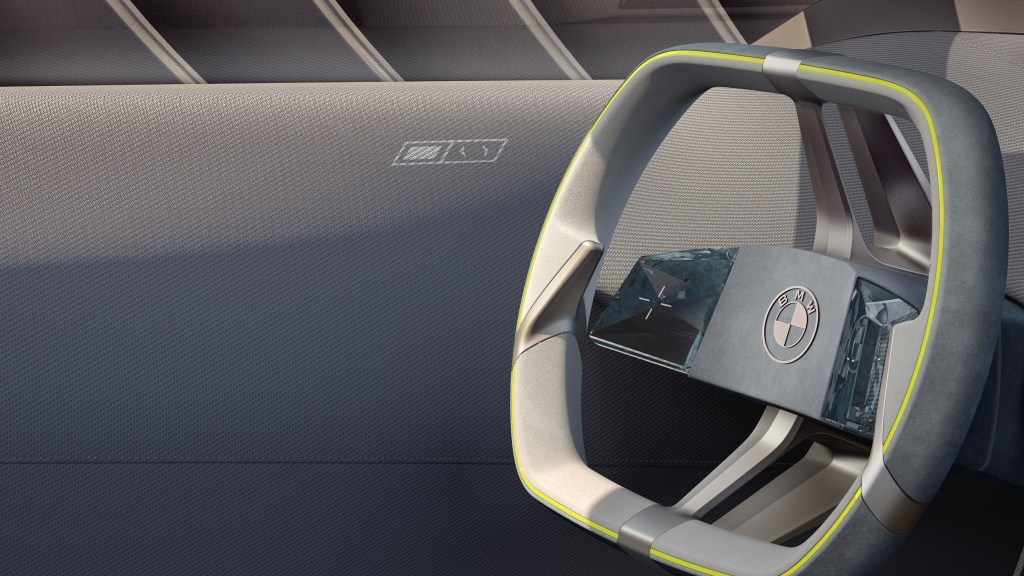
Inside, digitalisation goes hand in hand with reductive use of materials, operating controls and displays to ensure nothing distracts from the digital experience and the new feeling of enhanced driving pleasure. The unconventional design of the steering wheel, with its central vertical spoke, creates touchpoints that come to life when approached or touched and can be operated by moving the thumb. These phygital touchpoints control selection of the content projected onto the windscreen and, together with the Head-Up Display, thus support the principle of “hands on the wheel, eyes on the road”.

“With BMW i Vision Dee, we are showing how the car can be seamlessly integrated into your digital life and become a trusty companion. The vehicle itself becomes your portal to the digital world – with the driver always in control,” said Adrian van Hooydonk, head of BMW Group Design. “Implemented the right way, technology will create worthwhile experiences, make you a better driver and simply bring humans and machines closer together.”

Another milestone on the road to the NEUE KLASSE

The future of the BMW Group is electric, circular and digital. BMW i Vision Dee represents the digital aspect of this trio and will be another milestone on the road to the next vehicle generation, the NEUE KLASSE. The BMW Group will provide further insights and glimpses of the revolutionary vehicle concept of the NEUE KLASSE over the course of 2023. See more news soon!

Hans Knol ten Bensel

Fiat present at CES with the 500 electric, and a metaverse powered showroom…

The FIAT brand is playing its original approach to automotive mobility again at the Consumer Electronics Show (CES) in Las Vegaswith two major exhibits starring the New 500 electric.

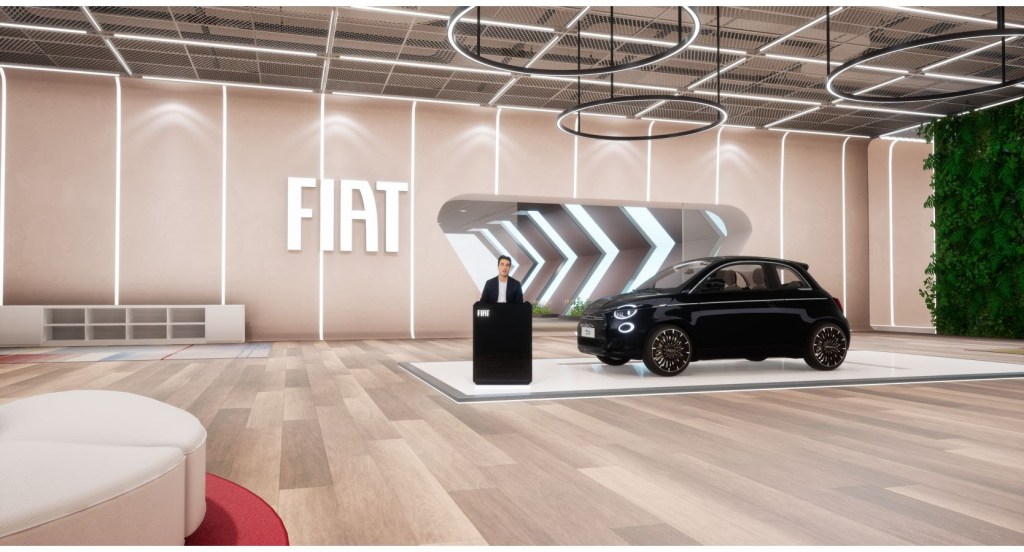
FIAT unveils for the first time the world’s first metaverse-powered showroom: the FIAT Metaverse Store. This revolution in customer experience is accessible, thanks to the partnership with Microsoft and Touchcast, at the Microsoft booth located in the West Hall #6017, recreating the feel of a showroom from home.

Alongside the FIAT Metaverse Store, the New 500 will also be the center of attention in the Free2move area of the Stellantis booth.

Reinventing customer approach in North America…

At the Los Angeles Autoshow 2022 Olivier Francois, FIAT CEO and CMO Global of Stellantis, officially announced the launch of the new Fiat 500e in North America in the first quarter of 2024 and the FIAT Metaverse Store will be one of the key innovative pillars for launching the FIAT electric icon in the US.

Launched last December in Italy, the FIAT Metaverse Store makes the Brand a leader in offering an immersive, simple, and human-driven brand experience. Inside the FIAT Metaverse Store, customers will be able to discover, configure, and even purchase the New 500 La Prima by Bocelli, experiencing the feel of a showroom with the help of the FIAT Product Genius, a real person ready to answer any questions. The entire New 500 line-up, additional models and markets can be found in the metaverse-powered showroom during 2023.

The FIAT Metaverse Store is a user-friendly and accessible to all technology, in fact it does not require a virtual reality (VR) headset or expensive hardware. The public will be able to try it out at the Microsoft booth located in the West Hall #6017 at CES 2023.

FIAT and Free2move together for more sustainable urban mobility

Lights shine on the New 500e 3+1 in the special Rose Gold livery, displayed as the only car at the Free2move stand. A collaboration, between FIAT and Free2move, stemming from a common goal: to build an increasingly sustainable urban mobility ecosystem as part of their mission to make EVs more accessible. The two brands are working on a unique value proposition that goes beyond rental, car sharing, and subscription. The customers will be able to enjoy a 360° Free2move experience through a Fiat car for a few minutes, several days or even months. This offer allows customers to tailor their rental contracts and associated services based on usage with a single invoice, directly from a dedicated APP.

More Fiat news soon also on the Brussels Salon de l’auto!

Hans Knol ten Bensel

Volkswagen Group of America will provide a glimpse of the ID.7…

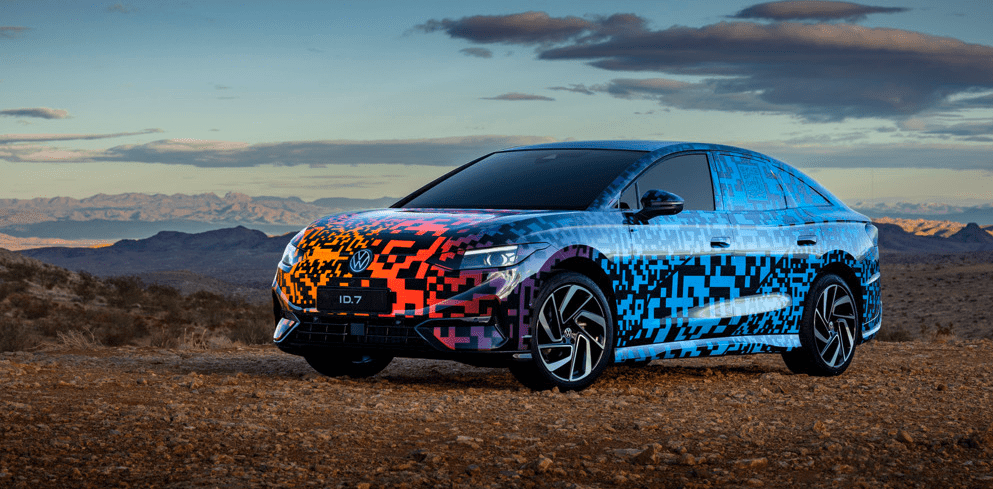
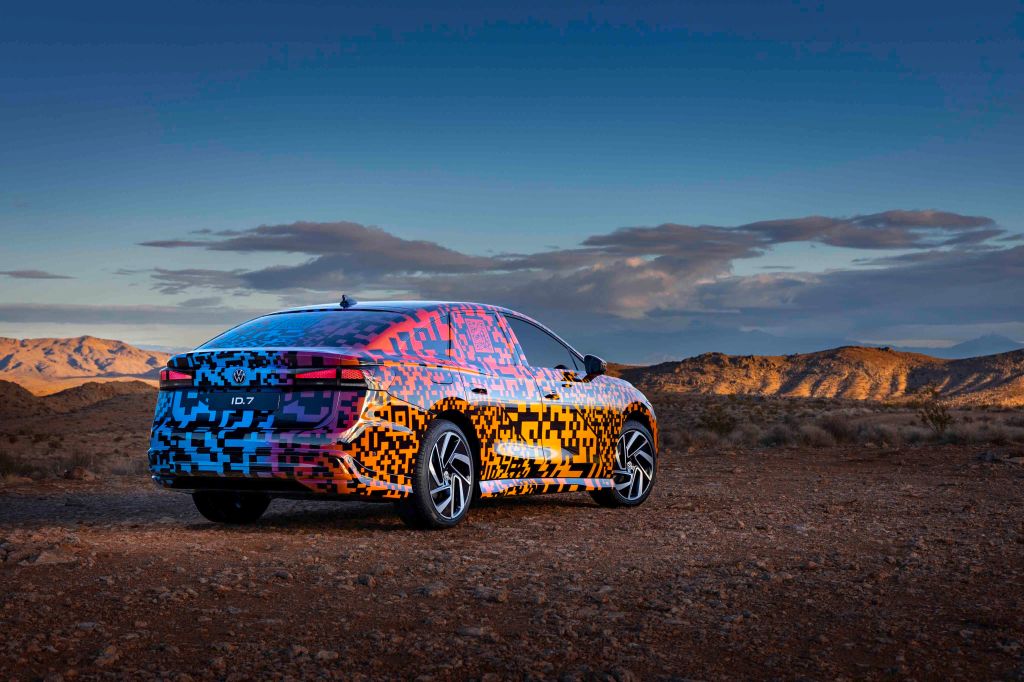
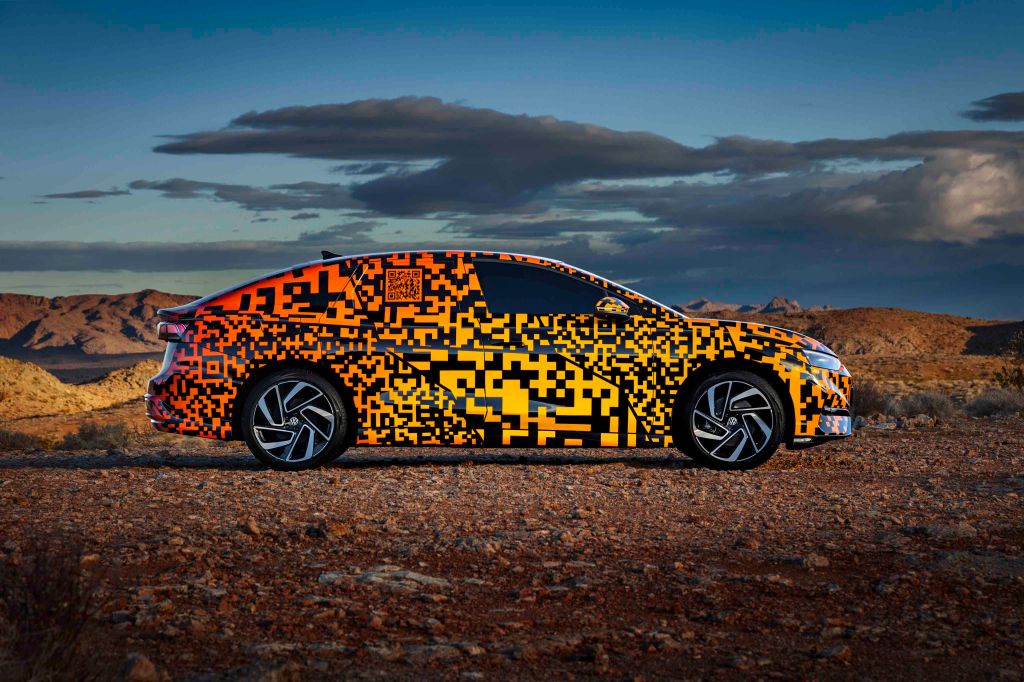
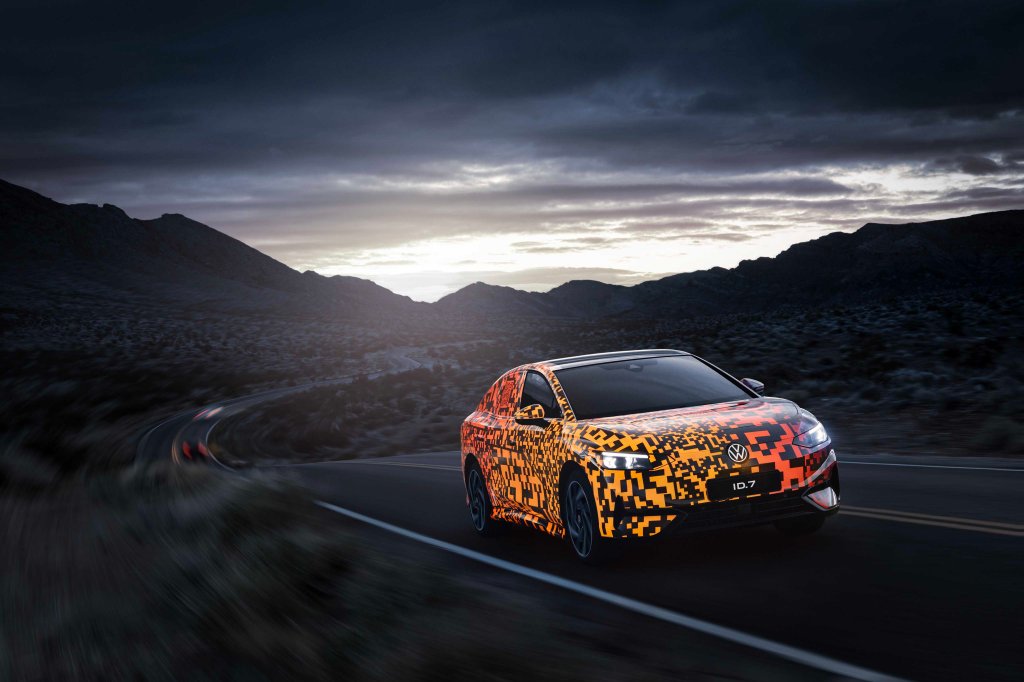
At the CES (Consumer Electronics Show) in Las Vegas between 5 and 8 January 2023, Volkswagen Group of America will showcase its first fully electric sedan based on the modular electric drive matrix (MEB). It will still be seen in a “smart” camouflage, which uses unique technology and multi-layered paintwork to create light effects on parts of the vehicle.

The ID. AERO3 concept vehicle initially presented in China already provided a preview of the new model, which embodies an aerodynamic design concept and is able to achieve ranges of up to 700 kilometers (WLTP).

After a six-year break, Volkswagen Group of America is returning to the CES – the world’s largest trade show for electronics – with a very special product…

With the new ID.7, VW is extending its electric model range into the upper segments. The ID.7 is one of ten new electric models that VW is planning to launch by 2026.

VW seems to have learned some lessons when it comes to the functionality of the various infotainment and dashboard commands. It ofeers a new display concept, an augmented reality head-up display, a 38-centimeter (15-inch) screen and new air conditioning controls integrated into the first level of the infotainment system. Now we also have illuminated touch sliders…

Like all other models in the ID. family, the ID.7 is based on the MEB of the Volkswagen Group. The advantages of the modular matrix with short overhangs and long wheelbase (2.97 meters) provide a large interior.

With its ID.7 sedan, Volkswagen is expanding its successful fully electric ID. family into the upper middle class of the high-volume segment and advancing its electric mobility campaign with the ACCELERATE strategy. VW has already reached a first milestone: Since the first ID.3 models were handed over to customers in September 2020, Volkswagen has delivered 500,000 vehicles from its ID. family worldwide through its subsidiaries – around one year earlier than planned and despite the ongoing difficulties in the supply chain.

After the ID.3, ID.4, ID.5 and ID.6 (only in China) models and the new ID. Buzz7, the ID.7 will be the sixth model from the ID. family and is Volkswagen’s second global car to be based on the MEB after the ID.4. It is planned to launch the electric sedan in the three primary markets of China, Europe and North America. The ID.7 for the European market will be produced at the Volkswagen Emden plant. After the ID.4, it will be the second model based on the modular electric drive matrix to be built in Emden.

More news soon!

Hans Knol ten Bensel