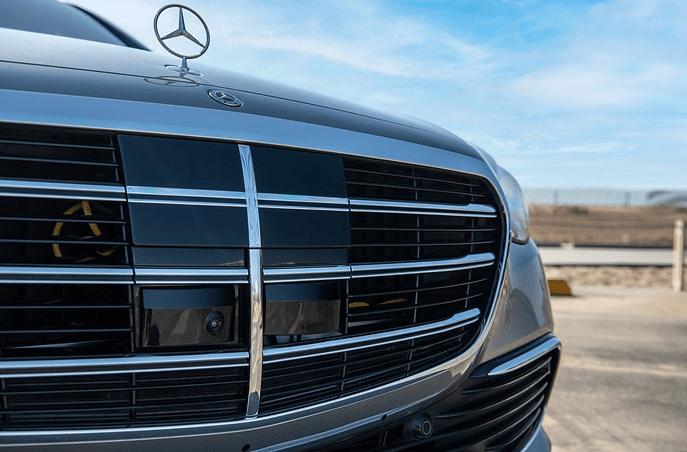
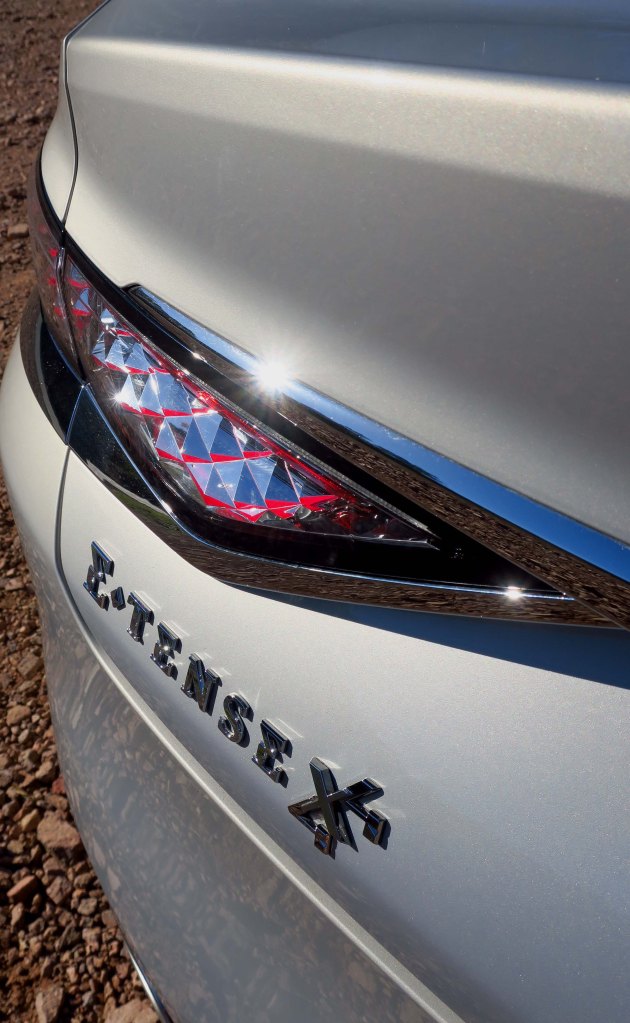
Arriving late last night from Nice, we report you here immediately about the wonderful driving experience with the most powerful DS9, enjoying its pure GT talents over the winding roads around Grasse and the iconic Côte d’Azur. We will soon tell you more about it.
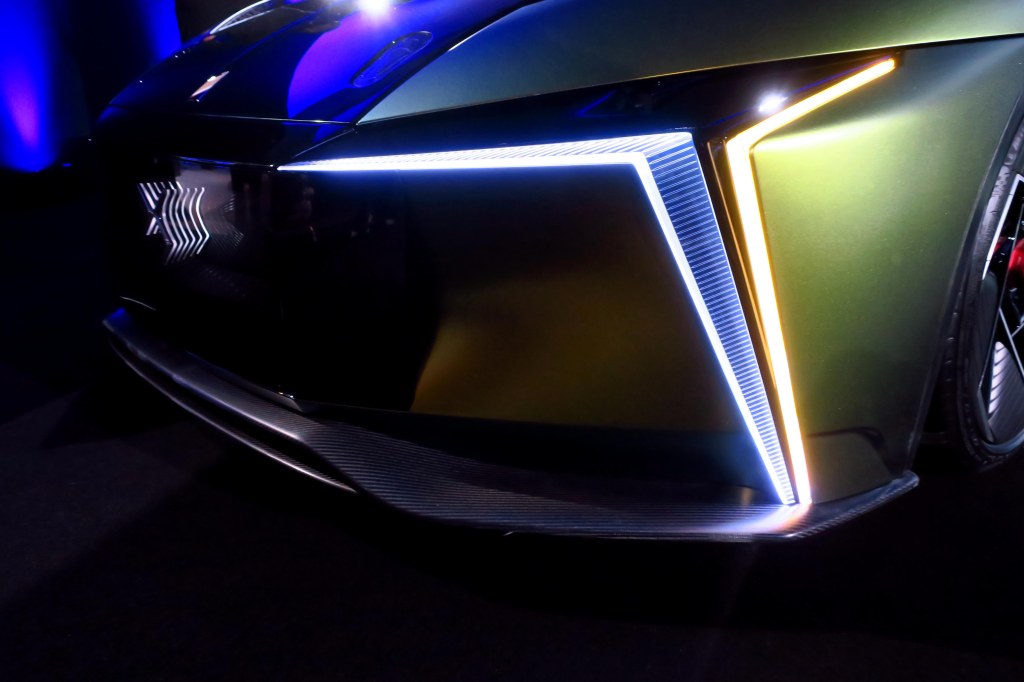
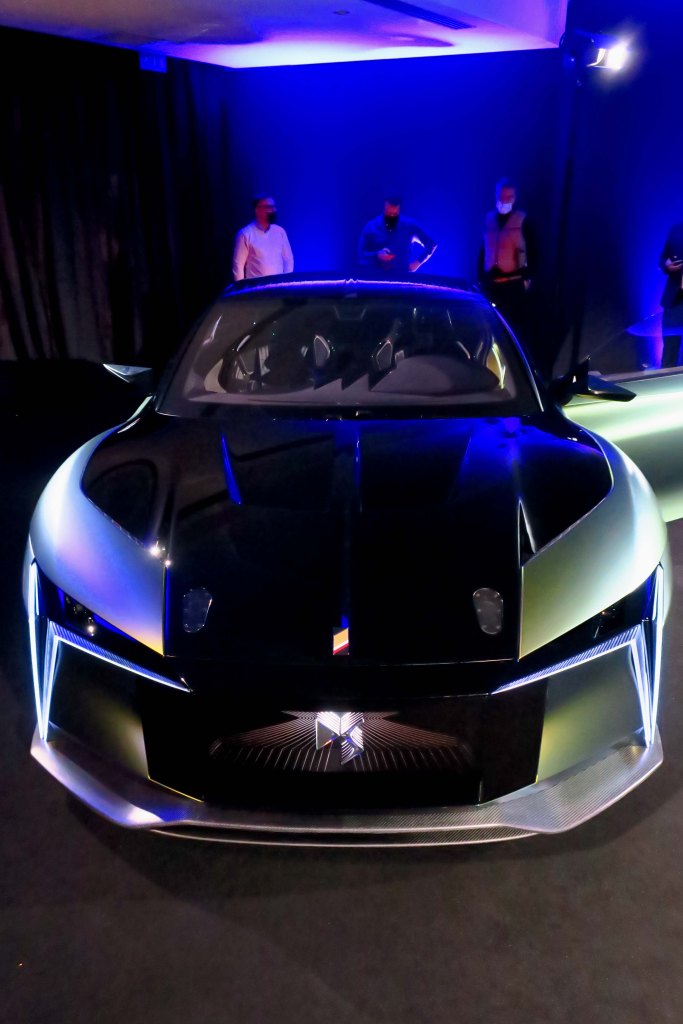
But the gentlemen of DS Automobiles did even more than just letting us have a drive in their flagship DS9, they also unveiled in the flesh at their press conference a wonderful Supercar, with absolutely stunning looks and performance.
DS Automobiles puts their E-Formula racing experience into practice on our roads… What to think of 815 HP or 600 kW, developed by two electric motors of 250 kW in the front, and 350 kW driving the rear wheels.
Acceleration from 0 to 100 km/h is done in a fantastic 2 seconds…and the car is a beauty too!
Much more about this superfast E-“bolide” and the impressive top-level DS9 soon on these pages!
When testing the Arkana Hybrid, we already mentioned the clever way Renault sources know how and expertise across boundaries. With the electric age coming upon us, further cooperation is growing to develop and produce ever more efficient drivetrains, using ever less resources. The news came that Renault is now joining forces with Valeo and Siemens… interesting!
Indeed, Renault Group, Valeo and Valeo Siemens eAutomotive have signed on February 10th a memorandum of understanding to form a strategic partnership for the design, co-development and manufacture in France of a new-generation automotive electric motor, eliminating the use of rare earths.
Under this partnership, each of the three partners will contribute to the development and production of the two key parts of the electric motor: the rotor and the stator.
Overall architecture comes from Renault…
Renault will develop and produce the EESM (electrically excited synchronous motor) rotor technology, designed without the use of rare earths, it offers enhanced energy performance.
In addition to the supply of components based on each company’s best expertise, the overall architecture of the all-in-one motor for Renault Group will also be designed by Renault.
Valeo and Valeo Siemens eAutomotive will develop and produce the stator, which is based on Valeo’s technological expertise in copper wire assembly. Thanks to its unique know-how in this field, which allows it to use a higher density of copper in the stator, Valeo is able to generate more power without having to use more electrical energy.
Renault Group, Valeo and Valeo Siemens eAutomotive will be the first to mass produce a 200kW electric motor without using rare earths, starting in 2027. Production of the motor for the automaker’s own needs will be based at Renault Group’s Cléon plant in Normandy, France.
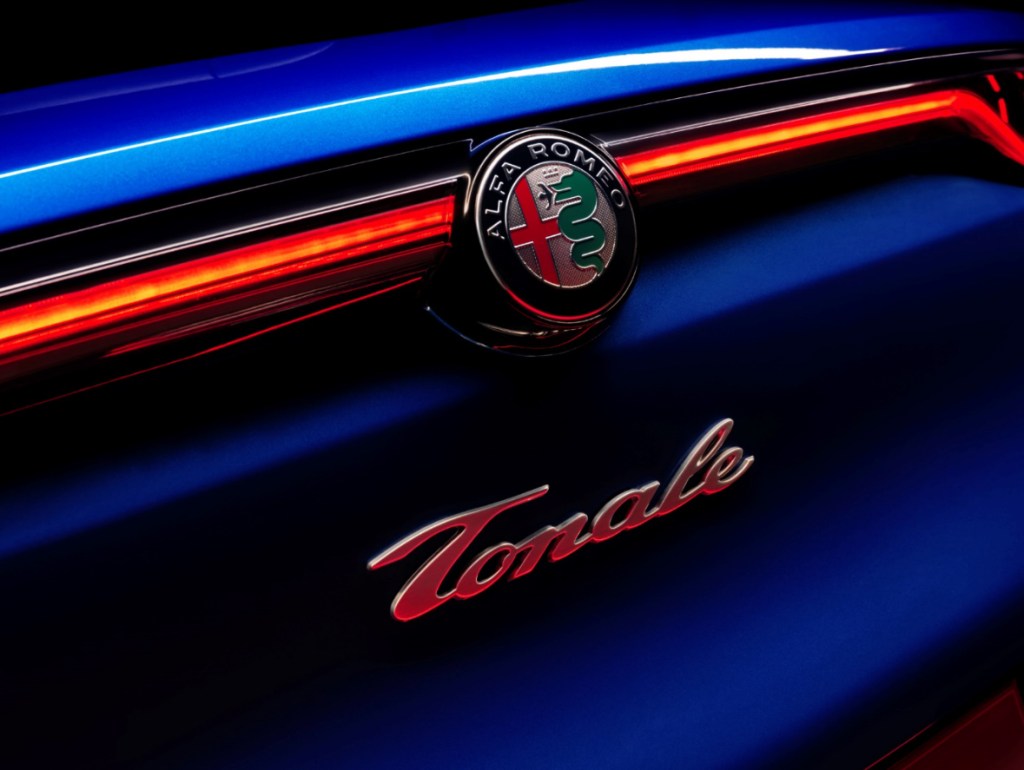
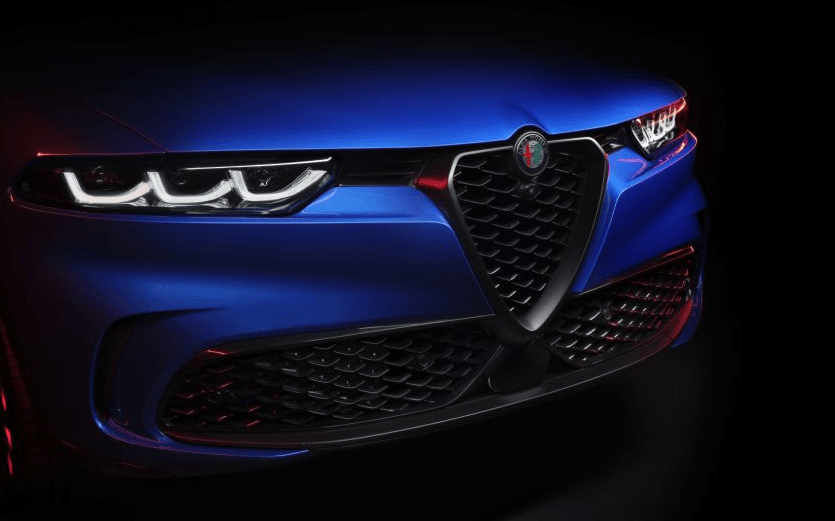
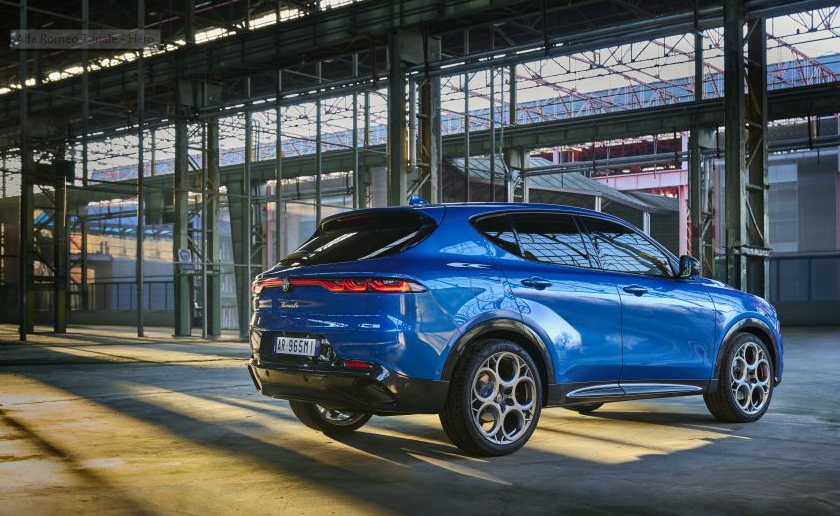
Alfa Romeo presented on February 8th its Tonale, the model that marks the Brand’s metamorphosis. Of course Alfa remains true to its DNA of noble Italian sportsmanship since 1910, but the Tonale a radical evolution is taking place at Alfa Romeo. It enters a new era of connectivity and electrification.
We bring you here in this first report the main points, of course, more will follow when we see the car ‘in the flesh’ at further presentations.
The Tonale breathes unique Italian design, being extraordinarily faithful to the concept model which you see here on the photo above, which we could admire feel and touch at the Centro Stile.
The car embodies state-of-the-art technology, Alfa says, with software and electrification systems enhancing the Brand’s DNA. With the launch of this car, Alfa also deploys a universe of innovative, customer-focused services. See more below…
The Tonale has a clear mission: reinventing sportiness for the 21st century. The name marks the evolutionary continuity with Stelvio, a fascinating new road that leads to a new destination: the future.
The car is made in Italy, at the revamped “Giambattista Vico” plant in Pomigliano d’Arco, according to Alfa one of the most advanced production plants in the automotive world, where a dedicated assembly line has been built with cutting-edge technology and high levels of automation.
The technology in the Tonale is aimed at enhancing the unique Alfa driving experience, but not only that: it also wants to bring the customer experience at another level and sets steps to protecting its residual value.
Indeed, in a a world exclusive, Tonale is the first car on the market equipped with a NFT (non-fungible token) digital certificate. Based on blockchain technology and uniquely linked, the Tonale NFT certifies the car upon purchase, then evolves to represent its use during the car’s life cycle, with major benefits in terms of protecting its residual value. With the customer’s consent, the NFT will record vehicle data, generating a certificate that can be used as a guarantee that the car has been properly maintained, with a positive impact on its residual value. On the pre-owned car market, NFT certification represents an additional source of credibility for owners or dealers to count on. In the meantime, buyers will be reassured in their choice of car.
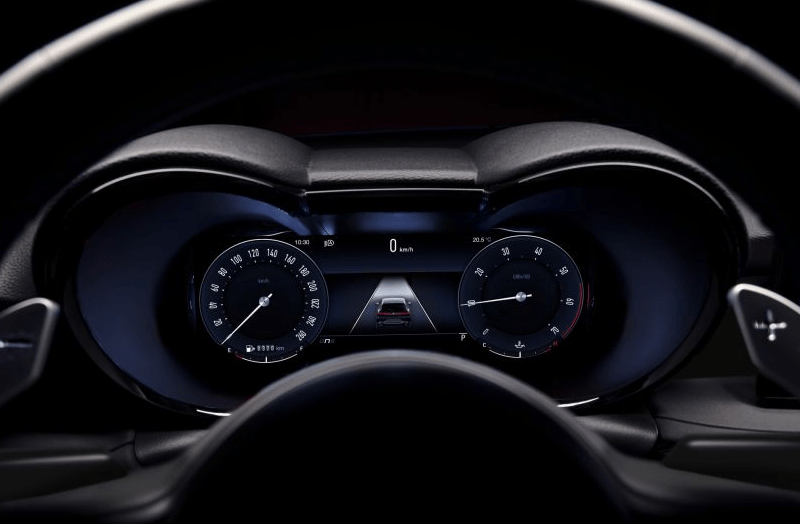
The Tonale also sports an all-new infotainment system. Totaling 22.5”, the two large Full TFT screens are installed.
The world of Amazon in your Alfa…
The infotainment system is designed to offer Over-the-Air updates and integration with Amazon Alexa.
There is a complete integration with Amazon: courtesy of the “Secure Delivery Service”, you can choose the Tonale as the place to deliver the packages you are expecting, by unlocking the doors and letting the courier leave them inside the car, all completely safely.
You can also receive constant updates on vehicle status from the comfort of your home, find out the level of charge and/or fuel, search for points of interest, find your car’s latest location, send remote locking and unlocking commands, and much more. “Alexa” can also be used to ask to add products to your shopping list, to search for a restaurant nearby or to adjust lights or heating connected to your home automation system, all while remaining focused on the road.
The technology is also focusing on safety, with level 2 ADAS systems.
Cabin comfort is of course not neglected. Alfa tells us that the cabin environment is designed for and around the occupants, with meticulous attention to detail, paired with a constant quest for the highest quality.
Two levels of electrification – Hybrid and Plug-in Hybrid Q4, developed by Alfa Romeo.
State-of-the-art electrification: this electrification serves the Brand and its DNA, with the mission of reinventing sportiness for the 21st century, Alfa announces.
The Tonale debuts the 160-hp Hybrid VGT (Variable-Geometry Turbo) engine, an exclusive for Alfa Romeo. Its variable-geometry turbocharger paired with 7-speed Alfa Romeo TCT dual-clutch transmission and the 48-volt 15-kW, 55-Nm “P2” electric motor makes it possible for the 1.5-liter gasoline engine to propel the wheels even when the internal combustion engine is turned off.
Alfa Romeo has opted for this technical solution to offer an authentic electrified experience. The transmission enables startup and travel in electric mode at low speeds and when parking and cruising. At launch, the 130-hp Hybrid version is also available, again paired with 7-speed Alfa Romeo TCT and 48-volt “P2” electric motor.
The 275-hp Plug-in Hybrid Q4 version with all-wheel drive is has an expected range in electric mode of up to 80 km in the city cycle. It is the most powerful and efficient version in the line-up.
To complete the engine range, there is also a new 1.6-liter, 130-hp diesel engine with 320 Nm of torque, paired with 6-speed Alfa Romeo TCT dual-clutch automatic transmission and front-wheel drive.
Customers at the center of the Alfa Romeo universe…
With Tonale, Alfa Romeo launches a series of new services, which redefine the customer experience and will cover the brand’s entire line-up.
A digital experience: the customer purchase experience can take place online from the comfort of home, in three simple steps, by accessing an interface identical to the one used in dealerships.
Extended warranty: Efforts to improve the quality of the end product have resulted in the availability of an innovative Alfa Romeo extended warranty, lengthening the protection of the vehicle’s main components to 5 years. The warranty for the batteries in the hybrid Tonale versions has also been extended to 8 years or 150,000 km traveled, becoming the best offer in the segment.
Alfa Romeo Certified is the dedicated to customers in the pre-owned car market. The aim is to ensure a shopping experience that is identical to that of buying a new vehicle. The main features of the service are as follows:
Warranty coverage equivalent to that of a new car.
“Satisfaction or your money back”, within 10 days or 1,000 km
No maintenance costs, for 15,000 km or 1 year
120 vehicle checks
Customized after-sales and financing services
Test drive
24/7 roadside assistance in Europe during the warranty period
Finally, Alfa Romeo Videocheck is the service dedicated to after-sales, created in consideration of the special relationship its customers have with their car. One sole aim: service quality and transparency for customers. When at a workshop, if a car is found to need more work than agreed with the customer, the technicians will be required to follow a procedure via mobile app to certify the work, with a video to accompany the related repair costs. The customer will then be free to partially or fully accept or reject the new quote.
Driving dynamics…
Rather impeccable, according to Alfa. It has the best weight distribution and the most direct steering in its segment (13.6), and the fact it is the only model in its class to be equipped with the Integrated Brake System (IBS). The adoption of fixed calipers by Brembo, with 4 pistons and self-ventilated discs at the front and full discs at the rear, contributes to the improved braking performance.
The Tonale opts for the fully independent MacPherson suspension system, with Frequency Selective Damping (FSD) shock absorbers. The new Tonale offers two drive solutions: Q4 all-wheel drive in the Plug-in Hybrid e-Q4 version, and front-wheel drive in the Hybrid and diesel versions. The latter are also equipped with Alfa Romeo electronic self-locking differential. The specifications are completed with a “Dual Stage Valve” active suspension with electronically controlled damping.
New line-up strategy
The Alfa Romeo Tonale introduces a new line-up strategy.
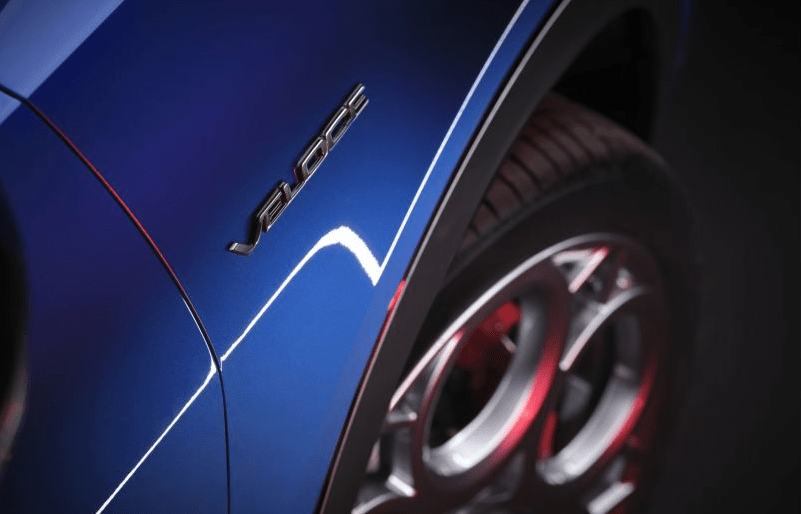
Two trim levels are available – Super and Ti, both with clearly defined specifications. The Super trim can be customized with the Sprint pack, which includes numerous options with a strong sporty connotation. Alternatively, the Ti trim can be added to with the Veloce pack, to reach the peak in terms of performance and sportiness.
Renault is a brand which moves boundaries now and then. It brought a new definition of a roomy and timeless city car with the Twingo, built the legendary 4L and the “Cinq”, its Espace brought nothing less than a revolution in car concepts and design: the “space” car was born.
Then we don’t forget the Avantime. A car which was truly totally ahead of its time. We drove it at its introduction in the streets of modern, united Berlin. When you saw it on the road, you would expect a V6 formula 1 turbo engine under the hood, running on hydrogen of course, with a sweet voice softly telling you what the history is of the street and buildings you driving through, in the language of your choice. That car made us dream. Its stylish panache and the promise it embodied still has to be equalled.
Then Renault embarked on the E-path, opening it up to the masses with the ZOE and recently also putting a very clever full hybrid on the road, culminating in the E-Tech family of cars. Affordable with a touch of genius. And then we don’t forget Dacia…
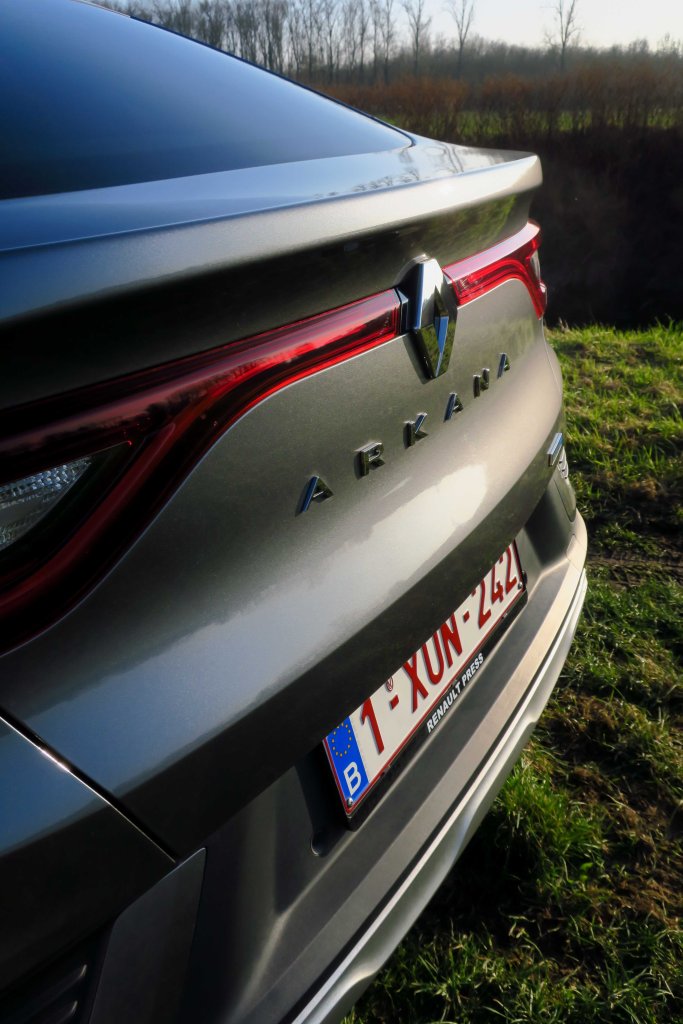
Now its talented designer Laurens van den Acker took a long hard look at the BMW 4X and brings the stylish silhouette of the iconic fastback SUV to the wider public. The Arkana, a name derived from the Latin Arcanum, meaning secret, first made its entry in the Russian market, based on the Dacia Duster B0 platform. This allows the Russian built Arkana to offer 4WD, a must for the Russian market.
But this is not the E-Tech Arkana we meet on our shores. Renault needed here a platform which allowed electrification. Just read further!
Hans Knol ten Bensel
So “our” Arkana started life in South Korea in January 2020 as the… Renault Samsung XM3, and we find this again a fascinating story in itself, showing how cleverly big groups are combining talents and allocating resources found in their world wide organisations. Showing that they are truly unifying the world, having learned to work, cooperate and thrive across boundaries.
So Renault Samsung Motors is a reality, and they build the Arkana for us in their South Korean factory in Busan.
Renault is maybe also teaching politicians a lesson nowadays: the “Russian” Arkana is built both in Moscow by Renault Russia as well as in… Ukraine, in Zaporizhzhia, in South eastern Ukraine, at ZAZ, the most important (former) Russian Automobile Manufacturer.
The European Arkana runs on the more modern CMF-B platform, which we find also for the Clio V and the Captur II.
Stylish
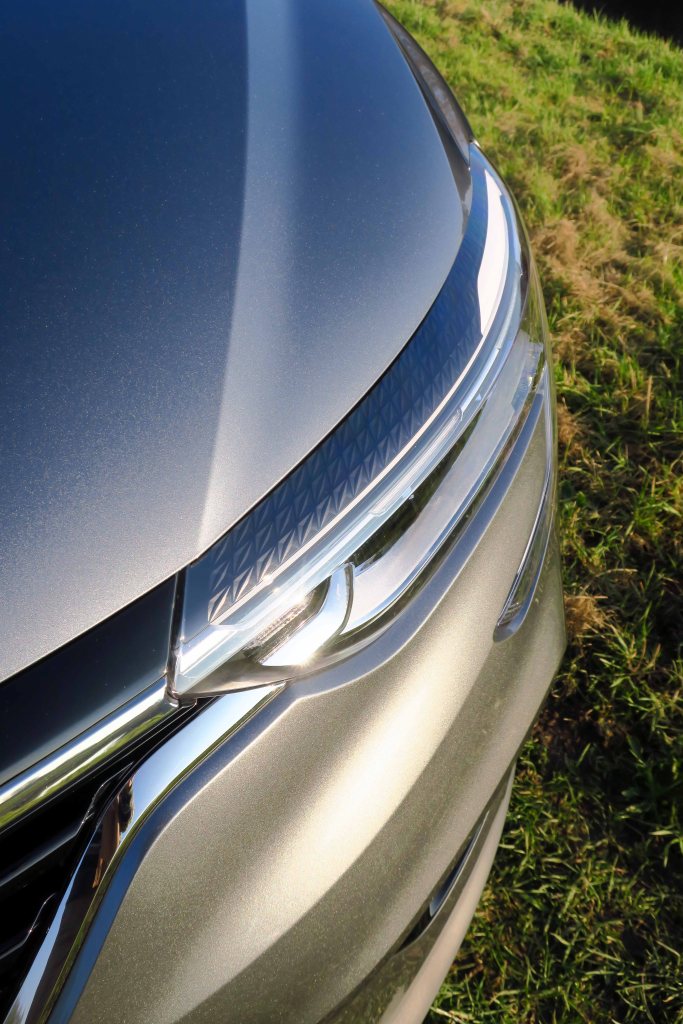
Approaching the Arkana and walking around it, one is pleased by its excellent proportions and shape, from any angle. We liked also that it stands boldly on its wheels, with a ground clearance of not less than 20 centimeters. This allows you to negotiate sleeping policemen’s with ease of mind, as their dimensions always differ greatly from borough to borough, if not from street to street. The fact that this is not unified on a European scale, let alone not even on a national scale is utterly ridiculous. But the Arkana copes with all that, marvelous!
We found also the level of finish and paint quality of the bodywork top notch. The same can be said of the fit, look and feel of the panels in dashboard and cabin.
The layout is similar to what we find in the ZOE and Clio. The seating position is excellent, everything is logically within reach. Also the infotainment system with the large screen on the centre console is a breeze to use, and quite intuitive. Of course instrumentation is digital, and you can have also the road indications right in line with your eyesight if you prefer this.
The Arkana E-Tech is frugal: on the open road merely 4,7 l/100 km…
The learning curve to get acquainted with infotainment in this car is wonderfully short, and it is also very practical and wise to let the heating/airco ventilation system be controlled through three big round manual knobs.
A fully fledged hybrid…
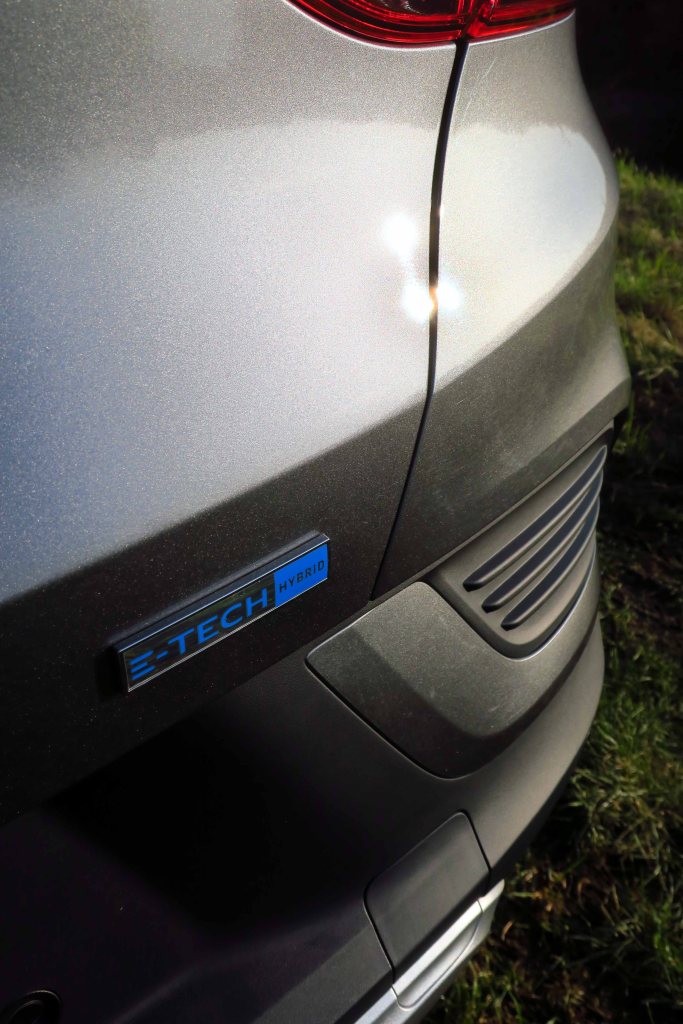
The Renault Arkana uses the Renault “E-Tech” hybrid solution, consisting of a petrol engine delivering 94 HP, a starter generator which delivers 20 HP or15 kW, and last but not least an electric motor incorporated in the transmission, which is good for another 49 HP or 36 kW.
The gearbox has four speeds in store for the combustion engine, and reserves two speeds for the electric motors. These are no synchro rings or clutches, the electric motor within the gearbox synchronises everything. This uniquely clever system is derived from Formula 1 technology, Renault says.
It works wonderfully. Driving away is always on E-power for the first meters at least, the electric motor in the gearbox with its close to 50 HP has more than sufficient zest for its task. If the small 1,2 kW battery runs out of power, the engine sets in smoothly, helps to power the car further forward, and also charges the battery. Total system power is 143 HP.
Depending on the chosen driving mode, the system will also keep the battery more or less constantly charged, and so it happens more than often that when having accelerated on E-power to say a cruising speed of 70 km/h, the petrol suddenly engine starts up and gets eagerly to work recharging the battery. It does this at relatively high revs, and the recharging time is therefore rather short.
The higher revs seem to be a bit out of place, but soon one gets used to it, even more so because everything happens smoothly as the revs between gearbox and engine are exactly matched and you understand why this is happening.
We noticed that in city driving the Arkana runs often on E-power, and indeed, the consumption during our test hovered around the 5 litres/100 km. Performance is more than adequate for everyday driving, with a 0 to 100 sprint in 10,8 seconds and a top speed of 178 km/h.
Comfortable and well balanced
The suspension of the Arkana has a rather firm undertone, but is very well balanced and comfortable, and will never show any hint of harshness. On winding roads, the car stays flat with very little body roll despite its 20 cm ground clearance. Steering is responsive and pleasant. Indeed, the Arkana is an excellent Gran Turismo with also very good urban qualities, and a pleasure to steer and drive.
There is sufficient head- and legroom for the rear passengers, and the E-Tech configuration only costs some 33 liters of luggage space, which remains at 480 to 1263 liters, more than adequate we would say. Living with the Arkana is truly nice…
Conclusion
A stylish, frugal, future oriented Renault, roomy, well finished, easy to use and pleasant to drive in everyday life. It offers good interior space despite its elegant coupé silhouette. Indeed, Renault sets again new standards in offering to many car buyers the panache and zest of a modern four dour coupé combined with some distinct SUV touches. And it can be had as a hybrid, which is a strong selling point for today’s environmentally conscious buyers…
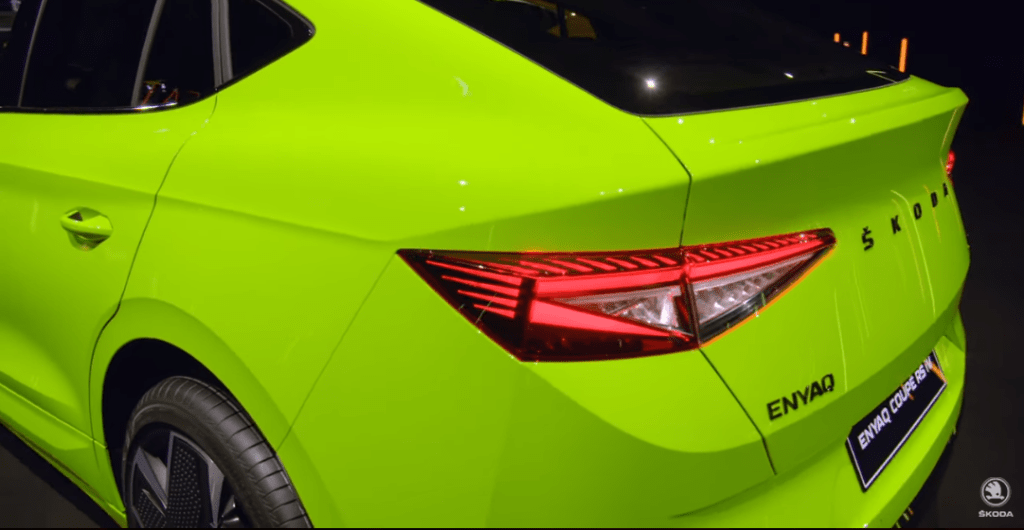
The new Enyaq Coupé in RS version will be first in the showrooms….
Also Škoda is convinced that the future is electric. On January 31st they presented for us the all electric Škoda Enyaq iV Coupé. It will be initially only available in the RS version, which promises to be rather formidable if one reads the figures: an acceleration form 0 to 100 km/h in 6,5 seconds, charging time from 10 to 80 % in under 30 minutes, a range of 545 km.
Oliver Stefani, Head of Designshows the sleek roofline of the new Skoda…
At the same time, this new version remains typically Škoda: spacious and practical. The luggage compartment is a massive 570 liters… and of course it has lots of “Simply Clever” features.
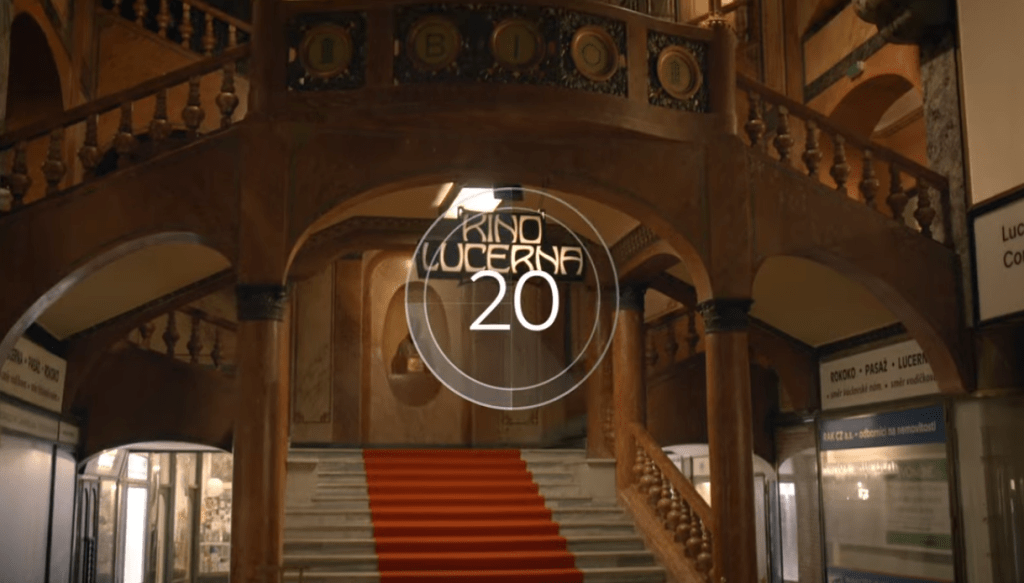
At the virtual presentation, we saw Jens Katemann, Head of Communications of Škoda Auto leading us into the Kino Lucerna,
the oldest still operating cinema theatre in the Czech Republic, and introducing us to the actress driving the Enyaq iV Coupé in the film, Ana Geislerova, and Thomas Schäfer, CEO of Škoda Auto. (Photo below, from left to right).
Jens Katemann, Head of Communications of Škoda Auto, Ana Geislerova, and Thomas Schäfer, CEO of Škoda Auto.
The film starts with the CEO Thomas Schäfer running in the woods towards a vantage point, embodying the will to go (ever) forward, and looking into the (electrical) future.
CEO Thomas Schäfer running…
and looking out into the future…
Then we are introduced to Johannes Neft, board member Technical development, and further to Oliver Stefani, Head of Design.
Inspiration through perspective…Olivier Stefani, Head of Design.
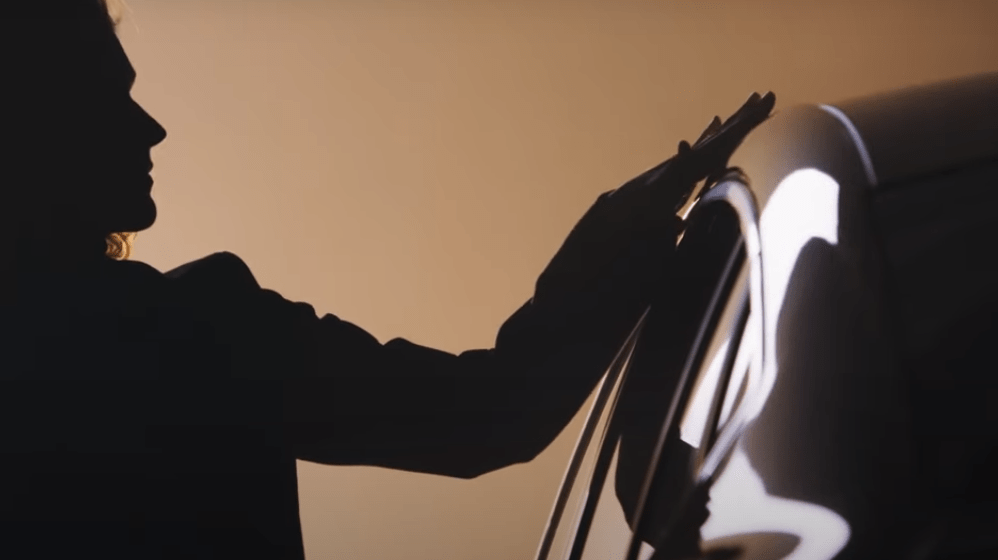
Actress Ana Geislerova then lovingly caresses the roofline of the sleek coupé,
and takes the wheel… for an exhilarating drive;
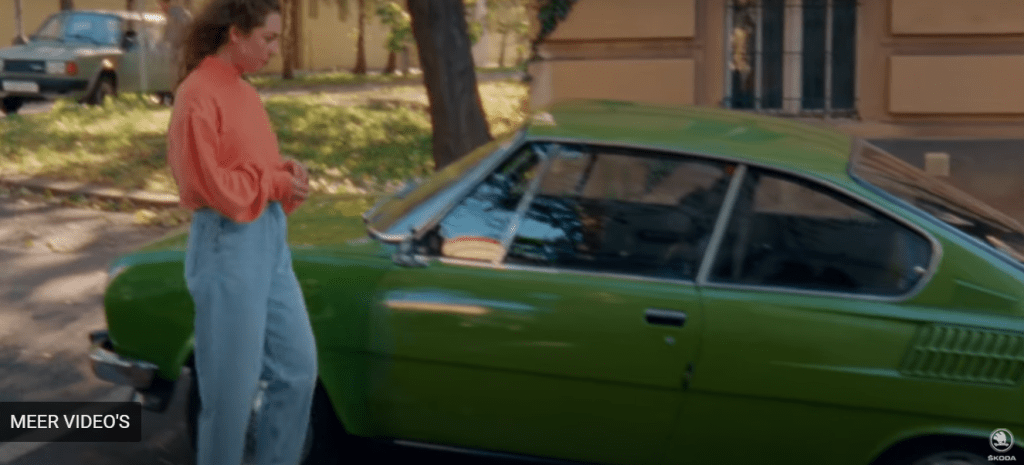
The second part of the film presents the RS version, which will be offered first to the eager customers, and it tells the story of a Czech teenage girl who drives the first RS Coupé, based on the rear engined MB 1000.
The person is now is some decades older, but remains in love wih life and freedom,
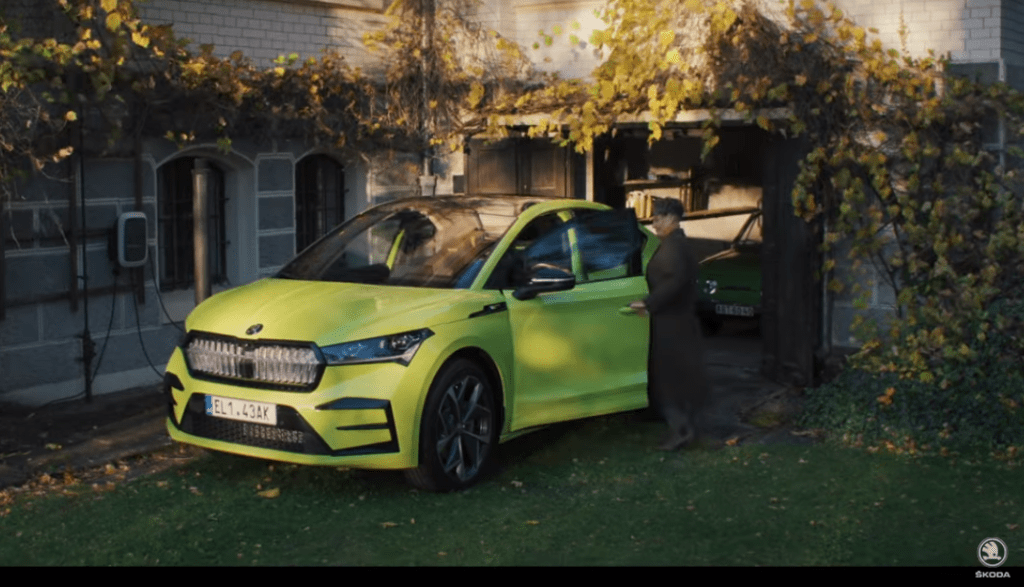
and of course drives now the new coupé…
I couldn’t resist showing you here some clips of this film…
The bold green colour is exclusive to the RS version…
The cars themselves are then presented in more detail by CEO Thomas Schäfer and his team. We show you here also some clips, revealing the car more in detail…
It all happens at Renault’s technocentre at Guyancourt… 3D sketching brings a revolution…
As some readers may know, your servant makes daily ink drawings of flowers on his Instagram account hanskrisjanknol and is an artist painter who has exhibited twice this year. Anything that has to do with drawing, painting or figurative art in general therefore has his keen interest. Needless to say that the drawing and sketching of car designers and stylists also take centre stage… so when Renault brings a news story about the status of 3D sketching in today’s electronic world, I have to share it with you, dear reader… just read on!
Hans Knol ten Bensel
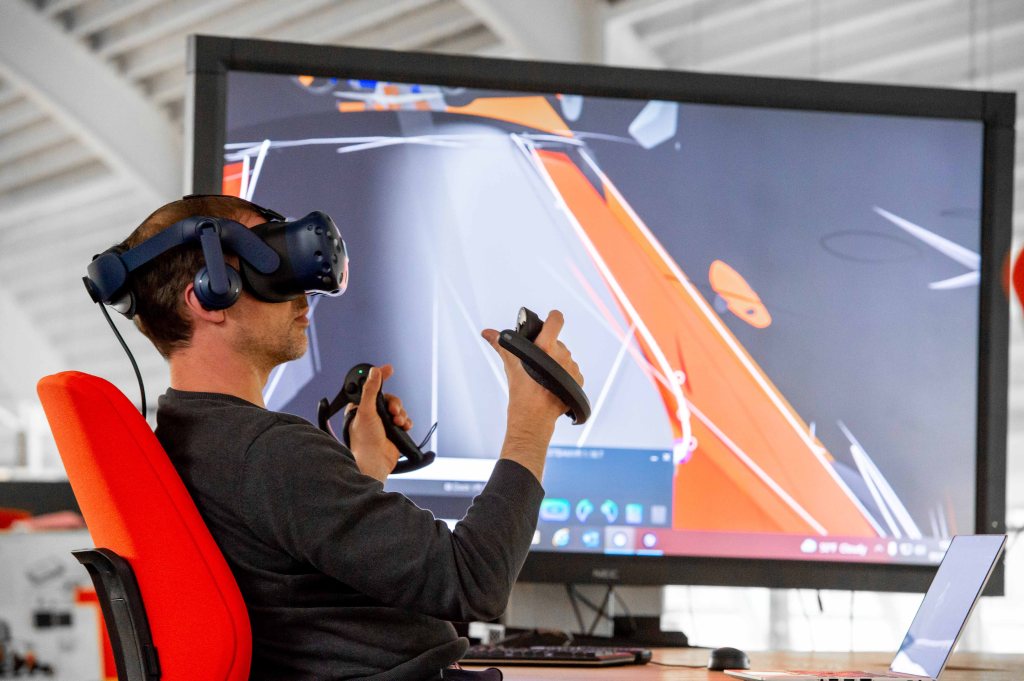
All one needs to do 3D sketching is a VR headset, two controllers, and an internet connection
As is the case with film, video games, and landscape mapping, the past few decades has seen the automotive industry incorporate more technological advancements in 3D modelling to bring its projects to life. Nowadays, before a car can be sent to the production line, it must first be born in a 3D world. This mission is entrusted to designers, whose set of digital tools is constantly growing. One such tool involves 3D sketching – revolutionary technology that allows designers to draw with neither pencil nor drawing board. Welcome to the future!
It all happens at Renault’s technocentre at Guyancourt. A man, decked with a VR headset and a controller in each hand, stands in the middle of a room gesticulating wildly. He appears to be drawing invisible lines in the air around him. A curious scene that is clearly reminiscent of the world of virtual reality gaming. And yet, Udo – that’s the man’s name – is not a gamer… he is a designer! And he is hard at work. His latest gadget? A program for 3D sketching; a drawing method currently being rolled out at Renault Group’s Design division.
With 3D sketching, you are immersed in a space where there are neither constraints and limits. Udo, Chief Designer
What does 3D sketching involve?
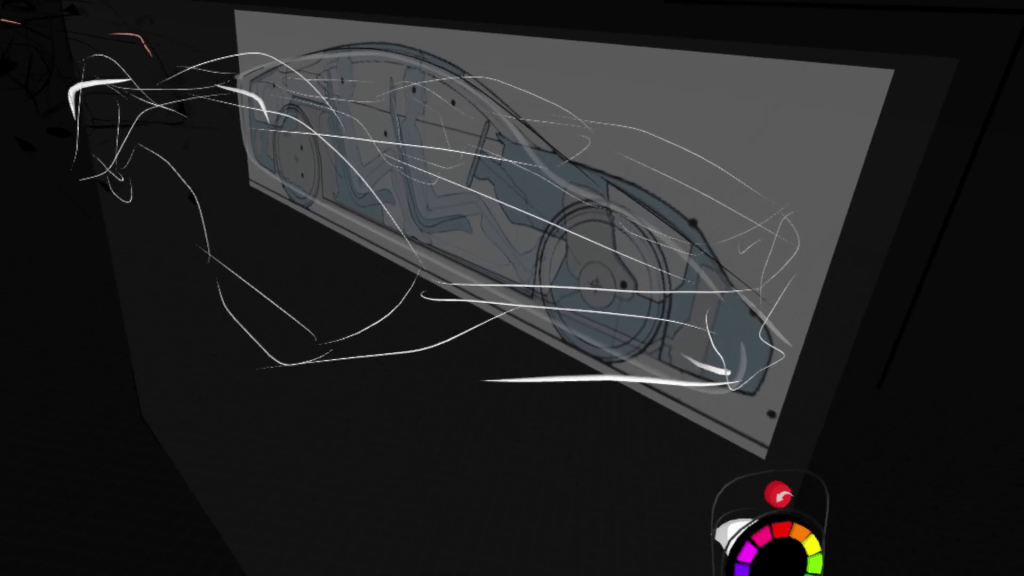
3D sketching is a form of intuitive technology that enables you to ‘draw in thin air’ all around you.
Draw in thin air? Pablo Picasso was already carrying out such experiments in 1949. The famous Spanish artist replaced pencil with cigarette lighter to perform his ‘dancing light’ pieces. These ephemeral drawings were immortalised by photographer Gjon Mili, and the technique was known as light painting (or light drawing). It was an art form that, even back then, saw ideas come to life out of thin air.
Today, 3D sketching is much the same idea, though minus the lighter and camera. The technique requires the use of a VR headset (virtual reality headset). Invented 50 years ago, it became more widespread about ten years ago, with consumer models for video game use hitting the market.
With the headset firmly on and plugged in, the designer is immersed in an entirely virtual 360° drawing studio. Using two controllers (one in each hand), they can then choose colours from a palette, draw lines, create shapes, fill surfaces, and much more. A computer program models and records each and every movement.
All one needs to do 3D sketching is a VR headset, two controllers, and an internet connection
Digital creative freedom that is almost limitless
Near the end of the 1990s, the work of designers had already been through a first transformation with the popularisation of drawing on digital tablets. Today, 3D sketching takes it a step further where designers no longer need a tablet, pencil, mouse, or even a desktop to work. Design is entering a new era: one where digital tools sit at the heart of automotive design.
Renault Group has been harnessing digital tools for some time. Today marks the beginning of a new era for designers.
As the technology continues to improve, digitalisation gives designers a considerable amount of freedom tenfold and makes their projects even more accessible. It has never been easier to quickly whip up a 3D sketch, create perspective, model shapes – even on a 1:1 scale – or fill volumes. “It saves time,” says Udo. “It takes at least four weeks to run a scan or data file through a machine, while everything here is in real time. That’s a huge advantage.” In short, 3D sketching makes it far easier to experiment with new ideas as they are so readily brought to life.
Only drawbacks: eye strain, headaches, and other back and joint pain experienced by some designers after prolonged use. “Drawing in 360° means you have to be in good shape and take breaks every hour,” says Udo.
Engineers are already thinking about ways to make the experience more enjoyable and less restrictive. This includes making the headset lighter. For example, mixed reality headsets are being developed, so designers can draw in VR while still being able to see what is happening around them and interact with colleagues.
Collaboration 2.0: distances are no object anymore…
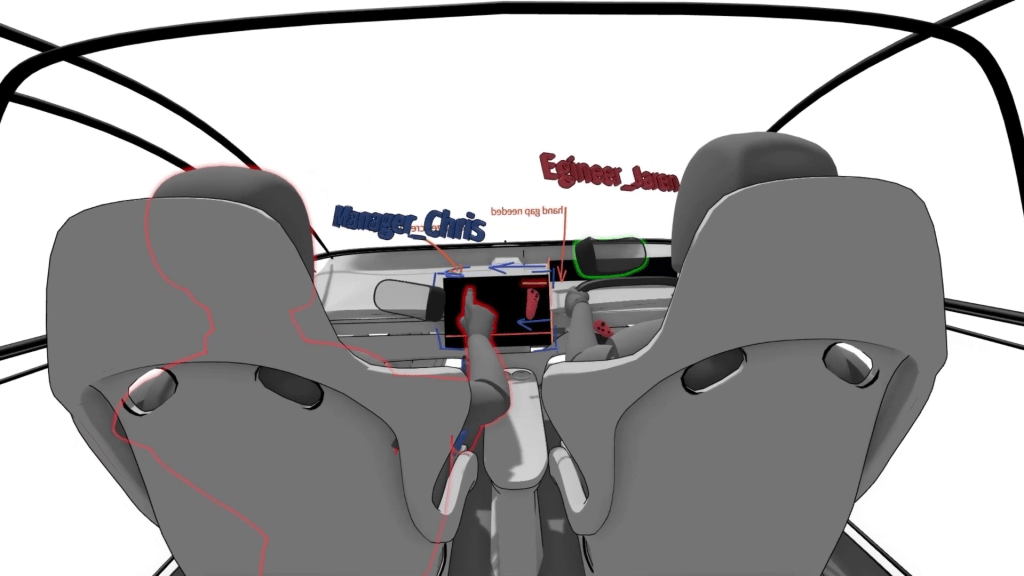
3D sketching adds another string to the designer’s bow: colleagues can now work together at the same time, on the same project, regardless of the distance between them.
“As long as you have an Internet connection, geographical limitations are a thing of the past. You can feel like you’re together even if you’re actually thousands of miles apart,” says Udo. Two designers can communicate with each other via the 3D sketching tool using earphones and a built-in microphone in the VR headset. They can then talk, share what they have each been doing on their own and even work together on joint projects. All without having to leave their home, offices, or wherever they may be in the world.
The outcome being that possibilities are endless, and people misunderstand each other far less often.
Thanks to VR that acts as a gateway to a world of 3D, we can express ourselves more precisely.
But that’s not all: the workflow has also been improved. First, models are made using 3D sketching before being exported as a digital file. The files can then be used by all those who are part of a vehicle’s design and production line. For example, designers can hand over a digital copy of their work to a modeler who makes a physical mock-up of the design or to an engineer who will estimate its feasibility. Much like digital modelling, 3D sketching removes obstacles that may arise from miscommunication and gradually breaks down barriers between professions.
The augmented designer’s new pencil
For some time now, digital drawing has offered those at the Design Department the power to produce more iterations of their work, to work faster, and to go further, right from the outset. This trend has been taken up a notch thanks to 3D sketching. In addition to reducing costs and manufacturing times, this new technology makes it easier to view and review working sketches.
In concrete terms, designers can now hone in on specific details of their drawing with greater precision, experiment with different surface types, work with mirroring tools to stretch a 2D shape into 3D object, attain a better finish on sketches and models, present projects in real time, and even give life to their drawings thanks to the compatible nature of 3D printers.
Modern designers harness the numerous advantages of such technology, along with new skills and a wide range of tools to express their ideas and thus evolve into augmented designers.
We will always need physical mock-ups of working designs because customers want to buy a real product, something they can touch and feel.
According to Udo, “While 3D sketching is yet another tool to be used, traditional methods still have a role to play.” Digital and physical techniques go hand in hand. They each play their part in the car making process. Modelers continue to use plasticine to make models. An ideal material to use when working on the silhouette of a new model, they are essential in determining the success a design during the final stages of the design process. Similarly, 3D sketching is not a substitute for the designer’s talent when it comes to drawing, a cornerstone of the design process.
3D sketching is already a crowd favorite in other industries
Renault Group designers aren’t the only ones to work with the new technology. Already used in many design schools, it is now used by designers working on motorcycles, sports shoes, bicycle helmets, and backpacks. It is fair to say that in the future it will be a key to the success of numerous projects in fields as varied as fashion, interior design, medicine, architecture, and video games…
Brave new world!
Stay tuned for more Renault news: next week I will be testing the Arkana E-TECH Hybrid…
Much more than a racing car, the PEUGEOT 9×8 has grown to become already an iconic object, an aesthetic and technical revolution, an ultimate design adventure.
The reason is simple: For the PEUGEOT 9X8 Hybrid Hypercar, the styling was not only dictated by the necessity to obtain maximum performance. Peugeot wanted it also to be a design object. Therefore, engineers and designers worked closely together to achieve a convergence between style and technology to create a competition vehicle. “The level of discussion was absolutely unprecedented,” said Matthias Hossann, PEUGEOT Style Director. “We had contact with the PEUGEOT Sport team and really worked hand in hand with them.”
Supercar photographer Agnieszka Doroszewiczphotographed the car in brutalist architecture…
A competition between the designers…
“To identify the theme for our future racing car, we first launched a competition between the designers. We received a lot of entries because this project sparked tremendous enthusiasm, with the prospect of one day seeing our creation compete against the world’s most prestigious brands on the most mythical circuits.”
Matthias Hossann continued: “Once the theme was chosen with the help of the PEUGEOT Sport engineers, we got to work together. Guided by performance that was never compromised, and under innovative regulations, the engineers left as much leeway as possible to give the designers the freedom of creativity to develop the design of the Hypercar. The PEUGEOT 9X8 was born along with the DNA of the new Hypercar Regulations (LMH) sought after by the Automobile Club de l’Ouest, the organizer of the 24 Hours of Le Mans and the Fédération Internationale de l’Automobile, and presents the basic features of a PEUGEOT. This car will be a milestone in the history of Endurance racing.”
The cabin echoes the brand’s signature i-Cockpit concept…
Another distinctive sign of PEUGEOT’s expertise and style is evident in the 9X8’s interior, which is based on the brand’s signature i-Cockpit concept. As with a series model project, the care for the interior design was matched only by the high demands placed on the exterior: the driver and fans in front of their screens should feel like they are inside a PEUGEOT, beyond any shadow of a doubt. In addition, the entire cockpit of the PEUGEOT 9X8 has been designed to offer the driver the highest degree of ergonomics and intuition.
A photo session before the endurance racing season…
PEUGEOT Design Director Matthias Hossann has placed it in brutalist architecture before starting the Endurance races in 2022. This was an opportunity for fashion and supercar photographer Agnieszka Doroszewicz to play with the light and contrasts of the concrete.
Her photos are a metaphor for the 24 Hours of Le Mans, a mythical race in which the light changes as the hours pass. We show you the stunning photos here, of indeed a beautiful racing car…
Amidst the Supercar Story exhibit at Autoworld, D’Ieteren presented the brands it imports in Belgium, with Rimac as a newcomer…
The famous Belgian firm D’Ieteren, which has a unique and rich history, mainly but not exclusively in the automotive world, looks back at a very good year for its three luxury brands, and adds another one… Rimac.
The Flying Spur Hybrid reveals its electrified nature by a blue colored radiator mascotte…
But let’s start our overview here with Bentley. Your servant has always been very fond of these cars, and vividly remembers a drive in the Mulsanne Bentley from the D’Ieteren headquarters in Brussels to Le Mans, to attend the 24 h race there. This unique experience was further enhanced by the invitation by D’Ieteren to attend the race in the Bentley hospitality room above the Bentley pit stand. Sweet and precious memories…
Your servant was unfortunately medically advised not to attend the press conference at Autoworld in the light of the present pandemic, but thanks to the excellent D’Ieteren PR department, last but not least PR Managers Bernard Van Bellingen and Jean-Marc Ponteville, there is, dear reader, more than enough info material available to present all the news in detail to you.
A Bentley remains a Bentley, even when only judging it by its dashboard instruments…
Bentley took advantage of the sensational Supercar Story exhibit at Autoworld to delight fans and enthusiasts of exceptional cars. The Continental GT Speed Cabriolet has been on display since the opening of the show on December 17 last. Over 40 exceptional cars from the history of the automotive industry accompanied the Flying Spur Hybrid at the Autoworld venue. Among these were the Flying Spur V8, the Continental GT Speed Convertible and the Bentley Continental GT3-R. The selection of Bentley models on display showcases the strongest product portfolio in the history of the brand whilst cementing the role of Bentley in automotive history.
The Flying Spur Hybrid made its debut…
But in a surprising move, at the initiative of its headquarters in Crewe, this collection has been joined by two additional models: the Flying Spur Hybrid, which is having its European premiere there, as well as the very first Flying Spur to leave the factory in 2003 with the number 1 stamped on its chassis.
“The Bentley Flying Spur Hybrid that we can admire at Autoworld until January 23, is the model that has traveled 733 kilometers through Iceland with electricity generated from geothermal sources and biofuel. Because, indeed, our engines are already compatible with 100% renewable synthetic fuels ,” said David Favest, Bentley General Manager.
Combined with electricity from natural sources, this biofuel can reduce CO2 emissions from well to wheel by 45%. In electric mode, the Bentley Flying Spur Hybrid can travel 40 kilometers. We will come back with a detailed review of this formidable car.
Towards carbon neutrality
Bentley’s ambitious Beyond100 strategy…
Indeed, “the world’s best luxury sedan”, as Bentley calls it, goes green: the Bentley Flying Spur Hybrid is another step in Bentley’s “Beyond100” strategy. Its goal is to be carbon neutral from start to finish by 2030. On its journey, it will see the entire Bentley range having an electrified drivetrain option by 2024 and the brands first BEV in 2025.
In that respect, the dealership Bentley Brussels is setting a good example with its power supply on solar panels. But that’s not all: in 2021 Bentley Brussels also installed three beehives on its site in Drogenbos.
David Favest explains: “The surrounding site, which is owned by D’Ieteren, is a Natura 2000 site. In this zone we are recolonizing Belgian Black Bees (Apis Mellifera Mellifera), the purest breed of the Belgian bees on the brink of extinction; we aim to have 30,000 bees in three hives over a three-year period.”
We would also like to remind you that last summer Bentley Motors entered into a partnership with The Macallan, the prestigious Scottish producer of Scotch whiskey and alcohol-free thanks. Both companies want to develop a number of experiments together for a more sustainable future.
More sales and more customization
2021 was a remarkably successful year for Bentley with 109 registrations. But with the foreign registrations added, the order book is more representative: together with Lamborghini, a total of 250 vehicles last year. In Belgium, Bentley’s registrations grew by 9%, orders even by 70%!
In the total luxury market (more than 450 hp), Bentley and Lamborghini have a market share of 22.2%, while the D’Ieteren group (Porsche, Bentley, Bugatti and Lamborghini) even approaches a share of almost 45%!
“Last year we also observed a strong evolution in spending on bespoke customization,” continues David Favest. “The Bentley customer currently spends an average of €42,000, excluding taxes, on the Mulliner program. That’s almost €20,000 more than before.”
The health crisis has led us to create new services for our customers, such as the #One2OneXperience. This allows them to configure their car from home in a paperless manner. This experience is only available in the company of a vendor who provides remote access to the world’s most powerful configurators, storing more than 1.7 million images per model in ultra-high resolution. “To develop this service, we upgraded our entire IT system with twice the bandwidth for Teams. This increases the degree of personalization by 10 billion possible combinations,” explains David Favest.
If the customer wishes to complete the configuration at the dealer, we offer him or her a private appointment, with a prepared test vehicle also available. The dealerships of Bentley, Lamborghini and Bugatti Brussels are currently only open by appointment.
As a result of its bees conservation programme, Bentley even produces honey…
The #One2OneXperience service also includes after-sales service. This makes it possible to collect or deliver a vehicle for maintenance where the customer wishes, either via closed transport or with a driver.
These new services, launched during the health crisis to limit contacts, have increased the satisfaction rate to over 90%!
Of course, news will follow about Lamborghini, Bugatti and a new fully electric supercar brand: Rimac.
PEUGEOT is accelerating its electrification and, starting in January 2022 in Europe, focusing its People Mover offer – embodied by the compact Rifter and the medium Traveller/Expert Combi – solely on purely electric vehicles.
Linda JACKSON, CEO of the PEUGEOT Brand, commented: “PEUGEOT is already at the spearhead of electric mobility: 75% of our passenger cars and 100% of our commercial vehicles are already available with an electrified powertrain. In 2021, every sixth vehicle sold by PEUGEOT in Europe was electrified and, in November, this reached one electrified PEUGEOT vehicle out of every five sold.
With room for 5 or up to 7 passengers, the PEUGEOT e-Rifter is fitted with a 100 kW/136 hp electric motor and a 50 kWh lithium-ion battery allowing a range of 280 km (according to the WLTP cycle).
As for the PEUGEOT e-Traveller, it is available in three body lengths and with a choice of two batteries of 50 and 75 kWh which power the 100 kW/136 hp electric motor, making it possible to transport up to 9 persons in great comfort with a range of up to 330 km (75 kWh battery, WLTP cycle).
For customers needing a simpler People Mover with similar capacity, the PEUGEOT e-Expert makes shared electric mobility even more accessible. To enable faster shuttle rotations or to ease longer distance travelling, the 50 kWh battery of all PEUGEOT people movers can be charged to 80% in only 30 minutes at a public DC fast charging station.
At PEUGEOT, electrification takes the shape of both plug-in hybrid technology – in the SUV 3008 or the top of the line 508 sedan and SW – and pure battery-based set-ups – like in the e-Rifter and e-Traveller, but also in the e-208 and e-2008.
The new 308, just being launched in the market, will be the first PEUGEOT to display the full scope of electrified technologies: plug-in hybrid versions, already available from launch, and full-electric battery versions coming as early as 2023 for both body styles: the sedan and the SW.
More Peugeot news soon… We are keen to test several Peugeot’s this year!
We are driving the impressive DS 4 E-TENSE, and you will read our driving experiences soon. Did you know that since its launch, DS Automobiles has a 100% electrified range offered to its buyers since 2019?
DS Automobiles was the first premium manufacturer to commit to Formula E, and is the only brand to have won two consecutive Teams’ and Drivers’ titles. As of now, DS Automobiles has renewed its commitment until 2026, while starting development of a new generation of single seater that’s more competitive and more efficient. This technology laboratory enables progress to continue with production models.
On the Stellantis stand, DS Automobiles is showing off its Formula E World Championship DS E-TENSE FE21 single seater, like a winning secret of electrification from the brand.
Taking advantage of its commitment to this competition to transfer its expertise to its production vehicles, DS Automobiles is accelerating its electrification strategy and will present new exclusively 100% full electric models from 2024…
For the moment, with the 100% electric DS 3 CROSSBACK E-TENSE plus DS 4 E-TENSE, DS 7 CROSSBACK E-TENSE and DS 9 E-TENSE plug-in hybrids with 225 to 360 horsepower, every DS is offered with an electrified power unit.
In 2020 and H1 2021, DS Automobiles has been the leading multi-energy brand in Europe with the lowest average CO2 emissions (100.2 g/km WLTP in 2021) with its electrified range (34% of registrations).