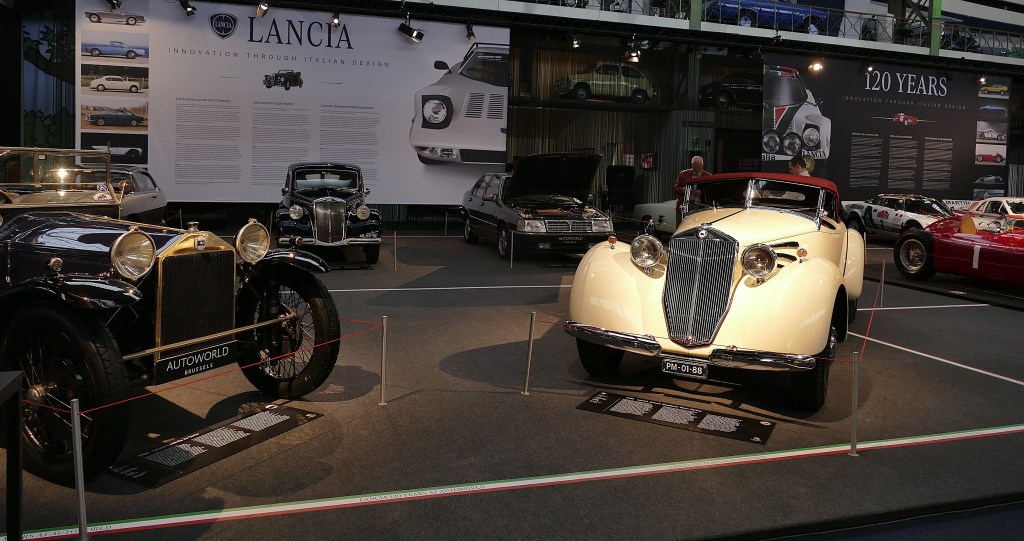
We continue here our report about this stunning exhibition of 12 absolutely iconic Lancias, which we can admire until April 19 at Brussels Autoworld.
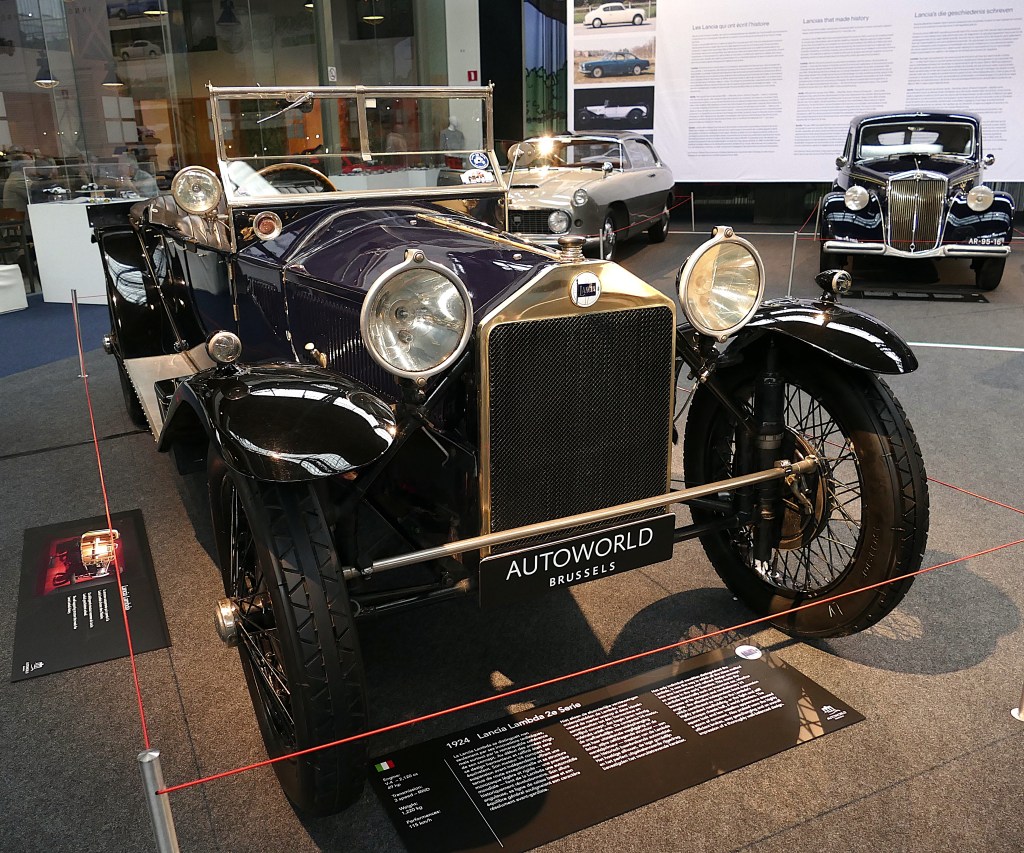
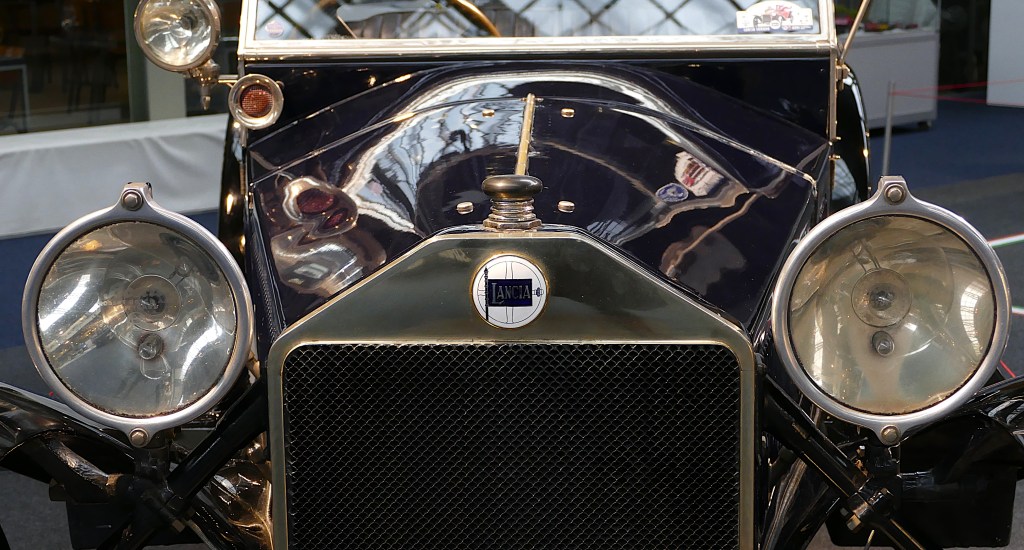
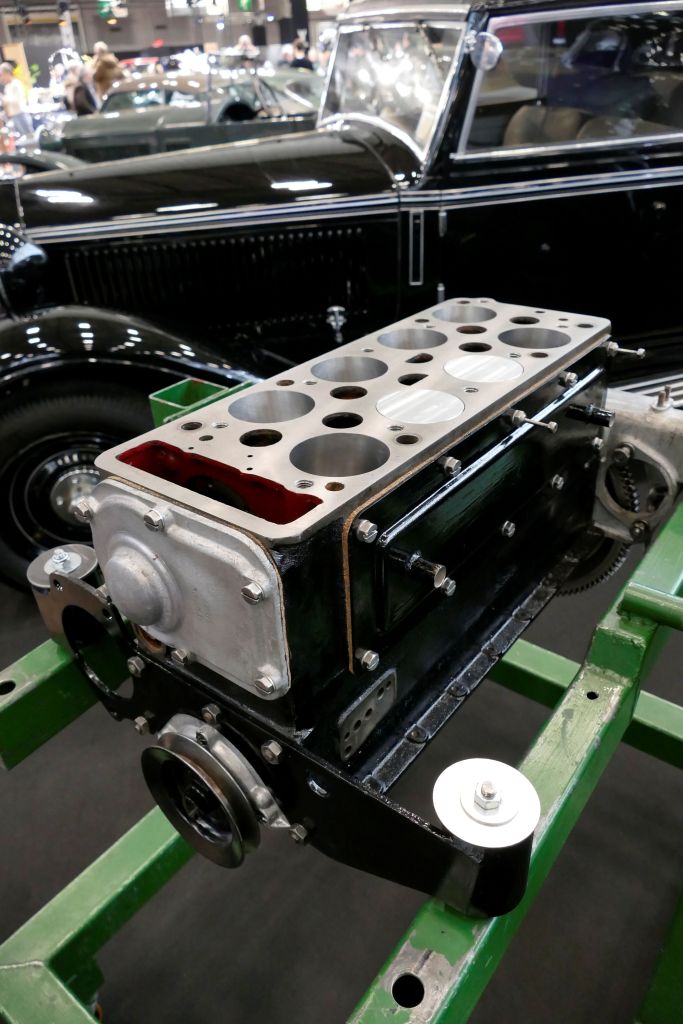
A car which set Lancia apart as a brand with a unique enineering excellence is the Lambda. It was intoduced in 1922 and featured not only a revolutionary and compact V4 engine. This V-4 was banked at a tiny 13-degree angle (later 14 degrees), with a flat cylinder-head face and combustion chambers in the block. Nobody had ever seen anything like it.
But there were other surprises: it also had a load-bearing unitary body. Indeed, and here we cite the famous connoisseur Michael Frostick: “its unique unitary construction, in which body and chassis were one, came a good ten years before Mr. Budd succeeded in selling his idea for a monocoque to Andre Citroen.”
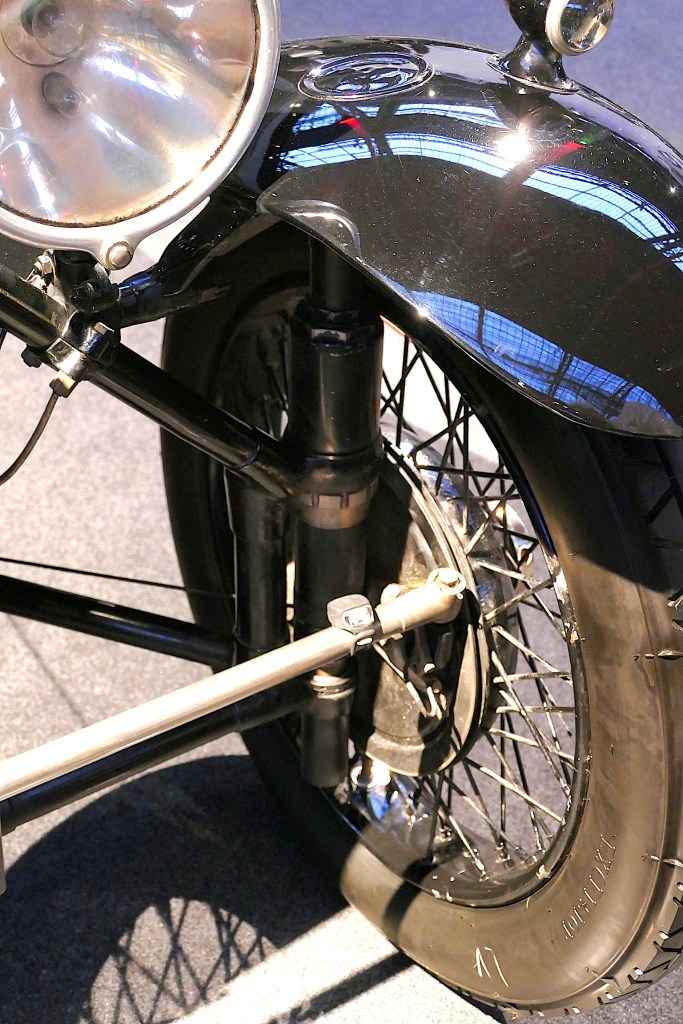
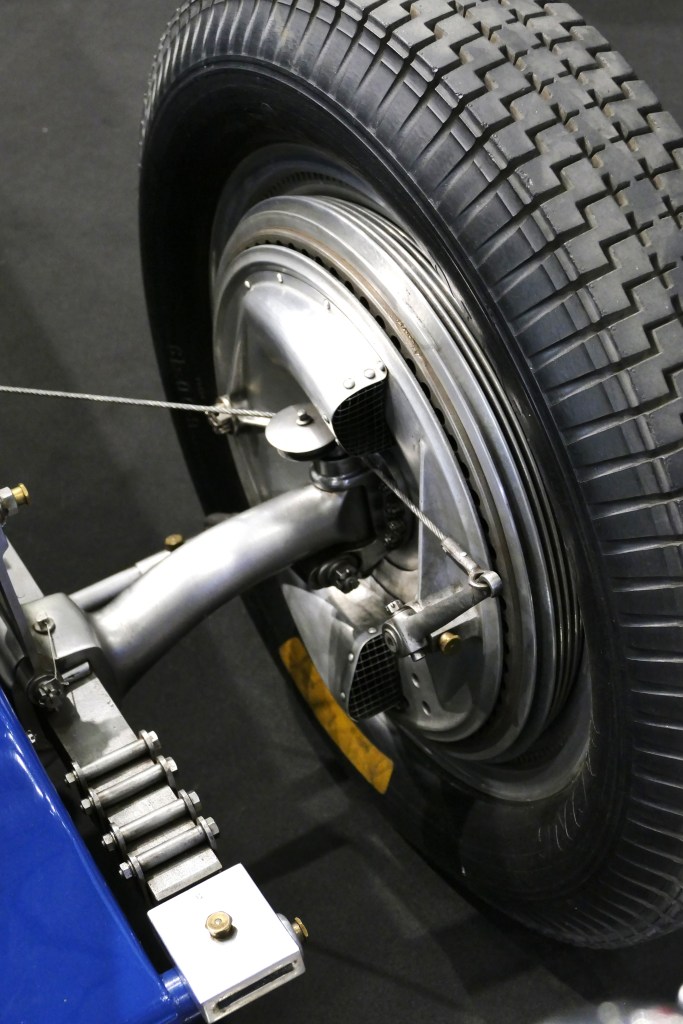
As if this were not enough, it also introduced an independent front suspension. This sliding pillar suspension was a trademark of all subsequent Lancias, used not only for all the cars before the Aurelia, but also for the Appia, up until its replacement in 1963 by the Fulvia. The suspension has an integral spring and shock absorber (all made by Lancia in house) working around a large vertical set pin internal to the assembly.
The pin is anchored into a beam axle at a particular angle, and camber and caster are fixed at the factory. The shock setting is easily adjustable by hand at the top of the pillar, and one can change it from soft to hard in a moment, or even (as the Lancia Owner’s Manual suggests) summer/winter. Absolute genius!
Lancia also introduced powerful four wheel brakes on the Lambda. All this resulted in a car with excellent handling, and indeed the Lambda proved faster over a winding track than anything Lancia had hitherto produced, including the big Tri Kappa, an eight cylinder with twice the horsepower.
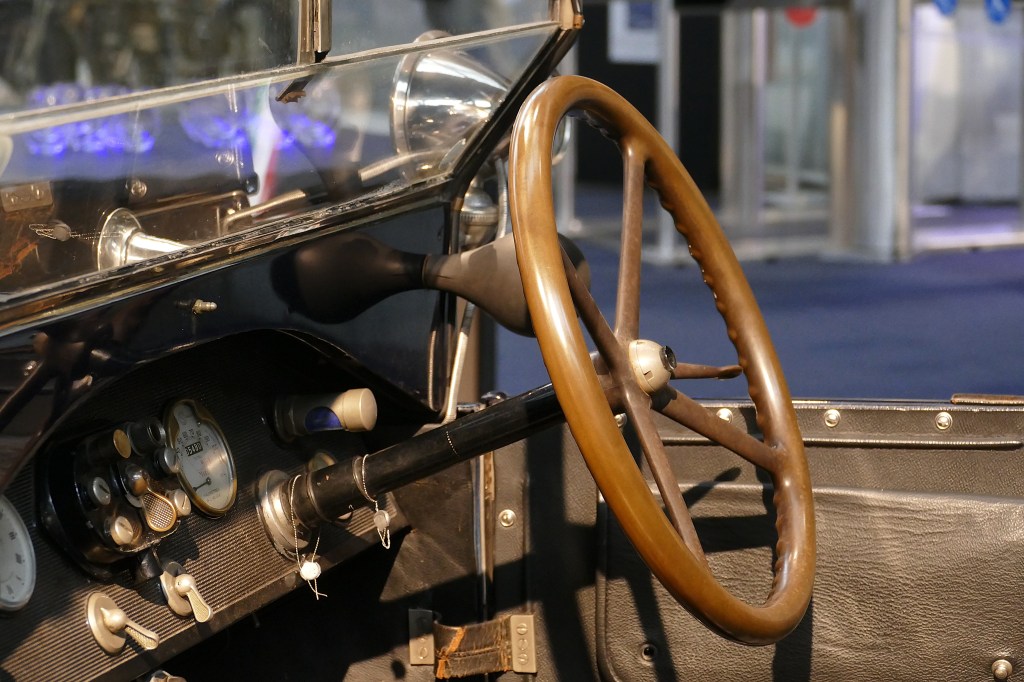
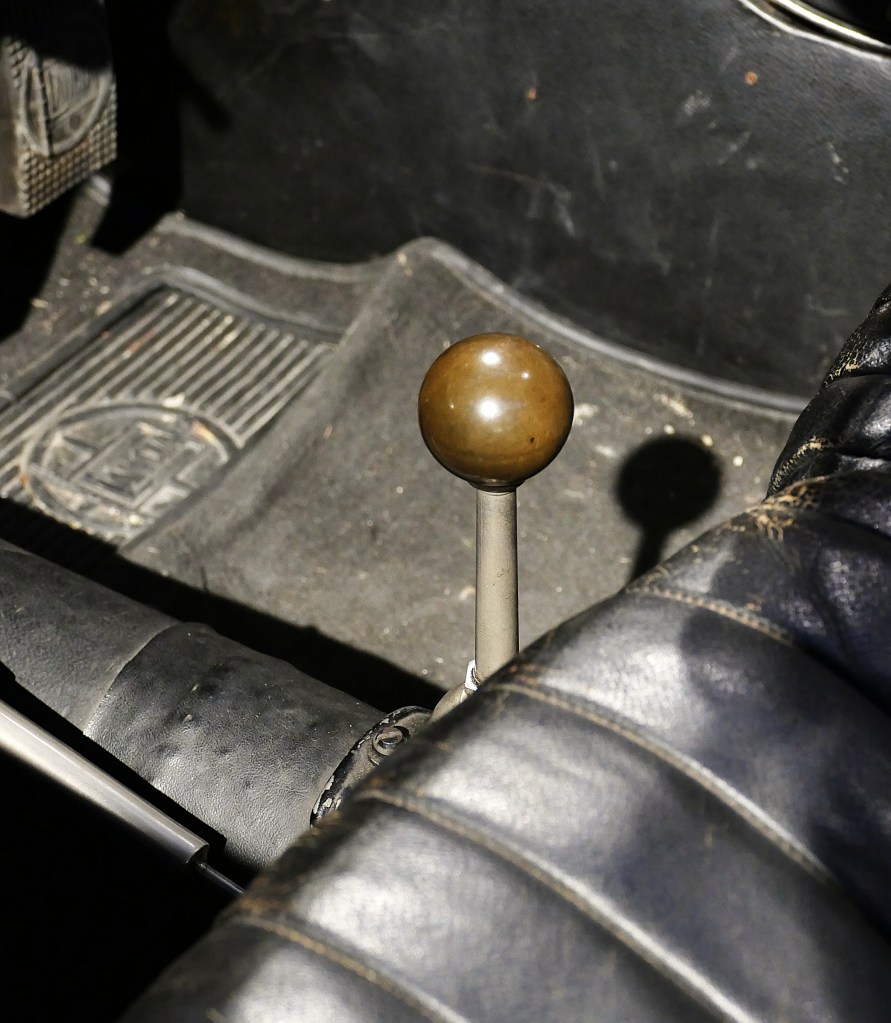
The Lambda became the car to win races with, and in 1927, when Italy’s famous open road race, the Mille Miglia, was first held, a trio of Lambda’s took the first three places overall. Note on the photo above the short, sporting gear lever!
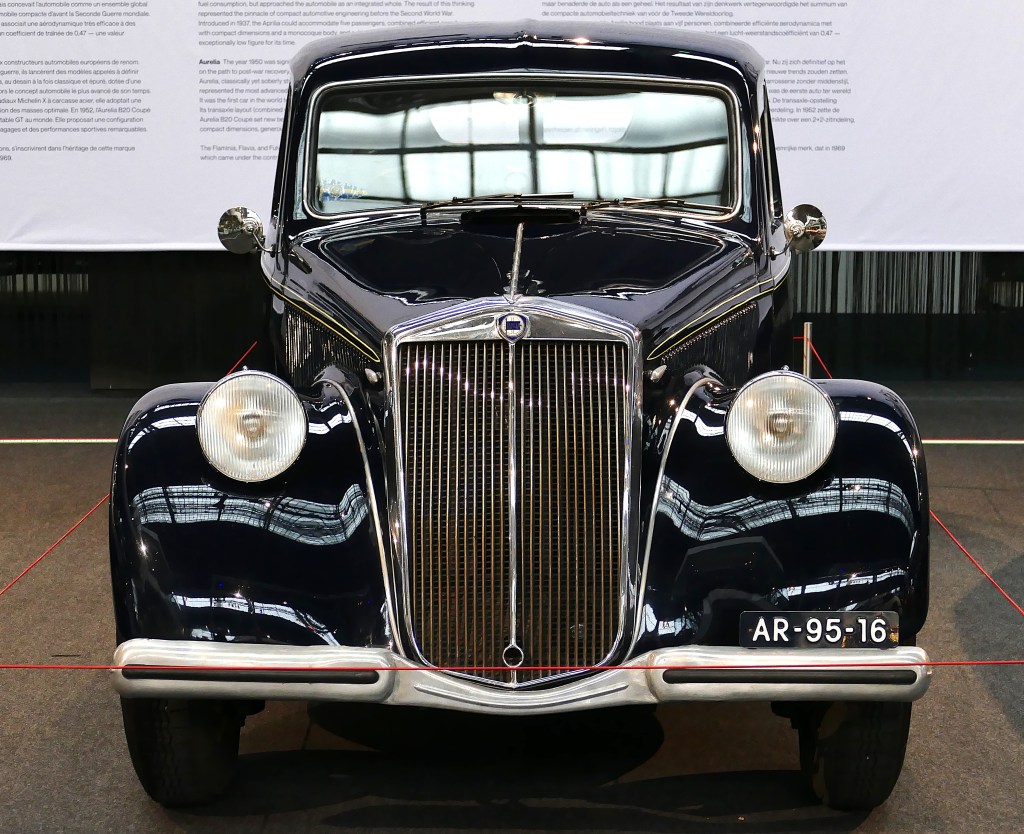
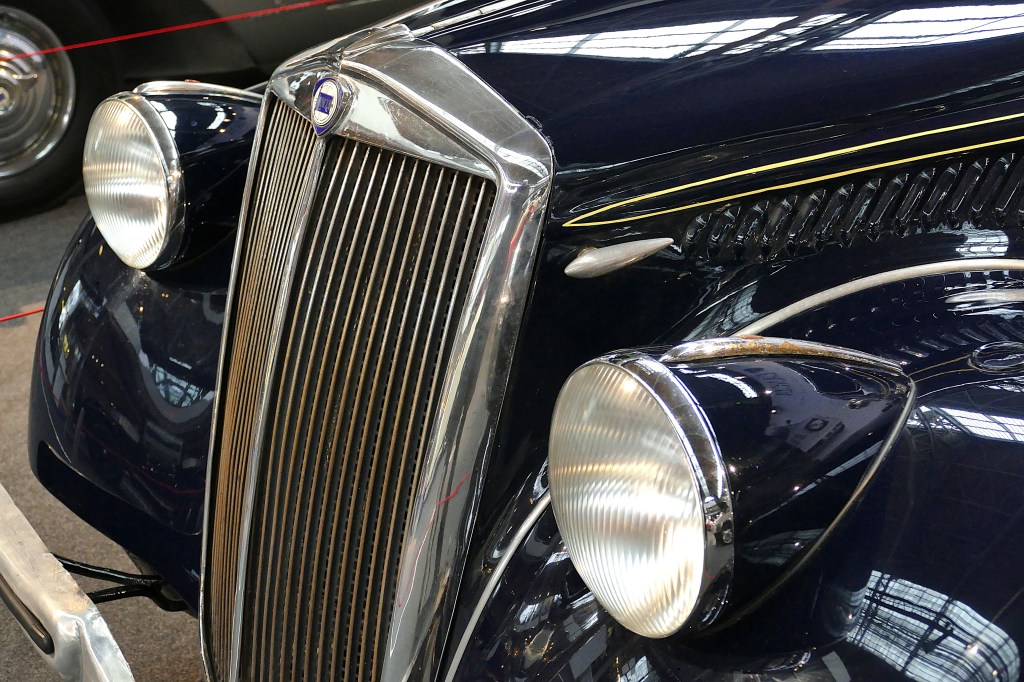
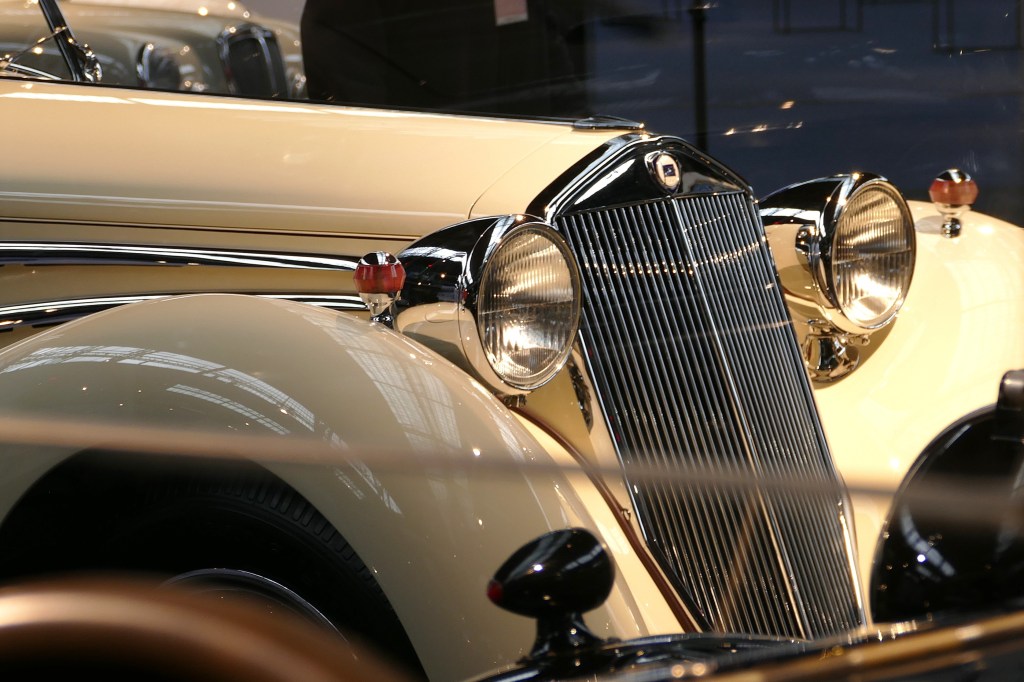
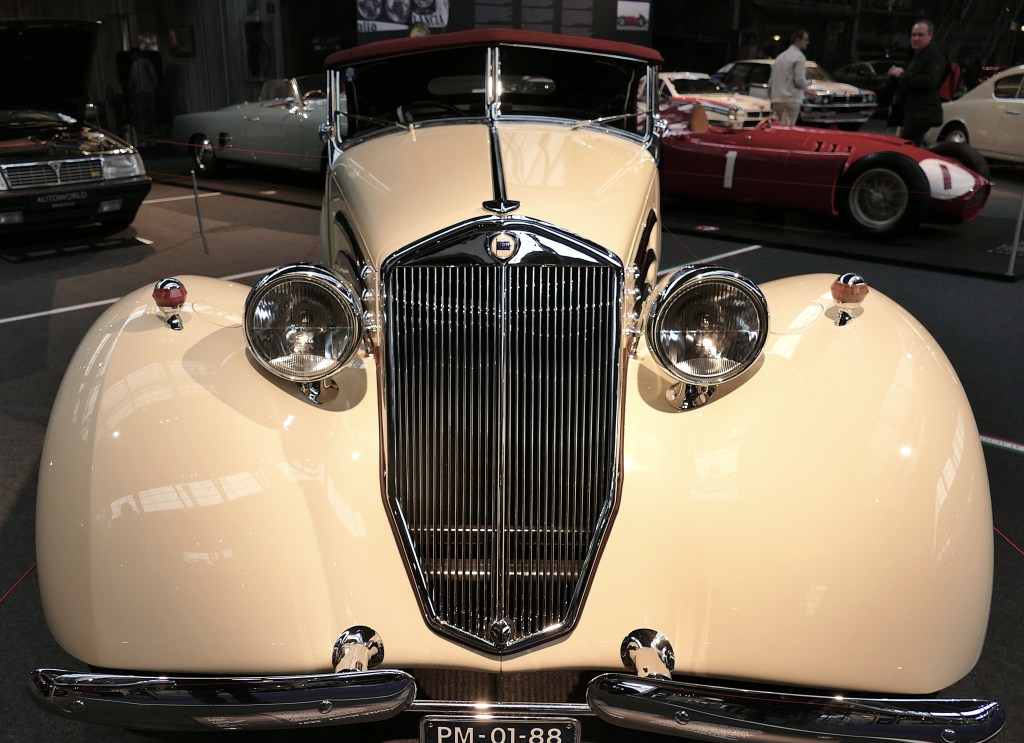
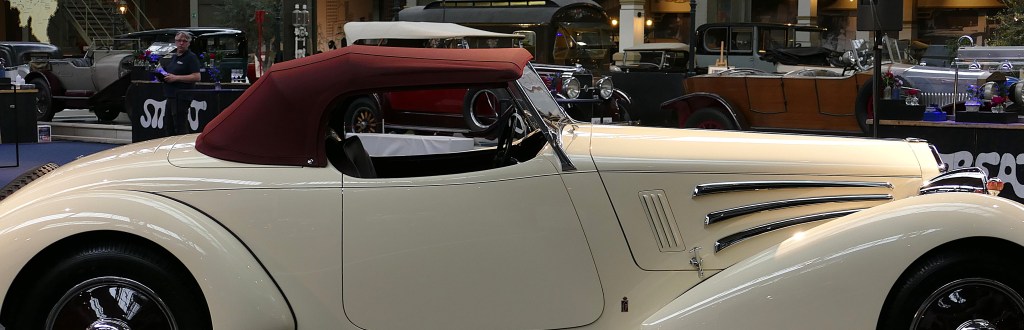
Another pre-war Lancia that won my heart was the Aprilia. Just look at its classic, timeless, compact proportions. It was born in 1936, but the car on the show is a 1947 2nd series example. It was Lancia’s first berlinetta aerodinamica. Indeed, it was one of the first designed using a wind tunnel in collaboration with Battista Farina and Polytechnic University of Turin, achieving for those days a record low drag coefficient of 0.47.
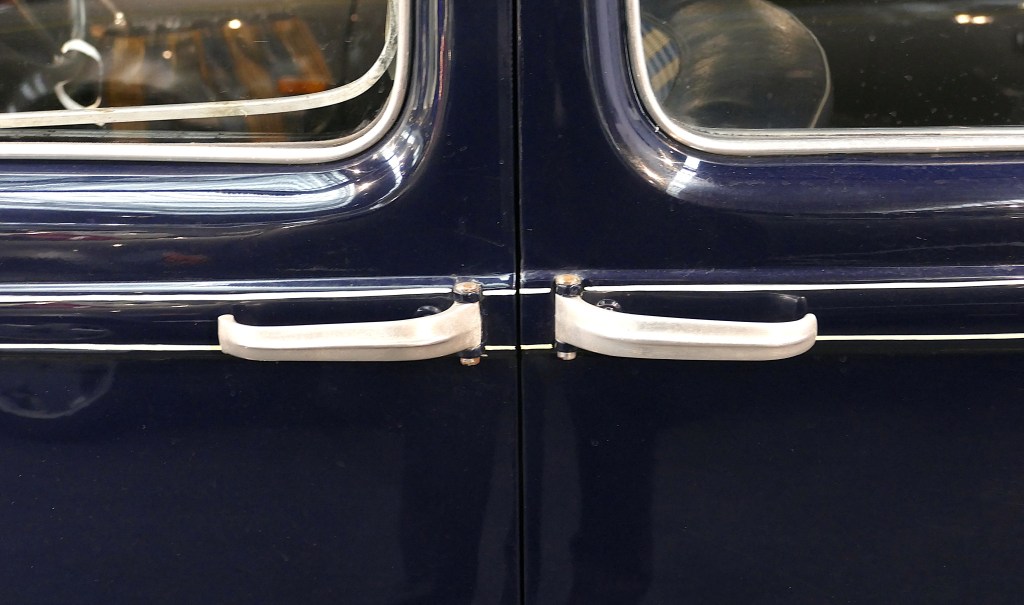
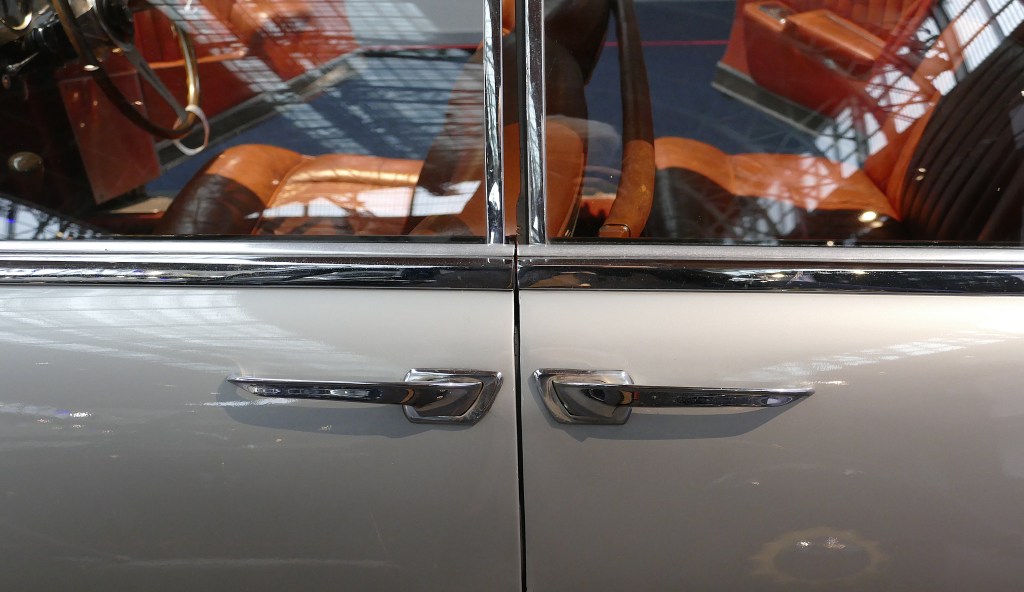
It was to be Vicenzo Lancia’s very last car, as the founder died in 1937, when series production started. It was indeed designed by Vicenzo, and featured four pillarless doors. Just look at the door handles, which are in the same position as in the pillarless 4-door Lancia Florida, which I showed you in part one. The Aprilia also featured an independent rear suspension, with inboard brakes…
The Lancia story will go further in part 3. We will tell you then more about the Lancia PF200 prototype and the legendary D50 racing car…
Hans Knol ten Bensel
Practical info: The exhibition runs until April 19 at Autoworld, Parc du Cinquantenaire 11 1000 Brussels, Belgium.
Please note, the museum is closed Wednesday 11 March, Thursday 12 March and Monday 16 March 2026.
Autoworld Brussels has again an exquisite exhibition ready for us: until April 19 we can admire a carefully curated selection of about 12 absolutely iconic Lancias. It shows us the elegance and innovation through design, as the title of the exhibition indicates. But we would add, the pop-up exhibition also showcases innovation through ingenuity and engineering excellence.
The cars are beautifully displayed at the beginning of the vast and inviting central hall of Autoworld, taking you on a journey of more than a century of technical innovation, refined design, and engulfing you in its rich motorsport heritage.
My eyes first fell on, at least to my taste, the absolute beauty of the show, the Lancia Astura Roadster by Pinin Farina. This 1935 Astura is a technical gem. The V8 engined car was introduced on the Paris Motor Show in 1931. This Astura on the show belongs to the third series, built between 1933 and 1937, with 1,243 units made.
The third-generation Astura was offered in short-wheelbase and long-wheelbase variants, and was powered by a new, larger engine. Indeed, it was enlarged from 2,6 to 3 litres, and the 17° narrow angle V8 single overhead camshaft engine now developed 82 hp. This short wheelbase you see on the photos was ideal for coachbuilders to show their talent.
ounded with the moral and financial support of Vicenzo Lancia, the Carrozzeria of Battista “Pinin” Farina witnessed a revival and produced breathtaking bodies. Of the just 328 “Corto” chassis built, many were clothed by Pinin Farina. The contours of this roadster are from the artistic hand of Mario Revelli di Beaumont, an independent stylist who worked actually for several “carrozzerie”…
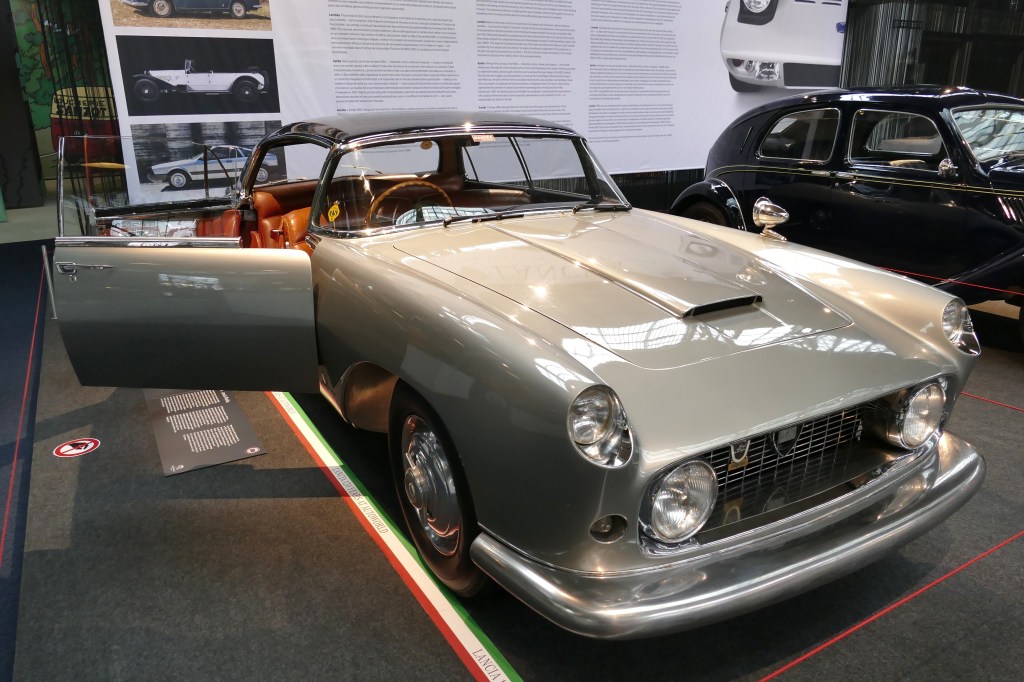
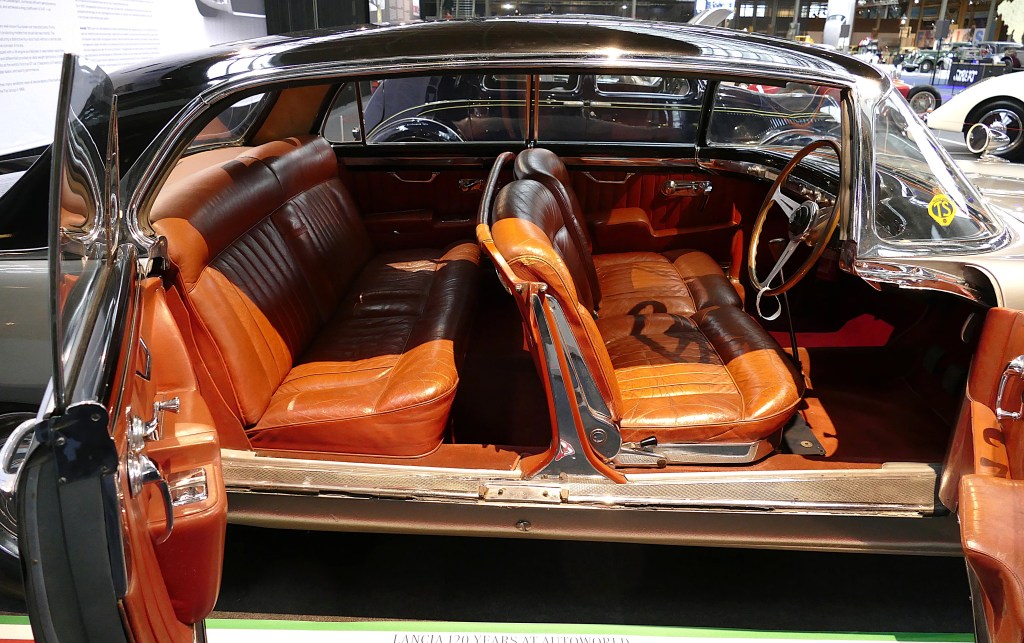
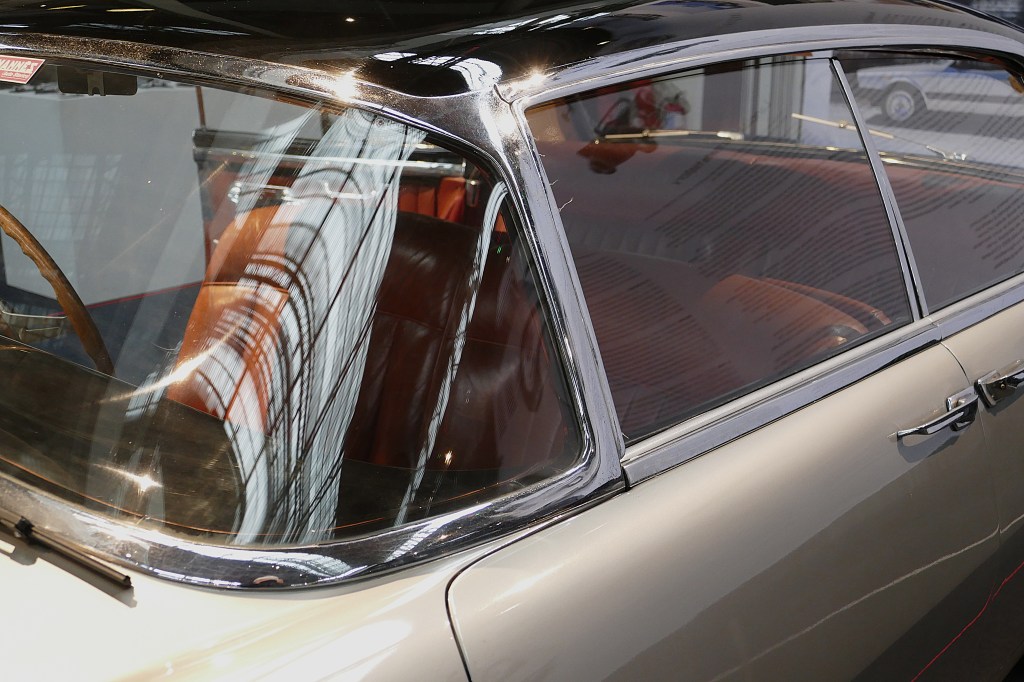
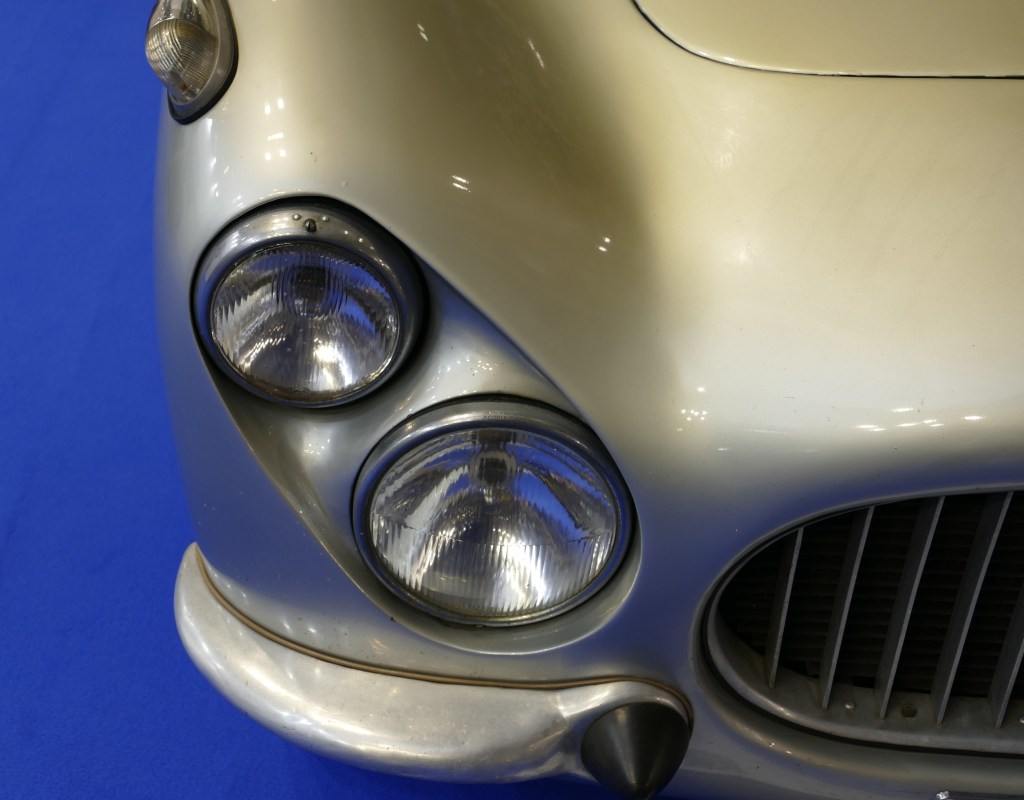
Another car by the hand of Pinin Farina was for me the Lancia Flaminia. I was therefore elated to see the conceptual predecessor of the Flaminia, the Florida. The “bellezza” and elegance of this car deeply moves me. Just look at the photos. The car was built by Pinin Farina on an Aurelia B56 chassis, and it was a technically quite daring four-door pillarless saloon.
It was shown on the 1956 Brussels salon, and as a young boy, I dreamt about it. Just like the Boano styled Ferrari’s, it was for me the pinnacle of what human art, intellect and craftmanship could reach in terms of sheer contemporary beauty.
The pillarless doors had to go in the production version, the Flaminia, therefore the elegance of this Florida truly stands out.
Much more to follow on this Lancia show at Autoworld soon, about the D50 racing car, the iconic rally cars like the Stratos… just remember, go and see it, it is on show until April 19.
Practical info: Autoworld, Parc du Cinquantenaire 11 1000 Brussels, Belgium.
Please note, the museum is closed Wednesday 11 March, Thursday 12 March and Monday 16 March 2026.
Do you know “Automechanika” ? It is actually one of the pillars in the “Messe Frankfurt” organization, which generally offers tailor-made trade fairformats worldwide with an international target audience. Of course, the automotive sector is an important part of their activity. Therefore, they organise automotive events, and also automotive aftermarket events.
Automechanika, being the leading trade fair brand, is its most important platform with 16 events worldwide. Not only is it the international meeting place for the manufacturing industry, repair shops and automotive trade, it also represents the entire automotive aftermarket value chain like no other trade fair brand.
Now they have launched a new B2B Classic Car Network, and are working to establish a comprehensive network between the automotive aftermarket and the classic car sector.
As we all know, classic and collectible cars and supercars represent a market worth billions – and a key goal of this initiative is to bring clarity to this fragmented sector.
Members of the new network will receive industry insights and exclusive invitations to classic and collectible car events, while also enjoying the opportunity to discover new business models and make new contacts in the worlds of industry, retail, workshops and services. Just read further…
Hans Knol ten Bensel
Put Frankfurt 8-12 September in your diary…
During the trade fair from 8 to 12 September 2026, the new community will be gathering in Hall 11 for a daily happy hour where they can network and share ideas. There will also be a captivating supporting programme organised by Jürgen Book, a classic car aficionado and paintwork expert with more than 45 years of experience in the automotive industry. One highlight will be the presentation of the ‘Golden Classic’ award by Auto BILD Klassik on the evening of 8 September 2026.
Bringing together leading players from industry, workshops and retail to address topics throughout the automotive value chain is part Automechanika’s DNA. This is also true for Automechanika’s network concept for the classic car business.
Automecahnika has taken this step in response to growing global interest in classic cars and associated challenges such as spare parts supply, the retention and transfer of expertise (increasingly important as many experienced specialists retire), and, also very important, a distinct lack of specialised training formats.
For many workshops, classic cars have been little more than a sideshow to date, yet they offer numerous automotive businesses a lucrative additional source of income – in restoration, maintenance, spare parts supply and specialised services for classic vehicles.
The network specifically strengthens the visibility and networking of professionals in this sector while helping them to network. This includes not only industry companies exhibiting at the event, but also international associations and institutions, as well as trade visitors with business ties in the classic car business.
Automechanika Frankfurt’s organisers will be getting support from their new strategic partner FIVA (Fédération Internationale des Véhicules Anciens), the well known international association for classic cars.
FIVA represents clubs in more than 70 countries with over two million members and has one of the largest international networks in the world of classic cars. We will discuss also more at length the role and acivities of the FIVA organisation when we present you here on this site the conference organised by the Belgian Historic Vehicle Association (BEHVA), titled “Motoring Heritage, History in Motion.” You can read a first short comment of this event on my Instagram Site autoprova.be. But more to come soon on this site here.
Tiddo Bresters, President of FIVA commented on the B2B Classic Network: “Our strategic partnership with Automechanika, a global player in the B2B automotive supply exhibition industry, demonstrates confidence in the growth potential of the historic vehicle business and the opportunities it also offers young people for a career in this market.”
Supported by industry…
Automechanika’s initiative is besides FIVA also supported by its partners Bosch, DAT (Deutsche Automobil Treuhand), Eucon and ROWE.
Bosch Classic comes here in the picture. Michael Mack, Director of Bosch Classic commented: “Bosch Mobility Aftermarket has had a strong presence at Automechanika for many years now. We are delighted to be adding Bosch Classic’s portfolio of products and services to the mix in 2026 and relish the opportunity to present these to a broad international audience. Automechanika Frankfurt’s B2B Classic Car Network promises to make a valuable contribution to the classic car community in future.”
Osvaldo Celani, Managing Director of Eucon: “The dynamics of the classic car market are presenting the industry with new challenges. Factors such as increasing technical complexity, growing market diversity and higher expectations among stakeholders mean that classic cars can no longer be viewed merely as a hobby, but rather as a professional business area. Reliable data and strong partnerships are crucial in this regard. With our data service for classic cars, we at Eucon are increasing transparency and efficiency in this segment – an important contribution to sustainable growth and the future viability of the classic car industry.”
Raphael Dammann, DAT Head of Sales Strategy: “DAT has been an integral part of the automotive industry since 1931. We help our experts, workshops and dealers with data and values that help keep our automotive heritage moving throughout the vehicle lifecycle. We welcome the additional opportunity that the Automechanika B2B Classic Car Network gives us to come into contact with highly specialised providers.”
Stefan Wermter, CEO of ROWE Mineralölwerk GmbH: “Our participation in the B2B Classic Car Network is a clear commitment to our involvement in the field of classic and modern classic cars. Historic vehicles exude pure fascination, but also require particularly intensive care from their owners to protect them and maintain their value. The interests and needs of the classic car scene are as diverse and exciting as our high-quality full range of products.
Our product solutions thrive on the exchange with connoisseurs. With the classic oils in our vintage product range, ROWE already offers a wide selection that meets the special requirements of young and oldtimers. The coming together of the automotive aftermarket with professionals from the scene offers enormous potential for establishing contacts, expanding our portfolio in a targeted manner and thus contributing to ensuring that enthusiasts can enjoy their classic cars for as long as possible.”
We will keep you posted on further developments of this laudable initiative of Automechanica. Stay tuned for the report of the conference held by BEHVA on the latest Brussels Motor Show!
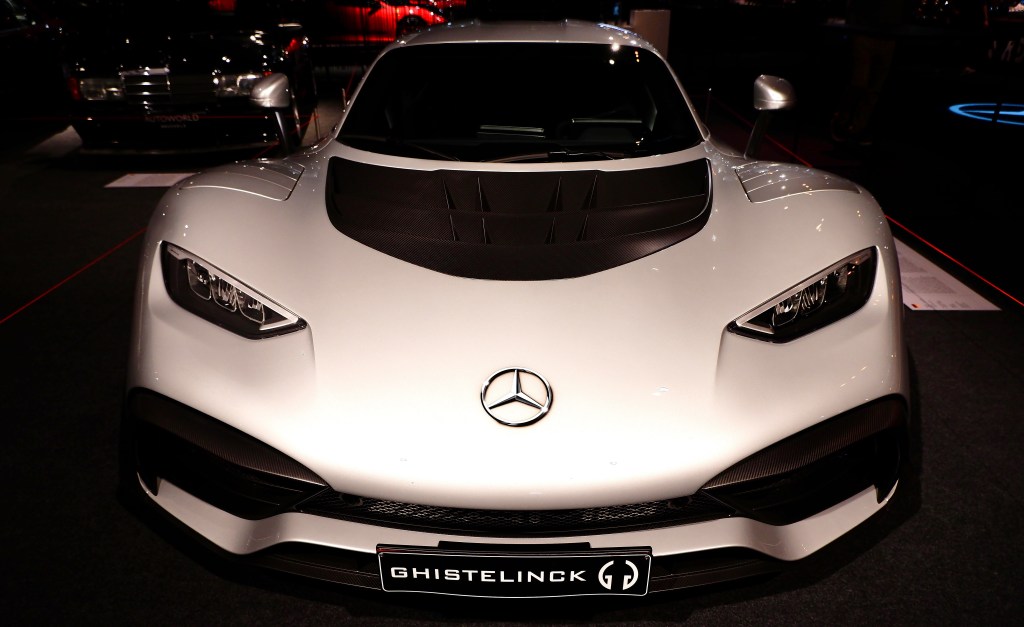
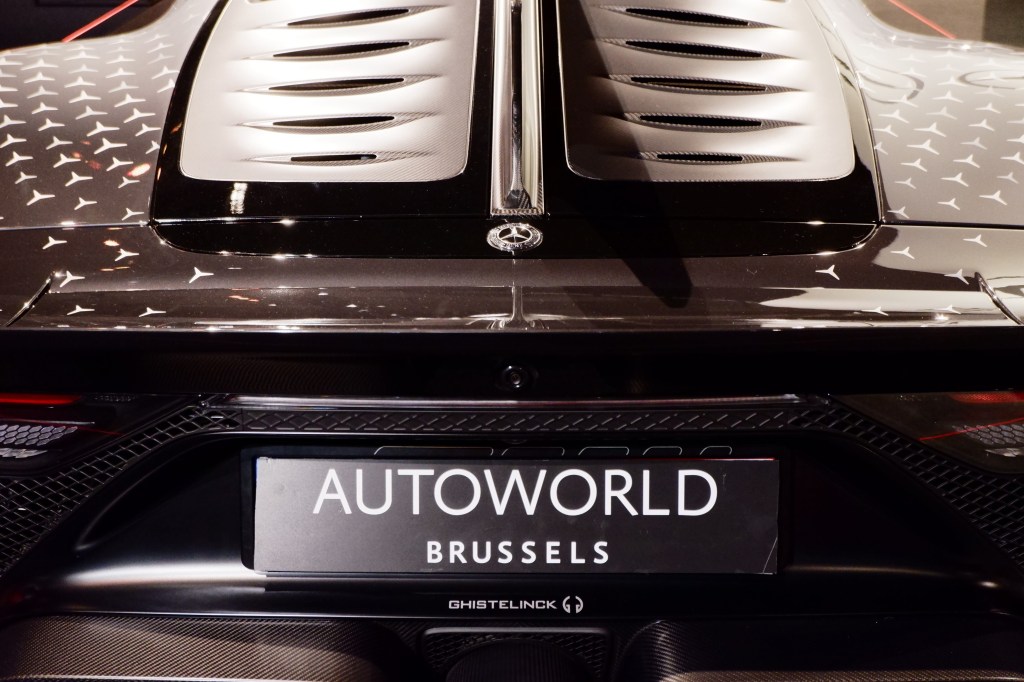
The exhibition retraces this remarkable story, from the very first three-wheeled Benz (1886) to the spectacular AMG ONE, here on the photo.
The magnificent Autoworld Museum traditionally ends the year with a major exhibition. This year, the house with the good star, Mercedes, takes centre stage. You can admire all the cars which made the brand truly legendary, and this until 22nd of February 2026.
Indeed, Mercedes has quite something to celebrate: not only is the brand now 140 years old, but it celebrates also the 100th anniversary of the merger between Daimler and Benz.
The exhibition retraces this remarkable story, from the very first three-wheeled Benz (1886) to the spectacular AMG ONE. More than fifty vehicles, including several rare highlights, are brought together for the first time in Belgium, displayed across thematic zones that reveal the many faces of Mercedes-Benz.
We attended the press evening, and of course we took our Fujifilm camera along the exhibits. We show you here some remarkable cars, but you should definitely put a visit to Autoworld, housed in the magnificent Cinquantenaire monumental site.
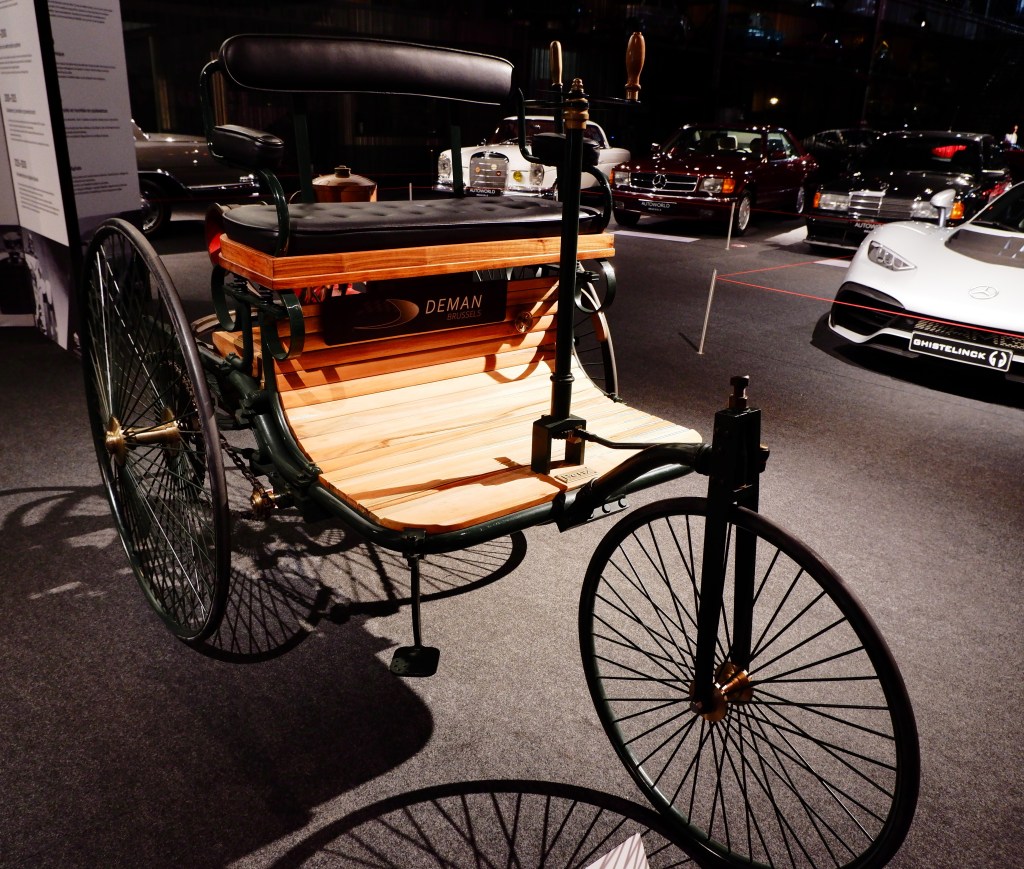
You can start your tour with the 1886 Benz Patent-Motorwagen Replica. A replica indeed, as Mercedes had 100 replicas build in England, to celebrate the 100th birthday in 1986.
Carl Benz (1844 -1929) built the car and it contained quite a few novelties: fully elliptic springs were used at the back with chain drive on both sides. A simple belt system served as a single-speed transmission. The four-stroke engine was extremely light for the time, weighing about 100 kg. A large horizontal flywheel stabilized the power output. Nevertheless, Benz was cautious, and opted for 3 wheels because he was… as an engineer not really familiar with a 2-wheel steering mechanism (!). The vehicle was awarded the German patent number 37435, applied for on 29 January 1886. Everyone knows about the drive which his wife Bertha Benz made with this car to visit her mother. The first fully-fledged automobile drive ever… when you see the car in the flesh, you wonder how on earth this was ueberhaupt possible.
The unique Mercedes DNA was soon established…
When you stroll a few meters further, you stand eye to eye with a magnificent green 1937 Mercedes-Benz 540 K Sport Cabrio A (W29). The car was originally delivered to Alfred Krupp , and was early after the second world war sold to Prince Bernard, the husband of Queen Juliana of the Netherlands. Since he wanted his cars to be green, it was resprayed in his favorite color.
It was sold to a Swedish owner in 1953. Around 1990, Daimler-Benz meticulously restored the car to its original specification. The current owner has cherished this remarkable automobile since 1995.
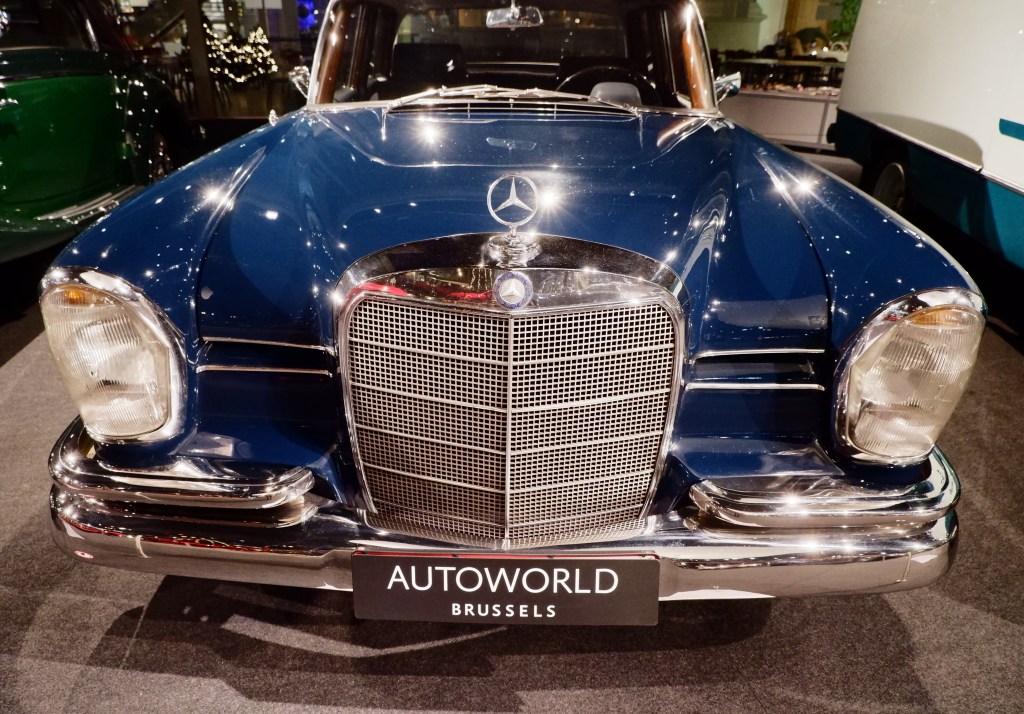
Alongside the 540 K stands a 1961 220 S (W111) “Heckflossen”. This nickname stemmed from the rather timidly styled rear fins, which Mercedes apologetically commented as “helpful for parking”. This 220 S was revolutionary for its “safety cell”, truly representing a milestone in car design where front and rear crumple zones absorbed kinetic energy on impact. F1 Racing car engineer Rudolf Uhlenhaut had a major hand in the design of suspension and refining the handling of this beautiful car, and since my father owned one in these days, it is a car in which I learned to drive expertly. I still love the specific handling of this car, and I vividly remember a long drive with a 230 S “Universal” together with Autoworld Curator Leo Van Hoorick to visit the German Mercedes Benz museum, where I could enjoy behind the wheel the wonderful performance and stability in fast corners and at speed of this car. I think Leo fell immediately in love with this very car, and soon after he bought this car from the Mercedes Benz Belgium collection…and still owns it!
Royal transport: the 600 “Pullmann”
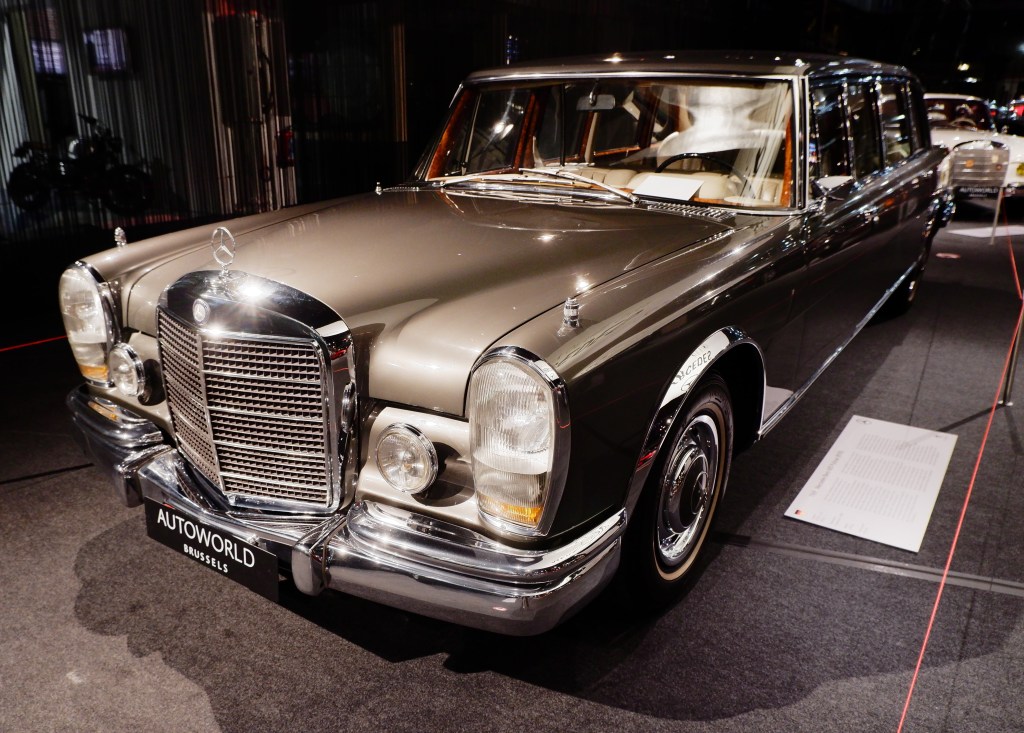
Strolling a bit further, one stands eye to eye with royal transport. Indeed, this car has served exclusively at the Belgian Royal Court, and is known as the “King Baudouin.”
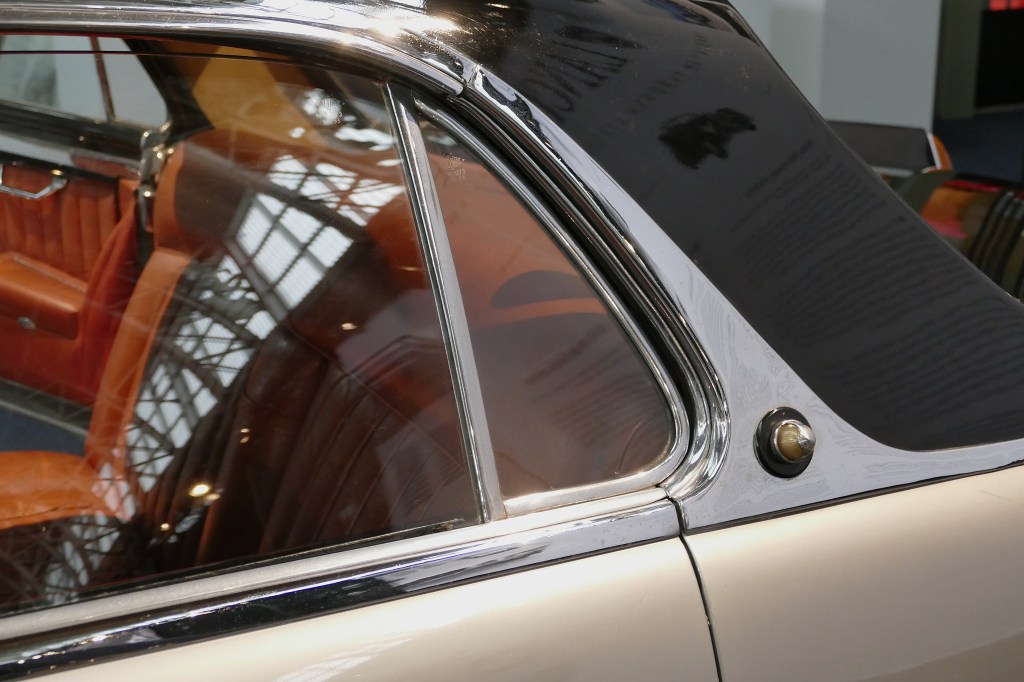
This car, designed by the Frenchman Paul Bracq, (he also designed the iconic “Pagode” 230 SL) did not undergo a single modification during its 18-year career, undoubtedly due to its modern styling. It is equipped with air conditioning and a hydraulic system that controls, among other things, power steering, braking, and the hydraulic windows. Production began in 1964, and more than 600 variants were built until 1972. The production continued, albeit at a slower pace, until 1981. In total, 2,677 units were produced of which 487 long-wheelbase Pullmans. (overall length 6,240 mm).
A F1 Mercedes for the road…
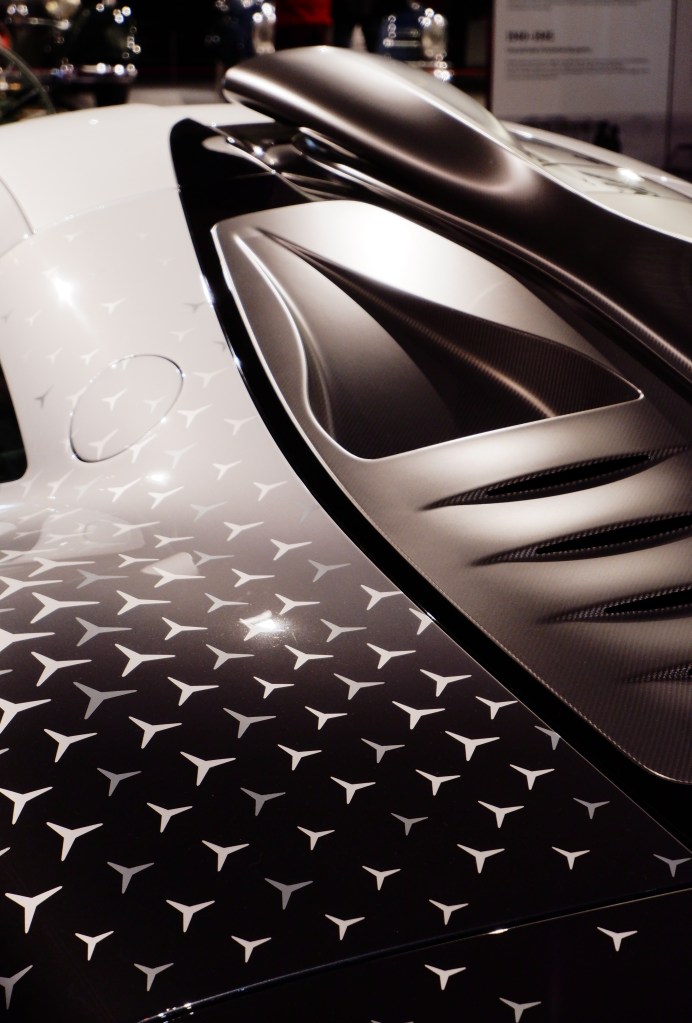
Sensational to admire is the 2025 Mercedes AMG-One. It is a hybrid supercar, nothing else actually than a F1 car adapted for road use. Behind the driver rests a 1,6 litre V6 turbo engine sourced from the Mercedes F1 car. But that is not enough: it also has four electric motors, which results in a total power delivery of 1062 HP and a top speed of 352 km/h. All this is not exceptional anymore in our dizzying EV age, but it stays quite impressive of course. The car made its debut on the 2017 IAA show in Frankfurt, but putting this complex drivetrain into production appeared to be a quite formidable task. So series production actually started only in August 2022. Only 275 units were planned, and of course they were completely sold out long before actual production began. The demand for this car was far higher, but AMG and Mercedes maintained the original production run, also to keep the car very exclusive.
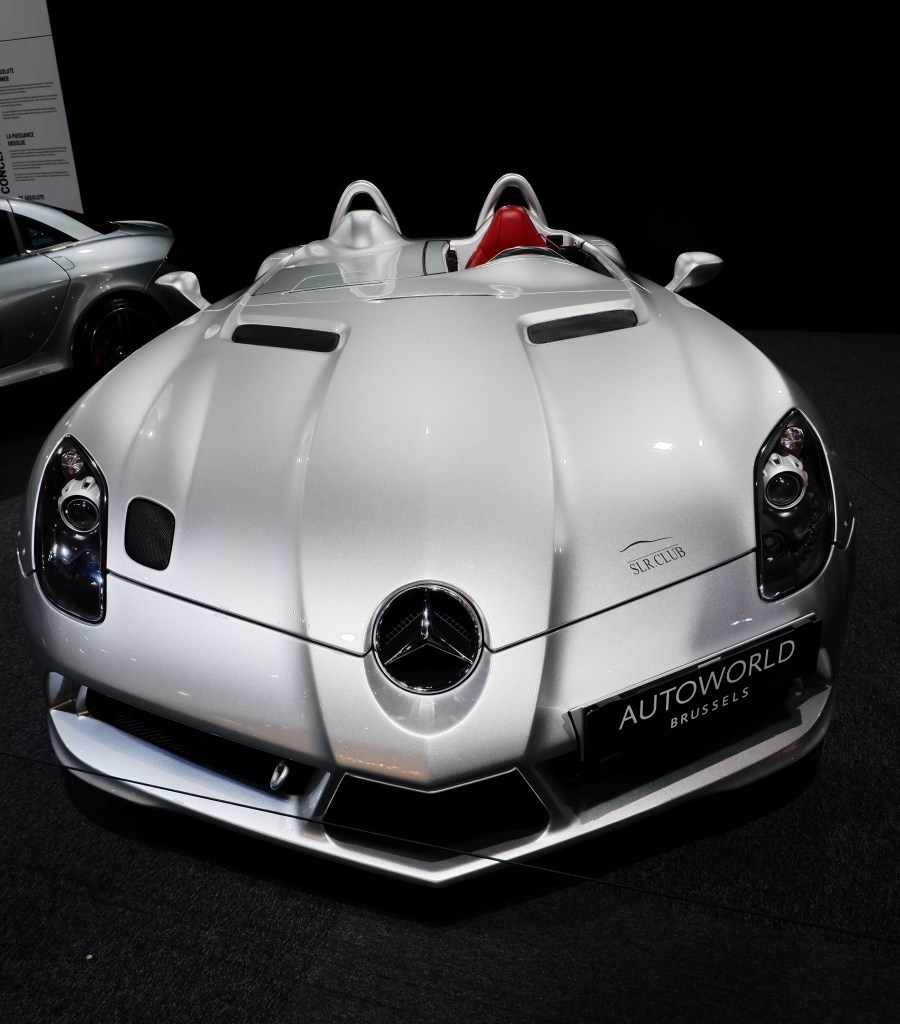
A tribute to Stirling Moss: the 2009 Mercedes-Benz SLR McLaren “Stirling Moss” (R199).
Your servant has vivid memories of this iconic British champion when he participated in the historic Mille Migilia in the official Mercedes factory team, alongside Stirling Moss. Together with my father, we drove the works 180 D “ponton”, which was far more comfortable and cooler that the 300 S Panamericana which Stirling Moss steered along the 1000 mile course. “You were having fun”, he commented, “you could drive virtually the whole course flat out!”
We like the panache and the contours of the car here which is built in his honour. Stirling drove this car on the 2009 Goodwood festival of speed.
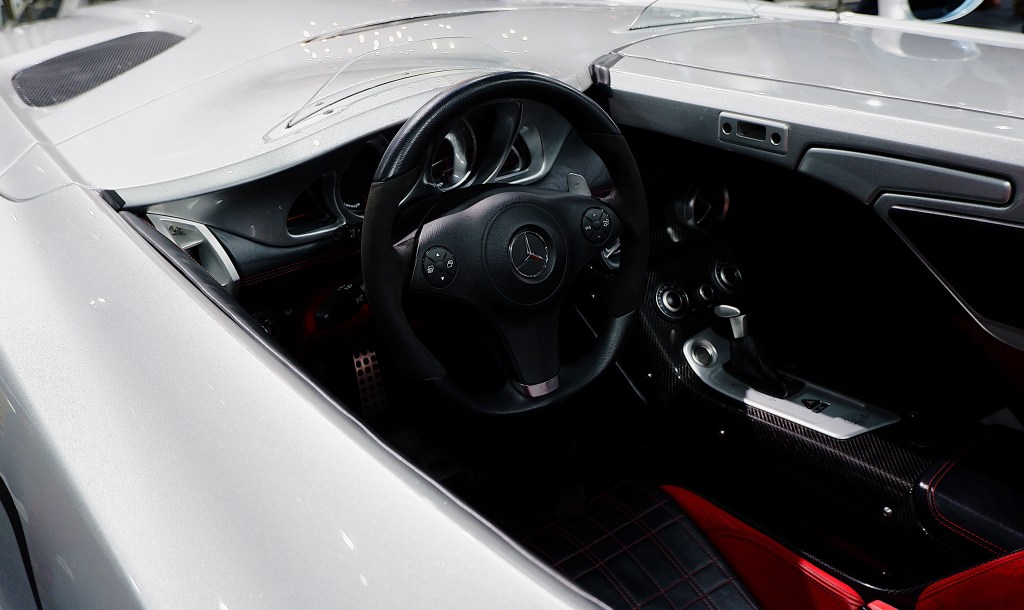
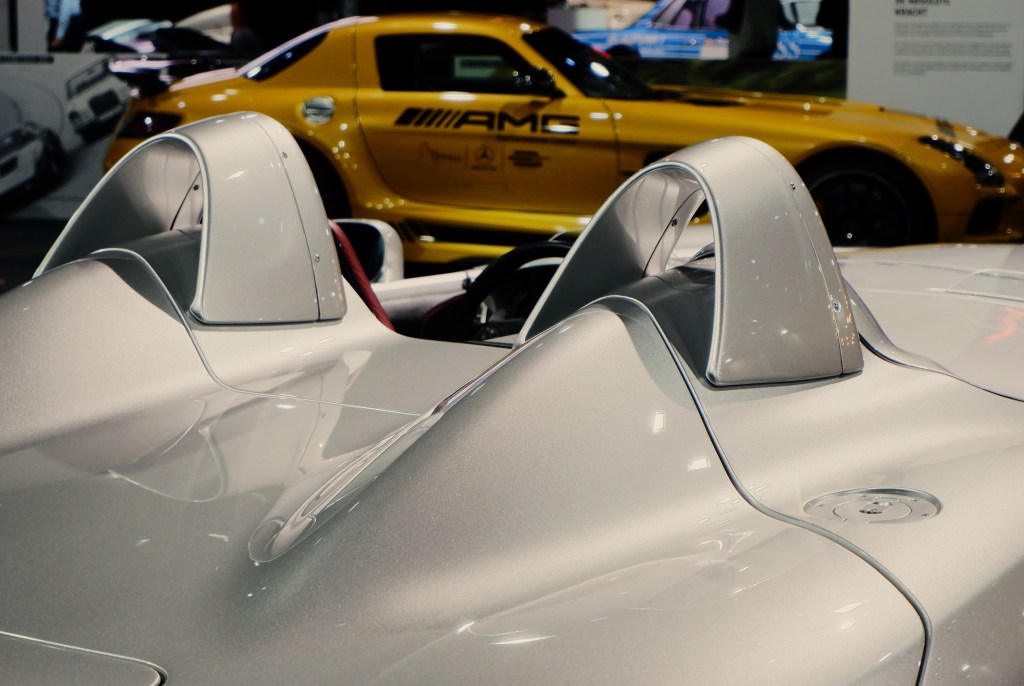
This limited edition variant uses a speedster styling that does not include a roof or a windscreen. The car is designed by Korean designer Yoon Il-hun and is of course inspired by the 300 SLR race car. The SLR Stirling Moss was to be the last series of the McLaren SLR built under the partnership between Mercedes-Benz and McLaren.
he car is approximately 200 kg lighter than the standard model thanks to carbon fibre construction and speedster styling. All 75 cars planned to be produced were completed by December 2009. It was available only to the existing SLR owners and each car cost in excess of US$1 million. This one was driven and signed by Stirling Moss in Goodwood in 2009….
Autoworld curator Leo Van Hoorick (left) and Mercedes Benz Cars PR Bastien van Den Moortel guided us expertly through the exhibition…
But of course there is much more to be seen of stunning Mercedes cars in Brussels Autoworld. As said, the exhibition runs until February 22nd. Not to be missed…
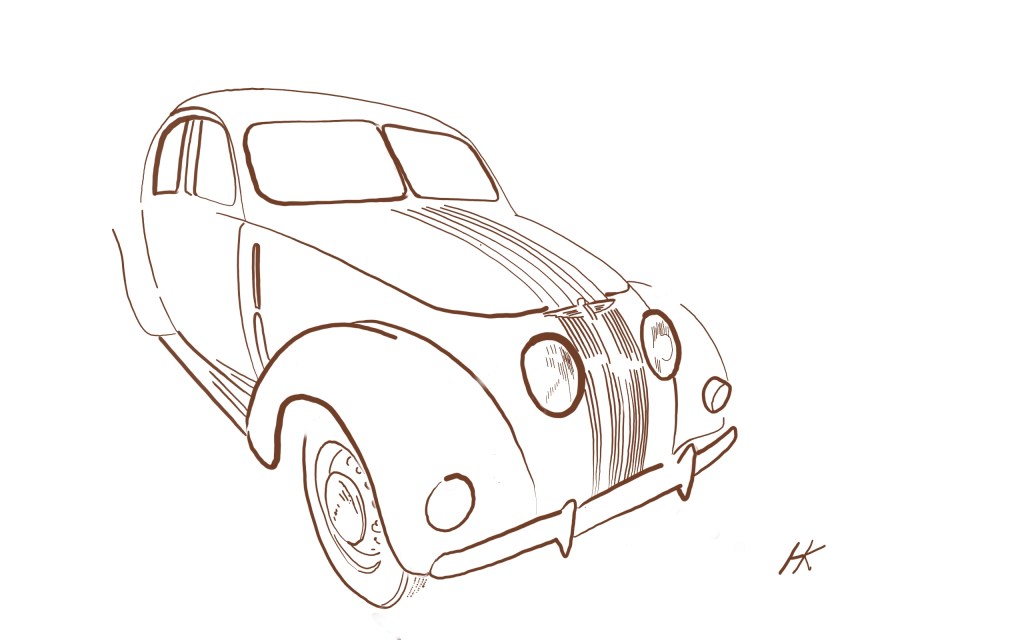
The six cylinder Adler had a streamlined body with a cW of merely 0,36…
The first car in a series where I delight you, dear reader, with my recent car drawings is the astonishing Adler 2,5-litre.
It showed its streamlined body on the 1937 Berlin Motor Show to a surprised public, and indeed it caused nothing short of a sensation. The Germans had a special name for the sloping roof saloon body: “Schiebedach Limousine”. It was designed by Karl Jenschke, who was until 1935 the director of Engineering at Steyr-Daimler-Puch. There he had created the Steyr 50, which also had a streamlined body akin to the Adler.
The Adler 2,5 litre was also available as a sleek cabriolet, built by Karmann in Osnabrück…
The Adler factory was situated in Frankfurt am Main. After the war, the management decided to stop with car production, as the factory had also been completely destroyed. Instead, it started manufacturing…typewriters.
But let’s turn back to the glorious days when Adler cars were rolling of the production lines.
Actually, the fast back saloon body was built by Ambi Budd in its factory in Berlin. The Adler Typ 10, as the car was officially known, was also available in two- and four door cabriolet bodies, which came from Karmann in Osnabrück.
A classic sidevalve straight six was powering the streamlined Adler…
A six cylinder for the Autobahn…
In 1937 the construction of the German Autobahnen was in full swing. This meant that the German automakers were keen on building cars meant for speed. The streamlined body was a first step, and the second one was providing sufficient power. So the Adler engineers opted for a 2,5 litre straight six, which otherwise was still fairly traditional with side valves and a four-bearing crankshaft. It offered a rather sedate 58 PS or 43 kW, but was nevertheless thanks to its streamlined body with a drag coefficient of merely 0,36 still 125 kph fast.
In 1938, a “Sport” version was offered. It had a two-door body that was lower and longer, built by Gläser-Karosserie in Dresden. It had the same 2,494 cc engine as the sedan, but had now THREE carburetors instead of one. Together with a higher compression ratio, 80 PS was achieved. It was offered for 8,750 Reichsmarks instead of 5,750 Reichsmarks for the standard Limousine. The stylish cabriolet version was costing only a few hundred Reichsmarks more.
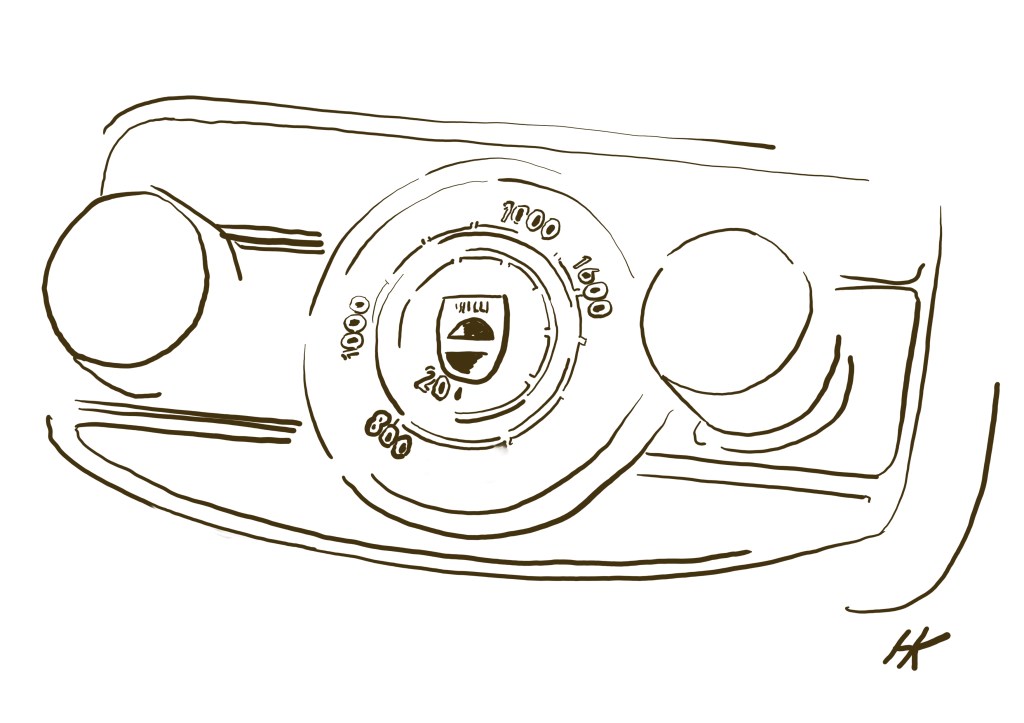
A small Philips radio, proudly mentioning “Made in Holland” was placed close to the steering wheel column…
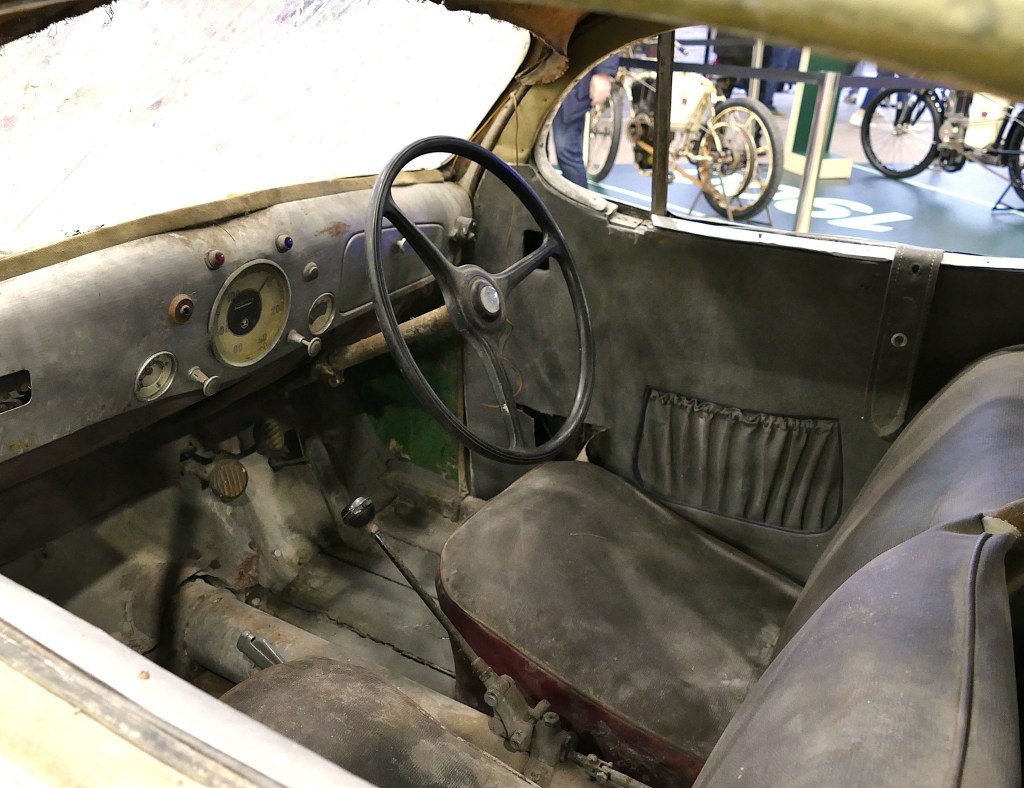
This Adler offered a few more futuristic touches like a compact Phillips car radio and a centrally located gear lever, emerging from the dashboard, later seen in the Citroën 2 CV…
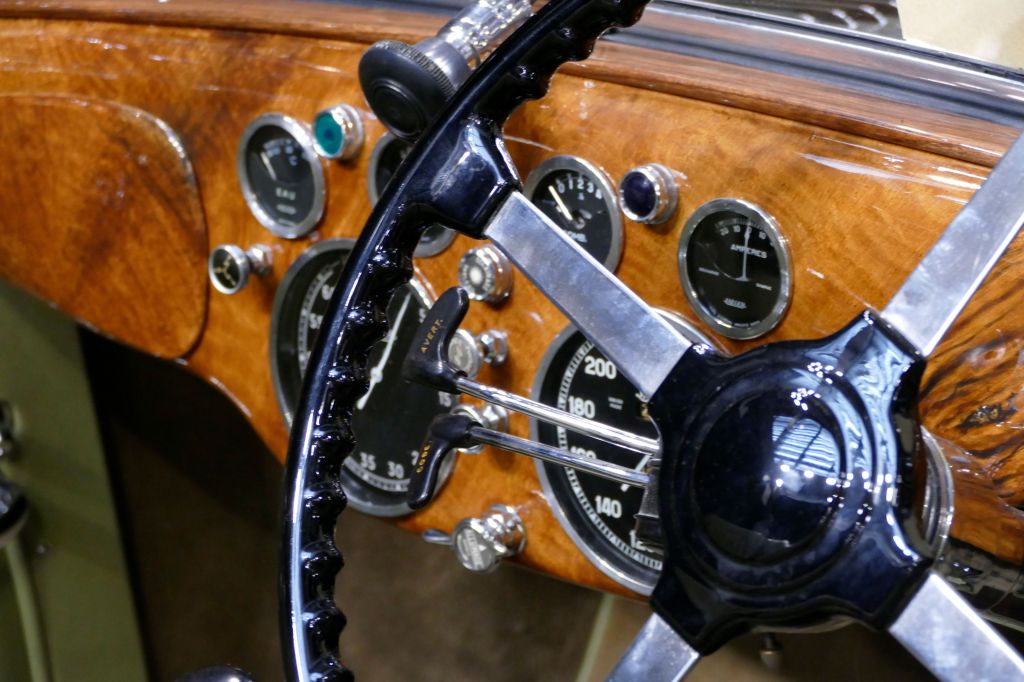
The instrument panel was rather boldly styled with a central placed gearlever on the dashboard…
Comfort and handling were already quite sophisticated. The front suspension used wishbones and quarter-elliptical springs. The rear wheels were attached to a swing axle with a transverse leaf spring and tie rods. The differential was bolted to the frame. All four wheels used hydraulic shock absorbers and hydraulically controlled drum brakes. This Adler can indeed be used in today’s traffic without a hitch.
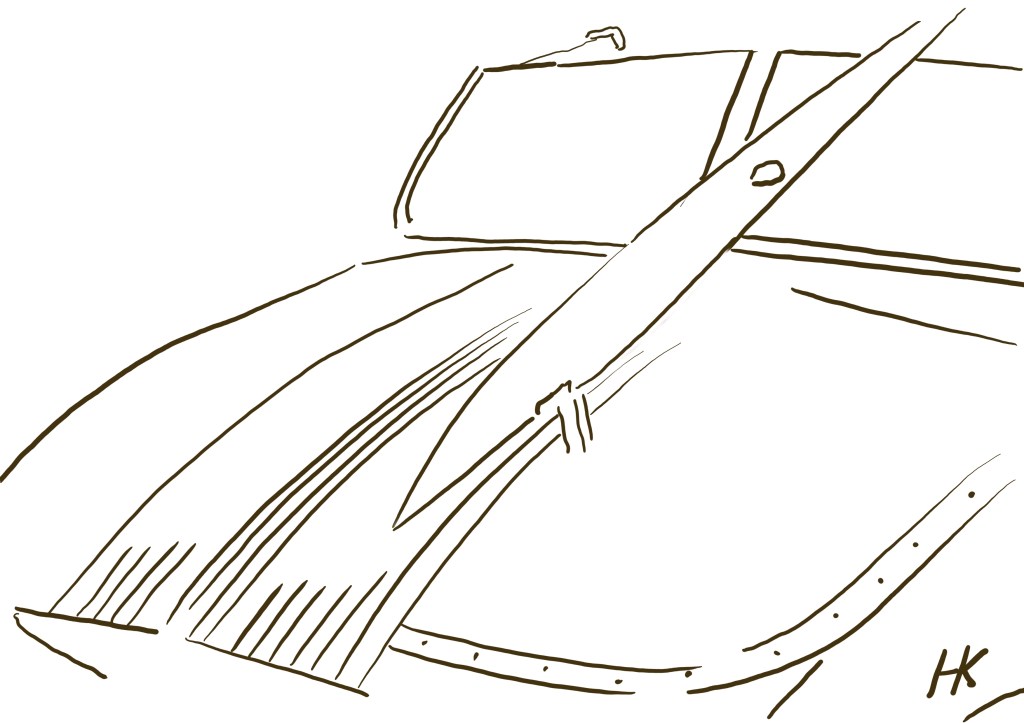
The engine hood consisted of two panels, which could be opened to reach the engine on both sides… the central part of the hood with its long profiles stayed fixed.
Despite its futuristic qualities and ingenuity, the actual sales success did not materialize; from its introduction to the end of production in 1940, only 5,295 units were sold, all versions combined. Maybe this streamlined proved too modern for its age…Just enjoy the drawings!
April 26 was already for weeks firmly put in the agenda for all the (Belgian) fans of British cars. After all, that’s when parts specialist Anglo Parts organized its annual “British Car Day”, where the classic car clubs and restoration specialists could put their best foot forward to recruit members or appeal to customers.
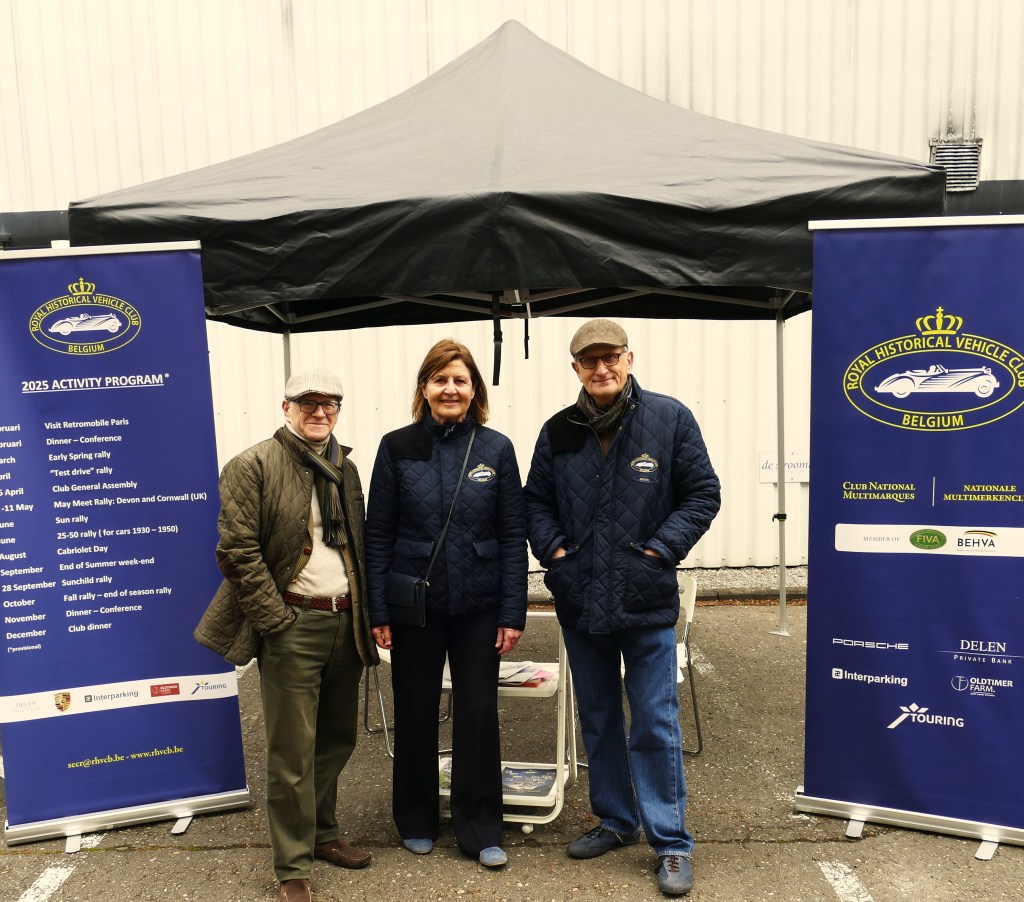
From left to right on our RHVCB stand: your servant, Ingrid De Jonge and Club president Michel Van Eesbeek
As faithful readers already have read in our post about our visit to parts specialist Anglo Parts, (see the post “Lifeblood for your British Classic Car”) your servant has become board member of the Royal Historical Vehicle Club Belgium, and I was present at the event which a stand of our club.
This time the weather gods were better than in the previous edition, and this attracted twice as many spectators.
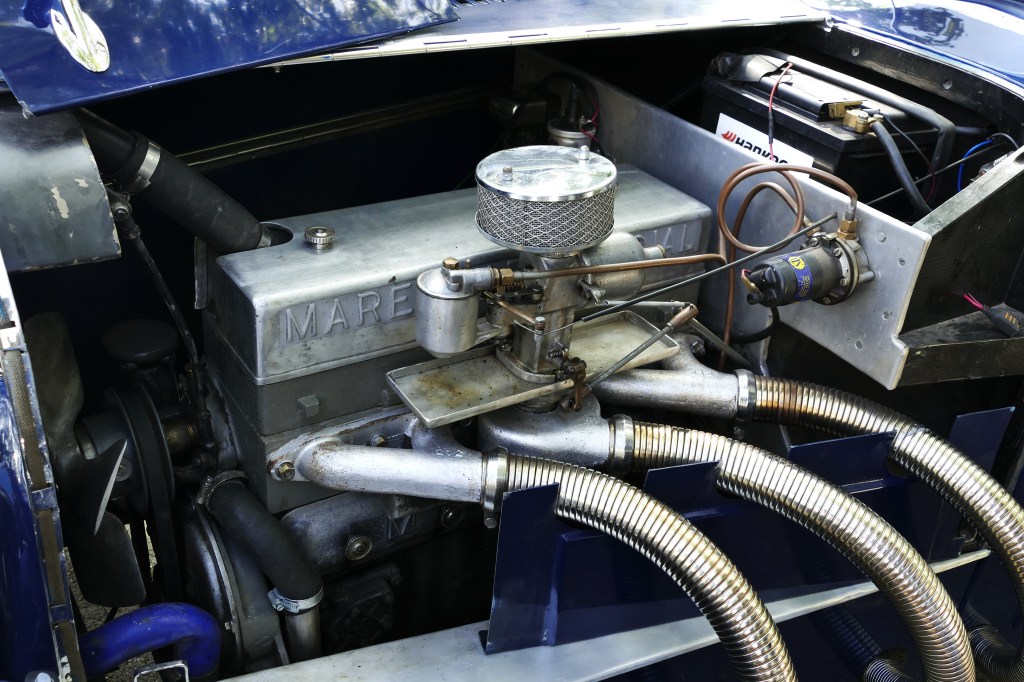
At the event itself there were a lot of enthusiastic enthusiasts who came up with very special cars. For example, we came face to face with a very rare Marendaz Special, a car designed by DMK (Donald Marcus Kelway) Marendaz and built between 1926 and 1932 in Brixton Road in London, and then until 1936 in Maidenhead in Berkshire. Of this beautiful sports car, whose radiator resembles that of the Bentleys of the time, only 20 to 50 copies were built by the eccentric Marendaz, who fought air battles in France during the First World War as a member of the Royal Flying Corps, in which he was wounded in 1918.
Your servant will make an extensive (photo) report of this very special car on our columns soon…
Most Marendaz Specials used Anzani engine(s)…
Also, a very enthusiastic more than 80 year old English enthusiast had arrived with a vintage… taxi. The man’s name is Dirk Harland, and he had left Hemel Hempstead the day before in his 1955 Beardmore London Taxi Mk7, with his grandson in the back.
He crossed the channel from Dover to Calais, and unfortunately got into a massive one and a half hour traffic jam on the Antwerp ring road. But don’t worry, he showed up flawlessly the next morning at the British Car Day with his Beardmore…
Furthermore, there was of course a legion of MGs to admire, Triumphs, Minis in all kinds of tune , Jaguars, in short, something for everyone…
Relatively rare: an MGA Twin Cam
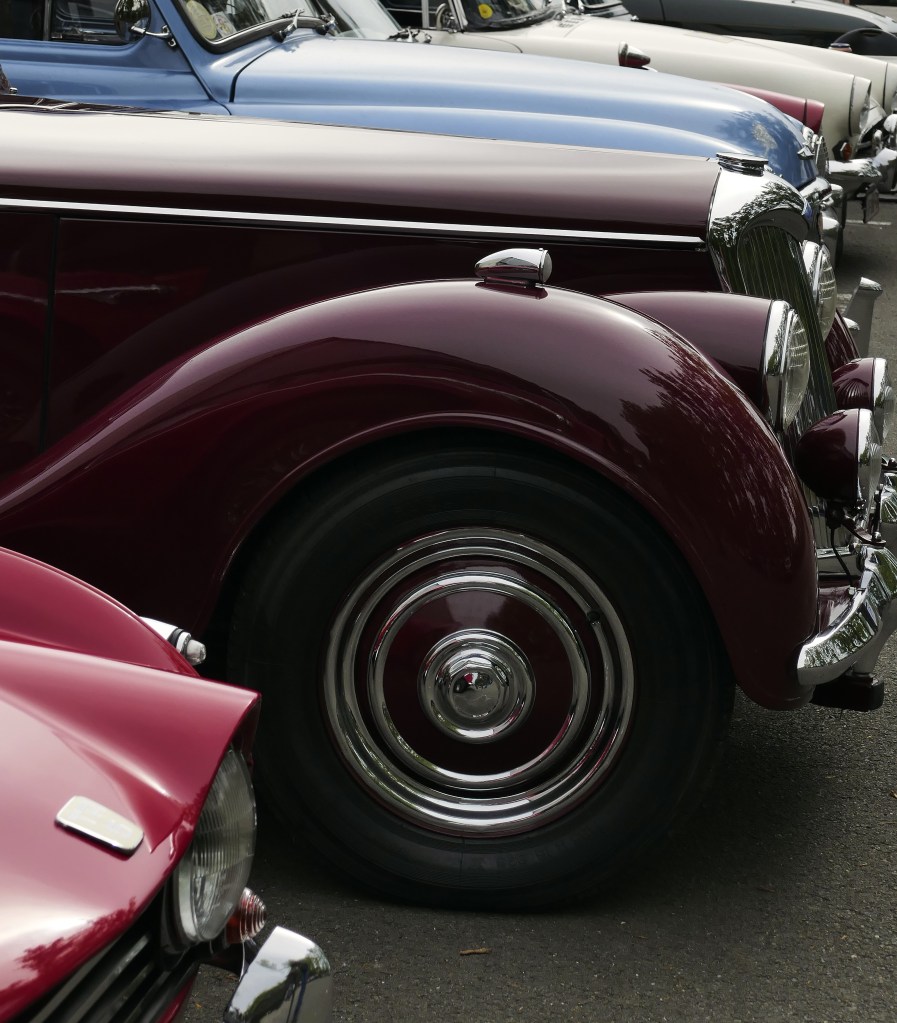
The event was also characterized by the enormous venue of enthusiasts, who all had taken out their British Classic and had it parked on the road and areas around the premises of the organizer Anglo Parts. Just have a look at the photos…
At the 39th edition of “Auto e Moto d’Epoca”, one of the most important events in Europe for vintage car and motorcycle enthusiasts, Alfa Romeo presents the “Alfa Romeo Classiche” heritage program, a range of services with the precise aim of protecting and promoting the history of the iconic Italian brand.
For the first time in Stellantis, the brand’s top management is personally involved in all the activities that make up the whole range of its dedicated services. In fact, the certification committee is chaired by Alfa Romeo’s CEO and the Head of Heritage department, with the support of the Alfa Romeo Museum. This support is crucial, as this museum houses the production registers and all the technical documentation used by the committee to analyze the information on the examined cars.
Abarth is also incuded in the overall Stellantis Heritage program…
Jean Philippe Imparato – Alfa Romeo CEO: “we are enhancing our historic heritage”
When presenting the program, the CEO stated: “Alfa Romeo is going through a key phase in its history. The historical period we are going through is a genuine evolution. The brand’s future includes very ambitious goals aimed at redefining the concept of sportiness in the 21st century, while remaining faithful to its DNA. While planning for the future, our heritage is always our main source of inspiration. For us, the Alfa Romeo Classiche heritage program aims to enhance our historic automotive heritage by certifying the authenticity of vintage Alfa Romeos and giving new life to marvelous examples that still captivate and excite car enthusiasts around the world.”
The program…
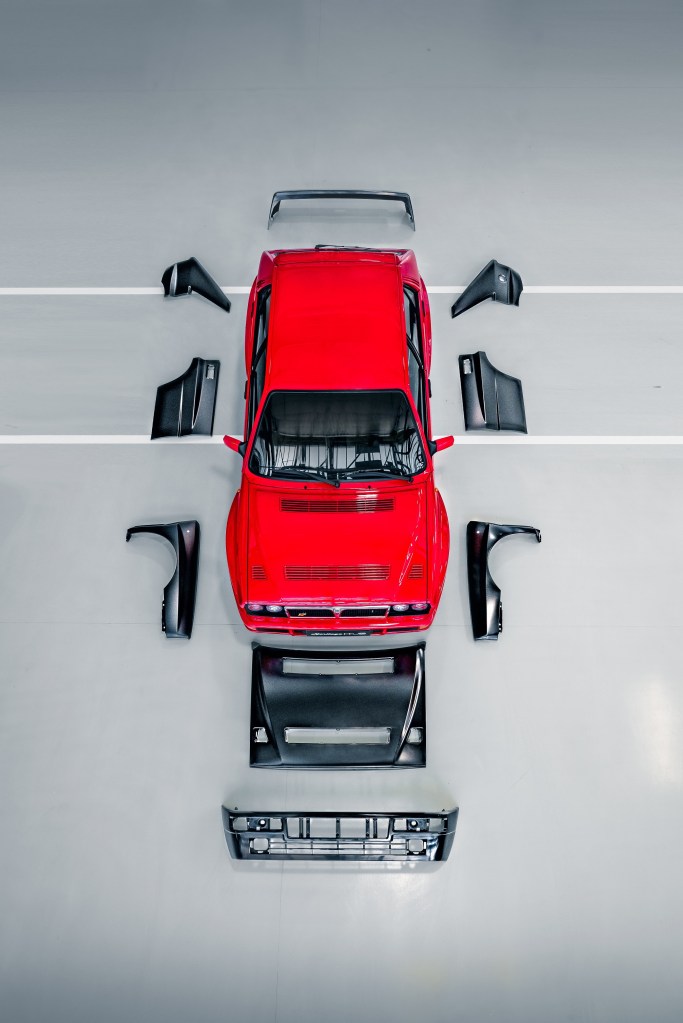
Parts for the Lancia Delta Integrale are also provided…
The Alfa Romeo Classiche heritage program consists of the Certificate of Origin – which has been offered for Alfa Romeo cars since 2016 – together with the Certificate of Authenticity and the Restoration. The Top management of the brand personally chairs and intervenes in the committee that evaluates historic cars and issues the certifications with the support of the Heritage team and the experts in Alfa Romeo history.
Issuing a Certificate of Origin…
Alfa Romeo offers the opportunity to discover the history of each car through its chassis number. The service provides for an accurate document review at the Brand’s production registers and the issue of a certificate certifying the car’s year of production and original configuration: model specifications, engine serial number, original exterior and interior details.
… and a Certificate of Authenticity.
Historic gems are kept and restored by the heritage department…
After analyzing in detail the historic car taken under consideration and verifying its production data and technical specifications at the company archives, Alfa Romeo, with the support of the Heritage department, certifies the authenticity of the classic car. To obtain this certification each car goes through a rigorous inspection and evaluation process which is carried out by the specialized team, verifying the authenticity of the car and its components and the functioning of the main mechanical parts. The vehicle can be examined at the Officine Classiche in Mirafiori or directly at the customer’s home, if he prefers, or at the Stellantis & You sales and service dealership in Rome and Palermo.
A fully fledged Restoration service.
Furthermore, the same team that takes care of the’ historical collection is available to private clients, with services ranging from simple maintenance to complete restoration: from diagnosis to exterior restoration, repair of individual mechanical and aesthetic components, and final testing.
A dedicated area on the official Alfa Romeo website…
The brand will introduce an area dedicated on its website to the new “Alfa Romeo Classiche” heritage program that allows lucky owners of historic cars to make use of programs dedicated to Certificates of Authenticity and Restoration. It will therefore be possible to receive all the information and support necessary to start a dedicated and personalized program directly from the brand’s website.
To put you in the mood, just look at the accompanying photos…where you don’t see only Alfa’s, but also Lancia and Abarth, which are also taken under the wings of the Stellantis Heritage depoartment…
Autoworld Brussels is during the summer filled with iconic Alfa’s
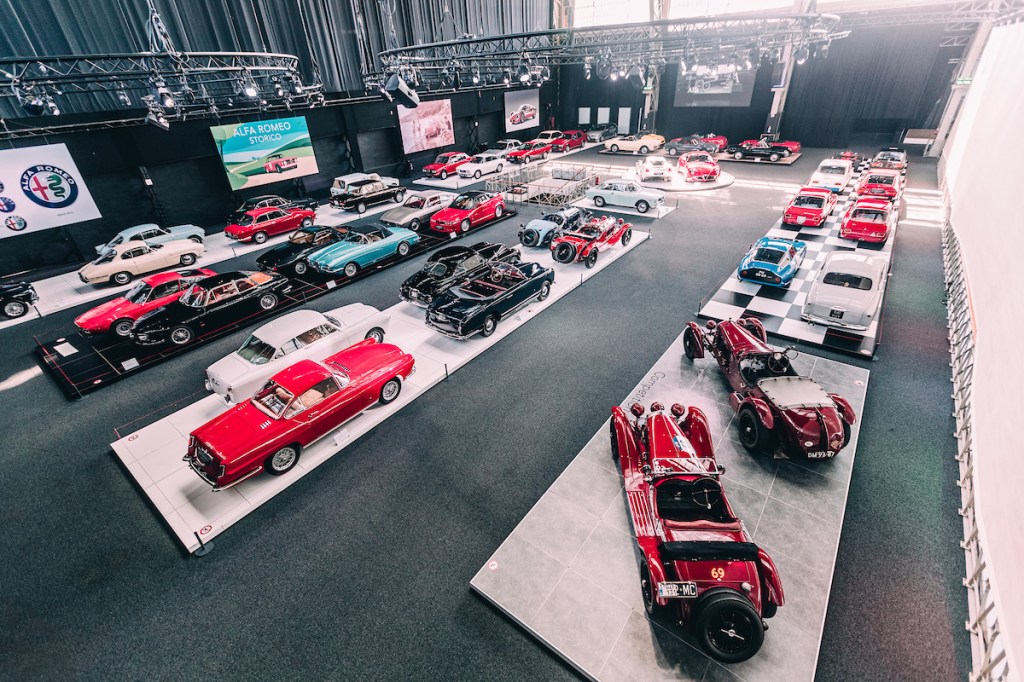
On the first day of July – for many of us the start of the summer holidays – the mythical Milanese brand Alfa Romeo stands in the spotlight in the iconic Autoworld-Brussels museum, and this until the 28th of August.
So plenty of time for you to come to Brussels, and see the more than 50 of the most emblematic Alfa’s, celebrating the 112th anniversary of the brand.
This stunning show is the result of a close collaboration with the Club Quadrifoglio Belgio, the National Automobile Museum of Mulhouse, private collectors, the Italian collector of prototypes Corrado Lopresto and Stellantis Belux (Alfa Romeo).
There is more for you to see, as this exhibition will start on Sunday 3 July with a event organized by the Alfa Romeo Quadrifoglio Belgio Club: a beautiful ride starting in front of the Royal Palace of Brussels and ending on the Esplanade du Cinquantenaire, in front of the Autoworld Museum, where a Concours d’Elegance will be held with nearly 150 cars.
On the first floor of the Autoworld museum are more than 50 historical Alfa’s: pre-war, commercialized, competition and special cars. These include a Giulietta Sprint and a Spider, the 2600 Sprint & 2000 Spider, a Montreal, a Giulia Sprint GT Veloce, a Spider Coda Tronca, a GT 1600 Zagato, a Giulia GT 1300 Scalino, a GT 1300 Junior, a 2000 GTV, an Alfasud, an Alfasud TI and an Alfasud Sprint, a Giulietta Turbodelta, an Alfa 90, an Alfa 75 2.5 QV, an Alfa 6, and many others…
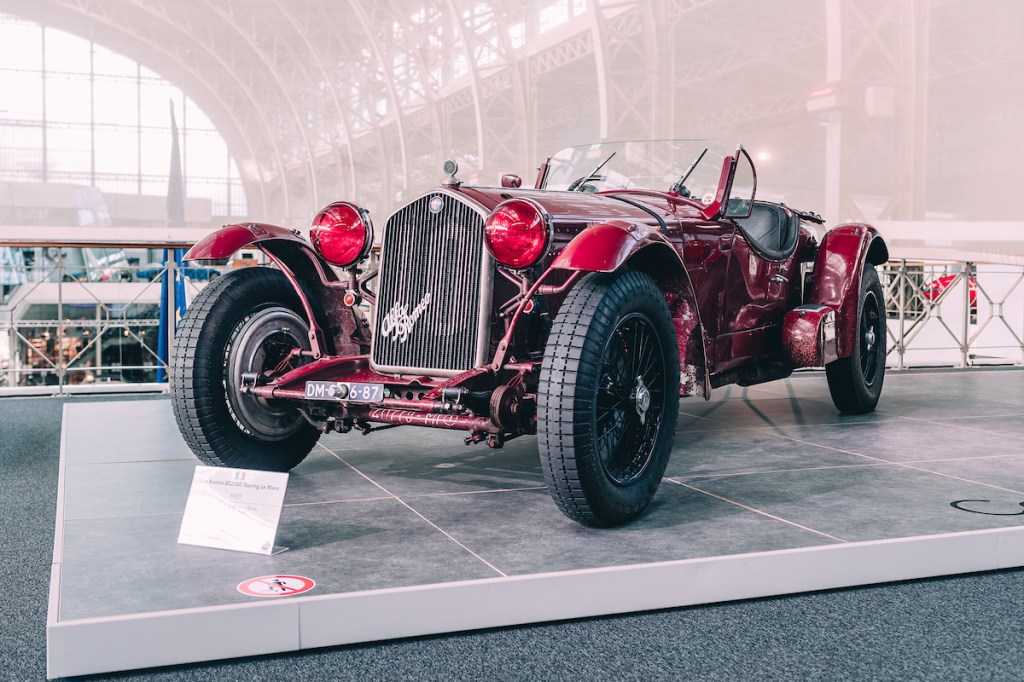
The Musée Nationale de l’Automobile de Mulhouse owns a beautiful 1936 Alfa Romeo 8C Pininfarina, which is said to have won the Mille Miglia that same year. In addition, part of the exhibition will be devoted to five exceptional prototypes from Corrado Lopresto’s magnificent collection.
The Lopresto collection is one of the most important collections of Italian prototypes in the world from 1901 until today. Many of the cars are unique, custom built with special features (rare copies, special series, number 1 chassis, cars with famous owners). Most of these cars have collected awards at Villa d’Este and Pebble Beach. Showcases with scale models show the same cars in subtle dioramas.
One of the absolute highlights of the exhibition is of course the new Alfa Romeo Tonale, the first electrified compact SUV in its history. In addition to the new Alfa Romeo Tonale, the dynamic Giulia and the Stelvio, the brand’s sporty SUV, will of course also be on display.
We would say, you have the whole summer to see this unique collection on display, and who wouldn’t visit the capital of Europe in the meantime, where there is so much to see, and excellent Belgian haute cuisine to enjoy?
Until soon, and I all wish you a fantastic (automotive) holiday. Your servant will be travelling to France at the wheel of his personal Audi A5 Cabrio… soon more about my trip!
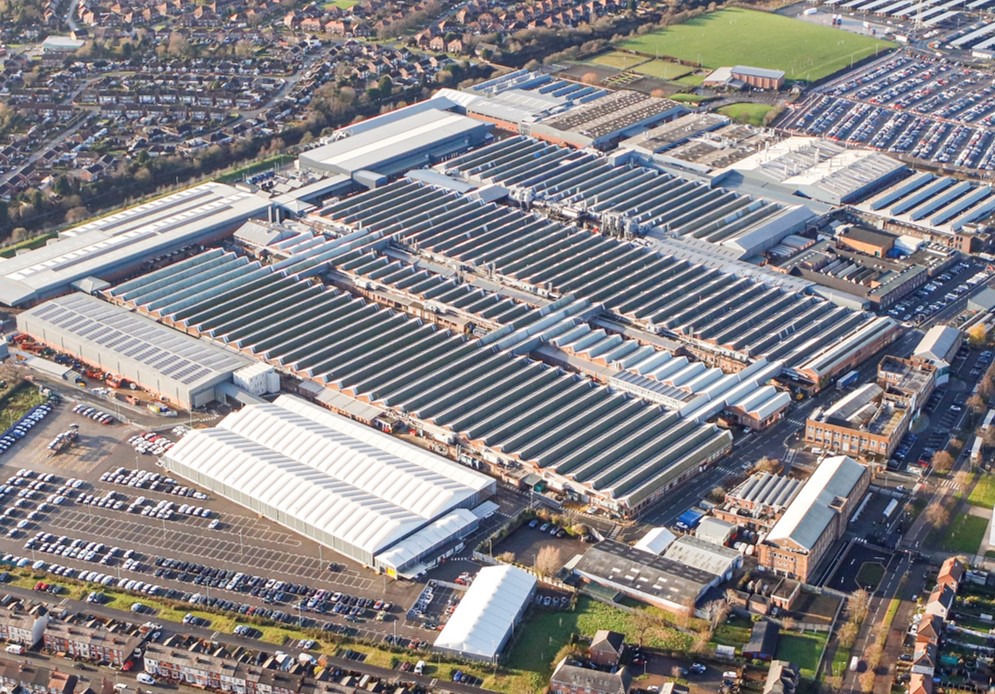
The Bentayga Hybrid, destined for a Chinese customer, met the oldest surviving Bentley, EXP 2, and a number of long serving colleagues, as it rolled off the production line at the home of Bentley in Crewe this week.
Things have taken off for the inconic brand over the last 18 years. Thanks to the success of the Continental GT and more recently the Bentayga SUV, daily production has soared. Indeed, over that period, over 75 per cent of 101 years of production has been hand-built at the Crewe factory, more than ever the home of Bentley. Current daily production, 85 cars per day, equals monthly production numbers of two decades ago.
The Bentley Continentals – then and now…
I vividly recall the interview I made at the Frankfurt Motor Show more than a decade ago with Franz-Josef Paefgen, then CEO of Bentley Motors and Bugatti Automobiles, posts he left in 2011.
During his time as the Chief Executive Officer of Bentley Motors Ltd., he was responsible for the Bentley Mulsanne and the Bentley Continental series of cars. From 2003 to 2005, Dr. Paefgen was responsible for the development of the Bugatti Veyron.
Every Bentley is actually a four wheeled chapter in automotive history…
I asked him then whether a hybrid Bentley was not on the cards, as Bentley’s could be considered the pinnacle of engineering and an electrified Bentley would be proper. It clearly was not in the strategy of the VW Group then, as the idea was immediately brushed aside by Mr. Paefgen as unrealistic, customers not wanting this at all…
Well times have changed quite a bit since then, as we now read that Company aims to be end-to-end carbon neutral by 2030 with entire model range switched to battery electric vehicles(!). Bentley will move to full electrification – PHEV or BEV only – by 2026, then switch the entire model range to battery electric vehicles by 2030. The industry-leading Beyond100 Strategy will transform every aspect of the business as Bentley accelerates into its second century of luxury car production.
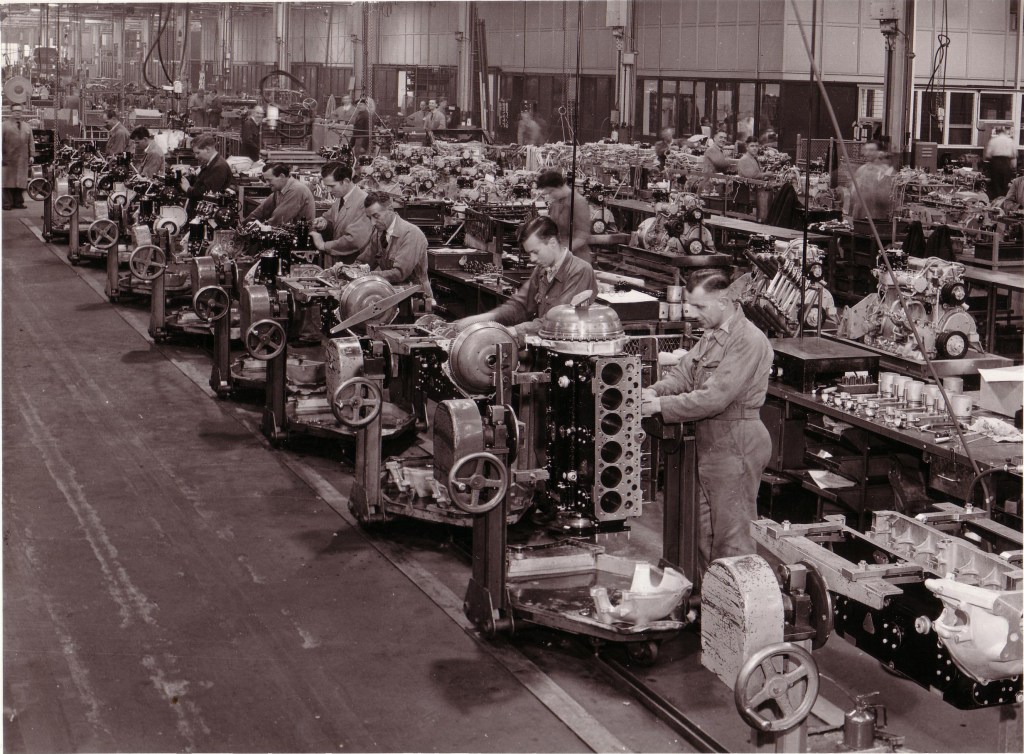
Six cylinder Bentley engine production in the ’50s in Crewe…
What this means for the retail value and depreciation of the existing and historic Bentley’s remains to be seen…
But back to the production history.
The Continental GT was the first landmark…
In 2003 the introduction of the Continental GT represented a transformative moment for the brand, and this Bentley alone, has represented 80,000 sales of the total of 200,000, and created both a new segment, and a contemporary image foundation for the Bentley business.
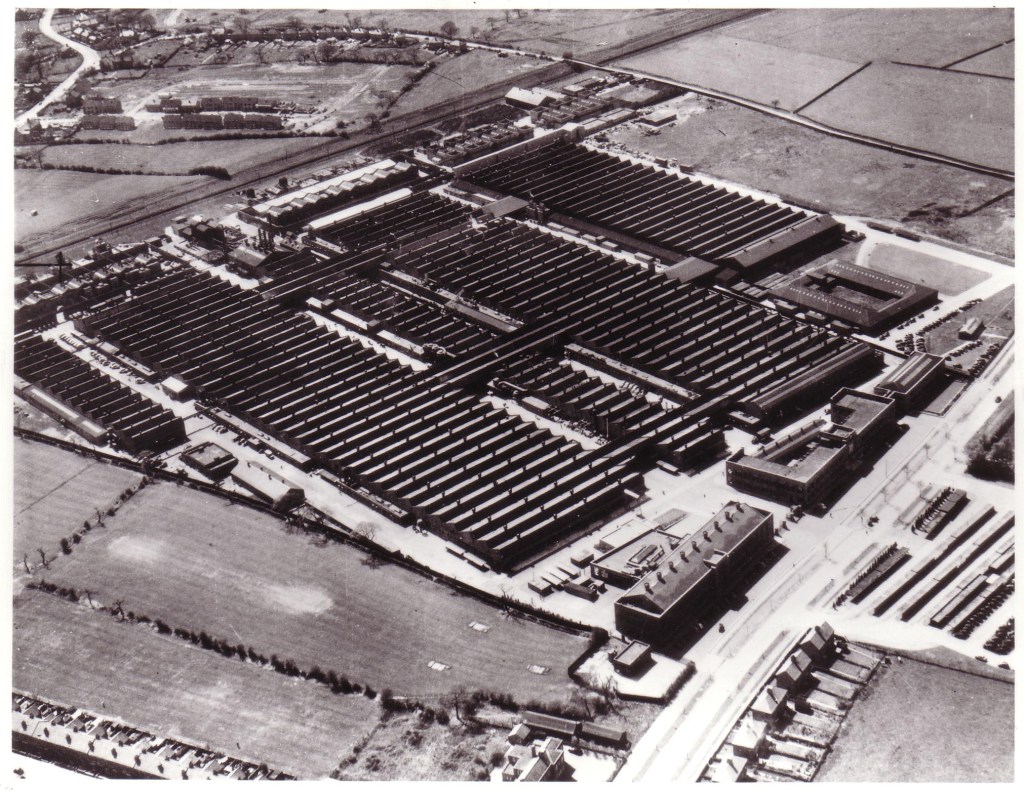
The Crewe factory in 1940…
…followed by the Bentayga
The success of the Continental GT has been mirrored by the Bentayga, offering a true Bentley driving experience and unparalleled luxury. Launched in 2015, when it established the luxury SUV sector, the fastest SUV in the world has reached its 25,000 production landmark. It is expected that the Bentayga could surpass total sales of the Continental GT within a decade and become the biggest selling Bentley model in history.
And now in 2021…
Since 2005, the company has also built 40,000 examples of the Flying Spur, the most successful luxury sports saloon in the world.
We show you here some photos, lifting a veil of the very interesting and multifaceted production history of the brand, and then we have told nothing of their sporting achievements…
International Women’s Day is an ideal occasion, Alfa Romeo found, to put its female racing champions behind an Alfa sportscar wheel into the spotlight. The material they put forward is so abundant and interesting, that we make (at least) a two-part series of it.
We start here with the early, very elegant protagonists, who combined female elegance with panache and excellent racing qualities…
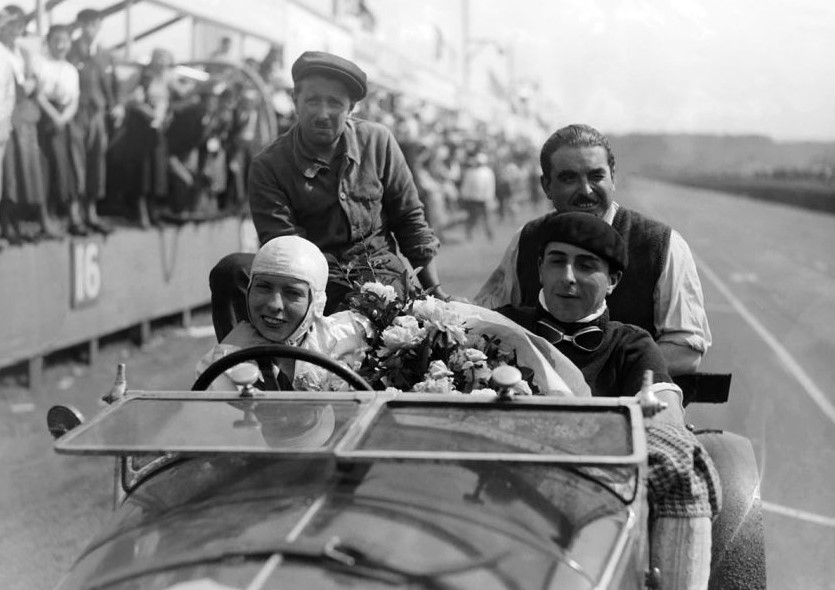
We start here with Odette Siko, you see her elegantly here in the photo above.
She takes you back to the 1930s, where Alfa Romeo asserted itself as one of the main protagonists in motorsport. This was partly down to extraordinary vehicles, but also to drivers who became part of the legend: these were the years of Nuvolari, Varzi, Caracciola and Sommer. The latter won the 24 Hours of Le Mans in 1932 behind the wheel of an Alfa Romeo 8C 2300, but the Alfa Romeo 6C 1750 SS driven by the striking Odette Siko finished fourth overall and won the 2.0-liter category! A young Parisian, Siko quickly became one of the stars on the track, displaying her elegance both in the paddock and in her racing performance, often accompanied by another female French racer whose path also crossed Alfa Romeo’s several times: Hellé Nice.
Hellé Nice, see the photo here, was a model, acrobat, and dancer. Her real name was Mariette Hélène Delangle, but was more commonly known as Hellé Nice. Renowned for her outgoing personality, Nice was good friends with the Rothschilds and the Bugattis. She raced in Europe and America and became one of the first drivers to display the logos of her sponsors on the bodywork of a single-seater racing car.
She took part in the 1933 Italian Grand Prix at Monza in her own 8C 2300 Monza; in the same race, Campari, Borzacchini and Czaikowski tragically lost their lives. In 1936, she won the Ladies Cup in Monte Carlo and took part the São Paulo Grand Prix in Brazil, where she fell victim to a dreadful accident, then miraculously came out of her three-day coma.
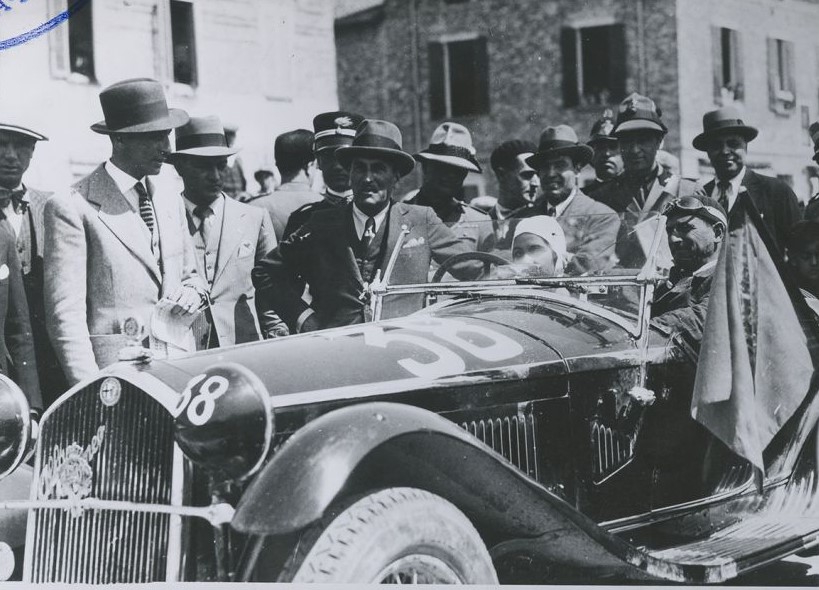
Further on, there was Anna Maria Peduzzi. In her time, the years of Scuderia Ferrari marked a crucial chapter in Alfa Romeo’s history. The drivers of the “Prancing Horse” included Como-born Anna Maria Peduzzi, the wife of driver Franco Comotti, who was nicknamed the “Moroccan”.
After her debut aboard her own Alfa Romeo 6C 1500 Super Sport, which she had purchased from Ferrari himself, Peduzzi almost always raced alone and only occasionally with her husband. In 1934, she won the 1500 Class at the Mille Miglia and, in the post-war period, raced in the Alfa Romeo 1900 Sprint and the Alfa Romeo Giulietta.
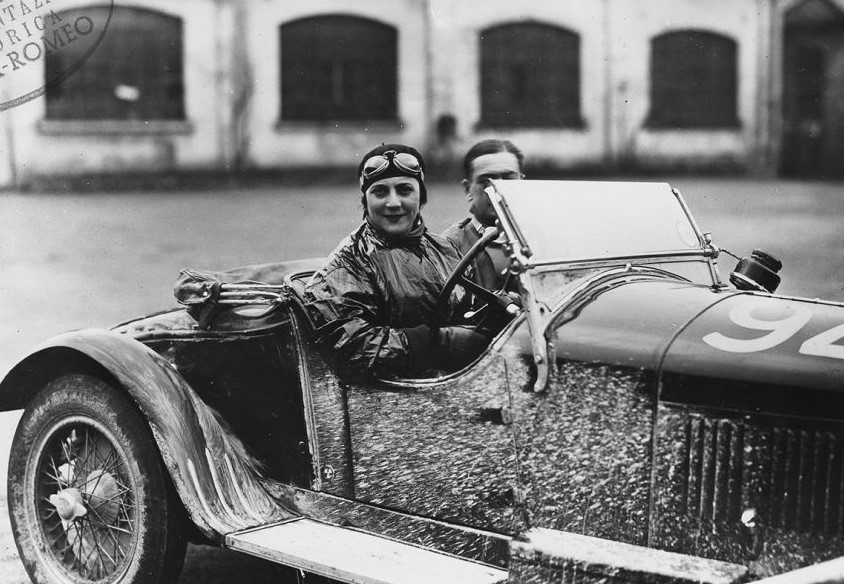
We conclude our first part here with Maria Antonietta d’Avanzo.
The forerunner of female Alfa Romeo drivers, Baroness Maria Antonietta d’Avanzo made her debut in the interwar years. A pioneer of Italian motorsport, aviator and journalist, d’Avanzo won third place in the Alfa Romeo G1 at Brescia in 1921, and proved her worth in many competitions as a formidable opponent for the best drivers of the time, including a young Enzo Ferrari.
Baroness d’Avanzo in her Alfa 20-30 ES
Baroness d’Avanzo raced until the 1940s in a variety of vehicles and races, traveling all over the world to do so…
In the next part we will tell you more about our national champion Christine Beckers and her more contemporary colleagues… Stay tuned!























 Autoprova - for the Connaisseur