The Formula E racing is taking increasingly centre stage in motor sport, and we will also report more regularly about it.
Here is already some Porsche news. The race-bred brand took some Formula E tests from 29 November to 2 December in Spain…
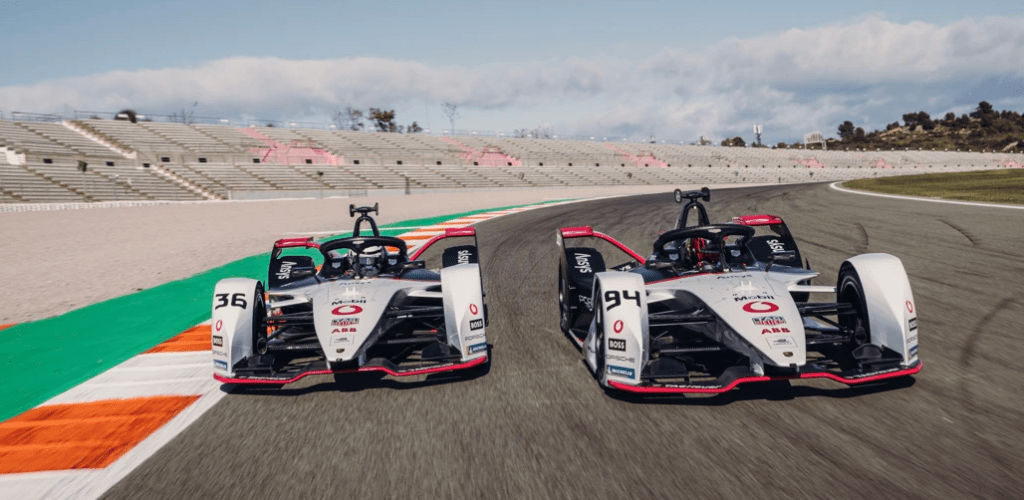
The TAG Heuer Porsche Formula E Team seems well prepared to tackle its third season of the ABB FIA Formula E World Championship. At the official test drives in Valencia, the squad from Weissach received its final polish. With the Porsche 99X Electric, André Lotterer (GER) and Pascal Wehrlein (GER) covered a total of 1.321 kilometres. Season 8 of the ABB FIA Formula E World Championship begins on 28/29 January 2022 with two races in Diriyah, Saudi Arabia.
All eleven teams with their regular drivers took part in the test days. The TAG Heuer Porsche Formula E Team used the five test sessions on the 3.376-kilometre circuit as a final shakedown for the Porsche 99X Electric. Engineers at Weissach updated the software in Porsche’s first electric racing car, while the powertrain remains the same. Due to the pandemic, the FIA decided that, for financial reasons, only one drive system can be homologated for seasons 7 and 8.
At the last test before the season kicks off in Diriyah, André Lotterer clocked up a total of 610 test kilometres in the No. 36 Porsche 99X Electric. His teammate Pascal Wehrlein covered 711 kilometres at the wheel of his car sporting the new No. 94 starting number.
One of the key points in the extensive test programme was to simulate the new qualifying format for season 8. From now on, the 22 drivers will initially head out onto the track in two groups. They have 220 kW of power available and can turn any number of laps in twelve minutes. The four fastest in each group move into the quarter-finals, with the others allocated the grid spots 9 to 22. From the quarter-finals, drivers pit themselves against each other two at a time in a duel-stage knockout. The winner of Group 1 competes against the fourth in Group 2; the second in Group 1 competes against the third in Group 2, and so on. In the semi-finals and the finals, the drivers have 250 kW at their disposal. The winner of the final session starts from pole position and, as in the past, earns three championship points.
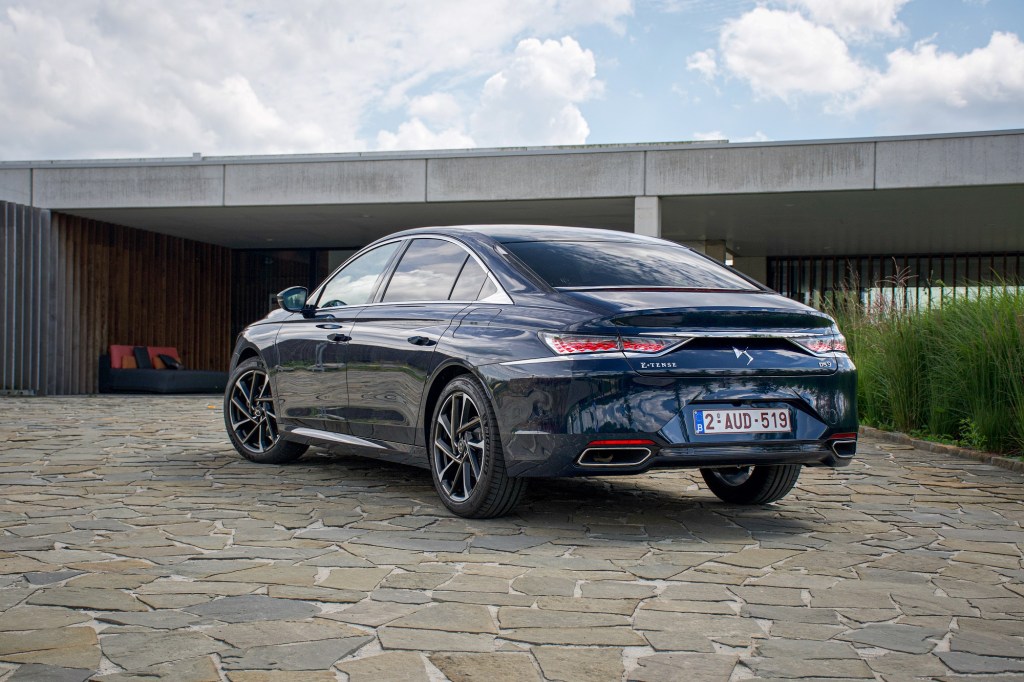
Continuing its electrification strategy which was already established when the brand was founded in 2014, DS Automobiles is continuing its energy transition with the launch of a new plug-in hybrid package for the flagship DS 9. We will drive the new DS9 for you mid January, and we are certainly looking forward to it!
The DS 9 E-TENSE 250 features a 200 hp 4-cylinder PureTech engine, accompanied by an 80 kW (110 hp) electric motor. A new 15.6 kWh (total capacity) battery, with an unchanged number of cells, delivers up to 70 kilometers on the WLTP city cycle (EAER City) or 61 kilometers on the WLTP combined cycle with an unchanged vehicle weight. The 7.4 kW on-board charger allows charging from 0-100% in merely 2 hours and 23 minutes.
CO2 emissions drop to merely 26 g/km, with a certified fuel consumption of 1.1 litres/100 km according to the WLTP combined cycle.
Performance leaves nothing to be desired: top speed of the DS 9 E-TENSE 250 is electronically limited to 240 km/h, with the possibility of reaching 135 km/h on electric drive only.
The DS 9 E-TENSE 250 costs €55,990 (incl. VAT) in Belgium in its PERFORMANCE LINE + version and €59,990 (incl. VAT) in Belgium in its RIVOLI + version.
More on this stylish flagship DS9 here below. Just read further!
Hans Knol ten Bensel
Refinement for the eye and touch… in different equipment levels
As its top of the range model, the DS9 stands out, as you could expect, in sheer refinement.
The DS 9 PERFORMANCE LINE + has chrome front door badges with the DS PERFORMANCE LINE logo, DS WINGS and a chrome boot lid. The radiator grille in brilliant black is topped off by the DS PERFORMANCE LINE emblem. The 19″ aluminum MONACO Black wheels are enhanced up by a Carmine wheel core.
In the interior, one finds mixed Alcantara®/black leather seats with Carmine and gold stitching complementing the Alcantara® center console and dashboard.
On the dashboard, your eyes rest on a DS PERFORMANCE LINE badge executed in turned aluminum.
A crystal insert on the control panel below the central screen adds a further touch of sophistication. The multifunction steering wheel is crafted in perforated full-grain leather with a leather-wrapped airbag cushion and handmade Carmine and Gold stitching.
The DS 9 RIVOLI + is inspired by the Tuileries district and combines noble materials with high-quality diamond-shaped decorations. Three different interiors are offered: Basalt Black in grained leather or OPERA with a choice of two shades of Nappa leather, highlighted by Ruby Red or Black strap-on seats.
The elegance of the OPERA version is illustrated by the use of nappa leather on the seats, rear seat, center console, door panels and upholstered instrument panel.
A high-quality rear center armrest and adjustable Lounge headrests complete the comfort package for the rear seats.
The nobility of materials sooths your senses with an all-leather steering wheel, smooth leather-covered gear knob, leather-wrapped grab handles, aluminum accents on the pedals and center console, Alcantara® headliner, sun visor and parcel shelf, and haute-couture-inspired mother-of-pearl stitching.
Building on the research carried out since the brand’s inception, acoustic insulation is also further enhanced.
Acoustic and laminated glazing is combined with a state of the art welded body which dampens vibrations. You can also enjoy the sound of a 515 W FOCAL Electra® Hi-Fi system, developed especially for the DS 9, with stainless steel tweeter grilles beneath the fourteen speakers, ideally placed throughout the cabin for an auditorium-like audio experience.
Behind the wheel, you are safely assisted by the latest tech…
The DS 9 benefits from the advanced technologies that make the other models in the DS range so outstanding. With DS ACTIVE SCAN SUSPENSION, a camera at the top of the windshield scans the road, while four position sensors and three accelerometers record all movements and transmit the information to a computer that can react to each wheel individually to improve safety, comfort and ease of use.
With DS DRIVE ASSIST, the DS 9 allows its driver to enjoy a level 2 semi-autonomous driving behavior.
The speed is controlled according to the environment in which the DS 9 is driven. The system uses sensors to precisely position the car in its lane of the driver’s choice by acting on the steering. DS DRIVE ASSIST can be used at speeds of up to 180 km/h and controls speed and trajectory under the driver’s supervision to ensure comfort and peace of mind.
The speed is controlled by an adaptive controller, which makes it possible to manage the driving conditions in traffic jams: the car restarts automatically after a stop of less than three seconds. If the car is stationary for a longer period of time, the DS 9 is restarted in traffic with a simple push of a button or a touch on the accelerator pedal.
DS DRIVE ASSIST’s on-board camera detects solid and broken lines. While driving, it constantly analyzes the image and deciphers situations. It keeps the vehicle in its lane, or even in the part of the lane desired by the driver. If the driver prefers to regain control of the steering, he or she cancels the correction by holding the steering wheel firmly. The change is also interrupted when the direction indicators are activated. The system can be activated from 30 km/h.
When parking, the DS PARK PILOT function detects parking spaces when driving at a speed of up to 30 km/h. The driver then indicates on the touchscreen that he or she wants to park in a stroke or a slot. Then there’s only one thing to do: press the Park button and wait for the technology to work. Acceleration, braking and steering are controlled automatically. DS PARK PILOT also makes it possible to leave a parking space.
On long journeys, DS SAFETY combines a series of key functions: DS NIGHT VISION, DS DRIVER ATTENTION MONITORING, DS ACTIVE LED VISION, blind spot monitoring, automatic emergency braking, comprehensive traffic sign recognition and active lane departure warning.
DS NIGHT VISION offers an exceptional view of the road at night. The infrared camera, located in the radiator grille, detects pedestrians, cyclists and animals on the road up to 150 meters away. The driver sees the scene of the accident on the large digital handset, with hazards displayed in yellow and then red depending on the degree of hazard. He can then respond.
DS DRIVER ATTENTION MONITORING uses an infrared camera on the top of the steering column and a camera on the top of the windshield to continuously monitor the driver’s eyes for fatigue (blinking), face (direction of gaze) and head movement for distractions, as well as the trajectory of the driver. car on the road, especially driver anomalies or steering inputs. For example, it can identify any drop in vigilance due to an anomaly in any of the factors – blinking, non-linear and erratic movements – and automatically trigger an audible and visual alarm on the central screen, day and night.
In addition to the visual pleasure provided by the modules that light up and rotate 180° at the counter, the DS ACTIVE LED VISION can be adapted in width and reach to the driving conditions and the speed of the car. Different lighting modes are automatically activated: Parking, Town Beam (increased beam from the third second of driving), Country Beam (focused on the front from 50 km/h), Motorway Beam (increased range from 110 km/h), Adverse Weather (activated when the windscreen wipers are on, increased module power and reduced high beam intensity) and High Beam (maximum illumination combined with automatic high beam switching). The “revolving headlamps” function completes the offer. By illuminating the road better and further, or with a wider beam of light, the driver – and the passengers – gain in safety.
Needless to say that we are looking forward to sample driving impressions of this new version of this refined “grande routière”, and as said, we can tell you already that we will drive the new DS9 for you mid January, so stay tuned on these columns!
We will unveil also soon some more Citroën news, a bigger range for the ë-C4 and Citroën informs its B2C and B2B clients to make still better use if their plug-in hybrid C5 aircross…
At the end of January next year, we will test for you, dear reader, the Renault Arkana E-TECH Hybrid, and this will prove highly interesting indeed. But Renault has further stunning news in store, which your servant reserves for you in these columns.
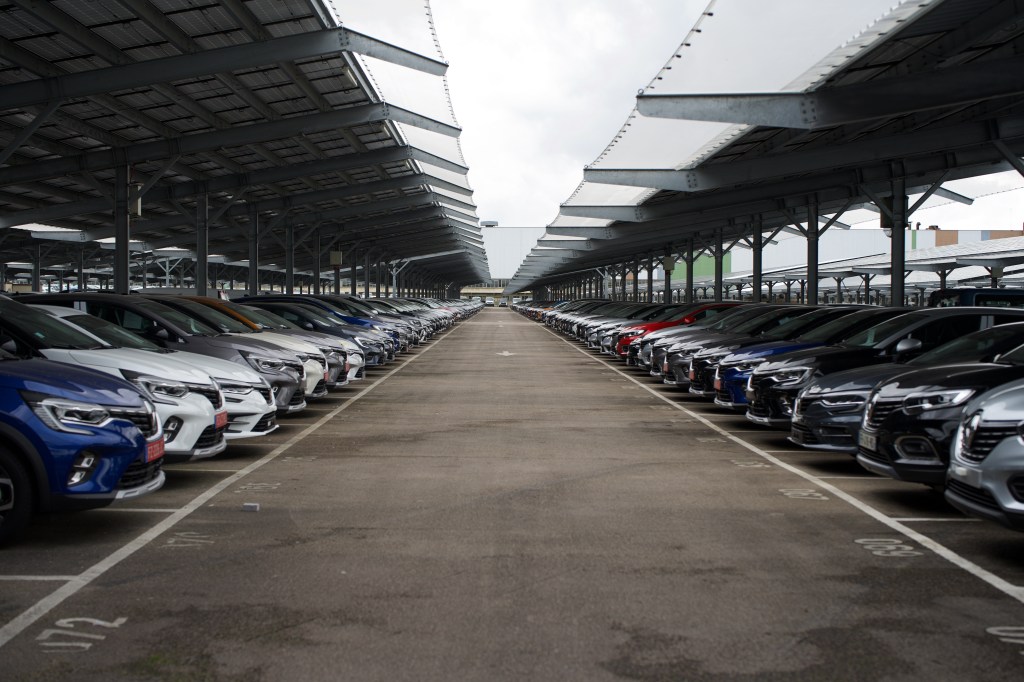
Renault Group presented namely the actual progress of its Refactory project, an initiative launched a year ago to transform the Flins site (Yvelines, France) into the first European factory dedicated to the circular economy of mobility. Circular here means re-using second hand vehicles…no less!
On this occasion, the group is inaugurating its Factory VO (Used Vehicles), the first factory specializing in the reconditioning of used vehicles on an industrial scale. This conversion is part of the group’s overall transformation plan, focused on value creation and sustainable development. Just so interesting!
Read more about it here…
Hans Knol ten Bensel
A wonderful initiative…
Your servant can only applaud this bold initiative, which in my opinion is visionary to say the least. We just cite here Luca de Meo, CEO of Renault Group, on this project.
“We are keeping our promise: one year after its launch, the Refactory embodies an innovative and ambitious project for the Flins site, a new source of economic, social and environmental value. The Refactory is emblematic of the Renaulution, which engages the group in a deep, rapid and lasting transformation, driven by the creation of value. At the heart of this project, our 1st used vehicle factory demonstrates our ability to industrialize our know-how and activities linked to the circular economy. This Factory OV (or used vehicle factory) puts us in an excellent position on the growing used vehicle market, with a unique industrial tool capable of reconditioning up to 45,000 vehicles per year ”.
4 poles…
According to Renault, the Refactory is based on an ecosystem articulated around 4 poles:
RE-TROFIT: this division brings together the retrofit and reconditioning activities of used vehicles. Operational since September 2021, the Factory VO has already reconditioned more than 1,500 vehicles. In the next two years, it is planned to increase its capacities and introduce new activities, such as important body repair. A retrofit offer to convert commercial vehicles to electric will also be studied by 2023.
RE-ENERGY: this pole contributes to the development of applications around the second life of batteries and new energies. With the rise of electric mobility, Gaia, a subsidiary of the group specializing in battery repair, is preparing to change its scale of activities: by the end of 2021, 2,000 battery repairs will be carried out and this will grow to more than 20,000 repairs per year by 2030. In coordination with Mobilize, the Flins site hosted in 2021 a stationary energy storage device from batteries, with a capacity of 15 MWh (“Advanced Battery Storage” project). The development of mobile or stationary energy storage systems for multiple uses (construction sites, solar energy storage, on board ships, etc.) will represent a capacity of 30 MWh over the years 2021 and 2022. In the As part of the Hyvia joint venture dedicated to hydrogen mobility, the Flins site will also host, from 2022 onwards, the assembly activities of fuel cells, recharging stations and the supply of hydrogen.
RE-CYCLE: this division brings together recycling and re-use of parts and materials. The gradual arrival between 2021 and 2022 of the teams from the Choisy-le-Roi plant, experts in the remanufacturing of mechanical parts, will make it possible to maximize the use of reconditioned and spare parts within the Factory VO and the group. It is also planned to extend the strategic activity of repairing electronic boards (mechatronics) as part of this transfer of activity. The division is continuing to implement short loops for the recycling of materials and parts, such as catalytic converters or bumpers.
RE-START: this cluster encompasses the innovation and training center project. It brings together 3 entities: an innovation center at the service of Industry 4.0 to develop specifically prototyping, 3D printing, the retrofitting of our robots, a commercial vehicle prototyping activity, as well as a campus where professional training leading to diplomas are offered to employees of the Flins factory. At the start of 2022, this cluster will integrate an incubator dedicated to research and innovation in the circular economy, as well as new academic certifying training courses with the support of the region.
A state of the art factory, creating value…
To preserve product value and respond to the growth of the second hand vehicle market, the Flins used vehicle reconditioning plant is based on a unique model, designed to offer the best level of the market in terms of lead times, cost and quality.
The Factory VO is a 100% digitized site, which ensures excellent traceability and real-time monitoring of the repair stages. Developed to recondition all types of vehicles, of all brands, the site is mainly based on 4 major assets:
Economies of scale:
Spread over an area of 11,000 m2, the Factory VO in Flins is presently the largest reconditioning site in Europe. Organized into three teams, it can recondition 180 second-hand vehicles per day, or 45,000 vehicles per year by 2023, with the possibility of doubling this figure in the medium term.
Lower costs…
The site’s competitiveness is a result of the high productivity rate, driven by an online organization and optimized production systems for new vehicles. The Factory VO benefits from short delivery loops of parts and materials from group subsidiaries such as Gaia, Indra, and Choisy in order to limit the replacement of parts as much as possible, favouring repairs instead. Pooling logistic flows with those of new vehicles also cuts costs and reduces the impact on the environment.
Short repair and reconditioning times…
Equipped with 4 production lines, the Factory VO is organized in such a way that there is no going back. Carried out by SGS Automotive Services, technical inspection and control is integrated on the line in order to increase efficiency and reduce delays. The site is equipped with a photo and video studio installed on a turntable to generate automated shots (up to 10 vehicles per hour). This high-resolution scanner gives access to a virtual 360-degree inspection (interior, exterior, underbody and tires). Designed by specialist Twinner, this tool allows the vehicle to be offered again for sale immediately, without waiting for it to be returned to the dealership. On average, the Factory VO reconditions a vehicle in 8 days instead of 21 days.
“New vehicle” quality standards…
Reconditioned vehicles benefit from the same quality standards as the manufacture of new vehicles. An independent quality control device is integrated into the production, as well as a battery qualification system for electric vehicles. By 2022, 200 employees will have joined the Factory VO. These internal recruitments at the Flins plant are accompanied by a certified training program, made up of a general section (after-sales strategy, durability of materials, recycling, etc.) and more specific training geared to to the Factory VO (electromechanical, smart repair).
The Refactory project is, still according to Renault, at the heart of the Group’s sustainable development strategy. It is a global industrial project, which is intended to be deployed more widely, recently also at the factory in Seville, Spain.
All this has a very good reason: these activities contribute, at their scale, to the decarbonisation trajectory to aim for the group’s carbon neutrality in Europe in 2040.
A very interesting initiative, which we will follow closely in the future…
We have not been driving Peugeots and Opels for a (very) long time, and besides bringing you Peugeot and Opel news on a regular basis, we will in the future also test and collect driving impressions of their new models.
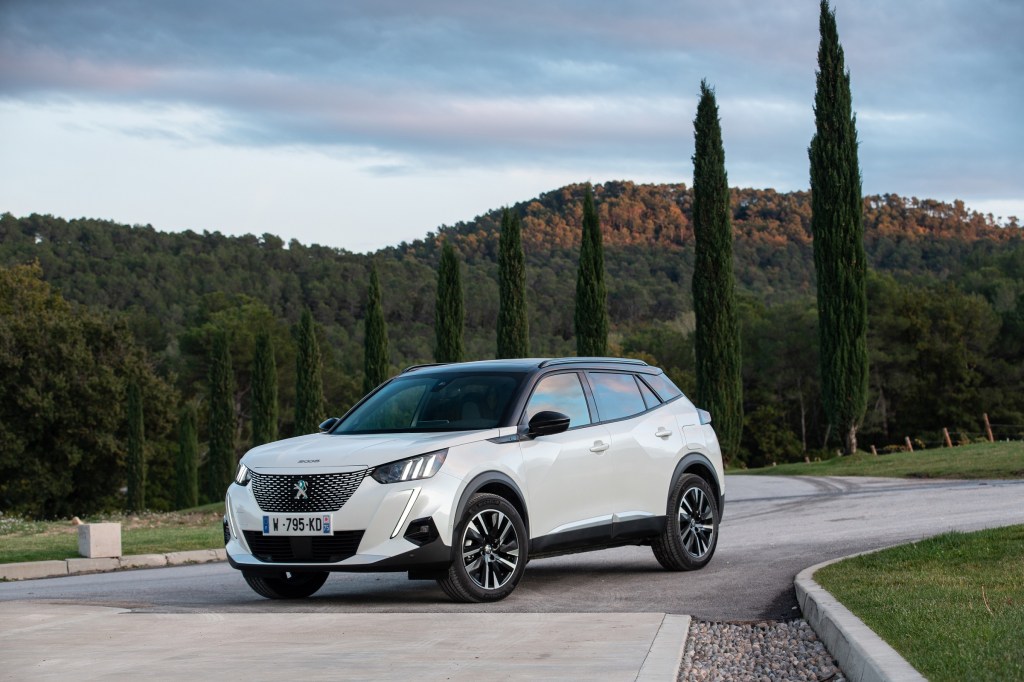
Now to the news: the latest technological developments from early 2022 on the 100% electric versions of the new PEUGEOT 208 and 2008 and Opels will deliver up to 25 km and 8% more range according to the WLTP cycle, and even more in practice.
Based on the eCMP (Common Modular Platform), equipped with a 50 kWh battery, a 100 kW (136 hp) electric motor and a torque of 260 Nm, these models will – like the DS 3 – also receive the latest technological developments to increase their autonomy.
Talking about the platform, did you know that this is a global subcompact platform jointly used and developed by Groupe PSA and state-owned Chinese automaker Dongfeng?
The DS3 also runs on it, as do the latest Citroën DS4 and the ë-DS4. But also the Opel Mokka and Mokka-e and last but not least the Corsa and the Corsa-e.
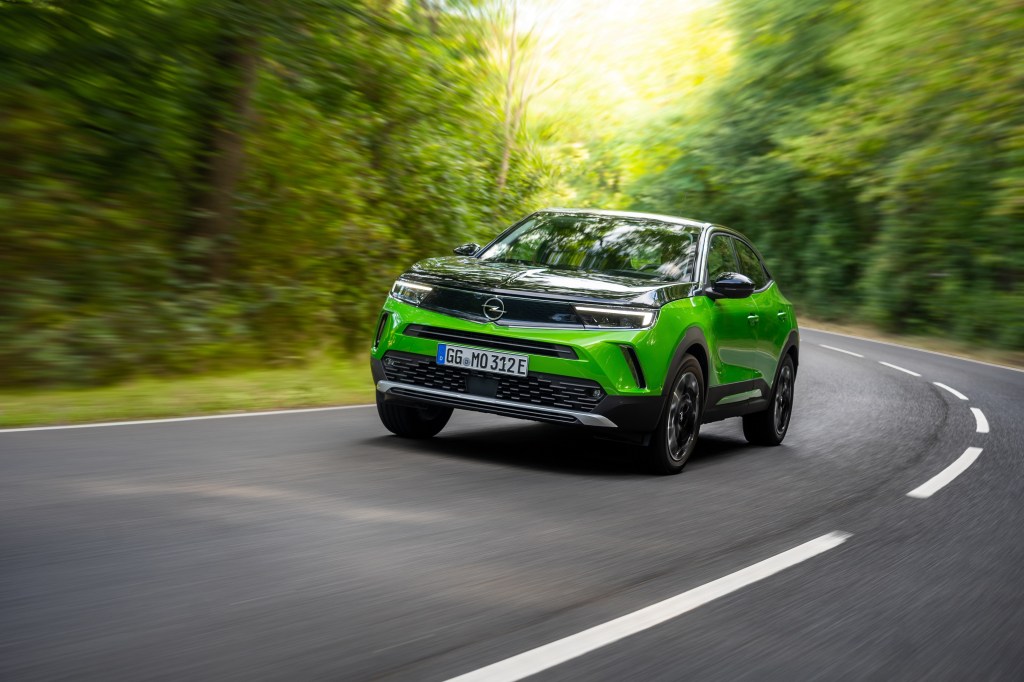
2020 Opel Mokka-e
The DS3 is built in Poissy, as are the Opel Mokka’s. As with the DS3, for the 208 and 2008, the tires have been optimized and now have a lower rolling resistance. This concerns amongst others the 16 inch wheels for the PEUGEOT e-208 and the 17 inch wheels for the PEUGEOT e-2008.
The Corsa-e is now good for 359 kilometers, the Mokka-e has an improved range of 338 kilometers.
In addition, the Peugeots and Opels have also the new gearbox ratio, which optimizes further the range on the road and on the highway.
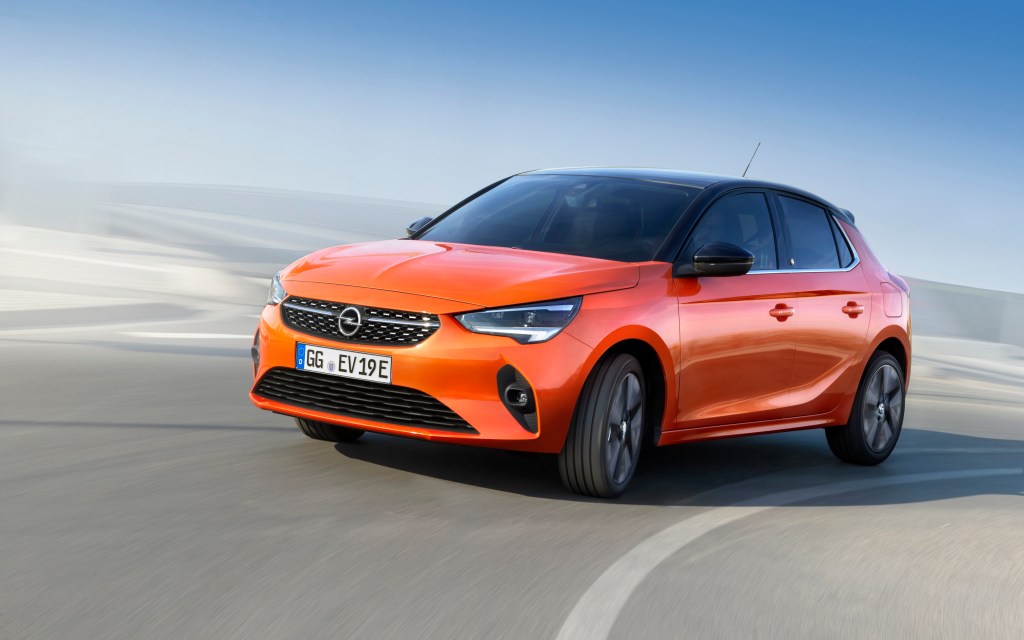
2019 Opel Corsa-e
Finally, they have, like the DS3, also received a new heat pump in combination with a humidity sensor at the top of the windscreen optimizes the energy efficiency of heating and air conditioning.
The improved sensor enables a more precise control the air circulation in the passenger compartment, so it costs less energy to heat up and maintain the temperature in the vehicle. This latest development is particularly noticeable at low outside temperatures.
We will be driving the coming month the stylish M4 Coupé, and we are looking forward to it. But in the meantime, we show you here some (very) interesting news from BMW, which is a harbinger of stylish things for the brand to come…
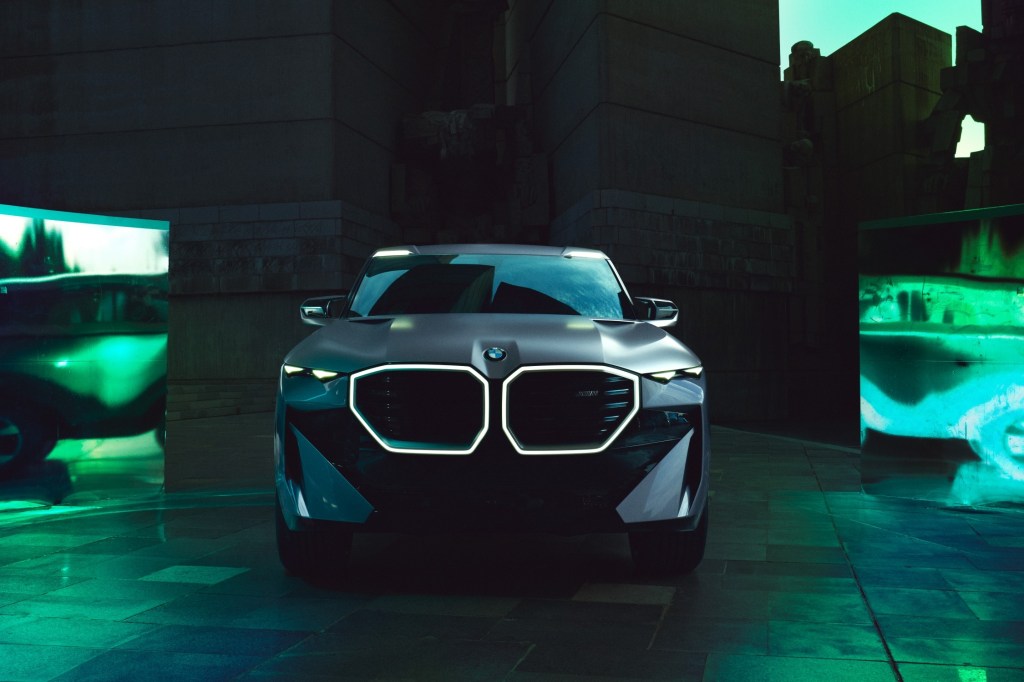
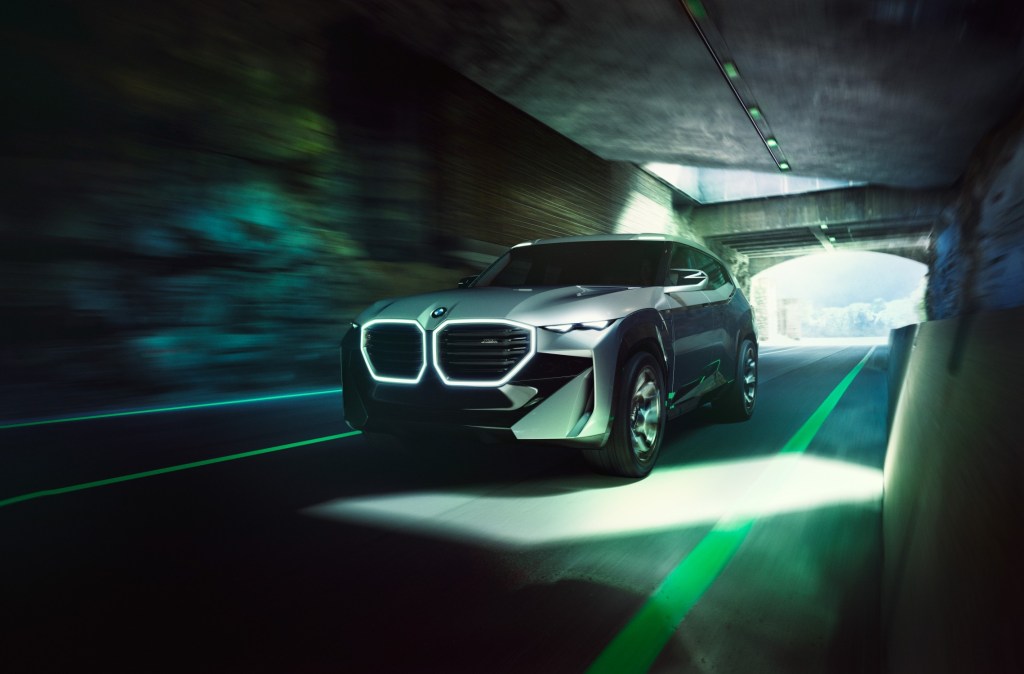
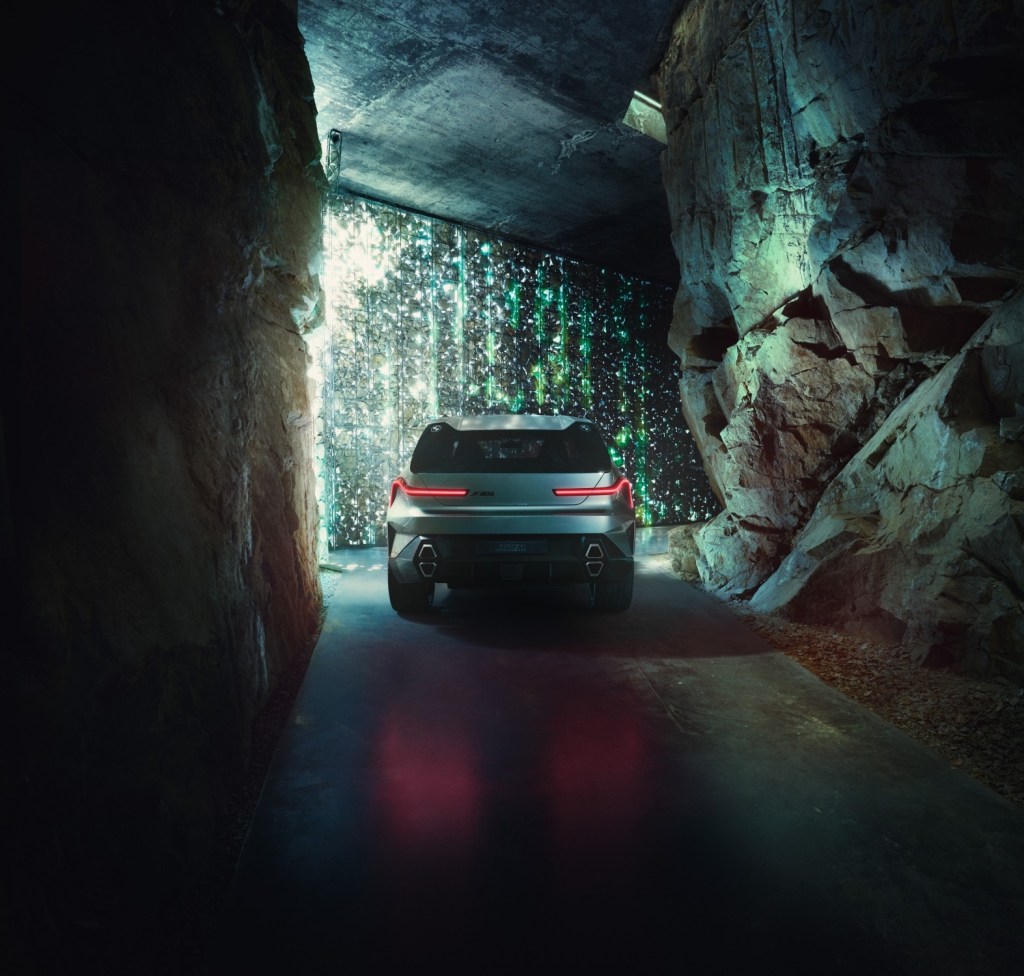
At Art Basel’s 2021 Miami Beach show, BMW M GmbH is presenting an expressive new vehicle concept on the global stage. The BMW Concept XM looks ahead to the most powerful BMW M car ever to go into series production, which is set to begin at the end of next year.
The BMW Concept XM provides a first glimpse of the new front-end design for BMW’s forthcoming luxury-class models. It will also introduce its audience to a highly progressive and distinctive take on BMW X model design and an all-new form of luxury and sense of space for the interior.
The series-production model – the BMW XM – will be built from the end of 2022 at BMW Group Plant Spartanburg in the USA, the most important sales market for the new high-performance car. BMW M will therefore be introducing its first standalone vehicle since the legendary BMW M1 in the year it celebrates its 50th anniversary. The BMW XM will be available in plug-in hybrid form only and exclusively as an M model.
The bold exterior styling of the Concept XM reflects the car’s exceptional performance attributes: dynamism, agility and precision, plus an all-electric range of up to 80 km. The newly developed M Hybrid drive system in the BMW Concept XM brings together a V8 engine and a high-performance electric motor to develop maximum output of 550 kW/750 hp and peak torque of 1,000 Nm (737 lb-ft). The first electrified vehicle from BMW M GmbH in the high-performance segment is therefore pointing the way for the future of the brand.
BMW M goes its own way in the luxury segment…
The BMW Concept XM sees BMW M GmbH forging a distinctive path in the luxury segment. The car’s exterior majors on presence and extrovert appeal. Inside the car, a special take on the driver-focused cockpit typical for the M models meets an all-new rear compartment design: high-comfort seats and an illuminated, sculptural headliner add panache.
“The design of the BMW Concept XM is an extravagant statement by BMW M in the heart of the luxury segment,” says Domagoj Dukec, Head of BMW Design. “It has a unique identity and embodies an expressive lifestyle like no other model in the BMW line-up.”
The front end: progressive design for maximum presence.
The BMW Concept XM debuts the new, progressive front-end design for BMW’s luxury-class models, a version of which will be seen for the first time in 2022 as part of the BMW model offensive in the luxury segment. The headlights have been split into two separate modules. The horizontal kidney grille sits between the headlights and tapers towards the outer edges, producing a near-octagonal outline that emphasises the front end’s character. The black kidney grille elements are enclosed within an intricate surround and appear almost to be floating freely within a High-gloss Black surface. The new XM logo in the kidney grille and the large air intakes hint at the power of the V8 engine, which teams up with the electric motor to form the M Hybrid system.
M-specific details point to compromise-free performance.
The glasshouse of the BMW Concept XM rises up vertically, accentuating the front end’s imposing feel. The colour of the roof contrasts with the black finish of the A-pillars. The windscreen seems to have an even heavier rake as a result, injecting modern dynamism into the front end. Slim LED searchlights have been incorporated into the roof above the A-pillars.
The powerful and heavily contoured proportions of the BMW Concept XM highlight the car’s identity and draw the eye to the coupé-like character of the body. The visually striking front end, long bonnet and stretched, sloping roofline present a characterful two-box design with a distinctive outline.
The two-tone paint finish of the BMW Concept XM further accentuates its lines: the upper section is in matt gold-bronze, while the lower section sports the Space Grey metallic shade. Below the window graphic, a broad, High-gloss Black line – the “black belt” – separates the two exterior colours. The charging flap rearwards of the front-left wheel is a reminder of the M Hybrid drive system at work.
The rear : bold stature
The design of the rear end likewise accentuates the car’s powerful stance, and the BMW Concept XM cuts a low and sporty figure from this angle. The BMW logo is laser-etched into the window below each of the two cant rails. This is a stylistic reference to the BMW M1, to date the only example of a standalone model developed exclusively by BMW M GmbH.
The interior design – high performance and extrovert luxury.
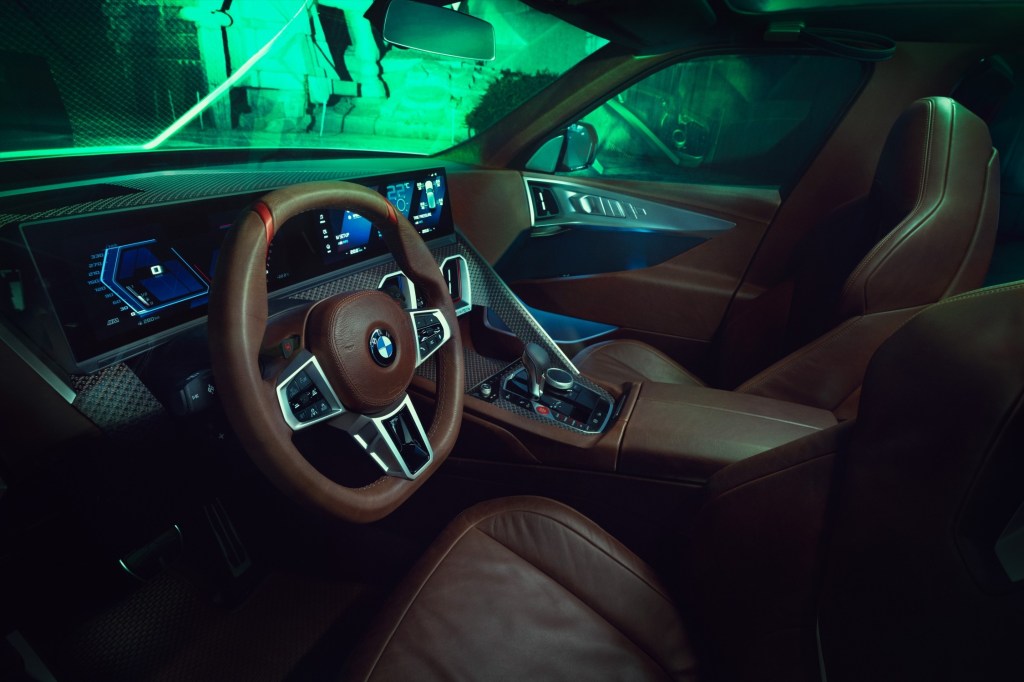
Inside the BMW Concept XM, the driver will find a distinctive M interpretation of driver-focused cockpit design. The lines and surface design of the instrument panel, centre console, door trim and seats give the ambience in the front compartment a progressive feel with their powerful geometry and high-quality materials. Brown, vintage-look leather, copper and carbon fibre create a bridge between luxury and motor sport. A bold trim element provides clear visual separation between the driver’s area and the other sections of the car.
The new BMW Curved Display screen grouping creates a neat balance between traditional driver focus and modern digitality. Red accents on the steering wheel and centre console are M-specific references to the car’s sporting DNA. A trio of vertical elements presented in the three colours of the BMW M brand logo form the heart of the centre console.
Spacious and luxurious: the M Lounge.
The unwavering driver focus of the front compartment contrasts with the extravagant and luxurious lounge-like ambience in the rear of the BMW Concept XM. Special materials, visually powerful surfaces and expressive details turn the rear seats into the unique M Lounge, black-tinted rear side windows underscoring the abiding sense of privacy here. While warm brown leather dominates the cockpit, the rear is decked out in the rich colour shade Petrol. The large rear seat bench with its deep seat recesses forms an inviting space to relax. Only the diamond-shaped area of the head restraints – which provides the supporting function familiar from BMW M Sport seats in other models – is leather-trimmed.
Illuminated and sculptural: the headliner .
The visual highlight of the cabin is its headliner with a three-dimensional prism structure. A combination of indirect and direct lighting produces a relief-like structure. The ambient lighting can be activated in the three BMW M colours.
BMW Curved Display with M-specific user interface.
Based on the latest generation of BMW iDrive, the M-specific version of the control/operation system translates the high-performance character of the BMW Concept XM into the digital world. Showcased in the familiar three M colours, it visualises the modes of the hybrid drive system as well as the pure-electric driving mode with captivating aesthetic appeal.
Early next year we will drive for you the DS4 and the DS9, and we are looking forward to have a taste of French refinement, elegance and panache.
But did you know that thanks to an electrification strategy pursued since its inception, DS Automobiles is the multi-energy brand with the lowest average CO2 emissions in Europe?
Indeed, it registered 100.2 grams CO2 per kilometer per vehicle in the first half of 2021 according to the WLTP cycle. Not surprisingly, as its production mix of electrified cars exceeds a third. This strategy is now only gaining momentum: from 2024, all new DS Automobiles models will be 100% electric only.
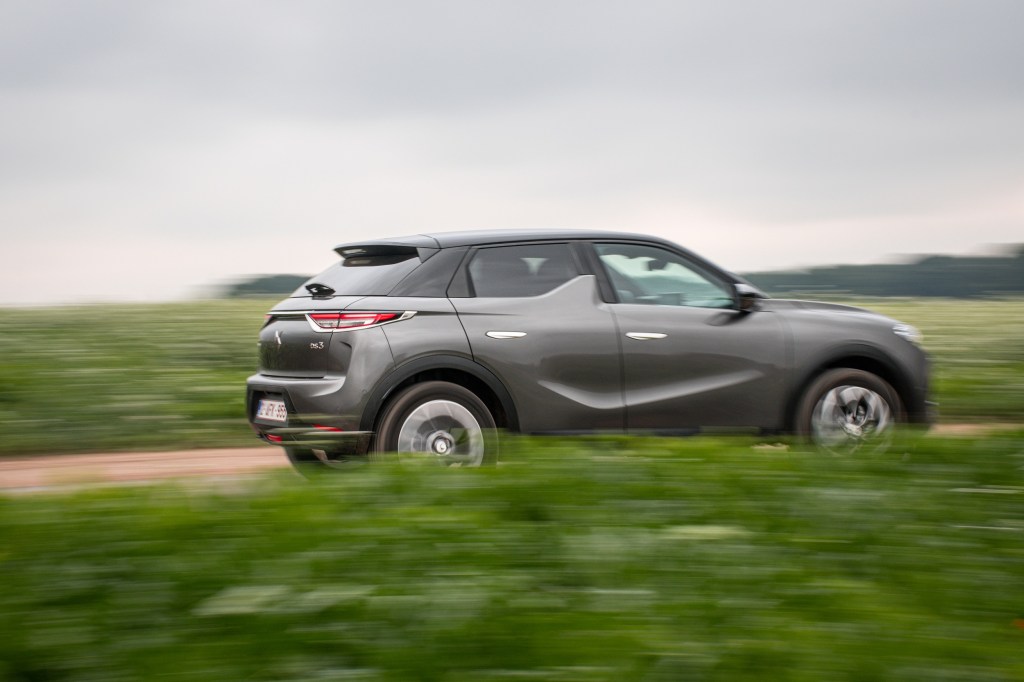
The first 100% electric model in the DS range is continuously under further development. The DS 3 CROSSBACK E-TENSE, on the market since 2019, now has a range of 340 kilometers according to the combined WLTP cycle, an increase of almost 7%.
During development, the focus has always lied on improving the practical use of the DS 3 CROSSBACK E-TENSE. In particular, the heat pump has been improved through the use of a humidity sensor to improve efficiency. The heat pump, supplied as standard, produces heat by compression to generate warm air. This significantly reduces the need for E-energy.
As a result of continuous development and ongoing discussions with the Formula E championship team, supported by DS Performance, the transmission ratio has also been optimized to improve the efficiency of the DS 3 CROSSBACK E-TENSE.
The hand stitched steering wheel upholstery stands out in an interior full of French panache…
Greater autonomy in real-world use is also achieved through the use of new 17″ class A tires developed by Continental. The Continental EcoContact 6 Q is available in 215/60 R17 96H and has a new high-tech silica compound to improve rolling resistance. improve and reduce noise emissions.
In Belgium, the DS 3 CROSSBACK E-TENSE is available from €38,400 (incl. VAT) with a 100 kW (DC) and 11 kW (AC) charger.
Audi has ambitious plans for further electrification: in 2025, it will have not less than 20 pure EV’s in its model range. Besides the big Audi e-tron Quattro and its Sportback version and the stunning e-tron GT, another pure EV joins the party: the compact SUV Q4, which is also available right away in a stylish Sportback version.
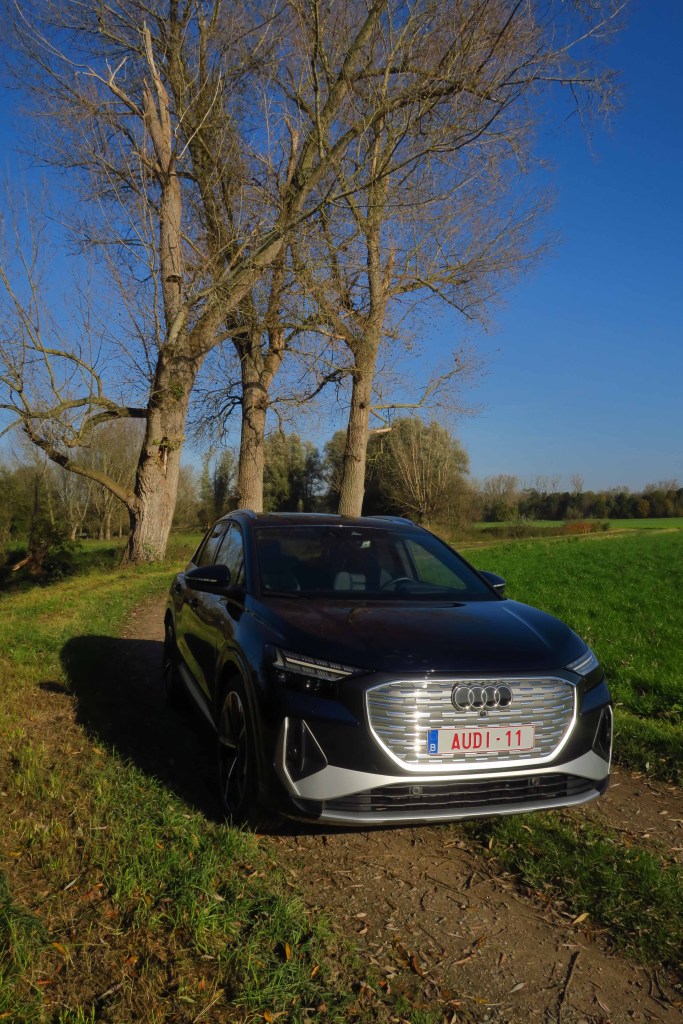
The Q4 comes in two battery and power versions. The base model is the Q4 35 with a 55 kWh battery. Its range is said to be 350 kilometers and it has a 125 kW/170 HP motor driving the rear wheels. We tested for you the Q4 40 which has the 77 kWh battery and the 150 kW/204 HP motor we also find in the VW ID.4.
The Q4 is built… in the VW factory in Zwickau, where also the ID.3 and ID.4 are rolling off the production lines. Only logical if one knows that the Q4 runs on the same MEB platform as the two Volkswagens.
So the Q4 is a dressed up VW? Not at all, the Audi engineers and designers have succeeded in giving the Q4 its unmistakable premium character and Audi identity.
Just read further…
Hans Knol ten Bensel
Stylish
The bodywork of the Q4 breathes the timeless Audi styling language, with very good proportions throughout. The front end grille betrays its “pure” EV character, as it is closed. Indeed, electric motors need a lot less cooling.
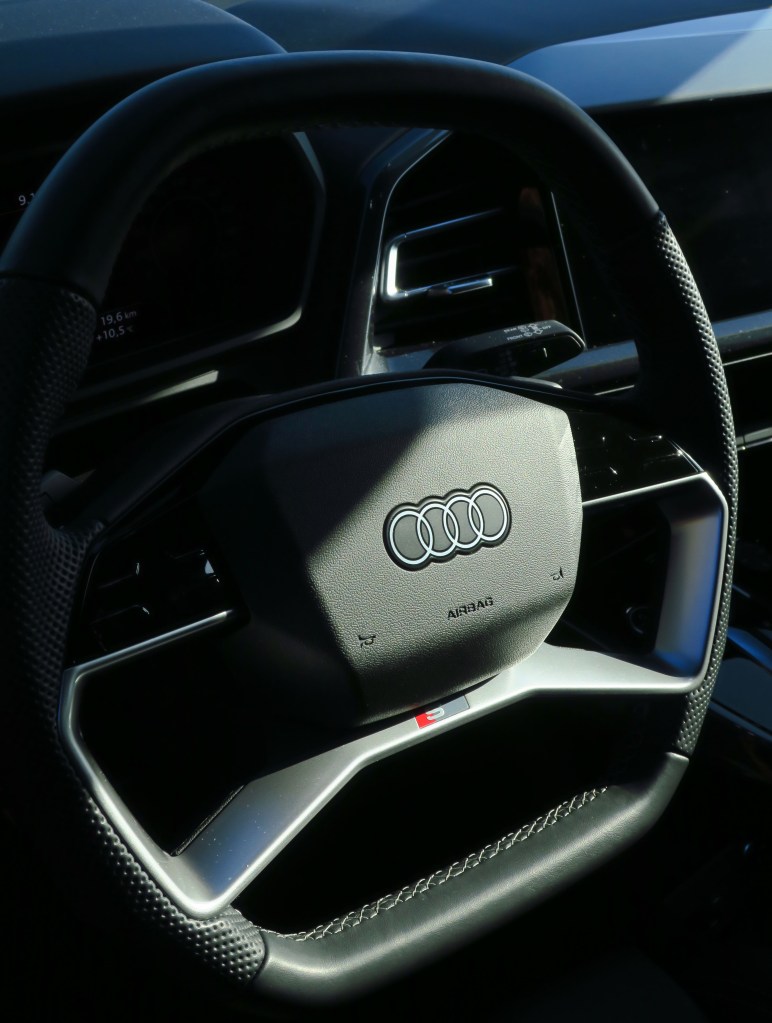
The dashboard and cabin breathe Audi panache: the instrumentation is directed towards the driver here, rather untypical for a SUV. Bravo for Audi, and they did also very well with the instrument layout: two large dials are seen in front of you, on the digital display which is almost equally as large as the central touchscreen.
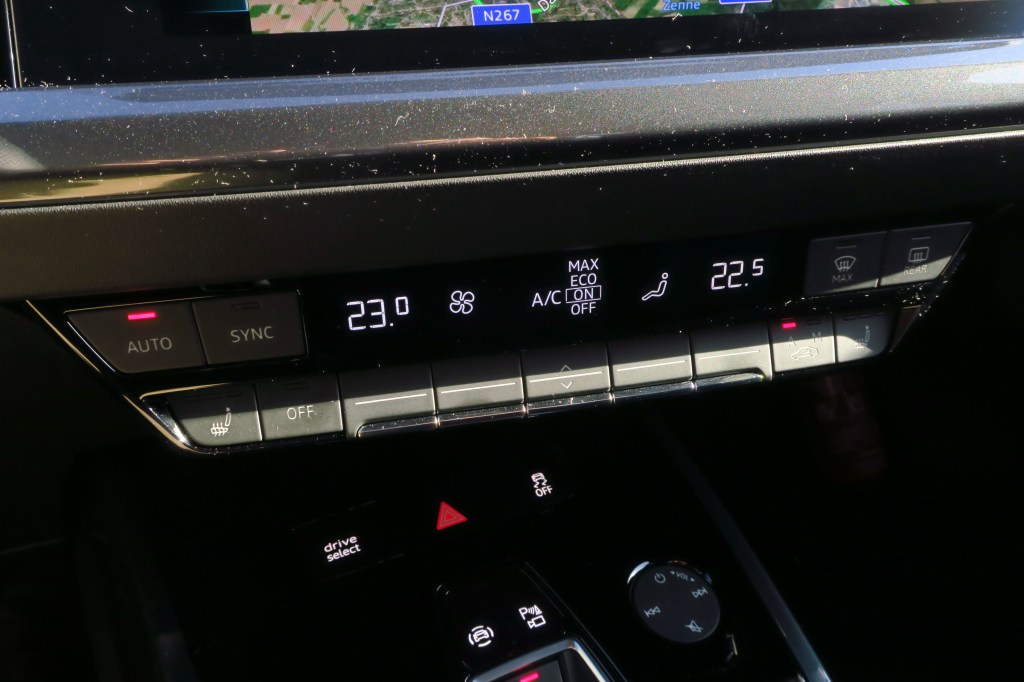
The ventilation commands are thankfully also on a separate panel with extra knobs, and also the audio volume knobs are of the rotating touch type as found on the early Apple I pods.
When you opt for the MMI package, you can also enjoy an augmented reality head up display. Our test car came with it and we liked it very much.
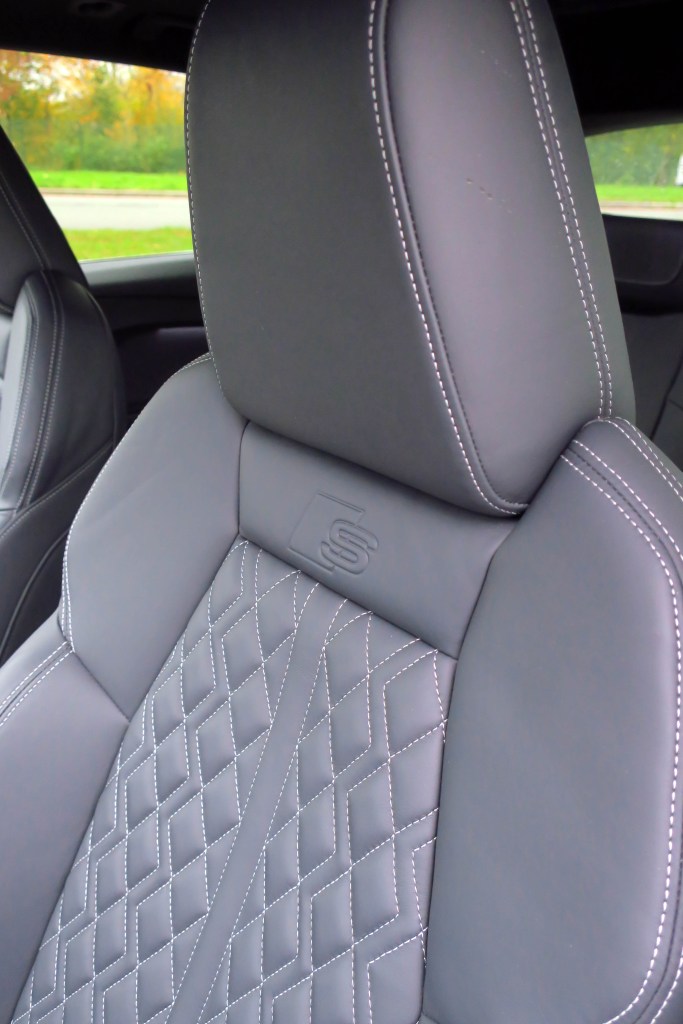
In the posh “S line” equipment level of our test car the seat upholstery with its typical cross stitched patters was very pleasing to the eye, and the seats are also very comfortable indeed.
While we are talking about the cabin, we can mention here that also the Q4 offers plenty of room, also for its rear passengers, taking advantage of the good qualities of the MEB platform. This SUV is certainly not compact here…
There is also plenty of room for storage in the interior, a good 24,8 liters. On the central console between the two front seats you have already 4,4 liters at your disposal.
Luggage space is more than adequate with 520 liters, with both rear backrests down you have a maximum of 1490 liters at your disposal, when you use the available space up to the roof.
The charging cables are neatly tucked away under the luggage floor. Only a bit cumbersome to reach them when the boot is fully loaded when on holiday. For the rest of the year it’s very fine.
Dynamic and smooth…
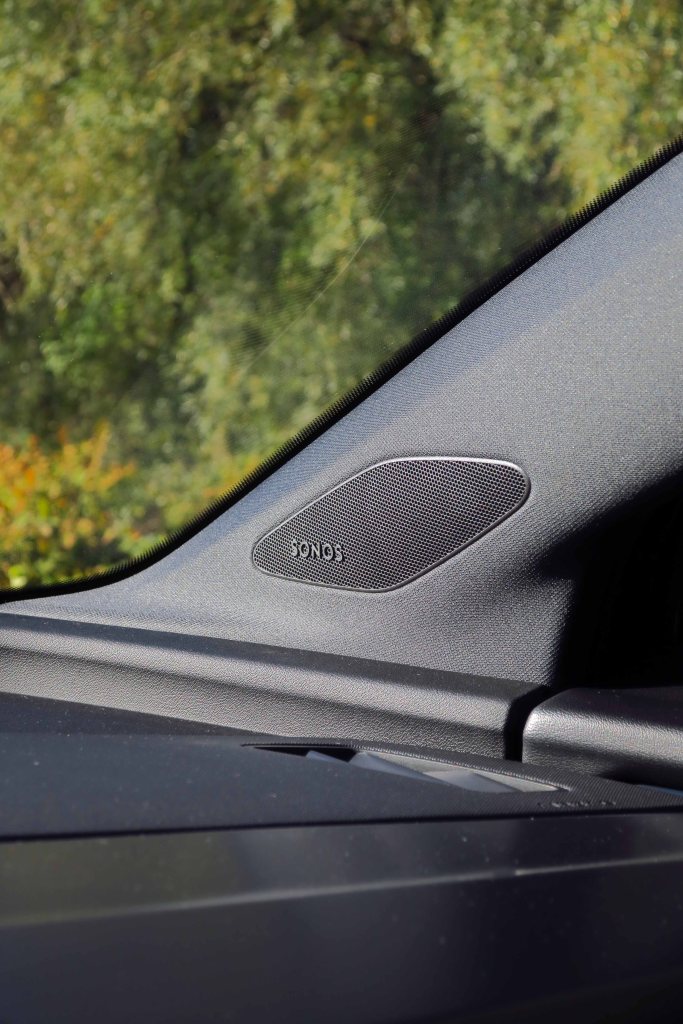
Let’s get behind the wheel now and start driving. As an EV befits, this Audi is again supersmooth. It is “Zen” driving all the way. EV’s are just a delight to drive in town, with their feline power delivery. 310 Nm of torque is at your disposal, always. It makes this Audi beautifully agile and nimble in dense traffic. Stop and go traffic is now for you an ideal moment to relax behind the wheel, and enjoy the beautiful sound coming from the Sonos system we had in our test car.
Performance is of course excellent, with a 0 to 100 km/h acceleration time of 8,5 seconds. Top speed is limited to 160 km/h, as in the ID.4.
German Autobahn aficionados would like this to be more, but then we would not speak of a useable range anymore.
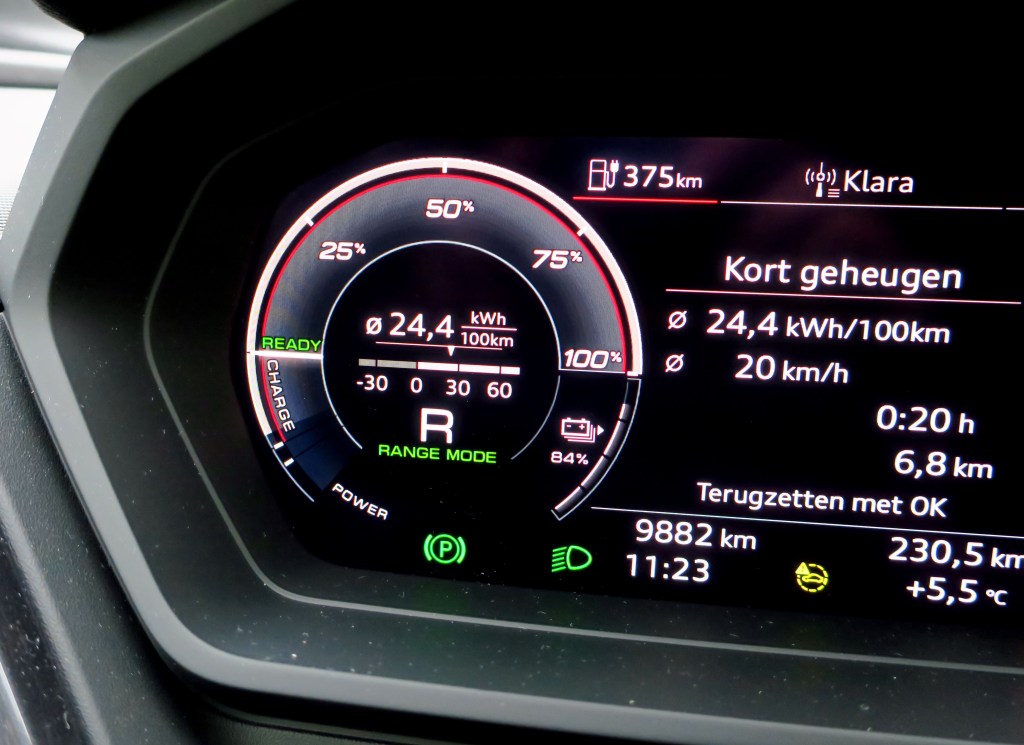
When it comes to range, your driving style is here of paramount importance. You see it clearly on the photo showing the instrumentation: when collecting our test car, we drove it gently to the motorway, where we drove a constant 95 km/h, just a bit faster than the trucks, to reach our photo spot. Consumption was then a very reasonable 15,2 kWh/100 km, over 19,6 km at an average speed of 42 km/h.
A cold start in the morning, with heater full ablaze and just some slow stop and go traffic paints another picture. There the consumption over 5,4 km was a whopping 43,6 kWh. The following photo tells the story.
When we take the WLTP consumption as the norm, being 19,3 kWh, then the effective range would be 530 km. In practice, you can expect a useable range of a good 400 km.
There are different driving modes on the Audi, one of them being the “Range” mode. It limits power and sets a maximum speed of 90 km/h.
Charging at the home wallbox is possible up to 11 kWh, and on public charging points you can “fast charge” your Audi at not less than 125 kWh. Then it takes only 10 minutes to add an extra of 130 km to your range.
Practice in our country is of course rather different to say the least. 98 % of our existing condominium and apartment buildings have NO wallbox provisions in their underground garages, not even electricity sockets in many cases, limiting possibilities of enjoying EV propulsion greatly.
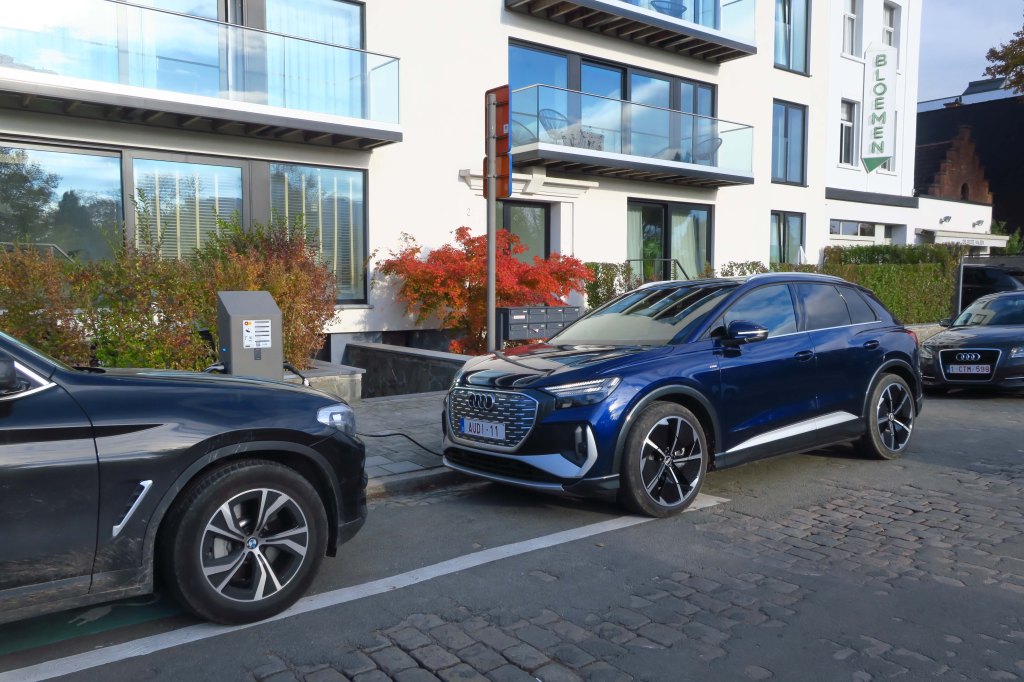
My nearest public charging point is about 1 kilometre away, and this is not a “fast” charging point. Allowed time for charging is also limited to 3,5 hours. Belgian municipalities – at least those near Antwerp – have still to wake up to reality that the charging points have TWO sockets and can actually charge two cars simultaneously. The square they paint on the pavement actually is clearly meant for ONE car. Users of the charging point are so kind and gentlemen-like to ignore this, so your servant could charge the Q4 too, as the following photo shows, which leaves one certainly perplex…
Driving the Q4 to Knokke, we found no unoccupied charging points within a reasonable walking distance from the place we stayed, so the next day we used the “Range” Driving mode to get us home again. It was a magnificent and leisurely drive…
Car manufacturers are certainly not to blame here. Their products increasingly offer useable ranges, and we could easily plan a longer route on the Audi, where the touchscreen clearly indicated which charging points en route we could use, how long we had to charge, which were open, etc.
Of course, providers are working hard to change the situation. At the moment of writing, IONITY is invetsing 700 million € for 5.000 extra HPC charging points in Europe.
Comfortable and agile
Besides room of its occupants, the Audi Q4 also offers a genuinely comfortable ride and steering is also precise and engaging. Audi’s are build to deliver driving pleasure, and this is also found in this Q4. A well balanced car, certainly making the very best of what the MEB platform has to offer. The same goes for the brakes, which can be well dosed to come to a smooth stop.
We also mention here the “coasting function”. When one hasn’t chosen the “B” mode, the Audi will just coast along when you lift the throttle, and this adds greatly to the “Zen” driving pleasure, once you have mastered the art of anticipative driving.
Of course you can recuperate energy when decelerating, or you can leave everything to the wisdom of this Q4. Indeed, you can put the Predictive Energy Assistant at work, which will interpret road signs and navigation data. Then the system will calculate for you continuously the right balance between sailing and energy recuperation, no less!
Conclusion
Audi has succeeded in designing and building a magnificent compact EV on the MEB platform. A car with impeccable finish, oozing with style, panache, good comfort and handling, very good range and performance, and on top of all that roomy too.
Of course this has a price tag, but it is a timelessly styled premium car, one of the very best which ever rolled of VW production lines.
The Kia Niro is already a few years amongst us, first electrified as hybrid, then plug-in hybrid, and finally as a “pure” EV.
The competition has become a lot stronger since its introduction, notably with newcomers as the Volkswagen ID.3, the Peugeot 2008 and the Citroën ë-C4, but this Kia still has a lot of qualities which make it still earn very well an excellent place its segment. Of course, Kia is ready for this competition, and at the moment of this test going to press, it presents a completely new version of the Niro at the Seoul motor show, but the present model is still relevant enough to put it through its paces for you here.
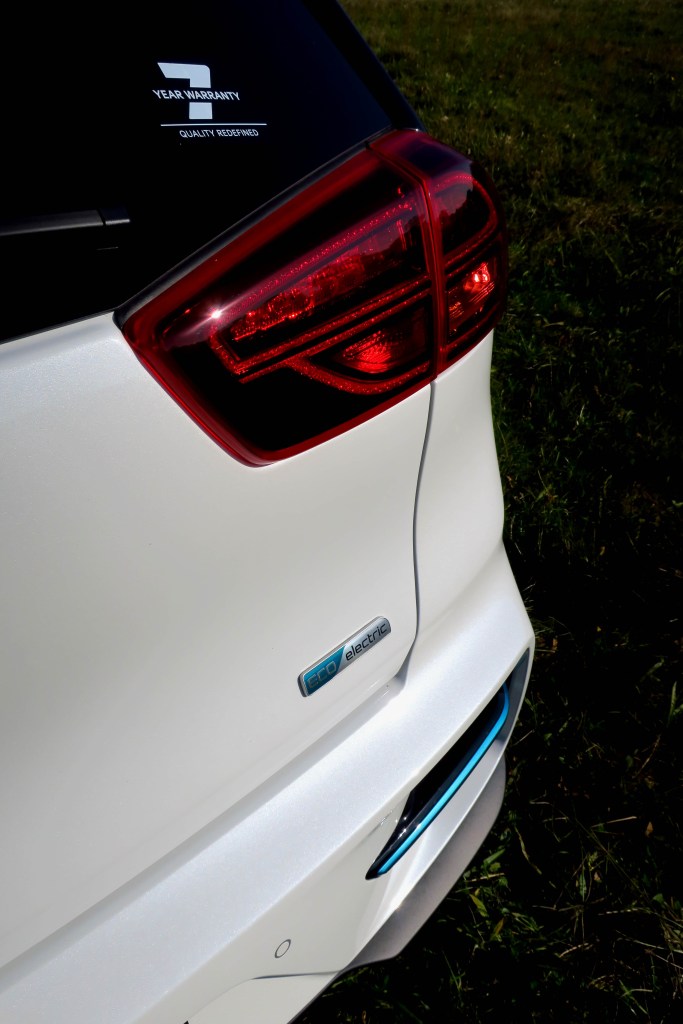
We should also not forget that this Kia EV with its 64 kW battery set the trend towards longer ranges: according to the WLTP norm, it is still good for 455 km…and on top of that, it offers very good value for money, with a 7 year guarantee!
Hans Knol ten Bensel
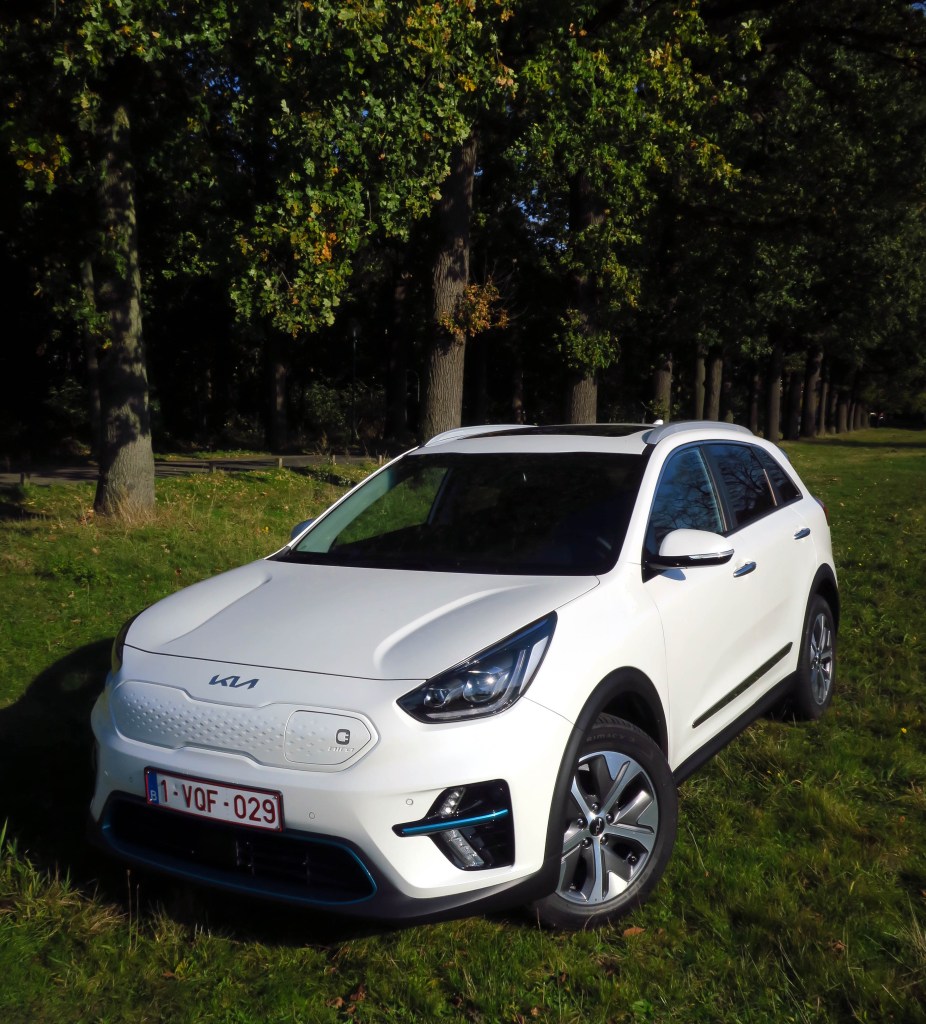
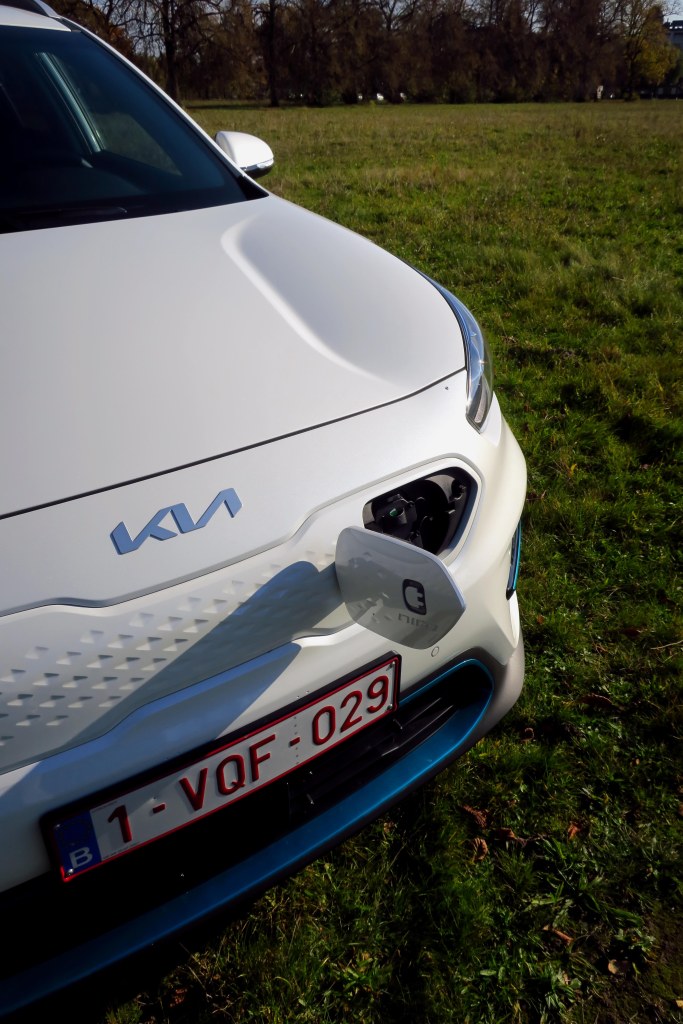
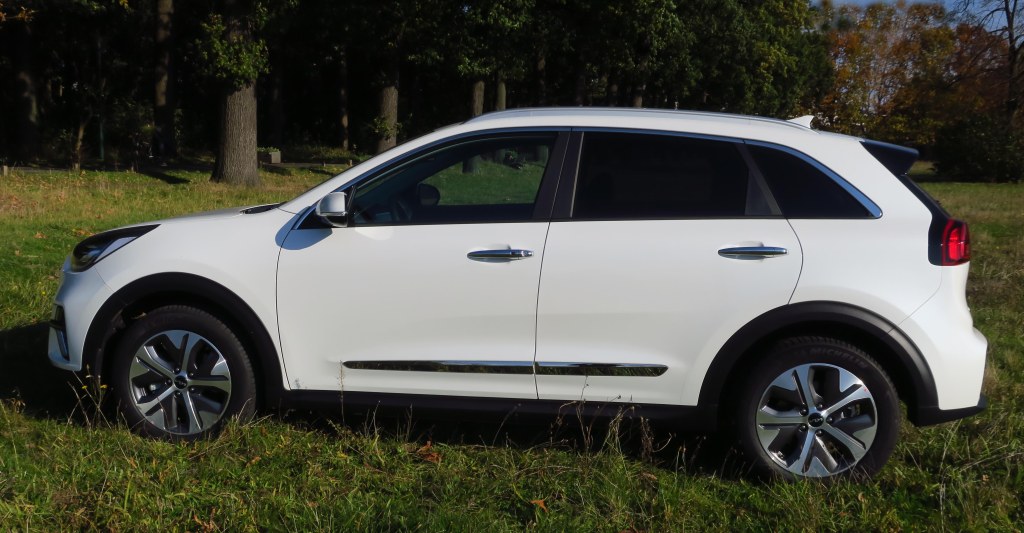
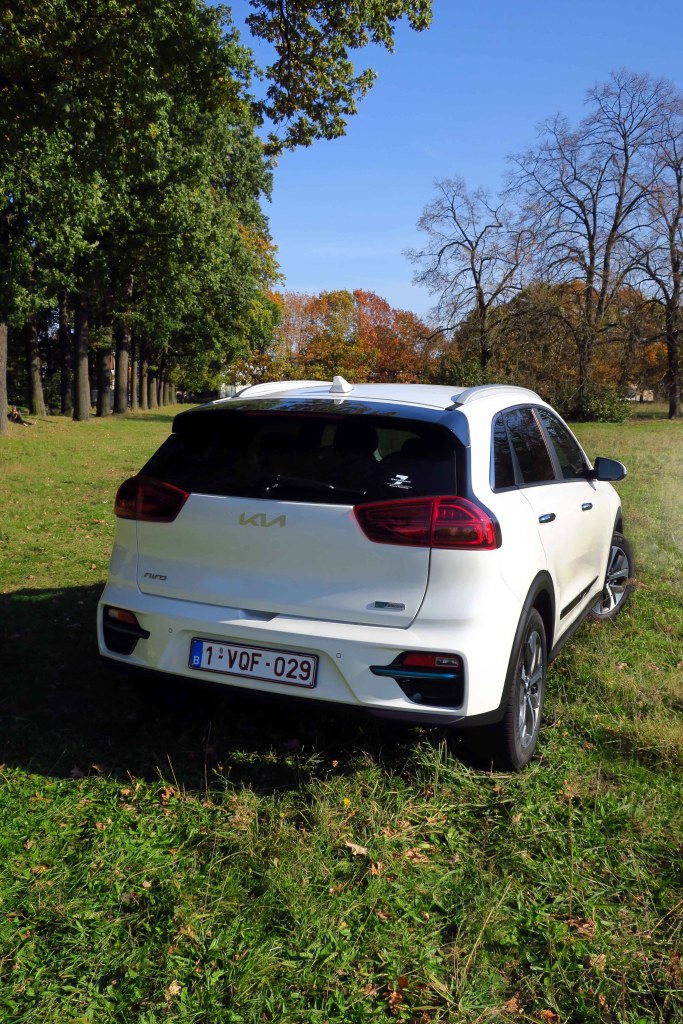
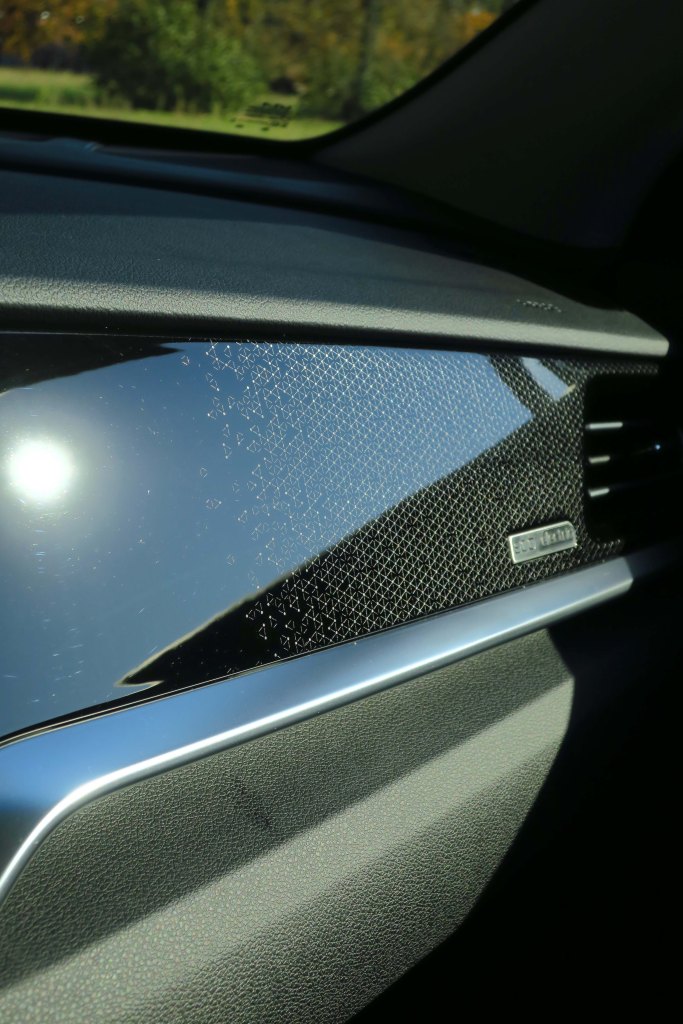
The Kia Niro still has very pleasing and now already familiar looks, with some specific blue coloured accents for the EV version. The front end clearly shows its EV character, and also the flap of the charging sockets is clearly visible. The cabin is well laid out, with classic disposition of instrumentation, commands and central touchscreen, so indeed one would hardly suspect sitting in an EV vehicle. This is all for the better, as one is very soon familiarised in using and driving this Niro.
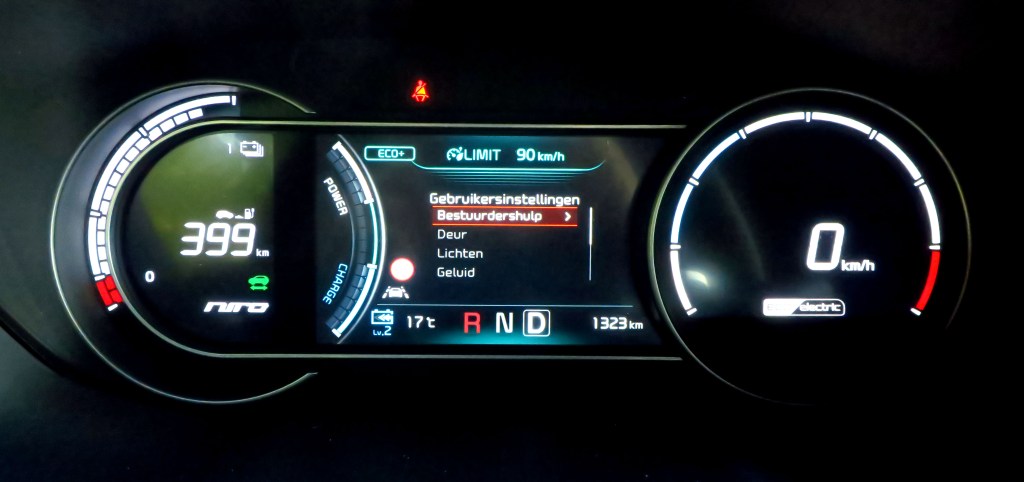
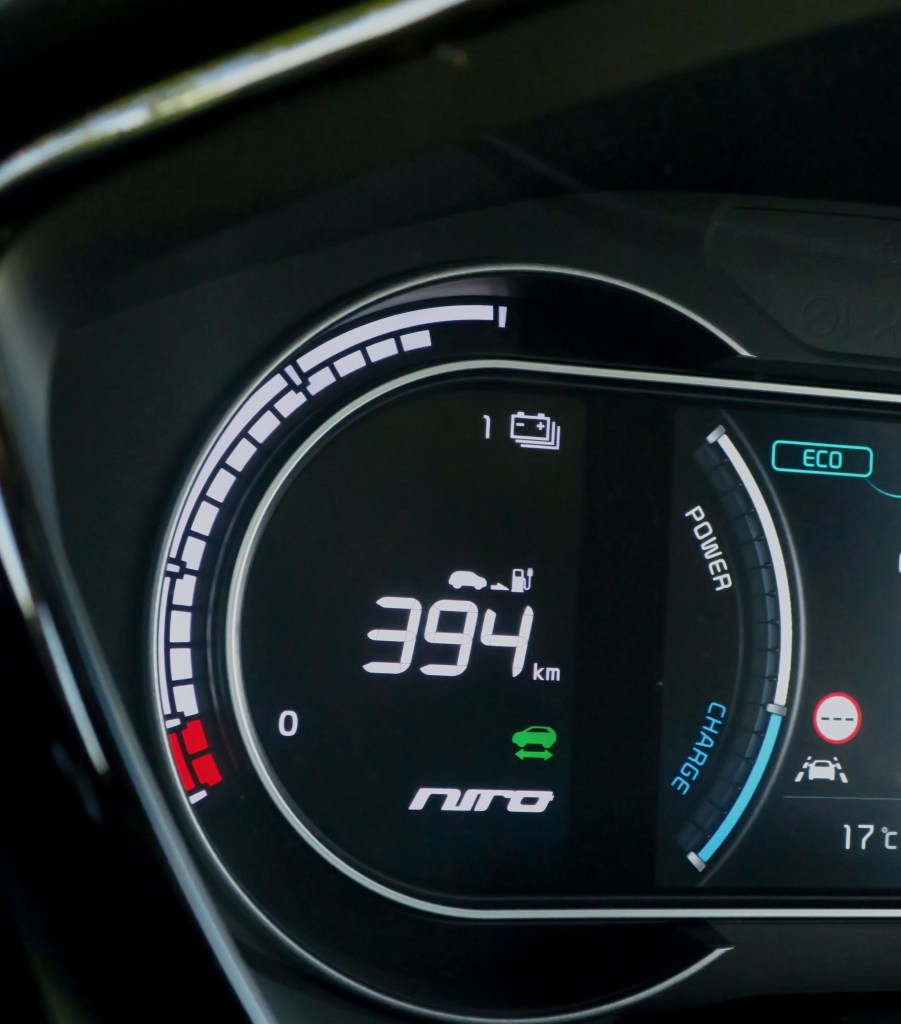
The display in front of you clearly indicates of course battery status and range, as well as the immediate or average consumption in KW/h. Soon one notices that this 150 kW or 204 HP Kia is quite frugal, where your driving style is of prime importance of course.
The manufacturer quotes 15,9 kW/h according to the overall quite realistic WLTP cycle. We took the test car on a lengthy trip to Holland, using the ECO mode throughout, and easily achieved an average of 17 kW/h.
It was delicious to be able to make this trip without the usual range anxiety, and on top of that to find plenty of public charging points in the Netherlands, not even 50 meters away from the house of the family member where we stayed over the weekend. All in all, in this ECO mode, a range of over 400 kilometers is even in more wintry conditions easily achievable when adopting a normal driving style.
Having said this, EV cars have decidedly come of age with our northern neighbours, where the e-Niro has been the top selling car in 2020 by the way…
Smoothness combined with power…
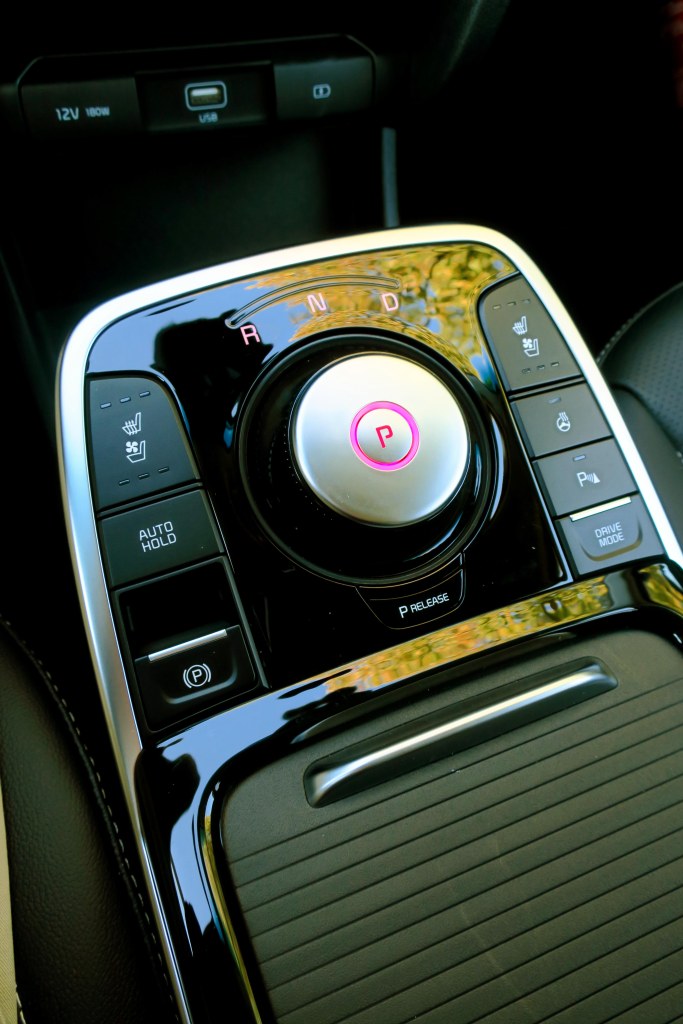
As a pure EV befits, “Zen” like feline and vibrationless power is for you to enjoy here. On the centre console is a familiar circular knob which lets you choose between drive and reverse, as we have seen in Jaguars and Land Rovers.
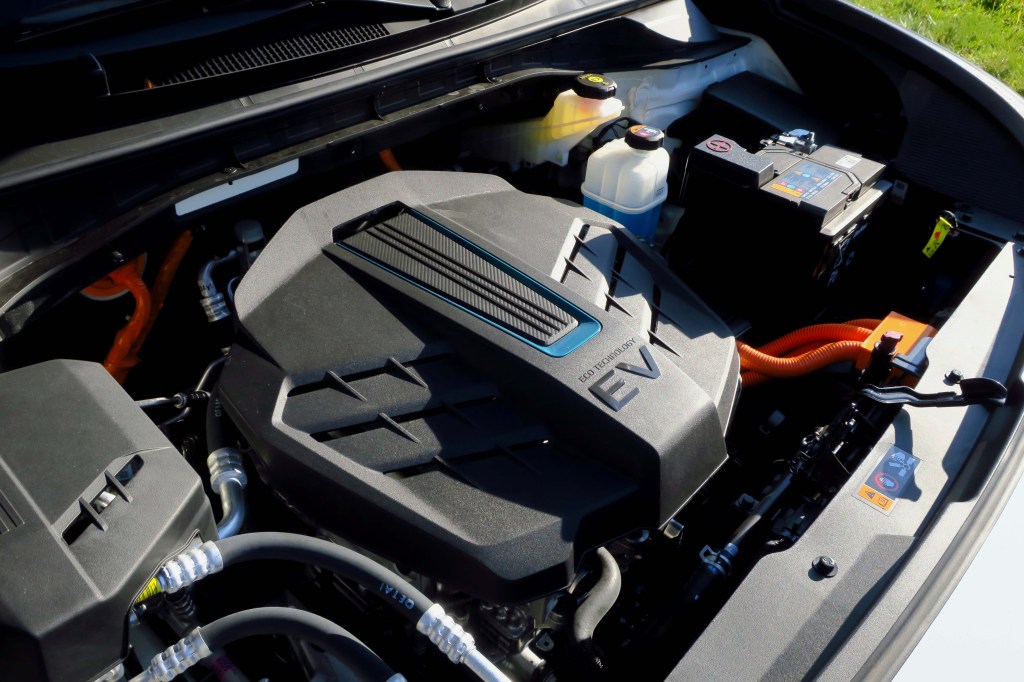
Off you go, and indeed, this Kia has under the hood what it takes. The front wheels are driven, and will pull you from 0 to 100 km/h in merely 7,8 seconds, which is no small feat as one knows that the kerb weight of the e-Niro is 1712 kg. Top speed is a very creditable 167 km/h. So performance wise, one is rather spoiled too, besides of course the uncanny smoothness and silence of the drivetrain.
There are paddles at the steering wheel column which let you choose the amount of regenerative braking, so “one pedal” driving is easy to achieve.
On the technical side, let us tell you here that our test car was equipped with the lithium-polymer 64 kW/h battery and that the permanent magnet synchronous motor has a power of 150 kW/204 HP and 395 Nm of torque.
For home charging, one is of course well advised to install a three-phase wallbox. With the optional three phase onboard charger, you can be fully charged in some 4,5 hours.
Roomy and practical
The e-Niro is quite roomy, with sufficient legroom also for taller passengers in the rear, with standard luggage space being a good 451 and 1405 liters.
With the rear cover in place, the volume is reduced to 280 and 1175 liters respectively. In the cabin, there is enough storage room in the central console and beneath the central armrest as well as the door bins. As we said, using infotainment and all the commands for heating/airco/ventilation is intuitive, and we also used the voice command to good effect for navigation amongst other things.
Safe handling
The e-Niro will not exactly invite you to throw it around corners, but its handling is fine to say the least. Sudden steering wheel movements will be met with initial understeer, with well controlled oversteer by the ESP when you lift the throttle. This e-Niro will not lean unduly in fast corners, has good straight line stability and is comfortable too.
Conclusion
The present e-Niro with its attractive range is still very much a desirable EV, combining excellent performance with low E-consumption. Add to this the good value for money considering the space and equipment found, with last but not least the 7-year warranty. You will agree that this EV-range trendsetter which will accompany you for many years in to wonderful “Zen” world of EV motoring and mobility.
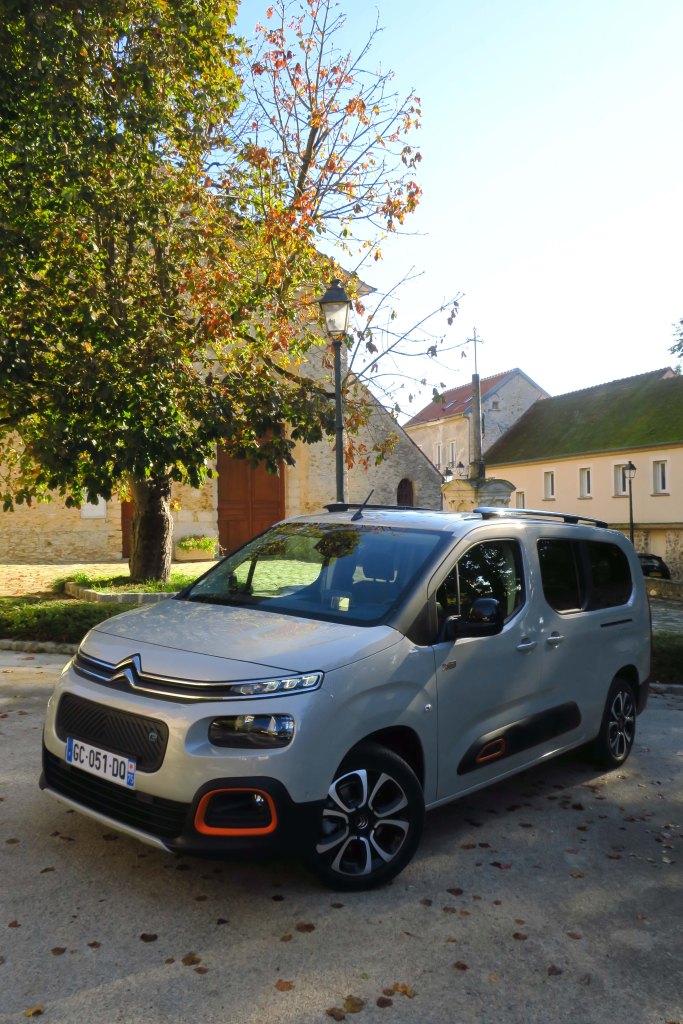
We drove the ë-Berlingo in the scenic surroundings of the Domaine des Maffliers, near Paris…
Electrification is now also expanding to commercial vehicles and popular minivans and family carriers like the Berlingo. We sat for a few hours behind the wheel of this spacious and endearing Citroën to enjoy all the delicious “Zen” refinements brought by electric propulsion, which totally transformed the driving experience of this Berlingo.
The Citroën PR and marketing team had carefully chosen a very scenic route around and in the woods of the Domaine des Maffliers, in the neighborhood of Paris. An excellent environment to get a taste the velvety power of its electric motor, to enjoy the seating and suspension comfort of this Berlingo.
We first tested the M version, which is 4,4 meters short, and thereafter the 4,75 meter “long” version. Suspension comfort and handling is virtually the same in both versions, and the EV drivetrain is identical. But then even more space is to be found in the “long” version, which can seat comfortably up to seven people.
Along the scenic villages near Paris with the “long” version…
A smooth performer…
The silence and utter smoothness of the electric motor totally transforms the driving experience. With its very comfortable suspension, one has the distinct feeling of sitting behind the wheel of a top class limousine, helped by the comfortable central armrest which supports your right arm and elbow, which has the only task to select the proper driving mode on the central selector.
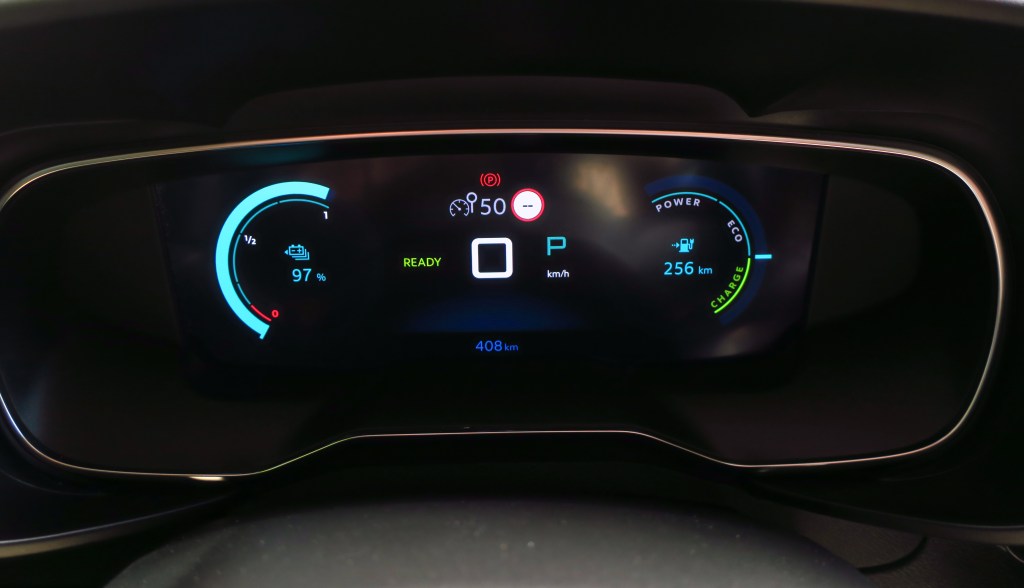
But let us first tell you a bit more about the drivetrain. Citroën selected a 100 kW or 136 HP electric motor, fed by a 50 kW/h battery. Torque is sufficiently ample with 280 Nm. Top speed is limited to 135 km/h.
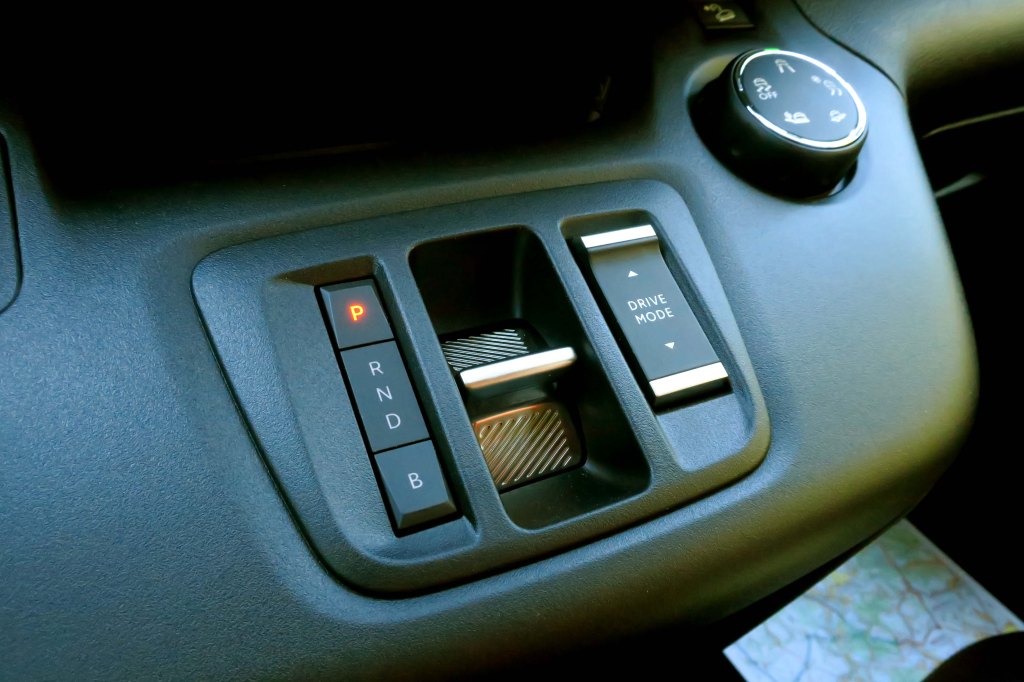
The driver has the choice between three driving modes, activated with a special so-called ë-toggle.
Comfortable simplicity: ë-toggle on the right for the drive modes, selector in the middle for reverse and drive, knobs for “P” and “B” to the left…
First, there is the so-called Normal mode, where the motor develops 80 kW/210 Nm, striking a good compromise between performance and economy. Then comes the Eco mode, with 60 kW/180 Nm, still quite sufficient in terms of liveliness we found, which gets you further on a full charge. According to WLTP, the range is then a good 280 kilometers. You also have to settle for reduced heating or airco power, but this remains still within comfortable limits. Finally there is the power mode, where the full 100 kW is at your disposal. Interesting of course when the Berlingo is heavily loaded, and/or you are driving in hilly or mountainous areas.
Simplicity is truth…
Of course there is also a “B” knob on the centre console, which lets you recuperate energy when you lift the throttle, and gives that “one pedal” driving opportunity when you adopt an anticipatory driving style, which you learn soon enough…
Spacious…
The battery pack sits snugly on the floor of the Berlingo, so the charging volume is not impaired at all. The M version has 775 liters luggage space, the XL version in 5 seat configuration brings this to a whopping 1050 liters.
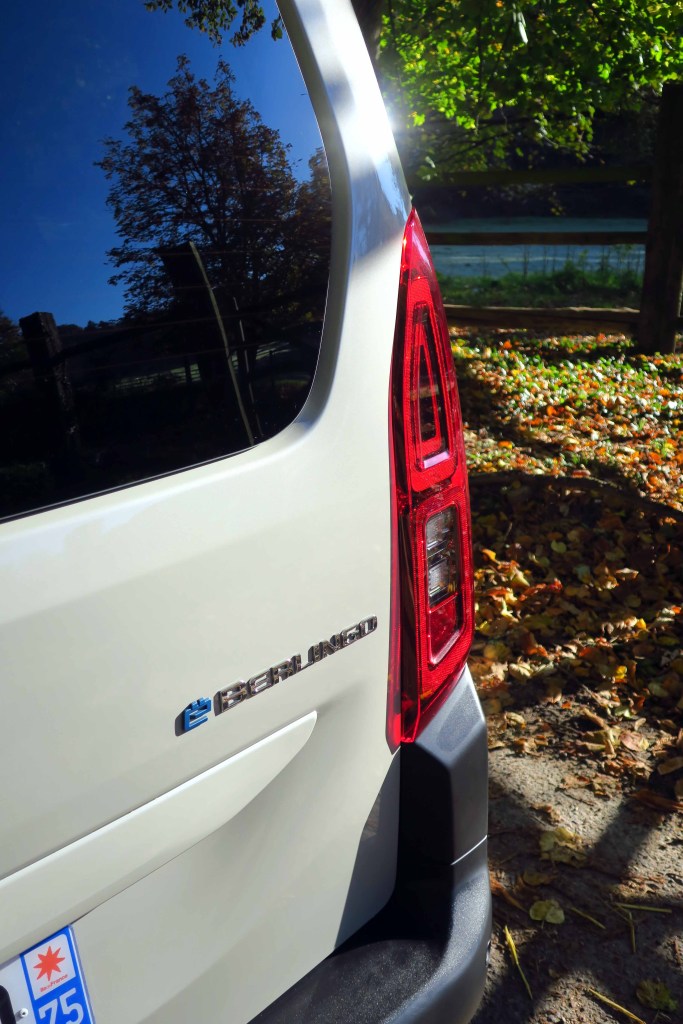
The ë-Berlingo proudly wears its badge…
The cabin boasts a further 167 liters of storage space, so this Berlingo makes you truly feel at home. This is a car which makes family life really easy…
… and easy charging
The practicality of a fully fledged EV stands or falls with the charging facilities, and we all know that the public charging situation in Belgium is nothing short of abysmal. Home or office charging is the answer for the time being, and here Citroën offers for its Berlingo plenty of opportunities.
Home charging can be done with the so-called Mode 2 cable, which is compatible with an 8A and/or 16 Amp socket. For fast chargers, both public or private, one needs an optional Mode 3 cable. This allows you to charge from 0 to 100 % in 7,5 hours if you have a single phase 7,5 kW wallbox. This is reduced to 5 hours if you have a three phase 11 kW wallbox.
Super fast charging is possible at public charging points up to 100 kW, and there one needs a mode 4 cable which is integrated in the charger. It then takes merely 30 minutes to charge the 50 kW battery up to 80 %.
The Berlingo leaves you the choice between three connected packages, connect assist, connect nav and connect play.
In the basic assist package you can get connected with a call center in case of emergency or accident, and via the My Citroën App you can be informed about range, charging status, mileage, next service, etc.
In the nav package, you can use voice command/recognition for interaction with the phone, navigation and radio functions. TomTomTraffic displays for you the best route under up to date traffic conditions.
The connect play feature sports Mirror Screen technology, compatible with Apple CarPlay™ and Android Auto.
Conclusion
Electrification is not an empty word at Citroën anymore…
The electric propulsion completely transforms the driving experience with this Berlingo, and this refined upper class panache makes this family friendly space car even more endearing and desirable. But not only for the family man. Every craftsman or public/private services worker/small entrepreneur who works in urban spaces will just love this EV version, which will be a soothing companion in his daily work life. After a stint behind the wheel, you will indeed wonder how we fared for decades without this full EV enjoyment and “Zen” progress…
Note that at this Citroën ë-experience day we also drove the full EV version of the C4. More about our driving impressions soon…
With this ID.4, Volkswagen is taking another bold step forward: it is building an SUV which will be offered worldwide, notably built and sold in China, the US and Europe. For us here, it is produced in Zwickau. It is the second model to use the celebrated MEB platform, the EV platform which is also sold to Ford. The car embodies a quite important if not formidable step for VW, where every aspect of this car has to please many customers, all over our globe.
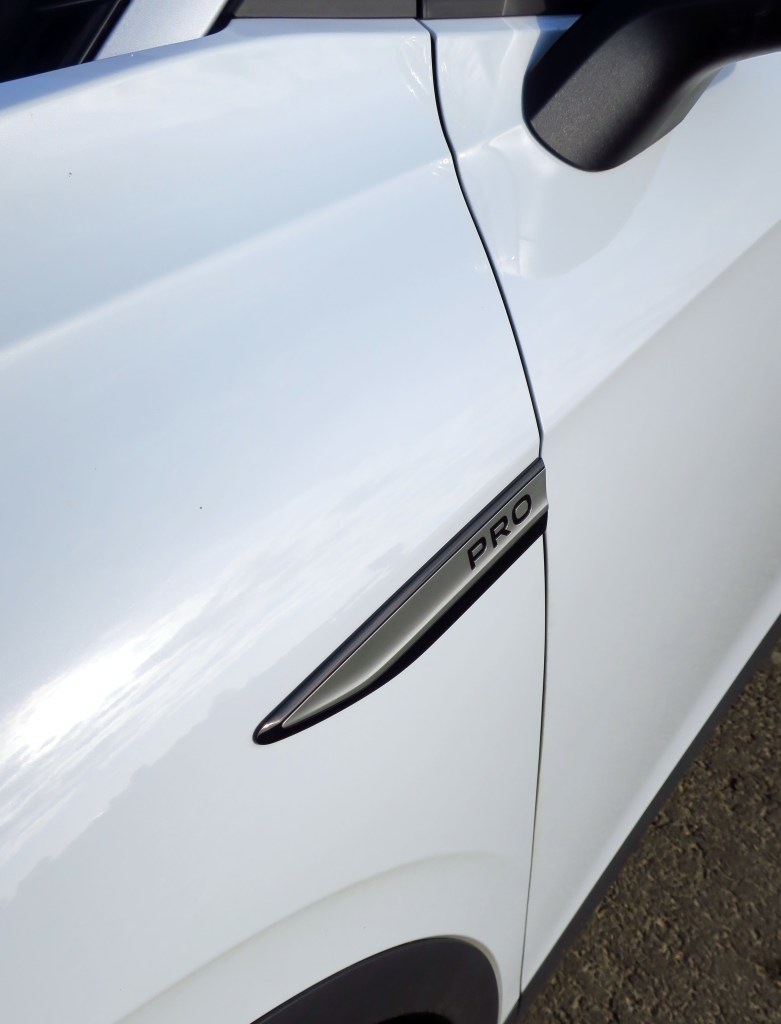
We drove the so-called “Pro” version, with the 77 kW battery, about 500 km range, 204 HP or 150 kW, and lively performance. It certainly did please us, and this pleasant impression got better the longer we drove it. Just read on…
Hans Knol ten Bensel
Friendly and harmonious looks
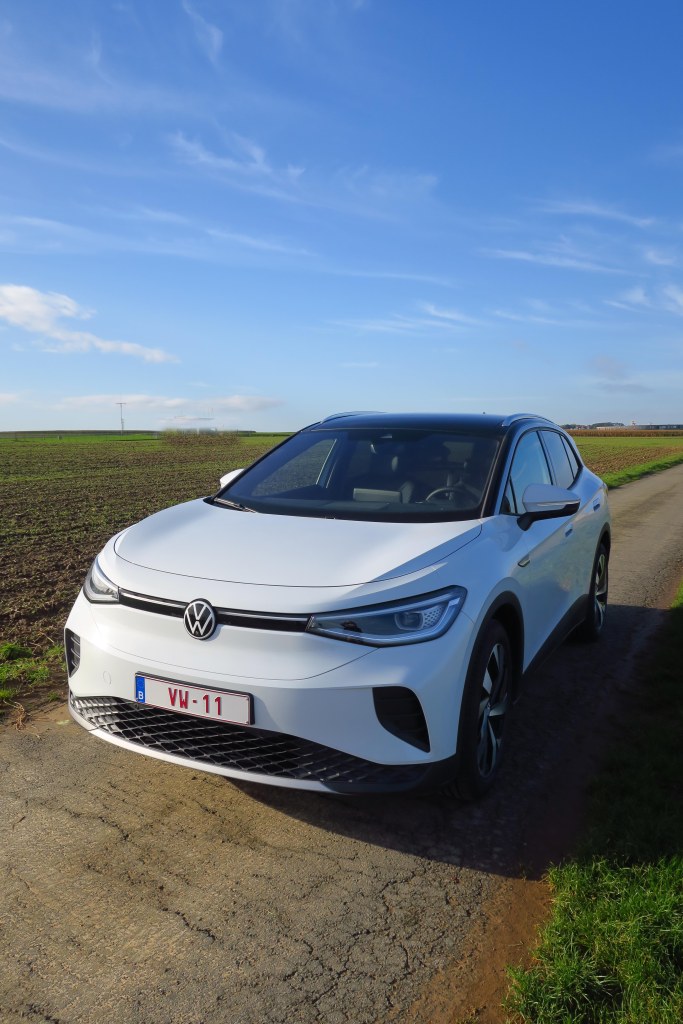
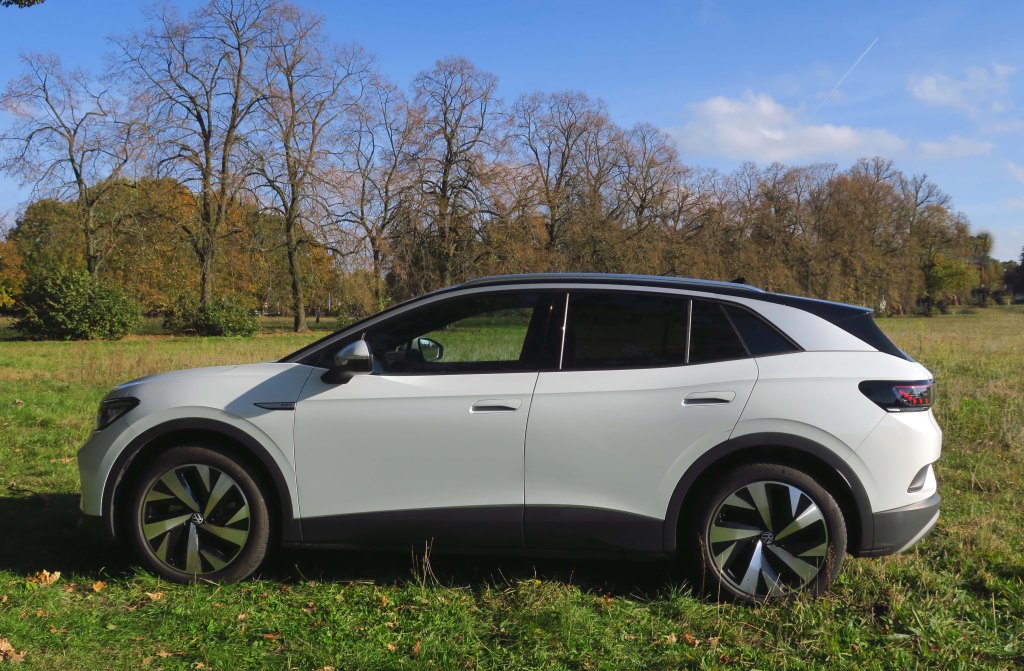
Stylists of a world car have no easy task. It looks that they have succeeded though. Just know that the ID.4 has recently been singled out for the “2021 World Car of the Year” award. When we approached the ID.4 and walked around it, our eyes meet iconic, timeless and pleasing shapes. Lines and contours with character, evoking exactly what this car wants to be: a family-friendly roomy SUV, which will accompany its owner with style for years to come. The rounded styling language is never aggressive, the front end is clean, not without elegance, has a timeless touch. The proportions are well chosen, look just right from every angle, also the big wheels with their aerodynamic alloys add panache to this SUV. We took some photos close to the runway of Zaventem airport, so the flatness of the empty landscape adds to the clean lines of this ID.4.
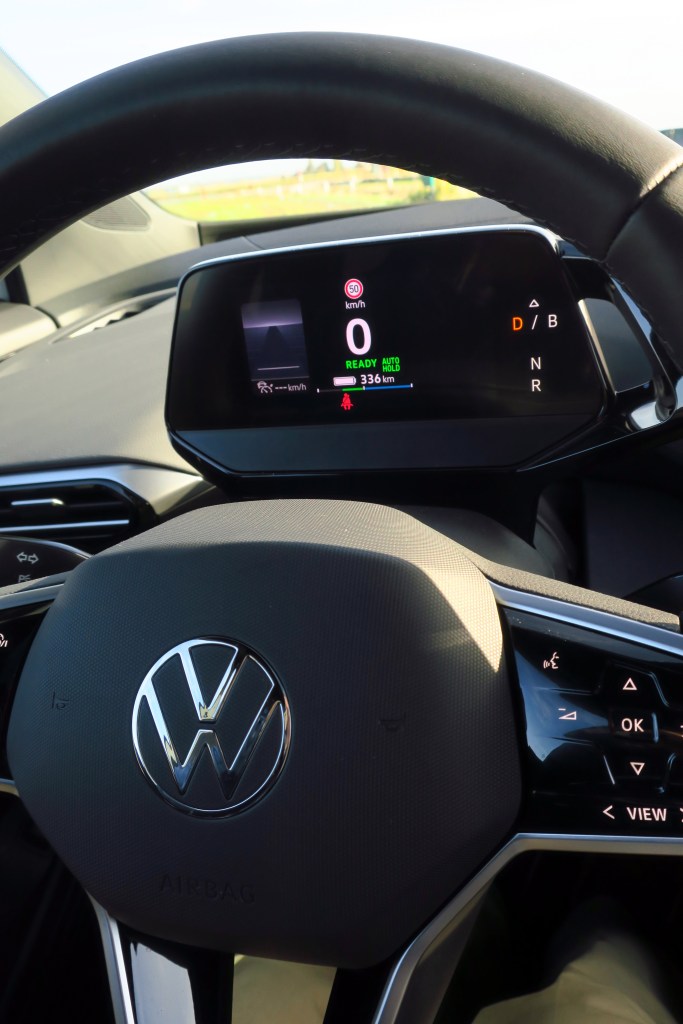
The same simplicity and clean lines are found in the interior and the dashboard layout and instrumentation. It is very similar to the ID.3, with an instrument cluster forming one unit with steering column and steering wheel, and a large touch screen in the centre of the dashboard. Its driver assistance and infotainment system is everything you could wish for. Of course you have to familiarize yourself with its controls, so we suggest you to read the instruction book carefully.
Reading the instructions is the proper thing to do when you buy a car of this refinement, engineering excellence and build quality. It is by the way ALWAYS the thing to do when you purchase any car, actually. Also, remember, there is YouTube. Many VW car dealers have a film made for you, so-called instruction films, where you can see and hear the workings of every accessory and functionality.
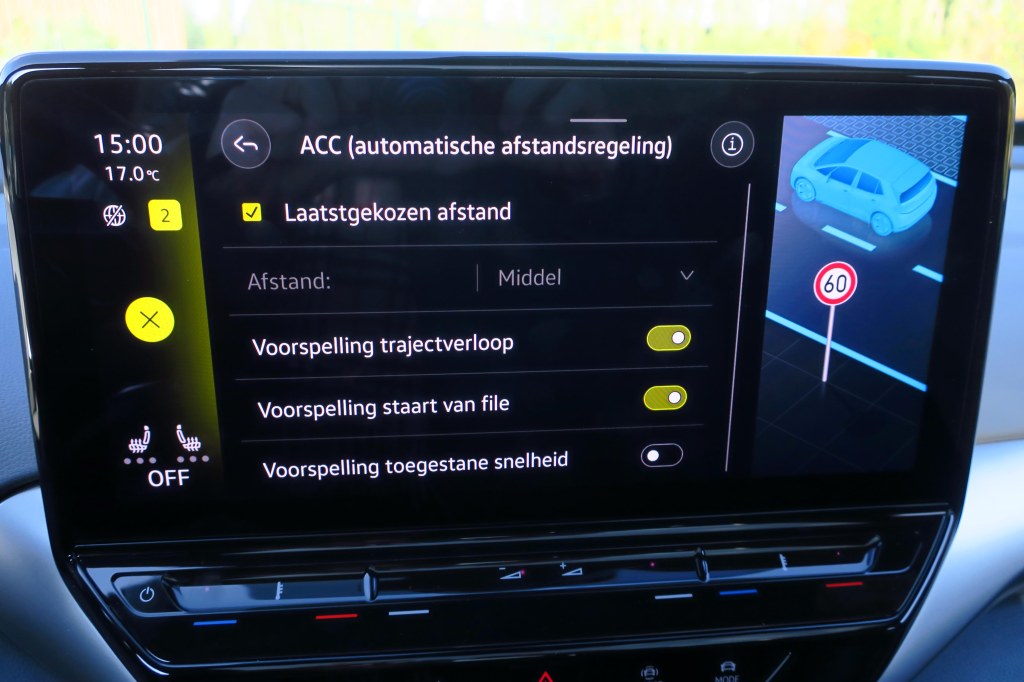
In our test car, suffice to say the diagonal size of the touch display was 10 inches, and it is good to know that natural voice control with an online connection and the ID. Light come as standard. You will not read any critique here about the workings of any of the functions of the ID.4, it takes getting used to, and even a week can be too short for this to have everything intuitively in its fingers.
I always keep in mind that the owner or user of this car will be behind the wheel of this VW for months, if not years, and will have familiarized him (her) with every function, that is if he (she) was not too lazy to read about it in the manual or try it out. I mentioned ID. Light. It is a light strip below the windscreen, and tells you when to take a left or right turn, when it has understood a voice message from you, after you said first “Hello ID.” Indeed, the future has arrived in this car.
The driver uses the central display to manage the telephone system, navigation system, entertainment functions, assist systems and the vehicle setup. Sliders for volume and temperature adjustment are located below the display. Clean and purposeful.
Daily life with the ID.4 has become simple. Just step in, push the brake pedal and select “D”. Off you go. On the right side of the steering column is a big switch which you have to turn towards or from you, to select D, B or Reverse. At the end of this switch us a big knob “P”. Just push it and the parking brake is on.
With “D” you drive normally, with “B” the electric motor regenerates energy when you lift the throttle. It will decelerate the car of course. When you are a master in anticipative driving, remain in “D”, you can coast then almost forever. Using kinetic energy by just coasting is still the most efficient, albeit the most difficult thing to do as you have REALLY to anticipate traffic situations.
“Zen” driving…
The biggest advantage of EV’s, I find personally, is their supersmooth progress. Gone is the so disturbing jerkiness of sticky transmissions and unwilling cold engines. So the ID.4 is also a very soothing vehicle. Silent, vibrationless, with smooth feline power thanks to its impressive torque. 310 Nm if it. Good enough to take this rather heavy ID.4 from standstill to a speed of 100 km/h in 8,5 seconds. Almost pushing your back firmly in the seat. Almost, but remember, this is meant to be a family car. Top speed is limited to 160 km/h. It is also a towing vehicle. Up to 1,000 kg in our test car’s configuration.
The suspension is rather firm, but not uncomfortable. The laws of physics command some firmness as there is a good 500 kg of batteries in the platform underneath the seats. The electric 150 kW motor sits above the rear axle and drives the rear wheels. The advantage is that it allows a small turning circle of just 10.2 metres. Rear wheel drive then, but do not expect to make any power slides. Steering is precise and handling is quite good, even on the rather sporting side.
The WLTP range with the 77 kW battery is according to the manufacturer up to 522 km. There is no secret. Using kW/h costs range. If you cruise at say 85 km/h on the motorway (the truck drivers won’t like this and disturb your “Zen” progress) everything is fine. In winter, and/or when driving faster, the practical range can be estimated as being a good 360-380 kilometers, which is still quite OK. At a DC quick-charging station, the ID.4 with its 77 kWh battery and a charging capacity of 125 kW can be recharged ready for the next 320 km in around 30 minutes (according to WLTP).
Roomy
The VW engineers and stylists have kept one thing firmly in mind: this is a family SUV. So indeed, it offers room which is actually that of a SUV which belongs to a class higher. Ample legroom in the rear, (similar to the Tiguan Allspace), three passengers can sit easily, and even tall drivers do not touch the roof when they put their seat in the highest position. Need we say more? Suffice to say that the wheelbase is a good 2766 millimeters.
The ID.4 has also lots of room in the front centre console, as there is no gearchange lever to disturb things. The luggage space is also impressive: 543 litres of luggage, a figure that increases to 1,575 litres after folding down the backrests (loaded to roof height).
And comfortably equipped
Standard features in all ID.4 models include the ten-colour ambient lighting, the speed limiter and Air Care Climatronic. This is coupled with an electric stationary air conditioning system, which can also be activated when the car is not charging from the mains power grid. Life is good with the ID.4.
All nine ID.4 models are equipped with the Discover Pro navigation system and 10-inch display as standard. All models above the ID.4 City and ID.4 Life come with the Infotainment package. (We tested the “Pro” version.) Its highlights include the Comfort mobile phone interface, which is able to connect a smartphone to the vehicle’s electronic system and charge it inductively. The standard App-Connect function enables media to be streamed via a smartphone, which can be embedded in its native environment using Android Auto, Apple Car Play and Mirror Link. In the Infotainment Plus package (which comes with the ID.4 Tech and ID.4 Max), the navigation system has a 12-inch display.
The ID.4 is equipped with the lane keeping system Lane Assist as standard. Front Assist monitors the area in front of the vehicle and responds with warnings and braking interventions to warn the driver of impending collisions with other road users. The acoustic Park Distance Control function is able to avoid parking collisions or reduce the level of damage using the automatic manoeuvre braking function. The speed limiter is also included in the ID.4’s standard equipment.
Another technology that every ID.4 has on board is called Car2X, which allows the car to exchange information about local hazards with other vehicles and the traffic infrastructure – via the wireless standard WLAN p. The maximum distance here is 800 metres, with warning transmission taking only milliseconds. Car2X is currently active from a speed of 80 km/h, but is also intended to improve safety and traffic flow in urban traffic in the future.
Conclusion
A very able, roomy and stylish compact SUV and a marvelous EV, that’s what this ID.4 essentially is. It is a true Volkswagen, setting standards in timeless modernity, embodying purposeful and clever engineering.
Add to this the know-how of a world manufacturer, the vast dealer network, you will agree that this new generation VW EV have a lot going for it. It ranks already in some countries where the charging infrastructure is decent among the bestsellers, so this ID.4 has a bright future ahead, electrifying the world…





























 Autoprova - for the Connaisseur