We attended a very interesting presentation by Stellantis Belux CEO Stéphane Lévi, last but not least about Stellantis Belux itself. We start with this topic in this report.
But of course, the future of the Stellantis Group holds many different interesting aspects, and this will be covered in further reports. Just stay tuned!
Hans Knol ten Bensel
The merger between FCA and PSA leading to the birth of the Stellantis group has been very well managed in Belgium, and is now properly settled indeed.
Mr. Lévi explained that it was a very good strategic decision to bring the different brands with their respective departments as soon as possible under one single roof, notably at the premises at the Avenue de Bourget in Brussels. Indeed the implementation of Stellantis Belux in this “Stellantis House” in Evere took merely three months after the merger, which was done in January 2021. The organisation of Stellantis Belux was finalised in July this year. 20 % of the employees working in Stellantis Belux have now taken a new position within this organisation.
“It is important that the staff also feels physically that they belong to one family, and are able to interact and meet on one single work and office space”, stated Mr. Lévi.
“The staff of the several brands immediately started to figure out not why, but concentrated rather on how they would work together”, he concluded.
New working spaces are being finalised at Stellantis House to adapt to the changing working conditions brought about by the Corona pandemic.
Strong market position… and investing in the future.
Stellantis Belux has an enviable market position in Belgium and Luxembourg with a market share of 23,07 %.
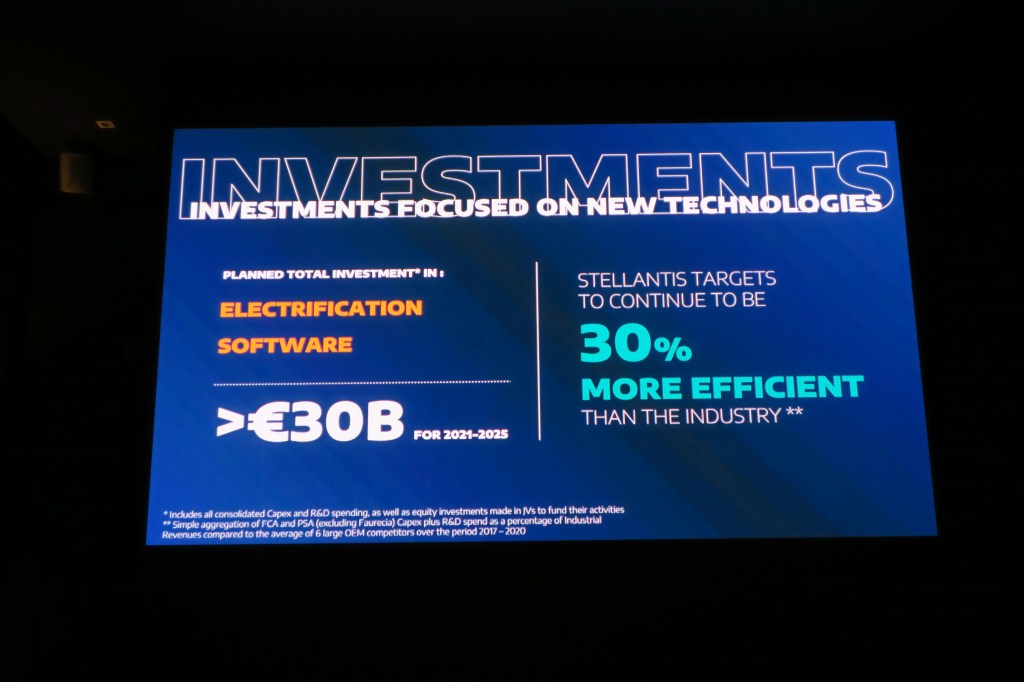
The Stellantis Group is further focused on investing in new technologies: the planned total investment in electrification and software will exceed 30 billion € between 2021 and 2025.
Stellantis targets to continue to be 30 % more efficient than the industry. This figure is based on the simple aggregation of capital expenditure and R & D spent by PSA and FCA, as a percentage of industrial revenues; this is then compared to the average of 6 large OEM competitors over the period 2017-2020.
A further EV model offensive in 2022…
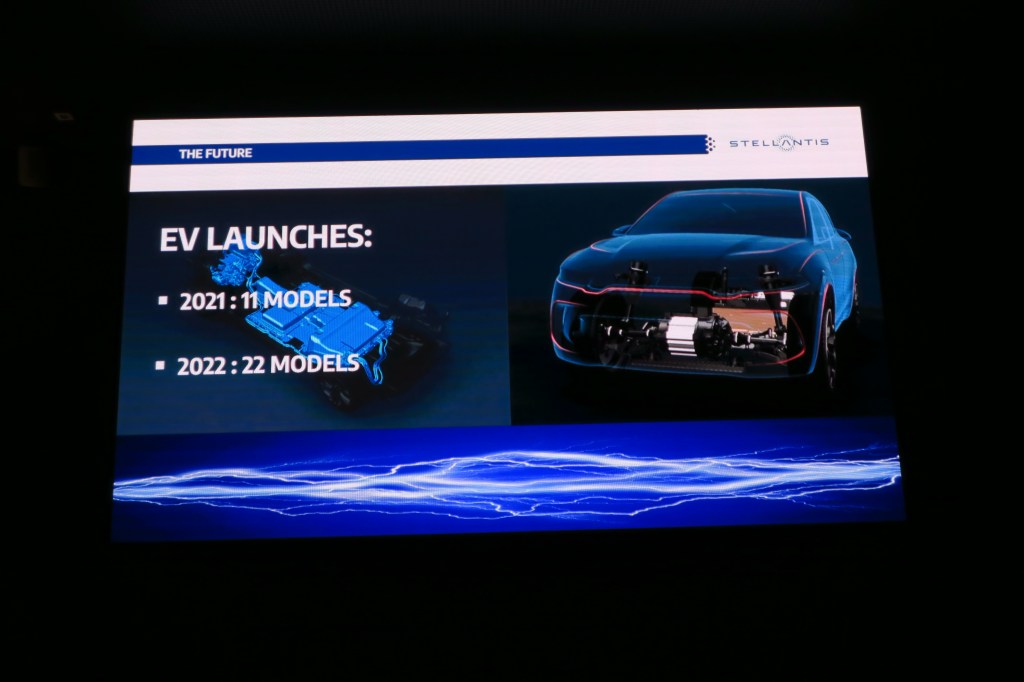
EV launches were 11 models in 2021, and this will be not less than 22 models in 2022…
It expects also its LEV mix to grow fast. For Europe, it forecasts the LEV share of total passenger car and LCV sales to rise from 14 to not less than 70 %, for the US market, the corresponding figures would be a rise from 4 % to 40 %.
Earlier this month, actually on December 7, Stellantis announced that it targets about € 20 Billion in Incremental Annual Revenues by 2030 Driven by Software-Enabled Vehicles.
Indeed, it mapped out its software strategy to deploy next-generation tech platforms, building on existing connected vehicle capabilities to transform how customers interact with their vehicles, and to generate approximately €20 billion in incremental annual revenues by 2030.
This transformation will move Stellantis’ vehicles from today’s dedicated electronic architectures to an open software-defined platform that seamlessly integrates with customers’ digital lives. It greatly expands the options customers have to add innovative features and services via regular over-the-air (OTA) updates keeping vehicles fresh, exciting and updated years after they have been built.
We will come in detail back on this in a special report later. In the next report about this press conference we will focus on further presentations on what the different Stellantis brands will have in store for 2022…
It had to happen: the cute Citroën My Ami city car was due to convert itself in a robust, go-anywhere champion for the outdoor-loving crowd, and here it is… as a concept car.
“This concept expresses without reservation the style of Citroën and draws its inspiration from non-automotive worlds such as building games, industrial design and fashion. The My Ami Buggy Concept” says Citroën, “it has an unbridled style, but remains fully rooted in real life, being at once playful and functional, aesthetic and ergonomic, but also eminently practical and ecological.”
We just cite here its designer, Samuel Pericles:
“The My Ami Buggy Concept is a proposal in line with the philosophy of Ami that is not a car. That is why we have sought inspiration from the world of building games for the playful and functional, industrial design for ergonomics and aesthetics which include everyday objects (furniture, lighting, etc.), fashion accessories (sneakers, sports equipment, glasses, etc.), for example, the camera and smartphone holders with their simple, extruded shapes are inspired by the work of designers who in the second half of the last century created essential and timeless utensils. My Ami Buggy Concept is minimalist, functional, simple, in the purest spirit of iconic contemporary industrial objects.”
My Ami Buggy is indeed a mischievous concept car that every kid from 14 to 77 might want to put on their Santa wish list… more details about this concept car here, and some photos.
Hans Knol ten Bensel
Cute robustness…
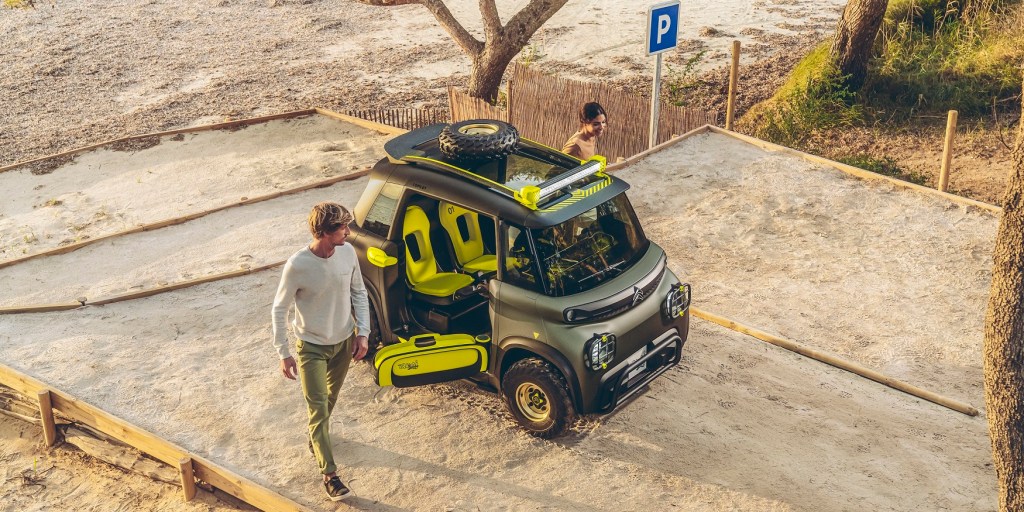
Standing firmly on its large notched wheels, the My Ami Buggy has a distinctly adventurous character, which is emphasized at the front and rear by its bull bars, headlamp shrouds and grilles, bumper panels and front panels with the chevrons in the middle.
On the sides, reworked fender flares and tubular protectors on the undersides of the doors give the car a more muscular appearance. On the roof, the roof rack and spare wheel reinforce the adventurous spirit of the concept. All these decorations are in a single black color, which is dyed directly into the mass.
The LED light bar on the front of the roof adds to the sense of adventure when driving at night or in fog. Once the vehicle is stationary, everything is set up for a “campfire atmosphere” thanks to the light diffused by this bar and the sound of its playlist, distilled through the nomadic loudspeaker.
The doors have been removed and replaced with clear watertight covers that can be pulled up in bad weather, a reference to the Mehari. These use sliding latches to close off the cab with a high opening reminiscent of the glass doors of classic vehicles. The practical covers can be removed, rolled up and stored in the backs of the chairs in special covers.
My Ami Buggy Concept is available in a total of three colors: black, khaki and yellow. The black, inspired by camping equipment, enhances the functional and robust character of the vehicle. The different shades of black – anodized black on the wheel arches and roof, textured speckled black for a hammered effect at the rear – match with the anodized khaki and lemon yellow, giving the vehicle a bold look with careful detailing.
My Ami Buggy Concept comes in a two-tone color scheme: Anodized Khaki at the front and Speckled Black at the rear, a play of symmetry that also aims to clearly distinguish the front from the rear of the vehicle.
The color anodized khaki is a nod to nature, because black, synonymous with strength and modernity, catches the light and dramatizes the colors with which it is associated. The choice of black was also motivated by the desire to use a dark, less messy color.
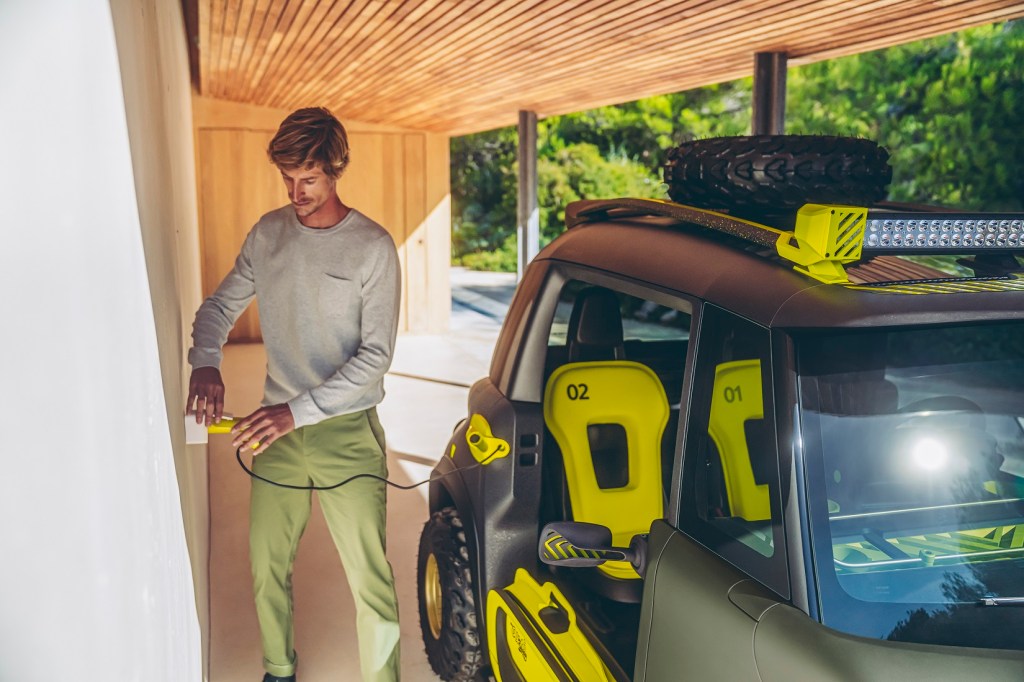
Many key elements of My Ami Buggy Concept are accentuated by a speck of Citric Yellow, such as the seats, the charging cable, the graphics capsule on the doors, all luggage and many accessories. This acidic color also indicates that the articles marked in this way are functional.
It’s all in the details…
The chevron theme, a key Citroën styling feature, is repeated with the same graphic elements on various exterior and interior elements to create a rhythm reminiscent of the Traction’s grille, the center console of the 19_19 concept car, the front roof panels of the Ami One Concept and the design of the Ami’s storage compartments. On the My Ami Buggy Concept they can be seen on the outside of the wheel covers, fascia’s, hood, side skid plates, light rail brackets, underside of bumper and rear of mirrors; and inside on the accessory brackets, storage bins and dashboard.
The word ‘Pilot’ can be seen on the roof on the driver’s side and ‘Copilot’ on the passenger’s side, and in a similar nod to motorsport, the number 01 is engraved on the driver’s seat and 02 on the passenger’s seat to indicate the location of each. Cool!
Yellow arrow stickers under the nose cone indicate the direction of the wind, a reference to aviation. This type of decoration can be found on the wheel arches.
A “+” badge appears on the driver’s side mirror, referring to the electric motor and battery terminals, just like in the parking spaces reserved for electric vehicles.
Originality also continued in the cabin…
The interior design of My Ami Buggy Concept has been meticulously (re)worked on in three areas: the seats, the storage space and the luggage.
The My Ami Buggy Concept has new Advanced Comfort® seat cushions with an increase in foam thickness from 35mm on the “City” Ami to 70mm. The combination of memory foam and seat cushions makes them both light and soft. They are easy to remove from the shell, interchangeable and washable. Their construction, consisting of two shells mounted one above the other, is inspired by the design of a buoy, thus establishing a link with the world of beach accessories.
The storage units are smart and mobile. Each has its own function in the cabin, but can also be taken outside for a picnic or outing.
The storage compartments on the dashboard, accessories already available on My Ami, have been redesigned especially for My Ami Buggy Concept. A matte gold metal gallery is attached above the bins to prevent objects from sliding.
A specific luggage line has also been created, with each piece in harmony with the interior spaces of the vehicle. Storage space is also built into the doors at seat height.
It can hold all kinds of items or a large detachable bag, which is custom and can be opened from the inside. It works like a bag. A nice push button is used to unlock the doors, which, like the Ami, always open in the opposite direction.
The charging cable is attached to the passenger door frame by means of a handle-like element that makes it easier to hold and operate.
Functional, well-designed accessories…
The accessories of My Ami Buggy Concept are not just a mere exercise in style. They had to be also truly functional. The designers adopted the mindset of a leisure enthusiast and came up with functional items to make a trip on board of the My Ami Buggy Concept are both fun and practical.
The design of the interior components was self-explaining to make their use very intuitive. For example, the turning wheel used to hold or adjust objects is used several times, in a spirit of homogeneity. The design instinctively suggests its operation. The fastening mechanisms of many accessories are designed according to the same model and are arranged transversely, so that they can be detached and placed in different places in the passenger compartment, as a mounting kit.
This is for example the case with the support for attaching a camera or camera, a must for capturing and sharing the highlights of a journey or the landscapes you pass… Equipped with a universal screw suitable for all types cameras, it can be retracted thanks to the release button integrated into the part and can thus be placed on the four anchor points located on the vertical moldings of the driver and passenger doors. A touch of genius!
The exterior mirrors can be adjusted by means of the ball joint integrated in the mounting device and can be mounted in the places provided in the door pillars. They are also removable.
The cup or bottle holder can be placed on the dashboard or on the holder instead of the My Ami bag holder.
The smartphone clamp developed for My Ami, located on the right side of the driver’s seat, transforms in the My Ami Buggy Concept into a support in the form of a cylinder with a clamping wheel at the right end of the object to hold the device. The tube can be engraved with the owner’s name and surname, a must for some.
A new conical bracket has been designed to fit the mobile speaker into the rounded shape of the dashboard behind the steering wheel.
Thanks to 3D printing, the step from idea to reality is made quickly. Each of these accessories has been the subject of an original design, as they are 3D printed and can therefore be reproduced at will.
The My Ami Buggy Concept, is for the moment a style study that you might want to put on your Christmas list. It illustrates one of the many faces that Ami could take on, the atypical mobility object developed by Citroën, ready to explore new areas. A runabout that I would love to have in my holiday home, but then, could it be sitting there for several (winter) months without using it? Would the batteries endure this? Hmmmm, wait and see…
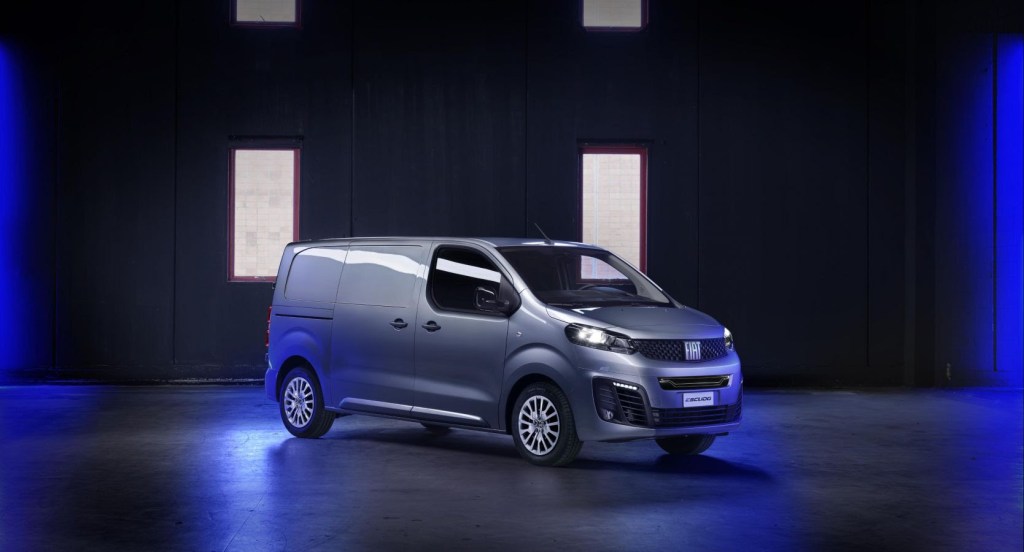
A new Fiat Scudo is available for ordering. This new Scudo, after the E-Ducato, is the second Fiat Professional commercial vehicle also available in an electric version.
This is another important step in Fiat’s Electric journey. Of course, here we also await a Hydrogen version soon. The Scudo runs on the same platform as the Citroën Jumpy, and is built in the same French factory. So it is certainly in the cards that it will also be converted to Hydrogen in Rüsselsheim…
The Scudo for now has a 50- or 75-kWh battery, and offers a range of up to 330 km (WLTP)
Flexibility is important in the cabin, and thanks to the “Moduwork”, it can commute the double passenger seat bench in a workstation and in a loading bay extension.
The “car-like” driving comfort, the “urban-fitting dimension” (max height 1,9mt), the ergonomic cockpit and complete set of ADAS and safety features delivers to the customer a stress-free, zero-emissions together with outstanding comfort, according to Fiat.
The Scudo is available with full-electric and diesel powertrain with manual or automatic transmission and can now be ordered in four versions and up to three lengths: Van, Crew Cab, Cab with platform, and Combi M1.
By the way, did you know that Stellantis will produce the Fiat Scudo also in Russia and export them to other markets?
Stellantis owns a 70% stake in a car plant in the Russian city of Kaluga, where it plans to produce the vehicle by 2022. Mitsubishi owns the remaining 30% stake…
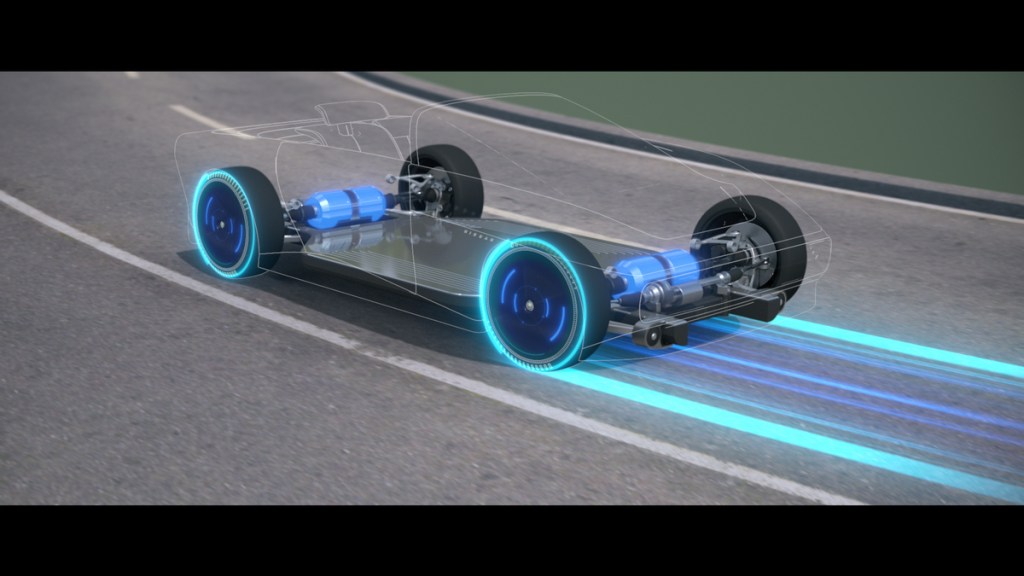
The development of fuel cell technology is now taking on a new dimension at CITROËN with the production of the first ë-Jumpy Hydrogen. Indeed, the CITROËN ë-Jumpy Hydrogen, assembled in France in the SevelNord-factory, is being adapted to hydrogen in the hydrogen-fuel cell expertise center of the STELLANTIS-group in Russelsheim, Germany…
This ë-Jumpy Hydrogen has therefore the same technical specifications as its Opel sister car, the Vivaro e-HYDROGEN. Like the Opel, it retains a 10.5 kWh lithium-ion battery, which provides dynamic peak power when required, for example, at start-up and under acceleration. Since the battery covers power needs in such situations, the fuel cell can run at optimum operating conditions.
Post-production : Astuce Productions
Citroën also wants their car to be put to the test in daily practice as soon as possible. This first ë-Jumpy Hydrogen will be delivered in the coming days to the SUEZ Group, which is preparing to test this model on a large scale at its Carcassonne site, a pilot site where SUEZ is investing in the production of green hydrogen, an important challenge for the coming years.
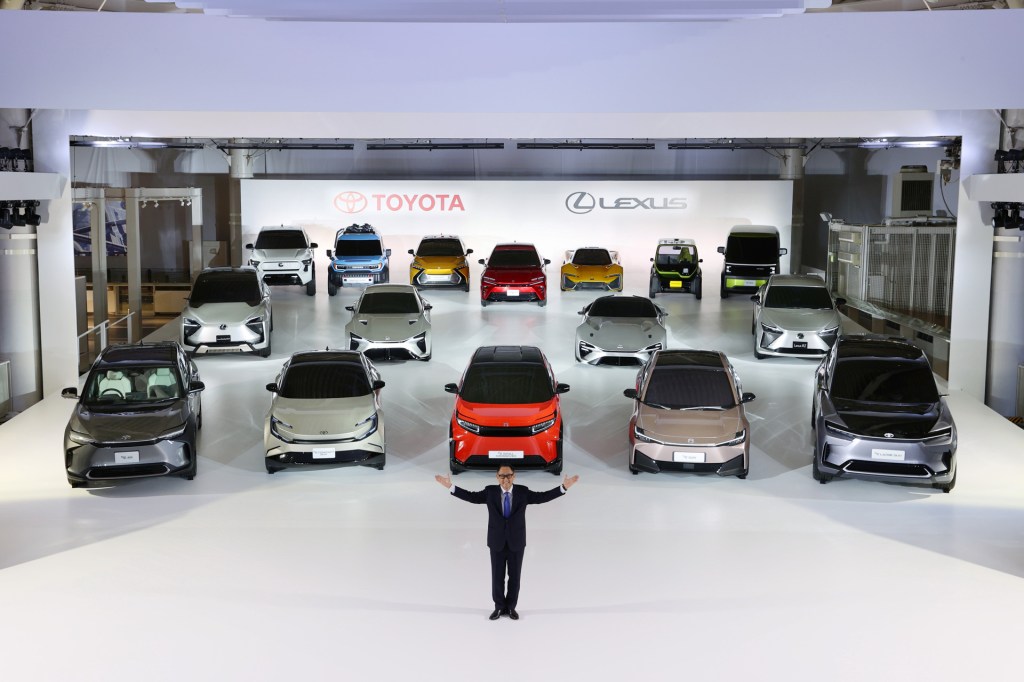
Toyota now takes the BEV market very seriously: Akio Toyoda, President of the Toyota Motor Corporation, seen on the photo above, today presented news concerning the company’s carbon neutrality strategy, by outlining its plans to offer 30 battery electric models by 2030 (Toyota & Lexus combined).
The company expects total global battery electric vehicle sales to reach 3.5M by 2030, and this announcement underpins the plan of for a 100% CO2 reduction in all new vehicles sales by 2035 in Western Europe.
Toyota’s bZ (beyond Zero) battery electric family in Europe is also soon to expand with introduction of a compact SUV as follow up to bZ4X launch. Not less than three battery electric ‘Toyota bZ’ vehicles are planned for Europe by 2025.
Toyota will further increase its investment in batteries from the 1.5 trillion yen – which was announced in September – to 2 trillion yen (15 billion euros).
The Lexus electrified sport will have formidable performance and range…
Now let’s turn the spotlight on Lexus:
Lexus aims for 100% battery electric mix in Europe, North America and China by 2030
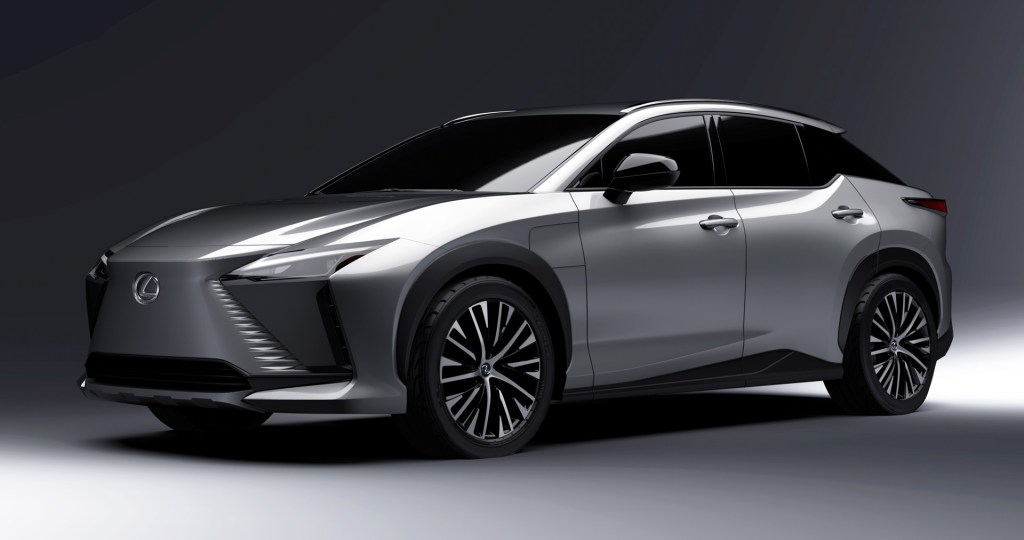
The full name of the new Lexus BEV (that will be launched towards the end of 2022) was revealed: the Lexus RZ450e. See the photo here below…
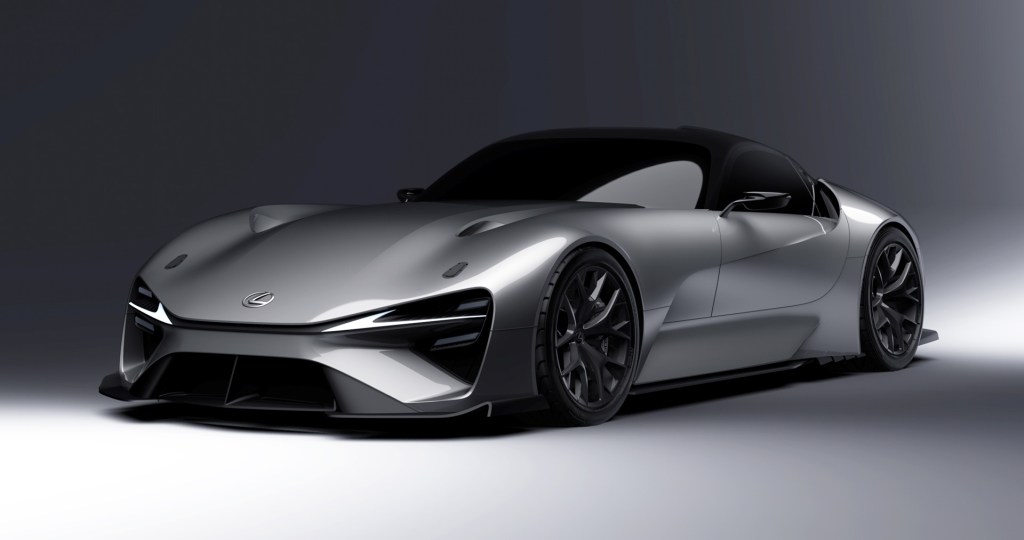
The Lexus Electrified Sport (Sports BEV) concept was also shown: it offers impressive Lexus driving performance, with an acceleration time that will be in the low 2 second range and a cruising range over 700km.
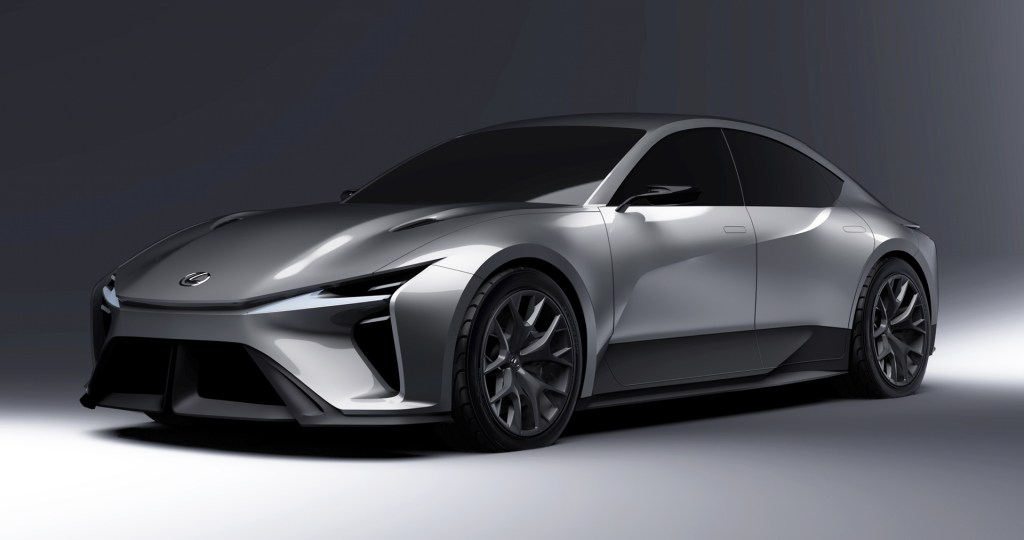
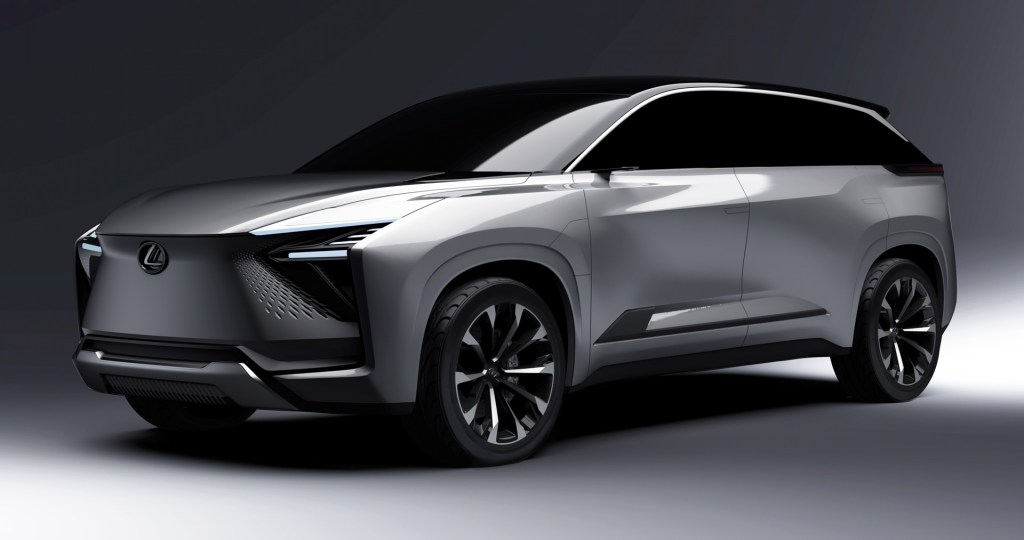
There were also two other future concepts were shown: the Lexus Electrified Sedan (BEV Sedan), and Lexus Electrified SUV (SUV BEV). We show you the photos here.
The Lexus electrified sedan…
More interesting Toyota/Lexus news to come. Faithful readers know that we are the a satisfied owner of a midnight blue Lexus CT 200h, which proves to be not only frugal with an average consumption this year of 4,7 liter/100 km, but also utterly reliable and recently passed the yearly technical inspection with flying colours. A report will follow soon. Stay tuned!
Times are changing in our electronic age, and fast. Manufacturers will have to build cars with an open software-defined platform, and three new platforms will arrive as early as 2024… says Stellantis.
Indeed, Stellantis N.V. today mapped out its software strategy to deploy next-generation tech platforms, building on existing connected vehicle capabilities to transform how customers interact with their vehicles, and to generate approximately €20 billion in incremental annual revenues by 2030.
This transformation will move Stellantis’ vehicles from today’s dedicated electronic architectures to an open software-defined platform that seamlessly integrates with customers’ digital lives. It greatly expands the options customers have to add innovative features and services via regular over-the-air (OTA) updates keeping vehicles fresh, exciting and updated years after they have been built.
“Our electrification and software strategies will support the shift to become a sustainable mobility tech company to lead the pack, leveraging the associated business growth with over-the-air features and services, and delivering the best experience to our customers,” said Carlos Tavares, Stellantis CEO. “With the three all-new AI-powered technology platforms to arrive in 2024, deployed across the four STLA vehicle platforms, we will leverage the speed and agility associated with the de-coupling of hardware and software cycles.”
Stellantis plans to invest more than €30 billion through 2025 to execute its software and electrification transformation.
The Stellantis software strategy works hand-in-hand with the Company’s vehicle electrification plans, detailed at EV Day in July 2021, which targets that more than 70 percent of its vehicle sales in Europe and more than 40 percent of vehicle sales in the United States will be low emission vehicles (LEV) by 2030. Each of the Company’s 14 iconic brands is committed to offering best-in-class fully electrified solutions.
More about this, and the strategic partnership with suppliers and software companies it implies, will follow soon!
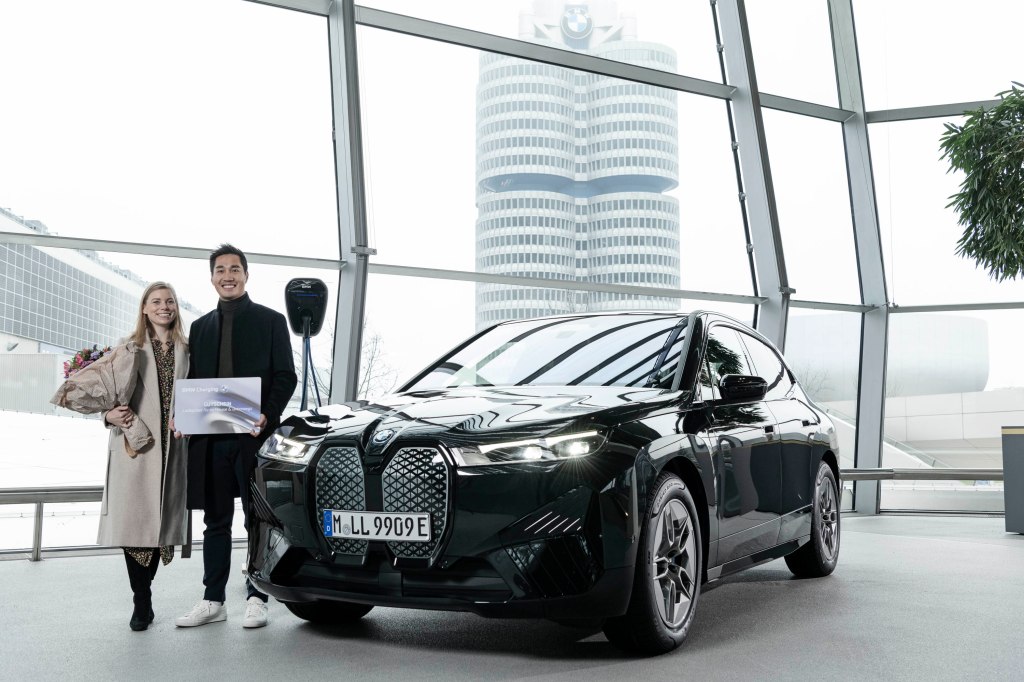
Shortly before the end of the year, the BMW Group celebrated the delivery of its one-millionth electrified vehicle: Pieter Nota, member of the Board of Management of BMW AG responsible for Customer, Brands and Sales handed over the milestone vehicle, a BMW iX xDrive40 (Power consumption in kWh/100 km: 22.5-19.3 WLTP), to its owner at BMW Welt on 6 December.
The company included a special bonus with the delivery: The customer not only received the keys for his new vehicle, but also a BMW Wallbox, including installation, to enable safe and convenient home charging, as well as a credit for public Europe-wide charging with BMW Charging.
“The delivery of our one-millionth electrified vehicle marks a milestone in our transformation – and we already have the next one in our sights: We aim to break through the two-million mark in just two years,” said Nota. “Thanks to our steadily growing product range, we are setting ourselves ambitious sales targets, in particular for fully-electric vehicles: In 2022, we aim to double this year’s sales. By 2025 the BMW Group will have delivered around two million fully-electric vehicles to customers. We expect at least one out of every two BMW Group vehicles sold to be fully electric by 2030,” Nota continued.
The BMW Group released two key innovation flagships, the BMW iX and the BMW i4, onto the market in mid-November. Both models are being very well received by customers worldwide – as reflected in new orders from around the globe
Over the next year, the BMW Group will expand its electrified product line-up to include fully-electric versions of the BMW 7 Series and BMW X1. The high-volume BMW 5 Series will be added to the electric portfolio in 2023. The successor to the MINI Countryman and the all-electric Rolls-Royce Spectre will follow. By 2023, the company will already have at least one fully-electric model on the roads in about 90 percent of its current market segments. Over the next ten years or so, the BMW Group plans to release a total of about ten million fully-electric vehicles onto the roads.
The Neue Klasse, which is uncompromisingly geared towards electric drive trains, will make a significant contribution to BMW Group sales volumes from the middle of the decade.
The MINI product range will already be exclusively all-electric by the early 2030s and Rolls-Royce will be an all-electric brand from 2030 on. All future new models from BMW Motorrad in the field of urban mobility will also be fully electric…brave new world!
We will drive for you at the end of this year the latest Qashqai, and look forward to have a go next year at their new (EV powered) products; In the meantime, there is some interesting Nissan news.
Did you know that by 2026, this is merely within some four years, more than 75% of all Nissan passenger cars sold in Europe will be electrified?
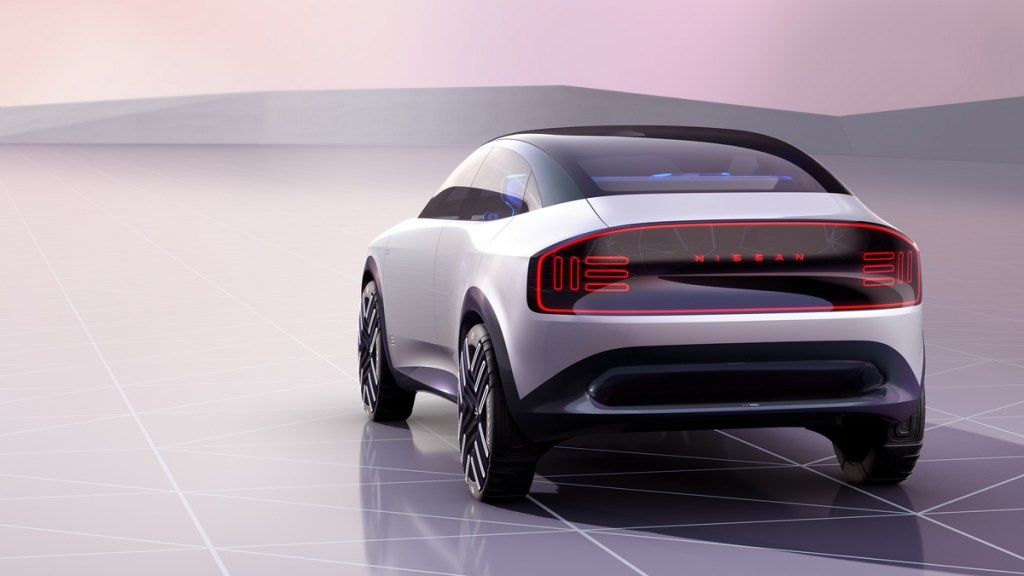
Nissans “CHILL OUT” concept foreshadows the future 100% electric crossover to be built in Sunderland, and there is a new battery recycling facility planned in Europe…
Just read further!
Hans Knol ten Bensel
Nissan Motor Co. Ltd. Unveiled the Nissan Ambition 2030, the brand’s new long-term strategy that goes beyond mobility.
Earlier this year, Nissan launched the EV36Zero concept, the world’s first fully integrated EV production ecosystem, which connects mobility and energy management to help achieve carbon neutrality for Nissan. The future hub is centered around the production facility in Sunderland, UK, and will include the production of an EV, a new giga production facility and use of 100% renewable electricity. Initially, £1 billion will be invested.
The AMIEO Region, centered on the EV36Zero, will play a leading role in realizing the “Ambition 2030” vision, which will help Nissan achieve carbon neutrality across the entire lifecycle of its products by fiscal year 2050. Here are some key points:
By the end of fiscal 2023, Nissan will offer electrified versions of all models offered in Europe, and by fiscal 2026, more than 75% of all Nissans sold are expected to be electrified.
The now-unveiled CHILL OUT crossover concept, as announced in Sunderland in July as part of the EV36Zero project, uses the Renault-Nissan Alliance CMF-EV platform to deliver the European handling and performance customers expect. The model has a sleek and modern design, is both attractive and aerodynamically optimized, fun-to-drive, has advanced safety technologies and has a practical and comfortable interior, according to Nissan.
Nissan plans to expand battery recycling and reuse facilities outside of Japan with a new location in Europe during fiscal year 2022. This infrastructure will support a circular economy for energy management. Nissan plans to fully market its ‘vehicle-to-everything’ and ‘home battery’ systems in the coming years.
Building on the success of the Nissan LEAF, Nissan will soon introduce innovative e-POWER technology in the all-new Qashqai and X-Trail. With the 100% electric crossover Ariya and the future all-electric Townstar Van on the way, an electrified European model program is in the works.
‘In the past period, Europe has been leading in the transition to electrification. Our goal for the next decade is to accelerate this development, with new products and technologies that will enhance the driving experience for Nissan’s customers,” said Guillaume Cartier, President of Nissan AMIEO Region.
Not only will we be offering an electrified version of every Nissan model in Europe, our 360-degree vision of sustainable mobility also means using 100% renewable electricity in our EV Hub in the UK. New battery recycling and reuse facilities will also be built in Europe.
To spearhead the transition to full electrification and carbon neutrality, our teams and products in Europe will serve as a source of information and support for our plans for electrified cars in the rest of the AMIEO Region and other markets.”
Bold new plans… we will report on them regularly as they unfold!
The Kia Niro is already a few years amongst us, first electrified as hybrid, then plug-in hybrid, and finally as a “pure” EV.
The competition has become a lot stronger since its introduction, notably with newcomers as the Volkswagen ID.3, the Peugeot 2008 and the Citroën ë-C4, but this Kia still has a lot of qualities which make it still earn very well an excellent place its segment. Of course, Kia is ready for this competition, and at the moment of this test going to press, it presents a completely new version of the Niro at the Seoul motor show, but the present model is still relevant enough to put it through its paces for you here.
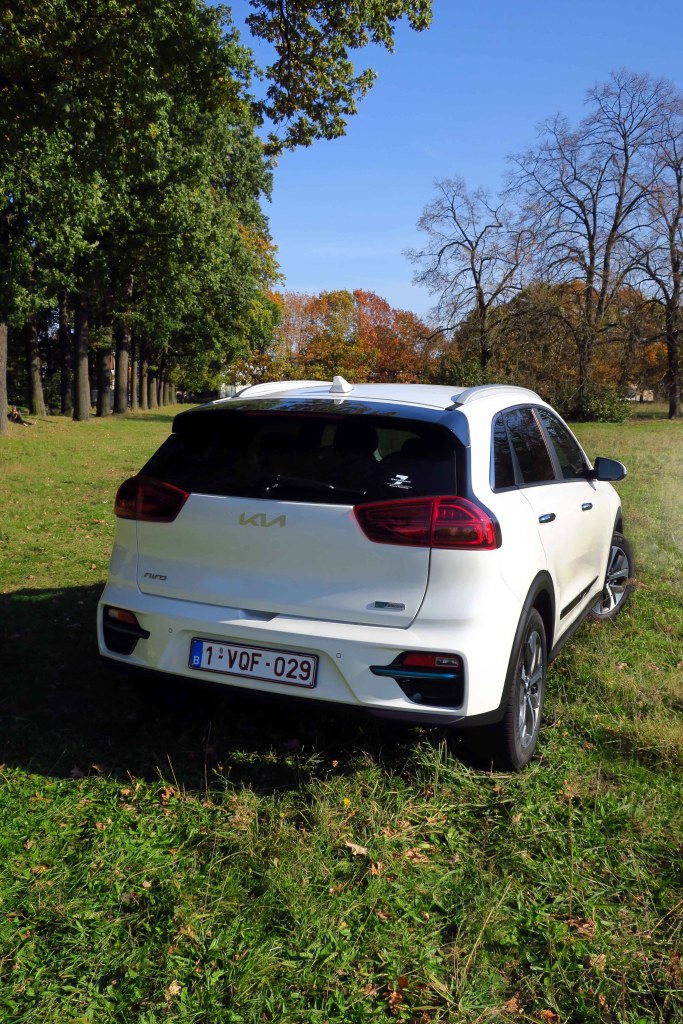
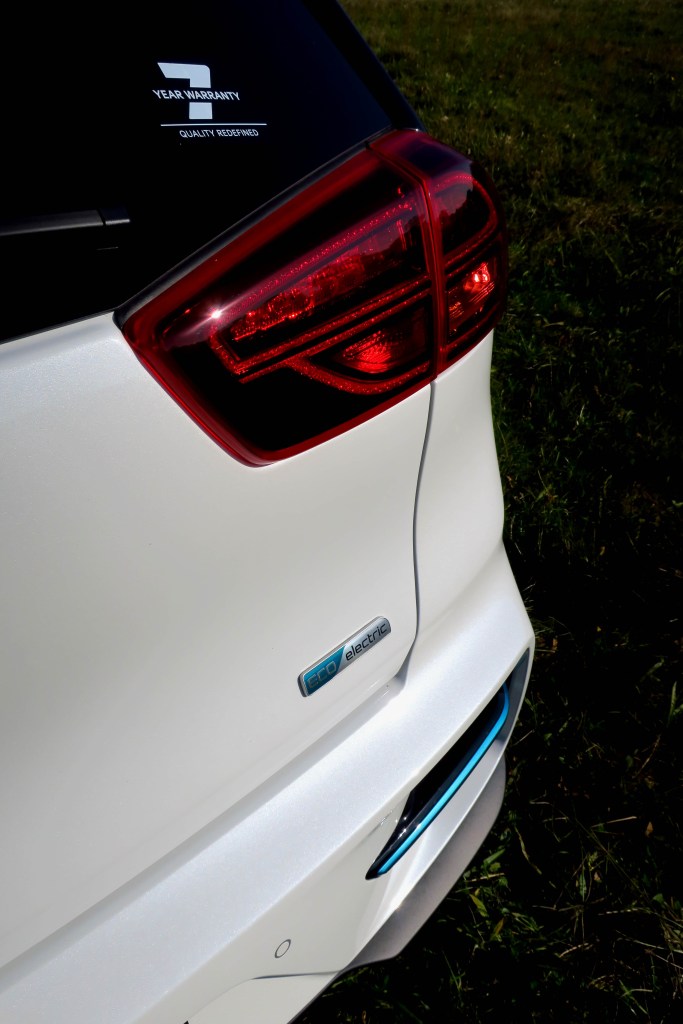
We should also not forget that this Kia EV with its 64 kW battery set the trend towards longer ranges: according to the WLTP norm, it is still good for 455 km…and on top of that, it offers very good value for money, with a 7 year guarantee!
Hans Knol ten Bensel
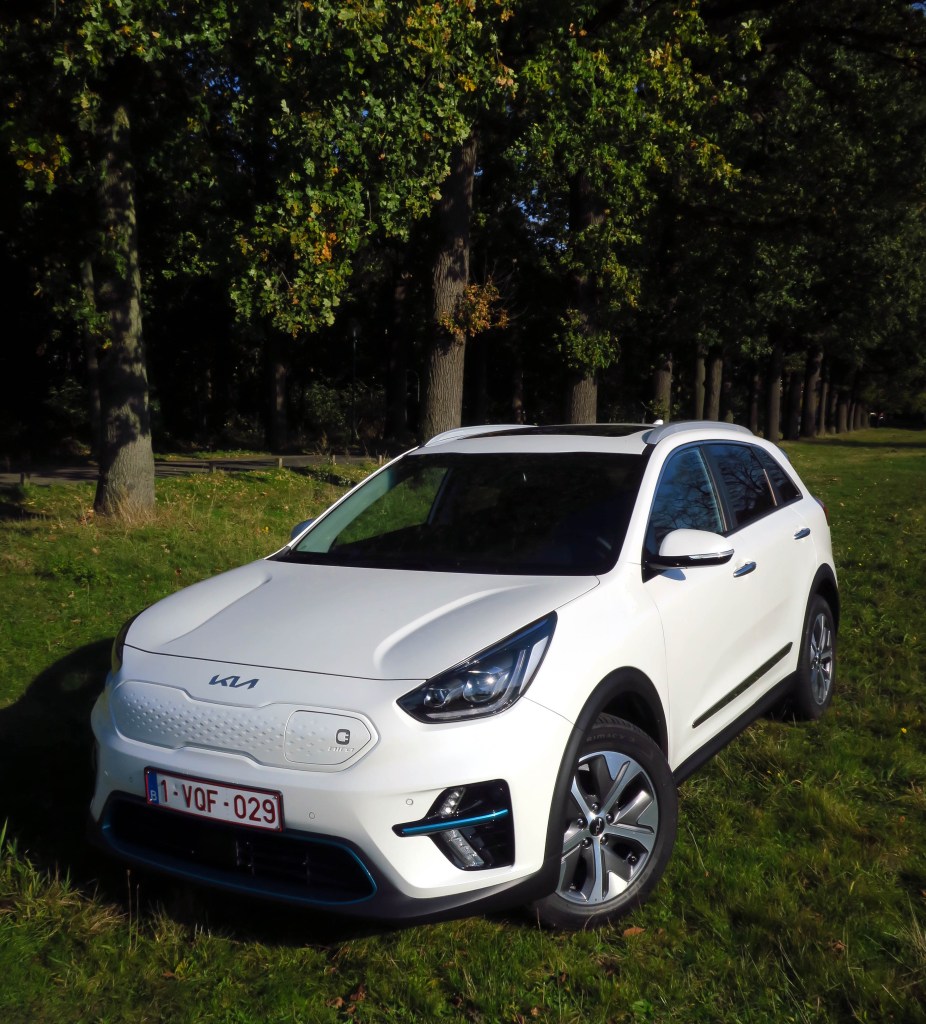
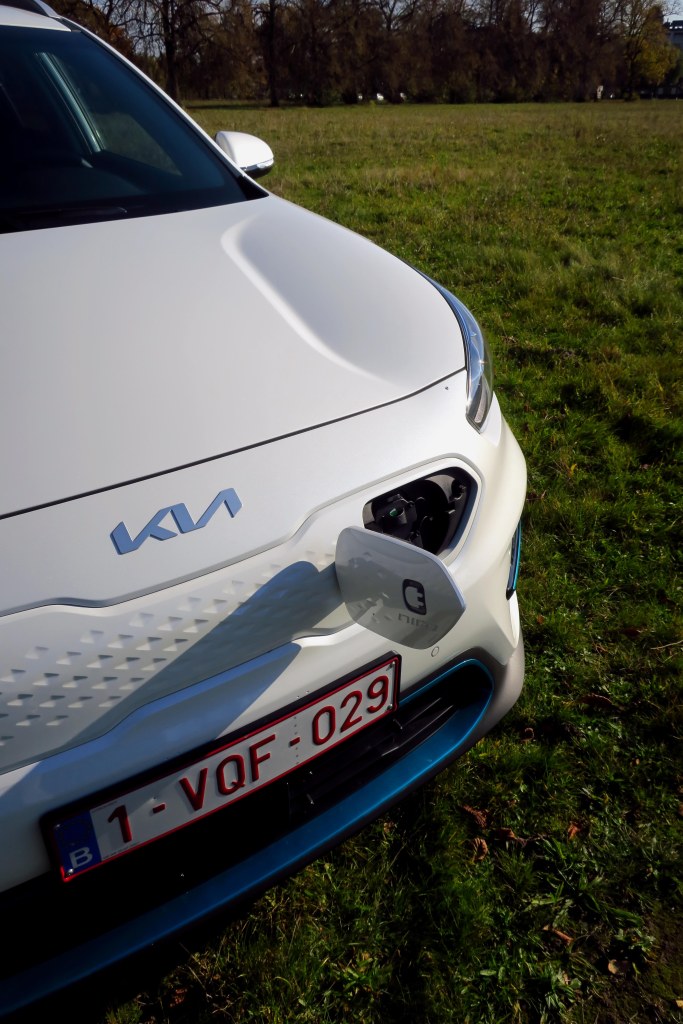
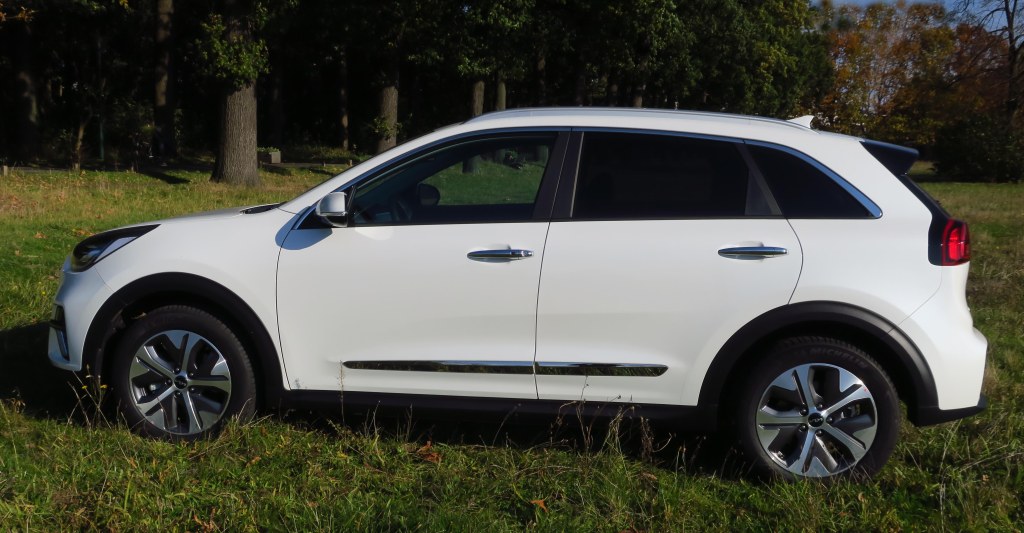
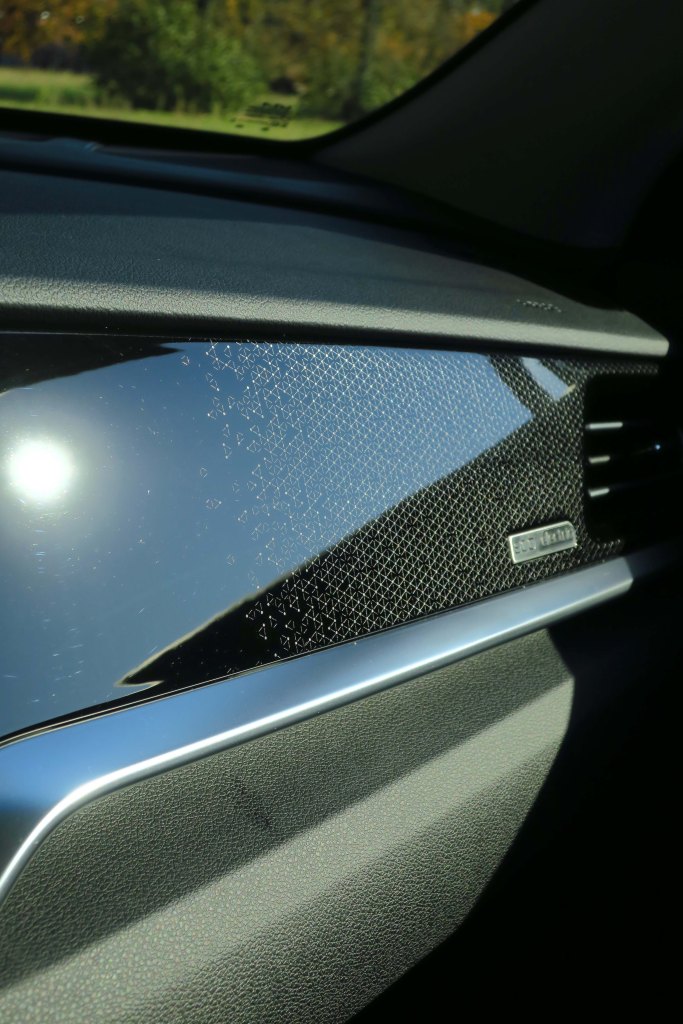
The Kia Niro still has very pleasing and now already familiar looks, with some specific blue coloured accents for the EV version. The front end clearly shows its EV character, and also the flap of the charging sockets is clearly visible. The cabin is well laid out, with classic disposition of instrumentation, commands and central touchscreen, so indeed one would hardly suspect sitting in an EV vehicle. This is all for the better, as one is very soon familiarised in using and driving this Niro.
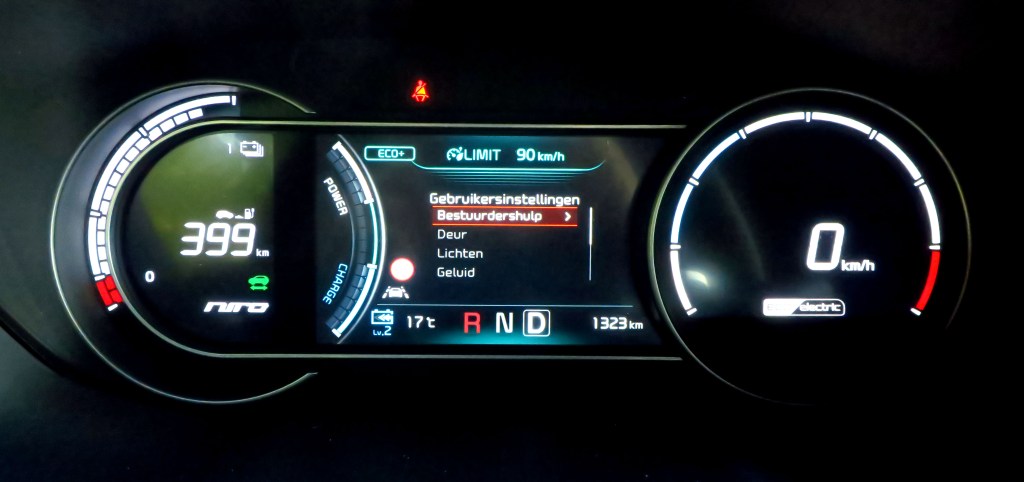
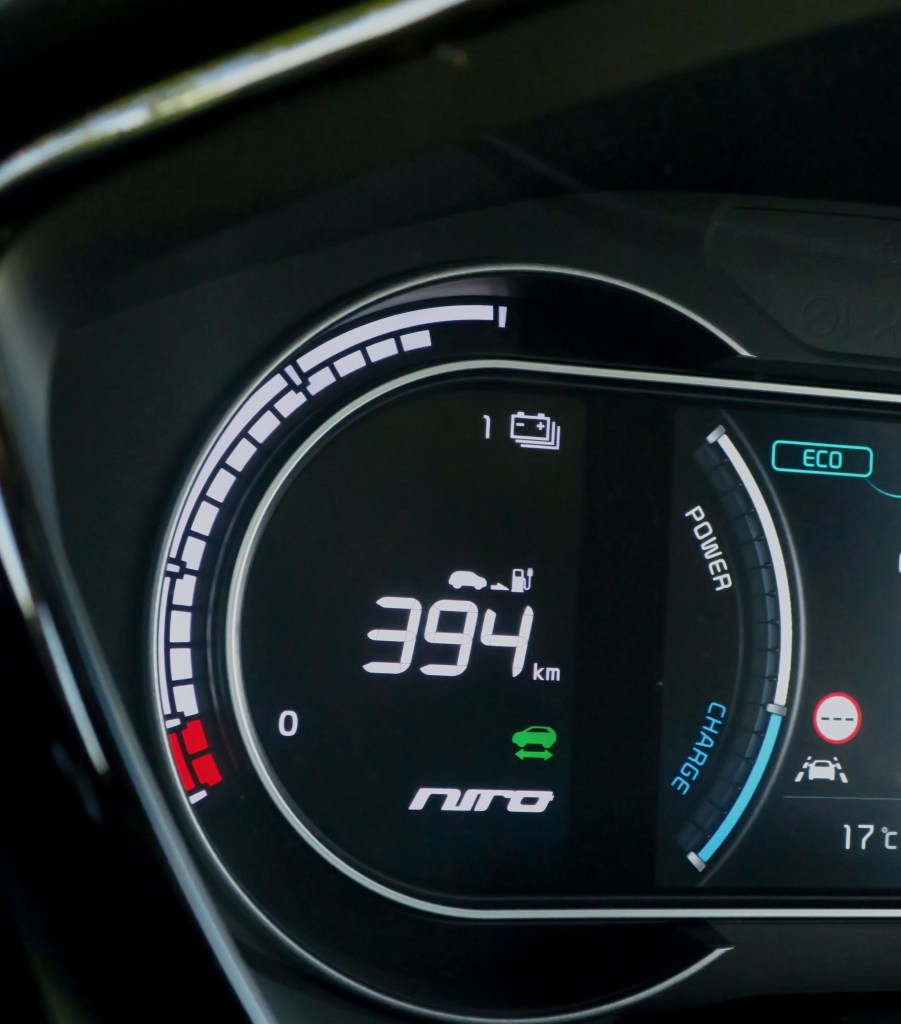
The display in front of you clearly indicates of course battery status and range, as well as the immediate or average consumption in KW/h. Soon one notices that this 150 kW or 204 HP Kia is quite frugal, where your driving style is of prime importance of course.
The manufacturer quotes 15,9 kW/h according to the overall quite realistic WLTP cycle. We took the test car on a lengthy trip to Holland, using the ECO mode throughout, and easily achieved an average of 17 kW/h.
It was delicious to be able to make this trip without the usual range anxiety, and on top of that to find plenty of public charging points in the Netherlands, not even 50 meters away from the house of the family member where we stayed over the weekend. All in all, in this ECO mode, a range of over 400 kilometers is even in more wintry conditions easily achievable when adopting a normal driving style.
Having said this, EV cars have decidedly come of age with our northern neighbours, where the e-Niro has been the top selling car in 2020 by the way…
Smoothness combined with power…
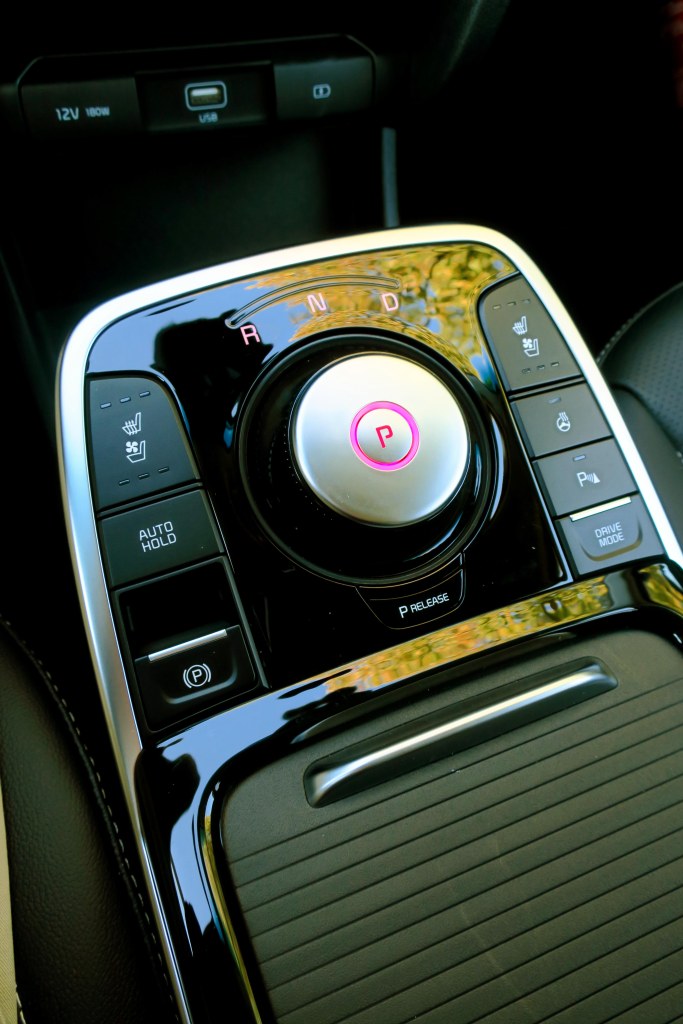
As a pure EV befits, “Zen” like feline and vibrationless power is for you to enjoy here. On the centre console is a familiar circular knob which lets you choose between drive and reverse, as we have seen in Jaguars and Land Rovers.
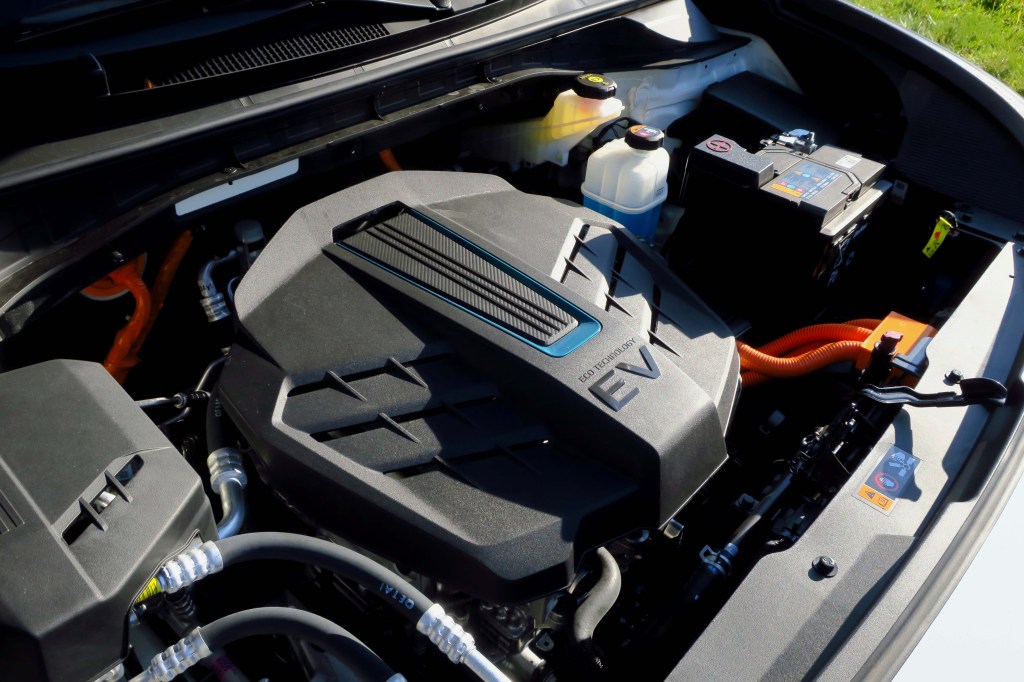
Off you go, and indeed, this Kia has under the hood what it takes. The front wheels are driven, and will pull you from 0 to 100 km/h in merely 7,8 seconds, which is no small feat as one knows that the kerb weight of the e-Niro is 1712 kg. Top speed is a very creditable 167 km/h. So performance wise, one is rather spoiled too, besides of course the uncanny smoothness and silence of the drivetrain.
There are paddles at the steering wheel column which let you choose the amount of regenerative braking, so “one pedal” driving is easy to achieve.
On the technical side, let us tell you here that our test car was equipped with the lithium-polymer 64 kW/h battery and that the permanent magnet synchronous motor has a power of 150 kW/204 HP and 395 Nm of torque.
For home charging, one is of course well advised to install a three-phase wallbox. With the optional three phase onboard charger, you can be fully charged in some 4,5 hours.
Roomy and practical
The e-Niro is quite roomy, with sufficient legroom also for taller passengers in the rear, with standard luggage space being a good 451 and 1405 liters.
With the rear cover in place, the volume is reduced to 280 and 1175 liters respectively. In the cabin, there is enough storage room in the central console and beneath the central armrest as well as the door bins. As we said, using infotainment and all the commands for heating/airco/ventilation is intuitive, and we also used the voice command to good effect for navigation amongst other things.
Safe handling
The e-Niro will not exactly invite you to throw it around corners, but its handling is fine to say the least. Sudden steering wheel movements will be met with initial understeer, with well controlled oversteer by the ESP when you lift the throttle. This e-Niro will not lean unduly in fast corners, has good straight line stability and is comfortable too.
Conclusion
The present e-Niro with its attractive range is still very much a desirable EV, combining excellent performance with low E-consumption. Add to this the good value for money considering the space and equipment found, with last but not least the 7-year warranty. You will agree that this EV-range trendsetter which will accompany you for many years in to wonderful “Zen” world of EV motoring and mobility.
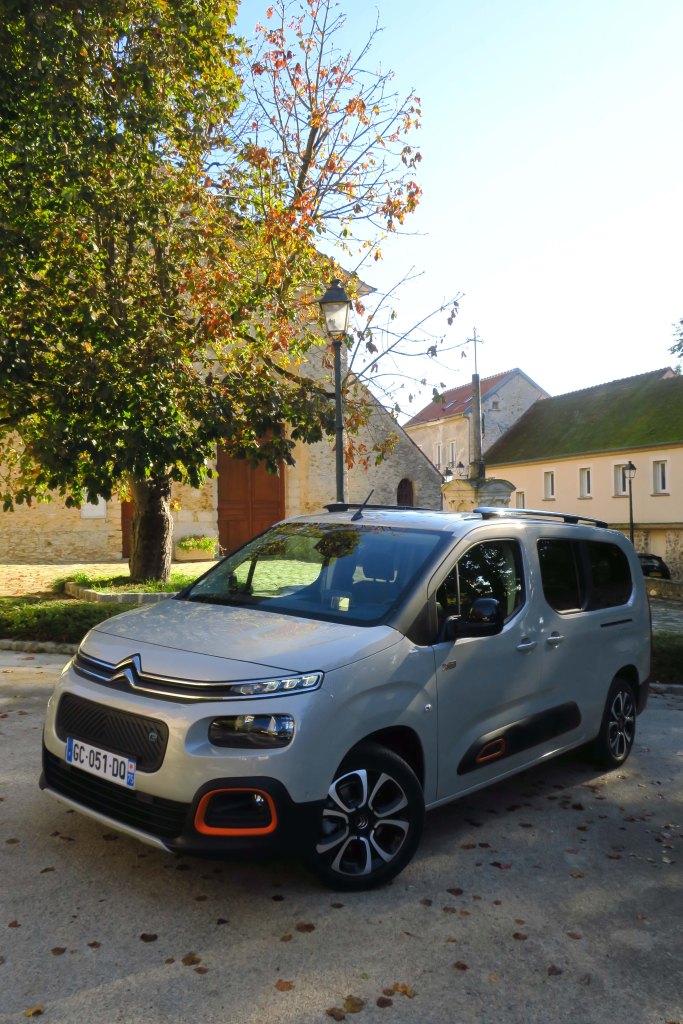
We drove the ë-Berlingo in the scenic surroundings of the Domaine des Maffliers, near Paris…
Electrification is now also expanding to commercial vehicles and popular minivans and family carriers like the Berlingo. We sat for a few hours behind the wheel of this spacious and endearing Citroën to enjoy all the delicious “Zen” refinements brought by electric propulsion, which totally transformed the driving experience of this Berlingo.
The Citroën PR and marketing team had carefully chosen a very scenic route around and in the woods of the Domaine des Maffliers, in the neighborhood of Paris. An excellent environment to get a taste the velvety power of its electric motor, to enjoy the seating and suspension comfort of this Berlingo.
We first tested the M version, which is 4,4 meters short, and thereafter the 4,75 meter “long” version. Suspension comfort and handling is virtually the same in both versions, and the EV drivetrain is identical. But then even more space is to be found in the “long” version, which can seat comfortably up to seven people.
Along the scenic villages near Paris with the “long” version…
A smooth performer…
The silence and utter smoothness of the electric motor totally transforms the driving experience. With its very comfortable suspension, one has the distinct feeling of sitting behind the wheel of a top class limousine, helped by the comfortable central armrest which supports your right arm and elbow, which has the only task to select the proper driving mode on the central selector.
But let us first tell you a bit more about the drivetrain. Citroën selected a 100 kW or 136 HP electric motor, fed by a 50 kW/h battery. Torque is sufficiently ample with 280 Nm. Top speed is limited to 135 km/h.
The driver has the choice between three driving modes, activated with a special so-called ë-toggle.
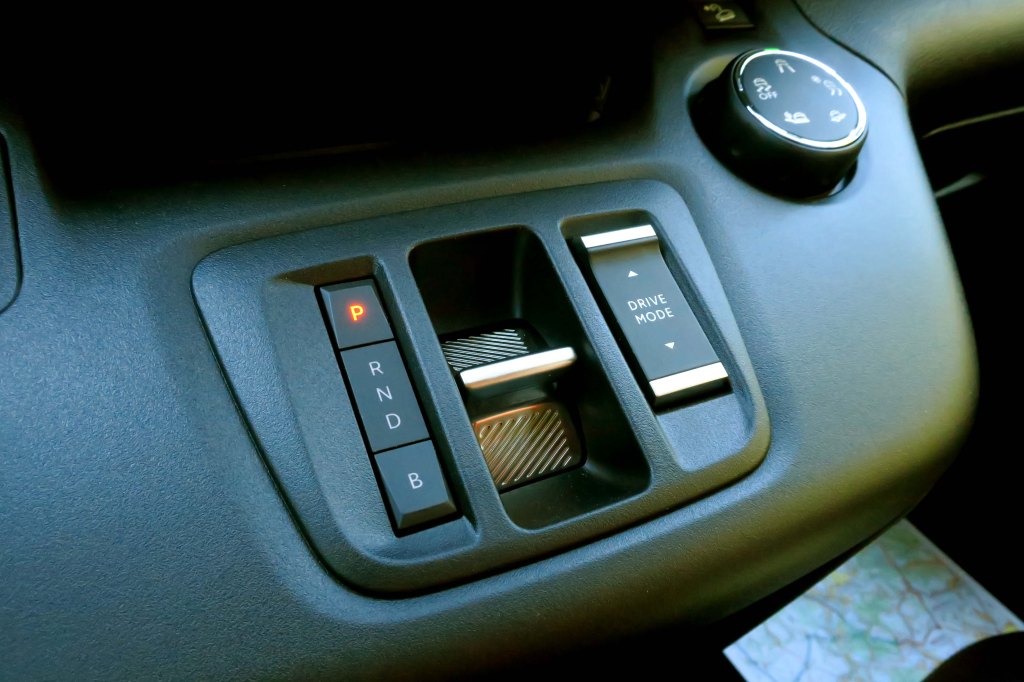
Comfortable simplicity: ë-toggle on the right for the drive modes, selector in the middle for reverse and drive, knobs for “P” and “B” to the left…
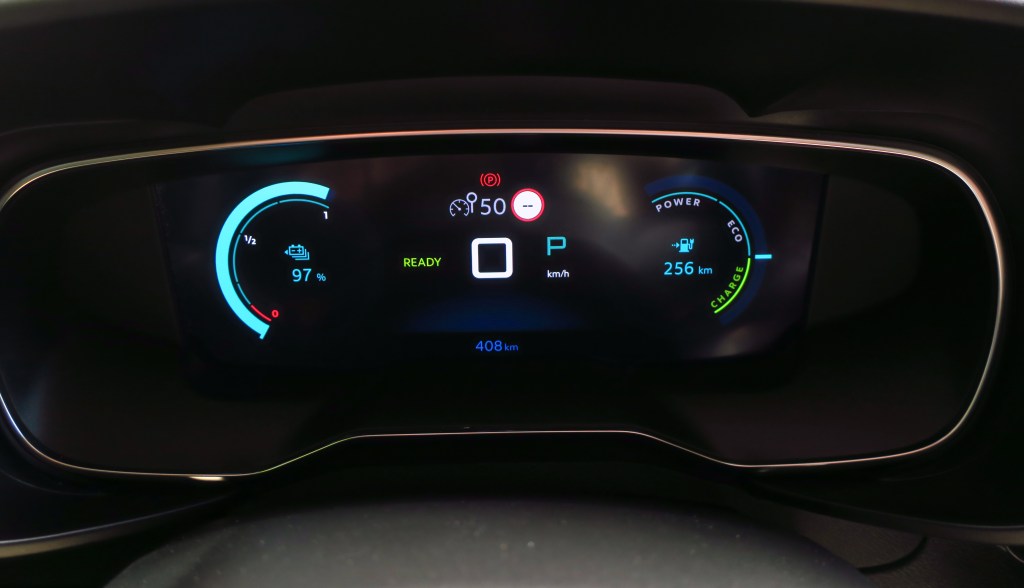
First, there is the so-called Normal mode, where the motor develops 80 kW/210 Nm, striking a good compromise between performance and economy. Then comes the Eco mode, with 60 kW/180 Nm, still quite sufficient in terms of liveliness we found, which gets you further on a full charge. According to WLTP, the range is then a good 280 kilometers. You also have to settle for reduced heating or airco power, but this remains still within comfortable limits. Finally there is the power mode, where the full 100 kW is at your disposal. Interesting of course when the Berlingo is heavily loaded, and/or you are driving in hilly or mountainous areas.
Simplicity is truth…
Of course there is also a “B” knob on the centre console, which lets you recuperate energy when you lift the throttle, and gives that “one pedal” driving opportunity when you adopt an anticipatory driving style, which you learn soon enough…
Spacious…
The battery pack sits snugly on the floor of the Berlingo, so the charging volume is not impaired at all. The M version has 775 liters luggage space, the XL version in 5 seat configuration brings this to a whopping 1050 liters.
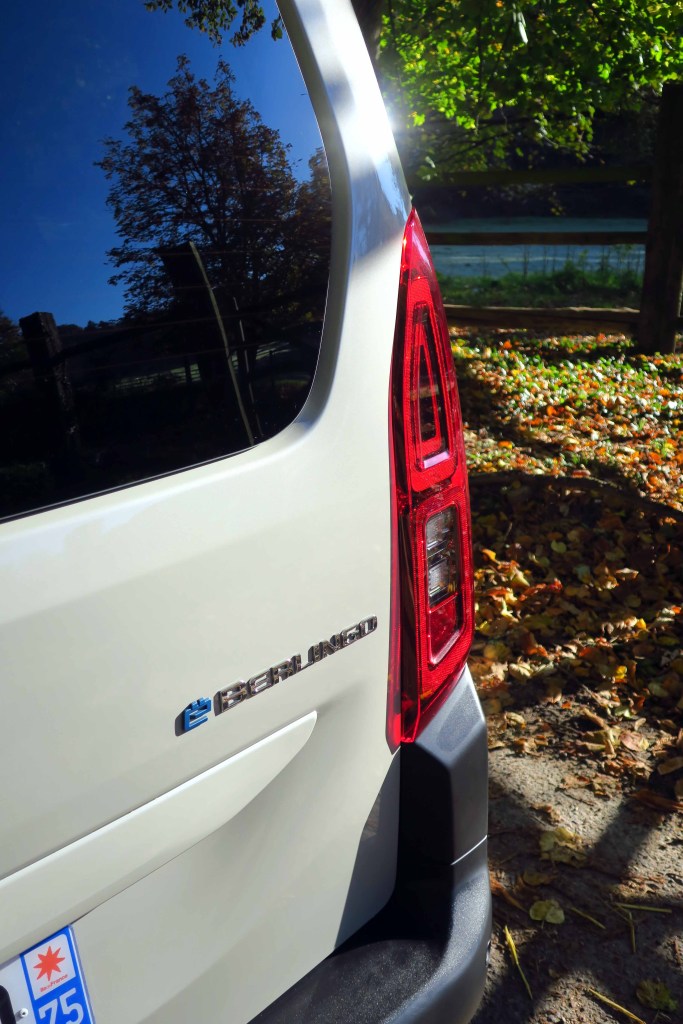
The ë-Berlingo proudly wears its badge…
The cabin boasts a further 167 liters of storage space, so this Berlingo makes you truly feel at home. This is a car which makes family life really easy…
… and easy charging
The practicality of a fully fledged EV stands or falls with the charging facilities, and we all know that the public charging situation in Belgium is nothing short of abysmal. Home or office charging is the answer for the time being, and here Citroën offers for its Berlingo plenty of opportunities.
Home charging can be done with the so-called Mode 2 cable, which is compatible with an 8A and/or 16 Amp socket. For fast chargers, both public or private, one needs an optional Mode 3 cable. This allows you to charge from 0 to 100 % in 7,5 hours if you have a single phase 7,5 kW wallbox. This is reduced to 5 hours if you have a three phase 11 kW wallbox.
Super fast charging is possible at public charging points up to 100 kW, and there one needs a mode 4 cable which is integrated in the charger. It then takes merely 30 minutes to charge the 50 kW battery up to 80 %.
The Berlingo leaves you the choice between three connected packages, connect assist, connect nav and connect play.
In the basic assist package you can get connected with a call center in case of emergency or accident, and via the My Citroën App you can be informed about range, charging status, mileage, next service, etc.
In the nav package, you can use voice command/recognition for interaction with the phone, navigation and radio functions. TomTomTraffic displays for you the best route under up to date traffic conditions.
The connect play feature sports Mirror Screen technology, compatible with Apple CarPlay™ and Android Auto.
Conclusion
Electrification is not an empty word at Citroën anymore…
The electric propulsion completely transforms the driving experience with this Berlingo, and this refined upper class panache makes this family friendly space car even more endearing and desirable. But not only for the family man. Every craftsman or public/private services worker/small entrepreneur who works in urban spaces will just love this EV version, which will be a soothing companion in his daily work life. After a stint behind the wheel, you will indeed wonder how we fared for decades without this full EV enjoyment and “Zen” progress…
Note that at this Citroën ë-experience day we also drove the full EV version of the C4. More about our driving impressions soon…





















 Autoprova - for the Connaisseur