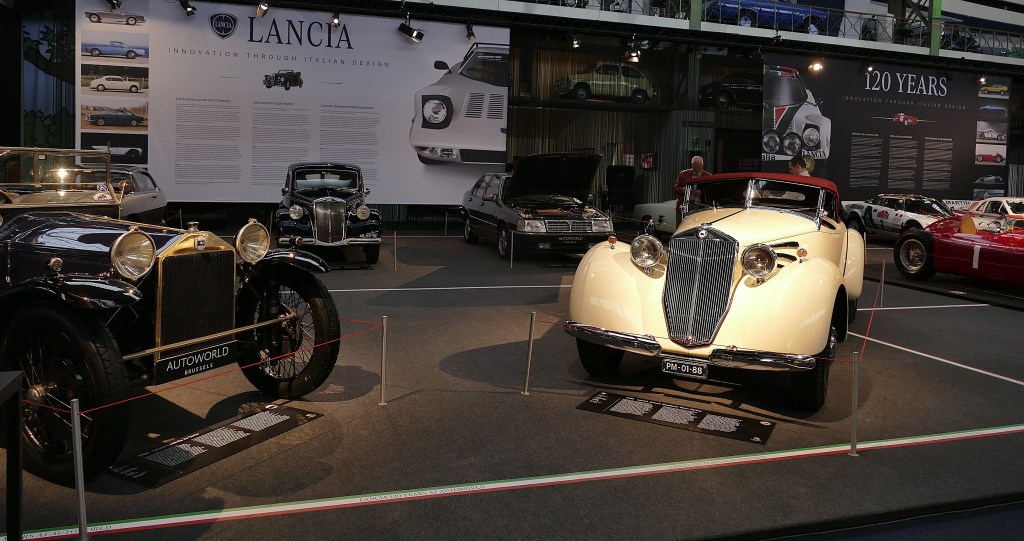
Autoworld Brussels has again an exquisite exhibition ready for us: until April 19 we can admire a carefully curated selection of about 12 absolutely iconic Lancias. It shows us the elegance and innovation through design, as the title of the exhibition indicates. But we would add, the pop-up exhibition also showcases innovation through ingenuity and engineering excellence.
The cars are beautifully displayed at the beginning of the vast and inviting central hall of Autoworld, taking you on a journey of more than a century of technical innovation, refined design, and engulfing you in its rich motorsport heritage.
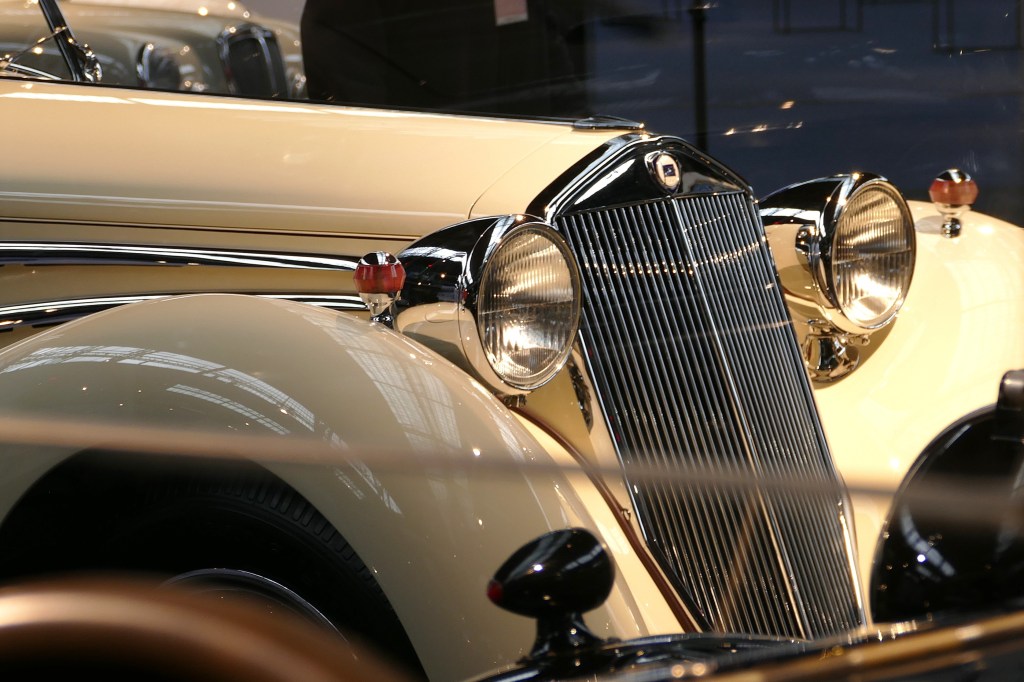
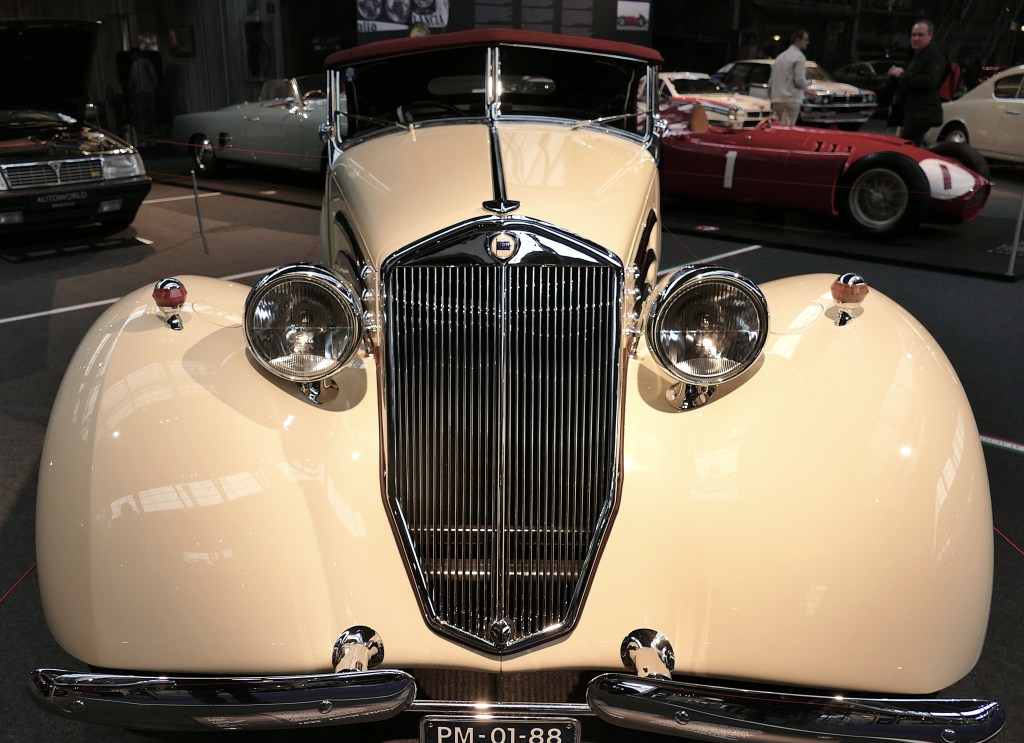
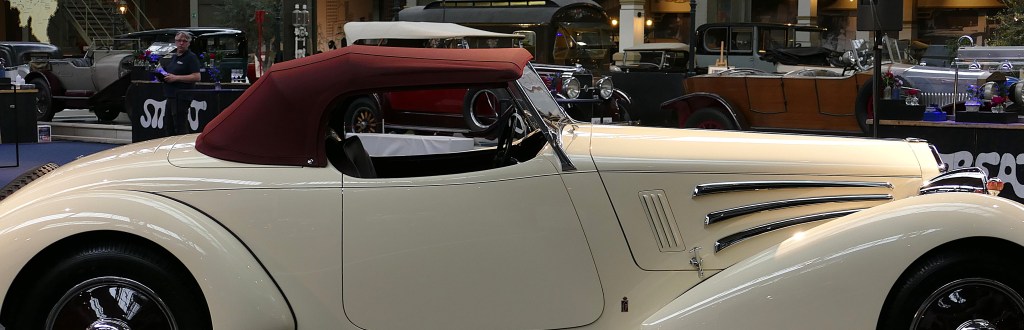
My eyes first fell on, at least to my taste, the absolute beauty of the show, the Lancia Astura Roadster by Pinin Farina. This 1935 Astura is a technical gem. The V8 engined car was introduced on the Paris Motor Show in 1931. This Astura on the show belongs to the third series, built between 1933 and 1937, with 1,243 units made.
The third-generation Astura was offered in short-wheelbase and long-wheelbase variants, and was powered by a new, larger engine. Indeed, it was enlarged from 2,6 to 3 litres, and the 17° narrow angle V8 single overhead camshaft engine now developed 82 hp. This short wheelbase you see on the photos was ideal for coachbuilders to show their talent.
ounded with the moral and financial support of Vicenzo Lancia, the Carrozzeria of Battista “Pinin” Farina witnessed a revival and produced breathtaking bodies. Of the just 328 “Corto” chassis built, many were clothed by Pinin Farina. The contours of this roadster are from the artistic hand of Mario Revelli di Beaumont, an independent stylist who worked actually for several “carrozzerie”…
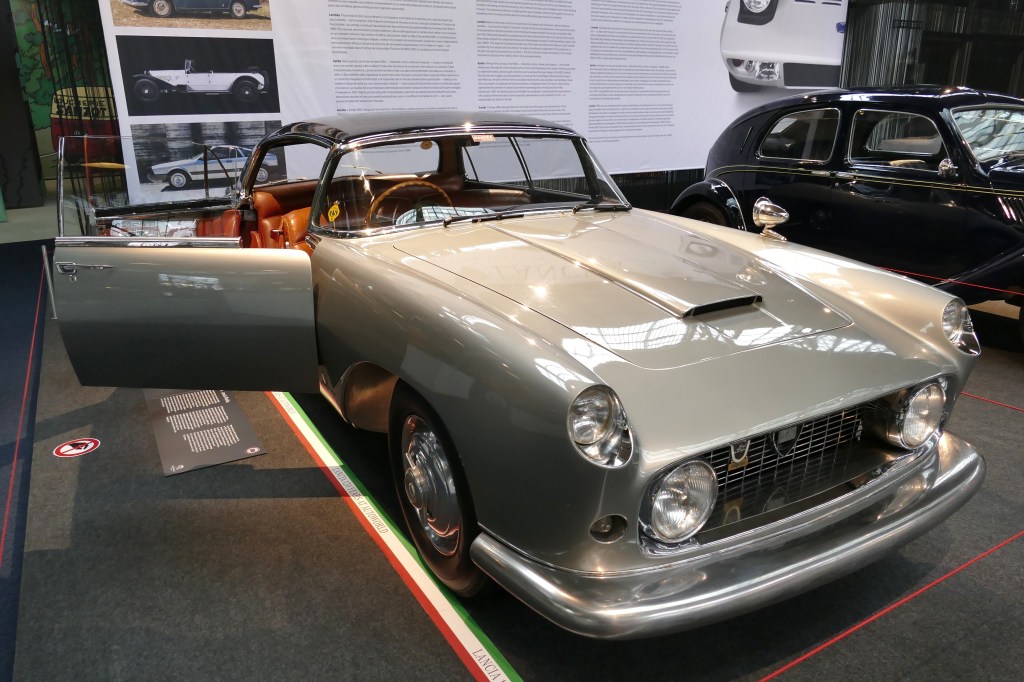
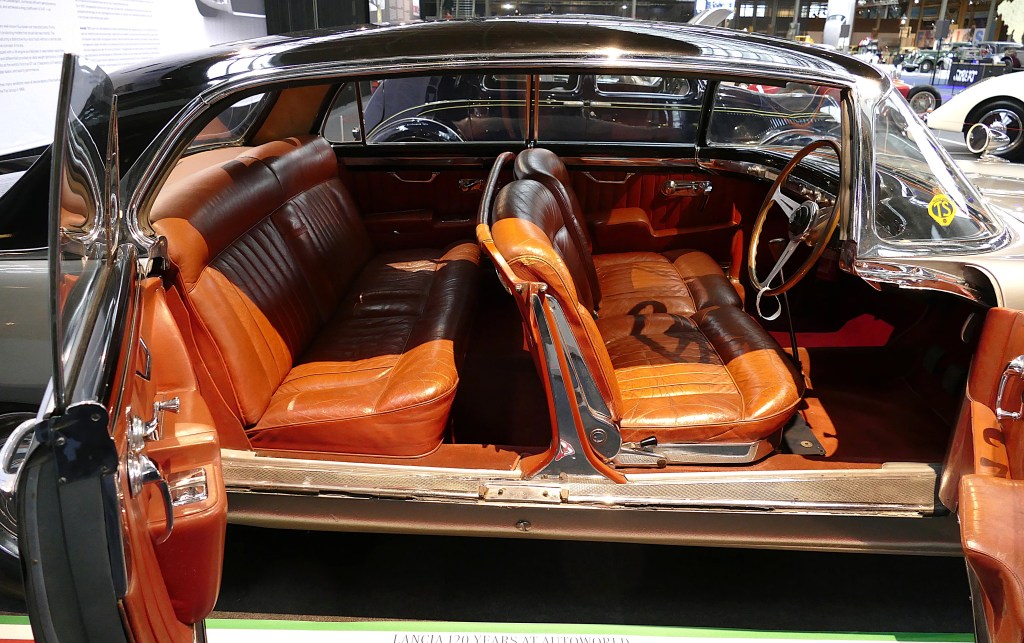
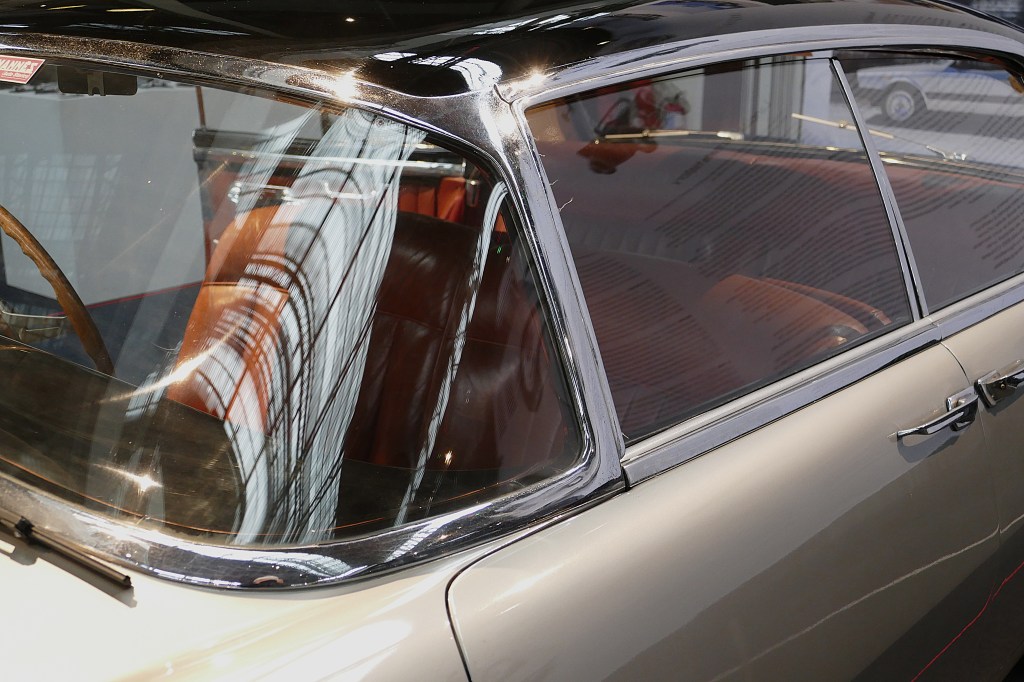
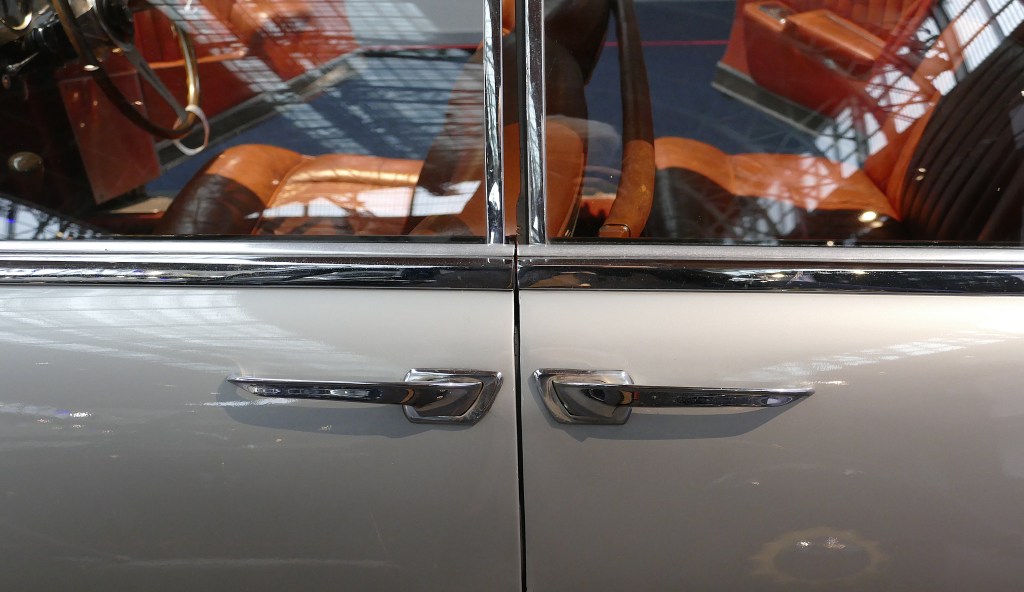
Another car by the hand of Pinin Farina was for me the Lancia Flaminia. I was therefore elated to see the conceptual predecessor of the Flaminia, the Florida. The “bellezza” and elegance of this car deeply moves me. Just look at the photos. The car was built by Pinin Farina on an Aurelia B56 chassis, and it was a technically quite daring four-door pillarless saloon.
It was shown on the 1956 Brussels salon, and as a young boy, I dreamt about it. Just like the Boano styled Ferrari’s, it was for me the pinnacle of what human art, intellect and craftmanship could reach in terms of sheer contemporary beauty.
The pillarless doors had to go in the production version, the Flaminia, therefore the elegance of this Florida truly stands out.
Much more to follow on this Lancia show at Autoworld soon, about the D50 racing car, the iconic rally cars like the Stratos… just remember, go and see it, it is on show until April 19.
Practical info: Autoworld, Parc du Cinquantenaire 11 1000 Brussels, Belgium.
Please note, the museum is closed Wednesday 11 March, Thursday 12 March and Monday 16 March 2026.
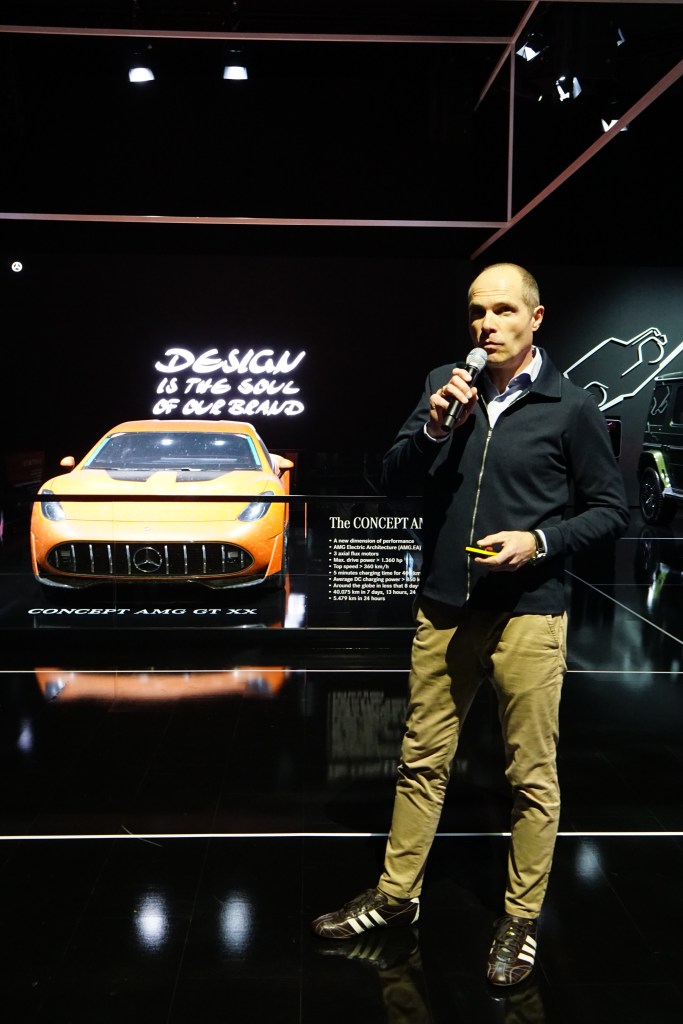
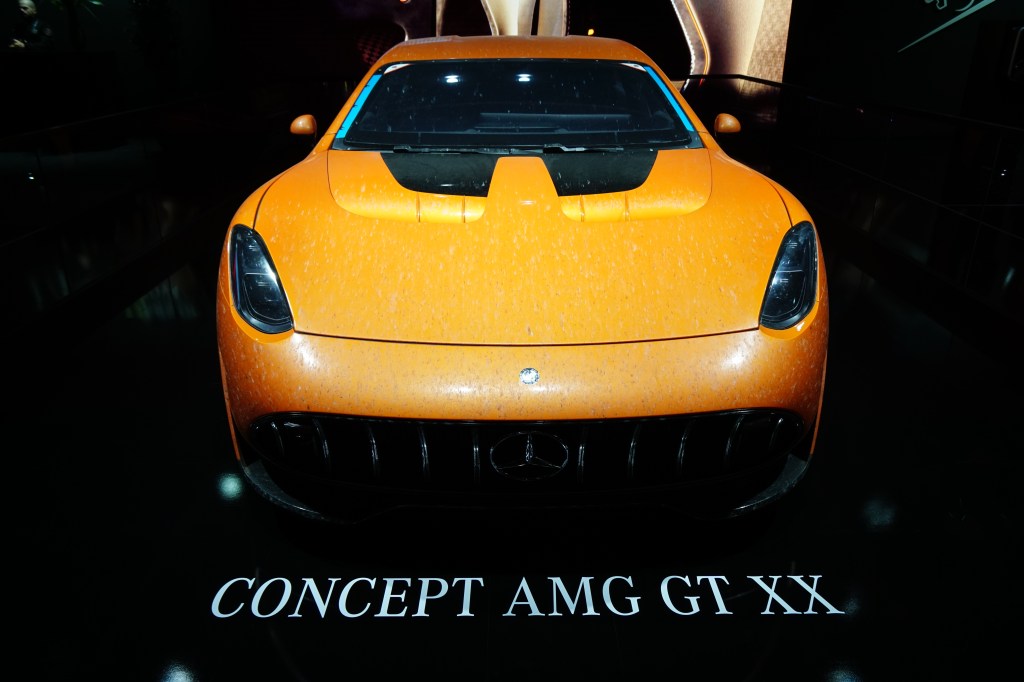
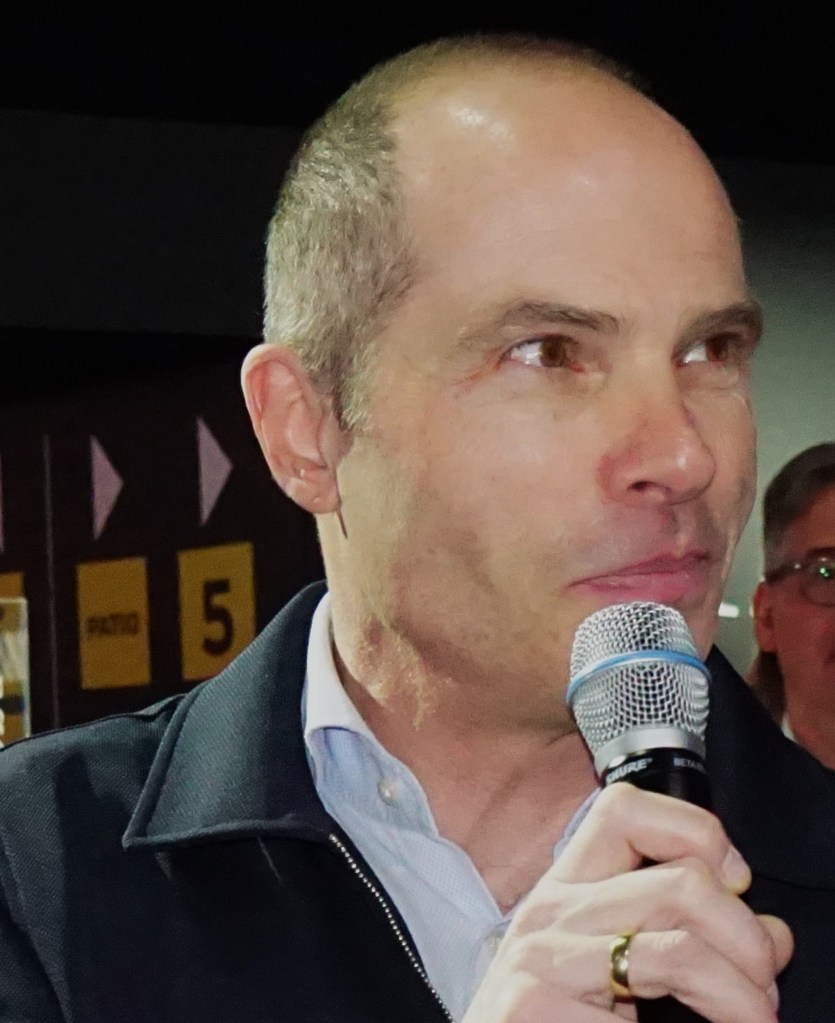
The latest Brussels Motor Show proved to be a treasure trove for us car enthusiasts. At the impressive wonderful Mercedes stand on the show we met on the press day with Robert Lesnik, Director of Exterior Design. In front of the iconic and already legendary Concept AMG XX, he presented styling examples of what Mercedes believes stands for the brand.
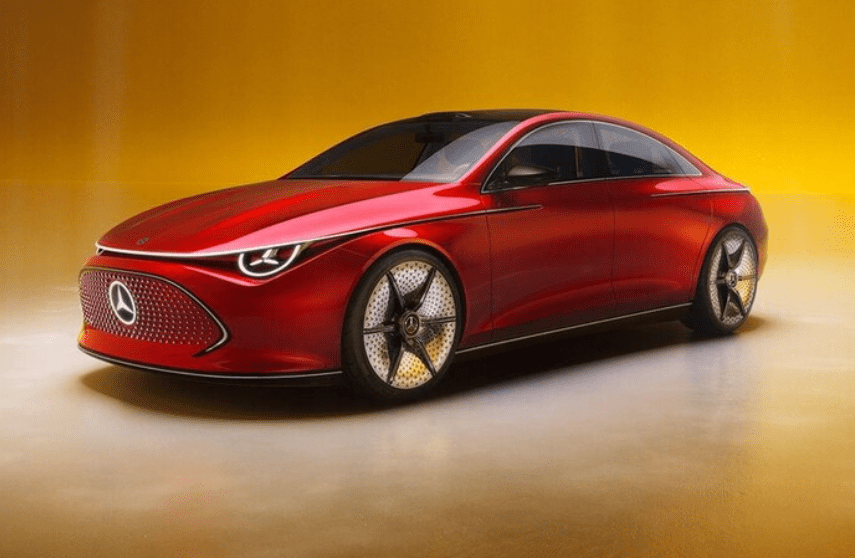
He started off with this AMG XX, and commented that this car embodies a rare combination a very aggressive sporting front end, the side view with the timeless proportion of the long bonnet, a very round shaped rear end and an amazing interior. He also showed the legendary Autobahnkourier, and he also focused on the grille of the 300 SLR Uhlenhaut Renncoupé, being so iconic and a typical design hallmark over the years for the sport coupés and cabrios of the brand. He also commented further on the Concept AMG that this car is the harbinger of what is to come for the series version of this AMG Electric sports coupé.
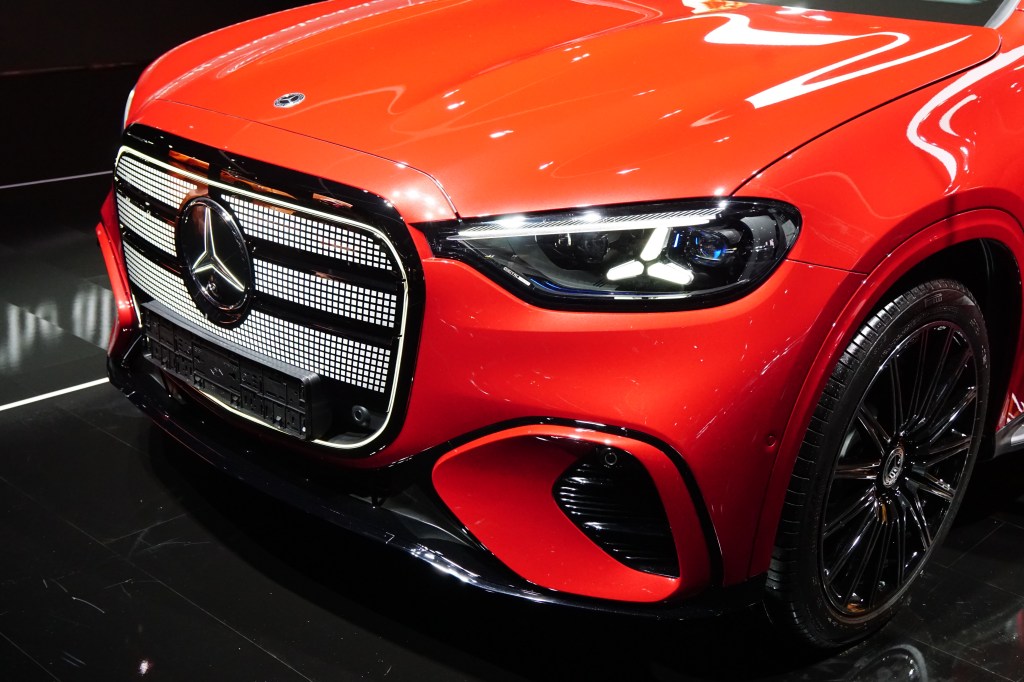
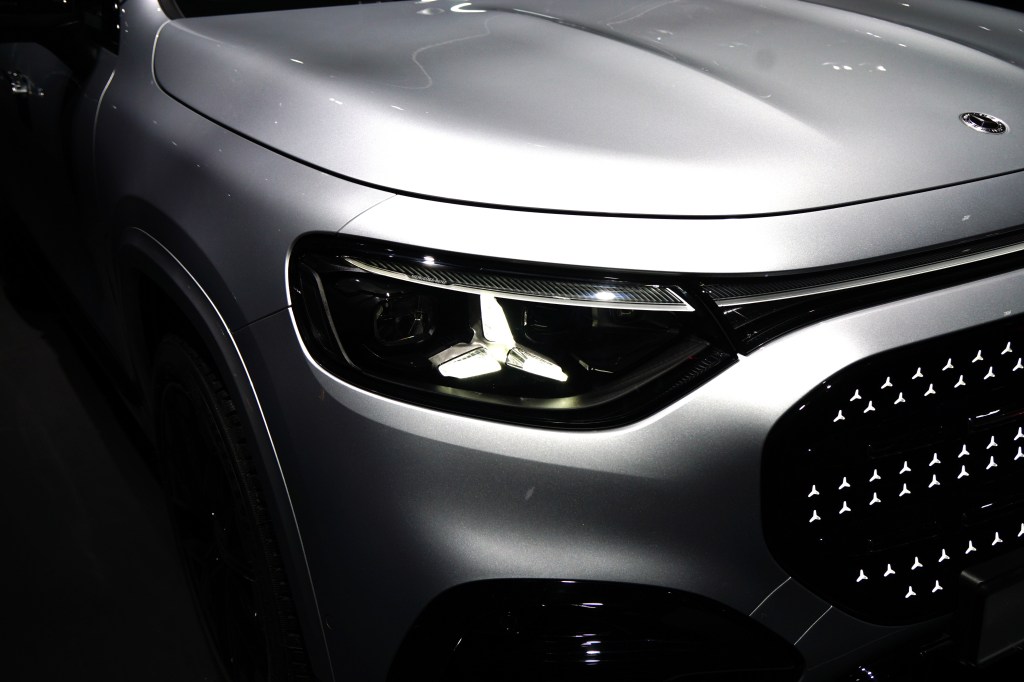
Robert Lesnik commented further: “For the new generation we were inspired by our past cars and design heritage, which doesn’t mean that we are doing retro design. You can see it on the radiator grille of the new GLC Electric SUV, with just three horizontal bars illuminated, it is a modern interpretation of a classic design icon.”
Beauty and attraction…
“There are two elements, beauty and attraction, which are the goals when we design a Mercedes”, Robert continued. Something that attracts the customer and what he perceives as beautiful.”
“Obviously, this goes for both the exterior AND the interior. There must be a certain power. I would say the sweet spot for every Mercedes is the three-quarter rear end perspective, where you really see the shoulder, and you see also a very iconic graphic with two roundish rear lights, with three lights for the AMG versions.”
We asked also about the interior, although he is responsible for exterior design, but nevertheless…
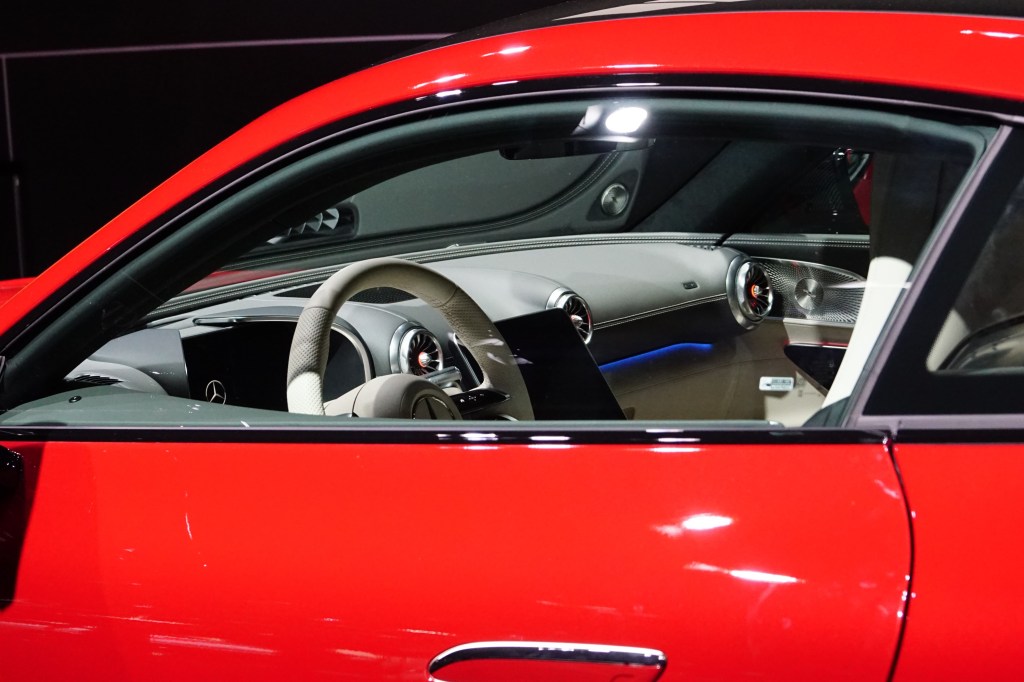
“For the interior,” he continued, “there is always a combination of the digital and the analog. For the first time, we have a hyperscreen, made of three screens being seamlessly positioned together. Also when the instruments and screen is shut off, it is not uniformly black, the air vent openings are still illuminated, the touch fields and items on the screen are also still visible, the inside door handles have a metallic coating, silver shadow galvanized so to say, these elements were there earlier, and will stay also in the future. I always say, Mercedes has always a chromium strip more.” We could only agree…
Focusing further on the front of the car, Robert stressed that it is still somewhat higher, which results in a spacious frunk. We will also strive to have clean lines.
We asked Robert also when looking back at the elegantly styled cars for the hand of Paul Bracque, the cars were lean, low, with excellent all round visibility. Do we see these styling elements back in the Mercedes cars of today and the future?
“Indeed, cars were (much)smaller, but now cars are electric, and they need more volume because of the batteries. Cars therefore need to be higher and this also calls for bigger wheels. This means also that cars are wider and have longer wheelbases. So cars are bigger and later hopefully will get smaller again. But cars as elegant as the Pagode will never appear again because of the safety regulations… But for the next five years, our horizon is set, we have a good idea what our design strategy will be.”
We thanked Robert for the interview and show you here some photos.
In a further episode we will have a further interview with Oliver Löcher, Vice President Vehicle Engineering and Overall Vehicle Functions Mercedes-Benz Cars.
Conceiving the automotive future is always a very challenging task. Some brands have also a future-oriented attitude more than others in their DNA, and one of them is certainly Citroën.
75 years ago, they brought us the 2 CV, a car which embodied nothing less than a four-wheeled French revolution, embodying Liberty, Equality and Fraternity. Indeed, this adagio of the French revolutionists fitted the post-war French “citoyens” admirably, as the 2CV brought them just that. Freedom for all, with low-cost mobility, practicality, and go-anywhere capacity.
This revolutionary dream of the brand with the double chevron has never died. And Pierre Leclercq, the Belgian born head of design, proved its love for practicality, out of the box progressive “back to authentic basics of automotive mobility” thinking already with its wonderful and stunning OLI.
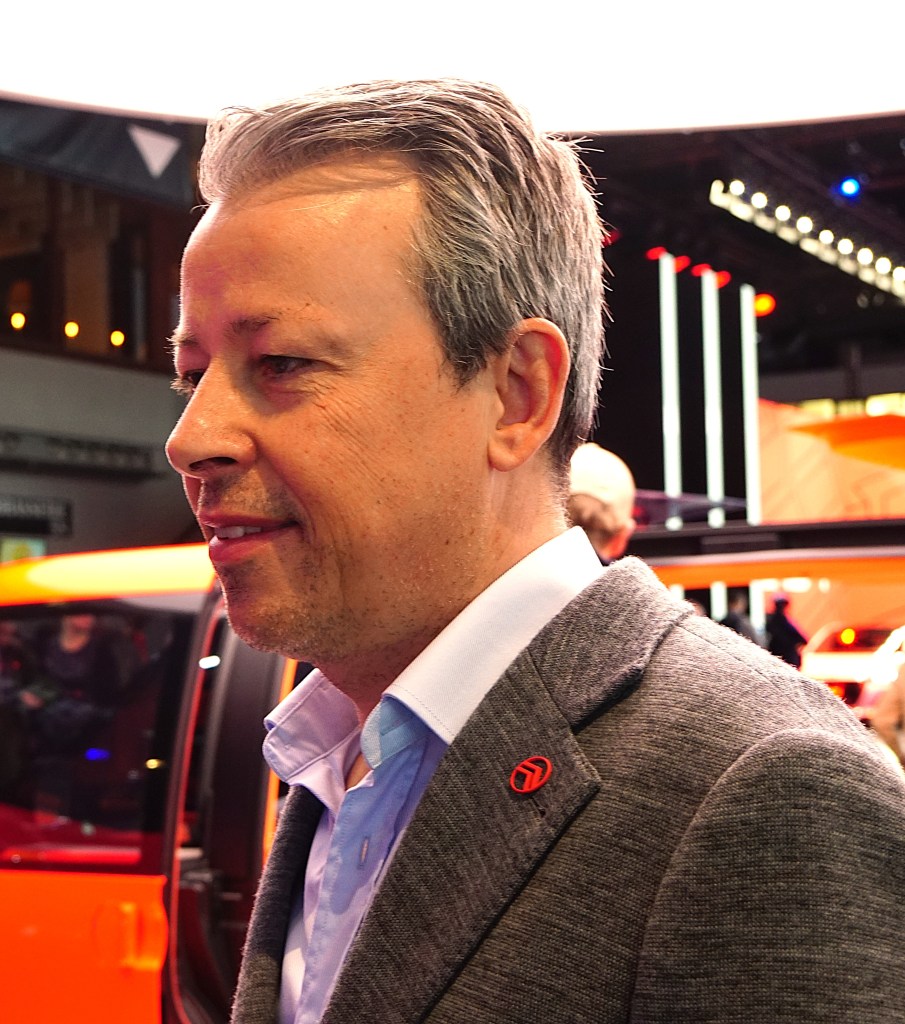
Your servant was at the presentation of this OLI in Paris, and now stood eye to eye with the equally intriguing ELO. On both occasions, he met the designer, Pierre Leclerq. We talked to him again in Brussels…
Hans Knol ten Bensel
A creative career…
Pierre Leclercq started in 1998 at BMW as an intern, he joined the Italian coachbuilder Zagato in 1999, which he left after three months to join Ford Ghia. Here he designed the interior of the Ford Street Ka concept. In 2000 he returned to BMW, where he worked for 13 years. There he notably designed the BMW X5 E70, BMW X6 E71 and the rear of the first Mini Countryman. He also worked on a successor to the BMW M1 based on the BMW i8, but the project was ultimately abandoned.
Pierre Leclercq headed the design studio of Great Wall Motors from 2013 to 2017. He then became design director at Kia, but stayed only one year with the South Korean manufacturer. Needless to say that he acquired a keen understanding of the design philosophy and DNA of both European and Far East manufacturers.
In November 2018, he took over the head of Citroën’s design office, succeeding Alexandre Malval, who had moved to Mercedes-Benz. The first project he led entirely at Citroën was the C4 X, a 4-door version of the third-generation C4.
Three pillars to keep in mind when building this concept car…
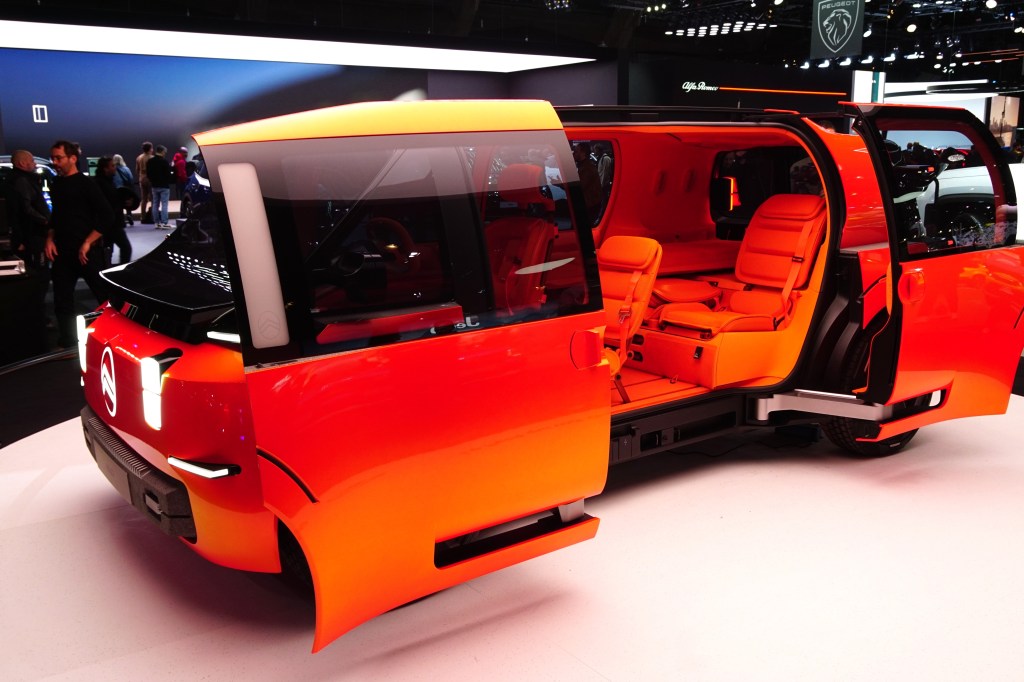
On the Brussels show, at the presentation of the ELO and the subsequent talk we had with him, Pierre stressed that this concept car is first and foremost a laboratory of ideas. He also wants to demonstrate the three pillars of the design philosophy of this car; he told us: “The ELO must become your third place (after home and office – editor’s note) to live in which you must be able to play, work and rest ”
Work…
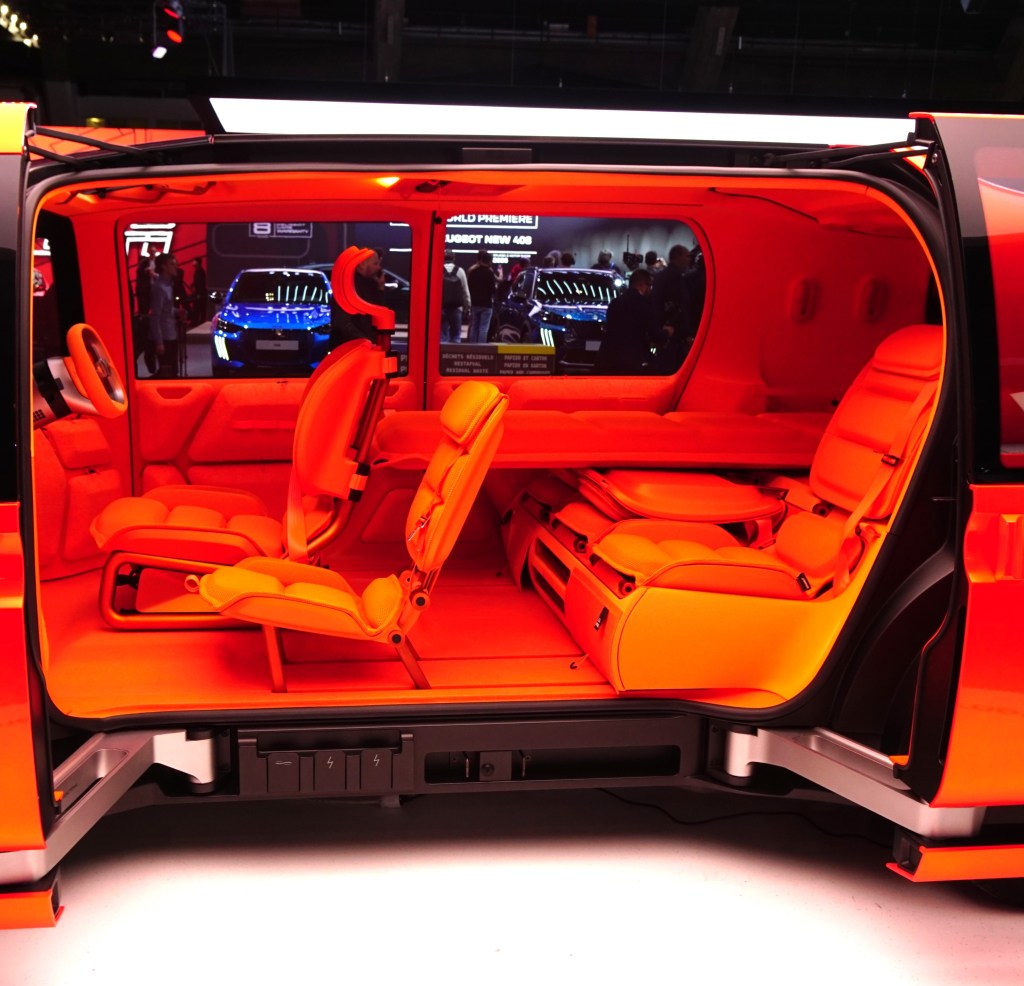
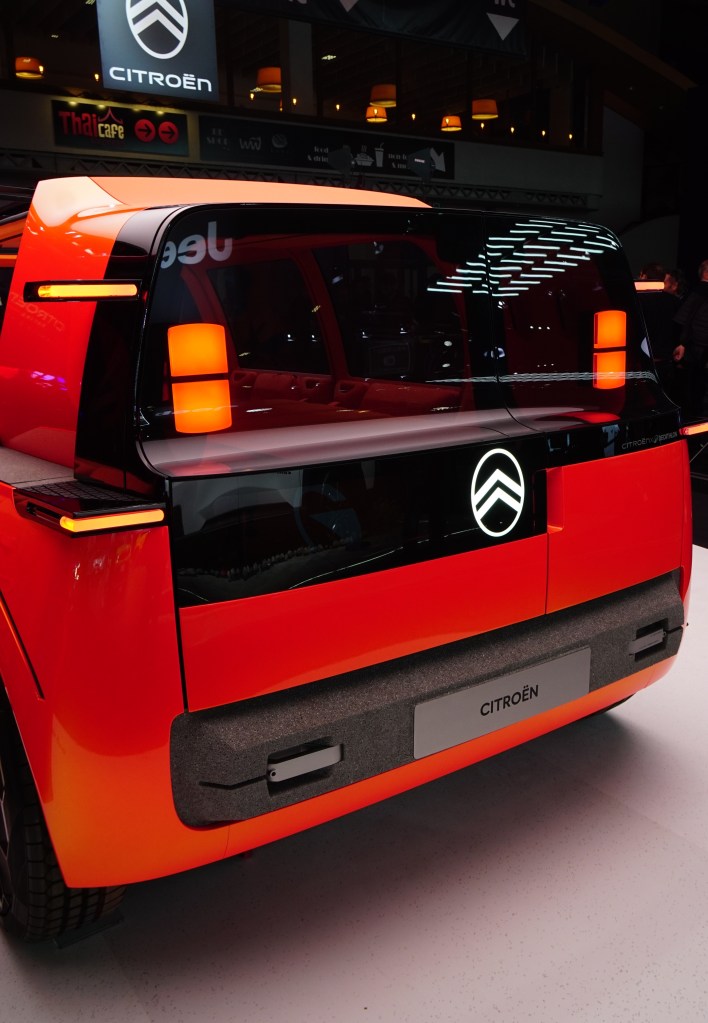
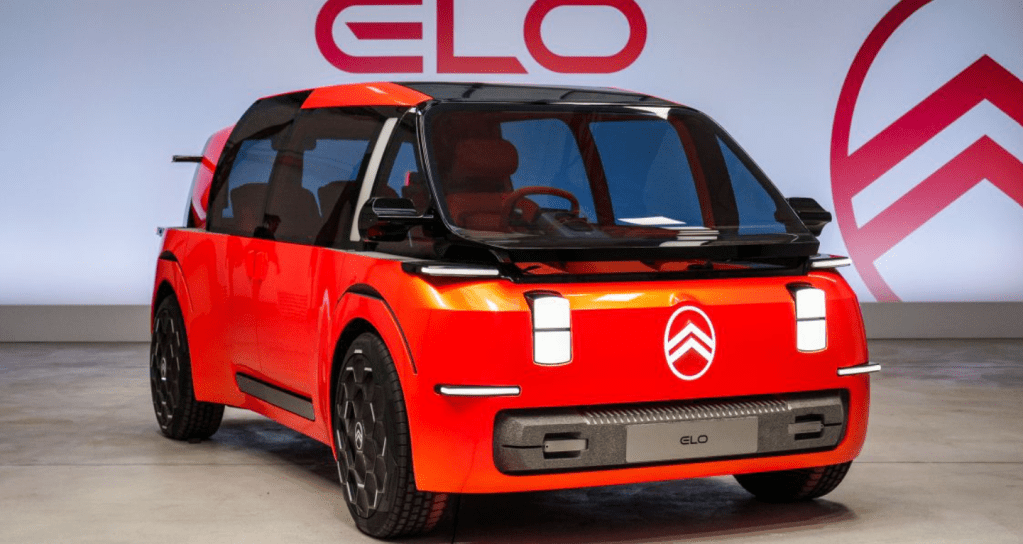
Pierre presented the ELO to us, showing the highlights of its design. “We start with a six seater”, with the driver in the center and two seats on both sides. The second row is made of three other seats.”
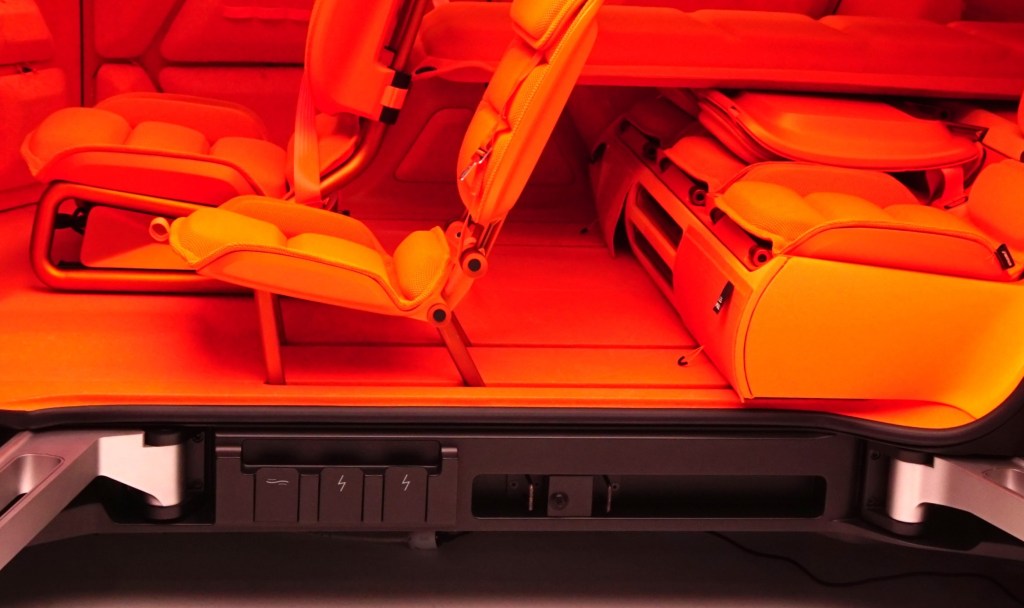
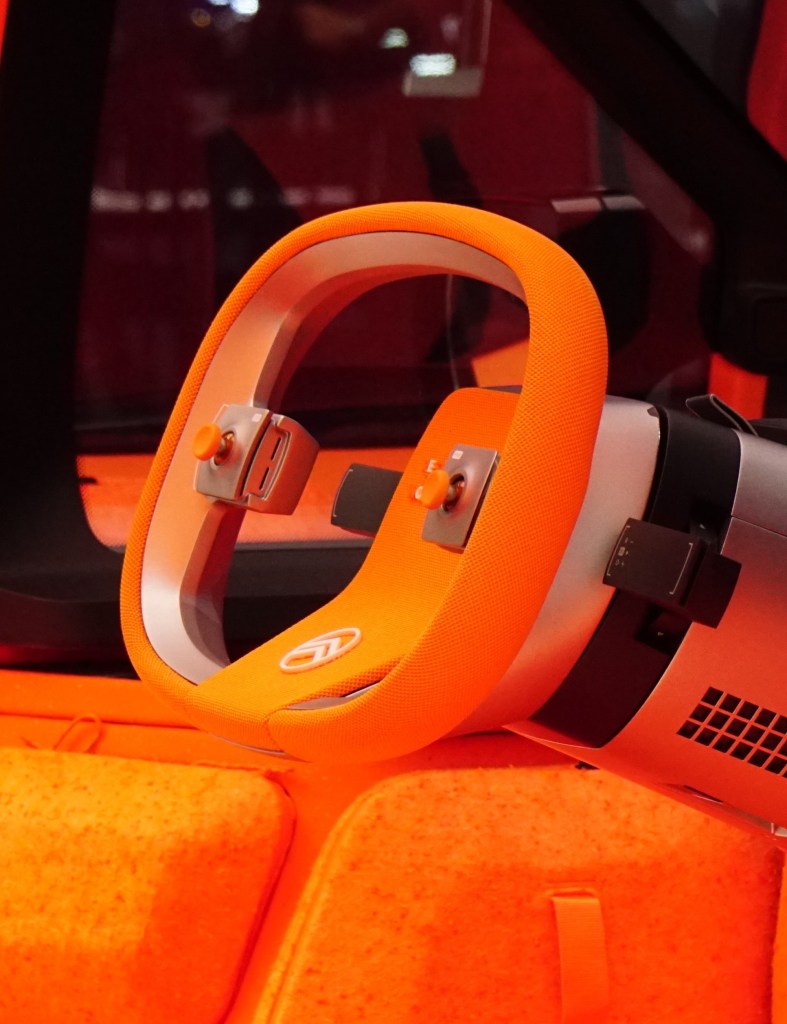
“Fold two seats under the rear seats and then you can rotate the driver’s seat 360 degrees, either for a good entry or when you want to work. Ideal for people who want to work – our first pillar – in another place than the office.”
Play…
“I told you the second pillar is play”, he continues. “The cooperation with Decathlon was so inspiring and led to new ideas and applications. We developed an app together with them. You can plan your trip, plan your weekend, so that you don’t forget anything that you need, you have electricity and (compressed) air for your bikes and toys…”
Compressed air and electricity for your E-bikes are provided…
Rest…
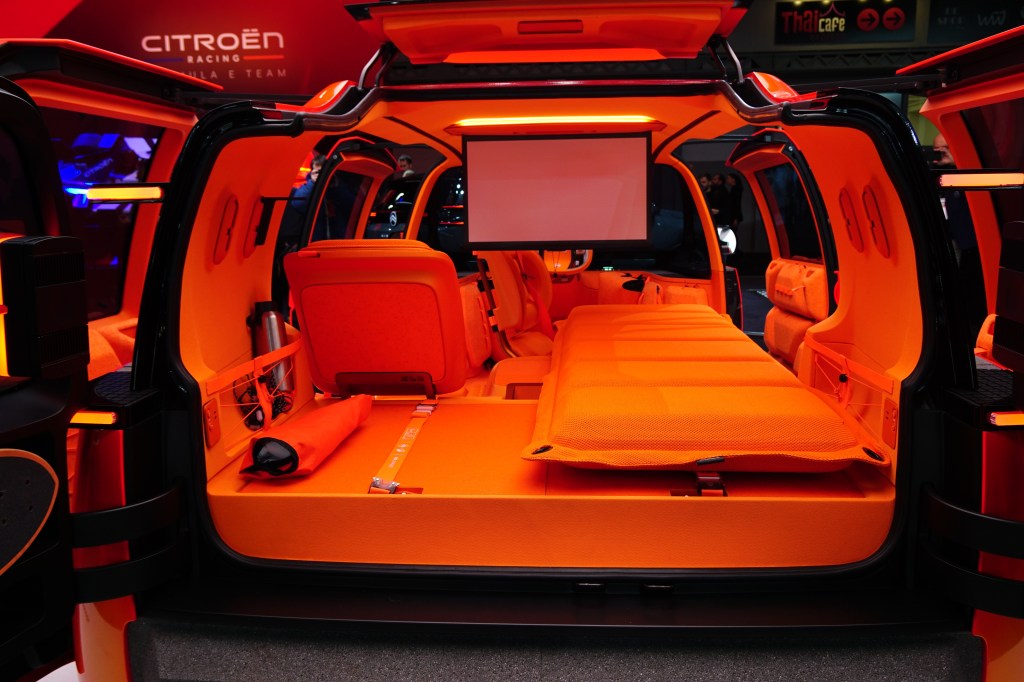
“The third pillar is rest. You fold the seats in the back row, and you have a flat floor. You then use two matresses, again an innovation from Decathlon. You inflate them to have perfect rigidity. We also have a larger screen that can unfold and we have a projector that is on the side of the car, and the little roof opens up at the back of the car to let you look at the stars in the sky.”
We asked him also about the cooperation with Decathlon on this project…
PD: “We liked Decathlon because we carry the same values.” was his answer. “Decathlon is innovating because it makes well designed and well thought products and is not reverting to expensive technologies. We worked together from the beginning to the end on this project, and it was a big learning experience for us.”
What are the futher design hallmarks of the ELO, we asked.
PD: “The car is compact, but has a lot of glass, which is very important both for the driver and people in the back, and more importantly, children.”
Can you tell us more about the materials used, we wanted to know.
PD: “Many materials are recyclable and we even recycled materials from the OLI for this project. Also the interior panels for example. They are also cheap and easy to replace when scratched due to intensive use…”
You took advantage of the EV architecture, we remarked…
PD: “Indeed, we could maintain very compact dimensions whilst offering much room. We could move driver forward, even putting him in the centre.”
We will see much of these solutions in forthcoming models?
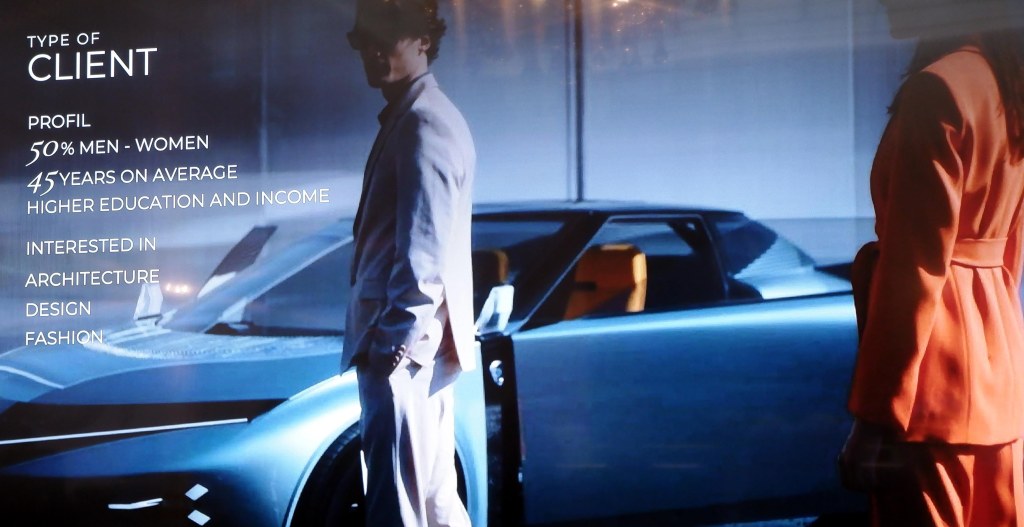
PD: “Yes, this concept car is a laboratory of ideas, there is not one idea which we will not try to put into production. Of course, this is the beauty of our craft, of being a designer, is to make and develop many projects, and to put them on the road, and last but not least to sell them, because these concept cars are not made for us, but for the cliënt.
Needless to say it was a big pleasure for us to meet up again with Pierre Declercq, and see and admire his stunning concept car, the ELO.
In the next report on the Brussels Salon we will talk to Robert Lesnik, Director Exterior Design Mercedes-Benz and Oliver Löcher, Vice President Vehicle Engineering and Overall Vehicle Functions Mercedes-Benz Cars. Stay tuned!
The Brussels Motor Show is now in its 102nd edition and will be quite important, with an impressive array of world premieres to admire.
You can stand eye to eye with the Citroën ELO concept car, the Ford Ranger (facelift), Hyundai’s biggest EV so far, the Staria EV, KIA will show its new EV2 and powerful GT versions of the EV3 , EV4 and EV5, Mercedes-Benz will bring its new GLB, Mazda probably the European version of the EZ-30. Last but not least there is the Opel Astra and Peugeot E-408.
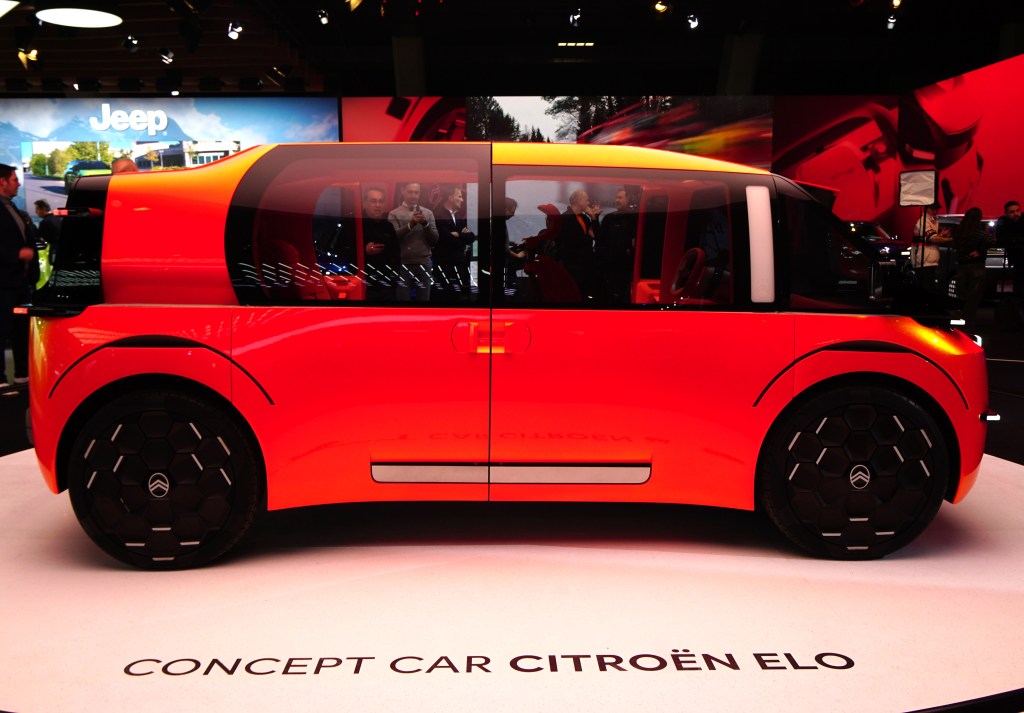
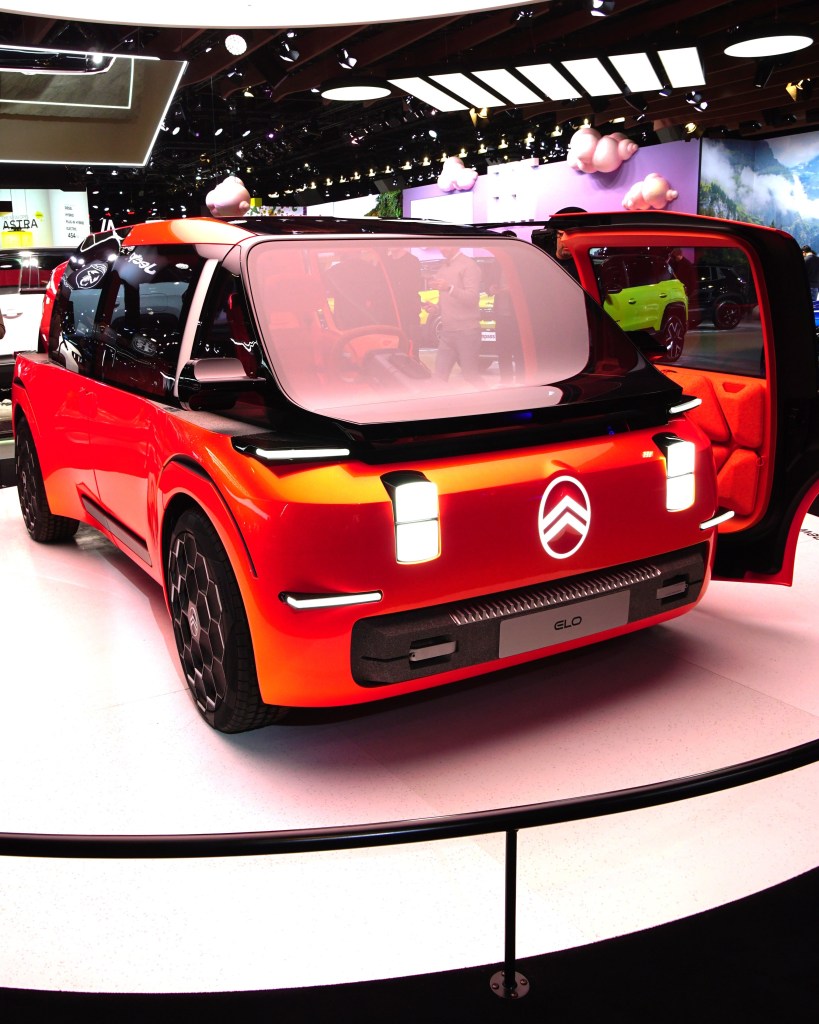
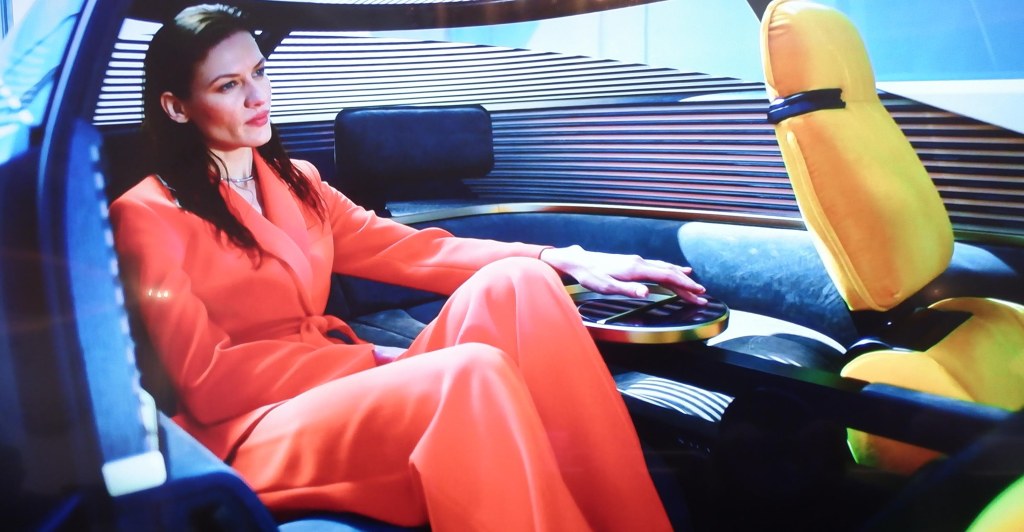
Indeed, Citroën has chosen Brussels to unveil the world premiere of ELO, a concept car designed as a veritable laboratory of ideas. ELO is firmly rooted in society and evolving lifestyles: responsible, functional, clever, multi-purpose, accessible and resolutely friendly. Compact (4.10 m) but incredibly spacious, ELO is “the little car that thinks big”. Its 100% electric architecture is optimally exploited to offer a modular space that can accommodate up to six people.
Kia will unveil the EV2, an all-electric B-segment SUV dedicated for Europe, on 09 January 2026, at the Brussels Motor Show. It is expected to have one E motor, borrowed from the Kia Inster. The 115 HP EV will be built in Žilina, in Slovakia.
Hyundai will launch new EVs in 2026, starting at the Brussels Motor Show with the world premiere of its biggest EV yet,” the automaker said in a statement. “The new model will showcase state-of-the-art electric technology, including an advanced 800-volt charging system.”
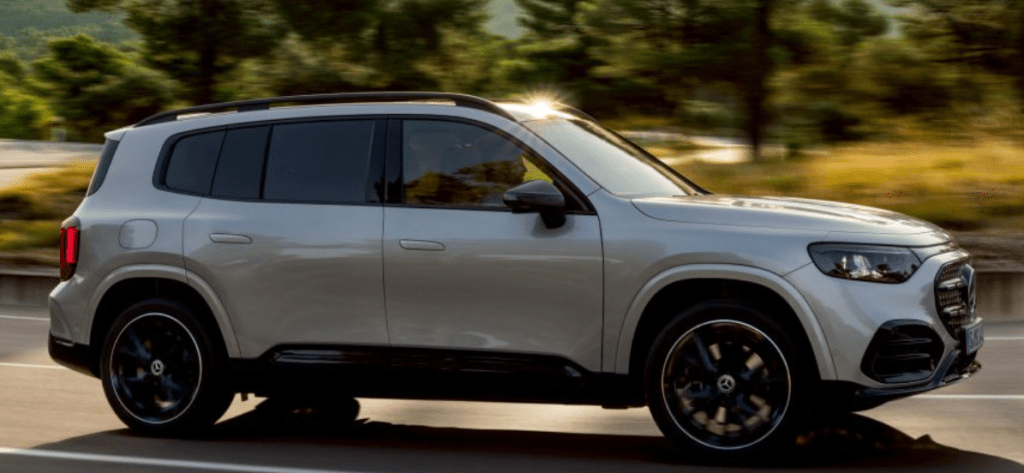
The all-new Mercedes GLB is built for everyday life. Available as a 5-or 7-seater, it adapts to all customers’ needs. It has more space, a new design, greater comfort, and even the ability to tow a full-size caravan.
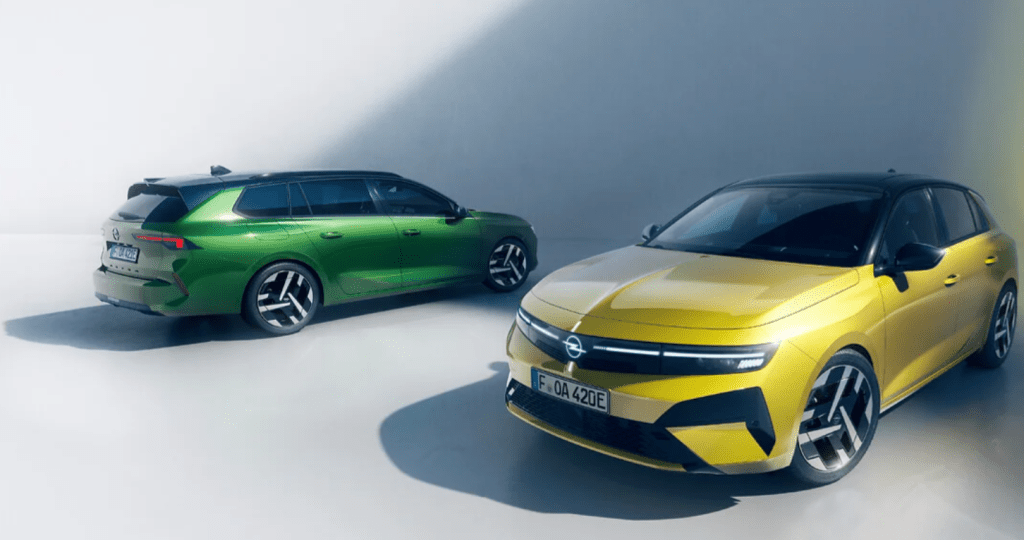
The new Opel Astra and Astra Sports Tourer will celebrate their world premieres at the 102nd edition of the Brussels international motor show. The compact class bestsellers ‘made in Germany’ are sharper and more technical than ever, featuring the permanently illuminated Opel Blitz in the centre of the modernised Opel Vizor brand face for the first time, as well as the segment-unique, adaptive Intelli-Lux HD light.
PEUGEOT will unveil its new saloon car, the PEUGEOT 408, in Brussels. A true ambassador of French dynamism and panache, says the manufacturer in its press message, the new PEUGEOT 408 boasts an expressive and unexpected design. Wow effect guaranteed…
This will also be an opportunity for the Belgian public to discover the NEW PEUGEOT E-208 GTi.
The Brussels Motor Show will open its doors to the public from January 10 until 18 January. Your servant will attend the press day on January 9, and you will soon read my impressions in these columns… Don’t miss it!
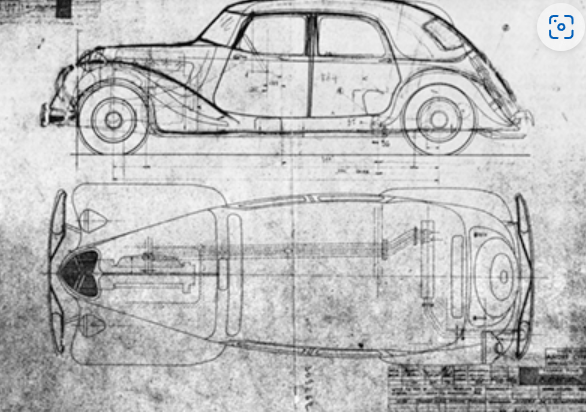
Already in 1934, the dream of the goddess of the road began: Citroën designers drew the first contours of a more streamlined body for the “Traction”, which was launched only a few months earlier.
This year we celebrate 70 years of DS, as indeed the iconic DS 19 was launched in October 1955, this year now 70 years ago.
Reason enough to delve into the stunning history of the birth of this goddess, and subsequently also DS Automobiles, who since 2014 carries further the tradition of making superbly styled, avant-garde automobiles offering exquisite comfort and panache.
Your servant started to delve into his archives, and here is a tale, which every car enthusiast can adopt as an exquisite story to be told at a dinner table with friends and family, about the men with a unique “Génie Français” which led to the birth of a truly unique automobile.
Hans Knol ten Bensel
But development work started rather in earnest in 1938, when Pierre Boulanger codenamed the project for a successor of the Traction VGD, or “Voiture à Grande Diffusion”
The man behind it all: Pierre Boulanger...
But first a word about the actors of this unique engineering adventure. It starts with Pierre Boulanger, who was a so-called “Michelin man”. He started working for Michelin in 1918, reporting directly to Eduard Micheli, co-director and founder of the business. Boulanger joined the Michelin board in 1922, and in 1938, he became the company’s joint managing director.
What has Michelin to do with Citroën? In December 1934, despite the support of the Michelin company, Citroën filed for bankruptcy. In that same month Michelin, already the car manufacturer’s largest creditor, decided out of necessity to become its principal shareholder.
Pierre Boulanger then became the assistant of Pierre Michelin, who was already the chairman of Citroën. Boulanger became the vice-president and chief of the Engineering and Design department. He became president in 1937 until his accidental death behind the wheel of a Traction 15 CV . He also jointly managed the Michelin company.
Pierre Boulanger was already since 1936 working on a project to create the TPV (short for ‘Très Petite Voiture’). This led, as you might already know dear reader, to the birth if the 2 CV, affectionately called by the French “La Deuche”.
The driving genius of the project: André Lefebvre …
But let’s go back to our VGD project, which he started with the help of André Lefebvre, the spiritual father of the Traction. Another most important actor in our tale. He was an engineer with unique insight and creativity, with a wonderful talent to think out of the box. He was a lifelong friend of aviator, artist and also car designer and engineer André Voisin. And this is a man who designed and built absolutely stunning cars.
André Lefèbvre in his younger years, a keen racing engineer, working for Voisin…
We show you here a photo of the Voisin which was to be seen in the Brussels Autoworld museum last year. It was also André Voisin who recommended Lefebvre to André Citroën.
The man behind the hydropneumatic suspension: Paul Magès
The genius who invented and developed the legendary hydraulic suspension was Paul Magès. He came to Citroën as a draughtsman at the age of 17 and a half, and made a wonderful career thanks to its practical sense, creativity and entrepreneurship. In September 1940 he was promoted to quality engineer and in 1942 Pierre Boulanger included him in his research team, to create and develop a suspension system for the 2 CV. Here his out of the box thinking and creativity proved crucial.
Already early in the development, he saw the advantages of a liquid that would compress a gas. It was a new idea that Paul Magès began to experiment with in 1944 on a 2 CV with a very crude system comprising 1 gas tank per wheel, which theoretically made it possible to vary the flexibility from one to four, with a gas and a liquid separated by cork. Cork will not withstand high pressure however. This archaic start is refined, perfected, tested a multitude of times, and the results are always more surprising. Paul Magès then created his own team which manufactured all the organs itself. The skills of each person are at stake, in the feverish atmosphere of research. The theory gradually became reality, the concept was simplified, the tests multiplied, the results were refined.
First trials of a hydropneumatic suspension on the 2 CV prototype…
In 1946, Pierre BOULANGER encouraged Paul Magès to continue his research, no longer on the 2CV but this time on a front-wheel drive, because it was necessary to think about the future VGD car. (Mass Circulation Car)
Besides the suspension, the car had to be revolutionary, and Boulanger proposed a monocoque structure in which the centre of gravity would be as low as possible, the roof and bonnet would be of aluminium and the floorpan would support unstressed, lightweight body panels.
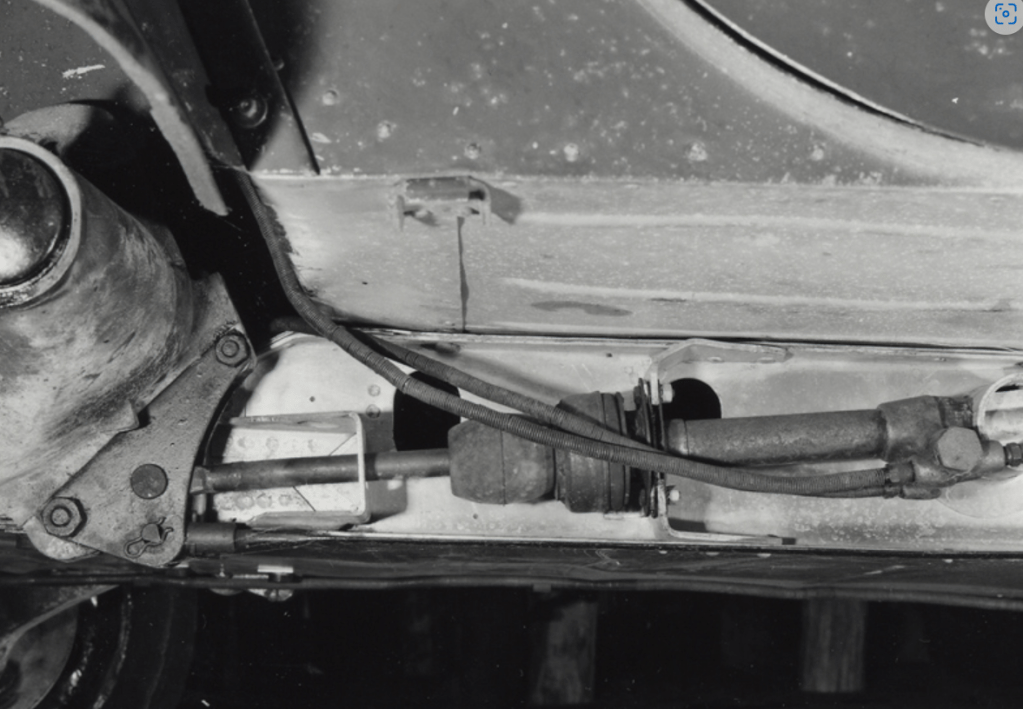
The hydraulic suspension found its way on the rear axle of the six cylinder 15 CV Traction…
In 1949, Paul Magès, after multiple tests, finally developed a hydropneumatic suspension that he put to the test in the cold in the Nordic countries, then in Algeria for resistance to high temperatures. It was from this adventure that the idea of a manual height control was born, in order to allow the vehicle to face snow or chaotic terrain. Other trials will be the source of questioning, creations, and multiple improvements. In 1953, the hydropneumatic suspensions were deemed reliable enough to equip the 15 six, then the DS 19…
But soon more about the story of the DS in the following 70 years since its birth…
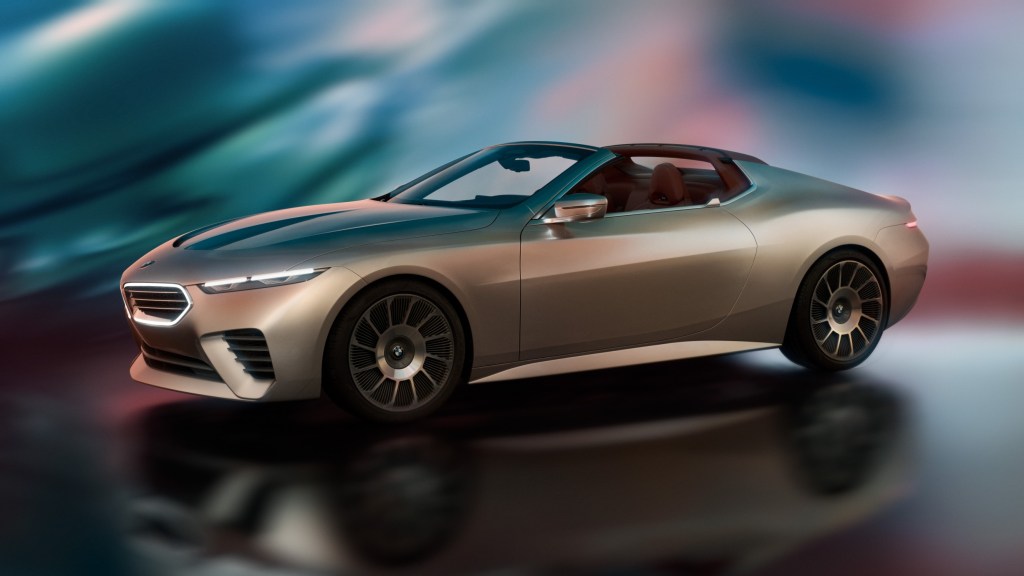
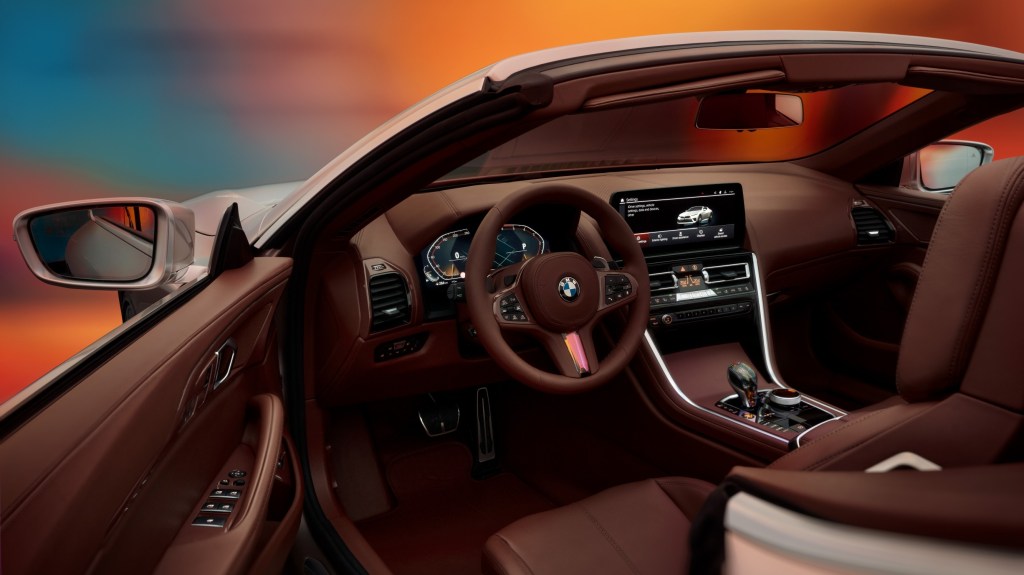
Designers can make you dream, and at BMW this is no exception. It brought to this year’s Concorso d’Eleganza Villa d’Este a unique design study: the BMW Concept Skytop. It has clearly athletic proportions, and Adrian van Hooydonk, head of BMW Group Design, commented: “It offers a combination of driving dynamics and elegance at the highest level, comparable to its historic ancestors, like the BMW Z8 or BMW 503.”
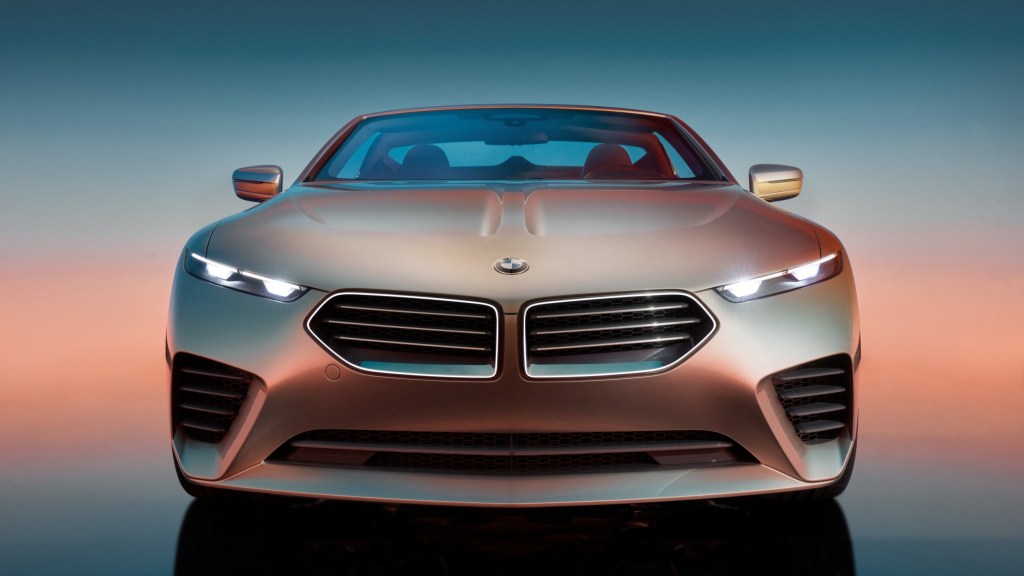
Indeed, it does, its lines, surfaces and volumes breathe the classic proportions of its iconic predecessors. Is it a harbinger for future BMW styling? It certainly has interesting details, like winglets integrated into the door shoulders replace conventional door handles. Light-alloy wheels with precise lamellas are also adding elegance and drama.
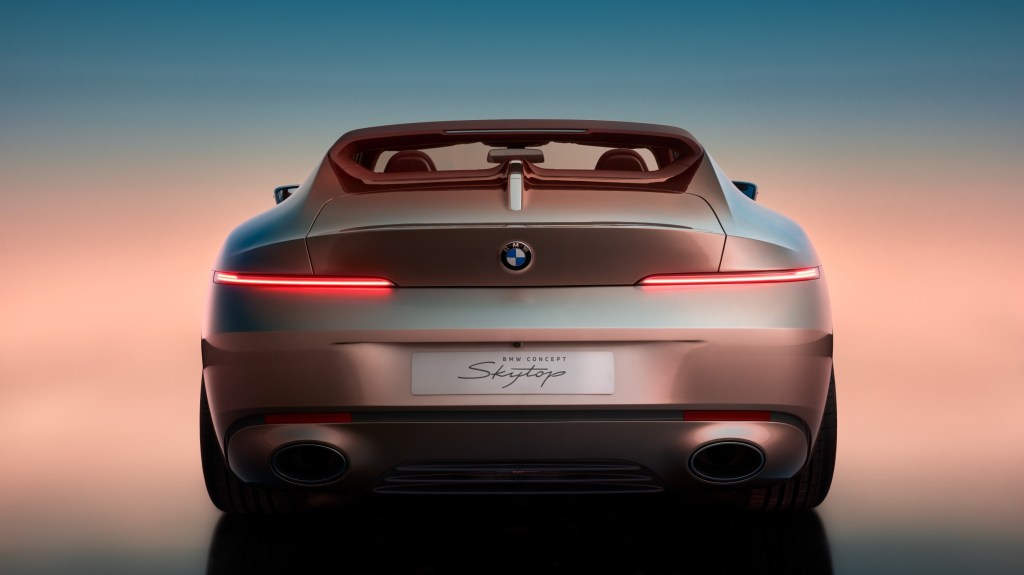
We like the impressive long bonnet and the classic kidney grille, and also the retracted rear end and the pronounced central spline, which runs over the bonnet through the interior and ends an aluminium trim positioned on the tailgate, add both panache.
The LED headlight units, positioned on milled aluminium carriers, were custom developed for the BMW Concept Skytop, utilizing the latest technology and design for automotive headlights with the slimmest profile currently available.
We also love the leather-finished roll-over bar behind the BMW Concept Skytop’s two seats, as it is combined with side fins on the B-pillar and a fully retractable rear window. The setup is quite practical: the two removable roof parts, also finished in leather, can be stored in a special compartment in the luggage space.
Color harmonies…
The colour scheme ensures a smooth transition from interior to exterior, regardless of whether the roof is open or closed. In the rear section, the reddish-brown tone of the roof flows into the muted silver with chrome shadow effect of the exterior paintwork. The technically elaborate colour gradient was crafted by an experienced master painter at BMW Group Plant Dingolfing (!)
…and luxury in brogue-style leather…
The leather seats in the interior carry brogue-style accents. The reddish-brown tone of the leather gives the whole interior a sense of luxury and spaciousness. Chrystal elements and further are artfully embedded in the gearchange lever and the cockpit, adding to the overall impression. The interior surfaces of the BMW Concept Skytop were crafted in the traditional saddlery of the BMW Group plant in Dingolfing.
The spirit of the Z8 reigns also in this concept car: under the hood roars the most powerful V8 engine in the BMW drive train portfolio.
Of course there is much more news on the BMW front: the new 3 Series Sedan and Touring, the new 5 series Touring and the first BMW i5 Touring, to say the least. Stay tuned!
Indeed, the Management and PR team of Stellantis Belux, welcomed recently the Press and B2B to a, called ‘House of Innovation’.
A fitting initiative, set up in the absence of the Brussels Motor Shows, keeping the tradition in our country of a traditional show period and at the same time providing a platform for unveiling the latest innovations, concept cars and the future direction of the Stellantis brands.
Needless to say we were very keen to attend this event, giving your servant also the opportunity to have several interviews with the managers of several brands, which we will present soon on our columns. Here in this first report about this “Kickoff Press conference” we will focus on the future strategy of Stellantis and its plans for the Belux market. Just read further!
Hans Knol ten Bensel
The event started with an inspiring introduction by Florian Kraft, CEO of Stellantis Belux…
…followed by interactive brand presentations and workshops. “This event symbolizes our continued pursuit of innovation and progress in the automotive world. We are excited to share our latest developments and our vision for the future with the press and our valued customers and partners,” said Florian Kraft, CEO.
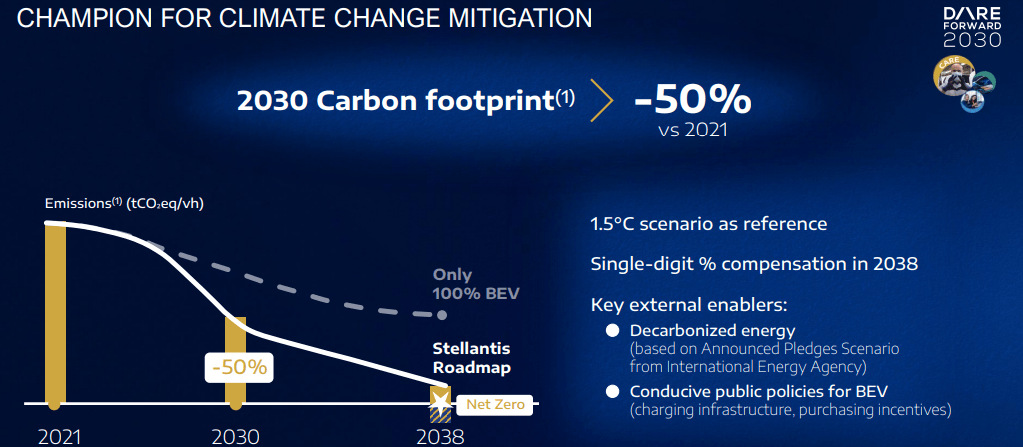
Florian Kraft first pointed out the four core targets of the Stellantis “Dare Forward strategic plan 2030.” This plan will move Stellantis into a sustainable mobility tech company.
The first target is reducing its carbon footprint by 50 % in total CO2 emissions per vehicle compared with 2021, on the path to achieving carbon net zero in 2038. This then includes not only from well to wheel, but also throughout the entire supply chain.
The second target is setting the course for 100% BEV sales in Europe and 50% in the United States in 2030. The third is achieving number one position in customer satisfaction. The fourth is doubling net revenues while transforming our business models and sustaining double-digit operating margins. How Stellantis will achieve this, will be the subject of a future report in our columns. Stay tuned!
Ambitions for 2024…
Looking ahead to 2024, Stellantis Belux has set itself several goals. In terms of network, the company aims to ensure a successful transition to the New Retailer Model using its existing network. Indeed, Stellantis is progressing at full speed in the execution of its Dare Forward 2030 Strategic Plan, with the ambition to be #1 in customer satisfaction in all markets, in products and services. Indeed, the customer experience will be at the core of this retailer model.
Customers will be able to take advantage of a multi-brand and multi-channel approach with a wider range of services. Dealers will have a new and efficient business model aimed at benefitting from Stellantis’ 14-brand portfolio, creating synergies, optimizing distribution costs and offering additional sustainable mobility solutions, says Stellantis. So far for the aims, let’s explain this further in more concrete terms.
In September last year, Stellantis launched the reorganization of its European dealer network, starting with four specific markets before extending it further across Europe in 2024. Stellantis announced it was ending its previous sales and services contracts with European dealers for its 14 brands and moving toward a new distribution framework based on an agency model. What is this agency model?
Under this model, the manufacturer becomes the retailer while the dealer remains the physical touchpoint with the customer. The agent/dealer receives a commission on each sale and no longer individually sets prices or discounts.
As the dealer does not have to purchase the cars from the manufacturers anymore, he does not carry significant commercial risks and has less administrative costs as billing and payment towards the customer is done by the manufacturer. It protects also the profitability of the retailer. Because, as everybody knows, profit margins on new car sales can fluctuate.
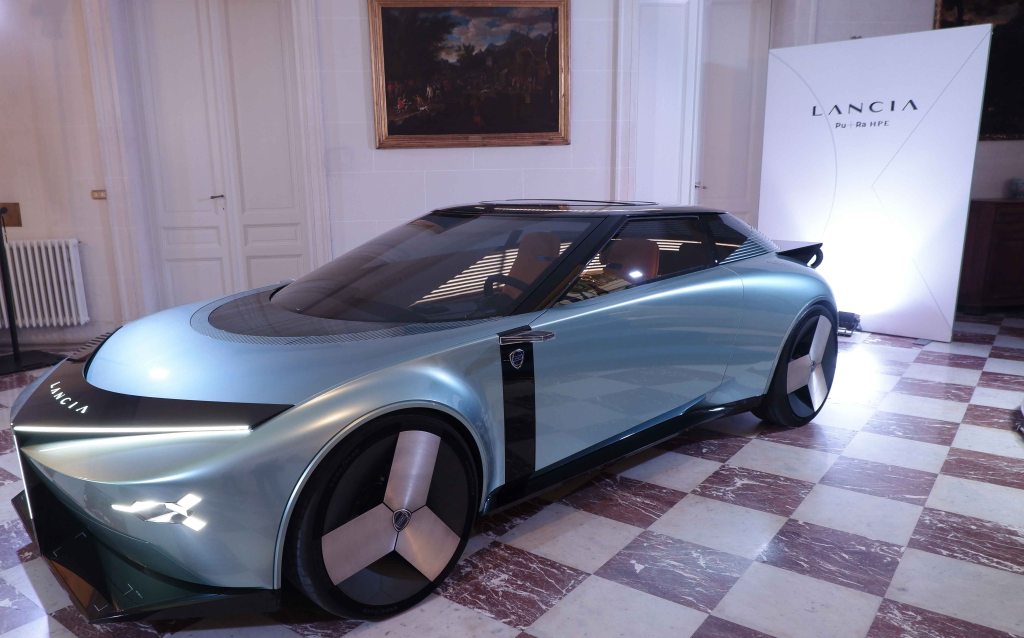
With the Lancia Pu+Ra HPE, the Lancia journey towards the future begins, drawing inspiration from the past
The advantage for the car manufacturer is a direct contact with the customer, which it did not have so far….
The manufacturer can now determine end-customer discounts themselves, in this way achieving price consistency and avoiding competition between dealers of the same brand. They can optimize costs through centralization, and profit from the scale effect of transferring responsibilities from individual dealerships to the bigger sales organizations on national levels.
The new Alfa Romeo Stradale: the future is already a pur-sang reality…
It also is more in line with today’s consumer preferences, which would rather see fixed prices and an equally simple buying process as they experience in e-commerce.
Stellantis is moving towards this model in big steps now. In September last year, Stellantis announced that the revised retail model will be fully effective from Sept. 4, starting with Austria, Belgium, Luxembourg and the Netherlands. Stellantis is not the only one to prefer this agency sales model. BMW and Mercedes opt for it too…
The BEV line up at Peugeot: towards a leading position in the B and C segment…
Stellantis market position in Belux …
In terms of sales, Stellantis Belux aims to regain the lost market share in 2024 and further strengthen its position. In 2023, Stellantis Belux achieved a global market share of 17.2%, with more than 100,000 units sold. On the LEV (Low Emission Vehicles) market, Stellantis Belux occupies a fourth place with an 11.6% market share. The BEV (Battery Electric Vehicle) and the PHEV (Plug-in Hybrid Electric Vehicle) occupy a fourth place with respectively 10.5% and 12.8%.
Stellantis Belgium confirms its strong position with a pole position in the segment A and with not less than six models of Stellantis (Peugeot e-208, Peugeot e-2008, Opel Corsa Electric, Jeep Avenger, Opel Mokka Electric, DS3 E-tense) in the TOP 10 of the segment B (BEV), representative 66% of the part of the segment.
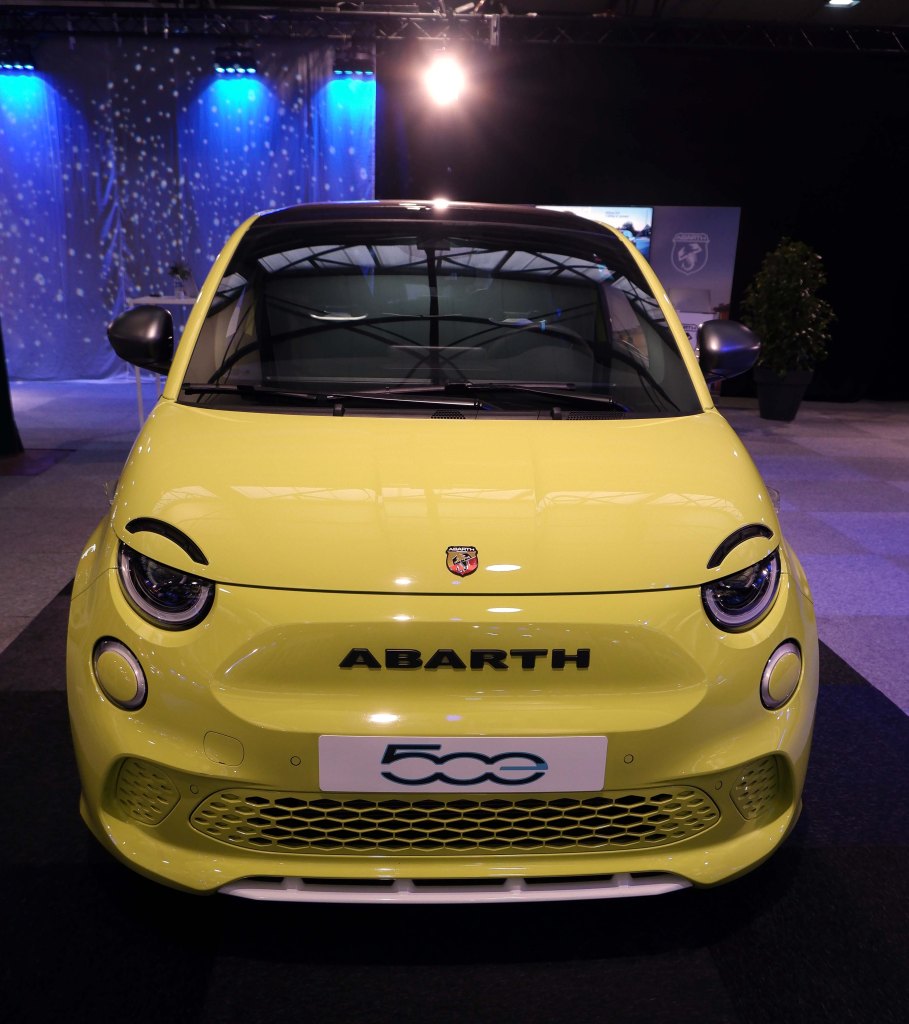
Introducing petrolheads to the joys of E-power: the Abarth 500 E, waiting for the imminent 240 HP 600 E…
Last but not least, Stellantis Belux is the leader in the segment of the LCV (Light Commercial Vehicle) with more than 30% of market share, of which more than 50% is electrified!
In terms of product innovation, Stellantis Belux will continue its electrification, where it currently leads in the A-B segment and LCV, and further expand it to the C segment with models such as the Opel Astra, Peugeot 308 and 3008 and Citroën C4.
As is tradition in January, the Stellantis brands start the year with super attractive “salon conditions” on their range. This applies to both private and professional customers and to electric and ‘thermal’ vehicles.
We made on this event interviews with Pierre Voineau, Managing Director Citroën Belgium & Luxemburg, (see photo here above), Asterio Perez, Managing Director of Fiat, Abarth and Fiat Professional in Belgium and Luxemburg, and last but not least Eric Laforge, Head of Jeep Brand Enlarged Europe.
This will be followed by a special report on the magnificent prototypes which were displayed amongst the 36 cars on this conference.
Autoworld, the impressive car museum at the Brussels Cinquantenaire, holds now an exhibition ”Porsche, driven by dreams” celebrating the 75th anniversary of the brand. You can already read about it in our columns. Some 50 Porsches are displayed, many of them brought to the capital of Europe by the Stuttgart Porsche museum, with some of them never seen before on public display in Belgium.
It ranges from the 984 to the “Mission E” prototype, the latter which was a harbinger of the alternative future coming to us all.
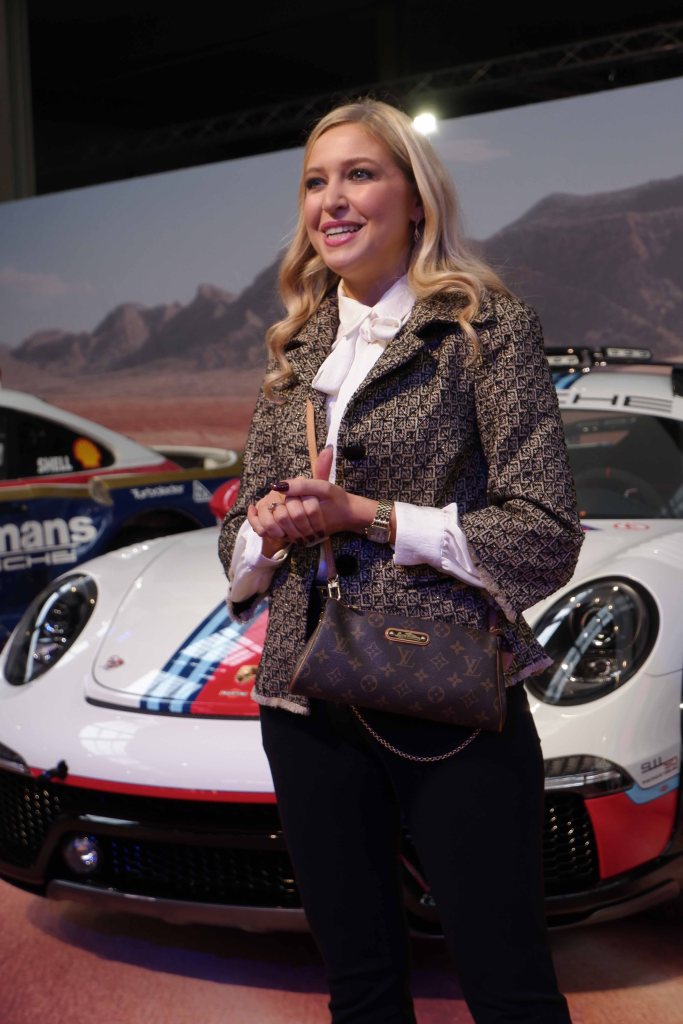
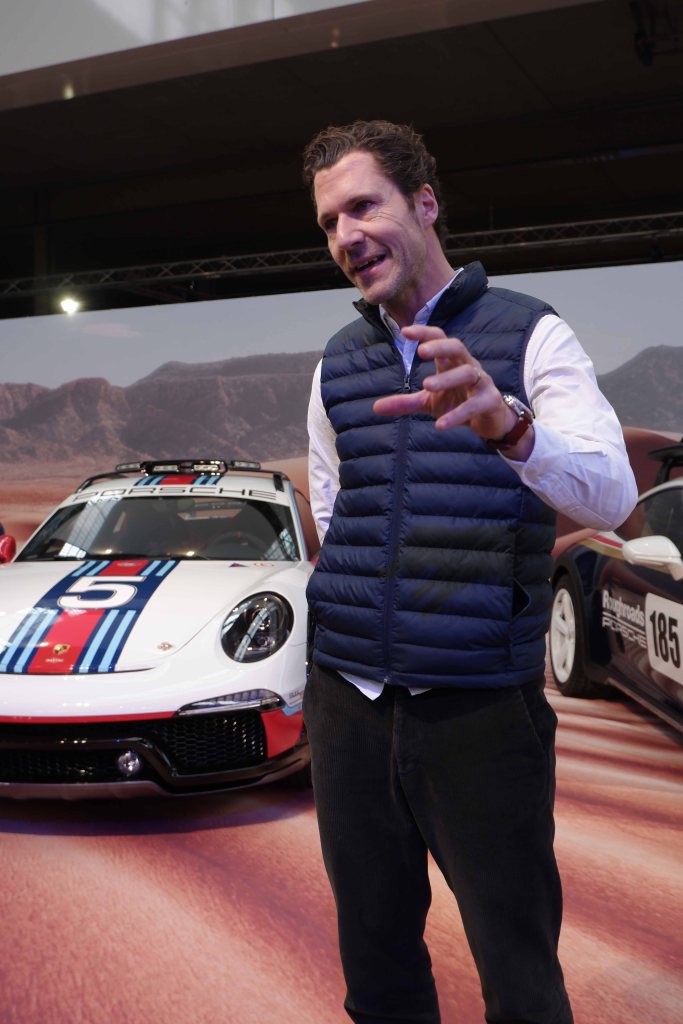
The show was presented by PR manager Porsche Belgium Liana Picard, General director Autoworld Sebastien de Baere and last but not least car expert and curator of Autoworld Leo Van Hoorick, who showed us around the exhibition and offered us his expert comments and insights. (See photo here and further in the article).
Hans Knol ten Bensel
The 911 is now already 60 years among us, and your servant still remembers driving these 911’s with sporting abandon in the early seventies. I just loved to take these genuine drivers’ cars to the limit, their handling needed an expert hand, but they never betrayed me and on the contrary, it was a pure delight to master them. The flat six engine was then still air cooled, and the echo of their roar and hiss at high revs still echoes in my ears. Just look a bit further in our columns, click the following link: https://autoprova.be/2021/03/27/some-early-photos-from-my-automotive-beginnings/
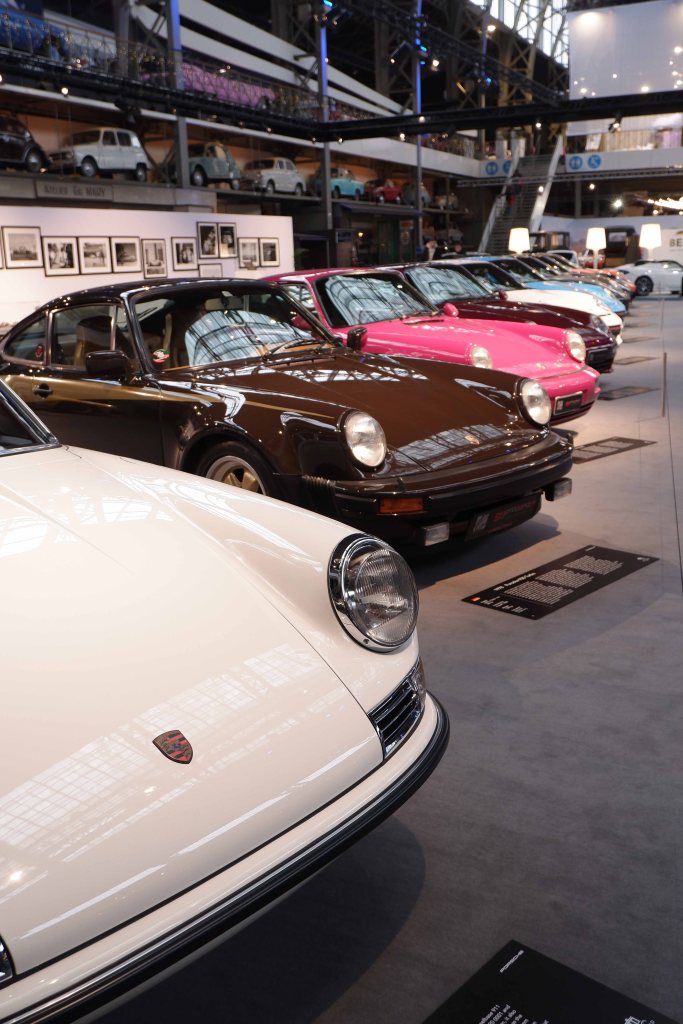
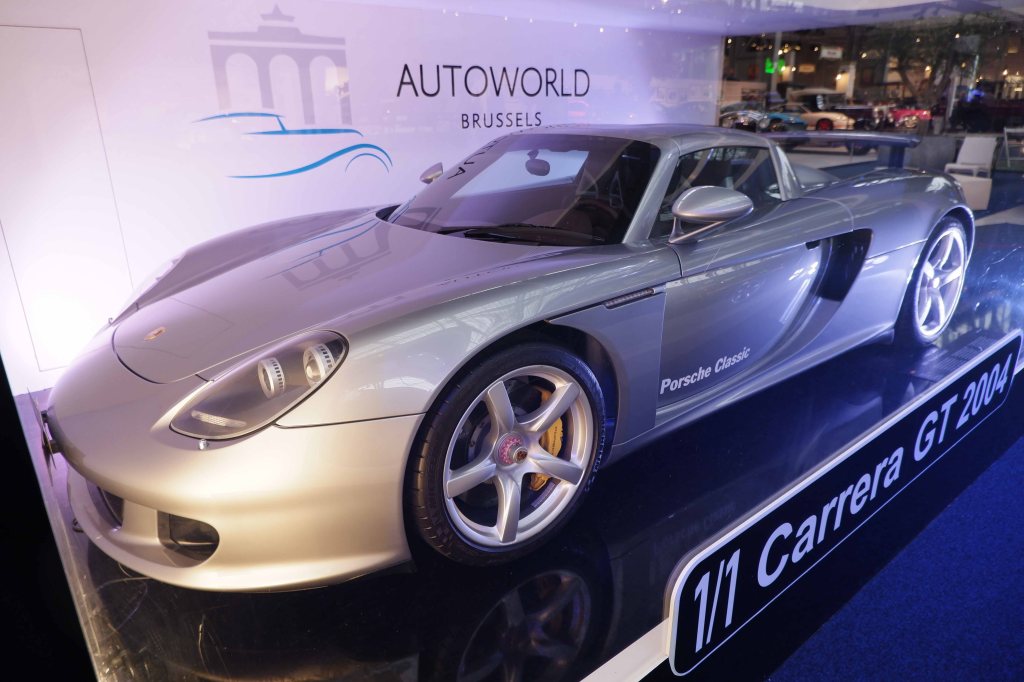
Besides the iconic 911, of which we still found an absolute classic early version in the Museum, on display outside the specific Porsche show, just look at the photo here above, there were indeed some very dramatic Porsche Museum Cars, and the most stunning for me was the Carrera GT with its V10 engine. It is a stylish classic sportscar, breathing the “Zeitgeist” of two decades ago, with its clean, fluent lines, inspired by the bolides at le Mans.
It’s a carbon-fibre, mid-engined super car, and made its debut at the 2003 Geneva International Motor Show. It came three years after its debut appearance at the Paris Motor Show in prototype form – an event itself which caused such an explosion of interest that Porsche knew their dream needed to be made a reality. The birth of what is today considered one of the greatest of modern classic sports cars, says Porsche. We can only agree…
Pushing technical boundaries 23 years ago…
The Carrera GT is a car that pushed technological boundaries beyond any supercar of that time. Its beautiful profile encompassed a staggeringly powerful 612PS V10 engine that was a direct descendant of the 10-cylinder race engine developed for the Le Mans 24-hours of 2000. The only modifications the race engine required were those to meet worldwide emissions and noise regulations for road legal cars. In keeping with its push for innovation, the Carrera GT also pioneered the use of pure carbon fibre for its monocoque and subframe. Performance is – considering even today’s standards – quite impressive. It can reach 100km/h in just 3.9secs and roar on to 200km/h in 9.9secs. The top speed of the Carrera GT is officially 330km/h.
The racing engine needs of course a fair amount of cooling. The huge air intake along the car’s flanks, along with the three radiators are five times larger in area than that of the Porsche 911 Turbo of the time.
Then there are the purposeful contours of the Carrera GT. It was designed by a team headed up by legendary Dutch car designer, Harm Lagaay. He already worked since 1971 for Porsche, and designed the 924. He moved to BMW in 1985, and designed for them the BMW Z1. Also purposeful and elegant. This purposefulness is found also in this GT. He returned to Porsche in 1989 as head of the “Style Porsche” department in Weissach, and oversaw the design of the Porsches of the period – the 968, 989 (the stillborn four door Porsche), 993 (the 1993-1997 generation of the 911 for which Englishman Tony Hatter is also credited), Boxster, 996 (the all-new 911 of 1997), last but not least the Cayenne and one of his absolute masterpieces, the Carrera GT.
General director Autoworld Sebastien de Baere…
Some 1270 units of the Carrera GT were made in total over its production life (manufacture ended in May 2006). Today, the Carrera GT Type 980 is an official member of the Porsche Classic family, which means both owners and those Porsche Classic partners and Porsche Centres who maintain the cars have access to an extensive supply of genuine parts. As you might expect, many of them are still on our roads and retail at around the $1 million range for a reasonably good example… Mind you, it cost close to half a million Euros when new…
Italian blood: the Carrera Abarth
Can you believe, looking at the picture above, that this car was built in 1960? Three years before the 911, as the dust sheet was pulled back on this brand-new Porsche model at the 1963 Frankfurt International Motor Show. Looking in profile, it is quite reminiscent of the overall proportions of the 911. Just a bit more muscular, racier, more pur-sang even. It is officially called the Porsche 356 B 2000 GS Carrera GTL Abarth, and for me, it is one of the “purest” Porsche street cars.
We go back to the early sixties here. To remain competitive in Grand Touring (GT) racing, Porsche needed lightweight versions of the 356 B. They looked south for help, and found it in the Italian-Austrian sports car builder and Porsche representative Carlo Abarth. He has enjoyed a good relationship with Zuffenhausen since their collaboration with the Type 360 Cisitalia Grand Prix car in 1947. Abarth now commissions Ugo Zagato in Milan to build 20 lightweight coupés. The handcrafted aluminium bodies featuring the characteristic air scoop on the rear are compact and streamlined. It is a true beauty with wonderful proportions, in our opinion a forerunner of what the 911 was to be.
Gave us expert information about the Porsches in the exhibition, connaisseur and Autoworld curator Leo Van Hoorick…
. The 356 B Carrera GTL Abarth weighs almost 120 kilograms less than the standard 356 B. The “marriage” of the chassis and body takes place in Milan, with the GTL receiving its finishing touches at Abarth and Porsche. The list of successes of the 356 B Carrera GTL Abarth includes class victories at the Targa Florio – in 1960 with a 1.6-litre engine, 1961 with a 2-litre Carrera unit – plus outright victory at the Lyon-Charbonnières Rally of 1960 as well as class wins at Le Mans.
Driving the Abarth GTL, racing drivers such as Hans Herrmann, Herbert Linge, Edgar Barth and Paul Ernst Strähle win world championship titles in 1961 for Porsche for GT cars with a displacement of up to 2 litres. Further international titles in 1961 include Heini Walter’s fourth victory at the European Mountain Championship and Hans-Joachim Walter’s win at the European Rally Championship.
Even with the 1,588 cc flat four, developing 135 hp or 99 kW, the 778 kg Carrera was 220 km/h fast…
There is a lot more to see in this Porsche exhibition in Autoworld, and we will come back on this in following reports, where we will delve more in detail about the Porsche prototypes and the iconic Gmünd Coupé. Stay tuned!
In the magnificent surroundings of the Italian embassy in Brussels, we talked with Milosz Tomanek about Lancia’s return to the Belux market…
At the presentation of the Lancia Pu+Ra HPE and the announcement of the return of Lancia in Belgium, we had an interesting talk with the Director of the Premium Cluster Belux at Stellantis, on the opportunities of the iconic brand on the Belux market…
Hans Knol ten Bensel
Q: The Belgian market has much potential for Lancia, but due to its long absence, the question arises what is now your client base and what is your approach to re-enter our market? We have the Dutch approach, where the market is already very digitised. Both countries have a very large fleet market, and this will also be the challenge for Lancia…
MT: Indeed, the fleet market is with around 70 pct of the total volume very important. For the premium segment, its share is even 80 pct. When we want to re-launch Lancia, we have to establish ourselves in this fleet market too. This is also the reason why we have electrified the new Ypsilon, and are offering a plug-in hybrid version as well as a full electric variant.
When we want to re-launch a brand, we have also to take the right steps to grow. We have to start from a solid base. The B segment is quite large in Belgium with a total volume of not less than 125.000 cars. We also have the private client. His market importance has admittedly diminished over time, but he exists. When a new model is launched by an Italian brand, it is the private client who is the first to show substantial interest.
Driven mostly by family members or acquaintances which had previous ties with the brand. When it was rumoured that Lancia would come back to Belgium, many private clients reacted eagerly to the news. This shows clearly that Lancia still stirs emotions and interest amongst many. Clients which are looking for emotion, design, a sporting touch, elements which are intrinsically part of Lancia. We must certainly not overlook this segment.
Q: I also think that the interest of the private client forms the basis for the subsequent appeal of the brand in the fleet market. Don’t you agree?
MT: Indeed, this is why the private client constitutes the basis of our market approach.
Q: Will you adopt for Lancia a similar service model which Stellantis uses for the other premium brands in the group, like DS for instance? MT: What you are saying now is somewhere the essence of the premium approach, but we have three brands with their own, specific identity. If you put the three brands in a showroom, the clients will invariably go to the niche or corner of their brand. But of course, what DS has established and built over the last few years is valuable. We have to offer a credible and worthy alternative of the German brands. Having said this, we have to offer a client experience which is at least as good as what the German competition is offering. But we don’t have to merely copy their approach. The client has to discover the identity of the brand in his service experience. Therefore we cannot simply copy what DS or Alfa does for its clients, but we take the right elements which are in line with the identity and character of the brand. Last but not least we have to offer a proper atmosphere of the reception and showrooms of the dealerships.
One of my tasks is to find the synergies, but always with an eye for the specific identity of the brand. We don’t want to be merely a corner within the Alfa showroom, we want to offer a complete client experience, but then of course we will use the best practices learned with DS and Alfa Romeo. One must not forget that despite their iconic and long history, these brands are relatively young for the Belgian market in terms of a substantial market presence. But the brands nourish each other, this is also important for our distribution network.
There will be 10 dealers this year which will have also Alfa or even the three premium brands under one roof, and we see that proven best practices are shared for the three brands, inspiring but not cannibalizing each other in their specific client approach.
Q: We will see the Ypsilon in a full electric and electrified hybrid version, also to enable a smooth transition for the existing Ypsilon owners to this electric age, which is certainly indicated for senior clients who live in urban areas and apartments…
MT: Indeed, there is a philosophy behind this. We will not dictate what the client has to buy. We will listen to the client, but at the same time we have to project what the client of the future will buy. We notice that the market is getting more mature what full electric purchases is concerned, and political decisions now cause a rapid expansion of this segment. But this switch is slower for clients living in urban areas.
Thanks to the financial strength of the Stellantis Group, we could carefully work out our renaissance strategy and roll it out judiciously step by step. This consistency has helped me when I started up the team and the retailers were identified. Credibility was already created. One should keep in mind that irrespective of the fact that a brand has been absent of the market for 5 or 10 years, you only have one chance to (re)launch a brand successfully. You have to do it right. I am convinced we are doing it the correct way…
Belgium has always been a country with many Lancia enthusiasts, and the iconic brand returns therefore in its renaissance strategy also to our country and Luxemburg as one of its 6 major European markets. We could witness the presentation at the Italian embassy in Brussels of the beautiful and stunning Lancia Pu+Ra HPE, a concept car which embodies, as Lancia puts it, “the brand manifesto for the next 10 years in terms of design, interior home feeling, sustainability, electrification and effortless technology.” We will come back in more detail on the styling and innovations incorporated in this car, which will indeed be a harbinger of things to come for the brand.
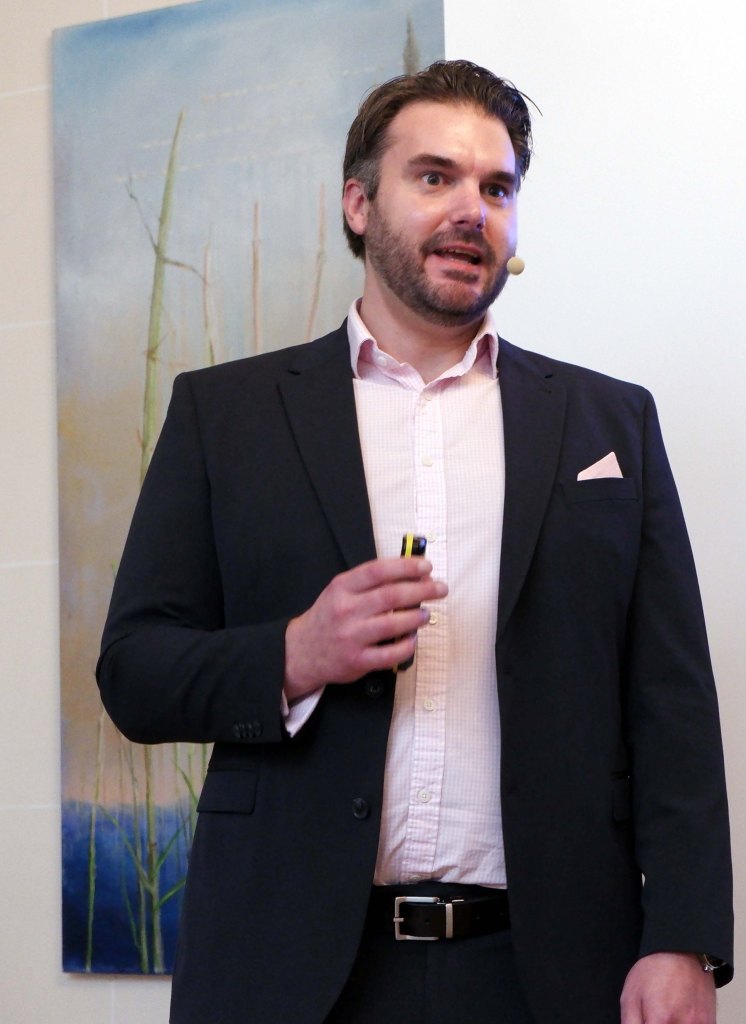
At the press conference, we listened to four speakers, Mr. F. Colonnese Business Development Manager EE (see photo here above) , Mr. C. Louwerse_Premium Cluster Director NL, Mr. Milosz Tomanek_Premium Cluster Director Belux and last but not least Emanuele Tomassorri, Exterior Designer.
We could have an interview with both misters Tomanek and Tomassorri, which you will see further soon in our columns.
Milosz Tomanek, Director of the Stellantis Premium Cluster in Belgium and Luxembourg (photo here above) stated “as soon as we announced Lancia return to Belgium and Luxembourg, we set up a dedicated team to work on and implement the brand Renaissance, making of Lancia the brand that embodies the Italian elegance. For the launch of the new Ypsilon in 2024, we will have 10 retailers and 13 after-sales service points. We are ready to have Lancia back and make of Belgium and Luxembourg two of the main European markets for Lancia.” Lancia will also launch the Gamma in 2026 and last but not least the Delta in 2028. From 2026, Lancia will only be launching 100% electric models and, from 2028, it will only sell 100% electric cars.
Lancia’s Roadmap for Europe
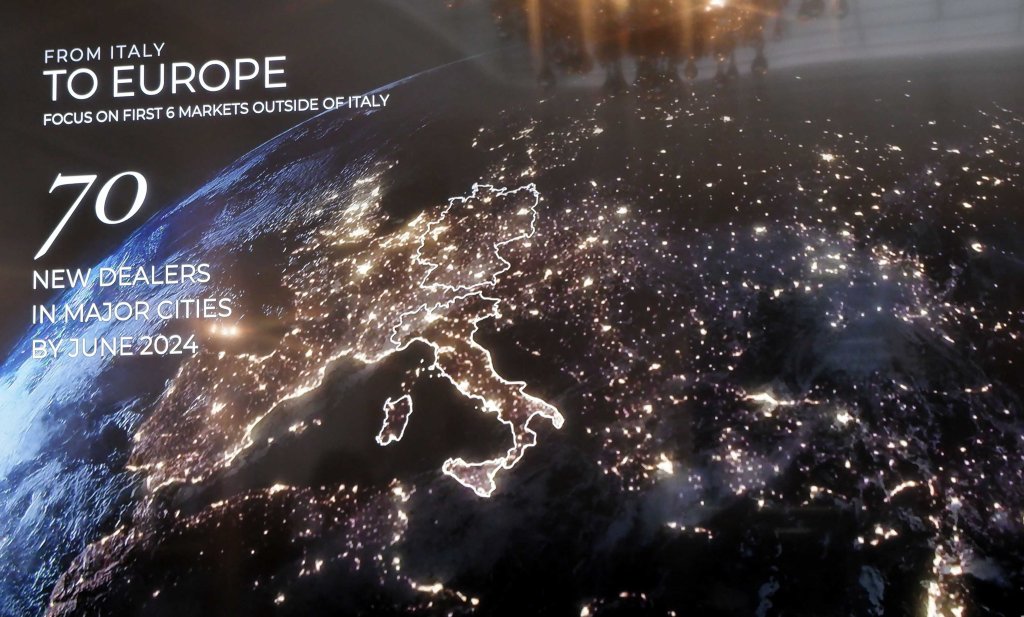
Lancia’s arrival in Belgium and Luxembourg is another step of the brand’s Renaissance towards its internationalization and forms part of a roadmap in line with the Stellantis “Dare Forward 2030” strategic plan.
By the first half of 2024, the brand will have 70 new retailers in 70 major European cities and 100% of the letters of intent have already been signed. The strategy involves, as Lancia puts i officially, a new efficient and innovative distribution model, with a selected number of retailers based on a key concept of Lancia Renaissance: quality.
The new showrooms will provide customers with a totally immersive experience, both online and offline, recreating a “home feeling” atmosphere, thanks to materials, colors and attention to detail, inspired by Italian architecture and design.
As said, more soon with interviews and further separate reports and comments on the design of the Pu+Ra HPE…
we just tell you here that the name Lancia Pu+Ra HPE is based on Pu+Ra, the brand’s new pure and radical design language, whereas HPE stands for ‘High-Performance Electric’…



























 Autoprova - for the Connaisseur