We drove the Opel Astra Electric Grand Tourer: space and EV smoothness…

The very popular Astra Grand Tourer occupies a quite unique position in the EV segment: instead of the usual SUV, it is a low slung station wagon, and indeed combines style and looks with roominess and practicality. Just read further…

Hans Knol ten Bensel

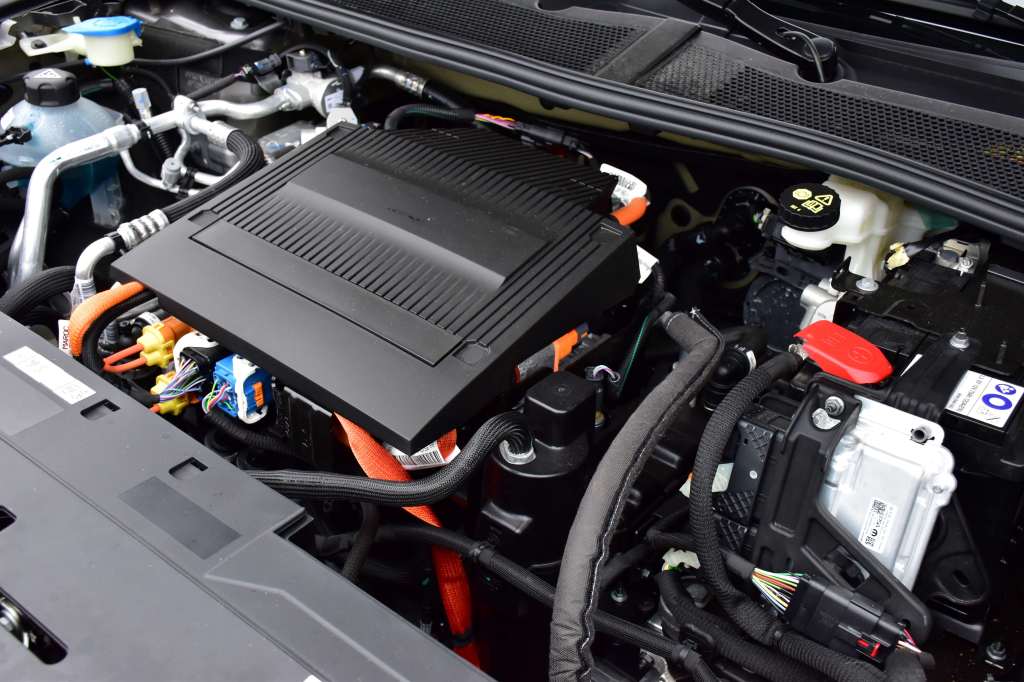
We already drove the Astra in a full electric version, and we were indeed quite impressed. Of course we were keen to drive for you the Sports Tourer station wagen version here. It certainly has the good looks, and also the extra practicality. The electric Astra has a 54-kWh lithium-ion battery with  102 battery cells housed in 17 modules. The motor delivers 115 kW or 156 hp and 270 Nm of torque
at the front wheels.

More than sufficient to deliver zesty performance, providing these delightful instant accelerations from very low speeds which we have come to love so much with EV’s.
The biggest advantage I personally find is the absolute smoothness of the propulsion an electric motor gives you. It adds so much driving pleasure when driving at slow speeds in (urban) traffic, transforming it in an absolute ”Zen’’ experience. My Audi A5 V6 with its CVT transmission attains the same smoothness and pulling power, but it needs a 3 litre engine to do it…


Top speed is set at 170 km/h, which is more than enough to make your way on Autobahnen. We all know that high speed driving is the Achilles heel of EV’s, and the range of your EV dwindles like snow in the (winter) sun when you drive it with verve on the left lane. The experienced EV driver knows than staying at around 110-120 km/h on the open road and absolutely avoid fierce accelerations is the only way to have a reasonable range and consumption.

The Opel -or shall we say Stellantis engineers- have made their homework, as our test car proved quite efficient indeed. We clocked averages between 14 and 15 kW/100 km, which we find excellent. This results in a realistic range of around 360 to 400 km. You can charge it in merely 26 minutes from 20 to 80 pct as it allows 100 kW fast charging.


Cabin layout shows less is more…

We like the philosophy of simplicity which Opel uses when designing its dashboards and infotainment. The necessary information is there, in clear and no nonsense fashion. I am personally a lover of large speedometer and rev counter displays in the most dramatic fashion, but this purposeful simplicity is nevertheless also quite attractive. This approach of course will only have its merits when the essential controls one frequently uses are intuitive and physical when appropriate, and also here the Opel designers have done a very good job. We also liked the very readable Intelli-HUD (Head up Display). Of course, Android Auto and Apple car Play are installed, and Bluetooth Audio Streaming is also possible.

A word of praise is also fitting for the front seats. Opel has designed them in team with medical experts, culminating in the ’’Aktion Gesunder Rücken”, or freely translated ”action healthy backs” and this results in truly excellent seating, ideal for long drives. A small ribbon on the seat with the initials ”AGR’’ tells you the story. Read also the words of praise we wrote in our previous test of the Opel Astra Electric in our columns.


Driving the Astra, or (re)discovering the essence of Opel…

Surefooted stability on winding roads and on Autobahnen up to very high cruising speeds, predictable handling without surprises, these are the hallmarks of every Opel since the mid ’70s of last century. The rally successes of Walter Röhrl at the wheel of the Mantas and Asconas amply proved this point already decades ago.
This Astra breathes the same DNA, and it inspires confidence behind the wheel, at every speed. Of course, a rather firm suspension setup goes with it, but it is well calibrated and never unduly harsh. At night, we enjoyed the Intelli-Lux® LED Pixel headlamps with not less than 168 individual LED segments. We also appreciated the smooth and efficient assistance of the Intelli-Drive 2.0 system, which includes Advanced Intelligent Speed Adaptation (A-ISA) and Semi-Automated Lane Change (SALC). The Intelli-Vision systeem is activated when you select reverse and uses four camera’s.  
Quality built…

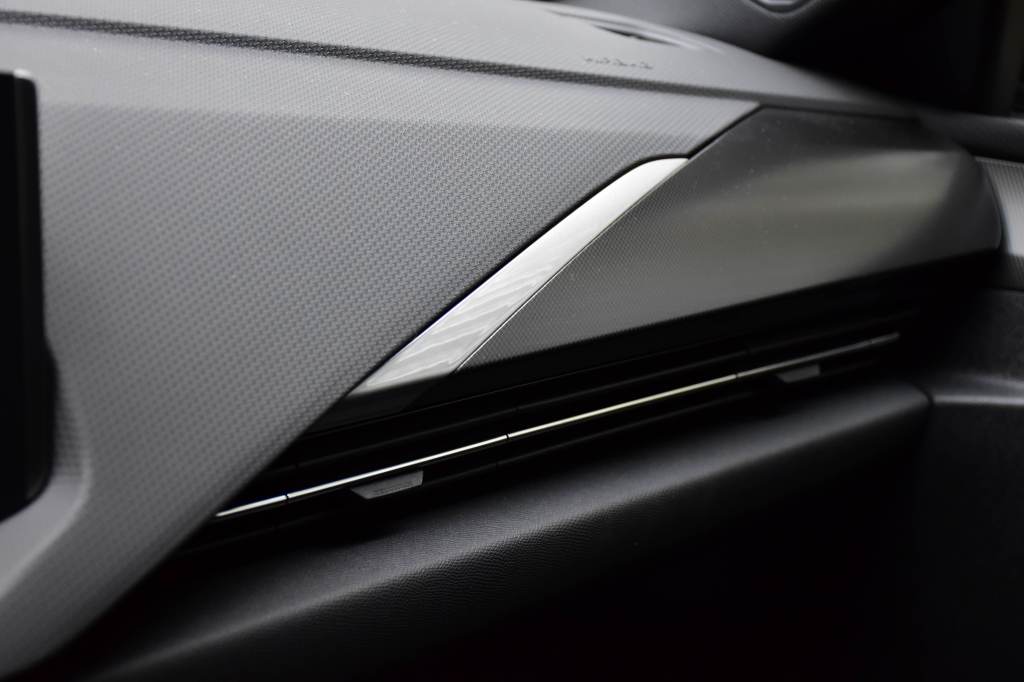
The fit and finish of the Astra is quite good, as is the overall quality of the materials. Durability is also paramount and attention is also given to easy cleaning and maintenance of the panels and surfaces. Opels are built to be lived with everyday…

…and practical

The EV Astra runs (still) on a ’’universal’’ platform which also allows for ICE engines and their drivetrains, which results in the presence of a  transmission tunnel fore and aft, costing some rear legroom and less space for the rear middle passenger, making it not a fully fledged five seater. This station wagon version offers of course extra space and indeed this Sports Tourer offers you a maximum space of 1553 liters, and you can enjoy the 40/20/40 folding rear seats and Opel’s Intelli- Space double loading floor.

Conclusion

The Astra is stylish, well built, agile and even more pleasant to drive with its electric motor. It is overall quite efficient, with a reasonable range and good (100 kW) recharging capacity, so a coffee break provides enough time to give you a further range of a few hundred kilometers. We suggest you to read also our conclusions in our test of the sedan version of the Astra Electric. We certainly liked to sit behind the wheel of this Astra once again…

Hans Knol ten Bensel
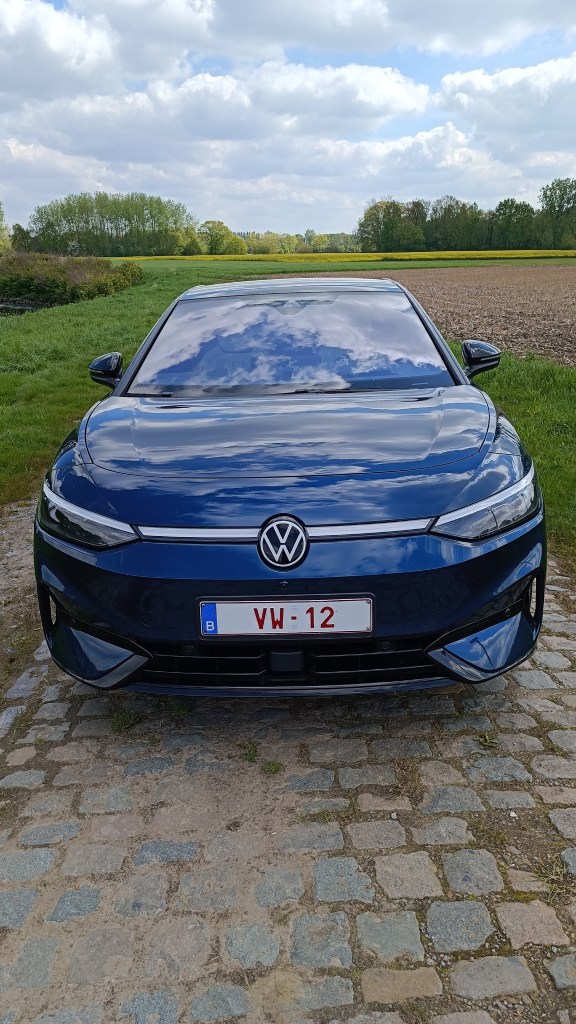
We drove the Volkswagen ID.7: your electrifying flagship…

Volkswagen has gained over the years already quite some experience in designing, developing and building EV’s with its already iconic ID series. All this know how is now brought together in the ID.7, the big EV limousine at the top of their ID range. The result is manifest: this car is full of good qualities, and earns indeed top marks in virtually all aspects. We found it clearly one of the best bigger EV’s we have come across lately.
Just read further…

Hans Knol ten Bensel

Imposing and well proportioned

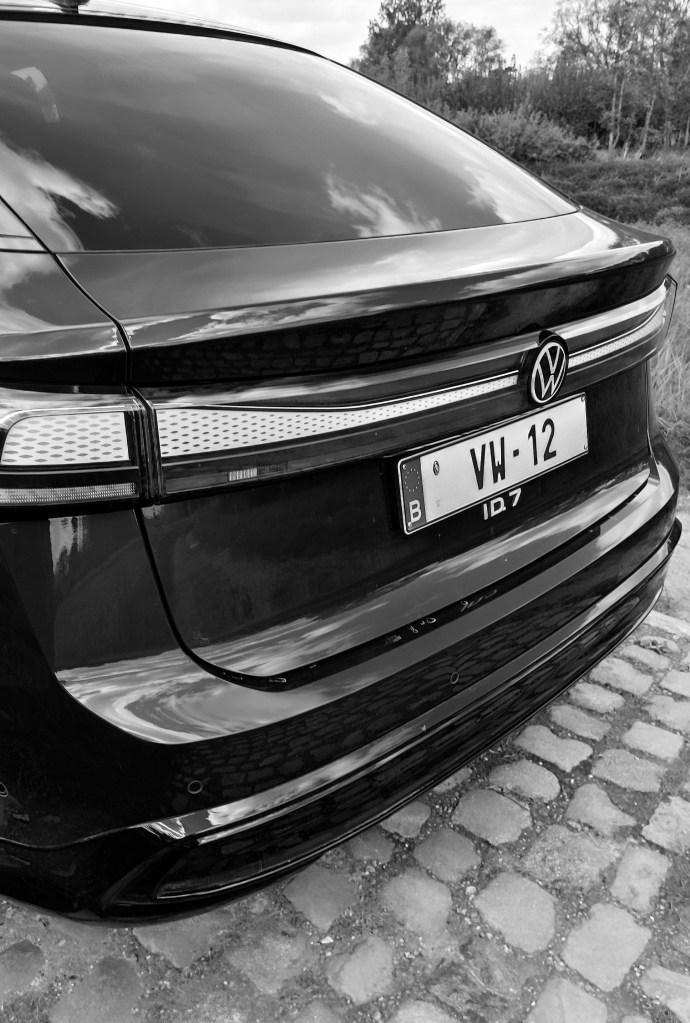
The ID.7 has the same styling and form language as the smaller models in its ID range, but its proportions are even better, not in the least because of its  longer weelbase. The overall length of 4,97 meters lets the lines and contours flow more gradually and elegantly and indeed, this ID.7 looks good from any angle.
The ID.7 is also very aerodynamic, with a Cw value of merely 0,23. This is very crucial to reduce energy consumption at higher cruising speeds, and to achieve longer ranges on long distances. But there is more: the VW engineers gave the ID.7 also a brand new electric motor. It drives like in the other ID models the rear wheels and develops 210 kW or 286 HP.

Plenty  of power, to say the least, and this ID.7 is very agile indeed. It sprints from 0 to 100 km/h in merely 6,5 seconds and overtaking becomes the proverbial breeze. The ID.7 behaves also wonderfully when you drive it more quietly, and the car then rewards you with a very reasonable consumption. We achieved during our test an average of 17.60 kW/100 km, and we think that this tells the whole story.
Indeed, VW succeeded in giving their flagship EV an impressive range of close to 500 km. Of course, the usable range varies with outside temperatures and driven speeds, but let’s say that this ID.7 has its merits as a long distance Gran Turismo.
This good range is achieved with the 77 kW battery which is also found in the other cars of the ID  range, and all this is due to the improved motor and the better aerodynamic qualities. Of course, as you already know by now, EV cars just LOVE slow driving. The slower the (constant) speed, the further you go. Even to very slow speeds, like say 40 km/h, EV’s are frugal, where IC engined cars need to revert to lower gearing to keep the revs up and are therefore less efficient. Also the outside temperatures are relevant. So at a nice springtime outside temperature of 20 degrees and at a cruising speed of say 90 km/h, you will drive far beyond 600 kilometers with your stylish ID.7. Top speed is sensibly limited to 180 km/h.

This electric flagship will also recuperate its kinetic energy nicely. If you put it in Eco mode, it will also decelerate smoothly and anticipate for bends and crossroads.

Comfort and space…

We found the suspension of the ID.7 actually “just right”, offering excellent comfort in all circumstances and under all driving styles, with outstanding handling and agility. A superbly balanced car indeed.

But it is not only the suspension which stands out, the generous dimensions in the cabin do the rest. Indeed, this is a limousine fit for the very tallest. Even when the front seats are put back to accommodate 1,95 meter tall front passengers, you will still enjoy ample legroom in the back. Indeed, this is a car to fit four basket ball players, and this is pretty unique.
Your servant is barely 1,70 m tall, so you can imagine that I was absolutely spoiled.

Climate comfort

The seats itself also merit superlatives. The front seats are optionally equipped with so-called ’Adaptive Climate Control’.  It has to be felt to believe it. Humidity sensors in the backrest will prevent transpiration, small jets will cool or heat the seats for optimal comfort.
Besides this, the seats will also spoil you with an array of massage functions.

The light atmosphere in the cabin can be changed almost at will, 10 different colour shades are standard, and can optionally be as many as 30…

Our test car came with a panoramic roof, which has a layer of polymer dispersed liquid crystals, so you can control the transperance with a simple touch.

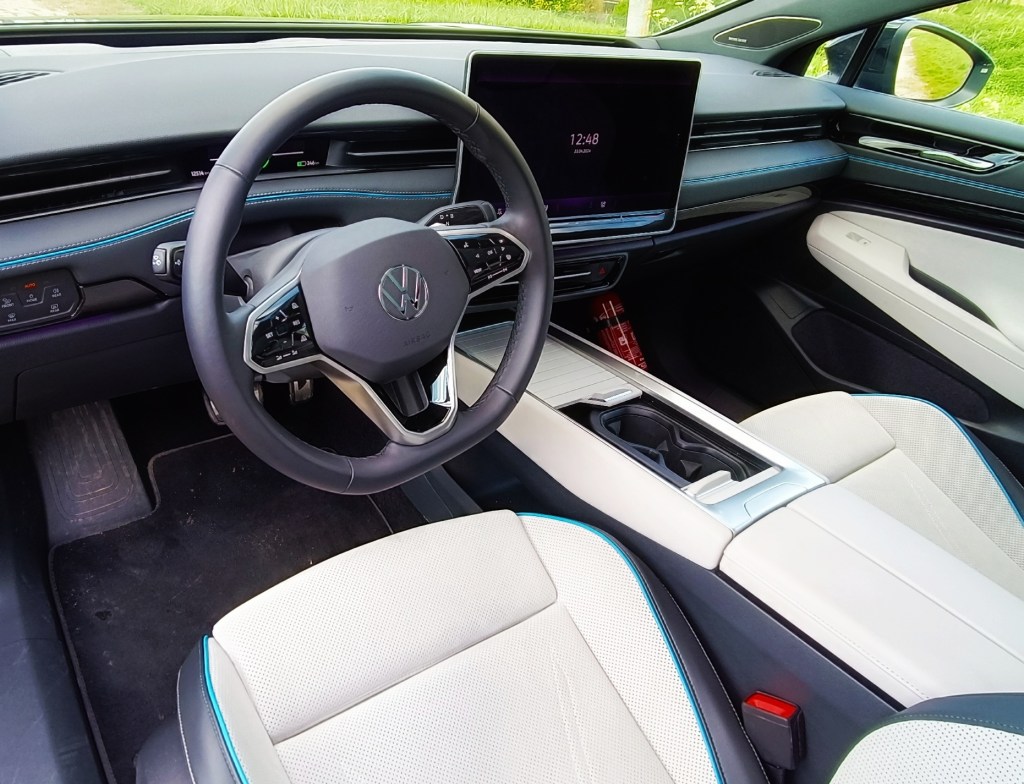
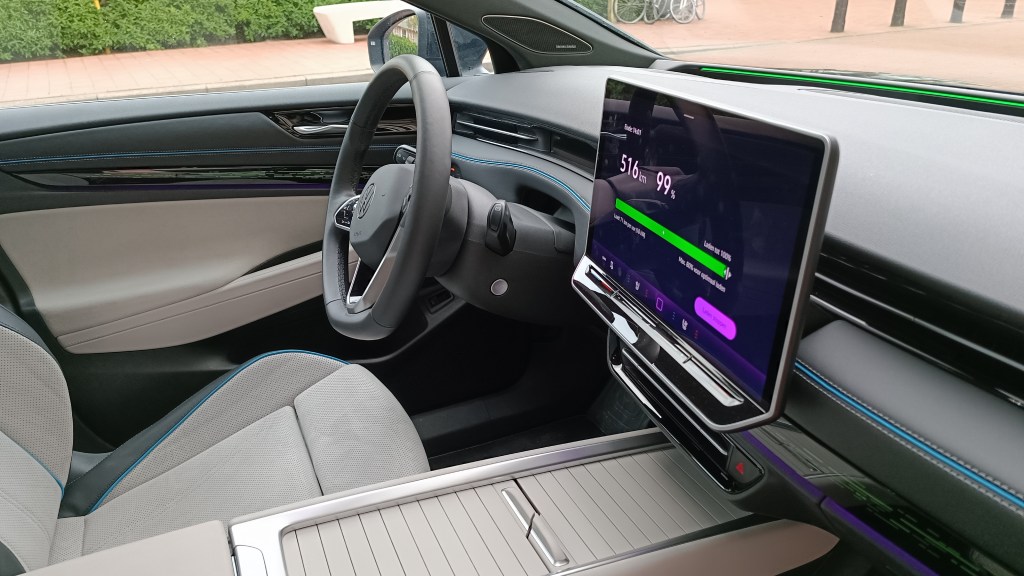
Heating and ventilation are controlled on the immense central touchscreen, although there is an illuminated control bar at the base of the screen which lets you adjust with sliders the basics like air  temperature and airflow volume. The direction of the airflow through the vents can only be adjusted on the touchscreen however. Your servant is very sensitive to colder airflows, and was very surprised to feel an intermittent air stream on his face. Indeed, the airvents can be set to turn constantly on a horizontal axis, like a stand ventilator in your home…

A range of well over 500 kilometers is quite possible with the ID.7..

On a public charging point it will accept power up to 11 kW, and the battery will be 80 pct charged in about 4 hours…

Touch controls…and clear instrumentation.

Again the haptic touch controls are the hallmark of this VW, as is typical for the entire ID range. It takes some getting used to, and for instance you are well advised to set the voice command sensor on the steering wheel properly, otherwise she will ask you what she can do for you at every turn of the way.

What we loved is the very clear and concise driver information the instrument display puts in front of you. Indeed, less is more. There is also a very readable head up display. It informs you about speed, the direction you should take and energy consumption.

Practical

In good VW tradition, the boot space is enormous. When you fold the back seats and load until the window openings, you can store 888 liters…
There is even a small separate 25 litre storage space for the charging cables.

The ID.7 is rather wide for urban traffic, but its turning circle is a modest 10,7 meters, and indeed the car is thanks to the driving aids also a breeze to park.

Fast charging is a strong point of the ID.7. It will accept up to over 180 kW charging power, and under these conditions it will take little more than half an hour to recharge this flagship from 10 to 80 pct. On a public or wallbox charger it will typically accept 11 kW, and you have to reckon with a charging time of some 8 hours.

Conclusion

The ID.7 is indeed a totally convincing limousine EV. It is hard to find any weak points, and it is therefore not surprising that it earns many top laurels in the international motoring press. Notably it was given the very best note ever for an EV by the German ADAC in their test.

Quality doesn’t come cheap, but then this is a rather formidable EV, and we sincerely regretted to part with it…

Hans Knol ten Bensel

We drove the Peugeot e-2008: a bestseller goes electric…

The stylish 2008 has already won many car loving hearts in its B-SUV segment over the last three years, and Peugeot now again improved its styling, equipment and last but not least gave it a new electric motor, bigger battery and longer range.

Reason enough for us to have a go for you behind its cute, dynamic and very pleasant small steering wheel, which gives this 2008 the extra panache and feel to brighten up your daily driving. We drove the top notch GT version here, and were spoiled indeed…

Hans Knol ten Bensel

The E-2008 was already quite popular in its earlier  version, with not less than 75,000 units sold. It accounted for 17.4% of sales in 2022, placing it on the podium of European sales of electric SUVs in the B segment.

Even more style…

The 2008 had already an appealing overall design, but now after the new 508 saloon and 508 SW, the 2008 is the second model to adopt the new PEUGEOT signature light. This consists of three vertical light claws which are integrated into the gloss black inserts on the bumper. In the GT versions, the effect of the three claws is extended in the lighting of the full LED headlamps through the use of three light modules. We liked it…see the photo below.


The new LED rear lights on all versions of the new 2008 are redesigned. The emblematic three claws are made up of three superimposed horizontal double slats, giving the 2008 optically a wider stance.

The new 2008 has a new front end, which features the new PEUGEOT emblem, and we liked very much the new Selenium Grey which was chosen as the launch colour. It gives the 2008 a decidedly upmarket appeal.
The wheel design is now in line with those introduced on the PEUGEOT 408. Several models are available, in 16-inch “NOMA” (ACTIVE versions), 17-inch “KARAKOY” (ALLURE and GT) or 18-inch “EVISSA” (optional on GT). All alloy wheels feature a 4-spoke wheel centre, stamped with the PEUGEOT crest…

A pleasant cabin and a new digital instrument cluster

Ideally located at eye level, just above the steering wheel, the new 2008’s instrument cluster is digital on the ALLURE and GT versions. Its 10-inch digital display has a new design and, on GT versions, a 3D display. The colour of the display, the hierarchy and the layout of the information can be fully adjusted to suit the driver’s preferences, and indeed, is quite intuitive to use. We like the Peugeot idea of putting the instruments in your line of vision, just above the upper rim of the small steering wheel, but we would suggest that you test this out for yourself so that you feel comfortable with it.

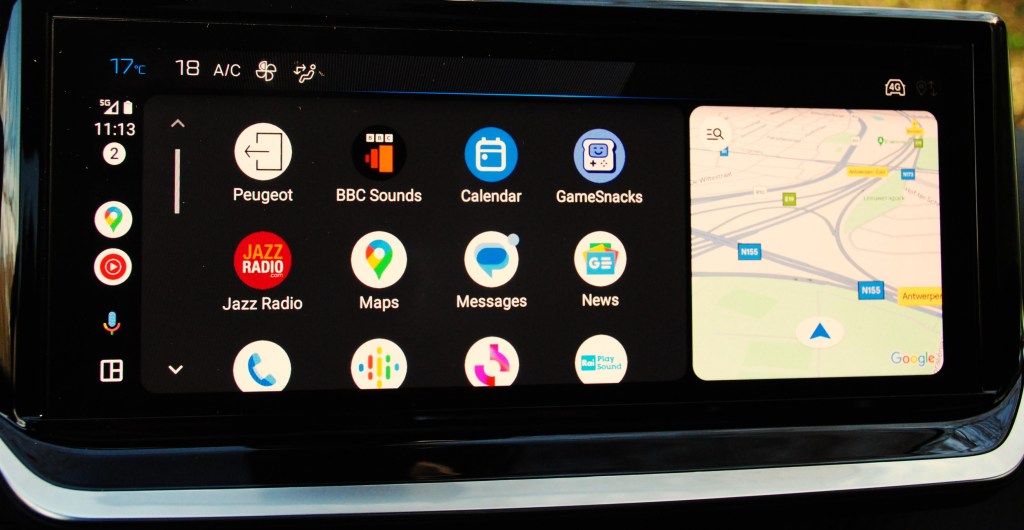
Of course, the central display will also show your Android Auto connection…

All 2008 models now come with a 10-inch central touchscreen as standard, and on the ALLURE and GT versions, the central screen has improved readability thanks to HD technology. It is indeed a breeze to use, also thanks to the row of piano keys under the central screen, giving quick access to key functions. We also liked very much the big round audio volume control knob, it is always the most intuitive and useful tool for radio listening, no matter what…

The cabin is pleasant, the seats not only look good, but give excellent comfort and support. As icing on the cake, the GT version we tested offers ambient lighting which can be customised in eight different colours, coordinated with those of the central touch screen and even taking into account the selected driving mode (!).

If you plan to take your E-2008 to snowy alps or muddy country roads, it is good to know that the 2008 comes with Grip Control, which provides access to three driving modes: sand, mud and snow. Depending on the country, this grip control offer is combined with ‘3PMSF’ all-season tyres.

A new electric engine and longer range…

Stellantis installs now a more powerful 156 HP electric motor in the 2008, and this engine is also found in the E-208 and E-308. The same goes for the improved battery, now good for 54 kWh. All this results in a longer range – according to WLTP standards – of 406 km.
Everybody now knows that outside temperatures and driving styles greatly influence the possible range of an EV. And it must also be said that for EV driving, the slower is the better, contrary to IC engined cars, which in the top gear have a so called ”sweet” spot for economy driving at some 70-85 km/h. At this speed, an EV is already consuming a LOT MORE kWh than at say 50-60 km/h. Speeds between 30 and 40 km/h are most economic for an EV, this is the reason why it excels in urban traffic, and this is the main reason for adopting hybrid drivetrains to lower overall consumption in frequent urban use.

To achieve decent efficiency at higher speeds and more dynamic use, manufacturers of electrified cars have adopted the so-called ”drive modes” systems, as is of course also found on this E-2008. In this ”Eco” mode, the engine power is harnessed to some 109 HP, which is indeed more than sufficient for everyday driving. The excellent torque characteristics of an electric motor make up for this, and one never has the feeling that the car is underpowered.


What remains is the uncanny and brilliant smoothness of EV driving, and indeed, nothing comes close if you want pleasant (urban) mobility. On the open road, we try to achieve in the milder springtime temperatures a decent range of some 350 kilometers, and this means cruising in the ”Eco” mode at some 100 km/h, which means that you truly can enjoy the jazz or classical music coming from the very melodious sound system.
On the practical recharging level, it is good to know that you can fast charge the 2008 at up to 100 kW. This means that you can recharge this Peugeot in merely 27 minutes from 10 to 80 %.

We also appreciated here the very well dampened rolling noises, making a longer trip a very relaxing and enriching experience.
EV cruising is indeed under these circumstances a marvelous ”Zen” activity, where we are of course grateful that the distances in our rather small country are not by any means large. A word of praise also for the sound system, very important now in an EV.

French car builders have a unique “savoir faire”, when it comes to making suspensions which are both comfortable and well balanced, offering excellent road manners. The small steering wheel inspires you to adopt a more active driving style, and indeed, the 2008 doesn’t miss a beat, on any road and at (almost) any speed…Having said this, this 2008 feels however most at ease when you adopt a zesty, but a still rather relaxed driving style.

With 156 HP the E-2008 offers quite adequate performance, if not sensational. It will sprint from 0 to 100 km/h in 9,1 seconds, top speed being limited to 145 km/h.

Practical

The 2008 scores well in everyday life. Offering good seating comfort fore and aft, luggage space is still very much OK with 434 litres, and you can extend the luggage space by folding the 60:40 split rear seats. When it comes to equipment, there are three levels you can choose, Active, Allure and the Gt version we tested. The Allure version seems the ideal compromise in terms of value for money, as it offers most of the things you get in the GT  version, although we must admit that we liked the extra panache of the GT nevertheless…

Conclusion

The 2008 convinces in styling, above all a fantastic looking interior and dashboard. It is smooth and comfortable, seats four easily, has adequate boot space, and is reasonably e-efficient. It is very well possible to achieve an average consumption of around 15 kW/h given a relaxed driving style.

Hans Knol ten Bensel 

We drove the EV Car of the Year: The Jeep Avenger Electric


Jeep has conquered many hearts over the years, and its popularity keeps steadily rising. The iconic brand for outdoor lovers has also chosen the path of electrification, which has been very well received indeed. The Avenger earned also top marks right after its introduction. It is designed and built in Europe, and is – for the time being – available only on our EU markets.

The Jeep Avenger Electric is only front wheel drive, but has the cutest proportions and overall looks, and just that makes it so desirable. It is unmistakably “Jeep”, and small styling details both inside and out remind you of this. We tested for you this ultrasmooth (urban) icon, just read further…

Hans Knol ten Bensel

Indeed, the looks and proportions are top notch, whereby the overall dimensions remain beautifully compact. Overall length is only 4,08 meters, which is 16 cm shorter than the Renegade. Of course, the platform comes from the Stellantis group, is built in Poland in the state of the art Tychy plant and harbours the latest EV technology, of which much more here below. The side view is marked by the classic trapezoidal wheel arches, allowing more wheel travel for maximum articulation. The seven bar grille is of course classic Jeep…


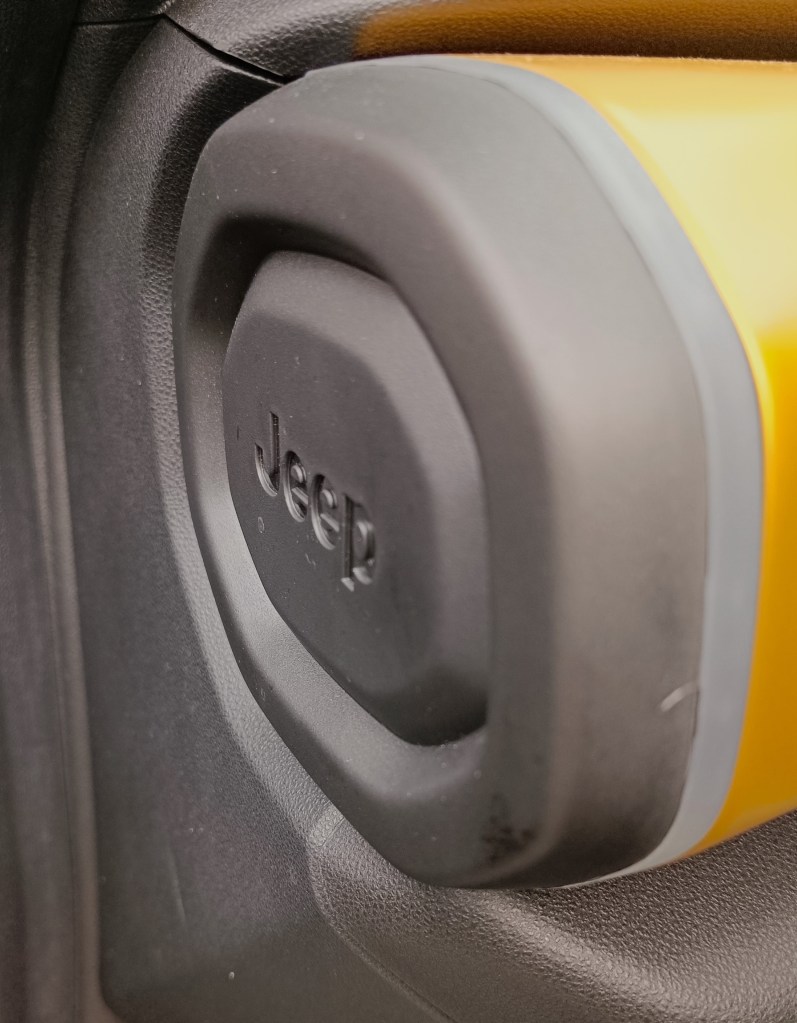
At the rear, the Avenger carries signature-lights inspired by the classic X fuel cans. This “X” is a recurring theme inside and outside via the “X-Camo”, a pattern which combines the concept of “camouflage” with the letter “X”. Cute!

Practical

The interior space feels in our modest opinion “just right” and the height is wonderfully suited to get in and out of the car most easily. The clean design of the dashboard breathes the “design to function” premise. It was inspired by the Jeep brand’s history and particularly by the Jeep Wrangler. It certainly looks refreshing and we just loved it

The upper part of the dashboard is shaped by a single horizontal function ‘beam’ which includes all the air vents, ambient lighting and a centrally located 10.25 inch touch screen, which can be seen by both the driver and passenger. The lower side of the dashboard is then marked by a wide-open storage shell, where you can put not less than 34 liters of all your stuff which you think are unmissable in your daily life. Below the buttons controlling the automatic transmission, this space has a neat folding magnetic cover which let you hide it from other’s eyes… Below it you can for example charge a cell phone while simultaneously storing a 1.5-liter bottle of water.

The front seats are electronically adjustable and can be had with massage function, and we found them quite comfortable indeed. Boot space is good with 380 liters, and is practical with the sill height lowered to 72 cm. Also the boot lid which is more than 1 meter wide.

Second generation BEV powertrain…

The second-generation 400 Volt electric powertrain is the first one to be launched by Emotors, a joint venture between Stellantis and Nidec Leroy-Somer Holding. It supplies 115 kW, corresponding to 156 horsepower, and 260 Nm of maximum torque. This means zesty performance…It runs on the “small” STLA platform. We tell you here that Stellantis has designed four EV platforms. STLA Small platforms vehicles will house packs with capacities between 37 kWh and 82 kWh. STLA Medium EVs will carry between 87 kWh and 104 kWh, STLA Large will use packs of 101 kWh and 118 kWh, and the big STLA Frame will require between 159 kWh and 200 kWh packs. 

Each platform can be built to up to 2 million units a year. Volume and a high degree of shared components are of course key for both speed to market as well as cost control, according to Stellantis.

There will be three core drive modules that package the electric motor together with the transmission and power inverter. These drive modules also will be suitable for front-, rear-, and all-wheel drive applications, as well as 4xe in the case of plug-in hybrid Jeeps. So much here about the Stellantis platform strategy.

As rather typical for an EV, the acceleration leaves little to be desired. It will sprint from 0 to 100 km/h in 9 seconds. A rapidly diminishing range will prevent you to put your right foot very deeply on the motorway, and therefore the engineers already limited the top speed to 150 km/h.


A useful range.

The new 54 kWh battery, which is also produced by Stellantis, is made up of 17 modules and 102 cells utilizing NMC 811 Lithium-Ion chemistry and delivers 400 km of range in the WLTP cycle, which becomes 550 km in the urban cycle, still according to Stellantis.

The battery, is found under the front and rear seats and the central tunnel. Furthermore, it is protected by a high ground clearance and underbody skid plates during off-road.

Speaking of range, in the real world where we drove the Avenger in winter, and this affects of course battery performance. The range using the heating normally and doing some brisk highway and motorway driving at the legal maximum speeds, is reduced to some 230 km, with close to 300 km available when you use the Avenger exclusively for (sedate) urban driving. We said it already many times before in these columns, the smoothness and silence of E propulsion is just wonderful, and indeed the Avenger is a pure delight to drive.

Off road talent maintained…

The full electric Avenger we tested is only front wheel drive. But make no mistake, it is a Jeep. Therefore, it is equipped with standard Selec-Terrain® and Hill Descent Control which, together with the good  approach and departure angles and the vehicle’s ground clearance, make it very fit to discover nature’s off road paths. We tried it, and indeed we were astonished…

The Selec-Terrain® system offers six modes: “Normal” for everyday driving; “Eco” to enhance range; “Sport” for more driving fun; “Snow” for maximum traction on icy roads or trails; “Mud” to optimize mud performance and to enhance grip; and “Sand” to limit the risk of becoming stuck on sandy soil.  Needless to say that we used on the open road almost exclusively the ”Eco” mode…

Infotainment and driving aids…

The Avenger offers of course Android Auto and CarPlay; you can mix and match content to build your own interface (up to twelve widgets per page, up to six pages); you can enjoy embedded navigation by TomTom with enhanced natural voice recognition; and last but not least over-the-air updates. 

The new Jeep Avenger also offers a suite of remote services and functionalities. For example, thanks to the Jeep Mobile App, users can locate the location of their cars directly from their smartphones. Users can even lock and unlock their doors, check the battery level, set the climate functions and recharge the vehicle, as well interact directly with the Avenger through a vocal assistant.

The Avenger offers also Level 2 autonomous driving, which automatically adjusts speed and trajectory, and makes use of Adaptive Cruise Control and Lane Centering. We found it together with the “zen” character of E driving quite relaxing indeed…

We liked the pleasant compact dimensions of the Avenger, yet offering excellent head and legroom fore and aft even for tall adults. It is a marvelously well balanced car with, as we said earlier, pleasing and iconic looks and proportions.    


Conclusion


The Avenger has many qualities which impressed us greatly. It looks good, drives beautifully, offers enough room for four adults and their luggage, is marvelously fit for urban use and is also surprisingly well at home on unhardened country roads. It is also an excellent cruiser, comfortable and silent, but when you have Gran Turismo high speed aspirations, look rather for the hybrid version.
We look forward to testing this e-Hybrid version soon…

Hans Knol ten Bensel

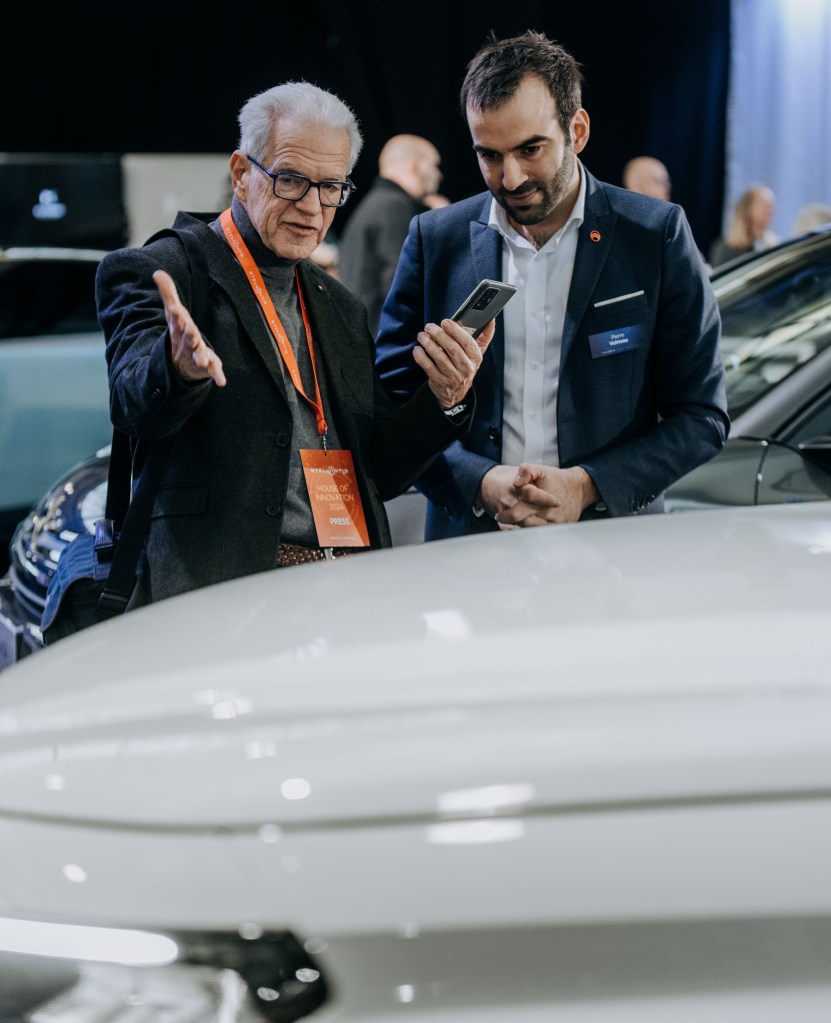
We spoke with Pierre Voineau, Managing Director Citroën Belgium & Luxemburg

On BEV-mobility In the B segment, we will indeed be the spearhead for the Stellantis Group.

On the recently held Stellantis  Press conference where it unfolded its strategy, results and future plans for its brands, we had the opportunity to talk with the leading managers of the several brands. As Citroën is the linchpin of the group in terms of European volume sales, we were keen to talk with Pierre Voineau, more specifically about a very important EV for Citroën, the new ë-C3.

Just read on…

 Hans Knol ten Bensel

HKTB: The new electric C3 will be a very important car for Citroën on our market…

PV: Indeed, it is the most important model launch for the Citroën brand over the last decade. Of course, the C3 is the most popular car here in Belgium, and has been already over the last few years. We also want to revolutionize the EV market with this car, making it accessible for everybody and at the same time producing the car in Europe…
We are at the crossroads of a decisive moment both for the Citroën brand as well as the car market in general.  

HKTB: For you it is also a mini-SUV, the C3 has grown taller…

PV: Indeed, we have injected the DNA of an SUV into the well known C3, but we did not make the car any longer or wider. This was very important. The car does not take up more room on the road than the present C3, just by a few centimeters at most. But we heightened the ground clearance of the car by 3 centimeters, and raised the roof line considerably with 10 centimeters. The passengers sit higher and indeed the front end is more imposing with a styling reminiscent of the OLI prototype you saw in Paris. The OLI embodies the strategy of the brand in terms of the total technical concept and styling in the long term, but indeed, some elements are already incorporated in this new C3.

HKTB: Which extra market segments or client groups do you want to attract besides the existing Citroën buyers?

PV: We will not in the first instance attract other client groups. It is rather the mobility itself which changes. With this, the needs of our existing client base also evolve. Now the need arises for cheap EV mobility, and we respond to that.

HKTB: The problem for you as a brand and certainly for a big automotive group like Stellantis is that the public charging infrastructure is still insufficient to meet all the mobility requirements. What do you put forward strategically here as a brand and a large group?

PV: We have Free2move eSolutions within the Stellantis group, which accompanies the client from A to Z in purchasing and installing his home charging point. When the client is in a particular situation and has no home or office charging point, or otherwise, it is good to know that in the spring we will also offer a thermal version of the C3.

Having said this, we will also have a special application, called e-ROUTES, on our electric C3. The route planner knows how many kilometers you need to travel, it will calculate a stop at say 20 % of the battery left, indicating the position of a charging point and also whether this charging point is available. It will indicate the recharging time needed, depending on the power of the charging station. One can charge up to 100 kW by the way. This will give the customer peace of mind when traveling over longer distances. With a battery of 44 kW and a range of some 320 kilometers one responds to almost all needs. On average, customers don’t travel more than 80 km per day.

HKTB: EV driving also needs a different state of mind and driving style…

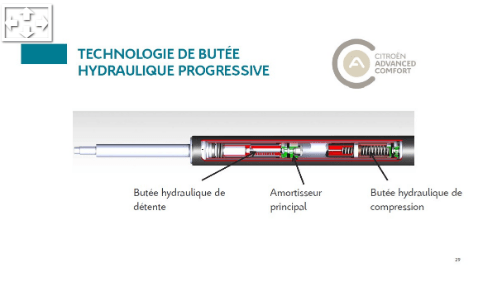
PV: Indeed, one will embrace a different, anticipative, more leisurely and “zen” driving style… What’s more, we focus at Citroën also on comfort: the new electric C3 has a so-called Progressive Hydraulic Cushions® suspension, ensuring that you enjoy the legendary ‘magic carpet ride’ feeling of comfort on the road, thanks to the use of progressive Hydraulic bump stops.

PV: We also have a manual airco on all the equipment versions of the C3, including a rear-end sensor. This combination of e-refinement with comfort and lavish standard equipment has great appeal and indeed the European wide orders for the new car at the end of December last year amounted to not less than 20,000. This year, we have chalked up already 1,000 orders in Belgium only. On BEV-mobility In the B segment, we will indeed be the spearhead for the Stellantis Group.

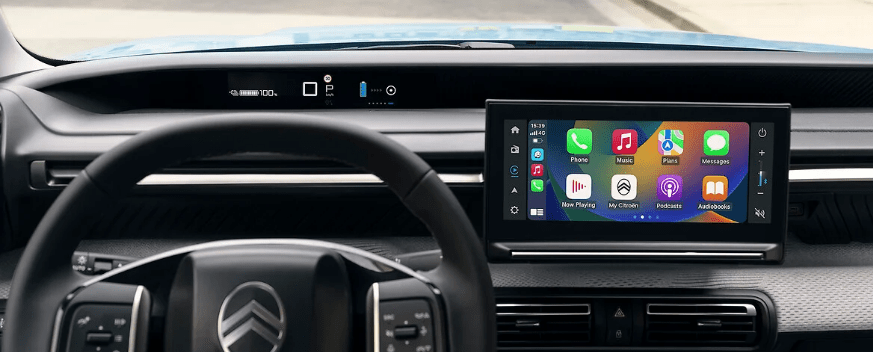
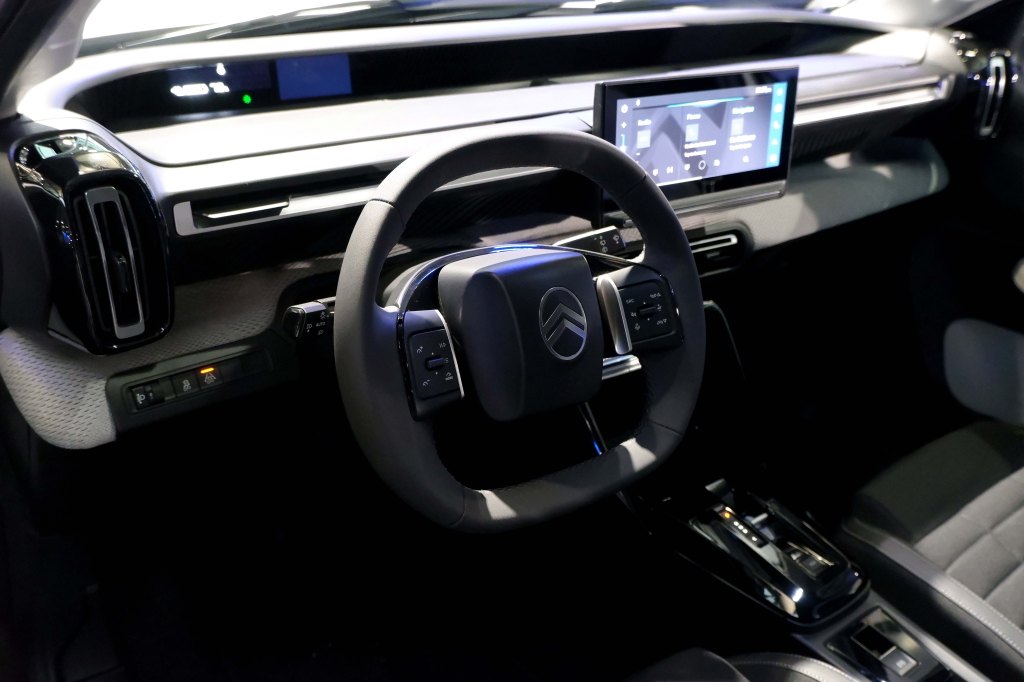
PV: I would like to comment also a bit more on the interior of the C3. Just look at the display. It reflects vehicle information onto a glossy black section between the top of the dash panel and the bottom of the windscreen. This smart solution ensures there is no duplication of information as there would traditionally be between a Head Up Display system and instrument cluster, and ensures drivers can easily access all the key information they need without taking their eyes off the road. The new multi-function steering wheel is also smaller, and so does not obstruct the head-up display.

Owners of the ‘You’ model have as standard equipment the ‘My Citroen Play with Smartphone Station’ dedicated App to access music, radio, calls and navigation via their own device.

HKTB: The clever use of the smartphone was also a solution found on the OLI prototype… actually, this C3 has everything of a compact “grande routière”…

PV: Indeed, as said, standard on ‘You’ models and features a built-in smartphone holder that allows drivers to ‘dock’ their device and auto launch the dedicated new App using NFC (Near Field Communication) wireless technology. Via this app, owners use their device to access shortcuts to Phone, Radio, Navigation and Music App services. The ë-C3’s steering wheel controls ensure drivers keep their hands on the wheel, and the ‘Home’ button makes it easy to navigate back to the homepage of the App.     

Indeed, she has everything of a “petite grande”…

HKTB I thank you for this interview.

Hans Knol ten Bensel

Nissan Benelux unfolds her strategy for the Benelux market…

Managing Director Jerome Saigot unfolds the strategy of Nissan Benelux…

We are at the start a new automotive year, and therefore it is a good opportunity for manufacturers to look forward into 2024 and announce to the Belgian press what their strategy, plans and objectives will be in the forthcoming 12 months.

So we were invited at the end of last year by the Melvin Keuter, head of communications of Nissan Benelux at their press conference…and their interesting initiatives are certainly worth a closer look. Just read further!

Hans Knol ten Bensel

Melvin Keuter, head of communications of Nissan Benelux, exposed the electrification strategy of Nissan and its future…

Nissan Belux and Nissan Nederland merged into Nissan Benelux

On the 1st of July last year, this merger was executed in order to improve response to the needs of the Benelux market. Now the two entities are joined in a new so-called Regional Business Unit, led by Managing Director Jerome Saigot. Indeed, the car market is going through a fundamental transition, and Nissan will respond to these challenges by focusing on electrification, digitalization of the customer approach and responding to major changes in the buying behavior of their clients. Mr. Saigot emphasized these points of the strategy in his presentation at the press conference. He sees also in this merger further useful synergies for staff and dealerships.

He exposed the mission of Nissan Benelux, which is to be an innovative brand which offers electrified mobility and a superior service to its customers. Its objectives are to enlarge its volume, raise brand identity and awareness as well as boosting profitability.

The strategy to achieve this will be to focus, as we said, on further digitalization of customer approach, further electrification of the model range, strengthening corporate sales, bolstering brand identity and streamlining distribution.

According to Jerome Saigot, digitalization is a major trend which will strengthen further. In 2020, only 4 % of customers were buying a car online, which has risen to 12 % in 2023. Market surveys show that soon 45 % of the future customers will buy their car online. Of course, Nissan will work further on its electrification, and indeed focus also increasingly on corporate sales.

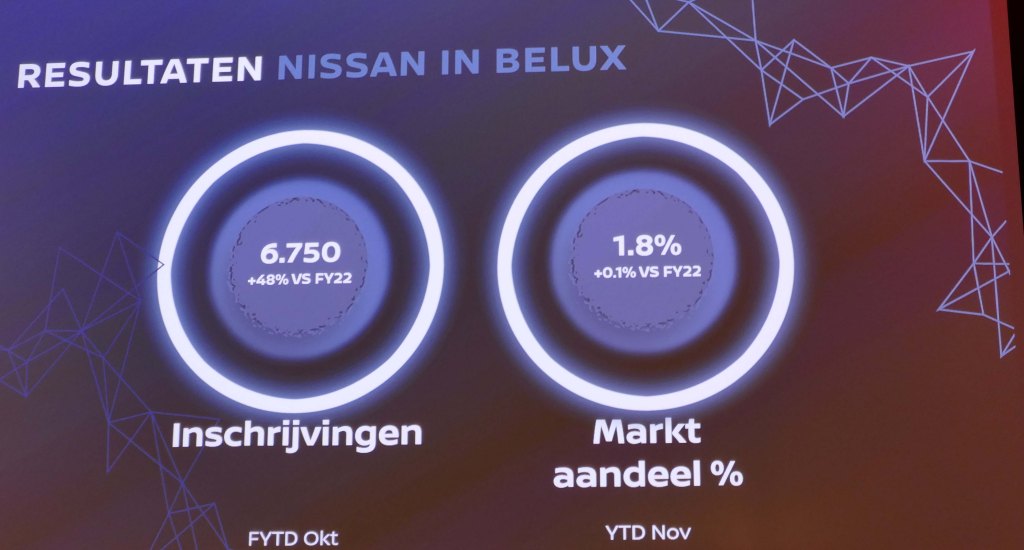
Looking at the results last year of Nissan Belux, 6.750 units were sold, which is an impressive 48 % rise compared to FY 22.

Also in distribution and dealership the focus will be on further developing synergies and tailoring the customer approach on their changing preferences and buying behavior. In December last year, Nissan sent a message to the professionals, small and medium enterprises, craftsmen and the like, pointing out the attractiveness of their increasingly electrified LCV segment.

Decisive steps toward further electrification… or EV36Zero.

EV36Zero is a key part of Nissan Ambition 2030. In this period Nissan will deliver exciting, electrified vehicles and technological innovations while expanding and transforming its operations globally the company announces. The vision supports Nissan’s goal to be carbon neutral across the lifecycle of its products by fiscal year 2050.

In November last year, Nissan announced that the EV36Zero hub in Sunderland, Nissan’s blueprint for future manufacturing, will consist of three electric vehicles (EVs), three gigafactories and up to £3bn investment.

The transformational project includes future all-electric versions of Nissan’s flagship Qashqai and JUKE crossovers, and Nissan also confirmed that the third vehicle planned for UK production will be next-generation Nissan LEAF.

Nissan also announced that that it expects its passenger car line-up in Europe to be 100% electric by 2030.

Nissan is also incorporating in their electrification strategy the latest developments in battery technology. It will adopt Cobalt-free batteries, and towards 2028 there will be a cost reduction in comparison with Lithium-Ion batteries of not less than 65 %. This year Nissan will open a pilot factory in Yokohama to produce solid-state batteries, which can be charged three times faster and cost much less. They will be introduced to the market in 2028…  

Looking into the future…

After exposing the good qualities of the present range, a veil was lifted in this conference about the cars we can expect in the (not so) distant future.

Indeed, the three future versions of the full electric Juke, Qashqai and Leaf will be inspired by three exciting all-electric concept models, two of which were recently unveiled at the Japan Mobility Show:

The Nissan Hyper Urban Concept, a crossover EV characterized by a sleek and modern aesthetic.

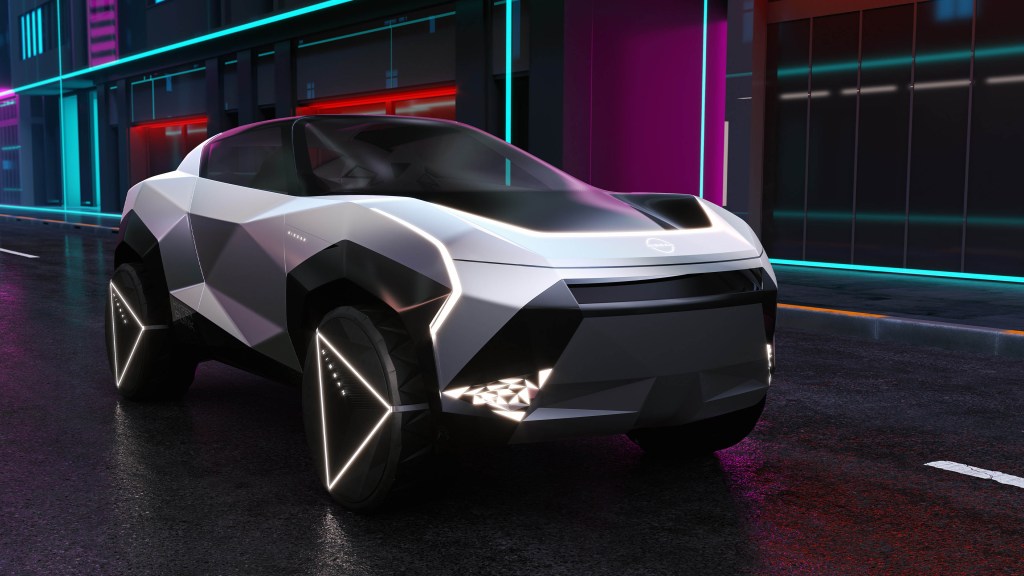
The Nissan Hyper Punk Concept, an all-electric compact crossover with an exterior aesthetic defined by multifaceted and polygonal surfaces.

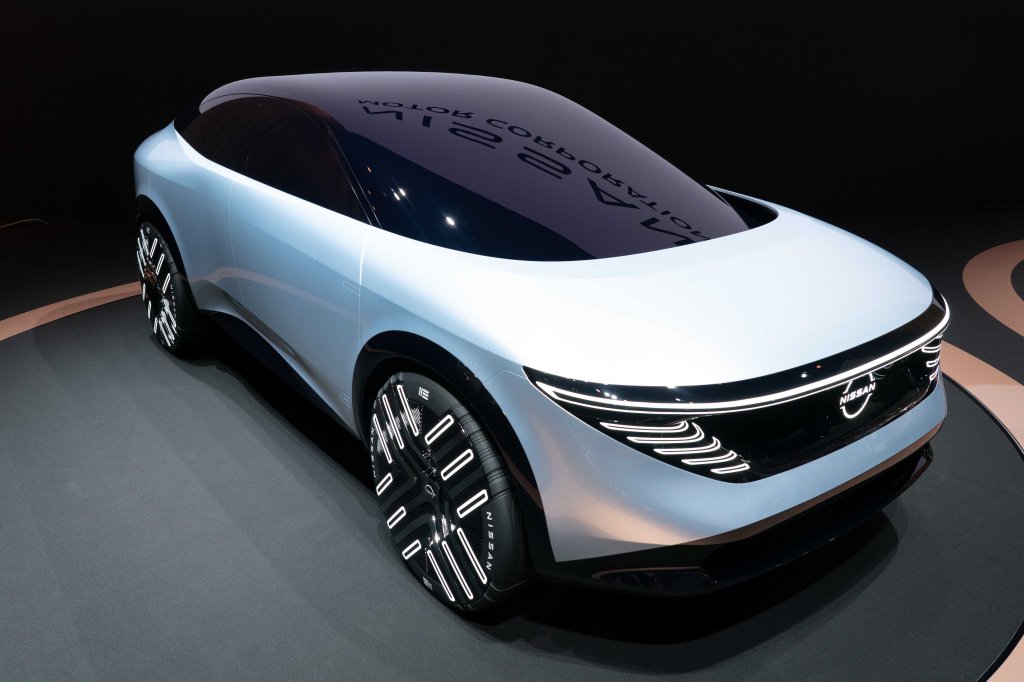
The Nissan Chill-Out Concept, was unveiled in 2021 and previously confirmed as the inspiration for a future EV to be built in Sunderland.

 The car is a compact, sporty, city EV concept with an influence from the world of virtual gaming. Besides the sleek and modern design, advanced safety technology, it has a productive and comfortable interior space.

The Chill-Out, – see photo here above – which looks to us as a very realistic concept car which we might see on our roads in the (very?) near future, utilizes the CMF-EV platform.

The Nissan Hyper Urban Concept – see photo here above – was announced at the 2023 Japan Mobility Show; its styling complements the sophisticated tastes of its target users, such as urban and suburban based professionals who prioritise environmental sustainability.

This all-electric crossover concept is designed to remain up to date for every new owner, ensuring an extended lifecycle through regular software and hardware upgrades, aiming to achieve the utmost sustainability. To maximize this further, the vehicle seamlessly integrates into the electric vehicle ecosystem (V2H/B/G), for power sharing.

Last but not least, there is the Nissan Hyper Punk concept was also announced at the 2023 Japan Mobility Show.

It is positioned as an all-electric compact crossover concept, catering for a dynamic audience seeking self-expression through style and creativity. It offers owners a canvas for self-expression with its polygonal-shaped exterior with dynamic color changes.

Further styling exercises: the Nissan Concept 20-23

To celebrate the 20th anniversary of Nissan Design Europe (NDE) being located in London, Makoto Uchida, Nissan’s President and Chief Executive Officer, visited NDE in September last year to unveil an all-new sporty urban electric concept car called Nissan Concept 20-23.

The car certainly turns heads, as you can see from the accompanying photo. It was designed by a team including some the younger members of NDE, with the simple brief to design a car – with no constraints – which they would like to drive on the streets of the city where they work.

Of course there is the present range of Nissan, with the Juke, bestseller Qashqai and Ariya. Last but not least also the Leaf. Head of Marketing Rémy Le Gall presented them. See photo here below.

Soon we will refresh our driving impressions of these cars for you, and tell you then more about their unique qualities. Stay posted!

Hans Knol ten Bensel  

Stellantis Belux holds annual press conference: The merger is successfully settled in Belgium, and the group is investing further in electrification and software for a promising future… 

Stellantis Belux CEO Stéphane Lévi

We attended a very interesting presentation by Stellantis Belux CEO Stéphane Lévi, last but not least about Stellantis Belux itself. We start with this topic in this report. 

But of course, the future of the Stellantis Group holds many different interesting aspects, and this will be covered in further reports. Just stay tuned! 

Hans Knol ten Bensel  

The merger between FCA and PSA leading to the birth of the Stellantis group has been very well managed in Belgium, and is now properly settled indeed. 

Mr. Lévi explained that it was a very good strategic decision to bring the different brands with their respective departments as soon as possible under one single roof, notably at the premises at the Avenue de Bourget in Brussels. Indeed the implementation of Stellantis Belux in this “Stellantis House” in Evere took merely three months after the merger, which was done in January 2021. The organisation of Stellantis Belux was finalised in July this year.  20 % of the employees working in Stellantis Belux have now taken a new position within this organisation. 

“It is important that the staff also feels physically that they belong to one family, and are able to interact and meet on one single work and office space”, stated Mr. Lévi. 

“The staff of the several brands immediately started to figure out not why, but concentrated rather on how they would work together”, he concluded.

New working spaces are being finalised at Stellantis House to adapt to the changing working conditions brought about by the Corona pandemic. 

Strong market position… and investing in the future. 

Stellantis Belux has an enviable market position in Belgium and Luxembourg with a market share of 23,07 %. 

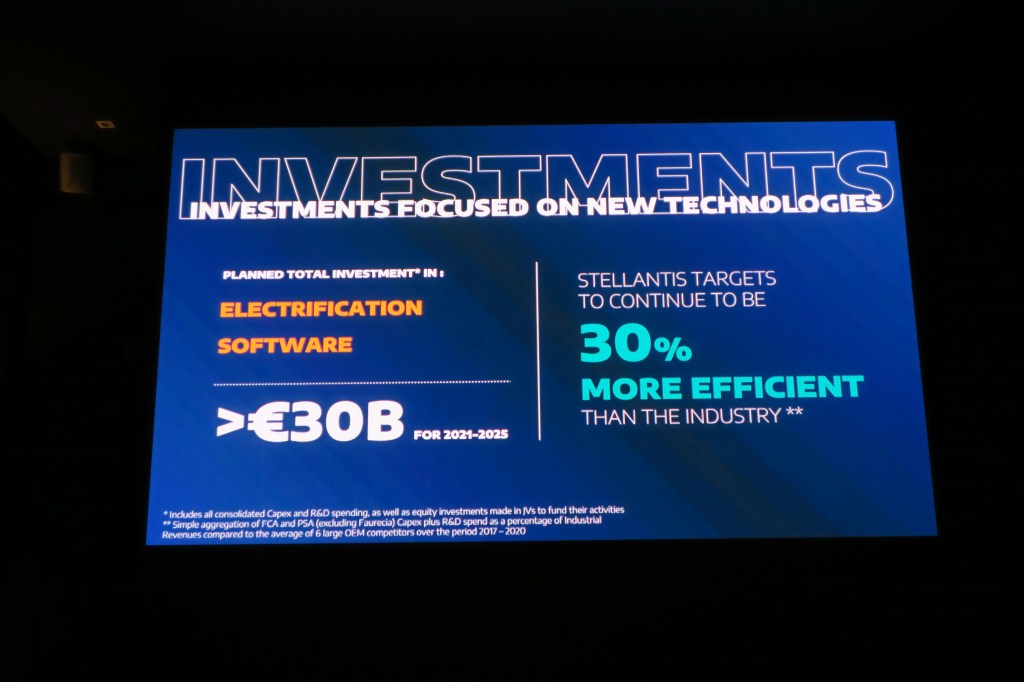
The Stellantis Group is further focused on investing in new technologies: the planned total investment in electrification and software will exceed 30 billion € between 2021 and 2025. 

Stellantis targets to continue to be 30 % more efficient than the industry. This figure is based on the simple aggregation of capital expenditure and R & D spent by PSA and FCA, as a percentage of industrial revenues; this is then compared to the average of 6 large OEM competitors over the period  2017-2020. 

A further EV model offensive in 2022…

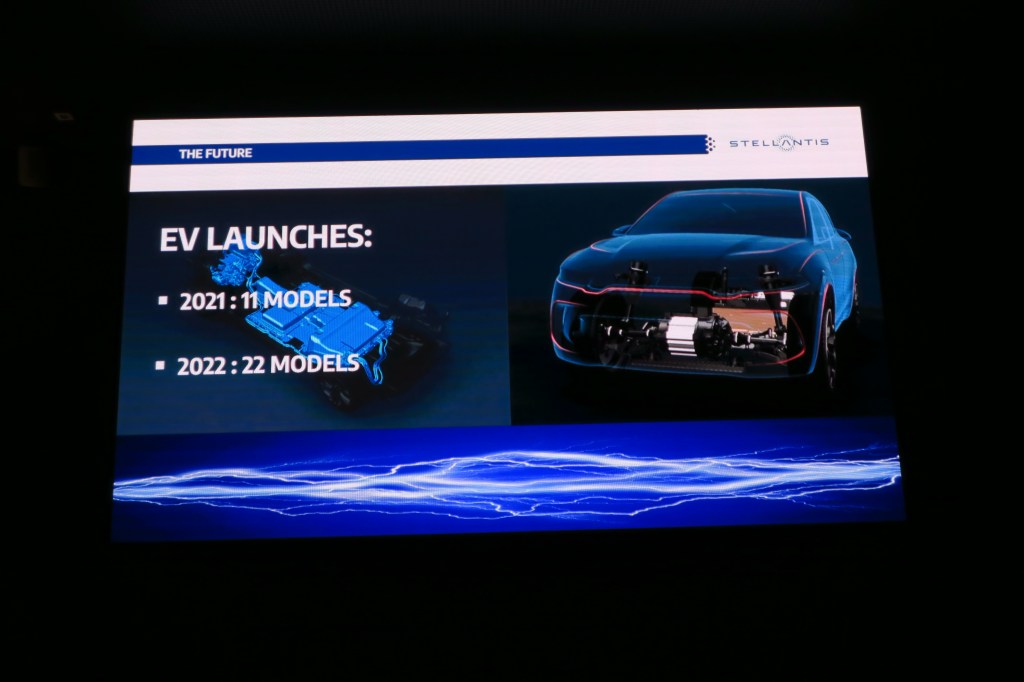
EV launches were 11 models in 2021, and this will be not less than 22 models in 2022… 

It expects also its LEV mix to grow fast. For Europe, it forecasts the LEV share of total passenger car and LCV sales to rise from 14 to not less than 70 %, for the US market, the corresponding figures would be a rise from 4 % to 40 %. 

Earlier this month, actually on December 7, Stellantis announced that it targets about  € 20 Billion in Incremental Annual Revenues by 2030 Driven by Software-Enabled Vehicles. 

Indeed, it mapped out its software strategy to deploy next-generation tech platforms, building on existing connected vehicle capabilities to transform how customers interact with their vehicles, and to generate approximately €20 billion in incremental annual revenues by 2030.

This transformation will move Stellantis’ vehicles from today’s dedicated electronic architectures to an open software-defined platform that seamlessly integrates with customers’ digital lives. It greatly expands the options customers have to add innovative features and services via regular over-the-air (OTA) updates keeping vehicles fresh, exciting and updated years after they have been built.

We will come in detail back on this in a special report later. In the next report about this press conference we will focus on further presentations on what the different Stellantis brands will have in store for 2022… 

Hans Knol ten Bensel