Our faithful Lexus CT 200h continues to please us. Over the past year, it clocked an average consumption of 4,8 litres/100 km, and besides fuel, it really did not need anything else. Well to wheel, it scores still very well, and given its longevity and reliability, its footprint is also quite small, adding to this that it doesn’t carry a massive array of batteries…
We had it serviced in June 2020, with amounted to basically an oil and filter change, and it will be scheduled for a new service next Wednesday December 22 at Beerens in Aartselaar. Nothing further to report, except that it rides ever so smoothly.
Our Lexus has some very clever items we started to like over the years, like for instance the command and manipulation of the infotainment system and screen via a “mouse” on the centre console.
Ever tried to enter a lengthy address on the touchscreen with your finger when “on the move”, with your car bouncing like a toy car on a cobblestoned or uneven road? Right, that’s what we mean…
The clever “mouse” command provents our screen to become soiled with finger marks…but we still keep it dust free!
Add to this the fact that your touchscreen gets so muddled up with finger marks, not exactly what you want in Corona times… So in the Lexus you rest your arm gently on the centre console, where it lies beautifully steady, and then slide the arrow with the mouse knob over the letters or symbols on the screen, and presto…
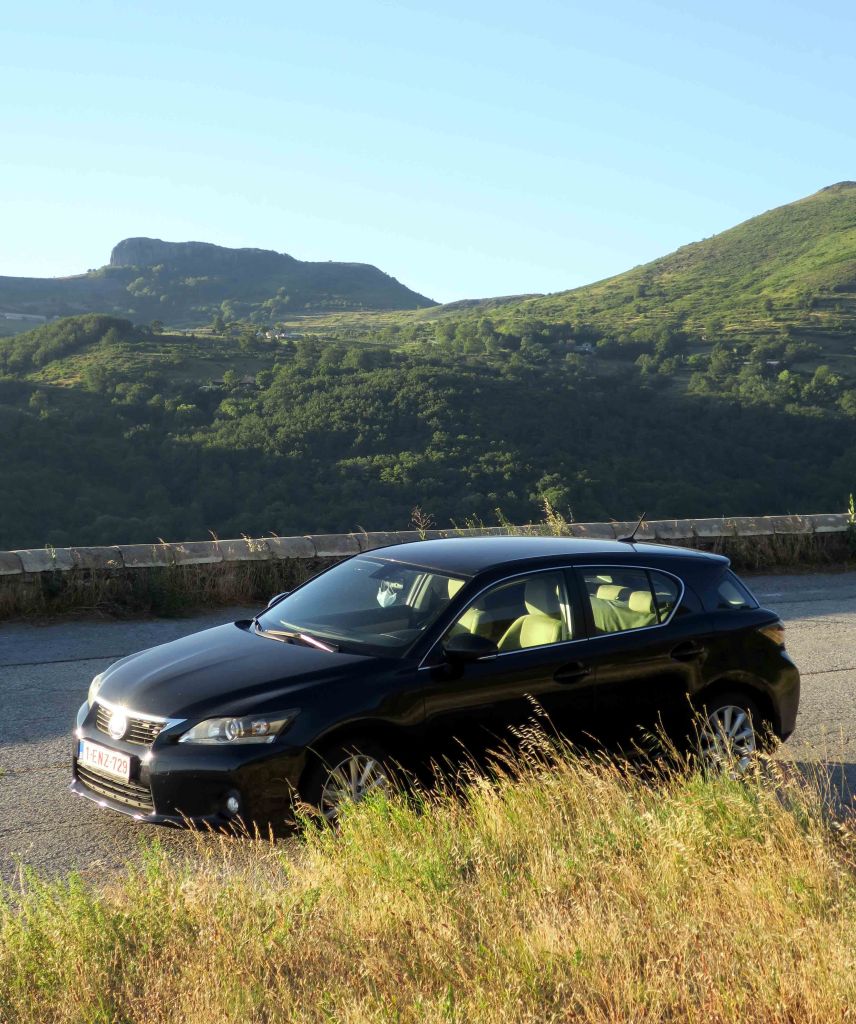
Our Lexus “sleeps” out in the open all year round, it doesn’t have a garage. Despite this, paintwork is still beautiful, also the beige interior holds very well, as the photos show.
The car deserves a proper polish and wax treatment, and we will get around that next year… promised!
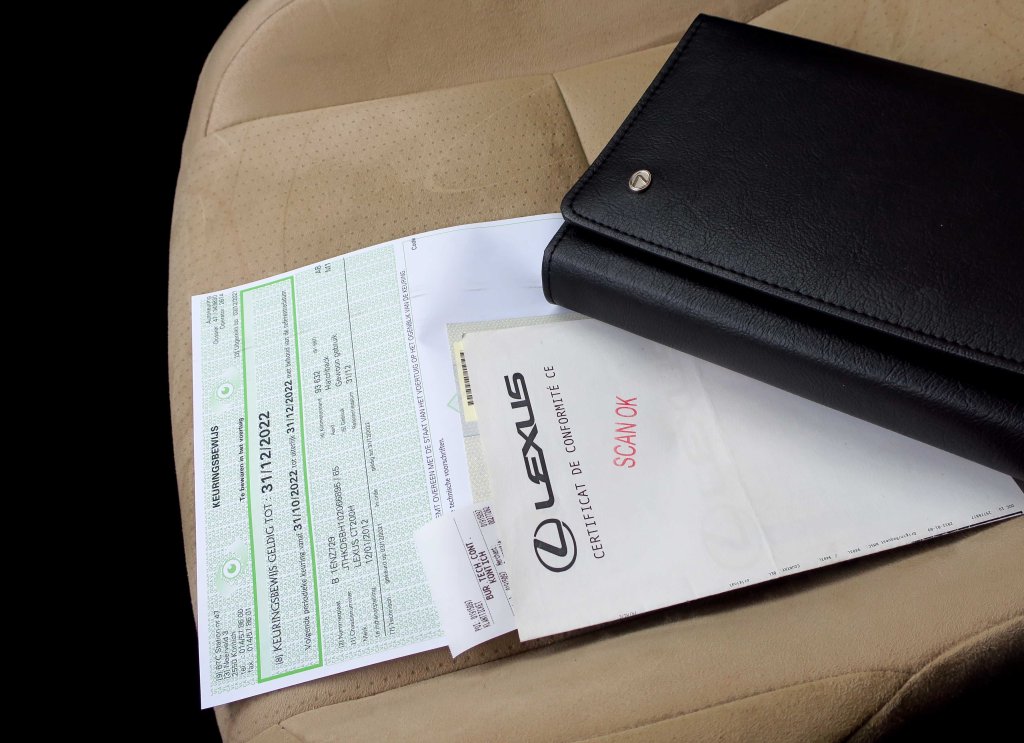
We put it though the technical control recently and, as the photo shows, there was indeed nothing wrong with our Lexus. So we have another year – until 31st of December 2022.
We told you that the ë-C4 shares its platform with the DS3 amongst others, and the E-range improvements are therefore also implemented for the ë-C4.
Indeed, since October, the ë-C4s have benefited from the same technological developments, resulting in an increase of the approved range in the WLTP cycle to 357 km; This represents a longer field range by almost 30 km, depending on the conditions of use.
Manufactures are also helping their fleet customers via software (updates) to optimize the cost management and use of their car fleets.
Therefore, Citroën has been helping its C5 Aircross Plug-In Hybrid customers in France and the United Kingdom with the Plug-in-Reminder system to reduce their fuel consumption and environmental impact by displaying messages on the car’s screen that invite them to charge the car. The ideal time for charging is set by the on-board computer when it registers that the fuel consumption of the car can be optimized based on the number of trips made and the number of times the car has been charged. This system will be extended to Europe in early 2022 and will be fitted in the C5 X. With PHEV Connect, Citroën helps fleet managers manage their plug-in hybrid fleet and optimize their costs. PHEV Connect has been deployed in Europe since March 2021 and already covers more than 7,400 vehicles…
At the end of January next year, we will test for you, dear reader, the Renault Arkana E-TECH Hybrid, and this will prove highly interesting indeed. But Renault has further stunning news in store, which your servant reserves for you in these columns.
Renault Group presented namely the actual progress of its Refactory project, an initiative launched a year ago to transform the Flins site (Yvelines, France) into the first European factory dedicated to the circular economy of mobility. Circular here means re-using second hand vehicles…no less!
On this occasion, the group is inaugurating its Factory VO (Used Vehicles), the first factory specializing in the reconditioning of used vehicles on an industrial scale. This conversion is part of the group’s overall transformation plan, focused on value creation and sustainable development. Just so interesting!
Read more about it here…
Hans Knol ten Bensel
A wonderful initiative…
Your servant can only applaud this bold initiative, which in my opinion is visionary to say the least. We just cite here Luca de Meo, CEO of Renault Group, on this project.
“We are keeping our promise: one year after its launch, the Refactory embodies an innovative and ambitious project for the Flins site, a new source of economic, social and environmental value. The Refactory is emblematic of the Renaulution, which engages the group in a deep, rapid and lasting transformation, driven by the creation of value. At the heart of this project, our 1st used vehicle factory demonstrates our ability to industrialize our know-how and activities linked to the circular economy. This Factory OV (or used vehicle factory) puts us in an excellent position on the growing used vehicle market, with a unique industrial tool capable of reconditioning up to 45,000 vehicles per year ”.
4 poles…
According to Renault, the Refactory is based on an ecosystem articulated around 4 poles:
RE-TROFIT: this division brings together the retrofit and reconditioning activities of used vehicles. Operational since September 2021, the Factory VO has already reconditioned more than 1,500 vehicles. In the next two years, it is planned to increase its capacities and introduce new activities, such as important body repair. A retrofit offer to convert commercial vehicles to electric will also be studied by 2023.
RE-ENERGY: this pole contributes to the development of applications around the second life of batteries and new energies. With the rise of electric mobility, Gaia, a subsidiary of the group specializing in battery repair, is preparing to change its scale of activities: by the end of 2021, 2,000 battery repairs will be carried out and this will grow to more than 20,000 repairs per year by 2030. In coordination with Mobilize, the Flins site hosted in 2021 a stationary energy storage device from batteries, with a capacity of 15 MWh (“Advanced Battery Storage” project). The development of mobile or stationary energy storage systems for multiple uses (construction sites, solar energy storage, on board ships, etc.) will represent a capacity of 30 MWh over the years 2021 and 2022. In the As part of the Hyvia joint venture dedicated to hydrogen mobility, the Flins site will also host, from 2022 onwards, the assembly activities of fuel cells, recharging stations and the supply of hydrogen.
RE-CYCLE: this division brings together recycling and re-use of parts and materials. The gradual arrival between 2021 and 2022 of the teams from the Choisy-le-Roi plant, experts in the remanufacturing of mechanical parts, will make it possible to maximize the use of reconditioned and spare parts within the Factory VO and the group. It is also planned to extend the strategic activity of repairing electronic boards (mechatronics) as part of this transfer of activity. The division is continuing to implement short loops for the recycling of materials and parts, such as catalytic converters or bumpers.
RE-START: this cluster encompasses the innovation and training center project. It brings together 3 entities: an innovation center at the service of Industry 4.0 to develop specifically prototyping, 3D printing, the retrofitting of our robots, a commercial vehicle prototyping activity, as well as a campus where professional training leading to diplomas are offered to employees of the Flins factory. At the start of 2022, this cluster will integrate an incubator dedicated to research and innovation in the circular economy, as well as new academic certifying training courses with the support of the region.
A state of the art factory, creating value…
To preserve product value and respond to the growth of the second hand vehicle market, the Flins used vehicle reconditioning plant is based on a unique model, designed to offer the best level of the market in terms of lead times, cost and quality.
The Factory VO is a 100% digitized site, which ensures excellent traceability and real-time monitoring of the repair stages. Developed to recondition all types of vehicles, of all brands, the site is mainly based on 4 major assets:
Economies of scale:
Spread over an area of 11,000 m2, the Factory VO in Flins is presently the largest reconditioning site in Europe. Organized into three teams, it can recondition 180 second-hand vehicles per day, or 45,000 vehicles per year by 2023, with the possibility of doubling this figure in the medium term.
Lower costs…
The site’s competitiveness is a result of the high productivity rate, driven by an online organization and optimized production systems for new vehicles. The Factory VO benefits from short delivery loops of parts and materials from group subsidiaries such as Gaia, Indra, and Choisy in order to limit the replacement of parts as much as possible, favouring repairs instead. Pooling logistic flows with those of new vehicles also cuts costs and reduces the impact on the environment.
Short repair and reconditioning times…
Equipped with 4 production lines, the Factory VO is organized in such a way that there is no going back. Carried out by SGS Automotive Services, technical inspection and control is integrated on the line in order to increase efficiency and reduce delays. The site is equipped with a photo and video studio installed on a turntable to generate automated shots (up to 10 vehicles per hour). This high-resolution scanner gives access to a virtual 360-degree inspection (interior, exterior, underbody and tires). Designed by specialist Twinner, this tool allows the vehicle to be offered again for sale immediately, without waiting for it to be returned to the dealership. On average, the Factory VO reconditions a vehicle in 8 days instead of 21 days.
“New vehicle” quality standards…
Reconditioned vehicles benefit from the same quality standards as the manufacture of new vehicles. An independent quality control device is integrated into the production, as well as a battery qualification system for electric vehicles. By 2022, 200 employees will have joined the Factory VO. These internal recruitments at the Flins plant are accompanied by a certified training program, made up of a general section (after-sales strategy, durability of materials, recycling, etc.) and more specific training geared to to the Factory VO (electromechanical, smart repair).
The Refactory project is, still according to Renault, at the heart of the Group’s sustainable development strategy. It is a global industrial project, which is intended to be deployed more widely, recently also at the factory in Seville, Spain.
All this has a very good reason: these activities contribute, at their scale, to the decarbonisation trajectory to aim for the group’s carbon neutrality in Europe in 2040.
A very interesting initiative, which we will follow closely in the future…
Recently, the new EQB has been added to the Mercedes full-EV fleet. An interesting car, which we hope to drive soon. In the meantime, we are looking forward to test for you from 7 December onwards the CLS 220d, and see what a modern Mercedes Diesel can still offer in these electrifying times. Also soon our faithful 1,6 litre petrol engined (now already more than 4 years old…) 180 B Class gets its Type A service at Hedin Automotive in Kontich, about which we will report too.
Then there is more intriguing company news about the Mercedes revolutionary production techniques they are unfolding in their Berlin factory, where they are rolling out electric motors for their EV cars. More about this in a forthcoming special report.
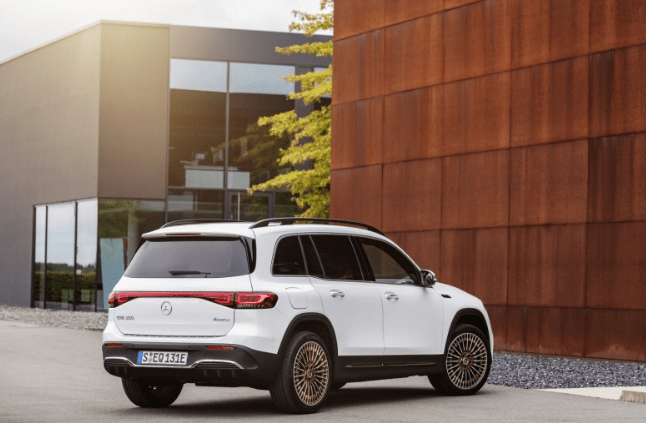
But now to some more news about the EQB. The EQB 300 4MATIC can be ordered now in our country, from € 63,041 VAT incl.
The EQB is quite roomy, and is optionally also available as a seven-seater. After the EQA, the EQB is already the second fully electric compact model from Mercedes-EQ.
The model range initially consists of the EQB 300 4MATIC (combined power consumption: 19.4-18.1 kWh/100 km). It has a motor developing 168 kW/228 hp. Then there is also the EQB 350 4MATIC (combined power consumption: 19.2-18.3 kWh/100 km) Its electric motor develops 215 kW/292 hp. The price of this more powerful version starts at € 65,945 VAT incl.
The sale price of the EQB includes one year of Mercedes me Charge. Mercedes-EQ customers have easy access to a network of more than 600,000 charging points worldwide via Mercedes “me Charge.” At the same time, they benefit from an integrated payment function with simple invoicing.
The EQB will be available as Edition 1 for a limited period after its launch. Externally, this limited edition combines elements from the “Night package” with AMG styling. But there is more: 20-inch AMG light-alloy wheels, matt copper and high-sheen finish complete the sporty look. Highlights of the Edition 1 interior are the upholstery in neva gray leather with CYBER CUT blue, the rear-illuminated trim in spiral look and air vents with the outer ring in silver chrome and the inner ring in energy blue.
Here are the main options and packages of this 4WD EQB, which is offered in Luxury Line and AMG line trims:
The third row of seats with two additional individual seats comfortably accommodates people up to 1.65 meters tall. The comprehensive safety equipment includes extendable head restraints, seat belts with belt tensioner and belt force limiter on all outer seats and a window bag that also protects the passengers in the third row of seats.
The Premium package further enhances comfort with the KEYLESS GO comfort package, the THERMOTRONIC 2-zone automatic air conditioning, a rich sound system and a wireless charging system for mobile terminals.
The EQB comes with intelligent driver assistance systems with cooperative driver support. The Driving Assistance package now includes additional functions. It includes for example the exit function, the emergency lane function, the exit warning function that warns the driver of passing cyclists or vehicles, and a warning when pedestrians are detected near a zebra crossing.
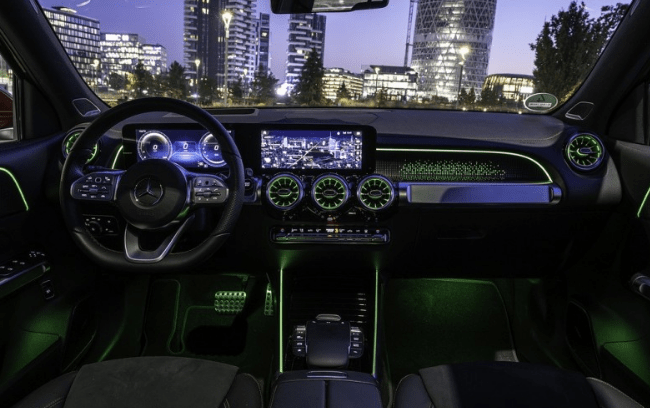
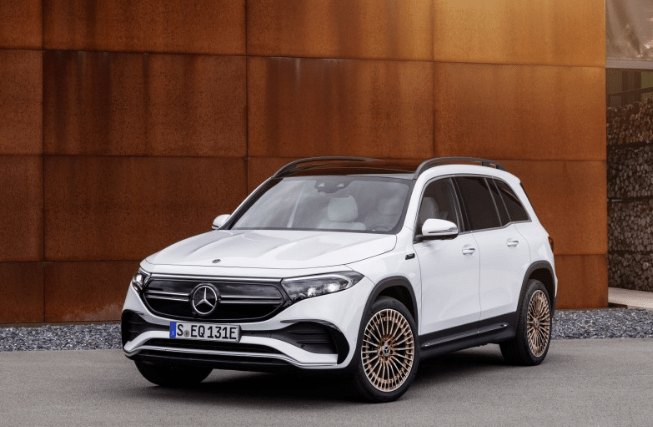
We show you here some photos of the EQB in the meantime. Stay tuned for, as said, more news about the cars with the iconic star!
Our pristine Z3 is now fit for the road again…passing the technical control without a hitch.
In these columns you could read about the play in the driver’s seat which prevented our shining mount to pass the annual technical control. As the bushes were very probably worn and the repair was rather intricate as the seat mounts have to be moving strictly parallel when propelled forward or backward by the electric motor, we decided to leave the repair in the expert hands of BMW dealer Jorssen Zuid.
The bushes on the driver’s seat were completely worn out, actually virtually shredded!
I first thought that only the driver’s seat had play, but closer inspection by the mechanics of Jorssen revealed that the passenger seat was also rocking fore and aft in its rails. This was not noticed by the inspectors of the technical control.
Then they ordered the parts necessary for the repair, which were 2 sets of guide bushes for 23,96 Euro each (ex VAT) and 8 six sided screws at 7,27 Euro each, again ex VAT. It brought the total cost of all the necessary parts for this repair to 106,08 Euros, ex VAT.
The bushes on the passenger seat witnessed the same fate…
The Jorssen mechanics then proceeded to remove the seats from the car. Removing and again installing the seats cost in total 35 minutes, the repair itself, disconnecting and reconnecting the electric motors, replacing the bushes, reinstalling everything and ensuring than the seat attachments are perfectly parallel cost in total 1 hr. 10 minutes.
Finally a 10 minute driving test was executed. The total cost of the repair, ex VAT, amounted to 316,17 Euros.
Very reasonable we would say, and BMW Jorssen is not only to be applauded for its diligence, it is also very comforting to see that the parts for a 1997 built BMW are readily available.
We asked the people at Jorssen also to take some photos of the worn out bushes, for the sake of our report here, showing indeed that they were completely worn out and even literally torn to pieces.
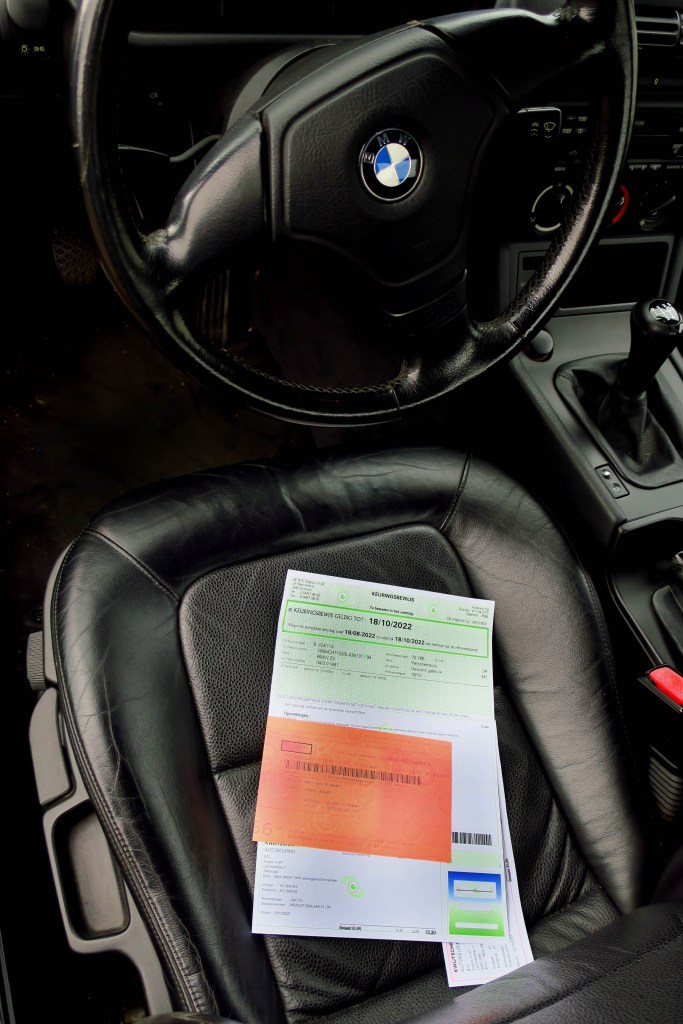
Fit for the road again for another year with a green technical control card…
This shows again how it important is for premium – and actually for all car manufacturers – to test and inspect the quality of each part in their products. Cutting corners in quality can impair not only the reliability, but also the security of their products.
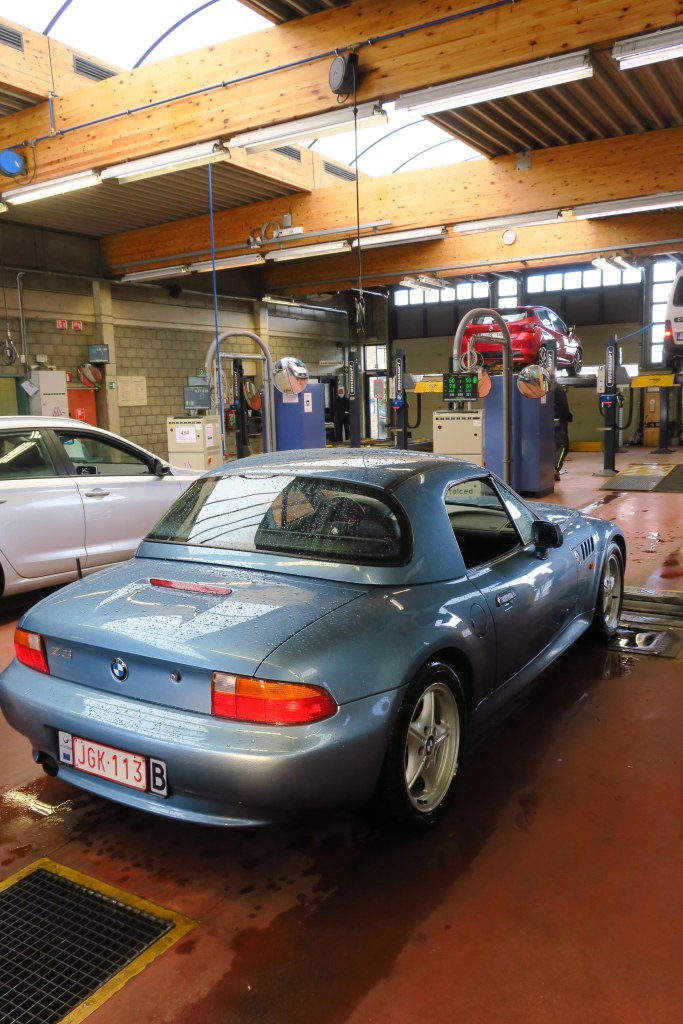
Needless to say that the subsequent technical control went without a hitch, and our beloved Z3 is again totally fit for another year on our roads. It is even allowed to drive around in the emission zone in Antwerp until 2024, and this also puts a broad smile on our face…
We just let you look at the photos here, and soon we will proceed with a thorough cleaning, protecting and rejuvenating of the leather of the nice seats of our Z3…
Our Z3 passed again with flying colours the technical control… except for a rocking driver’s seat!
Unfortunately we missed with our pristine 1997 built Z3 the celebrations of the 25th anniversary of the Z3. Too bad. We would have liked to participate, but alas were not invited nor warned of the event.
Otherwise our Z3 is proving utterly reliable and a pleasure to use and drive. We put it now through the (in Belgium) annual technical control, and everything proved top notch. Except for the driver’s seat, which showed to have some rocking play in its rails. It’s an electronically adjustable seat, and it moves freely without any trouble in its rails, but it has some fore and aft play. We expected the repair to be rather straightforward, so we made first an appointment with our local garage. Then we discovered one needs new shims or bushings to eliminate the play, parts which a local garage doesn’t have readily at hand.
Another You Tube film is titled “How to Fix BMW Z3 Rocking Sliding Seat in Under Five Minutes Bushing Rails Bushes Replace”with the link: https://www.youtube.com/watch?v=q3lmAyYGZvM
The last video I want to mention is BMW Z3 Z3M Seat Rail Track Runner Sub Frame Mechanism Bushes Bushings Rocking Repair Kit. The link is https://www.youtube.com/watch?v=n6PsUywdt74
It already starts with the seat removed, but otherwise it’s the same as the previous films.
Our Z3 got checked on a very wet autumn day, but the bodywork is well waxed to withstand the rain…
Anyway, the flaw of the slightly rocking chair has indeed been going on for quite some time now, and we have to repair I for safety’s sake. Since we don’t have the room nor the tools available and last but not least not (even) the parts available, we contacted our BMW dealer Jorssen Zuid to have the drivers’ seat repaired. The repair is rather intricate as the exact location of the seat attachment with its two bushes needs to be meticulously maintained, therefore it is of utmost important to measure and determine its location before dismantling. Otherwise the seat will be out of alignment in its rails and will pull sideways, leading to overcharging the electric motor, even with the slightest misalignment.
Mercedes is in this new electrical age going from strength to strength, and is also doing quite well globally. Recently, the company posted a 2020 profit for its shareholders of 3,6 billion Euro. This was 1,2 billion Euro or 50 % more than the previous year. Asian markets are friendly for the brand with the famous, iconic star.
Your servant has now left hospital after two major operations mid-February and within a few weeks will again be legally allowed to sit behind the wheel. Soon enough, at the end of April, I will be testing the new and highly interesting EQA, followed by the impressive G 400 d J. Good times ahead!
Mercedes-Benz has opened an online reservation system for the EQS. Interested customers can reserve the fully electric luxury limousine via the link http://www.mercedes-benz.be/eqsreservatie. When making the reservation, a reservation amount of € 1,500 is requested. The reservation entitles the holder to a production location of the EQS, but the customer always has the option to cancel – if necessary. As soon as the sale of the EQS starts, the customer will compile his own EQS and convert the reservation into an order.
The online reservation system offers customers the opportunity to be the first to drive in the EQS. With its progressive design, the new MBUX Hyperscreen and interesting specifications – such as a range of up to 700 km (WLTP) and a 250 km range recharging in just 15 minutes – the EQS offers all the advantages of a full electrical architecture. The camouflaged prototypes reveal key design features that are revolutionary for the luxury segment, such as the “cab forward” design and the coupé-like “one bow” styling.
Ambition 2039…
The introduction of the EQS and the consistent electrification of the entire model range are important parts of the strategic plan “Ambition 2039”. As part of Ambition 2039, Mercedes-Benz is working to offer a CO2 neutral model range in less than twenty years. In 2022, the portfolio will include eight fully electric Mercedes-EQ models.
Needless to say, the global production network of Mercedes-Benz is ready for the company’s electro-offensive and is consistently integrating the EQ models into the series production of existing plants. From the start of production, the EQS in Factory 56 in Sindelfingen is producing on a CO2-neutral basis. The batteries of the EQS are also produced in a CO2 neutral fashion by CATL (Contemporary Amperex Technology Co. Limited)…. Brave and very Green New World!
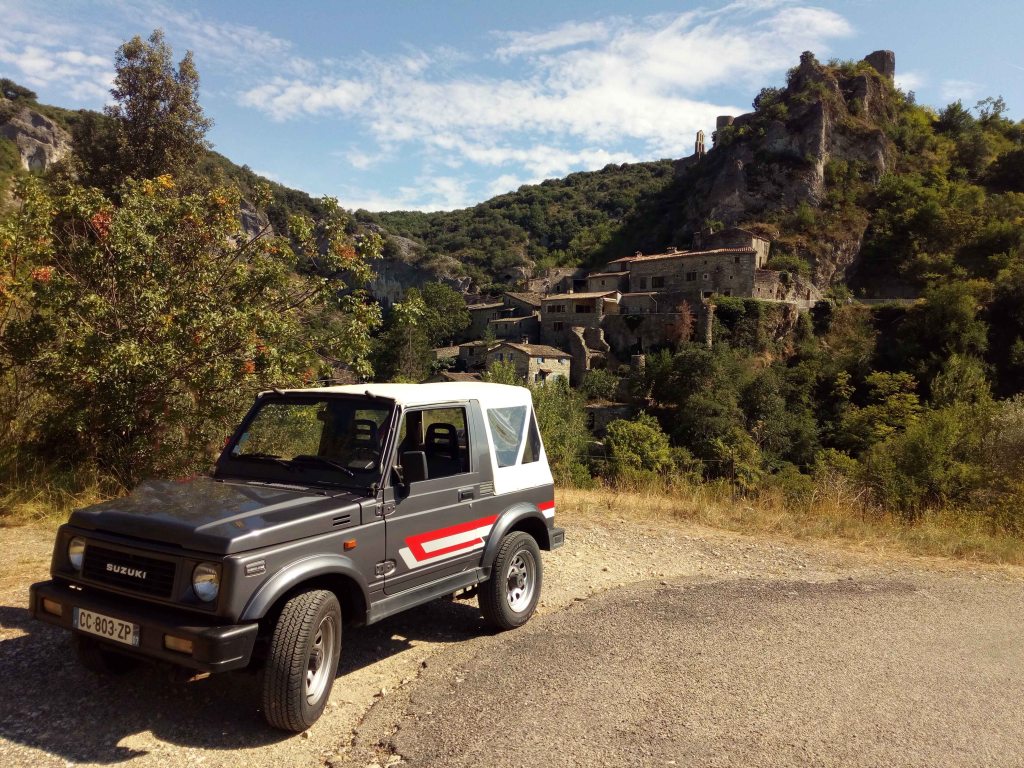
Our Samurai in front of the scenic village of Rochecolombe…
Our faithful Suzuki has reached true oldtimer status now. It is eligible to become “Voiture de Collection” in France, and we are preparing the final documents now to register it. This means the gleaming Samurai has only to pass every five years at the technical control, it can run on original “vintage “ French license plates of the sixties/seventies, and can even carry the famous French yellow bulbs in its headlights. Wow!
Hans Knol ten Bensel
In the meantime, our mid-eighties Samurai certainly has leaded a rather protected life in our hands, and the result is that it still looks virtually “as new”. Also pristine are the mechanics. We just dropped the battery in and after two starting attempts to allow the fuel to reach the carburetor, we gave it a blip on the accelerator pedal to start the automatic choke, and there it started in a smooth idle. Carefully warming it up for a minute or two to “run in” the waterpump and ancillaries after their long winter sleep, and off we went.
Our Samurai in the Vineyards near St. Maurice d’Ibie
The 80 HP 1,3 litre Suzuki is a fine performer, and of course very much at home off-road. Small “V” or “Voirie” roads in the French mountains are its favored playgrounds, and one cannot think of a better four wheeled companion to make those mountain tours far from the (Corona)maddening crowds. This jeep is therefore much cherished and immensely popular amongst outdoor lovers in the French mountain regions, due to its sturdy compactness and excellent offroad qualities.
The interior is still in mint condition…
We took it amongst others on a scenic tour to St. Maurice-d’Ibie, on the D 558 towards Les Salelles and then turning right on the D1 through Lagorce, from there on to the right on the D 401 to Rochecolombe. Here we also took some photos for this report.
The Samurai is pleasantly short geared, so steep hills are an absolute breeze, and in slow crawling traffic in the small village alleys this Samurai feels totally at home.
On the scenic road towards Les Salelles …
Again consumption depends on your driving style, but keep the revs low, and this efficient 1,3 litre combined with the light weight of the Samurai will not let you down at the pump, and consumption averages below 8 litres/100 km are quite achievable.
We loved again every minute behind the wheel of our Suzuki again, and look forward to see it again in autumn, Corona times helping of course…
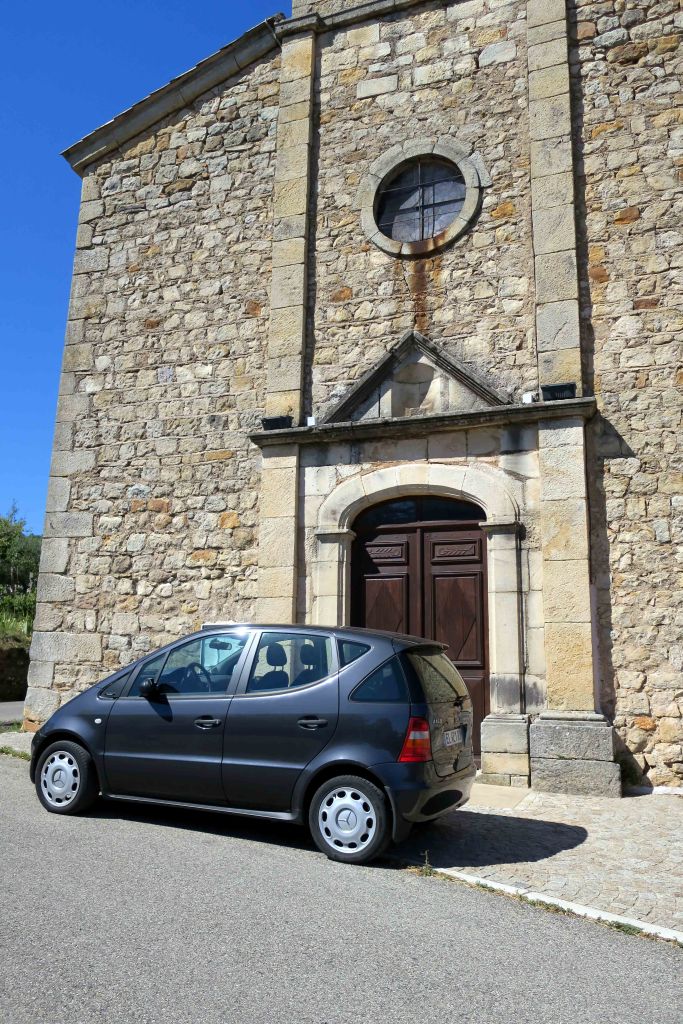
The holiday tale of our cars continues with our faithful A Class, which is showing its solidity and utter reliability. The battery did not quite survive its lengthy sleep, and we had to replace it with a new “Point S” 70 h battery, setting us back some 100 Euros. We decided for the future to take it back home, as we did with the Suzuki and Beetle, and keep it charged regularly. We should of course have done this in the first place!
Hans Knol ten Bensel
But that’s about all we had to do with the still cute and contemporary looking A Class. It fired up without problems and runs quite smoothly, and proved with its 102 hp 1,6 litre four-cylinder petrol engine to be quite zesty and amusing to drive. Acceleration from 0 to 100 is around 11,8 seconds with the auto box and top speed is 180 km/h, so no problem to keep up with today’s traffic…
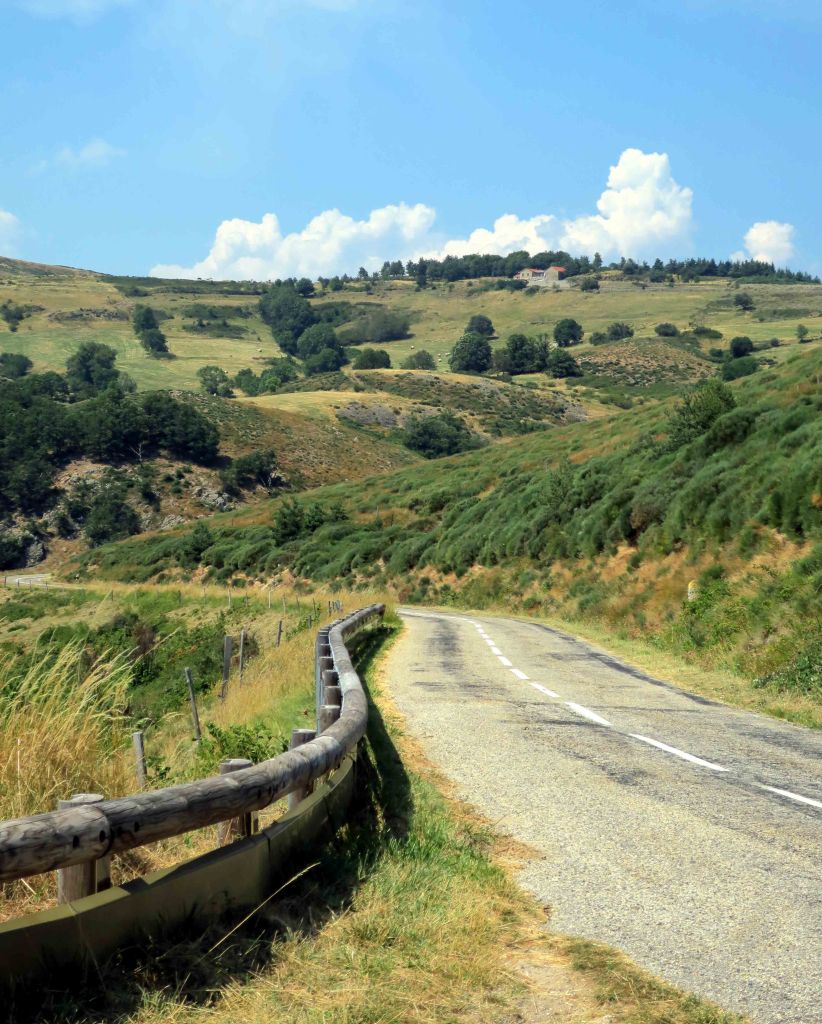
The engine is admirably supported by a five speed automatic, which is a pleasure to use in the mountainous and hilly areas of the French Midi and Massif Central. For the photo session of our faithful mount we took it on a scenic ride from the charming village Ailhon via a small Départementale 359 to another gem of a village, Fons. From there on to the neighbourhood of Chapelle s/s-Aubenas, leaving it on our left side and continuing in the direction of Chassiers, on the D 103, to the villages of Rocher and Prunet via the D5, through and alongside dense woods, running in the valley of the Ligne river. From there on, the D5 treated us to some breathtaking views to be enjoyed on the Col de la Croix de Millet, at an altitude of 776 meter. On the panorama, we even caught a glimpse of the Mont Ventoux!
With a “classic” electro/hydraulic operated Daimler Benz automatic, your driving style is of course of paramount importance. But when driving with some restraint, the gearbox takes economy well into account. When left in “D” mode, the gearbox keeps revs low at smaller throttle openings, so the engine runs hardly above 2000 rpm, resulting in quite reasonable consumption figures between 6 and 7 liters/100 km.
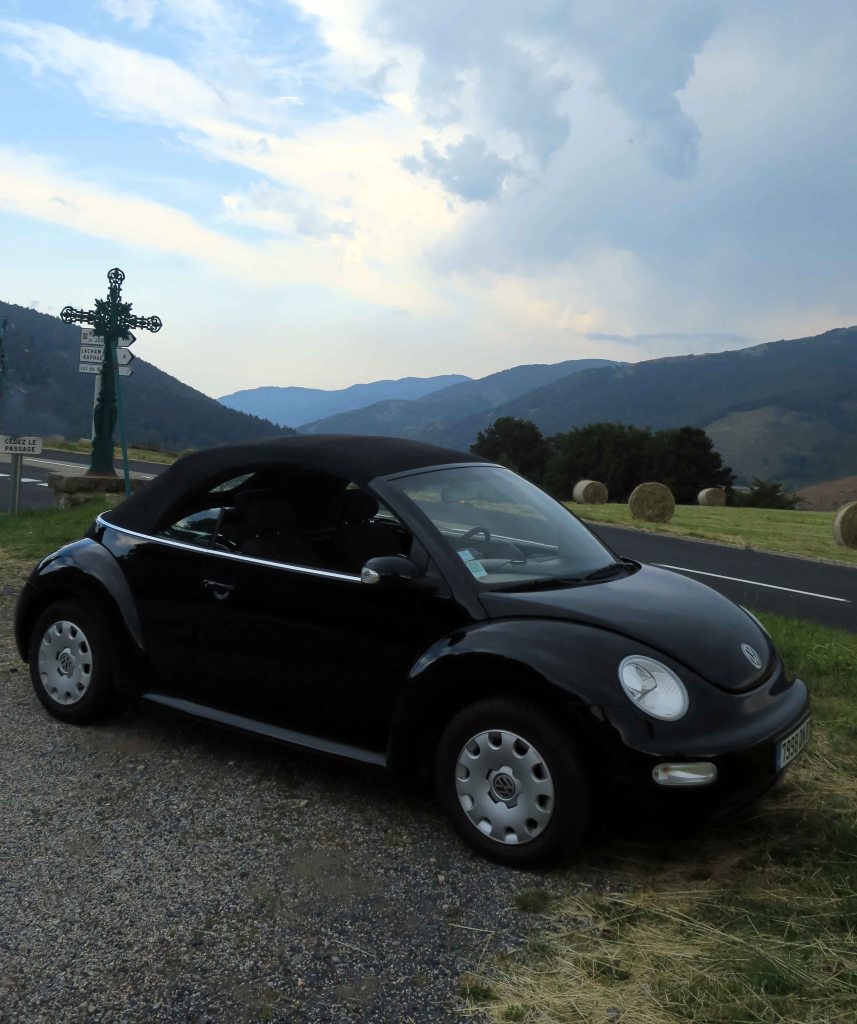
Further photo was taken after a vigorous rain and hailstorm whilst we were driving from St. Pierreville to St. Julien-du-Gua, 11 kilometers over a very narrow D58, giving us a scenery which was worthy of a Wagnerian opera, and indeed we felt like the Flying Dutchman, only happy to find ourselves behind the wheel of a car with the good three pointed star. After this drive, we crossed the D122, and on these crossroads we photographed the car, driving at an altitude of roughly 1000 meters.
So nothing but good news of our A Class, which proves again the point that quality built cars really stand out when the years go by. To be continued!
We made the trip to the French Midi with our Lexus: 4,3 l/100 km…
At the moment of writing we are spending our holiday as usual in a village in the French Massif Central, which is now luckily rather “Corona Safe” simply because it is not densely populated. This means of course that everybody has go remain very careful as even – as we have seen in the earlier stages of the pandemic – mountain villages can be hotspots spreading the disease.
As our holiday car to make the 1,000 km trip to the south we picked this time our faithful and oh so frugal Lexus CT200h, which just had its service done only a month before. Besides the usual checks and a filter and oil change nothing else was needed.
It proved a very comfortable trip in the true Lexus style, and with the drive mode selector in “ECO” and good use of the cruise control, we managed a fuel consumption of 4,3 litres/100 km over the trip, which equals some 54 miles per US Gallon or 65,6 miles (!) per Imperial gallon.
Digital airco and excellent sound deadening in combination with the good sound system made it a very enjoyable and relaxing affair.
In our holiday home we found back our Mercedes A Class and the VW New Beetle 1.4i, and last but not least our Suzuki Samurai, which we will endeavour this year’s holiday to register it as a “Voiture de Collection”.
At the moment of writing, we have used so far the compact Mercedes, so ideal for the necessary supermarket/grocery errands, and the New Beetle for the scenic mountain trips in the surroundings. Both cars fired up without any hesitation, and drive as smoothly as ever.
A driver’s dream: the road from Génestelle to Mézilhac
Whilst we took our Beetle on a very scenic route over Antraigues, Genestelle and Mézilhac, the right rear side window cable snapped, leaving the side rear window in half open position. This means for us getting a new cable set and doing the extensive repair, rather time consuming as the complete rear upholstery, seats and coverings have to come off.
En route over the Vivarais mountains, the rear window stayed open due to a broken cable…
A nice project to tackle next year, as we decide to use the car for our touristic trips this year anyway with the right rear side window half open. It is summer time and the car can be locked up safely also inside the cabin with glove box lock. As it is a convertible, access to the boot lid and fuel filler cap can be locked off too, by locking the commands in the driver’s door. It spends the rest of the year in a closed garage, so there is no problem there either….
The coming days we will start up the Samurai, and we will make also some nice (offroad) mountain tours with it. Stay tuned!




















 Autoprova - for the Connaisseur