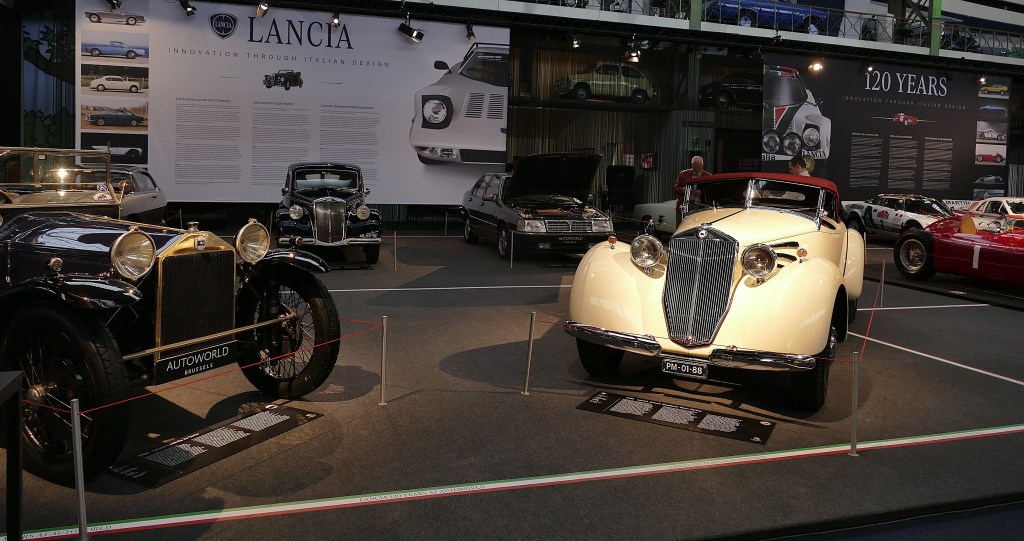
Autoworld Brussels has again an exquisite exhibition ready for us: until April 19 we can admire a carefully curated selection of about 12 absolutely iconic Lancias. It shows us the elegance and innovation through design, as the title of the exhibition indicates. But we would add, the pop-up exhibition also showcases innovation through ingenuity and engineering excellence.
The cars are beautifully displayed at the beginning of the vast and inviting central hall of Autoworld, taking you on a journey of more than a century of technical innovation, refined design, and engulfing you in its rich motorsport heritage.
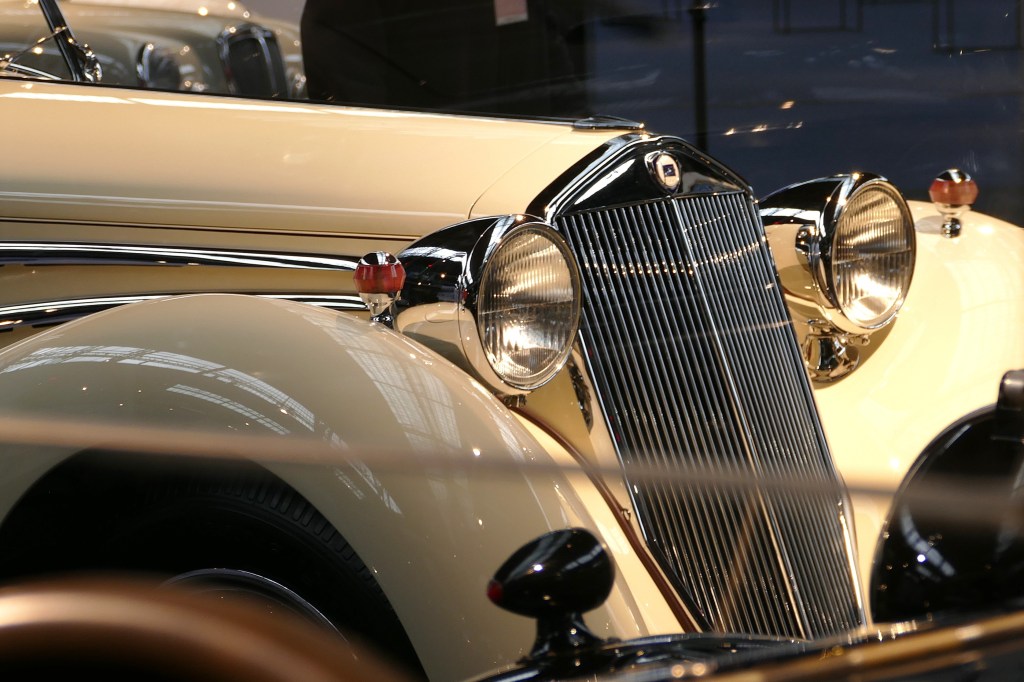
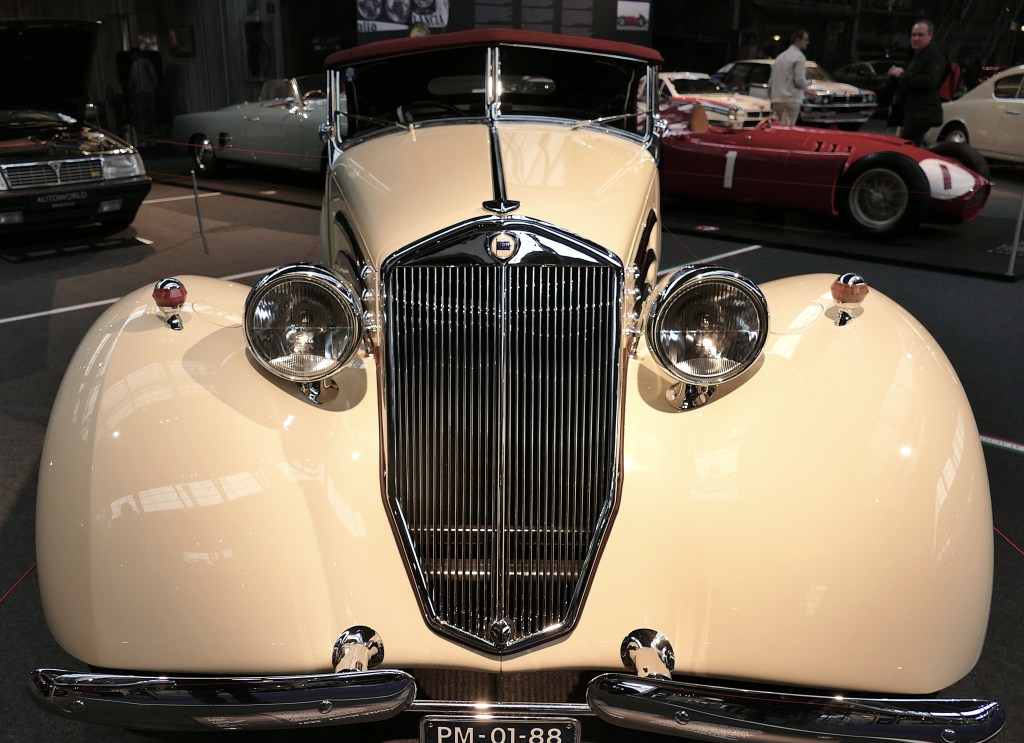
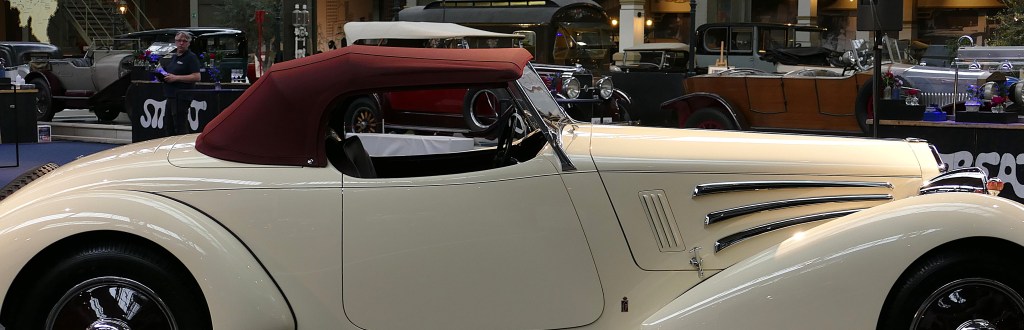
My eyes first fell on, at least to my taste, the absolute beauty of the show, the Lancia Astura Roadster by Pinin Farina. This 1935 Astura is a technical gem. The V8 engined car was introduced on the Paris Motor Show in 1931. This Astura on the show belongs to the third series, built between 1933 and 1937, with 1,243 units made.
The third-generation Astura was offered in short-wheelbase and long-wheelbase variants, and was powered by a new, larger engine. Indeed, it was enlarged from 2,6 to 3 litres, and the 17° narrow angle V8 single overhead camshaft engine now developed 82 hp. This short wheelbase you see on the photos was ideal for coachbuilders to show their talent.
ounded with the moral and financial support of Vicenzo Lancia, the Carrozzeria of Battista “Pinin” Farina witnessed a revival and produced breathtaking bodies. Of the just 328 “Corto” chassis built, many were clothed by Pinin Farina. The contours of this roadster are from the artistic hand of Mario Revelli di Beaumont, an independent stylist who worked actually for several “carrozzerie”…
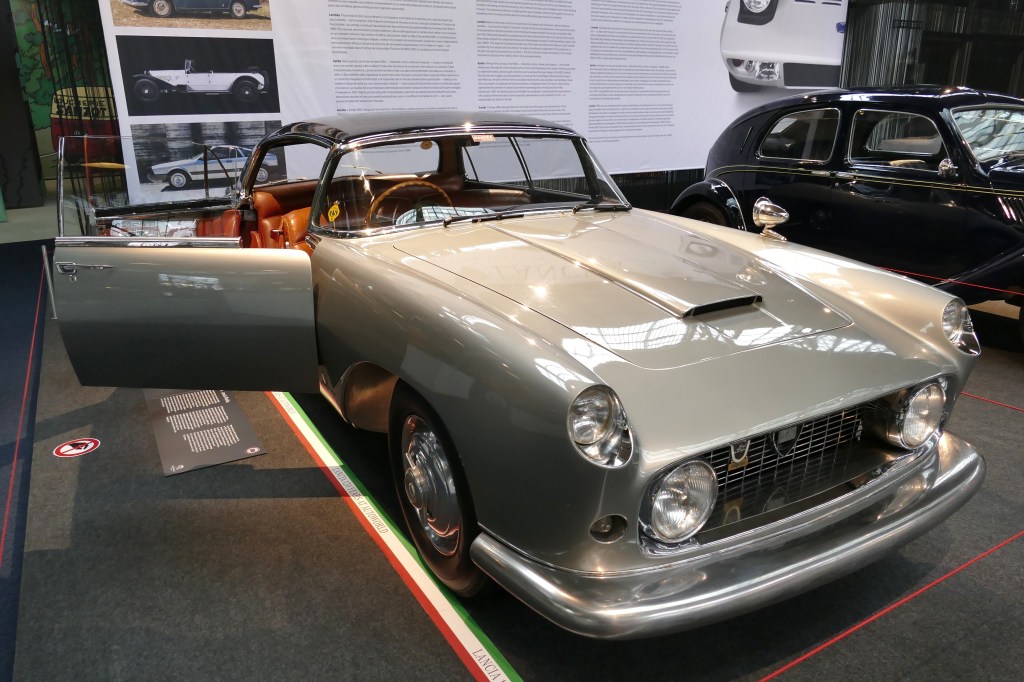
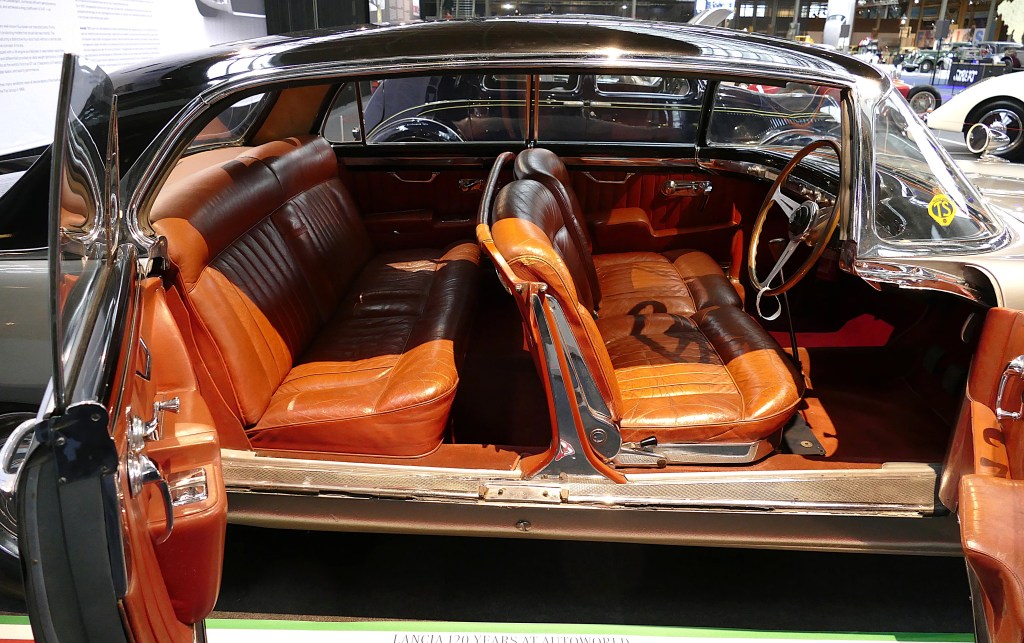
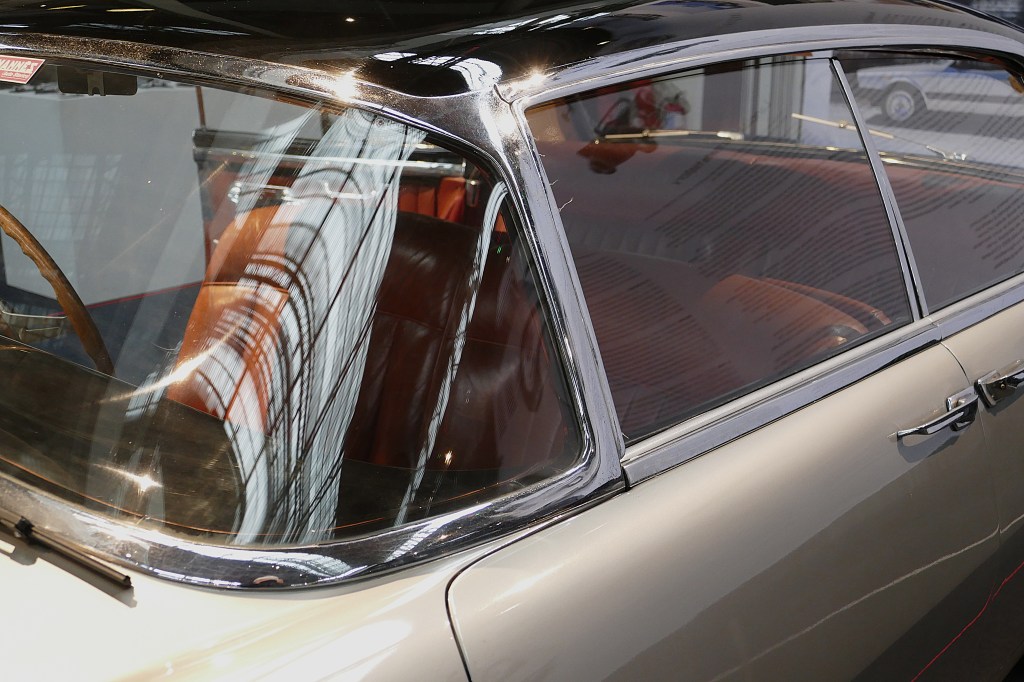
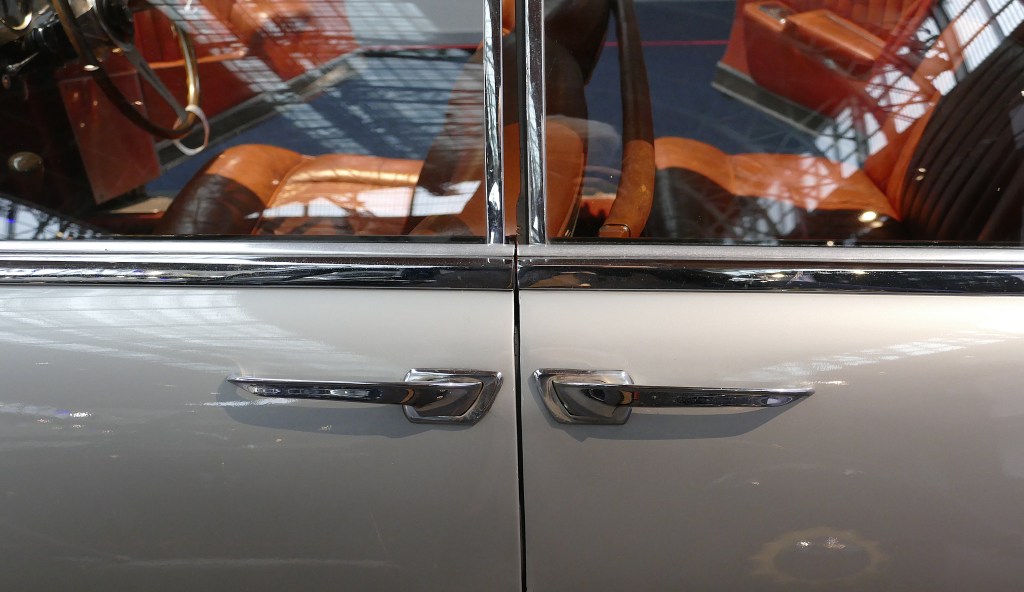
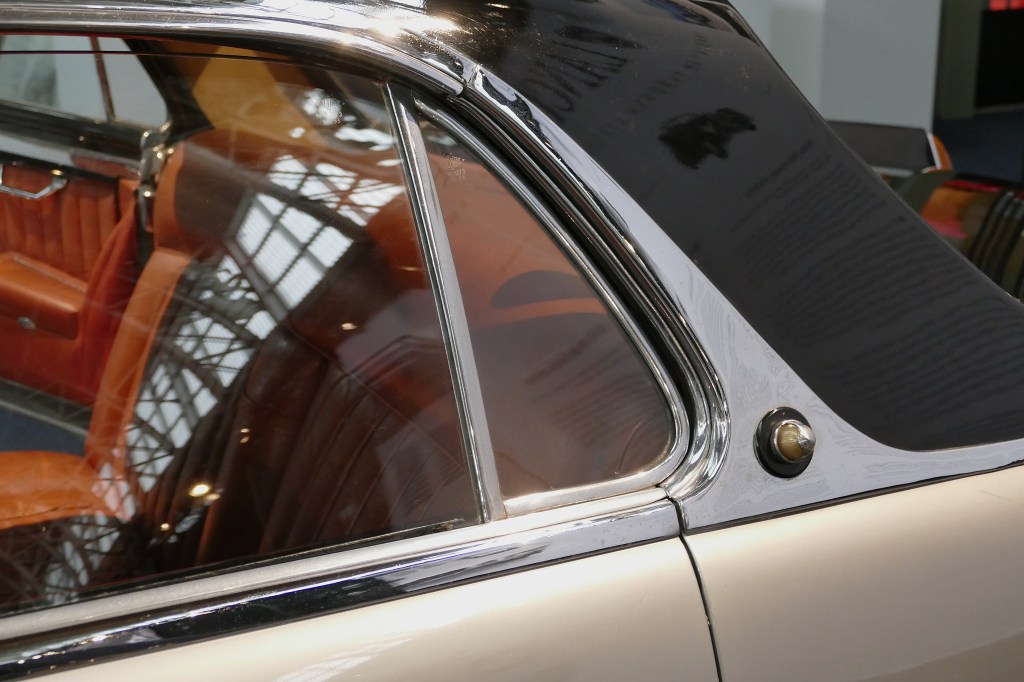
Another car by the hand of Pinin Farina was for me the Lancia Flaminia. I was therefore elated to see the conceptual predecessor of the Flaminia, the Florida. The “bellezza” and elegance of this car deeply moves me. Just look at the photos. The car was built by Pinin Farina on an Aurelia B56 chassis, and it was a technically quite daring four-door pillarless saloon.
It was shown on the 1956 Brussels salon, and as a young boy, I dreamt about it. Just like the Boano styled Ferrari’s, it was for me the pinnacle of what human art, intellect and craftmanship could reach in terms of sheer contemporary beauty.
The pillarless doors had to go in the production version, the Flaminia, therefore the elegance of this Florida truly stands out.
Much more to follow on this Lancia show at Autoworld soon, about the D50 racing car, the iconic rally cars like the Stratos… just remember, go and see it, it is on show until April 19.
Practical info: Autoworld, Parc du Cinquantenaire 11 1000 Brussels, Belgium.
Please note, the museum is closed Wednesday 11 March, Thursday 12 March and Monday 16 March 2026.
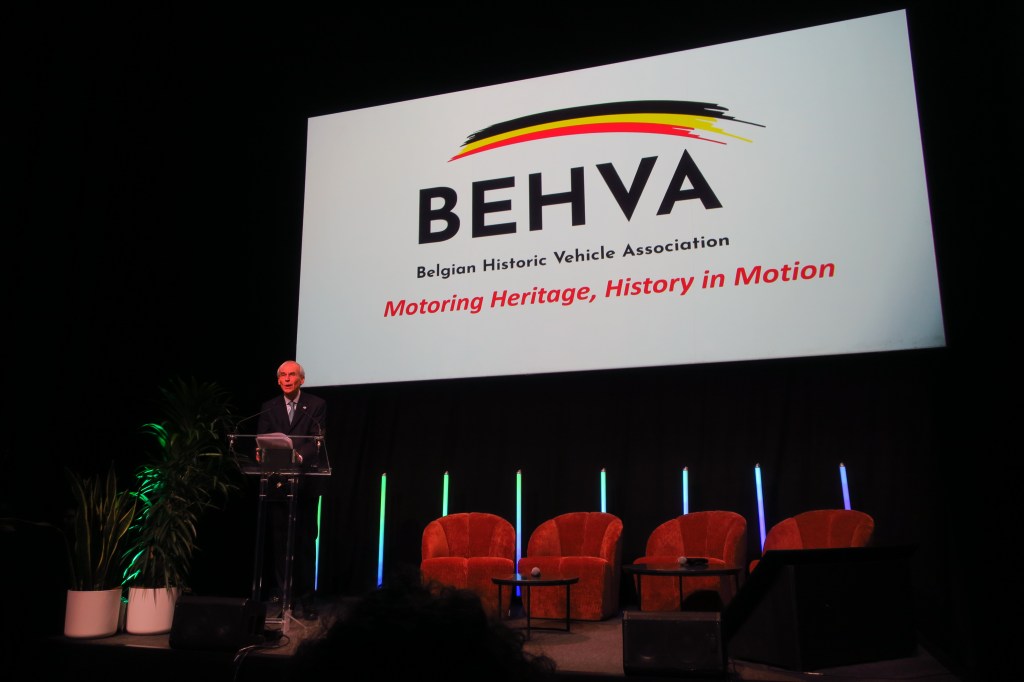
We attended a remarkable conference organized by the Belgian Historic Vehicle Association on the Brussels Salon, moderated by automotive history connoisseur Philippe Casse. The speakers were experts in the field: Loïc de la Roche, General Director of the Aventure Peugeot Citroën DS. He was followed by Thomas Stebbich, head of Audi Tradition and Audi Archives, Audi Museum Mobile and last but not least the August Horch Museum in Zwickau.
The third speaker was Thomas Antoine, honorary ambassador of Belgium and philosopher. Needless to say that he viewed the opened a very original perspective on our historic vehicle world.
Other (introductory) speakers were respectively Philippe Dehennin, President of BEHVA and Peeter Henning, CEO of Behva.
We thought it is useful to go more extensively into depth on what the speakers brought forward, as it was indeed interesting and opened many further perspectives. We therefore split the report in 3 parts.
You read here in this first part the main points put forward by the first respective speakers, offering us much food for thought: just read further…
Hans Knol ten Bensel
Introduction
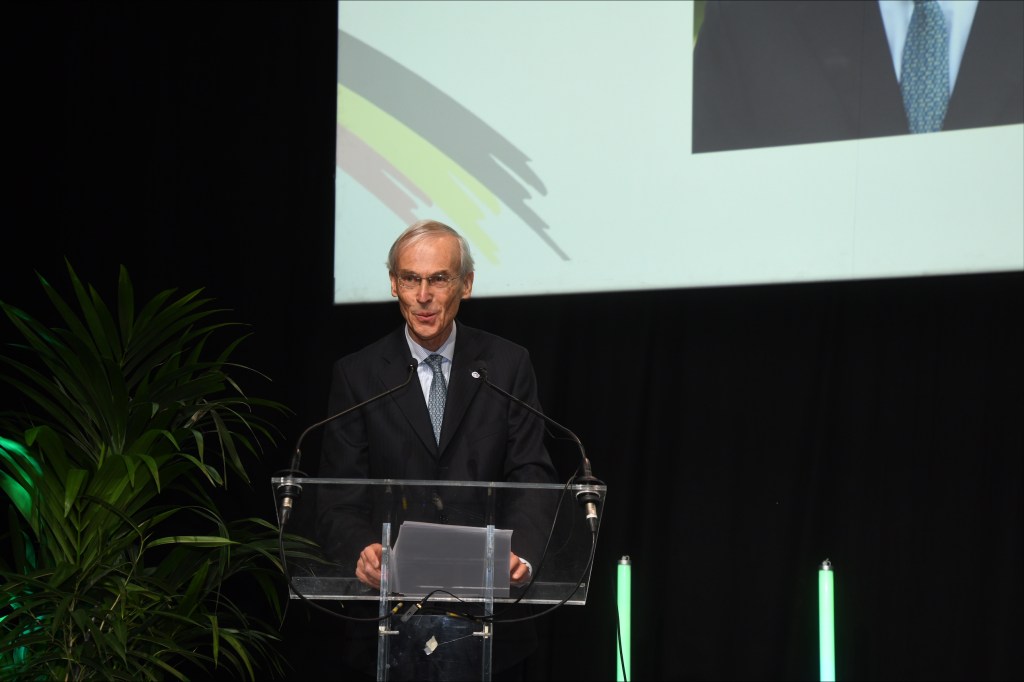
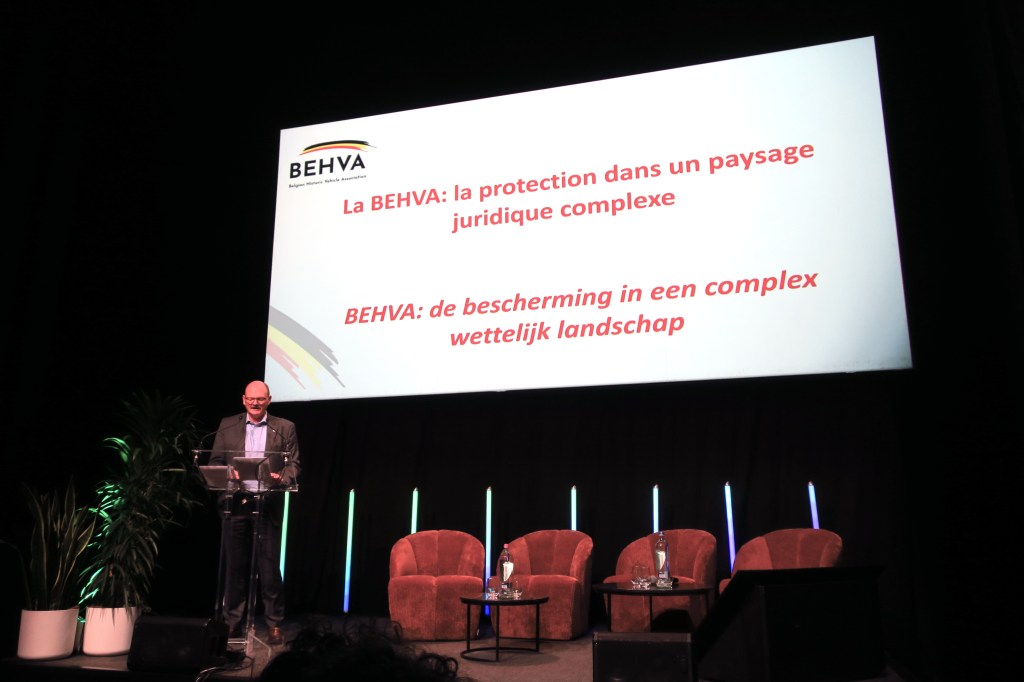
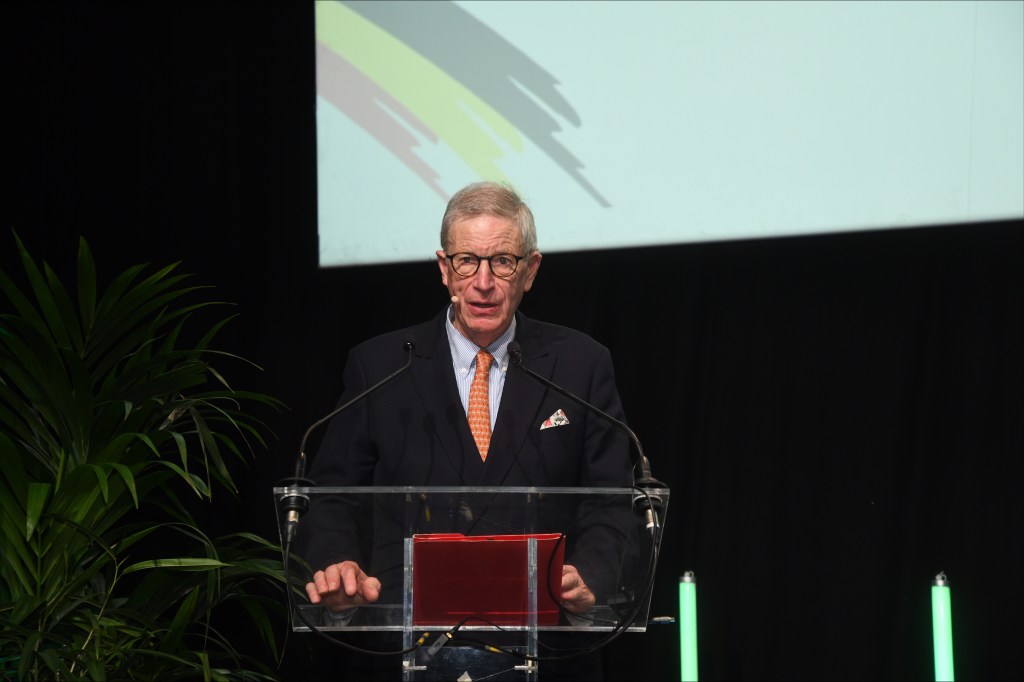
An introductory adress was held by Philippe Dehennin, (see photo here above) who pointed out the explosive growth of historic automotive collections and museums. This automotive heritage forms now an integral and dynamic part of our European identity, and embodies a physical and iconic bridge between our past, present and future.
The crucial role of BEHVA…
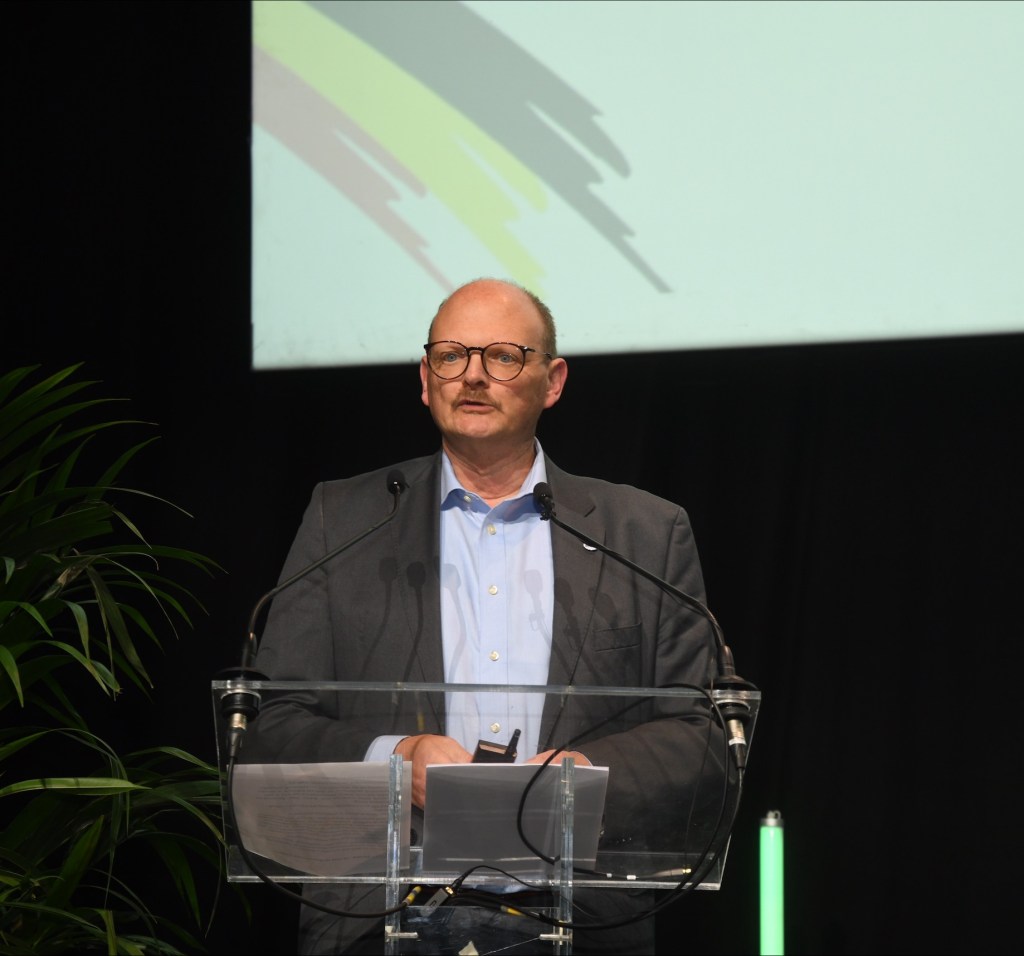
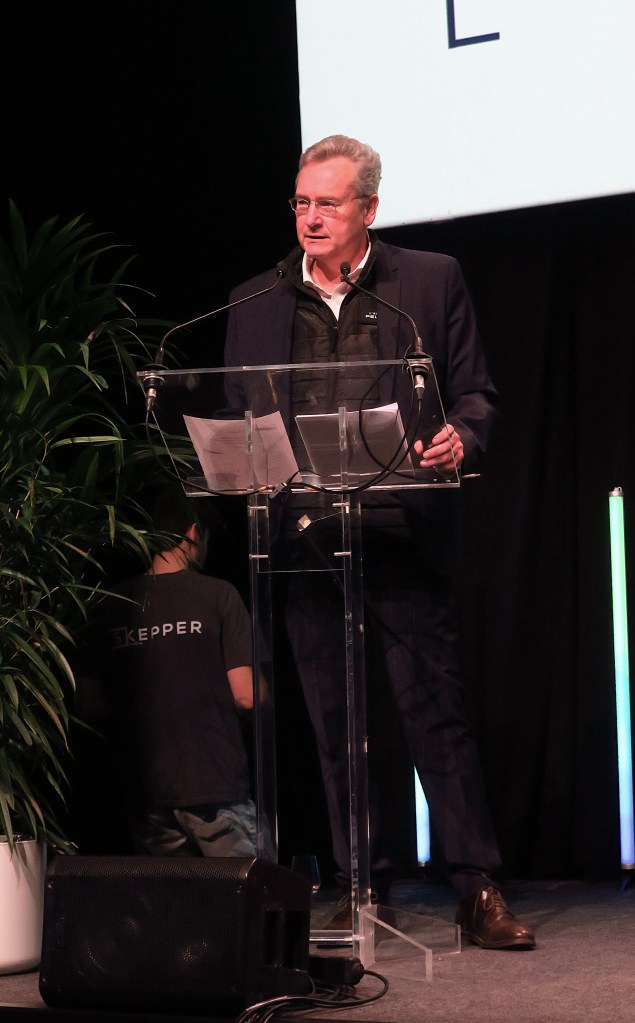
Peeter Henning (see photo below) then presented the role and activities of BEHVA. The title of this conference already summarizes what BEHVA as an organization stands for: preserving a heritage that is not standing in a garage or museum, but which is to be admired and enjoyed on the road. We are all here together because we all believe that mobile heritage is cultural heritage, he pointed out. They bear witness to our technical, social, and cultural history. They celebrate craftsmanship, evoke industrial production and design, and last but not least, individual mobility and freedom.
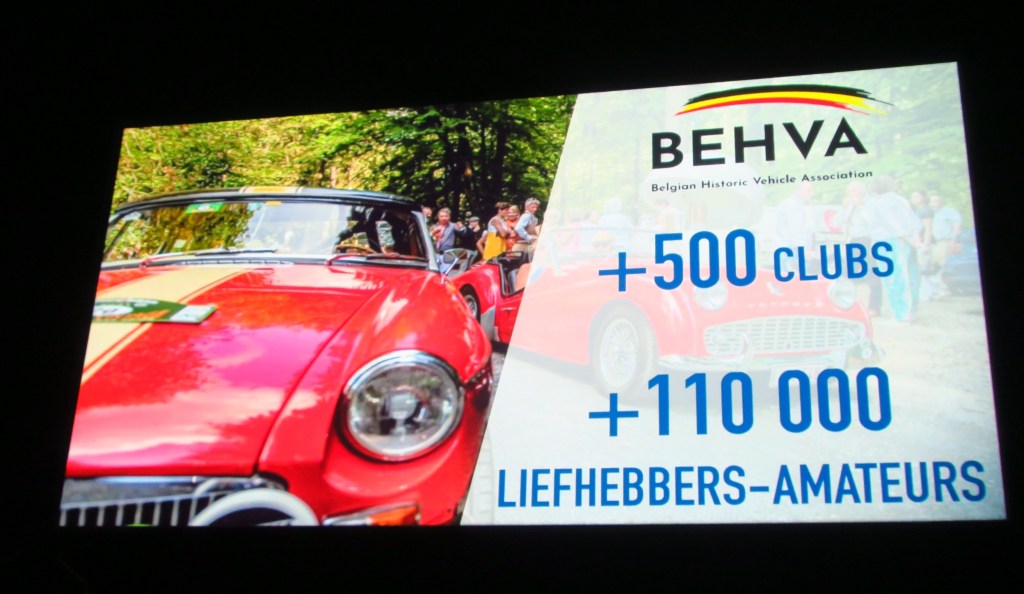
The role of BEHVA is to defend the interests of this heritage. The BEHVA represents in Belgium all the amateurs of historic cars and their clubs. This includes more than 500 clubs and 110.000 members.
But our lawmakers put the existence and use of this heritage under pressure. BEHVA is the spokesperson for all these enthusiasts at the government level and is also the bridgehead toward the automotive sector and the international historic car world. We continuously stress the fact that the mileage of the cars of our members is about the equivalent of one month of an ordinary vehicle, and that lawmakers should take this into account.
BEHVA also keeps a close contact with all the actors of the automotive world, importers, independent specialists, insurers, education centers and schools. BEHVA Insurance now insures more than 72.000 historic vehicles in Belgium. We are the official representative at FIVA for our country in establishing international standards.
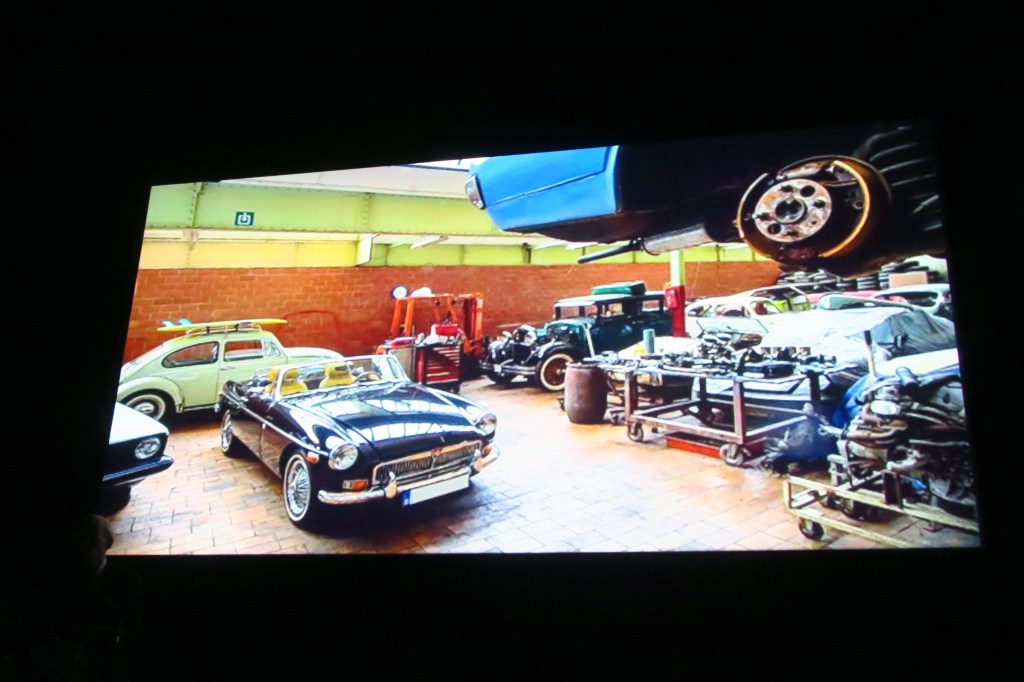
Preserving our heritage needs also the upkeep of technical knowledge, and passing them on to future generations. We have education projects for our youth, in maintenance, restoration and electric, mechanical and bodywork repair. We form a bridge between the professional garage and maintenance sector and schools and education centers, and tie them with the our historic car world.
There is a need in the sector for motivated young people and we create learning possibilities for them, as they are in need for a succesful career. Historic cars live in an ecosystem which BEHVA actively supports. Thousands of jobs are connected to this system. It is our mission that this history in motion stays indeed, in motion…
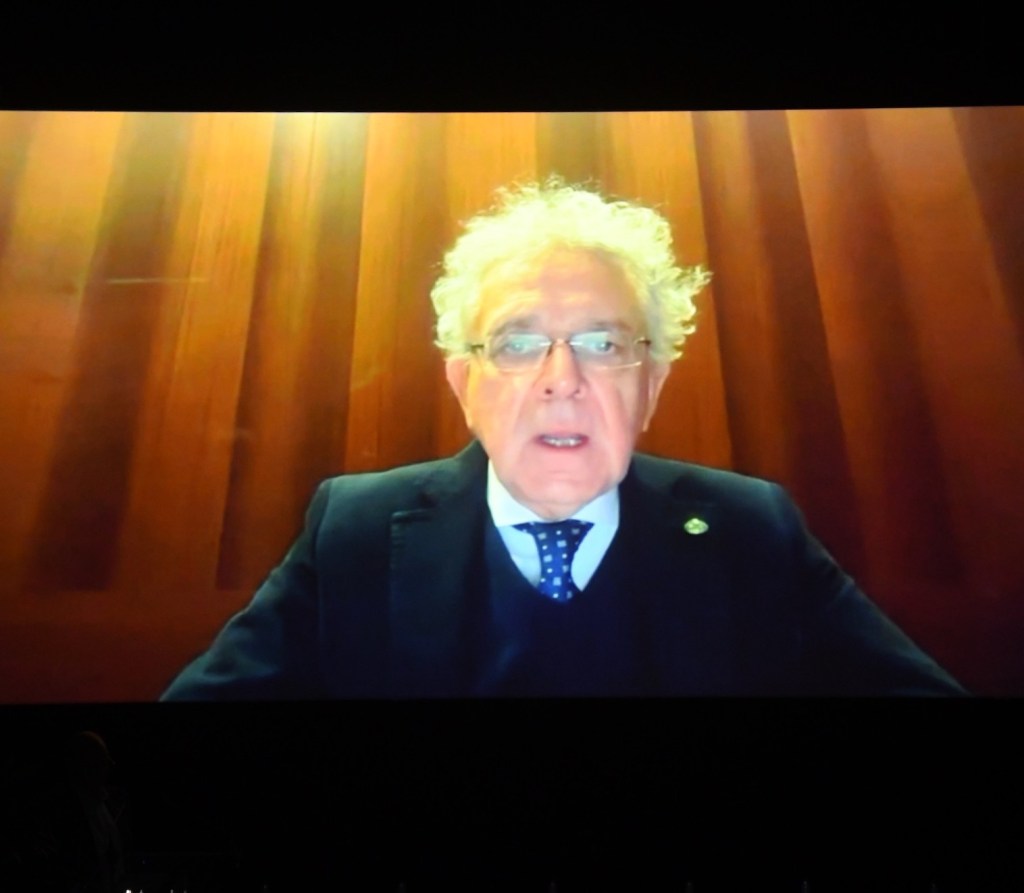
A filmed message was shown of the president of FIVA, Alberto Scuro. He is president of Automotoclub Storico Italiano (ASI) and was elected in november last year as president of FIVA. FIVA was founded in 1966 by an international group of historic vehicle organisations, who felt the time had come for a worldwide body to promote and guide the interests of the historic vehicle movement throughout the world. At present, FIVA comprises member organisations in 71 countries throughout the world, which in turn represent many millions of historic vehicle enthusiasts. We will come back on the role and function of FIVA in a special report soon…
A story of 9000 brands…
Moderator Philippe Casse discussed the beginnings of automotive history, and pointed out that Aristotle came up first with the idea of a self propelling vehicle, or “auto mobile.” It took another two millenia before Bertha Benz drove on August 5th 1888 at the wheel of her husband’s invention, the Patent Motorwagen, 106 kilometers from Mannheim to Pforzheim. Aristotle had already pointed out, there is no genius without a touch of folly… but it has changed the life of billions.
In 138 years, not less than 9000 different brands, of which 158 were Belgian, saw the light. They all together produced about 3,5 billion cars, of which today some 1,5 billion are every day on the road.
Every brand contributed to this, and therefore merits to be appreciated and preserved, as the collectors and clubs do today. Numerous brands also have museums, archives and collections. There are not less than 1,500 museums worldwide and several hundred thousand collectors.
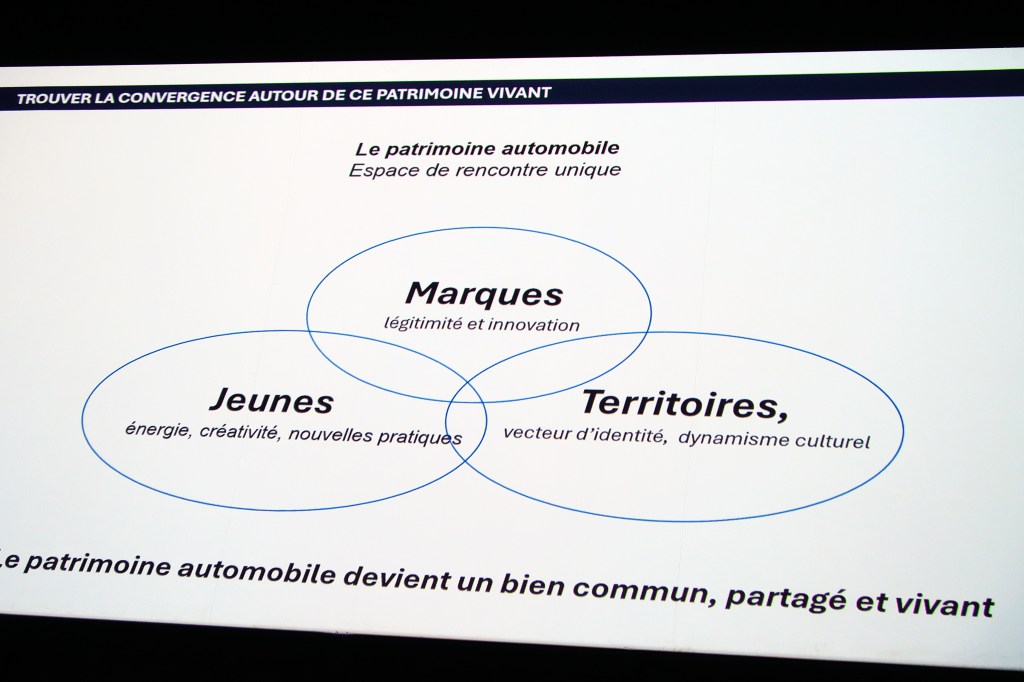
The speakers today will convince you of the importance to preserve this heritage, this legacy which has triggered fundamental socio economcial changes brought about by the fabulous tool which is the automobile. Indeed, preserving this heritage is of great importance for the future of the automobile, and also to actively appeal to young generations to continue this task.
L’Aventure Peugeot and Citroën DS…
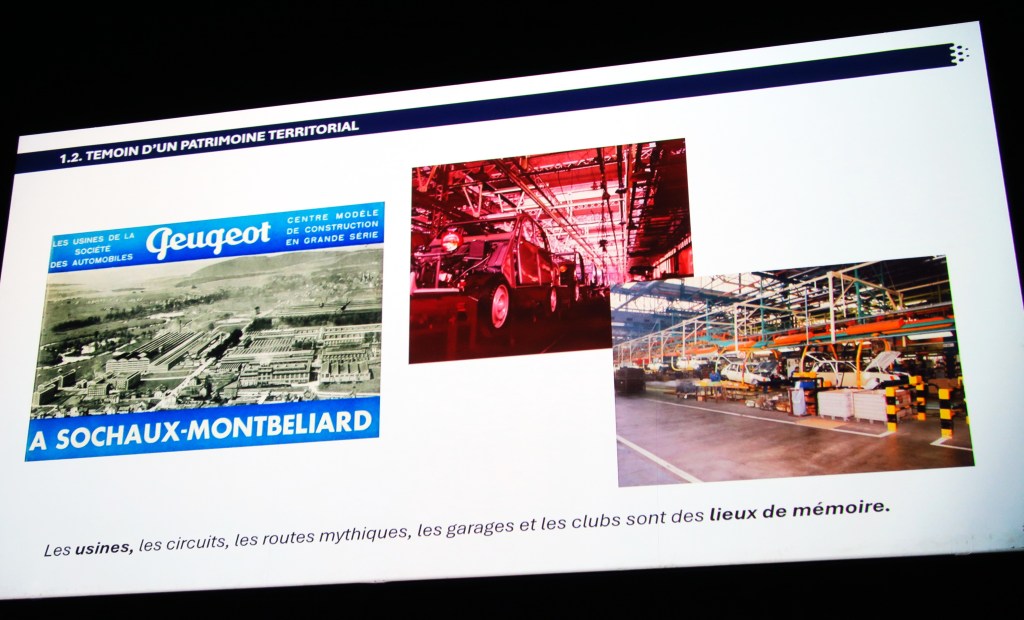
Loïc de la Roche also stressed that the automotive “patrimoine” or heritage is a tangible witness of history; just look at the museum in Sochaux, and it is also something that is essential to transmit to future generations. It also adds to brand value, showing its roots. In his conclusion he presented what we have to remember and which lessons we have to learn from all this.
Loïc stated that it will be a voyage in time, discovering the (historic)passion and emotion(s) around the automobile. It will be about discovering the emotions which the automobile has triggered in us throughout history. Discovering the (historic) automobile, getting to grips with it, drive it, describing the adventurous experience this represents.
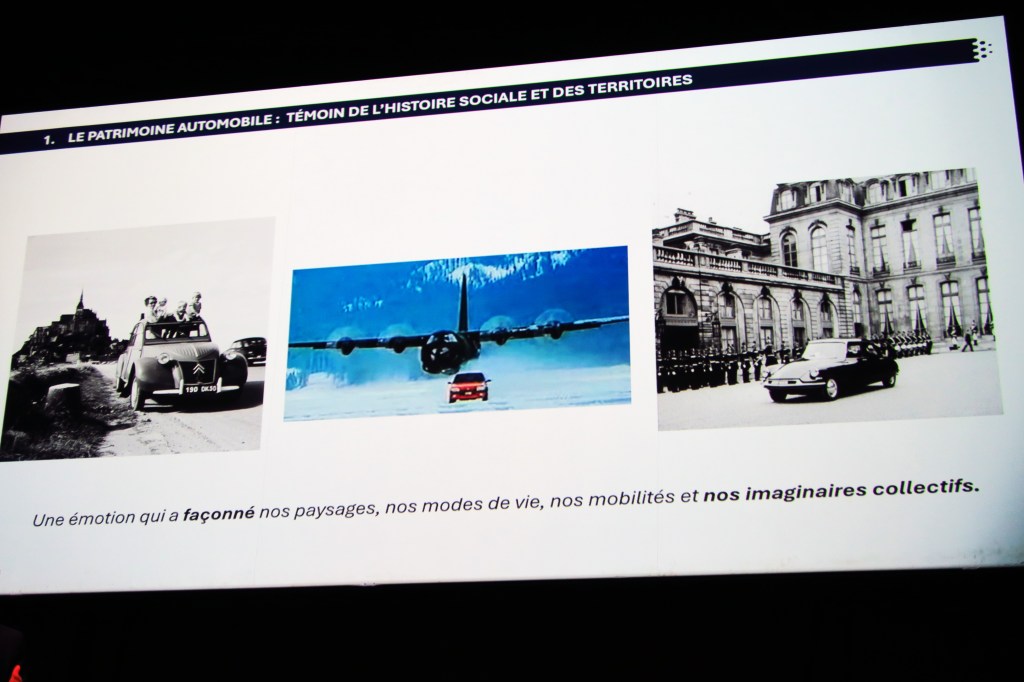
He proposed to start with the beginning, the automobile as a witness of social and territorial history. Indeed, the automobile has changed landscapes, our way of life, our mobility but also our collective imagination.
This collective imagination is the story we tell about the cars of our youth, we dream about. Therefore we call it “adventure”, as it moves our imagination and inspires us. It is the present and the future, and this collective imagination is the strength of our brands.
Automotive industry changed societies…
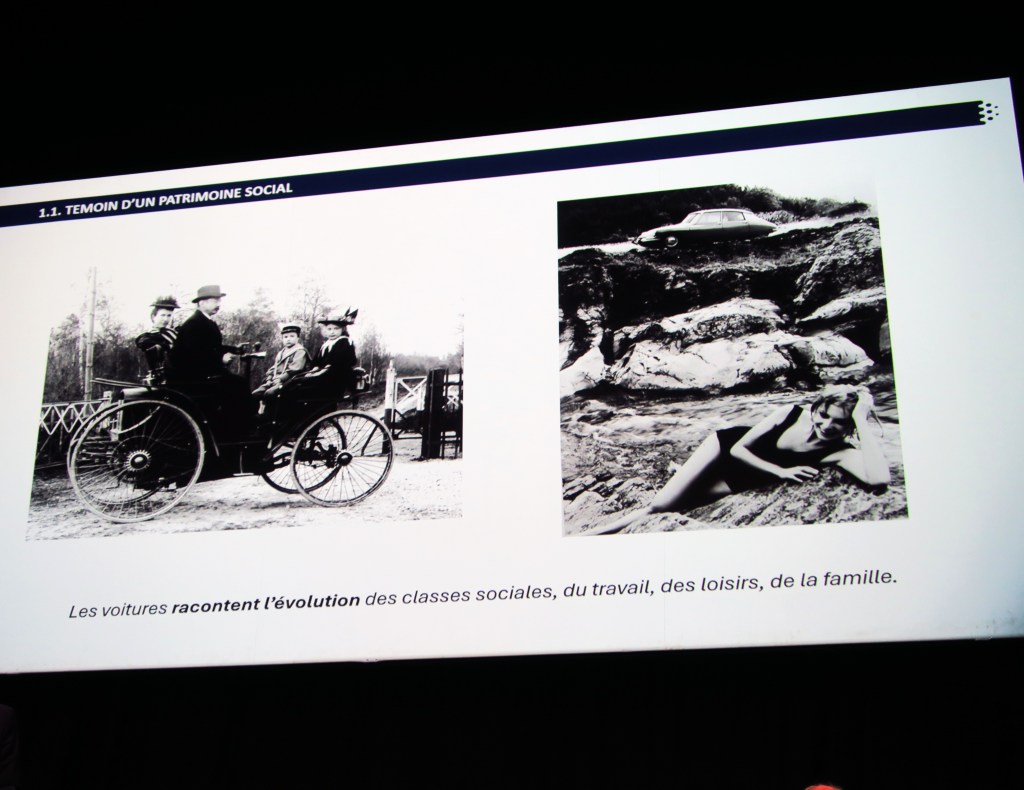
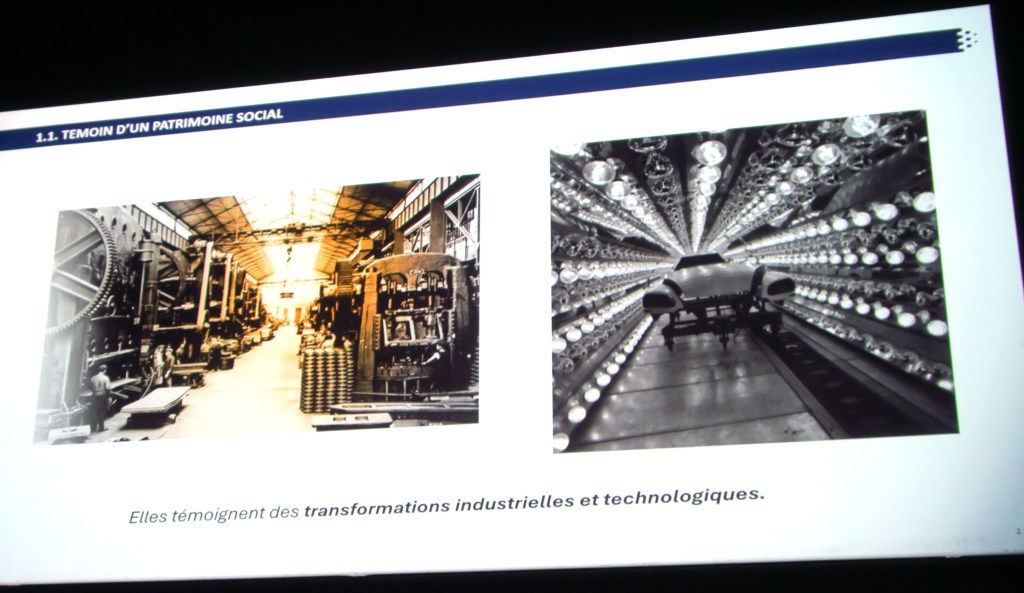
The car also tells us about the evolution of the social classes, work, liberty of society. Our archives are mostly visited by…sociologists. Based on the documents, they reconstruct a period, a social history of people and their territory.
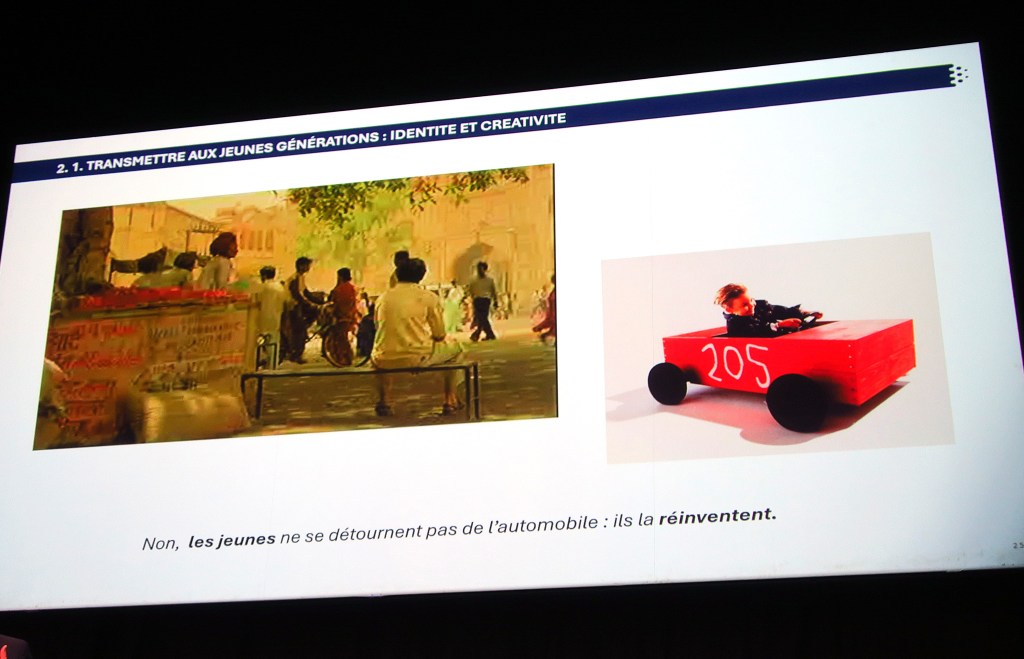
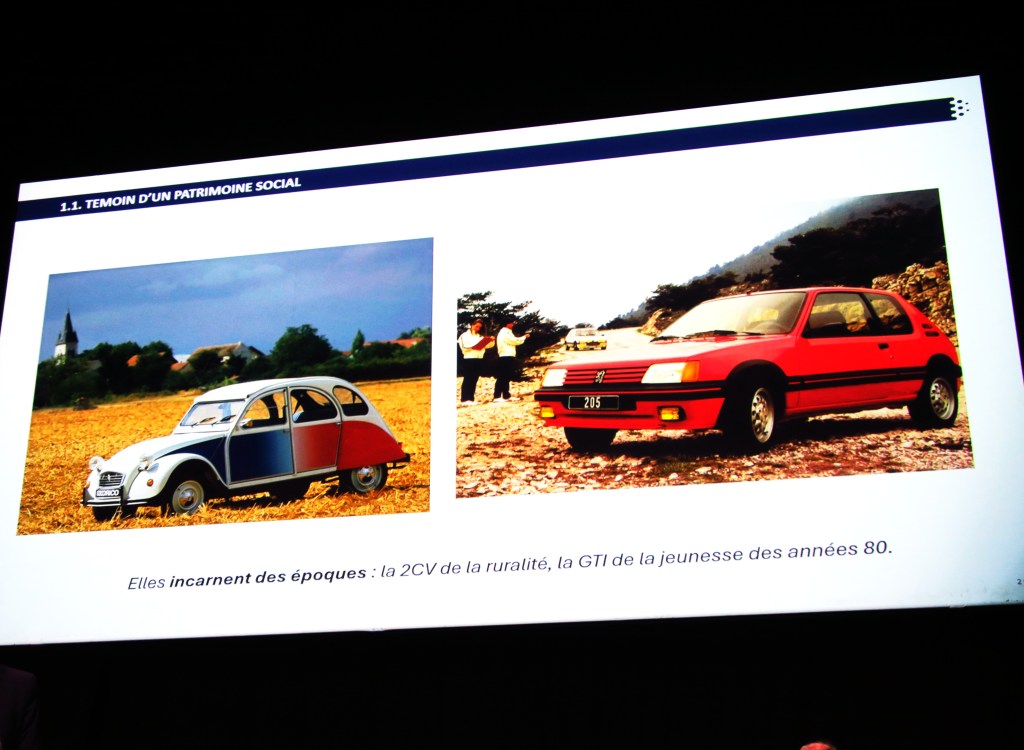
The cars also evoke an epoch, like the 2 CV. The Peugeot 205 (GTI) inspires young generations. They illustrate the cultural mirror which is the automobile. Then comes the importance of power, technology, the new ways to use a car, mobility contracts, etc.
Everything that surrounds the automobile, amongst others the industrial heritage, mass production, mondialisation, energy transition, all this has a heavy impact on people. The factory in Rennes in 1961 had originally 14,000 workers, in 1980 it was slightly below 3,000…
We open our museum to companies organizing B2B events for instance, and we discuss with them about what they want to convey to the participants and people they invite. Some parts of the museum are more suitable for them to convey the message they want to put across.
The automobile has always been a very important factor in triggering innovation, notably in the materials. So one finds always an element in the history of the automobile and in our Peugeot museum in Sochaux which allows the visiting companies to attach their message to it and to convey the values which they want to bring to their invitees.
The automotive industry also shaped our regions and landscapes…
As we said, the automobile industry is also a witness to our territorial heritage. We have noticed that the visitors to our museum are not only interested in the cars, but that the visit was for them also an industrial and territorial happening and experience, an adventure so to say. They see how the region has developed and changed due to the presence of industry. The Sochaux factory was 20,000 square meters in 1921, 585 hectars in 1960 and in 2022 we are again concentrated at 150 hectars.
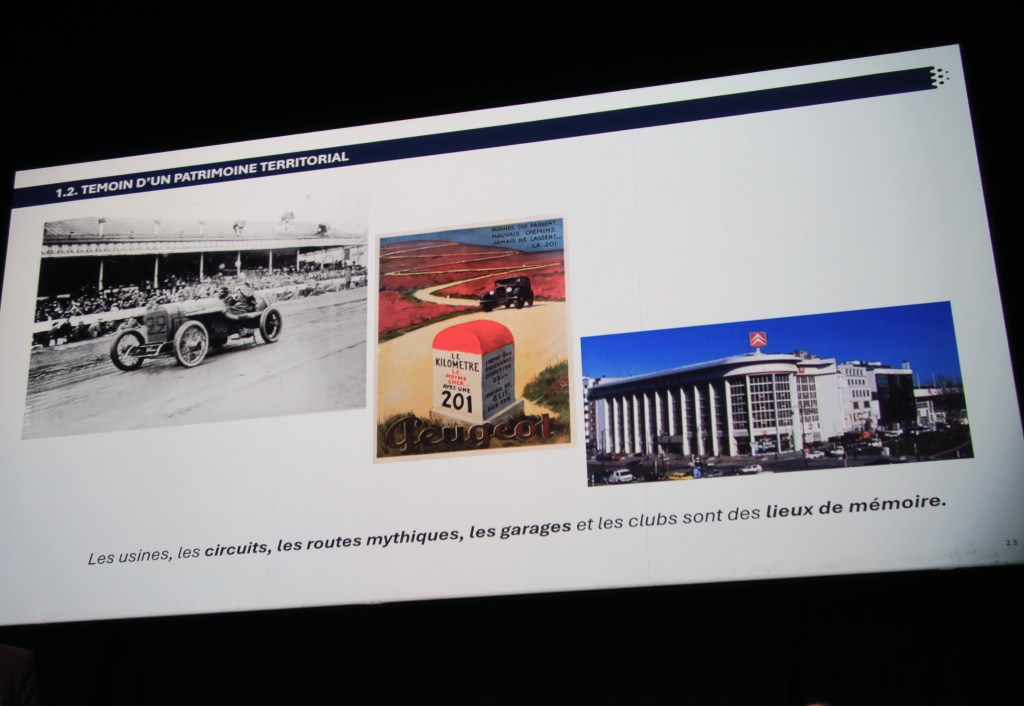
The car racing circuits are also an important witness. Of course, you all know Spa Francorchamps, Monthléry, but there are also iconic roads, like the Nationale 7. You have also mythical dealerships, like the Citroën dealership building at the Place de l’Yser in Brussels, now being converted in an art museum.
The young generations will also change the way in which they will approach, accept and acquire the historic automobile. They will reinvent it, so to say. Many young people now also enter into the realm of the “aventure Peugeot” and are inspired and seduced. They search authentic experiences, they want to connect with it physically. They also accept that things can break down, in an age where everything works perfectly without a hitch. The Aventure Peugeot has of course connections with schools and education/training centers.
Automobile history also brings emotion…
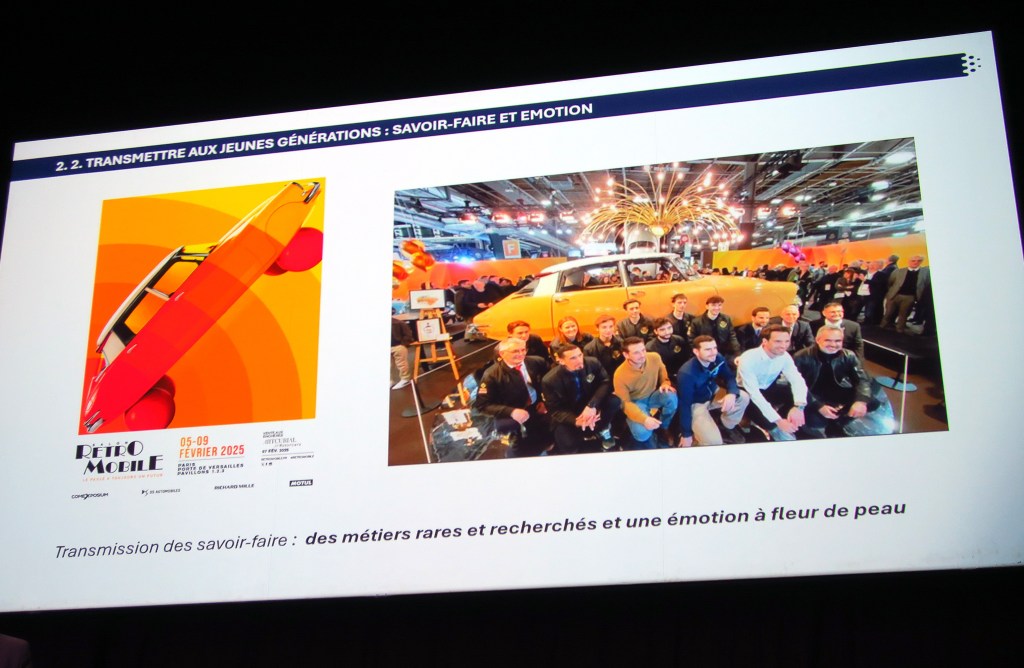
We also want to transmit emotion. This was particularly true at the happening when celebrating 70 years of DS, notably at Rétromobile. The DS “Ballon” has been meticulously recreated, as the original was…dismantled and sold to a private customer(!) A team of 25 young “compagnons de métiér” did a wonderful job, and the car has been shown throughout 2025 on 16 venues, amongst witch Autoworld in June last year. The car continues its tour…
A museum of national importance…
The director of the MUCEM Museum in Marseille told Loïc de la Roche in a discussion about the Aventure Peugeot and its museum that considering the richness of the message you can transmit about the automobile and its history to the future engineers, it makes it such a such an important subject that you can consider it to be part of the national soverignity. What is better than a museum like ours to inspire young engineers to a career in (automotive) engineering? This indeed, is now an element in our strategy.
Social engagement…
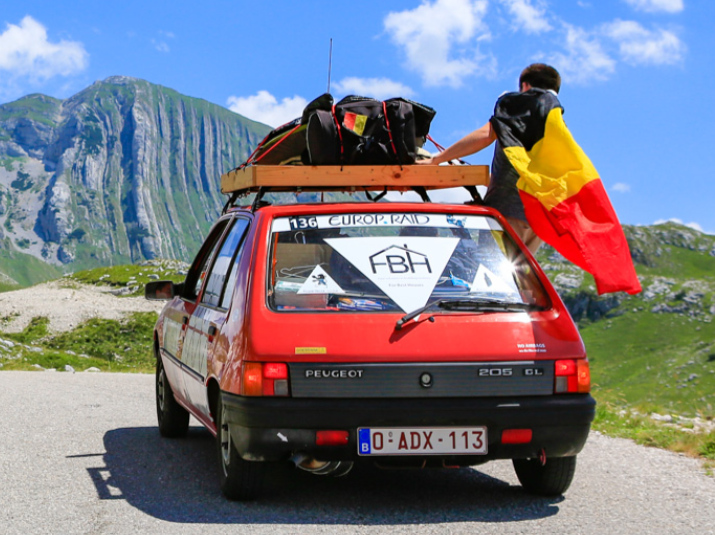
A further element we want to transmit is social engagement. We organise the Europe Raid, through 20 pays, visiting 12 capital cities, 60 UNESCO heritage sites and 220 stages, over the most scenic routes of Europe. One creates strong ties, also between generations, and indeed, the world is moving. Recently a club Citroën C6 has seen the light. The average age of its members is 25 years…
We also look at video games to attract the enthusiasm and engagement of young generations and to awaken the desire to find and preserve our moving heritage, even if it is more recent and consequently inspires them.
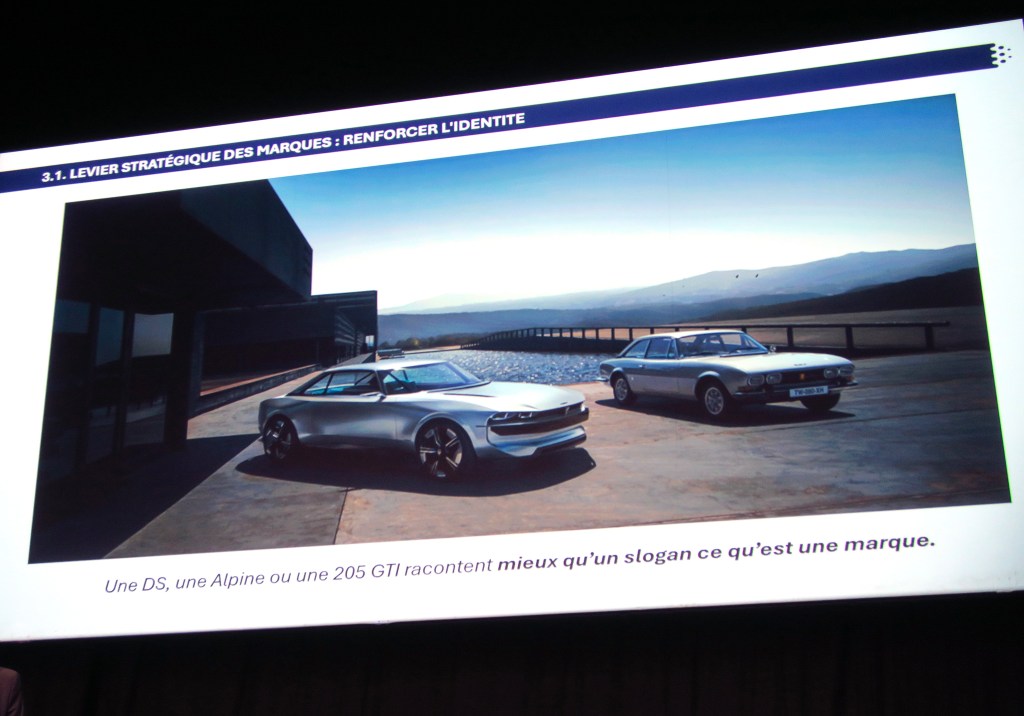
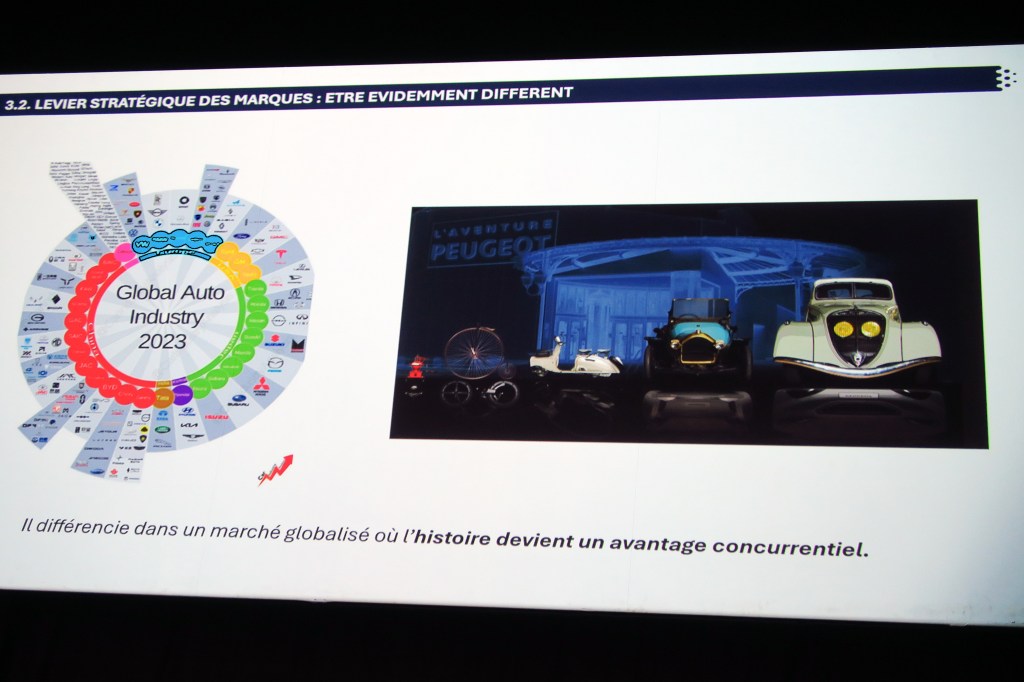
An important pillar in the Aventure Peugeot is also to strengthen and enhance our brand image. It is craftmanship, know how, but above all embodying and bringing a promise, strengthening and upholding our values, our identity. In our present automotive market it is important to have a history, a distinct design language and putting this in perspective. This allows us to be different and stand out. Of course we talk about icons and sagas.
The saga is the 205 and the icon is the GTI. Our present e 205 GTI is a perfect example of this strategy, where we use our history as a future oriented spearhead. Last year before the start of the Le Mans race, Peugeot had invited 50 owners to drive their 205 GTI around the circuit. It is difficult to describe the enormous energy this triggered, spreading across generations. Here we really talk about authentic experiences. Also in our museum we search to enhance these experiences, so we invite the visitors to see also our restoration workshop. We are also entering the aftermarket to rescue and preserve spare parts, and we also support the collectors to keep their cars which are (partially) electronic running reliably. In France, some 30,000 persons are involved in the ecosystem of historic cars, representing a turnover of some 3,5 billion Euros…
Preserve it for future generations…
With the car history in general and the Adventure Peugeot Citroën, we have here an enormous immaterial asset, which we will keep alive with a coherent history which is preserved also in the future. I will finish with the slogan of the Patek Philippe Watches, which I will turn around a bit: when you have a historic Peugeot or Citroën, you will merely be its keeper, and preserve it to hand it over to future generations…showing that the automobile is a magnificent human adventure.
In the part 2 of our report on this remarkable conference we will present the speech of Thomas Stebbich and Thomas Antoine. In the third and final part we will present the subsequent panel discussion.
From May 24 to 25, in the extraordinary setting of the Villa Sucota overlooking Lake Como, Alfa Romeo will be the Official Partner of the 2025 edition of FuoriConcorso, and will show its beautiful cars, with its unique sporting design language, a festival of beautiful contours and shapes which are an everlasting delight to the eyes of every car enthusiast.
Just read on and enjoy the photos…
Hans Knol ten Bensel
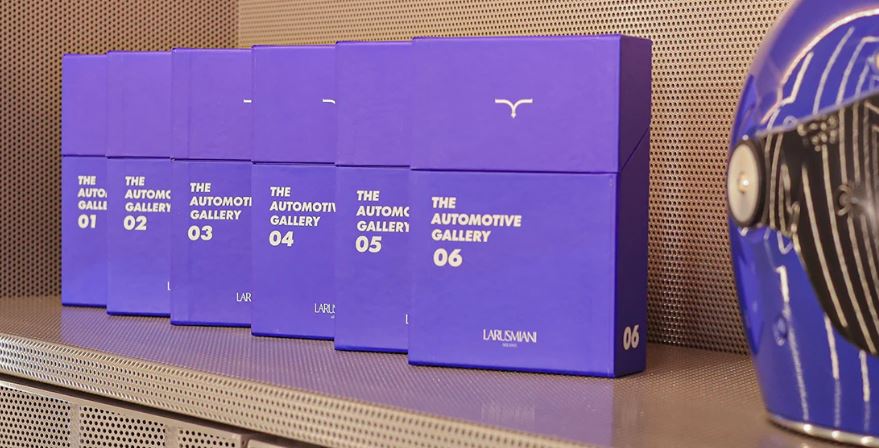
The FuoriConcorso is an event with a well rooted tradition: it was founded in 2019 by Guglielmo Miani, president of Larusmiani, the bespoke menswear and gentleman accessories firm which has been there for gentlemen since 1922. The passion for cars results also in a boutique to create an exclusive collection limited edition. There now you can purchase a collectors box of the Alfa Romeo 6C which contains: the numbered t-shirt with rear print depicting the car and a caption postcard with the history of the car.
But let’s return to the FuoriConcorso. It has grown to an international event that every year attracts thousands of collectors, experts and car enthusiasts from all over the world. The theme selected for this year is – “Velocissimo – Italian Race Cars”, and this means that Alfa Romeo will put its mark on this event. Indeed, the splendid Villa Sucota will become this year the “Casa Alfa Romeo”.
Around 15 extraordinary models will be on show there, some from the Alfa Romeo Museum in Arese and others from private collections.
The Zagato 6C…
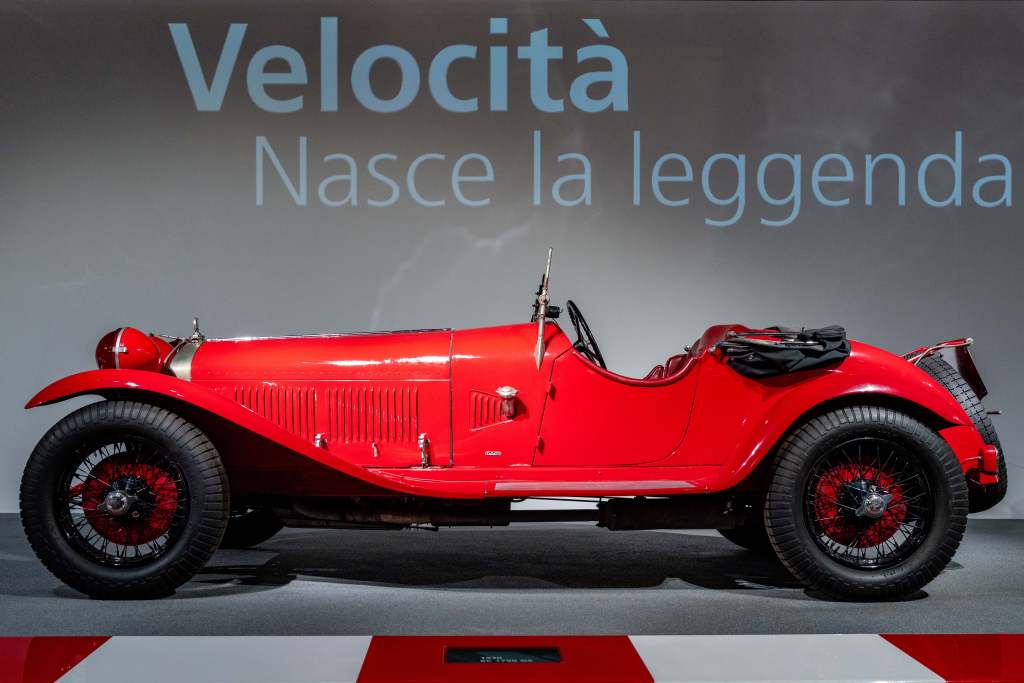
A car which truly stands out is the 1930 6C 1750 Gran Sport, one of the most famous Alfa Romeos for its unmistakable line (Zagato), six-cylinder engine with compressor and its wide-ranging trophy haul in motorsport, spread out between the Mille Miglia, Targa Florio, Tourist Trophy and many other victories in endurance races.
On a model similar to the one on display, the legendary Tazio Nuvolari won the 1930 Mille Miglia, setting an average speed record of 100 km/h across the entire route, in a memorable duel with his teammate, Achille Varzi, also driving a 1750.
The Giulia TZ2…
Many aficionados still dream of the golden era of road racing, and the cars which played a prominent part in this. Like the spectacular 1965 Giulia TZ2. An evolution of the previous Giulia TZ, this car is lower, more tapered and aerodynamic, with fiberglass bodywork on a tubular chassis. Designed by Ercole Spada at Zagato, it sports a sleek and muscular line, dominated by the famous truncated tail, which consecrates it as one of the most beautiful racing cars ever.
The 1.6 twin-cam engine evolved with double ignition and dry sump, reaching 170 hp and 250 km/h. At its debut in 1965, it won its class at the 1000 km of Monza and went on to take other victories in the same season, including the 12 Hours of Sebring, the Targa Florio and the 1000 km of the Nürburgring. One year later, the TZ2 achieved the same feat at Monza, Sebring, the “Targa” and the “Ring.”
The 33 TT12…
Then there is the 1975 33 TT12. It made its racing debut on May 5, 1973 at the “1000 km of Spa-Francorchamps,” when the World Championship for Makes was experiencing a period of great popularity and commitment from the most prestigious manufacturers, including Alfa Romeo with the “Tipo 33” family.
The “33” which saw the light in 1967 has now become legendary, where the letters “TT” stand for Telaio Tubulare (‘tubular chassis’; based on its forerunner the 33 TT3 with a V8 or ’Otto Vu’ engine) and “12” is the `number of cylinders of the new 180° (‘flat’) three-liter V engine that can exceed the threshold of 500 hp. The aesthetics are unmistakable, with its side fins and famous periscope. After a year of development and initial wins in ’74, total domination came in 1975: seven victories out of eight races to win the World Championship for Makes, the fourth overall title in Alfa Romeo history. Legendary drivers such as Merzario, Andretti, Ickx, Vaccarella and many others were behind the wheel to build this immense series of wins.
The legendary F1 compressor Alfetta’s…
When you stroll a few steps away from Villa Sucota, an exclusive area pays homage to the bolides that have made Formula 1 history, starring the 1951 Alfa Romeo GP Tipo 159 “Alfetta,” the veritable ruler of the first two World Championships. An evolution of the legendary 158 of 1938, the 159 triumphed with Fangio after the victory by “Nino” Farina in 1950. After the title – the first of five for Fangio – Alfa Romeo officially withdrew from racing to devote itself to the Giulietta.
Compared to the 158, the 159’s engine was equipped with a two-stage compressor, De Dion rear suspension – the name given to the 1972 Alfetta is based on the adoption of this technical solution – and a more efficient aerodynamic look. The supercharged 1.5-liter inline 8-cylinder engine reaches incredible levels of power: in tests, it even achieved 450 hp, equivalent to 304 hp/liter. This was also made possible by the use of alcohol based special fuels, which had a considerable cooling effect when evaporating, making higher compression rates possible without corresponding high combustion temperatures.
Last but not least, the 33 Stradale…
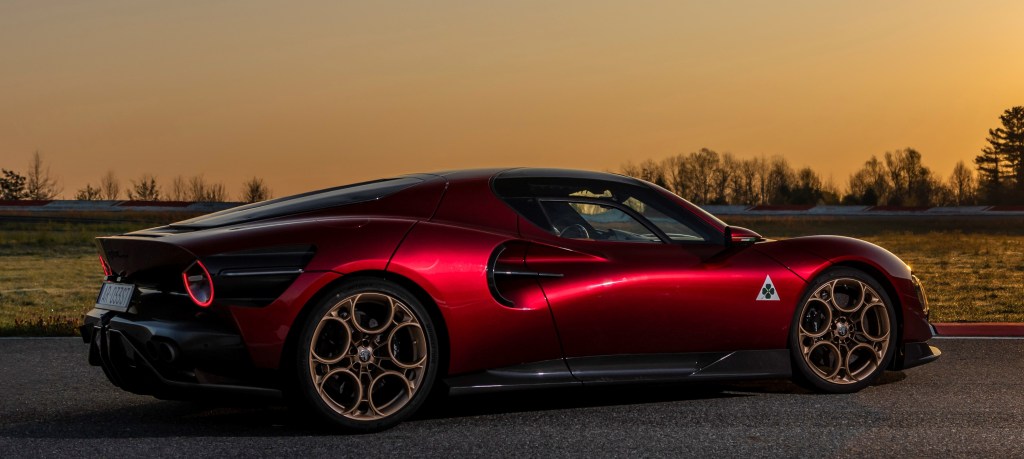
Also on show at Villa Sucota will be the new 33 Stradale, a “custom-built” car approved for road use that ensures outstanding performance on the track.
It was unveiled in 2023 and produced in only 33 models (all of which have already been sold), the car represents the return of the legendary 33 Stradale, an icon of the 1960s, reputed by many to be one of the most beautiful cars of all time, and derived directly from the Tipo 33 – once a big name in world motorsport.
We can only suggest you to take a look at the photos, and spend some delightful ”Alfa” moments…
Already in 1934, the dream of the goddess of the road began: Citroën designers drew the first contours of a more streamlined body for the “Traction”, which was launched only a few months earlier.
This year we celebrate 70 years of DS, as indeed the iconic DS 19 was launched in October 1955, this year now 70 years ago.
Reason enough to delve into the stunning history of the birth of this goddess, and subsequently also DS Automobiles, who since 2014 carries further the tradition of making superbly styled, avant-garde automobiles offering exquisite comfort and panache.
Your servant started to delve into his archives, and here is a tale, which every car enthusiast can adopt as an exquisite story to be told at a dinner table with friends and family, about the men with a unique “Génie Français” which led to the birth of a truly unique automobile.
Hans Knol ten Bensel
But development work started rather in earnest in 1938, when Pierre Boulanger codenamed the project for a successor of the Traction VGD, or “Voiture à Grande Diffusion”
The man behind it all: Pierre Boulanger...
But first a word about the actors of this unique engineering adventure. It starts with Pierre Boulanger, who was a so-called “Michelin man”. He started working for Michelin in 1918, reporting directly to Eduard Micheli, co-director and founder of the business. Boulanger joined the Michelin board in 1922, and in 1938, he became the company’s joint managing director.
What has Michelin to do with Citroën? In December 1934, despite the support of the Michelin company, Citroën filed for bankruptcy. In that same month Michelin, already the car manufacturer’s largest creditor, decided out of necessity to become its principal shareholder.
Pierre Boulanger then became the assistant of Pierre Michelin, who was already the chairman of Citroën. Boulanger became the vice-president and chief of the Engineering and Design department. He became president in 1937 until his accidental death behind the wheel of a Traction 15 CV . He also jointly managed the Michelin company.
Pierre Boulanger was already since 1936 working on a project to create the TPV (short for ‘Très Petite Voiture’). This led, as you might already know dear reader, to the birth if the 2 CV, affectionately called by the French “La Deuche”.
The driving genius of the project: André Lefebvre …
But let’s go back to our VGD project, which he started with the help of André Lefebvre, the spiritual father of the Traction. Another most important actor in our tale. He was an engineer with unique insight and creativity, with a wonderful talent to think out of the box. He was a lifelong friend of aviator, artist and also car designer and engineer André Voisin. And this is a man who designed and built absolutely stunning cars.
André Lefèbvre in his younger years, a keen racing engineer, working for Voisin…
We show you here a photo of the Voisin which was to be seen in the Brussels Autoworld museum last year. It was also André Voisin who recommended Lefebvre to André Citroën.
The man behind the hydropneumatic suspension: Paul Magès
The genius who invented and developed the legendary hydraulic suspension was Paul Magès. He came to Citroën as a draughtsman at the age of 17 and a half, and made a wonderful career thanks to its practical sense, creativity and entrepreneurship. In September 1940 he was promoted to quality engineer and in 1942 Pierre Boulanger included him in his research team, to create and develop a suspension system for the 2 CV. Here his out of the box thinking and creativity proved crucial.
Already early in the development, he saw the advantages of a liquid that would compress a gas. It was a new idea that Paul Magès began to experiment with in 1944 on a 2 CV with a very crude system comprising 1 gas tank per wheel, which theoretically made it possible to vary the flexibility from one to four, with a gas and a liquid separated by cork. Cork will not withstand high pressure however. This archaic start is refined, perfected, tested a multitude of times, and the results are always more surprising. Paul Magès then created his own team which manufactured all the organs itself. The skills of each person are at stake, in the feverish atmosphere of research. The theory gradually became reality, the concept was simplified, the tests multiplied, the results were refined.
First trials of a hydropneumatic suspension on the 2 CV prototype…
In 1946, Pierre BOULANGER encouraged Paul Magès to continue his research, no longer on the 2CV but this time on a front-wheel drive, because it was necessary to think about the future VGD car. (Mass Circulation Car)
Besides the suspension, the car had to be revolutionary, and Boulanger proposed a monocoque structure in which the centre of gravity would be as low as possible, the roof and bonnet would be of aluminium and the floorpan would support unstressed, lightweight body panels.
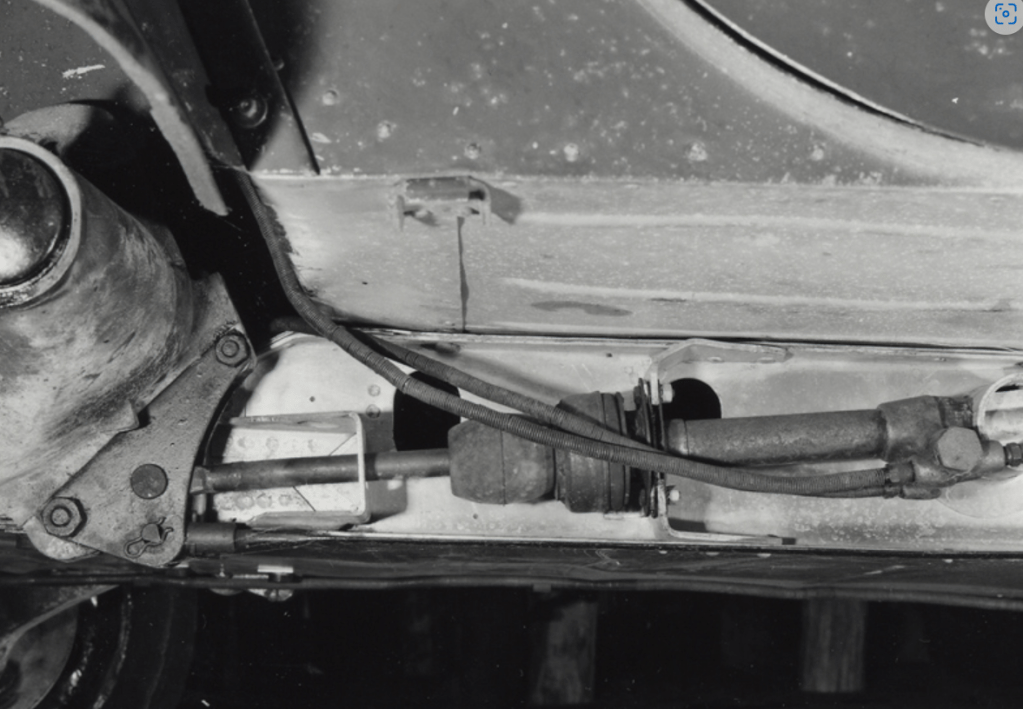
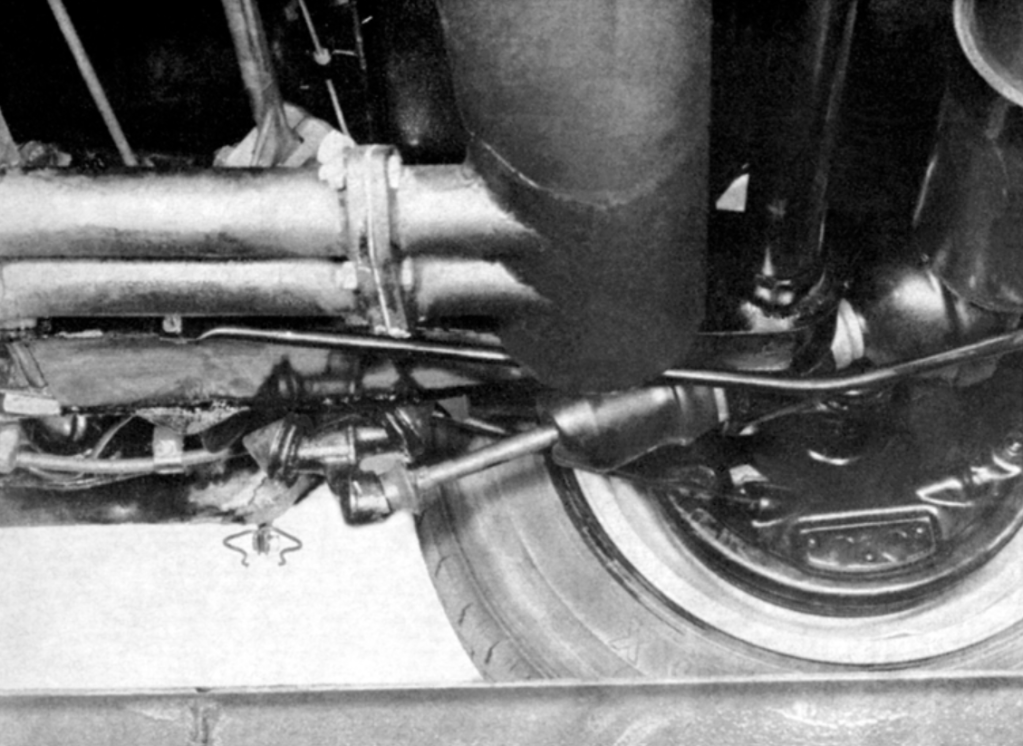
The hydraulic suspension found its way on the rear axle of the six cylinder 15 CV Traction…
In 1949, Paul Magès, after multiple tests, finally developed a hydropneumatic suspension that he put to the test in the cold in the Nordic countries, then in Algeria for resistance to high temperatures. It was from this adventure that the idea of a manual height control was born, in order to allow the vehicle to face snow or chaotic terrain. Other trials will be the source of questioning, creations, and multiple improvements. In 1953, the hydropneumatic suspensions were deemed reliable enough to equip the 15 six, then the DS 19…
But soon more about the story of the DS in the following 70 years since its birth…
Porsche has been making people dream for 75 years, and Autoworld, the iconic automotive museum in Brussels, joins in on that dream with the end-of-year exhibition “Porsche, Driven By Dreams”.
The exhibition runs from December 8, 2023 to February 25, 2024.
After the exhibition ‘Porsche – Electric to Electric’ in 2013 and ‘Porsche 70 Years’ in 2018, Autoworld continues its successful collaboration with Porsche Belgium and the Porsche Museum in Stuttgart. With a never-before-seen collection of exclusive Porsches, collected thematically in a unique setting, you are taken into the overwhelming dream world of Porsche.
The storytelling goes much further than just the cars…
In addition to the beautiful cars, the exhibition also focuses on the people behind the brand. People who, just like Ferry Porsche, have always believed in their dreams, achieved great things and realized great ideas. The stories of international and Belgian personalities are highlighted in the various theme groups. Examples are Jacky Ickx, Johan Dirickx, Thierry Boutsen, Laurens Vanthoor, André Lotterer…
Unseen: from Concept to Model
Reality often starts with a dream, and every Porsche starts life as a concept. Autoworld collected 9 Porsche concept cars that have never before been exhibited in Belgium and shows them side by side with the production model.
From the 984 that would become the 914 to the prototype of the Taycan that dreams of an alternative future, via the 989 (the Panamera project), the 959 group B study, the 911 Vision Safari and many more models.
911 celebrates its 60th birthday…
Naturally, the 911 forms a separate theme within the exhibition “Porsche, Driven By Dreams” with another unique collection spanning 8 generations of the “Neunelfer.”
Art and Heritage
“Porsche, Driven By Dreams” is more than just presenting dream cars. The renowned Belgian street artist Vexx, known for his Porsche Vision Gran Turismo that can be viewed until January 8, 2024, will be present exclusively for Autoworld on December 7 and 8 with an animation about Porsche.
Another artist, renowned photographer Bart Kuykens, will exhibit his works, in which the Porsche 911 always plays a prominent role.
Ferdinand Porsche fulfilled his absolute dream 75 years ago by building his own dream car. His very first 356 ‘Gmund,’ built in a barn in the village of the same name in Austria, to other classics that helped turn Ferdinand Porsche’s dream into reality are on show.
Motorsport
The 991 RSR, 991 GT1, 919 Hybrid and Formula E Gen 3 are just some of the racing cars on display that have made Porsche the most successful racing car brand.
Of course, the Belgian contribution is not forgotten with racing cars driven by legendary drivers such as Jacky Ickx, Thierry Boutsen and Laurens Vanthoor.
The world of the Dakar Rally
It was Jacky Ickx who made Porsche dream of the famous Dakar rally. A dream that once again became reality with, among other things, the 959 with Rothmans colors.
Porsche honors the successful Dakar models with the recent 911 Dakar, the 911 GT3 Rally in D’Ieteren colors and the 953 Dakar. Autoworld honors Porsche’s successful Dakar past in a separate, sandy universe of the expo.
Kids Corner
The youngest visitors can attend workshops in the separate room where they can build the Porsche of their dreams. For inspiration, a life-size Porsche in Lego is on display. And who knows, the next Belgian Le Mans winner with Porsche will be discovered on our racing simulator.
Permanent collection
Autoworld’s permanent collection will continue to be admired during the three-month exhibition “Porsche, Driven By Dreams”. The ‘Bagnole’ restaurant will of course remain open to the public, as will the museum shop with an extensive Porsche collection, ideal for the holidays…
Autoworld is located in the beautiful Parc du Cinquantenaire (French) of Jubelpark (Dutch). Opening hours: Monday to Friday: 10-17 h, Saturday and Sunday 10-18 h.
Christina Posta at the Nardi wheel of a 1900 Super Sprint
Alfa Romeo has launched an exceptional initiative at the 40th edition of the re-enactment of the “Mille Miglia”, the “most beautiful race in the world” in the famous words of Enzo Ferrari.
It features a truly exceptional crew, let us present it here for you:
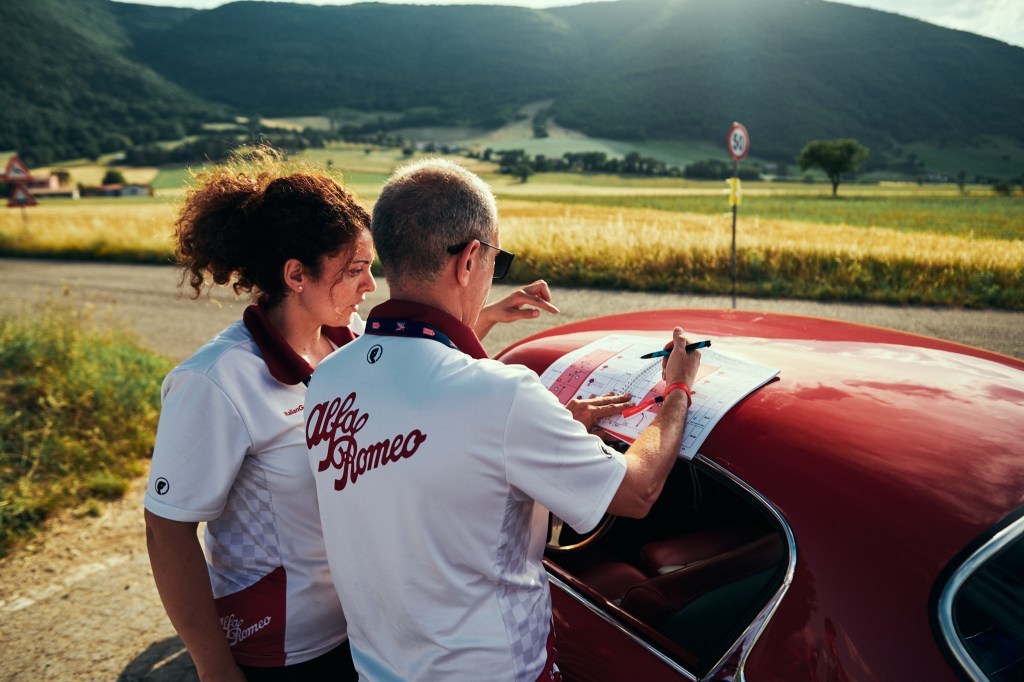
Francesco Pirozzi, a member of body shop at the Giambattista Vico plant in Pomigliano, and Cristina Posta, an assembly line employee at the Cassino plant, will represent Alfa Romeo Manufacturing at the race on board a 1900 Super Sprint.
Francesco Pirozzi is 46 and has been gaining professional experience in the body shop at the Pomigliano d’Arco plant since 2005, especially on the geometry of the Alfa Romeo 147 and 159 models. An avid fan of the Alfa Romeo brand, today he is entirely dedicated to the Tonale project, which he has followed since its inception.
Father to a nine and seven-year-old, he is passionate about cars, electronics and mechanics.
Cristina Posta was born in Pontecorvo (FR) in 1984 and has worked on the assembly at the Cassino plant since 2018.
Due to her family ties, she had an emotional connection to Alfa Romeo even before working there and always wanted to be part of the Group.
Outside the factory, Cristina loves to wake up early, spend time in the kitchen and garden, and help her parents with the family agricultural business.
This crew embodies the inclusive spirit of this brand, which can rely on a cohesive and passionate team in every department.
We can only applaud this initiative. Alfa Romeo wants to engage its customers just like its own employees, offering visceral experiences like the “1000 Miglia” and remaining faithful to the Italian sporty DNA which has made it an icon since 1910.
The brand invites its fans to “Join the Tribe”…
Alfa Romeo’s 50 vehicles once again make it the most well-represented brand at the race. These include models from the brand’s private collection which are normally on show at the Alfa Romeo museum in Arese: the 6C 1500 Super Sport from 1928, the 1900 Sport Spider from 1954 and the 1900 Super Sprint from 1956.
Your servant has very fond memories of this iconic Mille Miglia. Years ago, I was invited now years ago together with my father by Mercedes Benz to form a crew at the wheel of the brand with the iconic star… it was legendary, to be then in the same team with the legendary Mille Miglia winner, Stirling Moss!
Jacky Ickx has his 75th birthday this year, and the organisers of the Brussels Interclassics decided to celebrate him on the sixth edition of their show, which will be held on the weekend of 19, 20 and 21 November.
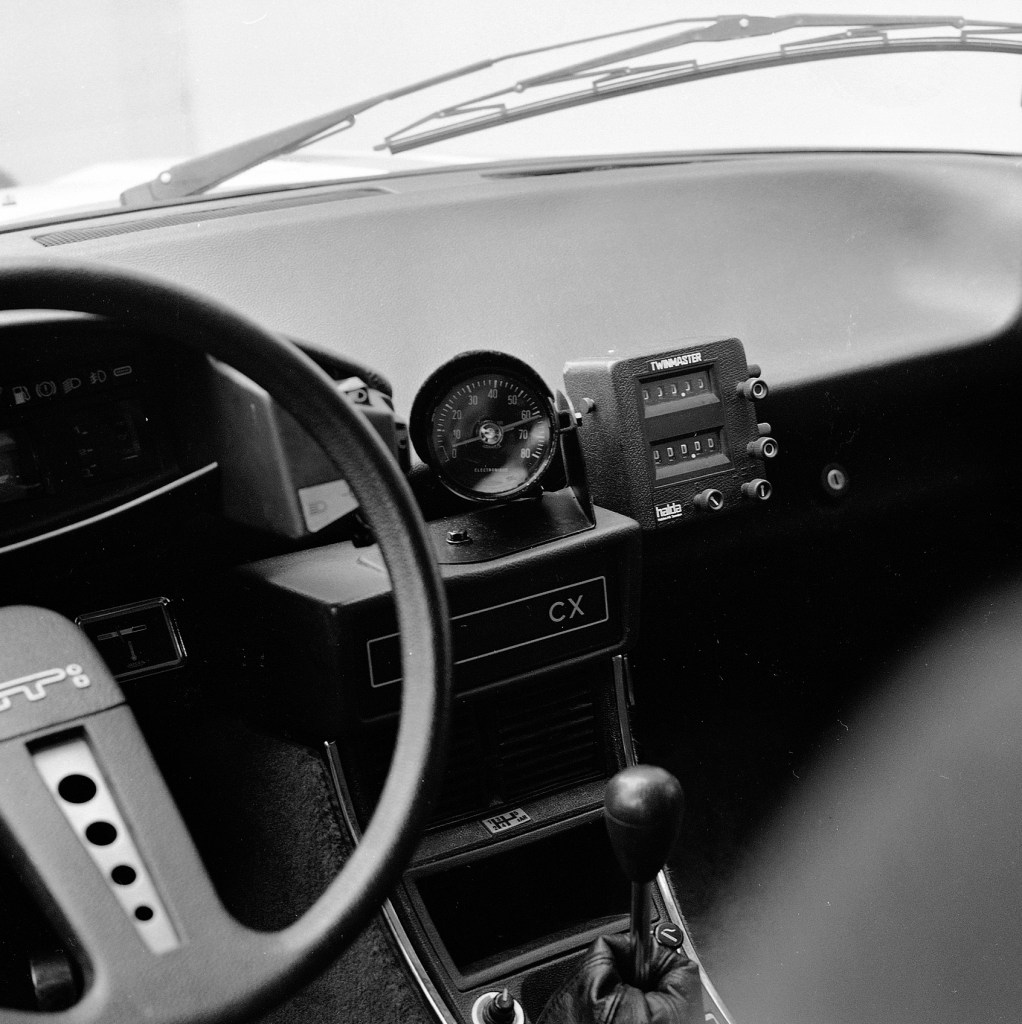
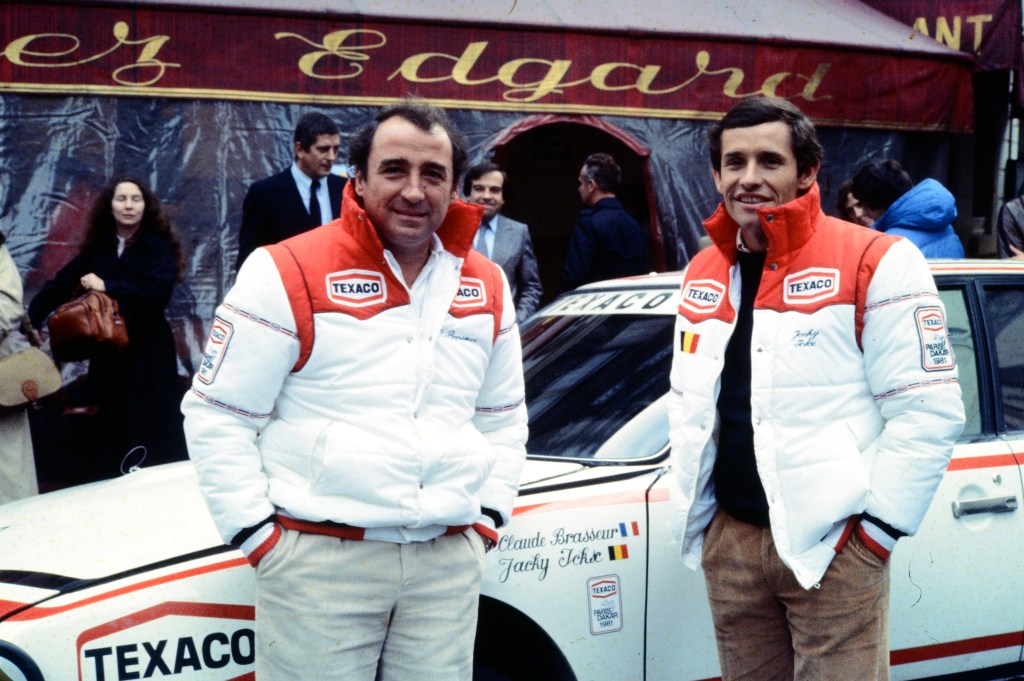
15 cars will be shown on the event, representing the milestones of Jacky’s career. On the central display, a Citroën CX 2400 GTI will also be seen, a perfect replica of the CX he drove on the 1981 Paris Dakar, together with his co-pilot, the French actor Jean Claude Brasseur.
The Citroën CX in Paris Dakar livery was remarkably close to standard, and therefore making a replica was quite feasable…
For the third edition of Paris Dakar, Citroën had entered 4 cars, one in white, driven by Jacky Ickx. The other teams were well trained, Jacky had only seen some film reels of the event prior to the race, and he commented later “Jean Claude and I were total novices to the event, we could have won this race, as the car proved very competitive indeed”.
Nevertheless, Jacky and his team mate led the race, only to abandon in the last stage due to an accident.
The impressive CX 2400 GTI is to be admired in hall 5, stand 5.307. The car is put on the show by CQS Classics, based in Tienen.
We just let you enjoy the photos here, and let you admire how sleek, powerful and efficient these rally Citroëns were in their heydays.
For Citroën enthusiasts, your servant can tell you here Citroëns have always been quite exceptional cars for me, I always cherished the moments I sat behind the wheel of them. I just love their comfort, their unerring stability, even in the worst of weather and road conditions.
Jacky Ickx and his faithful team mate, French actor Jean-Claude Brasseur
My first encounter with the marque of the “double chevron” was behind the one spoked “volant” of a DS 23 Pallas injection electronique, although as a passenger, my memories were even earlier. My aunt in Holland had bought in 1955 a white DS 19, and I sat as a king on the deep blue rear seat, totally smitten by the futuristic design both inside and out, the beautiful and cleanly styled dashboard, the hydraulic commands, the unique comfort and roadholding. My aunt liked to drive with zest, and on the straight but still rather narrow roads, speeds well above 120 km/h were often seen. It felt perfectly normal in this DS. Indeed, the goddess of the road it was called, and deservedly so.
But also the CX left us with indelible memories. I remember driving the CX 2400 GTI – indeed, exactly that model – to the Birmingham motor show. What a delightful Gran Turismo experience it was.
We can tell you here that more Citroën news is to follow: we drove the range of electric Citroëns, amongst others the Berlingo and C4 near Paris, and also tested a diesel powered version of the C4 with the 8 speed automatic, which proved very impressive indeed, showing all the good Citroën qualities.
This is already the second series of the Laurin & Klement, enjoying also success in the middle east, besides the many buyers in the vast Austro-Hungarian empire…
The car manufacturer Laurin & Klement enjoyed first economic and sporting success with bicycles immediately after it was founded in 1895. Bicycles were the product to begin with. But already 4 years later, the product range was expanded to include motorbikes before the company presented its first automobile in the autumn of 1905 – the Laurin & Klement Voiturette A.
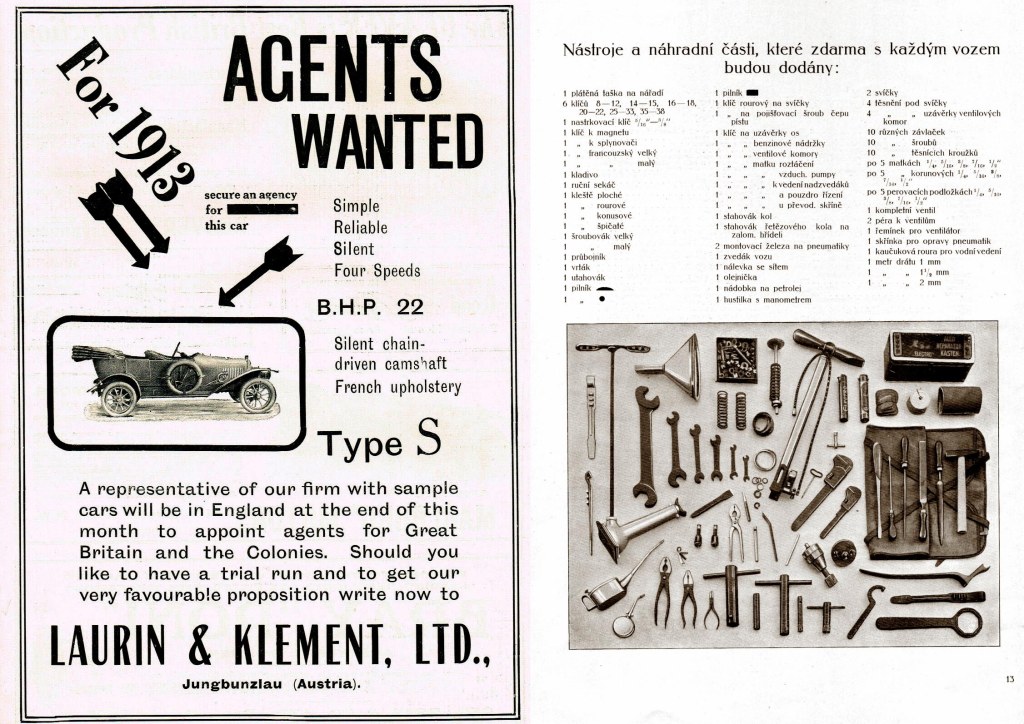
The Austrian sales center of Laurin & Klement was eagerly looking for dealerships in the UK and Commonwealth, for its Type S.
Lets not forget, Laurin & Klement was embedded in the vast Austro-Hungarian empire, and this meant a domestic market good 50 million people. In 1908, 90 per cent of all automobiles in the voiturette segment manufactured during the dual monarchy of Austria-Hungary were made by Laurin & Klement. And voiturettes were quite popular too.
In addition to its high utility value, the vehicle also had a particularly attractive price-performance ratio and low fuel consumption.
Laurin & Klement presented its best-selling model, the S series, on 16 April 1911. It sold in high numbers: more than 2000 units had been built by 1924 in numerous versions, including the Lady coupé and the Kavalier ‘double saloon’.
Laurin & Klement’s vehicles also appealed to international customers, finding buyers as far afield as the British and Russian Empires. The S series performed well in the most demanding races and competitions, finishing 6th overall in the 1914 Targa Florio, for example.
The additional designation 12/14 HP resulted from 12 ‘tax horsepower’, a value calculated for tax purposes according to an officially defined formula, as well as from the actual output of 14 hp (10.3 kW). This was produced by a water-cooled four-cylinder petrol engine with a displacement of 1,771 cm3 and side valves.
The engine, with a flywheel positioned at the front, closely behind the radiator, formed a single unit with the clutch and the three-speed gearbox. This meant that only one oil level had to be checked and changed. In addition, the car manufacturer installed a special lubricator made by Friedmann, which served as an oil pump and oil reservoir. It ensured the supply of oil, thus increasing the service life of the mechanical assemblies. The Eisenmann magneto-electric system was used for the ignition.
There were several versions of the robust chassis, and the four-cylinder petrol engines with a displacement of up to 2,413 cm3 generated 30 hp (22.1 kW) at this stage of development.
The fifth series of the celebrated Model S was quite powerful and fast for its time.
The range quickly grew with the addition of models in higher vehicle classes, and the number of units produced in the individual model series soon numbered in the dozens or even hundreds.
A robust ladder frame made of U-shaped steel profiles riveted together formed the basis of the L&K S. The rigid axles at the front and rear were each suspended with two longitudinally mounted leaf springs. The pedal-operated main service brake acted on the cardan shaft behind the gearbox, while the drum brakes on the rear wheels were connected to the handbrake lever. The standard equipment included special spoked wheels, the steel rim of which was firmly bolted to a wooden hub cap. This made it easier to repair the 710 x 90 mm tyres when they were damaged, which was a common occurrence at the time. For an additional charge, the manufacturer also offered wire-spoke wheels, followed by full steel rims from Michelin after the First World War. The complete road-ready chassis of the Model S with a wheelbase of 2,688 mm weighed 650 to 700 kg.
Wide range of variants to meet all requirements
The early Laurin & Klement S reached a top speed of 50 to 60 km/h, depending on whether it was completed with a light commercial vehicle body or passenger car body. The basic versions could be adapted to the specific needs of each customer. At first, the open-top models with two or four seats were most in demand, but later the range was expanded to include other versions, such as the ‘Vienna’ landaulet, the ‘Karlovy Vary’ saloon, the ‘Kavalier’ double saloon and the ‘Lady’ or ‘Doctor’ coupés, each with a specific ladies’ or gents’ interior. The light commercial vehicle derivatives included the ‘Fortschritt’ platform truck and the ‘Express’ luggage carrier.
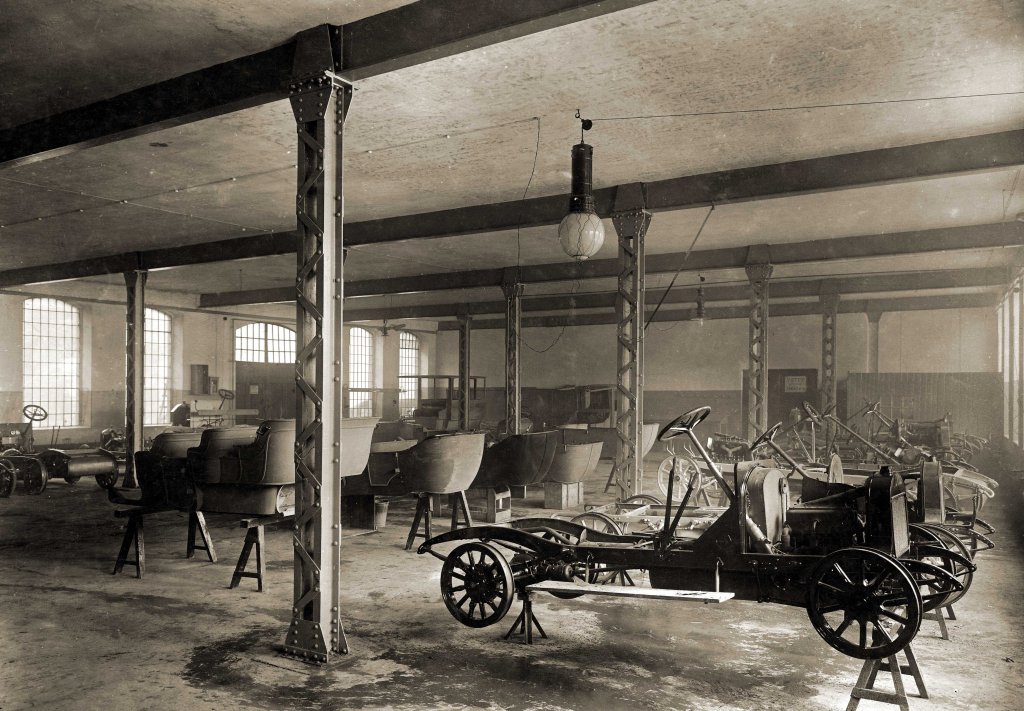
The “series” production of the sixth and last series of the Model “S”: cars and bodies were already on stands to make work easier…
Customer demand continued to rise, not least because of the regular modernisation of the Laurin & Klement S vehicles. Each stage of development was denoted by a type designation with a subsequent letter from Sa to So. The designations complemented each other, and there were overlaps in the production periods. Over time, the wheelbase grew in numerous steps from the original 2,688 millimetres to 3,220 millimetres. The basic configuration of the in-line four-cylinder engines was retained; however, the displacement increased from 1,771 cm3 to 2,413 cm3 over several stages. In turn, the power output increased from 14 hp (10.3 kW) to 30 hp (22.1 kW). In addition, the three-speed gearbox was replaced by a four-speed transmission to enhance the dynamic characteristics of the S-series vehicles. A modern electric starter became available from 1918 – initially only at the customer’s request – although it was still possible to crank the engine as before. Due to the larger displacement and the higher compression ratio, however, cranking was very strenuous. The original acetylene lights with carbide gas generators were replaced at the beginning of the 1920s by electric light bulbs, which were much easier to operate.
During the 14 years that the Laurin & Klement S models were built, the car manufacturer achieved numerous motor racing successes with the series. Among the most noteworthy are the victories in the Trieste – Opicina and Troppau – Moravian Ostrava races (1911) as well as the Grand Gold Medal at the race in Parma, Italy (1913), 6th place in the overall standings at the challenging Sicilian mountain race Targa Florio (1914) and the special prize awarded by the Chairman of the Czechoslovak Automobile Club Prof. Otakar Kukula for the ‘L&K Se’ model in the 2,000-kilometre reliability race of 1921. In the same competition, the larger ‘L&K So’ model was awarded the silver plaque. In addition, the cars drove to victories in the Zbraslav – Jíloviště and Ecce Homo hill climbs as well as in the Schöber race (1922).
By the First World War, the Laurin & Klement company had become the largest car manufacturer in the Austro-Hungarian Empire. A significant proportion of the vehicles produced in Mladá Boleslav went to foreign customers on all continents.
Tradition of volume models from Mladá Boleslav
After more than 2,000 vehicles of the S series had been produced, the Laurin & Klement / ŠKODA 110 model became the best-selling model of the Mladá Boleslav-based manufacturer; a total of 2,985 units were produced between 1925 and 1929. These were the last cars to be developed in the Laurin & Klement era, though they already bore the ŠKODA logo.
The tradition of affordable volume models, which began 110 years ago with this Laurin & Klement S series, continued after ŠKODA entered as a strong strategic partner.
The ŠKODA 422 was the brand’s first vehicle to be produced on an assembly line using efficient production methods and was available from the spring of 1930 at a starting price of 33,000 crowns. The average annual salary of a civil servant at that time was 18,000 crowns. Between 1930 and 1932, 3,466 customers opted for the Š 422.
In March 1934, the Baťa company took delivery of the first model of a completely new generation of cars from Mladá Boleslav – the ŠKODA POPULAR. The model was the answer to the economic crisis at the time. The POPULAR’s technical innovations included its central tubular frame and independent suspension. The price of the vehicle, which was also in high demand abroad, started at just 17,800 crowns. This was one of the reasons the car won over more than 22,500 customers between 1934 and 1947.
Other milestones in the Czech automaker’s history include the introduction of rear-engined vehicles (1964: ŠKODA 1000 MB), and transversely mounted front engine and drivetrain (1987: ŠKODA FAVORIT). In 2020, ŠKODA presented the ENYAQ iV, the first series-production model based on the Volkswagen Group’s MEB platform for battery-electric vehicles.
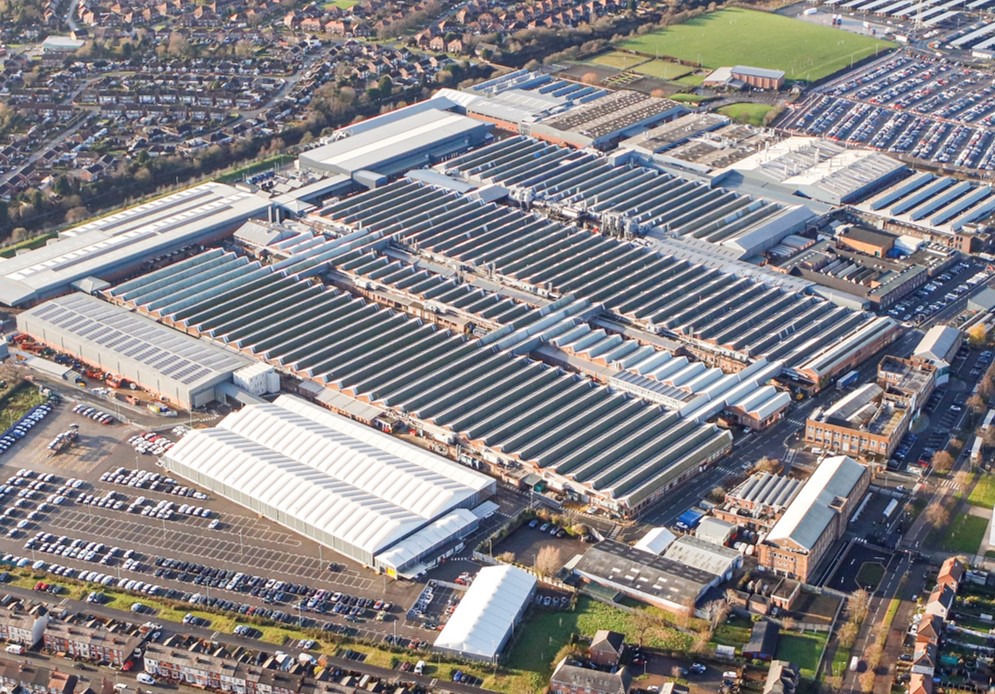
The Bentayga Hybrid, destined for a Chinese customer, met the oldest surviving Bentley, EXP 2, and a number of long serving colleagues, as it rolled off the production line at the home of Bentley in Crewe this week.
Things have taken off for the inconic brand over the last 18 years. Thanks to the success of the Continental GT and more recently the Bentayga SUV, daily production has soared. Indeed, over that period, over 75 per cent of 101 years of production has been hand-built at the Crewe factory, more than ever the home of Bentley. Current daily production, 85 cars per day, equals monthly production numbers of two decades ago.
The Bentley Continentals – then and now…
I vividly recall the interview I made at the Frankfurt Motor Show more than a decade ago with Franz-Josef Paefgen, then CEO of Bentley Motors and Bugatti Automobiles, posts he left in 2011.
During his time as the Chief Executive Officer of Bentley Motors Ltd., he was responsible for the Bentley Mulsanne and the Bentley Continental series of cars. From 2003 to 2005, Dr. Paefgen was responsible for the development of the Bugatti Veyron.
Every Bentley is actually a four wheeled chapter in automotive history…
I asked him then whether a hybrid Bentley was not on the cards, as Bentley’s could be considered the pinnacle of engineering and an electrified Bentley would be proper. It clearly was not in the strategy of the VW Group then, as the idea was immediately brushed aside by Mr. Paefgen as unrealistic, customers not wanting this at all…
Well times have changed quite a bit since then, as we now read that Company aims to be end-to-end carbon neutral by 2030 with entire model range switched to battery electric vehicles(!). Bentley will move to full electrification – PHEV or BEV only – by 2026, then switch the entire model range to battery electric vehicles by 2030. The industry-leading Beyond100 Strategy will transform every aspect of the business as Bentley accelerates into its second century of luxury car production.
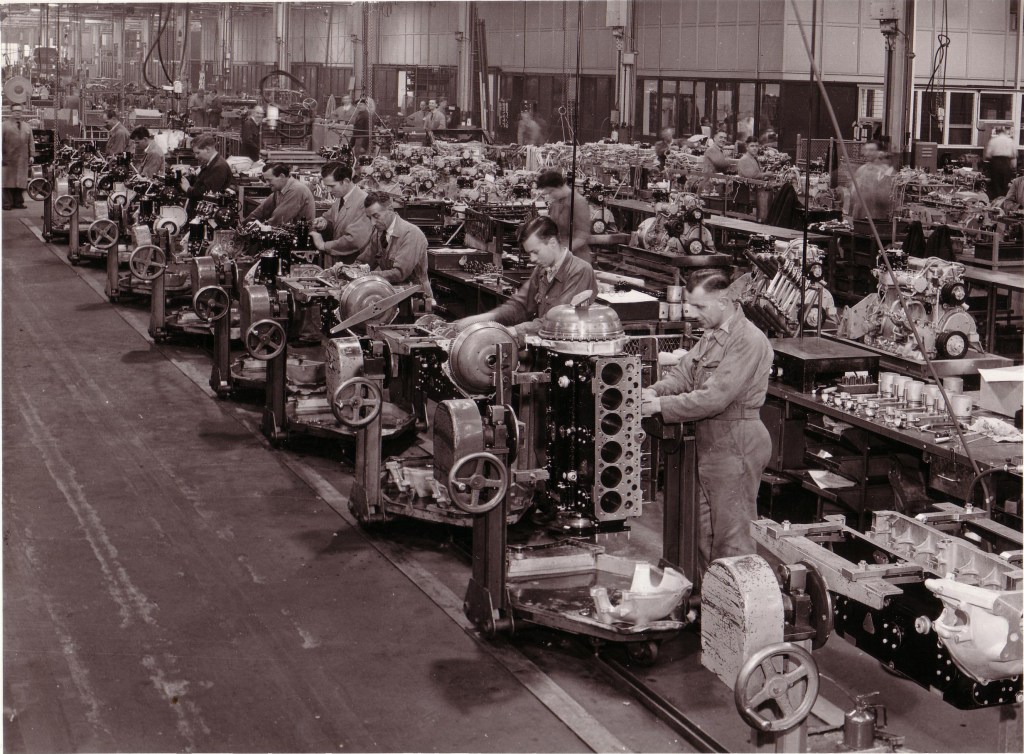
Six cylinder Bentley engine production in the ’50s in Crewe…
What this means for the retail value and depreciation of the existing and historic Bentley’s remains to be seen…
But back to the production history.
The Continental GT was the first landmark…
In 2003 the introduction of the Continental GT represented a transformative moment for the brand, and this Bentley alone, has represented 80,000 sales of the total of 200,000, and created both a new segment, and a contemporary image foundation for the Bentley business.
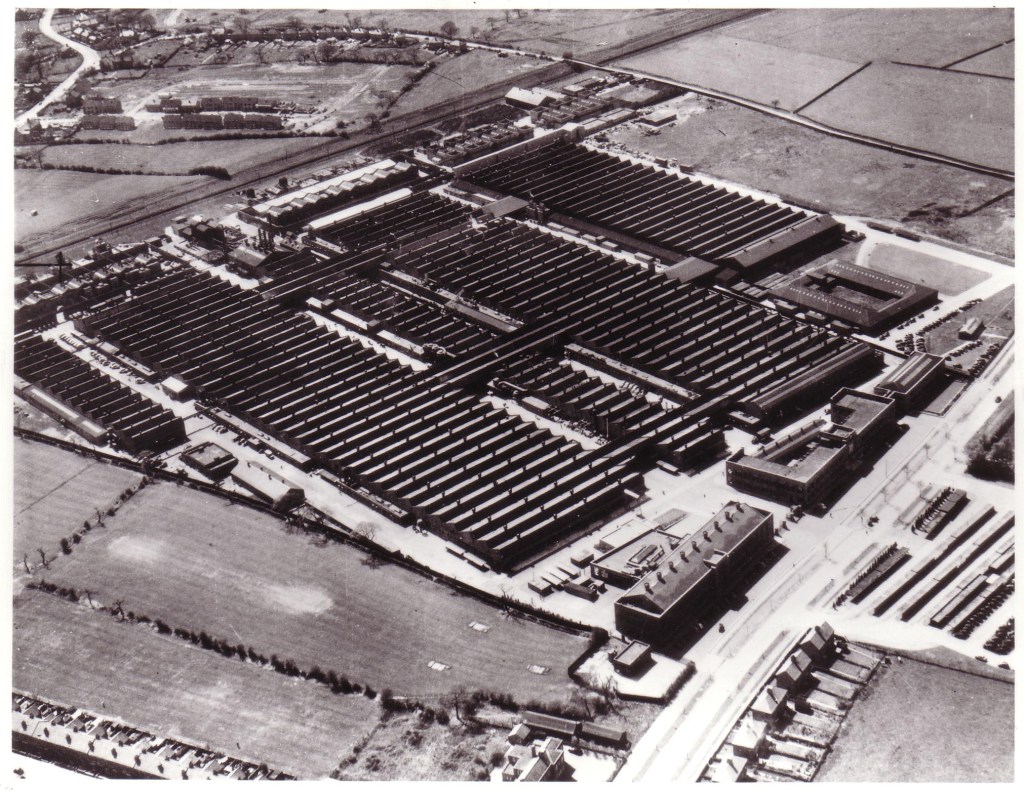
The Crewe factory in 1940…
…followed by the Bentayga
The success of the Continental GT has been mirrored by the Bentayga, offering a true Bentley driving experience and unparalleled luxury. Launched in 2015, when it established the luxury SUV sector, the fastest SUV in the world has reached its 25,000 production landmark. It is expected that the Bentayga could surpass total sales of the Continental GT within a decade and become the biggest selling Bentley model in history.
And now in 2021…
Since 2005, the company has also built 40,000 examples of the Flying Spur, the most successful luxury sports saloon in the world.
We show you here some photos, lifting a veil of the very interesting and multifaceted production history of the brand, and then we have told nothing of their sporting achievements…
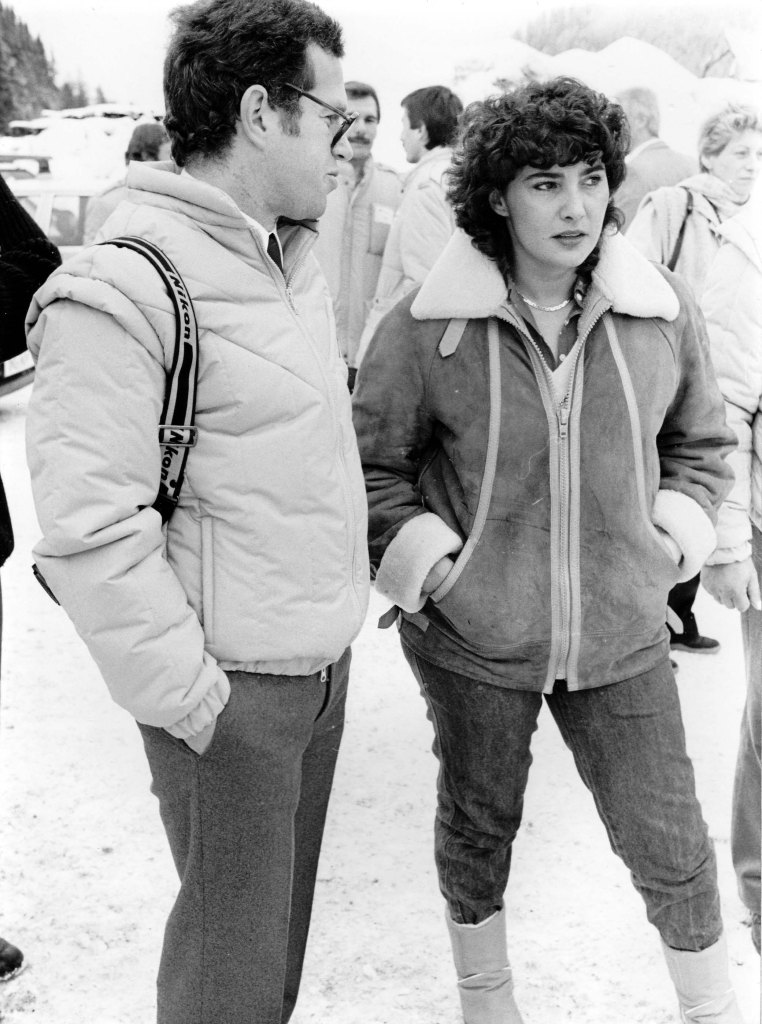
We were there: your servant in conversation with Michèle Mouton in Sankt Moritz, on December 8, 1982…
Your servant was already active as a freelance car journalist from the mid-seventies of last century, so we witnessed up close the birth of the Audi 5-cylinder engines and the (rally) cars powered by it were quite familiar. When we were telling you the long career of Audi’s 5 cylinder engine, we told you how your servant remembered a drive behind the wheel of the Audi 80 Quattro with this magnificent engine. Just look at our pages on this site, and more especially https://autoprova.be/2016/09/18/sweet-memories-our-drive-with-the-5-cylinder-audi-80-5e-quattro-in-sankt-moritz/
This memorable test drive of this Audi 80 5E Quattro took place in Sankt Moritz, on 8 and 9 December 1982. For the assembled international journalists, Audi had also organized a demonstration run with the Quattro Rally Cars, and had brought Michèle Mouton and Stig Blomquist to the venue.
You see me here chatting with Michèle Mouton before having a demo drive with her at the wheel in her Quattro Rally machine…






















 Autoprova - for the Connaisseur