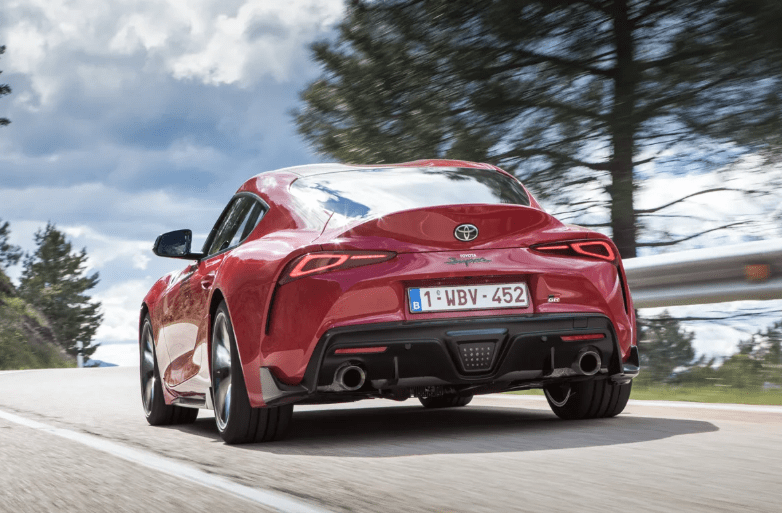
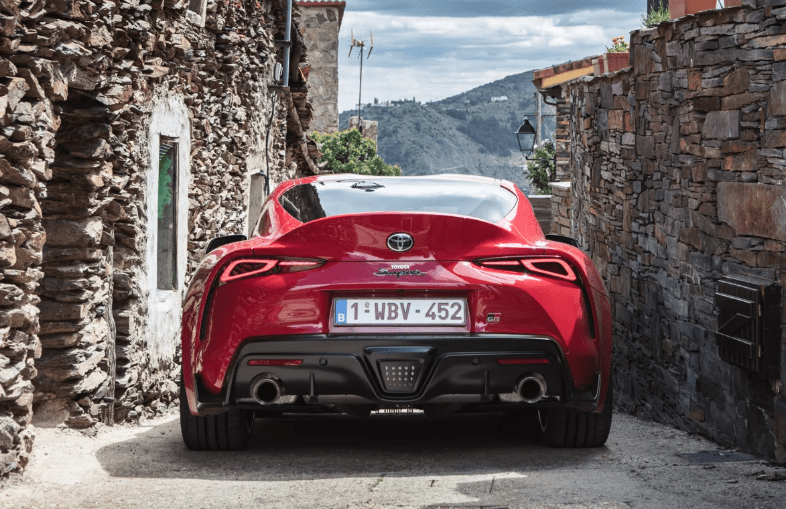
Race bred by Toyota Gazoo Racing: the latest Supra.
There are car builders which nurture classic and iconic sports cars and bring them to perfection. A classic two seater coupé with a well sounding straight six under its long hood and with all the power fed to the rear wheels.
This car builder is Toyota, and the car is the Supra. This sports/GT has been honed and carefully improved over five model generations now and is better than ever.
The Supra is not only race proven over the years, speeding from success to success under the flag of Toyota Gazoo Racing, Toyota’s President Aiko Toyoda actually hurtles this Supra himself around the Nürburgring Nordschleife for hours on end. The result is a breathtaking machine. We present you here its highlights…
Hans Knol ten Bensel
First worldwide GR model of Gazoo Racing
Actually this fifth generation marks a remarkable début for Toyota Gazoo Racing, in establishing its GR model range. They couldn’t have chosen a better car.
Toyota Gazoo Racing is the global
organisation of Toyota’s worldwide racing and sporting activities. They chalked
up last year a win in Le Mans and also won the Dakar rally.
Tetsuya Tada’s masterpiece
Chief engineer kept the layout and character of the original GT 2000 and the previous Supra generations firmly in mind when designing this latest Supra.
Aiko Toyoda sat himself behind the wheel to give the Supra its final touch…
Short wheelbase, wide track, low gravity
point, low weight and a very stiff chassis are the ingredients for pur sang
handling. The 3 litre straight six has a twin scroll turbo and develops 340 DIN
horsepower and 500 Nm torque. It is coupled to an eight-speed automatic
transmission, and guarantees powerful accelerations and indeed tons of pulling
power at all engine speeds.
TOYOTA GAZOO Racing was instrumental in honing the new sports car’s performance, working extensively on the famous Nürburgring Nordschleife and surrounding roads in Germany to achieve the most agile, stable and rewarding handling possible. Further extensive testing was carried out on roads around the world.
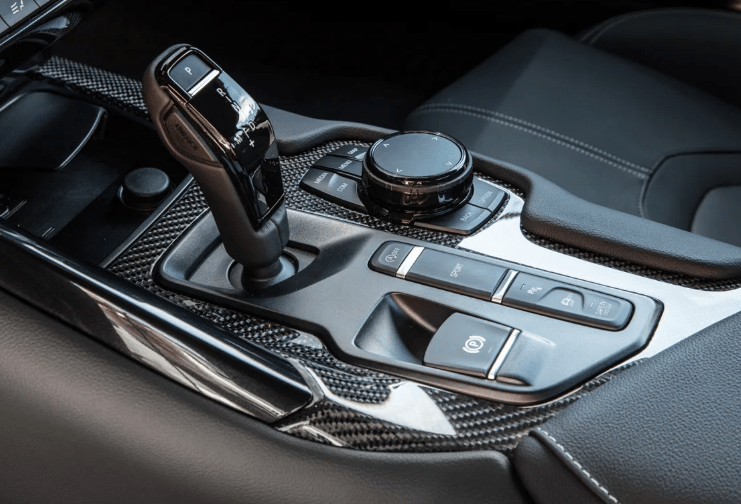
An 8 speed automatic lets you control the power like a master…
To be certain that the car delivered on its promise, Toyota President Akio Toyoda himself put it to the test at the Nürburgring in his role as a Master Driver before giving it the final green light.
New Toyota GR Supra customer deliveries
will start from summer 2019. By the way, did you know that all cars will be
manufactured in Graz, Austria?
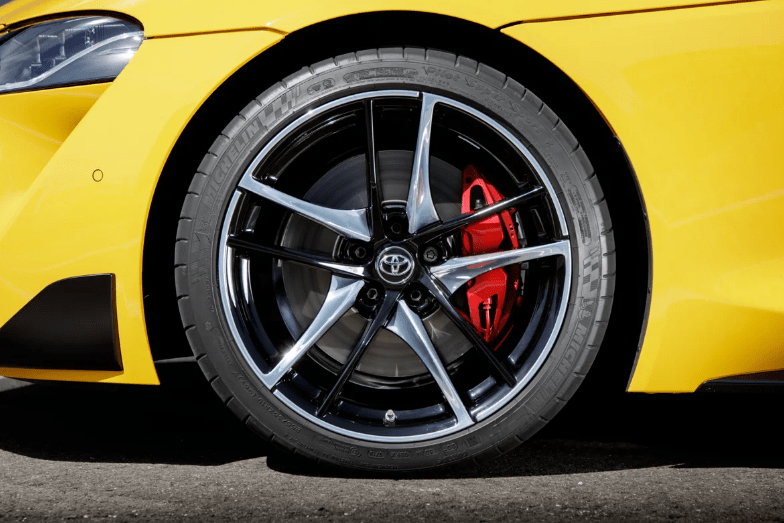
Just look at the photos here, and indeed we
are looking forward to driving this absolute gem!
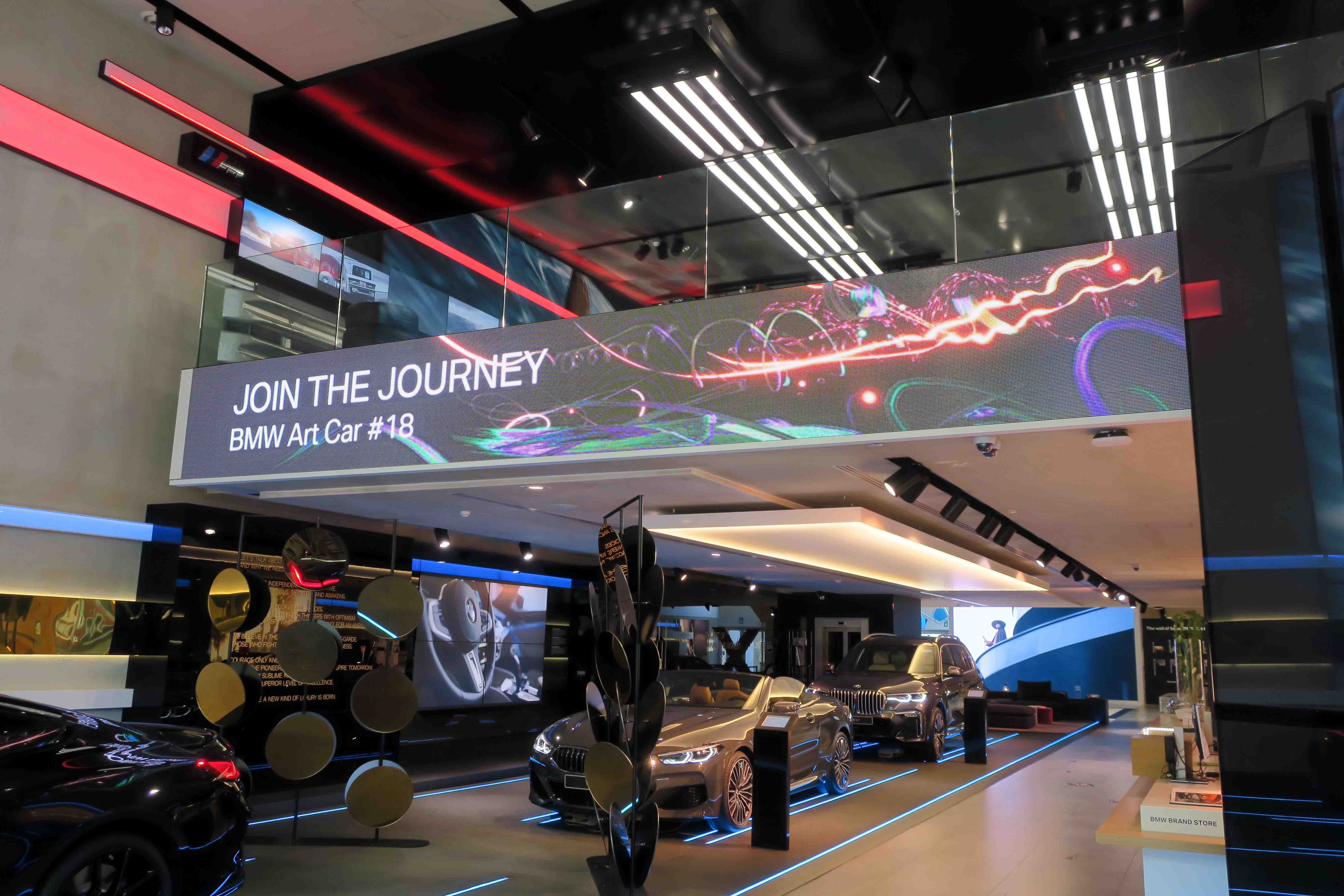
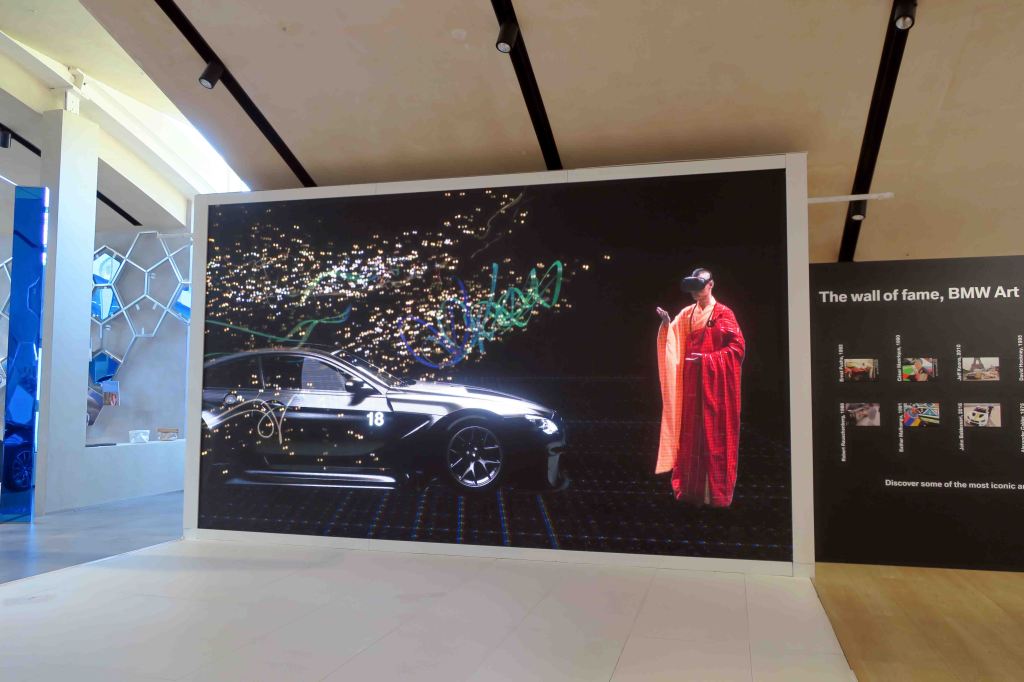
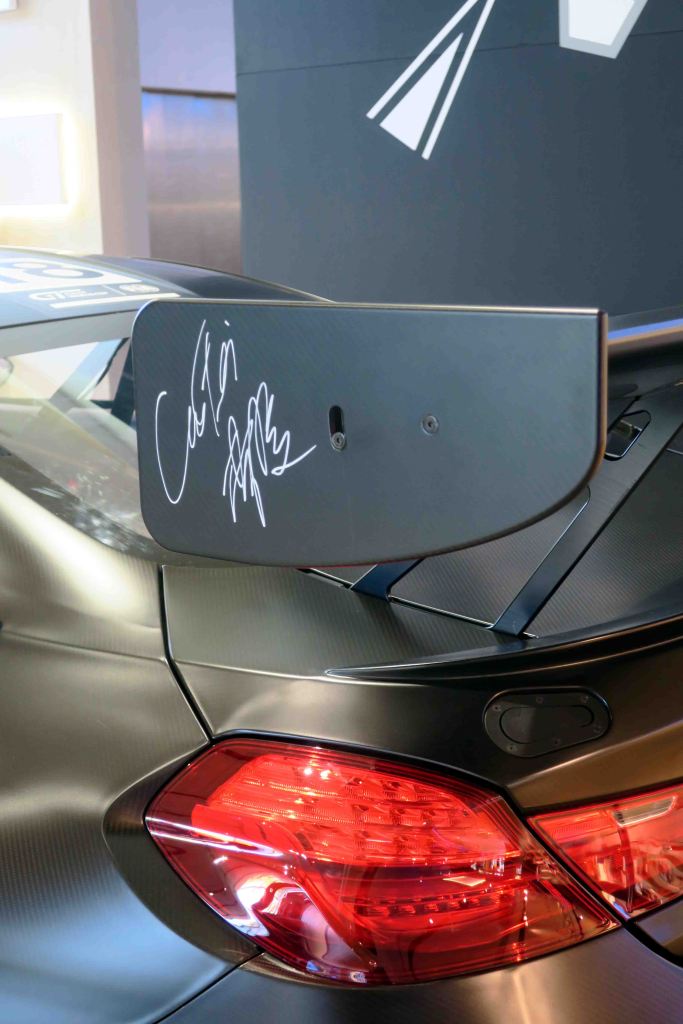
BMW driving art is again to be seen in the capital of Europe: In its flagship Brand Store, BMW organizes until June 1 an Art & Design Expo. The 18th BMW Art Car, a BMW M6 GT3 with multimedia design, has been created by the Chinese female artist Cao Fei, is the focus point of this show. It is even to be enjoyed and admired with the use of an app bringing the car to you on your smartphone with enhanced reality. A stunning experience, of which we show here some photos, but which has to be seen to be believed.
Hans Knol ten Bensel
In the Brussels BMW Brand Store you can join the stunning journey to discover this Art Car in augmented reality…
This virtual animation is also created by the artist, and forms an integral part of the car. “We are now entering a new era where the mind can steer objects directly and thoughts can be transferred, like unmanned controls and artificial intelligence.” comments Cao Fei.
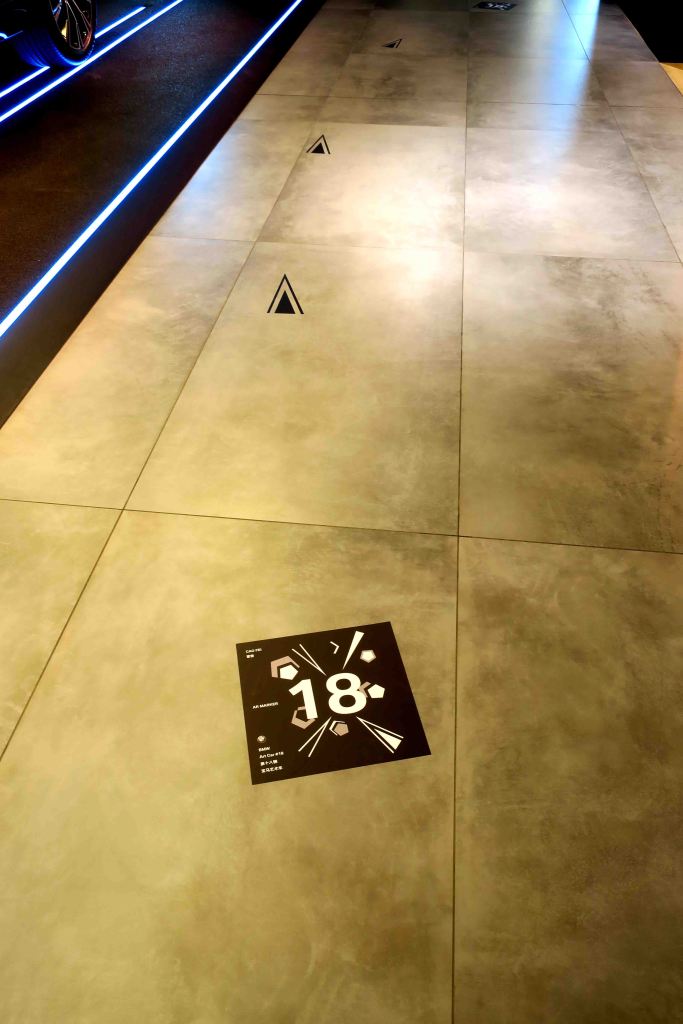
Follow this path in the showroom and zero in with your Ios device on this graph to experience the augmented reality… Download the app BMW ART CAR #18 on your mobile (IOS) device, follow the screen instructions and enjoy!
The work of Cao Fei illustrates the fast and stunning changes in China and its society. With her BMW Art Car she spans a road which stretches over thousands of years, honouring the spiritual wisdom of Asia, which now enters the third millennium with breathtaking speed. The film can of course also be viewed on YouTube, using the following link: https://www.youtube.com/watch?v=Y_GNSyeIpOY&feature=youtu.be.
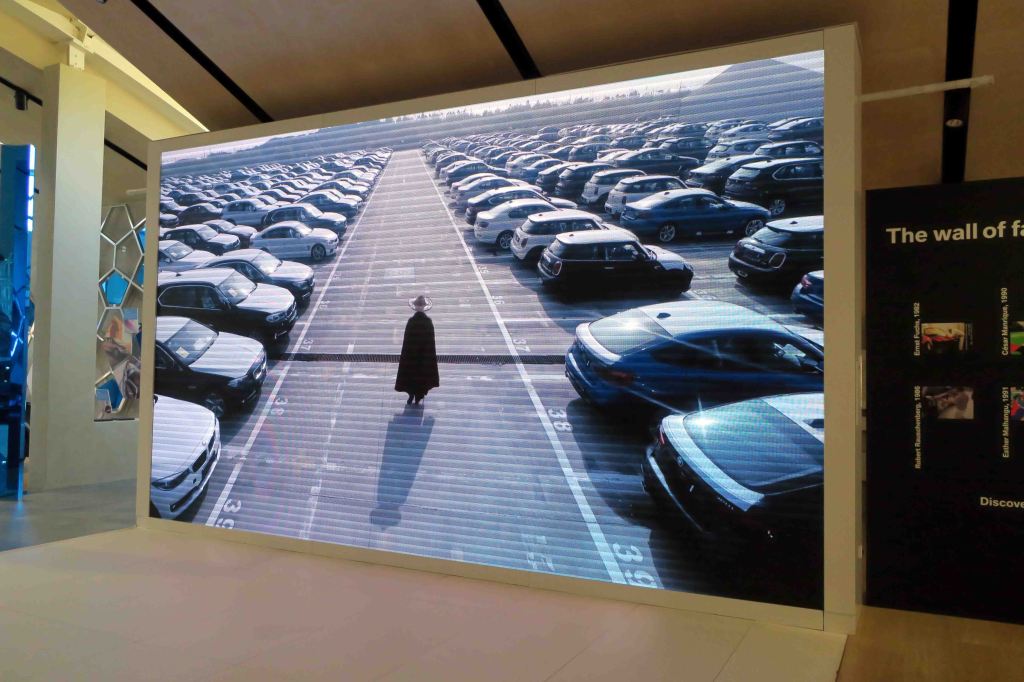
A video which focuses on the millennial time which a spiritual person travels through… Finishes with presenting the augmented reality…
The multimedia artist approaches the
concept of a BMW Art Car in her own unique way, with which she builds a
parallel universe.
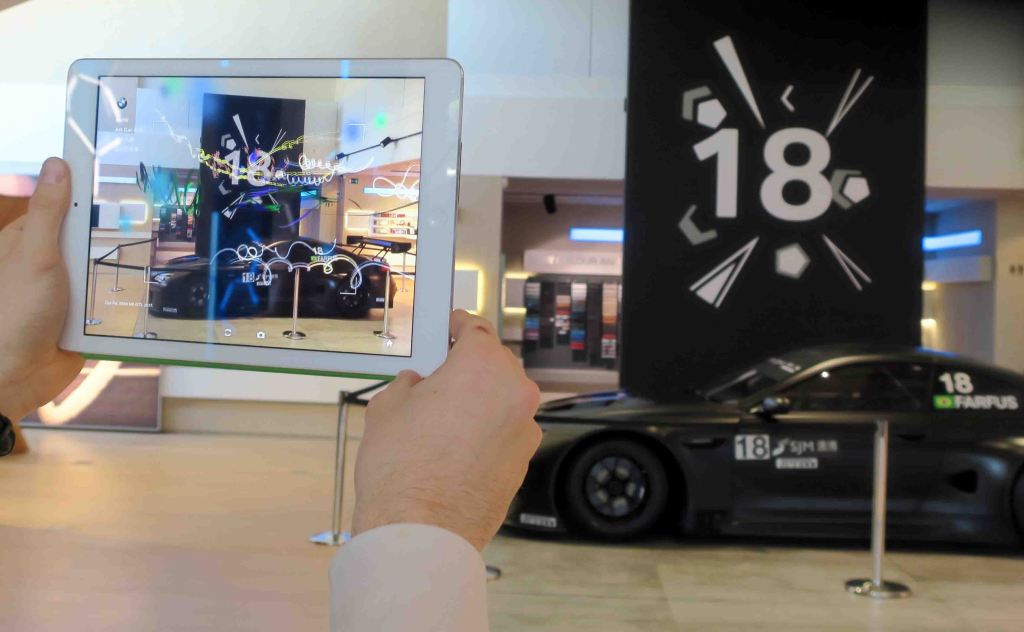
Her work consists of three components: a video that focuses on the millennial time which a spiritual person travels through, augmented reality with colourful light particles (via a special app called BMW Art Car # 18) and the BMW M6 GT3 racer in the original colour carbon black.
As a tribute to the carbon fibre structure of the BMW M6 GT3 applies Cao Fei a lot of non-reflective black paint, which means the possibilities in the digital world are endlessly applicable.
The application of video and augmented reality creates an environment in which the BMW M6 GT3 plays an essential role. Cao Fei uses in her video spiritual movements that express themselves in colourful flashes of light.
Point your device on the graph and a whole enhanced world opens to you…
When the app is used in the vicinity of the car, these light accents are transformed into an augmented reality installation that floats above and around the BMW M6 GT3. In this way, the viewer becomes interactively involved in the artwork.
Just download the app BMW ART CAR #18 on your mobile (IOS) device and follow the instructions on your screen.
The BMW Art Car Tradition runs back already decades… more about this in a special report!
Practical info:
The
exhibition runs until May 31, at BMW Brand Store Brussels, Waterloolaan 23,24, 1000
Brussel
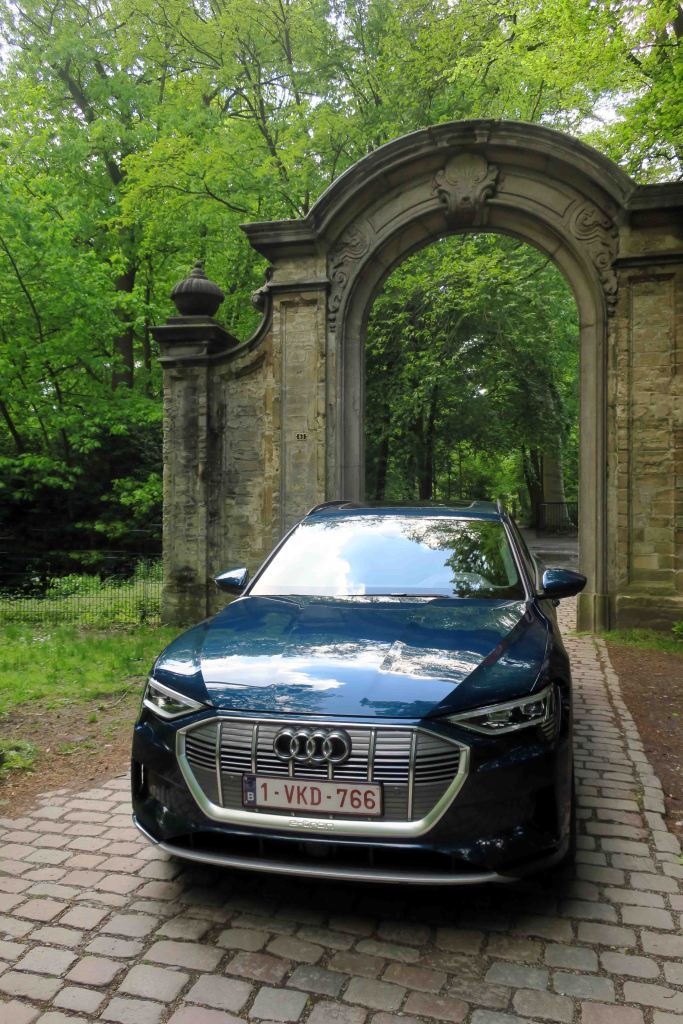
We photographed the first e-tron we drove at the entrance of the beautiful Middelheim park in Antwerp…
When visiting Audi’s “The Place To-e” in Antwerp, we took the opportunity to slide behind the wheel of Audi’s all-electric SUV flagship. It is already quite familiar to us seeing it produced, as your servant has made already several guide tours around the Brussels factory where it is built.
I will also continue to do so and in the
near future be able to welcome you there to show you around the production
lines, but until now we never had the opportunity to sit behind the wheel of
one.
Of course, Audi Import in the person of PR
Manager Audi Belgium, D’Ieteren – Audi Import Sofie Luyckx will rather sooner
than later offer me a longer test drive in one, but we tell you here already
our “first drive” experiences.
Hans Knol ten Bensel
Impressive in ingenuity, style and build quality
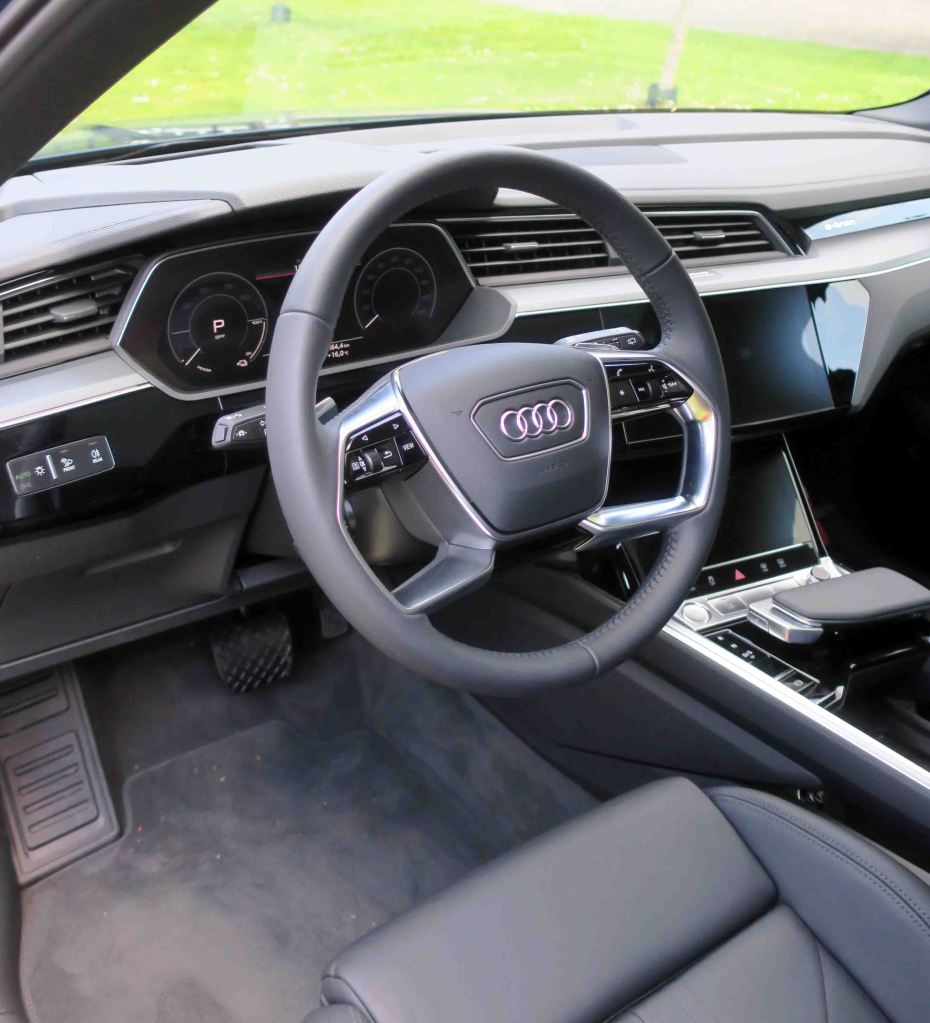
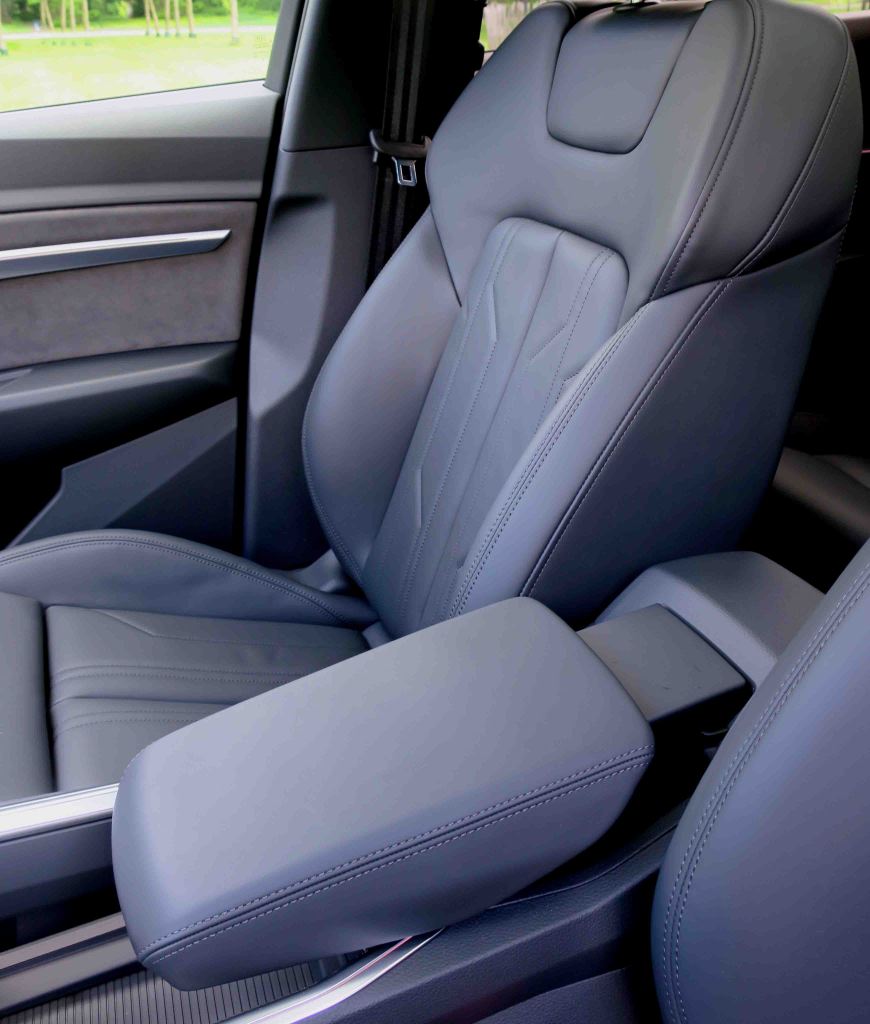
The e-tron makes a statement of quality and style when you approach it. This is even reinforced when you see the dashboard and cabin and slide behind the wheel. Clean, well balanced, superbly finished, this is what your eyes and hands see and feel.
All commands are digital/virtual, or via stylish knobs like the drive selector…
The instruments, dials and function knobs are all digital, embedded in shiny black surfaces, which are ergonomically ideally angled towards you. You would like to touch them with gloves, as your fingers leave marks on their semi-matte surfaces. Maybe we should go back – with pleasure – to this gentlemen drivers’ tradition of wearing fine leather gloves when driving a car, certainly with a noble example like this one.
It is all breathing this angular futuristic
Audi styling language, which has a timeless balance to it.
Comfort in silence and refinement
We took this e-tron fro a very gentle urban ride, testing out the energy recuperation modes when decelerating and/or braking, which is very cleverly controlled in intensity by the paddles on the steering wheel. A very refined touch.
Progress is of course, as an e-car befits, silky smooth, with ample acceleration power delivered by both engines fore and aft. With this luxury SUV it is combined with excellent suspension comfort, and here the Audi really stands out. This is further enhanced by the superb seats, which make the picture of a fine quality car offering top level refinement complete.
In the neighbourhood of the “The Place To-e” in Antwerp is the magnificent Middelheim park, and this is where we photographed the e-tron for you.
Soon more about this superb car, when we
have it for a longer drive…
Klaus Busse talked with us in depth about the Alfa Romeo Tonale…
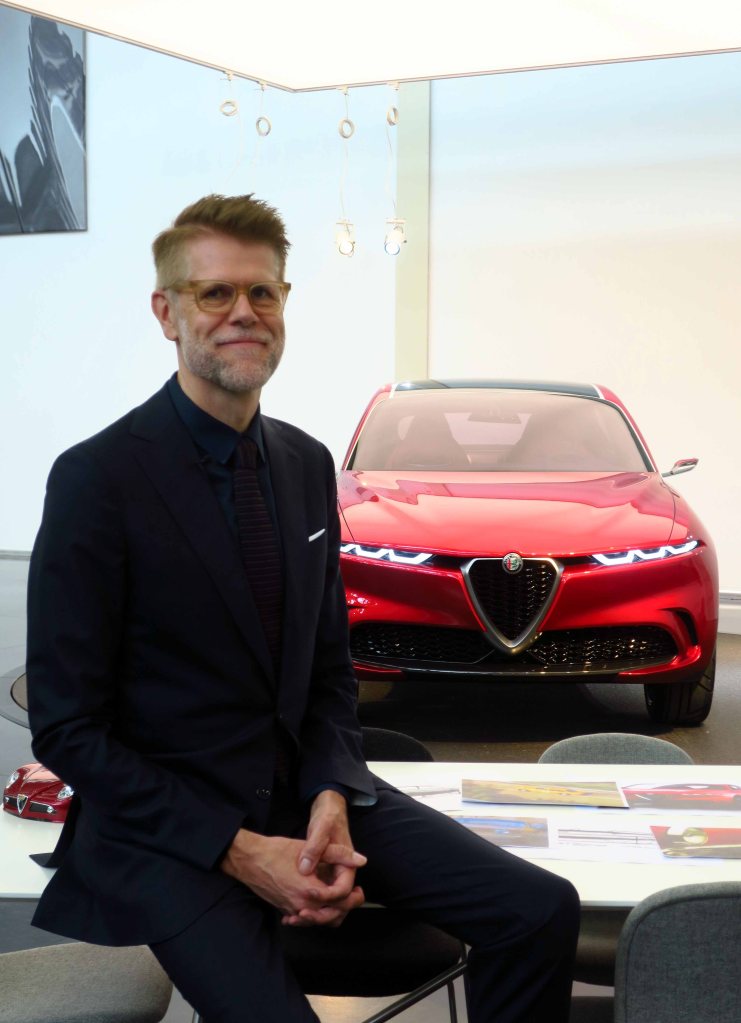
Our series about the visit to the FCA Centro Stile in Torino starts with an intriguing interview and talk with Klaus Busse, vice president of Design for Fiat, Abarth, Lancia, Alfa Romeo and Maserati, offering us interesting insights into the sculptural design philosophy and language of the iconic sporting Milano brand.
Of course this is not all. This in depth
talk and interview covers more aspects about the Tonale, and furthermore also the
Fiat approach to automotive product design…so we decided to split this
interview into a series, focusing in more detail on the various aspects. So stay
tuned on these columns for further reports in this series!
Hans Knol ten Bensel
The original wooden styling sculpture of the legendary Multipla stands proudly in the entrance hall of the Torino based FCA Centro Stile…
Having walked through the impressive
entrance hall of the Centro Stile, we started off with a question about how
this styling centre is set up.
B: “It is of course every day a joy for me to walk through the several studios of our Centro here. Every brand has a separate studio, and you met earlier here with Scott Krugger, the head of design for Alfa Romeo. (Note: this will be our next interview in this series). Every brand has their own head of design. We have 200+ individuals working here, from around the world. It is a very international team, we look at ourselves as the “espresso beans”, because as you know, espresso beans also come from around the world, but with the Italian process it creates an Italian iconic drink, and with the Italian process of design, we hopefully, you will agree, we are able to create Italian iconic design, even though the designers are not coming only from Italy, but from around the world.
We went first to the room of Alfa Styling department
Q: We are here seeing today shoulder to shoulder two different cars on our visit: the Tonale and the Centoventi…
B: I can tell you here first a few words about the Tonale itself, and notably also of the Fiat Centoventi. (Note: which we will also discuss later in separate interviews). It is a very rare thing for us to go to a show with two concept cars, and the beautiful thing we were able to do with the Alfa Romeo and the Centoventi, is that we were able to show the two sides of Italian design, the way we see it. So we have in front of us here with the Tonale the classic sculptural beauty of Italian design, and with the Centoventi we have the Italian approach to product design, applied to the car. So you see the two extremes of Italian design in the automotive sphere.
In the Fiat Centro Stile room, we stood eye to eye with the Centoventi… more about it later in this series!
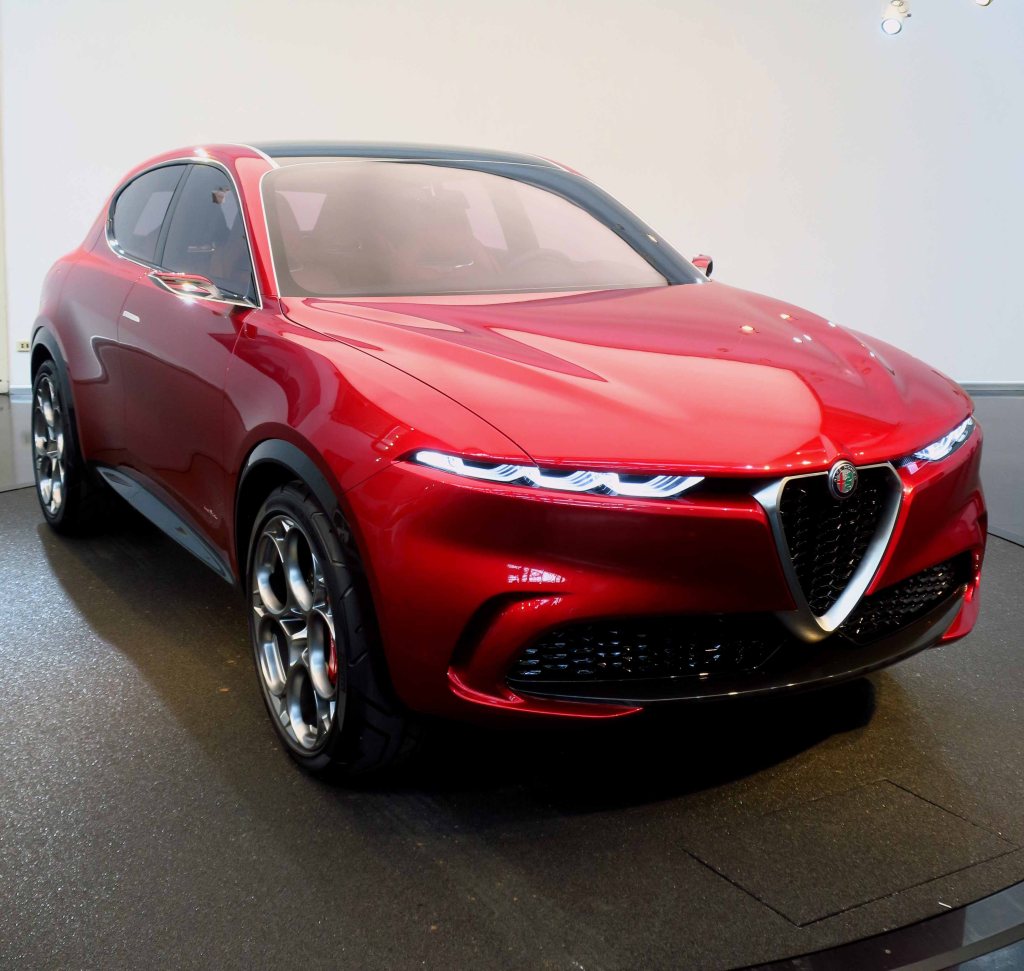
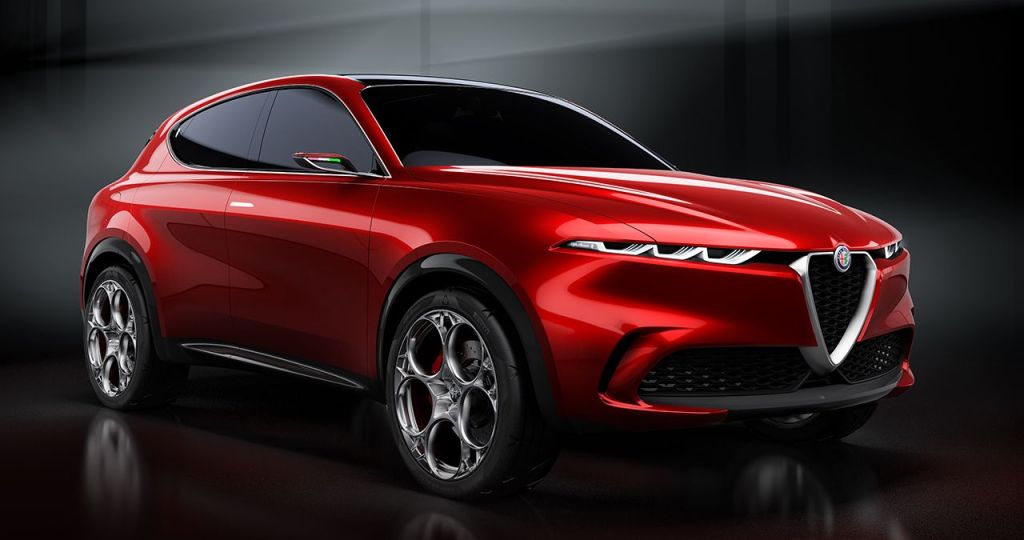
With the Tonale, the challenge was, since it is again an SUV, and we have already an SUV with the Stelvio, to create something that is typical Alfa Romeo, but has nothing to do with the Stelvio in terms of the shapes. The Stelvio is a very muscular car, with emphasis on the wheels and the voluptuous shapes, here on the side you see we have a different construction of the car, we have a completely different front, so the challenge was that with our second entry to the SUV market, we do not create a copy of the big brother, like you see with other companies, who are just adopting a same design and adapt it to different sizes. We wanted to create something completely different with the Tonale.
The horizontal “eyebrow” line is clearly seen here…
Q: Will this car be a trendsetter for the future Alfa design?
The one thing you will not hear me talk about today is the future. I will talk about the present, about the Tonale, but I will not lift the veil more. All I can say is that I think we found something which is a beautiful progression. I saw that my team put the 8C model here, and maybe that allows me to highlight where I see the progression what the team has done here, when we look at the front. The 8C, the 4C, the Stelvio, the Giulia, all of these cars have basically have this hood line, it is a flowing design, and it nicely encompasses the grille. This face was applied to all current generation vehicles.
The muscle lines on the hood converging into the Scudetto, as seen here in the 8C, is now completely given up in the Tonale…
With the Tonale, we completely gave up this kind of interpretation, you still see the muscles of course leading to the Scudetto, but we went to a much more horizontal design. So we went from a vertical design to a horizontal design, and that of course is a completely different construction of the front, and this much I can tell you, we would not do this just for one car…
Klaus Busse dedicated a drawing to your servant… with the horizontal line clearly visible…
Because here, the 8C created a family of cars, and in this case again, it might create a new family of cars…
As
said stay tuned for the next part of this interview, where we will talk in
depth about tradition and modernity embodied in today’s Alfa design language…
We will have this week a workshop visit the
Centro Stile of the FCA Group, where we will also be able to have an interview
and talk with the designers who created the stunning Alfa Romeo Tonale and Fiat
Centroventi. Both cars are very important harbingers of things to come, both
for Alfa and Fiat.
The Tonale concept car is the Italian brand’s first plug-in hybrid compact SUV, and after its global debut in Geneva, it was first seen in Italy at the 58th edition of the “Salone del Mobile.Milano”.
The Tonale will be one of the stars discussed and seen at the workshop…
The Tonale concept car embodies all Alfa
Romeo’s trademark language of beauty: it is a compact UV for urban use with a
sporty personal In keeping with the Alfa Romeo manifesto, every detail is designed
around the driver, with driving pleasure delivered through ergonomics, use of
premium materials and, above all, unrivalled dynamic handling. Furthermore, the
Tonale concept car is the Alfa Romeo take on electrification.
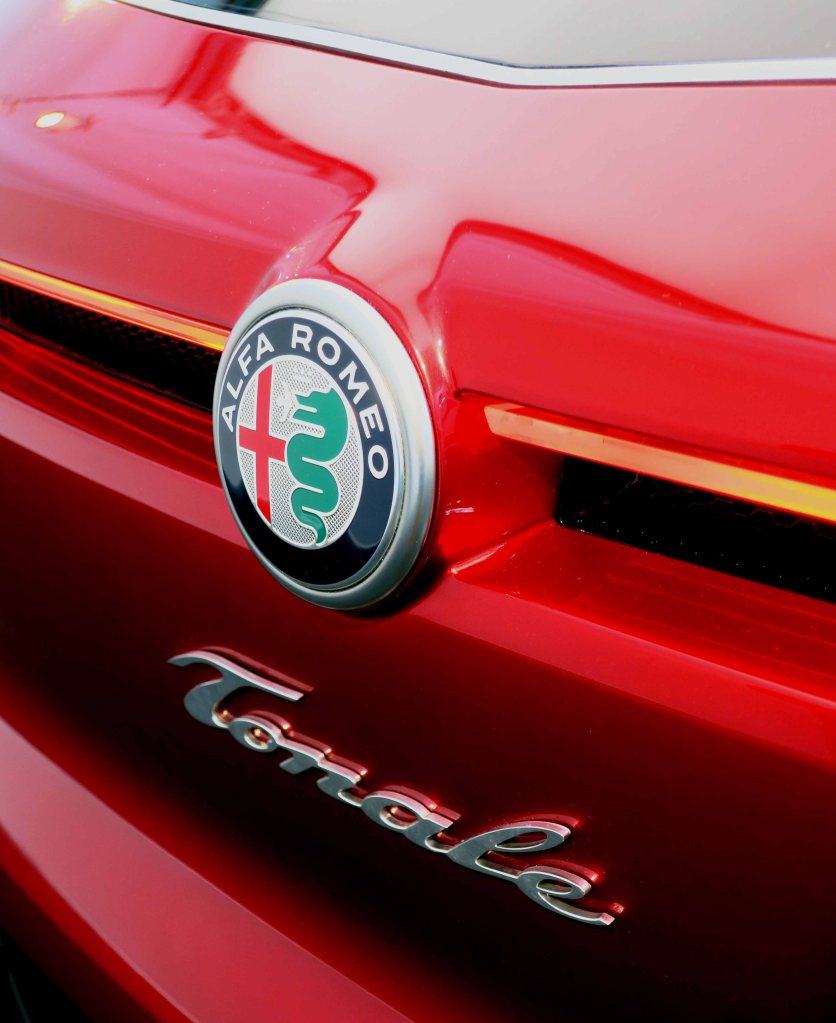
The front end displays the trademark
trefoil and the distinctive Alfa Romeo shield, which acts as a bold focus
point. Completing the design of the front end and accompanying this iconic
element are “3 plus 3” light clusters which in turn evoke the proud
look of SZ and Brera.
The rear of Tonale is characterized by an
enveloping rear window completed on the top by a suspended wing that exalts
continuity with the clear sunroof. As for every Alfa Romeo, design is
characterised by a distinctive touch. The rear light clusters are more like a
graphic sign than an optical lighting element, a sort of signature created
directly by the hand of an artist.
On the sides, the full and elegant volumes recall
the Duetto or the Disco Volante Spider, while the “Linea GT” of
Tonale reinterprets the pouncing stance and feeling of safety conveyed by the
award-winning GT junior.
Several celebrated style elements are
picked up in its design to become a tangible manifestation of the brand’s
history in a performance which elicits a modern approach to new Alfa Romeo
anatomy. The “teledial” wheel, for instance, is an element which hints
to the traditional DNA of Alfa Romeo. The design of 21-inch rim of Tonale
invokes the concept of a rotary telephone dial through a light architectural
structure for a clear, high-impact interpretation of the circular theme. This
style choice dates back to the 1960s, when it was sported by the iconic 33
Stradale.
The cockpit of Tonale is boldly designed
around driver but also to accommodate passengers in comfort. The contrast of
premium materials, such as cool solidity of aluminium that meets the warm softness
of leather and Alcantara, enhance the emotions of both driver and passengers.
Inside, there are translucent panels and a backlit central tunnel. The DNA mode
selector, one of the key elements of Alfa Romeo, is perfectly at ease on the
tunnel.
Comes the Concept Centoventi…
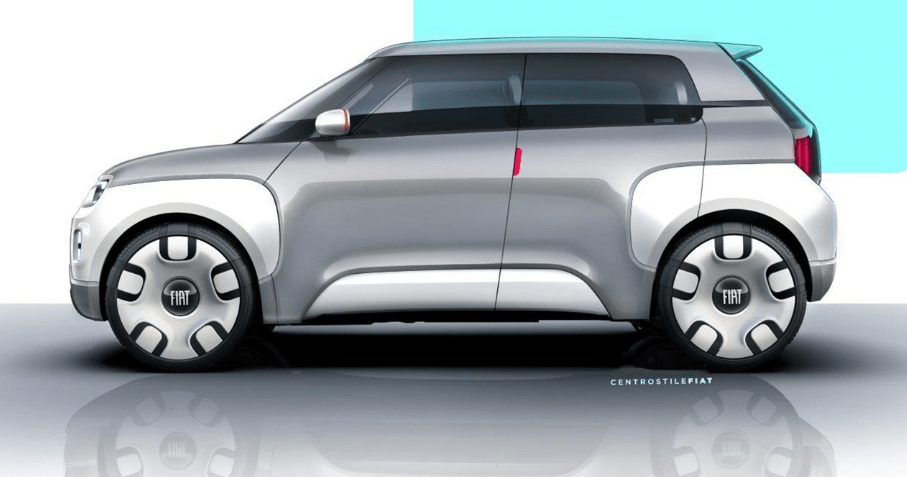
Fiat Concept Centoventi is fundamentally a “blank canvas” ready to be painted to suit the customer’s tastes and needs at any time of his life or day, without no customisation restrictions linked to the specific time of purchase. In fact, it will be produced in just one livery, which customers will be able to personalise using the “4U” program, with a choice of 4 roofs, 4 bumpers, 4 wheel covers and 4 external wrappings. So, just like modern devices, this vehicle can be updated with the greatest freedom and imagination in its colours, interior configuration, roof configuration, infotainment system and even battery range. And this is one of the concept car’s strong points: owners no longer have to wait for new special editions or facelifts, as they can “change” their cars any day they like. It is made even more revolutionary by the presence, at the launch, of 120 additional accessories that will generate a genuinely new business model, as well as a community of Fiat Concept Centoventi fans.
In other words, Fiat Concept Centoventi is
the response to a real design and business challenge, which embodies the
functional spirit of the brand and pays tribute to its 120 years of history, at
the same time, with a modern take on some trademark style elements that hint to
the Panda of the 1980s. Fiat Concept Centoventi is inspired by Italian design
and embodies Fiat’s “less is more” concept, which means getting rid
of everything unnecessary and complex in a car to provide more space for people
(More You), for attention to the environment and the community (More Care) and
for the brand’s DNA in terms of values and looks (More Fiat). By playing these
three cards, Fiat Concept Centoventi revolutionises the idea of electric
mobility, in town and out, successfully overcoming the tougher and tougher
challenges – in terms of traffic, regulations and costs of ownership – while
simultaneously making the most of the new opportunities offered by electricity.
Soon we will treat you in these columns
with a fascinating tale about what we heard, saw and experienced at the Centro
Stile in Turin… stay tuned!
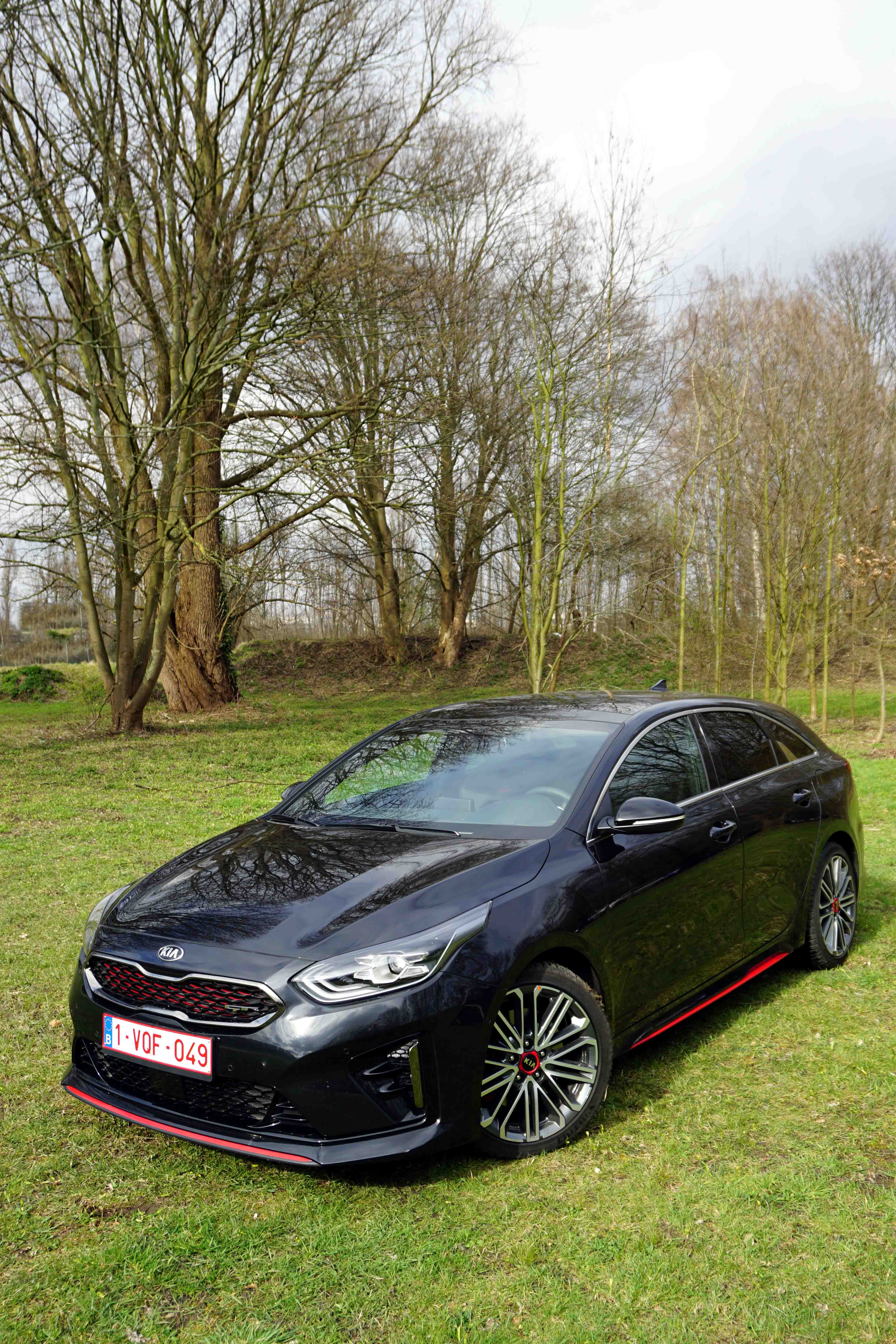
When we first stood eye to eye with this
Kia, we were convinced. This shooting brake has what it takes. Just look at the
fluent lines of this Shooting Brake, which seems to move even when standing
still. And then we say nothing about the dynamic 204 HP heart of this car, and
the way it handles and rides.
Just some extra info here to complete the
picture: the popular and very European Kia Ceed range has been designed in Kia’s
European Design Centre in Frankfurt under the guidance of European Head of
Design Gregory Guillaume and President of Design and Chief Design Officer Peter
Schreyer, and is manufactured at the Zilina plant in Slovakia. It has sold 1,3 million
cars in Europe since its début in 2006, and is indeed going from strength to
strength. Just read further…
Hans Knol ten Bensel
Well proportioned and pleasing…
Indeed, the design team in Frankfurt know what they are doing. We rarely saw in this class – taking into account its wheelbase of 2.650 mm – a car which looks so sleek and elegant. Indeed, the ProCeed is only 5 mm longer than the Ceed, and shares its “K2” platform. No surprise that the ProCeed actually won the Australian Red Dot Design Award, and we must admit that in the black colour scheme which we found on our test car, this Kia has style and panache. The GT version we drove also runs on 18 inch alloys, which don’t hurt either.
The cabin follows through on the elegance shown outside. Matte chromed inserts, nice round dials, a well positioned “floating” 8 inch touchsreen above the heating / ventilation commands, all very inviting and intuitive. This is one of the cars where one is not overwhelmed by too much futurism and where one finds its way in seconds. The design and execution of the door panels is also showing excellent taste and has a distinct premium touch. The central fascia panel is now finished in a high quality, anti-scratch gloss black…
Driving is believing
A gentle push on the matte chromed starting button and “Drive” is soon selected on the excellent 7 speed dual clutch transmission. A docile 1,6 litre petrol engine hums to life.
But this is no sleeper, even when it sounds very refined and subtle when idling. This machine is the Hyundai Gamma GDI series unit, with four valves per cylinder and D-CVVT or dual continuous variable valve timing. Wow! Turbocharged, it delivers a solid 204 HP at 6000 rpm, and offers a healthy 265 Nm of torque over a wide rev range between 1500 and 4500 rpm. Yes, you understood. This means zest, and indeed it will shoot away from 0 to 100 km/h in merely 7,7 seconds, hurtling further to a top speed of 230 km/h. If this is not super car performance, it comes really close.
The GT pilot is treated to an even more sporting experience, not only with extra engine sound coming from the speakers, but also with the possibility to select different driving modes. In the “Sport” mode, steering response is different, and the gearbox will let rev the engine markedly higher. The ProCeed has in standard version already all what it takes to cling to the road. Electronic Stability Control, ESC is standard, as well as Kia’s Vehicle Stability Management (VSM). This means Torque Vectoring by Braking-technology can be included.
The ProCeed GT was developed under the guidance of Albert Biermann, President Vehicle Test & High-Performance Development for Hyundai-Kia. Six months of additional tests have improved the handling even further, and this really shows. Agile and precise, this ProCeed feels utterly at home on mountain passes, winding roads, city boulevards and Autobahnen. A true, well handling GT, with thoroughbred character and panache.
The handling does not come at the expense of comfort, and indeed this ProCeed handles even quite uneven roads without trouble. For spirited as well as long distance driving, the recaro-type front seats provide excellent support. Consumption is reasonable, and we stayed in the 7 to 8 liter/100 km range without effort.
Practical
The name shooting brake says it already. You can expect passenger and luggage space, and indeed, this ProCeed delivers. Luggage space is plenty, with 594 liter, and of course, the rear backrests can be folded in 40:20:40 fashion. Our test car came with the Smart Power Tailgate, and the loading floor is completely flat.
There is also a net for small luggage and a rail system. A last word about the infotainment system: combined with the 8 inch screen the navigation and Kia Connected Services are steered by TomTom®. The system has full smartphone-integration with Apple CarPlay™ (for the iPhone 5 and newer) and Android Auto™ (for Android-phones which run on version 5.0 (Lollipop) or higher).
Our test
car was also equipped with a marvelous ‘Premium Sound System’ from JBL with the
restoration technology Clari-Fi.
Conclusion
A very endearing, stylish shooting brake with a marvelously willing and pleasant drivetrain, which invites you for a very engaging drive as well as a smooth stroll on urban roads. The available space is quite sufficient, the styling, choice and quality of materials and sheer workmanship and finish are quite worthy of a premium segment car. When considering a roomy hatchback with a beautiful rear end, certainly do have a long look (and drive) of this one…
The Audi e-tron houses its batteries in a floorpan housing, which is waterproof and crash resistant…
When talking about the production of the impressive Audi e-tron on the Brussels site, the batteries are an intriguing part of the driveline. We take a closer look at it here, and show you some very interesting drawings provided by Audi Media…
Hans Knol ten Bensel
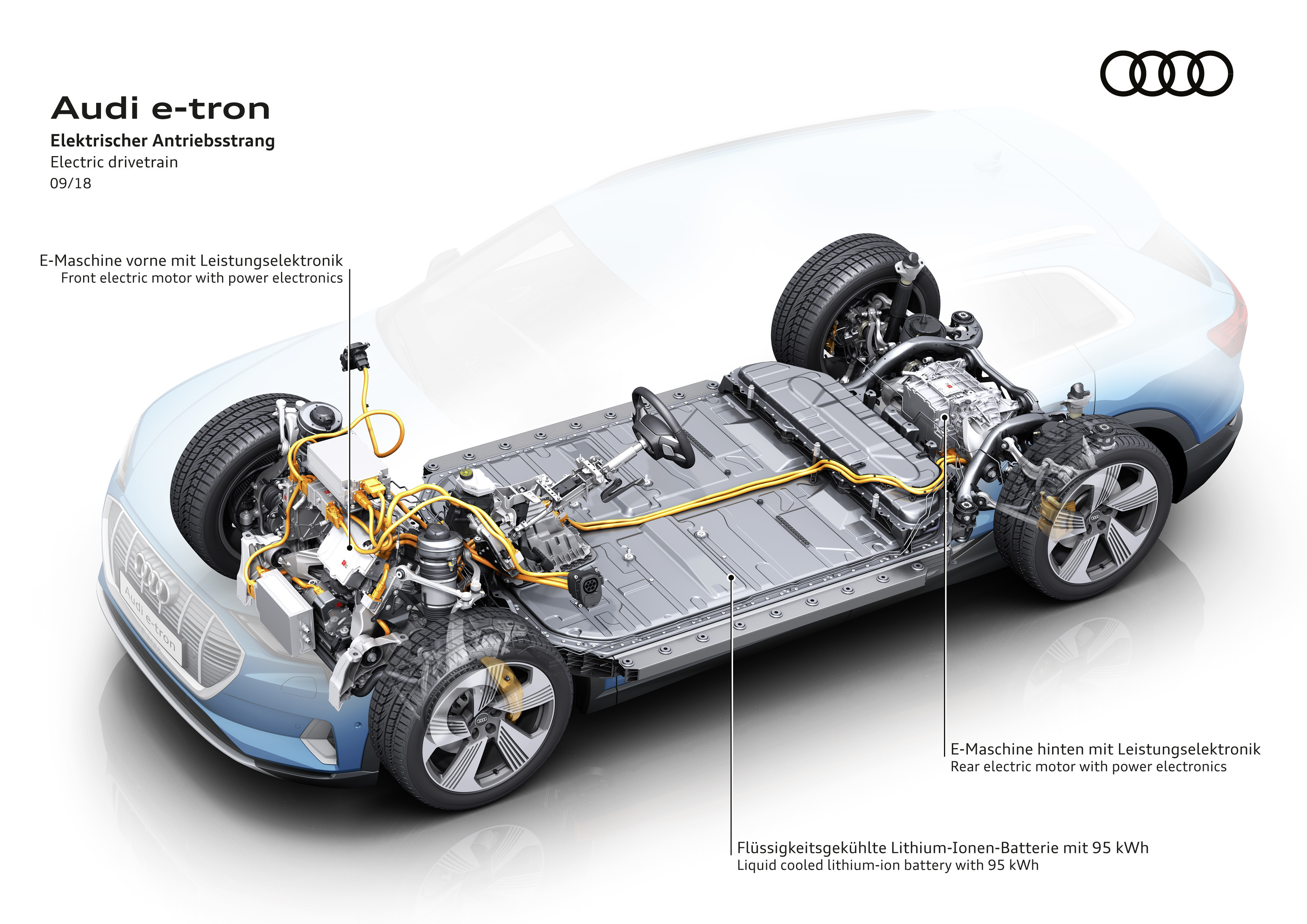
The large lithium-ion battery in the Audi e-tron provides for a range of more than 400 kilometers (248.5 mi) in the WLTP driving cycle. The battery operates with a nominal voltage of 396 volts and stores 95 kWh of energy.
Electric drivetrain in detailed view (ctrl + to enlarge)
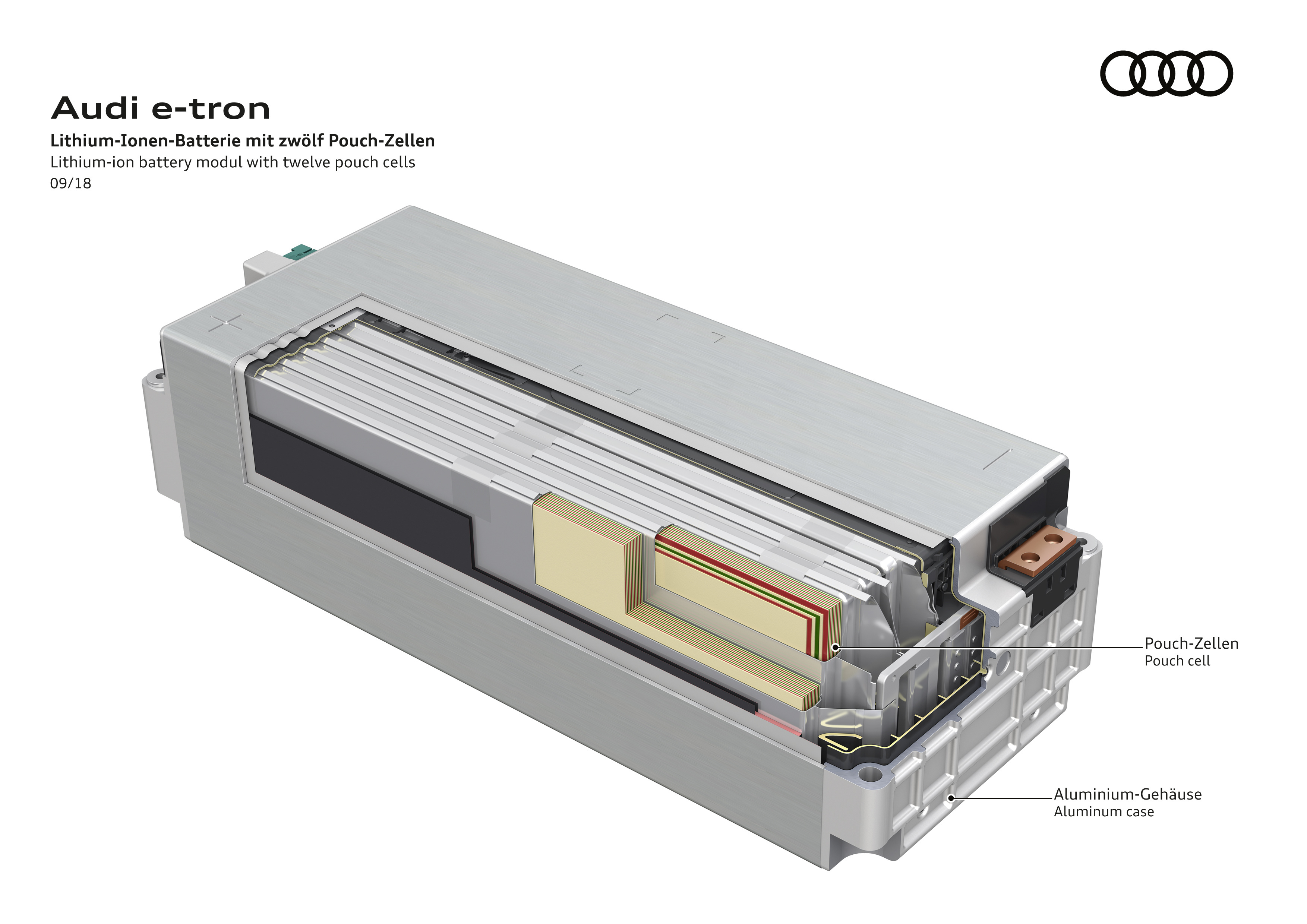
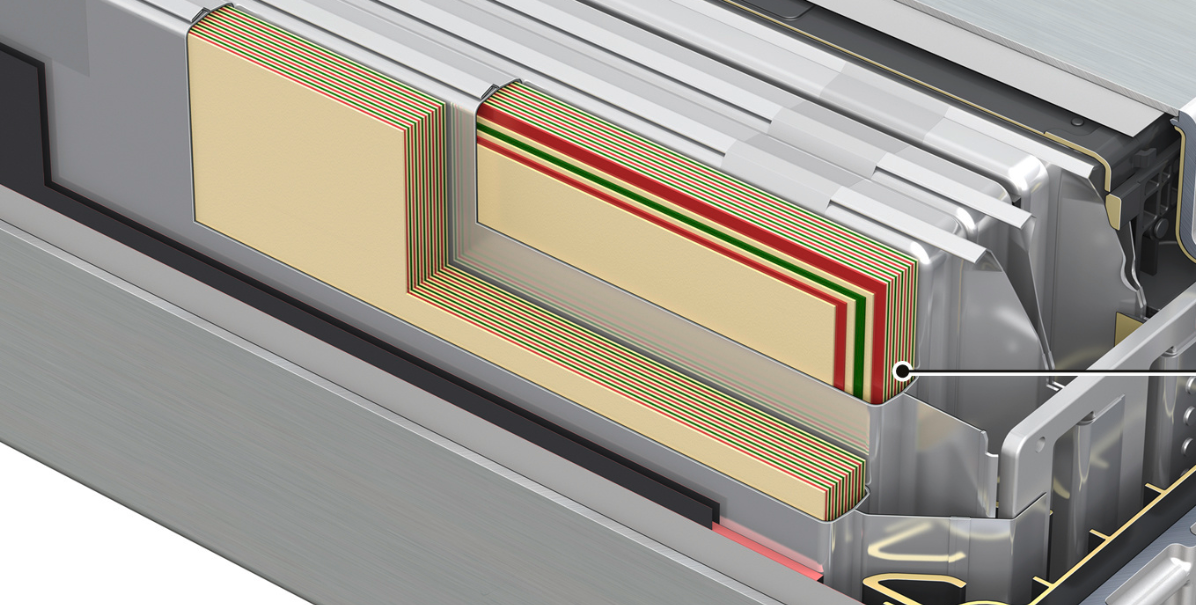
The battery system in the Audi e-tron is located beneath the cabin and is 2.28 meters (7.5 ft) long, 1.63 meters (5.3 ft) wide and 34 centimeters (13.4 in) high. It comprises a total of 36 cell modules in square aluminum housings, each of which is roughly the size of a shoe box. They are arranged on two levels, known as “floors” – a longer lower floor and a shorter upper one. At market launch, each module is equipped with twelve pouch cells having a flexible outer skin of aluminum-coated polymer. In the future, Audi will use both technically equivalent prismatic cells in its modular concept, also in terms of a multiple supplier strategy.
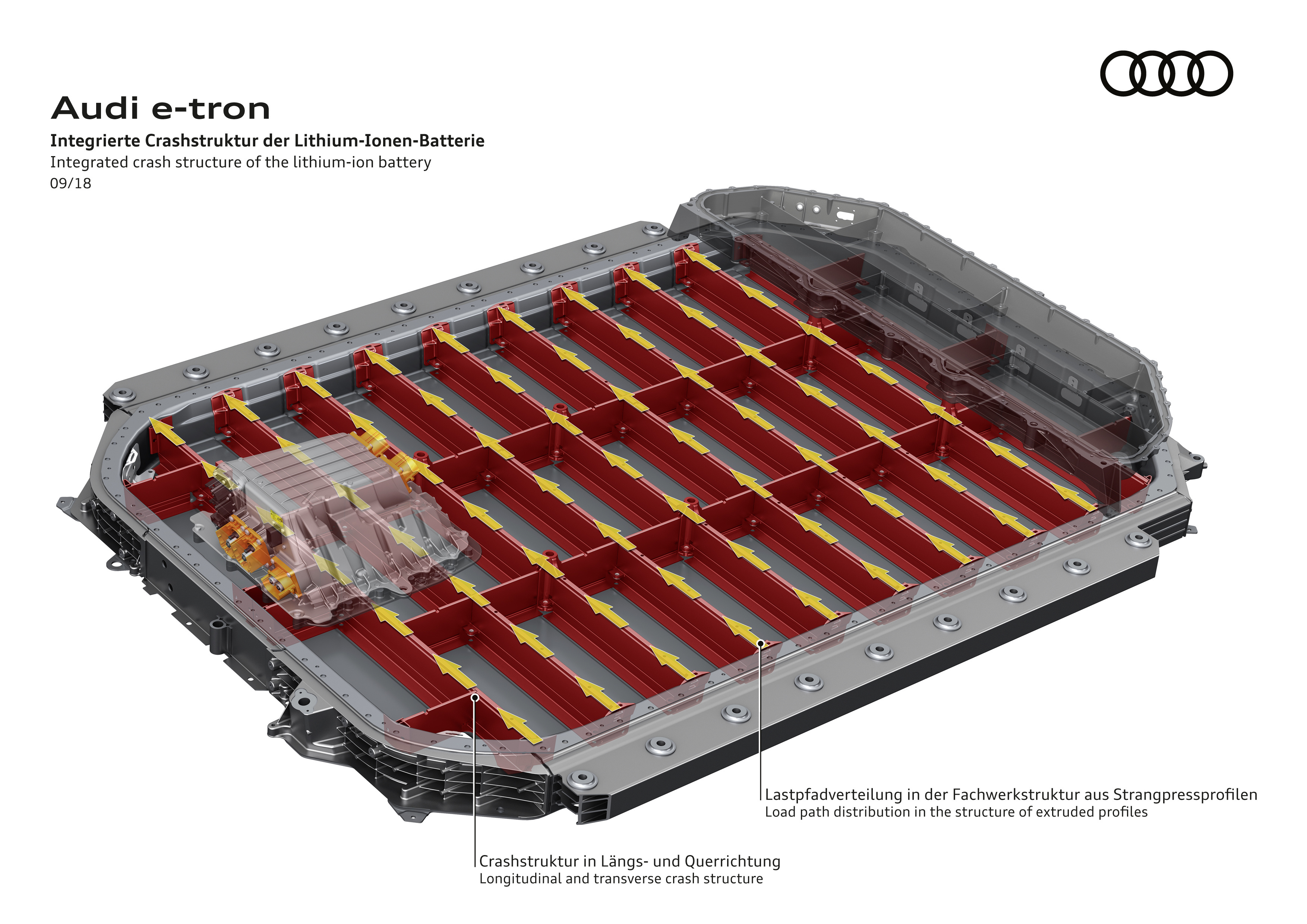
Integrated crash structure of the lithium-ion battery housing
The cell modules in the Audi e-tron can reproducibly discharge and charge electricity over a broad temperature and charge status window. The can be densely packed to achieve a very high output and energy density in the volume available.
Cooling the lithium-ion battery during DC charging via the NT cooler
A cooling system of flat aluminum extruded sections divided uniformly into small chambers has the task of maintaining the battery’s high-performance operation over the long term. Heat is exchanged between the cells and the cooling system beneath them via a thermally conductive gel pressed beneath each cell module. In what is a particularly efficient solution, the gel evenly transfers the waste heat to the coolant via the battery housing. The cooling system is first fixed to the bottom of the battery tray with adhesive. To protect the cooling system against stone and road debris, a base plate is installed, also to improve aerodynamics. At assembly, first the batteries/modules on both floors are placed into their locations, then the gel (also called gapfiller) is applied.
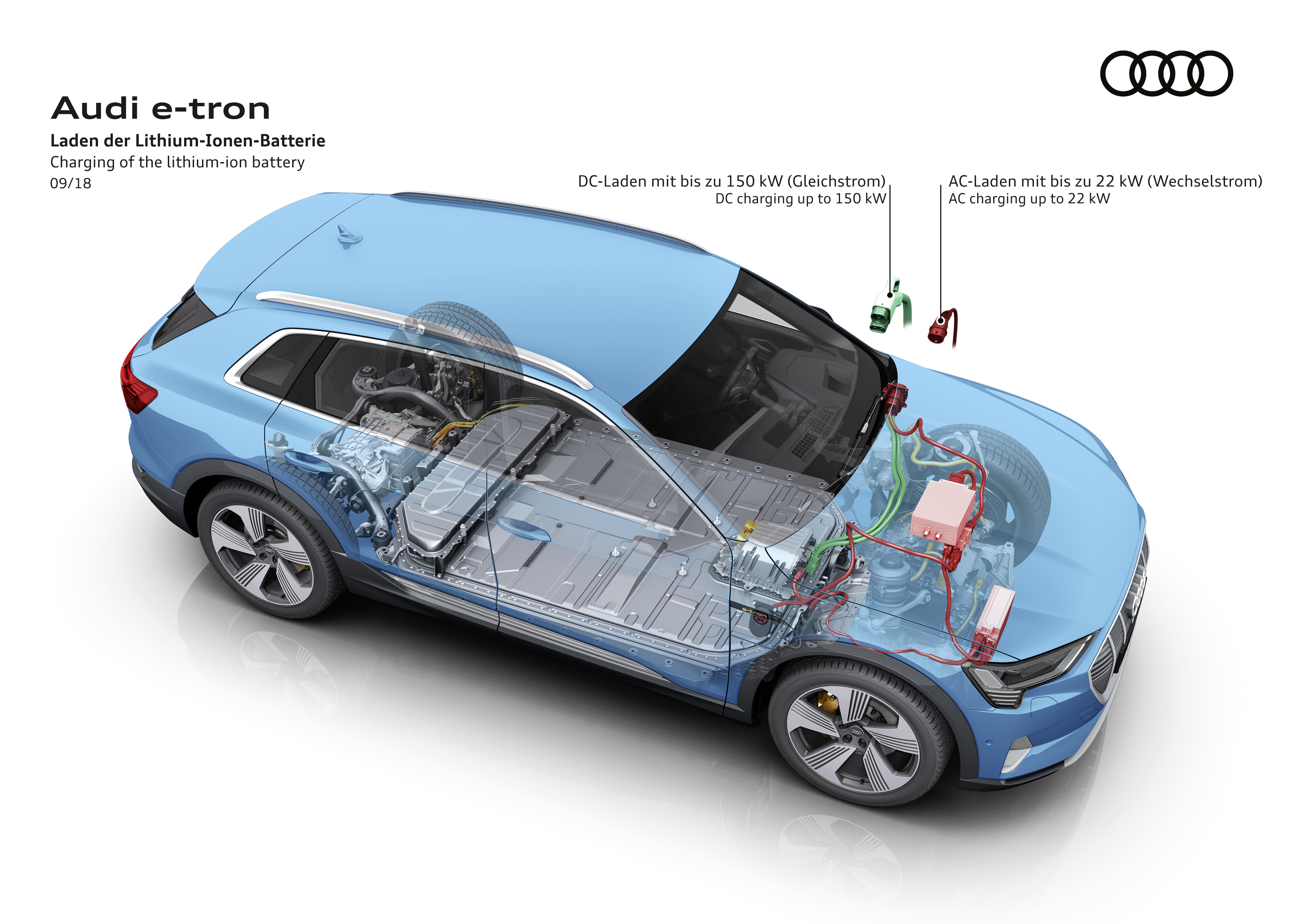
Charging of the lithium-ion battery
The battery and all of its parameters, such as charge status, power output and thermal management, is managed by the external battery management controller (BMC). This is located in the occupant cell on the right A-pillar of the Audi e-tron.
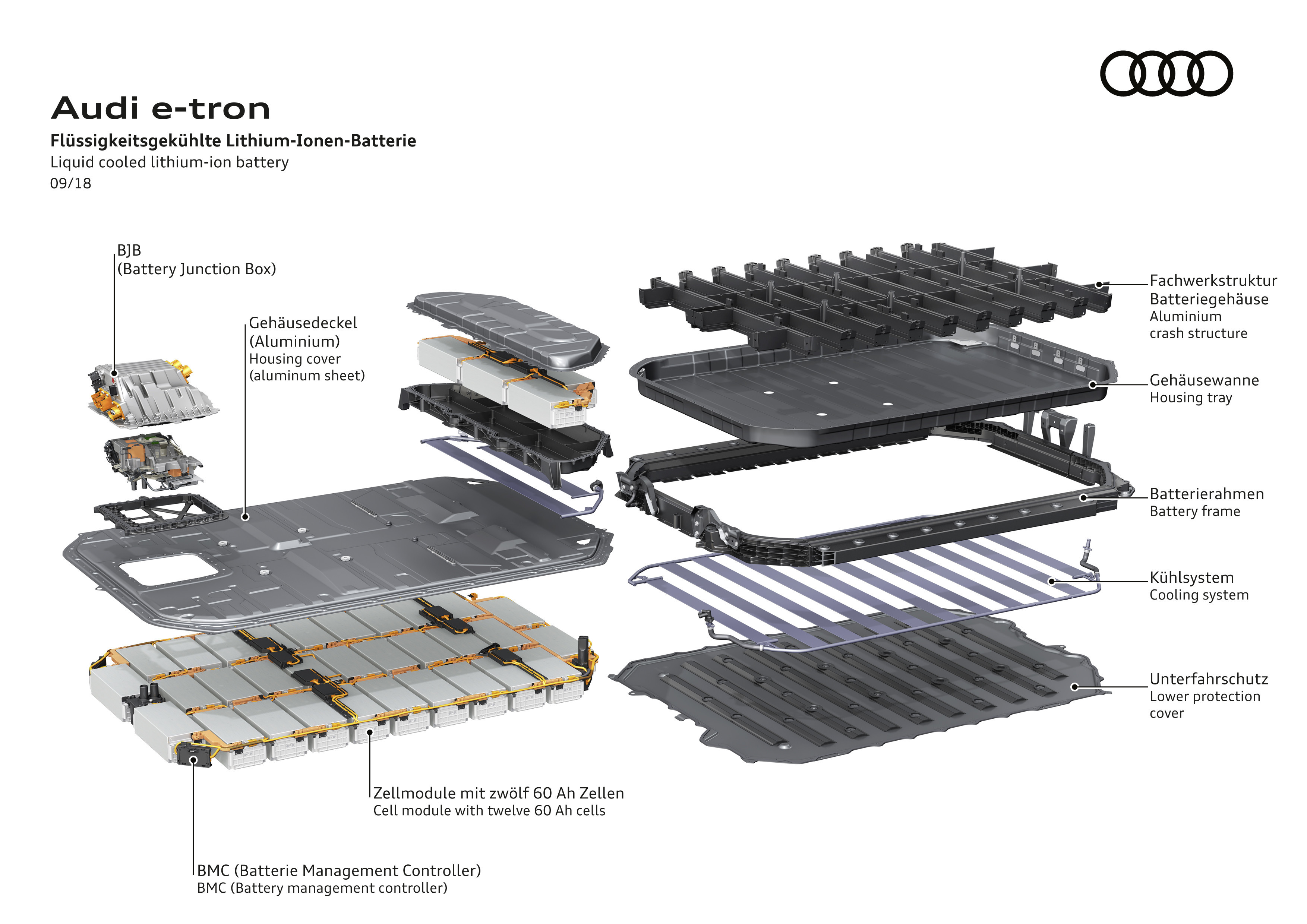
Liquid cooled lithium-ion battery, in exploded view one can clearly see the elements, the BJB (Battery Junction Box), the BMC or Battery Management Controllers, the cooling system, and last but not least the modules.
The BMC communicates both with the control units of the electric motors and the cell module controllers (CMC), each of which monitors the current, voltage and temperature of the modules, 3 modules at the time. In the whole battery system, therefore 12 CMC’s are present. The battery junction box (BJB), into which the high-voltage relays and fuses are integrated, is the electrical interface to the vehicle. Enclosed in a die-cast aluminum housing, it is located in the front section of the battery system. Data exchange between the BMC, the CMCs and the BJB is via a separate bus system.
Lithium-ion battery module with twelve pouch cells
Sophisticated measures have been taken to protect the high-voltage battery of the Audi e-tron. A strong enclosing frame of cast aluminum nodes and extruded sections, plus an aluminum plate 3.5 millimeters (0.1 in) thick protect against damage from accidents or curbs. Inside, a framework-like aluminum structure reinforces the battery system. Also comprised of extruded sections, it holds the cell modules like a typecase.
Detail of the pouch type cell
Including the housing with its
sophisticated crash structures comprising 47 percent extruded aluminum
sections, 36 percent aluminum sheet and 17 percent diecast aluminum parts, the
battery system weighs around 700 kilograms (1,543.2 lb). It is bolted to the
body structure of the Audi e-tron at 35 points. This increases its torsional
rigidity by 27 percent and contributes to the high level of the safety of the
Audi e-tron, as does the cooling system bonded to the outside of the battery housing.
Compared to a conventional SUV, the Audi e-tron offers 45 percent higher
torsional rigidity, a key parameter for precise handling and acoustic
comfort…
During production and assembly, utmost care
is taken that screws which fix the modules into place do not cause insulation
faults, and before the battery unit is cleared for further assembly, the
differences in voltage between the cells and the modules are carefully
controlled that it meets Audi Premium Standards. Finally leak tests are also
carried out, both on the cooling system and the battery. Not less than 8 final
tests are performed, before the battery is then partially (re)charged and fit
for further assembly in the car.
Mazda styling is reaching top levels
nowadays, and the Mazda 6 clearly shows it. Just have a look at the fluent
contours and the ideal proportions and balanced surfaces of this large sedan,
and be convinced with us. The Mazda 6 body has recently been revised and has
gained further in maturity and elegance, with also the interior having had a
stylish make-over. Under the hood, the G 2,5 and other SKYACTIV powertrains
have been further perfected, and driving dynamics have also been improved. We
took this elegant sedan for a test, and it showed its many qualities. Just read
on…
A design studio which works amidst a wide
audience, where their 3D models and drawings are made under the eyes of
interested viewers? That is what the bold man and women of the DS Design Studio
are doing.
These designers are the creative pillar of DS
Automobiles, a young car brand whose designs for DS 7 CROSSBACK and DS 3
CROSSBACK are already a benchmark. DS DIVINE, DS E-TENSE and DS X E-TENSE are also
the results of a creative process that came about within DS DESIGN STUDIO PARIS
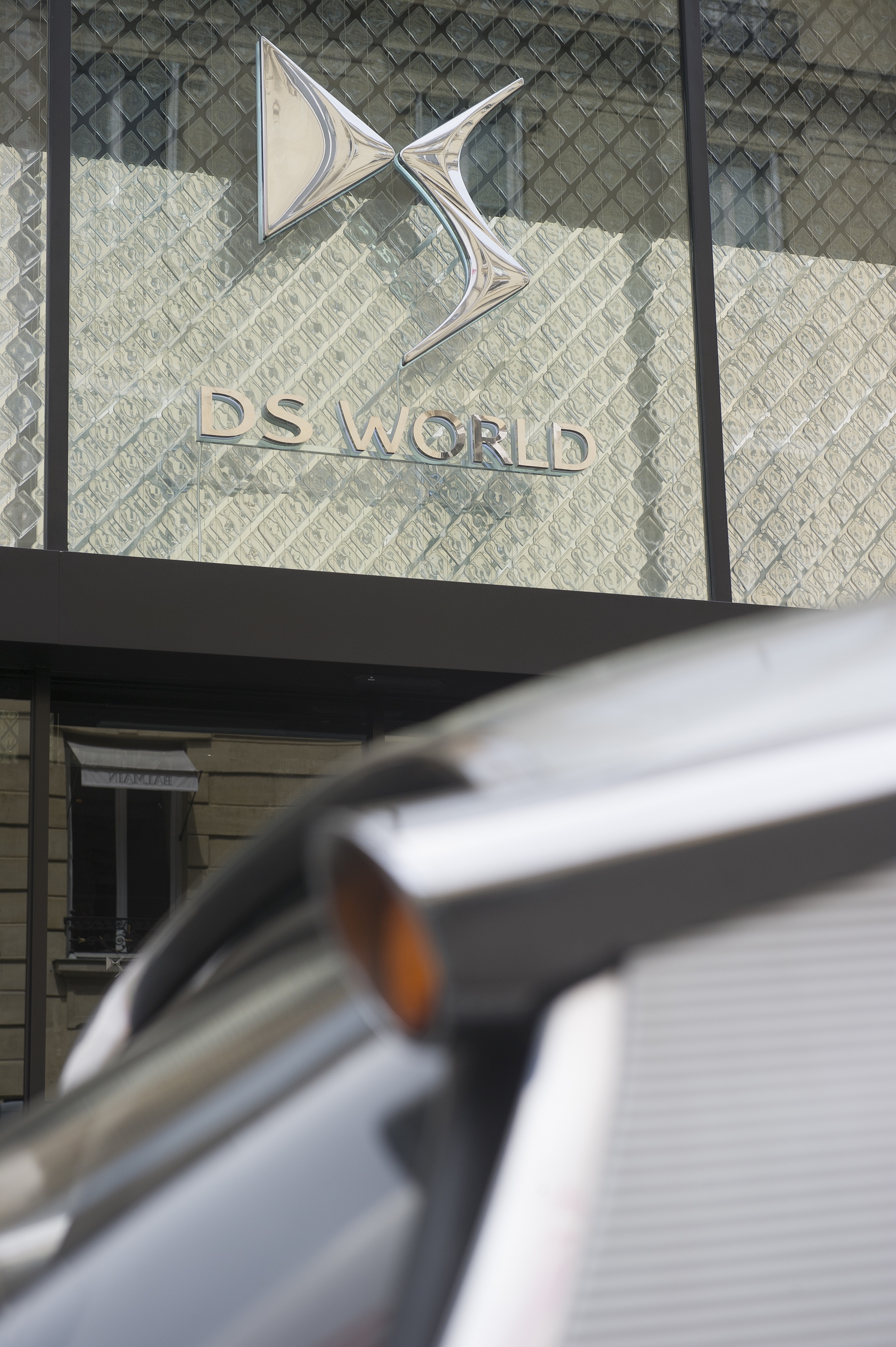
These designers are now leaving their usual work space and setting up over the three floors of DS WORLD PARIS at 33 Rue Francois 1er, Paris.
The DS World Paris is the elegant setting where the public can admire the iconic “DS” or “Déesse”, the godess on wheels, but now also the men and women of the celebrated DS design department will be at work under their eyes…
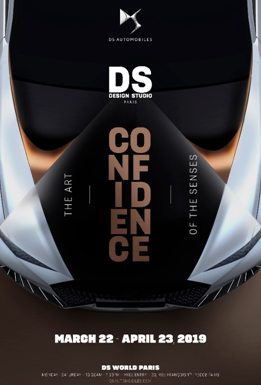
There, the men and women of DS Automobiles design under the direction of Thierry Metroz, DS Design director, will be revealing the innovative projects they’re working on and sharing their secrets through “CONFIDENCE The art of the senses”.
More than an exhibition, this is a
residency of artists, brought to life by DS Automobiles designers who are on
hand to explain their jobs, present their work and talk with visitors.
Indeed, the men and women of DS DESIGN
STUDIO PARIS are on hand throughout the event to explain their work and answer
visitors’ questions.
Some confidentiality restrictions have been
lifted so they can reveal additional secrets. The work of the 60 people who
make up the DS DESIGN STUDIO PARIS is presented by the different teams:
exterior design, interior, ProLab, VLab, modellers, colour and material
workshops and upholsterers.
The brand wants them to share their
inspiration and most recent work to cast a new light on the design and build of
a car.
So, if you are interested to see these design artists at work, we give you here some practical information: “CONFIDENCE The art of the senses” is held from 22 March to 23 April 2019 at DS WORLD PARIS, 33 Rue Francois 1er, Paris.
We all know that SUV’s are all the rage,
and are becoming ever more popular. No small wonder then that this stylish
Jaguar SUV, launched in 2015, is the bestseller of the iconic brand. But then,
you may ask with us, is this popular SUV still remaining a true Jaguar,
combining pace (performance) with grace and space? Will the growl of its
powerful engine lift your spirits, will its chassis seduce you with its
graceful handling and comfort, will the beautiful body and interior put you in
the exquisite mood and ambiance which only a Jaguar can convey? Just read
further…
Hans Knol ten Bensel
Feline contours
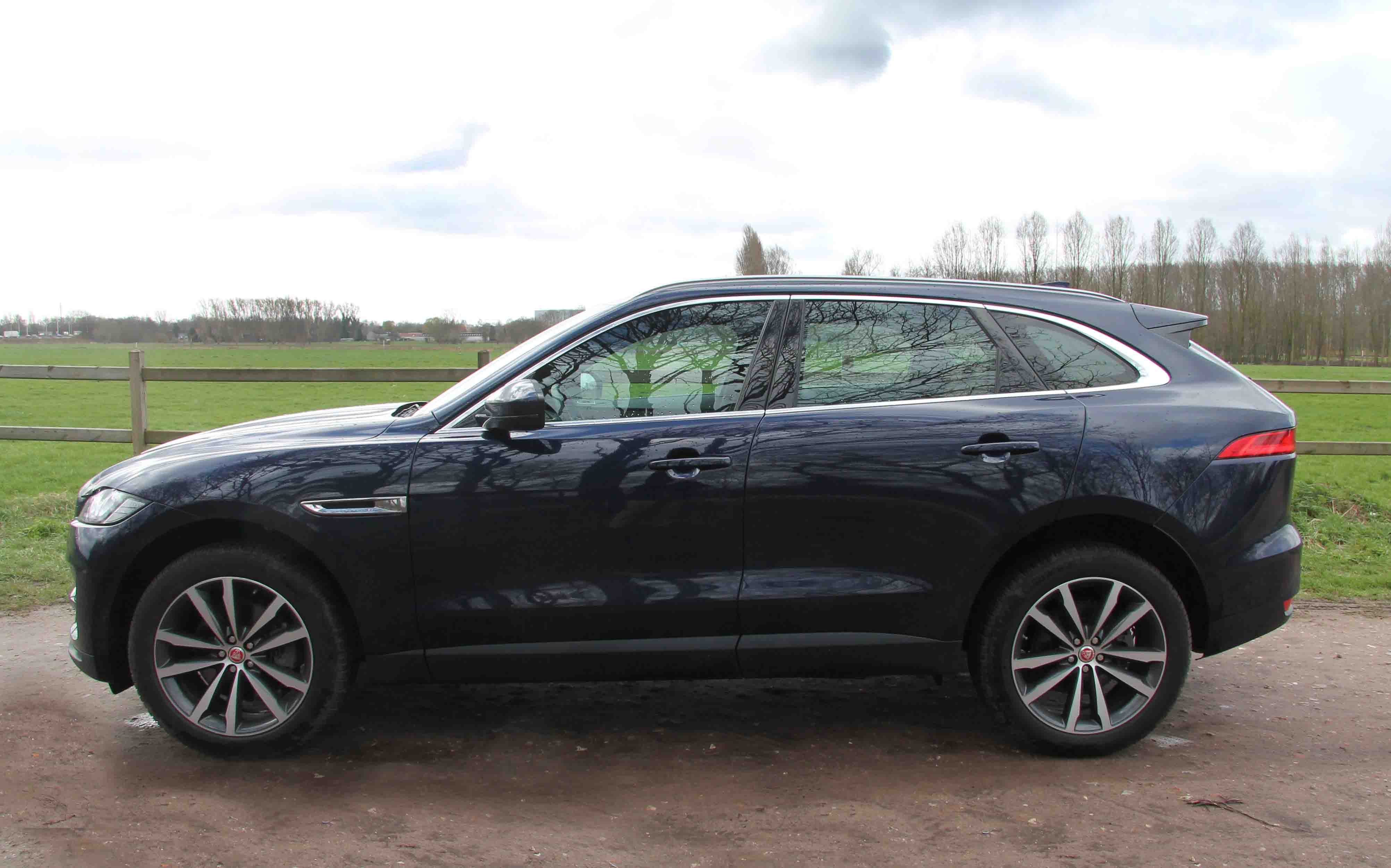
Looking at the photos you will agree, this F-Pace has the looks so unique to Jaguar. The waistline which ends in a higher tail contour, reminiscent of the rear end of the Jaguar E-type, where its high mounted rear bumpers also followed the waistline, the well rounded curves, the proportions of the wheel arches, well integrated in the fluent lines of the whole body, the subtle central bulge on the engine hood, all this is well and truly Jaguar.
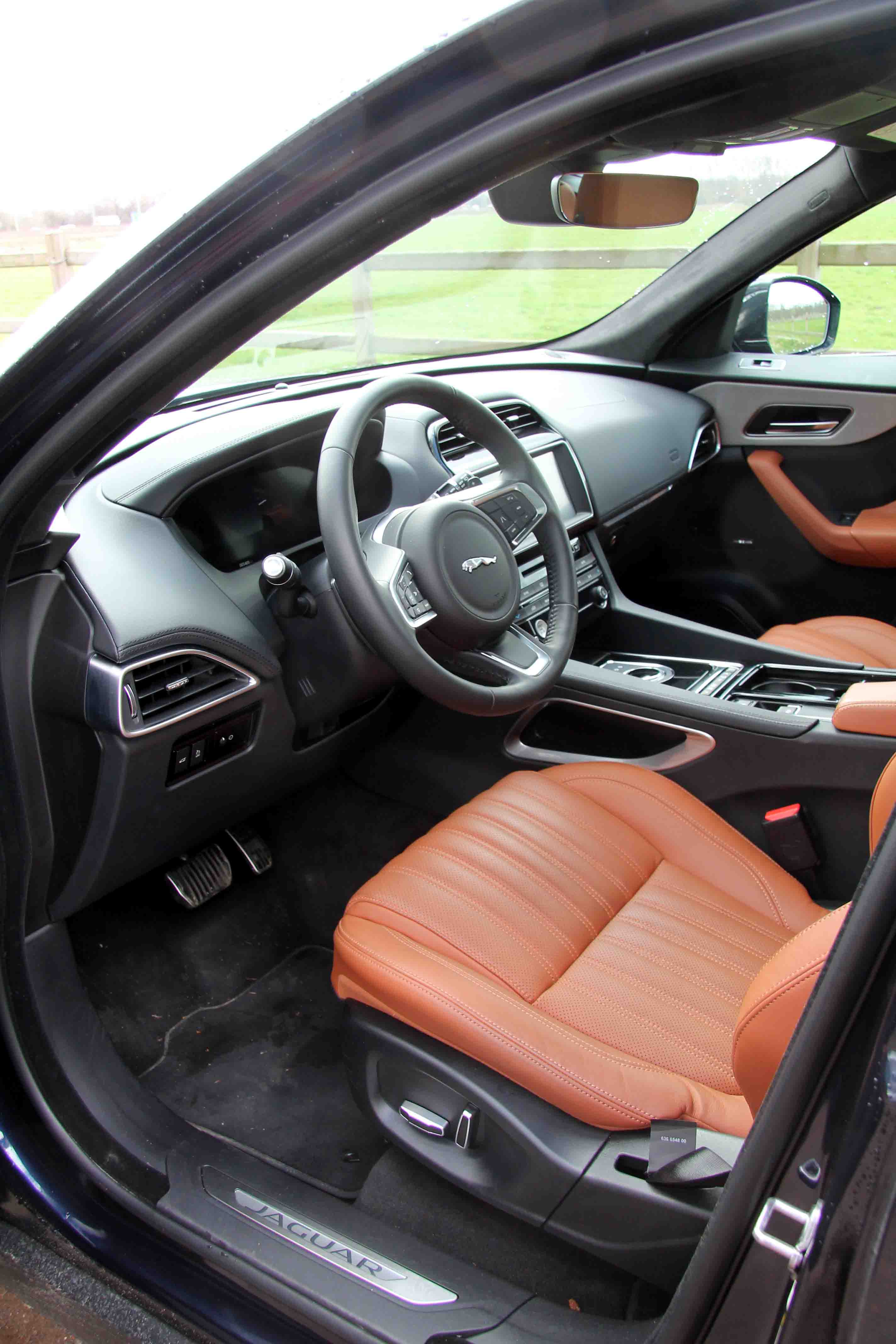
In the interior, the digital age and the utmost attention to passive safety has put its own boundaries and accents, and so, alas, you will not find a wood rimmed steering wheel, nor does it lay thinly rimmed in your hands, the trend of times has commanded otherwise. But once the digital instrumentation lights up on the screens, one sees the familiar big round dials, and the classic lettering in the instruments, white on black, of, well, vintage Jaguars. As readers know, your servant is the proud owner of a Mk II 3,4 litre Jag, and yes, I felt well at home in this one.
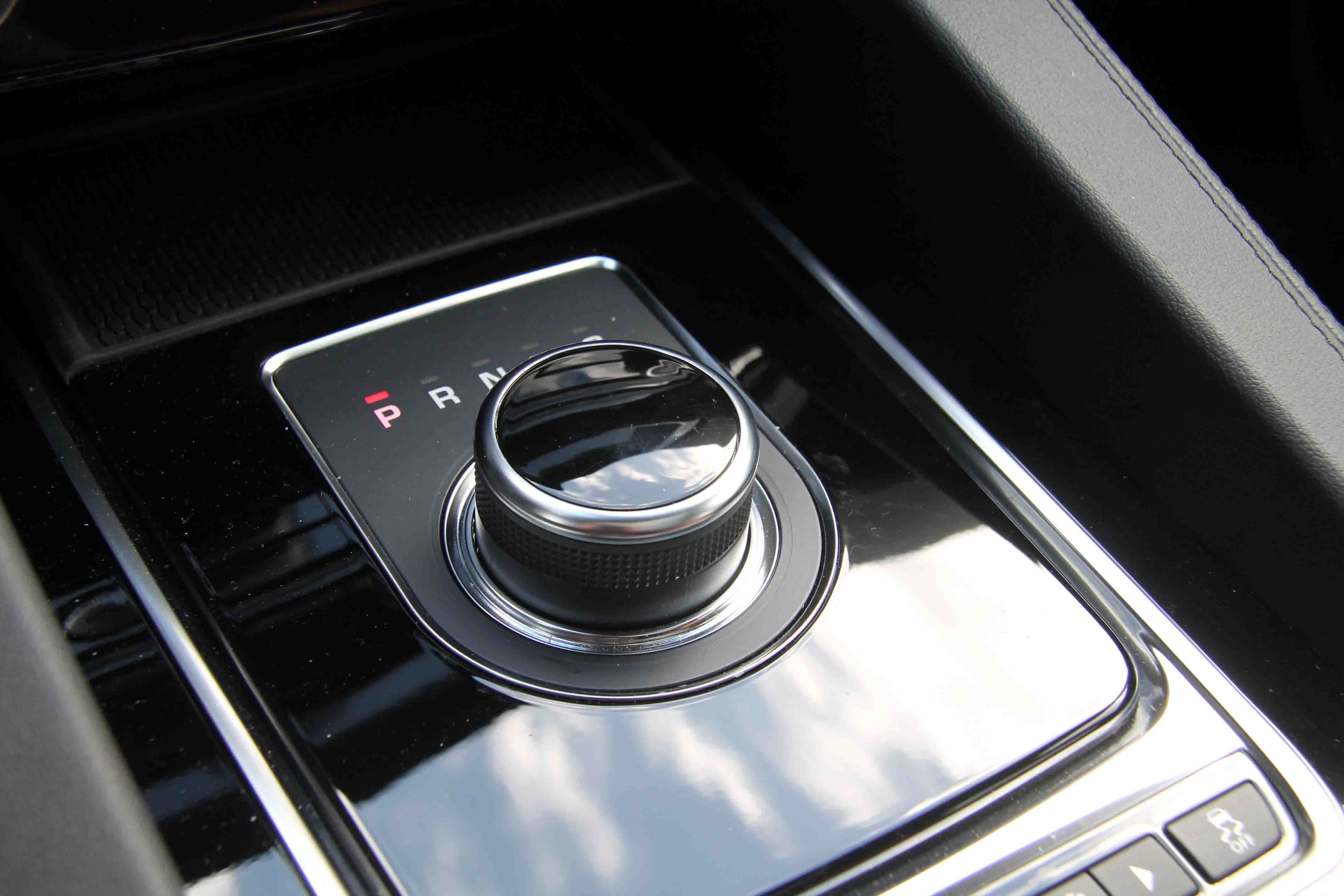
The latest generation digital infotainment screens and functions are also intuitive and the proverbial breeze to use, and rank among the very best you will find in any car nowadays. The centre console is wide – again a celebrated Jaguar tradition- and houses the ergonomic rotary gear selector of the excellent 8- speed ZF auto box, and one just has to turn the column to choose the right function, and it will discreetly descend into its mount when you stop the car and engine, so neat and practical, and (luck has it) so unique to Jaguar. Going from “D” to “R”everse is just a short twist on the column selector, and that is soo clever!
Abundant, smooth, growling power…
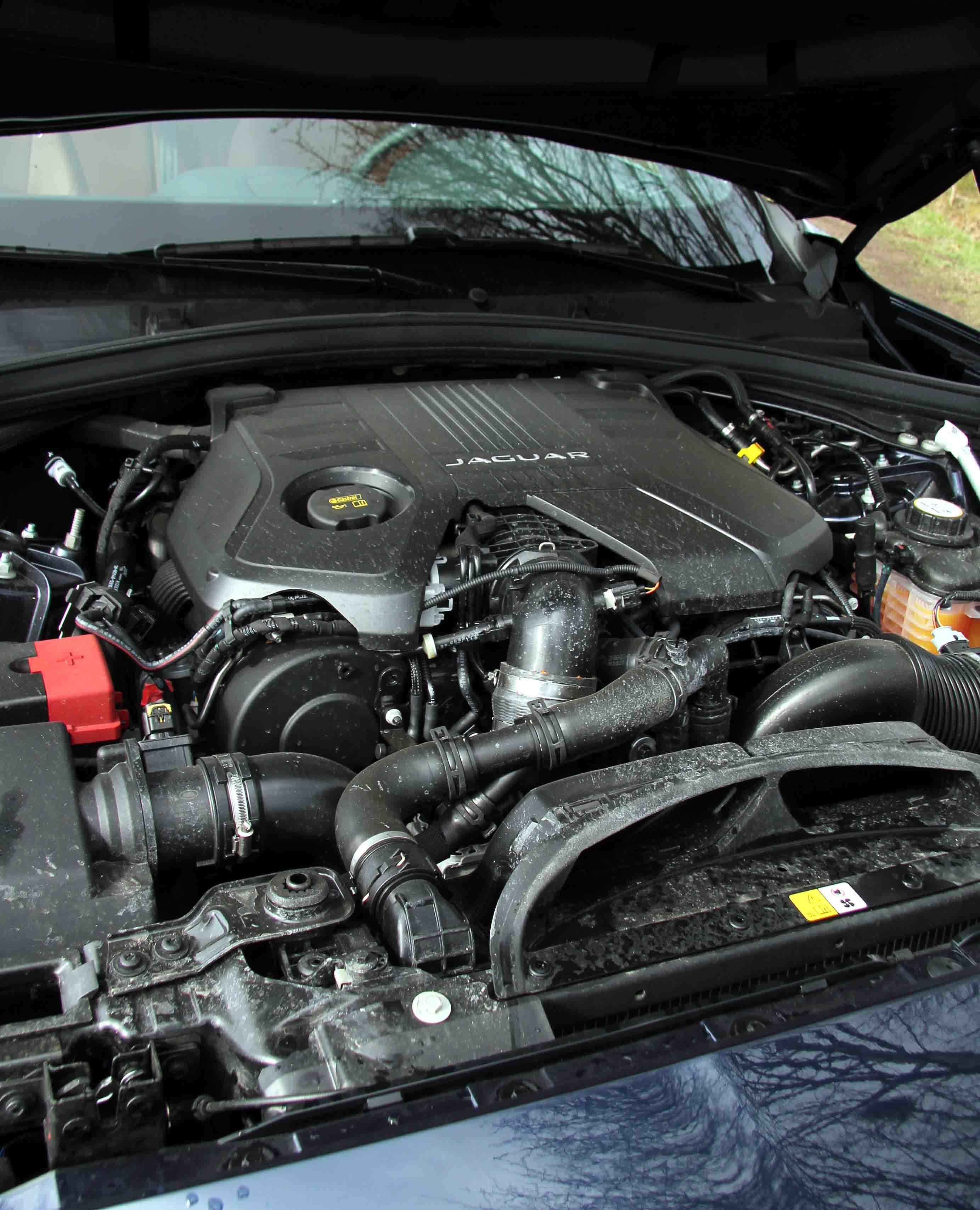
The heart of any car is its engine, and in a Jaguar it simply HAS to be powerful, with abundant torque and pulling power, from low revs onwards, and on top of all that it has to develop that deep, feline sound. No small feat for a Diesel engine. But then, this is a V6 (yes, to me, a Jaguar is only a Jag with a SIX cylinder engine, sorry…) and it has 3 litre of displacement. So there are 300 HP available, at 4000 rpm. Of this, the Jaguar E-Type could only dream. With on top of all that 700 Nm of torque in store for that necessary feline punch, and this at merely 2000 rpm. So the outright performance is truly Jaguar, and indeed, the classic E-type could hardly match its 0 to 100 km/h acceleration of 6.2 sec. It would also have needed the right rear tyre size and final drive ratio to reach the same top speed of 241 km/h which this F-pace is capable of.
The thermal efficiency of a (large) Diesel is legendary, and shows abundantly here too that they belong into the larger SUV’s when there is no electrified or hybrid propulsion present in the drivetrain. It took just a restrained driving style with the engine humming along around 1000 rpm at urban legal speeds, to reach consumption averages between 7,4 and 7,8 liters/100 km in dense urban traffic. A petrol engine of similar size and power does not come even close to these figures in such a 4,7 metre SUV with a kerb weight of 1884 kg. The ingenium technology in these all aluminium engines offers low friction, and all this truly pays off.
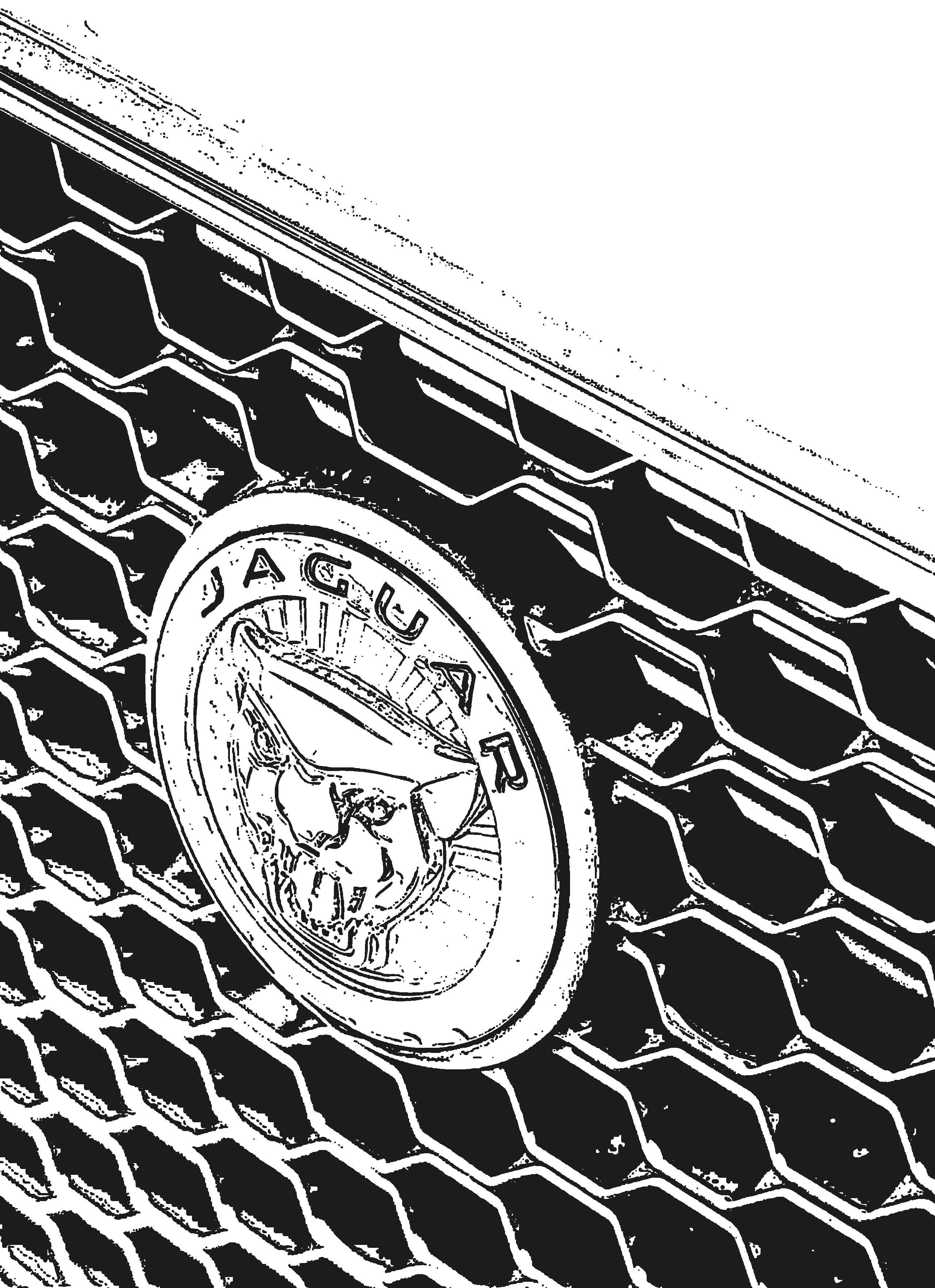
We couldn’t resist making this line drawing version of the inconic Jaguar badge on the front grille. This F-Pace is indeed a true Jaguar…
Handling like a thoroughbred
As shares some of its architecture with the XE and XF, it handles very car-like. Of course, you can choose between driving modes that stiffen the suspension and boost steering response, but even in normal settings the F-type handles like a dream, displaying also very little body roll for an SUV of this weight and size. With the larger engines, the F-type offers standard 4WD, and this sends all the power to the rear wheels most of the time, with occasionally 20 pct sent to the front. On slippery surfaces, up to 50 % of the pulling power can be sent to the front wheels.
A
key ingredient to these impeccable road manners is its lightweight
construction. Don’t forget that 80 pct of the body, excluding the doors, bonnet
and plastic tailgate, is made of aluminium. Then there is the near perfect
50/50 weight distribution, an integral link rear suspension, and the aluminium
double wishbone suspension at the front which is closely following the F-type
setup. Electronics will analyze steering movements up to 500 times per second,
body movements up to a 100 times per second. Do we need to say more? This
Jaguar is in all its sportiness graceful and comfortable, never too hard, even
in this sport mode.
Everyday practicality
The F-type is an SUV, and that means born and built for the modern day mobile couple and family. It easily seats five adults, has a minimum trunk volume of a very decent 650 liters, space for ski’s, toddler isofix seat anchors, electric tailgate, you name it. All thinkable driver assistance options can be had, the infotainment supports Apple and Android Car Play, the sound system is nothing short of superb.
Conclusion
The F-Pace is Jaguar’s bestseller, and for all the right reasons. It has feline, beautifully curved and timeless looks, both inside and out, displays uncanny panache behind the wheel, handles well balanced and displays all the growling Jaguar power you could ever wish for. Don’t forget also, this car is voted World Car of the Year 2017 en World Car Design of the Year 2017; Thi year, the model range has been extended with the 300 SPORT and Chequered Flag. In the diesel version it is as frugal as modern times command it, and if you decide to go green all the way, then Jaguar as the latest I-Pace, which is also a formidable looking car with many (E-) promises.
Needless to say we are very keen to lay our hands on one, but for the time being, and indeed for many years to come, this F-Pace will fulfil everything you could possibly wish of a Jaguar, and this better than ever.































 Autoprova - for the Connaisseur