The pleasures of car detailing…

In Corona times, it is a delicious period to pay (loving) attention to our cars. Your servant has tackled even to repair his BMW, something we would never have endeavored in normal times. Our Z3 is in mint condition, its car cover keeps it clean over the months, although the seats in the interior might also benefit from some care and attention. We will come back on this soon. We have the idea here to ask the opinion of Carrosserie Vercruysse, who helped us so beautifully and expertly putting our Lexus CT200h in mint condition.

The other good reason is that the cloth seats of the Lexus are easily soiled as they are light beige, and we need to put some proper maintenance to be done there too, so we will ask them how to tackle this properly.  

Cleaning Mercedes seats…

But the delights and pleasures of car detailing came also back to me when I cleaned the white faux leather front seats of my B Class Mercedes. I used lukewarm soapy water, applied it with a soft brush and soaked up gently the excess moisture with sponge and terry cloth.

They are again like new, and I do this regularly every 8 months or so, so the seats are hardly soiled to begin with. The rest of the interior and dashboard get the same gentle clean with a humid terry or microfibre cloth, gently, never scrubbing as the plastic dial covers can be o so easily scratched, as the rest of the dashboard.

Soft brushes are used for vent openings, again never too vigorous as the polished surfaces can also be damaged easily.

When delving into literature about Car cleaning and detailing, we stumbled on an article by Porsche on car detailing.

Really magnificent, as it is car detailer Richard Tipper who explains to get your car looking again as new.

Pores are meticulously cleaned in our B Class Mercedes… here photo taken in daylight…

He has an obsessive approach to cleaning cars, it seems. He has built up a very large clientele of car lovers, from collectors with more than 200 cars to the daily driver who just happens to cherish his mount.

As he also often disassembles interior/exterior elements of a car to make them meticulously clean, he has a keen notion how cars can be designed and built with love and attention to detail. Needless to say that this man is also a Porsche lover, and the proud owner of a Cayman R. He has detailed a Carrera GT more than once, and is impressed with the care Porsche engineers have taken to engineer every little part of this car.

Detailing a car is no small affair. It usually takes Richard a day or two, but when the owner wants also the inner brake linings for example to be cleaned, it involves taking things apart, and then it can take even up to a week. Usually he takes the seats out for example, just to clean everything thoroughly in every nook and cranny of the car floor. But that is a minimum.

You can find him on Instagram under @perfectionvalet, and of course on YouTube.

Wheel cleaning like an expert

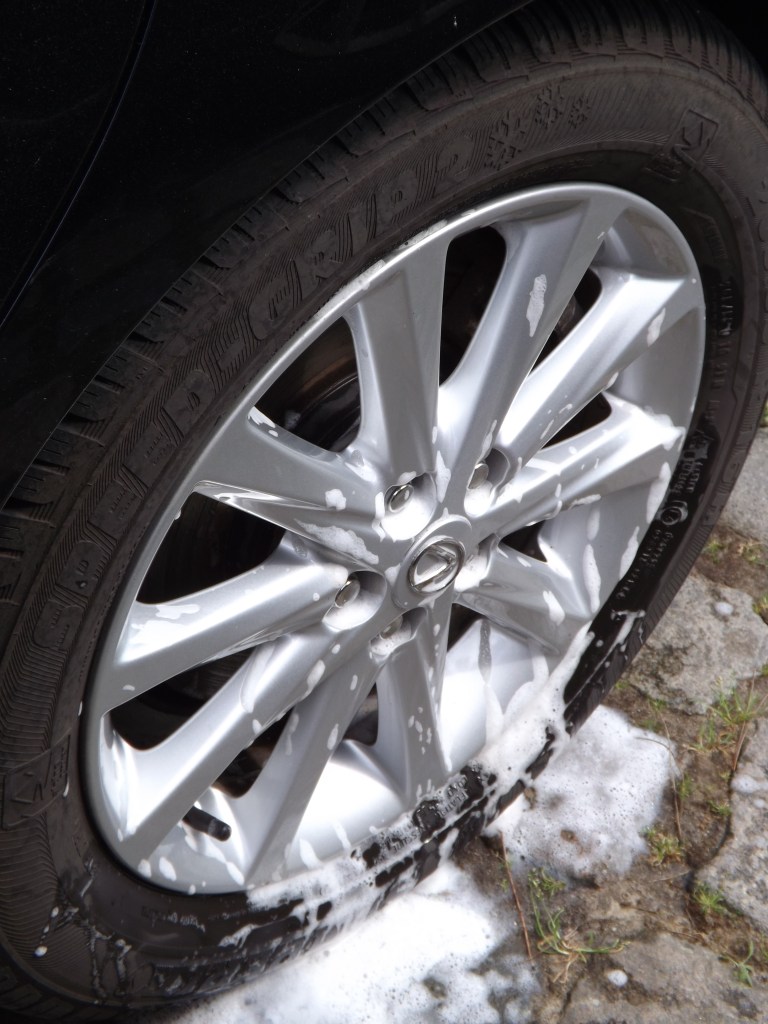
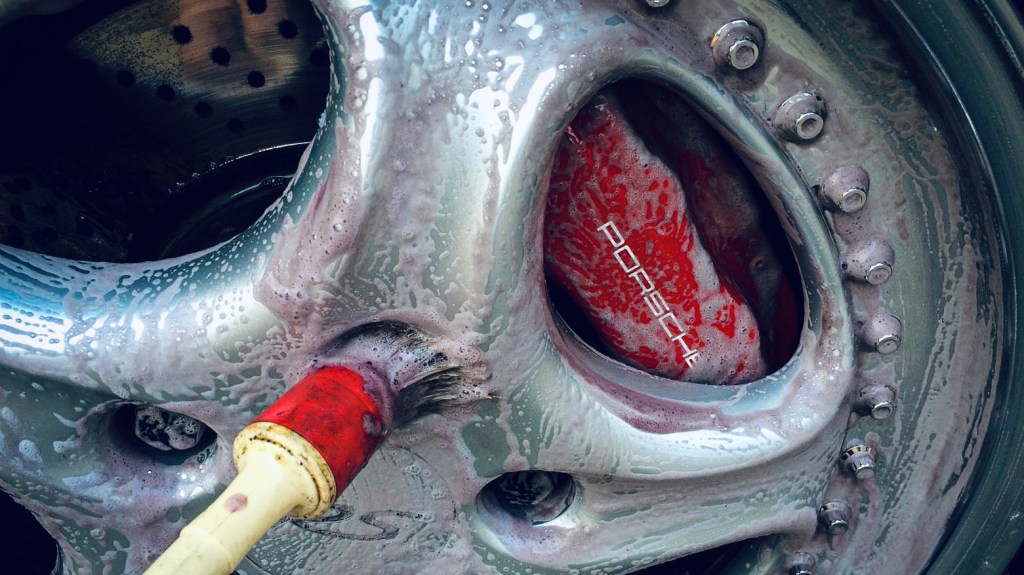
Soft brushes uses for cleaning alloy wheels…

We cite here the tips he gave us about cleaning your very nice alloy wheels.

“It’s best to do the wheels before you wash the rest of the car, as they are often the dirtiest part of the whole vehicle. Use a different bucket for this bit.”

We gave also the alloy wheels of our Lexus a thorough makeover…

He continues:

-Invest in some soft ‘wheel brushes’, which are usually made out of microfibre, not bristles. Choose a set with plastic handles, rather than metal, to help prevent scratching.

-You’ll also need a deioninising decon gel. I never use acidic wheel cleaners, especially on cars with Porsche Carbon Ceramic Brakes (PCCB), as the disc hub is anodized and the acid will damage the surface.

-But the gels work really well (other than stinking like rotten eggs) and have a colour change technology in them so you can tell they’re working. Most will ‘bleed’ purple to show they’re reacting with the iron in the brake dust.

-The best way to clean a wheel is to take it off, but if you can’t do that, spray the decon gel on the cold wheel, trying to avoid getting it on the disc or pads as much as possible.

-Give it a bit of ‘dwelling time’, allowing the product to work its way into the nooks and crannies.

-Next, it’s onto the wheel brushes. These come in various sizes, so use whichever one is best for the area you’re working on. Use them to spread the decon gel around, paying particular attention to the valve and wheel nuts.

-Don’t forget the inside of the wheel to make a really thorough job of it. If you’re lucky enough to own a Carrera GT, you’ll find the caliper sits very near to the back of the wheel so it’s tricky to get a wheel brush in behind the alloy. Rotate the wheel by a quarter of a turn and then you’ll be able to clean that section as well.

-Finally, thoroughly rinse everything off. Please don’t blast the alloys close-up with a pressure washer – just a gentle rinse will do.

-Some people use tire shine as a final flourish, but one warning: avoid it if you leave your car under a cover, as it’ll smear itself all over the inside of the cover.

More to come soon, about a very important bit: how to expertly wash your car…

Just enjoy some photos here already…

Hans Knol ten Bensel

Rediscovered camera’s

Corona times at home are very useful to take stock of what one actually owns. Doors of hard to reach cupboards are opened, shelves are inspected, boxes from earlier moves are unpacked. And long forgotten gems appear. Just read with us this (very) happy tale…

Hans Knol ten Bensel

It all starts with a Leica.

My father used it for the Summer Olympic Games in Montreal. This was back in 1976. He procured himself this Leicaflex SL with a Leitz Canada Summicron 1:2 90 mm lens. I found it back in a box stored in an upper cupboard. My father had used it intensively, but luckily everything was still in working condition. The shutter functioned, the camera back opened without a hitch, the film pressure plate, everything OK.

The letters “SL” stood for “Selektive Lichtmessung” or “Selective Light Metering” and indicated explicitly that the Leicaflex SL was capable of through-the-lens spot metering, contrary to the earlier Leicaflex Standard, which relied on an external metering cell. The SL’s meter reads a limited area of the image corresponding to the coarse microprism zone on the viewscreen.

Well, everything on our camera was almost OK, as there is one very important element missing around the shutter release knob: the shutter speed dial. Maybe the camera had been dropped, and the circular ring to select the shutter speed was gone. So it sticks invariably to a shutter speed of 1/2 second. Can it be repaired? Who knows. It appears that Leica is not servicing this model anymore. Leica does no longer support R-system cameras. The company recommends to send cameras to Paepke-Fototechnik in Düsseldorf for any repairs. We will contact them soon, and when Corona times are over, we will make a trip to Düsseldorf…

Another hitch is that the mercury cells that supplied a constant 1.34V to the metering cell do not exist any more. We will also ask the Paepke-Fototechnik people how we can work around this…  

Apparently the SL was produced until 1974, when it was replaced by the Leicaflex SL2. More soon when we contact Paepke-Fototechnik!

The Hasselblad 500C

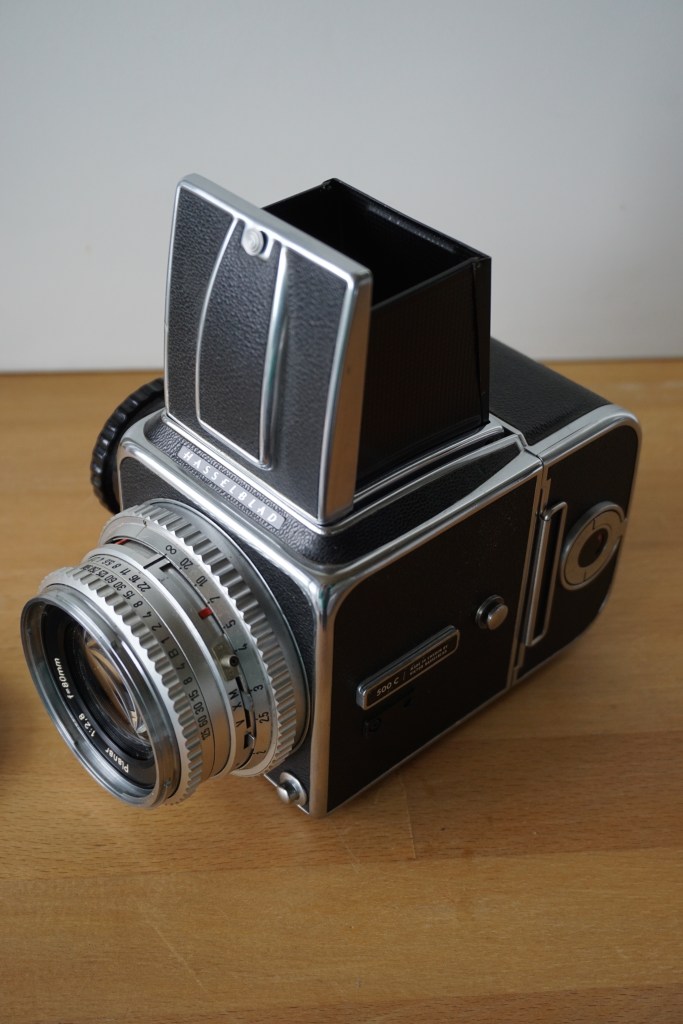
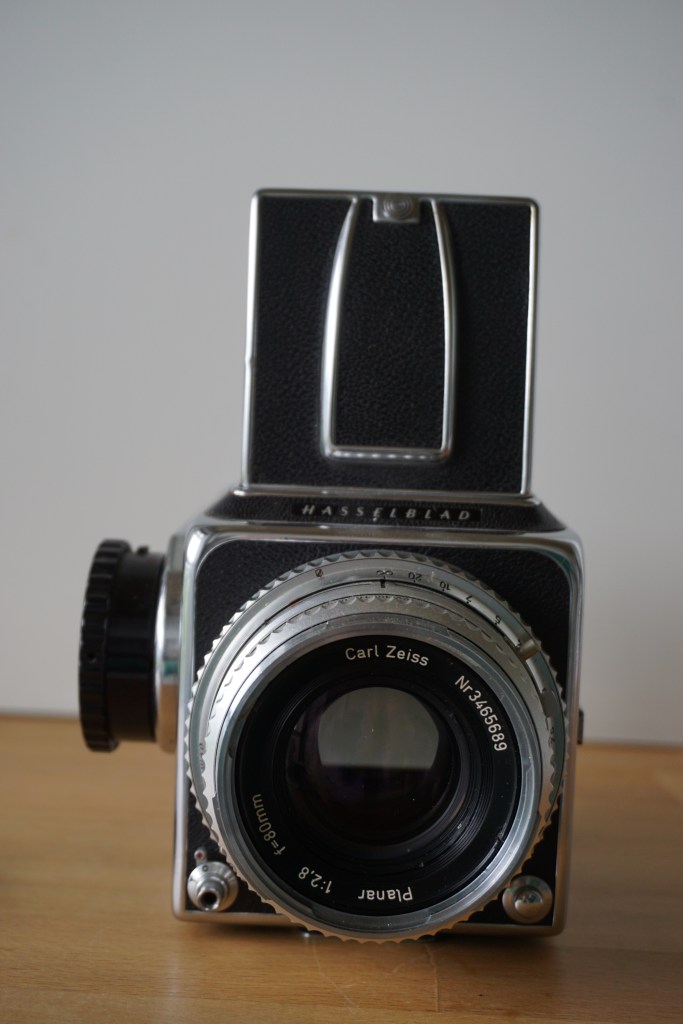
Another gem we re-awakened from its box was the Hasselblad 500C. It has the Carl Zeiss 2:8 Planar lens and is still in very mint condition, and, as far as we can see “on the dry”, in perfect working order. We will start to use it soon, with one caveat however, and this goes for all the analogue film camera’s, my darkroom is in my house in France, and in Corona times, we are still not allowed to cross the French/Belgian border at the moment of writing…

Then there are the two Mamiya’s 645. One with a classic viewfinder, and one with a prism viewfinder and built in light meter. One has the standard 80 mm lens, the other one the wide angle 55 mm 2.8. They are still as brand new and of course in perfect working order. There is also a 250 mm telelens to complete – literally – the picture.

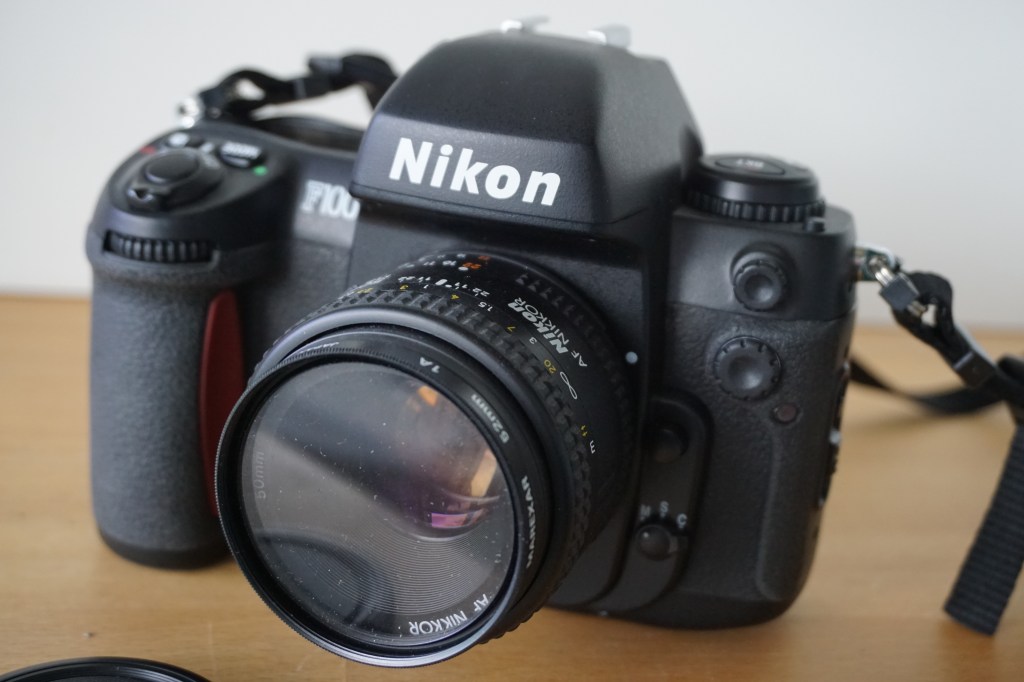
Another analogue camera waiting on the shelf for better times is the Nikon F100. It sits there with a standard 50 mm 1,8 Nikon lens, is also mint, as new and also just waiting to be used again. It just needs batteries to get cracking.

Now we come to some (almost) forgotten digital camera’s. We recently used a lot our Fujifilm X10 with the Fujinon 28-112 mm equivalent F2-2.8 lens, a compact gem of a camera we really happen to like very much, especially in street and social event photography.  This is an exeption to the camera’s shown in this report, this one has never been “forgotten”.

Unfortunately the camera won’t shut down when one clicks the lens barrel again in the “off” position, and will continue to function for 2 minutes. This of course shortens battery life dramatically, so we bought a spare battery and keep the camera going when touring, visiting museums and the like.   

One camera we thought we had lost however is a Fuji Finepix “S”4200, a 14 mp cropped sensor “crossover” camera of yesteryear we would say, with a quite creditable 24 x optical zoom lens. It is not ideal at high ISO – far from it – but then again it is versatile with its zoom lens. The sensor of the Fujifilm 10X is quite in another league, we must admit. This camera cannot produce any images in RAW, the only option apparently is shooting in Fujifilm Finepix standard color, chrome or b&w. You can boost its ISO to 6400, but then things get quite horrible. OK, in B&W there is still something to be done, but nowadays your average smartphone outclasses it… But, as said, we found it again, and will – for the sake of it – put it again through its paces to see what it still can do in modern times, when we have our next test car, for example. We will compare the results with the much more modern Sony A 5100, which we will then use alongside it.     


We – last but not least – got the Sony A 5100 again out of its box, we bought a Nikon adapter for it so we can use our Nikon glass on it, but even with its 16-50 mm standard lens it is a quite good performer. It is also an excellent vlog camera, but more about this later…Note that this last photo was taken with the Fujifilm Finepix S4200, at 200 ASA, quite creditable indeed as one knows that all the photos of the other camera’s are taken with the Sony A 5100…

Hans Knol ten Bensel

Miami wheels…

Noblesse Oblige: a Rolls Royce is the car for shopping at Worth Avenue in Palm Beach…

Before Corona hit our shores, we went in February to Florida to soak up the early sun. Undoubtedly this proved to be a wise choice, as at the moment of writing, we are still not allowed to travel. We visited Miami and made a drive to Key West, in a rented Nissan Altima. A very comfortable mount with a well pulling and smooth 2,5 litre 188 HP four cylinder petrol engine coupled to a soave CVT transmission. This CVT performed well, raising the revs gradually following the push of your right foot, and restraining fussy revving even when you accelerate full throttle. Once above 4,000 rpm, it will make crisp upshifts.

With lots of support from the power steering the Altima is very easy to steer, stable and comfortable, and offers lots of room for its occupants. An ideal, and stylish travelling machine, which left little to be desired.

On Florida roads, the usual pickups abound, but there is a lot of room left for supercars and European (noble) brands. Indeed, Florida is the realm of the well to do, and also one of the states with a 56,14 % majority of foreign brands in its total car market. It counted in 2018 some 7,6 million registered vehicles. California is actually the top car state with not less than 14,6 million registered vehicles, and a foreign car market share of 64,9 %.

Go in the posh shopping and hotel areas of Miami beach, and you will see it is the home of Lamborghini’s, Maserati’s, Mercedes, BMW, Porsche, Range Rover, Bentley, Rolls Royce. Many buyers of the noble European brands opt for SUV’s as well as cabrio’s and coupés.

On the road, big SUV’s and pickups from American and Japanese brands abound, with the open Mustangs being frequently seen too, as well as Chevy Camaro’s.

Every now and then an American built classic meets you, as a fifties or sixties open Ford or Thunderbird. Indeed, Cuba is not far away…

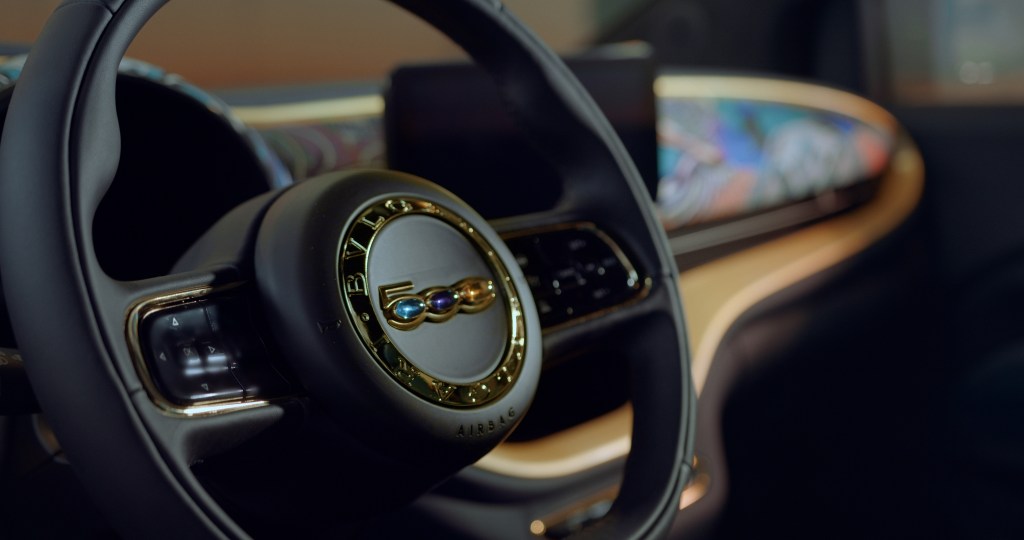
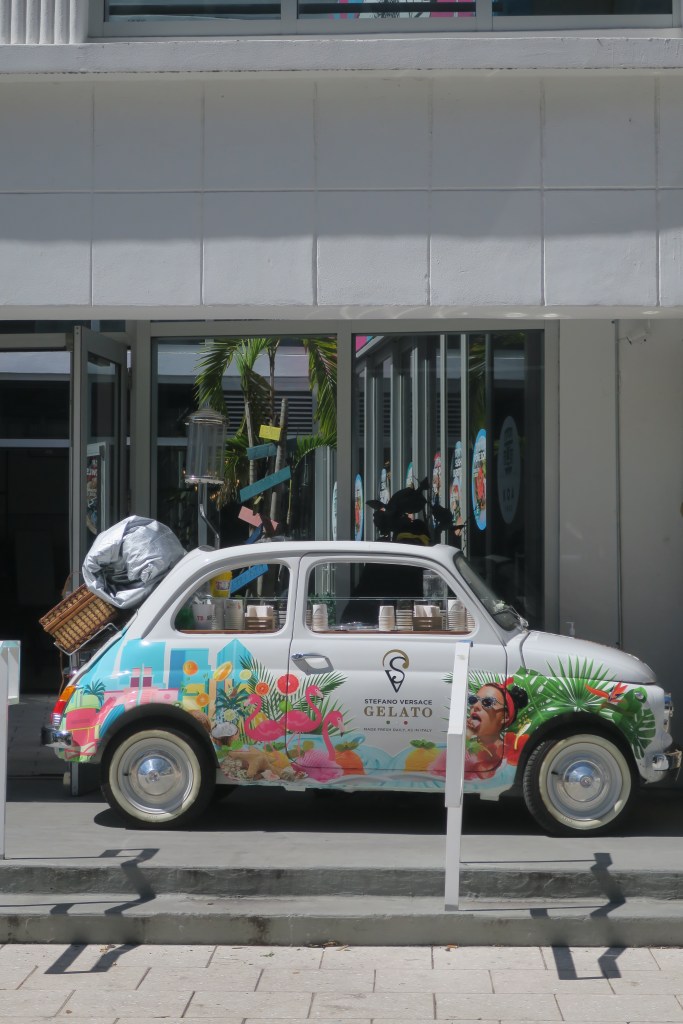
Of course, there are the Cinquecento’s. We saw a new one on Miami Beach, and a vintage or “classic” Cinquecento used by a Sicilian Ice cream vendor…

Also a two decades old SUV was totally sculpted in sand, if there ever was a beach car, this is the one…

We just let you enjoy the photos here, and dream with us of these sunny shores and their nice cars…

Hans Knol ten Bensel       

The Fiat Panda is now 40 years young…

In iconic black, the original Panda is still very modern…

Your servant remembers it vividly. Back in 1980, photographing a brick stone red Panda in the Galerie de la Reine in Brussels, on an early Saturday morning. Those were the times when you could pull this off, without asking anybody. Of course we had to be quick. To make our presence a bit more official, I asked also some garcons of the nearby restaurant Aux Armes de Bruxelles – who were just putting out the tables in the early morning – to pose for me, putting some of their ornamental flower trays in the opened hatch of our Panda.

My test car’ had the zesty four cylinder 903 cc engine in the front, borrowed from the Fiat 127. It was fast with it. Top speed not less than 140 km/h.

The original Panda had soon also a4WD version…

I just loved the design of this Panda, both inside and out. Its elegant, simple, rectangular shapes, its perfectly balanced proportions still inspire. Just drive it now in chique black with beige interior through our cities.

It still is a beautiful, modern car. The car is also up to this day brimming with practicality and genial storage solutions. Fast, zesty, compact.

The future car within this same lineage of geniality is the Centoventi. We stood eye to eye with the prototype in the Centro Stile last year. More about this car later.

The Centoventi breathes the same practical spirit as the original Panda…

The present day Panda is eminently capable. We recently drove the hybrid version, just read our report… This Panda lives in the heart of many, and is since 2003 the most sold city car in Europe. And has a bright future for many years to come…

Hans Knol ten Bensel

Easter eggs and a colouring album from Fiat and Jeep…

Keeping your offspring busy in these (Easter) times is quite a task, and Jeep and Fiat are there to help.

Fiat launces a cute #fiatforkids initiative. The Colorbook 500 – in Fiat’s usual playful, entertaining style – is designed specially for children to spend a few hours drawing and coloring in the three generations of the 500. Fiat is offering four plates of their iconic Cinquecento. Your offspring can colour the three generations of the 500, the landscape it is passing, or draw the view from the window of the car.

But there is more for kids in store during Easter time. They will look for “Easter Eggs” in hidden places in the garden, terrace or in the home, much to their surprise and delight. The Jeep designers have made “Easter Eggs” an integrated step in the creation process of each vehicle, and a distinctive, very special design feature.

The “Easter Egg” lies here in the small red Jeep on the alloy rim…

‘Easter Eggs‘ are hidden decorative motifs that Jeep stylists conceal in Jeep vehicles, meant to be discovered throughout time by their owners.

These hidden gems are unique and unexpected, they change from one Jeep vehicle to another and can be found both on the exterior and on the interior. Originally, Easter Eggs were an offhand addition of a graphic to an otherwise standard part of the vehicle but over the course of the years, they developed into something typical of Jeep design.

They are also styling cues that recall the brand’s design heritage – such as the seven slot grille or iconic Jeep models like the Wrangler.  

Often they can also be found in small functional areas, such as storage compartments, to be discovered by customers during the daily use of their vehicle.

Today, the practice continues with every new Jeep model and customers will shortly have an opportunity to discover the Easter Eggs hidden in the soon-to-be launched Jeep Renegade and Compass 4xe…

Hans Knol ten Bensel  

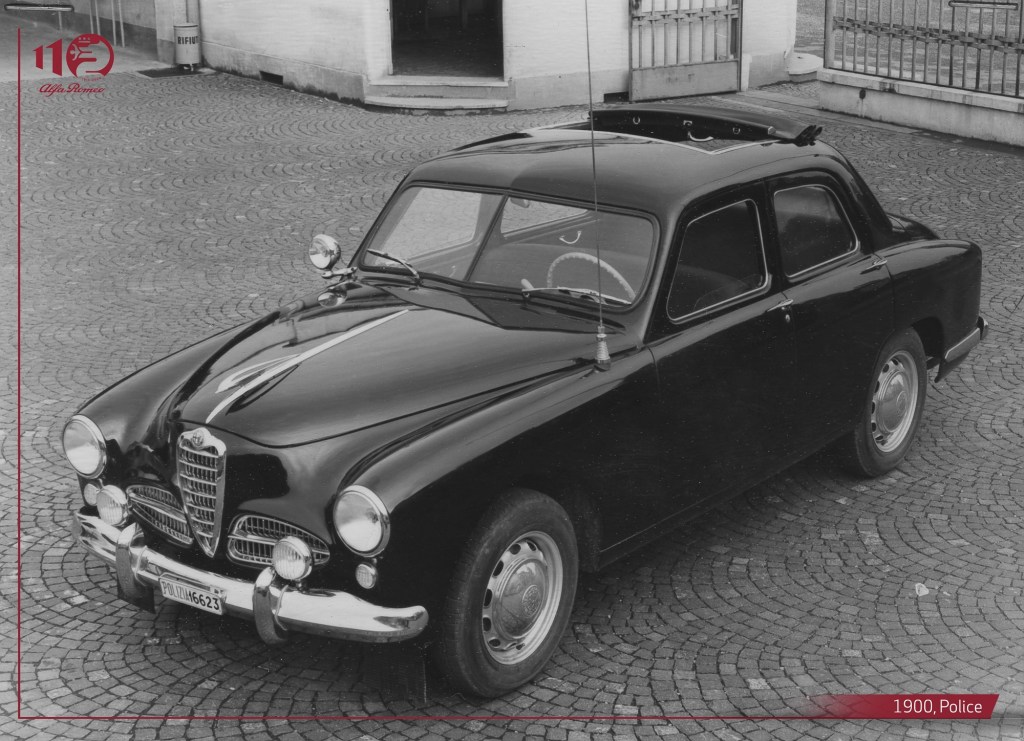
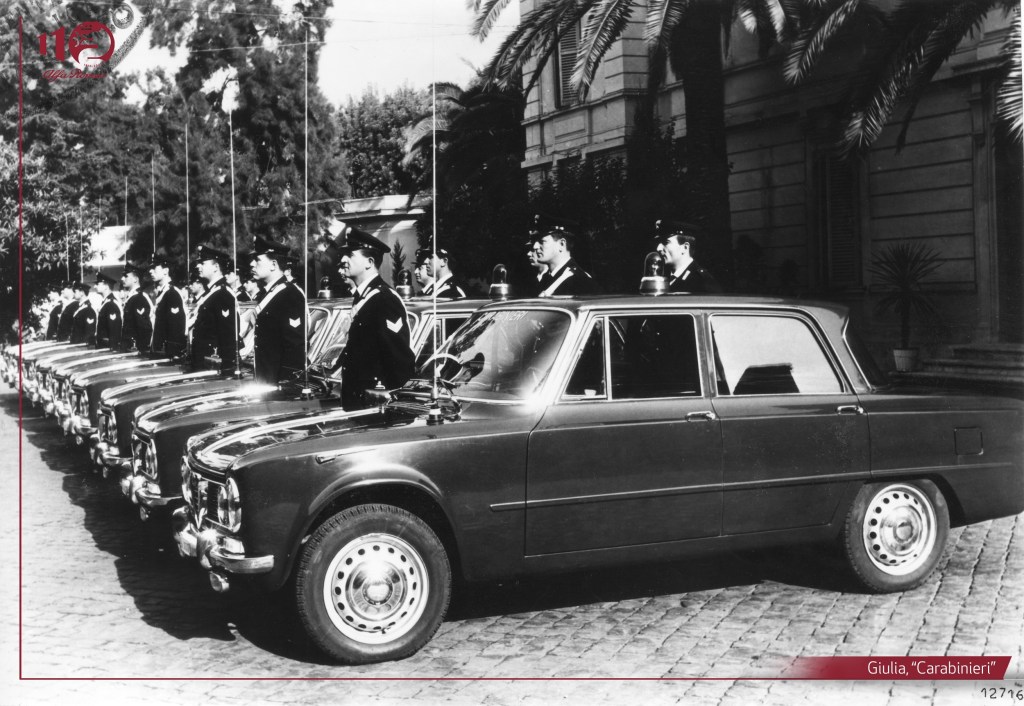
Announcing 110 year Alfa anniversary with a video…

The dynamic PR people of FCA Belgium created a new video to keep in touch with current customers and future prospects in Belgium and Luxembourg, a few weeks before the official celebration of the brand’s 110th anniversary.

To have a look at this new video for sports car enthusiasts who look forward to taking the wheel of their Alfa Romeo again in optimal living conditions, just click https://we.tl/t-hGoEXfwzUA

The video footage was shot on the streets of the Principality of Monaco, which also serves as a prestigious setting for the F1 Grand Prix and where the brand’s latest publicity campaign was shot for the new Giulia and Stelvio MY202. The new models Giulia and Stelvio are equipped with new exclusive content: dynamic driving becomes a real driving experience.

Prices for the New Alfa Romeo MY2020: Giulia from € 34,900 (€ 33,746 in Luxembourg) and Stelvio from € 39,990 (€ 38,668 in Luxembourg).

Stay tuned for more Italian car news soon…

Hans Knol ten Bensel

Citroën’s “AMI” brings E-power to all of us…

Citroën changes the world once again, after its post war 2 CV. Now in (and after) Corona times, it launches an E-powered runabout, which will make the world think differently about affordable, urban electric mobility.

The “AMI”is non-conformist, with 2 seats, 100% electric, comfortable and protective, compact and agile, of course to be customized at will.

As a direct descendant of AMI ONE Concept introduced at the Geneva Motor Show in March 2019 and following the strong interest it generated, Ami has become a reality in barely a year.

Ami is a practical response to new mobility expectations for short journeys: enabling easier access to city centres, finding micro-mobility means for everyone, and presents a real alternative to scooters, bicycles, mopeds, public transportation at reasonable cost.

Nimble and simple, E power for all…

The AMI is ultra-compact: set on its specially designed 14″ wheels located at all four corners for easy handling, Ami is 2.41m long, 1.39m wide and 1.52m high.It has a 7.20m turning diameter.  It is a light quadricycle, which benefits from a smooth clutch-less ride and an instant acceleration from a stand-still , capable of speeds of up to 45km/h. Ideal for multiple short trips in the city – such as going to a meeting, to work, running an errand or going out for the evening – Ami has a range of up to 70 kilometres.

Copyright maison-vignaux @ Continental Productions

Its 5.5 kWh lithium-ion battery, housed flat under the floor, can be charged via the on-board electric cable located in the passenger-side doorway. Once the cable is plugged in, 3 hours are enough for a full charge on a conventional 220 V socket. The use of Ami is as simple as any everyday electric object. Ami – 100% electric can also be charged at a public terminal or Wall Box using a suitable cable.

The AMI has a standard panoramic roof. In a nod to Citroën’s history, the side windows open by manually tilting upwards like the 2 CV.6 coloured accessory packs are available. Bright and pleasant, it is symmetrically designed. The wide doors that are completely identical on the right and left and open in the opposite direction: rear-hinged on the driver’s side to benefit from better on-board accessibility and increased comfort, and traditionally front-hinged on the passenger side.

Make your own mark…  

In a “Do It Yourself” fashion, the possibility of creating the object that suits each customer’ tastes through a kit of accessories that can easily be installed yourself. This kit incorporates functional decorative items: a central separation net, a door storage net, mat, storage tray on the top of the dashboard, small hook for a handbag, smartphone clip, DAT@MI box (dongle device) connected to the My Citroën app to retrieve essential information from Ami on the smartphone.

Post-production : Astuce Productions

There is harmony between the interior and the exterior with touches of colour on the wheel trims, quarter-panel stickers or even a capsule at the bottom of the door. 4 main shades are available: MY AMI GREY, MY AMI BLUE, MY AMI ORANGE, and MY AMI KHAKI. This accessory kit allows everyone to create their own mood and tailor the functionalities to their needs.

Post-production : Astuce Productions

Another and even higher level of customisation offers 2 packs combining all the aforementioned decorative elements as well as large stickers that dress up the exterior of Ami giving it a style all of its own:

My Ami POP with the Orange customisation and a fun, young and sporty design, with a rear spoiler

My Ami VIBE with the Grey colour and more upscale, chic and graphic accessories that incorporate roof trims to complement the stickers.

The installation of these higher level customisation packs is entrusted to professionals before delivery.

No driver’s license needed…

Copyright maison-vignaux @ Continental Productions

The AMI is in its home country AM licenced, i.e. for engines under 50 cm3. Any 14 year old can drive it. In most European countries, a 16 year old can do too. Ami also makes life easier for its customers in accessing mobility by offering them several formulas through digital solutions: car sharing, rental or purchase. The rates are very low indeed, will of course vary from country to country. But let it be known that you can purchase an AMI for around 6,000 Euros…  

Post-production : Astuce Productions

Ami is offered in France at a rent of €19.99 including VAT per month with an initial payment of €2,644 including VAT (Ami Ami version; long-term rental of 48 months, ecological bonus of €900 including VAT deducted in France).

Buy it from home…

It is therefore possible to acquire Ami – 100% ëlectric 24 hours a day, 7 days a week. Everything, from discovery to order, can be done from your sofa using your tablet or smartphone in just a few clicks via citroen.fr website, which is the entry point for finding out about Ami, which provides information on the product and on solutions adapted to the needs dictated by each person’s needs.

Digital is present in using Ami – 100% ëlectric with My Citroën mobile app via DAT@MI connected box. The application allows drivers to access essential information about Ami at any time via a smartphone, including: range, charge status and time remaining for a 100% charge, mileage, maintenance alerts and after-sales appointment scheduling. The app also makes it easy to locate nearby public charging stations, a feature offered by Free2Move Services.

More details to come soon, the opening of orders is scheduled for 30 March in France, and a few months later in Spain, Italy, Belgium, Portugal and then Germany. The first deliveries to customers are scheduled for June in France. Car-sharing at Ami’s wheel will start in Spring in Paris with versions bearing the “Free2Move” logo. Of course we are eagerly awaiting to see and drive the AMI “in the flesh”!

Hans Knol ten Bensel

Volkswagen news to admire via webcast, and not in Geneva…


Ralf Brandstätter, Chief Operating Officer of the Volkswagen Brand, presents here the ID. CROZZ showcar

We are living in digital times. So even when the Corona virus limits (temporarily, as we all hope) our present mobility, and led to the cancellation of the Geneva Motor Show, we can still see all the automotive news via our PC’s, Phones, Tablets.

Volkswagen presents therefore its important news on a special webcast, for you to admire via the following link: https://www.volkswagen-newsroom.com/en/live-stream-5455.

Ralf Brandstätter, Chief Operating Officer of the Volkswagen Brand, presents here the ID. CROZZ showcar, which now evolves into its series production version, the ID.4.

Volkswagen is forging ahead with its electric mobility strategy by providing a detailed insight into the brand’s first all-electric SUV. The new ID.4 will be launched this year. Following in the tracks of the ID.3, the countdown has already begun for the second model based on the new modular electric drive matrix (MEB). “Just like the ID.3, the ID.4 will also come onto the market as a carbon-neutral vehicle”, explains Ralf Brandstätter, Chief Operating Officer of the Volkswagen brand. “We will produce and sell the ID.4 in Europe, China and the U.S..”

Just read on for more VW news…

Hans Knol ten Bensel
The ID. 3 started production in Zwickau, the ID.4 now follows…

The ID.4 will initially be launched with rear-wheel drive, while an electric all-wheel drive version will be added to the portfolio at a later date. The high-voltage battery is positioned near the center of the underbody to create a low centre of gravity and an optimum in terms of driving dynamics, along with an extremely well-balanced axle load distribution.

Also new mild and plug-in hybrid drives…

For Volkswagen, the ID.4 and ID.3 represent important milestones in the brand’s bid to become entirely carbon-neutral by 2050 – in line with the Paris climate agreement. Plans have been put in place to reduce the Volkswagen fleet’s CO2-emissions by a third by as early as 2025.

Dr. Frank Welsch, Member of the Board of Management of the Volkswagen Passenger Cars Brand with responsibility for Technical Development, presents in the webcast the new Touareg R

Volkswagen is currently investing one billion euro to electrify its model range while also offering an increasing number of hybrid vehicles. This is based on the fact that, just like electric powertrains, new mild and plug-in hybrid drives in large-scale product lines such as the all-conquering Golf will significantly help to reduce fleet emissions in the future.

New Touareg R

This is why the company’s focus during the webcast is not only on ID. models, but also on new Volkswagen models with hybrid drive. Dr. Frank Welsch, Member of the Board of Management of the Volkswagen Passenger Cars Brand with responsibility for Technical Development, presents in the webcast the new Touareg R with plug-in hybrid technology and the the Golf GTE 2 for the very first time.

The Touareg R,the most powerful Volkswagen model will in future also be powered by an efficient plug-in hybrid system. The alliance between an electric drive motor generating 100 kW (136 PS) and a V6 turbocharged petrol engine (TSI) with an output of 250 kW (340 PS) develops a system output of 340 kW (462 PS). The battery capacity of the Touareg R with a top speed of 140 km/h in all-electric E-MODE has been designed so that most average daily commuting distances can be covered with zero emissions.

Golf GTE with stronger battery…

The same applies to the new Golf GTE – its plug-in hybrid drive has been geared towards performance and consists of an electric drive motor with 85 kW (115 PS) and a four-cylinder turbocharged petrol engine (TSI) generating 110 kW (150 PS). As a unit, the electric drive motor and the TSI develop a system output of 180 kW (245 PS). The new Golf GTE’s top speed in all-electric mode is 130 km/h.

Further Volkswagen highlights include the new Golf GTD, which generates significantly lower nitrogen oxide emissions compared with its predecessor thanks to innovative twin dosing technology, plus the eighth generation of the Golf GTI, produced more than 2.3 million times. The most recent version is powered by a 180 kW (245 PS) 2.0-litre turbocharged direct injection engine. The maximum torque is 370 Nm. The four-cylinder engine is coupled with a 6-speed manual gearbox as standard.

Last but not least, the eight generation of the GTI takes the central stage, presented again by Ralf Brandstätter, Chief Operating Officer of the Volkswagen brand. It is a formidable performer, this GTI, and A 7-speed dual clutch gearbox (DSG) is optionally available.

Digital instruments for the GTI for maximum performance…

We include here some screenshots of the webcast, and stay tuned for more!

Hans Knol ten Bensel

E-power for all of us: the Dacia Spring

2020 – Dacia SPRING… will lift your E-hearts…

It was only a matter of time:Renault puts its massive experience in designing and building E-vehicles even more to the wide public with a full electric Dacia model.

And here it is: the Dacia Spring. It caters for the young at heart with a city car that has a distinctive SUV look and modest dimensions, making it the ideal car for everyday use.

2020 – Dacia SPRING has an appealing light signature…

The light and compact series version of Dacia Spring is aimed at a driving range of approximately 200 kilometers (WLTP).

It has also quite appealing looks and colours. What to think of a body in pastel Mouse grey with accents in Matt Fluo Orange, painted in the massive protective strips for the wheel arches, roof bars, and door sills…

The Dacia Spring has an increased ground clearance, integrated base plates in the front and rear bumper, to show its mettle in today’s city jungle…

2020 – Dacia SPRING rear lights with typical “Y” signature…

A lot of attention was paid to the lighting functions of the car. At the front the ‘full LED headlamps split into two levels: a horizontal line for the upper part and four graphics elements integrated into the bumper. At the rear, the four “full LED” lights form one double “Y”. These light blocks indicate the future light identity of the Dacia models will look like.

The Dacia Spring series version will be available in 2021. Of course we will be keen to have a closer look “in the flesh” and drive it!

Hans Knol ten Bensel

A new Citroën C3…

It is high time that we start talking in our columns about the iconic brand of the “Double Chevron”with some important news…

Citroën has very recently unveiled its New C3, marking a further evolution of the Brand’s best-seller worldwide, a real success with 750,000 sales achieved by the 3rd C3 generation since its launch at the end of 2016.

Did you know that the C3 is sold almost 4,5 million times since its launch? It is the best-seller of Citroën range, belongs to the top 5 in Europe in its segment at the end of December 2019 and the 3rd best-selling car in France.

The new C3 has a proper look. It doesn’t look like any other vehicle. It builds on its differences with a colourful personality and very good comfort. It now stands even more out with new LED headlights, 97 exterior possible combinations, 3 new roof stickers, 2 new wheel rims and 3 interior colour ambiences. It now has new Airbump® designs and up to 12 driving aids, with a lot of connected services: Connect Assist for the SOS assistance, Connect Nav with its 7 “ touch tablet and Connect Play for smartphone duplication. Equipment, completely in the tune of the times, which makes everyday life easier…

New C3 will arrive at dealerships starting in June 2020.
Hans Knol ten Bensel