We drove the Nissan X-Trail e-Power e-4ORCE : the best of both worlds?

Nissan is carving itself a wonderful niche in the electrified SUV world, with both its popular Qashqai and the all new X-Trail.

It offers a bold technological solution for these two popular models by decoupling the engine entirely from the proper drivetrain, letting it act solely as a generator to one (and in this case two) electric motors.

The idea behind it is obvious: it offers the pulling power and mechanical refinement of the electric motor and at the same time it avoids the inefficiency of the combustion engine when it operates under low charge  situations combined with relatively high revs, like in urban stop start traffic.

It lets the engine do its charging work under ideal thermal working conditions and loads, and uses a small(er) battery to deliver the extra electric energy when needed in specific driving situations, like starting off from standstill or engaging in fierce acceleration. Ideal? Let’s find out…

Hans Knol ten Bensel

Smooth…

The driving impressions are indeed very convincing: progress is silky smooth, and indeed the X-Trail is delightful to drive in town and slow traffic.

The ample torque of both electric motors inspires confidence, and lets you master every driving situation. The combustion engine, a 1,5 litre three cylinder, is well insulated and hardly audible. Its recharging task depends of course on how much e-power you want it to deliver, and therefore the more relaxed your driving style, the less you hear it. Whether it will rev higher depends also on the driven speed, soo clever! The Nissan engineers did a very good job here, as this gives a very “natural” impression to driver and passengers.

Total power of our top op the range e-Power e-4orce X-Trail is not less than 213 HP, and the torque is even more important with 330 Nm at the front and 220 Nm at the rear. Smooth performance is the result: the 1,9 tonne 7 seater will sprint from 0 to 100 km/h in 7 seconds and the top speed is an impressive 180 km/h. Indeed, this X-Trail will never feel underpowered.

Geared for comfort

Does the X-Trail awaken the sporting driver in you? Well, rather not. Its utter smoothness puts you rather in a “Zen” mood, and the comfortable suspension does the rest. The car is well balanced and stable in all circumstances, and this adds to the overall relaxing character of the car.

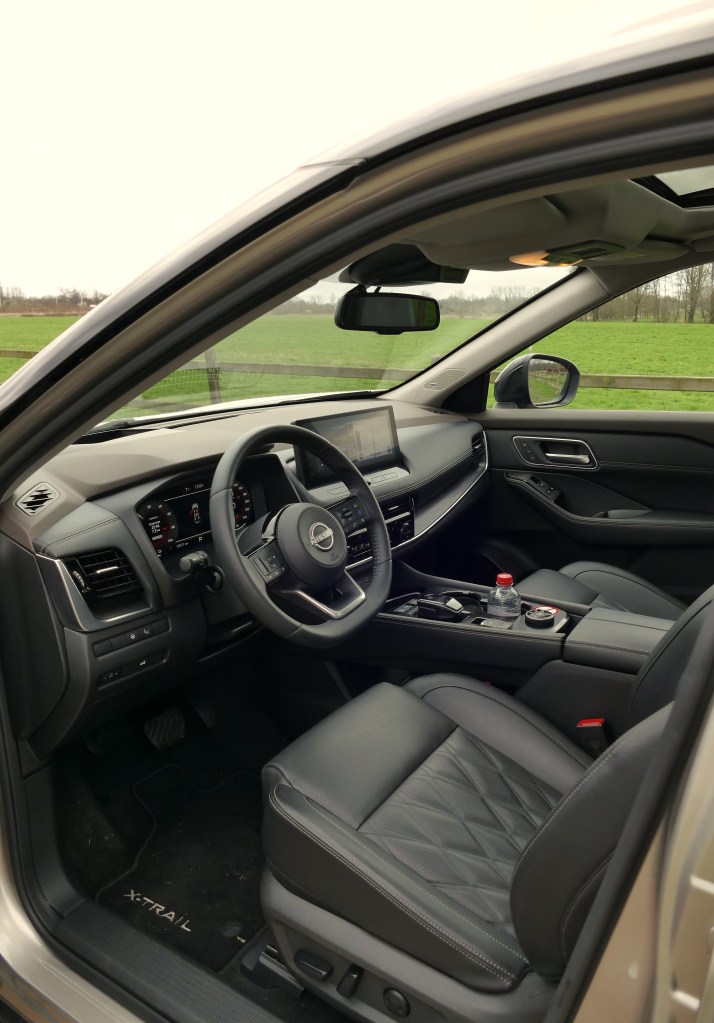
Well being is also found in the cabin. Of course, the top Tekna+ equipment version spoils your senses. The interior is also well laid out, stylish and the designers did keep wisely an array of knobs so you quickly find your way intuitively to all the functions of this X-Trail. We also liked the look of the digital instruments and screen display.

The X-trail e-4ORCE AWD is with its dual motors and 4WD very well at home off- road too…

… but also for economy?

The Nissan engineers had first and foremost the mechanical smoothness of e-propulsion in mind, and combined this with range comfort. Consumption seemed not to be an absolute priority. Nissan opted for a smaller  battery, not least because it would cost room, make the car heavier and pricier. This means that the engine has nowhere to dump its generating power when the battery is full. Of course, the drivetrain software will shut the IC engine down as soon as possible, or let it turnover purely on e-power. Having said this, if you adopt a relaxed driving style, it is quite possible to achieve a consumption between 7,5 and 8 litres, which is quite efficient for a car weighing close to two tonnes. Official figures indicate an average consumption of 6,4 litres/100 km, and 146 g/km of CO2 emissions.

A seven seater…

Indeed, this X-Trail will transport two youngsters on the third row seat, but this is not meant to be for super long trips. But a short run to the supermarket or football club is always in the cards, and this can be quite practical on more occasions than you would expect.

Conclusion

This Nissan X-Trail e-4ORCE is a very well balanced, refined car which offers you all the sophisticated “Zen” pleasures of electric driving combined with the range and long distance cruising panache of IC engined cars. It is very well finished, is lavishly equipped and offers more than adequate space.

We were so seduced by all its good qualities that we decided to join a Nissan e-Power e-4ORCE to our stable of cars, so soon we will inform  you regularly about how it behaves in long term use…

Hans Knol ten Bensel 

Thoughts about the future of our automotive mobility and our energy resources…  

Mr. Philippe Dehennin pleaded passionately for a change in EU Commission decarbonization policies in the interest or European car industry, its workers and its consumers…

Recently I assisted at an interesting luncheon conference held by Philippe Dehennin, Chairman of BEHVA and honorary Chairman of Febiac after a lifelong career at BMW, at the premises of Autoworld and organised by the dynamic Royal Historical Vehicle Club. 

He talked about the one-sided approach of the present EU commission and parliament in drafting the path to carbon neutrality of our automotive mobility.

He passionately pleaded for a neutral stance by the EU political decision makers concerning the technologies which are to be used in reducing carbon emissions. This is in the interest of both consumers and the European automotive industry, which is under pressure and economical risk due to one sided technological solutions (i.e BEV) which distort competitive balances in the global economy. Here I present to you an extensive report of his conference.

On the subject mentioned in our title, we will regularly report on what the captains of automotive industry have to say, and the adjustments they bring to their corporate strategies in these turbulent times of energy transition… Just read further!

Hans Knol ten Bensel   

The lunchean conference was held at Brussels Autoworld…and organised by the Royal Historical Vehicle Club.

After illustrating the broad evolution of our (Belgian and European) mobility from the early fifties to the present day, Mr. Dehennin described, amongst others, the positions of ecologists on our future mobility.

In terms of preference, these ecologists adhere to the following pecking order: walking, biking, metro, bus, and finally the individual car. They see further carpooling and car sharing as the only viable use for cars. They see the latter solution also ideal for bikes, like cargo- or tandem bikes for example.

However, all studies show clearly that in all everyday life situations, the car remains the preferred means of transport. This situation is somewhat less outspoken in cities, but the preference is even more outspoken on the countryside and suburbs. For many families and households, the car remains an outright necessity.

In terms of reducing the ecological footprint, car manufacturers have made a quite remarkable progress over the years and have convinced many car owners and users not to give up what they have acquired in terms of individual mobility. The car will have a bright future ahead, unless the EU commission maintains its stance to forbid the sale of cars with IC engines from 2035 onwards.

The private car buyer hesitates…

Do we have to fear that this will happen? Studies on the behavior of average, modest households, which represent the majority of our consumer base, clearly show  that they are largely opposed to the electrification of their cars. This situation now starts to have an impact on our politicians.

In the EU, only 1 in 10 of private car buyers opt for an electric vehicle. In Belgium, this is only one household on 20. The EV’s are just too expensive for the majority of average households. Many would just be forced to postpone the purchase of a new car and face the consequences of driving around illegally in (urban) low emission zones. Cities are aware of this and are starting to mitigate and loosen their emission regulations.  

But the trend is changing. There are also several countries who do not forbid anymore the sale of IC engine cars within their borders. The same goes for the use of heat pumps, etc. EU countries are now more than ever on the issue of decarbonization.

No place for climate skepticism…

I want to stress here that I am not a climate skeptic. I am convinced that reducing carbon emissions is an absolute necessity, but it has to be done with the support of the larger public, within the boundaries and limitations of their purchasing power. Now, EU and national politicians are increasingly becoming aware of this.

The actual and invasive consequences of the socially utopian obligations and regulations are seen and felt by the EU public, and one can indeed ask oneself whether these measures are deemed necessary, taking into account that Europe represents merely 8 pct. of global CO2 emissions. Since 1990, these EU emissions have dropped by 50 %, whereas the emissions of China and India have increased over the same period by 300 %.  

Saving the European car industry… through adopting a wider array of technologies.

Of course, the BEV is useful for many applications, notably in cities. But I also believe in the future of “thermal” or IC engine cars. 8 European countries, housing the majority of the not less than 13 million jobs tied to the automotive industry, have not said their last word. Nobody wants to open a free road to chinese imports. Germany obtained formal guarantees to be able to develop and use synthetic fuel for IC engines from 2026 onwards.

Jean Dominique Sénard, Chairman of the Board of Directors of the Renault Group, has repeated the strategy of Renault to go further on the path of electrification, but he thinks also that the combustion engine has still many good years ahead of it, thanks to the use of synthetic fuels, which he expects to go down in price in the coming years.

Oliver Zipse, chairman of the board of management of BMW AG, sees also hydrogen having a place in a diversified energy strategy to meet the varied needs of users the world over. In his latest statement, Zipse said “There is no “one size fits all” when it comes to mobility. Markets, customer wishes and conditions develop differently. This is a fact. As a global company, we take this into account. We are continuing to develop all powertrain technologies, including further researching the potential of hydrogen with our BMW iX5 Hydrogen pilot fleet.” (Added by editor).

Of course, hydrogen offers freedom of mobility with very short recharging times. BMW also believes in the future of thermal engines. Because the IC engine will live on for at least a century…And indeed, thermal engines are a crucial sector of European engineering excellence, whereas battery technology is a sector of Chinese engineering prowess.  

If we are driven by the political authorities in only one direction, i.e. BEV, without certainty of the geopolitical developments, nor the certainty of access to the necessary raw materials, without having the necessary “green” E-power and the corresponding adequate charging infrastructure, we will not be able to offer what the customer wants, nor will we be able to guarantee employment in the automotive sector.

A brief for the new EU commission: to adopt a neutral technological stance…

We need to convince the EU Commission to adopt a neutral stance on the technological level. The commission cannot dictate to the industry the technological path to follow. This has never been done in the past and should not be done now.

The CO2 neutral mobility has to be adapted to the diversified realities of the broad consumer base. Also the Diesel engine has not told its last word with the appearance of “clean” synthetic fuels on the market..

The new commission has to steer our European industry in an intelligent manner through this energy transition. If we need EV’s for our needs, we should also invite Chinese manufacturers to open  factories also on our shores; because only employment will generate the necessary prosperity and purchasing power.

Of course, the challenge for our manufacturers lies in offering also models for the average consumer besides the premium segment, where our European presence is already well established.

Only a combination of technologies will offer the proper solutions to the very diverse mobility needs of the EU consumer. The consumer should have the necessary freedom of choice, the liberty of selecting the ideal technology for his purposes.

Europe is a continent of liberties, the result of the declaration of human and citizen’s rights, like the freedom of speech, thought, opinion, property, the freedom to move when and how he or she wishes.

It is difficult to understand the complacency of a part of public opinion for those who seek to constrain us towards a single solution, i.e. the BEV and the bycicle. We need a technologically neutral, ecologically responsable mobility, respecting and preserving our economical prosperity. This will allow us to co-finance, together with the major powers, the decarbonization of the African continent.   

Europe has to be again the home of automobiles with passion and style…

One last word about design. It is time that the European car industry starts to offer intense and passionate automobiles, incarnating a (design) culture proper to each brand. This trend is now (thankfully) growing… concluded the speaker.

Hans Knol ten Bensel

We drove the EV Car of the Year: The Jeep Avenger Electric


Jeep has conquered many hearts over the years, and its popularity keeps steadily rising. The iconic brand for outdoor lovers has also chosen the path of electrification, which has been very well received indeed. The Avenger earned also top marks right after its introduction. It is designed and built in Europe, and is – for the time being – available only on our EU markets.

The Jeep Avenger Electric is only front wheel drive, but has the cutest proportions and overall looks, and just that makes it so desirable. It is unmistakably “Jeep”, and small styling details both inside and out remind you of this. We tested for you this ultrasmooth (urban) icon, just read further…

Hans Knol ten Bensel

Indeed, the looks and proportions are top notch, whereby the overall dimensions remain beautifully compact. Overall length is only 4,08 meters, which is 16 cm shorter than the Renegade. Of course, the platform comes from the Stellantis group, is built in Poland in the state of the art Tychy plant and harbours the latest EV technology, of which much more here below. The side view is marked by the classic trapezoidal wheel arches, allowing more wheel travel for maximum articulation. The seven bar grille is of course classic Jeep…


At the rear, the Avenger carries signature-lights inspired by the classic X fuel cans. This “X” is a recurring theme inside and outside via the “X-Camo”, a pattern which combines the concept of “camouflage” with the letter “X”. Cute!

Practical

The interior space feels in our modest opinion “just right” and the height is wonderfully suited to get in and out of the car most easily. The clean design of the dashboard breathes the “design to function” premise. It was inspired by the Jeep brand’s history and particularly by the Jeep Wrangler. It certainly looks refreshing and we just loved it

The upper part of the dashboard is shaped by a single horizontal function ‘beam’ which includes all the air vents, ambient lighting and a centrally located 10.25 inch touch screen, which can be seen by both the driver and passenger. The lower side of the dashboard is then marked by a wide-open storage shell, where you can put not less than 34 liters of all your stuff which you think are unmissable in your daily life. Below the buttons controlling the automatic transmission, this space has a neat folding magnetic cover which let you hide it from other’s eyes… Below it you can for example charge a cell phone while simultaneously storing a 1.5-liter bottle of water.

The front seats are electronically adjustable and can be had with massage function, and we found them quite comfortable indeed. Boot space is good with 380 liters, and is practical with the sill height lowered to 72 cm. Also the boot lid which is more than 1 meter wide.

Second generation BEV powertrain…

The second-generation 400 Volt electric powertrain is the first one to be launched by Emotors, a joint venture between Stellantis and Nidec Leroy-Somer Holding. It supplies 115 kW, corresponding to 156 horsepower, and 260 Nm of maximum torque. This means zesty performance…It runs on the “small” STLA platform. We tell you here that Stellantis has designed four EV platforms. STLA Small platforms vehicles will house packs with capacities between 37 kWh and 82 kWh. STLA Medium EVs will carry between 87 kWh and 104 kWh, STLA Large will use packs of 101 kWh and 118 kWh, and the big STLA Frame will require between 159 kWh and 200 kWh packs. 

Each platform can be built to up to 2 million units a year. Volume and a high degree of shared components are of course key for both speed to market as well as cost control, according to Stellantis.

There will be three core drive modules that package the electric motor together with the transmission and power inverter. These drive modules also will be suitable for front-, rear-, and all-wheel drive applications, as well as 4xe in the case of plug-in hybrid Jeeps. So much here about the Stellantis platform strategy.

As rather typical for an EV, the acceleration leaves little to be desired. It will sprint from 0 to 100 km/h in 9 seconds. A rapidly diminishing range will prevent you to put your right foot very deeply on the motorway, and therefore the engineers already limited the top speed to 150 km/h.


A useful range.

The new 54 kWh battery, which is also produced by Stellantis, is made up of 17 modules and 102 cells utilizing NMC 811 Lithium-Ion chemistry and delivers 400 km of range in the WLTP cycle, which becomes 550 km in the urban cycle, still according to Stellantis.

The battery, is found under the front and rear seats and the central tunnel. Furthermore, it is protected by a high ground clearance and underbody skid plates during off-road.

Speaking of range, in the real world where we drove the Avenger in winter, and this affects of course battery performance. The range using the heating normally and doing some brisk highway and motorway driving at the legal maximum speeds, is reduced to some 230 km, with close to 300 km available when you use the Avenger exclusively for (sedate) urban driving. We said it already many times before in these columns, the smoothness and silence of E propulsion is just wonderful, and indeed the Avenger is a pure delight to drive.

Off road talent maintained…

The full electric Avenger we tested is only front wheel drive. But make no mistake, it is a Jeep. Therefore, it is equipped with standard Selec-Terrain® and Hill Descent Control which, together with the good  approach and departure angles and the vehicle’s ground clearance, make it very fit to discover nature’s off road paths. We tried it, and indeed we were astonished…

The Selec-Terrain® system offers six modes: “Normal” for everyday driving; “Eco” to enhance range; “Sport” for more driving fun; “Snow” for maximum traction on icy roads or trails; “Mud” to optimize mud performance and to enhance grip; and “Sand” to limit the risk of becoming stuck on sandy soil.  Needless to say that we used on the open road almost exclusively the ”Eco” mode…

Infotainment and driving aids…

The Avenger offers of course Android Auto and CarPlay; you can mix and match content to build your own interface (up to twelve widgets per page, up to six pages); you can enjoy embedded navigation by TomTom with enhanced natural voice recognition; and last but not least over-the-air updates. 

The new Jeep Avenger also offers a suite of remote services and functionalities. For example, thanks to the Jeep Mobile App, users can locate the location of their cars directly from their smartphones. Users can even lock and unlock their doors, check the battery level, set the climate functions and recharge the vehicle, as well interact directly with the Avenger through a vocal assistant.

The Avenger offers also Level 2 autonomous driving, which automatically adjusts speed and trajectory, and makes use of Adaptive Cruise Control and Lane Centering. We found it together with the “zen” character of E driving quite relaxing indeed…

We liked the pleasant compact dimensions of the Avenger, yet offering excellent head and legroom fore and aft even for tall adults. It is a marvelously well balanced car with, as we said earlier, pleasing and iconic looks and proportions.    


Conclusion


The Avenger has many qualities which impressed us greatly. It looks good, drives beautifully, offers enough room for four adults and their luggage, is marvelously fit for urban use and is also surprisingly well at home on unhardened country roads. It is also an excellent cruiser, comfortable and silent, but when you have Gran Turismo high speed aspirations, look rather for the hybrid version.
We look forward to testing this e-Hybrid version soon…

Hans Knol ten Bensel

We drove the Cupra Formentor 2.0 TSI 4Drive: punch and style

Faithful Autoprova readers remember the test report of the Cupra Formentor 1.5 TSI, and we liked very much the Cupra’s style, handling and overall behaviour. We found also the performance more than adequate, but the dynamic PR team of the Belgian importer D’Ieteren suggested that we make a test drive with the 2.0 TSI 4Drive version, as it will show even better the superb balance and true grit of the Cupra. So we did, and indeed, we finished this test with a smile on our face…Just read on!

By the way, do you know what “Formentor” actually means? We looked it up for you: Formentor refers to a place or location, and is often associated with scenic or picturesque natural landscapes and can be found in various regions around the world. For example, Formentor is a well-known cape in the island of Mallorca, Spain, renowned for its breathtaking views and beautiful beaches. Now you know!

Hans Knol ten Bensel

Smooth power…

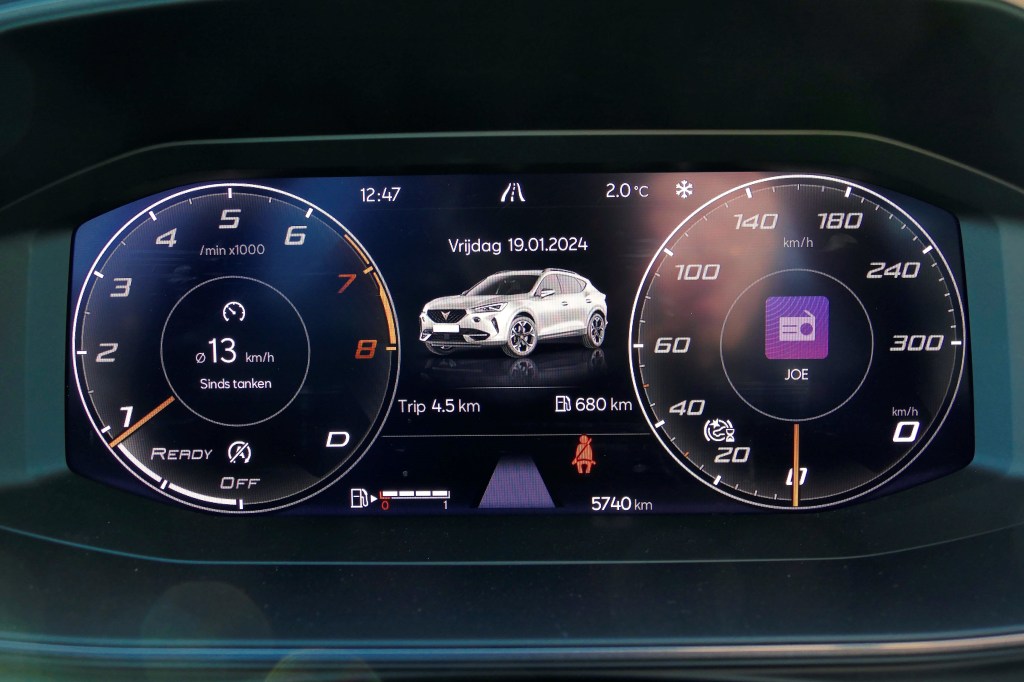
As soon as we push the starting knob and put the 7 speed DSG in “D”, we are impressed by the pulling power of this 2 litre unit, developing not less than 320 Nm of torque over a wide rev range, i.e. between 1500 and 4100 rpm. Not that you need any high revs to get ahead with verve, and indeed this is a nice big pulling engine for your svelte and relatively light Formentor, which only puts some 1521 kg on the scale. This is the Volkswagen Group EA888 series engine, a well proven DOHC unit with DCVV (continuously variable valve timing), developing 140 kW/190 HP between 4200 and 6000 rpm.

The performance leaves nothing to be desired. The acceleration figures speak for themselves: it costs only 7,3 seconds to reach 100 km/h, and the top speed is not less than 220 km/h. Aficionados will say this is more like a Cupra is supposed to be… Intermediate acceleration figures also speak volumes: from 60 to 100 km/h costs only 4 seconds, 80 to 120 km/h only 5,4 seconds.

The engine feels and sounds never stressed, and is silent and smooth. In combination with an alert DSG with fast and imperceptible changes and a variable 4 wheel drive you soon feel light-hearted and start truly enjoying this Formentor.

As revs remain low even with spirited progress, consumption stays very reasonable indeed. We achieved an average of 7,3 liters/100 km, with a fair amount of faster driving involved. We find this an excellent value. Of course, when one uses the performance to the full, well over 8 liters is consumed over 100 km, a figure which is however still quite creditable, given the performance achieved. CO2 emissions are set at 202 g/km.

Excellent handling

The 190 HP Formentor can be had optionally with the DCC variable suspension setup and you can choose between  good comfort up to firm sporting fit for razor sharp, flat cornering with virtually no body roll whatsoever. Combined with the sensitive and precise steering, it is a delightful car for the expert driver or the ordinary mortal who now and then wants to have some sporting pleasure behind the wheel. Motorway stability at (very) high speeds is excellent, and the steering is not too nervous, so this Formentor is totally fit for effortless high speed long distance driving.

During our test, we had a stint of (very) impressive snowy winter weather, so we were able to put the variable 4WD through its paces. It proved very efficient and kept us on the slippery and frozen snowy country roads always on the right path…

Conclusion

The Cupra Formentor really comes into its own with this lively 2 litre engine. The performance levels are excellent. In our country, the fiscal treatment of this version is not too good, and therefore one should – with this in mind – also have a look at the 1.4 litre e-Hybrid version(s), with 150 kW/204 PS and 180 kW/245 PS respectively. Maybe within the foreseeable future we can test one for you…

Stay tuned!

Hans Knol ten Bensel  

Abarth reveals the New Abarth 600e, the most powerful ever…

We don’t have to wait much longer now, the New Abarth 600e is undergoing final tests and will soon be making its first public debut in Milan, where shooting is going on at the moment of writing for its commercial film debut.

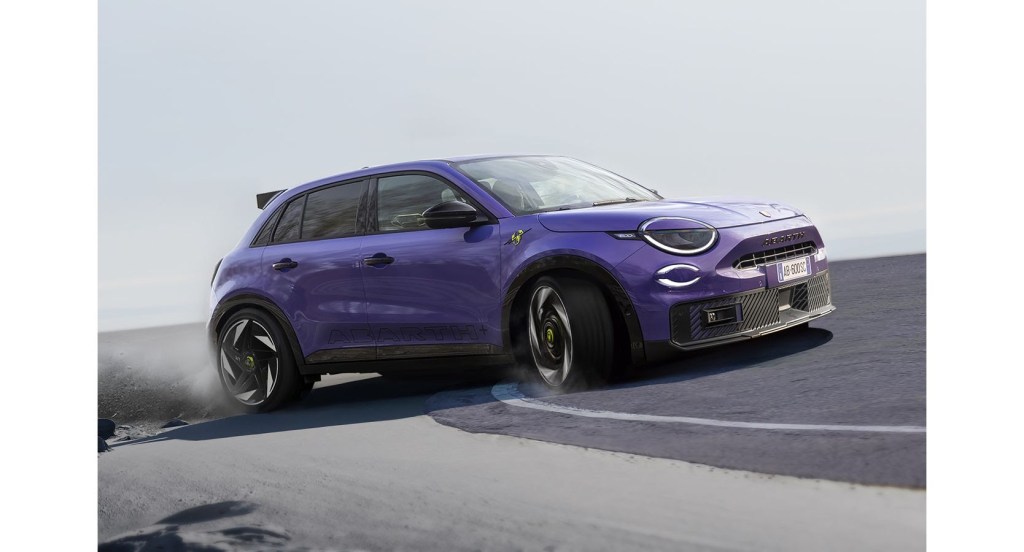
Here you see already a first picture, revealing  instantly the “evil” or “pur sang” character of the Abarth 600e Scorpionissima launch version, which will be produced in a limited-edition of 1,949 units.

Equipped with 240 HP, the New Abarth 600e Scorpionissima is fiercely competitive and powerful. There has never been a more powerful Abarth. Made to be unique in the field of electric cars, the Abarth 600e will feature a mechanical limited slip differential that guarantees excellent driving stability, improved handling, and traction.

The exceptional performance of the limited slip differential takes the car to new heights, especially when combined with its high-performance tires which were jointly developed with the supplier for Formula E to ensure maximum grip and guarantee excellent racing dynamics in all kinds of conditions. A harmonious equilibrium is attained by balancing performance and limited resistance, ensuring an improved range in an electric vehicle.

Looking at the car you can see it is clearly an Abarth! The exclusive Hypnotic Purple, the launch color inspired by the post-puncture hypnotic effect, highlights its aggressiveness, while the aerodynamic rear spoiler is designed to maximize performance.

It also has expansive wheels, a low profile, and 20-inch wheels designed to accommodate an extensive brake system.

For collectors and Abarth aficionados, the New Abarth 600e Scorpionissima will come with an authenticity certificate. And of course, there is more to come….like the Abarth 695 75° Anniversario limited edition, we will tell you about it also soon!

Hans Knol ten Bensel

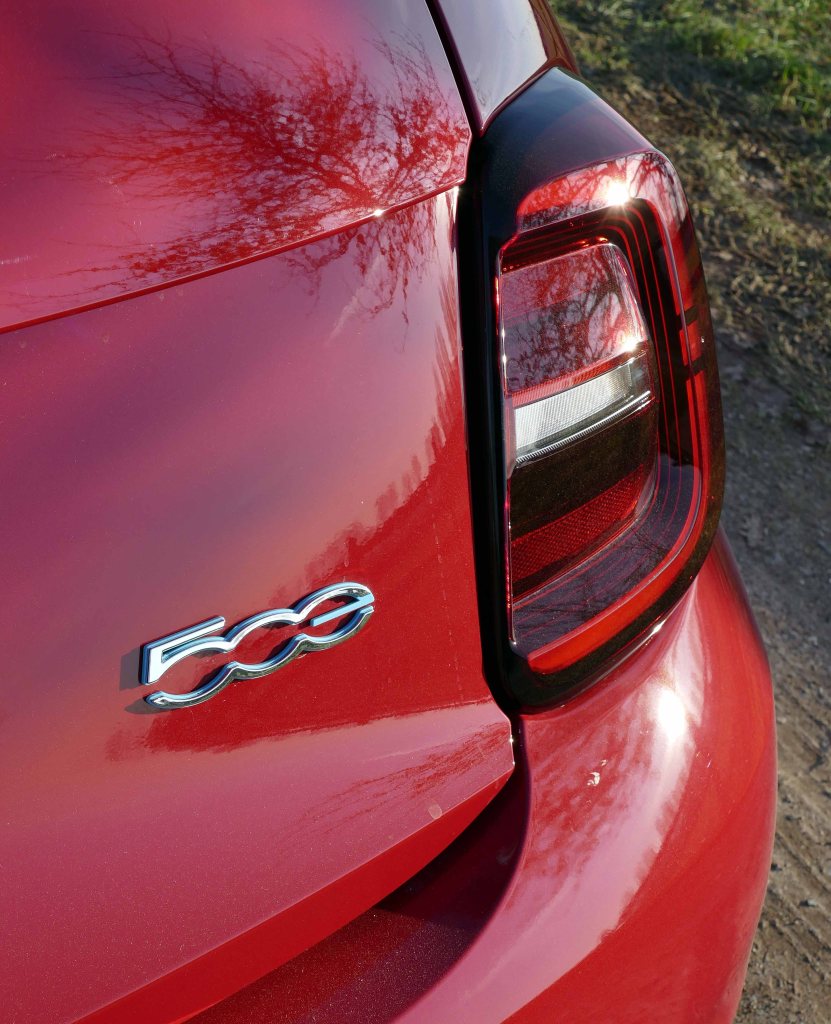
We drove the Fiat 500e “la Prima”: the endless fascination of a bestseller…

The Fiat Cinquecento has always been a car dear to our hearts, and we certainly are not alone in loving this car. It now continues since 2020 its successful career in EV form, and many say that this is the very best 500 ever. The popularity of the 500e is now indeed clearly written in the sales charts: it is an undisputed leader in the European A+B BEV segment with a market share of 14.7%.

Needless to say that we were very keen to take the wheel of this iconic city car for you here…

Just read further!

Hans Knol ten Bensel

Wonderful looks inside and out

The 500e is cute from any angle, and the “la Prima” version we tested has some extras which we came to like very much. Such as the full LED headlights with a special signature, making the front end even more attractive with its elegant round headlight contours. By the way, at night, the LED headlights offer of course excellent visibility.

We also loved the 17 inch alloy wheels with a diamond cut pattern, which suited our test car very well.

The proportions of the Cinquecento are nothing less than a stroke of genius. In the electric three door version now, the 500 has grown a bit in size, and thanks to a 60mm increase in length and width, it looks a more imposing car. It runs on a completely new platform, and it is also 4 cm taller, with a 2 cm increase in wheelbase. But the designers left the overall look untouched, and that is nothing short of an absolute masterpiece.

The interior is well finished, and the color patterns and textures of the surfaces were also pleasing to the eye. The finish level is also quite good. The instrument cluster houses very clear and “less is more” driver information, with a well positioned 10,25 inch touchscreen in the middle. Underneath this screen is thankfully an “analog” row of buttons for heating and ventilation.

Sound volume can be adjusted with a manual rolling button on the centre console, very neat and practical. On the left side of this sound volume control, you can choose between the different driving modes. Indeed, you can select either “Normal”, “Range” or “Sherpa”. The regeneration function when you release the throttle increases gradually, and in the “Sherpa” mode, you can easily drive without touching the brake pedal at all, as the deceleration is then quite marked. It takes only a little practice to learn this…Needless to say that this has a very positive effect on brake pad wear…who said that EV’s emit more brake dust than “classic” IC cars?

Stepping into the car, one notices immediately some big improvements. The driving position is now comfortable – it’s set lower and has a decent range of movement to the wheel and seat.

The front seats, elegant with their “Fiat” embossed finish are generously dimensioned, and indeed two up to 1,95 m persons can find a good position behind the wheel. This cannot be said for passengers in the back seat. Children and dogs can find a good home though, but anybody taller than 1,60 m will find life in the back seat rather cramped.

Thankfully, through the third door on the right side of the 500e “La Prima”, it’s easier to reach the back seat, and parents with toddlers will only appreciate this, as it makes (re)moving the baby safety seat more of a breeze.

Smooth performance…

The 500e “La Prima” has a 118 HP/87 kW electric motor, and a 42 kW battery pack. The motor drives the front wheels through a single gear transmission, and this means ultra smooth progress. Indeed, e-power refinement is also to be had in this iconic 500. Almost totally silent and of course vibration free, the 500e offers lively performance. However, we should not forget that with its batteries, the 500e puts somewhat more kilos on the scales, and it weighs 1,4 tonnes. Nevertheless, the 118 HP/87 kW motor develops a healthy 220 Nm of torque, so acceleration from lower speeds is quite brisk indeed. For example, it will jump from 15 to 30 km/h in merely one second and the classic sprint from 60 to 100 km/h costs only 5 seconds. Standing acceleration from 0 to 100 km/h is done in 9 seconds. This is (very nearly) as fast as the early Porsche 911… and indeed, subjectively, one has the impression that the 500e is fast in getting up to speed.

Top speed is limited at 150 km/h, but for cruising at legal motorway speeds, the 500e is well suited. Of course, as EV’s go, the range will dwindle dramatically at high cruising speeds. Remember, the 500e has this Sherpa mode, which limits the speed to 80 km/h. But then you have to get very friendly then with the big Scania’s and MAN’s who will overtake and outrun you…

Handling is quite good, with excellent stability in all driving situations. Comfort is adequate, rough sections with potholes and ridges will be felt quite clearly, so the 500e is not a comfort miracle, but it is not bad either.

Steering is pleasantly light, which is welcome for this urban car, and brakes are also very well up to the task.

A reasonable urban range

Speaking of range, maybe some BEV knowledge is useful here. Did you know that the outside temperature plays a significant role? Maybe more than you think. Let’s take a close look here for this “La Prima” with a 42 kW battery.

If we take (very) cold weather, with -10 sub zero temperatures, the range in urban driving is 230 km, when you are venturing on the highway in these wintry conditions, this dwindles down to 165 km. We want to tell here that for the highway, a constant speed of 110 km/h is assumed.

In summer, at a temperature of some 23 degrees with no A/C being used, city consumption rises to a rather impressive 355 km. On the highway in warmer spring weather, now 215 km are possible, but still with no airco. So you will just make a Brussels-Knokke quick retour. Not so formidable it? In winter, you can forget this. What’s more, if you have to make an unforeseen quick retour, it is hardly realistic to expect that your car is fully charged. Keep this in mind when you need to reach in emergency a sick parent or child at a certain distance…

So this means practically that this 500e is a town car, and fit for short commutes only, if you don’t have charging possibilities at home or your destination and/or want to make a quick (evening) retour with no time for recharging “en route”.

When it comes to consumption, the following figures are more realistic: for urban traffic 13,6 kW/100 km, on the open road approx. 18,0 and on the motorway 19,5 kWh/100 km. The official WLTP consumption is given at 14,4 kWh.

Smooth recharging

The 500e offers however the possibility of fast recharging, as it can recharge at up to 85 kW/h. Then you will charge in less than 30 minutes from 10 to 80 pct of the 42 kW battery charge. Practically, one will charge at 11 kW on most public charging points, and then it will take about 4 hours to get fully charged.

Infotainment and practicality

The Fiat 500 boot is pretty small, although there is underfloor storage for one of the two standard charging cables provided. In standard form, the boot space is some 200 liters; using the space until the roof, one has some 35 liters extra. Folding  the rear seats down and loading until the height of the window base, one can pack 460 liters.

You have a DAB+ radio, Bluetooth, 2x USB-A and 1x USB-C connections, Apple CarPlay and Android Auto, and an inductive Smartphone charging station. The navigation informs you about actual traffic situations and charging points. Via a Fiat-app you can heat/cool the car before you leave and be informed about range and charging points on your journey. Last but not least there is a nice JBL Premium-Soundsystem with 320 W system power…

 Conclusion

A formidable, cute looking, absolutely iconic urban BEV, that’s what this Cinquecento Elettrica “La Prima” is. Not the roomiest, nor the most comfortable, but then, with its possibility of having three doors, and even a cabrio version, it will continue to steal many hearts, as it has done so since it rolls of the production lines in the Mirafiori plant in Turin.

Hans Knol ten Bensel

Stellantis Belux unveils cars and future plans in a multi-brand car show …  

Indeed, the  Management and PR team of Stellantis Belux, welcomed recently the Press and B2B to a, called ‘House of Innovation’.

A fitting initiative, set up in the absence of the Brussels Motor Shows, keeping the tradition in our country of a traditional show period and at the same time providing a platform for unveiling the latest innovations, concept cars and the future direction of the Stellantis brands.

Needless to say we were very keen to attend this event, giving your servant also the opportunity to have several interviews with the managers of several brands, which we will present soon on our columns. Here in this first report about this “Kickoff Press conference” we will focus on the future strategy of Stellantis and its plans for the Belux market. Just read further!

Hans Knol ten Bensel

The event started with an inspiring introduction by Florian Kraft, CEO of Stellantis Belux

…followed by interactive brand presentations and workshops. “This event symbolizes our continued pursuit of innovation and progress in the automotive world. We are excited to share our latest developments and our vision for the future with the press and our valued customers and partners,” said Florian Kraft, CEO.

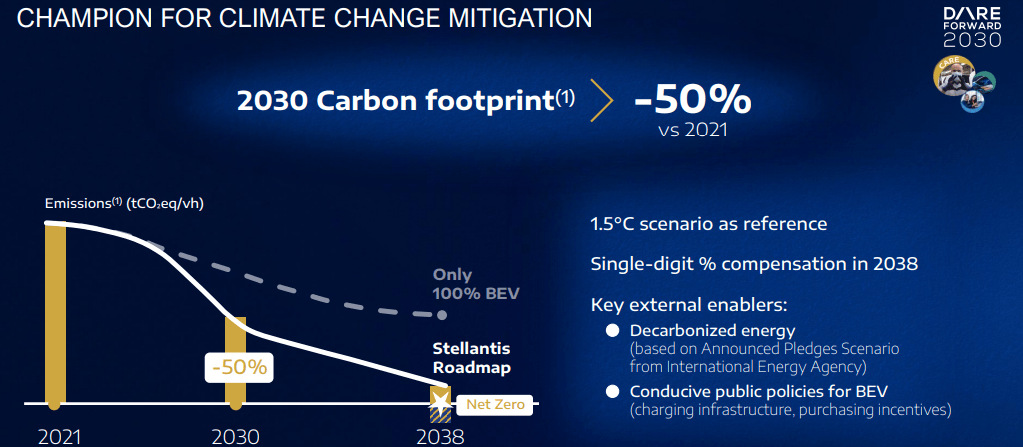
Florian Kraft first pointed out the four core targets of the Stellantis “Dare Forward strategic plan 2030.” This plan will move Stellantis into a sustainable mobility tech company.

The first target is reducing its carbon footprint by 50 % in total CO2 emissions per vehicle compared with 2021, on the path to achieving carbon net zero in 2038. This then includes not only from well to wheel, but also throughout the entire supply chain. 

The second target is setting the course for 100% BEV sales in Europe and 50% in the United States in 2030. The third is achieving number one position in customer satisfaction. The fourth is doubling net revenues while transforming our business models and sustaining double-digit operating margins. How Stellantis will achieve this, will be the subject of a future report in our columns. Stay tuned!

Ambitions for 2024…

Looking ahead to 2024, Stellantis Belux has set itself several goals. In terms of network, the company aims to ensure a successful transition to the New Retailer Model using its existing network. Indeed, Stellantis is progressing at full speed in the execution of its Dare Forward 2030 Strategic Plan, with the ambition to be #1 in customer satisfaction in all markets, in products and services. Indeed, the customer experience will be at the core of this retailer model.

Customers will be able to take advantage of a multi-brand and multi-channel approach with a wider range of services. Dealers will have a new and efficient business model aimed at benefitting from Stellantis’ 14-brand portfolio, creating synergies, optimizing distribution costs and offering additional sustainable mobility solutions, says Stellantis. So far for the aims, let’s explain this further in more concrete terms.

In September last year, Stellantis launched the reorganization of its European dealer network, starting with four specific markets before extending it further across Europe in 2024. Stellantis announced it was ending its previous sales and services contracts with European dealers for its 14 brands and moving toward a new distribution framework based on an agency model. What is this agency model?

Under this model, the manufacturer becomes the retailer while the dealer remains the physical touchpoint with the customer. The agent/dealer receives a commission on each sale and no longer individually sets prices or discounts.

As the dealer does not have to purchase the cars from the manufacturers anymore, he does not carry significant commercial risks and has less administrative costs as billing and payment towards the customer is done by the manufacturer. It protects also the profitability of the retailer. Because, as everybody knows, profit margins on new car sales can fluctuate.

With the Lancia Pu+Ra HPE, the Lancia journey towards the future begins, drawing inspiration from the past

The advantage for the car manufacturer is a direct contact with the customer, which it did not have so far….

The manufacturer can now determine end-customer discounts themselves, in this way achieving price consistency and avoiding  competition between dealers of the same brand. They can optimize costs through centralization, and profit from the scale effect of transferring responsibilities from individual dealerships to the bigger sales organizations on national levels.

The new Alfa Romeo Stradale: the future is already a pur-sang reality…

It also is more in line with today’s consumer preferences, which would rather see fixed prices and an equally simple buying process as they experience in e-commerce.

Stellantis is moving towards this model in big steps now. In September last year, Stellantis announced that the revised retail model will be fully effective from Sept. 4, starting with Austria, Belgium, Luxembourg and the Netherlands. Stellantis is not the only one to prefer this agency sales model. BMW and Mercedes opt for it too…

The BEV line up at Peugeot: towards a leading position in the B and C segment…

Stellantis market position in Belux …

In terms of sales, Stellantis Belux aims to regain the lost market share in 2024 and further strengthen its position. In 2023, Stellantis Belux achieved a global market share of 17.2%, with more than 100,000 units sold. On the LEV (Low Emission Vehicles) market, Stellantis Belux occupies a fourth place with an 11.6% market share. The BEV (Battery Electric Vehicle) and the PHEV (Plug-in Hybrid Electric Vehicle) occupy a fourth place with respectively 10.5% and 12.8%.

Stellantis Belgium confirms its strong position with a pole position in the segment A and with not less than six models of Stellantis (Peugeot e-208, Peugeot e-2008, Opel Corsa Electric, Jeep Avenger, Opel Mokka Electric, DS3 E-tense) in the TOP 10 of the segment B (BEV), representative 66% of the part of the segment.

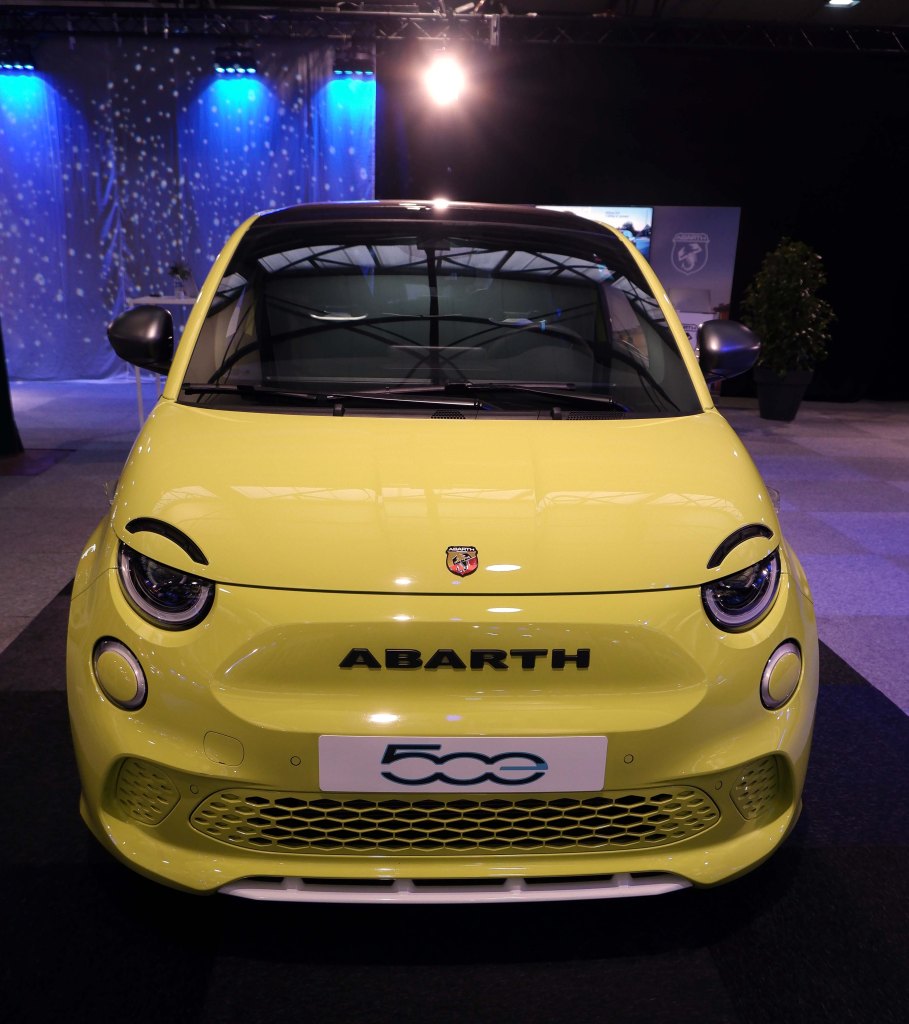
Introducing petrolheads to the joys of E-power: the Abarth 500 E, waiting for the imminent 240 HP 600 E…

Last but not least, Stellantis Belux is the leader in the segment of the LCV (Light Commercial Vehicle) with more than 30% of market share, of which more than 50% is electrified!

In terms of product innovation, Stellantis Belux will continue its electrification, where it currently leads in the A-B segment and LCV, and further expand it to the C segment with models such as the Opel Astra, Peugeot 308 and 3008 and Citroën C4.

As is tradition in January, the Stellantis brands start the year with super attractive “salon conditions” on their range. This applies to both private and professional customers and to electric and ‘thermal’ vehicles.

We made on this event interviews with Pierre Voineau, Managing Director Citroën Belgium & Luxemburg, (see photo here above), Asterio Perez, Managing Director of Fiat, Abarth and Fiat Professional in Belgium and Luxemburg, and last but not least Eric Laforge, Head of Jeep Brand Enlarged Europe.

This will be followed by a special report on the magnificent prototypes which were displayed amongst the 36 cars on this conference.

So stay tuned for (much) more soon!

Hans Knol ten Bensel

We drove the Peugeot 408 GT 225 HP hybrid : French style and panache…

Peugeot is well known for its outspoken design, and the latest version of the 408 sedan is no exception. We all know that we live in a time where imposing SUV’s are all the rage, but then Peugeot, with an eye towards automotive tradition, will always keep an attractive sedan in its range, and the 408 is the result.

Did you know that the bodywork definitions ”sedan” and ’limousine” are French? The definition “sedan” stems from the French town of that name. The definition ‘limousine’ comes from the French region “Limousin”. In automotive terms, it is a luxury saloon, in horse-drawn world, it is a utilitarian cart or any big cart with three lateral windows. 

But then, is this Peugeot a “classic” sedan? Well, no! Just read further…

Hans Knol ten Bensel
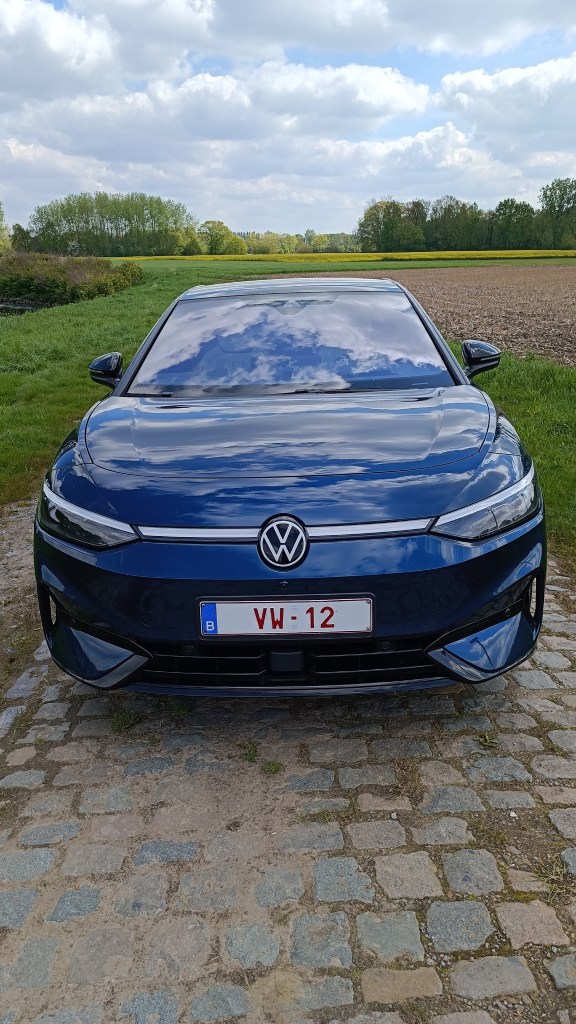
According to Peugeot, the 408 is a blend between SUVs, hatchbacks and saloons, and has been described as a “coupe crossover.” Indeed, with the Peugeot 408, the brand with the proud lion introduces nothing less than its own segment, that of a raised fastback sedan.  Actually the present day 408 is based on the EMP2 platform, shared with the third-generation 308.

The development of the vehicle, led by project manager Aurélie Bresson, PSA Group took several years due to its radical concept, codenamed as the P54 during development.  

The design was inspired from an internal concept car that Peugeot had worked on, which was known as the “2015 Advanced Design” manifesto. Its design concept is also featured in the Citroën C5 X, which shares the same platform (long-wheelbase EMP2 V3) and height with the 408. Indeed, the family resemblance is manifest, and the long-legged stable and very comfortable road manners are similar.

The 408 is bold and elegant. Peugeot calls it also a fastback (indeed, because of its fifth door) and places it at the top of the C segment. Peugeot also states that the car exudes “allure” and, as we said earlier in our article at the static presentation of the 408, we liked the angular shapes and its well accentuated contours , with remarkable styling details like the inverted cut-out of the rear bumper. We also liked the 20- inch rims featuring an interesting geometric design, and we already pointed out in our colums (see https://autoprova.be/2022/09/14/bold-and-beautiful-angular-and-elegant-the-new-peugeot-408-is-a-fastback-with-panache/) we appreciated that the tire rims protrude further than the alloy rims and thus protect them, so you cannot readily damage the beautiful wheels at the first high kerbed stone you meet.

The future smiles at you in the cabin…

The bold and angular futuristic styling continues in the dashboard and cabin layout. Indeed, the PEUGEOT 408 offers the latest generation of the PEUGEOT i-Cockpit®, instantly recognizable by its compact steering wheel dedicated to driving pleasure and controlled agility. The compact steering wheel puts you indeed in a sporting mood and encourages you to drive this 408 with slightly more verve, but then you have to concentrate on finding a proper seating position so that your vision on the instrumentation is not (partially) blocked by the enthusiastically shaped steering wheel.

Driving: the joy of French comfort, grace and speed… Peugeot attaches great importance on comfort combined with safe, superior and predictable handling. The 408 scores beautifully in all these points. The 408 takes comfort to a very high level, even on frost-ridden secondary roads, wet routes nationales or départementales, and floats over it at (high) speed with undisturbed stability, to take you swiftly and safely to your destination. Traveling big distances is a boon for this 408. As said here earlier, it bears resemblance to the road manners if the “big” Citroën C5 X.

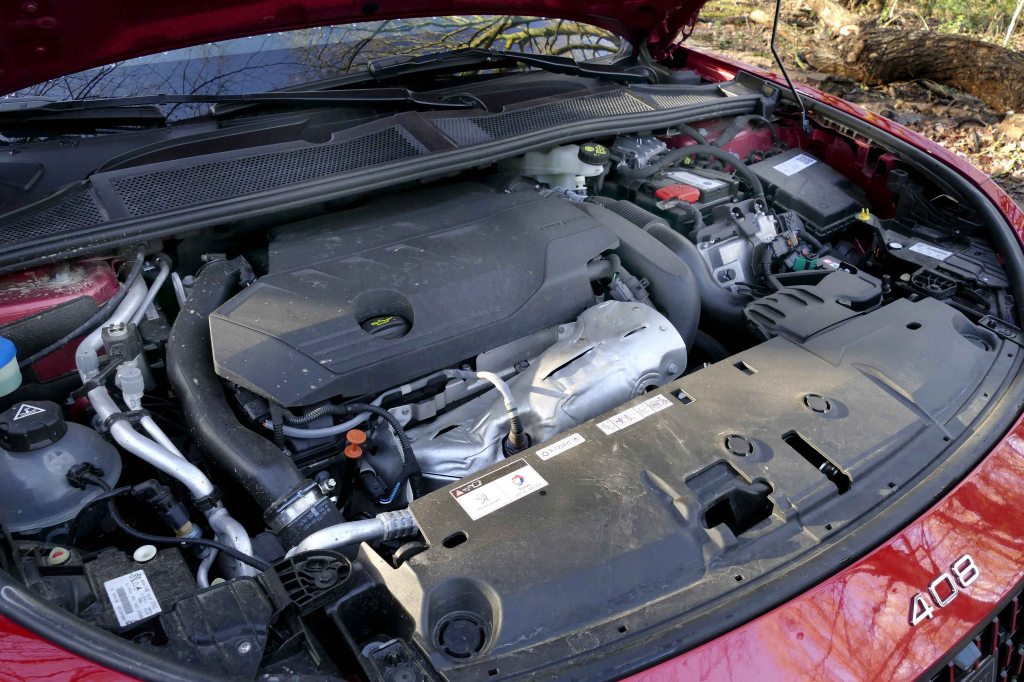
The test car was equipped with the top-notch drivetrain, in the PHEV version we tested. The 1,6 litre efficient four cylinder petrol engine develops 180 HP at 6,000 rpm, with torque being 250 Nm @ 1750 rpm. But there is also an electric motor of 110 Hp @ 2500 rpm sitting between the petrol engine and the 8 speed automatic transmission. The impressive torque of this motor, namely 320 Nm, is developed between 500-2500 rpm. All this results in a system power of 225 HP, and a system torque of 360 Nm.

This results of course in (more than) excellent performance. It will sprint in about 7,9 seconds from 0 to 100 km/h, and its top speed is a stellar 233 km/h. Abundant torque at every speed makes for a delightful performance experience. This car is well and truly a fast Gran Turismo. Mind you, this is nothing less than the performance of the iconic Jaguar E-Type!

Consumption depends greatly on how often you charge its 12,4 kW battery. According to WLTP standards, it is set at 1,4 l/100 km. Running it on petrol power, you can expect anything between 6 and 8 litres, depending on your driving mix between town and open road. You are helped by the relatively low weight (1.781 kg) of the car, and its excellent aerodynamics.

A roomy and practical daily companion

The 408 offers a lot of legroom on the elongated platform it shares with the Citroën C5 X. Boot space is also abundant, with a volume of 536 litres, which can be increased to 1.611 litres, once the rear seats are folded down.

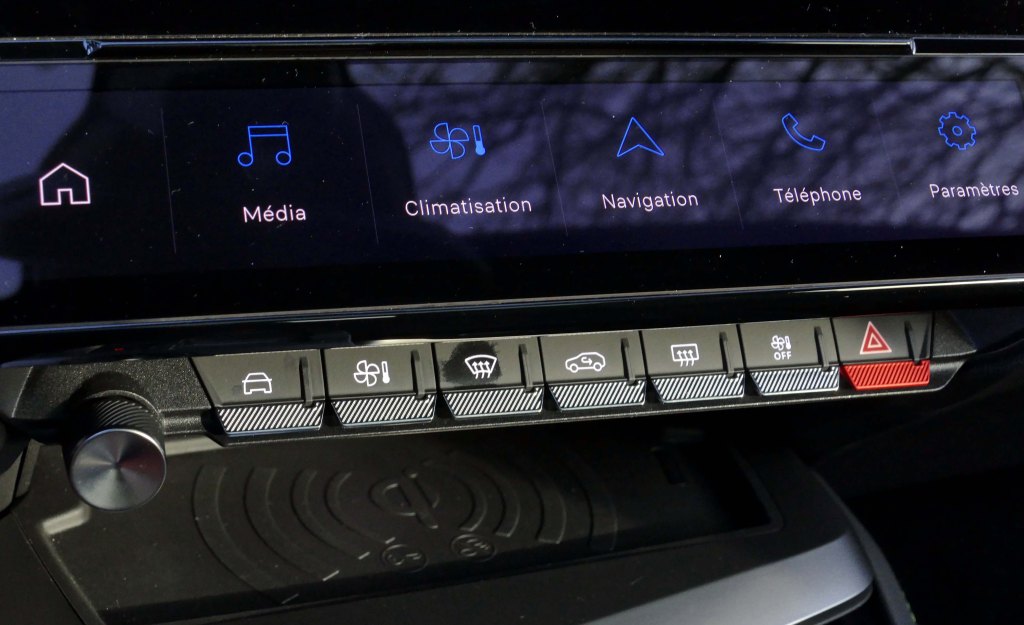
The 10 inch touchscreen gives you all the necessary navigation and infotainment info, and the 408 pleases with puttons and switches on steering wheel and below the touchscreen for all the usual functions.

Of course, this 408 offers all the thinkable driver assistance and safety functions. Powered by 6 cameras and 9 radars, the driver assistance systems include adaptive Cruise Control with Stop and Go function,  Night Vision, which warns of animals, pedestrians or cyclists ahead before they appear in the high beam, Long-range blind spot monitoring (75 metres) and last but not least Rear Traffic Alert, which warns of a potential hazard when reversing.

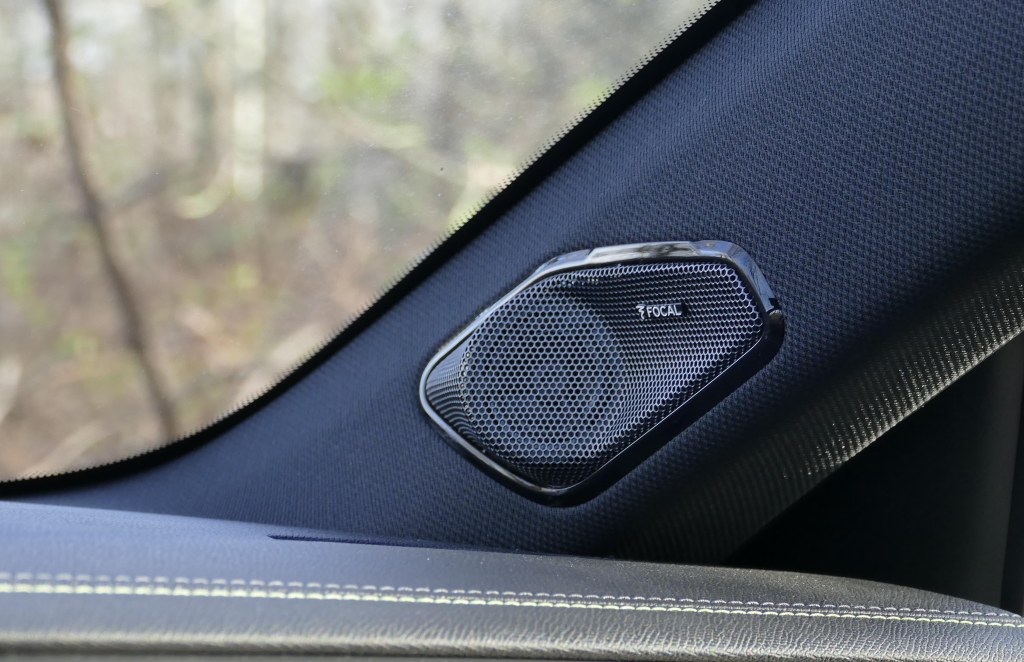
All this contributes to driving pleasure, which is indeed overall a very relaxing experience. Intuitively you will feel very much at home and rather sooner than later you will come to enjoy the excellent sound system and find every drive with this Peugeot a “Zen” moment in your (busy?) day…

Conclusion

Peugeot has truly succeeded to create a roomy four passenger comfortable Gran Turismo which gives you a soothing driving experience, where you can enjoy refinement, experience the unique panache of French comfort together with unerring stable handling and the sheer pleasure of the speed and performance of a “grande routière.”

Combine all this with responsible energy consumption, E-power capacity in town, smoothness and mechanical “raffinement” all packed in a bodywork with stylish “allure”, and you will agree that this Peugeot has a lot to go for…

Hans Knol ten Bensel  

Nissan Benelux unfolds her strategy for the Benelux market…

Managing Director Jerome Saigot unfolds the strategy of Nissan Benelux…

We are at the start a new automotive year, and therefore it is a good opportunity for manufacturers to look forward into 2024 and announce to the Belgian press what their strategy, plans and objectives will be in the forthcoming 12 months.

So we were invited at the end of last year by the Melvin Keuter, head of communications of Nissan Benelux at their press conference…and their interesting initiatives are certainly worth a closer look. Just read further!

Hans Knol ten Bensel

Melvin Keuter, head of communications of Nissan Benelux, exposed the electrification strategy of Nissan and its future…

Nissan Belux and Nissan Nederland merged into Nissan Benelux

On the 1st of July last year, this merger was executed in order to improve response to the needs of the Benelux market. Now the two entities are joined in a new so-called Regional Business Unit, led by Managing Director Jerome Saigot. Indeed, the car market is going through a fundamental transition, and Nissan will respond to these challenges by focusing on electrification, digitalization of the customer approach and responding to major changes in the buying behavior of their clients. Mr. Saigot emphasized these points of the strategy in his presentation at the press conference. He sees also in this merger further useful synergies for staff and dealerships.

He exposed the mission of Nissan Benelux, which is to be an innovative brand which offers electrified mobility and a superior service to its customers. Its objectives are to enlarge its volume, raise brand identity and awareness as well as boosting profitability.

The strategy to achieve this will be to focus, as we said, on further digitalization of customer approach, further electrification of the model range, strengthening corporate sales, bolstering brand identity and streamlining distribution.

According to Jerome Saigot, digitalization is a major trend which will strengthen further. In 2020, only 4 % of customers were buying a car online, which has risen to 12 % in 2023. Market surveys show that soon 45 % of the future customers will buy their car online. Of course, Nissan will work further on its electrification, and indeed focus also increasingly on corporate sales.

Looking at the results last year of Nissan Belux, 6.750 units were sold, which is an impressive 48 % rise compared to FY 22.

Also in distribution and dealership the focus will be on further developing synergies and tailoring the customer approach on their changing preferences and buying behavior. In December last year, Nissan sent a message to the professionals, small and medium enterprises, craftsmen and the like, pointing out the attractiveness of their increasingly electrified LCV segment.

Decisive steps toward further electrification… or EV36Zero.

EV36Zero is a key part of Nissan Ambition 2030. In this period Nissan will deliver exciting, electrified vehicles and technological innovations while expanding and transforming its operations globally the company announces. The vision supports Nissan’s goal to be carbon neutral across the lifecycle of its products by fiscal year 2050.

In November last year, Nissan announced that the EV36Zero hub in Sunderland, Nissan’s blueprint for future manufacturing, will consist of three electric vehicles (EVs), three gigafactories and up to £3bn investment.

The transformational project includes future all-electric versions of Nissan’s flagship Qashqai and JUKE crossovers, and Nissan also confirmed that the third vehicle planned for UK production will be next-generation Nissan LEAF.

Nissan also announced that that it expects its passenger car line-up in Europe to be 100% electric by 2030.

Nissan is also incorporating in their electrification strategy the latest developments in battery technology. It will adopt Cobalt-free batteries, and towards 2028 there will be a cost reduction in comparison with Lithium-Ion batteries of not less than 65 %. This year Nissan will open a pilot factory in Yokohama to produce solid-state batteries, which can be charged three times faster and cost much less. They will be introduced to the market in 2028…  

Looking into the future…

After exposing the good qualities of the present range, a veil was lifted in this conference about the cars we can expect in the (not so) distant future.

Indeed, the three future versions of the full electric Juke, Qashqai and Leaf will be inspired by three exciting all-electric concept models, two of which were recently unveiled at the Japan Mobility Show:

The Nissan Hyper Urban Concept, a crossover EV characterized by a sleek and modern aesthetic.

The Nissan Hyper Punk Concept, an all-electric compact crossover with an exterior aesthetic defined by multifaceted and polygonal surfaces.

The Nissan Chill-Out Concept, was unveiled in 2021 and previously confirmed as the inspiration for a future EV to be built in Sunderland.

 The car is a compact, sporty, city EV concept with an influence from the world of virtual gaming. Besides the sleek and modern design, advanced safety technology, it has a productive and comfortable interior space.

The Chill-Out, – see photo here above – which looks to us as a very realistic concept car which we might see on our roads in the (very?) near future, utilizes the CMF-EV platform.

The Nissan Hyper Urban Concept – see photo here above – was announced at the 2023 Japan Mobility Show; its styling complements the sophisticated tastes of its target users, such as urban and suburban based professionals who prioritise environmental sustainability.

This all-electric crossover concept is designed to remain up to date for every new owner, ensuring an extended lifecycle through regular software and hardware upgrades, aiming to achieve the utmost sustainability. To maximize this further, the vehicle seamlessly integrates into the electric vehicle ecosystem (V2H/B/G), for power sharing.

Last but not least, there is the Nissan Hyper Punk concept was also announced at the 2023 Japan Mobility Show.

It is positioned as an all-electric compact crossover concept, catering for a dynamic audience seeking self-expression through style and creativity. It offers owners a canvas for self-expression with its polygonal-shaped exterior with dynamic color changes.

Further styling exercises: the Nissan Concept 20-23

To celebrate the 20th anniversary of Nissan Design Europe (NDE) being located in London, Makoto Uchida, Nissan’s President and Chief Executive Officer, visited NDE in September last year to unveil an all-new sporty urban electric concept car called Nissan Concept 20-23.

The car certainly turns heads, as you can see from the accompanying photo. It was designed by a team including some the younger members of NDE, with the simple brief to design a car – with no constraints – which they would like to drive on the streets of the city where they work.

Of course there is the present range of Nissan, with the Juke, bestseller Qashqai and Ariya. Last but not least also the Leaf. Head of Marketing Rémy Le Gall presented them. See photo here below.

Soon we will refresh our driving impressions of these cars for you, and tell you then more about their unique qualities. Stay posted!

Hans Knol ten Bensel  

The VW Golf is now 50 years with us!


The “Ur” Golf, which looks still quite “modern”, 50 years later.

Many people will say that things are changing rapidly, and many things have disappeared or are not what they used to be. Well, we can be sure of one thing: the Golf, the heart of what Volkswagen as a car manufacturer stands for, is still amongst us.

Indeed, during five decades already, the Golf still accompanies us in our automotive life. Since 1974. Then your servant got married, and drove indeed the first Golf as a test car, and has the fondest memories of this first series, especially when testing the Golf GTI. This sporting Golf created nothing short of a legend. 50 years later, the sporting sound of its 1,6 liter 110 HP engine still seduces, as does its handling and acceleration.

The stuff of eternal legends: the Golf GTI

To me, even this very first series is still a “young” car. The straight-line design created by Giorgetto Giugiaro is timeless, the proportions are just right, the “Ur” Golf still looks good from any angle. Just read further…

Hans Knol ten Bensel

An instant hit…

The Golf set out to win hearts. The Golf quickly became a true “Volkswagen”, and the first million units were sold as early as 1976. Now, more than 37 million Golf’s have hit the road.

Over the decades, the portfolio has been expanded to include further variants: besides the GTI, there was also the Golf Cabriolet or Golf Variant, or many others.

With each new model generation, state-of-the-art technologies, safety concepts and convenience features have been incorporated into the compact class. The Volkswagen Golf has thus democratised not just technologies such as the monitored catalytic converter and anti-lock braking system, but also airbags, cruise control and electronic assist systems as well as mild and plug-in hybrid drives.

In the anniversary year 2024, Volkswagen will present the evolutionary development of the eighth Golf generation. It will impress with visually refined features, new assist systems and powertrains, and also next-generation infotainment systems and software. The world premiere of the new Golf is just a few weeks away, with pre-sales scheduled for spring 2024.

Keeping history alive Volkswagen Classic will also accompany the Golf in its anniversary year and will present historic Golf models from the Volkswagen collection on numerous occasions. First rendez-vous is in Paris. From 31 January to 4 February 2024, the Golf Generations I to VII will enhance Volkswagen France’s presence at the “Salon Rétromobile” show in Paris.

Directly afterwards, from 2 to 4 February 2024, Volkswagen will show a Golf I and the unique EA 276 concept car – the Golf predecessor from 1969 developed in Wolfsburg – at the “Bremen Classic Motorshow”.

A long history… with a touch of NSU

In this first report we will focus on the first series. The concept was nothing less than a complete technical revolution for Volkswagen. They had already acquired NSU in 1969, and so the technology of in-line engines was already present in the group, with the VW K70, originally an NSU design, and the famous Prinz 1000 to 1200 TT’s. The K70 was also a front wheel drive car, and the art of “Leichtbau”, or making light bodyworks, was also already acquired with this car.

Technical forerunner of things to come: the in line 1000/1200 cc four cylinder of the NSU Prinz in the late sixties, still air cooled however…

So the beacons were set in terms of technical product design and manufacturing engineering, to make a mass produced light car with transverse 4 cylinder in line engine.

The new Golf was light, some 165 kg lighter as the Beetle. The styling was done by Italdesign under the direction of Giorgetto Giugiaro. The first Golf is also beautifully compact: only 370 cm long. It had some good power, a healthy 50 HP with the basic 1100 cc engine, and 70 HP with the 1,5 litre engine. So the performance was something the Beetle could only dream of. The chassis, suspension and handling were also in another league. On top of it all, the Golf was cheaper to produce, but cost 600 Euros more than the last Beetle 1303…

In 1976 came the Diesel and the GTI version, and as I said, from that moment on, the “modern” VW was a fact…
More soon about the Golf history…

Hans Knol ten Bensel