Audi Brussels has undergone a total transformation over the last three years in becoming the production site for the Audi e-tron 55 Quattro, and you can read more about this plant in our columns here.
The front e-engine of the Audi e-tron is put in place on the front axle on the Audi Brussels production line…
At the helm of this rebirth stood Patrick Danau, and with his team he made the factory in the heart of Europe into a leading plant for electric mobility. This was his final challenge and crown on his long and successful career, as he celebrated his retirement last week.
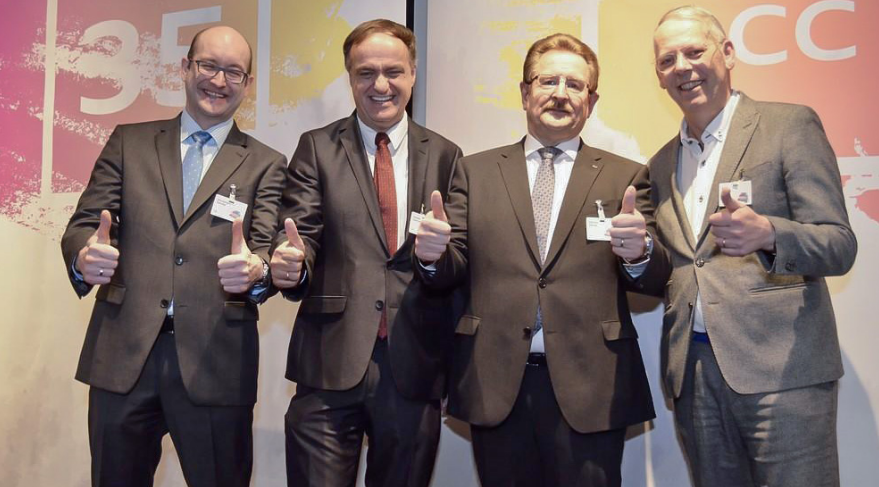
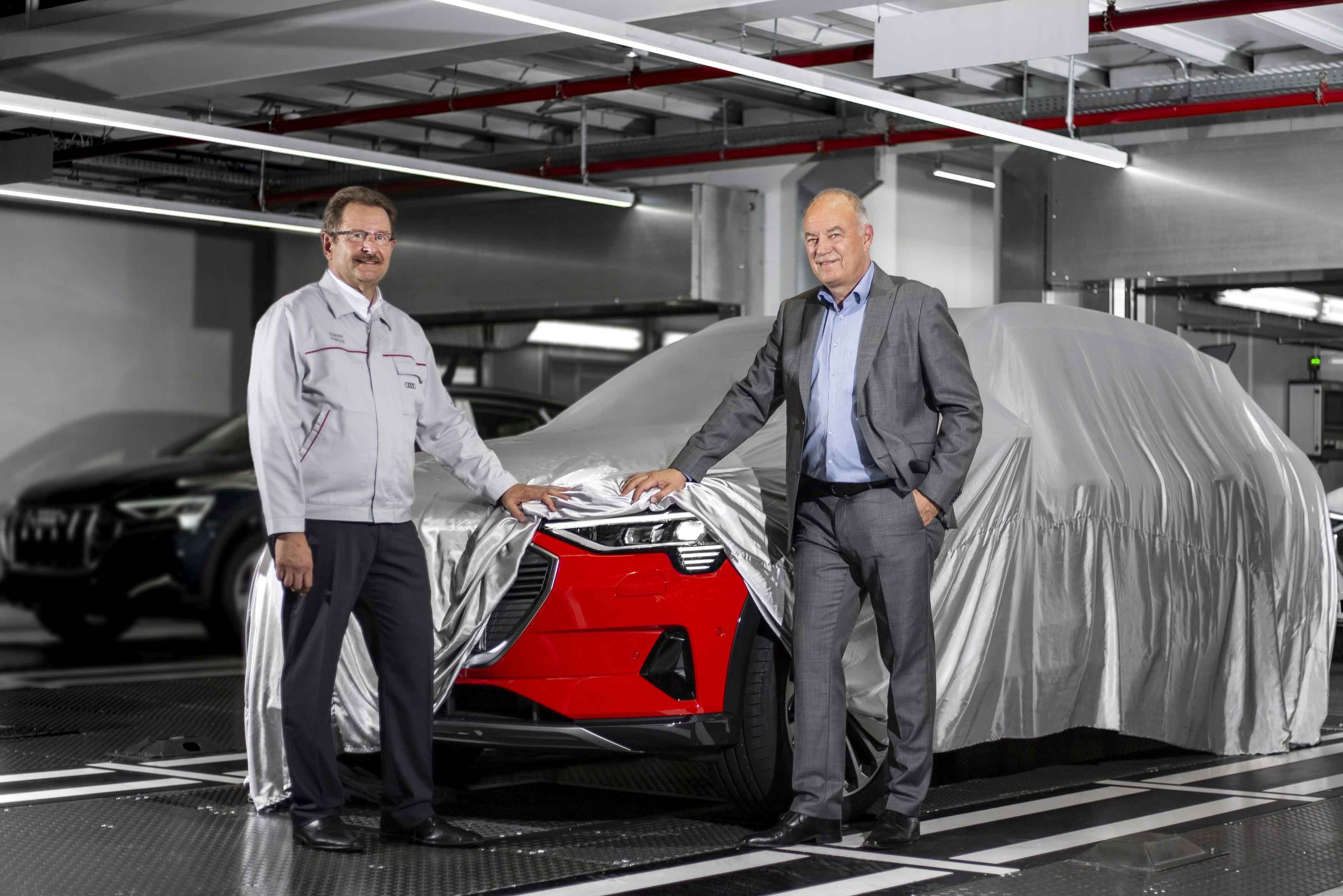
On this photo, from left to right: Christoph Herzig, General Director Finance, Volker Germann, new Managing Director, Patrick Danau, former Managing Director, Eric Prieels, General Director HR.
The graduate engineer had known the
Brussels plant since 1978, when he began his career in the assembly section of
the former VW plant in Brussels. After numerous positions in Group companies
around the world, Danau found his way back to Brussels in 2014, where he worked
for the past five years as General Director for Production, Technology and
Logistics and Spokesperson of the Management. “For me, my professional life has
come full circle: I am now ending my career where everything started for me
more than 40 years ago. I could not have imagined a better conclusion at the
end of my career than the production of the Audi e-tron.”
A new director with a vast international experience, spanning from Brazil to China…
Volker Germann is now the new managing
director at Audi Brussels. Within the executive board of Audi Brussels, Volker
Germann will hold the positions of General Director for Production, Technology
and Logistics and Spokesperson of the Management.
“With Volker Germann, a proven production
expert with great international experience has come to the Brussels site. We
are delighted that we have been able to gain him for this task,” says Peter
Kössler, Chairman of the Administrative Board of Audi Brussels and Member of
the Board of Management for Production and Logistics at AUDI AG.
Germann has been working successfully for
the Volkswagen Group and Audi for many years. He has a acquired a vast
international experience. He graduated in engineering at the College of
Technology in Mannheim and began his career in 1986 as an employee in central
planning for painting and assembly at VW. But in 2009 already, the distant
horizons called, and he became managing director at VW do Brasil in Curitiba.
In 2016, Volker Germann became managing director of the FAW-Volkswagen joint
venture in Changchun, China. The Audi A4 L, Audi A6 L, Audi A6 L e-tron, Audi
Q3 and Audi Q5 L model series are built for the Chinese market in that city, which
has a population of approximately seven million.
Germann is now looking forward to the new
professional challenge in the European capital: “The Brussels plant is
currently carrying out one of the most important ramp-ups at Audi. Under the
leadership of Patrick Danau, the factory has prepared itself optimally for this
task. I am happy to be able to help shape the dawn of the age of e-mobility and
the production of vehicles with completely new drive technology. I am now part
of the team that is putting the Audi e-tron on the road with great passion and
skill.”
The Audi e-tron houses its batteries in a floorpan housing, which is waterproof and crash resistant…
When talking about the production of the impressive Audi e-tron on the Brussels site, the batteries are an intriguing part of the driveline. We take a closer look at it here, and show you some very interesting drawings provided by Audi Media…
Hans Knol ten Bensel
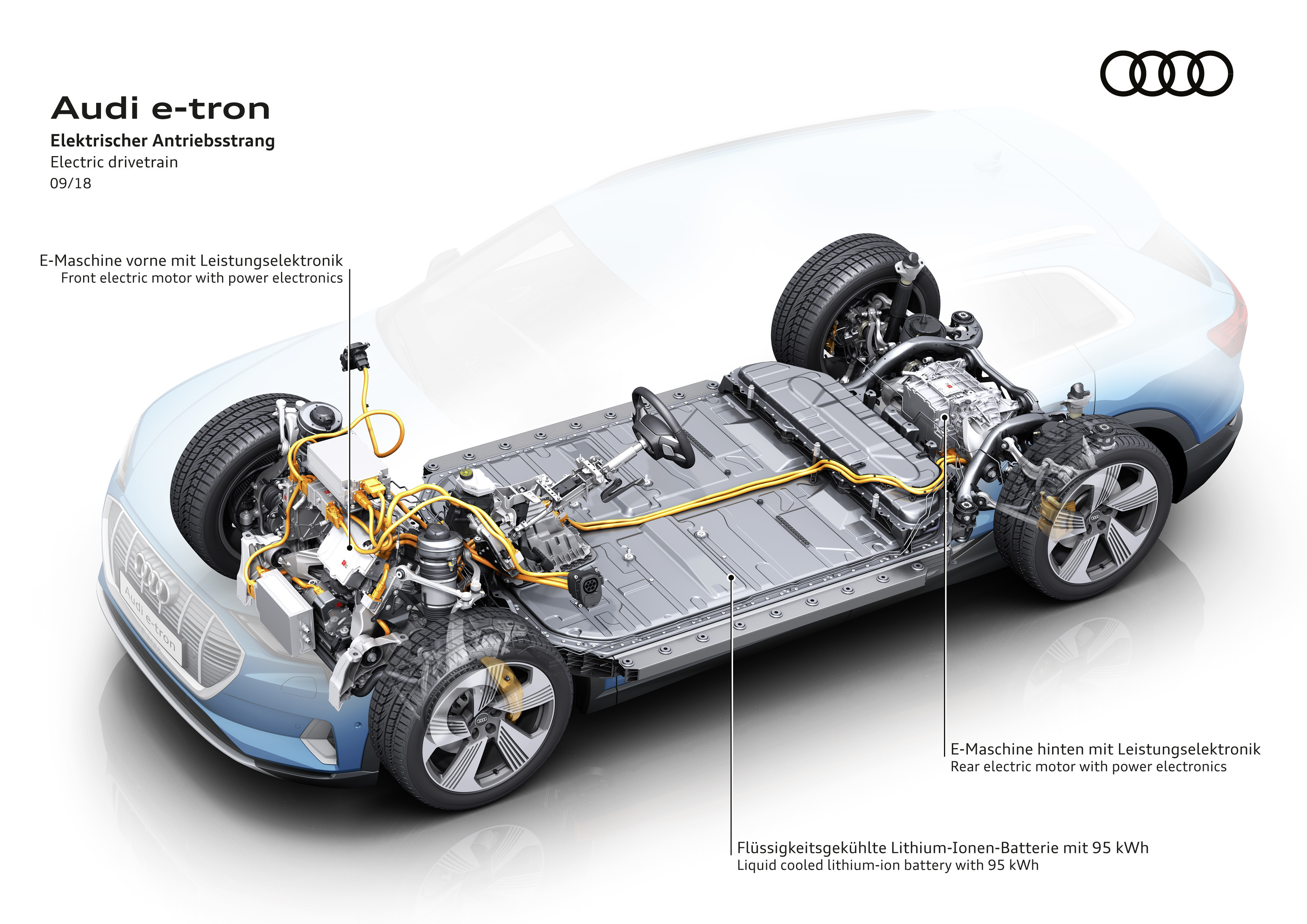
The large lithium-ion battery in the Audi e-tron provides for a range of more than 400 kilometers (248.5 mi) in the WLTP driving cycle. The battery operates with a nominal voltage of 396 volts and stores 95 kWh of energy.
Electric drivetrain in detailed view (ctrl + to enlarge)
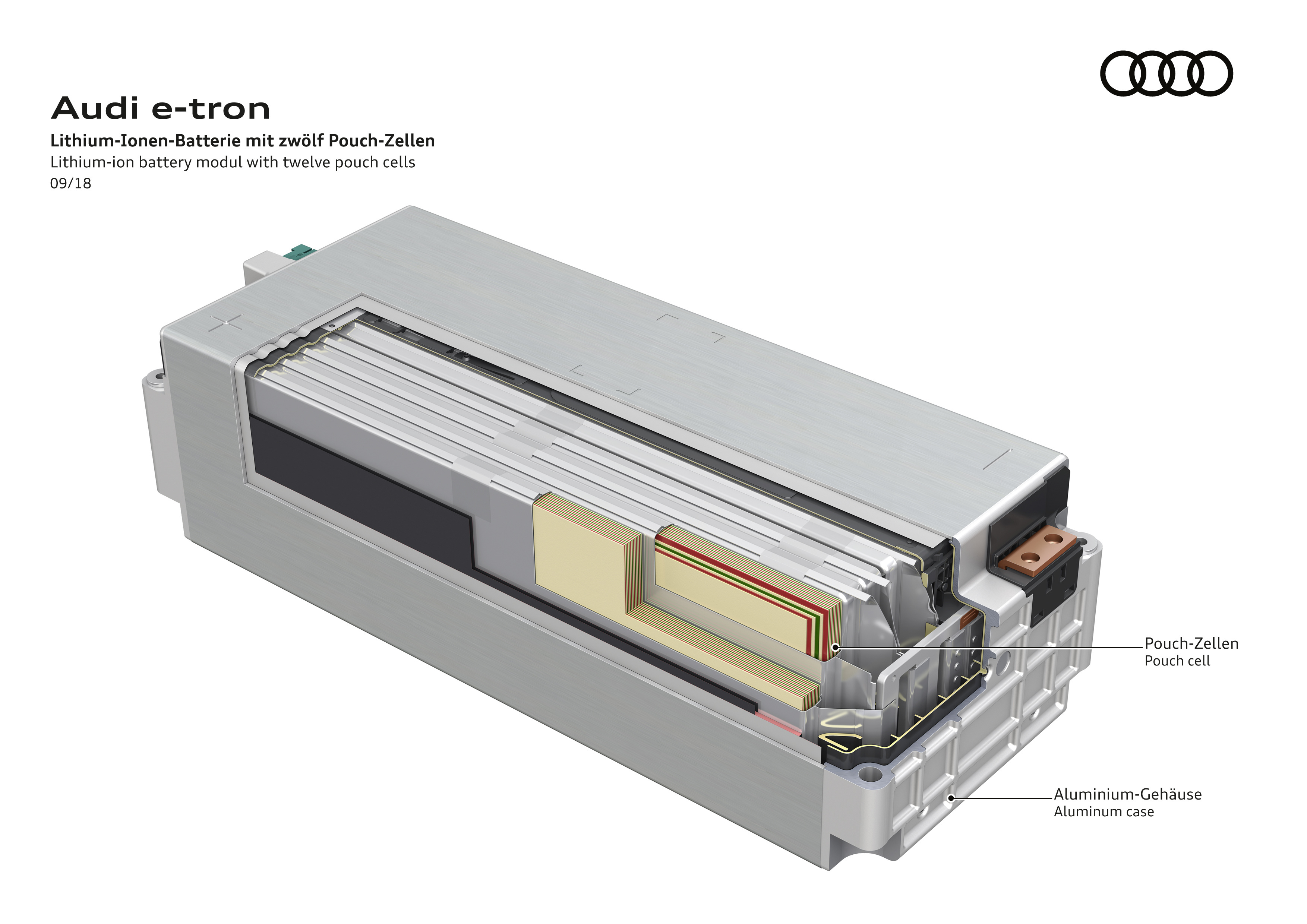
The battery system in the Audi e-tron is located beneath the cabin and is 2.28 meters (7.5 ft) long, 1.63 meters (5.3 ft) wide and 34 centimeters (13.4 in) high. It comprises a total of 36 cell modules in square aluminum housings, each of which is roughly the size of a shoe box. They are arranged on two levels, known as “floors” – a longer lower floor and a shorter upper one. At market launch, each module is equipped with twelve pouch cells having a flexible outer skin of aluminum-coated polymer. In the future, Audi will use both technically equivalent prismatic cells in its modular concept, also in terms of a multiple supplier strategy.
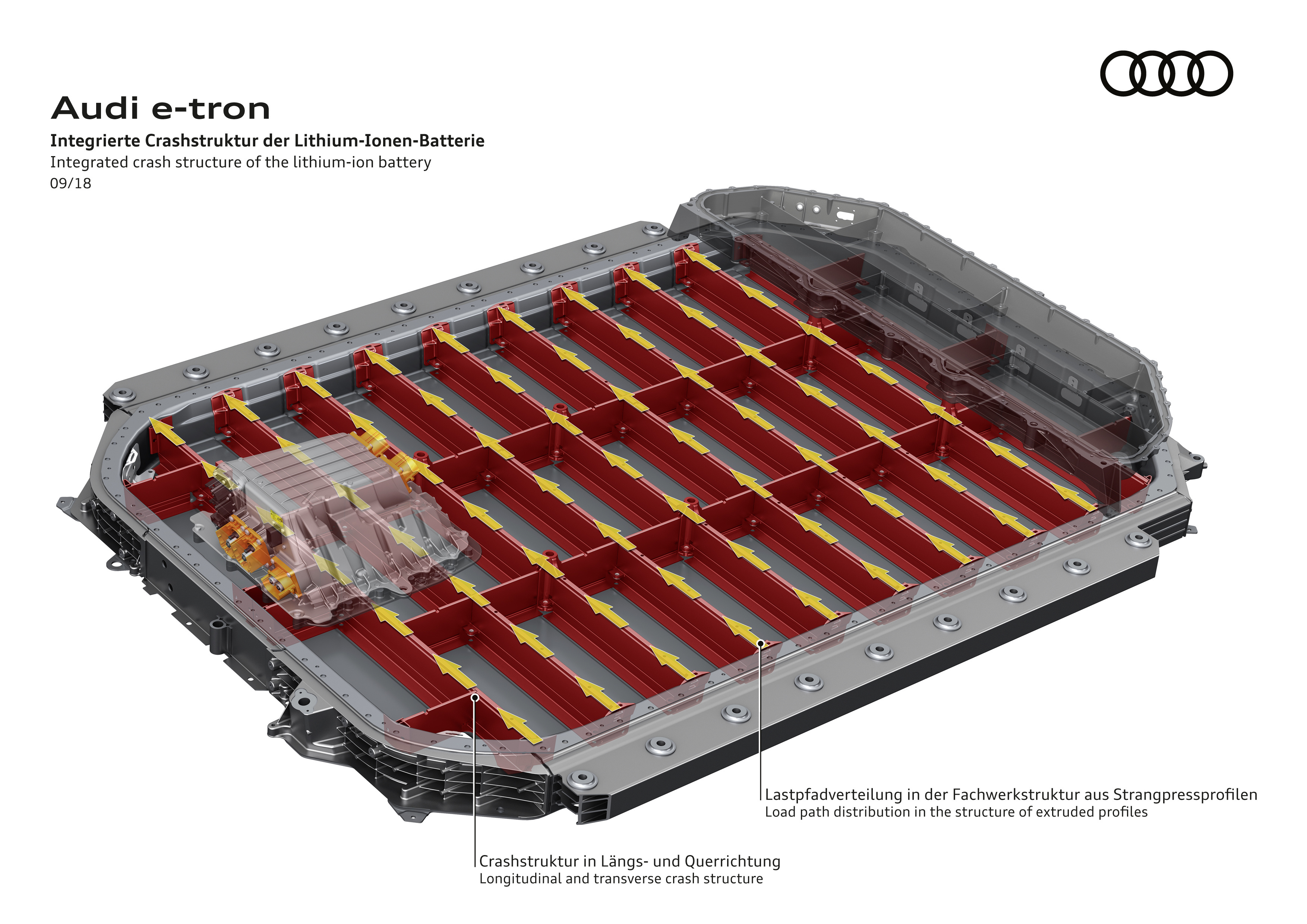
Integrated crash structure of the lithium-ion battery housing
The cell modules in the Audi e-tron can reproducibly discharge and charge electricity over a broad temperature and charge status window. The can be densely packed to achieve a very high output and energy density in the volume available.
Cooling the lithium-ion battery during DC charging via the NT cooler
A cooling system of flat aluminum extruded sections divided uniformly into small chambers has the task of maintaining the battery’s high-performance operation over the long term. Heat is exchanged between the cells and the cooling system beneath them via a thermally conductive gel pressed beneath each cell module. In what is a particularly efficient solution, the gel evenly transfers the waste heat to the coolant via the battery housing. The cooling system is first fixed to the bottom of the battery tray with adhesive. To protect the cooling system against stone and road debris, a base plate is installed, also to improve aerodynamics. At assembly, first the batteries/modules on both floors are placed into their locations, then the gel (also called gapfiller) is applied.
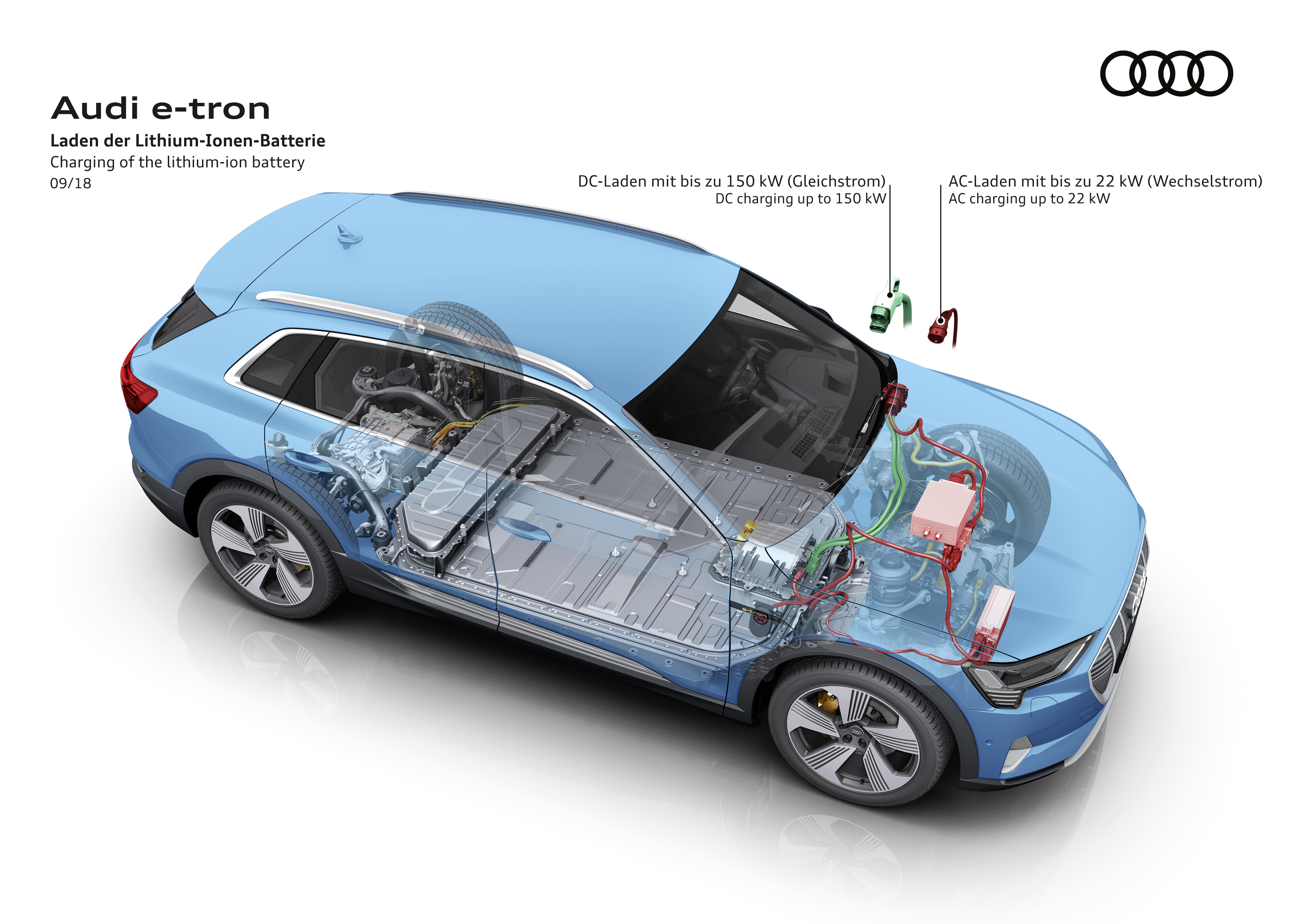
Charging of the lithium-ion battery
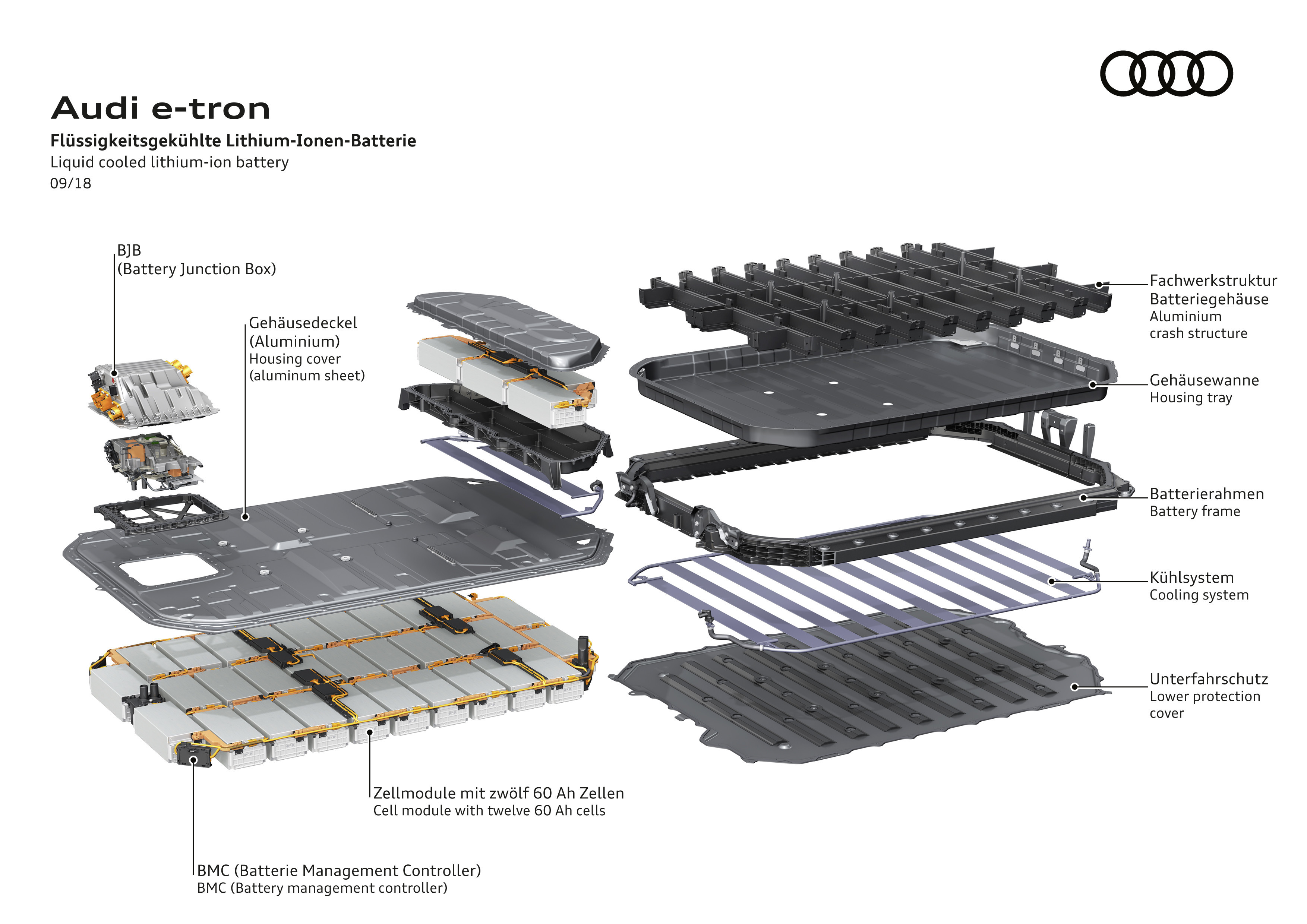
The battery and all of its parameters, such as charge status, power output and thermal management, is managed by the external battery management controller (BMC). This is located in the occupant cell on the right A-pillar of the Audi e-tron.
Liquid cooled lithium-ion battery, in exploded view one can clearly see the elements, the BJB (Battery Junction Box), the BMC or Battery Management Controllers, the cooling system, and last but not least the modules.
The BMC communicates both with the control units of the electric motors and the cell module controllers (CMC), each of which monitors the current, voltage and temperature of the modules, 3 modules at the time. In the whole battery system, therefore 12 CMC’s are present. The battery junction box (BJB), into which the high-voltage relays and fuses are integrated, is the electrical interface to the vehicle. Enclosed in a die-cast aluminum housing, it is located in the front section of the battery system. Data exchange between the BMC, the CMCs and the BJB is via a separate bus system.
Lithium-ion battery module with twelve pouch cells
Sophisticated measures have been taken to protect the high-voltage battery of the Audi e-tron. A strong enclosing frame of cast aluminum nodes and extruded sections, plus an aluminum plate 3.5 millimeters (0.1 in) thick protect against damage from accidents or curbs. Inside, a framework-like aluminum structure reinforces the battery system. Also comprised of extruded sections, it holds the cell modules like a typecase.
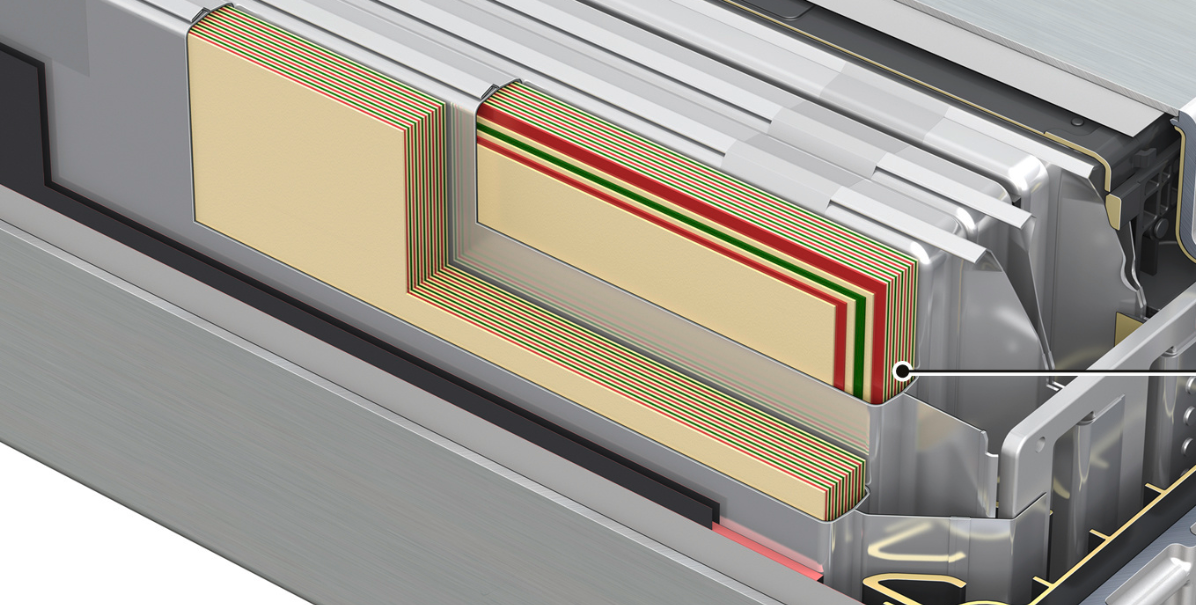
Detail of the pouch type cell
Including the housing with its
sophisticated crash structures comprising 47 percent extruded aluminum
sections, 36 percent aluminum sheet and 17 percent diecast aluminum parts, the
battery system weighs around 700 kilograms (1,543.2 lb). It is bolted to the
body structure of the Audi e-tron at 35 points. This increases its torsional
rigidity by 27 percent and contributes to the high level of the safety of the
Audi e-tron, as does the cooling system bonded to the outside of the battery housing.
Compared to a conventional SUV, the Audi e-tron offers 45 percent higher
torsional rigidity, a key parameter for precise handling and acoustic
comfort…
During production and assembly, utmost care
is taken that screws which fix the modules into place do not cause insulation
faults, and before the battery unit is cleared for further assembly, the
differences in voltage between the cells and the modules are carefully
controlled that it meets Audi Premium Standards. Finally leak tests are also
carried out, both on the cooling system and the battery. Not less than 8 final
tests are performed, before the battery is then partially (re)charged and fit
for further assembly in the car.
Audi Brussels, assembly: The Audi e-tron at the finish line (checkpoint 8)
Your servant will soon be your regular guide at the Brussels Audi site where the formidable Audi e-tron 55 quattro rolls of the production line. I will explain you in four languages, English, German, French and Dutch in a 2,5 hour factory tour all you want to know about the production of this formidable all-electric car. Soon you can start booking me (and my colleagues) on this tour, I will keep you posted when registration starts.
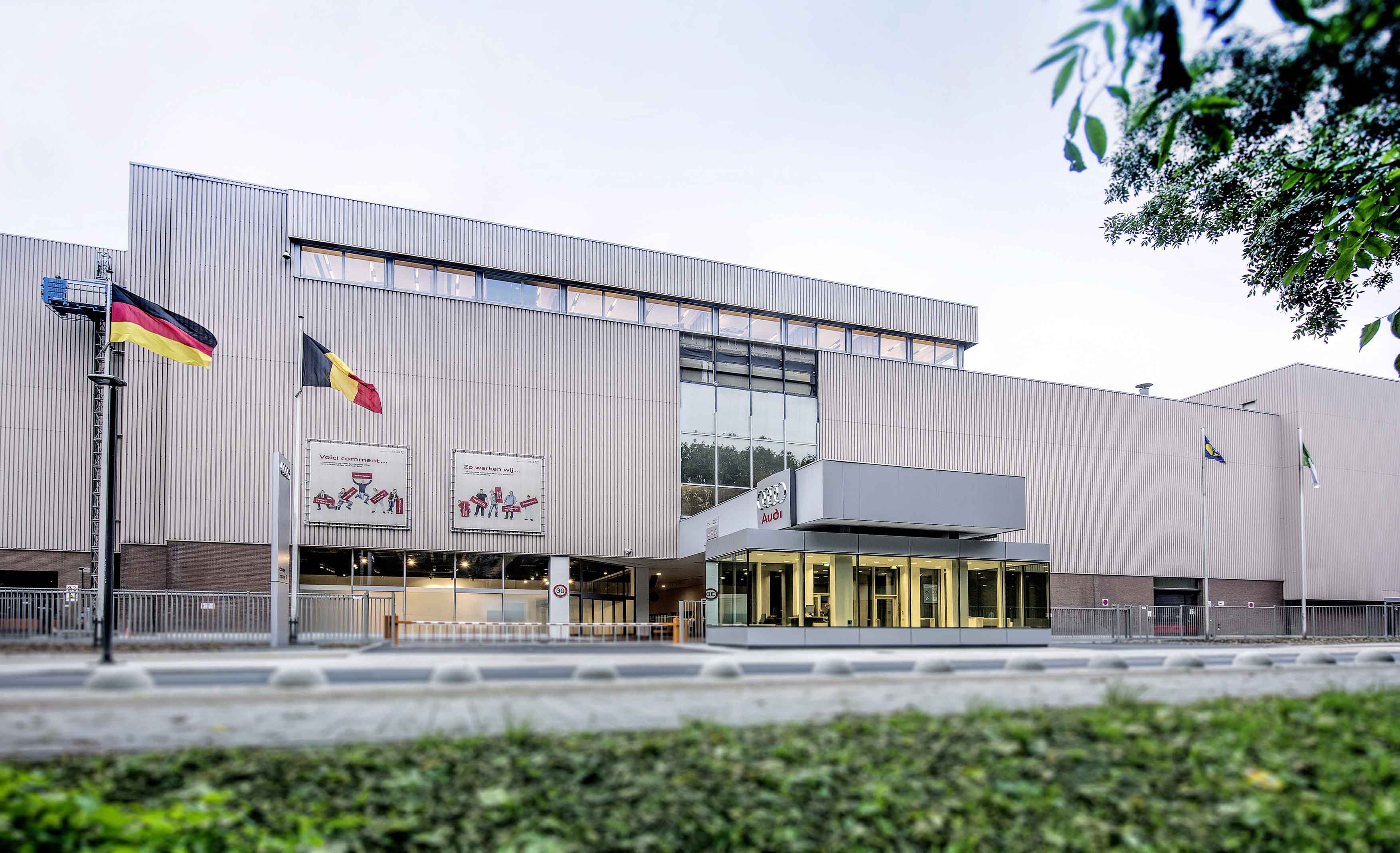
The entrance of the Audi Brussels site…
But in the meantime, in these columns I tell you already somewhat more about the Brussels factory; In further reports I tell you somewhat more about the Audi production techniques building the big Audi e-tron.
Of course, this series about the ins and
outs of Audi e-tron production is also an occasion to start with a regular
column about car factories of different brands and the way they build their cars.
So stay posted!
Hans Knol ten Bensel
Audi Brussels, battery assembly: Running highvoltage cable
In Brussels, the e-future has begun…
Since fall 2018, Audi Brussels has been
producing the first fully electric SUV from the brand with the four rings exclusively
for the world market. Actually, volume production of the Audi e-tron began on
September 3, 2018. Designing and producing the e-tron led Audi to establish numerous
in house competencies and it indeed has developed both the battery technology and
the drive by itself.
Also the Brussels factory was on a learning curve. The employees in Brussels received a total of over 200,000 hours of training to build the first fully electric Audi. Employees have replanned and implemented many production steps in production. Since summer 2016, the plant has comprehensively remodeled the body shop, paint shop and assembly shop step by step and has established its own battery manufacturing facility. With the intention of developing the Brussels plant further into a key component of the Audi production network, Audi has optimized the plant’s processes in accordance with the Audi Production System (APS).
Audi Brussels, paint shop: Applying waterbased filler, which is here dryed for 30 minutes at 160 degrees…
Major features of the APS are group work and continuous improvement processes. To improve the process chains, Audi has closely integrated the external suppliers and service providers into the production process. Short throughput times in production, low inventories and a high proportion of added value are the objectives on which Audi Brussels focuses.
In addition to a body shop, assembly shop and paint shop, Audi Brussels also has a modern Analysis and Pre-Series Center. This links the areas of Production and Technical Development, ensuring the high quality of the Audi e-tron.
Audi Brussels, body shop: Fabrication of battery housing with deep-drawn battery tray.
The Brussels site also has its own battery manufacturing
facility to support production of the battery-electric SUV. This makes it the key
plant for electric mobility within the Audi Group
Carbon neutral…
The Brussels plant is the first in the world with certified carbon-neutral volume production in the premium segment. Audi Brussels compensates for all emissions that occur during production and at the location. This takes place predominantly through renewable energy but also through environmental projects. At Audi, environmental protection is part of the corporate strategy. This applies to technology as well as to the production processes.
Audi Brussels: aerial view of the CO2-neutral site. Push Ctrl + to enlarge and read the captions…
The most stringent of environmental
standards are applied at the Audi Brussels site. In 2013, the Brussels region
recognized the plant as an “eco-dynamic company” – a regional environmental
certification that is awarded every three years. Audi Brussels was awarded the
highest rating of three stars. Since 2001, the Brussels site has also been
certified according to the environmental audit of the European Commission
(EMAS: Eco-Management and Audit Scheme). Audi Brussels installed a photovoltaic
system with a total area of 37,000 square meters at the site. As a result, Audi
Brussels operates the largest photovoltaic system in Brussels and generates
more than 3,000 megawatt hours of electricity per year and saves around 700
metric tons of CO2.
In late 2016, the plant received the
Business Award from the weekly magazine Trends. Audi Brussels was chosen as
Belgium’s most ecological company. The production of the first electric car of
the Audi brand will be carbon-neutral from the start of production in the
Brussels plant. To achieve this, Audi Brussels will procure green electricity
and purchase biogas certificates to make its heat-generation activities carbon neutral.
There are also compensation projects for emissions produced in part by the
company’s own fleet. Independent experts have certified the carbon-neutrality.
…and a bit of history
On August 1, 2018, the last Audi A1 of the first generation rolled off production line in Brussels. Since May 2010, a total of just under 910,000 units of the Audi A1 have been produced in Brussels. The successor model to the Audi A1 is now built in Martorell, Spain.
From 2010 to 2018 Audi has produced the Audi A1 family exclusively in the European capital. In 2017, approximately 95,284 automobiles drove off the production line there. Audi transferred production of the new Audi A1 to Martorell in Spain.
The plant in Brussels will turn 70 this
year. On April 7, 1949, the first vehicle rolled off the production line there.
The Audi A1 was the first model in the plant’s 70-year history to be produced
exclusively in the European capital. Before the plant was taken over by AUDI AG
in 2007, it had belonged to Volkswagen AG since 1970, producing various models
of the Volkswagen Group. Since belonging to AUDI AG, the Brussels facility has
assumed an important role in the Audi Group, and it now employs around 3,000
people. The start of production of the Audi A1 in 2010 marked the beginning of
a new era. Audi Brussels expanded its production in 2011 with the addition of
the Audi A1 Sportback and in 2014 with the Audi S1 and Audi S1 Sportback. In
2012, Audi Brussels produced the Audi A1 quattro as a special limited edition
model.
Dual learning and focus on employees…
Audi Brussels cooperates closely with the
trade unions. In a letter of intent from 2007, management and the trade unions
jointly defined the framework conditions for good cooperation. One important
component is the working time account system used at Audi Brussels since 2010.
It offers the company and its employees much more flexibility. Audi Brussels
awarded with the title of “Top Employer” for the fourth time in a row.
Audi also invests in education and training. Dual education allows the students of the two partner schools to complete part of their training on location at the company. Here, Audi Brussels cooperates with the Flemish school “GO! TA Halle” and the francophone school “Don Bosco Woluwé Saint-Pierre.” The project gives students the opportunity to gain more practical experience during their training. Another goal is to convince more young people in Belgium to choose an attractive technical apprenticeship.
Peter Kössler, Board of Management Member for Production and Logistics at AUDI AG and Chairman of the Board of Directors of Audi Brussels (on the right), peers the first Audi e-tron models from series production. He is accompanied by Patrick Danau, Managing Director of Audi Brussels.
Audi Brussels currently employs 2,756 employees (as of December 31, 2018), Of these employees, 940 work in production-related areas, while 1,816 employees work directly in production. With an average age of 44.7 years, the employees have worked an average of 18.6 years at Audi Brussels. The three working languages are French, Dutch and German. In December, Audi Brussels was awarded the “Diversity Label 2018” of the Brussels-Capital Region. The award, which was started in 2008 by the Brussels employment office supports companies in the fight against discrimination. To obtain the Label, Audi Brussels developed a “diversity plan” and implemented it.
Audi Brussels focuses on the employees,
which the plant’s own health center shows. It offers a prevention program for
the entire workforce: the Audi Check-Up. Experienced nurses and doctors work to
maintain and improve the employees’ health and help to recognize any risk factors
at an early stage and to counteract them.
Excellent logistiscs are the key to success…
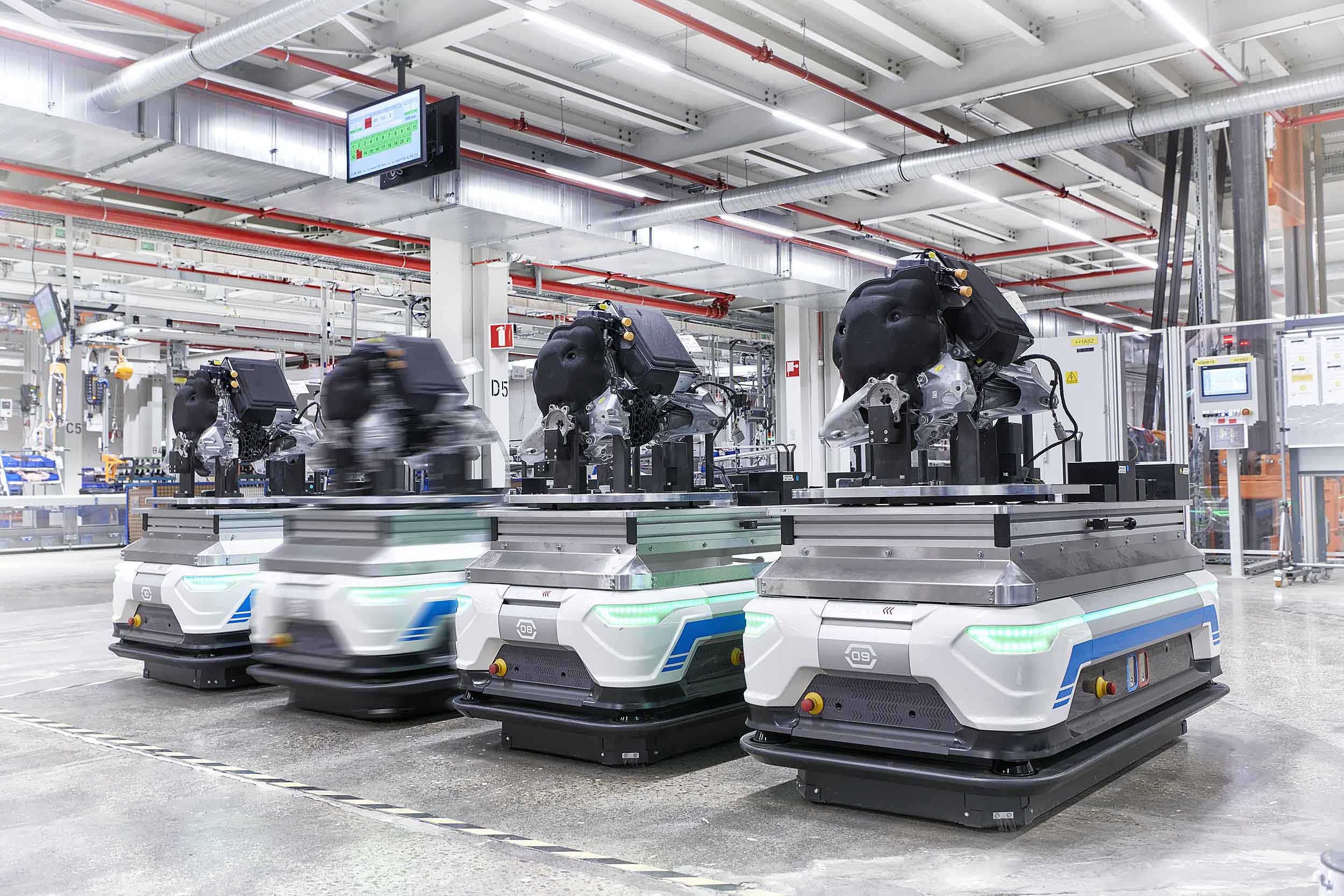
Audi Brussels: Driverless transport systems bring the components to the point of installation
Automotive Park logistics and supplier
center Automotive Park, the state-of-the-art logistics and supplier center, is
connected with the assembly shops by a 450 meter long bridge. It provides the
infrastructure for efficient processes in the supply of materials to the
Brussels plant. Every day, trucks and trains deliver 5,000 parts and components
from 457 suppliers. Due to the close integration of external suppliers with the
plant’s internal logistics processes, productivity is further boosted on a
sustained basis.
As said, in the next reports I will tell
you more about the actual production techniques and processes of the Audi
e-tron. Stay tuned!









 Autoprova - for the Connaisseur