Citroën’s “AMI” brings E-power to all of us…

Citroën changes the world once again, after its post war 2 CV. Now in (and after) Corona times, it launches an E-powered runabout, which will make the world think differently about affordable, urban electric mobility.

The “AMI”is non-conformist, with 2 seats, 100% electric, comfortable and protective, compact and agile, of course to be customized at will.

As a direct descendant of AMI ONE Concept introduced at the Geneva Motor Show in March 2019 and following the strong interest it generated, Ami has become a reality in barely a year.

Ami is a practical response to new mobility expectations for short journeys: enabling easier access to city centres, finding micro-mobility means for everyone, and presents a real alternative to scooters, bicycles, mopeds, public transportation at reasonable cost.

Nimble and simple, E power for all…

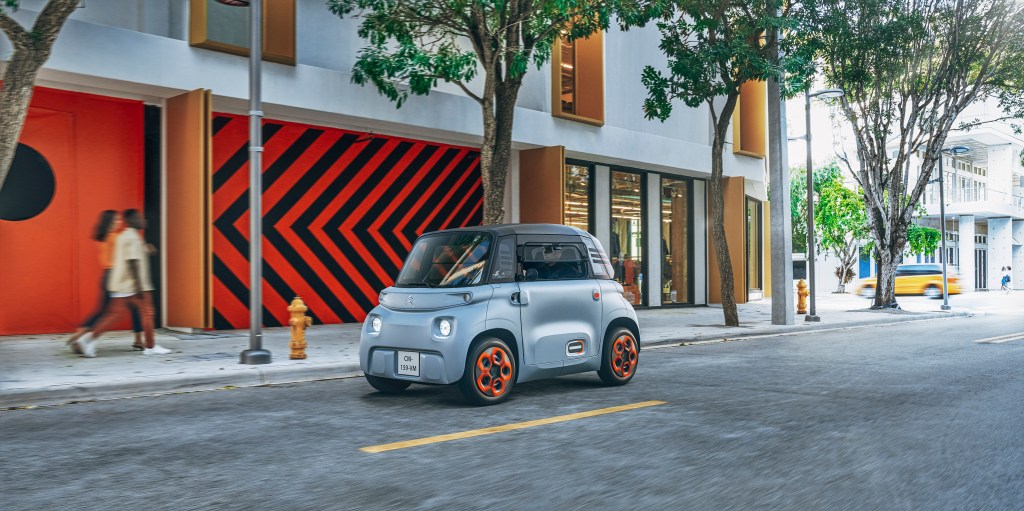
The AMI is ultra-compact: set on its specially designed 14″ wheels located at all four corners for easy handling, Ami is 2.41m long, 1.39m wide and 1.52m high.It has a 7.20m turning diameter.  It is a light quadricycle, which benefits from a smooth clutch-less ride and an instant acceleration from a stand-still , capable of speeds of up to 45km/h. Ideal for multiple short trips in the city – such as going to a meeting, to work, running an errand or going out for the evening – Ami has a range of up to 70 kilometres.

Copyright maison-vignaux @ Continental Productions

Its 5.5 kWh lithium-ion battery, housed flat under the floor, can be charged via the on-board electric cable located in the passenger-side doorway. Once the cable is plugged in, 3 hours are enough for a full charge on a conventional 220 V socket. The use of Ami is as simple as any everyday electric object. Ami – 100% electric can also be charged at a public terminal or Wall Box using a suitable cable.

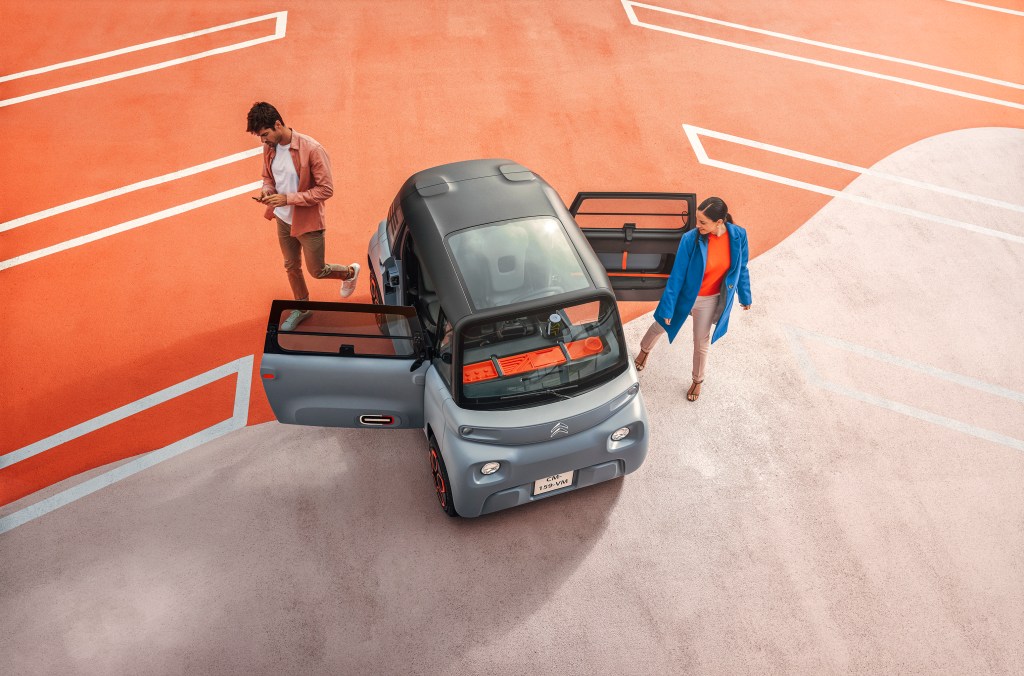
The AMI has a standard panoramic roof. In a nod to Citroën’s history, the side windows open by manually tilting upwards like the 2 CV.6 coloured accessory packs are available. Bright and pleasant, it is symmetrically designed. The wide doors that are completely identical on the right and left and open in the opposite direction: rear-hinged on the driver’s side to benefit from better on-board accessibility and increased comfort, and traditionally front-hinged on the passenger side.

Make your own mark…  

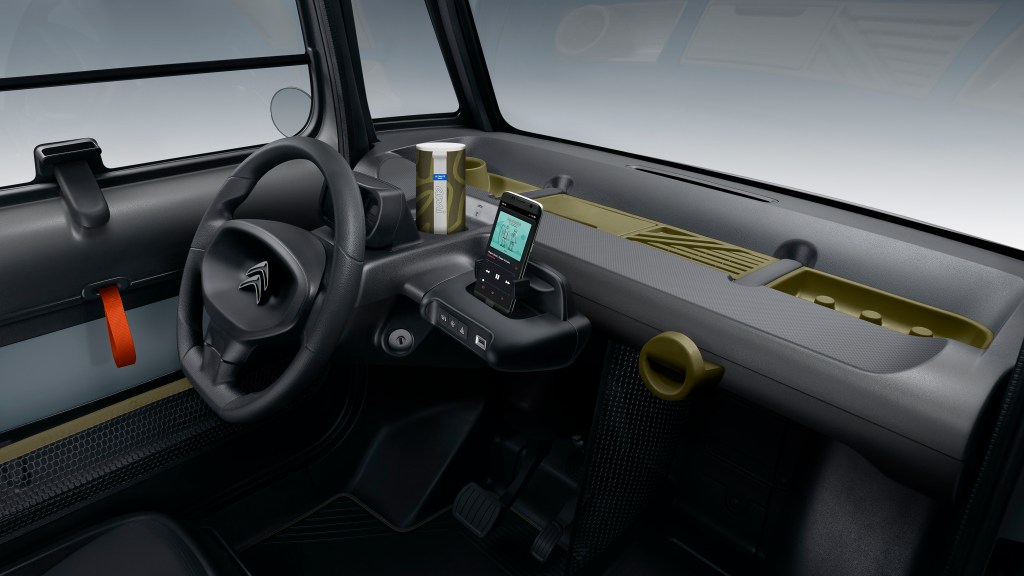
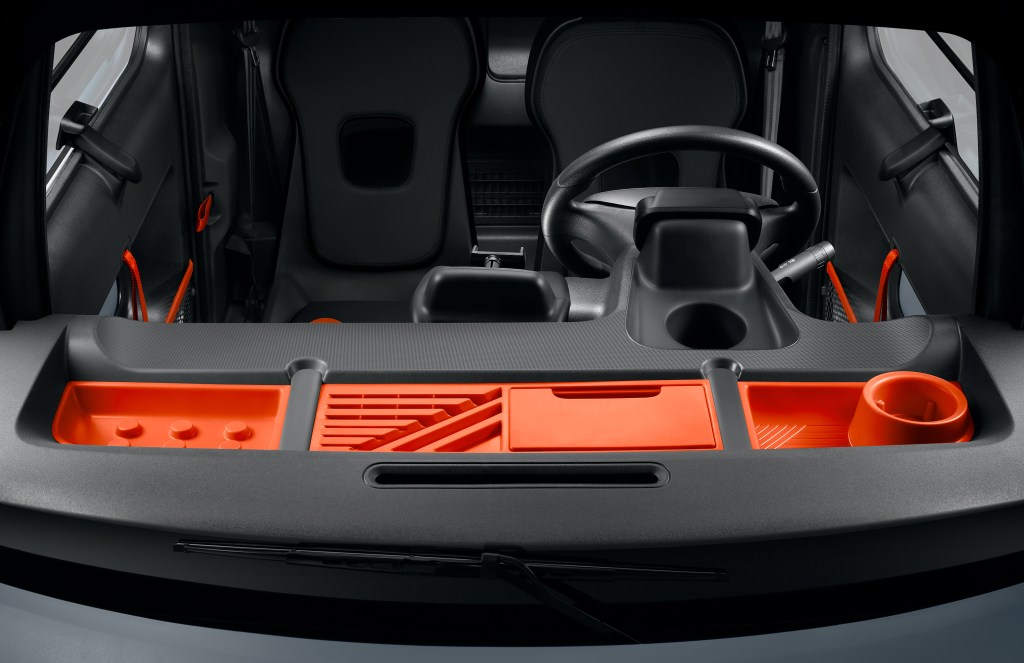
In a “Do It Yourself” fashion, the possibility of creating the object that suits each customer’ tastes through a kit of accessories that can easily be installed yourself. This kit incorporates functional decorative items: a central separation net, a door storage net, mat, storage tray on the top of the dashboard, small hook for a handbag, smartphone clip, DAT@MI box (dongle device) connected to the My Citroën app to retrieve essential information from Ami on the smartphone.

Post-production : Astuce Productions

There is harmony between the interior and the exterior with touches of colour on the wheel trims, quarter-panel stickers or even a capsule at the bottom of the door. 4 main shades are available: MY AMI GREY, MY AMI BLUE, MY AMI ORANGE, and MY AMI KHAKI. This accessory kit allows everyone to create their own mood and tailor the functionalities to their needs.

Post-production : Astuce Productions

Another and even higher level of customisation offers 2 packs combining all the aforementioned decorative elements as well as large stickers that dress up the exterior of Ami giving it a style all of its own:

My Ami POP with the Orange customisation and a fun, young and sporty design, with a rear spoiler

My Ami VIBE with the Grey colour and more upscale, chic and graphic accessories that incorporate roof trims to complement the stickers.

The installation of these higher level customisation packs is entrusted to professionals before delivery.

No driver’s license needed…

Copyright maison-vignaux @ Continental Productions

The AMI is in its home country AM licenced, i.e. for engines under 50 cm3. Any 14 year old can drive it. In most European countries, a 16 year old can do too. Ami also makes life easier for its customers in accessing mobility by offering them several formulas through digital solutions: car sharing, rental or purchase. The rates are very low indeed, will of course vary from country to country. But let it be known that you can purchase an AMI for around 6,000 Euros…  

Post-production : Astuce Productions

Ami is offered in France at a rent of €19.99 including VAT per month with an initial payment of €2,644 including VAT (Ami Ami version; long-term rental of 48 months, ecological bonus of €900 including VAT deducted in France).

Buy it from home…

It is therefore possible to acquire Ami – 100% ëlectric 24 hours a day, 7 days a week. Everything, from discovery to order, can be done from your sofa using your tablet or smartphone in just a few clicks via citroen.fr website, which is the entry point for finding out about Ami, which provides information on the product and on solutions adapted to the needs dictated by each person’s needs.

Digital is present in using Ami – 100% ëlectric with My Citroën mobile app via DAT@MI connected box. The application allows drivers to access essential information about Ami at any time via a smartphone, including: range, charge status and time remaining for a 100% charge, mileage, maintenance alerts and after-sales appointment scheduling. The app also makes it easy to locate nearby public charging stations, a feature offered by Free2Move Services.

More details to come soon, the opening of orders is scheduled for 30 March in France, and a few months later in Spain, Italy, Belgium, Portugal and then Germany. The first deliveries to customers are scheduled for June in France. Car-sharing at Ami’s wheel will start in Spring in Paris with versions bearing the “Free2Move” logo. Of course we are eagerly awaiting to see and drive the AMI “in the flesh”!

Hans Knol ten Bensel

BMW does not forget hydrogen propulsion…

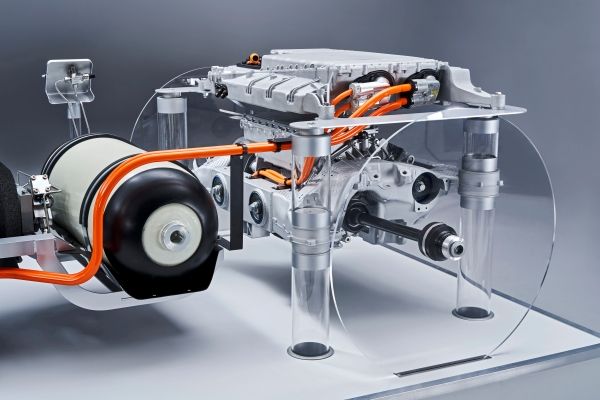
The second generation of the BMW fuel cell powertrain with a total system output of 275 kW will be piloted in the BMW i Hydrogen NEXT from 2022

BMW continues to look at alternative powertrain technologies. Did you know that the BMW Group is teaming up with the Toyota Motor Corporation as part of a successful partnership that dates back to 2013?

The two manufacturers have joined forces to work on fuel cell powertrain systems and scalable, modular components for hydrogen fuel cell vehicles under a product development cooperation agreement.

Fuel cells from the cooperation with Toyota will be deployed in the BMW i Hydrogen NEXT, alongside a fuel cell stack and overall system developed by the BMW Group.

As well as partnering on the development and industrialization of fuel cell technology for the mass market, the two companies are also founding members of the Hydrogen Council. A wealth of other leading companies in the energy, transport and industrial sectors have joined the Hydrogen Council since 2017, swelling its ranks to over 80 members.

According to Klaus Fröhlich, Member of the Board of Management of BMW AG, Research and Development, the hydrogen fuel cell technology could quite feasibly become the fourth pillar of our powertrain portfolio in the long term. The upper-end models in the extremely popular X family would make particularly suitable candidates here.

Not for the immediate future…

A customer offer powered by hydrogen fuel cell technology will be brought to market at the earliest in the second half of this decade. There are many good reasons for this cautious but realistic approach. “In our view, hydrogen as energy carrier must first be produced in sufficient quantities at a competitive price, using green electricity. Hydrogen will then be used primarily in applications that

cannot be directly electrified, such as long-distance heavy duty transport,” said Klaus Fröhlich. The requisite infrastructure, such as an extensive, Europe-wide network of hydrogen filling stations, is also lacking at present.

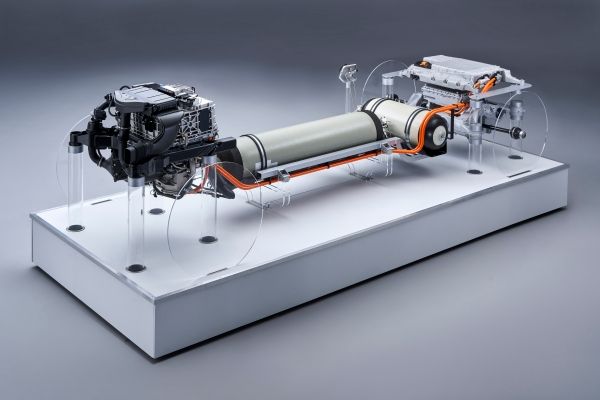
Initial technical details of the powertrain for the BMW i Hydrogen NEXT.


The BMW i Hydrogen NEXT will be propelled by the 5th generation e-machine, which will first be launched in the BMW iX3. The peak power battery located above the e-drive unit can supply boost power for additional dynamics, e. g. when overtaking. The total system output is 275 kW.

“The fuel cell system for the powertrain for the BMW i Hydrogen NEXT generates up to 125 kW (170 hp) of electric energy from the chemical reaction between hydrogen and oxygen from the ambient air,” explains Jürgen Guldner, Vice President of Hydrogen Fuel Cell Technology and Vehicle Projects at the BMW Group.

This means the vehicle emits nothing but water vapour. The electric converter located underneath the fuel cell adapts the voltage level to that of both the electric powertrain and the peak power battery, which is fed by brake energy as well as the energy from the fuel cell.

The vehicle also accommodates a pair of 700 bar tanks that can together hold six kilograms of hydrogen. “This guarantees a long range regardless of the weather conditions,” notes Guldner. “And refuelling only takes three to four minutes.”

The fifth-generation eDrive unit set to make its debut in the BMW iX3 is also fully integrated into the BMW i Hydrogen NEXT.

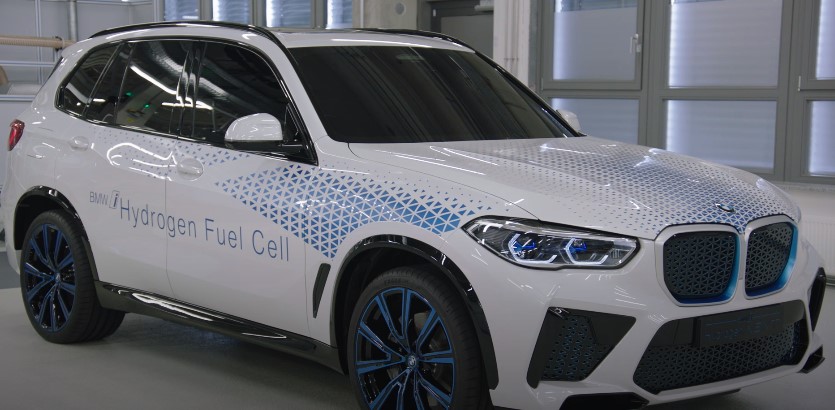
The peak power battery positioned above the electric motor injects an extra dose of dynamics when overtaking or accelerating. The total system output of 275 kW (374 hp) fuels the typical driving dynamics for which BMW is renowned. This hydrogen fuel cell electric powertrain will be piloted in a small series based on the current BMW X5 that the BMW Group plans to present in 2022.


The BMW i Hydrogen NEXT will be propelled by the 5th generation e-machine, to be seen first in the BMW iX3.

We just let you look at the photos here, giving you a detailed look into the hydrogen future…

Hans Knol ten Bensel

Renault Morphoz: the boldly flexible E future as seen by Renault…

The futuristic car on the photo here embodies Renault’s vision of personal, shareable electric mobility in the years beyond 2025. It’s called the MORPHOZ.

It draws on the Alliance’s new modular CMF-EV electric platform to offer several configurations not only of power, capacity and range, but also of user options and boot space too.

Faithful to the brand’s DNA, the MORPHOZ concept embodies the Family petal of Renault’s ‘Life Flower’ design strategy, which is based around the stages within a person’s life.

However, it is not only just a vision of mobility. In its design, details and interior presentation, this MORPHOZ also heralds a new family of Renault electric models for the coming years. 

The Renault MORPHOZ uses a brand new 100% electric modular platform

that we call CMF-EV.

Like the CMF-B platform which was inaugurated last year by the Clio and used on the New Captur, CMF-EV has been developed by the Alliance. It allows us to design, build, adjust and fine-tune electric vehicles more easily than with a platform designed for internal combustion engines (ICE) or for mixed ICE/electric applications. 

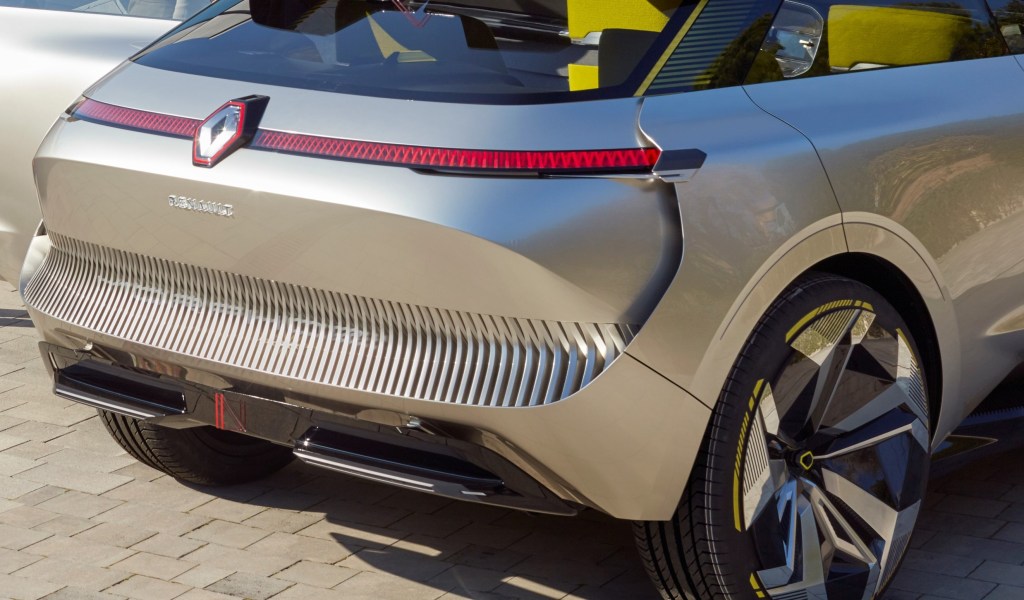
The platform’s architecture allows a long wheelbase with wheels at the very corners of the vehicle, reduced overhangs and a flat floor. With a streamlined battery, the CMF-EV platform allows to design vehicles that are closer to the ground, with a lower roof and the all-important improvement in aerodynamic performance. The low centre of gravity is also a bonus thanks to the location of the batteries below the rear floor.

MORPHOZ, a personal vehicle that can be tailored to requirements

Renault MORPHOZ is a 100% electric adaptable crossover concept car which charges by induction even as it is being driven.

It is connected and equipped with level 3 autonomous driving functions. Like the SYMBIOZ concept unveiled in 2017, this is a personal vehicle which now boasts specific sharing functions.

2020 – Renault MORPHOZ

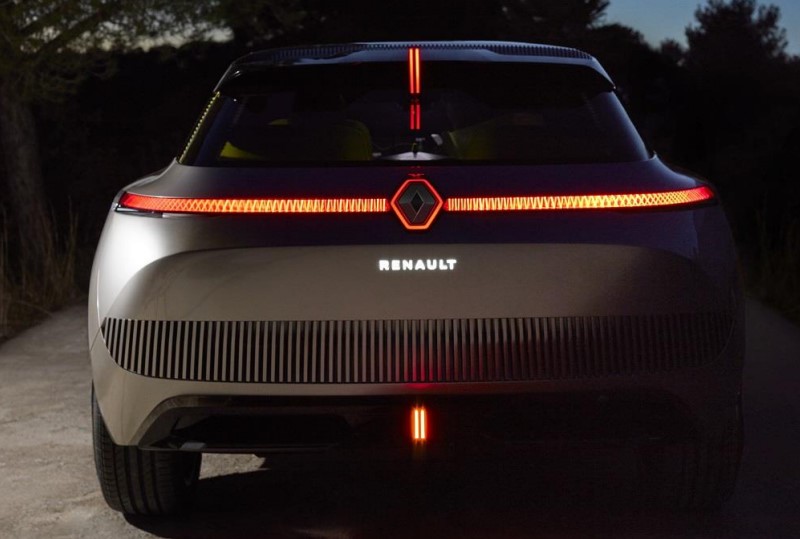
The high adaptability of the MORPHOZ concept-car is demonstrated by the physical transformation that occurs between its two versions: the short “City” one and the long “Travel” one.

The vehicle is in fact capable of adapting itself to the way its users live, be it for daily use or, for example, holiday travel. To achieve this, the City version is fitted with just the right battery capacity to meet day-today requirements, while the Travel version can accommodate the extra capacity needed for long distances on motorways, for example.

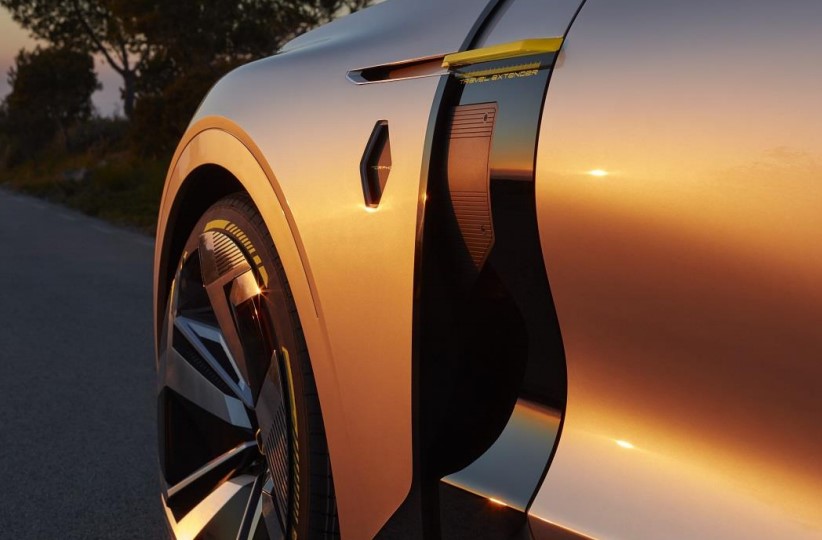
Although it is very slender in the City version, the vertical section of the front wing on the MORPHOZ expands in the Travel version as the vehicle’s bodywork and wheelbase lengthen.

Although its primary role is to display the capacity meter of the onboard batteries, its black and yellow finish also makes it stand out from the rest of the bodywork.

The City version

The short City version of the Renault MORPHOZ is 4.40 metres long. At 2.73 metres, its wheelbase is a record for such a vehicle length,so that it can easily house the 40 kWh of batteries that are fitted as standard.

The long Travel version of the Renault MORPHOZ is 4.80 metres long. Its wheelbase is proportionately longer at 2.93 metres to allow it to accommodate the additional battery capacity and provide a spacious interior. It can thus carry extra batteries that provide 50 kWh of power (total capacity of 90 kWh) and offer more leg room for the passengers, along with enough space for two more suitcases. In addition, this version – which benefits from a specific light identity – has a specific tapered

front-end and profile to improve its aerodynamic performance for long distances.

A very clever car, brimming with further smart solutions for its passengers, more about this in a next report…

Hans Knol ten Bensel

We drove the Skoda Superb Scout 2.0 TSI 200 kW DSG 4×4: stylish panache and sportiness…

Whatever the wheater and road conditions, this Scout is your ideal companion…Shot with our second hand Olympus in bad light conditions, ISO 400, F 6,3, 1/125 sec.

Classic recipes will always stay superb. This top end Skoda literally embodies it, and its badge tells it all…

It was a unique and refreshing experience to sit behind the wheel of this well engineered break and enjoy to the full what a modern, state of the art combustion engine can accomplish in combination with an equally top notch DSG gearbox . Push the starting knob and your ears already enjoy the humming sound of this thoroughbred four. This engine excels in smooth refinement, panache, pulling power and efficiency.

The rest of the drivetrain is up to the mark. The DSG seven speed box is alert, smooth, and always puts judiciously the right gear forward. The 4 x 4 drive consists of the state of the art Haldex system. Typically, 96 % of the total power is directed to the front, improving fuel efficiency. Depending on the road conditions, the electronic sensors redirect power to the wheels that have sufficient traction. The Haldex AWD has been seen on the Octavia since about a decade, but this is the first time it is coupled to a DSG gearbox.

This Superb has personality…

OLYMPUS E-510, ISO 400, F 5,5, shot at remarkably low 1/15 of a sec at 70 mm equivalent, showing how the image stabilizer does an excellent job…

This is a car with character. Inviting you to experience its punch and performance, yet remaining docile and refined in urban driving. It will respond beautifully when you push your right foot a bit further down, but will not protest when you subject it to endless stop and go traffic.

OLYMPUS E-510 F 5,5, ISO 400, 1/10 sec and 54 mm equivalent. Amazing sharpness due to stabilizer…

Performance leaves nothing to be desired. 200 kW or 272 HP see to that. It sprints from 0 to 100 km/h in merely 5,7 seconds, hurtling further to a top speed of 250 km/h. Pulling power is abundant over a very wide rev range, with 350 Nm being available between 2000 and 5400 rpm. Almost supercar performance, which is matched by excellent handling. This Superb will not protest when you decide to take it through its paces on winding roads, the judicious set up of the suspension clearly shows. Of course, the VW group and also even more Skoda borrows from a massive engineering and last but not least sporting rally experience of their cars, and they really know how to set up a decent handling car.

OLYMPUS E-510, ISO 400, F 4,9, 1/40 sec.

The straight line stability is also excellent, and high speed driving in this Superb is a relaxing affair.

Last but not least, the brakes are of course also up to the job.           

…and is immensely practical

Of course, fuel consumption is very much in function of how much power you use. Drive this Scout with some restraint, and it will quite naturally reward you with reasonable consumption figures.

OLYMPUS E-510, F 5,6, 1/20 sec at 65 mm equivalent. Image stabilizer working hard…

The manufacturer quotes 9 litres/100 km in urban driving, and this is easily surpassed in the region of 11-12 litres when the distances are very short and the engine has not reached its operating temperature. But keep the throttle openings small and the DSG will faithfully choose higher gears and keep the revs (very) low, and then this Scout will chalk up creditable figures. On the open road, the picture looks a lot brighter, with the manufacturer quoting 6 liters/100 km. On average, we reached 7,5 liters/100 km, with mostly relaxed driving.

OLYMPUS DIGITAL CAMERA

But as said, this Superb Scout is immensely usable. Not afraid of open terrain, it will transport five and their luggage.

OLYMPUS E-510 CAMERA, ISO 400, F 3,7, 1/13 sec.

And, in the good Skoda tradition, boot space is plentiful. From 660 liters to 1950 liter. Head room and leg room for the rear passengers has also to be experienced to be believed.

OLYMPUS E 510 CAMERA, ISO 400, F 5,6, 1/50 sec.

Of course, driving assistance systems and infotainment are up to scratch. The central display can be ordered from 8 up to 9.2 inches, and the top of the range Columbus system, found in our test car, offers 3D navigation, Skoda connect, gesture control and Wi-Fi hotspot. We enjoyed the Canton sound system too…

OLYMPUS E 510 CAMERA, ISO 400, F 5,6, 1/80 sec.

Besides the usual driver assistance systems, like lane assist, adaptive cruise control, practical items include 2 USB ports in the front, 2 USB ports and 230 v socket in the rear, inductive charging of your phone, just to name a few. Then there is the cooled glove box, space for 1,5 liter bottles in all the doors, and space also for your coloured safety vest…

Conclusion

OLYMPUS E-510, ISO 400, F 5, 1/30 sec.

A formidable, sporting companion, this Scout, on all the roads you may take to any destination in this wide world. It has a formidable combustion engine, and one should not forget, this is what more than 90 pct of us all still drives. It certainly has its evident merits, if only one considers the CO2 footprint of making large(r) batteries, and depending on what car you need for your lifestyle and driving habits. It is beautifully built, solid and reliable, well equipped, offering tons of space. It looks (very) good too, and its sporting panache could put a (broad) smile on your face for a very long time…actually, every time you take its wheel, for years on end.

Hans Knol ten Bensel  

The Fiat Cinquecento enters the electric age…

The ever young 500 is now in its third generation, and incarnates as FCA’s fisrt fully electric car. It has more space, top notch E-technology, new styling but remaining a true Cinquecento.

Its range and charging times are what customers nowadays expect. The lithium-ion batteries with a capacity of 42 kWh give the New 500 a range of up to 320 km in the WLTP cycle.

Charging is indeed a breeze: the New 500 is standard equipped with an 85 kW fast charger system to charge the battery very quickly. For example, it takes only 5 minutes to build up a sufficient energy reserve to travel 50 kilometers, more than is needed for average daily use.

The fast charger can also charge the battery to 80% in just 35 minutes. The Combo 2 socket located on the rear right side panel of the car powers the fast charger, for both AC and DC charging.

Home charging solutions are also available. The launch edition of the new 500 includes the Easy Wallbox™, a home charging system that can be connected to a normal home outlet. ENGIE EPS developed this exclusively for FCA, and it will be marketed by Mopar in Europe to coincide with the launch of the model.

It is a simple, accessible “plug-and-charge” solution that can be managed easily via Bluetooth, letting you stabilize your energy load by charging your 500 immediately at home with up to 2.3 kW of charging power, with no need for any intervention by skilled personnel. Moreover, the Easy WallboxTM is ready for a power upgrade to 7.4 kW, providing a full charge at home in just over 6 hours. The model also comes with a Mode 3 cable for charging from the public mains.

A “sherpa” mode gets you home

The New 500 has three driving modes: Normal, Range and Sherpa, which can be selected to match your driving style. In particular, Sherpa mode optimizes the available resources to ensure that you will reach your destination. The “sherpa” mode adjusts various parameters: maximum speed, limited to 80 km/h; accelerator response, in order to reduce energy consumption; and deactivation of the climate control system and heated seats (the driver has the option of activating them at any time).

“Normal” mode is as close as possible to driving a vehicle with a normal combustion engine, while “Range” mode activates the “one-pedal-drive” function. By selecting this driving mode, you can practically drive the New 500 with the accelerator pedal alone.

Lots of (city) zest…  

The engine has an output of 87 kW, providing a maximum speed of 150 km/h (self-limited) and acceleration from 0-100 km/h in 9.0 seconds and 0-50 km/h in 3.1 seconds.

Level 2 autonomous driving and connectivity

The car of the future is not just an electric city car, but goes one step further: it literally goes to the next level by being the first car in its segment to offer level 2 autonomous driving, bringing all the associated benefits to urban mobility.

Front-facing camera monitoring technology monitors all areas of the car, both longitudinally and laterally. The intelligent Adaptive Cruise Control (iACC) system brakes or accelerates in response to anything: cars, cyclists, pedestrians. Lane Centering keeps the vehicle in the center of the lane when the markings are correctly identified.

Intelligent Speed Assist reads the speed limits and recommends applying them, while Urban Blind Spot uses ultrasonic sensors to monitor the blind spots and warn of any obstacles with a triangular warning light on the wing mirror. Then there is Attention Assist, which provides warnings on the display, recommending that you stop and take a break when you are tired. Finally, the 360° sensors provide a drone view to avoid any obstacles when parking or performing complex manoeuvres.

The third-generation 500 is the first FCA car equipped with the new UConnect 5 infotainment system. FCA uses the easy, intuitive and incredibly customizable Android Auto operating system. For example, you can use widgets to configure how functions and apps are displayed. Apple CarPlay is already available wirelessly. The system is also ready to offer the same functionality for Android Auto.

In short, the New 500 offers seamless integration with your smartphone, offering a 10.25” high-definition touchscreen, with a horizontal form factor that fits perfectly into the car dashboard, following its lines.

The launch version also boasts the Natural Language interface system, with advanced voice recognition, so you can talk to the car to control parameters, set the climate control and choose your favorite music.

Style, and then again

The New 500 has all the elements of style, just quieter, cleaner and crisper. The front is vertical as in the 1957 version, making it less elusive, almost facing the road, and the dynamic feel of the profile has been accentuated.

The substance of the new platform has given the third-generation 500 a strong presence: it is 6 cm wider and 6 cm longer, the wheelbase has been extended by 2 cm, and the wheels are larger and further apart, giving it a stronger personality and greater comfort despite its length remaining under four meters.

Inside, the electric 500 is completely new and elegant, with clear references to elements of the first generation. As for the Hybrid Fiat 500, including the electric version, some trim levels also have seats made using “Seaqual” yarn, derived from plastic recovered from the sea.

The new 500 debuts in the convertible version: the first open-air four-seater with zero emissions: all open, all electric, all silent. As an icon of La Dolce Vita, it had to be reborn to bring out all the charm of its forms and sounds. And on the subject of sounds, here is another unique feature of the new city car, which will become available later: the Acoustic Vehicle Alert System (AVAS), an acoustic warning for pedestrians that is mandatory at speeds up to 20 km/h; the chosen sound is not a common acoustic signal, but rather the music of Amarcord by Nino Rota, in pure Dolce vita style, an example of the most authentic Italian creativity.

The “la Prima” launch edition is available for pre-booking

A dream is coming true: the “la Prima” launch edition, a limited edition designed for the launch of the New 500, with its own distinct style, exclusivity, technology and connectivity.

From today, March 4, it can be ordered via an online pre-booking system on the http://www.fiat.com* website, by following a simple procedure of just three clicks.

To book the “la Prima” limited edition, simply browse to the http://www.fiat.com* website, and with just three clicks and a deposit of €500, you can become a part of the mobility of the future.

Needless to say that we are keen to get behind the wheel of this New 500, Corona virus protection measures permitting. The date is set, at the digital presentation: the 4th of July…

I will come back on the new 500 with a description of unique one-off versions created by Kartell, Bvlgari and Armani…

Hans Knol ten Bensel   

Volkswagen news to admire via webcast, and not in Geneva…


Ralf Brandstätter, Chief Operating Officer of the Volkswagen Brand, presents here the ID. CROZZ showcar

We are living in digital times. So even when the Corona virus limits (temporarily, as we all hope) our present mobility, and led to the cancellation of the Geneva Motor Show, we can still see all the automotive news via our PC’s, Phones, Tablets.

Volkswagen presents therefore its important news on a special webcast, for you to admire via the following link: https://www.volkswagen-newsroom.com/en/live-stream-5455.

Ralf Brandstätter, Chief Operating Officer of the Volkswagen Brand, presents here the ID. CROZZ showcar, which now evolves into its series production version, the ID.4.

Volkswagen is forging ahead with its electric mobility strategy by providing a detailed insight into the brand’s first all-electric SUV. The new ID.4 will be launched this year. Following in the tracks of the ID.3, the countdown has already begun for the second model based on the new modular electric drive matrix (MEB). “Just like the ID.3, the ID.4 will also come onto the market as a carbon-neutral vehicle”, explains Ralf Brandstätter, Chief Operating Officer of the Volkswagen brand. “We will produce and sell the ID.4 in Europe, China and the U.S..”

Just read on for more VW news…

Hans Knol ten Bensel

The ID. 3 started production in Zwickau, the ID.4 now follows…

The ID.4 will initially be launched with rear-wheel drive, while an electric all-wheel drive version will be added to the portfolio at a later date. The high-voltage battery is positioned near the center of the underbody to create a low centre of gravity and an optimum in terms of driving dynamics, along with an extremely well-balanced axle load distribution.

Also new mild and plug-in hybrid drives…

For Volkswagen, the ID.4 and ID.3 represent important milestones in the brand’s bid to become entirely carbon-neutral by 2050 – in line with the Paris climate agreement. Plans have been put in place to reduce the Volkswagen fleet’s CO2-emissions by a third by as early as 2025.

Dr. Frank Welsch, Member of the Board of Management of the Volkswagen Passenger Cars Brand with responsibility for Technical Development, presents in the webcast the new Touareg R

Volkswagen is currently investing one billion euro to electrify its model range while also offering an increasing number of hybrid vehicles. This is based on the fact that, just like electric powertrains, new mild and plug-in hybrid drives in large-scale product lines such as the all-conquering Golf will significantly help to reduce fleet emissions in the future.

New Touareg R

This is why the company’s focus during the webcast is not only on ID. models, but also on new Volkswagen models with hybrid drive. Dr. Frank Welsch, Member of the Board of Management of the Volkswagen Passenger Cars Brand with responsibility for Technical Development, presents in the webcast the new Touareg R with plug-in hybrid technology and the the Golf GTE 2 for the very first time.

The Touareg R,the most powerful Volkswagen model will in future also be powered by an efficient plug-in hybrid system. The alliance between an electric drive motor generating 100 kW (136 PS) and a V6 turbocharged petrol engine (TSI) with an output of 250 kW (340 PS) develops a system output of 340 kW (462 PS). The battery capacity of the Touareg R with a top speed of 140 km/h in all-electric E-MODE has been designed so that most average daily commuting distances can be covered with zero emissions.

Golf GTE with stronger battery…

The same applies to the new Golf GTE – its plug-in hybrid drive has been geared towards performance and consists of an electric drive motor with 85 kW (115 PS) and a four-cylinder turbocharged petrol engine (TSI) generating 110 kW (150 PS). As a unit, the electric drive motor and the TSI develop a system output of 180 kW (245 PS). The new Golf GTE’s top speed in all-electric mode is 130 km/h.

Further Volkswagen highlights include the new Golf GTD, which generates significantly lower nitrogen oxide emissions compared with its predecessor thanks to innovative twin dosing technology, plus the eighth generation of the Golf GTI, produced more than 2.3 million times. The most recent version is powered by a 180 kW (245 PS) 2.0-litre turbocharged direct injection engine. The maximum torque is 370 Nm. The four-cylinder engine is coupled with a 6-speed manual gearbox as standard.

Last but not least, the eight generation of the GTI takes the central stage, presented again by Ralf Brandstätter, Chief Operating Officer of the Volkswagen brand. It is a formidable performer, this GTI, and A 7-speed dual clutch gearbox (DSG) is optionally available.

Digital instruments for the GTI for maximum performance…

We include here some screenshots of the webcast, and stay tuned for more!

Hans Knol ten Bensel
ŠKODA OCTAVIA RS iV: sporting and “green”…

Skoda launches its first plug-in hybrid in the performance-oriented ŠKODA RS family.

The new ŠKODA OCTAVIA RS iV has been fitted with a 1.4 TSI petrol engine and an 85-kW electric motor delivering a combined power output of 180 kW (245 PS). Featuring black details on the bodywork, the OCTAVIA RS iV can immediately be recognised as sporty top-of-the-range variant of ŠKODA’s bestseller, now in its fourth generation.

The Czech car manufacturer will offer the new OCTAVIA in three other electrified versions as well. The OCTAVIA iV is a plug-in hybrid delivering 150 kW (204 PS) and is available in the Ambition and Style trims. Two e-TEC variants producing 81 kW (110 PS) and 110 kW (150 PS) make use of mild hybrid technology for the first time at ŠKODA.

Christian Strube, ŠKODA Board Member for Technical Development, said, “By introducing the OCTAVIA RS iV, we are starting a new chapter in the success story of our RS portfolio. We are using plug-in-hybrid drive in a sporty top-of-the-range model for the first time. In the new OCTAVIA RS iV, this both increases performance and reduces fuel consumption as well as CO2 emissions.”

ŠKODA has fitted the OCTAVIA RS iV with a 1.4-litre TSI petrol engine (110 kW / 150 PS) and an 85-kW electric motor. Together, they have a combined power output of 180 kW (245 PS) and offer a maximum torque of 400 Nm, which is transferred to the front wheels via a 6-speed DSG. The car’s CO2 emissions are approximately 30 g/km in the WLTP cycle*, meaning it already complies with the new, stricter EU6d emissions standard for all newly registered vehicles in the EU, which will come into force from 1 January 2021.

The drivetrain is mostly the same as we have found in the hybrid Passat we tested for you. Just look alos in our columns.  

The high-voltage lithium-ion battery has a capacity of 37 Ah equating to 13 kWh, thereby giving the car an all-electric range of up to 60 km in the WLTP cycle*.

As the 330 Nm of torque provided by the electric motor are available straight away, the RS iV can pull away quickly. In Sport mode, which allows drivers to make use of the car’s full power output, the OCTAVIA RS iV accelerates from 0 to 100 km/h in just 7.3 seconds. Its top speed is 225 km/h. The progressive steering that comes as standard and dynamic tuning of the sports suspension that is typical for the RS range cater to energetic driving styles.

Sporty black accents provide distinguishing visual features

The ŠKODA OCTAVIA RS iV has specific LED fog lights and black 18-inch alloy wheels as standard; the brake callipers in RS-typical red catch the eye. 19-inch alloys are available as an option. The ŠKODA grille, air curtains, diffuser on the RS-specific front apron, aeroflaps, diffuser on the rear apron and window frames all come in sporty black. The hatchback sports a black RS rear spoiler; in the estate, the roof spoiler matches the car colour.

Oliver Stefani, Head of ŠKODA Design, explained, “We have given the already dynamic shape of the new OCTAVIA an even sportier appearance using familiar RS insignias. With its numerous black design details, such as the ŠKODA grille, front apron, rear diffuser and alloy wheels, the car is immediately recognisable as a member of our RS family.”

Dynamic, RS-style interior

Looking inside the OCTAVIA RS iV, the predominantly black interior stands out. The three-spoke leather multifunction sports steering wheel bears a vRS logo and features paddles for operating the DSG. The front sports seats are upholstered in black fabric, whilst the optional Ergo seats come with Alcantara and leather upholstery as well as seat-depth adjustment. The seats are adorned by an RS logo and coloured decorative stitching in red or silver-grey, which can also be found on the leather steering wheel, on the armrests and on the Alcantara-covered dashboard. Decorative strips in an RS look and pedals with an aluminium design round off the sporty impression.

OCTAVIA iV plug-in hybrid delivering 204 PS

In addition to the RS variant of the OCTAVIA iV, ŠKODA is also offering plug-in-hybrid drive for the Ambition and Style trim levels. Here, the 1.4 TSI petrol engine and the 85-kW electric motor provide a power output of 150 kW (204 PS) and a maximum torque of 350 Nm. This plug-in-hybrid variant can also cover an electric range of up to 60 km in the WLTP cycle* and is fitted with a 6-speed DSG, operated using shift-by-wire technology. Its CO2 emissions are approximately 30 g/km*. The OCTAVIA iV also complies with the EU6d emissions standard.

The lithium-ion high-voltage battery, with a capacity of 37 Ah equating to 13 kWh, used in both iV models can be conveniently charged at home using a standard household plug socket or a wall box. The charging port is concealed in the driver’s side of the front bumper. A regular 12-volt battery is located in the boot, which has a capacity of 450 l in the hatchback and 490 l in the estate. The fuel tank can hold 40 l – just five litres less than in OCTAVIAs that are powered purely by a combustion engine.

Two eTEC engines boasting mild hybrid technology

The two eTEC versions of the OCTAVIA are making their ŠKODA debut. They will be the brand’s first production cars to feature mild hybrid technology when they start to roll off the line this summer. When combined with a 7-speed DSG, the three-cylinder 1.0 TSI producing 81 kW (110 PS) and the four-cylinder 1.5 TSI outputting 110 kW (150 PS) make use of a 48-volt belt-driven starter motor and a 48-volt lithium-ion battery that is located under the front passenger seat and has a capacity of 0.6 kWh. Both models can be identified by a specific badge on their tailgate.

Mild hybrid technology enables energy to be recovered when braking so that it can be stored in the 48-volt battery. This energy is used to support the combustion engine by providing it with an electrical boost of up to 50 Nm and, depending on the situation, makes it possible for the engine to switch off completely, letting the vehicle coast. As soon as engine power is required again, the motor restarts the engine in a fraction of a second. The stop/start function also works faster and more conveniently thanks to the use of the belt-driven starter motor. In addition, the engine generates less noise and vibrations when starting and the 48-volt battery is able to charge the regular 12-volt battery using a DC/DC converter. In total, the mild hybrid technology used for the two ŠKODA eTEC engines allows for savings of up to 0.4 l of fuel per 100 km.

Hans Knol ten Bensel
Renault launches its electric offensive…

2020 – E-TECH Family: New Clio, Captur and Mégane Estate…

Renault has an ever wider choice of electric and electrified models in store now.

First of all the clever E-TECH, offering hybrid and plug-in hybrid powertrains on the new Clio, new Captur and new Mégane Estate. Renault drew on its vast Formula 1 experience as well as its know how in electrification to develop this E-TECH system. We will explain this very interesting system in a separate report.

2020 – Range E-TECH / Z.E.

There is also the new Twingo Z.E., also becoming 100% electric, and the new ZOE is now also available in a “Riviera” limited series.

Last but not least there is also A MORPHOZ electric concept car, of which more soon in a separate report. Renault announces here that it (re)invents the future of family mobility, with a car which adapts to the changing needs of everyday life and integrated into the electric ecosystem. Stay tuned!

Hans Knol ten Bensel
Kia reveals first images of next-generation Sorento…

The concept of ‘refined boldness’ inspired Kia’s designers, and they came up with a more confident, mature and desirable exterior design. But that is not all. The cabin is also definitely upscale with premium material quality.

Of course, the new Sorento is crammed with progressive connectivity, driver assist and infotainment technologies. It makes its first public appearance at 2020 Geneva International Motor Show

More to come!

Hans Knol ten Bensel
A new Citroën C3…

It is high time that we start talking in our columns about the iconic brand of the “Double Chevron”with some important news…

Citroën has very recently unveiled its New C3, marking a further evolution of the Brand’s best-seller worldwide, a real success with 750,000 sales achieved by the 3rd C3 generation since its launch at the end of 2016.

Did you know that the C3 is sold almost 4,5 million times since its launch? It is the best-seller of Citroën range, belongs to the top 5 in Europe in its segment at the end of December 2019 and the 3rd best-selling car in France.

The new C3 has a proper look. It doesn’t look like any other vehicle. It builds on its differences with a colourful personality and very good comfort. It now stands even more out with new LED headlights, 97 exterior possible combinations, 3 new roof stickers, 2 new wheel rims and 3 interior colour ambiences. It now has new Airbump® designs and up to 12 driving aids, with a lot of connected services: Connect Assist for the SOS assistance, Connect Nav with its 7 “ touch tablet and Connect Play for smartphone duplication. Equipment, completely in the tune of the times, which makes everyday life easier…

New C3 will arrive at dealerships starting in June 2020.

Hans Knol ten Bensel