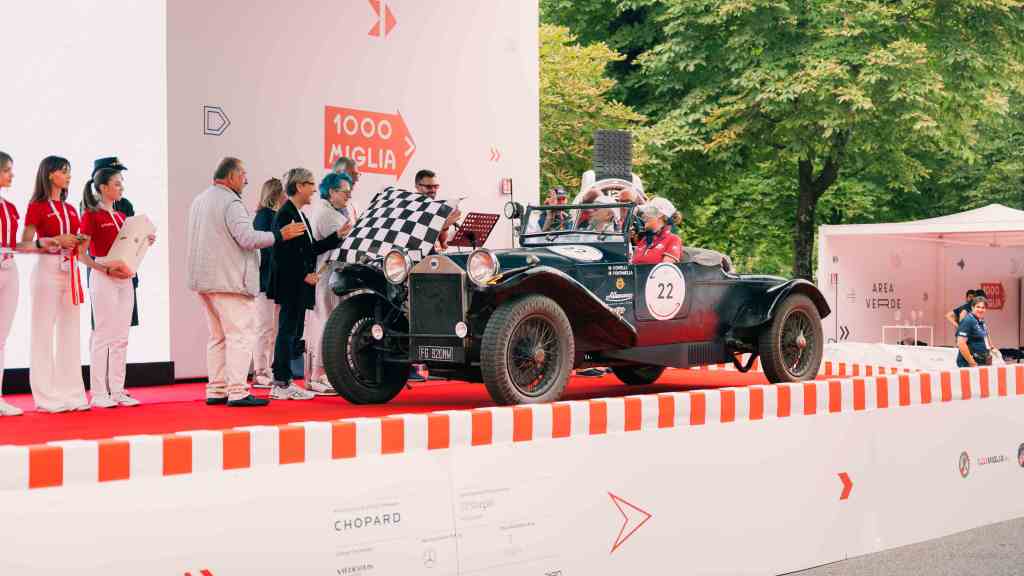
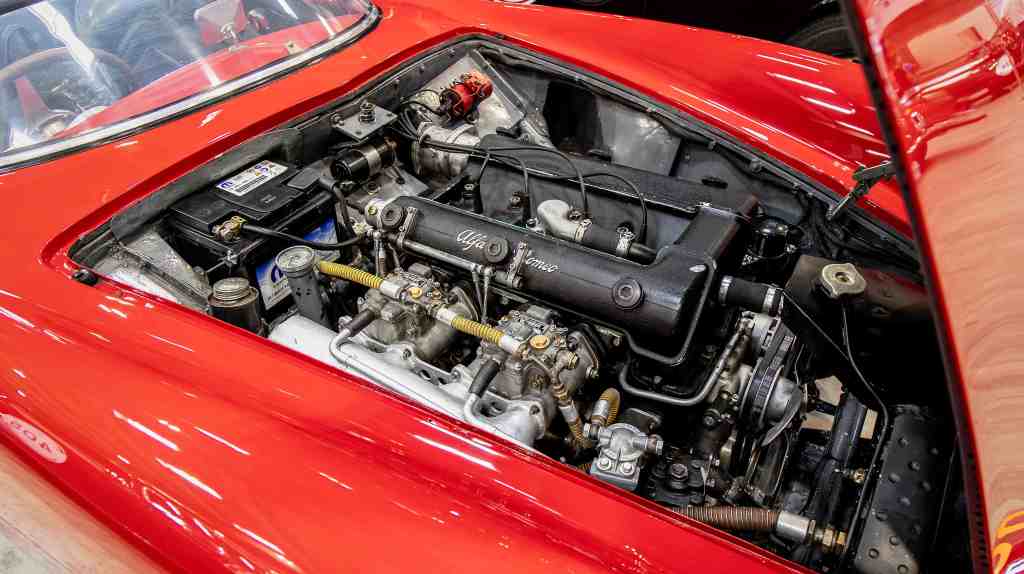
The Villa Trasqua team’s 1929 Alfa Romeo 6C 1750 Super Sport driven by the duo of Vesco and Salvinelli took the top step of the podium
The 42nd edition of the 1000 Miglia has been run beautifully again. The “Mille” is a race which has a very special place in my heart, as I have participated in it forming a team with my father in the official Mercedes Factory team, at the wheel of a works car. In the Mercedes team entry was then also Stirling Moss, and you can imagine that being in the same team, talking to him and wearing the same Mercedes Team racing overall as the celebrated champion was the pinnacle of what we would ever experience in our motoring life. I still have and cherish the Mille Miglia Shopard Watch with our entry number, 147, engraved in the back.
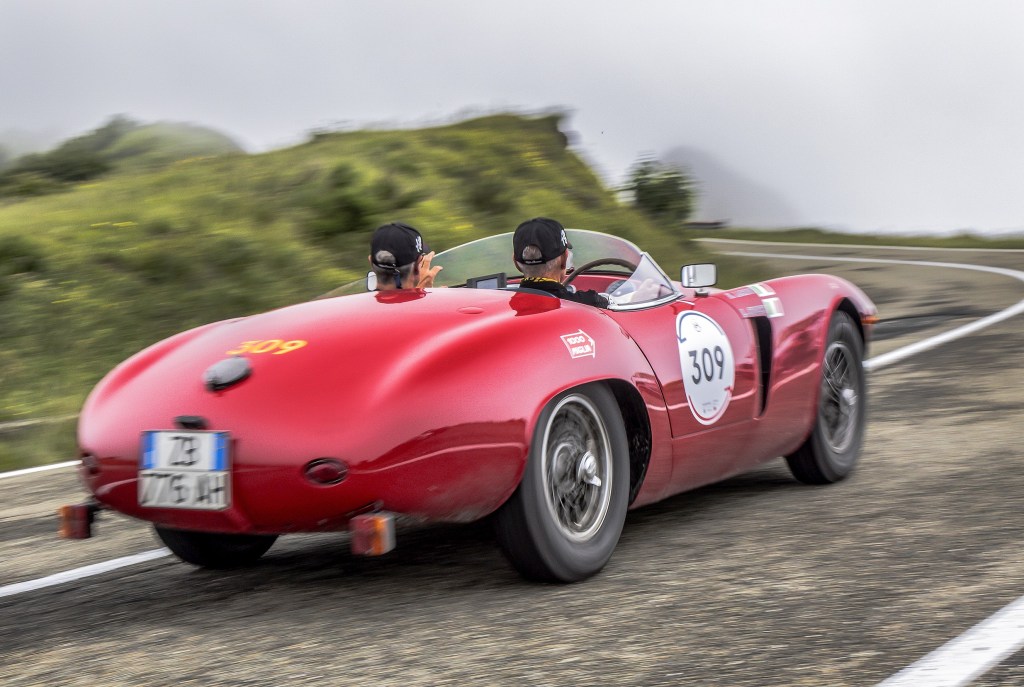
The Lancia Autrelia’s of the Automobile Club di Brescia were then the car on the winners podium, and now today Alfa Romeo’s undisputed dominance of the 1000 Miglia continues.
The 1927 Lancia Lambda Casaro VII Serie, crewed by Fontanella and Covelli, won the silver medal.
The route of the Mille Miglia is in itself totally epic…
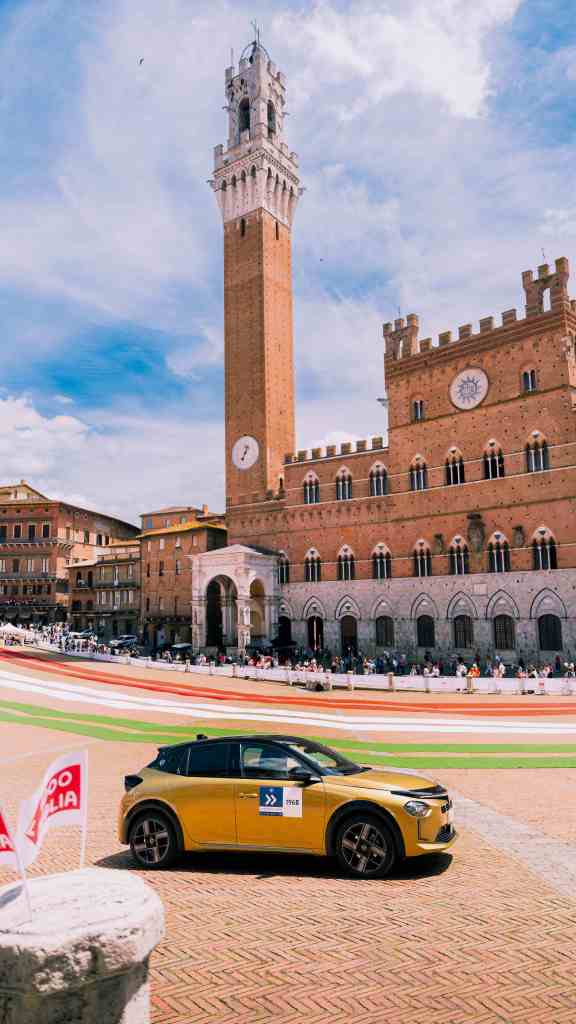
From Brescia it went for the first time in 76 years also to Turin, then from Genoa and the beaches of Viareggio to Via Veneto in the heart of Rome, then returning north via Siena, Ferrara and Lake Garda, to end with the traditional parade on Viale Venezia in Brescia, where it all began back in 1927.
Once again this year, the pass-by of this epic “traveling museum” aroused enthusiasm and curiosity among the throngs of spectators who crowded the route of over 2,000 km.
Also remarkable was the participation of the Alfa Romeo Junior, the new compact car that brings Alfa Romeo sportiness back into the largest segment in the European market.
The New Lancia Ypsilon finished at the third position participating for the first time at the 1000 Miglia Green. And this on the very same days the model became available at Italian dealerships! Needless to say that we are keen to drive both cars soon…
As you will recall, I mentioned this already earlier in my columns, I have been a Lancia owner for four years, driving a dark midnight blue Lancia Dedra. It NEVER missed a beat, come what may and accompanied me in many iconic European places and cities. After that, I drove for half a year a Lancia Gamma, which also was fast, reliable and full of panache.
But back to the Mille Miglia: what a fantastic event, it still moves my heart.
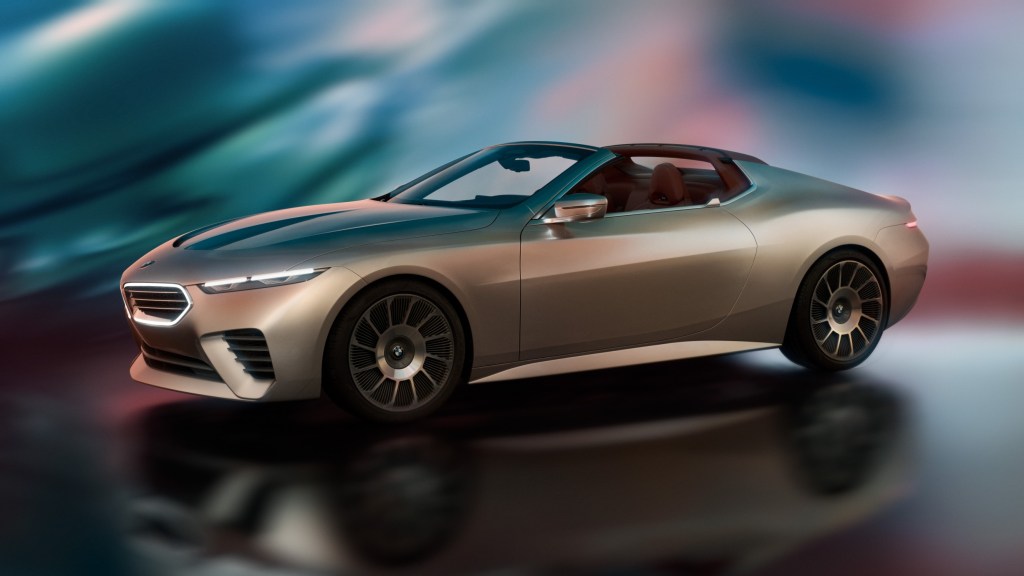
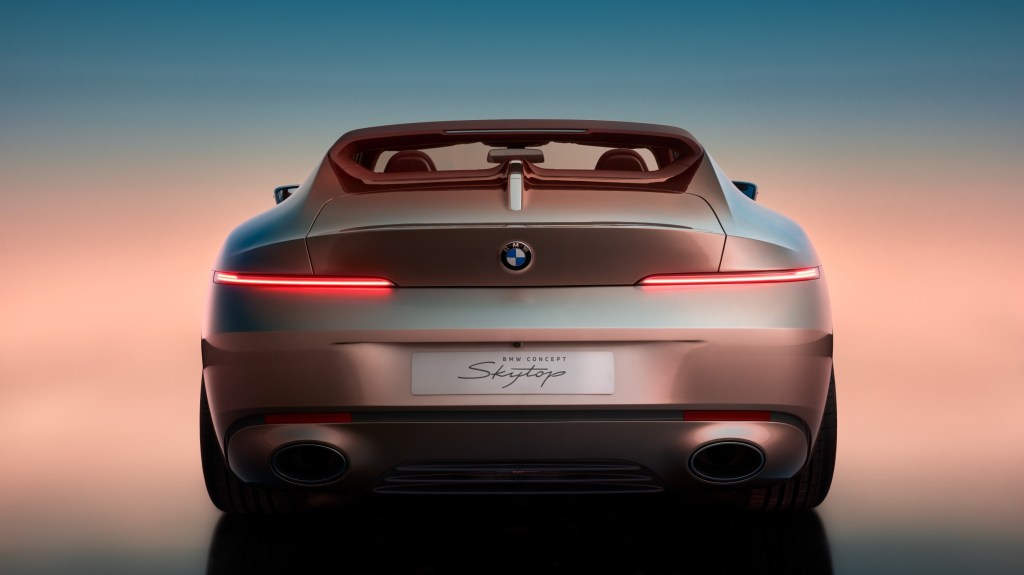
Designers can make you dream, and at BMW this is no exception. It brought to this year’s Concorso d’Eleganza Villa d’Este a unique design study: the BMW Concept Skytop. It has clearly athletic proportions, and Adrian van Hooydonk, head of BMW Group Design, commented: “It offers a combination of driving dynamics and elegance at the highest level, comparable to its historic ancestors, like the BMW Z8 or BMW 503.”
Indeed, it does, its lines, surfaces and volumes breathe the classic proportions of its iconic predecessors. Is it a harbinger for future BMW styling? It certainly has interesting details, like winglets integrated into the door shoulders replace conventional door handles. Light-alloy wheels with precise lamellas are also adding elegance and drama.
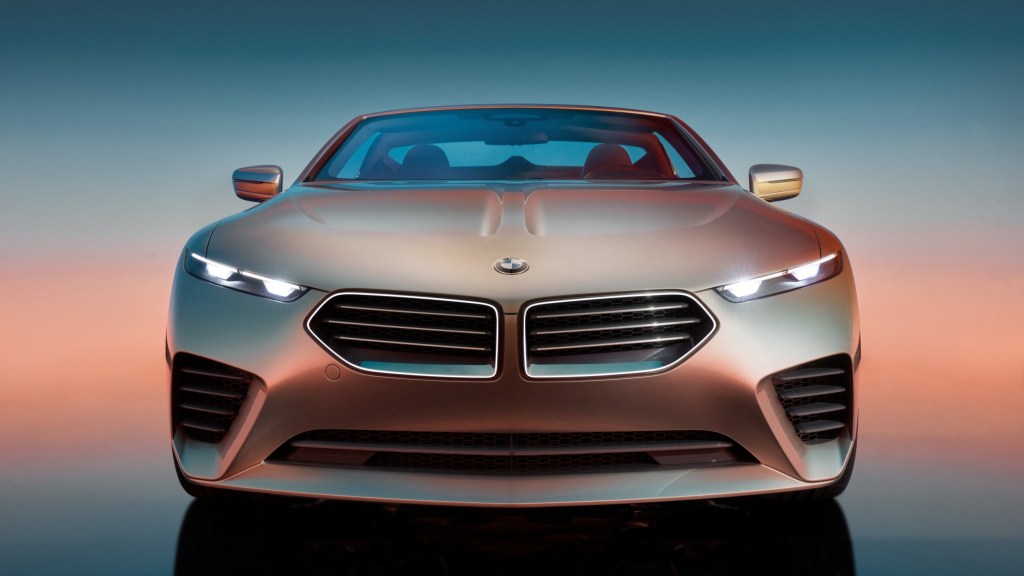
We like the impressive long bonnet and the classic kidney grille, and also the retracted rear end and the pronounced central spline, which runs over the bonnet through the interior and ends an aluminium trim positioned on the tailgate, add both panache.
The LED headlight units, positioned on milled aluminium carriers, were custom developed for the BMW Concept Skytop, utilizing the latest technology and design for automotive headlights with the slimmest profile currently available.
We also love the leather-finished roll-over bar behind the BMW Concept Skytop’s two seats, as it is combined with side fins on the B-pillar and a fully retractable rear window. The setup is quite practical: the two removable roof parts, also finished in leather, can be stored in a special compartment in the luggage space.
Color harmonies…
The colour scheme ensures a smooth transition from interior to exterior, regardless of whether the roof is open or closed. In the rear section, the reddish-brown tone of the roof flows into the muted silver with chrome shadow effect of the exterior paintwork. The technically elaborate colour gradient was crafted by an experienced master painter at BMW Group Plant Dingolfing (!)
…and luxury in brogue-style leather…
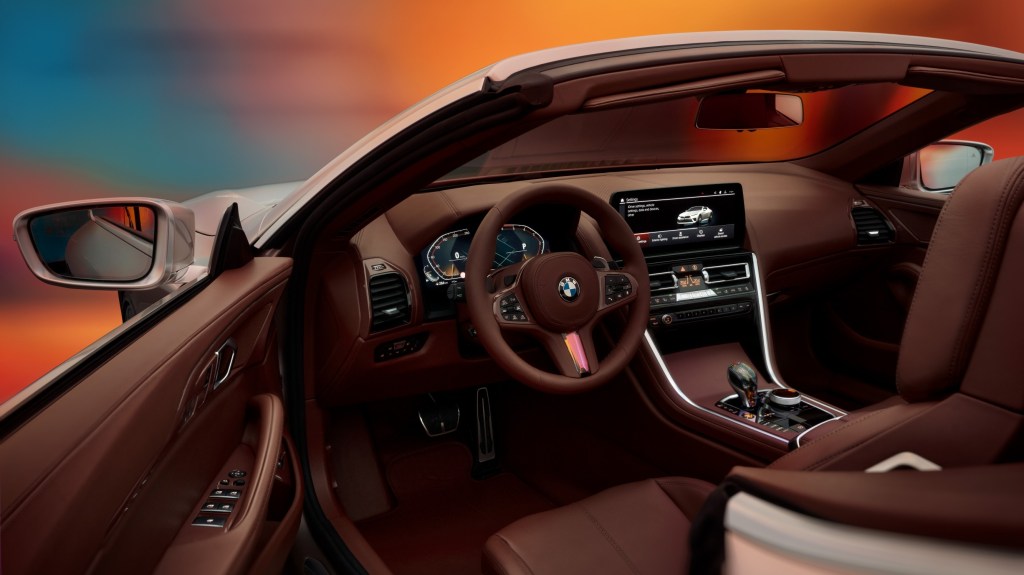
The leather seats in the interior carry brogue-style accents. The reddish-brown tone of the leather gives the whole interior a sense of luxury and spaciousness. Chrystal elements and further are artfully embedded in the gearchange lever and the cockpit, adding to the overall impression. The interior surfaces of the BMW Concept Skytop were crafted in the traditional saddlery of the BMW Group plant in Dingolfing.
The spirit of the Z8 reigns also in this concept car: under the hood roars the most powerful V8 engine in the BMW drive train portfolio.
Of course there is much more news on the BMW front: the new 3 Series Sedan and Touring, the new 5 series Touring and the first BMW i5 Touring, to say the least. Stay tuned!
Belgium, the Netherlands and Luxemburg have always been “home” for Lancia. Indeed, our roads were marked 4 to 5 decades ago by the presence of the elegant Fulvia’s, and connoisseurs were at the wheel of the Flaminia’s, not to speak of the beautiful Superleggera’s and later, last but not least, the 4WD Lancia Delta “Integrale”, which still makes the hearts of aficionados beat faster.
The rear lights of the new Ypsylon are reminiscent of the legendary Stratos, with also the “Y” Calice symbol worked in…
Even your servant fell for the brand with the elegant chromed “calice” on its radiator, namely a Dedra 1,8 i.e. By then, Lancia was already part of the larger Fiat concern, and it proved to be an utterly reliable and pleasant companion for four years in my stable, and I still remember it fondly. It already had the beautiful dark blue body paint and equally blue Alcantara interior and seats.
Given this enthusiasm, it is hardly surprising that Stellantis decided to pick the Benelux as one of the ideal places in Europe to have the renaissance of the brand, in line with the “Stellantis Dare Forward” strategic plan.
The Lancia Ypsilon is the much loved debutante…
The Ypsilon has maintained the brand alive in Italy, and has been highly popular there over the years. Not that the new Ypsilon has anything in common with its predecessor. It carries the Lancia Pu+Ra Design (the name a combination of ‘pure’ and ‘radical’), the one-of-a-kind Lancia design language with a timeless touch. The new Ypsilon It is available as a pure EV and in hybrid form. The 156 HP EV with a 51 kW battery has a WLTP measured range of 403 kilometers, the 3 cylinder, 100 HP 48 V hybrid caters for a wide(r) public and can be bought at an attractive base price of 24,000 Euros. The EV has the same technical basis as the Peugeot e-208 and the Opel Corsa Electric, but it certainly has quite different looks.
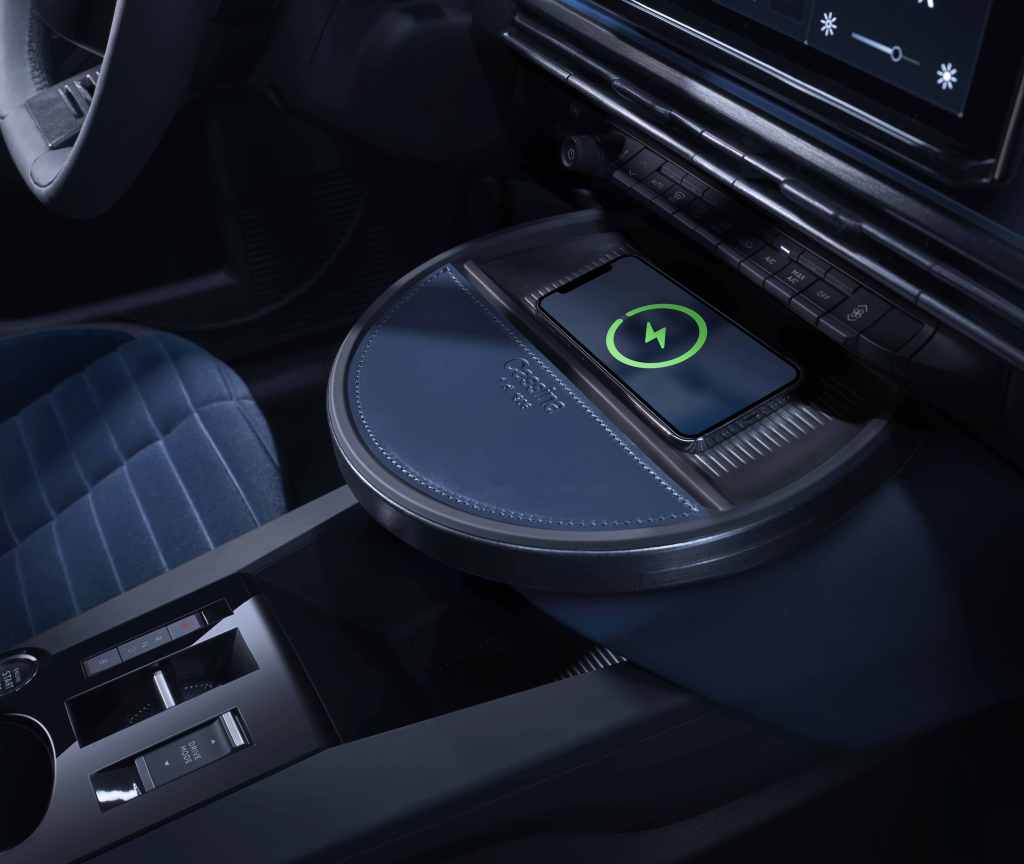
Lancia presented us their Ypsilon at the launch in a very attractive top notch “Edizione Limitata Cassina” version, whith an iconic “Lancia Blu” color for interior and bodywork, ”panno” wool upholstery for the seats executed in “cannelloni” pattern and as icing on the cake, one is seduced by an iconic “tavola” or small round table in the centre of the dashboard, sitting on top of the centre console. This brings you in the unique S.A.L.A. or “living room” atmosphere, which the Lancia designers created in collaboration with Cassina.
The abbreviation S.A.L.A., meaning living room in Italian, actually stands for Sound, Air, Light, Augmentation and is the new name used for the infotainment system. Its command module sits as a disk on top of the dashboard. We will come back on this system more in detail when we will get acquinted with the Ypsilon, hopefully soon…
This Cassina edition is exclusive: only 1906 units will be produced, and the number is actually also quite symbolic, as 1906 is the year Vicenzo Lancia was born…
The Benelux customer can now order this Ypsilon, and besides the top Cassina and the “base” version, one can also opt for the premium LX version. LX is also symbolic, as it is the Latin acronym for 60, created in 1966 to celebrate the 60th anniversary of the brand.
Even the base version is well equipped, with multifunctional steering wheel, automatic airco and keyless entry/start/lock. There is also one 10,25 inch digital instrument screen and an equally big central touchscreen. Of course Apple CarPlay and Android Auto is also provided.
A new dealer and sales network
The renaissance of Lancia comprises also an all-new network made up of 9 new showrooms in Belgium, 6 in the Netherlands, and 1 in Luxembourg, with 12, 6, and 1 after-sales service points respectively. You can order also your new Ypsilon online, if you wish.
Should you opt for a “pure” EV, it is good to know that Lancia offers “Free2move Charge”, a simple, complete, and integrated ecosystem that allows worry free charging at home and gives you access to 600,000 charging points across Europe. Lancia offers also the Easy Wallbox Home Charging solution and has interesting financial renting offers in store, worked out in collaboration with Stellantis Financial Services.
Last but not least, we had at the presentation an interview with Barbara de Mol, Marketing Director for Lancia and Alfa Romeo, about Lancia’s dealer/sales and marketing approach in our country. It to be published soon, so stay tuned!
It is a significant trend: the major automotive brands in our Belgian market organize targeted events to approach their customers in the absence of a Belgian Motor Show this year.
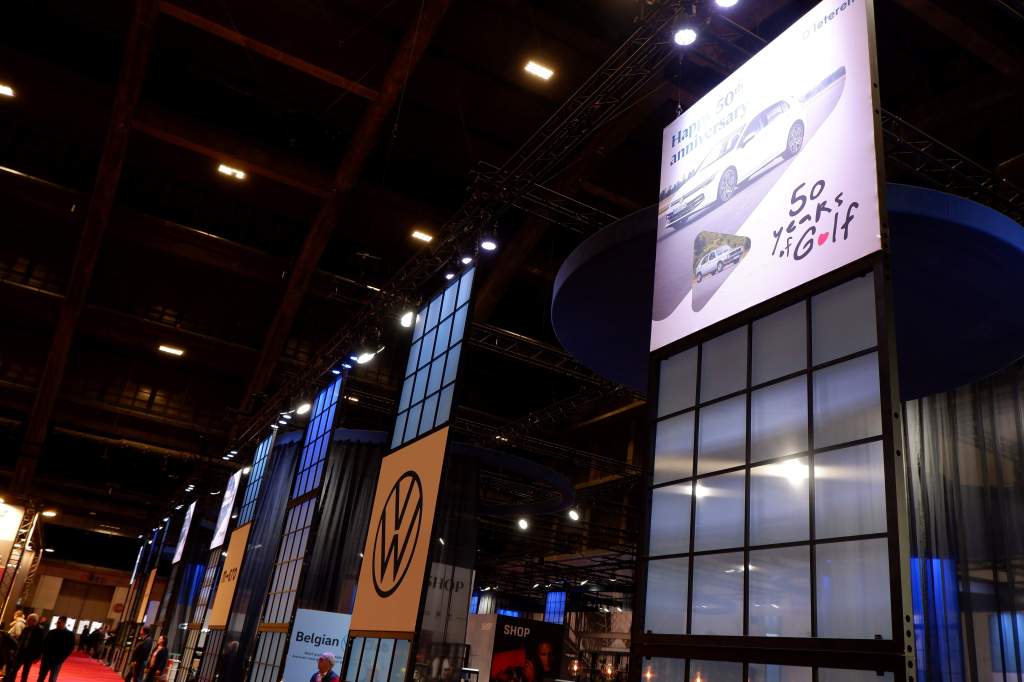
So from March 12 onwards, Mobility Solutions by D’Ieteren, formerly Group Mobility Solutions, immerses its B2B audience in an exclusive experience that focuses on innovative solutions and the leading trends in sustainable mobility.
“Developing seamless and sustainable mobility for everyone by offering our customers a connected mobility ecosystem: that is, in a nutshell, what we stand for,” says Joris Spigt, director of Mobility Solutions by D’Ieteren. “During our Mobility Experience by D’Ieteren, we therefore invite the B2B audience to get up close and personal with all the novelties within the entire ecosystem of mobility solutions that D’Ieteren has to offer today.”
News from the VW Group car brands…
There is quite some news. For example, Volkswagen and Volkswagen Commercial Vehicles will not only be showing the new Tiguan e-Hybrid at this event, the ID.7 Tourer will also be present, just like the ID. Buzz with long wheelbase and seven seats. One can also see the latest generation ID.3 and the ID.2 all-concept: a design study of a compact, fully electric model that will have a base price from € 25,000.
Škoda, for its part, is presenting two Belgian premieres: the new Superb Combi and the Kodiaq iV.. The latter is now available as a plug-in hybrid, further strengthening its B2B potential.
CUPRA presents the new Tavascan, the brand’s very first fully electric, sporty SUV. It is flanked by the also fully electric, compact UrbanRebel concept car that provides a glimpse of the future of CUPRA, and by the current Formentor and Born models.
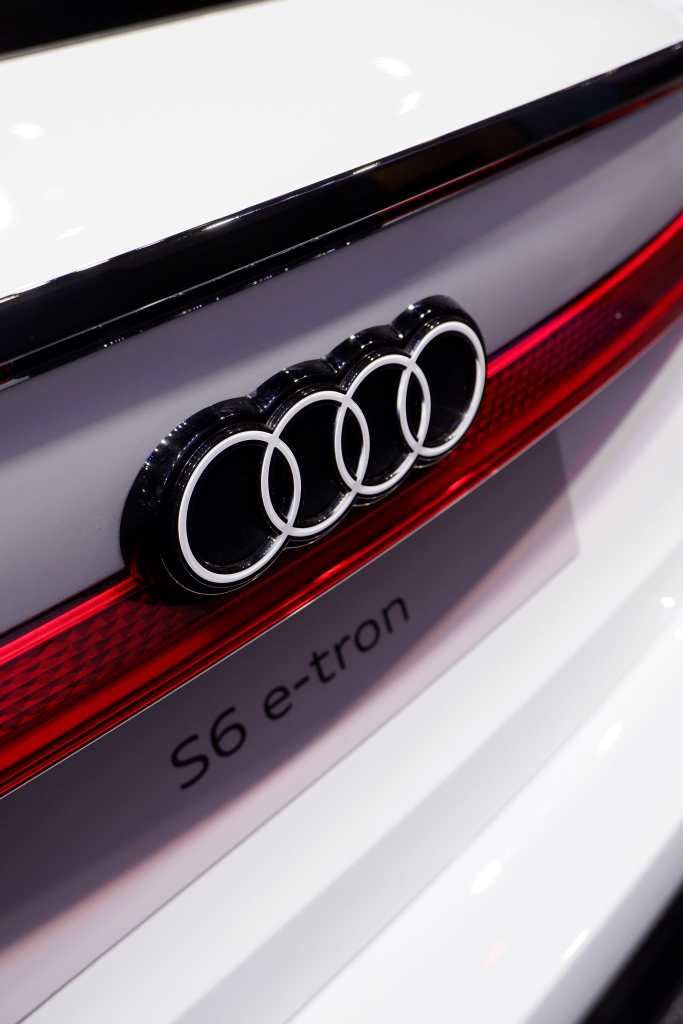
Audi’s long-term vision is given concrete form by the camouflaged prototype of the Q6 e-tron that will be unveiled very soon. A new SUV that perfectly embodies the electric DNA of the four-ring brand with even more autonomy thanks to the new Premium Platform Electric technology platform.
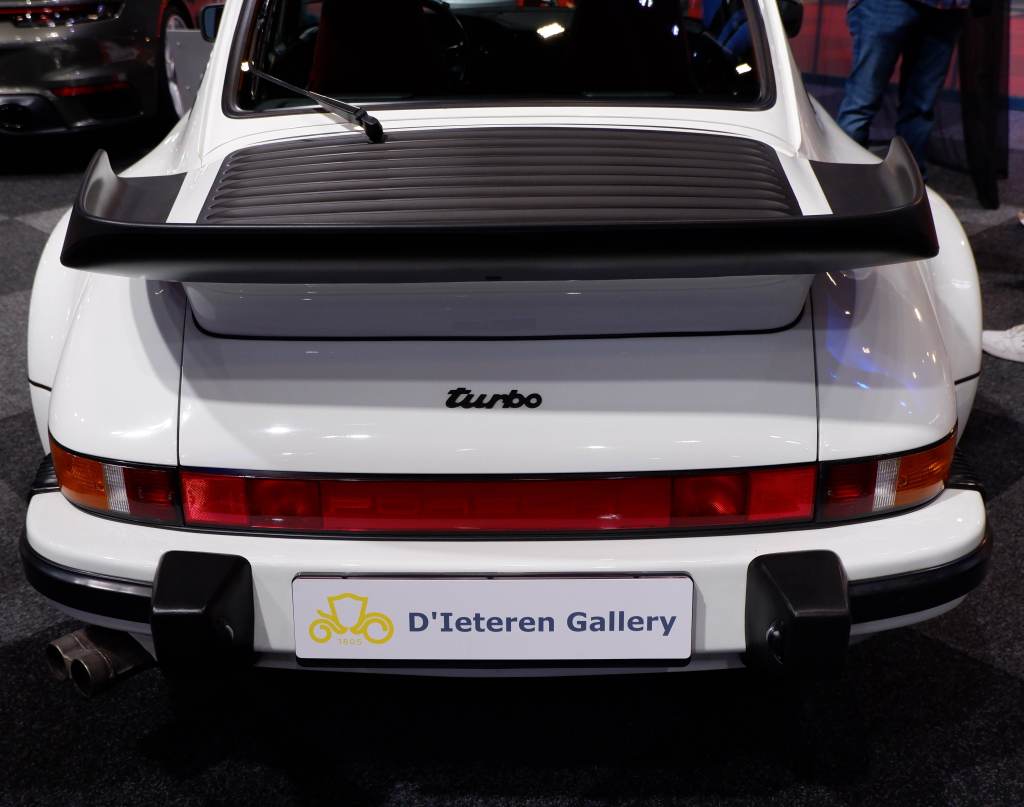
Finally, Porsche will be showing its latest Panamera Turbo E-Hybrid, which with its combination of power and emotions guarantees an unparalleled driving experience.
Seamless mobility offered…
In addition to the product novelties, Mobility Solutions by D’Ieteren will make time and space available during this show for all the mobility services it offers. The best known are probably the financial solutions of VDFin and the mobility sharing service Poppy/MyPop, but providers such as Joule, Taxis Verts/Husk, My Way/Audi Approved+, EDI/Go Solar and Mbrella are also present.
Finally, Wondercar is part of the mobility ecosystem in its own way and highlights this with a creative activation that tests the stress level of fleet managers when someone damages their company car.
Interactive workshops are also organized…
“But with our Mobility Experience by D’Ieteren we go one step further,” explains Joris Spigt, “by also strategically familiarizing our B2B audience with the mobility of today and tomorrow. In four interactive workshops we inform them about how they can integrate new transport modes into their policy, how new technologies can provide guidance and how they can tailor a mobility strategy to the ambitions of their company and the expectations of their employees.”
We show you the photos here, and needless to say that we are keen to test for you the numerous novelties D’Ieteren has in store for us…
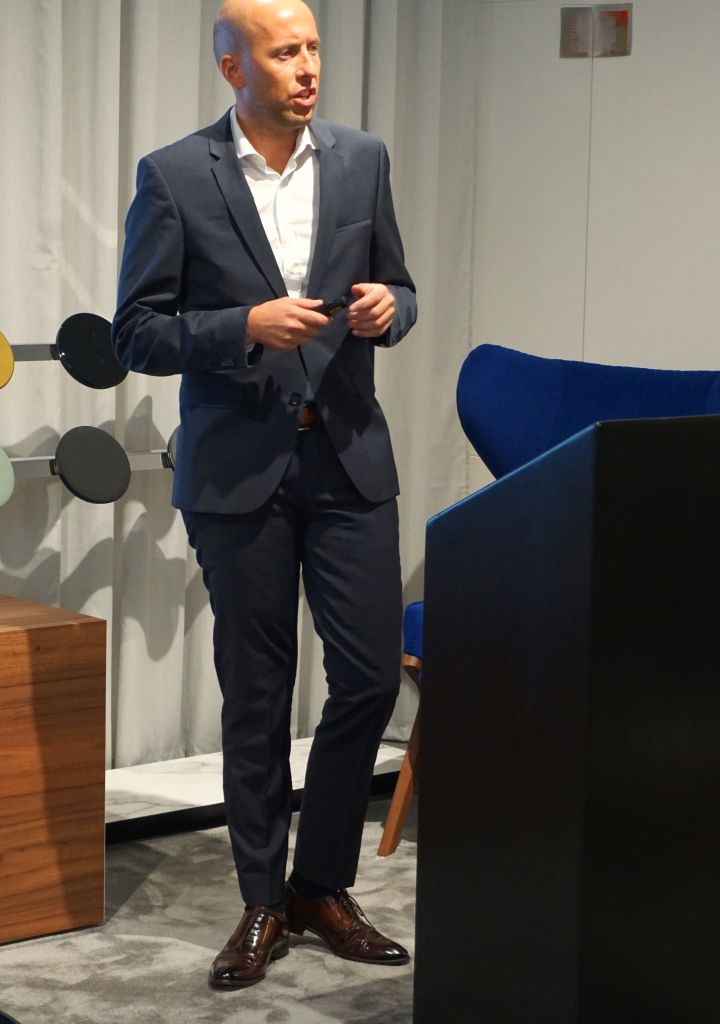
On February 21 I attended an interesting dinner conference organized by the Royal Historical Vehicle Club Belgium, where Sebastien de Baere, managing director of Autoworld Museum Brussels presented the impressive turnaround he achieved for this iconic museum, which is now more popular than ever.
Michel Van Eesbeek, president of the Royal Historical Vehicle Club Belgium, introduced the speaker Sebastien de Baere…
This evening conference was of course held in the restaurant of the Autoworld museum.
Sebastien told us at length about the very positive evolution the museum went through since he became its Managing Director in January 2011. His previous professional experience as event organizer (he was Director of SAP Lounge, situated in the historic setting of the ‘Tuchthuis’ in Vilvoorde, which offers a high class meeting and event facility to catalyze business interaction) helped him to revitalize and effectively transform the museum.
“I first started to transform the sleepy, dusty image of this museum in its stately premises at the Cinquantenaire, also literally”, Sébastien starts his conference. I drew up a five year plan, and indeed started with removing unnecessary old artifacts which did not contribute to the essence of the museum and then we began to restructure the collection of exhibits and display areas.
2024 started already magnificently with the end-of-year exhibition “Porsche – Driven By Dreams,” from December 8th 2023 until February 25th 2024. We reported about this outstanding exhibition on our pages…
Then we got to work on improving the image of the museum with a new logo, introduced up to date marketing and last but not least started organizing events, at a very frequent rate. (Not less than 150 annually). These events established close ties between the museum and companies and industry in the automotive sector as well as the whole Belgian and international car world.
The results are there: In 2023, the museum welcomed no less than 235,000 visitors, a spectacular achievement especially if you take into account that this number doubled in a mere five years.
The 2024 events calender will be very busy indeed…
The year started already magnificently with the end-of-year exhibition “Porsche – Driven By Dreams,” from December 8th 2023 until February 25th 2024. We reported about this outstanding exhibition on our pages…
Autoworld further honors 50 years of the Volkswagen Golf from March 1st to April 28th. The most successful European car is now in its 8th generation, having received a facelift again this year.
Many members of the Royal Historical Vehicle Club Belgium attended the conference…
It will be followed from the 60th anniversary of the legendary Ford Mustang, a retrospective on the history of Formula 1, and, of course, a few more surprises that Sebastien de Baere would like to keep secret until further notice…
Soon we will visit the VW Golf exhibition at Autoworld – stay tuned!
In the Stellantis Group, Fiat occupies of course a very important place, and therefore we made this interview about its future plans at the recently held press conference… Just read on!
HKTB: I propose to start this interview with the LCV market, which is very important for Fiat.
AP: Indeed, it is very important, and we have even reserved a specific brand for it, Fiat Professional. This means that we have also a dedicated network for this brand. Indeed, we have dealers who sell exclusively commercial vehicles. This means that they offer a service which is fully tailored to the needs of a professional client. For him, our vehicles are an instrument for his job, and so his needs are for example different time schedules for service and maintenance, and sometimes also assistance on Saturdays too.
Fiat has fully renewed its LCV range…
HKTB: I assisted a few years ago at the launch of the first electric Ducato…
AP: Indeed, this was the first phase in the electrification of our LCV range. Now we have a new Ducato which has been designed from the ground up for BEV use. This Ducato has an attractive range of some 400 kilometers. But the use of a fully dedicated BEV platform enabled us also to be more cost effective and reduce the price by not less than 25 pct and meet the needs of our professional clientele by offering multiple load and bodywork configurations.
HKTB: When we come back to the passenger cars, the new 600 will also be very important to introduce electrified and BEV mobility to a wider public?
AP: Our most important BEV car for the moment remains the 500. The latest generation of our iconic 500 is exclusively BEV, whereas the previous generation is still produced and offered in hybrid form. It is very important to note that our most popular and important car is now BEV only, not many mainstream manufacturers are doing this!
AP: This goes of course also for the Belgian market: the new 500 is exclusively electric. Now we come to the 600. This is a segment B car, and everybody knows that in this segment, a big share of the volume is still consisting of IC or “thermal” cars, let’s say that of the approximately 130,000 cars sold in this segment, only 7,000 are electric.
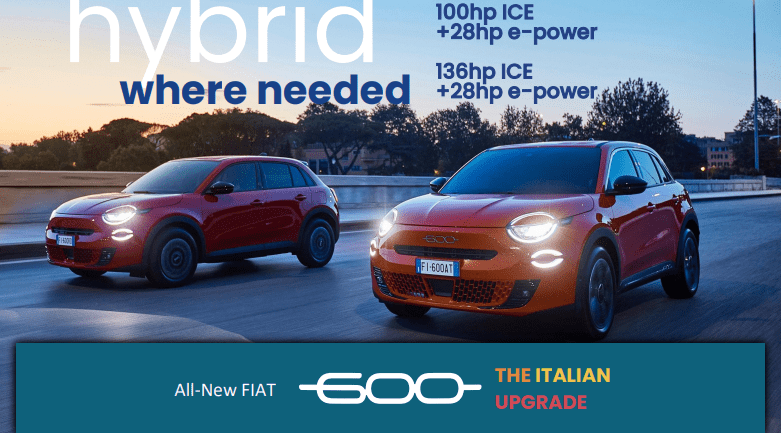
This is why we decided to offer the 600 also in hybrid form, besides the BEV version. Its hybrid drivetrain allows you still to drive on E-power in town for some 50 % of jour journey. The first hybrid cars will be available to the public around mid summer. This car will be available at a price around 24.000 Euros, which is quite attractive.
HKTB: Finally we have also Abarth. Being an engineer, this brand will certainly passionate you…I still remember the bialbero’s, the 850 TC’s…
AP: Indeed, as soon as you sit behind the wheel of an Abarth, you feel younger and invigorated… it gives you energy, even if you drive only at a speed of 30 km/h! There is this unique spirit…
HKTB: How do you see the energy transition for the “Abartisti”?
AP: We have already an electric version of the 500, and we will continue along this path. I understand that many enthusiasts of the brand are still somewhat skeptical, but even if you want a sporting car, its electrification is inevitable. I can assure them that they will find a car which is responsive, handles beautifully, will be full of character.
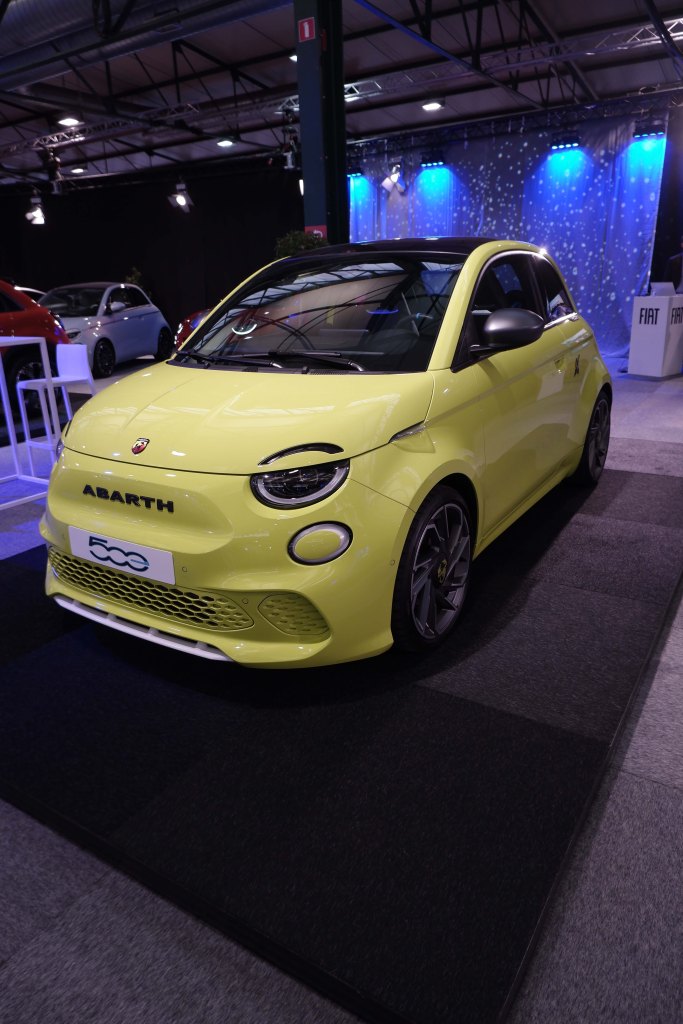
In the new 600 Abarth which will be launched this year, they will find all these unique qualities too. I cannot give more details at this moment, just that this car will be powerful with 240 HP… But in looks, feel and touch, it will be very much a pur sang and sporting automobile. The car is not only developed by Abarth, but also by the people of Stellantis motorsport.
HKTB: Will it be a car for the engaging, sporting driver, will it have performance controls like a formel E racing car, so the expert and talented driver can increase the handling and outright power of the car?
AP: I cannot give you any more details of the car at this moment, except that it will be very powerful, with 240 HP…
“On BEV-mobility In the B segment, we will indeed be the spearhead for the StellantisGroup.“
On the recently held Stellantis Press conference where it unfolded its strategy, results and future plans for its brands, we had the opportunity to talk with the leading managers of the several brands. As Citroën is the linchpin of the group in terms of European volume sales, we were keen to talk with Pierre Voineau, more specifically about a very important EV for Citroën, the new ë-C3.
Just read on…
Hans Knol ten Bensel
HKTB: The new electric C3 will be a very important car for Citroën on our market…
PV: Indeed, it is the most important model launch for the Citroën brand over the last decade. Of course, the C3 is the most popular car here in Belgium, and has been already over the last few years. We also want to revolutionize the EV market with this car, making it accessible for everybody and at the same time producing the car in Europe…
We are at the crossroads of a decisive moment both for the Citroën brand as well as the car market in general.
HKTB: For you it is also a mini-SUV, the C3 has grown taller…
PV: Indeed, we have injected the DNA of an SUV into the well known C3, but we did not make the car any longer or wider. This was very important. The car does not take up more room on the road than the present C3, just by a few centimeters at most. But we heightened the ground clearance of the car by 3 centimeters, and raised the roof line considerably with 10 centimeters. The passengers sit higher and indeed the front end is more imposing with a styling reminiscent of the OLI prototype you saw in Paris. The OLI embodies the strategy of the brand in terms of the total technical concept and styling in the long term, but indeed, some elements are already incorporated in this new C3.
HKTB: Which extra market segments or client groups do you want to attract besides the existing Citroën buyers?
PV: We will not in the first instance attract other client groups. It is rather the mobility itself which changes. With this, the needs of our existing client base also evolve. Now the need arises for cheap EV mobility, and we respond to that.
HKTB: The problem for you as a brand and certainly for a big automotive group like Stellantis is that the public charging infrastructure is still insufficient to meet all the mobility requirements. What do you put forward strategically here as a brand and a large group?
PV: We have Free2move eSolutions within the Stellantis group, which accompanies the client from A to Z in purchasing and installing his home charging point. When the client is in a particular situation and has no home or office charging point, or otherwise, it is good to know that in the spring we will also offer a thermal version of the C3.
Having said this, we will also have a special application, called e-ROUTES, on our electric C3. The route planner knows how many kilometers you need to travel, it will calculate a stop at say 20 % of the battery left, indicating the position of a charging point and also whether this charging point is available. It will indicate the recharging time needed, depending on the power of the charging station. One can charge up to 100 kW by the way. This will give the customer peace of mind when traveling over longer distances. With a battery of 44 kW and a range of some 320 kilometers one responds to almost all needs. On average, customers don’t travel more than 80 km per day.
Note from the editor: This new app, developed by Free2move Charge, is a trip planner that utilizes real-time data from the car and charging points on the driver’s planned route. e-ROUTES is available via an exclusive smartphone app. It is compatible with Apple CarPlay and Android Auto. To access e-ROUTES services, customers will need to use their MyCitroën account, either through the app on their smartphone or the car’s touchscreen, using the mirroring function.
HKTB: EV driving also needs a different state of mind and driving style…
PV: Indeed, one will embrace a different, anticipative, more leisurely and “zen” driving style… What’s more, we focus at Citroën also on comfort: the new electric C3 has a so-called Progressive Hydraulic Cushions® suspension, ensuring that you enjoy the legendary ‘magic carpet ride’ feeling of comfort on the road, thanks to the use of progressive Hydraulic bump stops.
Note from the editor: Two stops are used on each corner of the vehicle in conjunction with the shock absorber and spring instead of mechanical stops – one for compression the other for decompression.
PV: We also have a manual airco on all the equipment versions of the C3, including a rear-end sensor. This combination of e-refinement with comfort and lavish standard equipment has great appeal and indeed the European wide orders for the new car at the end of December last year amounted to not less than 20,000. This year, we have chalked up already 1,000 orders in Belgium only. On BEV-mobility In the B segment, we will indeed be the spearhead for the Stellantis Group.
PV: I would like to comment also a bit more on the interior of the C3. Just look at the display. It reflects vehicle information onto a glossy black section between the top of the dash panel and the bottom of the windscreen. This smart solution ensures there is no duplication of information as there would traditionally be between a Head Up Display system and instrument cluster, and ensures drivers can easily access all the key information they need without taking their eyes off the road. The new multi-function steering wheel is also smaller, and so does not obstruct the head-up display.
Owners of the ‘You’ model have as standard equipment the ‘My Citroen Play with Smartphone Station’ dedicated App to access music, radio, calls and navigation via their own device.
HKTB: The clever use of the smartphone was also a solution found on the OLI prototype… actually, this C3 has everything of a compact “grande routière”…
PV: Indeed, as said, standard on ‘You’ models and features a built-in smartphone holder that allows drivers to ‘dock’ their device and auto launch the dedicated new App using NFC (Near Field Communication) wireless technology. Via this app, owners use their device to access shortcuts to Phone, Radio, Navigation and Music App services. The ë-C3’s steering wheel controls ensure drivers keep their hands on the wheel, and the ‘Home’ button makes it easy to navigate back to the homepage of the App.
Indeed, the Management and PR team of Stellantis Belux, welcomed recently the Press and B2B to a, called ‘House of Innovation’.
A fitting initiative, set up in the absence of the Brussels Motor Shows, keeping the tradition in our country of a traditional show period and at the same time providing a platform for unveiling the latest innovations, concept cars and the future direction of the Stellantis brands.
Needless to say we were very keen to attend this event, giving your servant also the opportunity to have several interviews with the managers of several brands, which we will present soon on our columns. Here in this first report about this “Kickoff Press conference” we will focus on the future strategy of Stellantis and its plans for the Belux market. Just read further!
Hans Knol ten Bensel
The event started with an inspiring introduction by Florian Kraft, CEO of Stellantis Belux…
…followed by interactive brand presentations and workshops. “This event symbolizes our continued pursuit of innovation and progress in the automotive world. We are excited to share our latest developments and our vision for the future with the press and our valued customers and partners,” said Florian Kraft, CEO.
Florian Kraft first pointed out the four core targets of the Stellantis “Dare Forward strategic plan 2030.” This plan will move Stellantis into a sustainable mobility tech company.
The first target is reducing its carbon footprint by 50 % in total CO2 emissions per vehicle compared with 2021, on the path to achieving carbon net zero in 2038. This then includes not only from well to wheel, but also throughout the entire supply chain.
The second target is setting the course for 100% BEV sales in Europe and 50% in the United States in 2030. The third is achieving number one position in customer satisfaction. The fourth is doubling net revenues while transforming our business models and sustaining double-digit operating margins. How Stellantis will achieve this, will be the subject of a future report in our columns. Stay tuned!
Ambitions for 2024…
Looking ahead to 2024, Stellantis Belux has set itself several goals. In terms of network, the company aims to ensure a successful transition to the New Retailer Model using its existing network. Indeed, Stellantis is progressing at full speed in the execution of its Dare Forward 2030 Strategic Plan, with the ambition to be #1 in customer satisfaction in all markets, in products and services. Indeed, the customer experience will be at the core of this retailer model.
Customers will be able to take advantage of a multi-brand and multi-channel approach with a wider range of services. Dealers will have a new and efficient business model aimed at benefitting from Stellantis’ 14-brand portfolio, creating synergies, optimizing distribution costs and offering additional sustainable mobility solutions, says Stellantis. So far for the aims, let’s explain this further in more concrete terms.
In September last year, Stellantis launched the reorganization of its European dealer network, starting with four specific markets before extending it further across Europe in 2024. Stellantis announced it was ending its previous sales and services contracts with European dealers for its 14 brands and moving toward a new distribution framework based on an agency model. What is this agency model?
Under this model, the manufacturer becomes the retailer while the dealer remains the physical touchpoint with the customer. The agent/dealer receives a commission on each sale and no longer individually sets prices or discounts.
As the dealer does not have to purchase the cars from the manufacturers anymore, he does not carry significant commercial risks and has less administrative costs as billing and payment towards the customer is done by the manufacturer. It protects also the profitability of the retailer. Because, as everybody knows, profit margins on new car sales can fluctuate.
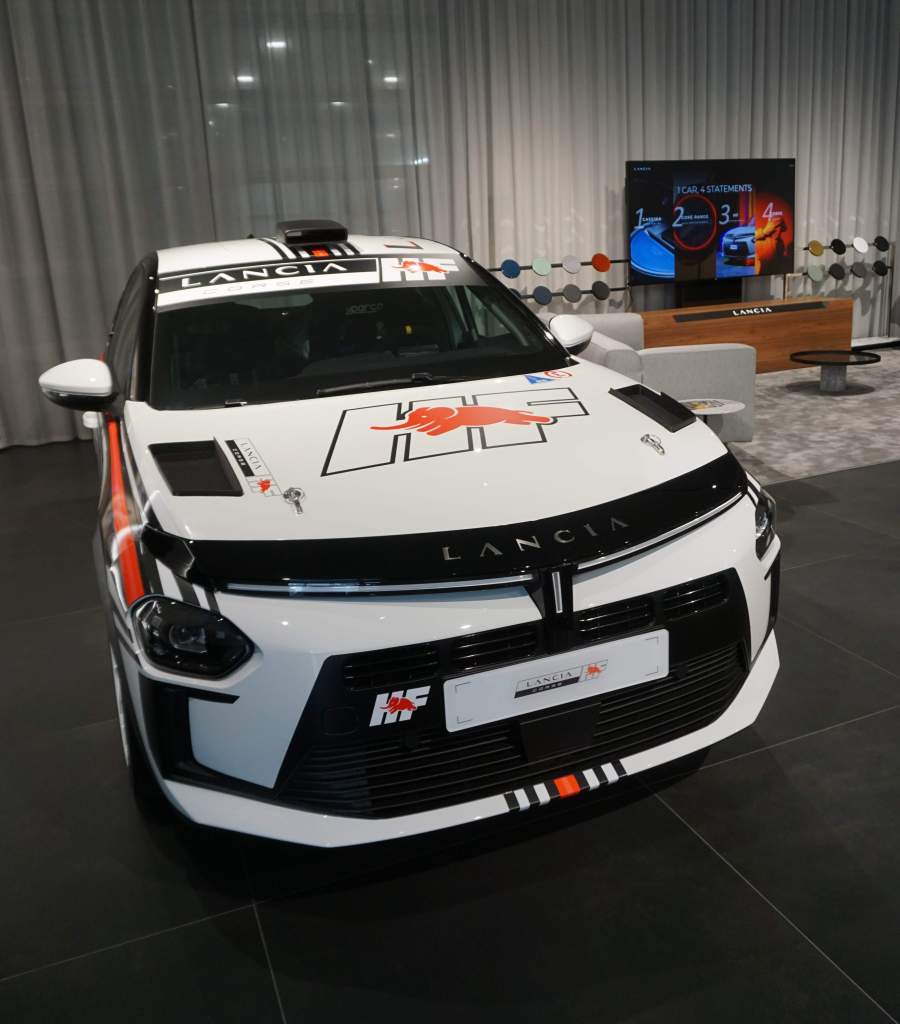
With the Lancia Pu+Ra HPE, the Lancia journey towards the future begins, drawing inspiration from the past
The advantage for the car manufacturer is a direct contact with the customer, which it did not have so far….
The manufacturer can now determine end-customer discounts themselves, in this way achieving price consistency and avoiding competition between dealers of the same brand. They can optimize costs through centralization, and profit from the scale effect of transferring responsibilities from individual dealerships to the bigger sales organizations on national levels.
The new Alfa Romeo Stradale: the future is already a pur-sang reality…
It also is more in line with today’s consumer preferences, which would rather see fixed prices and an equally simple buying process as they experience in e-commerce.
Stellantis is moving towards this model in big steps now. In September last year, Stellantis announced that the revised retail model will be fully effective from Sept. 4, starting with Austria, Belgium, Luxembourg and the Netherlands. Stellantis is not the only one to prefer this agency sales model. BMW and Mercedes opt for it too…
The BEV line up at Peugeot: towards a leading position in the B and C segment…
Stellantis market position in Belux …
In terms of sales, Stellantis Belux aims to regain the lost market share in 2024 and further strengthen its position. In 2023, Stellantis Belux achieved a global market share of 17.2%, with more than 100,000 units sold. On the LEV (Low Emission Vehicles) market, Stellantis Belux occupies a fourth place with an 11.6% market share. The BEV (Battery Electric Vehicle) and the PHEV (Plug-in Hybrid Electric Vehicle) occupy a fourth place with respectively 10.5% and 12.8%.
Stellantis Belgium confirms its strong position with a pole position in the segment A and with not less than six models of Stellantis (Peugeot e-208, Peugeot e-2008, Opel Corsa Electric, Jeep Avenger, Opel Mokka Electric, DS3 E-tense) in the TOP 10 of the segment B (BEV), representative 66% of the part of the segment.
Introducing petrolheads to the joys of E-power: the Abarth 500 E, waiting for the imminent 240 HP 600 E…
Last but not least, Stellantis Belux is the leader in the segment of the LCV (Light Commercial Vehicle) with more than 30% of market share, of which more than 50% is electrified!
In terms of product innovation, Stellantis Belux will continue its electrification, where it currently leads in the A-B segment and LCV, and further expand it to the C segment with models such as the Opel Astra, Peugeot 308 and 3008 and Citroën C4.
As is tradition in January, the Stellantis brands start the year with super attractive “salon conditions” on their range. This applies to both private and professional customers and to electric and ‘thermal’ vehicles.
We made on this event interviews with Pierre Voineau, Managing Director Citroën Belgium & Luxemburg, (see photo here above), Asterio Perez, Managing Director of Fiat, Abarth and Fiat Professional in Belgium and Luxemburg, and last but not least Eric Laforge, Head of Jeep Brand Enlarged Europe.
This will be followed by a special report on the magnificent prototypes which were displayed amongst the 36 cars on this conference.
Managing Director Jerome Saigotunfolds the strategy of Nissan Benelux…
We are at the start a new automotive year, and therefore it is a good opportunity for manufacturers to look forward into 2024 and announce to the Belgian press what their strategy, plans and objectives will be in the forthcoming 12 months.
So we were invited at the end of last year by the Melvin Keuter, head of communications of Nissan Benelux at their press conference…and their interesting initiatives are certainly worth a closer look. Just read further!
Hans Knol ten Bensel
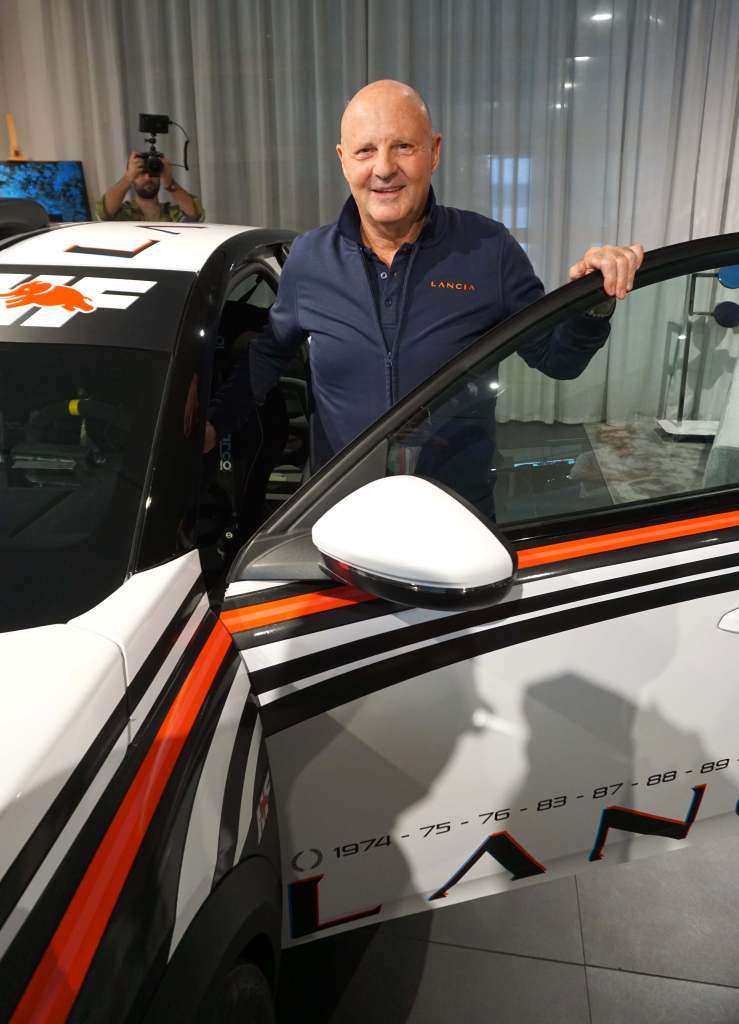
Melvin Keuter, head of communications of Nissan Benelux, exposed the electrification strategy of Nissan and its future…
Nissan Belux and Nissan Nederland merged into Nissan Benelux
On the 1st of July last year, this merger was executed in order to improve response to the needs of the Benelux market. Now the two entities are joined in a new so-called Regional Business Unit, led by Managing Director Jerome Saigot. Indeed, the car market is going through a fundamental transition, and Nissan will respond to these challenges by focusing on electrification, digitalization of the customer approach and responding to major changes in the buying behavior of their clients. Mr. Saigot emphasized these points of the strategy in his presentation at the press conference. He sees also in this merger further useful synergies for staff and dealerships.
He exposed the mission of Nissan Benelux, which is to be an innovative brand which offers electrified mobility and a superior service to its customers. Its objectives are to enlarge its volume, raise brand identity and awareness as well as boosting profitability.
The strategy to achieve this will be to focus, as we said, on further digitalization of customer approach, further electrification of the model range, strengthening corporate sales, bolstering brand identity and streamlining distribution.
According to Jerome Saigot, digitalization is a major trend which will strengthen further. In 2020, only 4 % of customers were buying a car online, which has risen to 12 % in 2023. Market surveys show that soon 45 % of the future customers will buy their car online. Of course, Nissan will work further on its electrification, and indeed focus also increasingly on corporate sales.
Looking at the results last year of Nissan Belux, 6.750 units were sold, which is an impressive 48 % rise compared to FY 22.
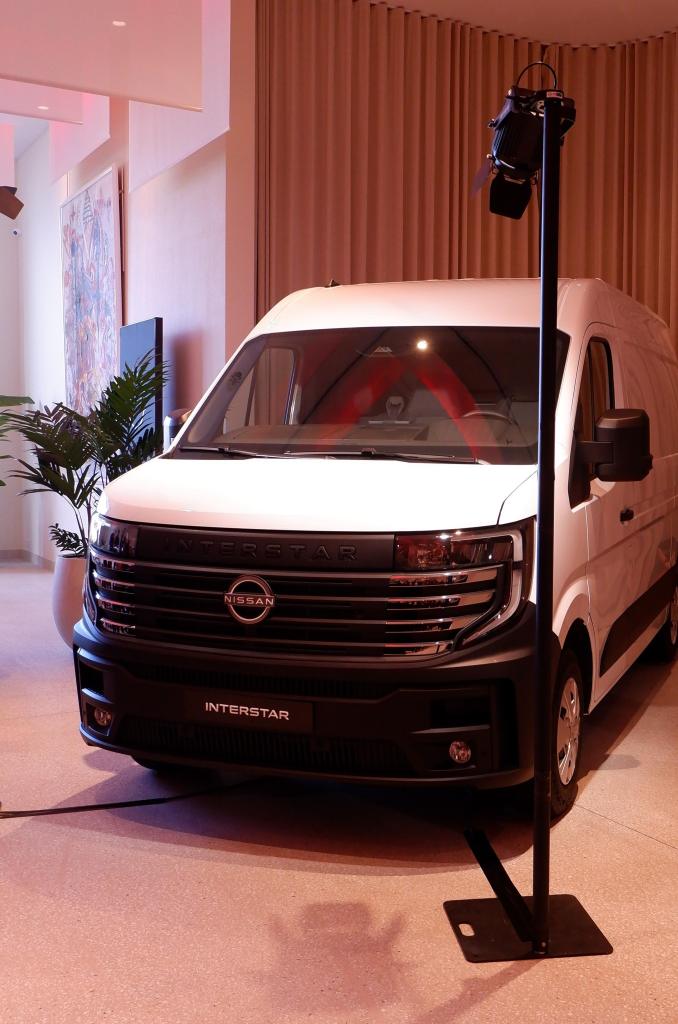
Also in distribution and dealership the focus will be on further developing synergies and tailoring the customer approach on their changing preferences and buying behavior. In December last year, Nissan sent a message to the professionals, small and medium enterprises, craftsmen and the like, pointing out the attractiveness of their increasingly electrified LCV segment.
Decisive steps toward further electrification… or EV36Zero.
EV36Zero is a key part of Nissan Ambition 2030. In this period Nissan will deliver exciting, electrified vehicles and technological innovations while expanding and transforming its operations globally the company announces. The vision supports Nissan’s goal to be carbon neutral across the lifecycle of its products by fiscal year 2050.
In November last year, Nissan announced that the EV36Zero hub in Sunderland, Nissan’s blueprint for future manufacturing, will consist of three electric vehicles (EVs), three gigafactories and up to £3bn investment.
The transformational project includes future all-electric versions of Nissan’s flagship Qashqai and JUKE crossovers, and Nissan also confirmed that the third vehicle planned for UK production will be next-generation Nissan LEAF.
Nissan also announced that that it expects its passenger car line-up in Europe to be 100% electric by 2030.
Nissan is also incorporating in their electrification strategy the latest developments in battery technology. It will adopt Cobalt-free batteries, and towards 2028 there will be a cost reduction in comparison with Lithium-Ion batteries of not less than 65 %. This year Nissan will open a pilot factory in Yokohama to produce solid-state batteries, which can be charged three times faster and cost much less. They will be introduced to the market in 2028…
Looking into the future…
After exposing the good qualities of the present range, a veil was lifted in this conference about the cars we can expect in the (not so) distant future.
Indeed, the three future versions of the full electric Juke, Qashqai and Leaf will be inspired by three exciting all-electric concept models, two of which were recently unveiled at the Japan Mobility Show:
The Nissan Hyper Urban Concept, a crossover EV characterized by a sleek and modern aesthetic.
The Nissan Hyper Punk Concept, an all-electric compact crossover with an exterior aesthetic defined by multifaceted and polygonal surfaces.
The Nissan Chill-Out Concept, was unveiled in 2021 and previously confirmed as the inspiration for a future EV to be built in Sunderland.
The car is a compact, sporty, city EV concept with an influence from the world of virtual gaming. Besides the sleek and modern design, advanced safety technology, it has a productive and comfortable interior space.
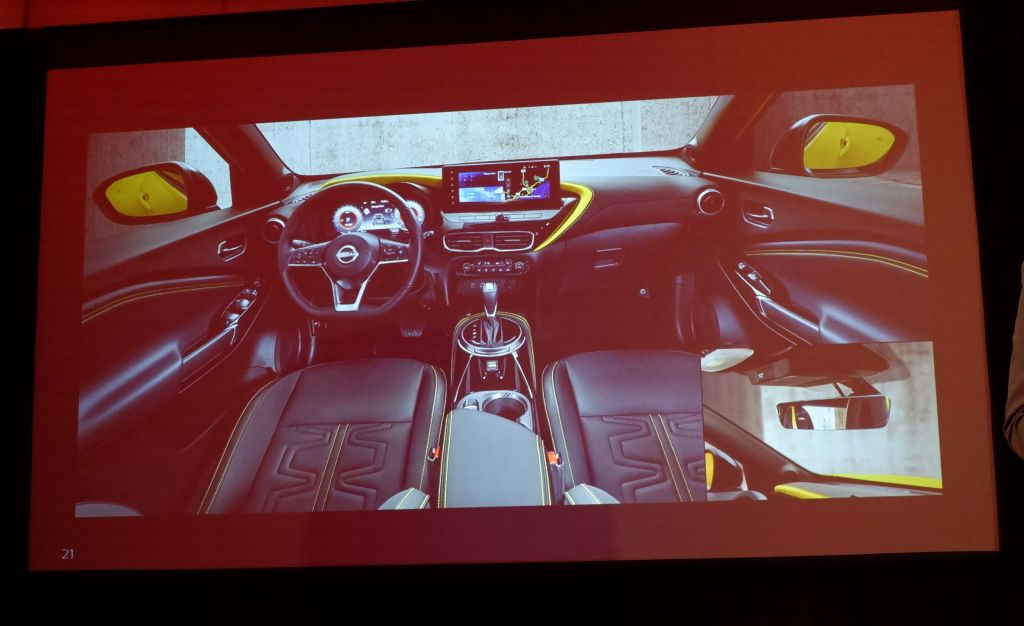
The Chill-Out, – see photo here above – which looks to us as a very realistic concept car which we might see on our roads in the (very?) near future, utilizes the CMF-EV platform.
The Nissan Hyper Urban Concept – see photo here above – was announced at the 2023 Japan Mobility Show; its styling complements the sophisticated tastes of its target users, such as urban and suburban based professionals who prioritise environmental sustainability.
This all-electric crossover concept is designed to remain up to date for every new owner, ensuring an extended lifecycle through regular software and hardware upgrades, aiming to achieve the utmost sustainability. To maximize this further, the vehicle seamlessly integrates into the electric vehicle ecosystem (V2H/B/G), for power sharing.
Last but not least, there is the Nissan Hyper Punk concept was also announced at the 2023 Japan Mobility Show.
It is positioned as an all-electric compact crossover concept, catering for a dynamic audience seeking self-expression through style and creativity. It offers owners a canvas for self-expression with its polygonal-shaped exterior with dynamic color changes.
Further styling exercises: the Nissan Concept 20-23
To celebrate the 20th anniversary of Nissan Design Europe (NDE) being located in London, Makoto Uchida, Nissan’s President and Chief Executive Officer, visited NDE in September last year to unveil an all-new sporty urban electric concept car called Nissan Concept 20-23.
The car certainly turns heads, as you can see from the accompanying photo. It was designed by a team including some the younger members of NDE, with the simple brief to design a car – with no constraints – which they would like to drive on the streets of the city where they work.
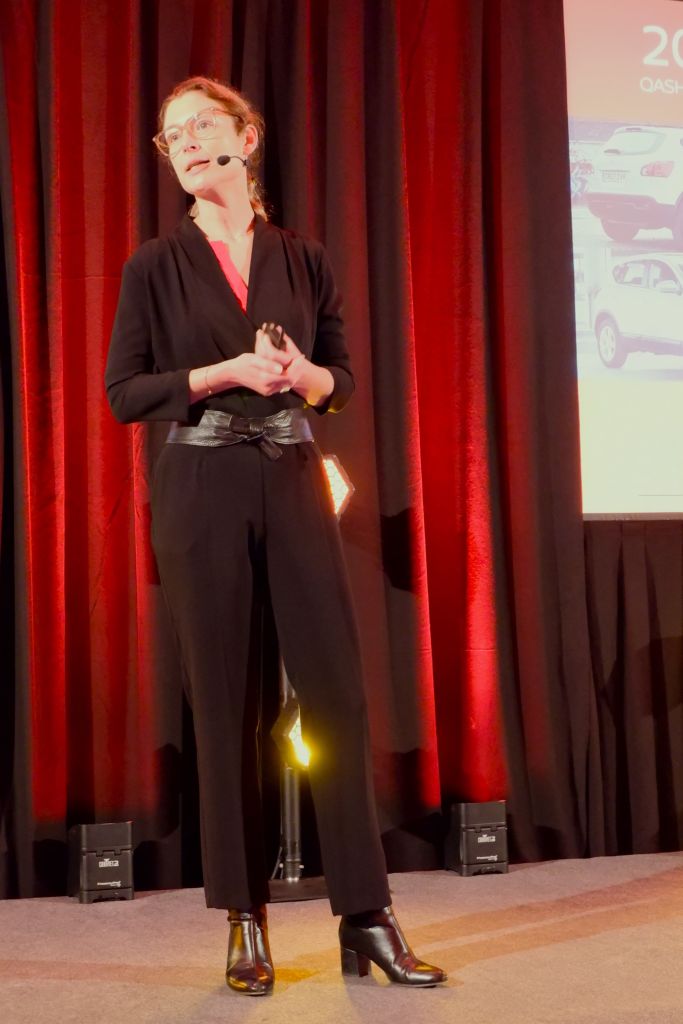
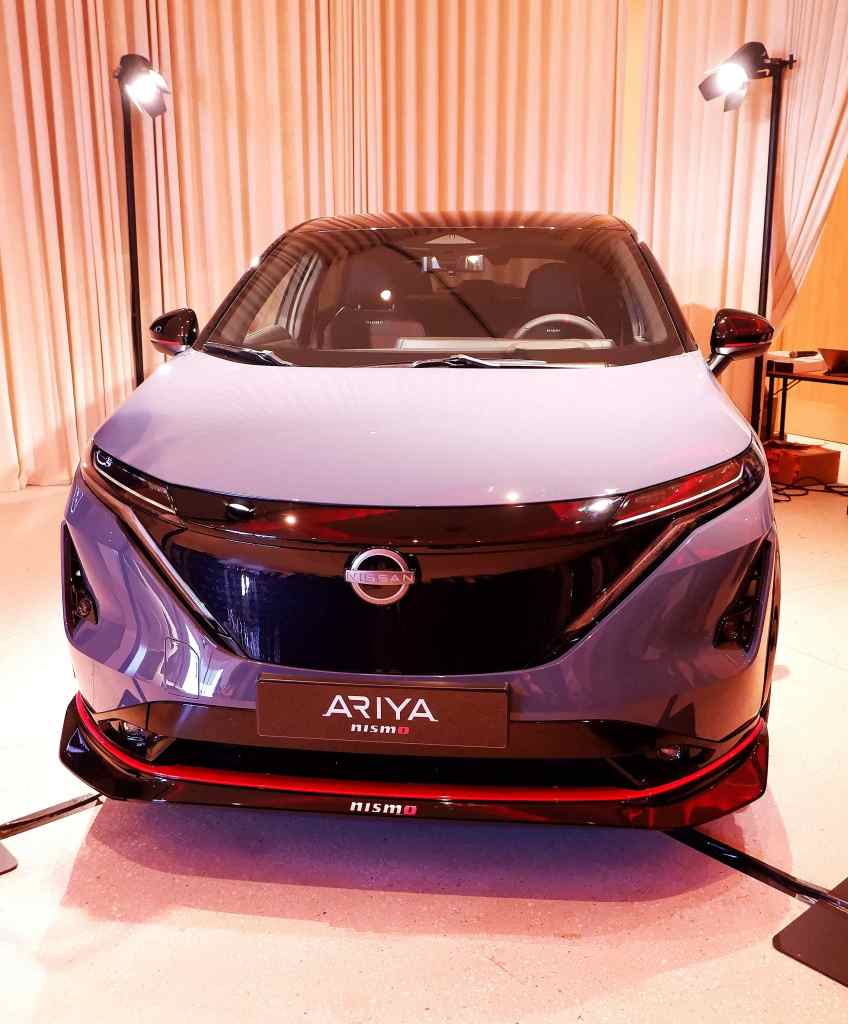
Of course there is the present range of Nissan, with the Juke, bestseller Qashqai and Ariya. Last but not least also the Leaf. Head of Marketing Rémy Le Gall presented them. See photo here below.
Soon we will refresh our driving impressions of these cars for you, and tell you then more about their unique qualities. Stay posted!
Autoworld, the impressive car museum at the Brussels Cinquantenaire, holds now an exhibition ”Porsche, driven by dreams” celebrating the 75th anniversary of the brand. You can already read about it in our columns. Some 50 Porsches are displayed, many of them brought to the capital of Europe by the Stuttgart Porsche museum, with some of them never seen before on public display in Belgium.
It ranges from the 984 to the “Mission E” prototype, the latter which was a harbinger of the alternative future coming to us all.
The show was presented by PR manager Porsche Belgium Liana Picard, General director Autoworld Sebastien de Baere and last but not least car expert and curator of Autoworld Leo Van Hoorick, who showed us around the exhibition and offered us his expert comments and insights. (See photo here and further in the article).
Hans Knol ten Bensel
The 911 is now already 60 years among us, and your servant still remembers driving these 911’s with sporting abandon in the early seventies. I just loved to take these genuine drivers’ cars to the limit, their handling needed an expert hand, but they never betrayed me and on the contrary, it was a pure delight to master them. The flat six engine was then still air cooled, and the echo of their roar and hiss at high revs still echoes in my ears. Just look a bit further in our columns, click the following link: https://autoprova.be/2021/03/27/some-early-photos-from-my-automotive-beginnings/
Besides the iconic 911, of which we still found an absolute classic early version in the Museum, on display outside the specific Porsche show, just look at the photo here above, there were indeed some very dramatic Porsche Museum Cars, and the most stunning for me was the Carrera GT with its V10 engine. It is a stylish classic sportscar, breathing the “Zeitgeist” of two decades ago, with its clean, fluent lines, inspired by the bolides at le Mans.
It’s a carbon-fibre, mid-engined super car, and made its debut at the 2003 Geneva International Motor Show. It came three years after its debut appearance at the Paris Motor Show in prototype form – an event itself which caused such an explosion of interest that Porsche knew their dream needed to be made a reality. The birth of what is today considered one of the greatest of modern classic sports cars, says Porsche. We can only agree…
Pushing technical boundaries 23 years ago…
The Carrera GT is a car that pushed technological boundaries beyond any supercar of that time. Its beautiful profile encompassed a staggeringly powerful 612PS V10 engine that was a direct descendant of the 10-cylinder race engine developed for the Le Mans 24-hours of 2000. The only modifications the race engine required were those to meet worldwide emissions and noise regulations for road legal cars. In keeping with its push for innovation, the Carrera GT also pioneered the use of pure carbon fibre for its monocoque and subframe. Performance is – considering even today’s standards – quite impressive. It can reach 100km/h in just 3.9secs and roar on to 200km/h in 9.9secs. The top speed of the Carrera GT is officially 330km/h.
The racing engine needs of course a fair amount of cooling. The huge air intake along the car’s flanks, along with the three radiators are five times larger in area than that of the Porsche 911 Turbo of the time.
Then there are the purposeful contours of the Carrera GT. It was designed by a team headed up by legendary Dutch car designer, Harm Lagaay. He already worked since 1971 for Porsche, and designed the 924. He moved to BMW in 1985, and designed for them the BMW Z1. Also purposeful and elegant. This purposefulness is found also in this GT. He returned to Porsche in 1989 as head of the “Style Porsche” department in Weissach, and oversaw the design of the Porsches of the period – the 968, 989 (the stillborn four door Porsche), 993 (the 1993-1997 generation of the 911 for which Englishman Tony Hatter is also credited), Boxster, 996 (the all-new 911 of 1997), last but not least the Cayenne and one of his absolute masterpieces, the Carrera GT.
General director Autoworld Sebastien de Baere…
Some 1270 units of the Carrera GT were made in total over its production life (manufacture ended in May 2006). Today, the Carrera GT Type 980 is an official member of the Porsche Classic family, which means both owners and those Porsche Classic partners and Porsche Centres who maintain the cars have access to an extensive supply of genuine parts. As you might expect, many of them are still on our roads and retail at around the $1 million range for a reasonably good example… Mind you, it cost close to half a million Euros when new…
Italian blood: the Carrera Abarth
Can you believe, looking at the picture above, that this car was built in 1960? Three years before the 911, as the dust sheet was pulled back on this brand-new Porsche model at the 1963 Frankfurt International Motor Show. Looking in profile, it is quite reminiscent of the overall proportions of the 911. Just a bit more muscular, racier, more pur-sang even. It is officially called the Porsche 356 B 2000 GS Carrera GTL Abarth, and for me, it is one of the “purest” Porsche street cars.
We go back to the early sixties here. To remain competitive in Grand Touring (GT) racing, Porsche needed lightweight versions of the 356 B. They looked south for help, and found it in the Italian-Austrian sports car builder and Porsche representative Carlo Abarth. He has enjoyed a good relationship with Zuffenhausen since their collaboration with the Type 360 Cisitalia Grand Prix car in 1947. Abarth now commissions Ugo Zagato in Milan to build 20 lightweight coupés. The handcrafted aluminium bodies featuring the characteristic air scoop on the rear are compact and streamlined. It is a true beauty with wonderful proportions, in our opinion a forerunner of what the 911 was to be.
Gave us expert information about the Porsches in the exhibition, connaisseur and Autoworld curator Leo Van Hoorick…
. The 356 B Carrera GTL Abarth weighs almost 120 kilograms less than the standard 356 B. The “marriage” of the chassis and body takes place in Milan, with the GTL receiving its finishing touches at Abarth and Porsche. The list of successes of the 356 B Carrera GTL Abarth includes class victories at the Targa Florio – in 1960 with a 1.6-litre engine, 1961 with a 2-litre Carrera unit – plus outright victory at the Lyon-Charbonnières Rally of 1960 as well as class wins at Le Mans.
Driving the Abarth GTL, racing drivers such as Hans Herrmann, Herbert Linge, Edgar Barth and Paul Ernst Strähle win world championship titles in 1961 for Porsche for GT cars with a displacement of up to 2 litres. Further international titles in 1961 include Heini Walter’s fourth victory at the European Mountain Championship and Hans-Joachim Walter’s win at the European Rally Championship.
Even with the 1,588 cc flat four, developing 135 hp or 99 kW, the 778 kg Carrera was 220 km/h fast…
There is a lot more to see in this Porsche exhibition in Autoworld, and we will come back on this in following reports, where we will delve more in detail about the Porsche prototypes and the iconic Gmünd Coupé. Stay tuned!