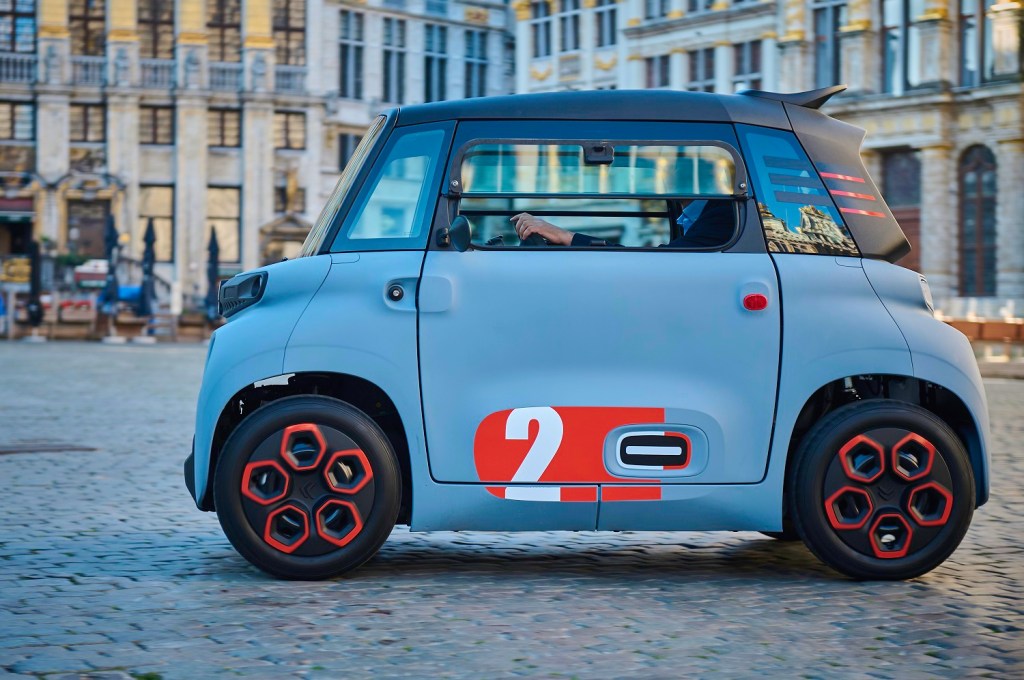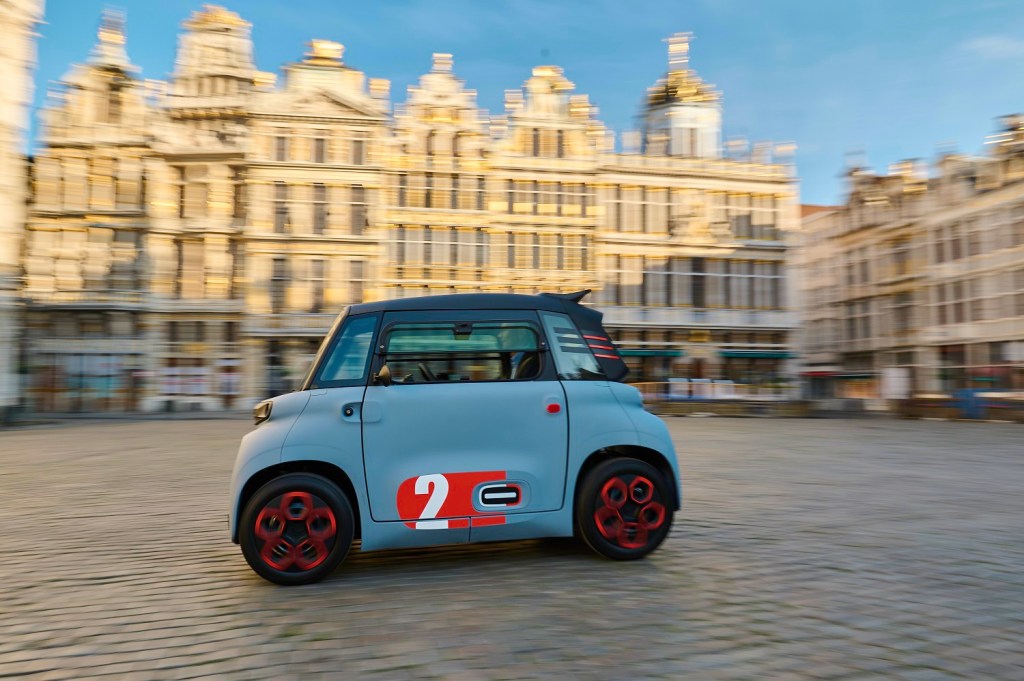
Citroën has always been THE brand for breakthrough mobility solutions. It responded this time to today’s challenges by offering 100 % electric mobility literally for all: a cute, roomy two seater with an 8 HP (6 kW) electric motor which can be charged in 3 hours on your home socket and which offers up to 75 km electric range in town or country/village roads. What’s more, since it is only 45 km fast, you don’t even need a drivers’ license for it. In France, 14 year old’s can drive it, in most European countries this is possible from 16 years onwards. But it is also excellent news for the (very) elderly, they have the ideal, roomy two seater which protects them from the elements, it is easy to step in and out of, has two wide opening doors and is the proverbial breeze to drive.
Citroën has done it, and we were delighted thanks to the dynamic PR team to experience the first kilometers behind its cute steering wheel in the streets, squares and boulevards of Brussels. Just read further…
Hans Knol ten Bensel
Light and roomy
Like the iconic 2 CV, this AMI is designed with nothing but practicality in mind. Its symmetrical body shape is unique, with a long roof and cabin, offering a sea of space for its two happy occupants. Only the driver’s seat can be moved fore and aft, the passenger’s seat is fixed, and therefore one sits normally a bit further back than the driver.
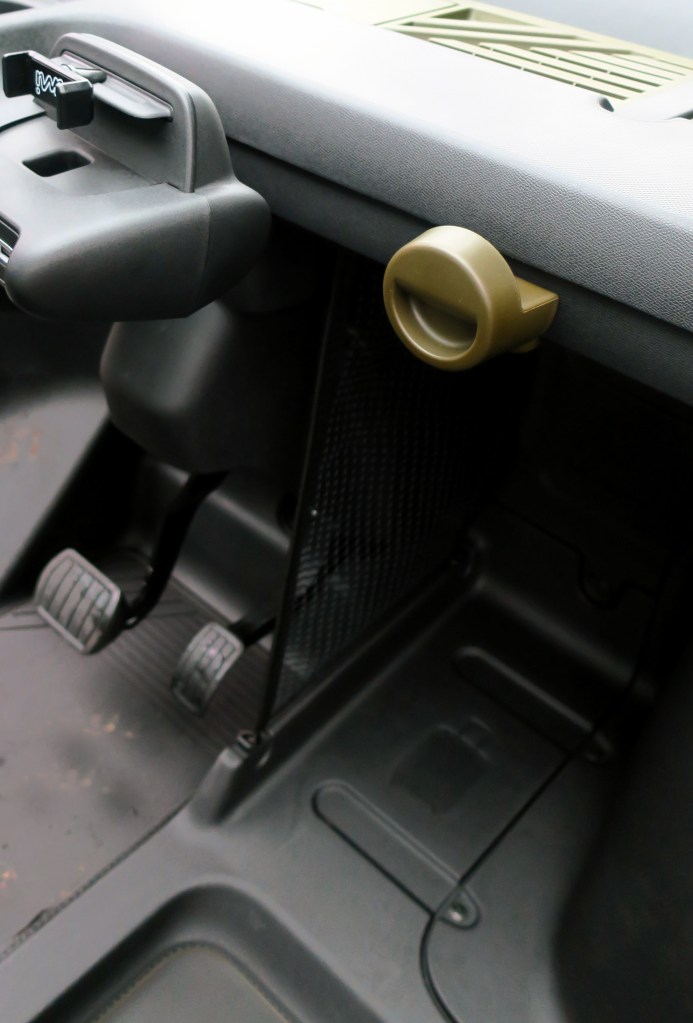
Room for a cabin space suitcase, and an elegant hook to hang your bag…
But she/he enjoys formidable legroom, and can actually stretch its legs fully. This means that seating with your legs in a normal position, there is even room for a cabin size suitcase in front of your feet! So there is always enough room for your errands, as besides in the cabin, the AMI has still an extra luggage space in the back.
Citroën has decided to make this long cabin as light and airy as possible. Therefore, a glass panoramic roof is fitted standard. So it is la Vie en Rose in your AMI. One gets in through the wide opening doors, which are identical and because of that opening in different directions. The driver’s door sways out in the front, making getting in and out super easy.
You can throw your pocket camera, bottle and sundry in one of the three customizable bins just behind the window, hang your city/handbag on the elegant hook provided on the passenger’s side, and get behind the wheel. The dashboard just reveals speed and battery charge level, indicating also the remaining range in km. Further, there is a switch for heating and fan. Next to it is a smartphone holder, so your phone can provide for navigation and music.
The row of knobs for “Drive”, “Reverse”, “Neutral” and “Park” sits on the left side of the driver’s seat. Just push “D” and off you go. Acceleration is lively, but don’t expect miracles from 8 HP moving a cute car with a total weight with battery of 485 kg, where one still has to add the weight of one or two passengers. But it is certainly enough to move along with the flow of urban traffic, and with some restraint one soon notices that a cruising speed of around 40 km/h needs just a push of 1 or 2 centimeters on the throttle. You don’t get any deceleration from the E-motor when you lift the throttle at speed, so adapt your driving style and drive with more anticipation as the distances to make good use the kinetic energy are longer. But it can be done, and soon you get the hang of it…
Driving in Brussels one soon notices that the indicated range is absolutely realistic, and that’s a big plus. Also remember, three hours is enough to fully (re)charge the AMI.
Brussels paves are ridden with potholes and ridges, but the AMI took it very well in its stride with a surprisingly comfortable suspension.
Make it your very personal AMI…
As said, life is good in this AMI. Typical and reminiscent of the 2CV are the side windows, which open by manually tilting upwards.
Citroën offers, in a “Do It Yourself” fashion, the possibility of creating the object that suits each customer’ tastes through a kit of accessories that can easily be installed yourself. This kit incorporates functional decorative items: a central separation net, a door storage net, mat, storage tray on the top of the dashboard, small hook for a handbag, smartphone clip, DAT@MI box (dongle device) connected to the My Citroën app to retrieve essential information from your Ami on the smartphone.
4 main shades are available for these accessory kits, costing 400 Euros: MY AMI GREY, MY AMI BLUE, MY AMI ORANGE, and MY AMI KHAKI.
2 characterful packs are available on AMI for even more customization. These 2 packs contain all the above decorative elements and large format stickers that cover the outside and thus give AMI its very own style.
– My Ami POP with Orange personalization and a fun, young and sporty look, with a rear spoiler, is available for €8,190 incl. VAT.
– My Ami VIBE in gray with a more upscale, chic and graphic design that integrates roof coverings in addition to the stickers, is available for € 8,690 incl. VAT.
The installation of these 2 personalization packs is entrusted to professionals before delivery.
The specific exterior body colour is neither too feminine nor too masculine and works with the different colour packs Citroën has developed (blue, white, khaki and orange).
So the Ami is a base that can become a completely customised object with exterior and interior accessories that are either pure style or offer real extra functionality, as well as stickers that give it a completely different characters, tells us Pierre Leclercq, Head of Citroën Style.
Prices…
AMI AMI: 7.290€ incl. VAT
MY AMI ORANGE, KHAKI, GREY, BLUE: 7.690€ incl. VAT
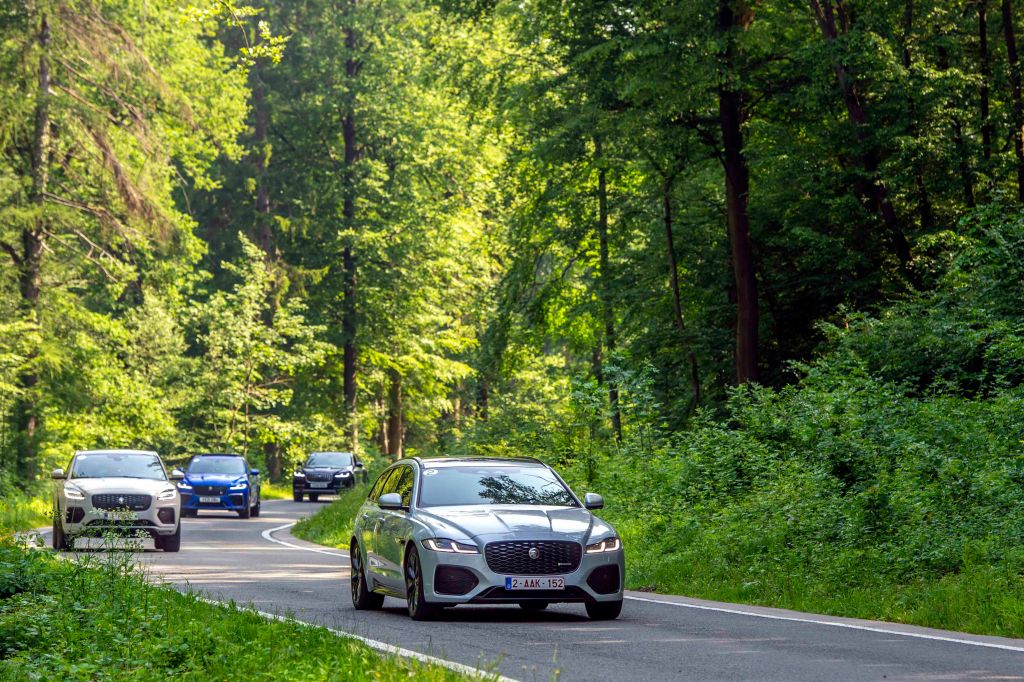
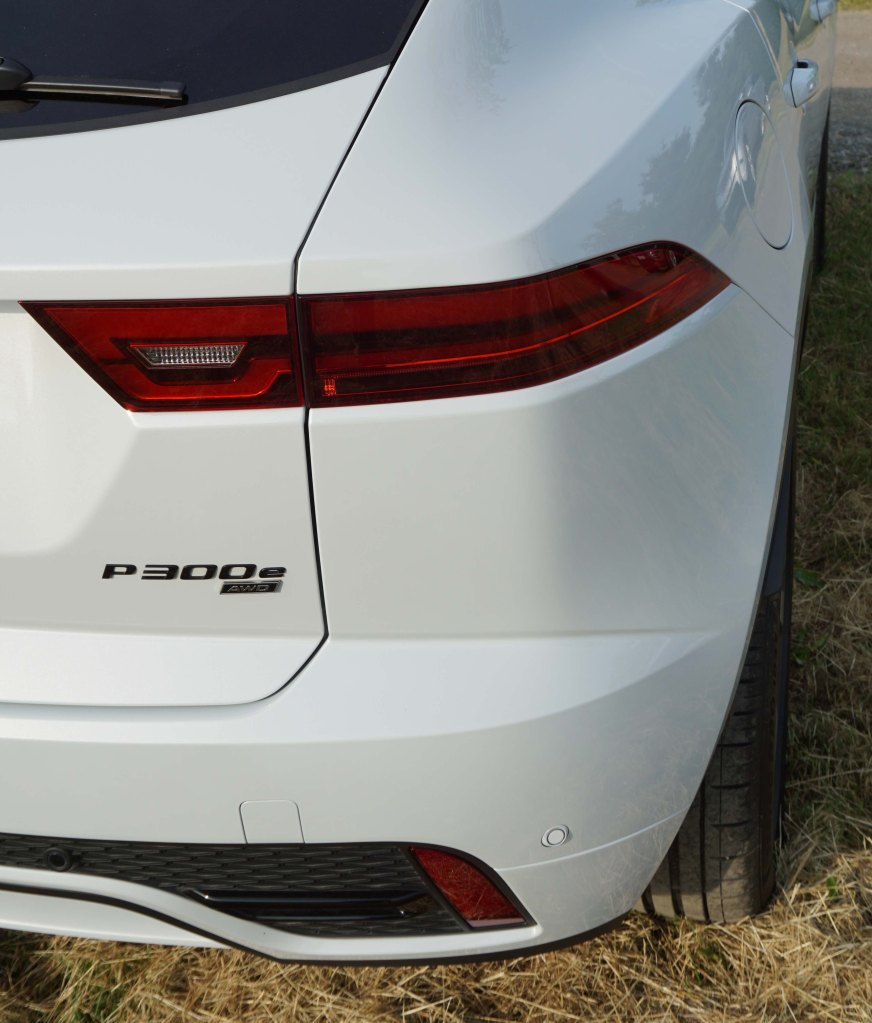
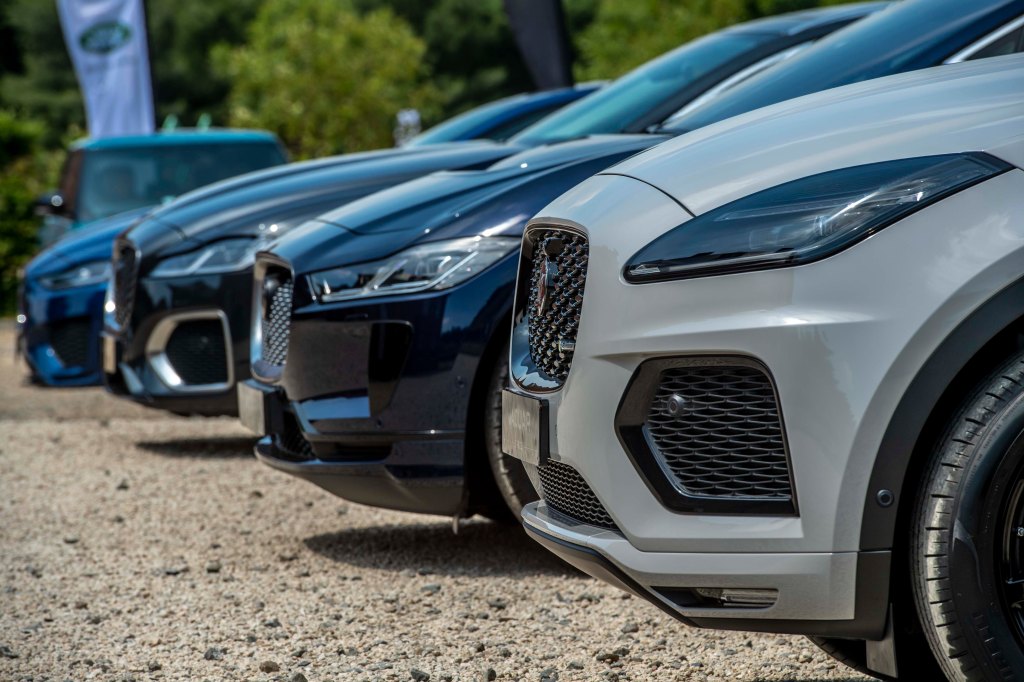
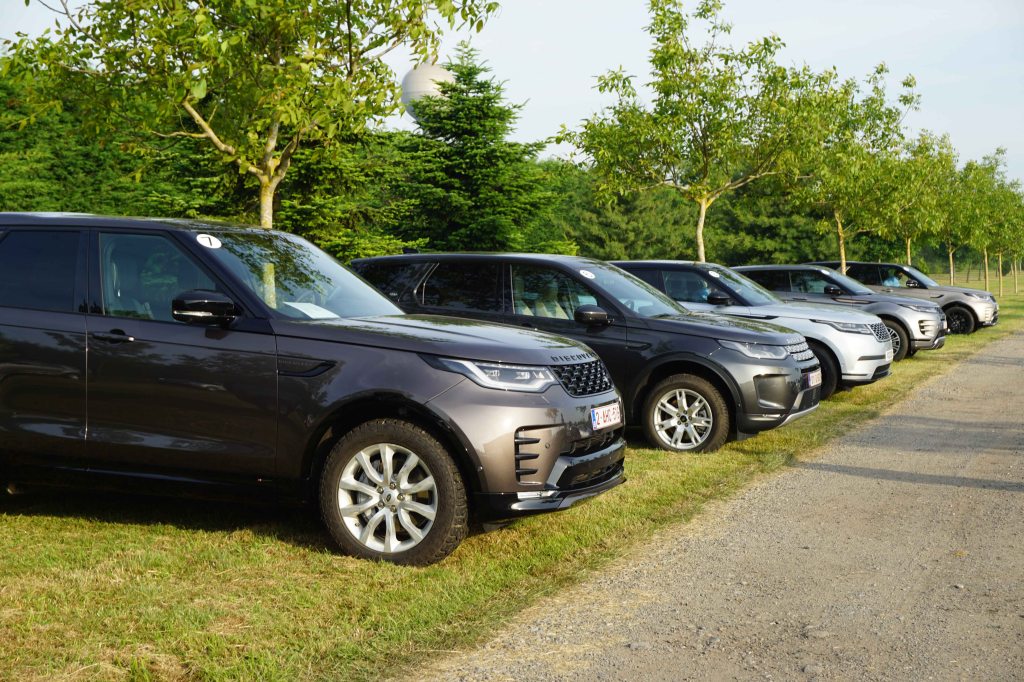
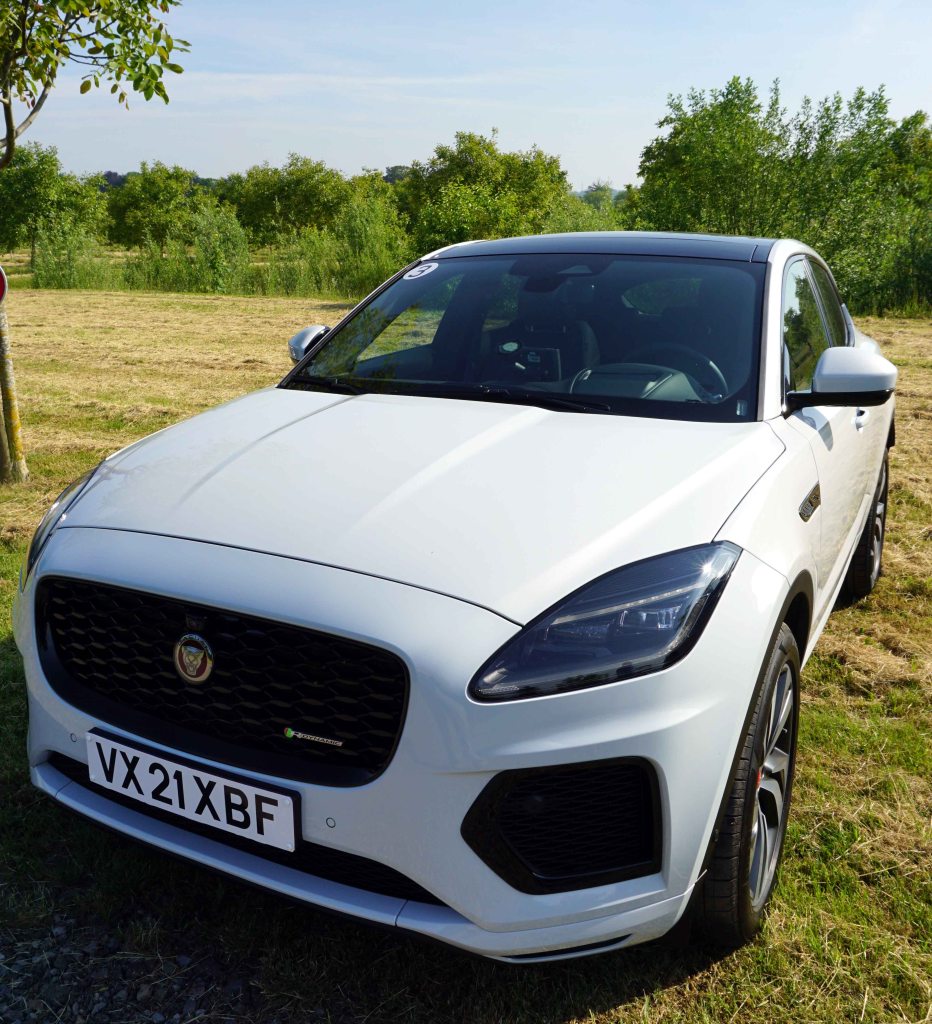
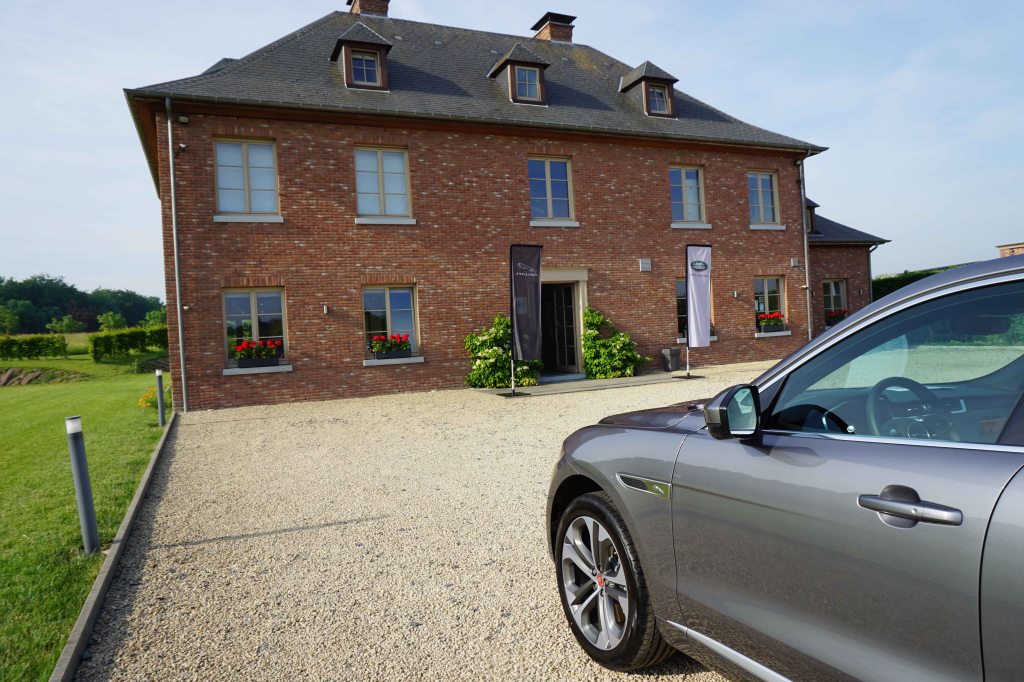
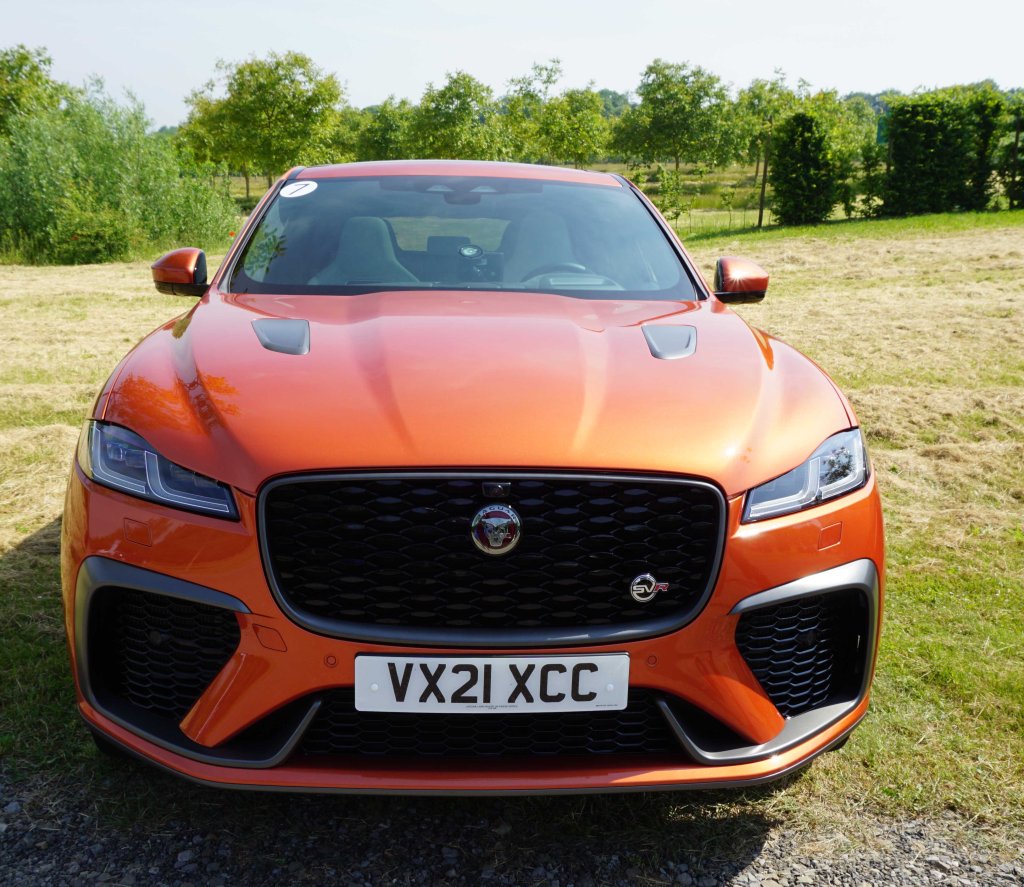
Today we were invited by the people of Jaguar Land Rover Belux for a Jaguar Land Rover Media Drive at the magnificent establishment La Noiseraie , and it proved a wonderful experience. The whole range of Jaguars were driven on the scenic winding roads and motorways around Namur…with the exquisitely sporting SV R being the icing on the cake, although the hybrid and full electric Jaguars proved very impressive indeed.
The Land/Range Rovers were put to the ultimate off-road test at the Land Rover Experience Center at Suarlée.
We were also able of course to have a thorough go in our former test car we drove earlier, the New Defender, see also our test on these pages…
More on all this soon, we just show you here a few images, which say more than thousand words… just stay tuned on these columns!
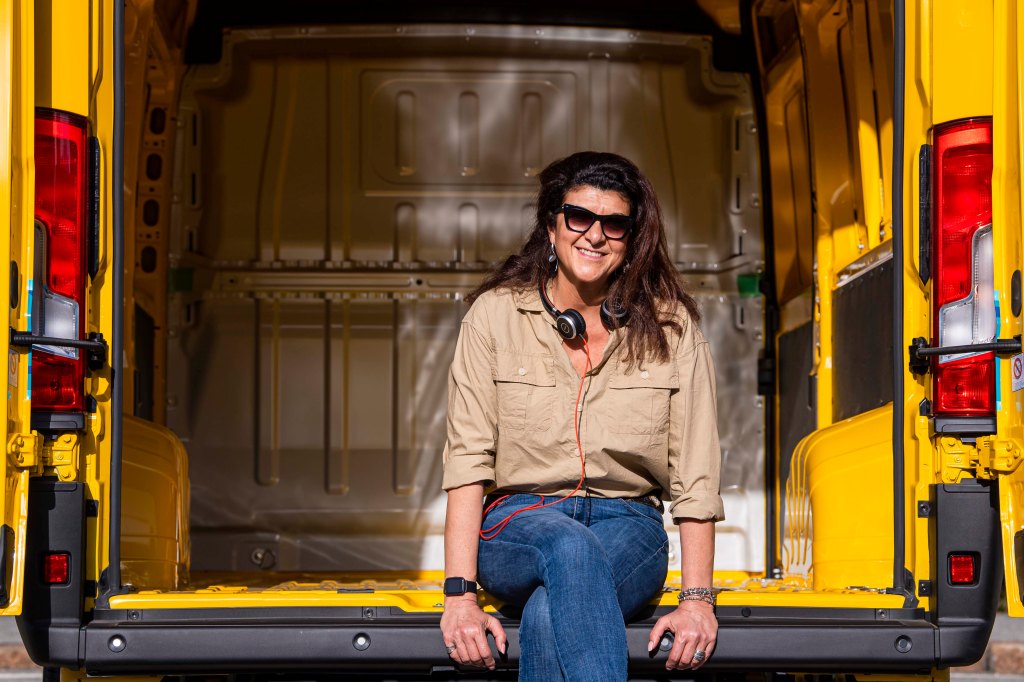
Her vast experience, very good knowledge of the company and a well established large and well honed network were the keys for Angelica Carapezza to bring the complex E-Ducato pilot project towards customers to a succesful end.
At the first presentation of the E-Ducato in mid- 2019 we met up with some very remarkable people of Fiat Professional, notably with Angelica Carapezza, now responsible for managing and coordinating the implementation of the Ducato’s electrification programs at full scale.
Now with the E-Ducato “coming of age” as it were with its commercial launch, after having went through a very thorough process of profiling the customer and their needs, we were very intrigued how this process exactly went about. All the more reasons for a second interview. The first interview, where we told you more about Angelica Carapezza’s multi-faceted career, can of course also be read in our columns, by following the link https://autoprova.be/2019/09/15/women-behind-cars-angelica-carapezza/.
Just read our second interview with Mme Carapezza here below…
Hans Knol ten Bensel
HK: The Ducato has built up an enviable reputation of commercial success, so launching a fully electric version is quite a challenge, as the expectations of the market are high. What was your business philosophy here in positioning the E-Ducato into the market?
AC: We have a long 120-year history in the LCV market, and Fiat Professional has always been a Brand that “lets the facts speak for themselves”. It is down to earth, so to say, producing vehicles that are first and foremost an ideal tool for the small or big entrepreneur who wants to grow his business. With this approach throughout the years, we achieved an undisputed leadership position in the world of light commercial vehicles, as shown by the figures for the Ducato: over 5 million units produced since 1981 in the biggest plant in the world, having also conquered over 75% of volumes in the Caravan bases sector and, finally, having achieved the European Best Seller status in 2020.
HK: Being close to the customer, responding to its needs, how did this translate in the actual approach?
AC: We wanted the E-Ducato to be absolutely “tailor made”. I can refer here to the Press Statement recently released by Stellantis about our “Pilot Project” to tune the E-Ducato to the needs of our customers, but let me explain it also a bit more for you here how we went about.
We first started with gathering data. With a solid database, you know where you’re going. So we collected data for a whole year from 4,000 thermal Ducato vehicles, whose control units, connected in real time, allowed the different individual mission profiles of our customers to be identified in their real application on the road.
E-Ducato’s were delivered to corporate customers like Arcese to further fine tune them to their needs…and collect their experiences.
Then we started analyzing the collected data, and aggregated them. Now, and this is of course crucial, we had established ourselves a very good idea about the profile of daily missions which could be accomplished by an electric instead of a thermal vehicle without causing any business interruption for the customer: in this way we identified the market segment which is “ready to divert” from thermal to electric, based on their specific mission(s) or activity and the size of their fleet.
This analysis which well founded, as it was carried out after not less than 50 million km being traveled by connected vehicles. This confirms again how deep knowledge about customers and their needs is fundamental and conditio sine qua non for the successful sale of commercial vehicles.
HK: Based on your findings, you could now further develop and fine-tune the engineering of the E-Ducato…
AC: Indeed, but we wanted our customers also to test out right from the beginning our pre-production vehicles, and communicate to us their findings during further development of the E-Ducato. We wanted them to have “their” driving experience in the field, based on real life conditions. To achieve this, we launched a “Pilot Project” so complete and complex that it was unprecedented in the history of Fiat Professional. During this engineering development phase of the electric version of the Ducato, we produced a mini fleet of pre-series vehicles and then assigned them to strategic customers. This time it allowed us to sample further data in purely electric mode.
Briefly, each user is assigned a vehicle on free loan for a period of 4-6 weeks, depending on mission/s tested, geography, type of paths chosen, allowing each customer effectively and empirically to start “his” Ducato experience.
The final target is to identify “his” vehicle, which is the result of the combination of two key and indivisible elements: offer and demand. Fiat Ducato’s commercial offer covers more than 18.000 different versions of the same vehicle, available with either thermic or electric propulsion, so you may imagine how important is for us to provide always the right and the best solution to our customers. In other words, we find the right match between on one hand the customer’s specific needs (type of route, daily km, delivery times/shifts, working days, type of goods transported and charging profile) and on the other hand the “right” Ducato with its wide range of product combinations (battery size, body configuration, options).
This allowed a “real life” customer profile to be established, and so we could tailor the E-Ducato not only ideally to its specific delivery tasks and missions, but also to the individual market-specific requirements and local conditions, with indeed the geography being another important key factor in the choice of the vehicles.
HK: Very remarkable, this close cooperation with customers. Does it have a following?
AC: Right indeed, the collaboration with selected customers for the “Pilot Project” continues today and covers various communication channels: press, web, social, co-marketing, joint participation in events and promotion of new experimental business lines.
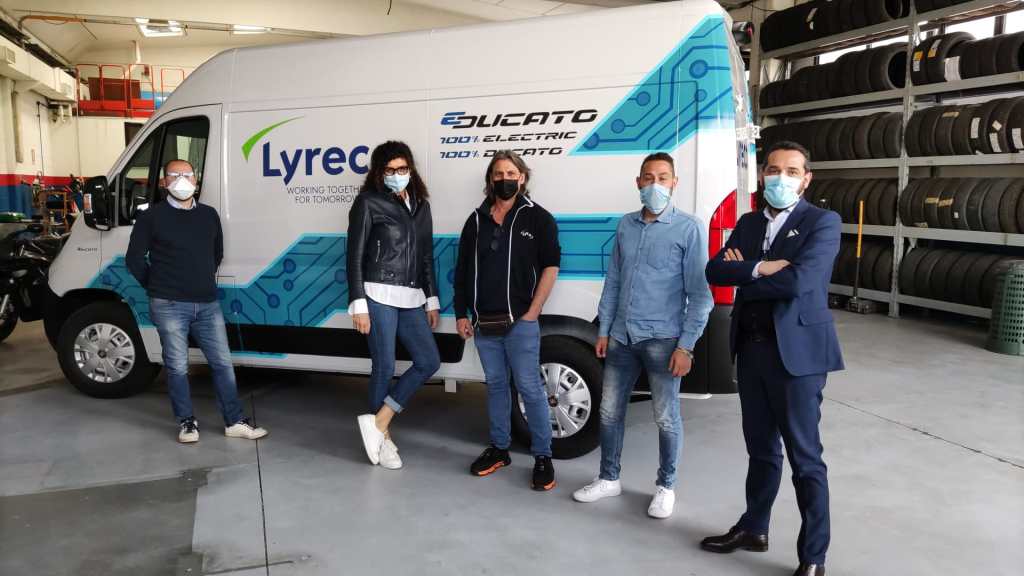
Furthermore, in terms of identification and visibility, it is worth emphasizing that the E-Ducato fleet bears the distinctive livery of the model, combined with that of the international partners who took part in the project, including Arcese, GLS, Lyreco, Mercitalia, EDF, Fraikin, CSB, Nippon Express and BT Fleet, and last but not least DHL: all leading companies in the market and devoted to innovation, which have shown that they want to combine the commercial side of their business with respect for the environment.
HK: Indeed, I understand, customers and manufacturers are working together towards eco-sustainable mobility…
AC: Absolutely. Respective expectations have the same target: to give a consistent contribution in achieving truly eco-sustainable mobility from the beginning, throughout the value chain, and this new mobility is now the result of two companies sharing a single major strategic goal. OEMs cannot any longer sell just vehicles; they have to sell a full mobility solution in a world that is constantly evolving and where customers need easy solutions to continue their daily mission. LCV customers make a purchase choice based on tangible elements: payload, volume, range; here there is no room for emotion like for passenger cars; our customers have a clear idea about what they want and need, they are very demanding, the vehicle is the business for them. With E-Ducato we are proud to state that we “emotionally sell product contents”.
HK: The car industry is now on the threshold of major eco-conscious changes… with its customers changing too…
AC: The entry of Electric Mobility happens not only in the Automotive market per se, but especially also in the culture and education of the people, which is leading to an epochal change that will impact heavily on the customer’s commercial approach, making her/his choice a «choice of full Mobility»: the customer is a pro-active stakeholder of this process of a new behavior and approach to Mobility.
For the car industry this means not only making the switch from thermal to electric, but also and above all fostering the evolution from the simple sale of a vehicle to the sale of a complete sustainable mobility service, in which the customer’s knowledge and needs become essential elements of the sale itself. Once again, Fiat Professional becomes the protagonist of a cultural change through a concrete approach to the issue of sustainability, with our “tailor-made” E-Ducato.
HK: What were your personal experiences, findings and satisfactions in setting up and bringing to a good end this complex project, amid Corona times? Do you have a message here – as a woman with a career– to our readers?
Well, good question Hans! If you ask me to summarize all my experiences with only one adjective, I would tell you “complicated”, but let me add a second one: “satisfying”. However, as satisfying as all complicated and challenging tasks are, it was not a “promenade”, notwithstanding my 35 years of experience in the Automotive Sector and having clear idea how the “machine” runs.
The Corona virus played its part too in complicating easy things like meeting the customers, feed commercial relations, being on the field, have internal meetings with the team and speed up developments. In one stroke, all these tools were taken away by the Corona pandemic, and we had to cope with delays and only virtual experiences at all levels. But I would mention Einstein here, “in the middle of every difficulty lies an opportunity”, and the Corona virus gave us the opportunity to deal with in a new – and unpredictable – scenario, in finding new ways to establish the collaboration in each part of the long chain of automotive processes, where everybody gave her/his strong contribution to deliver the project.
To those people, my colleagues, go my special thanks for having supported me for each time I asked for something that was “never done before”. Whether you are a man or a woman, if you commit yourself first and you strongly believe in what you are asking for, the results come in.
HK: In more general terms, do you think that the Corona Pandemic has affected the position of women in the working place? What challenges in your opinion lie ahead for them?
AC: Well… a question which is not so easy to answer. Once more, statistical data show us that most of the women have lost their job. We can state generally that women belong indeed still to a weak professional category: they are always the first to pay any change.
I can consider my self – as all women in multinational companies- as a privileged person, since I had immediately the chance to continue my daily job. To avoid any disruption, the Company had made work from home immediately available to all its staff, but of course, everything became virtual. I did not lose my job, but I had to change the way of doing it.
Angelica Carapezza, second from left, seamlessly adapting her dress code to the occasion, delivering the E-Ducato to customer Lyreco…
HK: Did your function in the Company pose specific personal challenges for you?
AC: I’m a Senior Marketing Manager, I’m responsible of the E-Ducato Pilot Project: this job is based on relationships, both within the company as well as externally.
This meant that, at the outbreak of the pandemic, we all had to rely on and capitalize as much as we could on the network we had build up so far. I can say that without a deep knowledge of the organization at all levels, If I would not have already known the thousands of people that work here and what they do, if I would not have built personal relations in the past, I would never have been able to deliver the Pilot Project as it is today.
Along with the network I built up, my professional experience also played an important role in this pandemic situation.
I think it must have been very difficult for young people who had just entered the organization prior to the pandemic. I keep asking myself, how have they worked from their homes without knowing the processes, the people, the organization flows, the fundamentals when you have to deal with an enormous organization? How could they develop that special feeling of “belonging to” the company if they could not experience it hands on and feel it on their skins?
HK: And to return to our first question, what were the extra challenges for women in general with this pandemic?
If you ask me about the challenge… well the challenge was just even bigger now with the pandemic, if you consider a full working day for a woman.
From a personal point of view, I think we have to see both sides of the so-called “remote working opportunity”: what it appears to be and the everyday reality. At first sight it seems that from home you can better manage and organize your daily workload, which – apparently –, leaves you more room to organize your life. But the truth is quite another matter.
The reality is that from home, as women, we tripled our daily tasks and got more and more efficient being at same time managers, mothers, housekeepers with no time limits!
We, like our children who paid the most expensive cost of this pandemic, lost the human contact, everything is done behind the screen, everything is happening inside your house, and most of times you don’t perceive that it’s time to switch off the PC.
HK: The pandemic has affected us all…
The pandemic has affected us as human beings. We are not born to become home robots. As a woman, I want to go back to work, I need to put on a nice dress, have make-up, wear shoes and go out, before we all forget what is so fundamental for a human being: the interaction among us, the fact that we need to see each other into the eyes, to talk face to face, directly, to shake hands, to re-establish relationships. Human relationships: this makes us live.
Today Luca de Meo, Renault Brand CEO, and the Renault brand team have participated in the first ever “Renault Talk”, a brand-new all-digital event where they discussed their vision of the wider group.
The new direction, unveiled by the team, presents Renault Group as an energy transition leader, at the forefront of the latest technology and services, operating in a more sustainable and responsible manner as part of its ‘Nouvelle Vague’ (New Wave).
A people-centric brand, Renault is entering a new era as it delivers enhanced modernity to the European automotive industry.
Technology and state of the art electronics will hallmark the future Renaults…
Nouvelle Vague…
The ‘Nouvelle Vague’ will turn Renault into a brand focused on technology, services and clean energy, by engineering smarter everyday vehicles and mobility solutions that are more sustainable.
This is in line with the DNA as a company that changed with the times throughout the 20th century with innovative, modern vehicles.
Now, more than ever, Renault strives to meet market expectations of responsible, carbon-free, safe and scalable mobility solutions that are in line with customer needs.
The Arkana, the first SUV Coupé of a volume manufacturer… presented here by Laure Grégoire – Model launch Manager.
During Renault Talk #1, Luca de Meo restated the direction set for the brand, at the heart of the Group’s Renaulution plan:
As industry leader of the energy transition, the Renault brand will be the greenest brand in Europe as of 2030, with nine out of 10 cars on sale being electrified.
At the forefront of technology and services, the Renault brandis shaping the future of urban mobility, primarily via the ‘Software Republique’. More than 2,000 engineers from five industry-leading companies will bring their shared expertise in cyber security, artificial intelligence, data processing, software, and microelectronics, in order to deliver turnkey mobility solutions for cities and communities.
The Renault Re-Factory – Europe’s first circular-economy hub – marks a move towards a more sustainable and responsible model, with up to 120,000 vehicles (EV included) recycled or upcycled every year. Nearly 80 per cent of strategic recycled materials will be reused in new batteries. By 2030, Renault will become the world’s best automotive manufacturer when it comes to the percentage of recycled materials in new vehicles.
Renault is taking its ‘voitures à vivre’ to upper segments: Seven models will be released in the C and D segments by 2025, all of them electrified, with the All-New Arkana marking the beginning of this offensive. The next generation Megane E-TECH Electric, a vehicle that embodies the future of connected and full-electric cars, is also set be launched in the near future. Lastly, ongoing improvements to E-TECH hybrid technology will continue to provide upcoming C- and D-segment vehicles with the very best in efficiency and dynamic driving experiences.
A NEW ERA, and a NEW LOGO
Throughout its history, the Renault brand has undergone several changes to its visual identity. But one thing has remained unchanged since 1925: the instantly recognizable Renault diamond, a true brand icon.
The latest version of the Renault logo was created in 1992 before being slightly refreshed and reworked in 2015. As a brand deeply rooted in a modern, international market, this all-new logo brings a more modern and vibrant feel and serves a key purpose of portraying the Renault brand as more relatable and built on people-centric values. A streamlined design without typography or brand signature, the logo is an open-ended shape, reflecting the brand’s openness and transparency.
The new logo was co-designed with Landor & Fitch consultants and will be phased in as of next year on all Renault brand vehicles and throughout the Renault network. By 2024, the whole Renault range will bear the new logo.
During the Renault Talk, Gilles Vidal, Renault Brand Design Director, unveiled an image of the logo as it will appear on the back of the new Megane E-TECH Electric, which will come to market in 2022.
ALL-NEW BRAND EXPRESSION
According to Arnaud Belloni, VP of Global Marketing for the Renault brand, the ‘Nouvelle Vague’ is also reflected in the brand’s advertising.
Imbued with a creative and modern edge, they incorporate some of the brand’s most iconic pieces of memorabilia: the Renault Fuego, covers of cult classics like ‘Johnny & Mary’, or the Renault-Gitane cycling jersey featured in a recent advert for the Captur E-TECH Hybrid.
Renault makes their “Cars fit for true living” increasingly electrified… presented here by Gilles Le Borgne – Engineering Director Renault Group
THE RENAULT E-TECH HYBRID OFFENSIVE
With more than 10 years of experience and almost 400,000 vehicles sold to date, Renault is a leader in the European EV market. Building from its expertise in pure-electric vehicles, Renault has extended its EV range with hybrid and plug-in hybrid versions of its core market vehicles.
With more than 150 patents to its name and having leveraged the brand’s experience in Formula One, E-TECH hybrid technology is as unique as it is modular. In both hybrid and plug-in hybrid versions, it provides the best in energy efficiency and driving pleasure while also reducing CO2 emissions and fuel consumption.
This revolutionary piece of technology debuted on three of the brand’s core vehicles in 2020 as a way of making the EV experience something for everyone:
Clio E-TECH Hybrid
Captur E-TECH Plug-in Hybrid
Megane Sport Tourer E-TECH Plug-in Hybrid
In 2021, the E-TECH range is set to expand with the release of the All-New Arkana and Captur E-TECH Hybrid, plus the Megane E-TECH Plug-In Hybrid, totalling an electrified range of six E-TECH hybrid and plug-in hybrid vehicles.
Gilles Le Borgne, EVP, Engineering, Renault Group, has confirmed that the brand is preparing for the future by extending the scope of its E-TECH hybrid technology to future generations.
Upper segments – especially the C-SUV segment – will see the arrival of a brand-new 1.2-litre three-cylinder engine combined with an electric motor, for a 200hp hybrid vehicle in 2022 and a 280hp in plug-in hybrid four-wheel drive vehicle in 2024.
ALL-NEW ARKANA: SPORTY, HYBRID, AND SPACIOUS
The All-New Arkana’s unique, full-hybrid design is the first SUV with coupe design from a mass-market manufacturer.
Its TCe engines feature 12-volt micro-hybrid technology delivering enhanced fuel efficiency, while the E-TECH hybrid powertrain is capable of running in electric mode for up to 80 per cent of the time on urban roads, contributing to around 40 per cent in fuel savings compared with a standard petrol engine.
Across Europe in May so far, more than 6,000 orders have already been placed for the All-New Arkana.
THE ALL-NEW KANGOO: ELEGANT AND SPACIOUS
The All-New Kangoo combines sophisticated design, space and technology, offering superior practicality with three full-sized seats in the rear and more than 49 litres of accessible storage areas. The car is here presented by Thierry Plantegenest – VP Sales Marketing LCV and Pick-ups, (on the left).
The bootspace ranges from 775 litres up to 3,500 litres of flat-bed cargo area, while it can be specified in five- or seven-seat models. The All-New Kangoo also boasts 14 standard-fit driver assistance systems.
In 2022, the All-New Kangoo range will expand further as it becomes available as a full-electric E-TECH model.
VALUE FIRST
Fabrice Cambolive, SVP, Renault Brand Sales and Operations, restated Renault brand’s commercial priorities:
The ‘green’ offensive: Ramping up the EV range and furthering the E-TECH offensive, as already in Europe, 25 per cent of Renault sales are electrified and 30 per cent of Clio sales in France are for the E-TECH Hybrid
Products: Speeding up product line renewal, both in Europe and abroad, by winning back market shares in the C-segment
A global player…
Proud of its French roots, the Renault brand is also an international brand. The Renaulution plan is Renault’s way of bolstering its international presence, while boosting efficiency. Model by model, market by market, the Renault brand has overhauled its business model. The final objective is to increase the profitability of its vehicles while preparing a generation of new products to conquer new markets.
Internationally, the Renault brand has been investing in its historical high-potential markets with a strong local presence – Brazil, Russia, Turkey, and India – while keeping risk levels in check.
In Europe, Renault continues to rely on its key markets – France, Spain, Italy, Germany, and the United Kingdom – with a more visible range and a clear roadmap: leverage E-TECH to foster E-mobility leadership and ramp up efforts to increase market shares for both C-segment and commercial vehicles.
A bold future lies ahead! We will soon test for you the Megane Grandtour and Captur Plug in Hybrid, as well as the bestselling ZOE – stay tuned!
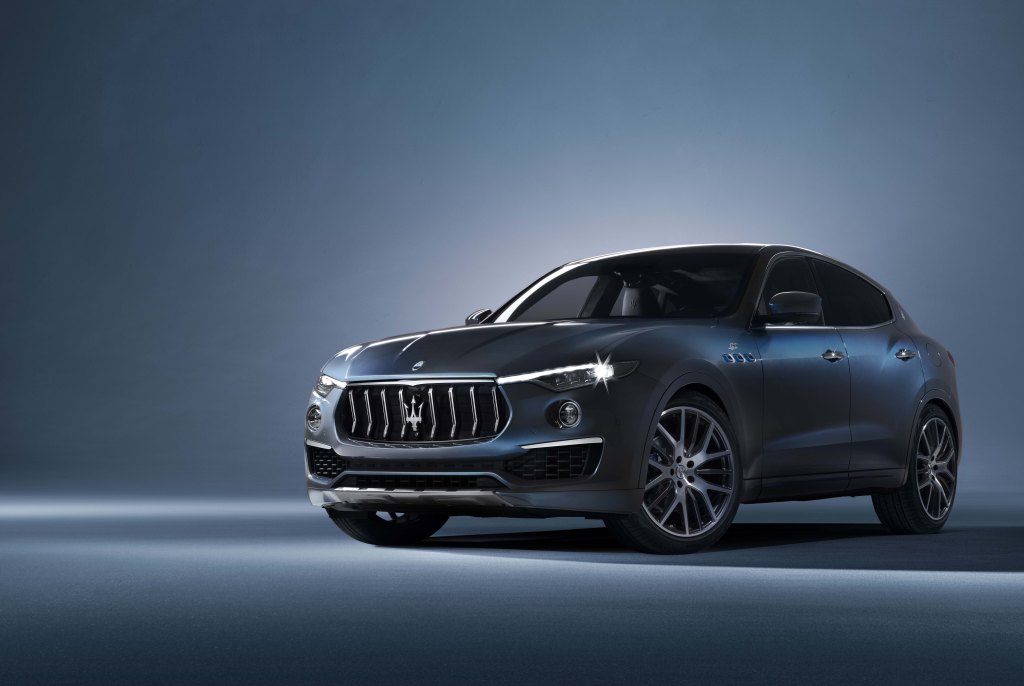
The Levante Hybrid was presented at ist launch in Azzuro Astro color. This metallic paint consists of three layers and is available through the Maserati Fuoriserie personalization program.
The Maserati Levante Hybrid has today experienced both a physical and a digital world premiere. At the time of the car’s unveiling at the Shanghai Auto Show, a virtual presentation has taken place simultaneously on the houseof.maserati.com website.
With its first electrified SUV, Maserati is taking another important step in the future plan launched last year with the Ghibli Hybrid, which will lead to the electrification of all new Maserati models.
“Faster. Cleaner. Unique ” is the motto at the launch: the Levante Hybrid is faster than a diesel, more durable than a car with an internal combustion engine and unique thanks to specific features and details.
The Levante Hybrid combines a two-liter four-cylinder engine with a 48-volt hybrid system that recovers energy during engine deceleration and application of the brakes. The hybrid SUV is lighter than the six-cylinder version (petrol and diesel) and also has a more balanced weight distribution because the battery – without sacrificing luggage space – is placed in the rear of the car. One of the goals during the development of the Levante Hybrid was to take the dynamics and driving pleasure to an even higher level.
With a maximum power of 330 hp and a torque of 450 Nm, which is available from just 2,250 rpm, the four-wheel drive Levante Hybrid delivers impressive performance: the car has a top speed of 240 km/h and accelerates from 0 to 100 km in 6 seconds.
The Levante Hybrid was presented at ist launch in Azzuro Astro color. This metallic paint consists of three layers and is available through the Maserati Fuoriserie personalization program.
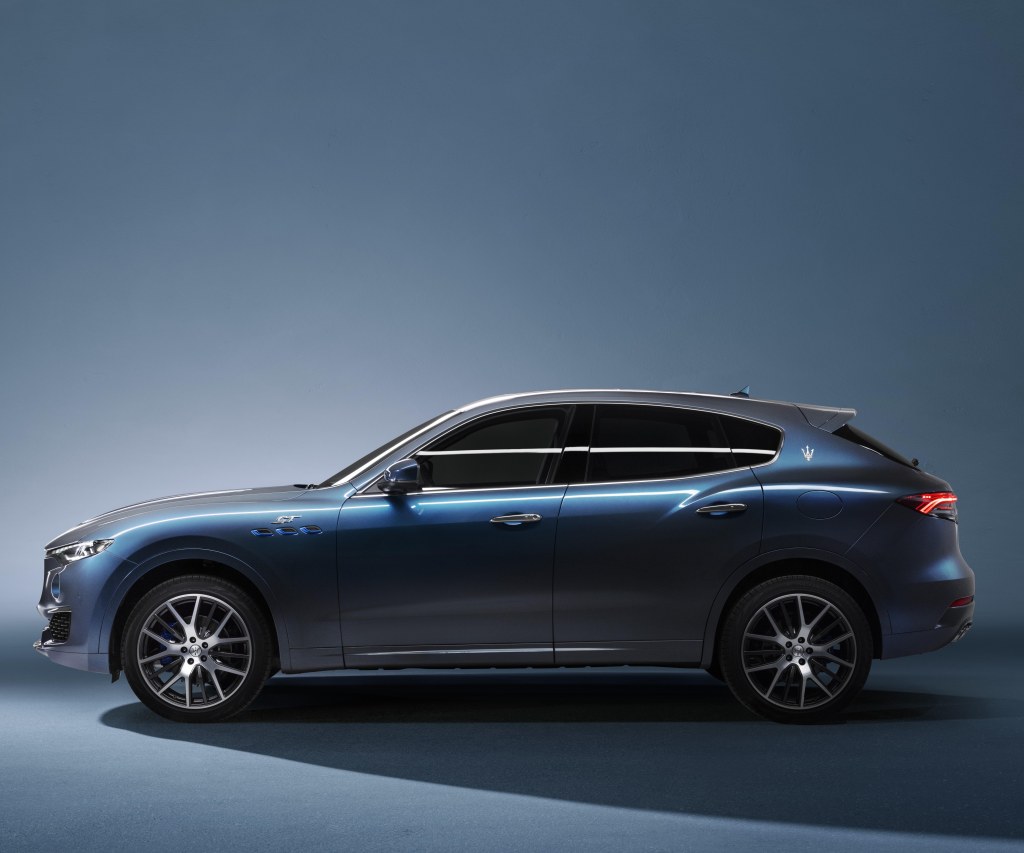
The Levante Hybrid is immediately recognizable by the unique details in the exterior and interior. Several elements are finished in blue, a color specifically chosen for Maserati hybrid models. Like the brake calipers and trident on the C-pillars, the iconic side vents are finished in this shade of blue. The same color returns in the interior, including the stitching of the seat upholstery.
With Maserati Connect, the Levante Hybrid is always connected to the outside world. The driver remains fully informed about the technical condition of the car: Maserati Connect alerts the owner when maintenance is required, thus improving the quality of the service. The owner is in contact with the car via the Maserati app on the smartphone or smartwatch. You can also contact the car from home with a virtual assistant such as Amazon Alexa or Google Assist.
The digital world premiere of the Levante Hybrid on houseof.maserati.com has been attended by Maserati’s global brand ambassador David Beckham and Italian songwriter and producer Dardust, who has composed an exclusive soundtrack for the unveiling of the Levante Hybrid.
More soon about this Levante in technical detail. Stay posted!
Audi Q4 50 e-tron quattro Colour: Geyser blue, metallic and Audi Q4 50 e-tron quattro Edition One Colour: Typhoon gray
Versatile all-rounders for everyday use that transfer the progressive design of the concept cars into series production and that can be driven locally without any emissions: The Audi Q4 e-tron and the Q4 Sportback e-tron are the first compact electric SUVs from the brand with the Four Rings.
Both of them impress with a new spacious dimension in the interior and pioneering solutions when it comes to operation, display, and assist systems. The augmented reality head-up display connects the virtual and the real worlds in a totally new way.
Q4 50 Sportback e-tron Quattro Colour: Florett silver
The range comprises three drive versions, spearheaded by a quattro model with a maximum output of 220 kW (299 PS). Attributes that they all share are zero local emissions driving and high ranges, charging times of around ten minutes for sufficient power to travel about 130 kilometers (80.8 mi) in ideal conditions (WLTP) and convenient charging with the e-tron Charging Service. The rear-wheel drive Q4 40 e-tron achieves a range of up to 520 kilometers (323.1 mi) in the WLTP cycle. It goes on sale in Europe in June 2021, with prices in Germany starting at EUR 41,900 – where the customer can claim a subsidy of EUR 9,000 (net).
Audi’s next step: the exterior design
With the Q4 e-tron and the Q4 Sportback e-tron, Audi is taking the next step in the design language of its electric models.
The two compact SUVs bring into series production the body line that the Audi Q4 concept and Audi Q4 Sportback e-tron concept show cars demonstrated at the beginning of 2019.
In the Audi Q4 Sportback e-tron, the especially low coupé-style roofline ends in an expressively designed rear where the spoiler sits deep on the two-part window.
On request, both of these compact electric SUVs can be driven off the assembly line with Matrix LED headlights. What’s more, the driver can switch between four signatures in the MMI touch operating system. At the rear, a light strip links the taillight units to each other. A choice of eight colors is available for the paint finish, including the new metallic shade aurora violet. In addition to the basic version, there are the two advanced and S line exteriors.
E-mobility for everyone…
Audi wants its new Q4 line to be an all-round car which offers everything for everyone. The available space in the interior is comparable with the full-size SUV class; there is no center tunnel. The feeling of spaciousness is not just confined to the front seats – with the generous legroom, passengers in the rear also benefit from the advantage of the technological platform, which is designed as electric-only.
Depending on the positioning of the rear seat backs, the volume of the luggage compartment is 520 to 1,490 liters in the Q4 e-tron and 535 to 1,460 liters under a power trunk lid in the Sportback. Both models can tow trailers with a weight of up to 1,000 kilograms (braked, at 12% incline), with the quattro versions even able to pull up to 1,200 kilograms.
Another strength for everyday use is the high range – the Q4 40 e-tron travels up to 520 kilometers (323.1 mi) (WLTP) on a single battery charge. Thanks to a maximum charging capacity of 125 kW, in ideal conditions it can charge enough power for about 130 kilometers (80.8 mi) (WLTP) in around ten minutes. Using the myAudi app, the owner can activate charging at home and pre-entry climate control from their smartphone.
In the interior, there are also quite a few innovations. For instance totally new is the steering wheel with its seamless touch surfaces, which the driver uses to control the digital instrument cluster.
Infotainment and navigation are operated primarily using the central MMI touch display, which will also be available in the largest configuration level of 11.6 inches towards the end of the year. Natural voice control provides the third operating interface.
On request, the Audi Q4 e-tron and the Q4 Sportback e-tron can be equipped with another innovation on board – the augmented reality head-up display.
Fully digital: the Q4 e-tron is an e-mobility device
The Q4 e-tron models offer a fully digital user experience. The infotainment package in the electric compact SUV is structured in three levels – from MMI through MMI plus to MMI pro.
Different functions are provided depending on the configuration level, including the augmented reality head-up display and the Audi virtual cockpit plus. The optional levels provide the online services of Audi connect, including the intelligent e-tron route planner for working out the optimal route that stays close to the public charging infrastructure. For premium sound, the Sonos sound system which combines lifestyle, technology and design in a new dimension.
Audi Q4 50 e-tron quattro
Static photo, Colour: Geyser blue, metallic
Audi Q4 50 e-tron quattro Edition One
Static photo, Colour: Typhoon gray
For urban commuters and long-distance drivers: battery, drive and charging options
The drive portfolio of the two compact electric models lives up to the expectations of very different groups of customers – from the urban commuter to the long-distance driver. It includes two battery variants and three drive variants. The compact battery for the Q4 35 e-tron has a net energy content of 52 kWh (55 kWh gross), while the figures for the large battery in the Q4 40 e-tron and Q4 50 e-tron quattro are 77 (82) kWh.
The Q4 35 e-tron and the Q4 40 e-tron have an electric motor that drives the rear wheels, with an output of 125 kW (170 PS) and 150 kW (204 PS) respectively. The top-of-the-range version Q4 50 e-tron quattro has two electric motors for the electric all-wheel drive. They give it a maximum output of 220 kW (299 PS) – sufficient for a sprint from 0 to 100 km/h in 6.2 seconds and an electronically limited top speed of 180 km/h. For efficiency, the motor on the front axle comes into action only when high power or a strong grip is needed.
Another important factor in energy-saving driving is intelligent recuperation, which also incorporates navigation and topographical data.
Dashboard
Audi’s two new electric SUVs can be charged with different outputs using alternating current (AC) and direct current (DC) depending on the battery. The compact battery can get up to 7.2 kW with AC charging and up to 100 kW when using HPC charging (high-power charging) with direct current. As standard, the larger battery allows for up to 11 kW with AC and up to 125 kW with HPC.
Audi e-tron Charging Service…
Drivetrain
The Audi e-tron Charging Service provides access to around 210,000 public charging points in 26 European countries, 4,400 of which are HPC fast-charging points (as of April 2021), using just one charging card. In the transit tariff, customers buying the Q4 e-tron do not pay any basic fee in the first year. They benefit here especially from the preferential conditions in the IONITY network: The charged kilowatt hour costs 31 cents, which corresponds to the price level when charging at home in Germany.
The Audi Q4 e-tron will appear in June 2021 on European markets, with the Q4 Sportback e-tron following in the late summer. Of course we are keen to sample driving impressions this summer!
In the opening act of the first round for the European Ferrari Challenge at the Monza circuit, the Passione Ferrari Club Challenge 2021 has started. During this exclusive circuit event, owners of the Ferrari 488 Challenge and 488 Challenge Evo were given the opportunity to perfect their racing technique and record a personal fastest lap time.
The Passione Ferrari Club Challenge was created to give Ferrari owners the opportunity to get to know their cars – without a competitive element – on the track. The program of these exclusive club meetings is aimed at both beginners and drivers with more track experience. The cars are equipped with telemetry thanks to which the lap times and track data can be read. These data allow the participants to analyze their performance and improve their driving technique. Professional Ferrari instructors personally supervise the participants, conduct driving technique workshops and assist with the analysis of the telemetry data.
The Ferrari 488 Challenge and 488 Challenge Evo are extreme sports cars, but their performance remains very accessible. With these cars, drivers experience the same sensations and excitement as a professional driver. For Ferrari owners who want to take part in the Ferrari Challenge, the Passione Ferrari Club Challenge is an ideal springboard. Drivers who dream of taking part in an official FIA Championship are being guided in the right direction.
Driving on six European circuits…
From April to September, owners of the Ferrari 488 Challenge and 488 Challenge Evo will be able to drive on six legendary circuits in Europe. In addition, they have the opportunity to start during the Finali Mondiali 2021, where all international Challenge series will ride the final race of their championship, according to tradition.
The Bentayga Hybrid, destined for a Chinese customer, met the oldest surviving Bentley, EXP 2, and a number of long serving colleagues, as it rolled off the production line at the home of Bentley in Crewe this week.
Things have taken off for the inconic brand over the last 18 years. Thanks to the success of the Continental GT and more recently the Bentayga SUV, daily production has soared. Indeed, over that period, over 75 per cent of 101 years of production has been hand-built at the Crewe factory, more than ever the home of Bentley. Current daily production, 85 cars per day, equals monthly production numbers of two decades ago.
The Bentley Continentals – then and now…
I vividly recall the interview I made at the Frankfurt Motor Show more than a decade ago with Franz-Josef Paefgen, then CEO of Bentley Motors and Bugatti Automobiles, posts he left in 2011.
During his time as the Chief Executive Officer of Bentley Motors Ltd., he was responsible for the Bentley Mulsanne and the Bentley Continental series of cars. From 2003 to 2005, Dr. Paefgen was responsible for the development of the Bugatti Veyron.
Every Bentley is actually a four wheeled chapter in automotive history…
I asked him then whether a hybrid Bentley was not on the cards, as Bentley’s could be considered the pinnacle of engineering and an electrified Bentley would be proper. It clearly was not in the strategy of the VW Group then, as the idea was immediately brushed aside by Mr. Paefgen as unrealistic, customers not wanting this at all…
Well times have changed quite a bit since then, as we now read that Company aims to be end-to-end carbon neutral by 2030 with entire model range switched to battery electric vehicles(!). Bentley will move to full electrification – PHEV or BEV only – by 2026, then switch the entire model range to battery electric vehicles by 2030. The industry-leading Beyond100 Strategy will transform every aspect of the business as Bentley accelerates into its second century of luxury car production.
Six cylinder Bentley engine production in the ’50s in Crewe…
What this means for the retail value and depreciation of the existing and historic Bentley’s remains to be seen…
But back to the production history.
The Continental GT was the first landmark…
In 2003 the introduction of the Continental GT represented a transformative moment for the brand, and this Bentley alone, has represented 80,000 sales of the total of 200,000, and created both a new segment, and a contemporary image foundation for the Bentley business.
The Crewe factory in 1940…
…followed by the Bentayga
The success of the Continental GT has been mirrored by the Bentayga, offering a true Bentley driving experience and unparalleled luxury. Launched in 2015, when it established the luxury SUV sector, the fastest SUV in the world has reached its 25,000 production landmark. It is expected that the Bentayga could surpass total sales of the Continental GT within a decade and become the biggest selling Bentley model in history.
And now in 2021…
Since 2005, the company has also built 40,000 examples of the Flying Spur, the most successful luxury sports saloon in the world.
We show you here some photos, lifting a veil of the very interesting and multifaceted production history of the brand, and then we have told nothing of their sporting achievements…
The 2021 F1 World Championship kicks off on Sunday, March 28th, at the Bahrain Grand Prix. Behind the wheel of the C41, unveiled in Warsaw in February, will be the proven Italian-Finnish pairing of Antonio Giovinazzi and Kimi Räikkönen.
But there is more: The two champions are involved in fine tuning the Giulia GTA project. The racing suits of both champions feature the acronyms GTA and GTAm, evoking this project that draws all its inspiration from the 1965 Giulia Gran Turismo Alleggerita, a car that racked up so many successes on circuits all over the world.
Antonio Giovanazzi showing the GTAm logo on his suit…
The Giulia GTA project has benefited greatly from the partnership with the Swiss Sauber team, using their Engineering know-how in the prototyping and development of carbon fiber components with a bold aerodynamic impact: the new front bumper, side skirts, extractor, the GTA spoiler and the GTAm aerowing. You see here two photos taken by dynamic press officer Wim Willems of the test sessions, showing clearly the aerodynamic body parts on the cars.
The aerodynamic parts were still camouflaged during the test sessions… Test session in full swing…
Indeed, the two drivers have also actively contributed to the project development, having completed a testing session at the Balocco Proving Ground.
Kimi and Antonio focused on the specific solutions taken up in terms of aerodynamics and handling, analyzing in depth all the changes made to the car and giving an account of their feeling on the track to the engineering team, resulting in a joint assessment of the effects on vehicle dynamics to complete its fine-tuning.
You see the champions and the here on the photo’s, at the test drives on the legendary Balocco circuit…
The BMW Group is embarking on a new chapter in its reporting: For the first time, it will be combining its Annual Report and its Sustainable Value Report for the reporting year 2020 in a single Integrated BMW Group Report.
After the Board of Management redefined the company’s central sustainability goals in 2020, integrated reporting marks the next logical step – thanks to integrated management of the company. Henceforth, the Integrated Report will be published to coincide with the BMW Group Annual Conference, outlining the company’s economic performance, as well as its contribution to the environment and to society.
The livestream is on Wednesday, March 17…
So, stay tuned again on Wednesday!
The BMW Group Annual Conference 2021 will be broadcast live via livestream and satellite.
Agenda 17.03.2021
08:00 –09:00 GMT BMW Group Conference – LIVE
09:00 – 10:30 GMT BMW Group Conference – Q&A Session LIVE
13:45 – 14:45 GMT BMW Group Conference – Replay
You can follow the BMW Group Annual Conference 2021 at http://www.live.bmwgroup.com and @BMWGroup social media channels: