We drove the new Mercedes A-Class AMG line: a compact gem…

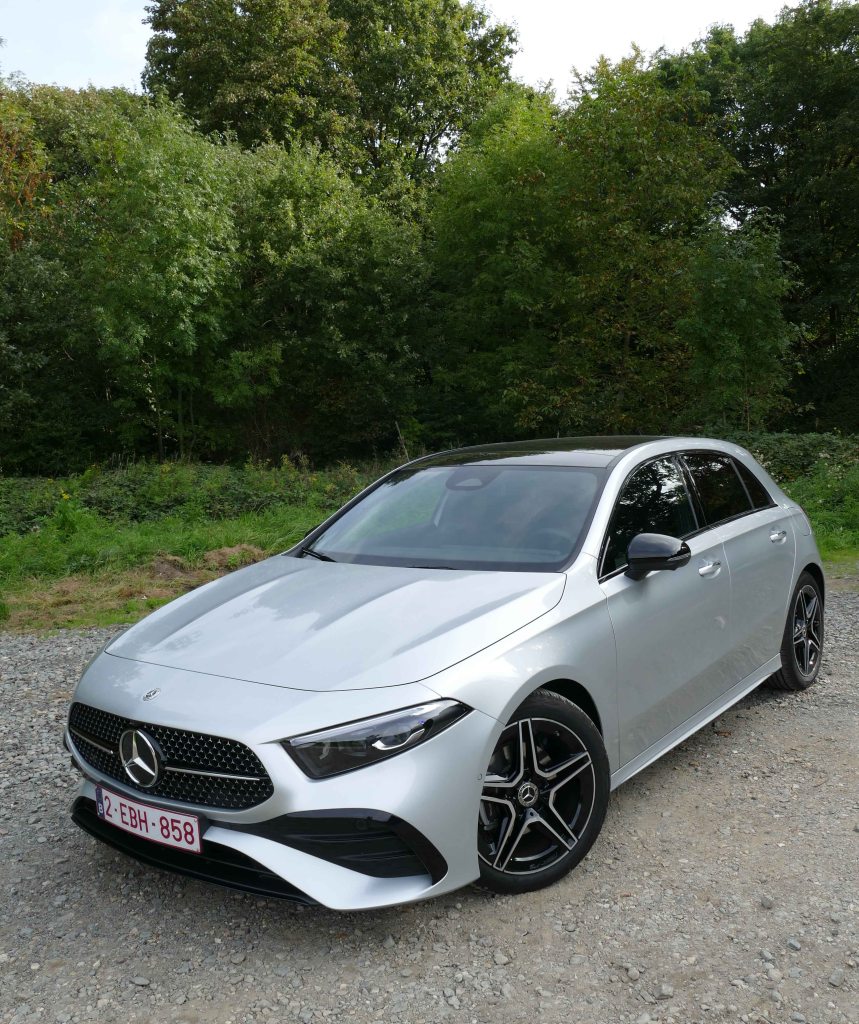
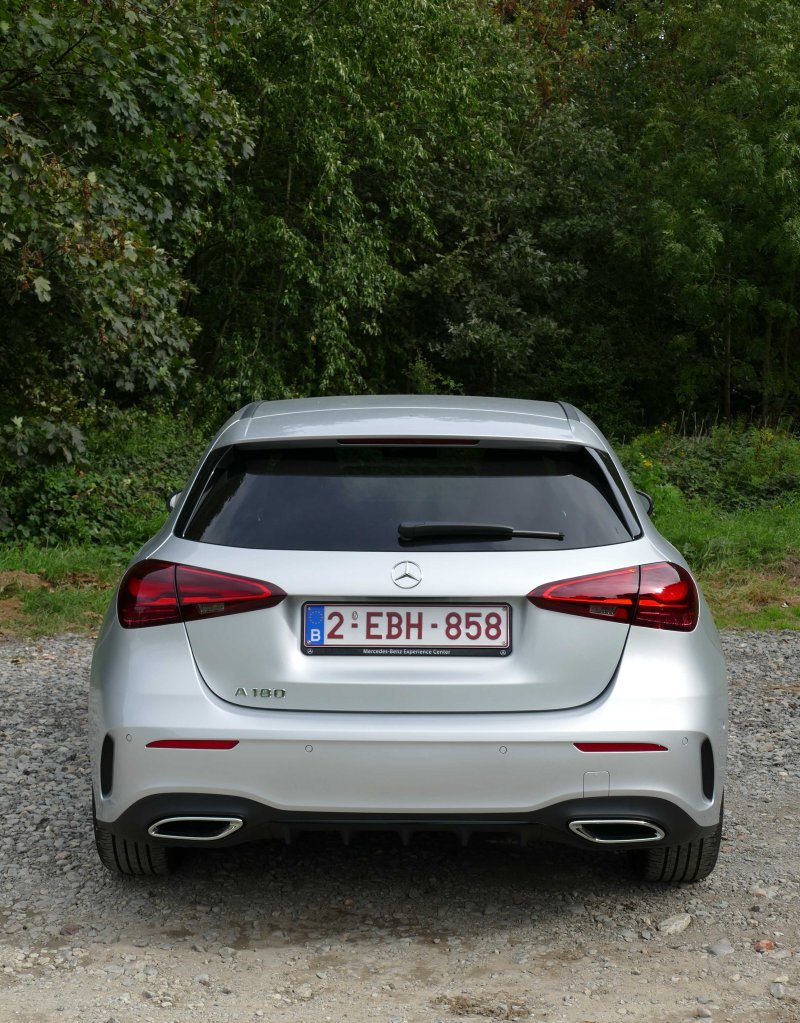
The ever so popular A-Class recently got a face-lift, and it was for us an  excellent opportunity to get behind the wheel of the latest edition of this very capable car with the iconic star. To tell you right away, it proved a wonderful experience, proving amply how good, well balanced and mature this A-class has become. An an icing on the cake, our good looking test car was sprayed in iridium silver and was equipped with the very tasteful AMG line, which gave this A-Class just this extra panache which made it stand out as a true Mercedes-Benz, just as we liked it.

We would say, read further…

Hans Knol ten Bensel

Dynamic looks

The facelifted A-Class looks sporty, even more so in the hatchback version we tested. The front end is dominated by a distinct shark nose, as Mercedes puts it, and the sloping bonnet shows two distinct power bulges, reminiscent of the legendary 300 SL…ah, it reminds us from the beautiful time we had behind the wheel of one in Marbella, celebrating 50 years of SL…

But also this A-Class lets you dream. Just have a look already at its gleaming AMG alloys, the dual exhausts and the new rear diffuser.

A cabin with the unique atmosphere of the good star… The cabin of this AMG line A-Class has plenty of atmosphere. The steering wheel is not only a steal to look at, it also feels great in your hands, the double horizontal spokes let you have all the functions at your fingertips. The latest version of the MBUX makes your life easier, and the dual screen display puts all the info crystal clear in front of you. Of course, the central screen is a touchscreen, but can also be controlled via the commands on the steering wheel.
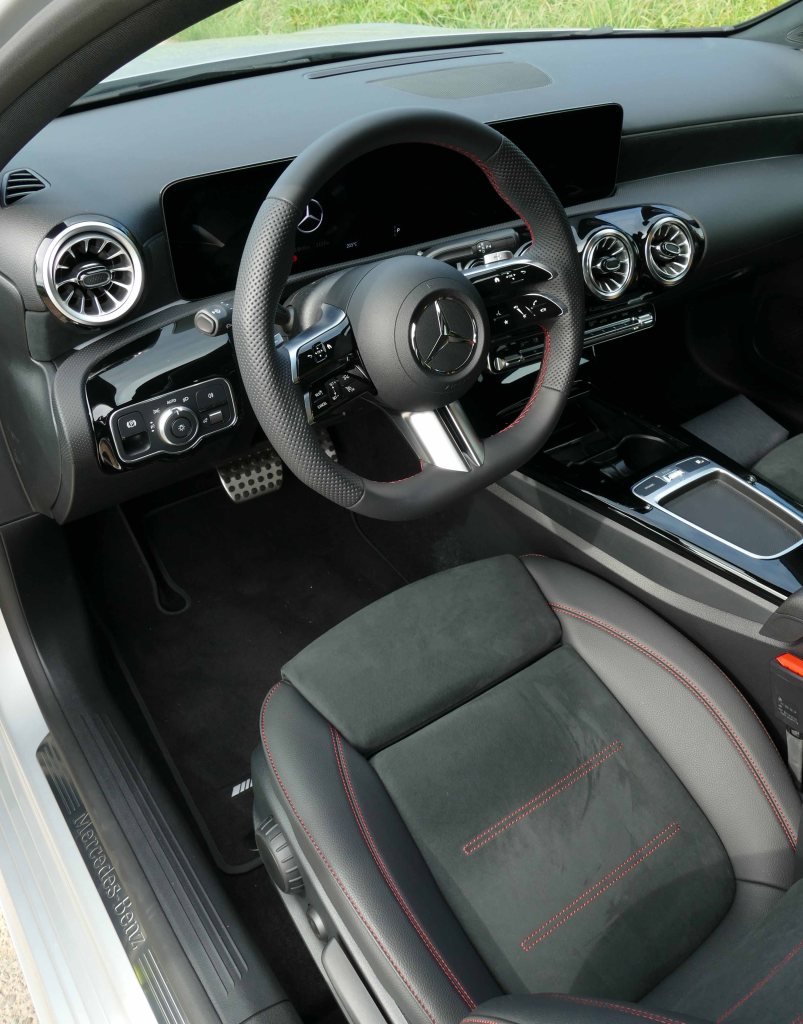
The latest  version of MBUX has a plethora of useful functions. For instance, did you know that you can prepare the car optimally for a car wash by a simple touch? All the well proven driving aids are of course also at your fingertips, and we appreciated very much in urban manoeuvring and parking the 360 degree camera which offers very crisp images. The camera retracts under the boot lid and so shields itself from the elements, staying always nicely clean.

The look of the digital instrument display can be customised of course. You can choose the “Classic” layout with round dials for speed and revs, “Sporty”  with the dynamic rev counter, or “Discreet” with reduced content. There are also three modes (Navigation, Assistance, Service) and seven colour worlds.

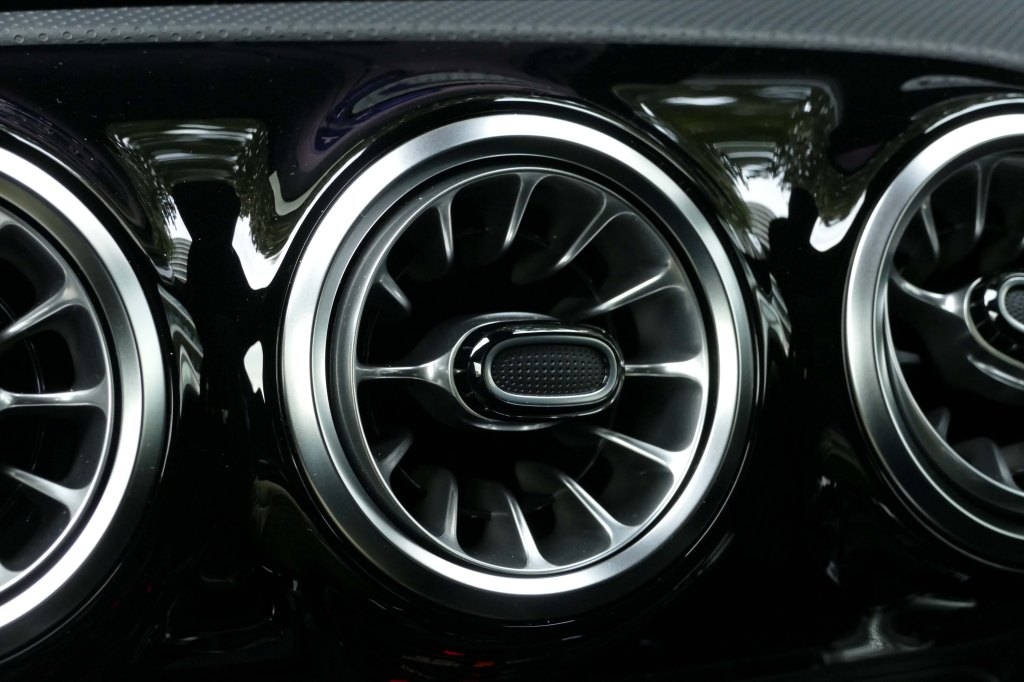
The dashboard is studded with beautiful round air vents, which have become a hallmark for the Mercedes passenger cars, and are nicely sculpted and heavily chromed here, providing a striking contrast with the dark interior. Below these vents one finds a row of buttons for all the necessary ventilation and heating functions, making daily life with the A Class a pleasant experience for everyone, even when unfamiliar with the car.

Of course you will find Android Auto and Apple Carplay in this Merc, so using your phone fully is a proverbial breeze…you also have extra charging points too.
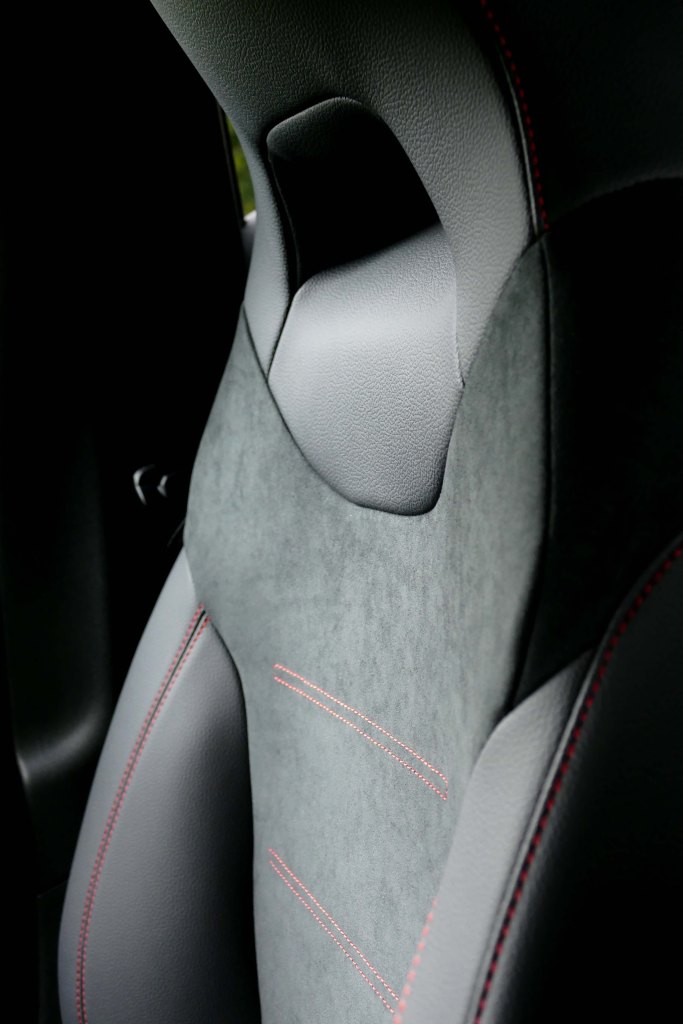
Ideal seating and comfort The AMG Line sports excellent looking seats with integrated headrests, with a nice looking contrasting red stitching, which is also seen on the steering wheel and door panels.  The seats, with their three dimensionally embossed Artico upholstery, as Mercedes puts it, offer excellent support and comfort, are adjustable over a very wide range.
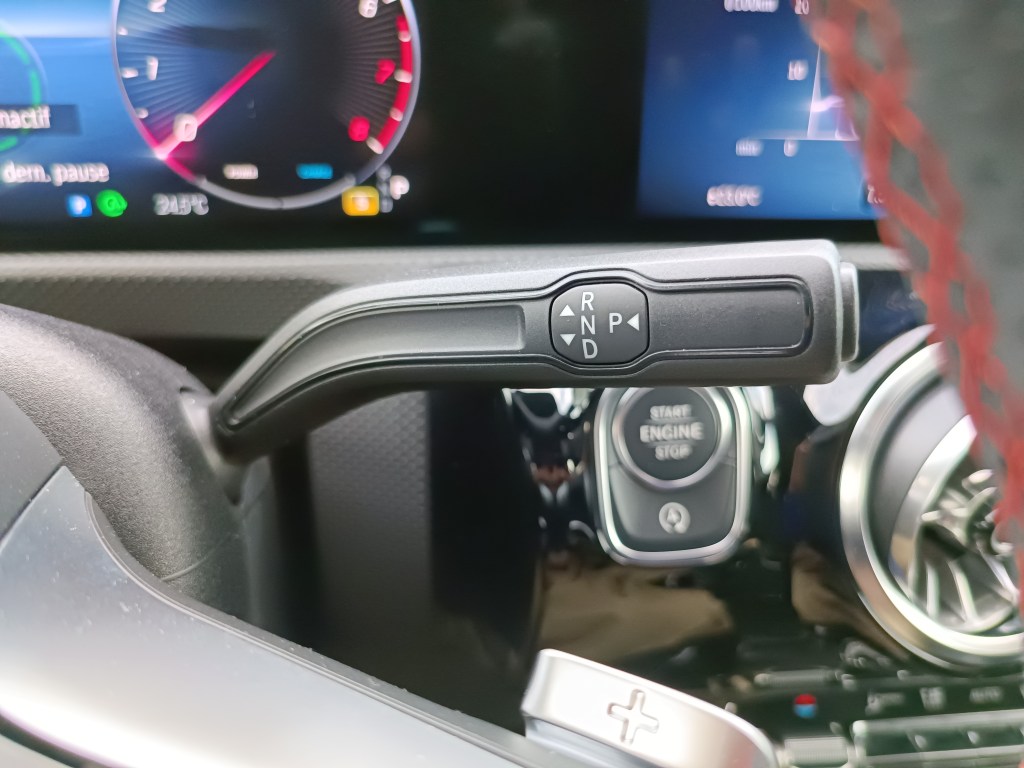
The same goes for the steering wheel, so an ideal seating position is soon found. Seating comfort is one of the strong points of a Mercedes, along with the well studied and honed ergonomics. We also liked the positioning of the small gear lever on the steering column, so you have hardly to lift your hand from the steering wheel when choosing forward, reverse or parking.
Dynamic driving pleasure…

Your servant owns now already for seven years a 180 B Class, which with its smooth 1,6 litre engine is laid out for silent and comfortable transport. The present A Class has clearly a different, more dynamic and sporting  character. This is already manifest when pushing the starting knob. The 1332 cc four cylinder emits a pleasant throb, and indeed lets itself heard. The engine revs willingly at the slightest blip of the throttle, and is quite dynamic of the mark. Even in comfort or eco mode, the engine tends to rev up from standstill, giving you quite brisk accelerations.

The governing electronics of the 7 speed automatic has clearly been laid out for this. Despite this sporting bias, the new belt-driven starter-generator (RSG) noticeably improves the comfort in start/stop situations. A lower-vibration and quieter start is the result, and in addition, it allows ‘sailing’ with the combustion engine switched off during steady cruising. During braking and overrun, the RSG recuperates and thus supplies the 12-volt on-board network and the 48-volt battery. The energy thus generated can then be put to good use when accelerating,  giving the combustion engine an extra boost of 10 kW. It makes the A 180 quite dynamic, even in the 100 kW version we drove. It increases the torque and pulling power of the 1,3 litre engine massively at small throttle openings, and lets you drive with zest in city traffic without impairing economy. Soon enough, one learns to avoid the engine revving too high when moving from standstill, by gently lifting the throttle as soon as revs increase above 2000 rpm.

It triggers the gearbox to change into second, and you repeat this for the third gear. Afterwards, the electronic steering system of the gearbox notices that you use small throttle openings at higher speeds and will further inequivocally choose the highest gear possible. Not only does this increase the pleasure of a “zen” driving, it also greatly helps economy. Urban consumptions dropped from 11-12 litres/100 km to around 8 l/100 km after we learned this.

Mercedes drivetrain engineers must have honed the gearbox and engine management to do this, despite the sporting bias, as when you lift the throttle gently in first gear, it immediately starts to coast when changing up, making the operation very smooth. Of course, in the “sport” mode, the gearbox will keep the gears engaged until at least 3000 rpm, and its behavior is decidedly sporting. At constant speed, even in the sport mode, economy is very good indeed. Mercedes quotes 6.4 – 5.8 l/100 km as combined fuel consumption according to WLTP standards, with combined CO2 emissions being 145.0 – 133.0 g/km.

Autobahn Meister

As a German car befits, this Mercedes feels totally at home on the Autobahn. With a pleasant throb and in total unstressed stability, the speedometer needle rises to 215 km/h. Overall, the performance leaves nothing to be desired, with the 0 to 100 km/h sprint being absolved in 9,2 seconds. And this is just the “base” power version of the A Class range…

Impeccable handling

Of course, performance means nothing if it is not well controlled. Here the beautiful handling of this AMG Line A-Class has to be applauded. With virtually no body roll, it steers with precision, with excellent feedback felt in the delightful steering wheel, which is such a pleasure to touch. Winding roads are the preferred playground of this A-Class, combined with as we said, excellent high speed manners and stability. Of course, the brakes are fully up to the task. The suspension strikes also an ideal balance between comfort and sportiness.

Living with the A-Class

Mercedes tells us it is the Class for everyday, and we can only agree. We drove the hatchback version, and it is a roomy four seater. Standard luggage space is not enormous with 350 liters, but then the split rear seat folds back in seconds, to transport for example the larger paintings I had to bring to my solo exhibition I held at the District House in Wilrijk, nearby Antwerp. We already mentioned the MBUX infotainment system, which makes life pleasant with the A-Class. When you think you know everything, just read fully its manual. You will discover even more… The same goes for all the driving aids you have at your disposal.
Conclusion

The A-Class has matured over the years into a truly superb automobile. Carriying the unique panache of the brand in looks, finish quality and styling, it continues to do so in handling, comfort, performance, economy and durability. You enter in the world of the three pointed star, as you get indeed everything the brand stands for when you slide behind its wheel. Just push the button. It’s a Mercedes.

Texas Wheels…

Our latest trip to the US included also a visit to Texas, where we were able to use a Volkswagen Tiguan Allspace on its wide and sometimes very busy roads.

We used the Tiguan SE amongst others for visiting art galleries in the charming old centre of Austin, parked here in front of the Wally Workman Gallery…

Indeed, we stayed in Austin, where the local economy is rapidly expanding, with gigafactories being put up by the likes of Samsung, Tesla amongst others. All this has of course a very big impact on its road infrastructure, which can hardly cope with the extra volumes of commercial and commuting traffic caused by this new economic activity. We found the traffic being quite dense, being combined with quite spirited driving habits in true Texan style. Something the Tiguan we drove took of course ideally in its stride…cruising happily along at 80 mph on its wide expressways, flanked by big trucks and the omnipresent big pickups, the car type par excellence which seems to be most preferred by most Texans. Indeed, the Texans like it energetic and fast. The speed limits are quite realistic, with a maximum allowed speed on the so-called expressways up to 85 mph.

Electric driving in Texas…in its infancy?

Recently oil state Texas signed a legislative proposal into law on May 13 that will make all electric vehicle (EV) owners in the state responsible for paying a $200 annual fee. But that’s not all… Indeed, this law, which takes effect on Sept. 1, will also require new electric vehicle (EV) owners to pay a one-time fee of $400 to register their cars in addition to the $200 yearly toll. The idea is that EV owners don’t pay the fuel taxes, and so Texas aims to recoup some of the tax losses. The state already has nevertheless over 200,000 EVs on the road, with more than 30,000 EVs added this year.

The State, which is indeed very big indeed, about 22 times Belgium, has only over 2,000 electric charging stations in place. Even Belgium has more, let alone the Netherlands, which is about 1,5 times the size of Belgium. It has not less than 90.000 charging points! However the state plans to put more charging points along its freeways, aiming to support one million electric vehicles and allow for easier long-distance driving with work starting in 2023. Let’s see…

Test drive with the Lucid Air…

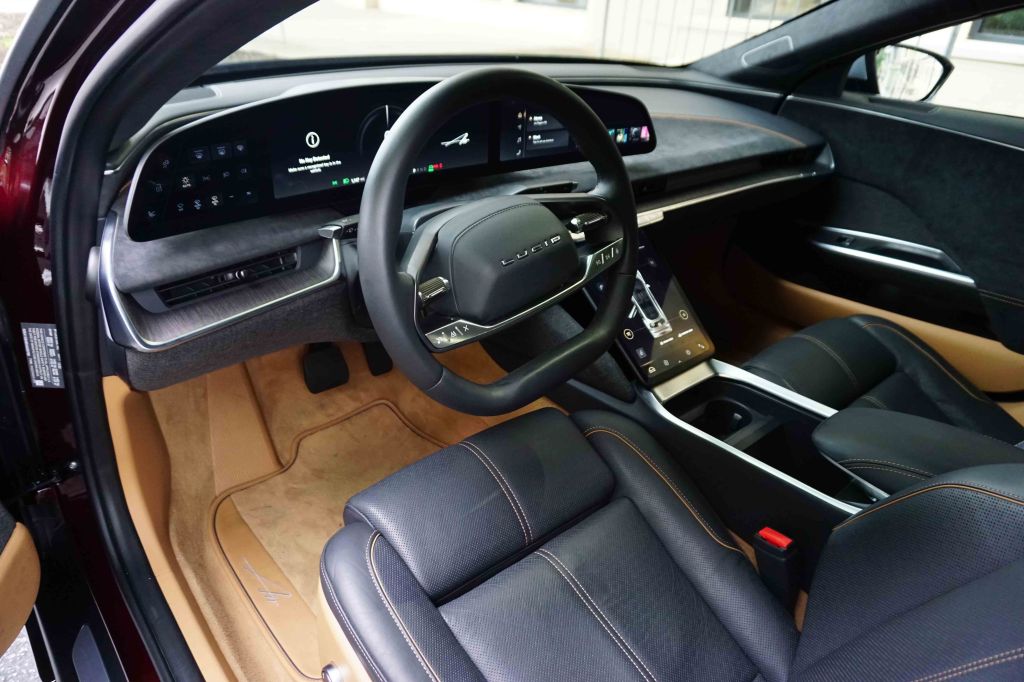
Needless to say full EV’s are still a relative rarity on the roads in and around Austin, although in its centre we were able to have a brief test drive in the elegant Lucid Air Grand Touring. The car looks sleek and stylish, and it is indeed a very impressive four door only battery powered EV luxury sedan. This Grand Touring version has dual motors developing together not less than 1050 hp in the performance oriented version. Plenty of power to enjoy a most exhilarating performance. You can pull from 0 to 60 mph in a mere 3 seconds, and if you drive it with somewhat more restraint, the range is a good 425 miles.

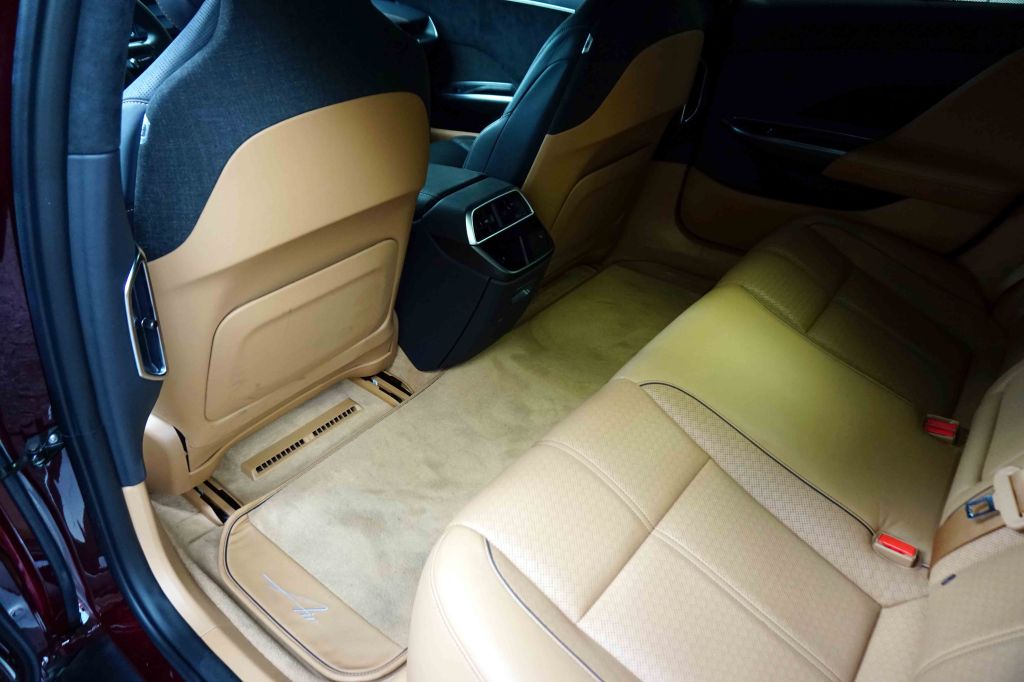
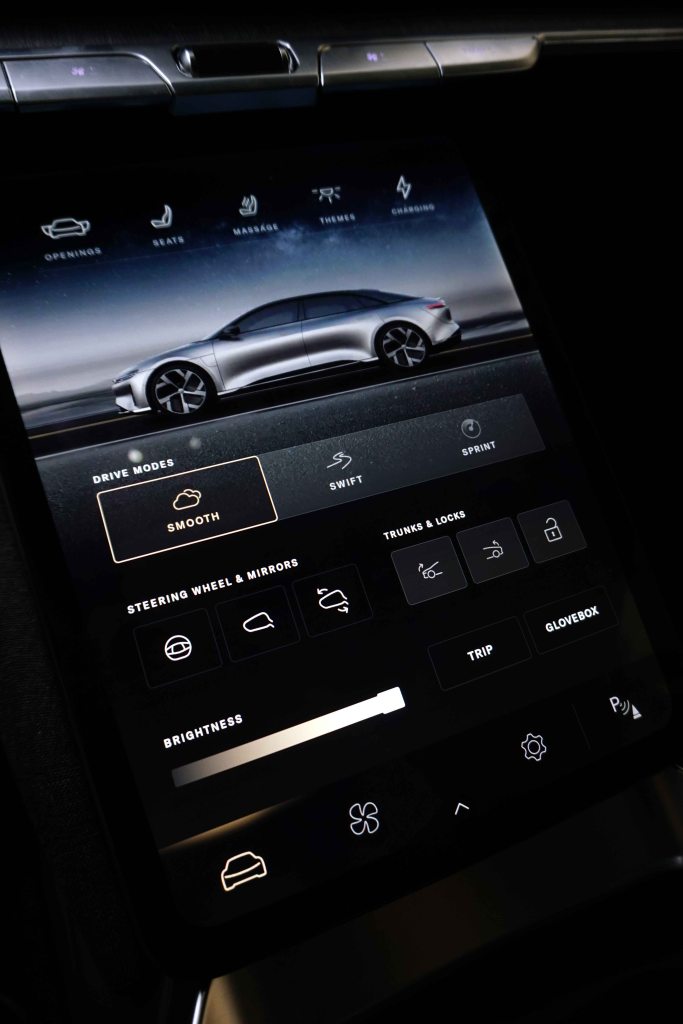
What impressed us also was the rich and spacious interior. Passengers in the rear will find any amount of seat and legroom on the massive back seat and also behind the wheel one enjoys the grace of space. The glass roof enhances further the airy impression in the cabin. The drive is also very smooth and silent, and in chosen “Smooth drive” mode, the coil sprung car proved very comfortable indeed. Infotainment is also top notch with a large upper touchscreen and a tablet type lower touchscreen, which is used for additional functions and can be retracted into the dashboard.

Really impressive, this Lucid Air. There is even a ”Sapphire” version which has not less than 1200 hp. But this Grand Touring version has already a lot to please.

There is also a quite lavishly equipped Touring version, which has 620 hp, with more than sufficient performance to match. It will set you back around 90.000 USD in the US, depending of course on the options you choose. Suffice to say that Lucid is an American based company, and it really stands out with its product in this luxury EV passenger car segment. We let you enjoy the photos here of this elegant Lucid.

A look into Texan car service…

We also have one of our American acquaintances working at O’Reilly Auto Parts, and so – noblesse oblige – it was for us an excellent opportunity to respond to his invitation to visit one of their local stores. First of all we want to stress that O’Reilly Auto Parts offers its services nationwide and has stores all across the USA. We were impressed by the wide range of parts and accessories available. Quite naturally what motorists most often need in everyday life are batteries, and every O’Reilly store has them in all possible kinds and sizes. They will of course also test your battery, and inspect at the same time the health and functioning of your alternator.

The parts service O’Reilly is offering its clients online is nothing short of mind blowing. You can order specific parts for any make, any year, and it covers a formidable range from mechanical to interior up to body parts.

O’Reilly will also offer free electrical testing and checks also for free what the source is of your engine light glowing up…

If you have a tricky job and need special tools, O’Reilly will loan it to you…

Pickups are THE thing in Texas, and O’Reilly has all the necessary trims in store for your beloved truck...

We were also very surprised to hear that O’Reilly offers a LIFETIME guarantee on its brake pads, and this for good commercial reasons. They will indeed hand out new brake pads to their clients when the pads are used, but then the clients come back in the store, and will invariably buy something else. It indeed enhances client loyalty…

Hans Knol ten Bensel

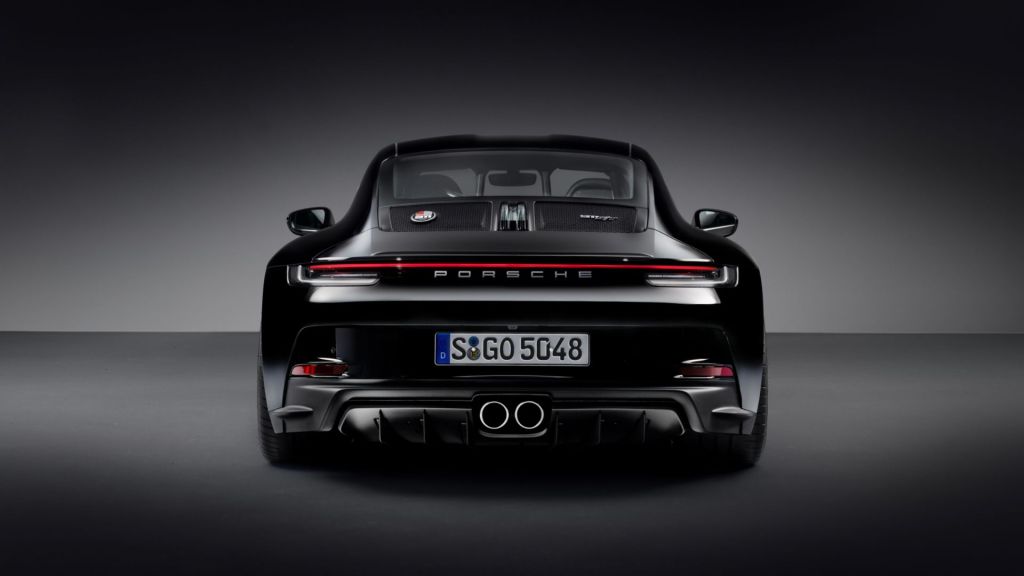
Porsche celebrates the 60th anniversary of the 911 with a special purist edition: the 911 S/T

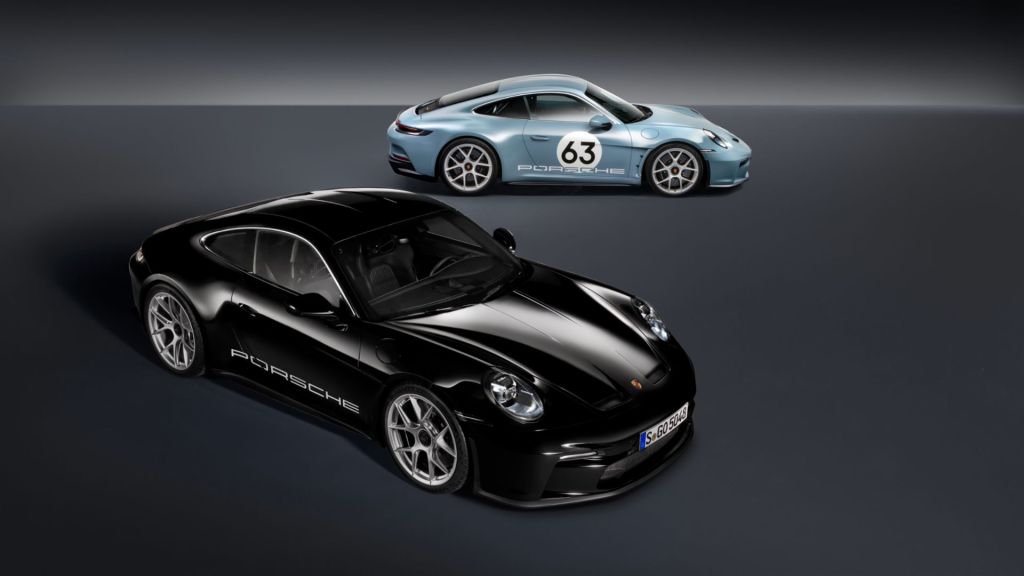
The 911 S/T here in black, with the Special Heritage Edition in the background. The new exterior colour Shoreblue Metallic and the wheel rim colour Ceramica are exclusive for this special edition.

The 911 is now already 6 decades with us. As soon as your servant hit 18 years, he sat behind the wheel of a 911 S 2,4 press car. What a legendary experience it was. My love for this car has remained unbroken ever since. Already the hissing sound of its (then air-cooled) flat six made you addictive. So Porsche takes us back to the “pure” original, with of course the power and panache of the modern day 911.

In a limited run of 1,963 examples, the Porsche 911 S/T offers lightweight design and the sound and fury of the high-revving engine from the 911 GT3 RS. The purity lies in the fact that it delivers its power to the road via a manual gearbox and lightweight clutch.

The naturally aspirated, 386 kW (525 PS) 911 GT3 RS engine has a capacity of 4 litres, and the gearbox has – noblesse oblige – short ratios. This is complemented by a resolutely lightweight construction and a running-gear setup optimised for agility and drivability. The 911 S/T weighs just 1,380 kilograms (DIN kerb weight, incl. all fluids), so you can imagine that this Porsche is to be enjoyed more than ever.

Unlike the 911 GT3 RS, the focus of the development of the 911 S/T has been not for track use, but rather for journeys on public roads. The name marks out the new 911 S/T as the descendant of a particularly performance-focused version of the first 911 generation. From 1969, Porsche offered a special race version of the 911 S. Internally, these vehicles were called 911 ST.

Modifications to the chassis, wheels, engine and body then significantly improved acceleration, braking, traction and cornering grip. The anniversary model combines elements of the 911 GT3 RS with the body of the 911 GT3 with Touring Package and supplements it with lightweight components specially developed for the 911 S/T.

Of course, performance is paramount: coupled with a six-speed manual transmission with shorter gear ratios compared to the 911 GT3, the high-revving engine in the 911 S/T propels the 911 S/T to 100 km/h in just 3.7 seconds. It achieves a top speed of 300 km/h. With that comes the beautiful sound of the flat 6 through the lightweight sports exhaust system… need we say more?

A Heritage Design Package

The 911 S/T is offered with an optional exclusive Heritage Design Package. The new exterior colour Shoreblue Metallic and the wheel rim colour Ceramica are exclusively available for this variant. On the doors, a starting number from 0 to 99 as well as a decorative foil can be applied on request. The classic-design Porsche crest from the original 911 that adorns the front, the hub caps, the steering wheel, the headrests and the car key underscores the historic roots of the 911 S/T.

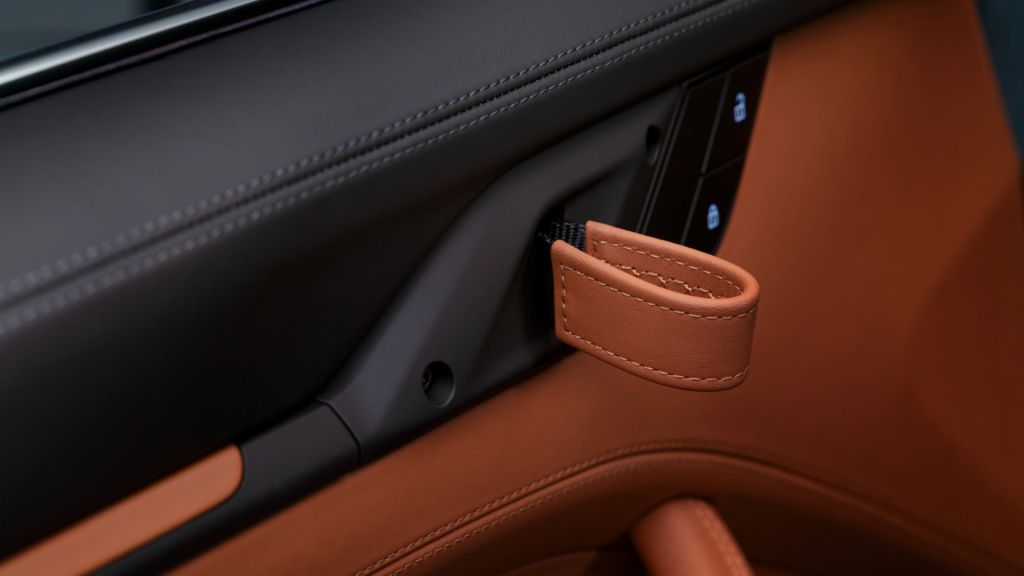
The interior also features cloth seat centers in Classic Cognac with black pinstripes, which are another homage to heritage. Two-tone semi-aniline leather trim in Black/Classic Cognac leather with extensive leather surrounds, a roof lining in perforated Dinamica, and other elements from Porsche Exclusive Manufaktur round out the package. The Porsche logo and the 911 S/T model designation on the rear of the car are in Gold.

Porsche Design is also offering customers the 911 S/T the Chronograph 1 – 911 S/T.

Featuring a titanium case, uncoated and blasted for weight-saving reasons, this exclusive timepiece goes all in on the lightweight design principle of the new purist 911 special edition.

The heart of the chronograph is the Porsche Design WERK 01.240 with its COSC certification and flyback function. It is operated with a rotor in the design of the magnesium wheel of the 911 S/T.

Already dreaming? We invite you to just look at the photos…and it is good to know that in Belgium this anniversary edition can now be ordered for 327.743,04 euro including VAT. With the chronograph 1 – 911 S/T included…  

Hans Knol ten Bensel

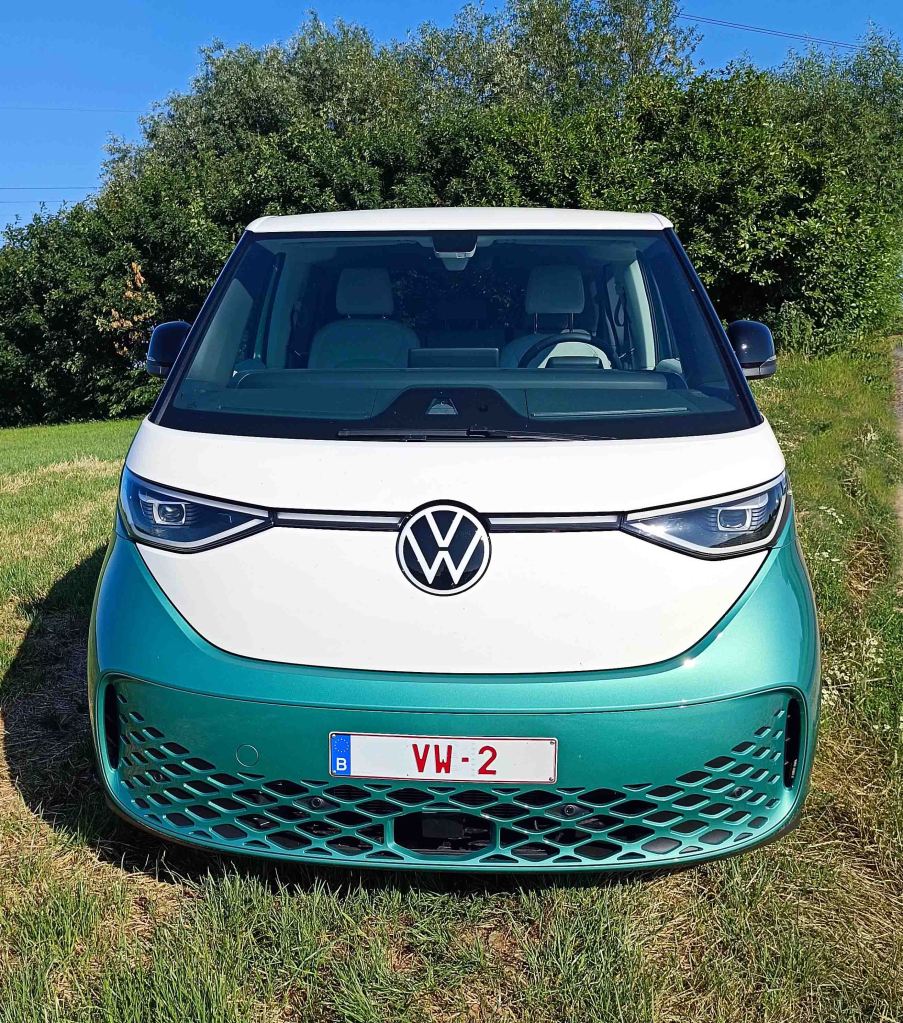
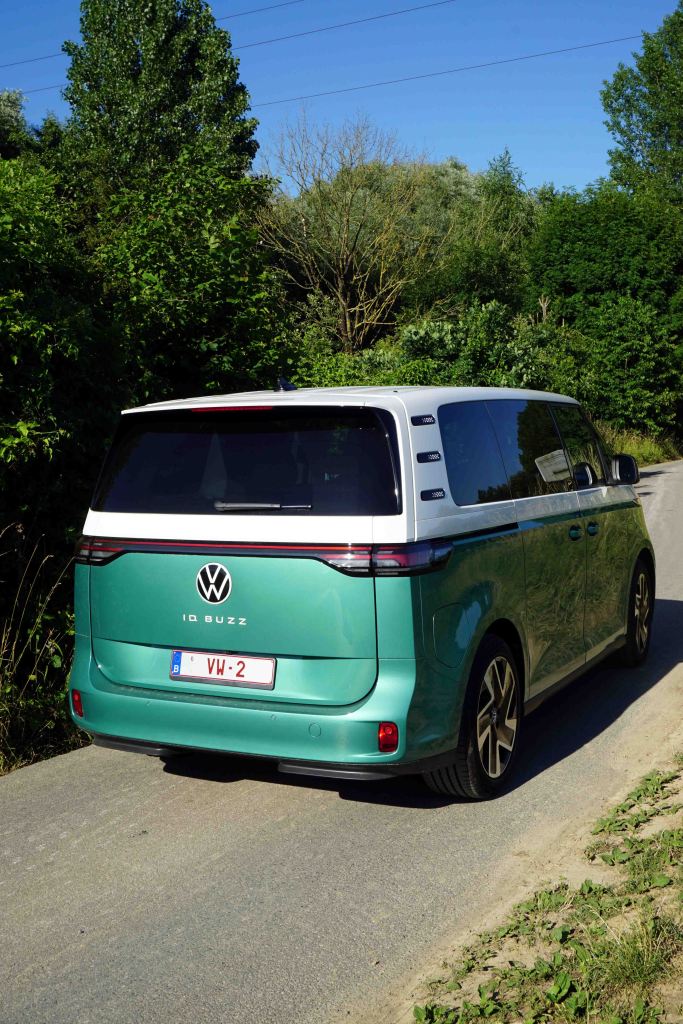
We drove the Volkswagen ID.Buzz: the “E”- renaissance of an Icon …

 Volkswagen designers and engineers recreated the iconic “Bulli” and made it fitting for our modern E-Times. Their ID.Buzz is a indeed a car which brings at least the aura and panache of the original VW bus, and is adding even more character to it. It underlines the stylistic hallmarks of the original, and has masterfully translated it to steal the hearts of many of us. But not only that: this ID.Buzz now also brings along the well proven VW E-technology. We drove it for you, just read further…

Hans Knol ten Bensel

Cool functionality…

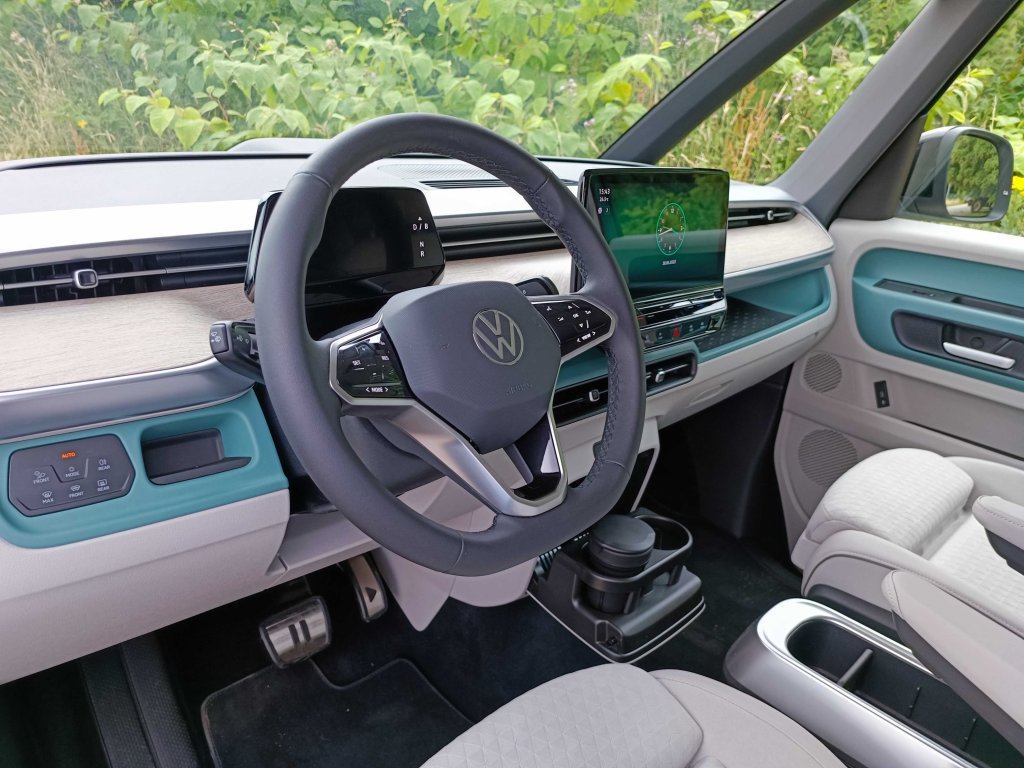
The ID.Buzz has character indeed, and the two tone paintwork of our test car even accentuated its early heritage. The cool character of its predecessor goes even further. Indeed, the original “Bulli” was very functional in its interior, and VW designers have somehow continued this approach in the interior of the Buzz.

Everything is functional, the “less is more” philosophy is applied in every detail.

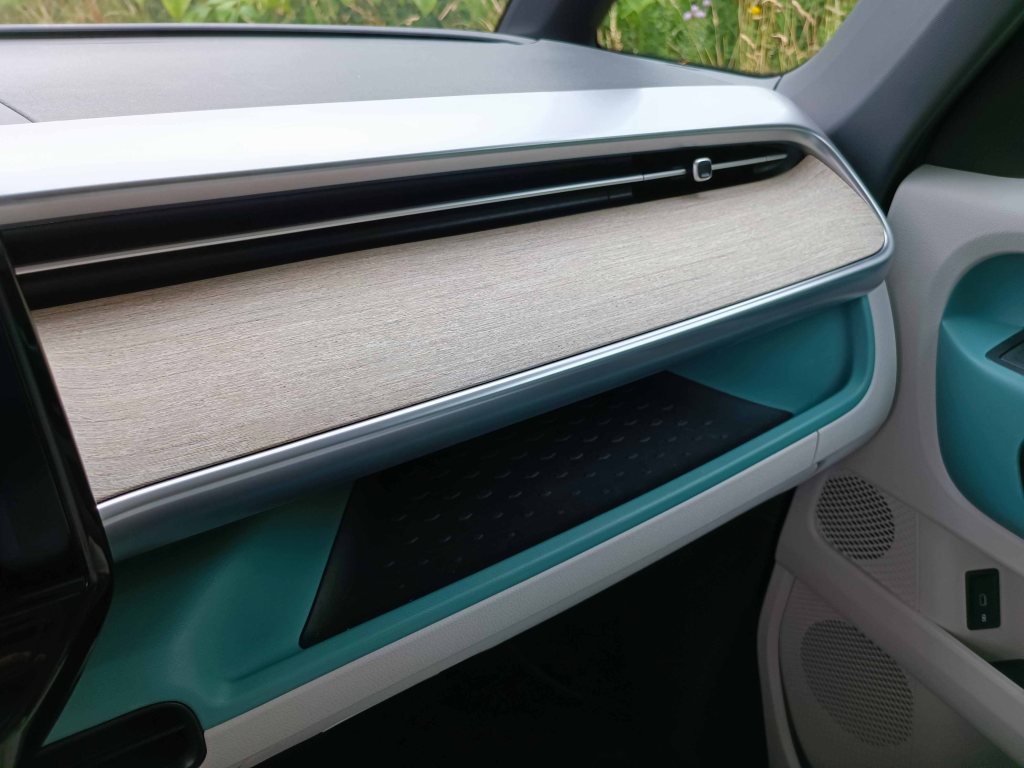
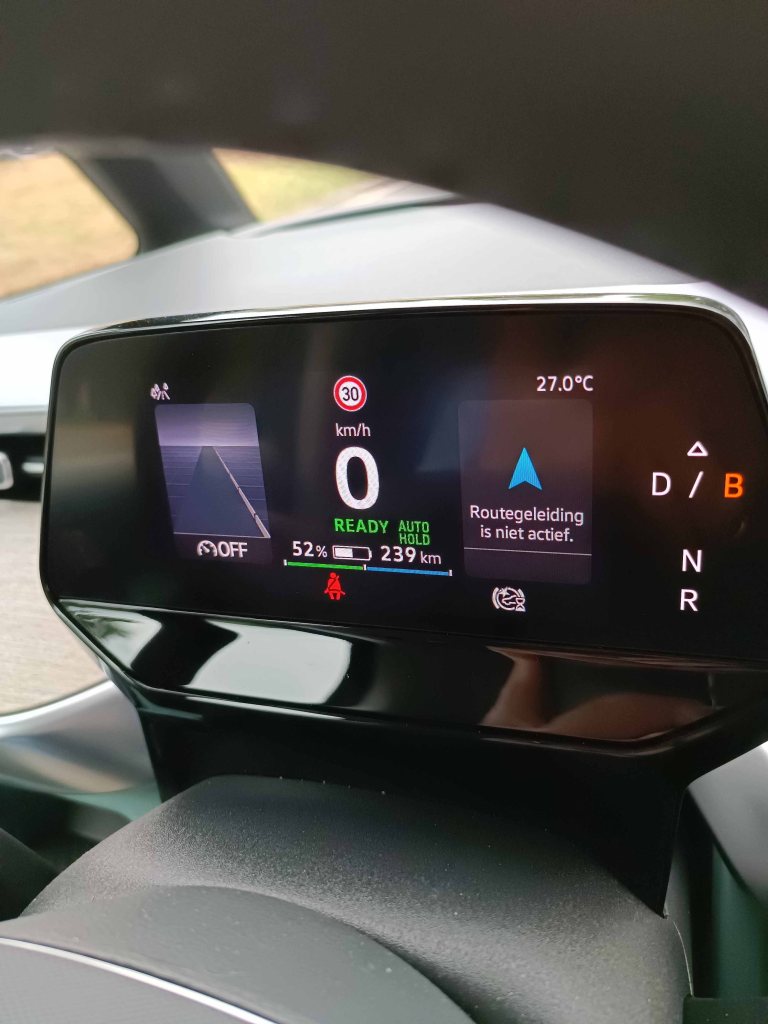
The instrumentation is wonderfully simple, and even the size of the central touchscreen is also kept within reasonable limits. The instruments and screens are put on a wooden finished large dashboard panel, which is set in a large matte aluminum band, running horizontally across the whole width under the windshield.

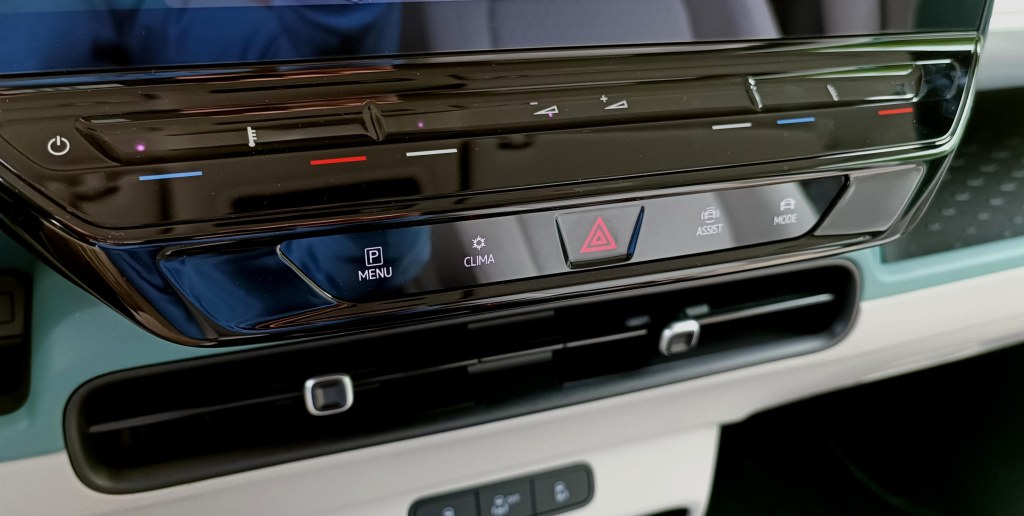
This certainly looks stylish, but also brings lot of reflections on bright sunlit days, so be sure to wear your sunglasses when you are behind the wheel. A lot has been said about the practical functionality of the “haptic” controls of VW’s ID generation, and indeed it takes a delicate hand to use them with success. But soon, one gets the hang of it.

The finish of the bodywork and interior is of the usual very high VW standards, the upholstery of the seats, certainly in the front, is also quite appealing. There is less padding on the plastic panels in the interior, certainly also in line with the “practicality first” philosophy of the original icon, but then we must not forget that this is a car commanding a price tag of around 75.000 Euros. But we personally think that very few users/buyers would have any objections here, as indeed the unique character of its original icon is preserved and this is what the lovers of the ID.Buzz want to experience and feel.

In terms of connectivity driver and passengers cannot complain. Of course one has DAB+ radio, Apple Play and Android Auto, and enough USB slots for passengers fore and aft. The navigation system with online functions and Live Traffic helps the E-driver wonderfully. It calculates also when and where to recharge the batteries. It will also recalculate them continuously in function of driving style and traffic conditions.

Driving

The ID.Buzz has the power, 150 kW of it and not less than 310 Nm of torque, but it has also the weight: 2,4 tons of it. Not that the Buzz is a slow car, far from it: it will accelerate with zest from 0 to 100 km/h in merely 10,2 seconds, and has powerful intermediate accelerations. But it does not invite you to use all this power. It rather suggests a more relaxed driving style, and this is indeed where this ID.Buzz excels. The gear lever can be turned either in “D” or in “B” position, and in the latter it will regenerate the kinetic energy when you lift the throttle. We used it actually all the time, and soon one learns to adopt fully “one pedal” driving with this setting. On motorways and higher cruising speeds, wind resistance of this ID.Buzz takes its toll, and wind and road noise are rather prominent. This will let you intuitively cruise at legal speeds of 120 km or thereabouts, and even slightly lower. The ID. Buzz has by the way an electronically limited top speed of 145 km/h. This makes absolute sense, as kW consumption rises markedly above these legal cruising speeds. Driving with some restraint, we averaged a test consumption in the neigbourhood of 19-20 kW/100 km, and this is very creditable indeed. A driving range around 450 km is achievable indeed.

The ID.Buzz is very stable, with a rather firm, but not uncomfortable suspension. Steering is precise, cornering/handling indeed being very predictable, with a tendency towards understeering. For the moment, the ID.Buzz cannot be had with adaptable suspension, but then the standard setting strikes a very good compromise for most.

Brakes are also OK, and the transition between engine braking and “pure” proper braking is very well balanced. One might be surprised that the Buzz has drum brakes at the rear, but then the electric engine sitting at the rear assists the drum brakes with its regeneration somewhat, so that even under more sporting driving no fading or diminishing efficiency occurs.

What we liked very much was the very small turning circle of merely 10,9 meters, which makes the Buzz a very nice car to drive in urban traffic.

Practical

When it comes to charging, the ID.Buzz has a 77 kW battery, and can be charged with the AC Type 2 plug or the DC type CCS unit. AC charging on a 11 kW wallbox takes some 8 hours, with DC charging one can go clearly much faster. The ID is fit for charging up to not less than 180 kW. So after a short break for a coffee or light meal one is on the road again, with the batteries up to about 80 pct charged…

The ID.Buzz has of course a (very) strong point: it is roomy. Fore and aft, the driver and his passengers have ample head- and legroom, one has to be taller than 2,15 meters to brush the front seats or the roof.

The boot space is also cavernous. Up to the cover, the boot space is 1.160 liters. When you stow things further until the roof, it is 1.760 liters. When you fold everything down, one has a massive 2.835 liters at its disposal.

There is no “Frunk” in front, so be careful that you have your charging cables stowed elsewhere when you load your Buzz fully, and consider also that avoid (parking) situations where you cannot open the rear lid, and cannot reach the cables…

We also liked the armrests on the front seats. Be sure to order the armrests on both sides of the seat, as the armrest in the door is set too high to achieve a comfortable position.

There is a large bin between the front seats, where you can also charge your smartphone, and of course there is storage space for large 1,5 and 1 litre bottles in the doors.

Conclusion

We were very much charmed by this ID.Buzz, and we truly liked it. Indeed, it invites you to take your everyday driving with a “Zen” and restful mindset. Listening to the excellent audio system, looking at the world around you with a smile. The other road users are doing the same by the way when they encounter you. Such is the sympathy of this ID.Buzz. It is also remarkably frugal when you drive it responsibly, to the joy and delight of everyone who drives with you. They find comfort and lots of room…

Add to all this the absolutely timeless character of this ID.Buzz. Its shapes and contours have instant “classic” status, and this will be a desirable car for so many across the years. So keep and cherish it as a family treasure, you will hear a never ending “buzz” of joy from young and old across the generations…

Hans Knol ten Bensel  

We drove the VW Tiguan Allspace R-Line 2,0 TSI 190 HP 4Motion: an all-round bestseller…

Did you know that the Tiguan is the most sold Volkswagen worldwide? There are many good reasons for this popularity: this is an all-round car, ideal for urban shopping, travelling long distances, towing horses, boats or caravans, or just hauling furniture. It occupies of course also the top of the sales hit parade in its homeland, and this since its introduction in 2007.

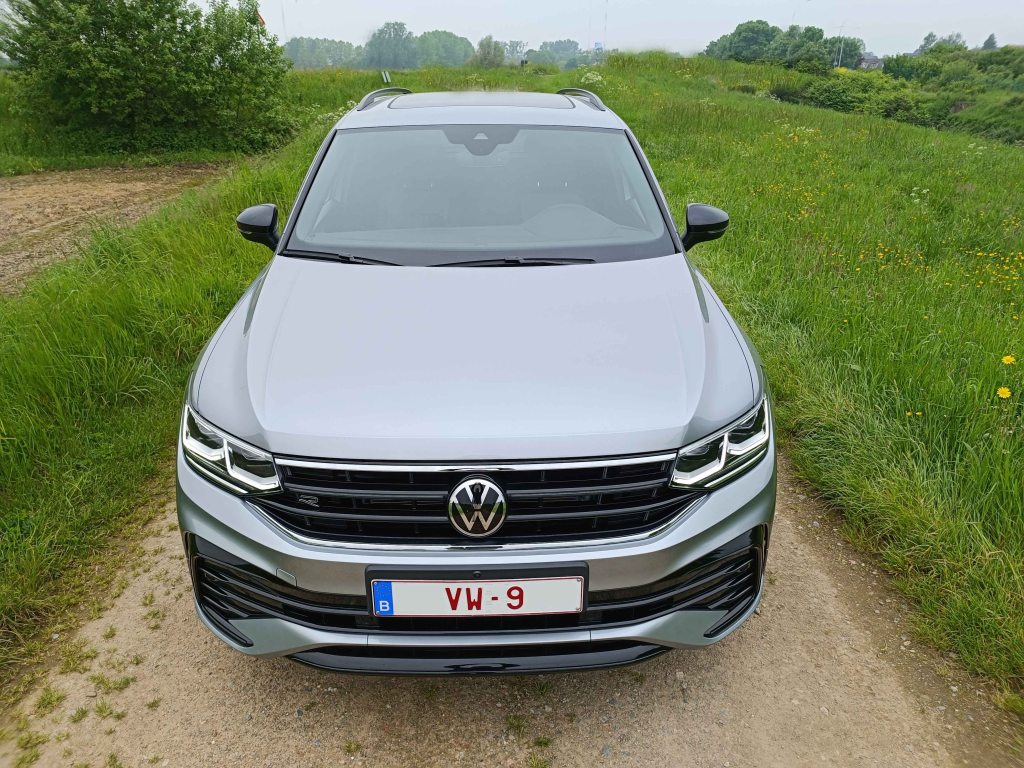
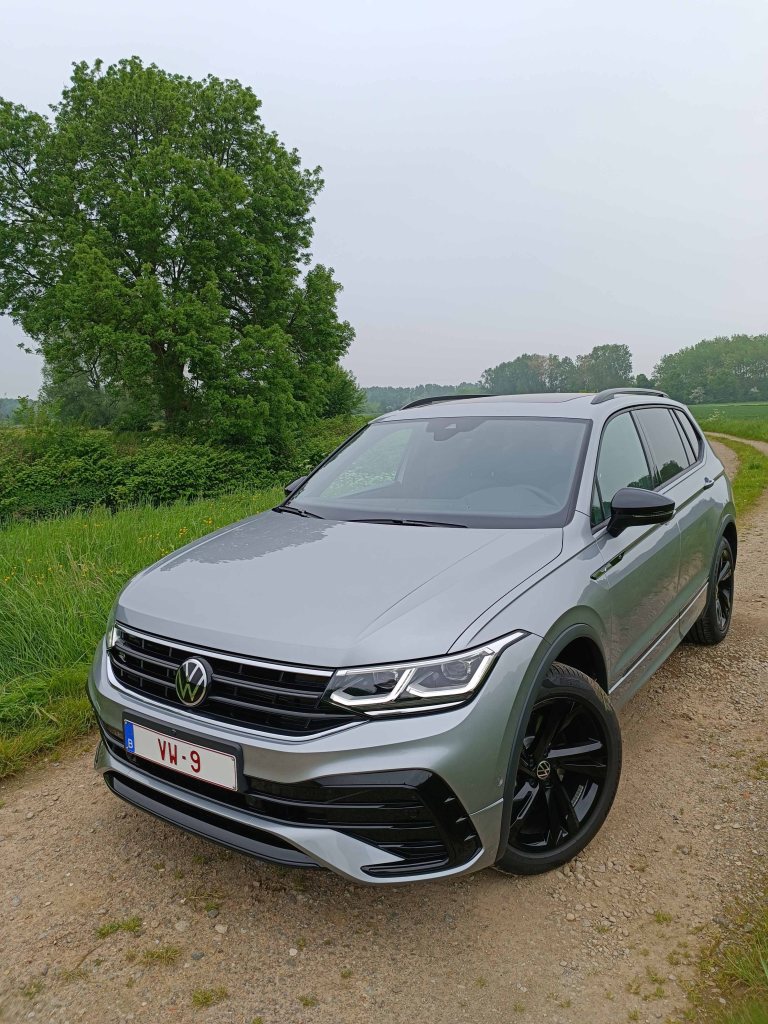
In 2021 the Tiguan got a welcome facelift: the front grille has been reworked to show a family resemblance to the bigger Tuareg. The headlight signature has also been revised somewhat and at the rear the now centrally placed Tiguan scripture distinguishes the latest generation.

VW has also been working on the engines. It is not forgetting the Diesel, which now has two SCR-catalyzers and who succeeds thanks to “twin dosing” to reduce NOx emissions by an impressive 85 pct.

In the course of 2021 a plug-in version also hit the showrooms, with a 1,4 litre 110 kW/150 PS Petrol engine and an electric motor of 85 KW/115 PS. Total system power is 180 kW/245 PS.

But let’s take a closer look at our test car: it came with the well proven 2 litre TSI petrol engine, coupled to a 7 speed dual clutch transmission. The engine has ample pulling power, with 320 Nm being delivered over a very wide rev range between 1500 and 4100 rpm. This results in good responsiveness and lively accelerations when you put your right foot more down a bit. The Tiguan will sprint from 0 to 100 km in less than 8 seconds, and will reach a top speed of approx. 213 km/h. You couldn’t wish for anything more, we would say.

The engine emits a slight throb when it’s working a bit harder under acceleration, but at constant (high) cruising speeds it remains perfectly inaudible. Of course, with this larger and weightier SUV (1,7 tonnes), the fuel consumption reflects even more how much kinetic energy is generated and lost. Therefore one is well advised to adopt an anticipative driving style in urban traffic. Then consumption stays within reasonable ranges, say around 8-9 litres/100 km or so, but then you have to really pussyfoot around! The WLTP figure for short distances is not less than 10,2 l/100 km. It is the Achilles heel of petrol engined cars, and this explains the popularity of Diesels until now. The stark truth is that only hybrid configurations can save the day for petrol engined cars in urban driving conditions, especially for weightier SUV’s. On the open road, the efficiency of the petrol engine is much better, and consumption will sink considerably. The WLTP figure for driving on country/secondary roads is 7,1 l/100 km, on motorways combined with higher speeds it’s 8,1 l/100 km, which is also the WLTP average. The WLTP combined CO2 value is 183 g/km, which is still on the rather high side. Miracles just don’t happen…Our test car was also equipped with the 4 motion package, and its electronic assistance makes you an instant offroad expert….

Excellent comfort

The Tiguan is quite comfortable indeed. It can be had with damper control, dubbed DCC, where you can choose between Normal, Comfort and Sport. Even in the Sport mode, the suspension is never too harsh and in the Comfort Mode there is not too much leaning in fast cornering. The long suspension travel swallows urban sleeping policemen optimally, and passengers are never jolted about.

This well being is also further enhanced by the ample legroom the 19 cm longer Allspace version offers, we could appreciate this when we drove also the very same Tiguan Allspace version during our recent USA trip on Texas roads, where the long distances were travelled in absolute comfort. The Tiguan steers quite precise, and its responsiveness is also altered in function of the chosen driving modes. The assistance is speed sensitive, making the Tiguan easy to maneuver in all circumstances.
Ever more digital

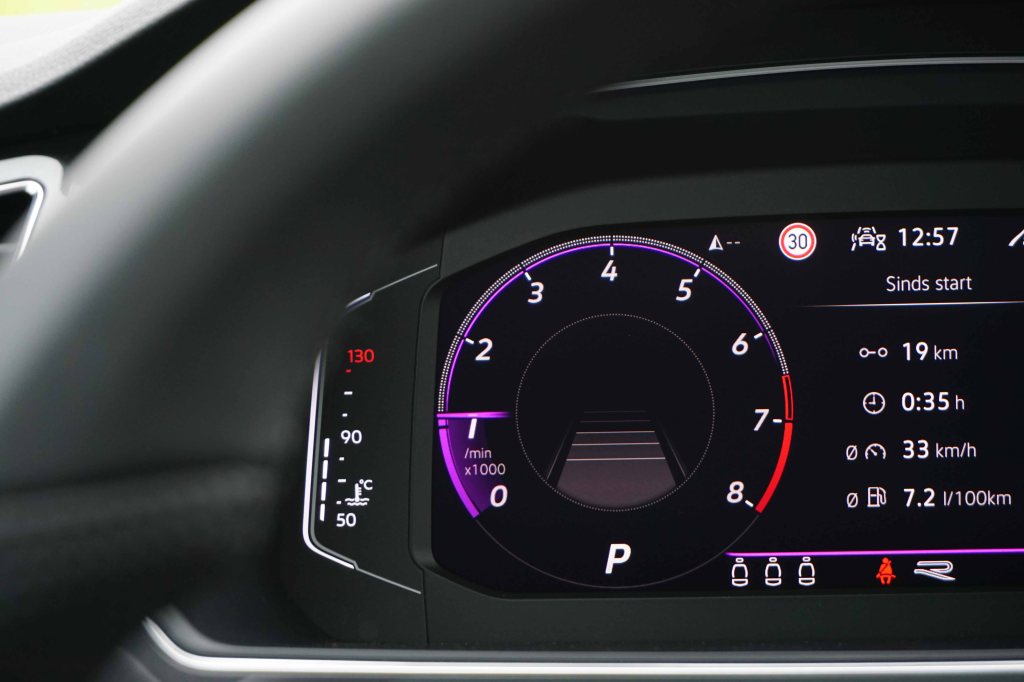
Of course, the age of digitalization spreads also further in the cockpits of Volkswagens, and the Tiguan is no exception. After the facelift the round knobs for heating/cooling/ventilation for instance are replaced by tactile sliders. It takes getting used to, but soon enough one gets the hang of it. I am personally always rather cautious to condemn “modern” functional idiosyncrasies, as owners have their cars for a much longer time than us journalists, who drive their test cars for much shorter periods. What seems annoying for a short term user isn’t necessarily so for a long term owner. It remains of course necessary that also occasional users find their way in it, and that cars are intuitive to use. Therefore any modification which makes this more difficult is indeed a step back…
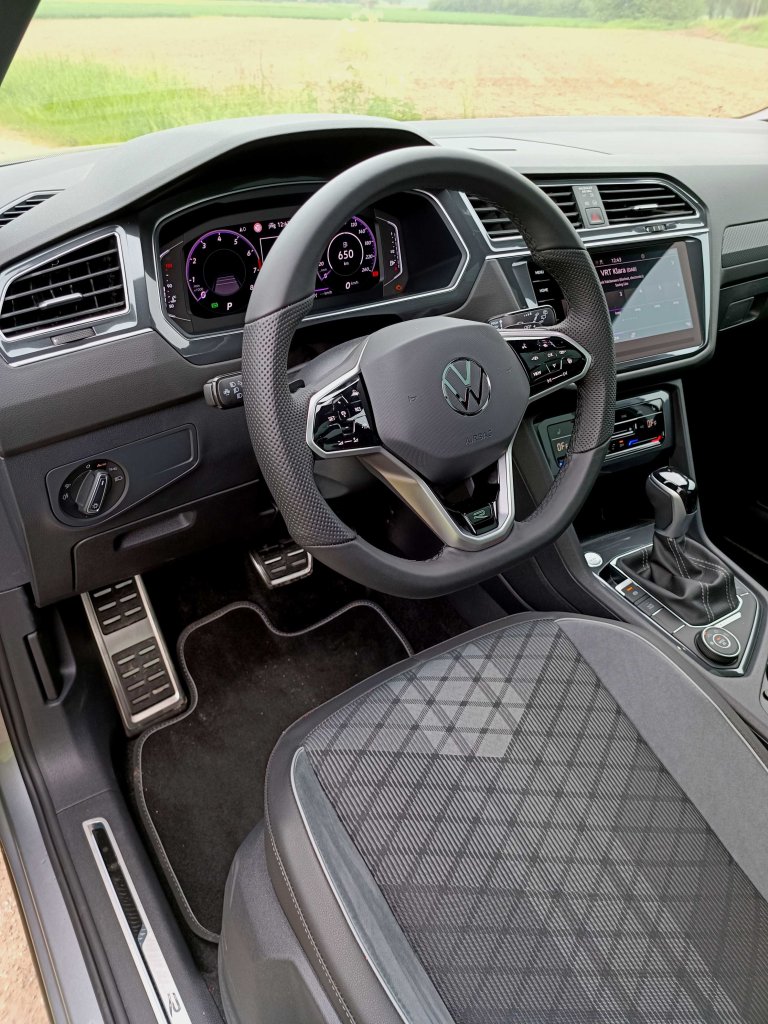
The Tiguan has now its own SIM card and is now always online. This makes staying connected so much easier. Apple Car Play and Android Auto now also run over Bluetooth.

Roomy and functional.

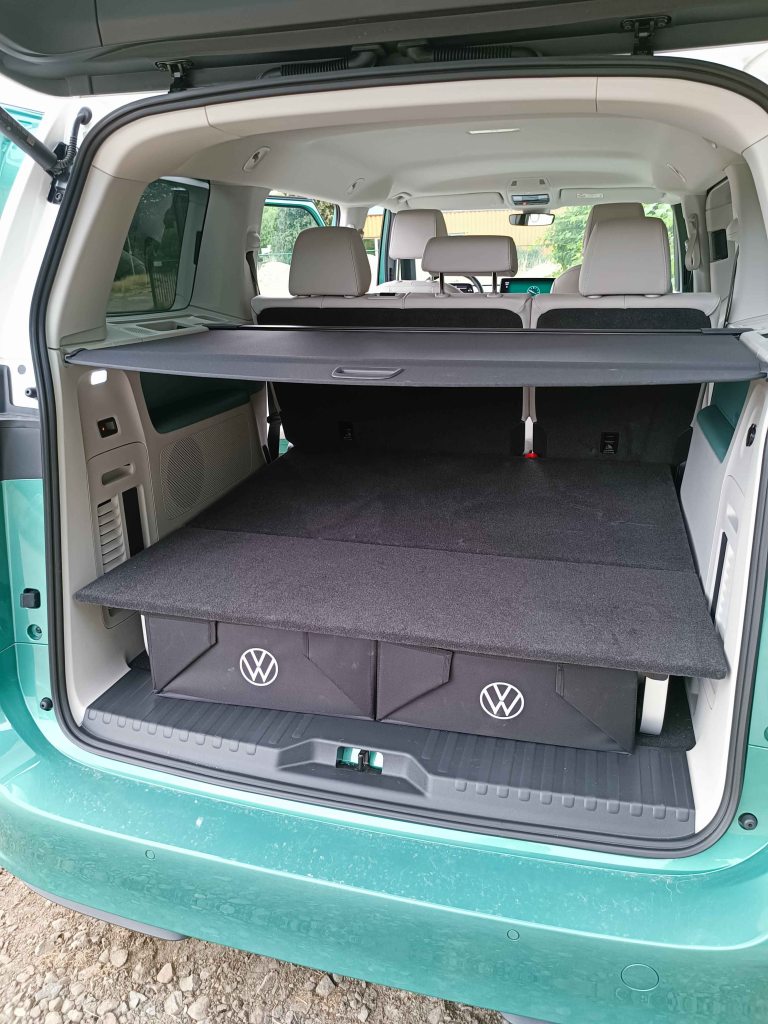
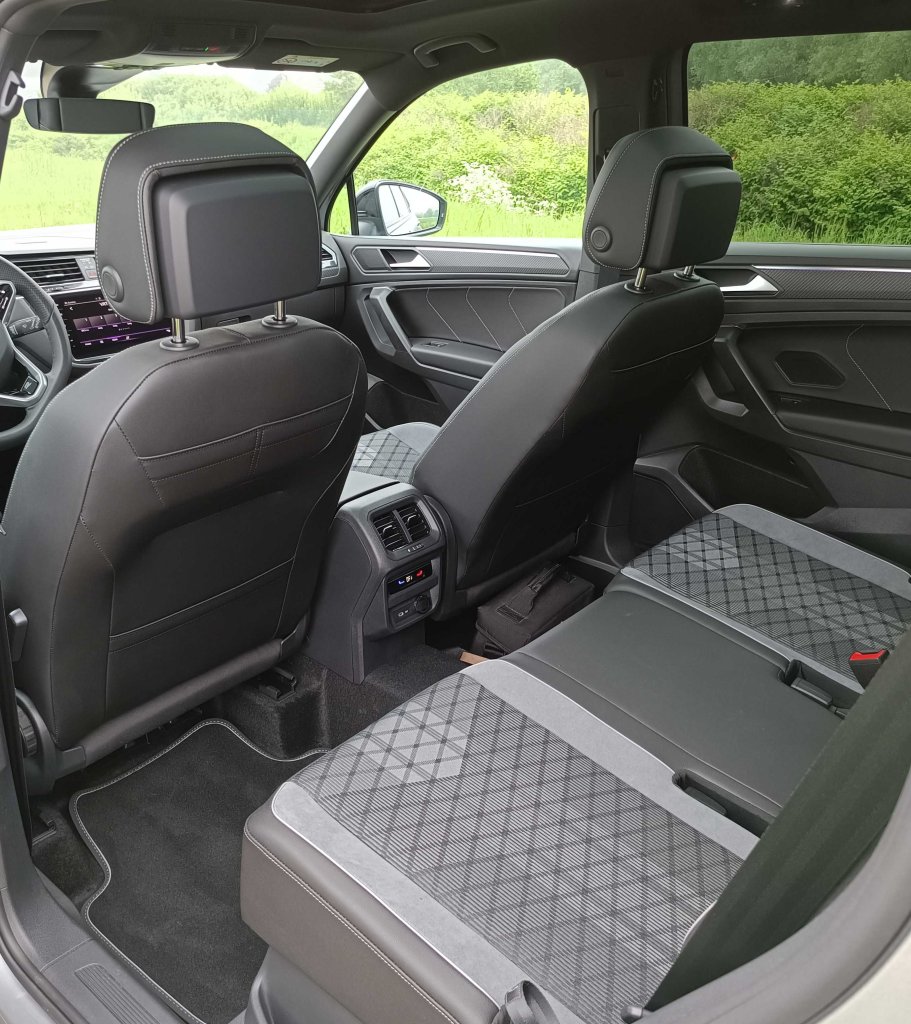
The Allspace offers 400 liters boot space until the luggage cover. Also beneath the luggage floor is an extra 50 liter space, maximum luggage space with all seats down is 1920 liters. As we said before, the Allspace offrers ample head- and legroom for all its passengers.  The Tiguan is also a good load carrier: one can add up to 565 kg. Not less than 2,5 tonnes can be towed.

 Conclusion

The Tiguan truly earns its bestseller status. It is an all-round car, with excellent driving characterics combined with lively performance and good looks. Its petrol engines are pretty formidable, smooth, powerful and sufficiently frugal. A car built with excellent quality and workmanship, designed and meant to last for decades. If only our lawmakers let you…

Hans Knol ten Bensel

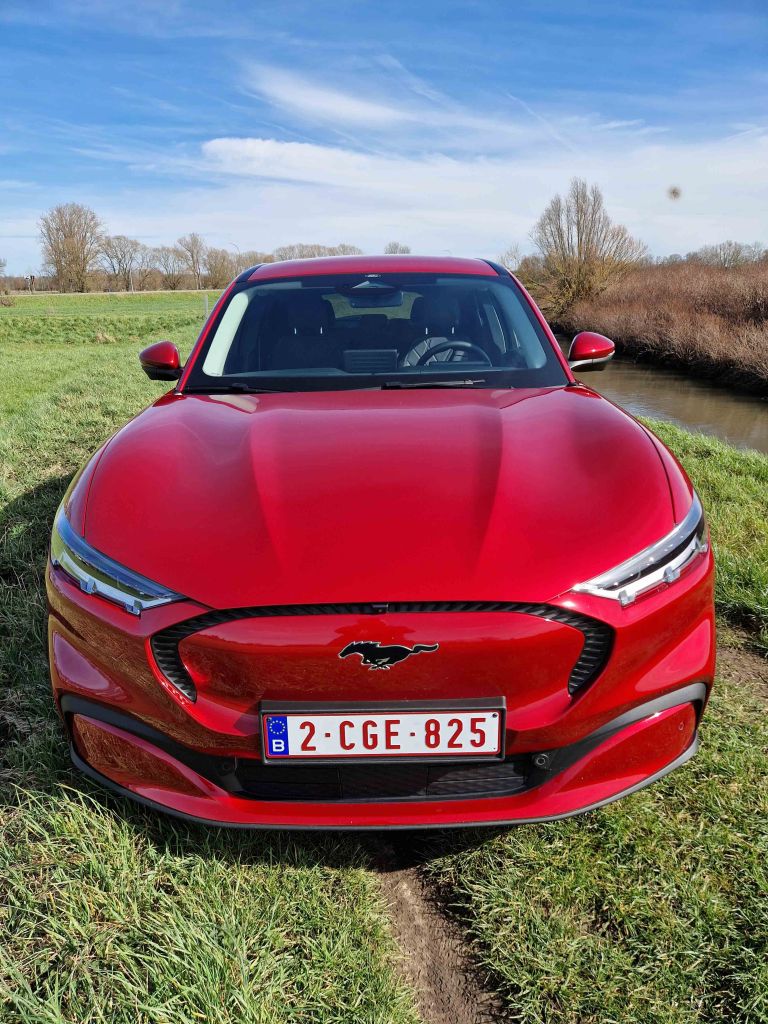
We drove the Ford Mustang Mach-E X: a very well-balanced EV…

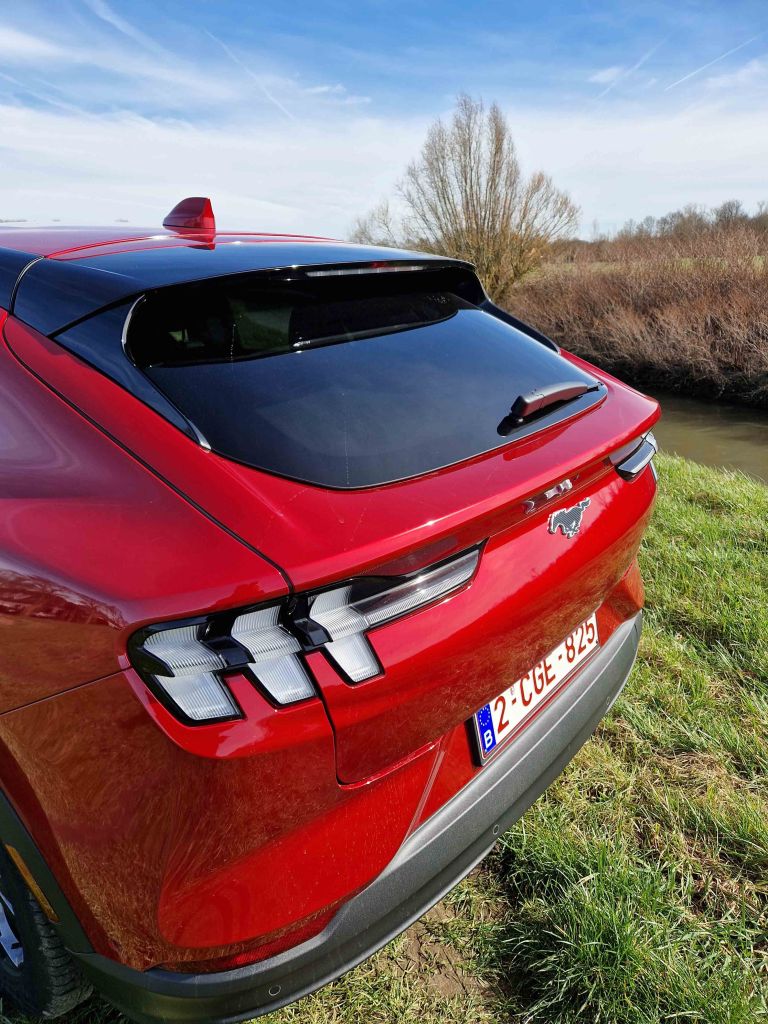
Ford has moved decisively in the electric age with this Mustang. A name which is reminiscent of its illustrious past, but actually the name is the only thing that is left over when you feel how this pleasing SUV actually drives. It is a nice handling and well performing five seater, offering practicality and sufficient range. It shows no weak points whatsoever, is actually quite fun to use and drive. Like Fords always have been, and that’s then again following the good tradition of the brand…

Hans Knol ten Bensel

The Mustang can be had in two battery pack sizes, namely 76 kWh and 99 kWh. You can also choose between one or two electric motors. The entry-level Mustang Mach-E has an electric motor at the rear, delivering 198 kW or 269 HP. Enough to make your driving quite zippy and entertaining, as this means an acceleration from 0 to 100 km/h in 6,1 seconds. Yes, that’s even faster than a Jaguar E-Type, gentlemen. The torque is equally impressive with 430 Nm. Ford quotes a useable range of 440 kilometers. You can choose the bigger battery, and then the range stretches officially to a good 600 kilometers. Of course, your driving style will decide whether you will reach these distances…

With the bigger battery comes also a more powerful motor, this time in this “premium RWD” version, it develops 216 kW and 294 HP, mainly to compensate for the extra weight of the bigger battery. It will accelerate in 6,2 seconds from 0 to 100 km/h. If you choose 4 WD with two motors, one in the front and one in the rear, total system power is then 258 kW and 351 HP respectively, with torque now being 580 Nm. Performance is further enhanced, with an almost supercar league 5,1 seconds to 100 km/h. Range is now somewhat reduced with 400 or 550 kilometers, depending on the battery size chosen. Last but not least there is also a GT version, where total system power is now further beefed up to 358 kW and 487 hp. This results in a 0 to 100 km/h sprint in merely 3,8 seconds. Need we say more? Range with the 99 kWh battery is now officially 490 km. Top speed is here 200 km/h, in all the other versions it is limited to 180 km/h.

As said, the “base” performance is certainly exhilarating enough.

Behind the wheel…

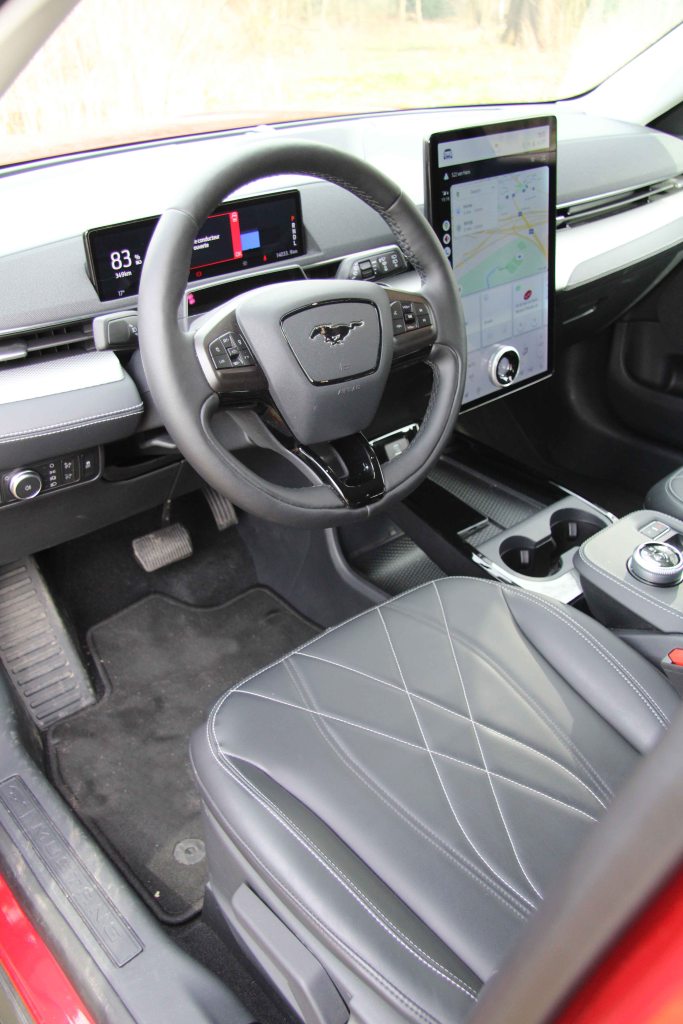
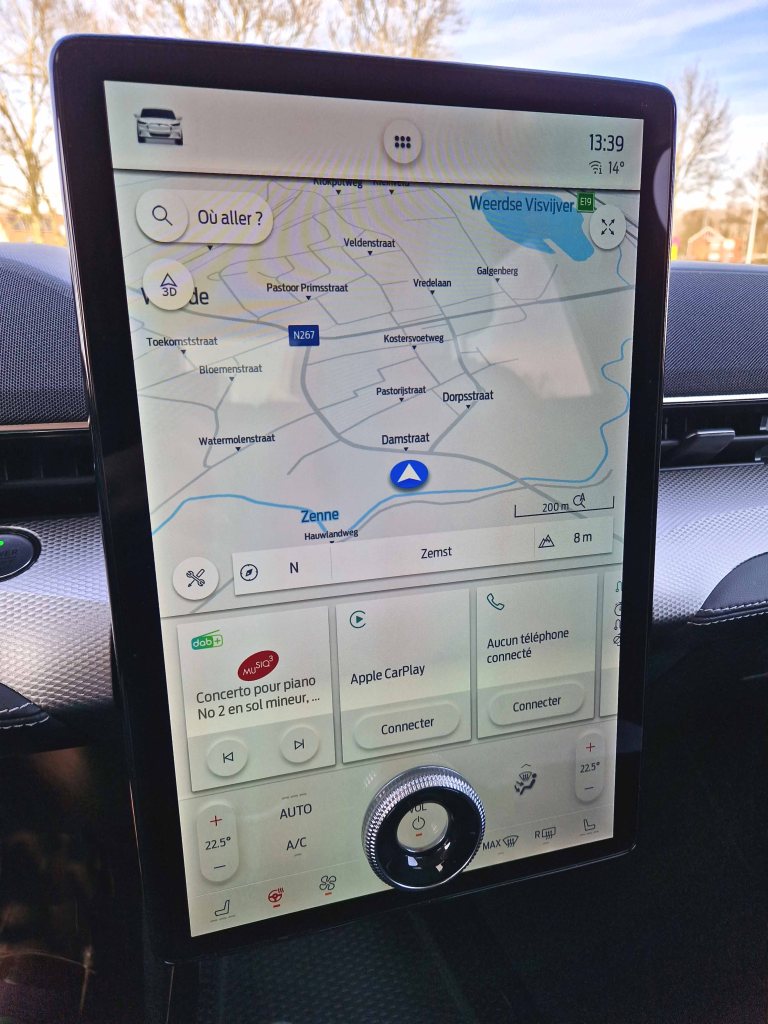
In the car one immediately notices the super large central touchscreen, which is indeed intuitive to use. One is never more than two clicks away from any function you choose. The dashboard is clean and stylish, and its level of finish is also excellent. We also like the round selector knob for selecting gears and driving modes.

Smooth one pedal driving

After having enjoyed the formidable performance with a few sprints, it is time to enjoy the smoothness and refined silence of E-driving. When you select one pedal driving in the menu, you can indeed drive it totally intuitively with just using the accelerator pedal. Lifting the throttle will not cause immediate deceleration, the slowing down will set in quite gradually, which adds to the smoothness and lets you drive this Mustang in a totally “zen” manner. Also one can choose between three driving modes, active, whisper and untamed.

The range looks quite reasonable, and given an anticipative and smooth driving style, quite realistic. You can charge on AC with 11 kW, on DC up to 150 kW (if you can find this fast charging point). Experienced users already know that it is of little practical interest to charge the battery to more than 80 pct of its capacity, from then on the charging rate will be much lower, and not exceed 15 kW or thereabouts.

Responsive and agile handling…

Fords are known for their very entertaining and pleasant road manners, and this Mustang is no exception. The Mustang Mach-E is built on the Global Electrified 1 (GE1) platform, which is a heavily reworked version of the C2 platform that is used on the fourth generation Focus and third generation Kuga/fourth generation Escape. It certainly performs well. The suspension in itself is quite comfortable, even on urban cobblestones, and certainly comes into its own on the open road. The low point of gravity and the 50/50 weight distribution does the rest: this Mustang effectively steers on rails. If your corner speed is somewhat too enthusiastic, it will gently understeer, but with the ample torque and pulling power under your right foot, it is very easy to balance the car with the throttle and even induce a smooth oversteer reaction. So yes, sporting driving pleasure is certainly to be had. Steering is precise, but the self centering reaction is quite noticeable, so grabbing the wheel firmly is “de rigueur” when you want to put this Mustang through its paces.

Safety first and lavishly equipped

Of course, this Mustang has the usual raft of driving aid systems and what’s more, you can enjoy over the air updates, so it is future proof too.

The Mustang is loaded with accessories, even in its “base” version. What to think of electric adjustable front seats in 8 directions with memory function? These seats are also heated of course. Then there is the superb B & O sound system, which you can enjoy so much in this silent EV. The 15,5 inch central touchscreen is also standard, as is the panoramic sun roof. Then there is the latest generation Ford Sync, with connected navigation and voice command. The electric boot lid lets you open it “hands free”.  

Practical

The Mustang offers very good passenger room in the back, and has 400 l luggage space in the rear, with a front “frunck” good for an additional 81 liters. Handy to stow away your charging cables. Note also that the Mustang can tow up to 750 kg unbraked, and 1500 kg braked.

Conclusion

 This Mustang is a good looking, well balanced SUV, as we said in the beginning. It has many good qualities, and shows virtually no weaknesses. It is sporting, a pleasure to drive, is well finished, offers lavish equipment, exhilarating performance and is roomy and practical. It is easy to use with its large central screen and intuitive commands. Altogether, it also offers a quite reasonable range and good charging performance. A car to live with?  For sure, and indeed, the iconic Mustang name and badge has lost nothing of its appeal, albeit in a very different (EV) form…

Hans Knol ten Bensel

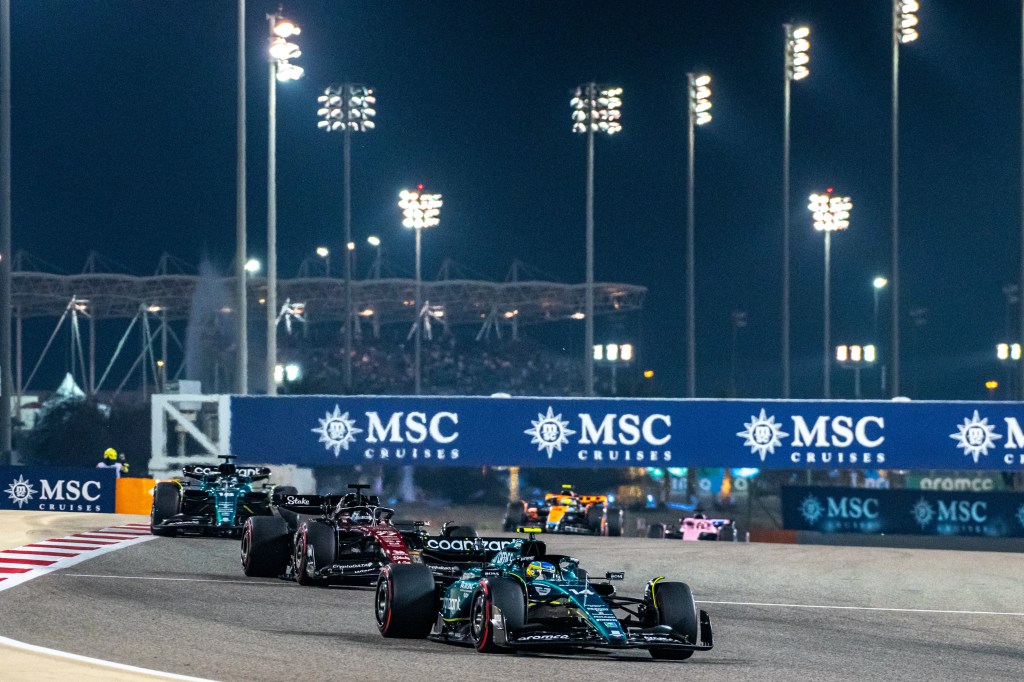
Watch the races with your cruiseship: MSC Cruises extends its global partnership with Formula 1®!

MSC Cruises is going from strength to strength, and May 5 it announced  that it will extend its global partnership with Formula 1®. They said this in Miami, on the eve of the Grand Prix™. MSC Cruises will therefore continue to be the official partner of Formula 1® for the cruise segment, until the end of the FIA World Championship in 2026.

MSC Cruises continues this partnership for all the good reasons: the ever growing interest in the Formula 1® universe around the world, and particularly in key markets for MSC Cruises, resulted in very strong results for the company and its product portfolio. The success of this collaboration between these two prestigious brands has enabled MSC Cruises to commit to further strengthen this partnership through an enriched program.

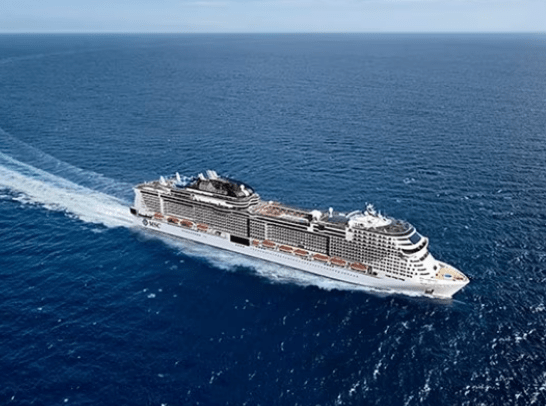
The MSC Ship Virtuosa will be your stay for the Abu Dhabi Grand Prix…

As part of the agreement, MSC Cruises will position ships in ports throughout select Grand Prix™ weekends to provide a unique hospitality experience from the circuit to the ship. The first of these event weekends will take place in November, for the last race of the 2023 season, in Abu Dhabi. The MSC ship Virtuosa will spend the Grand Prix™ weekend at the port, offering motorsport fans unique accommodation, hospitality and transport packages, including VIP packages. This concept will be enriched and deployed in other destinations, with other ships, from the 2024 season onwards.

The Virtuosa has longest LED Dome at sea…

In addition, MSC Cruises is confirmed as main sponsor of the F1® Grand Prix™ of Belgium in 2023. Thus, the brand will offer, among other things, immersive entertainment for spectators in the Fan Zone. Further main sponsorship deals will be unveiled shortly, for further 2024 F1® World Championship Grand Prix™. Needless to say that both parties are delighted with the collaboration:

Pierfrancesco Vago, Executive Chairman of MSC Cruises (on the right) said: “Formula 1® and MSC Cruises are excellent partners on many levels. Our success is partly based on teamwork, but also on our shared commitment to lasting change. We want to shape the future of our respective industries and leave a lasting legacy for generations to come. Our two brands are evolving at the head of their industries and contributing to a lasting change. For all these reasons, we are committed to Formula 1® for the long term on a global scale. We look forward to seeing this special collaboration evolve over the years. »

Stefano Domenicali, President and CEO of Formula 1®, (on the left) said: “We are delighted to extend our partnership with MSC Cruises, as our two brands share the same commitment to innovation and excellence. This collaboration has already delivered outstanding results and we look forward to strengthening our relationship. Together we will continue to push the boundaries and set new standards in sports and hospitality. »

We suggest the Grand Prix Lovers to have a closer look at MSC Cruises and their offers!

Hans Knol ten Bensel

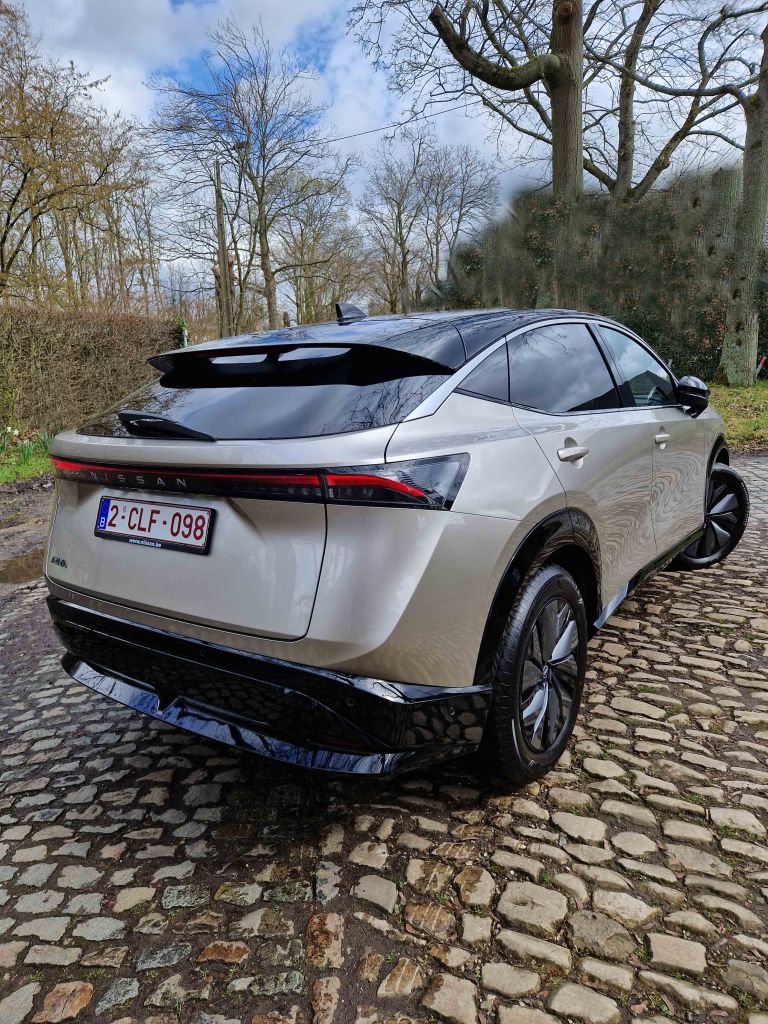
We drove the Nissan Ariya : a noble e-beauty

We all know, EV’s offer refinement. Some also offer roominess and the stance of a big SUV. Nissan decided to take things a step further: they also offer pure beauty.

Indeed, the designers of the Ariya surpassed themselves: they transformed the clunky dimensions of a SUv into fluid lines, which are sleek, well proportioned and completely natural. If you look at this car, the volumes, shapes and lines are completely logical, achieving an unsurpassed purity which seduces the viewer at first hand. Nissan calls its design language “Timeless Japanese Futurism”; it certainly is. 

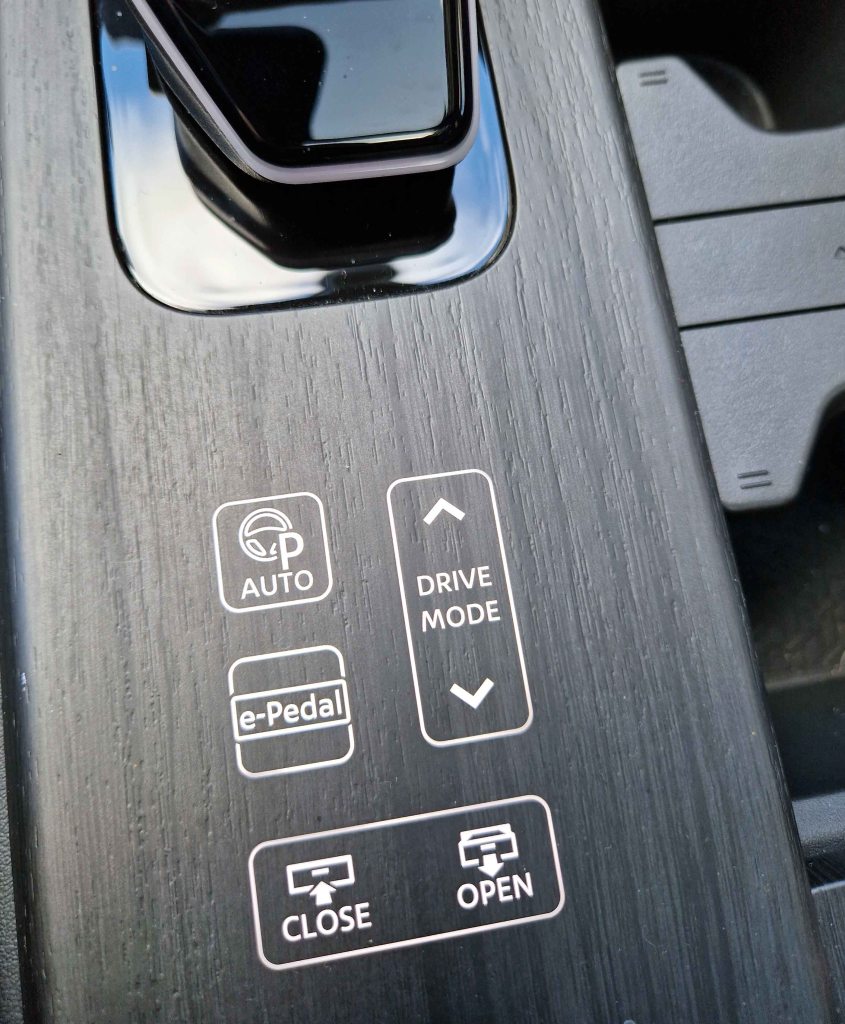
The interior breathes the same logical simplicity, underlined by a judicious choice of noble materials. The climate controls and the drive mode together with other essential functions on the console are – noblesse oblige in these modern times – haptic with a very positive feel. The styling of the dashboard is beautifully clean, the seats and steering wheel are electrically adjustable and soon an ideal seating position is found. One feels immediately totally at home in this Ariya, everything is totally self explaining what the commands are concerned, and a “Zen” feeling pervades you even before you have pressed the starting button.

The instrumentation has different modes and readings, you can have nice round dials if you want, the layout and functions of the touchscreen is top notch, with the “camera” functionality well placed in the top left of the screen, easy to push when you enter a tight garage entry for instance with your big Ariya. In the centre of the dashboard is an electric deploy-able tray, which is opened with one of the haptic buttons on the console.

Driving

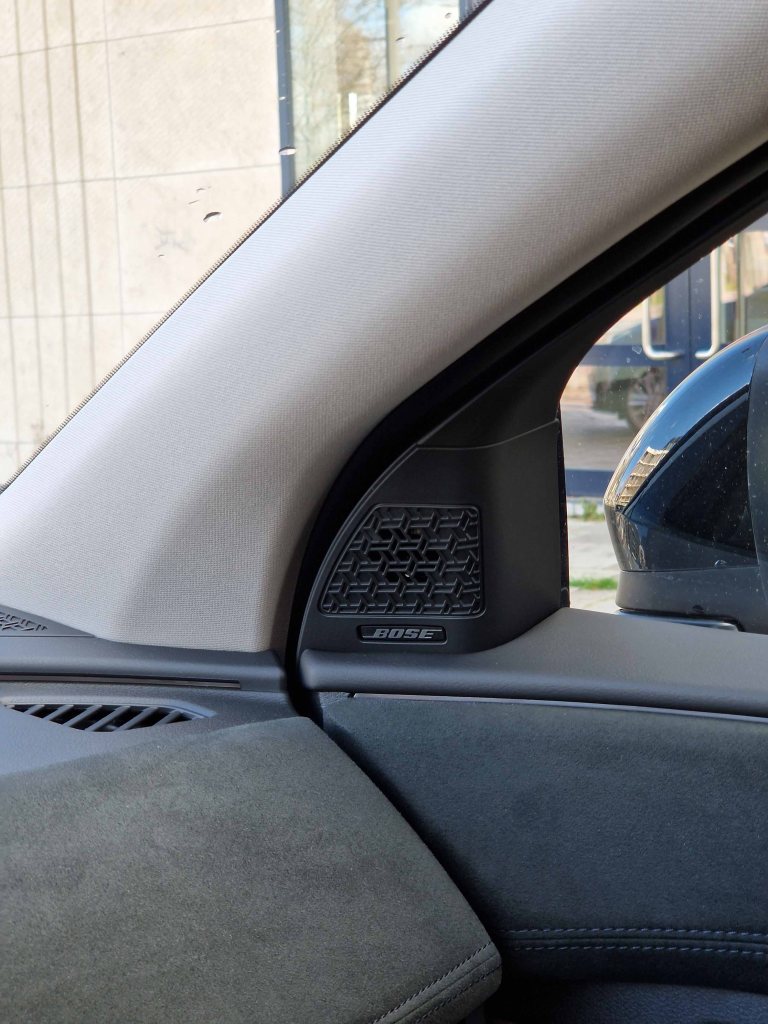
The Ariya is of course completely silent and smooth, and one has the choice between three driving modes, eco, standard and sport. For our test, we left it mostly on standard mode, but we always used the clever e-pedal mode, which lets you, after having learned it a bit, drive with anticipation using almost no brakes. Lifting the throttle puts the electric motor in regeneration mode. You cannot completely stop the Ariya without applying the brakes however, which is actually a good thing, as you can approach the traffic light smoothly, slightly creeping and accelerate immediately again away when it turns green. It adds to driving smoothness, and smooth driving is actually what EV’s are all about. Always remember that you are driving a two tonne car, which needs to be accelerated and stopped, and this is costing much energy indeed. If you want to reach easily the official driving range of your EV, drive it smoothly in town, avoid any brisk accelerations, which disturb the “Zen” feeling of the car anyway and hardly impresses any girl above 10 years of age, just enjoy the music AND the journey. There was a 10 speaker BOSE system in our Ariya, together with a DAB radio. You can imagine how we felt in this Ariya…

It rewards you with consumption figures as low as 9 (yes nine) kWh. This was reached on a urban stretch of 2 km with FOUR traffic lights. (!) Over the test, we reached without effort a driving range of well over 500 kms. We mention here that our test car came with the 87 kWh battery pack. Reaching this range supposes of course you also have to take it easy also on the open road. Settle for a cruising speed of 95-100 km/h, just a bit faster than the trucks. You have a wonderful, silent, relaxing voyage. Yes, we know, the charging situation in our country is still abysmal. So for the time being, be easy on the throttle, and by the way, aren’t we environmentally conscious?

You can charge it up to maximum 130 kW DC. Charging times than dwindle, in 35 minutes you can charge for a distance from 44 to 348 km or let’s say, from 10 to 80 % capacity.

Performance

Let’s first point out that the Ariya is available in three versions (Ariya 2WD 63kWh, Ariya 2WD 87kWh, Ariya e-4ORCE AWD 87kWh). With performance to match… For the 178 kW (242PS) 2WD version, acceleration from 0 to 100 km/h is in 7,6 seconds, top speed being limited at 160 km/h. Largely sufficient for any needs!  

Handling and comfort

The suspension is not too firm, with the suspension being a bit noisy on bumps and ridges, with a responsive and precise steering. Road noise is very well suppressed; the Ariya is very silent at speed. The Arya is quite engaging to drive at speed on winding roads, there is hardly any body roll. So yes, (sporting) driving pleasure is certainly to be had!

Just note here that the the Ariya is built on the all-new Alliance-developed CMF-EV platform that’s optimised to deliver unparalleled performance. Suspension in the front consists of independent MacPherson struts, in the rear there is an independent mulit-link setup.

Let’s talk about visibility. The visibility up front is excellent. The C pillar is a bit wide, so it obstructs the three quarter rear view somewhat. Rear visibility is also further enhanced by the built in camera in the rear view mirror. The camera’s give also an excellent 360° surround view

Practicality

There is good storage space in the Ariya, and indeed, the car comfortably seats five. With enough legroom in the back and no transmission tunnel, the third passenger sits comfortably too. One even gets heated seats in the back and the obvious USB sockets of course. The boot capacity is 466 litres, which is not enormous. There is no front boot space either. But the boot cover can be stored underneath the floor when you need more space and put the rear seats down. If you want to tow things up to 1500 kilos, you need the 4WD version, the Ariya with front wheel drive will only pull a good 750 kilos.

Luxurious

The Ariya is very well equipped. The Evolve version we drove featured a panoramic retracting sunroof, Intelligent Rear View Mirror, head-up display, power-adjustable center console and steering column, Digital Audio Broadcasting (DAB) radio, Bose 10-speaker stereo and temperature-controlled front seats.  We liked the Intelligent Rear View Mirror, indeed, a special camera in the rear view mirror lets you “see through” the third passenger on the back seat… The center console can also be moved fore and aft electrically, which we liked very much and let you really settle in comfortably.

Conclusion

A beauty, which also gives you the ultimate “Zen” driving feeling, with its clean interior, its superb commands, excellent sound insulation, roominess and good comfort. Add to this the good, predictable handling and practicality, leaving the excellent range as a last, very decisive argument too take a good look at this Ariya. It will brighten up your motoring life…

Hans Knol ten Bensel

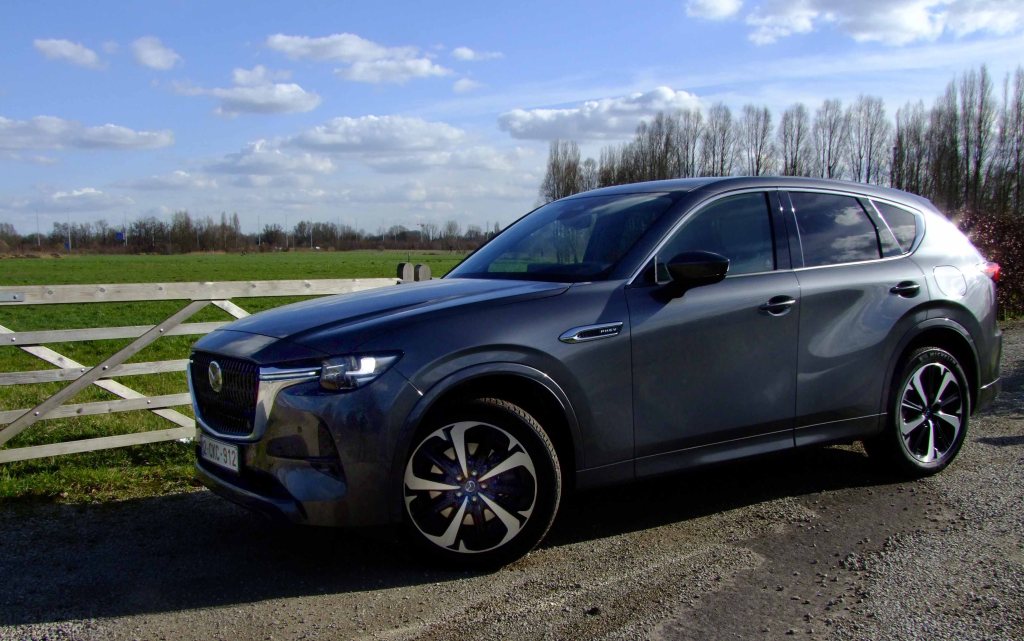
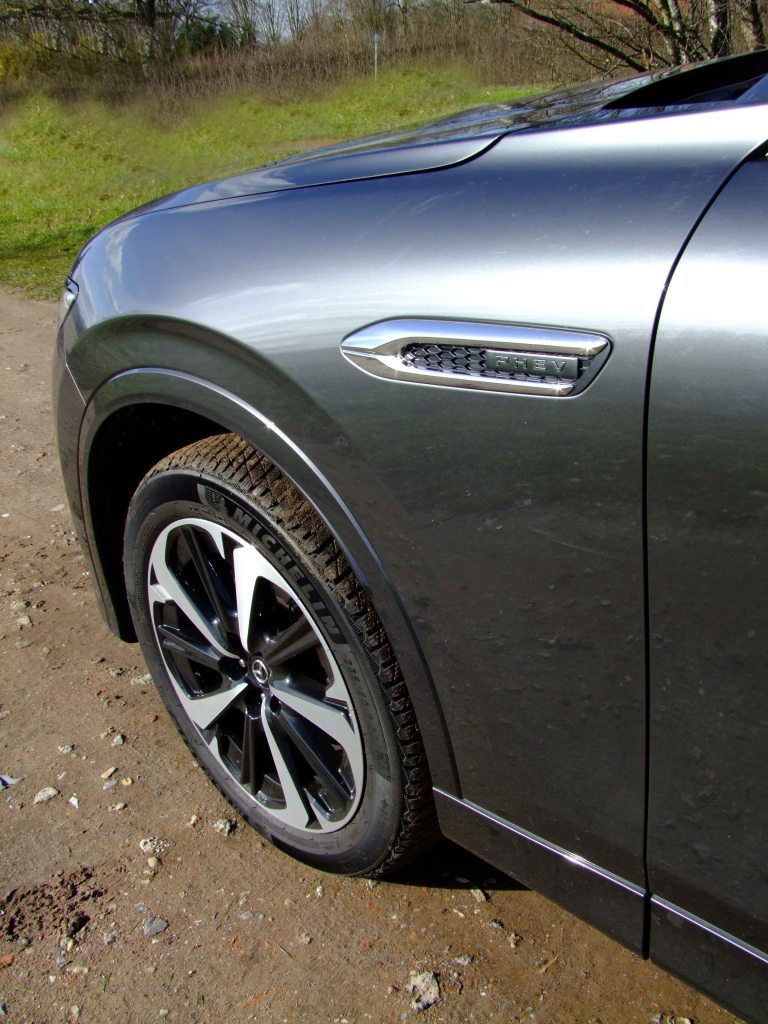
We drove the Mazda CX-60 e SkyActiv PHEV : a flagship SUV the Mazda way…

Mazda has bold ambitions. It wants to be an absolute premium manufacturer within a few years, and it is building up its model range accordingly. Looking at its latest SUV, the CX-60, it is definitely succeeding. This PHEV Mazda impressed us. Read further…

Hans Knol ten Bensel

Mazda elegance and style

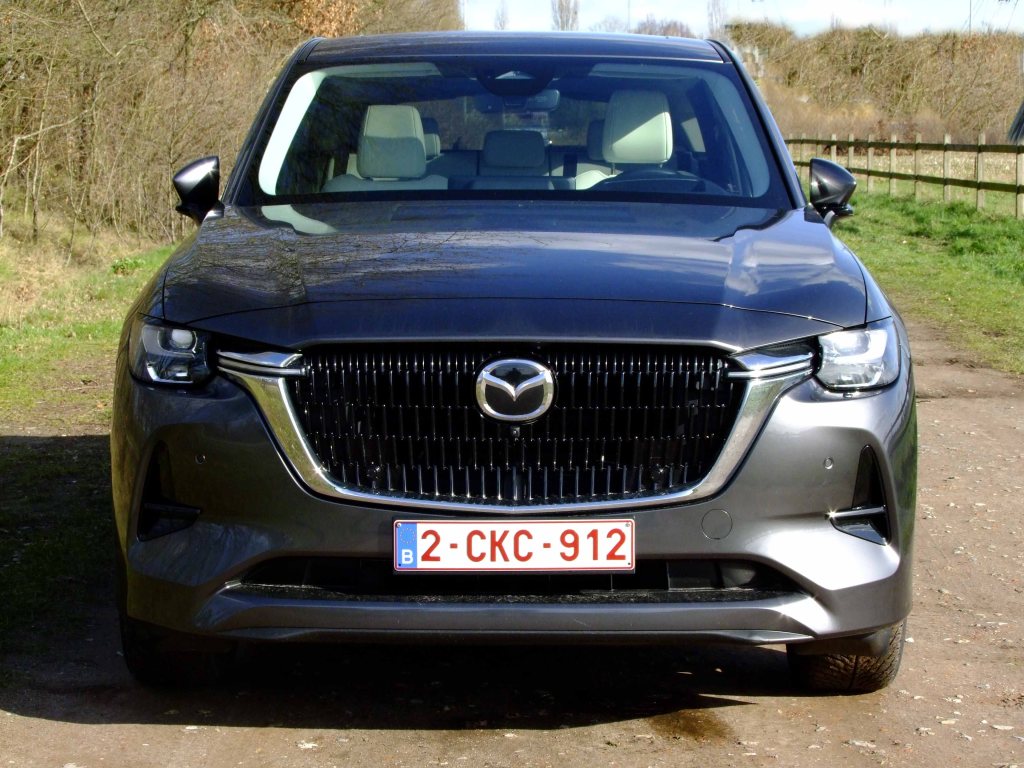
Mazda’s are well proportioned and styled, and have indeed a distinct, proper styling language which makes them stand out from the rest. The lines of this bigger SUV are not too busy, instead they are fluent and exude a distinct sportiness together with a quest for simplicity and elegance. The front end and radiator grille carry also the distinct Mazda DNA, which is now becoming well established and is quite pleasing.

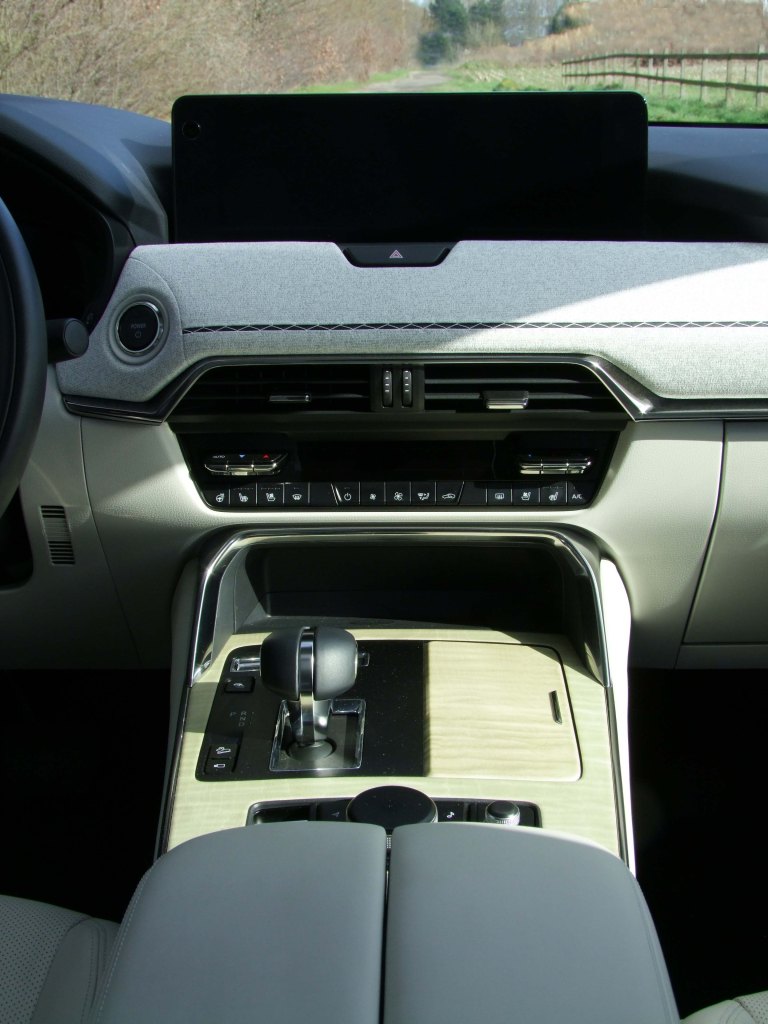
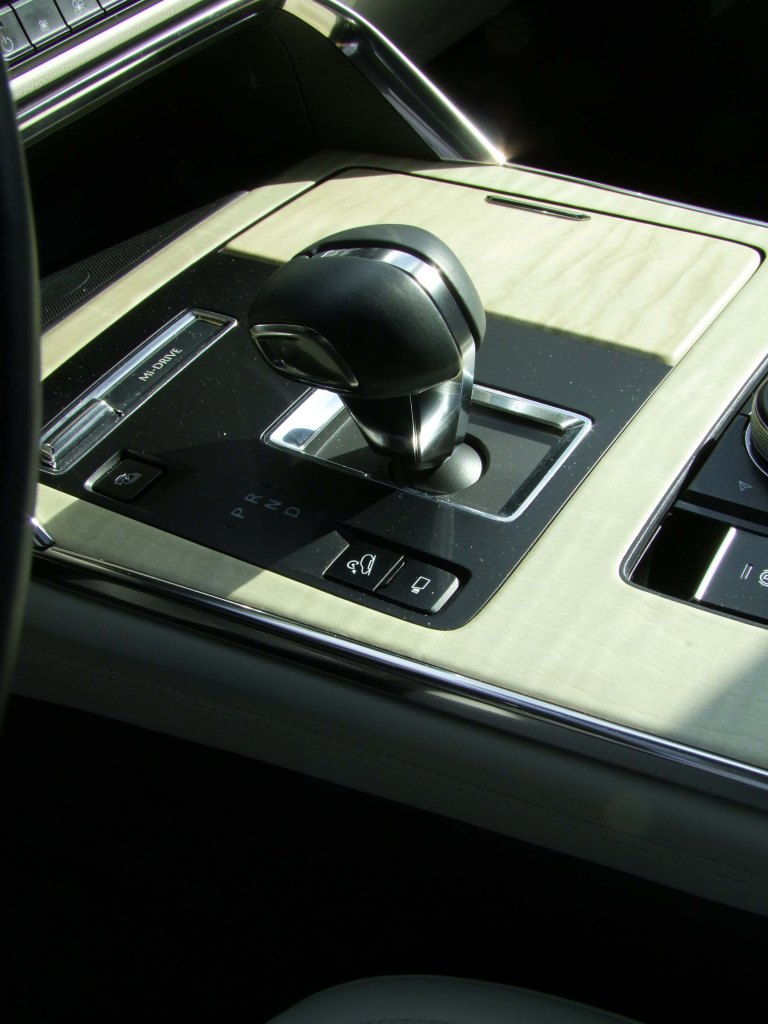
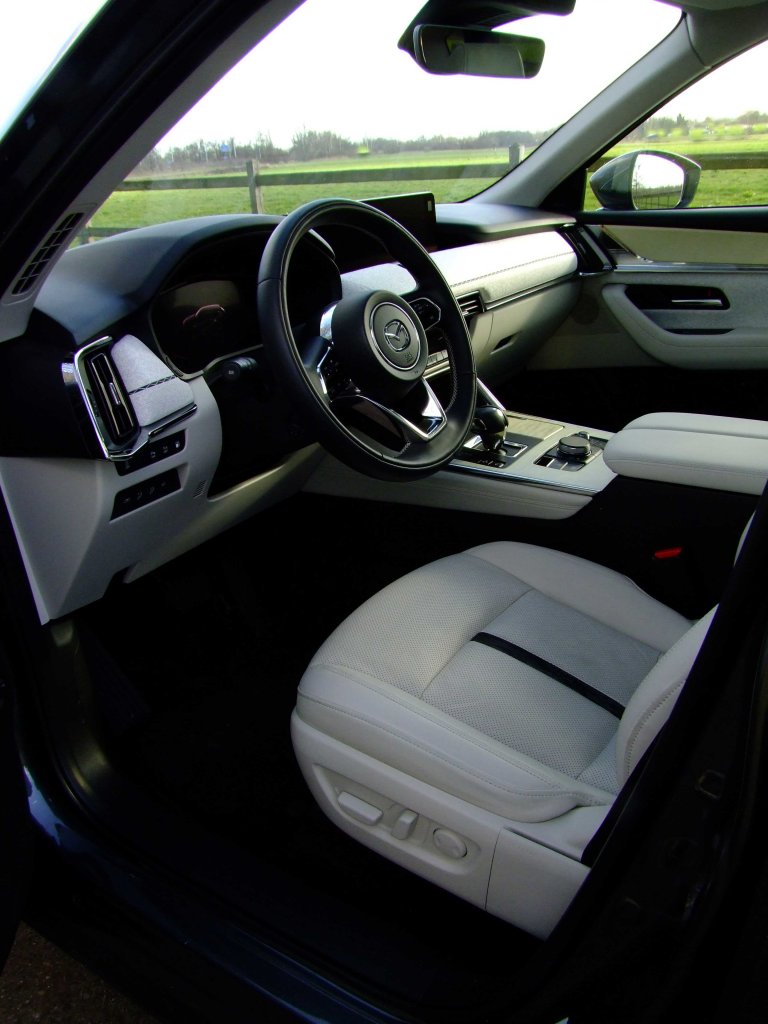
The style and sophistication is also found in the interior. We absolutely loved the white colour of the surface panels, upholstery and seats, and the lavish use of chrome around the edges of the lateral vents. On the wide central console, which is impressive due to the simple fact that a transmission runs through it, one finds even a tropical white wood veneer finish. Very oriental, we would say, and a refreshing departure from the all black colour schemes we so often encounter.

The elegant interior design introduces the ideas of Kaichou – an element of disruption which mixes different materials and textures. With the flagship Takumi grade, which was the top equipment version found in our test car, materials such as maple wood, nappa leather combine with uniquely worked Japanese textiles and chrome details, and Musubu – the art of binding which was the inspiration for a specially detailed instrument panel stitching. We liked that also very much.

The treatment of the maple wood trim reflects the Japanese aesthetic of Hacho – asymmetrical balance, or intentional unevenness. The woven fabrics’ diverse patterns and yarns respond sensitively to changes in light, and a Japanese stitching technique called Kakenui creates ‘hanging stitching’ seams with spaces between the trim fabrics revealing a glimpse of the material beneath. As we said, very elegant indeed…

Very powerful

The Mazda CX-60 comes with several engines, and even a six cylinder in line Diesel in world markets, but for the time being, in our country it’s a 2,5 litre four cylinder “Sky Active” petrol engine which is doing part of the work, as the CX-60 is a PHEV. The electric motor sits between the engine and the gearbox, and even has its own clutch, so this Mazda remains a 4WD also when in EV mode. Power galore with this Mazda. What to say of an electric motor which develops already 134 hp, and which is able to propel this two tonne SUV with the inboard 17.8 kWh battery on EV power alone for a range of 62 km.

Indeed, when you have charging possibilities at home and the office, and if your daily commute is rather short, it is totally feasible to use your Mazda as an EV. Just choose with the “I mode” sliding lever on the console the EV mode and you’re ok. You can expect then formidable economy, as the engine then is hardly used. The benchmark and crucial WLTP CO2 emissions value is set 33g/100 km. The WLTP combined fuel consumption is just 1.5l/100 km.

Combined with the petrol engine total power is an impressive 327 PS/241 kW. This makes it the most powerful Mazda ever, having also not less than 500 Nm torque, with performance to match: this SUV sprints in 5,8 seconds from 0 to 100 km/h, and top speed is not less than a limited 200 km/h. For your information, the petrol engine develops a maximum power output of 141 kW at 6000 rpm and 261 Nm of torque. The electric motor delivers 129 kW of power and 270 Nm of torque at 400 rpm.

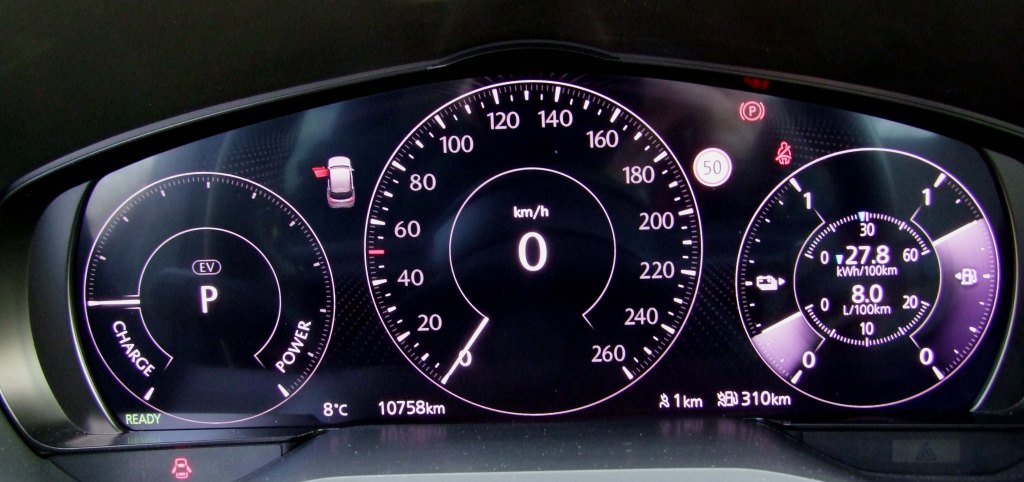
Does this CX-60 invite you to use all this power? Not quite, where I have to admit that we are a bit economy buffs, and seeing the cleverly designed instant consumption dial hovering fiercely in the red zone, with consumption well above 20 liters/100 km when we press our right foot a bit deeper, we tended intuitively to slow things down a bit.

Add to this that the engine makes itself well heard when called to duty, and you understand that we rather avoided using the “sport” mode. This Mazda will also use its engine rather often when the battery is low, which is understandable since one needs power to move this 2 tonne SUV around. Driving this CX 60 with restraint when the battery is depleted, one achieves an average consumption of some 7,8 litres/100 km as we registered during our test, which is a very good score considering the size and weight of this 4WD CX 60. The efficient 2,5 litre Skyactiv unit is coupled to an all new 8 speed automatic, which doesn’t use a classic hydraulic converter, but a multi-plate clutch as well as an integrated electric motor/generator.

Mazda claims that by replacing the torque converter with a clutch, the torque of the engine and motor is transmitted directly, with fast and rhythmic shifting much like a manual transmission. A little bit of the Mazda MX-5 “Zoom zoom” philosophy is still felt here. Nowadays, Mazda is aiming to become a premium manufacturer more than ever. The larger public should only be more aware of this…

The transmission is indeed very smooth when driving away from standstill, some jerkiness is felt when the transmission changes down when coasting and slowly decelerating. But under power, everything just feels great.

Driving dynamics

Mazda put a great effort in the handling and agility of this big Mazda. It wants it to be nimble, responsive and engaging. Not a small brief for a big SUV. First of all, it should be noted that the CX-60 The new Mazda CX-60 is based on Mazda’s Skyactiv Multi-Solution Scalable Architecture, designed to be compatible with the SUV’s longitudinal front-engine rear-wheel drive mechanical layout.

The Skyactiv Multi-Solution Scalable Architecture features numerous enhancements to improve as Mazda calls it, the Jinba-Ittai driving.

The feeling of Jinba-ittai (oneness between car and driver) that can be experienced when driving the CX-60 in varied day-to-day situations, remains the same even on challenging off-road paths during weekend outdoor activities or on slippery winter roads covered in snow and ice.

The i-Activ AWD and Mazda Intelligent Drive Select (Mi-Drive) allow the car to maintain responsive on-road driving while also offering a safe and secure driving experience even on various off-road surfaces thanks to its high controllability.

The bodyshell rigidity lets you feel the car’s handling and movements without lag. We should also mention here the Mazda-unique vehicle posture control system – Kinematic Posture Control (KPC). This stabilizes vehicle posture when cornering, braking the inside rear wheel to mitigate roll and draw the car body downwards.

How does all this translate in practice? The suspension revealed itself as rather firm, understandably so if you have to balance a 2,1 tonne SUV. Steering is precise, but rather busy. Yes, the CX-60 could indeed be thrown around corners, is up to the job, but it doesn’t exactly invite you to do so. The CX-60 sports double wishbones at the front and a multi-link rear suspension.

Driving aids

This Mazda of course incorporates all the usual driving aids and then some. We greatly appreciated the so-called “see through” function, which enhances even the 360 degrees camera function in this sense that it projects an image on the screen which lets the driver see through the front and rear corners of the car. Advanced Smart City Brake Support uses a front camera to show cars and pedestrians ahead.

Command comfort…

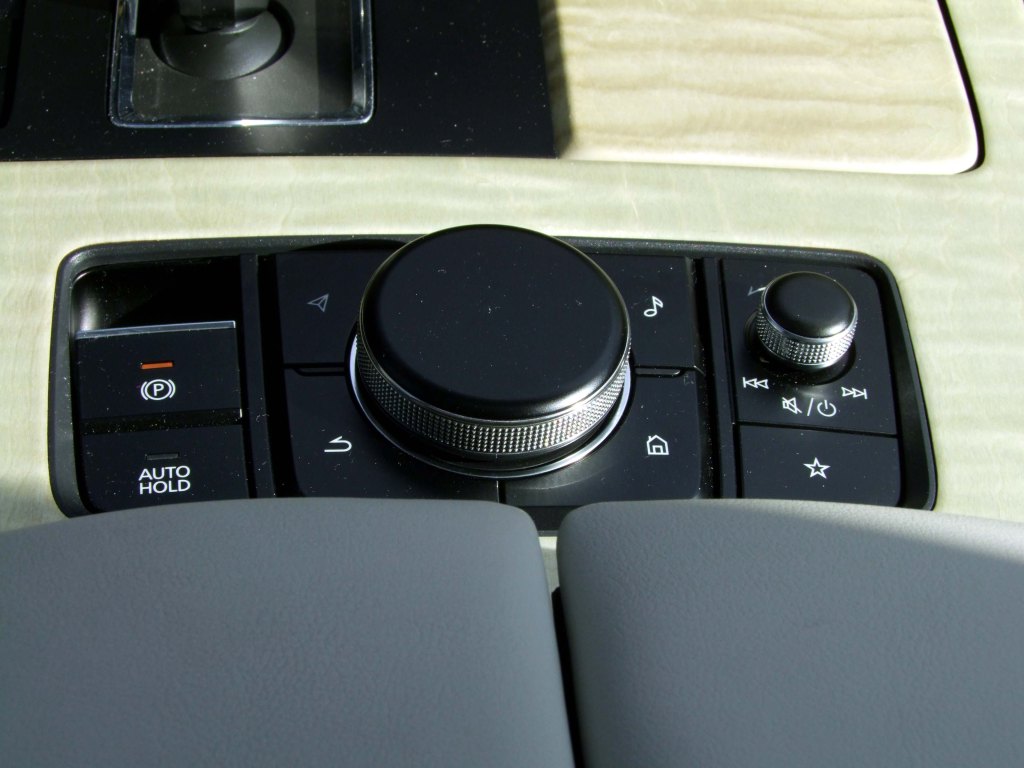
We greatly appreciated also the large central armrest and the command knob to, steer the functions displayed on the screen. Mazda is in my opinion only to, be applauded for maintaining this circular command knob, which is so much easier and stable to use when on the move on bouncy roads and avoids the unhygienic, finger prints on the screen. COVID-19 times made us aware of this ever more…

There is also the so-called Driver Personalisation System, which detects with a camera the eye position of the driver and his physique, then automatically adjusts the seat and steering wheel, Active Driving Display and the door mirrors.

And practicality

The boot space is 570 litres, increasing to 1148 litres with the rear seats folded flat. The load space is equipped with a 12 V 150 watt outlet, which can be raised in the PHEV to 230 V with not less than 1500 watts…

The CX-60 is also excellent for towing, as it can pull a weight of not less than 2500 kg…

Conclusion

Mazda succeeds in making this CX-60 an absolute premium SUV, certainly when it comes to styling, finish and opulent elegance, especially in the interior. As a PHEV, it offers its EV qualities when it can be frequently recharged. On the other hand, when the battery is depleted, it remains reasonably frugal. It certainly handles well, but a fluent, relaxed driving style suits it most.

It is lavishly equipped, and this goes for all the equipment versions you choose. The top version we tested leaves strictly nothing to be desired, with 20 inch alloys and panorama roof included, and this makes the CX-60 also attractive…

Hans Knol ten Bensel

Photographers notes

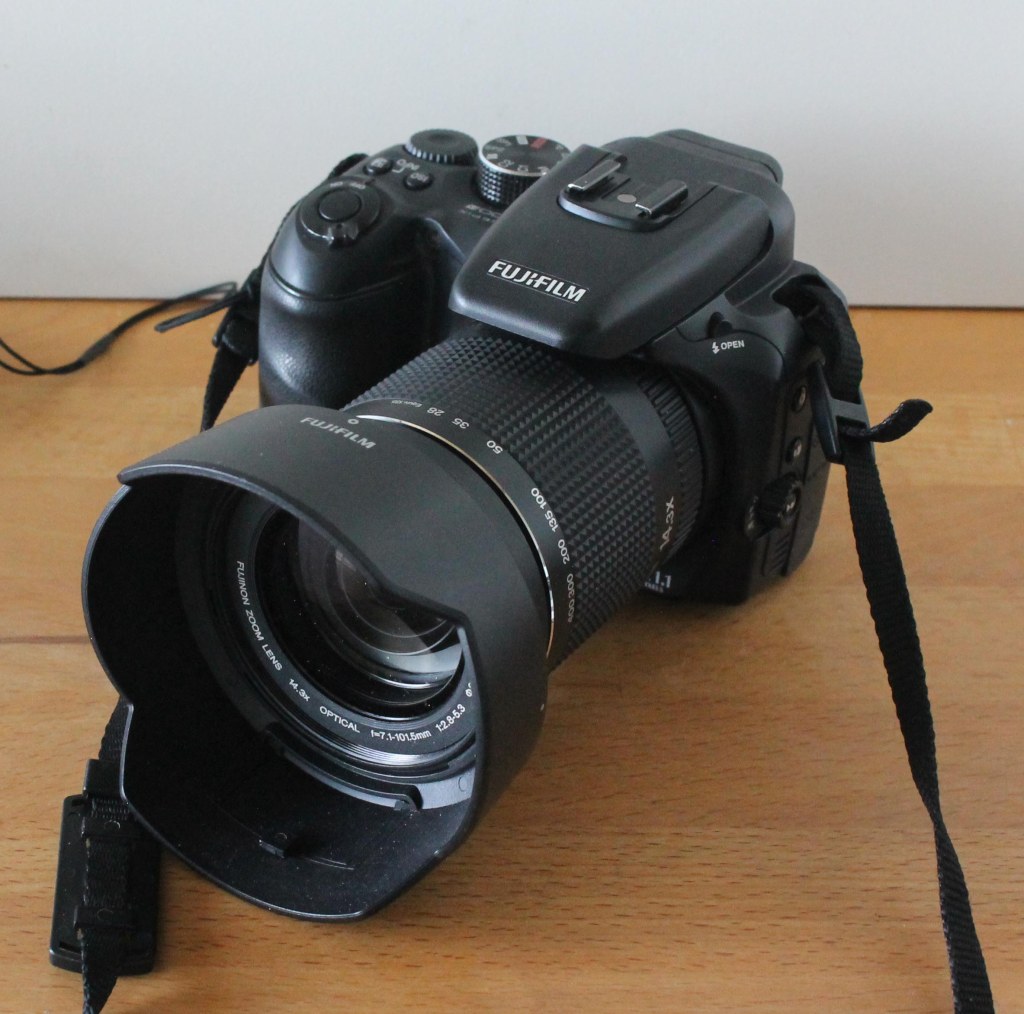
We shot the Mazda here entirely with our Fujifilm Finepix S100 FS , which was bought, as you know, for less than 70 Euros. We erroneously left the Dynamic Range at 100. Given the strong sunlight, we should have set it at least at 200 or 400. But there you are. The results are still pretty decent, considering also that we were also still shooting in JPEG. The sensor produces 11,1 megapixel images, which is plenty for our work. The 28-400 mm zoom lens even has a macro function and an ultra macro function, making close ups a breeze…

Hans Knol ten Bensel

Volkswagen takes a bold step towards the affordable EV for the masses with its ID.2all* concept car.

It’s coming: Volkswagen brought us a first glimpse of an all-electric Volkswagen costing less than 25,000 euros with their “ID. 2all” concept vehicle.

It is of course front-wheel drive, range of up to 450 kilometres, innovative technological features such as Travel Assist, IQ.LIGHT or Electric Vehicle Route Planner and a new Volkswagen design language.

Technical buffs are interested to know that this new “E”VW for the masses will be based on the MEB Entry platform and is one of ten(!) new electric models that Volkswagen will launch by 2026.

In my modest opinion, VW takes here a formidable and bold gamble… will the European car markets (and more specifically its electric infrastructure) be ready for this?

Read further about this “milestone” E-VW…it is sooo interesting and will be a harbinger for things to come!  

Hans Knol ten Bensel

VW’s goals and ambitions with this new true “E”-VW…

It is certain that VW wants the wider public to again fall in love with its cars: Thomas Schäfer, CEO of Volkswagen Passenger Cars stated it clearly: “We are transforming the company rapidly and fundamentally – with the clear objective of making Volkswagen a genuine Love Brand.”

The concept of “Wertarbeit”, a concept so beloved by the Germans, which can be freely translated to “Quality work which creates value”, is also not lost in the boardroom and lobby’s of Volkswagen. Imelda Labbé, Member of the Brand Board of Management for Sales, Marketing and Aftersales, stated it clearly: “We are transferring the typical Volkswagen virtues to the new world of mobility: top quality and workmanship, outstanding software and digital services with genuine added value.”

Mechanical perfection and reliability is therefore of prime importance, and so VW adops well-tried solutions, present in the MEB platform, which by the way uses also all the automated product processes which are already well in place.

Kai Grünitz, Member of the Brand Board of Management responsible for Development, states it for us: “The ID. 2all will be the first MEB vehicle with front-wheel drive. We are exploiting the great flexibility offered by our modular electric drive (MEB) platform and will set new standards in terms of technology and everyday usability with the MEB Entry platform.”

This VW will also certainly be no sluggard: It has a powerful electric drive motor with an output of 166 kW / 226 PS and will have a calculated WLTP range of up to 450 kilometres.

A new design…

The ID. 2all concept vehicle was designed by Andreas Mindt, who took over as the new Head of Volkswagen Design on 1 February 2023. Volkswagen is in his blood, as his father was a designer in Wolfsburg before him. Andreas Mindt joined Volkswagen in 1996 after studying design. He created bestsellers such as the first Tiguan and the seventh-generation Golf. In 2014, he moved to Audi in Ingolstadt as Head of Exterior Design.

The next step followed in 2021 when Mindt became Director of Design at Bentley in Crewe, England. However, he has always maintained his close ties to Volkswagen and continues to be the proud owner of a Beetle. Andreas Mindt on his first project as Volkswagen Head of Design: “We are transferring the DNA of our icons into the future. The ID. 2all is therefore also homage to the Beetle, Golf and Polo.”

Andreas Mindt has developed a new Volkswagen design strategy – one that will ensure the brand’s DNA remains clearly recognisable in the future. Mindt: “I am focusing on three main pillars: stability, likeability and excitement.”

“The most important value for Volkswagen design is stability,” says Andreas Mindt. This includes value stability, stability of form, reliability and recognisability. “A second core element of the brand is likeability,” explains the designer. The Beetle, Volkswagen bus, new Beetle and ID. Buzz clearly demonstrate this. “Stability and likeability – we have to achieve these two values in every respect.” But there is much more to a successful Volkswagen than that: “We also want to create excitement in our customers.” For example, with added dynamics, improved operability or the classic “form follows function” of an ID. Buzz or Golf. Technologies, forms and concepts are what make a Volkswagen desirable. Stability, likeability and excitement are typical characteristics of the Volkswagen design, the Volkswagen feeling. Mindt assigns three design elements to each of these three values. They are all reflected in the ID. 2all.

I was happy to read Mindt’s comments on design, which I have repeated time and again in my guide tours at Audi Brussels: Automotive design is an art form, but there are still clear laws that apply – such as the golden ratio. I couldn’t agree more with Andreas Mindt: “Likeability is created by the golden ratio. This is quite simply the ratio of three fifths to two fifths.” Leonardo da Vinci already followed this geometrical principle in works such as the Mona Lisa. The designer continues: “The feature line running below the window shoulder is located on exactly the golden ratio line of the ID. 2all. Both the Beetle and Golf also always followed the principle of the golden ratio.” People perceive this division created by nature as being pleasant and likeable.

Easy to use…

VW has learned from the usability mishaps in the commands of the early ID’s. VW now calls it ‘self-explanatory operation’. The touch display (diagonal: 32.7 cm / 12.9 inches) of the infotainment system has a new menu structure. Below this there is a newly developed, separate air conditioning control panel. Other vehicle functions are operated by means of a menu control in the centre console, which can also be used to change the look of the digital instruments. The new multifunction steering wheel is designed to be clear and self-explanatory – two thumbwheels on the left and right and two buttons each, and nothing else.

Charged to 80 per cent in less than 20 minutes…

The battery permits a calculated WLTP range of up to 450 kilometres. At DC quick-charging stations, the battery can be charged from 10 to 80 per cent in 20 minutes.

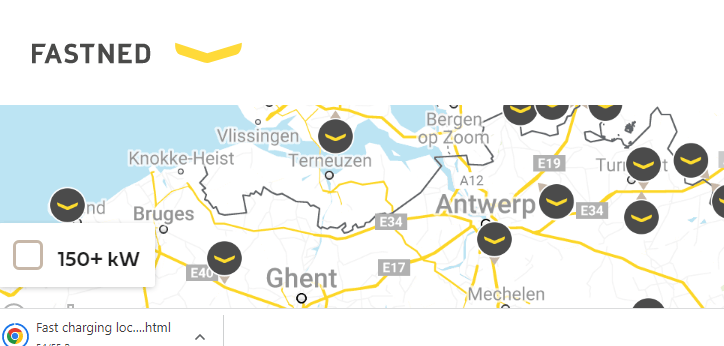
Provided we find these stations! In our country, the situation is still abysmal what these quick charging stations is concerned. Take Fastned: when I want for instance to drive from Antwerp to Knokke, I need to have enough range to make the 210 km trip back and forth to Antwerp, and to make things even worse, there is no Fastned charging station in the whole Antwerp region so far, and NONE in Knokke… so I would have to go towards Brussels in Steenokkerzeel, about 43,7 km from Antwerp, to find one… ridiculous isn’t it? I need at least 260 km range for the trip! To avoid any misunderstandings, we looked here only for Fastned charging stations. There are of course some other 4 to 38 kW charging stations, but any of the apps to find chanrging stations do NOT show whether you can use your bank card or not. At more than 90 %, it is not possible…

Back to our concept car…

Of course, this VW accelerates like a bullet: 0 to 100 km/h in less than 7 seconds. Its top speed is limited to 160 km/h.

A bold step for Volkswagen, but a very logical one if you take a look at its strategy. Soon, we will live in (very) different times…

Hans Knol ten Bensel