HKTB: Let me first congratulate you with your new responsibility, and thank you for granting this interview. You have already built up quite a career in the automotive world…
BDM: Indeed! I made my first steps at Renault, then joined the Group D’Ieteren, where I worked in the Marketing department at Porsche, and then took a new challenge by joining Electric by D’Ieteren, putting their product in the market. Then, as I was launching a new product in a premium (electric) automotive market, it was a logical step for me when an iconic brand like Lancia was (re)launching itself in our market, to take up also this challenge and this is how I landed here as a marketing director for Lancia and Alfa.
HKTB: Lancia is a unique premium brand with a noble Italian elegance and spirit, embedded in a rich history…
When I heard that 9 dealers will represent the Lancia brand in our country, with 1 in Luxemburg, it intrigues me to know how they will receive and approach the client and give him this premium impression and “feel” the moment he enters the showroom. What kind of support do you provide to these dealers?
BDM: Indeed, our support goes further than just marketing, and contains other aspects. For instance, the appearance and “look” of the showroom itself. We prescribe a premium level here. But there is also the sales person, i.e. the person who makes the first contact with the client. So we have established a training programme, where learning how to establish a good “face to face” contact is very important. We also have to address any doubts the client may have about the quality of our Italian cars, and therefore we offer an extended guarantee for the entire duration of the contract on our products.
HKTB: Do you work together with Italy to develop this training program for the sales staff?
BDM: Indeed, we have a very good collaboration. They communicate about their best practices, and of course we also have in Belgium our own training team. We have also developed a specific sales course, not only focusing on the technical aspects of the car, but also pointing out which elements constitute a premium brand.
HKTB: And the philosophy of the brand…
BDM: Of course. This has also a special appeal for them. The Italian elegance, the rally successes, there are many aspects. The history of Lancia is also very important.
HKTB: Can you tell us a bit more about the geographical distribution of the dealerships, for instance, there is no dealer in Knokke…
BDM: Indeed, there might come one in 2025… The first idea is of course to spread the dealerships across Belgium, and the person who lives in Knokke or rather has his second residence there, lives usually also in one of the main Belgian cities.
HKTB: You have a dealership in Courtrai…
BDM: Indeed! The (first) locations have been chosen in function of the potential sales volumes. We need motivated dealers who want to invest in the brand, and therefore we need to offer them an opportunity to grow…
HKTB: What about the dealerships who previously sold the Lancia Ypsilon, now some years ago?
BDM: These dealers will still exist for after sales service. Presently there are only two dealers in this situation. They can service the new Ypsilon, even when they don’t have the car in their showroom.
HKTB: The car has many technical similarities with other cars in the the Stellantis group, not to mention the Peugeot 208 and Opel Corsa …
BDM: Indeed, but when it comes to selling and servicing the Ypsilon, the approach is to maintain its strictly Italian character, which is reflected in the dealer strategy…and which is to be applauded!
HKTB: Do you have a cooperation with the Netherlands?
BDM: We are different, but we work together, as the Ypsilon is launched simultaneously in both countries.
HKTB: Within the Stellantis group, DS is also a brand which addresses a premium client base. Is there a “cross fertilization” concerning client approach, an exchange of best practices in this field?
BDM: Not really. Indeed, we have three premium brands in the group, Alfa, DS, Lancia. We can share some training programmes on how to sell a premium brand, but then for Lancia and Alfa the passion for the automobile, its elegance and its design are rather more important. It is more “Italian”.
HKTB: Can you tell a bit more about the plans and potential for the fleet market for this Ypsilon?
BDM: We know that in Belgium the premium is very much fleet oriented, but as the Ypsilon is a city car, we reckon that about 50 % will be sold in the fleet market and indeed 50 % will find its way to private clients, who will opt rather more for the hybrid version.
HKTB: There will also be a follow up in the Lancia model range with the Gamma…
BDM: Indeed, and next year also there will be the more engaging HF version of the Ypsilon.
HKTB: Are the dealers exclusively Lancia?
BDM: No, they are also Alfa. They are so-called multibrand, but they will have a specific showroom, dedicated to the brand. The showrooms of the different brands have also to be clearly separated, and indeed the sales people are also specific. There is a dedicated sales person for the brand, who has an intimate knowledge of the brand.
HKTB: Are you going to engage with Lancia in cultural and other events? Will you for example sponsor in the future events like the Concours Reine Elisabeth?
BDM: Not in 2024, we now concentrate on the launch of the brand; but the retailers will probably organize or sponsor (local) events. There will be however specific events for the fleet clientele.
HKTB: I am (also) an artist myself and have a keen interest in artistic events, and I could see Lancia sponsoring events in the cultural sector…
BDM: This is a very good suggestion! Maybe in 2025. But you can always contact me, I am always open to new ideas and suggestions! The first event is now the opening of our retailers. The 22nd of May, the Luxembourg retailer will open its doors…
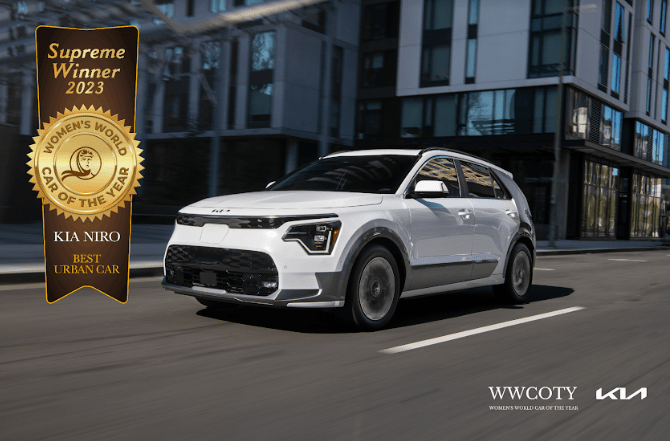
Before casting their vote, the 63 automotive journalists from 43 countries tested dozens of models and assessed every detail. In the first round of voting the best cars in each category chosen from a total of 59 candidates. In doing so, the Niro was awarded in the ‘Best Urban Car’ category. And also for the 5 other categories the finalists were chosen.
Finally, the final winner was chosen from these 6 finalists and crowned as “World’s Best Car 2023.”
“This year’s election was particularly difficult due to the excellent level of all candidates. Each of the finalists had enough merit to claim the trophy win”, says Marta Garcia, Executive Chairman of WWCOTY.
In the end, the scales tipped in favor of the Kia Niro…
TEN journalists from Women’s World Car of the Year travelled to Paris to present their ultimate accolade to Peugeot boss Linda Jackson in what WWCOTY Executive President Marta Garcia described as an ‘historic moment’.
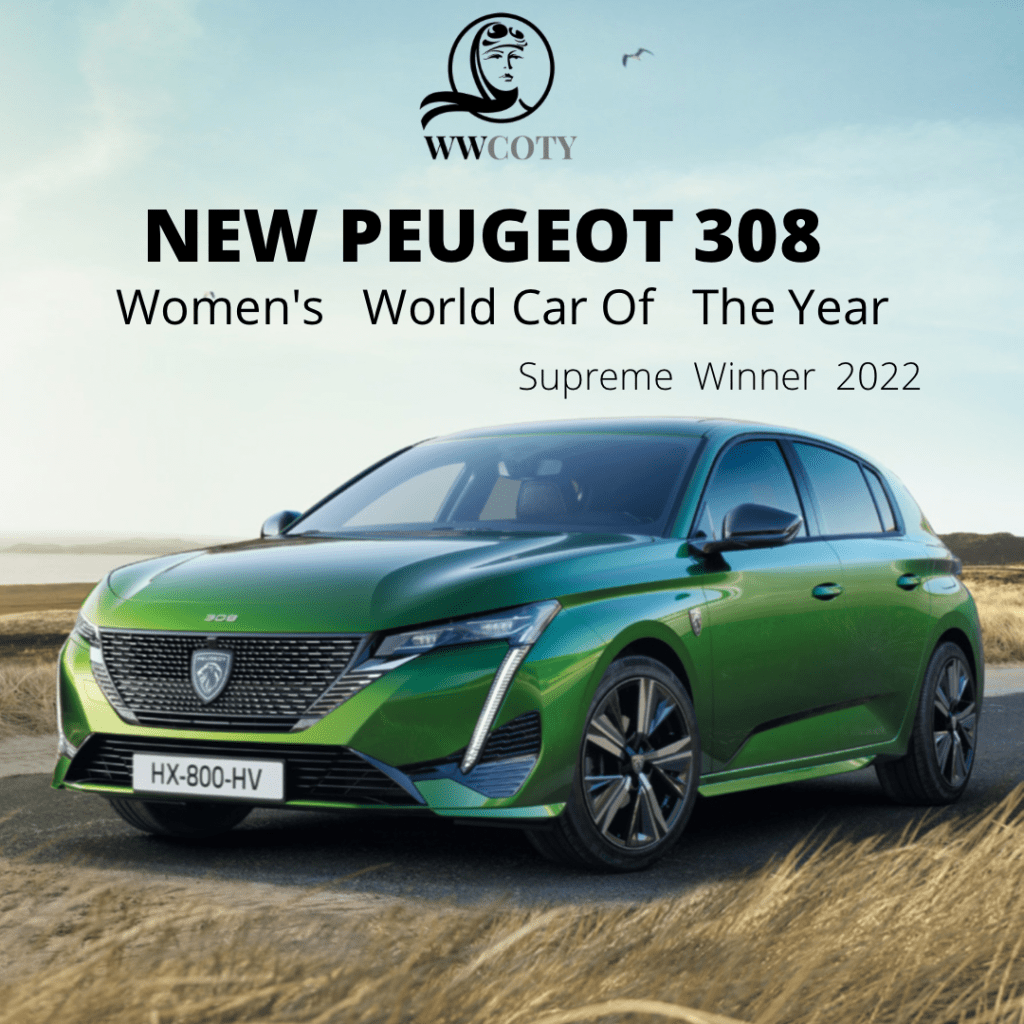
Peugeot’s new 308 took top honors this year in WWCOTY when it fought off competition from 65 other cars worldwide to be named Supreme Winner. The culmination of a year of testing, assessing, and voting on scores of cars from across the globe came at an intimate awards ceremony in the French capital when Linda Jackson accepted the trophy on behalf of Peugeot. (See photo below).
WWCOTY Executive President, Marta Garcia said: “This is an historic moment because it is the first time in the thirteen years history of the WWCOTY that the Supreme Winner is awarded to a company led by a woman. But that’s not why the WWCOTY is in Paris. It’s because the 308 has been voted the best car in the world by women motoring journalists from five continents. The Peugeot 308 is a global and down-to-earth car – a vehicle that meets the needs of buyers from young people to families to somewhat older drivers.”
Linda Jackson replied: “This award is a source of great pride for the entire Peugeot team, and it nurtures our motivation for all our future endeavors: we see that our efforts pay off.
Indeed, it is a double honor to receive this award:
It is first and foremost the honor of having the brand Peugeot recognized by international journalists who are true, genuine automotive experts. And it is the honor of being recognized by a jury of all-female journalists. I am delighted to see that women play a more and more important role in our industry. Thanks to this type of award, we know that we are moving in the right direction.”
The ten were representing the jury of almost 60 women motoring writers from more than 40 countries who had taken part in the voting first on a long list and then on a shortlist from which the 308 ultimately snatched victory after having been judged on safety, quality, price design, ease of driving and environmental footprint. Cars eligible for this global award must be sold on at least two continents although they may have different names. All votes are verified by accountants Grant Thornton.
Following the ceremony the panel from WWCOTY were invited to Peugeot’s Design Studio at Velizy just outside Paris for a first glimpse of a new completely redesigned model that will be unveiled to the general public on June.
The WWCOTY Trophy: The distinctive trophy was designed by Spaniard Scarleth Martinez Garrido. It is made up of a wooden plinth with an inscription marking Peugeot’s win. The metal plaque above has been created by the artist to simulates an engine part and is stamped through with the WWCOTY logo.
Previous winners were:
2021 Land Rover Defender
2020 Mazda3
2018 Volvo XC40
2017 Hyundai Ioniq
2016 Jaguar F-Pace
2015 Volvo XC90
2014 Mercedes-Benz S Class
2013 Ford Fiesta
2012 Range Rover Evoque
2011 BMW Series 5 and Citroen DS 3
About Women’s World Car of the Year
Women’s World Car of the Year is the only car awards group in the world comprised exclusively of women motoring journalists. It was created by New Zealand motoring journalist, Sandy Myhre, in 2009. She is currently Honorary President while Marta García performs as Executive President.
The aim of this unique award is to recognize the best cars of the year and to give a voice to women in the automotive world. The voting criteria are based on the same principles that guide any driver when choosing a car. The selections are not ‘woman’s car’ because such categories do not exist. Aspects such as safety, quality, price, design, ease of driving, benefits and environmental footprint, among others, are taken into account when casting the votes.
However, beyond choosing the best cars of the year, the goal of WWCOTY is also to give visibility to women in the automotive world, to contribute to making women voices heard on all continents because mobility for a woman means access to many personal and professional possibilities. See also their website womensworldcoty.com. E-mail: info@womensworldcoty.com.
Competition is embedded in the MINI DNA: the greatest feats in the brand’s history were achieved on the rally track. And the foundation for all this was laid by an exceptional female driver. In May 1962, the classic Mini was added to the list of winners of an international rally event for the first time. In the international Tulip Rally – from the Dutch municipality of Noordwijk to the French Riviera and back again – Pat Moss achieved the best time over the distance in the classic Mini Cooper.
60 years later, MINI celebrates the talent, courage and passion of this British woman racing driver with a fascinating special edition. The Pat Moss Edition of the MINI 3-door and MINI 5-door, limited to just over 800 vehicles, not only commemorates the launch of the classic Mini’s extraordinary sporting career, it also marks a pioneering achievement for female power in motorsports. Success in the Netherlands turned the classic Mini, Pat Moss and her co-driver Ann Wisdom into enduring heroines in a discipline otherwise dominated by significantly larger vehicles and entirely the preserve of men.
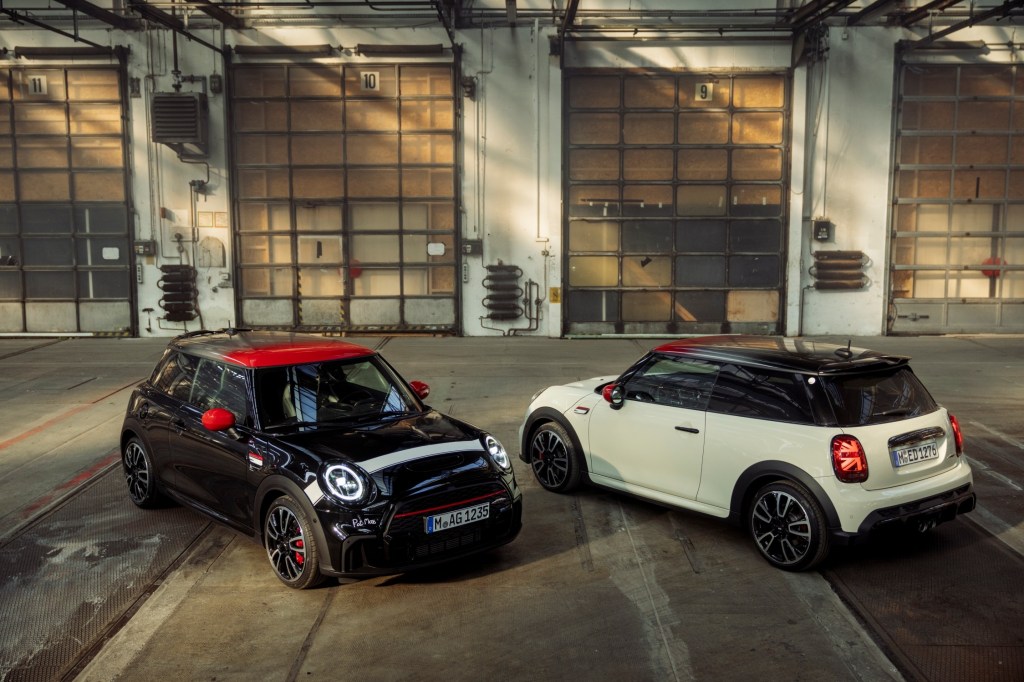
The Pat Moss Edition will be available from May 2022 for the MINI Cooper S 3-door and the MINI Cooper S 5-door and the MINI John Cooper Works. The exclusive design of the edition models cites the racing history of the British premium brand as well as the sporting careers of Pat Moss and Ann Wisdom.
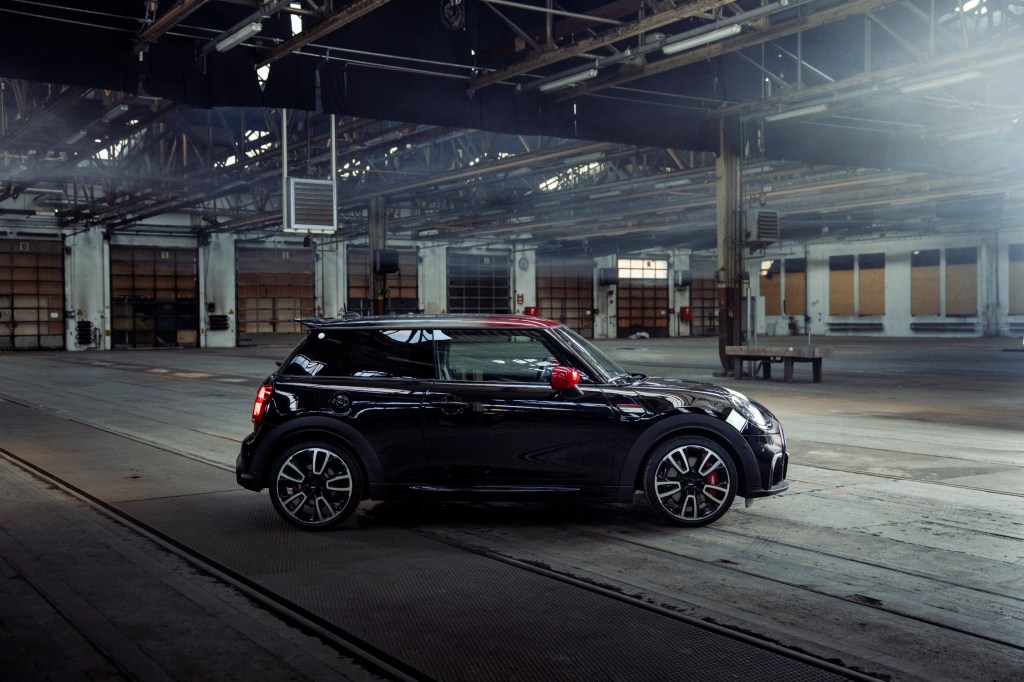
It also incorporates MINI product innovations such as the Multitone Roof. What is more, an additional variant of the Multitone Roof is available for the first time in the Pat Moss Edition. The colour gradient of the vehicle roof extends from Chilli Red to Melting Silver and Jet Black. With the innovative paint finishing process fully integrated in production at the MINI plant in Oxford, this will be the first time a second colour variant has been realised. Minimal deviations in the colour pattern caused by changing environmental conditions ensure that every MINI with a Multitone Roof has the character of a unique specimen ex works. On the new edition models, the charismatic roof paintwork is combined with the body finishes Pepper White or Midnight Black metallic and also red exterior mirror caps.
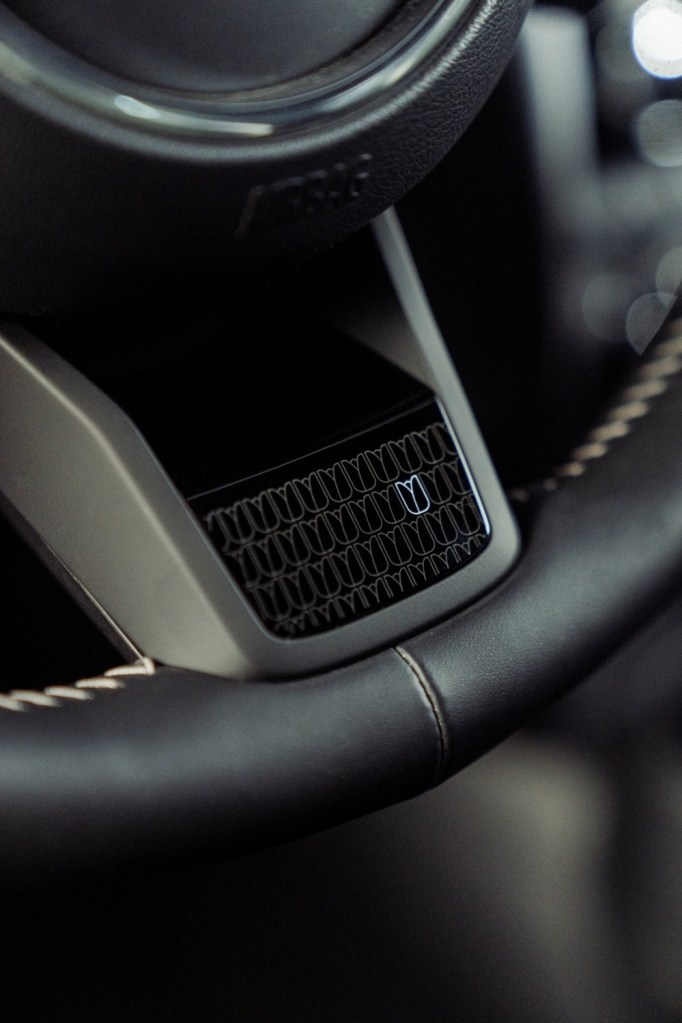
A stylised tulip symbolises the first rally victory: it appears on the C pillars and side scuttles of the edition vehicles along with the inscription “Pat Moss”. The wheel hub covers also feature an exclusive design with a graphic which is based on the outline of the typical Dutch flower and the MINI wordmark.
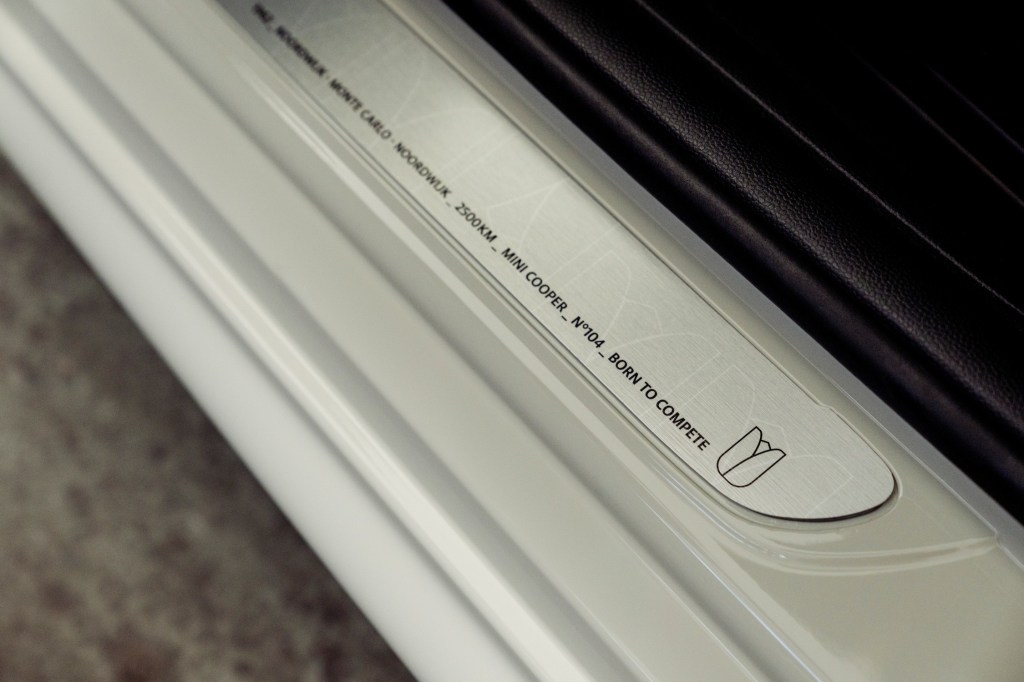
The key facts of the 1962 Tulip Rally appear below the side scuttles on the front side panels: the route Noordwijk – Monte Carlo – Noordwijk, the distance of 2 500 kilometres, the vehicle, namely a Mini Cooper, and its starting number 104. These are supplemented with the slogan that still applies to MINI to this day: “born to compete”. The tulip motif, the name inscription and the key facts about the first every rally win are also to be found on the screen-printed aluminium door sill trims designed exclusively for the edition model.
Another design element used for the first time in the Pat Moss Edition is the horizontally aligned bonnet stripe in white. The printed combination of three-dimensional numbers and letters – 737 ABL – is the registration number of the classic Mini that won the 1962 Tulip Rally, likewise recalling the historical model. Meanwhile the original signature that Pat Moss wrote on the bonnet of her car after one of her victories adorns the front apron of the edition model as a graphic imprint.
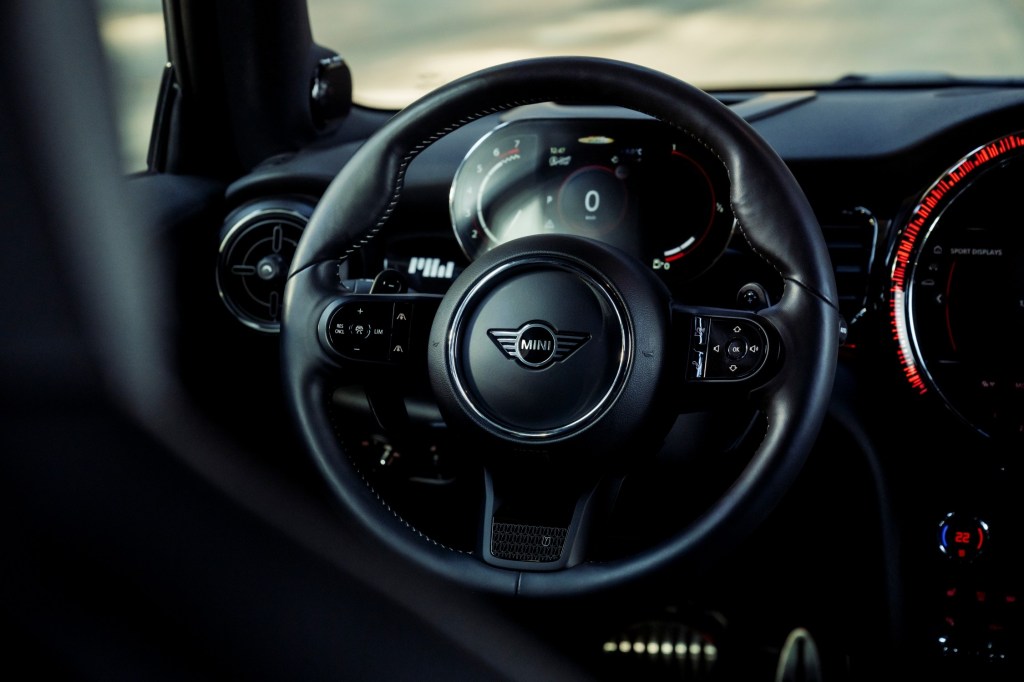
In the interior of the edition vehicles, the iconic signature on the Piano Black interior surface in the passenger area is another tribute to the revolutionary woman rally driver, who passed away in 2008. The sports leather steering wheel bears the edition emblem in the form of a tulip graphic which appears on the clip of the lower spoke. The abstract depiction of engine pistons moving up and down serves as the motif for a graphic on the interior surface on the driver’s side. With bars of different heights forming the shape of the letters “M” and “W” – standing for “Moss” and “Wisdom” – they symbolise that perfectly coordinated duo that caused a sensation in the rally scene for so many years.
The MINI Pat Moss Edition is a tribute to a female racing pioneer, MINI’s rally history and true team spirit. One of the remarkable details of the first rally triumph for the classic Mini is the fact that Ann Wisdom insisted on taking part in the Tulip Rally despite being pregnant at the time: she went on to provide her team mate Pat Moss with unerring navigation guidance over the 2 500 kilometre route.
Mossie and Wizz – as they were known in the paddock – formed a successful duo for seven years. The two women had the courage to compete in a male-dominated sport – and they brought about fundamental changes, too. The younger sister of Formula 1 driver Stirling Moss, Pat Moss also won the Sestriere Rally in Italy in 1968, achieved a podium finish in numerous other international competitions and was crowned European Ladies’ Rally Champion five times. Ann Wisdom is considered the first professional woman co-driver in the history of rallying. As successful sportswomen in their own right, the two viewed their courageous foray into a male-dominated domain with typical British understatement. “We didn’t see ourselves as pioneers back then,” said Ann Wisdom years later. “We were just entering a rally.”
Pat Moss and Ann Wisdom paved the way for an extraordinary career for the classic Mini. In 1964, 1965 and 1967, the British small car secured outright victory in the Monte Carlo Rally. Decades later, MINI became the dominant brand in the world’s toughest endurance rally, achieving overall victory in the Dakar Rally four times in a row from 2012 to 2015. Two more overall victories followed in 2020 and 2021.
It is the International Women’s Day on March 8, and what date is more proper to announce the Best Car of the Year, chosen by the Women’s World Car of the Year jury. The overall winner in the six categories the jury established is the Peugeot 308, already the winner in its category Urban Model.
The winners in this year’s six categories represent excellence in their segments based on safety, driving, comfort, technology, design, efficiency, impact on the environment and value for money.
This is the twelfth year for WWCOTY, a team of fifty-six motoring journalists from 40 countries spanning five continents. It is the only jury in the automotive industry comprised exclusively of women. For our country Belgium, our colleague Sabrina Parant is a jury member. See also their interesting website womensworldcoty.com
In this first round of voting, sixty-five candidates were in the running for the Women’s World Car of the Year awards. All of them were launched between January 1 and December 31, 2021.
Despite the challenges of living and working during a global pandemic, jurors made an extra effort to get behind the wheel of these vehicles to evaluate them.
Some jury members had the following comments on their choice of the overall winning car:
“The Peugeot 308 is an automobile that offers just about everything you could want in a car. It drives very well and it’s hard to believe there’s only a 1.2-litre engine under the bonnet of most versions,” Sandy Myhre, New Zealand.
“It is a car in which the driver feels very comfortable. It offers a very pleasant atmosphere inside,” Mélina Priam, France.
“The most important thing for me is that it has a good mid-range performance and that its automatic gearbox is very smooth,” Hoa Hguyen, Vietnam.
“The 308 is not content with simply maintaining and consolidating its success, but is committed to surpassing itself, and it succeeds in doing so,” Jimena Olazar, Argentina.
“It is easy to drive even in the narrow streets of Japan. Its turbo engine is extraordinary and quiet,” Etsuko Kusuda, Japan.
“Peugeot has been able to seduce families with a well-thought-out proposition and a very striking image, but also to win over those looking for different powertrains: petrol, diesel, plug-in hybrid and an EV coming next year,” Carla B. Ribeiro, Portugal.
“It is not an expensive dream car for the lucky few, but a car that most families can afford,” Malene Raith, Denmark.
“All in all, the 308 is a reliable and predictable car, without being boring. It steers directly and has a very short turning circle, which is ideal for the city. PEUGEOT has thought about the best driving position for the driver,” Rowan Peperkamp, Netherlands.
Here are the 2022 Women’s World Car of the Year Category Winners, chosen in the first round:
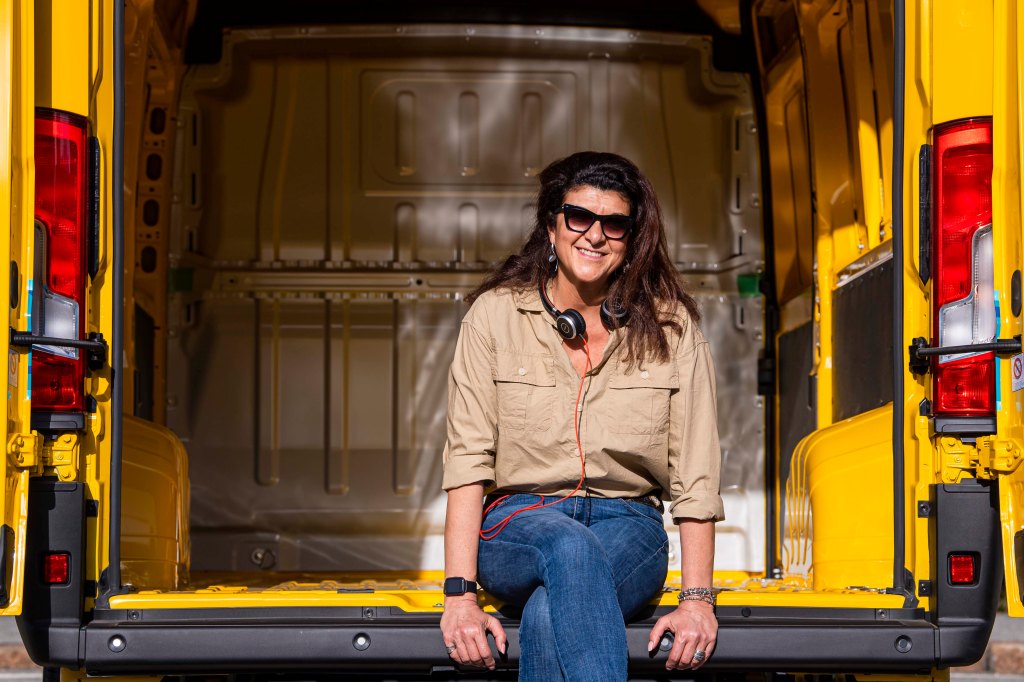
Her vast experience, very good knowledge of the company and a well established large and well honed network were the keys for Angelica Carapezza to bring the complex E-Ducato pilot project towards customers to a succesful end.
At the first presentation of the E-Ducato in mid- 2019 we met up with some very remarkable people of Fiat Professional, notably with Angelica Carapezza, now responsible for managing and coordinating the implementation of the Ducato’s electrification programs at full scale.
Now with the E-Ducato “coming of age” as it were with its commercial launch, after having went through a very thorough process of profiling the customer and their needs, we were very intrigued how this process exactly went about. All the more reasons for a second interview. The first interview, where we told you more about Angelica Carapezza’s multi-faceted career, can of course also be read in our columns, by following the link https://autoprova.be/2019/09/15/women-behind-cars-angelica-carapezza/.
Just read our second interview with Mme Carapezza here below…
Hans Knol ten Bensel
HK: The Ducato has built up an enviable reputation of commercial success, so launching a fully electric version is quite a challenge, as the expectations of the market are high. What was your business philosophy here in positioning the E-Ducato into the market?
AC: We have a long 120-year history in the LCV market, and Fiat Professional has always been a Brand that “lets the facts speak for themselves”. It is down to earth, so to say, producing vehicles that are first and foremost an ideal tool for the small or big entrepreneur who wants to grow his business. With this approach throughout the years, we achieved an undisputed leadership position in the world of light commercial vehicles, as shown by the figures for the Ducato: over 5 million units produced since 1981 in the biggest plant in the world, having also conquered over 75% of volumes in the Caravan bases sector and, finally, having achieved the European Best Seller status in 2020.
HK: Being close to the customer, responding to its needs, how did this translate in the actual approach?
AC: We wanted the E-Ducato to be absolutely “tailor made”. I can refer here to the Press Statement recently released by Stellantis about our “Pilot Project” to tune the E-Ducato to the needs of our customers, but let me explain it also a bit more for you here how we went about.
We first started with gathering data. With a solid database, you know where you’re going. So we collected data for a whole year from 4,000 thermal Ducato vehicles, whose control units, connected in real time, allowed the different individual mission profiles of our customers to be identified in their real application on the road.
E-Ducato’s were delivered to corporate customers like Arcese to further fine tune them to their needs…and collect their experiences.
Then we started analyzing the collected data, and aggregated them. Now, and this is of course crucial, we had established ourselves a very good idea about the profile of daily missions which could be accomplished by an electric instead of a thermal vehicle without causing any business interruption for the customer: in this way we identified the market segment which is “ready to divert” from thermal to electric, based on their specific mission(s) or activity and the size of their fleet.
This analysis which well founded, as it was carried out after not less than 50 million km being traveled by connected vehicles. This confirms again how deep knowledge about customers and their needs is fundamental and conditio sine qua non for the successful sale of commercial vehicles.
HK: Based on your findings, you could now further develop and fine-tune the engineering of the E-Ducato…
AC: Indeed, but we wanted our customers also to test out right from the beginning our pre-production vehicles, and communicate to us their findings during further development of the E-Ducato. We wanted them to have “their” driving experience in the field, based on real life conditions. To achieve this, we launched a “Pilot Project” so complete and complex that it was unprecedented in the history of Fiat Professional. During this engineering development phase of the electric version of the Ducato, we produced a mini fleet of pre-series vehicles and then assigned them to strategic customers. This time it allowed us to sample further data in purely electric mode.
Briefly, each user is assigned a vehicle on free loan for a period of 4-6 weeks, depending on mission/s tested, geography, type of paths chosen, allowing each customer effectively and empirically to start “his” Ducato experience.
The final target is to identify “his” vehicle, which is the result of the combination of two key and indivisible elements: offer and demand. Fiat Ducato’s commercial offer covers more than 18.000 different versions of the same vehicle, available with either thermic or electric propulsion, so you may imagine how important is for us to provide always the right and the best solution to our customers. In other words, we find the right match between on one hand the customer’s specific needs (type of route, daily km, delivery times/shifts, working days, type of goods transported and charging profile) and on the other hand the “right” Ducato with its wide range of product combinations (battery size, body configuration, options).
This allowed a “real life” customer profile to be established, and so we could tailor the E-Ducato not only ideally to its specific delivery tasks and missions, but also to the individual market-specific requirements and local conditions, with indeed the geography being another important key factor in the choice of the vehicles.
HK: Very remarkable, this close cooperation with customers. Does it have a following?
AC: Right indeed, the collaboration with selected customers for the “Pilot Project” continues today and covers various communication channels: press, web, social, co-marketing, joint participation in events and promotion of new experimental business lines.
Furthermore, in terms of identification and visibility, it is worth emphasizing that the E-Ducato fleet bears the distinctive livery of the model, combined with that of the international partners who took part in the project, including Arcese, GLS, Lyreco, Mercitalia, EDF, Fraikin, CSB, Nippon Express and BT Fleet, and last but not least DHL: all leading companies in the market and devoted to innovation, which have shown that they want to combine the commercial side of their business with respect for the environment.
HK: Indeed, I understand, customers and manufacturers are working together towards eco-sustainable mobility…
AC: Absolutely. Respective expectations have the same target: to give a consistent contribution in achieving truly eco-sustainable mobility from the beginning, throughout the value chain, and this new mobility is now the result of two companies sharing a single major strategic goal. OEMs cannot any longer sell just vehicles; they have to sell a full mobility solution in a world that is constantly evolving and where customers need easy solutions to continue their daily mission. LCV customers make a purchase choice based on tangible elements: payload, volume, range; here there is no room for emotion like for passenger cars; our customers have a clear idea about what they want and need, they are very demanding, the vehicle is the business for them. With E-Ducato we are proud to state that we “emotionally sell product contents”.
HK: The car industry is now on the threshold of major eco-conscious changes… with its customers changing too…
AC: The entry of Electric Mobility happens not only in the Automotive market per se, but especially also in the culture and education of the people, which is leading to an epochal change that will impact heavily on the customer’s commercial approach, making her/his choice a «choice of full Mobility»: the customer is a pro-active stakeholder of this process of a new behavior and approach to Mobility.
For the car industry this means not only making the switch from thermal to electric, but also and above all fostering the evolution from the simple sale of a vehicle to the sale of a complete sustainable mobility service, in which the customer’s knowledge and needs become essential elements of the sale itself. Once again, Fiat Professional becomes the protagonist of a cultural change through a concrete approach to the issue of sustainability, with our “tailor-made” E-Ducato.
HK: What were your personal experiences, findings and satisfactions in setting up and bringing to a good end this complex project, amid Corona times? Do you have a message here – as a woman with a career– to our readers?
Well, good question Hans! If you ask me to summarize all my experiences with only one adjective, I would tell you “complicated”, but let me add a second one: “satisfying”. However, as satisfying as all complicated and challenging tasks are, it was not a “promenade”, notwithstanding my 35 years of experience in the Automotive Sector and having clear idea how the “machine” runs.
The Corona virus played its part too in complicating easy things like meeting the customers, feed commercial relations, being on the field, have internal meetings with the team and speed up developments. In one stroke, all these tools were taken away by the Corona pandemic, and we had to cope with delays and only virtual experiences at all levels. But I would mention Einstein here, “in the middle of every difficulty lies an opportunity”, and the Corona virus gave us the opportunity to deal with in a new – and unpredictable – scenario, in finding new ways to establish the collaboration in each part of the long chain of automotive processes, where everybody gave her/his strong contribution to deliver the project.
To those people, my colleagues, go my special thanks for having supported me for each time I asked for something that was “never done before”. Whether you are a man or a woman, if you commit yourself first and you strongly believe in what you are asking for, the results come in.
HK: In more general terms, do you think that the Corona Pandemic has affected the position of women in the working place? What challenges in your opinion lie ahead for them?
AC: Well… a question which is not so easy to answer. Once more, statistical data show us that most of the women have lost their job. We can state generally that women belong indeed still to a weak professional category: they are always the first to pay any change.
I can consider my self – as all women in multinational companies- as a privileged person, since I had immediately the chance to continue my daily job. To avoid any disruption, the Company had made work from home immediately available to all its staff, but of course, everything became virtual. I did not lose my job, but I had to change the way of doing it.
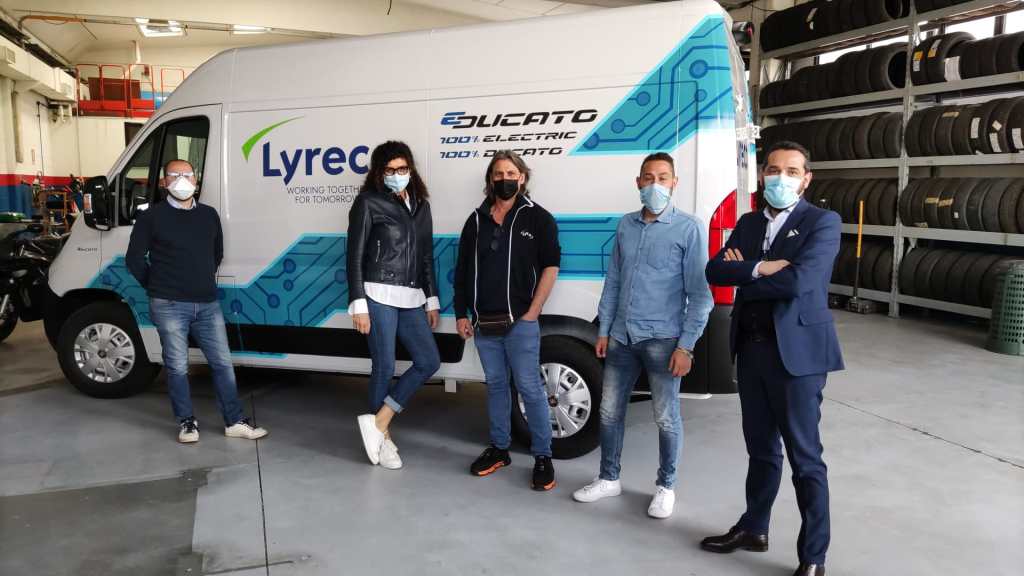
Angelica Carapezza, second from left, seamlessly adapting her dress code to the occasion, delivering the E-Ducato to customer Lyreco…
HK: Did your function in the Company pose specific personal challenges for you?
AC: I’m a Senior Marketing Manager, I’m responsible of the E-Ducato Pilot Project: this job is based on relationships, both within the company as well as externally.
This meant that, at the outbreak of the pandemic, we all had to rely on and capitalize as much as we could on the network we had build up so far. I can say that without a deep knowledge of the organization at all levels, If I would not have already known the thousands of people that work here and what they do, if I would not have built personal relations in the past, I would never have been able to deliver the Pilot Project as it is today.
Along with the network I built up, my professional experience also played an important role in this pandemic situation.
I think it must have been very difficult for young people who had just entered the organization prior to the pandemic. I keep asking myself, how have they worked from their homes without knowing the processes, the people, the organization flows, the fundamentals when you have to deal with an enormous organization? How could they develop that special feeling of “belonging to” the company if they could not experience it hands on and feel it on their skins?
HK: And to return to our first question, what were the extra challenges for women in general with this pandemic?
If you ask me about the challenge… well the challenge was just even bigger now with the pandemic, if you consider a full working day for a woman.
From a personal point of view, I think we have to see both sides of the so-called “remote working opportunity”: what it appears to be and the everyday reality. At first sight it seems that from home you can better manage and organize your daily workload, which – apparently –, leaves you more room to organize your life. But the truth is quite another matter.
The reality is that from home, as women, we tripled our daily tasks and got more and more efficient being at same time managers, mothers, housekeepers with no time limits!
We, like our children who paid the most expensive cost of this pandemic, lost the human contact, everything is done behind the screen, everything is happening inside your house, and most of times you don’t perceive that it’s time to switch off the PC.
HK: The pandemic has affected us all…
The pandemic has affected us as human beings. We are not born to become home robots. As a woman, I want to go back to work, I need to put on a nice dress, have make-up, wear shoes and go out, before we all forget what is so fundamental for a human being: the interaction among us, the fact that we need to see each other into the eyes, to talk face to face, directly, to shake hands, to re-establish relationships. Human relationships: this makes us live.
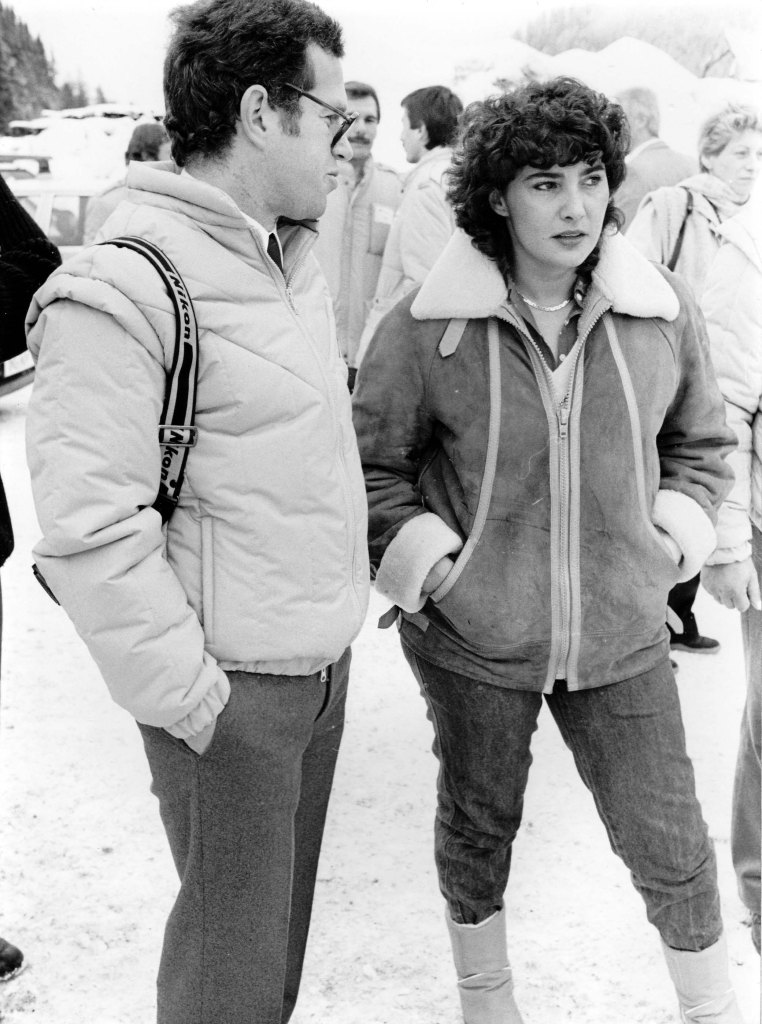
We were there: your servant in conversation with Michèle Mouton in Sankt Moritz, on December 8, 1982…
Your servant was already active as a freelance car journalist from the mid-seventies of last century, so we witnessed up close the birth of the Audi 5-cylinder engines and the (rally) cars powered by it were quite familiar. When we were telling you the long career of Audi’s 5 cylinder engine, we told you how your servant remembered a drive behind the wheel of the Audi 80 Quattro with this magnificent engine. Just look at our pages on this site, and more especially https://autoprova.be/2016/09/18/sweet-memories-our-drive-with-the-5-cylinder-audi-80-5e-quattro-in-sankt-moritz/
This memorable test drive of this Audi 80 5E Quattro took place in Sankt Moritz, on 8 and 9 December 1982. For the assembled international journalists, Audi had also organized a demonstration run with the Quattro Rally Cars, and had brought Michèle Mouton and Stig Blomquist to the venue.
You see me here chatting with Michèle Mouton before having a demo drive with her at the wheel in her Quattro Rally machine…
The Women’s World Car of the Year is the first time a Land Rover has won the top prize at the awards and is the latest in a series of international honours for the most capable Land Rover ever made.
The new Defender remains true to the pioneering spirit that has been a Land Rover hallmark for over 70 years and redefines adventure for the 21st century. Iconic in name, shape and capability, it is available in a choice of body designs and can be personalised with a choice of four Accessory Packs to help owners make more of their world.
The Women’s World Car of the Year (WWCOTY) awards are the only car awards in the world with a jury comprised exclusively of woman, with 50 motoring journalists from 38 countries on 5 continents recognizing the best new models available.
The New Defender was named Best Medium SUV 2021 at the awards before being awarded – to coincide with International Women’s Day – the headline WWCOTY prize.
Liane Engeman, from the race track to photo modelling for Alfa…
In the first part of our story where Alfa Romeo pays tribute to its glorious queens of speed, we took you back to the ‘30s, but now we guide you to more recent times. First we start off with a good looking racing driver, who later became even a …photo model for Alfa: The super-fast Dutch driver Liane Engeman, she excelled herself in the Toine Hezemans team’s Alfa Romeo 1300 Junior.
Liane Engeman with Toine Hezemans…
The photo here above let’s you understand fully why she became later an iconic model for Alfa…
Then there is Christine Beckers, who I came to know personally. Her heroic days were in the ‘60s, the era of the Alfa Romeo Giulia Sprint GTA. Its results, victories and importance in Alfa Romeo’s history are well-known. Less known, however, are the events of the (supercharged) Alfa Romeo GTA-SA. Prepared in ten units for Group 5, it was equipped with two hydraulically operated centrifugal compressors that boosted output to 220 hp, resulting in a top speed of 240 km/h.
It reached peak performance, but as historical test driver from Autodelta Teodoro Zeccoli explained, the GTA-SA had “an unpredictable boost of power would kick in suddenly without notice, making the SA an unpredictable vehicle, hard to govern on curves or when maneuvering.” One able to govern this ill-tempered vehicle better than any other was the young Belgian driver Christine Beckers, who won in Houyet in 1968 and went on to achieve excellent results the following year: in Condroz, at the “Tre Ponti”, at Herbeumont and at Zandvoort. But there are more heroines…
Maria Grazia Lombardi & Anna Cambiaghi
To follow Maria Teresa de Filippis in the 1950s, the second Italian woman to drive in a Formula 1 race – in as many as 13 GPs – was Maria Grazia Lombardi, known as “Lella”.
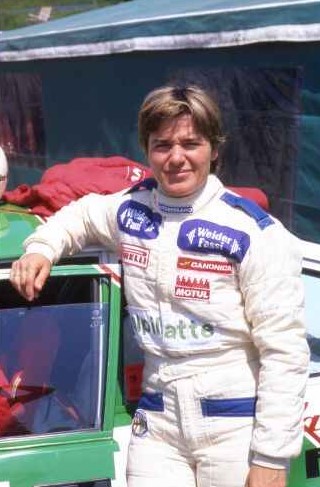
Between 1982 and 1984, she took part in the European Tourism Championship with the Alfa Romeo GTV6 2.5, together with Anna Cambiaghi, Giancarlo Naddeo, Giorgio Francia and Rinaldo Drovandi, and helped to bring in multiple titles. She remains the only female Italian driver to have improved her standing in a Formula 1 race.
Tamara Vidali
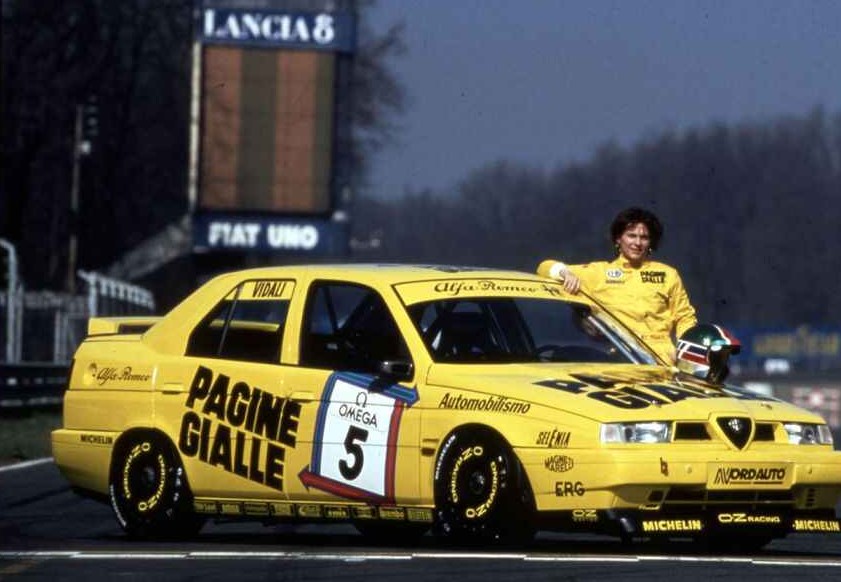
In 1992, Vidali won the Italian Tourism Championship (Group N) in an Alfa Romeo 33 1.7 Quadrifoglio Verde, set up by the brand’s newly established Racing Department. Just as unforgettable is the fully yellow livery of the Alfa Romeo 155 that she drove in the Italian Superturismo Championship (CIS) in 1994.
Last but not least there is Tatiana Calderon.
Born in 1993 in Bogotá, Colombia, Calderon took her first steps in motorsport in 2005, winning a National Championship in the Easy Kart Pre-Junior series. Just three years later, she would become the first woman to win the JICA class of the Stars of Karting Championship East Division in the United States.
In 2017, Calderon became a development driver for the Sauber Formula One team. One year later, Sauber promoted her from F1 development driver to F1 test driver for Alfa Romeo Racing.
We enjoyed reading about all these (very) fast women, and we trust you did too…
International Women’s Day is an ideal occasion, Alfa Romeo found, to put its female racing champions behind an Alfa sportscar wheel into the spotlight. The material they put forward is so abundant and interesting, that we make (at least) a two-part series of it.
We start here with the early, very elegant protagonists, who combined female elegance with panache and excellent racing qualities…
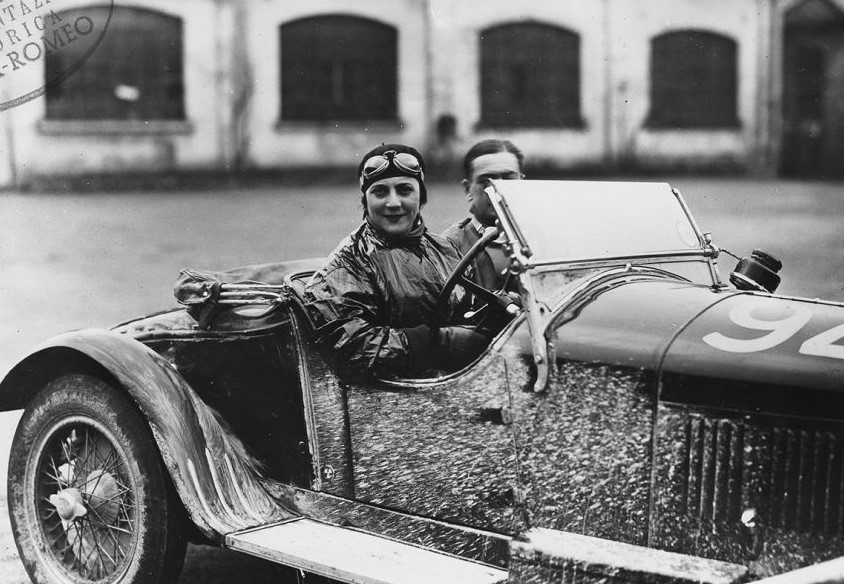
We start here with Odette Siko, you see her elegantly here in the photo above.
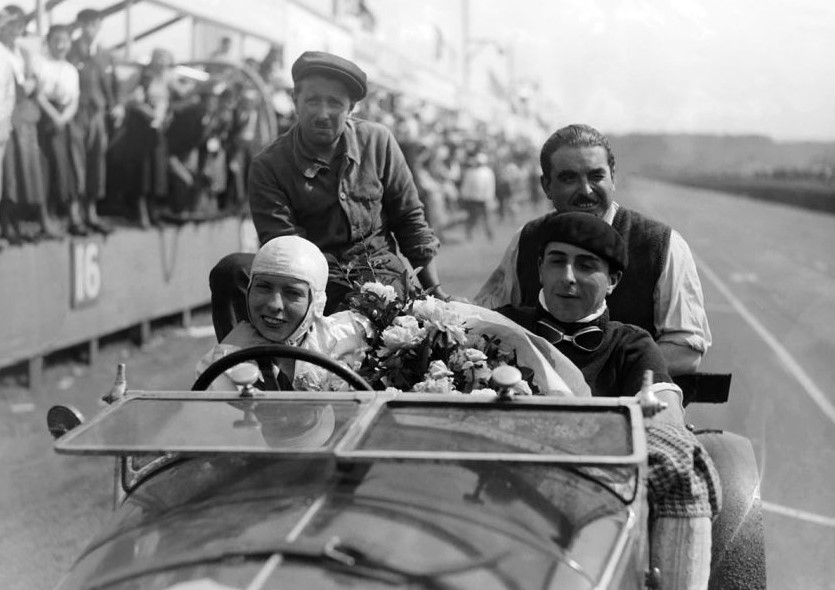
She takes you back to the 1930s, where Alfa Romeo asserted itself as one of the main protagonists in motorsport. This was partly down to extraordinary vehicles, but also to drivers who became part of the legend: these were the years of Nuvolari, Varzi, Caracciola and Sommer. The latter won the 24 Hours of Le Mans in 1932 behind the wheel of an Alfa Romeo 8C 2300, but the Alfa Romeo 6C 1750 SS driven by the striking Odette Siko finished fourth overall and won the 2.0-liter category! A young Parisian, Siko quickly became one of the stars on the track, displaying her elegance both in the paddock and in her racing performance, often accompanied by another female French racer whose path also crossed Alfa Romeo’s several times: Hellé Nice.
Hellé Nice, see the photo here, was a model, acrobat, and dancer. Her real name was Mariette Hélène Delangle, but was more commonly known as Hellé Nice. Renowned for her outgoing personality, Nice was good friends with the Rothschilds and the Bugattis. She raced in Europe and America and became one of the first drivers to display the logos of her sponsors on the bodywork of a single-seater racing car.
She took part in the 1933 Italian Grand Prix at Monza in her own 8C 2300 Monza; in the same race, Campari, Borzacchini and Czaikowski tragically lost their lives. In 1936, she won the Ladies Cup in Monte Carlo and took part the São Paulo Grand Prix in Brazil, where she fell victim to a dreadful accident, then miraculously came out of her three-day coma.
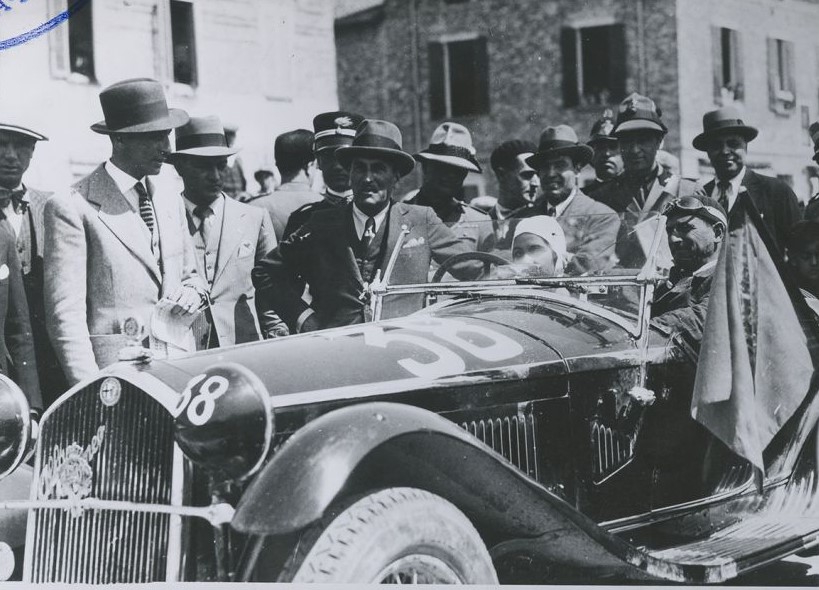
Further on, there was Anna Maria Peduzzi. In her time, the years of Scuderia Ferrari marked a crucial chapter in Alfa Romeo’s history. The drivers of the “Prancing Horse” included Como-born Anna Maria Peduzzi, the wife of driver Franco Comotti, who was nicknamed the “Moroccan”.
After her debut aboard her own Alfa Romeo 6C 1500 Super Sport, which she had purchased from Ferrari himself, Peduzzi almost always raced alone and only occasionally with her husband. In 1934, she won the 1500 Class at the Mille Miglia and, in the post-war period, raced in the Alfa Romeo 1900 Sprint and the Alfa Romeo Giulietta.
We conclude our first part here with Maria Antonietta d’Avanzo.
The forerunner of female Alfa Romeo drivers, Baroness Maria Antonietta d’Avanzo made her debut in the interwar years. A pioneer of Italian motorsport, aviator and journalist, d’Avanzo won third place in the Alfa Romeo G1 at Brescia in 1921, and proved her worth in many competitions as a formidable opponent for the best drivers of the time, including a young Enzo Ferrari.
Baroness d’Avanzo in her Alfa 20-30 ES
Baroness d’Avanzo raced until the 1940s in a variety of vehicles and races, traveling all over the world to do so…
In the next part we will tell you more about our national champion Christine Beckers and her more contemporary colleagues… Stay tuned!


















 Autoprova - for the Connaisseur