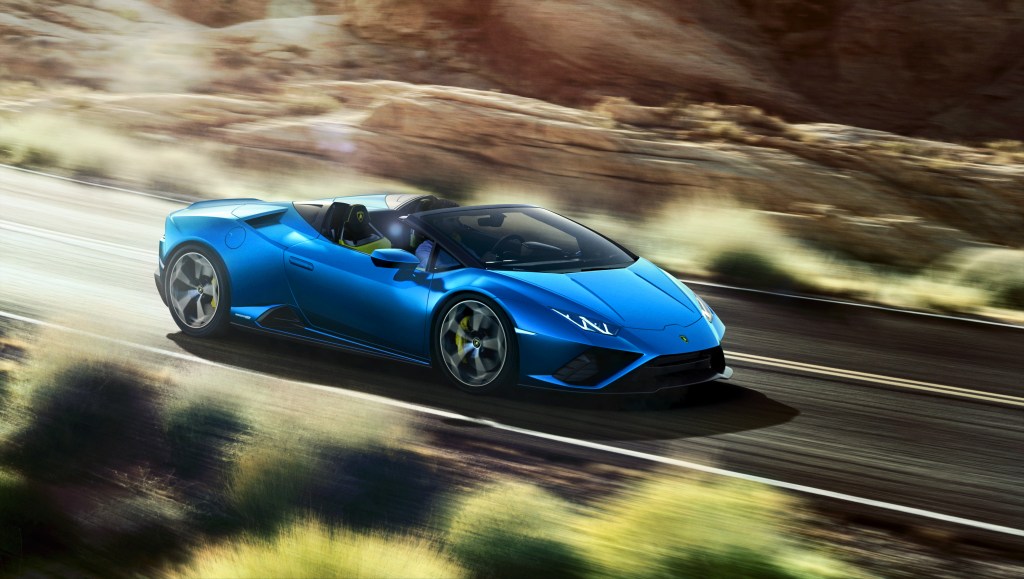
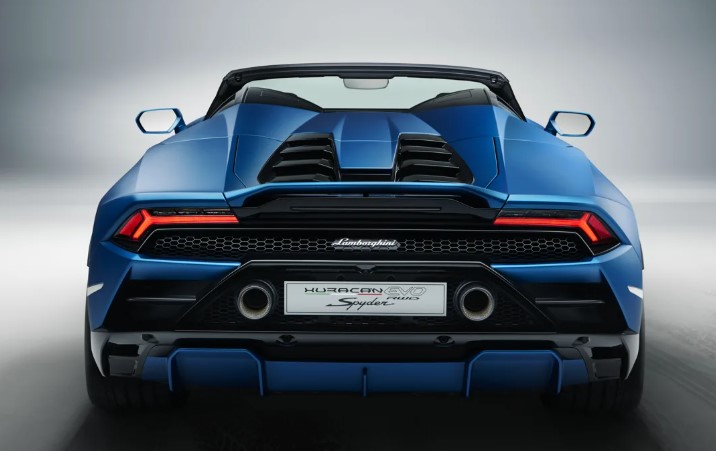
Automobili Lamborghini reveals the new Huracán EVO Rear-Wheel Drive Spyder virtually, using for the first time Augmented Reality (AR) on its official website lamborghini.com.
The new V10 model provides drivers with an open-air celebration of lightweight engineering, with rear-wheel drive and a specially tuned Performance Traction Control System (P-TCS). Roof up or down, daily driving and high-performance fun are accompanied by the inimitable sound of the V10 aspirated power plant, delivering the same 610 hp (449 kW) and 560 Nm of torque as the coupé version.
With a 0-100 km/h acceleration of just 3,5 seconds and a top speed of 324 km/h, like its coupé stablemate the Spyder is an instinctive driver’s car, delivering a fun-to-drive experience via hardware rather than software.
The Huracán EVO RWD Spyder’s design optimizes the integration and function of the extremely lightweight soft top. The Spyder is a true Lamborghini with roof open and closed. The Spyder’s exterior lines ensure drag reduction and the downforce matches that of the coupé without requiring additional aerodynamic appendages, while enhancing the rear-wheel drive car’s balance and dynamism with roof both up and down.
Driving modes…
The Huracán EVO Spyder’s ANIMA button on the steering wheel puts the pilot in control of driving modes, with the P-TCS calibrated to suit.
STRADA provides stability and safety in all conditions by minimizing rear-wheel slippage, and more proactively managing torque delivery on low-adhesion surfaces.
In SPORT mode, the driver enjoys drifting fun, allowing the rear wheels to slide and skate during acceleration, with torque limited when oversteer angles increase rapidly so the driver can stabilize and control the car.
CORSA mode optimizes the car’s traction and agility when exiting a corner in high-performance conditions, maximizing dynamics and speed.
Low weight…
The Huracán EVO RWD Spyder’s aluminum and thermoplastic resin body sits on a lightweight hybrid chassis in aluminum and carbon fiber, with a dry weight of 1,509 kg and a weight-to-power ratio of 2.47 kg/hp.
Front/rear weight distribution of 40/60, with double wishbone suspension with overlapped quadrilaterals and passive shock absorbers, providing optimized driver feedback. Ventilated and cross-drilled steel brakes are fitted to 19” Kari rims with specially-developed Pirelli P Zero tires, with optional 20” rims and carbon ceramic brakes.
One of the most legendary qualities of Citroën cars have been – certainly from the legendary “Traction” and the 2CV onwards – their comfort, which went arm in arm with just as unique roadholding qualities.
No small wonder, as one knows that Citroën had been taken over early 1935 by Michelin, and that since that day the genius of engineer and Pierre-Jules Boulanger was the inspiration behind the revolutionary design of Citroëns. Boulanger was the deputy of Pierre Michelin, who became the chairman of Citroën in 1935.
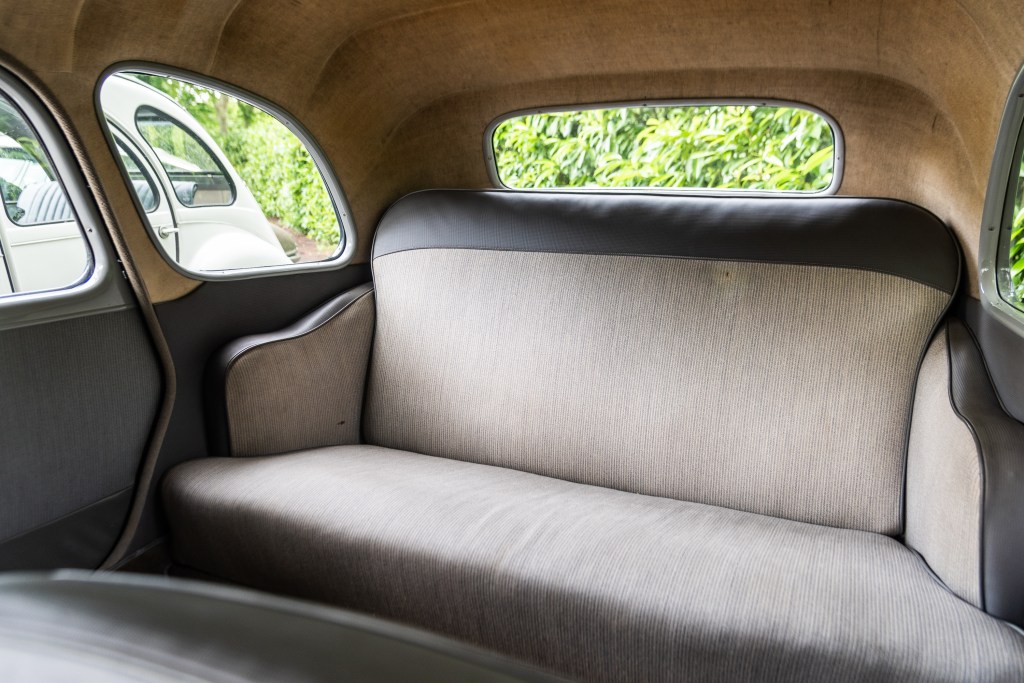
The long wheelbase version of the “Traction” offered superb comfort…
Pierre-Jules Boulanger became vice-president and chief of the engineering and design departments, and had a strong hand in the development of the 2 CV. He put his engineering know how to work with the revolutionary suspension, introducing the revolutionary concept of combining roadholding with a comfortable, very elastic suspension. They also made the world’s first radial tyres…for the 2 CV.
In the late stages of the life of the Traction, Michelin and the team of Pierre Boulanger also reached a helping hand with developing the revolutionary hydropneumatic suspension for the long wheelbase version of the Traction, which then later was adopted for the “Déesse”. Actually, this long wheelbase Traction served as a test bed for the revolutionary DS. Michelin then was at the basis of the development of the whole hydropneumatic system.
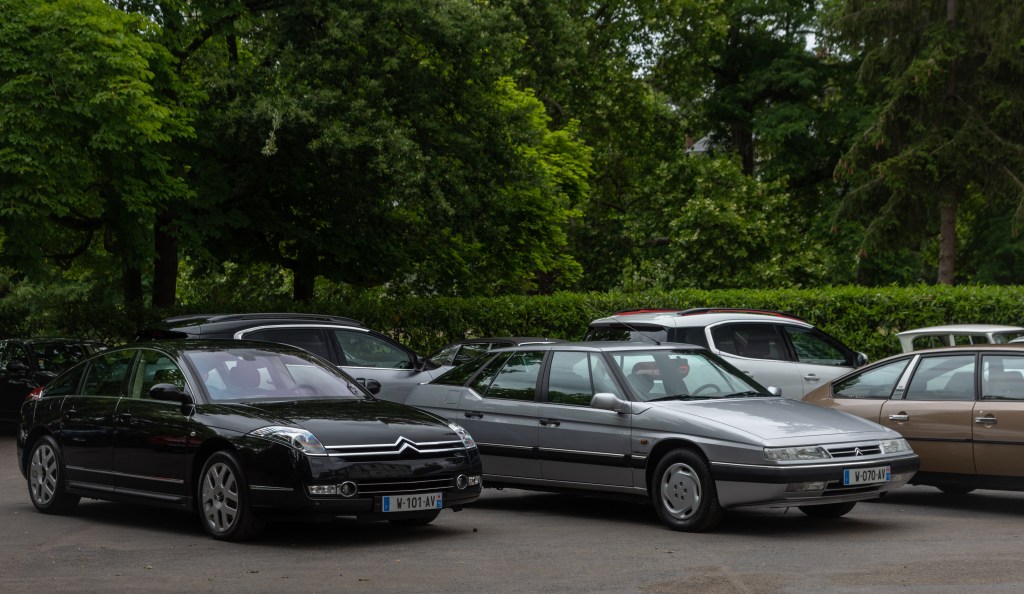
This high-pressure hydraulic system would form the basis of over 9 million Citroëns, spanning from including the DS, SM, GS, CX, BX, XM, Xantia, C5, all through the still so beautiful and iconic C6.
Revolutionary also in developing inboard space…
But of course there are more aspects to just suspension. Citroën has long emphasized the benefits of adaptable seating arrangements and maximum cabin space and storage.
In 1923, the B2Type offered buyers the choice of more seats or greater luggage capacity, with an early attempt at modular cabin design. The C3Type ‘Torpédo’ was a two-seater, yet offered a folding third seat behind the driver, creating more luggage capacity or passenger room as required.
In 1924, a new ‘Trefle’ (three-leaf clover) three-seat configuration was introduced, with a fixed third seat mounted in the middle of the cabin behind the two front seats, with cargo areas either side.
For the 1930s and beyond, the Traction Avant offered various seating layouts. These included a long-wheelbase sevenseat model, and a variant with a wagon-style rear lift-up door – possibly the world’s first production hatchback.
Even the 2CV ahd an adaptable, modular cabin. With removable seats, a convertible roof, wash-down floor, and an extendible cargo area, the 2CV could well be seen as the car that started the trend for functional or technological cabin design – more than half a century ago.
Both the DS and the CX were sold as wagons (or ‘breaks’), offering maximum living comfort with intelligent seating layouts, long before more recent trends for six- or seven-seat cars.
The multi-seat CX Familiale was unique in its market class and it took many years for its competitors to catch up.
Citroën has also produced a series of design concepts as ‘one off’ show cars, with living comfort key to their motor show stand appeal, notably the 1980 Citroën Karin concept. This pyramid-shaped three-seater, built with composite materials, featured new storage ideas, moulded seats, and a stunning control ‘pod’ and steering wheel interface with fingertip controls. Such ideas are now familiar in the company’s production cars.
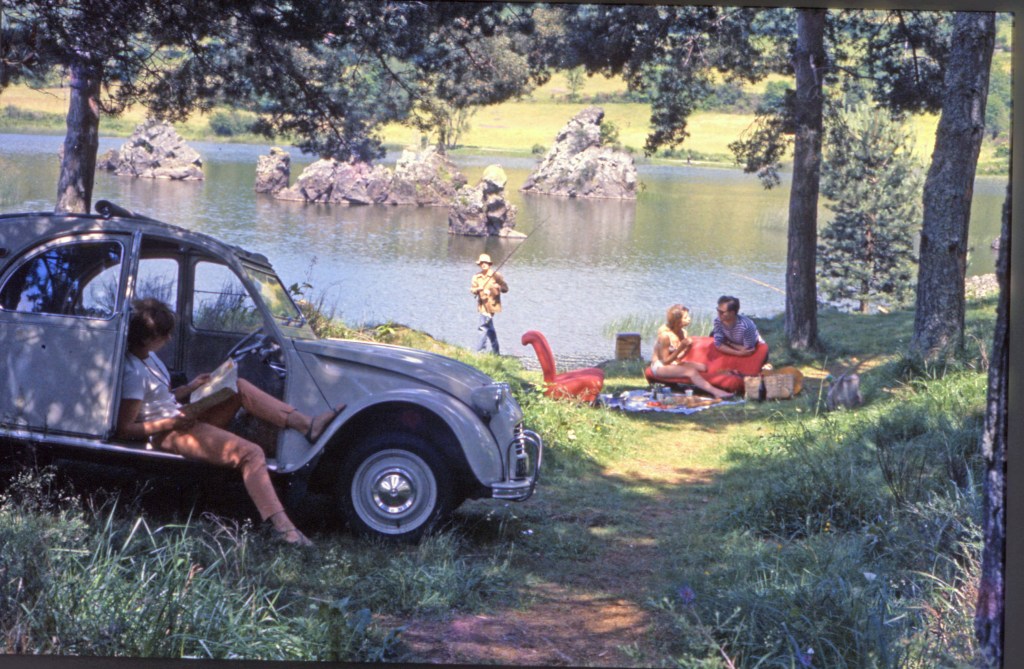
There is much more to come on Citroëns unique story around creature comfort, so stay tuned on these columns, and enjoy the photos here with us…
Noblesse Oblige: a Rolls Royce is the car for shopping at Worth Avenue in Palm Beach…
Before Corona hit our shores, we went in February to Florida to soak up the early sun. Undoubtedly this proved to be a wise choice, as at the moment of writing, we are still not allowed to travel. We visited Miami and made a drive to Key West, in a rented Nissan Altima. A very comfortable mount with a well pulling and smooth 2,5 litre 188 HP four cylinder petrol engine coupled to a soave CVT transmission. This CVT performed well, raising the revs gradually following the push of your right foot, and restraining fussy revving even when you accelerate full throttle. Once above 4,000 rpm, it will make crisp upshifts.
With lots of support from the power steering the Altima is very easy to steer, stable and comfortable, and offers lots of room for its occupants. An ideal, and stylish travelling machine, which left little to be desired.
On Florida roads, the usual pickups abound, but there is a lot of room left for supercars and European (noble) brands. Indeed, Florida is the realm of the well to do, and also one of the states with a 56,14 % majority of foreign brands in its total car market. It counted in 2018 some 7,6 million registered vehicles. California is actually the top car state with not less than 14,6 million registered vehicles, and a foreign car market share of 64,9 %.
Go in the posh shopping and hotel areas of Miami beach, and you will see it is the home of Lamborghini’s, Maserati’s, Mercedes, BMW, Porsche, Range Rover, Bentley, Rolls Royce. Many buyers of the noble European brands opt for SUV’s as well as cabrio’s and coupés.
On the road, big SUV’s and pickups from American and Japanese brands abound, with the open Mustangs being frequently seen too, as well as Chevy Camaro’s.
Every now and then an American built classic meets you, as a fifties or sixties open Ford or Thunderbird. Indeed, Cuba is not far away…
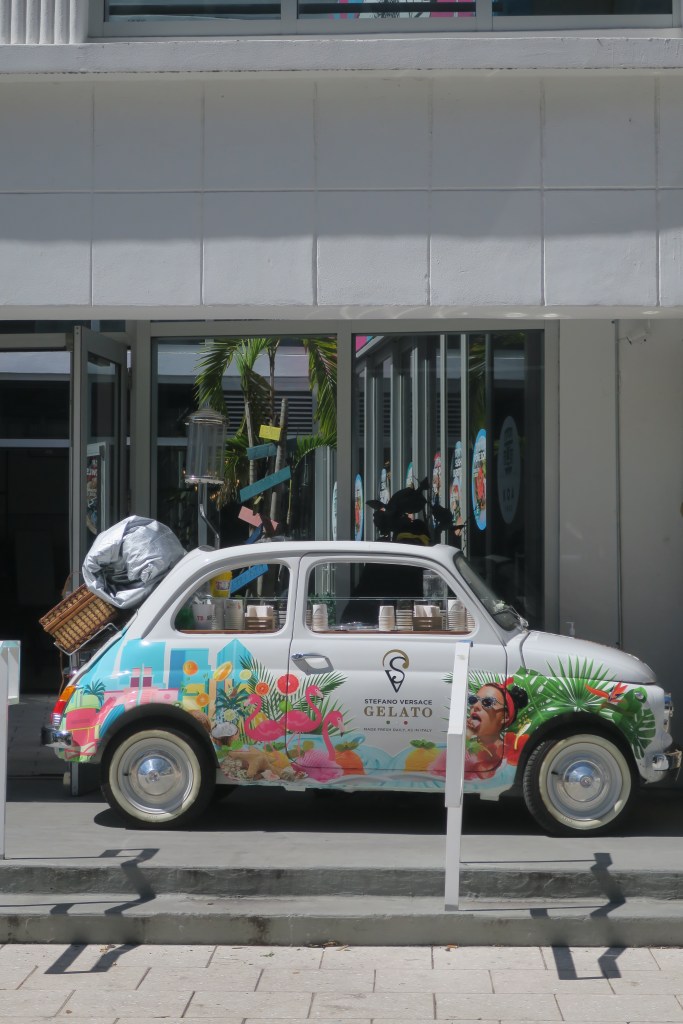
Of course, there are the Cinquecento’s. We saw a new one on Miami Beach, and a vintage or “classic” Cinquecento used by a Sicilian Ice cream vendor…
Also a two decades old SUV was totally sculpted in sand, if there ever was a beach car, this is the one…
We just let you enjoy the photos here, and dream with us of these sunny shores and their nice cars…
Health comes first: Perspex panels protect employees when working together in assembly.
Audi will gradually initiate the restart of production at its plants in Europe during the coming weeks.
As everybody knows, in mid-March, the company announced the temporary suspension of production at its European sites.
The background to the decision was supply bottlenecks and a drop in demand due to the corona pandemic. Now the Volkswagen Group will coordinate the upcoming regulated restart in the worldwide Audi production network together with suppliers and service providers.
The main focus in this restart is of course a comprehensive package of measures that targets on the safety of employees.
Health protection in focus: Perspex panels ensure safety on the assembly line.
In this respect, Audi is following the guidelines of the Robert Koch Institute and the regulations of the health authorities of the respective country.
Altogether an admirable undertaking, which will bring us all soon again on the right path…
Hans Knol ten Bensel
“A joint European Act”
Following the suspension of production at all AUDI AG plants in Europe, it is now a matter of taking the first step back towards normality: “We will manage the restart as a joint European act,” said Board of Management Member for Production Peter Kössler. This is because supply chains and production and logistics processes are closely interlinked within the Group and with partners at the international level. Kössler continued: “The focus is on the employees, because they need a safe working environment. Audi teams of experts have therefore adapted processes with a view to health protection in consultation with the specialist departments and works councils. I would like to thank all Audi employees and our partners around the world for their flexibility and joint efforts in times like these.”
Foils attached to the vehicles separate employees during parallel work on assembly.
The restart includes, for example, clear rules on distance and hygiene, a modified shift system to avoid contact, and the obligation to use mouth and nose protection in areas where distances of 1.5 meters are not possible.
The company has also created physical barriers at critical workplaces. In door pre-assembly, for example, two employees work simultaneously on the same transport rack and stand directly opposite each other. Here, the employees themselves have developed a transparent barrier made of plastic sheeting.
“Corona-ready”…
Managers of production sections and groups, together with experts from occupational safety, health care, industrial engineering and the works council, have looked at each individual workplace, analyzed it and developed suggestions for improvement. Only with the agreement of all those involved is a workplace considered “corona-ready.” The workgroup also took a close look at the working environment: group spaces, factory gates, parking spaces and internal factory traffic, as well as catering and factory restaurants. Audi has developed appropriate solutions for all areas.
Vehicle production at the Audi sites will be gradually ramped up from the end of April onwards according to a fixed plan. Engine production in Győr already started gradually ramping up again this week. For those employees at the factories in Germany who will only be able to resume their work fully in later phases of the restart, short-time working regulations will continue to apply until then…
In iconic black, the original Panda is still very modern…
Your servant remembers it vividly. Back in 1980, photographing a brick stone red Panda in the Galerie de la Reine in Brussels, on an early Saturday morning. Those were the times when you could pull this off, without asking anybody. Of course we had to be quick. To make our presence a bit more official, I asked also some garcons of the nearby restaurant Aux Armes de Bruxelles – who were just putting out the tables in the early morning – to pose for me, putting some of their ornamental flower trays in the opened hatch of our Panda.
My test car’ had the zesty four cylinder 903 cc engine in the front, borrowed from the Fiat 127. It was fast with it. Top speed not less than 140 km/h.
The original Panda had soon also a4WD version…
I just loved the design of this Panda, both inside and out. Its elegant, simple, rectangular shapes, its perfectly balanced proportions still inspire. Just drive it now in chique black with beige interior through our cities.
It still is a beautiful, modern car. The car is also up to this day brimming with practicality and genial storage solutions. Fast, zesty, compact.
The future car within this same lineage of geniality is the Centoventi. We stood eye to eye with the prototype in the Centro Stile last year. More about this car later.
The Centoventi breathes the same practical spirit as the original Panda…
The present day Panda is eminently capable. We recently drove the hybrid version, just read our report… This Panda lives in the heart of many, and is since 2003 the most sold city car in Europe. And has a bright future for many years to come…
Keeping your offspring busy in these (Easter) times is quite a task, and Jeep and Fiat are there to help.
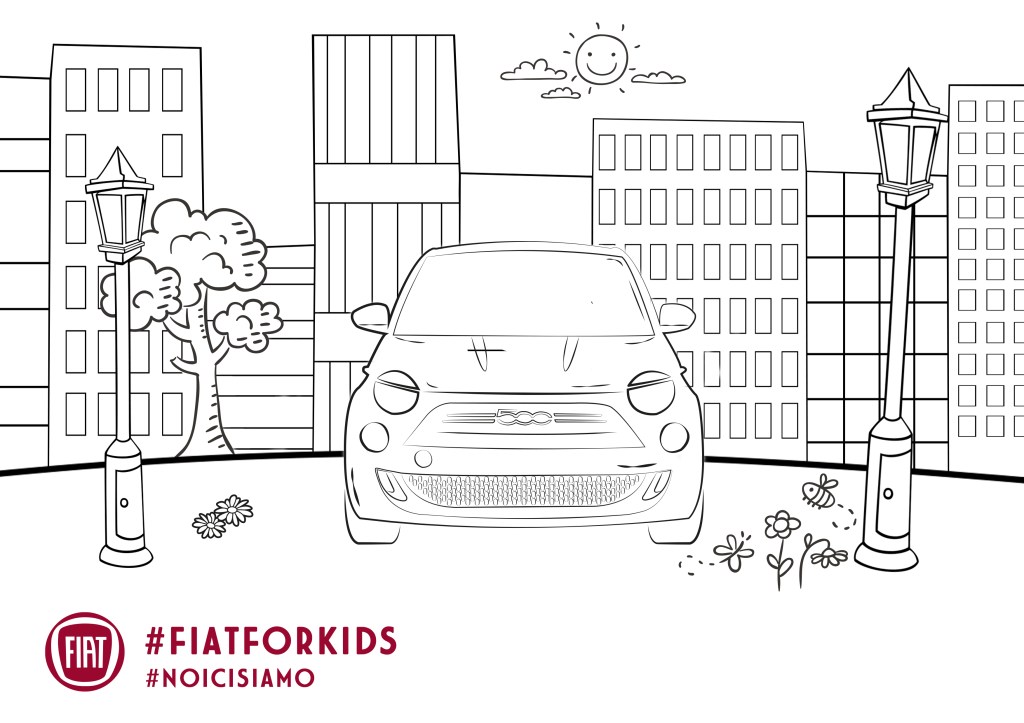
Fiat launces a cute #fiatforkids initiative. The Colorbook 500 – in Fiat’s usual playful, entertaining style – is designed specially for children to spend a few hours drawing and coloring in the three generations of the 500. Fiat is offering four plates of their iconic Cinquecento. Your offspring can colour the three generations of the 500, the landscape it is passing, or draw the view from the window of the car.
But there is more for kids in store during Easter time. They will look for “Easter Eggs” in hidden places in the garden, terrace or in the home, much to their surprise and delight. The Jeep designers have made “Easter Eggs” an integrated step in the creation process of each vehicle, and a distinctive, very special design feature.
The “Easter Egg” lies here in the small red Jeep on the alloy rim…
‘Easter Eggs‘ are hidden decorative motifs that Jeep stylists conceal in Jeep vehicles, meant to be discovered throughout time by their owners.
These hidden gems are unique and unexpected, they change from one Jeep vehicle to another and can be found both on the exterior and on the interior. Originally, Easter Eggs were an offhand addition of a graphic to an otherwise standard part of the vehicle but over the course of the years, they developed into something typical of Jeep design.
They are also styling cues that recall the brand’s design heritage – such as the seven slot grille or iconic Jeep models like the Wrangler.
Often they can also be found in small functional areas, such as storage compartments, to be discovered by customers during the daily use of their vehicle.
Today, the practice continues with every new Jeep model and customers will shortly have an opportunity to discover the Easter Eggs hidden in the soon-to-be launched Jeep Renegade and Compass 4xe…
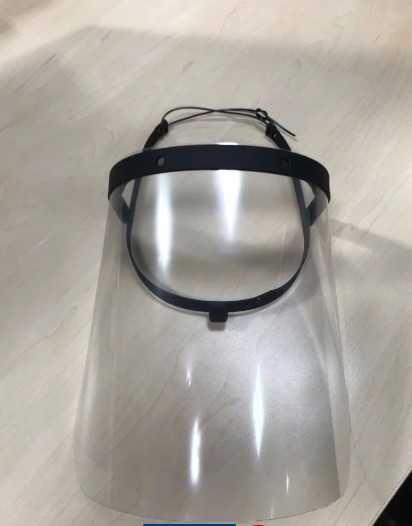
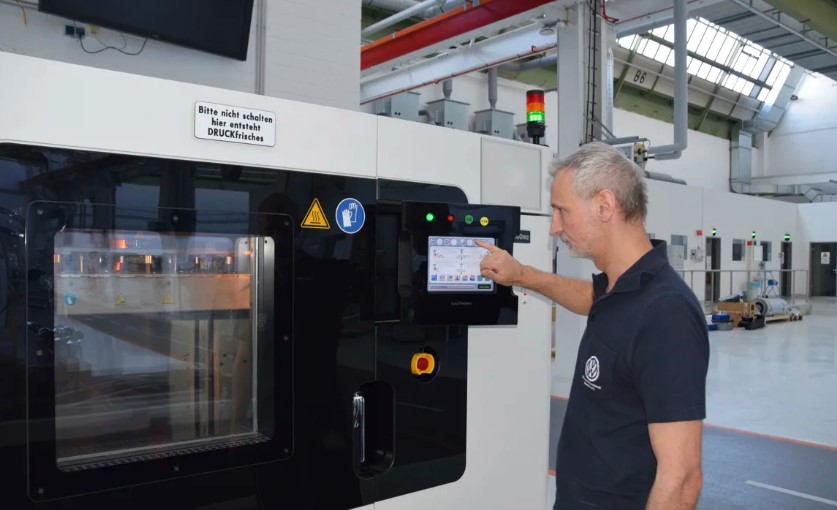
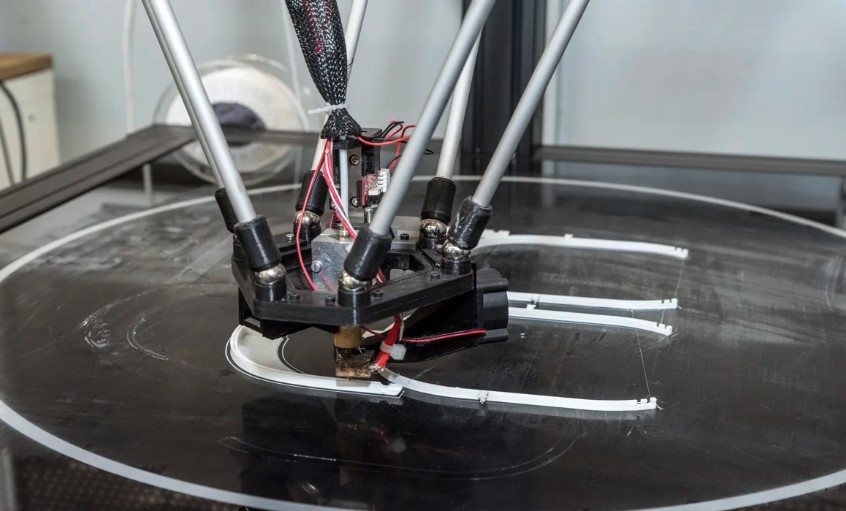
In response to the corona crisis, the Volkswagen Group has started to produce face shield holders by 3D printing. This is part of a joint transnational initiative with Airbus and the 3D printing network “Mobility goes Additive”, which includes about 250 companies.
The products developed by Airbus will be used in Spain and will be flown from Hamburg to Madrid by Airbus. In addition, there are a number of other initiatives by Volkswagen Group brands to produce medical supplies.
Production is in progress not only at the large 3D printing centers in Wolfsburg and Ingolstadt, but also at other plants of Audi, Bentley, Bugatti, MAN Truck & Bus, Porsche, Volkswagen Passenger Cars, Volkswagen Group Components and Volkswagen Motorsport. The Group currently uses more than 50 3D printers at its plants continuously adding additional printers for this project.
Lamborghini, SEAT, ŠKODA and Volkswagen Passenger Cars are also working on other medical supplies: Volkswagen Navarra (Spain) has already started last week to produce face shields and has handed about 1,000 units to the Navarra Government.
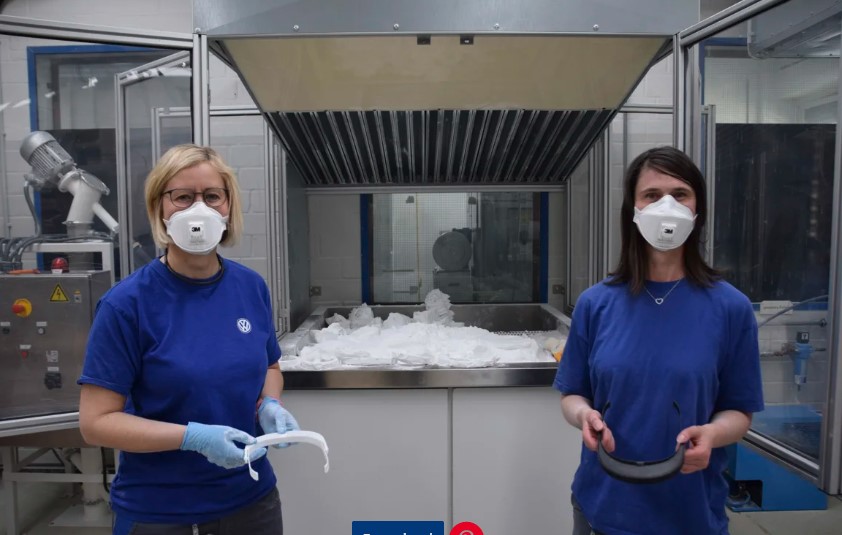
In collaboration with the Technical University in Prague, ŠKODA has developed a 3D printing process to produce reusable FFP3 respirators. The Czech Ministry of Health is now distributing these to doctors, hospitals and nursing staff.
Skoda is printing in 3D reusable FFP3 respirators…
Lamborghini is converting departments of its super sports car production plant in Sant’Agata Bolognese in order to produce surgical masks and protective plexiglass shields. The masks will be donated to a hospital in Bologna.
Lamborghini is stitching face masks…
SEAT is currently working on several initiatives to collaborate, including the production of a mechanical ventilator that will be assembled in Martorell and various models of face masks which are still pending official approval. See our story elsewhere. Volkswagen South Africa is also printing masks and face shields which are pending official approval.
Lamborghini Research and Development technicians and engineers are producing 200 medical face shields per day…
To date, Volkswagen has already donated several hundred thousand medical face masks for the public health system in Germany. The Volkswagen Group has also decided to donate additional medical supplies such as face masks and protective clothing for medical centers and hospitals with a total value of about €40 million. This is intended as a contribution to maintaining the functioning of the health system in Germany. As a global group, Volkswagen is also using its international supplier and logistics network to provide support for the procurement of medical equipment and supplies.
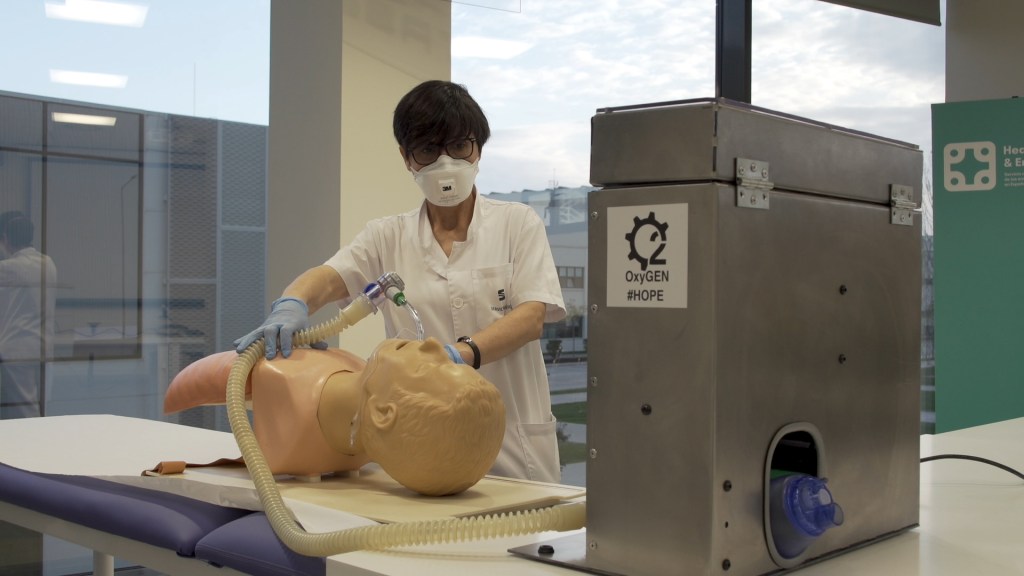
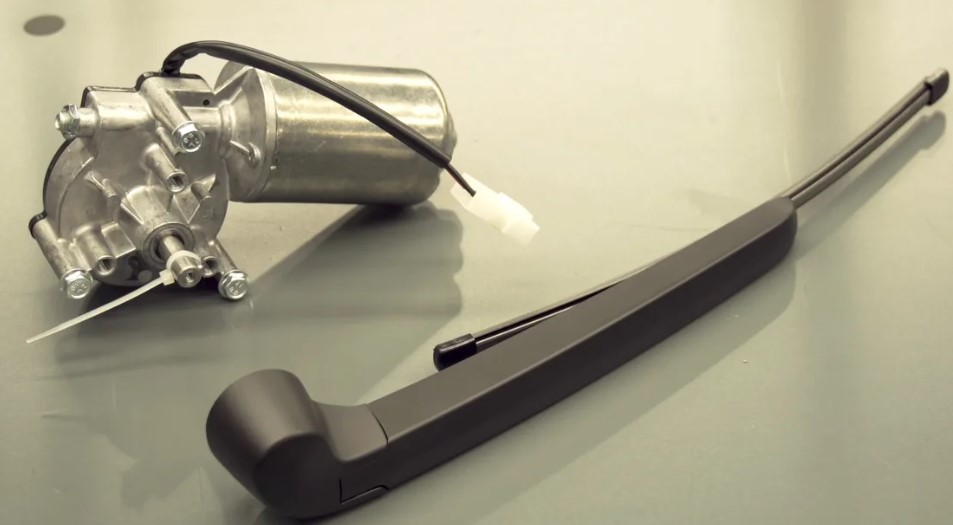
SEAT is supporting healthcare by making automated ventilators, using….adapted windscreen wiper motors!
150 employees from several areas of the company have done the unique job to come out after merely a week on the definitive model after designing not less than 13 prototypes.
A ventilator is currently undergoing prolonged testing as part of the approval process
The SEAT Leon line at the Martorell plant is almost unrecognisable. Today, cars are no longer being made; instead, automated ventilators are being produced to collaborate with the healthcare system in the midst of the COVID-19 crisis.
The key lies in the windscreen wiper. The project is taking shape with gears printed at SEAT, gearbox shafts and the adapted motor of a windscreen wiper.
The aim was to make ventilators of the highest quality, and the result is the OxyGEN. Designed in collaboration with Protofy.XYZ, they are being assembled at the SEAT facilities.
Reshaping the assembly line
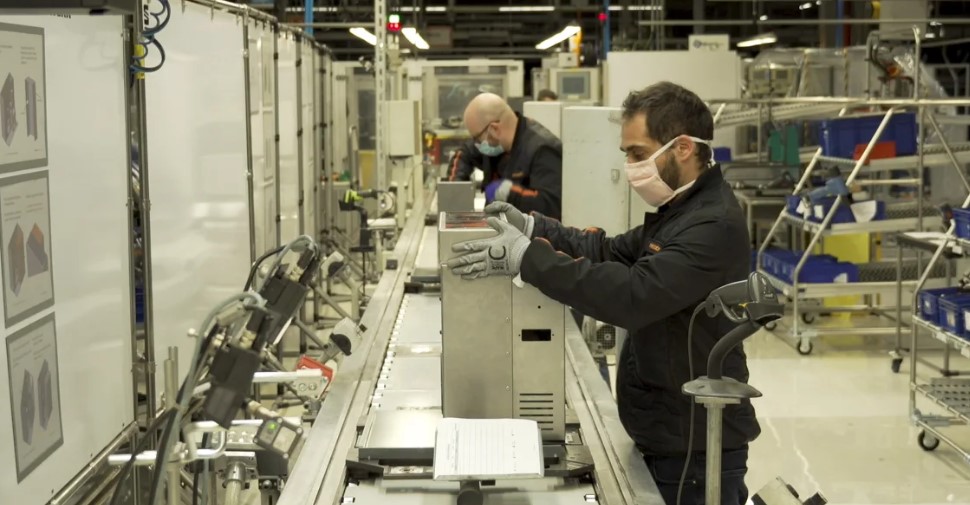
150 employees from different areas have changed their usual workstation to put together the ventilators where parts of the SEAT Leon used to be assembled.
“Taking an assembly line that manufactures subframes, a car part, and adapting it to make ventilators has been a lengthy, difficult job involving many areas of the company, and we managed to do it in the record time of one week”, says Sergio Arreciado from the Process Engineering area of SEAT. Each ventilator has more than 80 electronic and mechanical components and undergoes a thorough quality control with ultraviolet light sterilisation.
The project is taking shape with gears printed at SEAT, gearbox shafts and the adapted motor of a windscreen wiper.
Thoroughly tested…
A ventilator is currently undergoing prolonged testing as part of the approval process. Meanwhile, the line continues to operate thanks to many employees who have worked tirelessly on this project. “Just knowing that we’ve tried to help save a life makes all this work we’ve done worthwhile”, says Francesc Sabaté of R&D at SEAT.
Joint effort.
The result of this project has been possible thanks to the solidarity of its employees and the collaboration of many companies and entities that SEAT would like to thank for their involvement, especially the Spanish Agency of Medicines and Healthcare Products. Other companies which have participated in the project have been Protofy.XYZ, CMCiB, University of Barcelona, Recam Laser
Doga Motors, Luz Negra, Ficosa, Bosch, IDNEO, Secartys and LCOE.
This just shows how resilient our (automotive) companies and industries are…
Audi has another first: you can now experience virtual factory tours! For the moment, you can experience production processes of the brand at the Ingolstadt site online and in English language, both from the comfort of your own homes and/or while on the go. It is also interactive: experienced tour guides accompany the virtual tour and answer questions in the live stream.
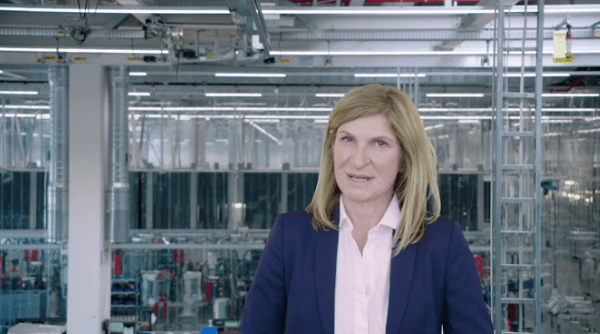
The tour guides moderate the virtual tours live from a studio…
AudiStream provides detailed insights into selected production stages at Audi in Ingolstadt. Additionally, the new online feature presents the technical highlights of the brand. The tour guides moderate the virtual tours live from a studio. They explain production processes, answer individual questions as part of a dialog, and tailor the course of the approximately 20-minute live stream to the wishes and interests of the participants.
You visit Audi Ingolstadt virtually…
AudiStream starts with the online feature “Audi live at the Ingolstadt factory.” Participants learn how an Audi is made, from the first production steps in the press shop up to the last manual operations during the final assembly. Streams about further topics concerning the Audi brand are to follow.
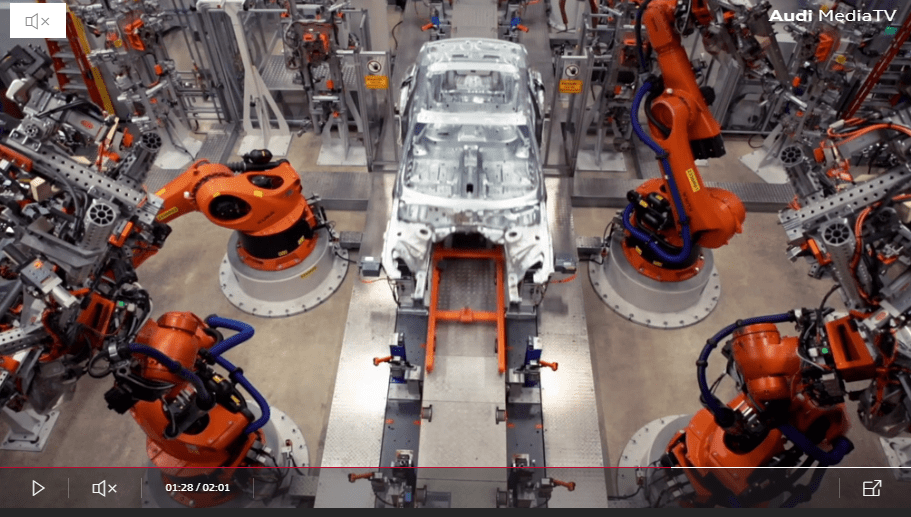
You see on your screen the A4 production at Ingolstadt
Users select the desired live stream and a suitable time slot online at http://www.audi.stream.
The offering is free of charge; fees may be charged for internet access, however, depending on the selected provider. Further information on AudiStream can be found in the video. We give you here the link:
Battery tray welding at Audi Brussels for the e-Tron: to see this, follow your servant in the factory!
If you want to see the production of the E-Tron at Audi Brussels, you will still see your servant and his colleagues. For your info, I am personally guiding you through the factory and tell you everything you want to know about its presence and history and all the state of the art Audi production techniques in four languages, German, English, French and Dutch. You can book a visit through the website http://www.audibrussels.be/brussels/web/nl/factory-visit/reservation.html. Just hurry, interest is large, and bookings are already months ahead!
If there is an absolute icon for rugged outdoors motoring, then it is Jeep. The original 1941 Jeep still celebrates in parades how it liberated our shores. And up to the present days, it uplifts our hearts and liberates our minds.
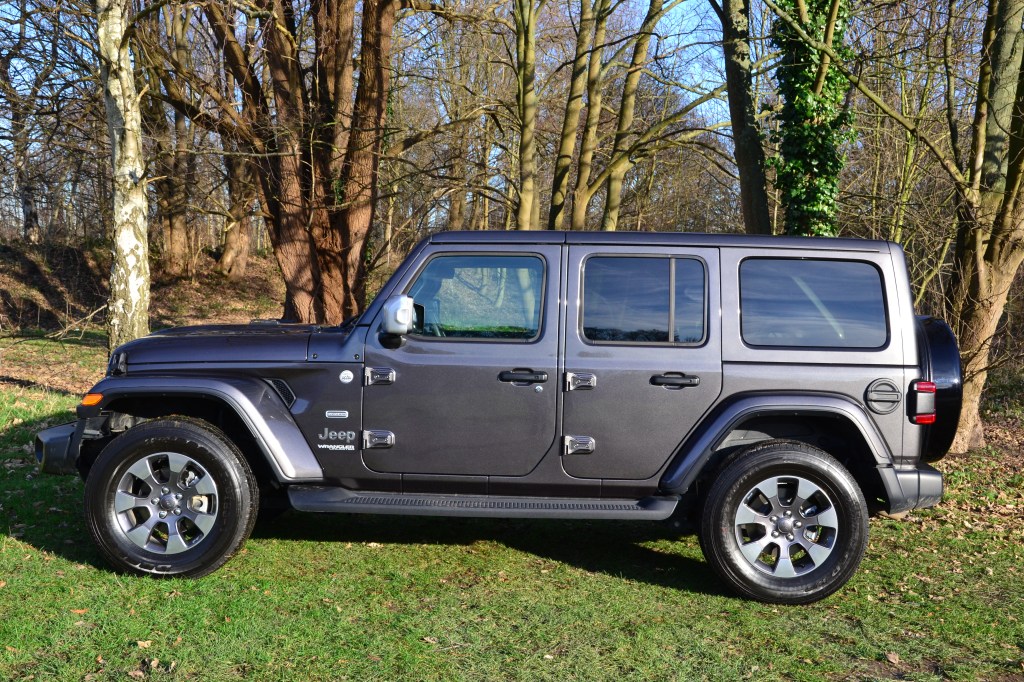
The Jeep Wrangler is an icon which continues to uphold the fascination for the original. Just look at it standing in front of your home. The looks are all there.
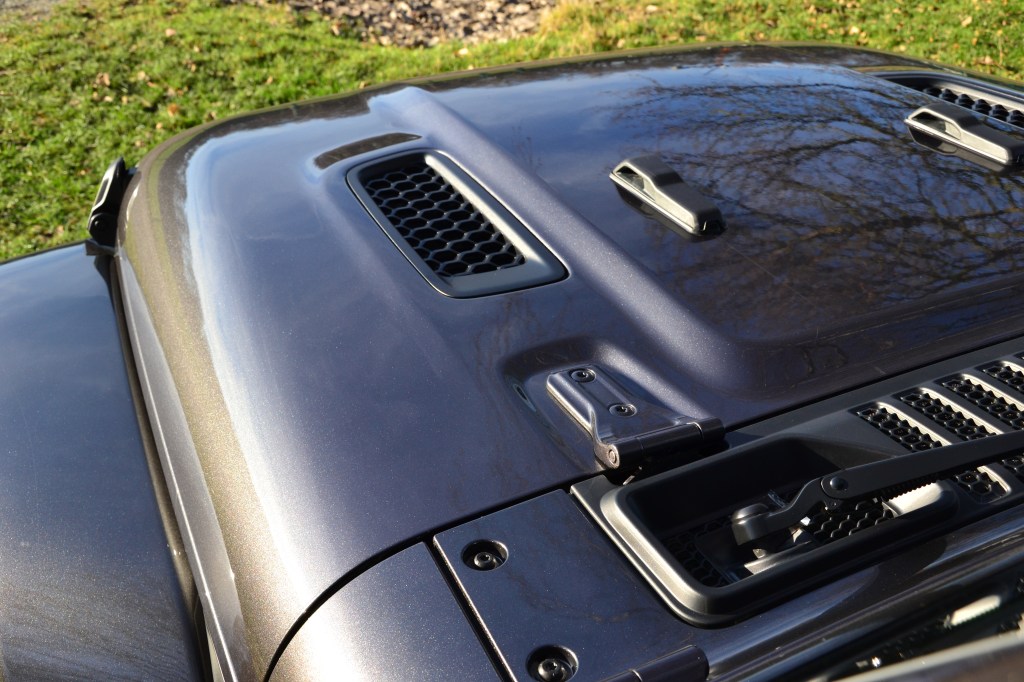
The legendary seven-slot grille, with the outer grille slats intersecting with the headlights, paying homage to the legendary CJ model. The trapezoidal wheel arches, the visible hinges, the removable top, all this continues the tradition, albeit in a very modern manner. As this Jeep is king on the rugged terrain, it is also royal to drive on the road, just read further…
Hans Knol ten Bensel
Don’t you just love a car which will never, ever let you down, and just brings you to your destination whatever the weather, the road conditions? A car which breathes timeless authenticity, looks and conveys exactly what it stands for, nothing more, nothing less? Then this Wrangler is the car for you. It certainly was the car for us, all during this test.
We just love the ideal, well honed proportions of this fourth generation Wrangler. We are smitten by its wide stance and lowered beltline with larger windows, making the car look “just right”.
The windshield is tilted to an optimal degree to improve aerodynamics, and features a new four bolt design at the top of the windshield’s frame to allow the windshield to fold down quickly and easily. It is also the only authentic full open-air 4×4 SUV available on the market. It has for instance an easy-to-use Freedom Top, a removable, three-panel hard top.
Our car also had the Overland pack, and this offers unique 18-inch aluminium wheels, a body colour grille with bright accent throats and headlamp bezels, body colour hard spare tyre cover and Overland logo. The exterior of the Overland pack is complemented by dedicated leather interior and LED lights.
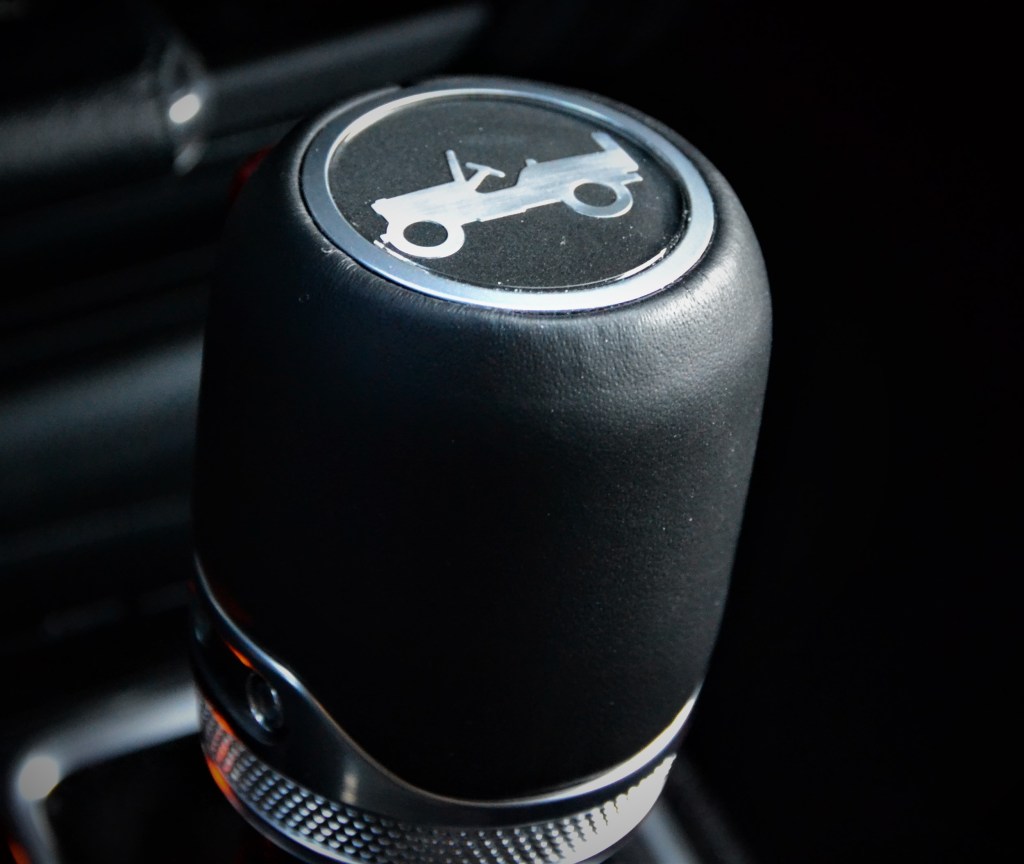
The cabin also breathes the Jeep purposefulness. The dashboard stands deliciously upright, and features round and very clear instruments combined with the soft-touch surface with accent stitching. The completely restyled centre console houses the gear shift selection, transfer case and parking brake. Real bolts featured on the shifter, grab handles and frame the infotainment screen highlight genuine construction methods. Yeah, this is Jeep.
One of Wrangler’s unique characteristics are the entirely washable interiors and the protective rubber cover for the infotainment system screen, that allows easy clean up in complete peace of mind.
Not that you are devoid of modern infotainment or or creature comfort. The Wrangler has heated front seats, and even a heated steering wheel. The armrests in the doors are also lengthened so you can comfortably lean back on motorway journeys.
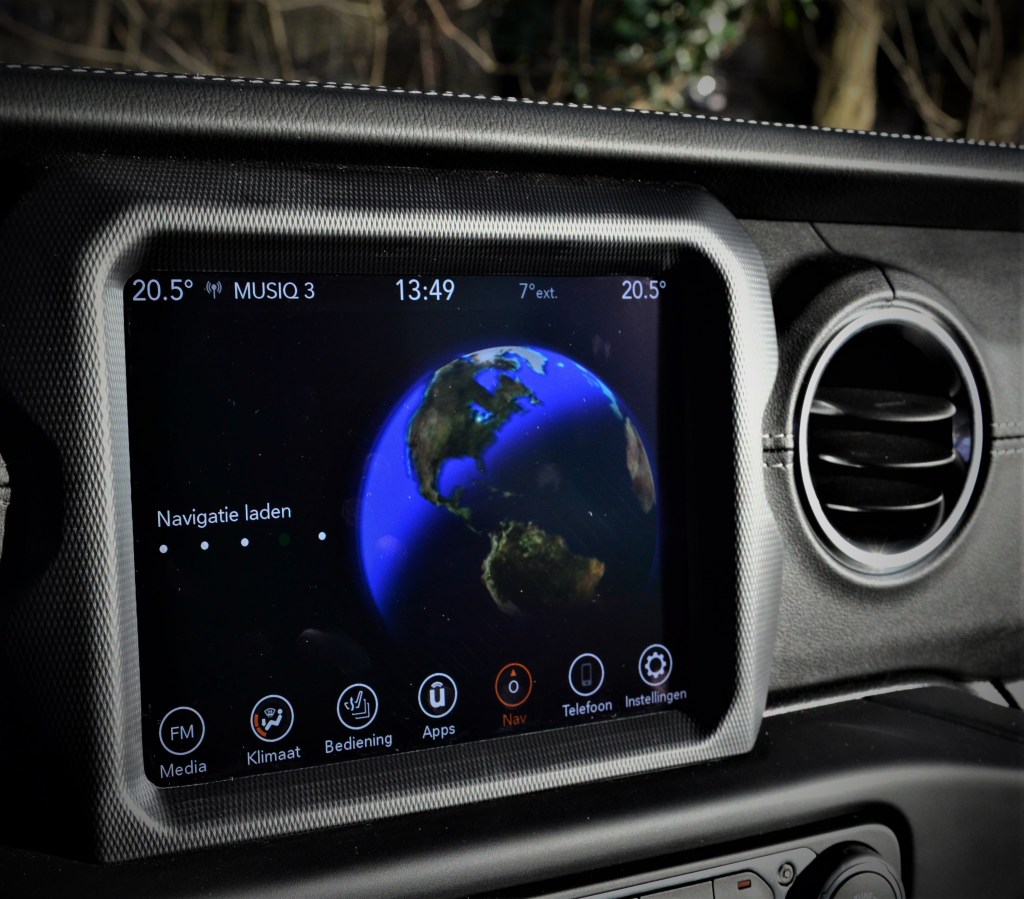
The central console also features a 7.0-inch or 8.4-inch touchscreens (both with Android auto Car Play connectivity). The fourth-generation UconnectTM system enhances the user interface and system performance with quicker start up times and improved screen resolution. The LED display is full-colour and allows the driver to configure information in more than 100 ways. All the functions are intuitive, well explained, utterly logical and we can say this is a car which you can use in its more than basic functions without ever having to look at the manual.
Going for that unique driving experience…
Pushing the dashboard weather sealed starting button lets the latest generation 2.2-litre MultiJet II turbo diesel jump to life. A state of the art diesel unit, with second-generation MultiJet technology, four valves per cylinder, belt-driven Double Over Head Camshafts (DOHC), 2,000-bar Common Rail injection system, solenoid injectors and a variable geometry turbocharger (VGT). It is good for 200 horsepower at 3,500 rpm and a torque of 450 Nm at 2,000 rpm. Enough to propel the Wrangler from 0 to 100 km in 9,6 seconds and push it further to a top speed of 180 km/h. But in everyday driving, you just enjoy the massive torque which is artfully passed on to the wheels by a supersmooth and alert 8 speed automatic. The Wrangler invites you to adopt a relaxed and anticipatory driving style, with the engine humming along hardly above 2000 rpm. Urban driving is a pleasure: you are sitting high above the traffic, and you are almost always well noticed by many other road users, as its imposing dimensions impress but find sympathy with many. Indeed, the Wrangler is quite popular, and as soon as the car is parked, it collects interested and admiring looks.
So you can potter along, with the engine and transmission providing silky smooth progress. The suspension is remarkably comfortable too, and of course our damaged and potholed urban roads and pavés are just the thing for your Wrangler.
The driver satisfaction continues on the open road. Not that the Wrangler begs you to throw it around corners, but it will provide excellent stability at speed and fast corners are taken with ease. As expected it is an excellent motorway cruiser, and the high gearing keeps consumption well within very reasonable limits. Cruising at legal limits on the motorway delivers an average consumption between 6-7 liters, urban errands let the consumption rise to 9-10 litres, although a cool, fluent driving style can work wonders here. CO2 emissions are still within boundaries with 202 g/km.
Off road champion
Of course, the brave really get going when the going gets rough. There are stories (and films) about Wranger owners who pull 30 tonne trucks out of snowy ditches, and this Wrangler is a true champion off-road. The terrain selector tells you already the story.
By shifting this dedicated lever to the 4WD High position, the driver can switch to four-wheel drive mode This 4H mode can be selected to operate either in the new “Auto” mode – ideal for any driving condition thanks to the continuous monitoring and management of the torque and the automatic engagement and disengagement of the 4WD as needed to maintain traction -, or in the 4H “Part Time” mode that ensures the torque is always evenly distributed between front and rear axles. To tackle extremely challenging and demanding off-road tracks,you can use the 4WD Low mode with a 2.72:1 low-range gear ratio that multiplies the engine torque.
We can assure you, there are no limits to what this Jeep can do. We tested this also out already for you some time earlier in the Austrian forests around Zeltweg and the muddy quarries in the region of the Lago di Garda, and you have to experience to believe it. In open forestland terrain in Belgium this Wrangler is hardly challenged, and what a delightful feeling it is that you will arrive at your destination no matter what.
Suffice to say here that two four-wheel drive systems are available on the Wrangler: Command-Trac – on the Sport and Sahara trim levels, i.e. our test car, and Rock-Trac – which is standard on the Rubicon trim configuration. Both systems feature the new “Selec-Trac” full-time two-speed transfer case for a continuous monitoring and management of the torque sent to front and rear wheels.
Creature comfort
This Wrangler is also quite a comfortable car. Not only are the seats excellent with plenty of bolster and lumbar support, the Wrangler continues to utilize the proven five-link coil suspension configuration. Front suspension features a lateral control arm and four longitudinal control arms, while the five-link rear suspension features two upper and two lower forged steel control arms for longitudinal control, and a track bar for lateral axle control.
The long suspension travel and progressive damping warrants excellent comfort, and on tarmac potholes as well as rough and rocky terrain, passengers are never unduly jolted. It is good living with the Wrangler too. Plenty of 12 V and even a 230 V plug for your electric devices, USB connections on dashboard panel and centre console, everything is at your disposal. Luggage space is quite adequate, with 533 liter minimum up to 1044 liters. Of course, there is still the roof, and Jeeps can carry a lot there too…
On top of all this, every Jeep lover knows all too well that Mopar has all the nifty accessories you always wanted, to make your Wrangler even more terrific.
Conclusion
This Wrangler really took our heart with its authenticity, its style, its on- and offroad performance, its comfort, its endearing solidity. A companion who will bring you everywhere you want, come what may. Its timeless shape will seduce you for years to come, its Euro 6d diesel engine is future (low-emission zone) proof. Last but not least a respectful right foot, which understands what proper Jeep driving is all about, will deliver you more than adequate economy, and put a broad smile on your face when you are behind the wheel in its cool and cosy cabin, cocooning while the kilometers unroll under its solid wheels.
You would never like it to stop, really, at least we never did…




























 Autoprova - for the Connaisseur