In iconic black, the original Panda is still very modern…
Your servant remembers it vividly. Back in 1980, photographing a brick stone red Panda in the Galerie de la Reine in Brussels, on an early Saturday morning. Those were the times when you could pull this off, without asking anybody. Of course we had to be quick. To make our presence a bit more official, I asked also some garcons of the nearby restaurant Aux Armes de Bruxelles – who were just putting out the tables in the early morning – to pose for me, putting some of their ornamental flower trays in the opened hatch of our Panda.
My test car’ had the zesty four cylinder 903 cc engine in the front, borrowed from the Fiat 127. It was fast with it. Top speed not less than 140 km/h.
The original Panda had soon also a4WD version…
I just loved the design of this Panda, both inside and out. Its elegant, simple, rectangular shapes, its perfectly balanced proportions still inspire. Just drive it now in chique black with beige interior through our cities.
It still is a beautiful, modern car. The car is also up to this day brimming with practicality and genial storage solutions. Fast, zesty, compact.
The future car within this same lineage of geniality is the Centoventi. We stood eye to eye with the prototype in the Centro Stile last year. More about this car later.
The Centoventi breathes the same practical spirit as the original Panda…
The present day Panda is eminently capable. We recently drove the hybrid version, just read our report… This Panda lives in the heart of many, and is since 2003 the most sold city car in Europe. And has a bright future for many years to come…
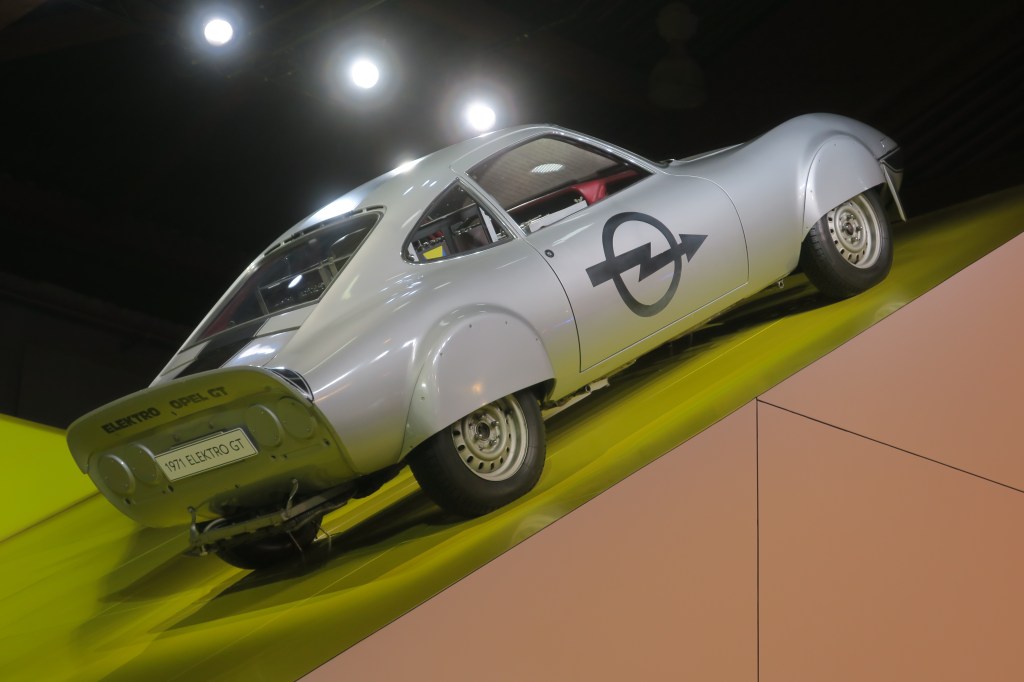
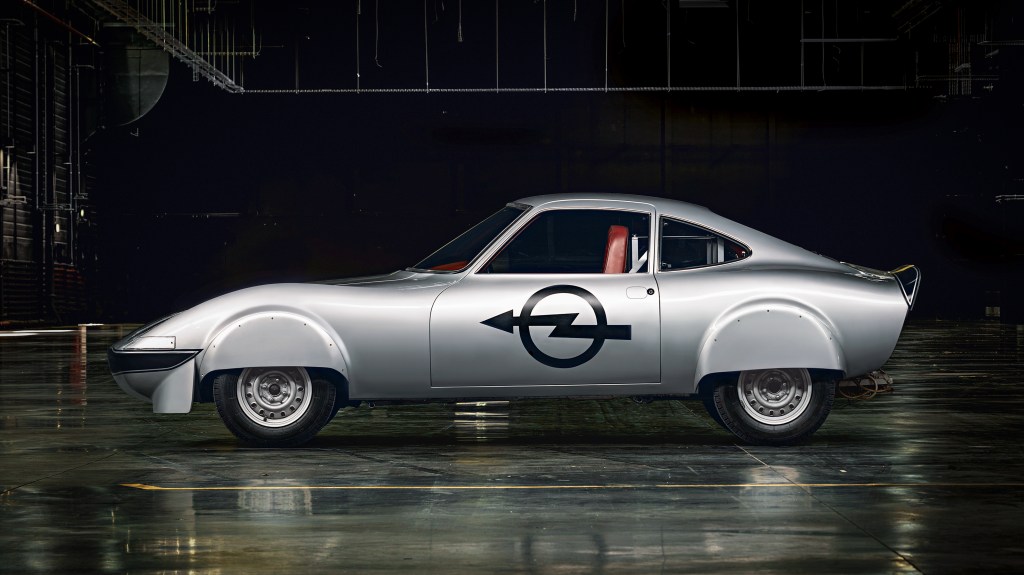
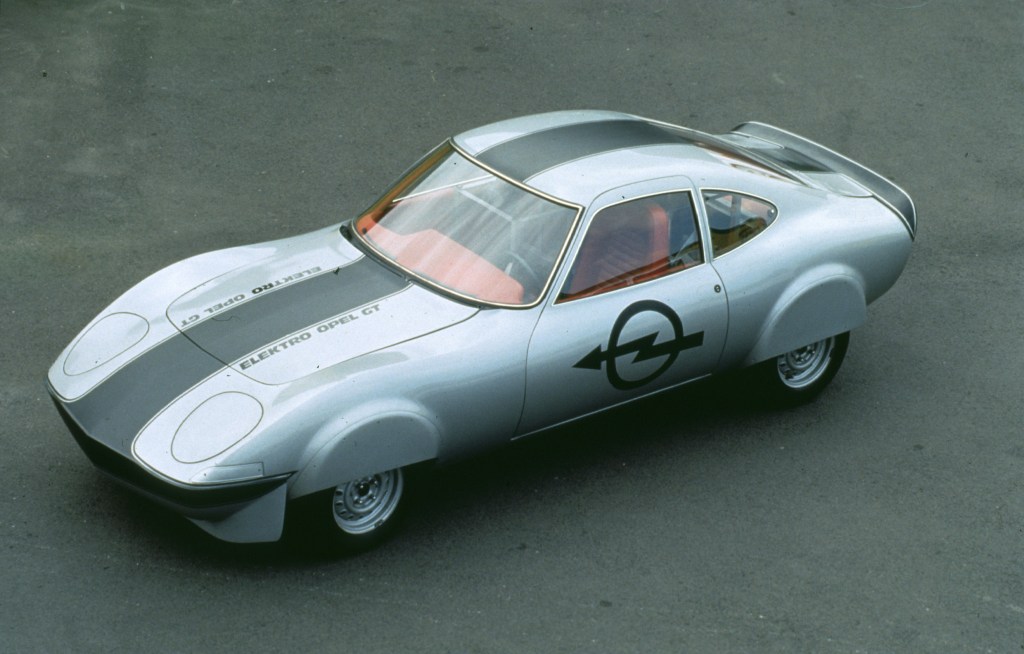
A stunning E-Opel at the latest Brussels show, with a remarkable logo…
We stood on the latest Brussels Salon eye to eye with not only the latest Opel electric cars like the Corsa-e and Grandland X plug-in hybrid, but also with a stunning looking 1971 Opel Electro GT. Clearly, Opel has been dabbling with electric cars already since five decades. At the presentation on the Brussels show by Opel CEO Michael Lohscheller of the entire Opel range, we asked him why the very photogenic “E-power” Logo on the Opel Electro GT was not used for Opel’s present E-models.
Opel Electro GT
But this aside, the early electric Opels were more than intriguing we found. So we delve a bit more in their history here…
Hans Knol ten Bensel
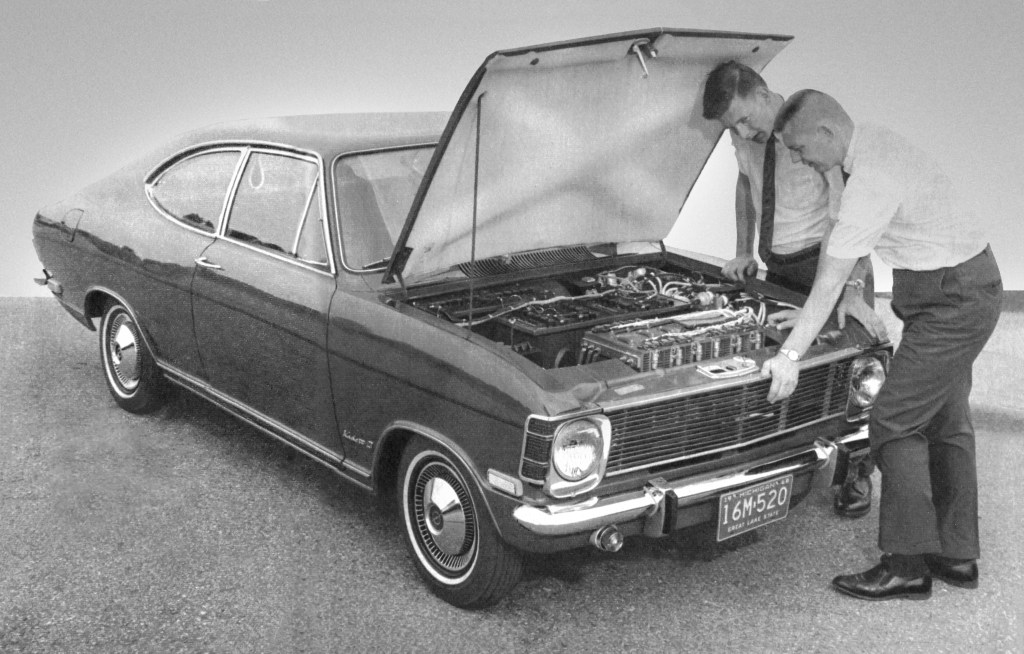
It is indeed a very long and interesting story, so we will come back on it several times. It all started back in 1968, when the Kadett B “Stir-Lec” I featured the principle of the “range extender” that would later go into production with the Opel Ampera. The “Stir-Lec” study was powered by 14 lead-acid batteries and the electricity that kept the batteries constantly charged was generated by a rear-mounted Stirling combustion engine.
Only three years later, Georg von Opel, the grandson of the company founder, broke six electric vehicle world records at the wheel of this stunning looking 188 km/h Opel Electro GT powered by two coupled electric motors producing 88 kW/120 hp. Energy was supplied by a 590 kilogramme nickel-cadmium battery pack and at a constant speed of 100 km/h, the car had a range of 44 kilometres.
I have personally sweet memories of the Opel GT. As a student but already dabbling in automotive journalism, I assisted at the presentation of the Opel GT 1900 in Port Grimaux, and was impressed by its agility on the winding roads in the Alpes Maritimes.
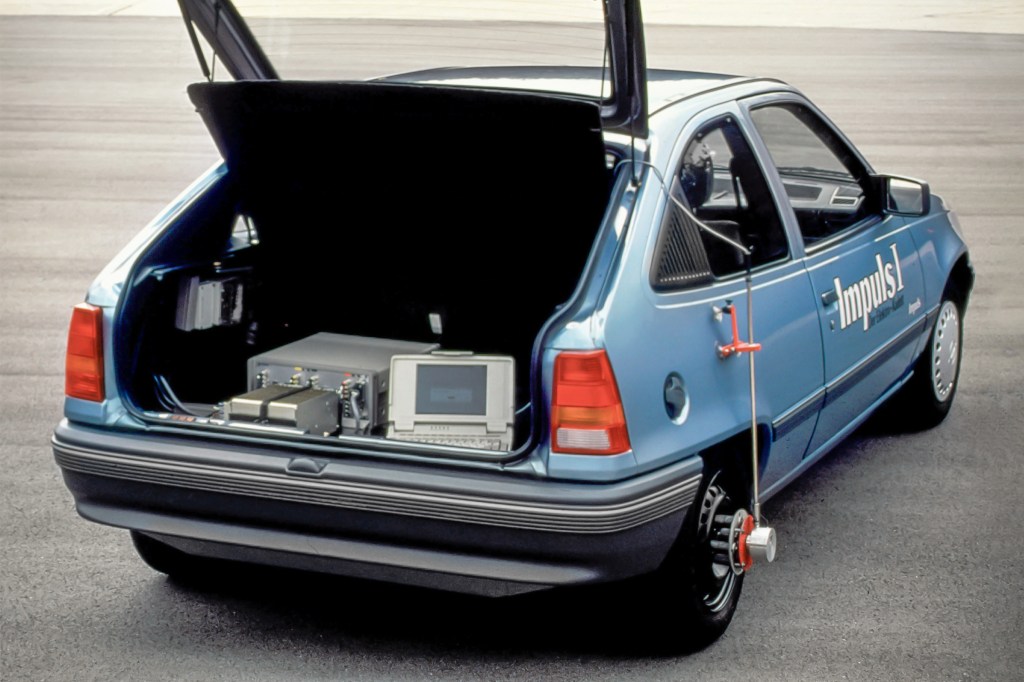
Research took a step forward with the Opel Impuls programme during 1990-97. The Impuls I was a Kadett-based vehicle powered by a 16 kW direct-current electric motor using nickelcadmium battery cells with a liquid electrolyte. It had a range of around 80 km and a top speed of 100 km/h. But more about the impuls programme later.
Opel also was keen on developing hydrogen propulsion.
In 2000, Opel’s fuel-cell development took to the streets with the Zafira-bodied HydroGen1. Its hydrogen fuel cell supplied electricity for a three-phase asynchronous motor giving 55 kW/75 hp and 251 Nm of torque. A buffer battery covered power peaks.
Arriving in Lisbon, Avenida da Torre de Belem…
In 2001, a fleet of 20 HydroGen3 models was driven by test customers. Power was increased to 60 kW/82 hp, giving a top speed of 160 km/h. In the 2004 Fuel Cell Marathon, two HydroGen3 vehicles covered nearly 10,000 km across Europe, from Hammerfest in Norway to Lisbon in Portugal. (See photo here above) At the wheel of a HydroGen3, Grand Prix and Opel DTM driver Heinz-Harald Frentzen also won the 2005 Monte Carlo Rally for cars with alternative propulsion.
A well styled gem… 13 years ago…
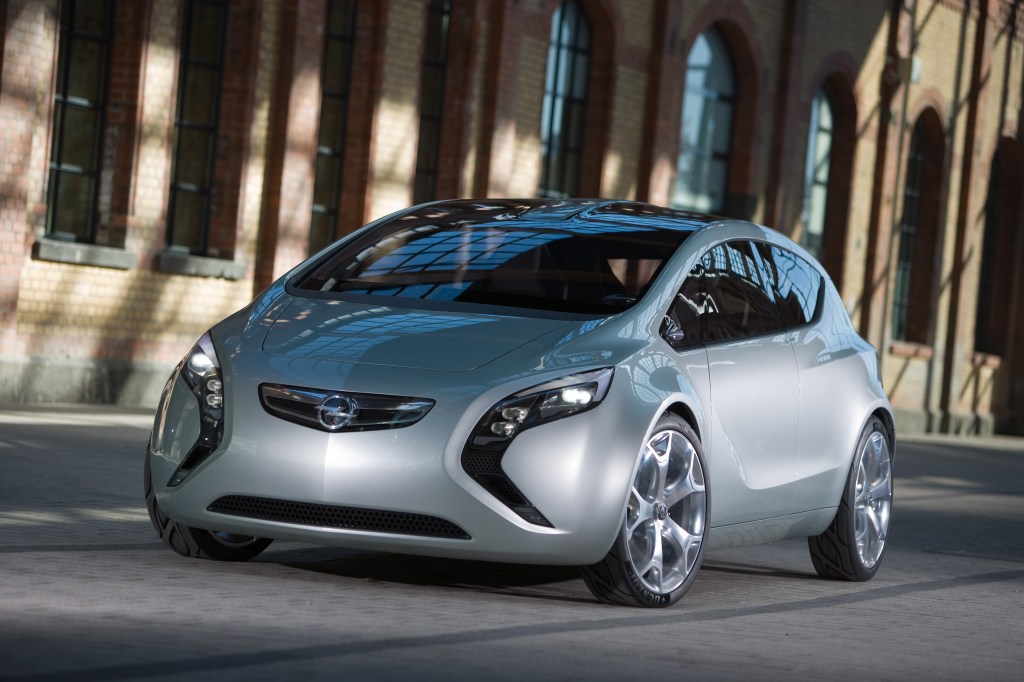
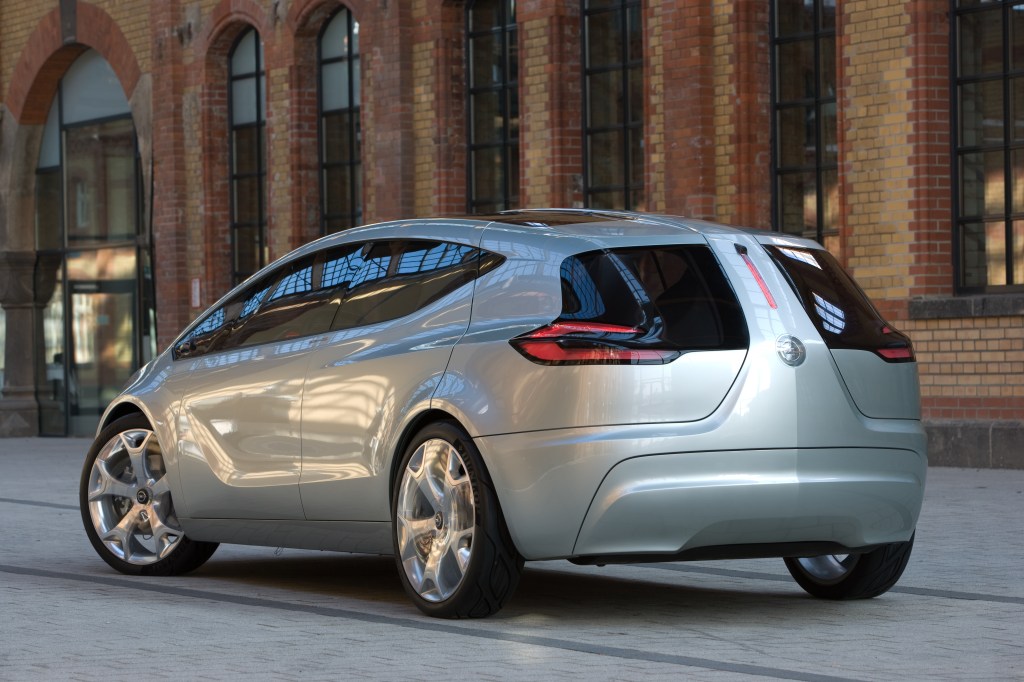
But we stumbled also on some surprisingly advanced and stylish E-cars. Indeed, Opel also pursued the development of battery-powered vehicles and presented the innovative Flextreme Concept at the 2007 IAA in Frankfurt, which featured the Voltec extended-range electric propulsion.
A harbinger of the Ampera, but more of that car in a following report.
In the meantime, just be surprised at the stunning elegance of the Flextreme…
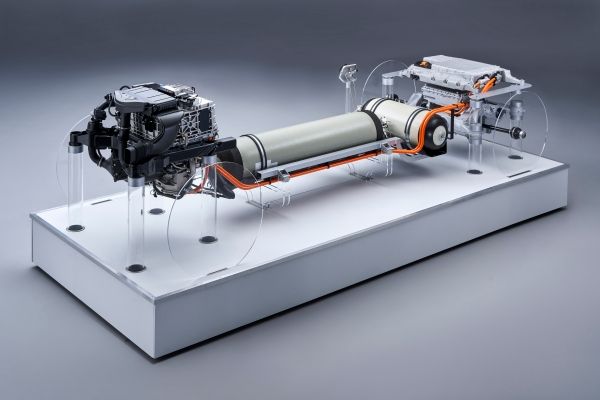
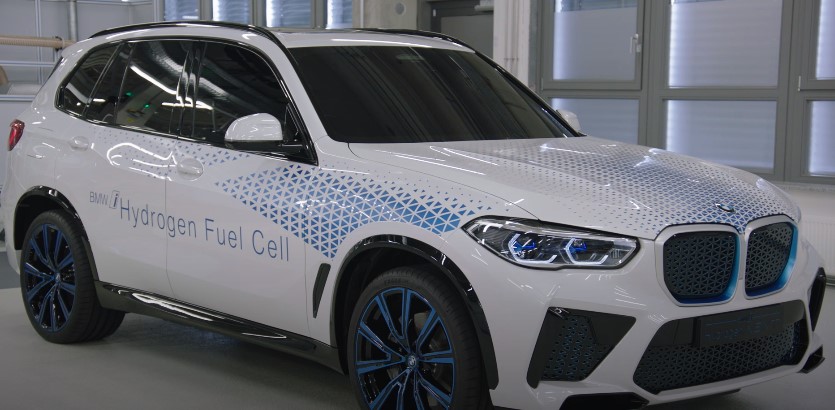
The second generation of the BMW fuel cell powertrain with a total system output of 275 kW will be piloted in the BMW i Hydrogen NEXT from 2022
BMW continues to look at alternative powertrain technologies. Did you know that the BMW Group is teaming up with the Toyota Motor Corporation as part of a successful partnership that dates back to 2013?
The two manufacturers have joined forces to work on fuel cell powertrain systems and scalable, modular components for hydrogen fuel cell vehicles under a product development cooperation agreement.
Fuel cells from the cooperation with Toyota will be deployed in the BMW i Hydrogen NEXT, alongside a fuel cell stack and overall system developed by the BMW Group.
As well as partnering on the development and industrialization of fuel cell technology for the mass market, the two companies are also founding members of the Hydrogen Council. A wealth of other leading companies in the energy, transport and industrial sectors have joined the Hydrogen Council since 2017, swelling its ranks to over 80 members.
According to Klaus Fröhlich, Member of the Board of Management of BMW AG, Research and Development, the hydrogen fuel cell technology could quite feasibly become the fourth pillar of our powertrain portfolio in the long term. The upper-end models in the extremely popular X family would make particularly suitable candidates here.
Not for the immediate future…
A customer offer powered by hydrogen fuel cell technology will be brought to market at the earliest in the second half of this decade. There are many good reasons for this cautious but realistic approach. “In our view, hydrogen as energy carrier must first be produced in sufficient quantities at a competitive price, using green electricity. Hydrogen will then be used primarily in applications that
cannot be directly electrified, such as long-distance heavy duty transport,” said Klaus Fröhlich. The requisite infrastructure, such as an extensive, Europe-wide network of hydrogen filling stations, is also lacking at present.
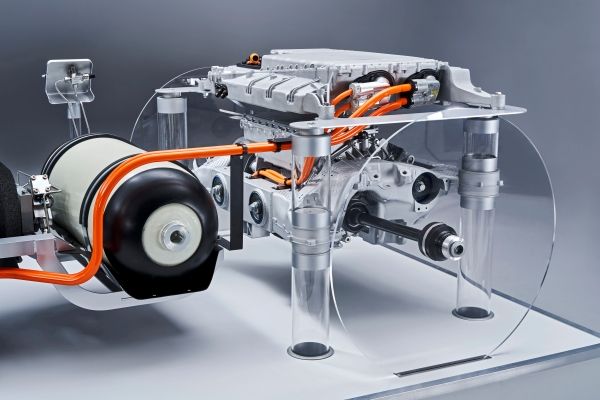
Initial technical details of the powertrain for the BMW i Hydrogen NEXT.
The BMW i Hydrogen NEXT will be propelled by the 5th generation e-machine, which will first be launched in the BMW iX3. The peak power battery located above the e-drive unit can supply boost power for additional dynamics, e. g. when overtaking. The total system output is 275 kW.
“The fuel cell system for the powertrain for the BMW i Hydrogen NEXT generates up to 125 kW (170 hp) of electric energy from the chemical reaction between hydrogen and oxygen from the ambient air,” explains Jürgen Guldner, Vice President of Hydrogen Fuel Cell Technology and Vehicle Projects at the BMW Group.
This means the vehicle emits nothing but water vapour. The electric converter located underneath the fuel cell adapts the voltage level to that of both the electric powertrain and the peak power battery, which is fed by brake energy as well as the energy from the fuel cell.
The vehicle also accommodates a pair of 700 bar tanks that can together hold six kilograms of hydrogen. “This guarantees a long range regardless of the weather conditions,” notes Guldner. “And refuelling only takes three to four minutes.”
The fifth-generation eDrive unit set to make its debut in the BMW iX3 is also fully integrated into the BMW i Hydrogen NEXT.
The peak power battery positioned above the electric motor injects an extra dose of dynamics when overtaking or accelerating. The total system output of 275 kW (374 hp) fuels the typical driving dynamics for which BMW is renowned. This hydrogen fuel cell electric powertrain will be piloted in a small series based on the current BMW X5 that the BMW Group plans to present in 2022.
The BMW i Hydrogen NEXT will be propelled by the 5th generation e-machine, to be seen first in the BMW iX3.
We just let you look at the photos here, giving you a detailed look into the hydrogen future…
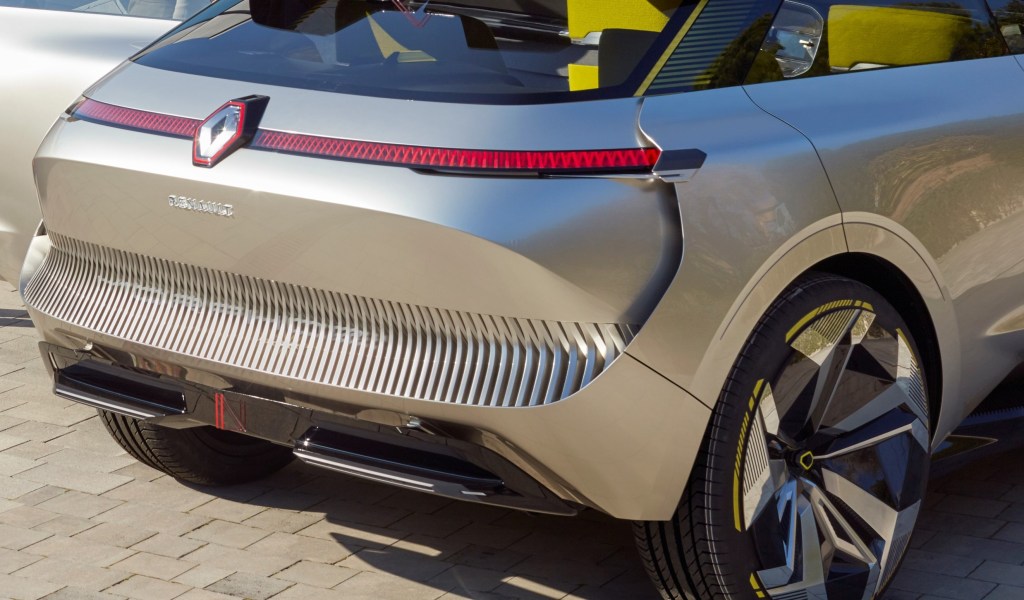
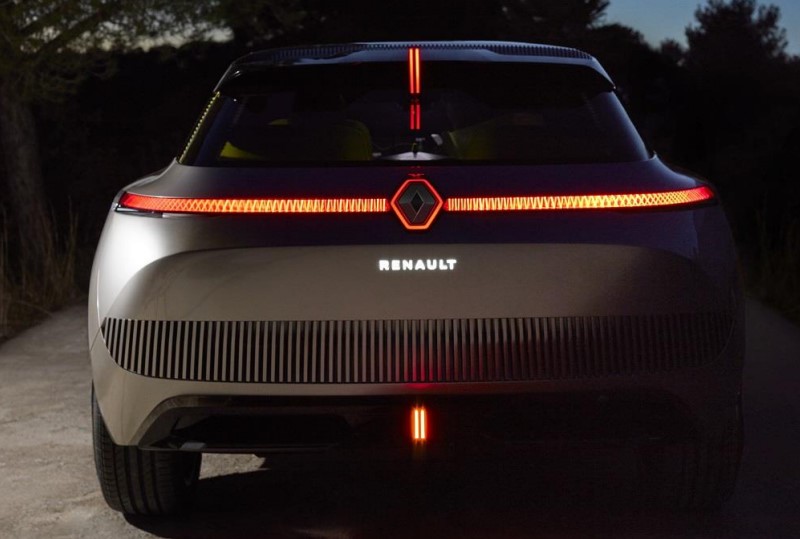
The futuristic car on the photo here embodies Renault’s vision of personal, shareable electric mobility in the years beyond 2025. It’s called the MORPHOZ.
It draws on the Alliance’s new modular CMF-EV electric platform to offer several configurations not only of power, capacity and range, but also of user options and boot space too.
Faithful to the brand’s DNA, the MORPHOZ concept embodies the Family petal of Renault’s ‘Life Flower’ design strategy, which is based around the stages within a person’s life.
However, it is not only just a vision of mobility. In its design, details and interior presentation, this MORPHOZ also heralds a new family of Renault electric models for the coming years.
The Renault MORPHOZ uses a brand new 100% electric modular platform
that we call CMF-EV.
Like the CMF-B platform which was inaugurated last year by the Clio and used on the New Captur, CMF-EV has been developed by the Alliance. It allows us to design, build, adjust and fine-tune electric vehicles more easily than with a platform designed for internal combustion engines (ICE) or for mixed ICE/electric applications.
The platform’s architecture allows a long wheelbase with wheels at the very corners of the vehicle, reduced overhangs and a flat floor. With a streamlined battery, the CMF-EV platform allows to design vehicles that are closer to the ground, with a lower roof and the all-important improvement in aerodynamic performance. The low centre of gravity is also a bonus thanks to the location of the batteries below the rear floor.
MORPHOZ, a personal vehicle that can be tailored to requirements
Renault MORPHOZ is a 100% electric adaptable crossover concept car which charges by induction even as it is being driven.
It is connected and equipped with level 3 autonomous driving functions. Like the SYMBIOZ concept unveiled in 2017, this is a personal vehicle which now boasts specific sharing functions.
2020 – Renault MORPHOZ
The high adaptability of the MORPHOZ concept-car is demonstrated by the physical transformation that occurs between its two versions: the short “City” one and the long “Travel” one.
The vehicle is in fact capable of adapting itself to the way its users live, be it for daily use or, for example, holiday travel. To achieve this, the City version is fitted with just the right battery capacity to meet day-today requirements, while the Travel version can accommodate the extra capacity needed for long distances on motorways, for example.
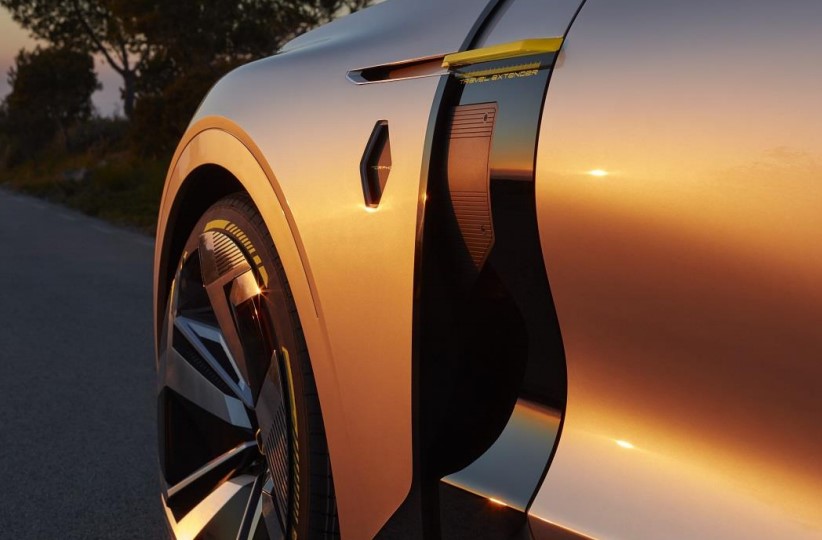
Although it is very slender in the City version, the vertical section of the front wing on the MORPHOZ expands in the Travel version as the vehicle’s bodywork and wheelbase lengthen.
Although its primary role is to display the capacity meter of the onboard batteries, its black and yellow finish also makes it stand out from the rest of the bodywork.
The City version
The short City version of the Renault MORPHOZ is 4.40 metres long. At 2.73 metres, its wheelbase is a record for such a vehicle length,so that it can easily house the 40 kWh of batteries that are fitted as standard.
The long Travel version of the Renault MORPHOZ is 4.80 metres long. Its wheelbase is proportionately longer at 2.93 metres to allow it to accommodate the additional battery capacity and provide a spacious interior. It can thus carry extra batteries that provide 50 kWh of power (total capacity of 90 kWh) and offer more leg room for the passengers, along with enough space for two more suitcases. In addition, this version – which benefits from a specific light identity – has a specific tapered
front-end and profile to improve its aerodynamic performance for long distances.
A very clever car, brimming with further smart solutions for its passengers, more about this in a next report…
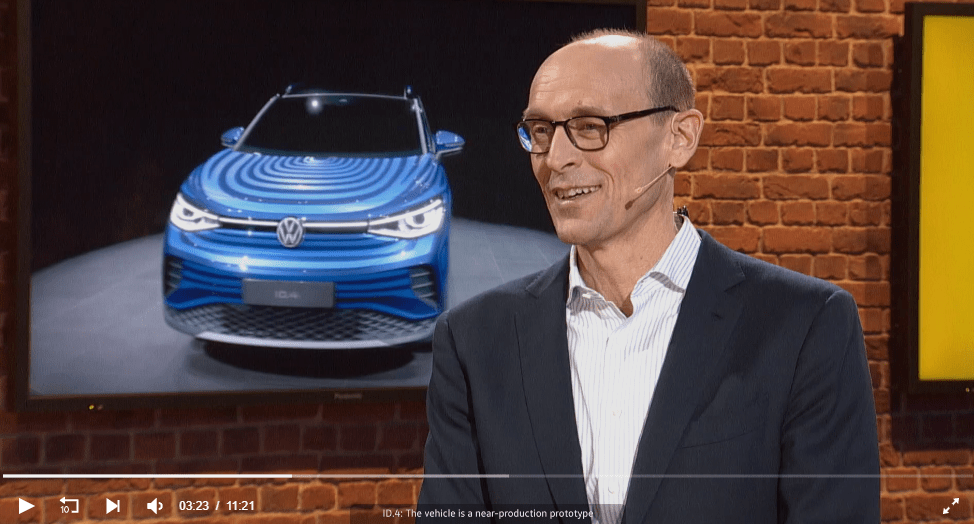
Ralf Brandstätter, Chief Operating Officer of the Volkswagen Brand, presents here the ID. CROZZ showcar
We are living in digital times. So even when the Corona virus limits (temporarily, as we all hope) our present mobility, and led to the cancellation of the Geneva Motor Show, we can still see all the automotive news via our PC’s, Phones, Tablets.
Ralf Brandstätter, Chief Operating Officer of the Volkswagen Brand, presents here the ID. CROZZ showcar, which now evolves into its series production version, the ID.4.
Volkswagen is forging ahead with its electric mobility strategy by providing a detailed insight into the brand’s first all-electric SUV. The new ID.4 will be launched this year. Following in the tracks of the ID.3, the countdown has already begun for the second model based on the new modular electric drive matrix (MEB). “Just like the ID.3, the ID.4 will also come onto the market as a carbon-neutral vehicle”, explains Ralf Brandstätter, Chief Operating Officer of the Volkswagen brand. “We will produce and sell the ID.4 in Europe, China and the U.S..”
Just read on for more VW news…
Hans Knol ten Bensel
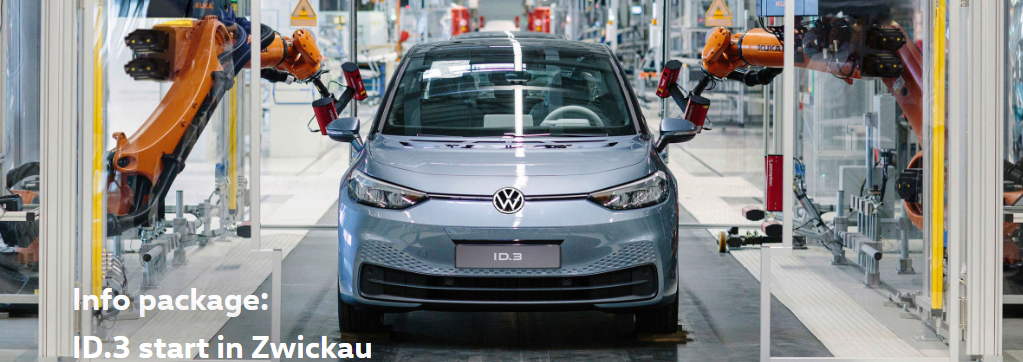
The ID. 3 started production in Zwickau, the ID.4 now follows…
The ID.4 will initially be launched with rear-wheel drive, while an electric all-wheel drive version will be added to the portfolio at a later date. The high-voltage battery is positioned near the center of the underbody to create a low centre of gravity and an optimum in terms of driving dynamics, along with an extremely well-balanced axle load distribution.
Also new mild and plug-in hybrid drives…
For Volkswagen, the ID.4 and ID.3 represent important milestones in the brand’s bid to become entirely carbon-neutral by 2050 – in line with the Paris climate agreement. Plans have been put in place to reduce the Volkswagen fleet’s CO2-emissions by a third by as early as 2025.
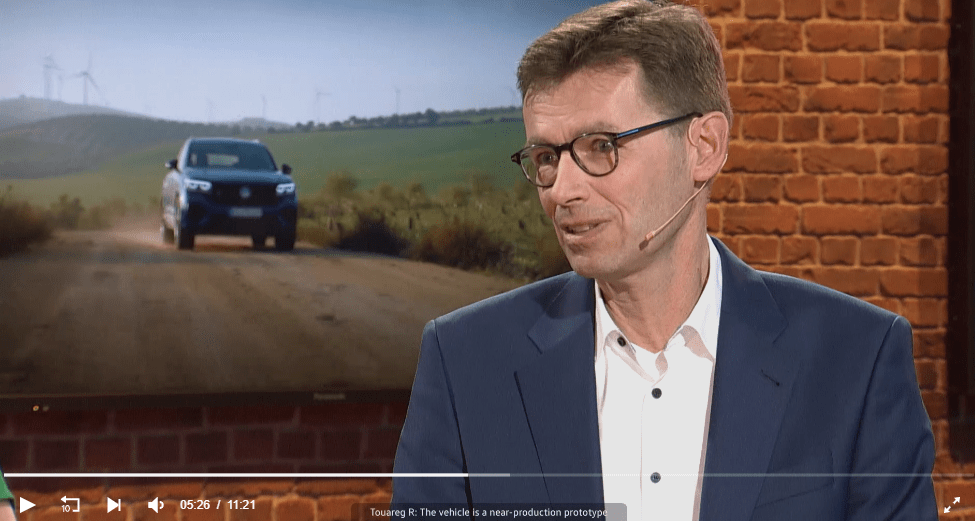
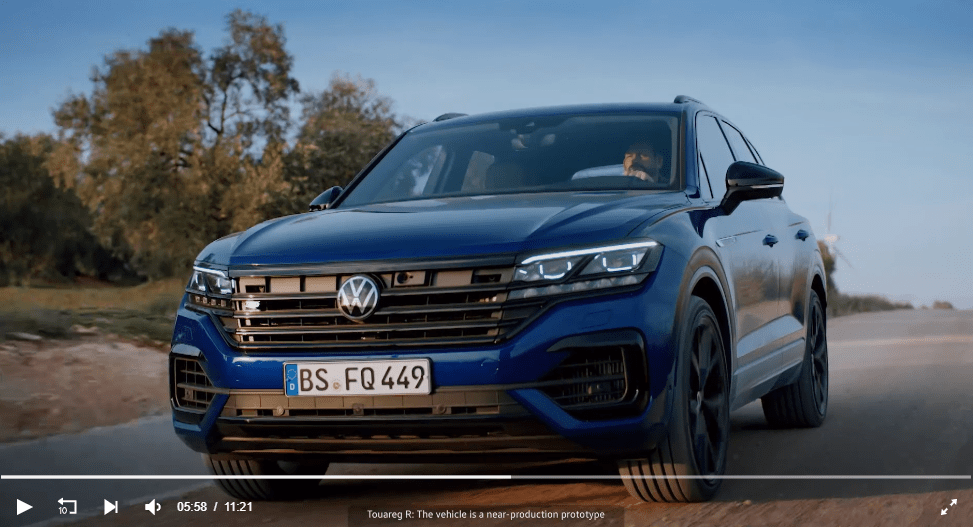
Dr. Frank Welsch, Member of the Board of Management of the Volkswagen Passenger Cars Brand with responsibility for Technical Development, presents in the webcast the new Touareg R
Volkswagen is currently investing one billion euro to electrify its model range while also offering an increasing number of hybrid vehicles. This is based on the fact that, just like electric powertrains, new mild and plug-in hybrid drives in large-scale product lines such as the all-conquering Golf will significantly help to reduce fleet emissions in the future.
New Touareg R
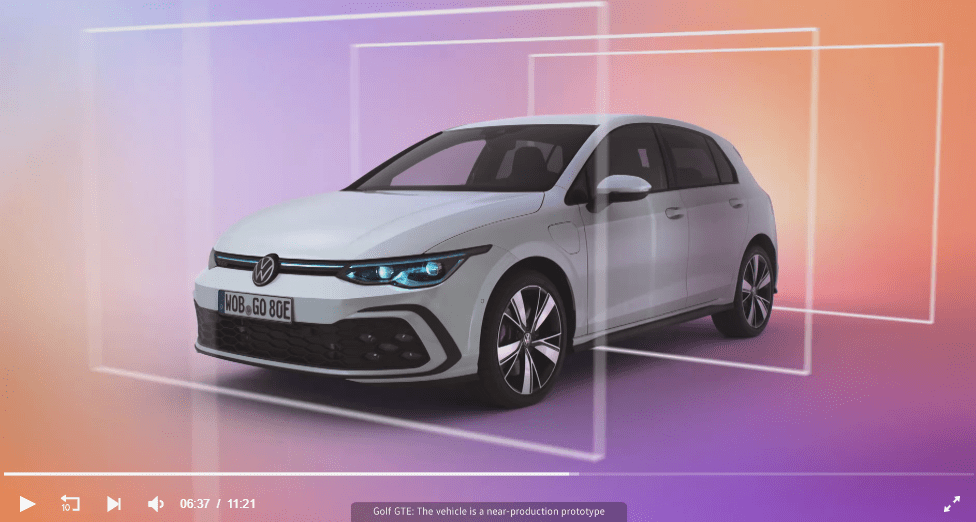
This is why the company’s focus during the webcast is not only on ID. models, but also on new Volkswagen models with hybrid drive. Dr. Frank Welsch, Member of the Board of Management of the Volkswagen Passenger Cars Brand with responsibility for Technical Development, presents in the webcast the new Touareg R with plug-in hybrid technology and the the Golf GTE 2 for the very first time.
The Touareg R,the most powerful Volkswagen model will in future also be powered by an efficient plug-in hybrid system. The alliance between an electric drive motor generating 100 kW (136 PS) and a V6 turbocharged petrol engine (TSI) with an output of 250 kW (340 PS) develops a system output of 340 kW (462 PS). The battery capacity of the Touareg R with a top speed of 140 km/h in all-electric E-MODE has been designed so that most average daily commuting distances can be covered with zero emissions.
Golf GTE with stronger battery…
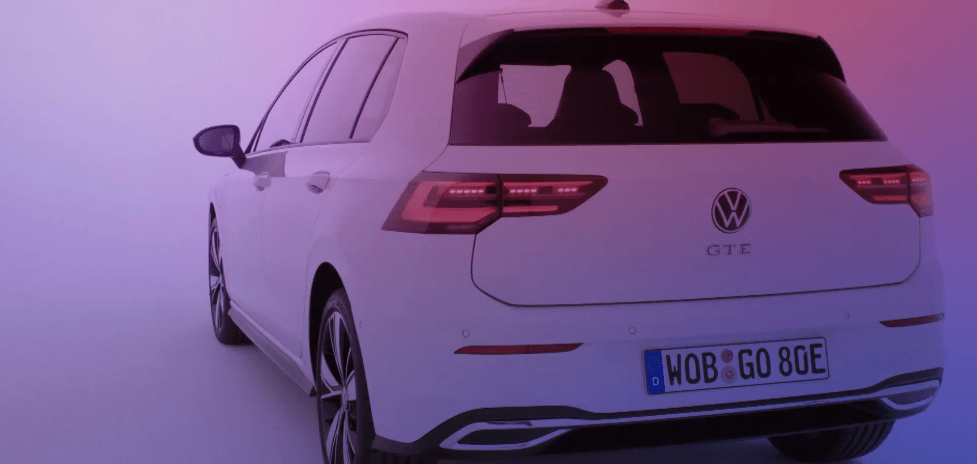
The same applies to the new Golf GTE – its plug-in hybrid drive has been geared towards performance and consists of an electric drive motor with 85 kW (115 PS) and a four-cylinder turbocharged petrol engine (TSI) generating 110 kW (150 PS). As a unit, the electric drive motor and the TSI develop a system output of 180 kW (245 PS). The new Golf GTE’s top speed in all-electric mode is 130 km/h.
Further Volkswagen highlights include the new Golf GTD, which generates significantly lower nitrogen oxide emissions compared with its predecessor thanks to innovative twin dosing technology, plus the eighth generation of the Golf GTI, produced more than 2.3 million times. The most recent version is powered by a 180 kW (245 PS) 2.0-litre turbocharged direct injection engine. The maximum torque is 370 Nm. The four-cylinder engine is coupled with a 6-speed manual gearbox as standard.
Last but not least, the eight generation of the GTI takes the central stage, presented again by Ralf Brandstätter, Chief Operating Officer of the Volkswagen brand. It is a formidable performer, this GTI, and A 7-speed dual clutch gearbox (DSG) is optionally available.
Digital instruments for the GTI for maximum performance…
We include here some screenshots of the webcast, and stay tuned for more!
The Brussels motor show is always a unique event. Last but not least because this is a true buyers’ show, to be taken in the literary sense: about 30 % of the annual car sales in our country is done on the grounds of the Motor Show!
“Our” show is also unique because all the brands are present here in Brussels. First of all because no car manufacturer wants to miss the sales opportunity, but also because the Brussels show is also an ideal “test” market, it allows brands to assess what global (European) market share they can achieve overall and for their respective models individually, judging by their penetration in the Belgian market, where no national brands can distort the situation in our market place.
We took a walk through some of the stands, and here follows our report, where we focus on the brands we did not yet discuss already in our show preview, starting here with BMW.
Hans Knol ten Bensel
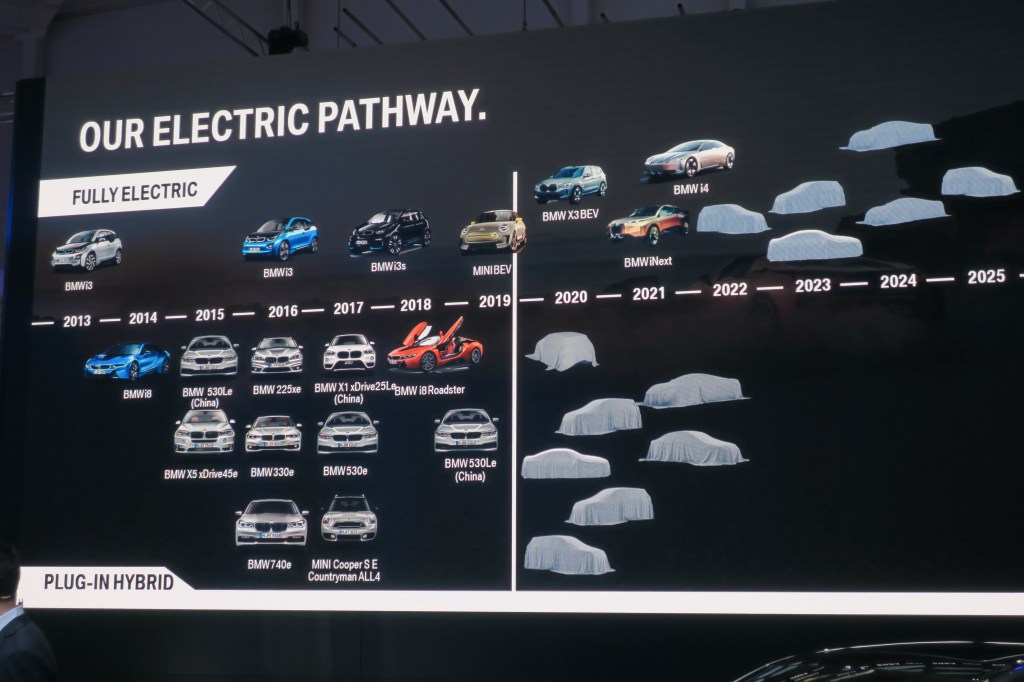
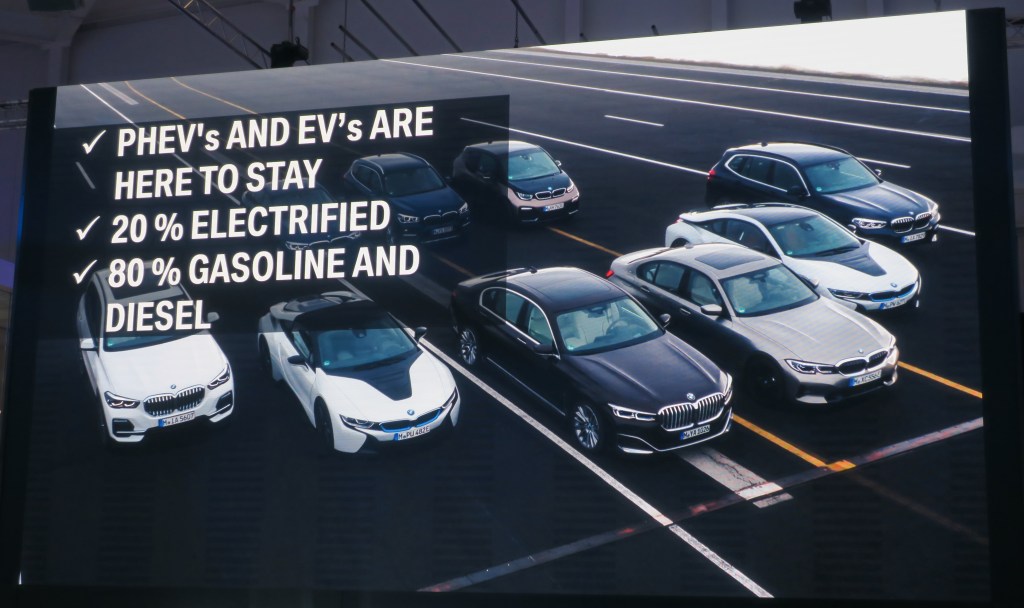
BMW and MINI unveiled two world premieres with respectively the BMW plug in hybrid versions for the X1 and the X2 models, the BMW X1 xDrive25e and the new BMW X2 xDrive25e. BMW is pushing its electrification very hard forward, and on the accompanying photo you can see the table they displayed at the show, showing the further steps they are taking towards an electrified future. An electric drive and a lithium-ion battery enable an electrically powered range of up to 57 kilometres in the two new plug-in hybrid models. In the near future, four BMW X models with plug-in hybrid drive will be available. BMW intends to have more than one million vehicles with electrified drive on the road by the end of 2021.
The plug-in hybrid system of the new BMW X1 xDrive 25e and the new BMW X2 xDrive25e consists of a 1.5 litre 3-cylinder petrol engine with BMW TwinPower Turbo Technology and an electric drive specially developed for this model. It is taken from the eDrive technology modular system of the BMW Group. The petrol engine mobilizes a peak output of 92 kW/125 hp and a maximum torque of 220 Newton meters. It transfers its power to a 6-speed Steptronic transmission and drives the front wheels.
The electric motor generates an output of 70 kW/95 hp and delivers 165 Nm of torque to the rear wheels via a single-speed transmission. This makes for a hybrid specific all-wheel drive…Together the combustion engine and electric motor produce a system output of 162 kW/220 hp. The maximum system torque of both drive units is 385 Nm. The new BMW X1 xDrive25e accelerates from 0 to 100 km/h in 6.9 seconds. The new BMW X2 xDrive25e does the 0 to 100 km/h sprint in 6.8 seconds. The top speed of the new BMW X1 xDrive25e is 193 km/h. Maximum speed of the new BMW X2 xDrive25e is 195 km/h.
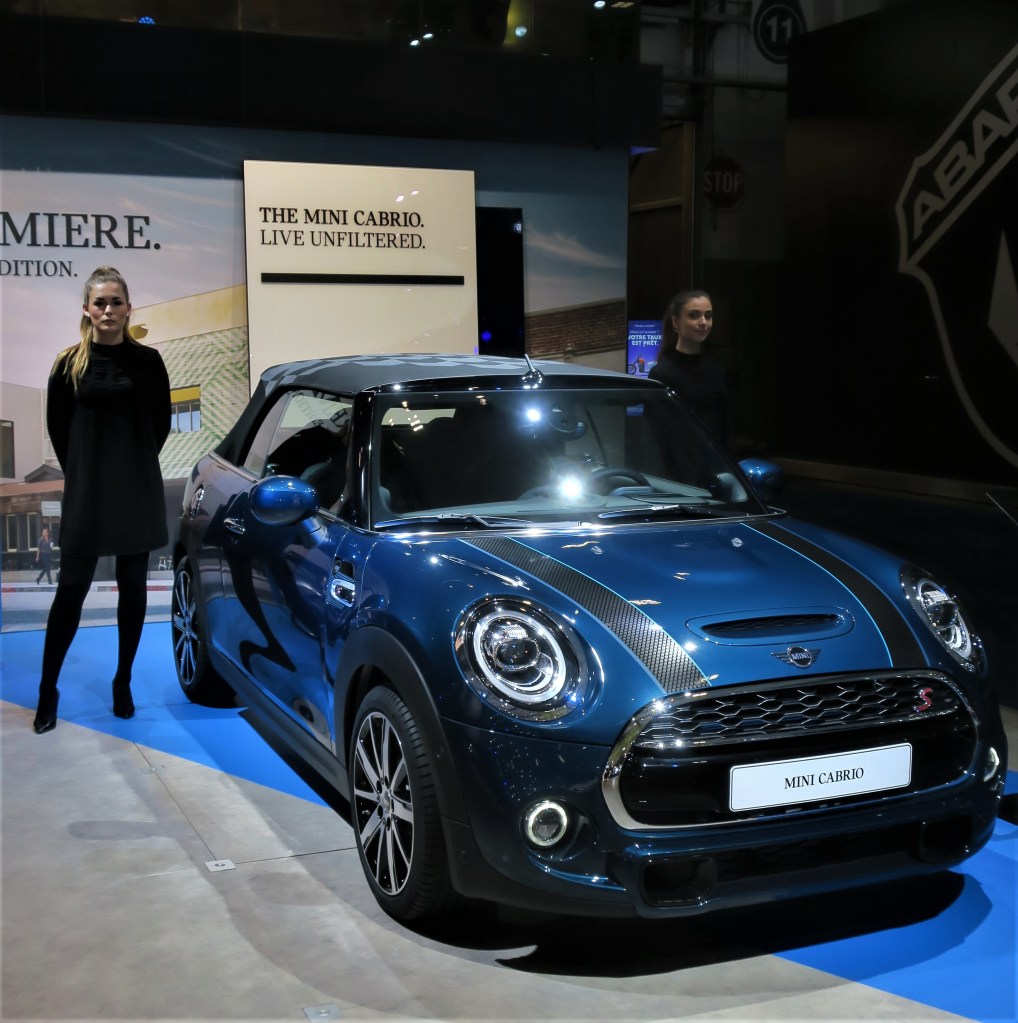
The MINI crowd was also spoiled with a world first of a Sidewalk Edition of the MINI convertible. The MINI is already cute, desirable and truly iconic, and a cabrio version adds to all the pleasure a MINI can offer its driver and occupants. Variants of the exterior paintwork, soft top design, rim styling and interior fittings are developed especially for the edition model. The version of the fully automatic textile soft top, specially designed for the edition model, can be opened or closed electrically and almost silently in 18 seconds. It features an artistically woven-in arrow graphic in the particularly high-quality finish typical of MINI Yours. The 17 inch light-alloy Scissor Spoke 2-tone wheels of the new MINI Convertible Sidewalk are also a model-specific design feature. There are also the side indicator bezels, known as side scuttles, which bear the “Sidewalk” model designation.
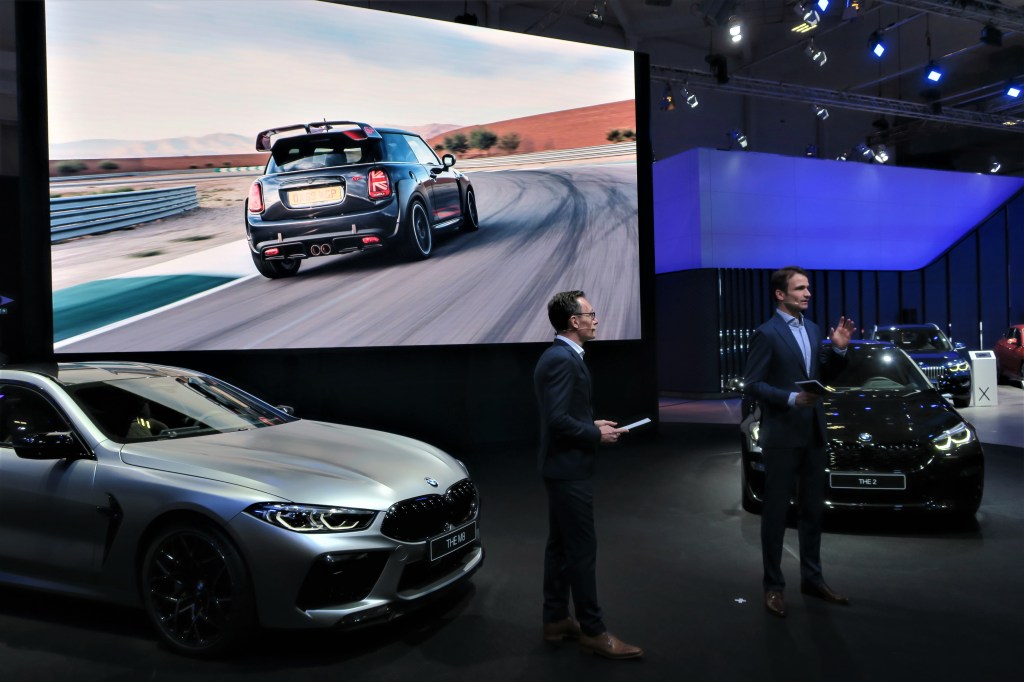
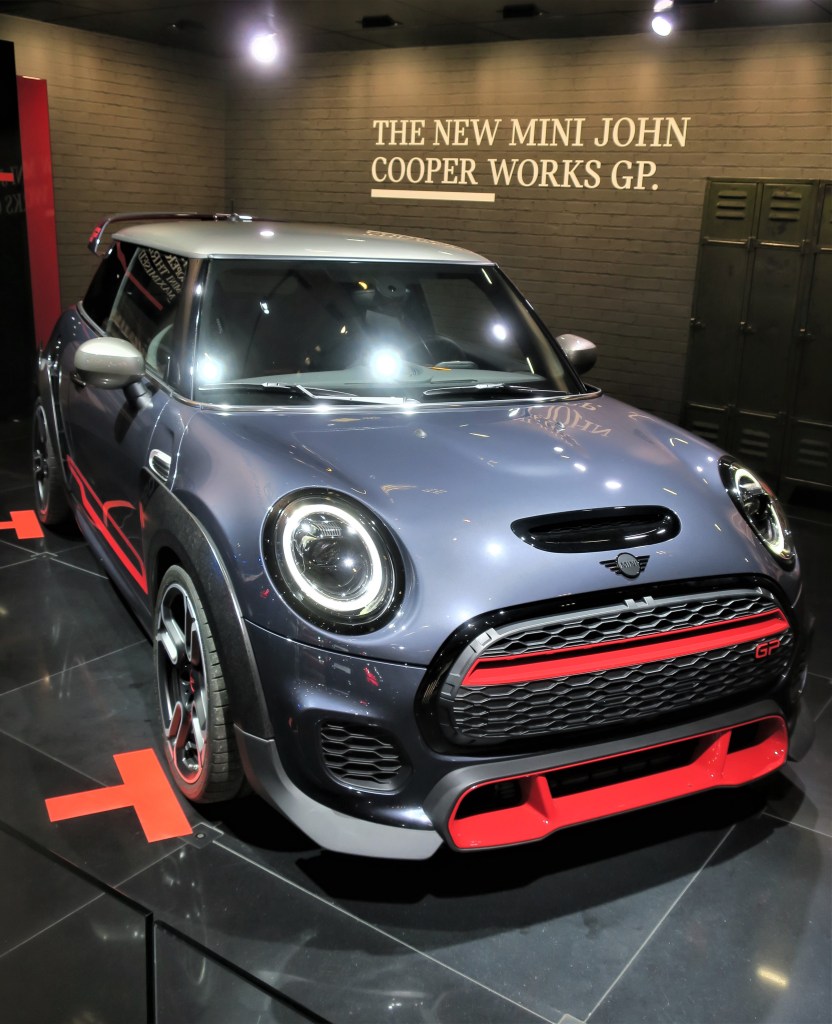
Presenting the MINI John Cooper Works GP and the M8 Gran Coupé
Three engine versions are available, The new MINI One Convertible Sidewalk develops 75 kW/102 hp from the 1.5 litre 3-cylinder engine. The new MINI Cooper Convertible Sidewalk is also powered by a 1.5 litre 3-cylinder engine which produces 100 kW/136 hp. The 141 kW/192 hp 4-cylinder engine of the new MINI Cooper S Convertible Sidewalk provides the sportiest fresh air experience.
European premieres for BMW and MINI
There were also European firsts in Brussels, like the BMW 2 Series Gran Coupé, interesting as it is beautiful, and we are certainly keen to drive one soon to tell you more about it. The same goes for the BMW M8 Competition Gran Coupe. It has a 200 mm longer wheelbase makes extra room for the rear passengers.
Furthermore there is the insipring MINI John Cooper Works GP, with a 4 cylinder 306 HP engine, catapulting this Mini from 0 to 100 km in merely 5,2 seconds. It is produced in Oxford in 3000 units, and is on sale from March 2020.
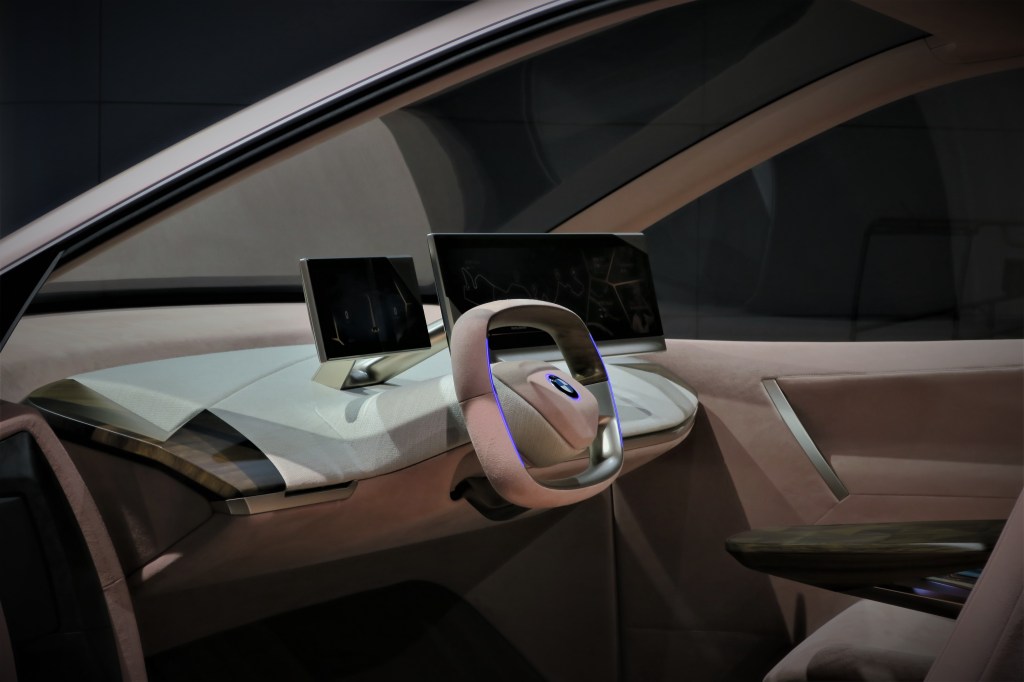
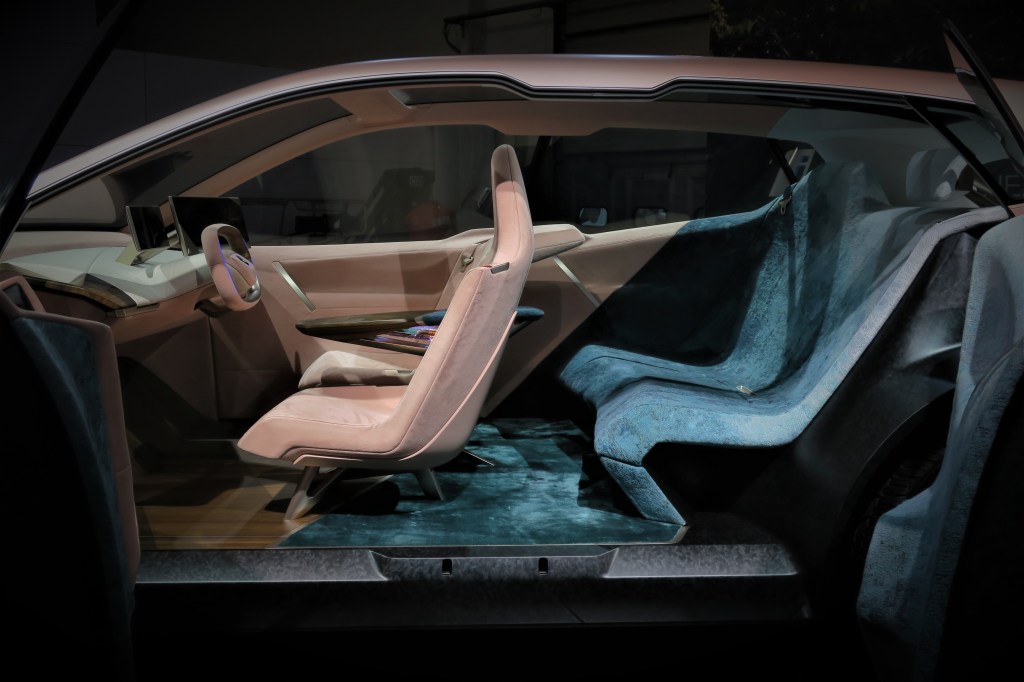
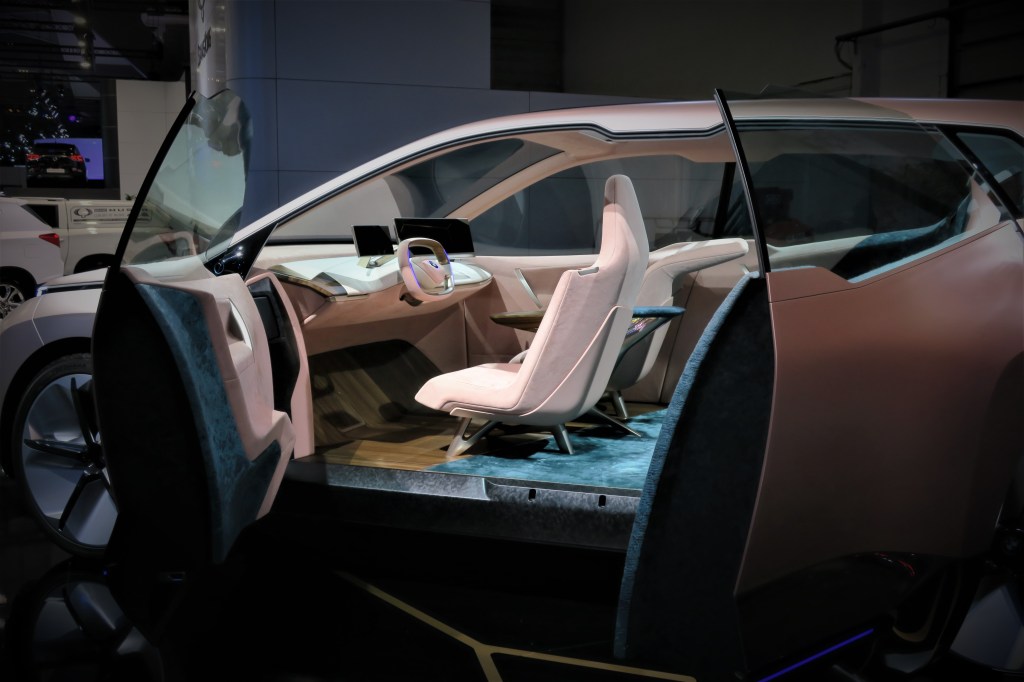
Things to come: The Vision INEXT dashboard…
The BMW BMW X5 M and X6 M have their Belgian premières, the 4,4 litre V8 is good for 625 hp and this formidable engine makes these cars sprint form 0 to 100 in merely 3,8 seconds. Last but not least there is the Belgian first of the MINI electric, or the 3-door MINI Cooper SE.
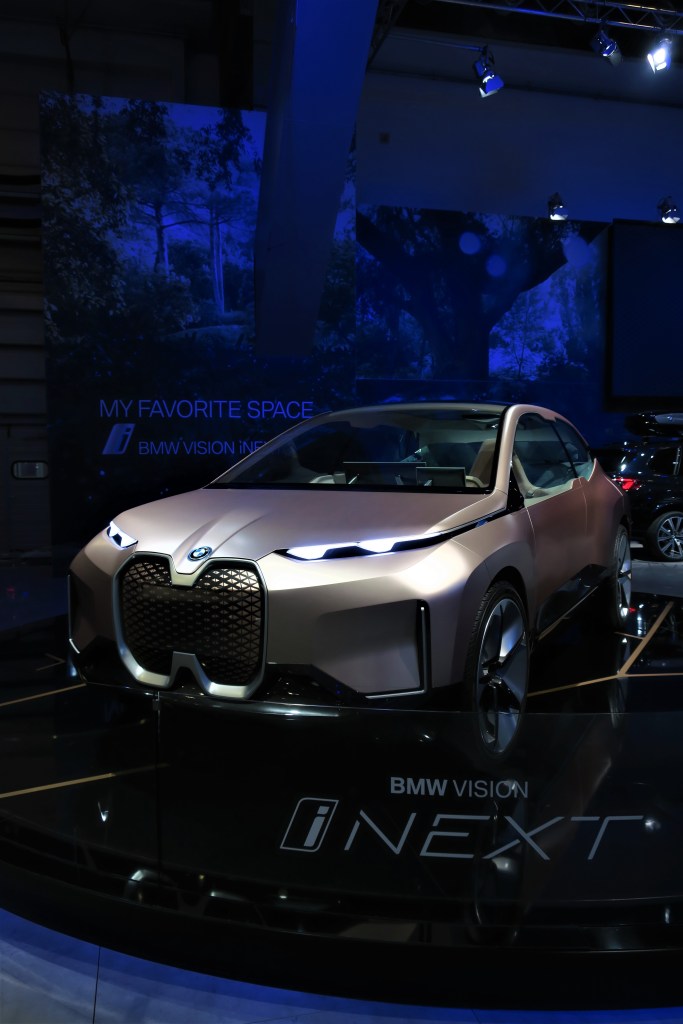
On the stand, we stood also eye to eye with the BMW Vision iNEXT, the optical highlight of the exhibition stand, which also showcases the interior design principle “My Favorite Space” with harmonious, natural surfaces and technology that is kept discreetly out of sight.
Just look at the photos here… which answers the question: “What will cars look like when they no longer have to be driven by a person, but still can be?” The interior can be a place for relaxation, interaction, entertainment, or concentration, as preferred. It is more like a comfortable and fashionably furnished “living space” on wheels – a new “Favorite Space”. A new design principle, referred to as “Shy Tech”, plays an especially important part in this.
To preserve the high-end, yet cozy character of the rear compartment, and place its occupants center-stage, the intelligent technology behind the operating controls is integrated out of sight. It only becomes visible and operable when required by the driver or passengers…
Soon more about other brands and novelties we saw on the Brussels show…
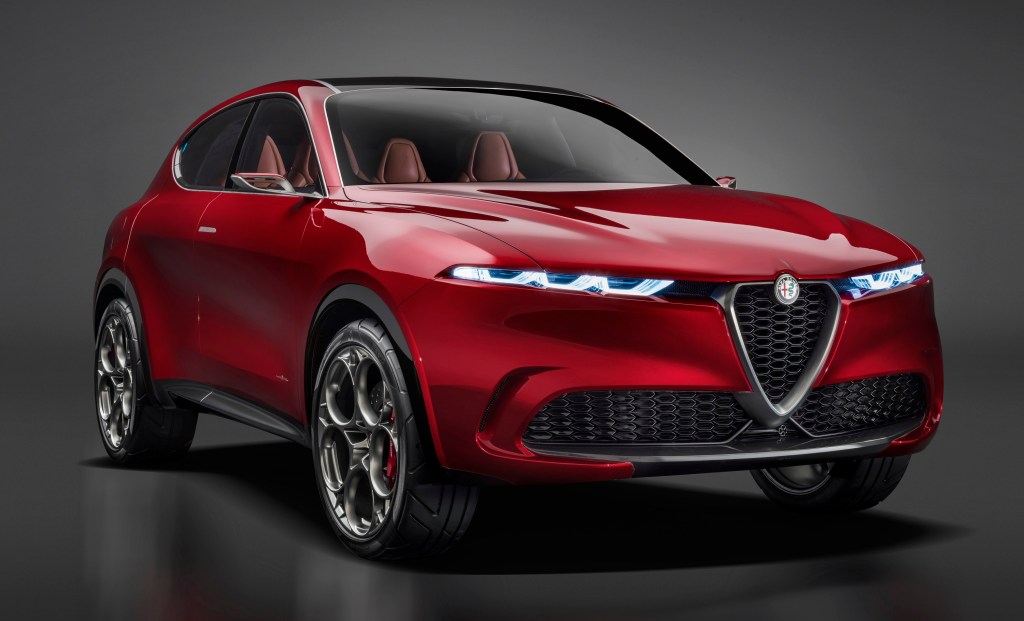
Faithful readers will remember that we stood in the FCA Centro Stile eye to eye with the stunning design concept car, the Alfa Romeo Tonale. For those lucky ones who will be invited to the gala evening and attend the press day on January 9, we have good news : it will be on show on that day in the Hall 7 of the Brussels Salon…
Hans Knol ten Bensel
Indeed, you can admire it for one day in Hall 7 of the Motor Show buildings, and you will see its design language close up. This is rather important, as its shapes will be seen back in the second SUV which will bear the Alfa Romeo badge.
Its expressive design and compact shape bode well for the future styling of Alfa’s, whilst maintaining and even rather enhancing and accentuating further the organic Alfa styling DNA of the past. One only has to look at the formidable 21-inch alloy wheels, which evoke the “telephone dial”, a pure execution of the circular theme of the wheel itself. It was first seen in the 60’s and proudly carried by the Alfa 33 stradale. The wheel design has been further enhanced by special custom-made Pirelli’s…
The lateral profile of the car is reminiscent of the shapes of the Duetto and Disco Volante Spider, and the “Linea GT” profile of the Tonale is a modern day interpretation of the shapes seen on the GT Junior.
The “Trilobo” front end bears proudly the “Scudetto” grille, and the “3 + 3” headlights remember proudly the SZ and the Brera.
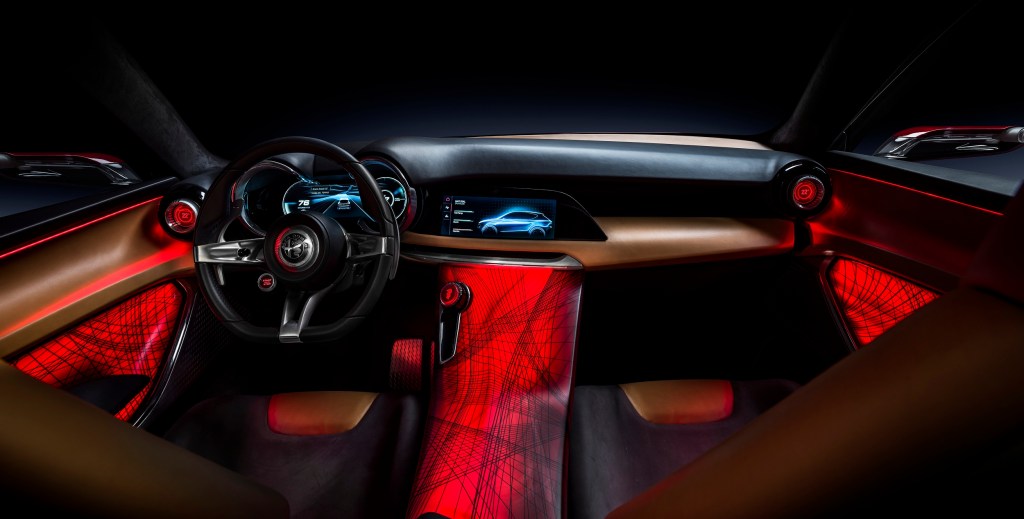
The cabin shapes have a distinct thoroughbred touch, and the materials are rich and inviting, with transparent panels in the centre console, and of course the DNA driving mode elector is a prominent element.
The Tonale is named after the Tonale mountain pass, which lies not far from the iconic Stelvio pass, and is equally breathtaking with eternal snow and water falls. Just come to admire it in Brussels…on the 9th of January. If you missed it, there is always a nice consolation for you: you can admire on the following days instead the new Giulia MY 2020…
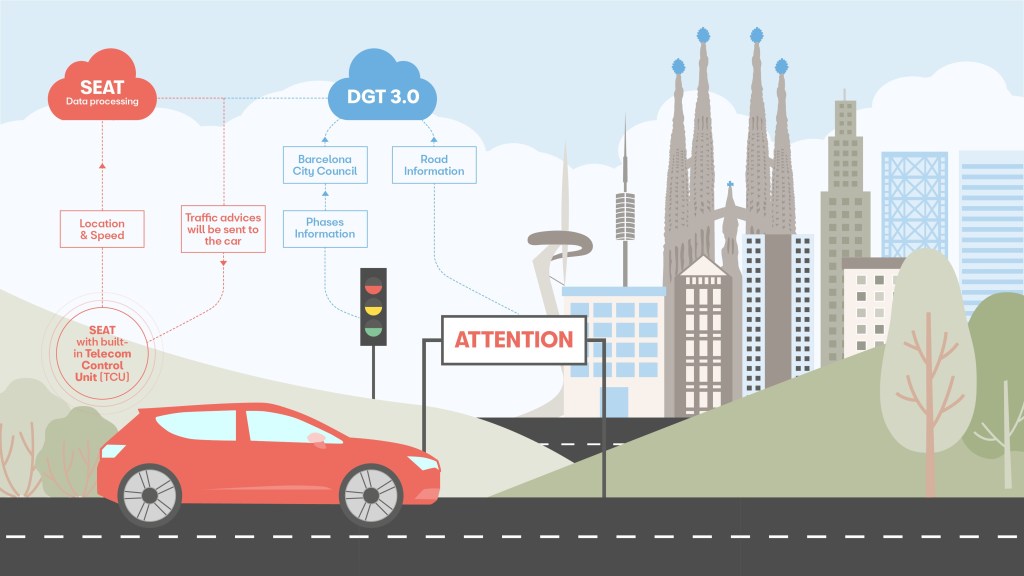
We all know the frustration: however slow or fast you accelerate from a traffic light, the next one will always be red, even if, as it happens so often, this next light is only a few hundred metres away. We all know too well how much energy is wasted with this. Seat now started a project together with the Spanish Traffic Authority, the Barcelona City Council and ETRA.
It successfully connects vehicles with traffic lights and the traffic control centre so drivers can anticipate their upcoming status. This project also enables information on motorway incidents to get sent directly to vehicles without the need for information panels, bringing cars and infrastructure together via the cloud using cellular technology with latency times of 300 milliseconds.
Oh so clever!
Hans Knol ten Bensel
Vehicles connected with traffic lights and road infrastructure.
The vehicle used in this pilot project is equipped with the necessary technology to connect with its surroundings and receive information uploaded by the Traffic Authority to the cloud, which in turn enables the driver to anticipate what lies ahead in real time.
“In this project, SEAT’s new connected cars receive real-time traffic information from the Traffic Authority’s central cloud, including information displayed on motorway panels or the traffic light status in cities”, explains Jordi Caus, the Head of Urban Mobility Concepts at SEAT.
How does it work?
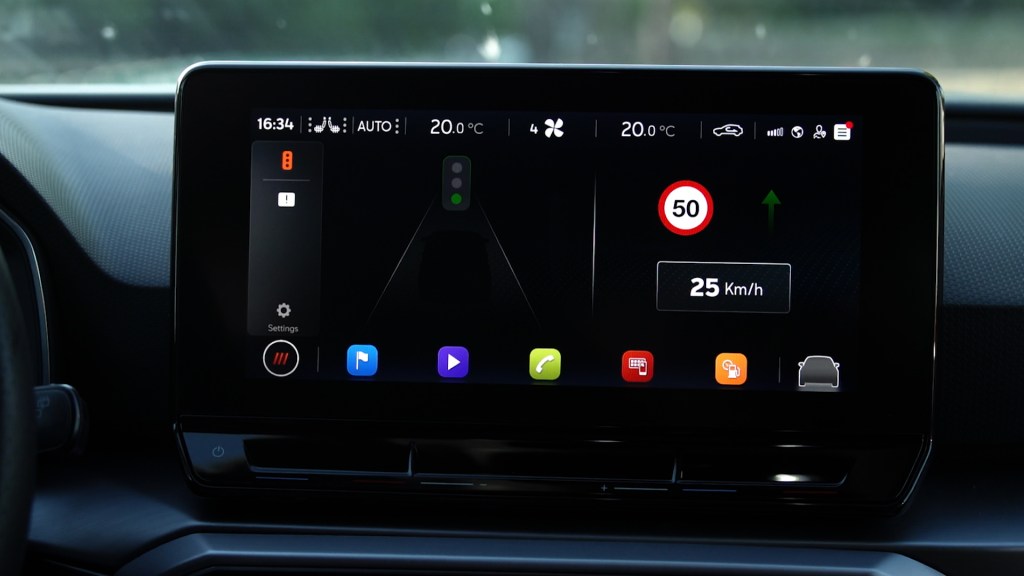
When a vehicle is approaching a traffic light, an alert appears on the screen showing whether it will be red, green or yellow when it arrives, as the system performs a calculation based on how far away the car is and the speed it is travelling at. One important note for safety is that it only works as long as the vehicle is not exceeding the speed limit. “The system does not work at above maximum speeds, which is very important for road safety. It wants to be an auxiliary tool that enables motorists to drive more smoothly”, assures Manuel Valdés, the Head of Mobility and Infrastructures at the Barcelona City Council.
Information panels in your car, too.
Today there are 2,000 information panels in Barcelona that provide drivers with traffic and weather conditions or information about road work or accidents. With this system, all this information is displayed directly on the screens of connected vehicles at any point of the road network. According to Jorge, “we can accomplish the same as what we used to do with variable message signs on the motorway, but now directly to the car from any point on the road.”
A future of collaborative information…
In addition, connected cars and users themselves will also be information suppliers. “Anyone with information about what happens on the road can share it, so other users will know in advance of any incident when they reach the same point”, explains Jorge.
“With this project we’re taking a first step to connect cars with overall traffic infrastructure. We’ve begun with information functions, but with the future autonomous vehicles in mind we’ll be able to act directly on the car in situations of risk”, concludes Jordi Caus.
At the Brussels press conference, the new Juke was under cover… before its premiere
The Brussels Motor Show approaches at a rapid pace, and in the coming weeks the car world is receiving the automotive media community to have a look at the new year and the models it will exhibit at the show.
Nissan Belux was the first to hold its annual reception, and also took the occasion to present the new Juke.
A tall standing Urban Coupé with fluid, inviting lines…
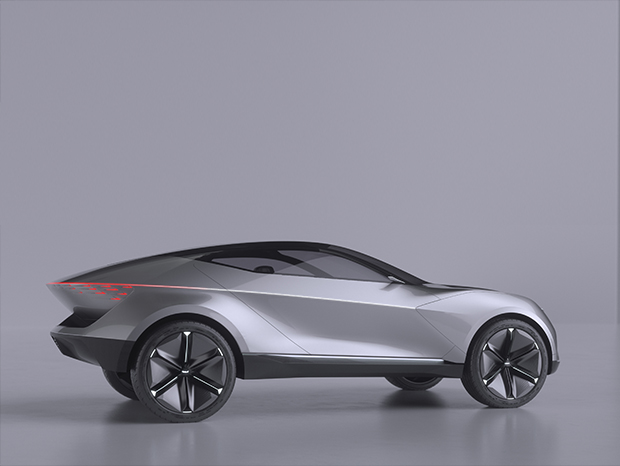
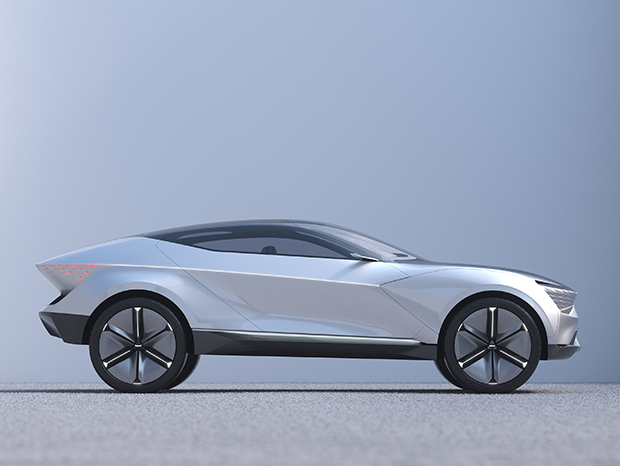
Kia recently showed a stunning electric coupé with novel proportions. This Futuron made its public debut at the 2019 China International Import Expo (CIIE) in Shanghai. Its low-profile SUV coupe body makes a strong statement of intent for Kia’s future cars, which will be – as the manufacturer puts it – confident, sporty and modern, yet also elegant. At 4,850 mm in length, 1,550 mm tall and with a 3,000 mm-long wheelbase, it has an elevated ground clearance is matched with a low, lean body to create a dynamic, confident posture.
It is indeed a sports car… on an SUV platform. Clever.
Because this makes – like for instance in the Audi e-tron – room for the
batteries to be lodged beneath the cabin floor. The advantage is also that the elevated
stance of the car is therefore matched with a low center of gravity.
And that slightly more elevated stance is just what
you want in an urban car, even if it has the sleek shape of a coupé.
Just read further…
Hans Knol ten Bensel
This “E”-Coupé
is powered by four powerful in-wheel electric motors. This e-AWD
system delivers as you can expect lively responses to driver inputs.
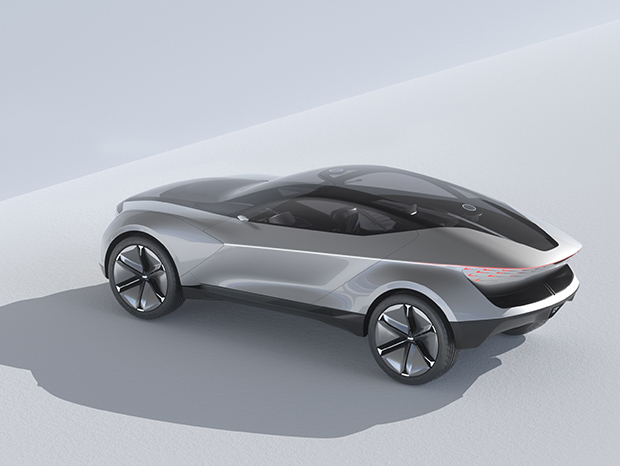
But the important hallmark here is its fluid, intriguing design. The front fender flows backwards from the front of the hood before plunging into the cabin itself, establishing a connection between the driving seat and the road ahead. The concept’s roof is a diamond-shaped panoramic glasshouse which sits atop the 360-degree core, in the best traditions of UFO and flying saucer design. It floods the cabin with natural light, and it also extends down the bonnet to give drivers an unparalleled view ahead. The glasshouse also incorporates a network of LiDAR (light detection and ranging) sensors capable of providing Level 4 autonomous driving features, enabling hands-off and eyes-off driving in most conditions.
Furthermore, the 360-degree theme is evident in the
lighting that illuminates a sharp character line encircling the Futuron’s body.
A new “tiger” face…
The newly-designed front of the car, like that of the
Imagine by Kia Concept first revealed earlier in 2019, expresses a new design interpretation for Kia’s future
electric vehicles.
With a wider ‘tiger face’ shape, the grille
incorporates the Futuron’s headlamps, an innovative ‘Star Cloud’ design which
gives the car a dazzling new night-time identity.
Flexible cabin space…
The layout of the electric powertrain and
incorporation of Level 4 autonomous
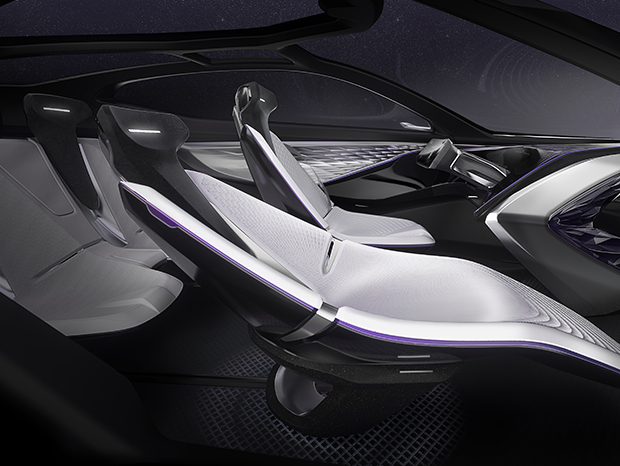
driving systems has enabled the creation of a spacious and flexible cabin
unlike any other vehicle on roads. The two
front seats are created out of flexible materials and can offer an upright
‘driving’ position, or a reclined ‘rest’ position, similar to the flexibility
afforded to first-class airline passengers. With the activation of the
Futuron’s autonomous driving features, the two front seats recline as the
steering wheel retracts. The ‘zero-gravity’ seating position this creates helps
to reduce fatigue on long journeys.
One of the most prominent features of the cabin is the
‘cockpit’ area surrounding the driver. The graphical user interface (GUI) of
the cockpit flows out of the driver-side door and wraps around the steering
wheel in a seamless arc. This merges the instrument cluster directly with the
audio-visual display at the center of the dashboard and is linked to the
display integrated within the surface of the steering wheel itself.
The GUI is operated by artificial intelligence
technologies, displaying useful information about the car various autonomous
driving, powertrain and navigation features, which creates a unique user
experience.
This is, according to Kia, what driving into the
(urban) future is all about. Just look at the photos here…