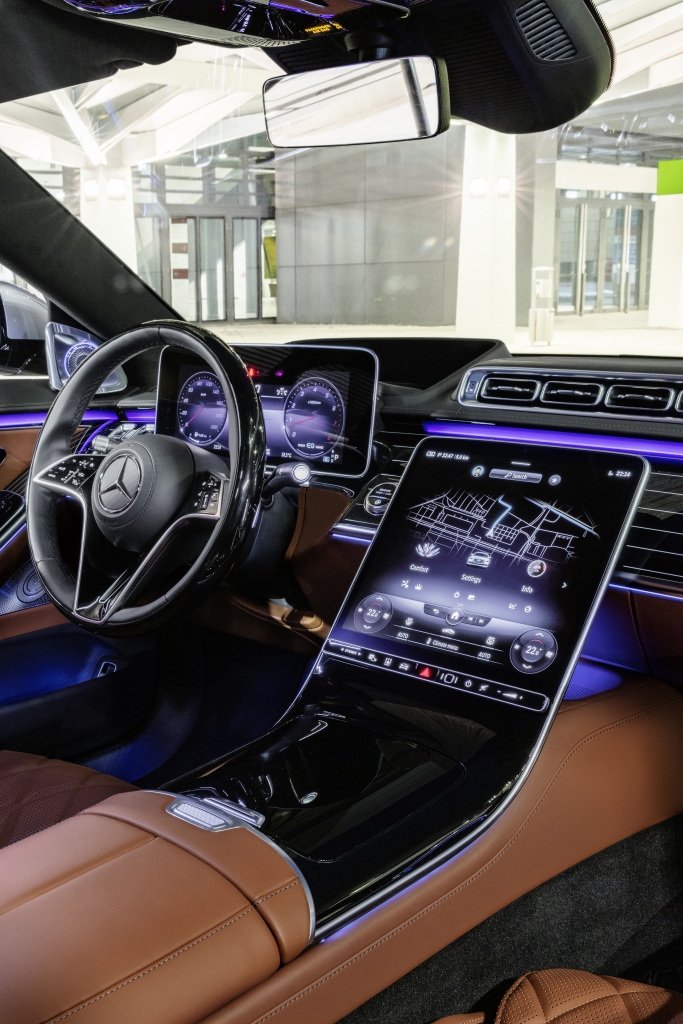
A new S-Class redefines the benchmark of luxurious motoring. This time, the high-tech innovations are centered around driver and passengers. We name a few of them: The second generation of MBUX (Mercedes-Benz User Experience) débuts in the new S-Class. Not less than five(!) screens are installed. New 3D driver display for the first time allows spatial perception of the scene with a real 3D effect thanks to eye-tracking. There is also a very large head-up display with augmented reality content. When navigating, for example, animated turn-off arrows (“fishbones”) are virtually and precisely projected onto the road lane.
Mercedes-Benz S-Class interior: leather siena brown
Using cameras in the overhead control panel and learning algorithms, MBUX Interior Assist recognizes and anticipates the wishes and intentions of the occupants. It does this by interpreting head direction, hand movements and body language, and responds with corresponding vehicle functions. For example, if the driver looks over his/her shoulder towards the rear window, Interior Assist automatically opens the sunblind.
Mercedes-Benz S-Class, interior: leather siena brown
The active ambient lighting with around 250 LEDs is now integrated into the driving assistance systems, and is able to reinforce their warnings visually.
The latest generation of the Driving Assistance Package has new and numerous improved functions. One example is the intelligent compliance with speed limits.
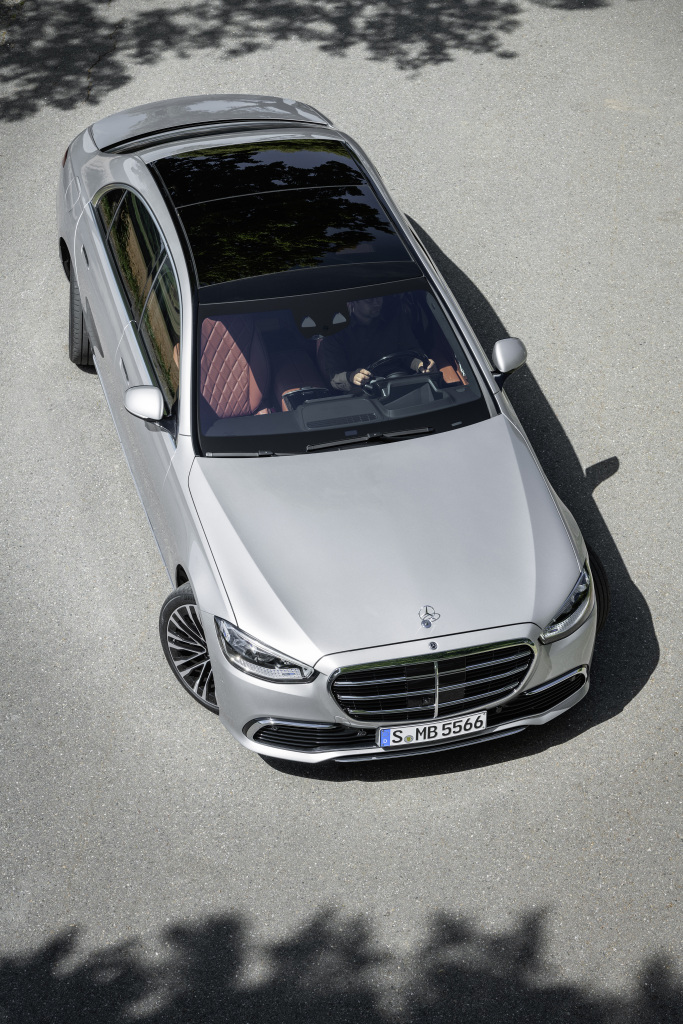
Mercedes-Benz S-Class, exterior: hightech silver
The new S-Class is also easy to manoeuver: Thanks to rear-axle steering (optional), the S-Class is as manoeuvrable as a compact car in the city. The steering angle at the rear axle is up to ten degrees. The turning circle is reduced by up to two metres.(!)
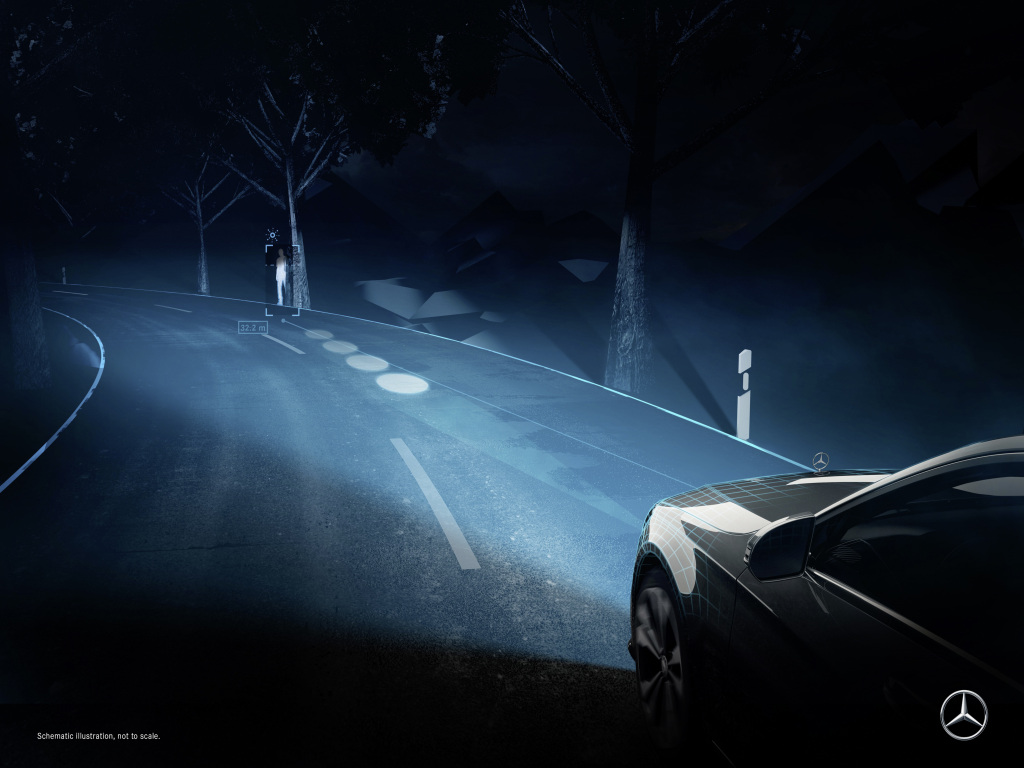
Mercedes-Benz S-Class DIGITAL LIGHT
More than 50 electronic components in the new S-Class can be updated with new software over-the-air (OTA). These include the entire MBUX infotainment system, the driver display, the driving assistance systems and the MULTIBEAM LED and DIGITAL LIGHT lighting systems. You don’t need to visit your dealer for this anymore…
The S-Class is also safer than ever. When a side impact with another vehicle threatens, the vehicle body can be raised by the E-ACTIVE BODY CONTROL suspension (optional) within a few tenths of a second.
Mercedes-Benz S-Class, interior: leather nappa black/carmin red
It is expected that from the second half of 2021 the S-Class will be able to drive in conditionally automated mode with the new DRIVE PILOT (optional extra), in situations where traffic density is high or in tailbacks, on suitable motorway sections …in Germany.
The revolutionary headlamp technology DIGITAL LIGHT (optional extra) allows completely new functions, e.g. the projection of marking aids or warning symbols onto the road ahead. In each headlamp, DIGITAL LIGHT has a light module with three extremely powerful LEDs with light that is refracted and directed by 1.3 million micro-mirrors. The resolution is therefore more than 2.6 million pixels per vehicle.
Mercedes-Benz S-Class, exterior: hightech silver
When the new S-Class is launched, six-cylinder in-line petrol and diesel engines in various output classes will be available, with a V8 engine with integrated starter generator (ISG) and a 48-volt onboard electrical system to follow shortly afterwards. A plug-in hybrid with an all-electric range of around 100 km will follow in 2021.
Of course, books can be written about this new S-Class; We will in the near future, describe some of these new technical and electronic breakthroughs in more detail…
In the premium SUV market, Kia shows its mettle. Alongside the Sorento Hybrid, here comes the plug-in hybrid version, combining the 13.8 kWh battery pack and 66.9 kW electric motor with 1.6-litre T-GDi engine and six-speed automatic. Besides all the power and eco-friendliness, it should be remembered that the fourth-generation Sorento has an innovative platform designed from the outset to accommodate electrified powertrains.
This means generous cabin and luggage space and both five- and seven-seat layouts. These new generation electrifieds are popular: In the first half of 2020, electrified models – including mild-hybrid, parallel hybrid, battery electric and plug-in hybrid vehicles – accounted for around one in four of all Kia vehicles sold in Europe.
Hans Knol ten Bensel
Clean power
The PHEV Sorento boasts the 1.6-litre T-GDi (turbocharged gasoline direct injection) engine, which, on its own, produces up to 180 ps and 265 Nm torque.
The engine is paired with a high-capacity 13.8 kWh lithium-ion polymer battery pack and an electric motor which produces 66.9 kW and 304 Nm torque.
Combined, these powertrain components enable the Sorento Plug-in Hybrid’s powertrain to produce up to 265 ps and 350 Nm torque. More than enough here. Power is sent to all four wheels through a six-speed automatic transmission. The transmission allows the full power of the engine and motor to be transferred in parallel.
The new model represents Kia’s first use of an independent battery pack water-cooling system in a PHEV, ensuring optimal heat management and efficiency for the high-voltage battery pack. For the 66.9 kW electric motor, the rotor benefits from a new two-stage lamination process to reduce noise and vibration levels.
The engine features Kia’s latest ‘Smartstream’ innovations, including Continuously Variable Valve Duration technology, which regulates the duration that the intake valves open and close depending on driving conditions.
Practical
The dedicated platform also offers plenty of cargo space: up to 809 litres (for seven-seat models) or 898 litres (five-seat models) with two rows of seats in place. In seven-seat models, with all seven seats in place, boot space is 175 litres (compared to 179 litres for its Hybrid counterpart).
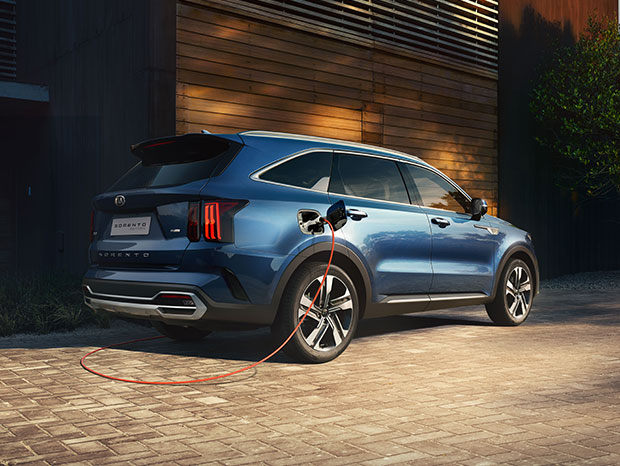
Visually, Sorento Plug-in Hybrid models retain the same modern exterior design as other variants in the line-up, with ‘eco plug-in’ badges and a charging port on the rear quarters standing out as the only points of differentiation.
Inside, the cabin also remains largely unchanged, although the 12.3-inch fully-digital instrument cluster is redesigned, with new graphics and dials to provide drivers with a clear picture of the powertrain’s status. It enables drivers to keep track of the battery’s state of charge, as well as the flow of electric and gasoline power through the powertrain. The 10.25-inch touchscreen infotainment system also features new functionality to enable drivers to easily locate vehicle charging points on-the-go.
Premium infotainment tech and driving aids…
The touchscreen infotainment system enables full, seamless smartphone integration with Apple CarPlay™ and Android Auto™. A powerful 12-speaker BOSE® surround-sound audio system is also available, delivering a more immersive sound to all passengers, as well as a cabin Mood Lighting system, with up to 64 colours for users to choose from.
The Sorento Plug-in Hybrid offers a range of Kia’s Advanced Driver Assistance Systems (ADAS), such as Forward Collision-Avoidance Assist (FCA) technology with pedestrian, cyclist and vehicle detection and FCA Junction, which detects vehicles at junctions when turning; Blind-Spot View Monitor (BVM); Surround View Monitor (SVM) and Blind-spot Collision-Avoidance Assist (BCA); Intelligent Speed Limit Assist (ISLA); Smart Cruise Control with Stop&Go (SCC) and Navigation-based SCC (NSCC), and so much more. It even helps you with parking in tight spaces…
We are eagerly awaiting a first drive with this new Kia Flagship. In the meantime, here are some photos…
Premium compact cars with sporting characters are a tradition at Audi. For more than 20 years now. It is indeed so long ago already that the first generation of the S3 series was born. Now it comes with ever more style and power. Its 2.0 TFSI engine produces 228 kW (310 PS) and 400 Nm (295.0 lb-ft) of torque. Enough to almost send you to the stars. It will accelerate from 0 to 100 km/h in 4.8 seconds, and that puts it almost in the supercar league. This marvelous four cylinder is coupled to a seven-speed S tronic, and you are a master of the road thanks to the quattro drive with intelligent control. An S-specific sport suspension with optional damper control also enhances your driver’s talent. There are further highlights, just read on…
Hans Knol ten Bensel
The S3 Sedan in python yellow
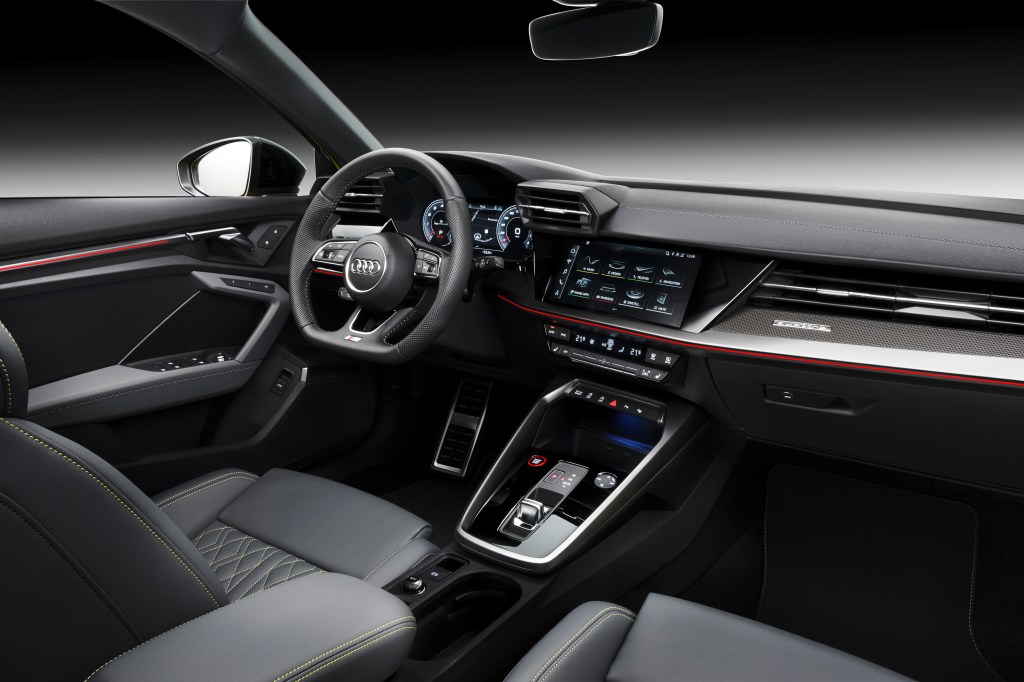
Indeed, A number of other new features – including the operating concept, infotainment, and assist systems – round off the high-tech character of the S3 models.
Audi has introduced some new specific styling accents. The lower areas on the body sides are now curved inward – placing a stronger emphasis on the wheel arches. Of course, the S3 has now an even more distinct light signature: digital daytime running lights consist of a pixel array made up of 15 LED segments, ten of which form two vertical lines.
Detail Four exhausts to document the sporting note…
Aficionados will also like the large diffuser at the rear end and the four exhaust tailpipes…The new model is also slightly bigger. The Sportback and the Sedan are three centimeters (1.2 in) and four centimeters (1.6 in) longer respectively, while both models are three centimeters (1.2 in) wider. The interior offers greater shoulder room and elbow room. The luggage compartment of the S3 Sportback holds between 325 and 1,145 liters (11.5–40.4 cu ft) depending on the position of the rear bench seat, while the Sedan has a capacity of 370 liters (13.1 cu ft).
High-tech sportiness…
The engine has what it takes, and sports the Audi valvelift system (AVS) – which adjusts the lift of the intake valves when required. Top speed is electronically governed at 250 km/h. Via the Audi drive select system you can make the sound of the powerful four-cylinder turbo engine even crisper…
The hydraulic multi-plate clutch in front of the rear axle is fully variable and moves the power flow between the front and the back at will. It is managed by the modular dynamic handling control – a new system that closely links the quattro drive to the Electronic Stabilization Control (ESC) and the controlled dampers that are available optionally. Then valves control the oil flow in the dampers so that they adapt to the condition of the road, the driving situation, and the driver’s requests, reacting within a few thousandths of a second.
…also found in the cabin
Cockpit
There is a new, compact shifter for the seven-speed S tronic and decorative aluminum or carbon inlays whose design evokes the cut of the headlights. The cockpit is focused on the driver. The distinctive air vents form a single unit with the instrument cover. A 10.25-inch digital display is offered as standard. Alternatively, the Audi virtual cockpit and its “plus” version can be ordered. Both have a 12.3-inch diagonal, with the latter also offering three different screens. In the middle of the instrument panel is a 10.1-inch touch display embedded in a large black panel. It recognizes letters entered by hand and provides acoustic feedback. As an additional operating level, the infotainment can also be voice-controlled using natural language as standard. Audi also supplies a head-up display as an option.
A new generation of infotainment
The MMI operating concept of the new S3 models is powered by the third-generation modular infotainment platform (MIB 3). Its computing power is ten times higher than that of its predecessor, it performs all tasks relating to connectivity with LTE Advanced speed, and it has an integrated Wi-Fi hotspot.
Interior
Navigation offers predictions on the development of the traffic situation, high-resolution satellite images from Google Earth, and information about the traffic flow. Individual settings, such as frequently selected destinations or air conditioning preferences, can be stored in up to six user profiles.
…with clever Car to X features…
The Audi connect online services also include car-to-X services, which help with finding available parking spots on the roadside or allow the driver to surf the green wave by communicating with traffic lights in cities like Düsseldorf and Ingolstadt. Connectivity between the new Audi S3 and the user’s smartphone is free of charge via the myAudi app, as well as via Apple CarPlay, Android Auto, and the Audi phone box – which links the device to the vehicle’s antenna and charges it inductively.
Last but not least the S3 is environmentally conscious with a combined fuel consumption in l/100 km of 7.4 liters and combined CO2 emissions in g/km: 170–169 for the sportback. For the S3 Sedan, the combined fuel consumption in l/100 km is 7.3–7.2 l with CO2 emissions at 166–165 g/km.
So you want a state of the art sporting mount? Then take a close look at this Audi S3, it offers you everything modern day driving can deliver…with tons of driving pleasure!
Porsche is introducing its first fully electric sports car as part of the exhibition series “Start to Drive Electric” in the capital city. You can already visit the special exhibition “Porsche – Pioneer of Electric Mobility”, as it started from Thursday, 16 July 2020 , and this until 1 November 2020 at “DRIVE. Volkswagen Group Forum” at Unter den Linden in Berlin. Entry is free of charge.
The exhibition not only deals with topics from the world of electric mobility such as range and energy recuperation, infrastructure and charging, but also takes a good look at the pioneering spirit of the Porsche brand. Sustainability, zero-impact factory, Formula E and the vision of climate-neutral mobility are other areas included in the special exhibition.
“The Porsche Museum does not see itself as an institution that just preserves collections and is a guardian of the past,” explains Achim Stejskal, Head of Heritage and the Porsche Museum.
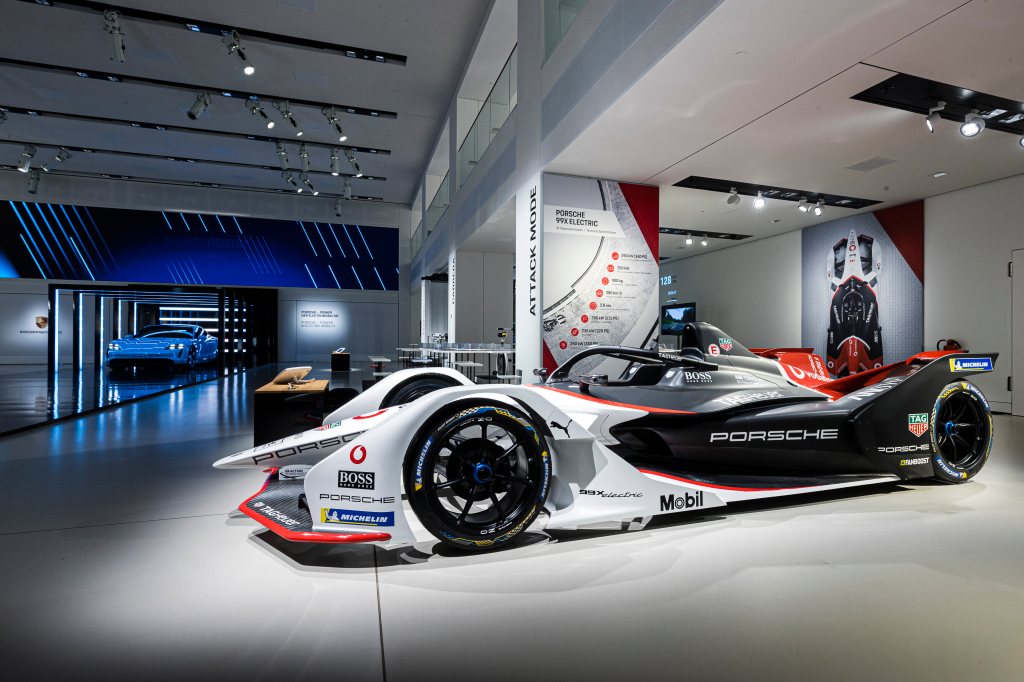
The visitors will see a number of cars, including a Taycan 4S, two Taycan Turbo, the endurance test car of the brand, the record car from the Nürburgring Nordschleife, as well as the Formula E display model. Further highlights:
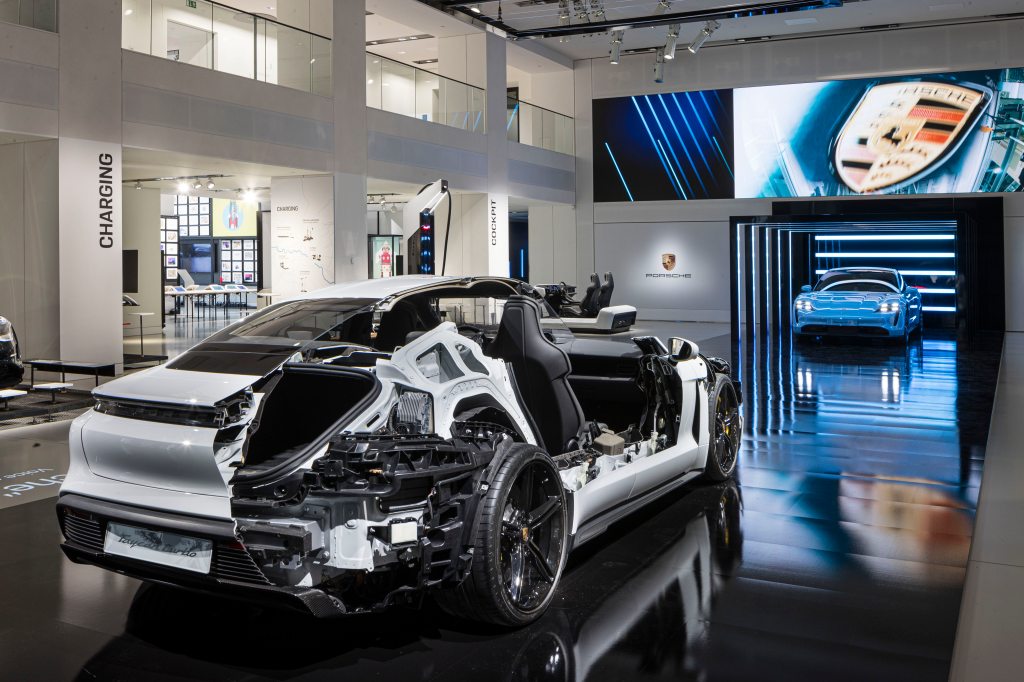
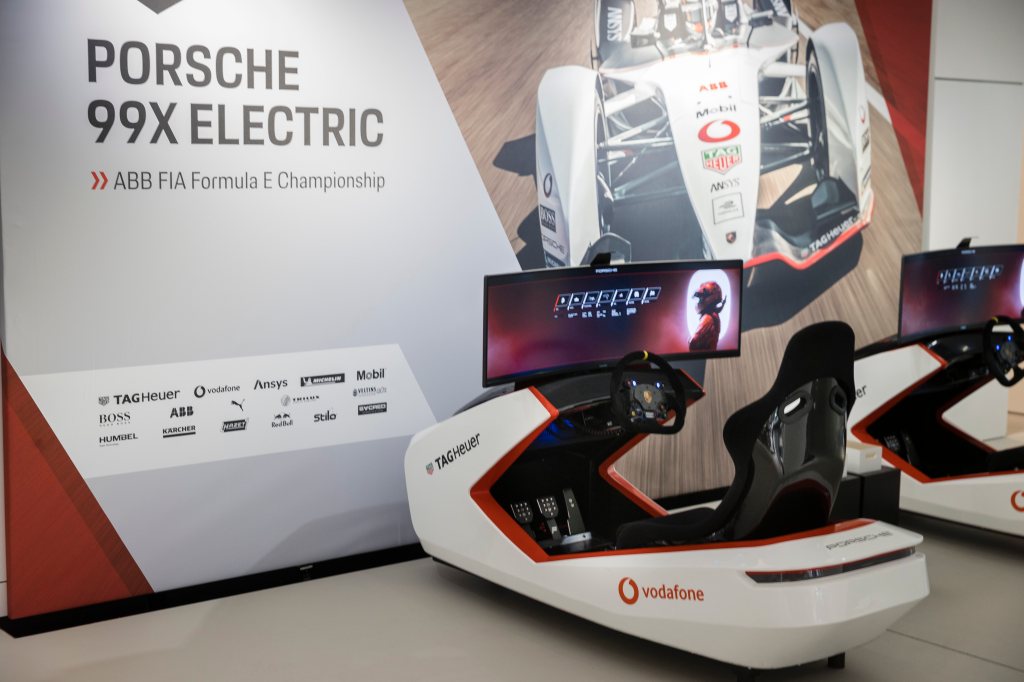
At Unter den Linden, a cutaway model of the Porsche Taycan, the Formula E race simulator, touch points with information on the milestones of electric mobility at Porsche, the Taycan cockpit, charging stations, the electric motors of the front and rear axles as well as a Carrera track await the visitors. The latter will prove especially energetic as visitors can pedal to generate electricity for the small slot cars themselves. The different experiences provide interaction between digital and analogue.
Visitors can choose between various themes in the media room “Accelerator” and can start projections. Protagonists from different sectors of Porsche who played an important role in the development of the Taycan are introduced there. They talk about their personal Taycan moment, their connection with the car, a pioneering approach and heritage of the brand, about design, sustainability, production, but also performance and adrenaline. Further information as well as film and photographic material can be found at www.porsche.com/museum.
So if you happen to be in the neighborhood of Berlin on your holiday travels, don’t miss this!
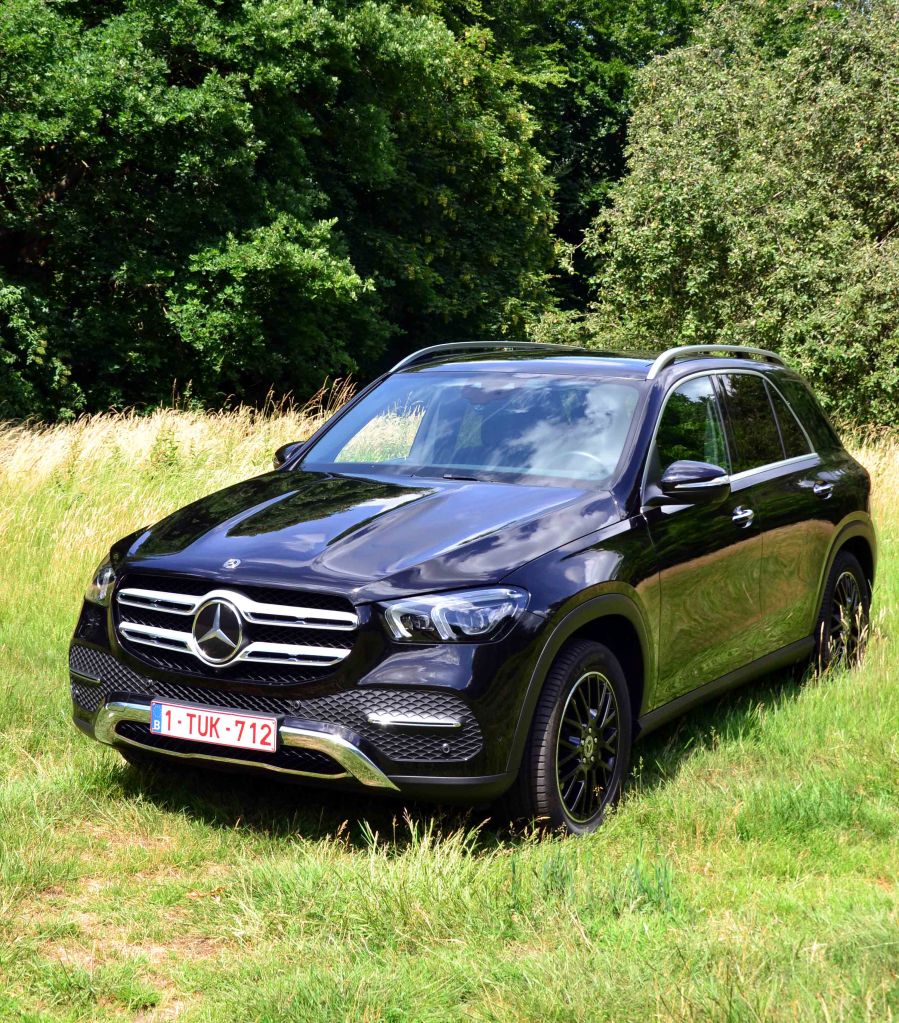
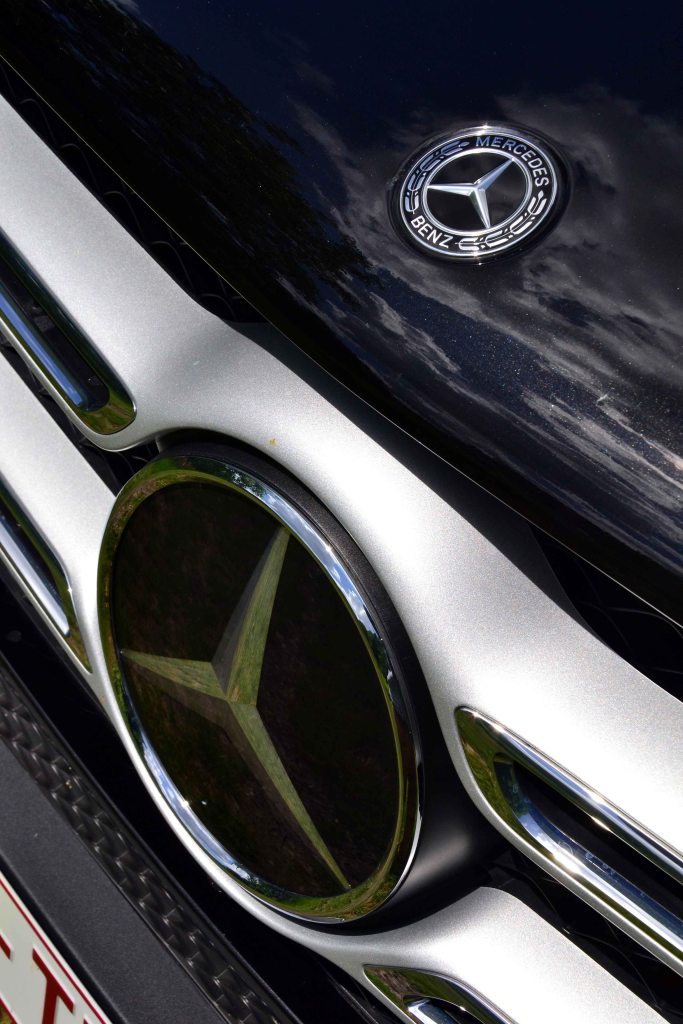
Mercedes brings their cars and drivetrains to rare perfection and maturity. This is noticeable from the first meter you drive them. The iconic diesel powered GLE we tested for you here, proved again this point…
This Mercedes SUV strikes a perfect balance between practicality, performance, economy and mechanical refinement. Add to this the superb build quality and you understand why this car rightfully earns the good star. Since the launch of the first Mercedes in the premium SUV segment back in 1997 with the M series, not less than 2 million customers found their way behind the wheel a Mercedes premium SUV… and it looks that many more will follow.
Just read on…
Hans Knol ten Bensel
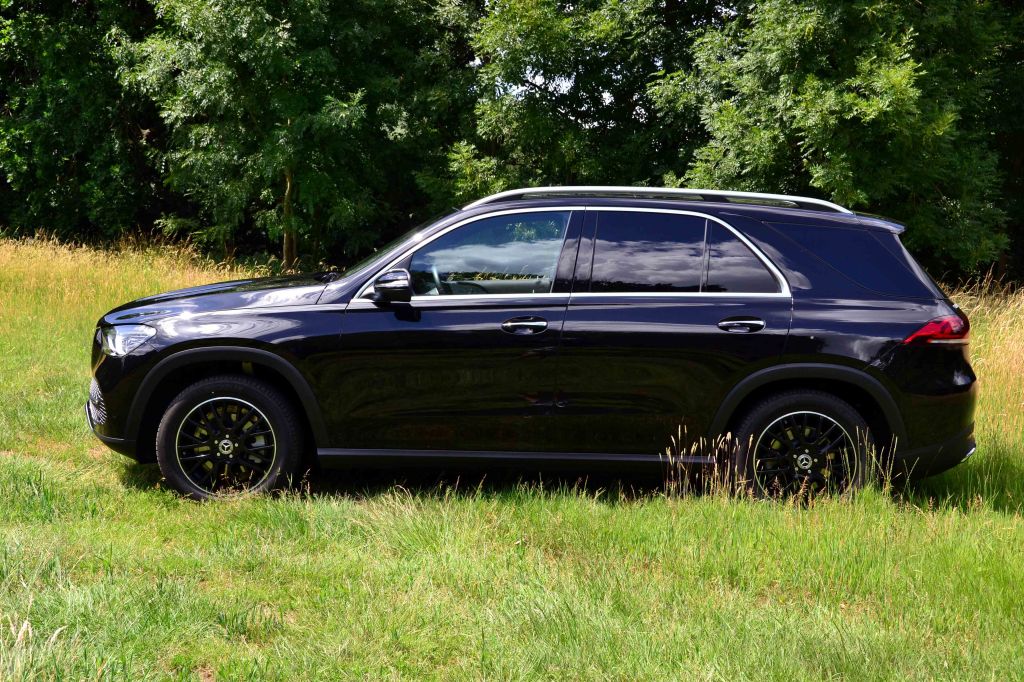
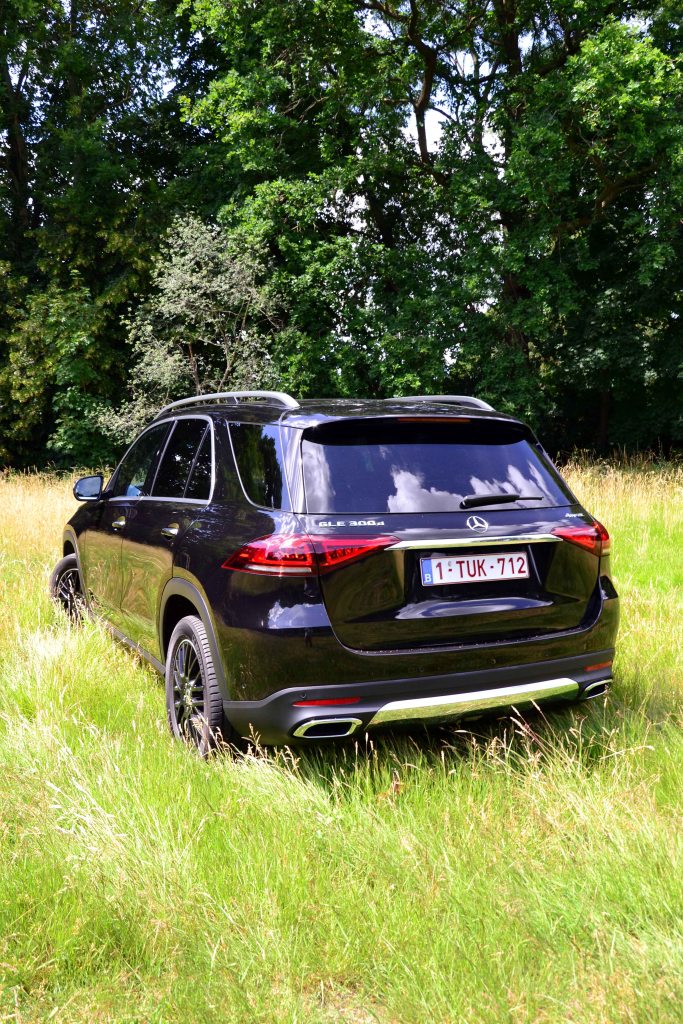
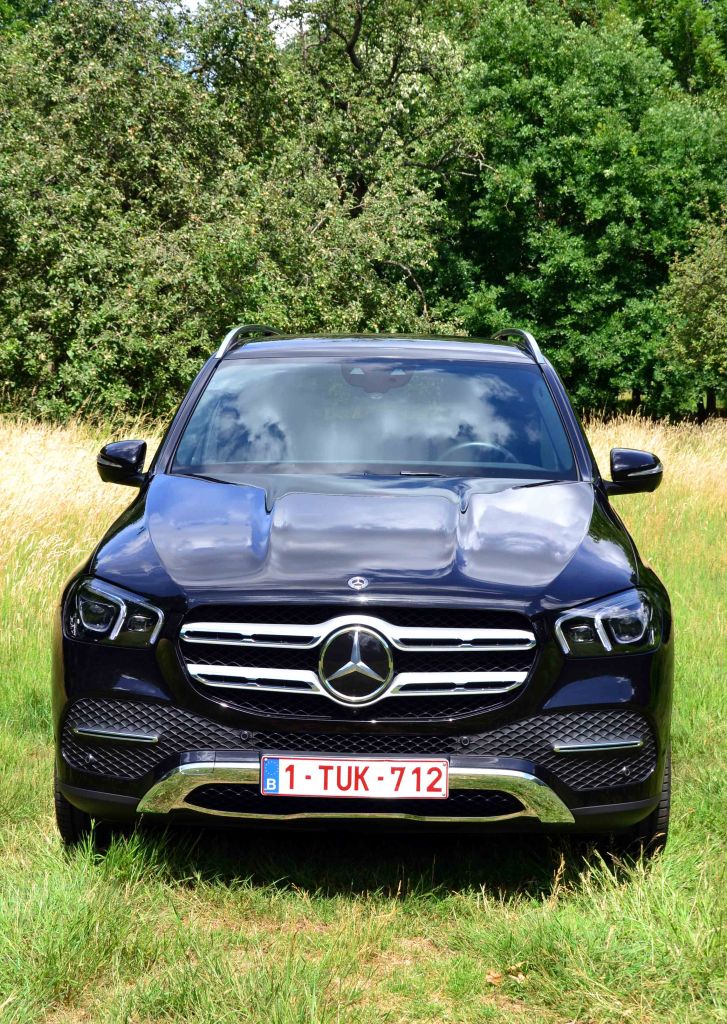
Mercedes has further improved its GLE. It looks even better than its predecessor, whilst retaining its typical Mercedes styling DNA, establishing personality and character. It is larger than its predecessor, now almost 490 cm long, which means an increase by 11 cm. The new GLE is also now 1 cm larger, being in total 195 cm. It is however 2,5 cm lower at 177 cm.
The proportions are very good, and this SUV looks good from any angle. What’s more, aerodynamics have been further improved to a Cd value of a whopping 0,29 and Mercedes is very proud of it.
Dynamic and trusty diesel power…
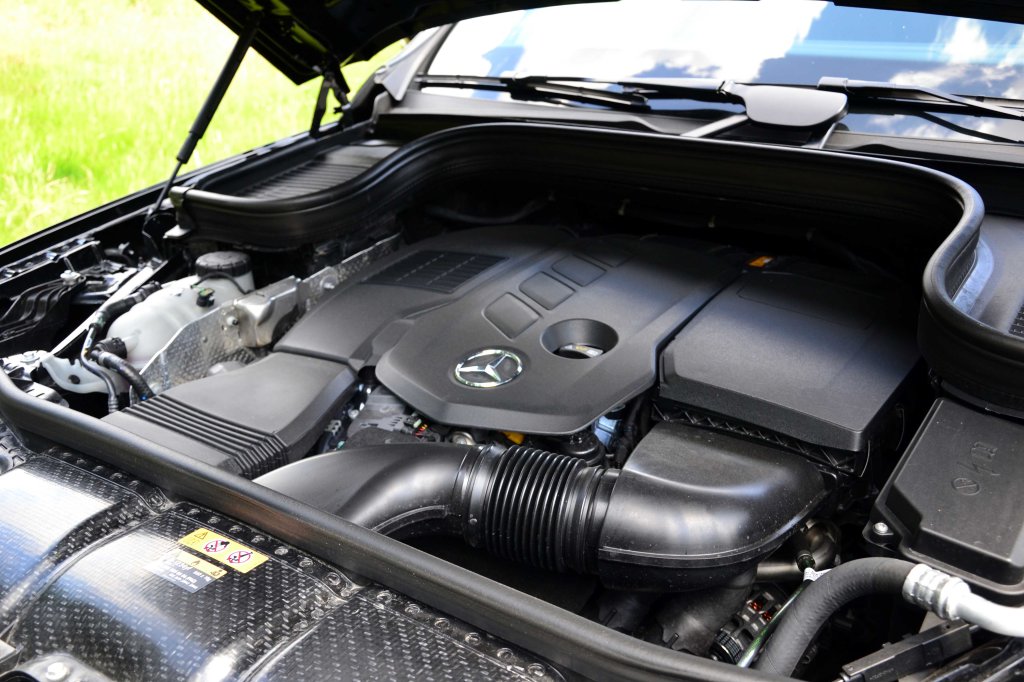
Our test car came with the well known 2 litre four-cylinder diesel from the OM 654 engine family, here delivering a very healthy 180 kW or 245 HP. This is a well proven, very efficient and frugal unit, which is very smooth and silent at lower revs and when you do not press the throttle too deeply. Asking for more power will produce more noise, but everything remains at a very reasonable level, although a smooth six cylinder would be more appropriate if you drive your GLE often with punch.
This is why Mercedes has also as a next step a beautiful six cylinder diesel in store for you in the 350 d, developing of 200 kW (272 hp) and 600 Nm of torque. But let’s not forget, the four cylinder also develops an impressive 500 Nm of torque, and it is efficient indeed. What to think of a fuel consumption – according to the manufacturer – between 6.4-6.1 l/100 km, with combined CO2 emissions being 169-161 g/km. It proved not trouble at all for us during the test to achieve a figure between 6 and 7 litres/100 km when driving with some restraint. With a fuel tank containing not less than 85 liters you understand that this GLE has a massive range, which is so comforting indeed if you drive a beautiful grand tourer like this one.
Cruising at constant speeds and engaging in average accelerations let you enjoy the utter smoothness of this powertrain, knowing that this diesel is coupled to a marvelous 9 speed 9G-TRONIC automatic transmission, as is the case with all engine variants by the way. With the four cylinder engines, 4MATIC all-wheel drive is realized with a transfer case which transmits the drive torque to the axles in a fixed ratio of 50:50 percent. A transfer case with an electronically controlled multi-disc clutch is used for the other engines, e.g. in the GLE 450 or GLE 400 d. This allows a variable transfer of drive torque from 0-100 percent (torque on demand) between the axles. Also new, and available as an option, is a transfer case specially configured for superior off-road driving characteristics. But during our test, the 4MATIC of our 300d proved superb.
With the good power and torque, performance leaves nothing to be desired. Acceleration from 0 to 100 km takes merely 7,2 seconds, top speed is not less than 225 km/h. Let’s not forget, this is almost as fast as the ‘62 Jaguar 3,8 litre E-type…
Space and comfort
The real vocation of this GLE is to transport you in utter Mercedes comfort, on any road and towards any destination you choose. The suspension, the marvelous seats, all this contributes to an exquisite driving experience. Going on a grand tour with this Mercedes is just ideal, and also long urban boulevard drives are something you would choose this GLE for.
Handling of this GLE is quite good. It doesn’t invite you actually to throw it around corners, but it will hold its own very well in high speed corners and on winding roads.
E-ACTIVE Body Control: The 48 V suspension
Even better ride comfort and agility plus completely new functions such as rocking mode are provided by the optional E-ACTIVE BODY CONTROL suspension, which is combined with the newly developed AIRMATIC air suspension. This is the only system in the market where the spring and damping forces can be individually controlled at each wheel. This means that it not only counteracts body roll, but also pitching and squat. Together with ROAD SURFACE SCAN and the curve inclination function CURVE, E-ACTIVE BODY CONTROL makes an extraordinary level of comfort possible, and supports the claim of Mercedes-Benz to build the world’s most intelligent SUV suspension.
Cabin space is ample, with boot space being 630 liters, split in two levels. You can also optionally equip your GLE with a third row of seats.
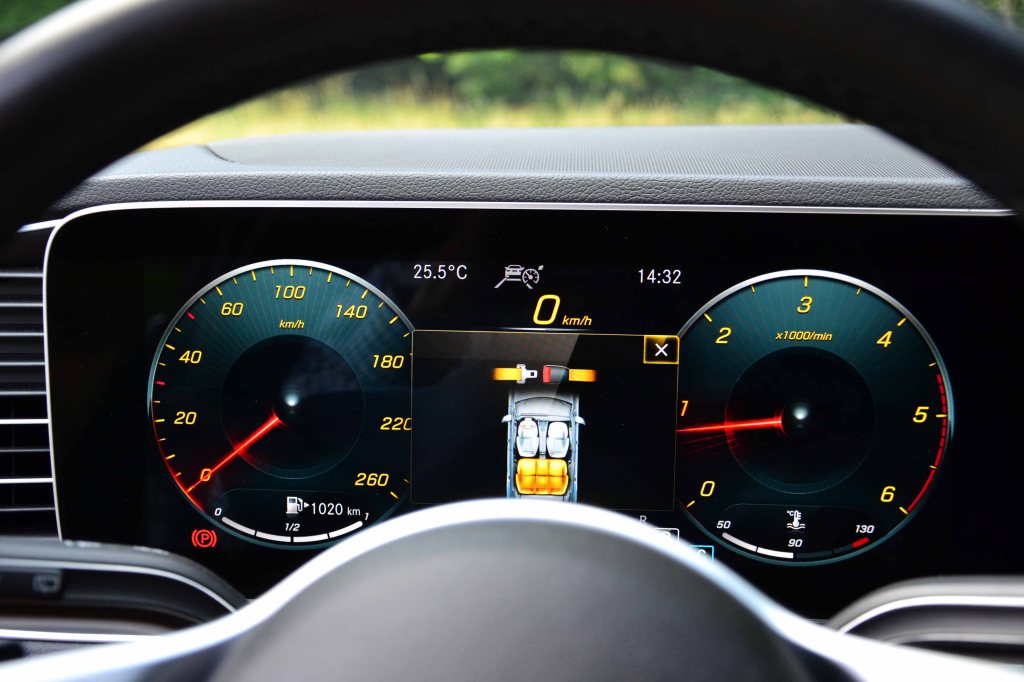
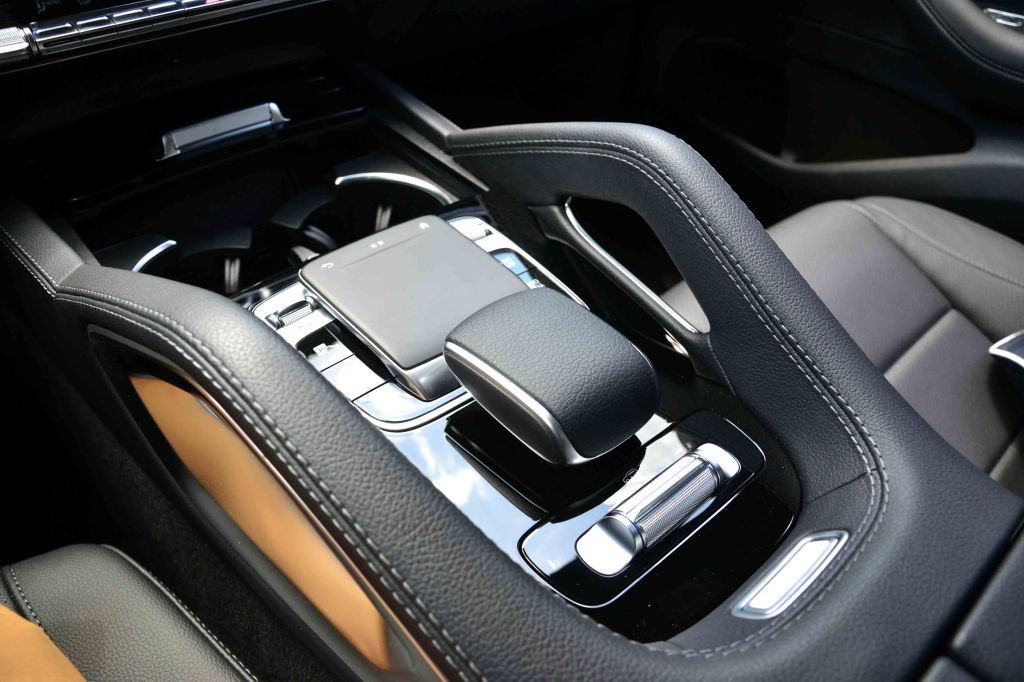
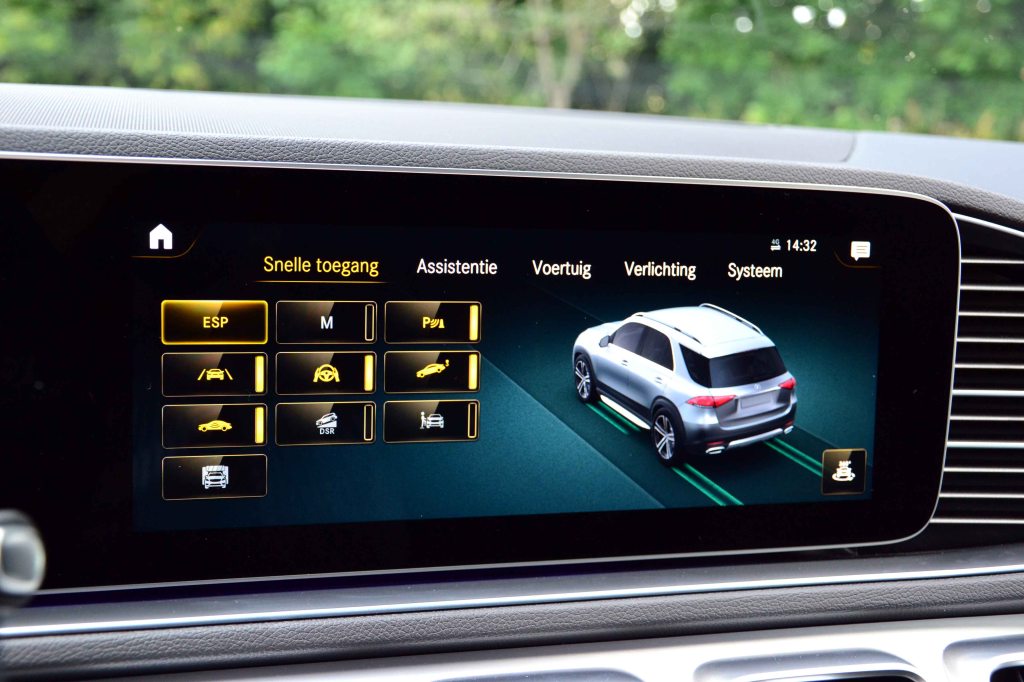
Living with the GLE is simpler than the daunting array of electronic commands and displays at first would suggest. Indeed, the GLE is equipped with the latest generation of the multimedia system MBUX – Mercedes-Benz User Experience. As standard it includes two large 12.3-inch/31.2 cm screens arranged next to each other for a stunning widescreen look. The information of the instrument cluster and media display is easily legible on the large, high-resolution screens.
Pushing intuitively the right knobs and handles let’s you enjoy the right climate and sound, informs you about anything you would like to know about your trip or your car. Also the rear passengers are pampered with individual sound and climate controls.
All this breathes the tradition of the “Grosser Mercedes”, the stately limousines the brand has made for the mighty and wealthy in this world. Indeed, the comfort and well-being this GLE offers you on your (urban) voyage is of a very high level indeed.
Conclusion
A superb SUV, brimming with quality, workmanship, style, top class engineering. It is roomy, comfortable, offers ample performance and also efficiency and economy. It is also well styled, breathing the timeless and iconic Mercedes styling language and DNA.
It comes with state of the art infotainment, and is built for the future with diesel engine(s) well exceeding the present emission requirements. What’s more, plug-in hybrid versions with long(er) E-power ranges will be coming soon. We will certainly present them to you then… stay tuned!
BMW used the iconic slogan since the birth of the new generation passenger cars in the early sixties: “Aus Freude am Fahren” , freely translated “built for driving pleasure.”
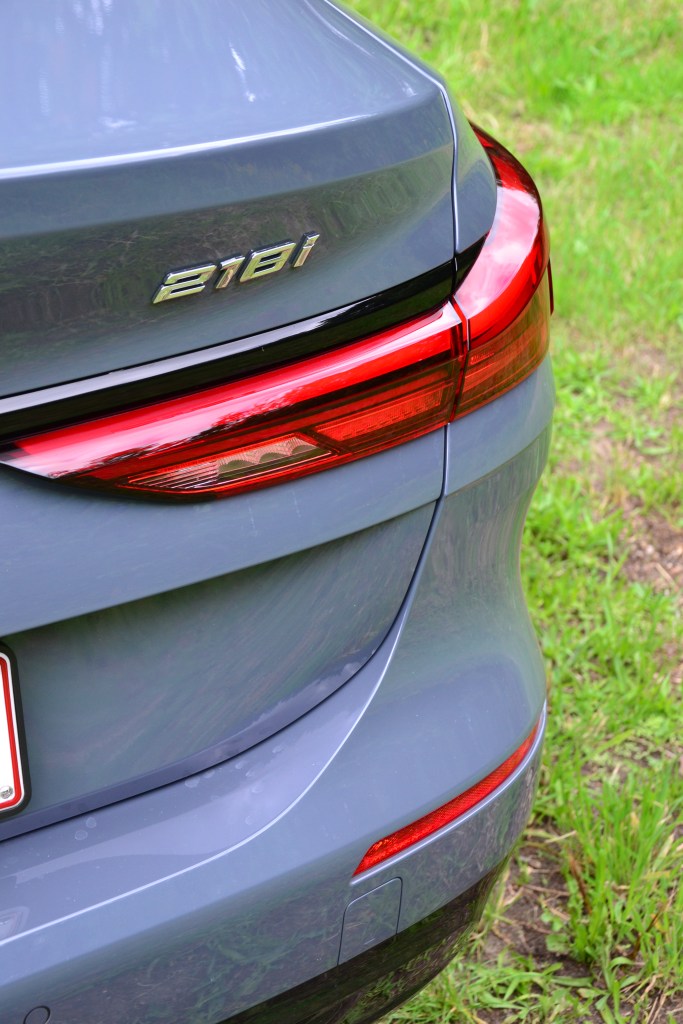
Well, this 218I makes you smile behind its elegant three spoked wheel, and indeed delivers tons of delightful handling and responsiveness, proving amply that you don’t need a top end BMW to fully enjoy what the brand stands for. Every, and indeed every BMW makes you a better driver.
We drove this sleek 218I here for you, and indeed, it made us rediscover the pleasures of driving and owning a car…and what’s more, a BMW.
Hans Knol ten Bensel
Indeed, many city dwellers condemn our cherished four wheeled individual transport as we have it today, and car makers are all scrambling to develop new kinds of e powered city cars, with the Bavarian brand being no exception by the way. One only has to look at the 3I range for instance, and the plethora of BMW’s fully e-powered and plug-in hybrids.
But then again, BMW is not forgetting the essence of a good car which delights its driver. It all starts with a good suspension, chassis and drivetrain. Add to this a decent power to weight ratio and the recipe for a good result is made. Of course, the engineers and developers of such cars have to know what the art of driving really entails, and be good drivers themselves. Rest assured, BMW has them. And what’s even more important, these men have the talent to translate their driving know how into the cars they develop. This is embedded in every gene of this sleek 218I.
BMW driving, remaining truly unique…
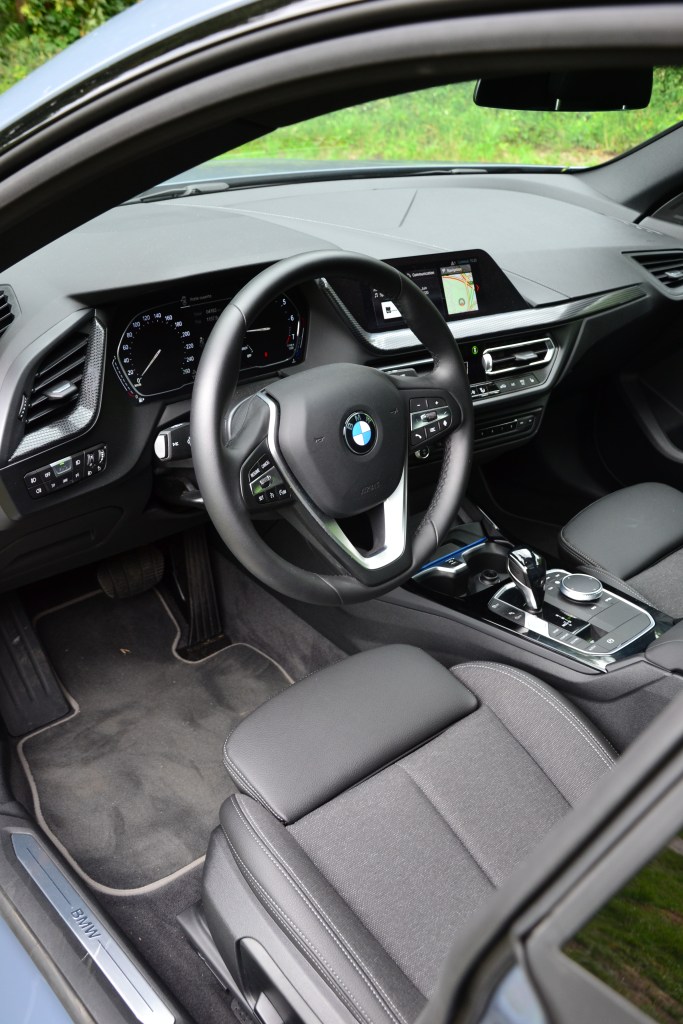
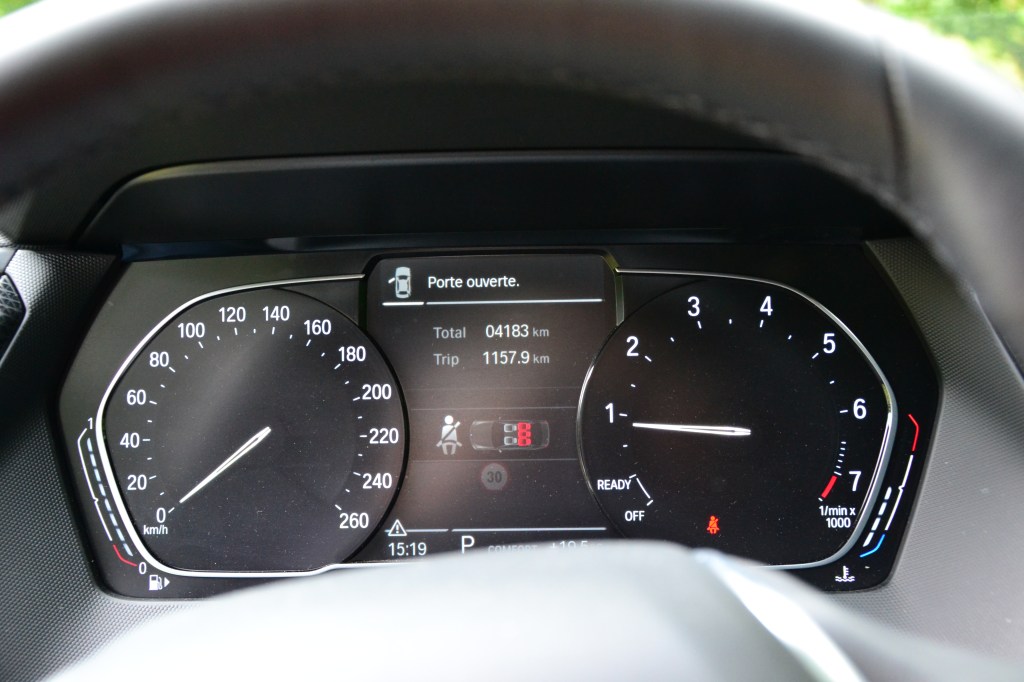
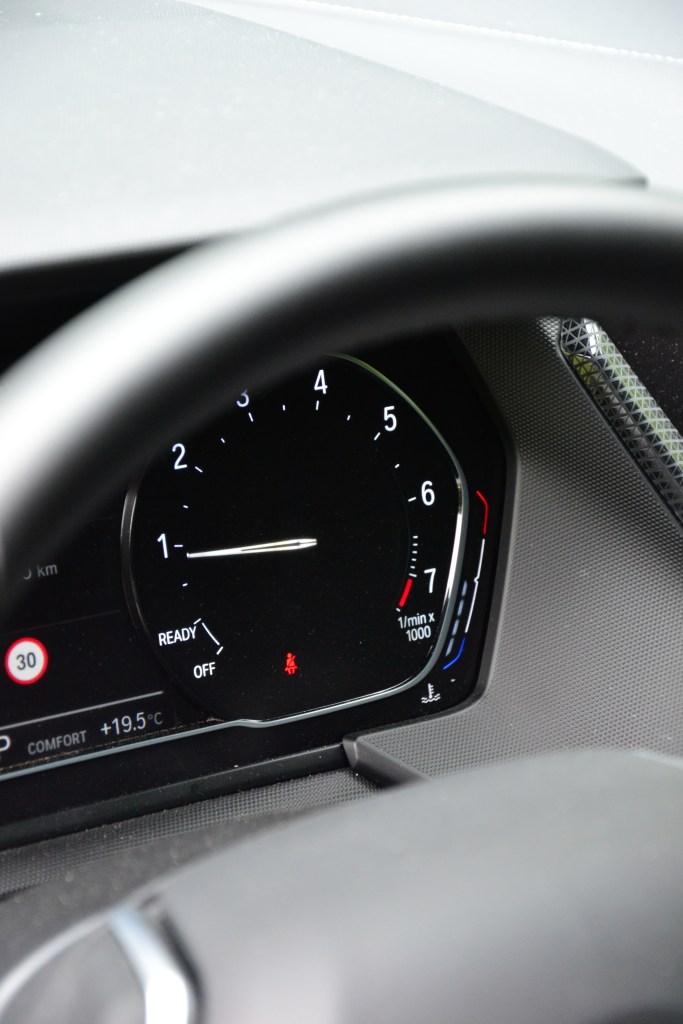
This delight starts when you push the starting knob, or rather, when you slide behind the wheel. You soon find your way with all the handles and knobs in its stylish cabin, and in the clean, angular instrument clusters the dials for speed and revs light up. The engine comes very smoothly to life. Almost inaudible and vibrationless.
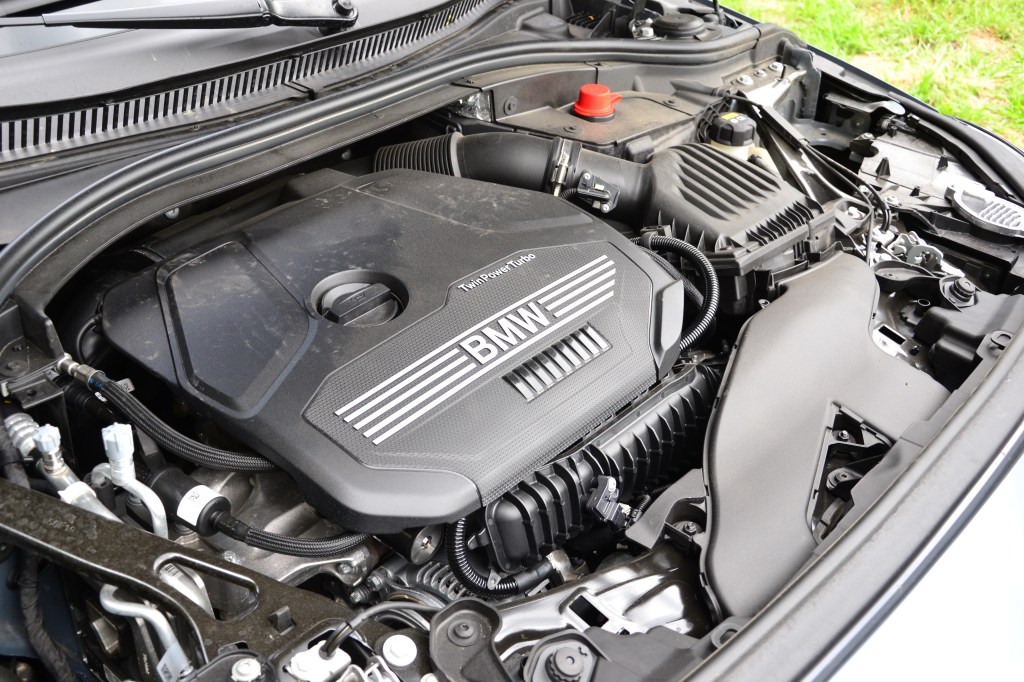
You would never guess a 1,5 litre three cylinder engine does the work here. Of course it has state of the art engine management, BMW TwinPower Turbo technology, combined with High Precision Injection, VALVETRONIC fully variable valve timing, Double-VANOS variable camshaft timing. This results in a power output of not less than 103kW/140 HP over a rather wide rev range, i.e. between 4600-6500 rpm. And this is delivered in all smoothness, the engine just soothing your ears with a beautiful staccato when you rev it up. Pulling power is also abundant in the mid rev range, with maximum torque of 220 Nm available between 1430 to 4200 rpm.
But this is not all. This state of the art thoroughbred engine is coupled in our test car to a formidable seven-speed Steptronic dual-clutch transmission, which totally matches the engine’s characteristics.
This drivetrain really gets your sleek Gran Coupé really going. 0 to 100 km/h is absolved in merely 8.7 seconds, top speed is an impressive 215 km/h. Enough to enjoy all the exclusive delights of a true Gran Turismo. And this time in style.
The sleek panache of the Gran Coupé styling now also found in the 2-series…
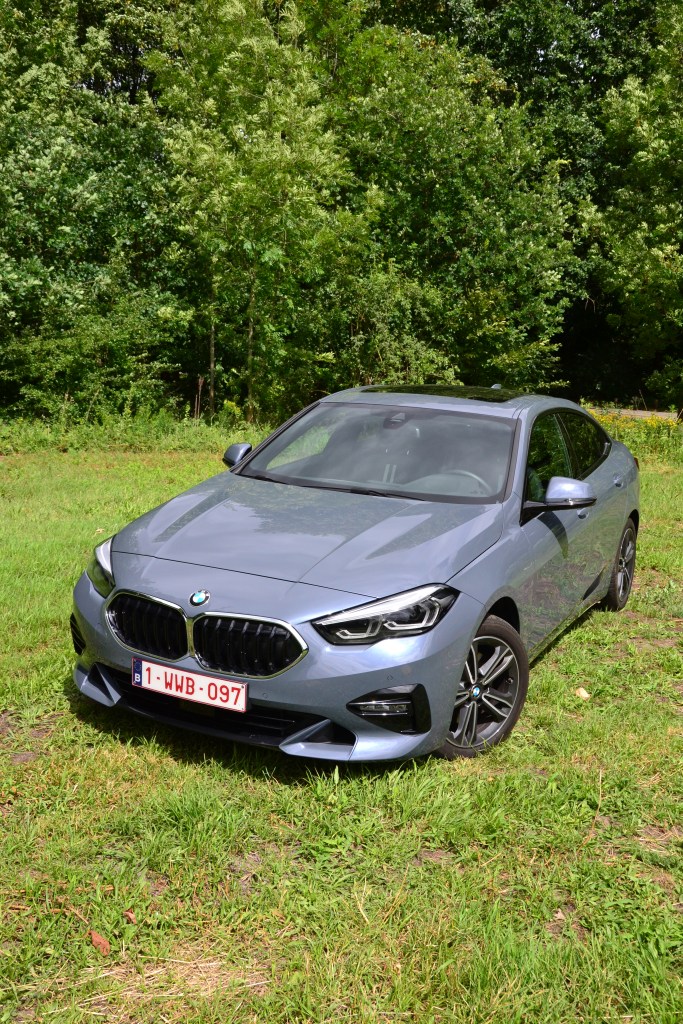
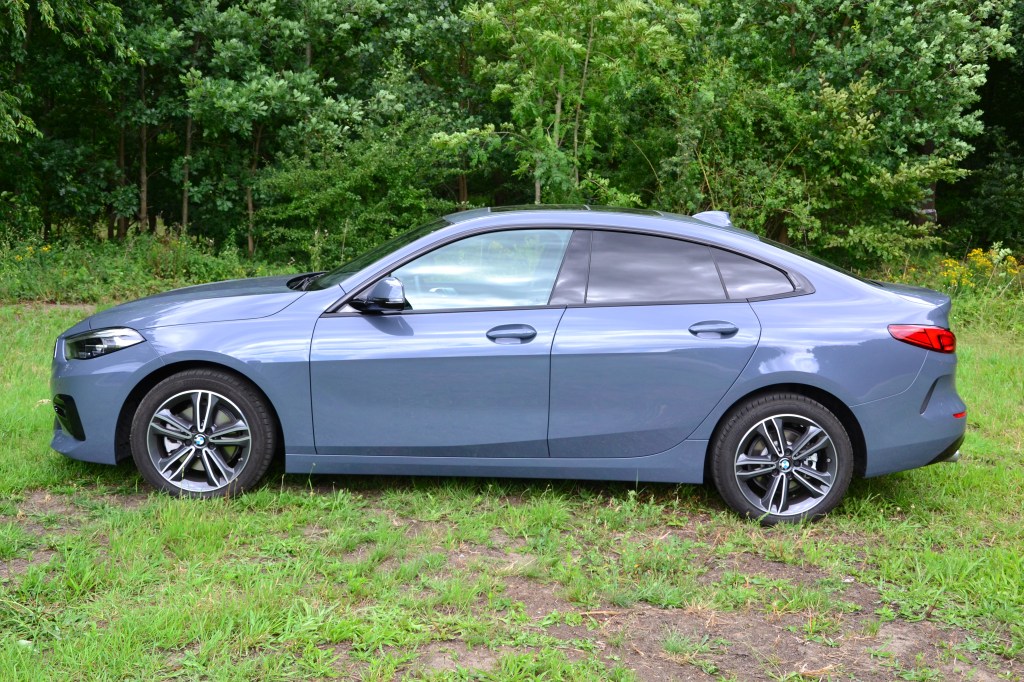
This is the first ever Gran Coupé in the 2 series range, and it is certainly a true winner in the looks department. The fluid and rakish lines of the Gran Coupé styling concept suit the more compact 2 series very well, and the proportions of the whole car just look and feel “just right”, and this from any angle.
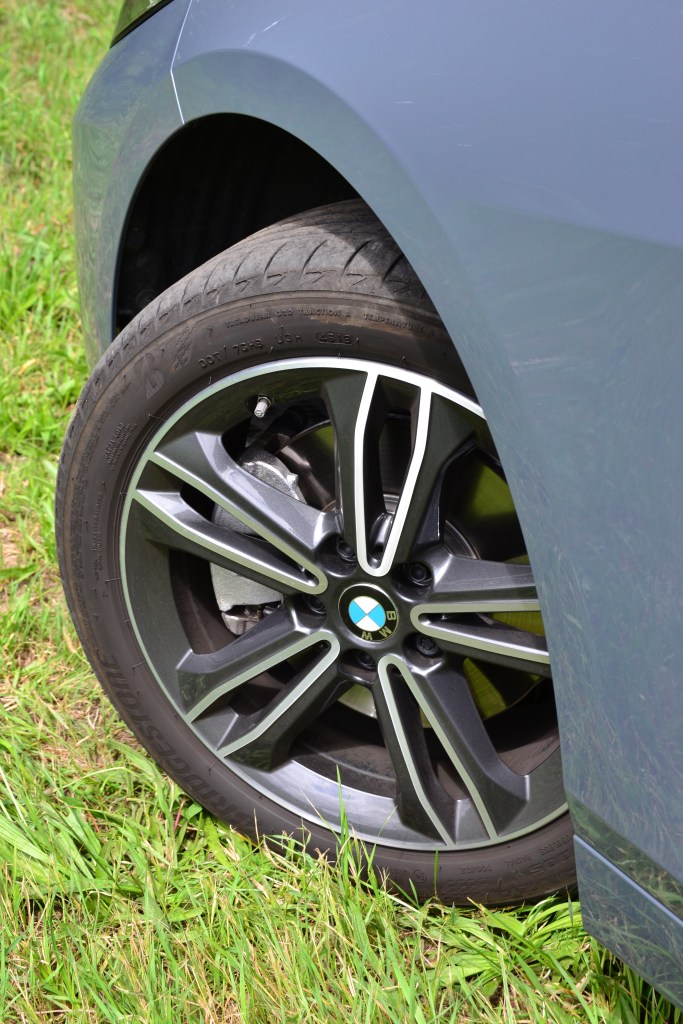
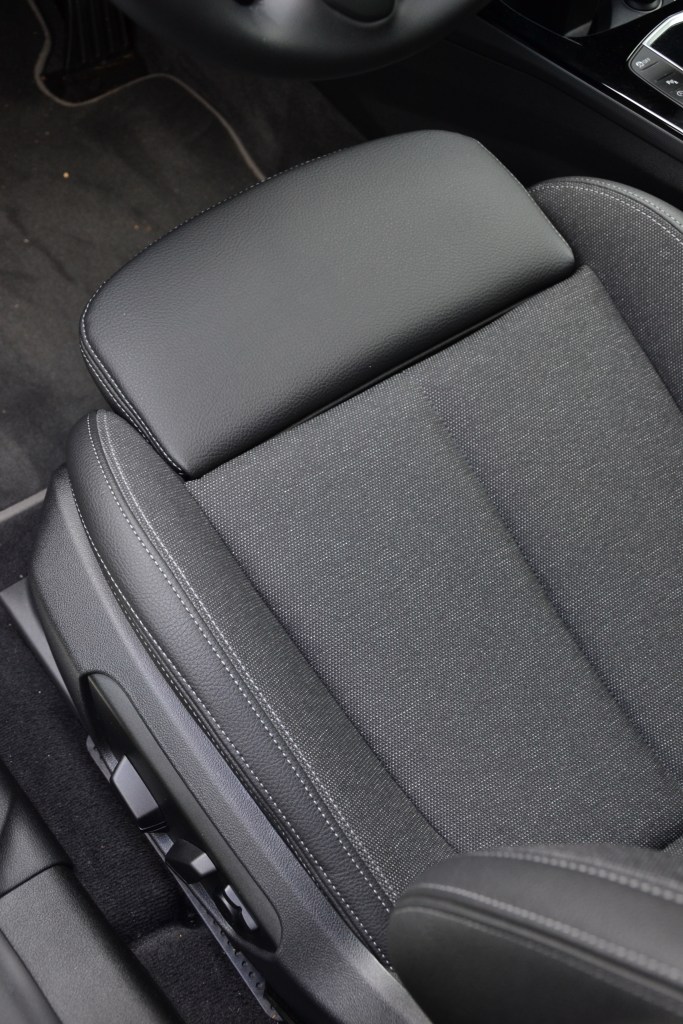
Styling details and contours make it a true BMW, and the styling DNA of the brand is very evident. The standout characteristic of the BMW 2 Series Gran Coupe is its dynamically stretched silhouette which, like the four frameless side doors, is lifted from the classical coupe blueprint. Our test car was shod with 17 inch alloys, styling 549, and this came with the so called sports package, which included sports seats in front, decorative bands in the cabin “Illuminated Berlin”, cruise control and a LED light package amongst others.
The slightly angled headlights actually feature full-LED technology as standard with the option of an adaptive variant, which is included in this package. In Belgium, this package costs at the moment of writing 2611 Euros ex VAT.
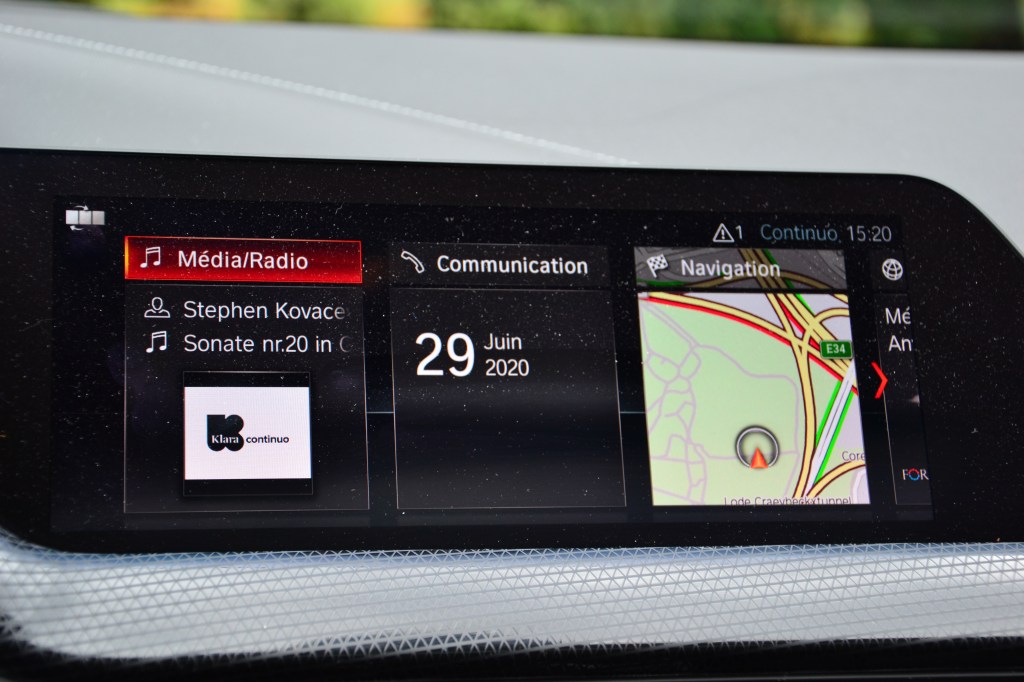
One also has to fork out a further 1835 Euros for the Business Pack, which includes the Connected Package plus and the Park Distance Control fore and aft. The latter we deem essential, as it is impossible to see the sleek edges of the car when parking. Connectivity in itself is also a must nowadays.
Impeccable handling and dynamics
As its sporting looks imply, the BMW 2 Series Gran Coupe has excellent road manners, which is based on the advanced BMW front-wheel-drive architecture, which the BMW in addition to an array of other technological developments – shares with the new BMW 1 Series.
The near-actuator wheel slip limitation (ARB) tech familiar from the BMW i3s is fitted as standard in the BMW 2 Series Gran Coupe. It improves traction when pulling away, cornering or accelerating on dry and wet roads, in mixed, snowy or icy conditions, and allows wheel slip to be controlled much more precisely and swiftly than before.
BMW has honed all this to perfection: The slip controller is positioned directly in the engine control unit rather than in the control unit for the DSC (Dynamic Stability Control) system. Eliminating long signal paths means that information is relayed three times quicker, while the driver perceives wheel slip being brought under control up to ten times faster.
Near-actuator wheel slip limitation works in tandem with the DSC system to significantly reduce power understeer – a typical drawback of front-wheeldrive cars – without the need for corrective inputs to stabilize lateral dynamics.
It should also be noted that all BMW 2 Series Gran Coupe models from entry level upwards have a multi-link rear axle.
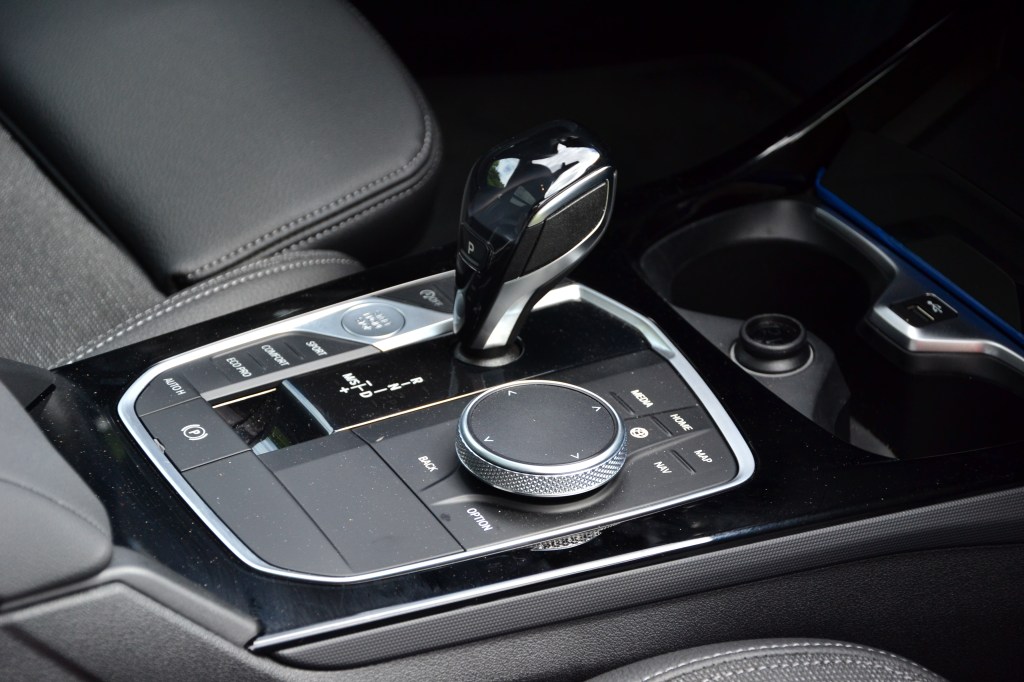
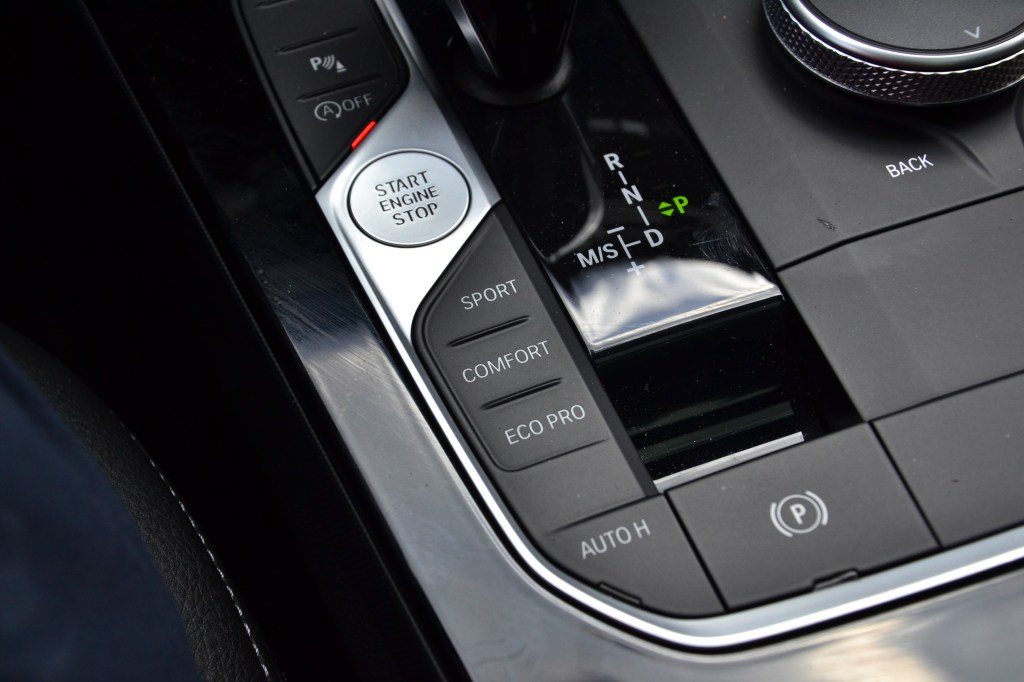
The 218i gives its driver the choice between several driving modes, sport, comfort and even eco pro. Most of the time we opted for the “comfort” mode, which indeed was most pleasant, setting up suspension stiffness and drivetrain responsiveness exactly to our liking, delivering very suave progress in urban driving conditions.
In this comfort modes, the pleasures of BMW driving are totally preserved, with excellent economy as a bonus. It was no effort at all to stay between 6 and 7 litres/100 km in town, on the open road the consumption dropped further by about 1 litre/100 km.
The manufacturer quotes average consumption between 5.7-5.4 l/100 km, which is not unrealistic at all, if you add 1/2 litre/100 km or thereabouts. CO2 emissions are given as 123-114 g/km. Emission class is EU6d-TEMP.
BMW has installed a host of technical features to reduce fuel consumption, such as Electric Power Steering, Auto Start Stop function, Optimum Shift Indicator, ECO PRO mode with coasting function (with automatic transmission), active air flap control, on-demand operation of ancillary units, map-regulated oil pump, differential with optimised warm-up behaviour, tyres with reduced rolling resistance, for instance.
Driving aids…
Standard equipment in Europe includes collision and pedestrian warning with city braking function, which also alerts the driver to the presence of cyclists. Also fitted as standard is the Lane Departure Warning system with active lane return, which is operational from 70 to 210 km/h (44 – 130 mph).
As said earlier, options include Active Cruise Control with Stop & Go function that can be engaged up to 160 km/h (99 mph) and the Driving Assistant, which comprises the Lane Change Warning system, rear collision warning and crossing traffic warning.
Cabin comfort
The interior seats four comfortably, welcoming rear passengers with significantly easier entry and 33 millimetres of extra kneeroom over the BMW 2 Series Coupe.
The seating position is 12 millimetres higher too. The boot holds 430 litres of gear (40 litres more than the two-door coupe) and this can be expanded further by folding down the 40/20/40 split rear seat backrest. The rear bench can be released fully from the load compartment. The tailgate opens automatically at the press of a button or – if the optional Comfort Access is specified – with the wave of a foot.
Conclusion
The BMW 218I is not only every inch a true BMW with all its iconic qualities, it offers all this in an extremely well proportioned and seducing bodywork, which felt “just right” in its dimensions, we found.
Workmanship, build quality and materials used are beyond reproach, styling both inside and out are standard setting for its class, the excellence of the drivetrain is to be experienced to be believed. Add to this unique driving dynamics combined with a comfortable ride and excellent economy, and you can understand that we actually rediscovered how much daily pleasure a BMW car offer you, even in it’s “sedate” 218I version. Of course we look forward to drive for you the more powerful versions in this Gran Coupé 2 series, but driving pleasure is already yours in this one…
Driving is believing, and the e-power experience proves to be even more exhilarating at Audi: their e-tron flagship comes now with three engines, making it 370 kW strong and giving it a massive torque of 973 Nm. Two engines are driving the rear wheels, and indeed, the emphasis is on rear end power, as well for daily use as for sporting driving. The rear end can even be seduced to produce power slides, and the Quattro concept has been further honed to deliver, as the factory puts it, an electronically controlled vector torque distribution with active and fully variable torque distribution between both rear wheels, doing away with a differential altogether.
Driving experience 2.0
The Audi pilots can wet their hands: this impressive SUV is your sporting partner on winding roads and mountain passes. Just put the electronic stability control ESC in “sport” mode and the drive mode selector in “dynamic” and things really start to happen. True power slides are now possible and the system will softly brake the inner front wheel should it want to slip through under full power. This leaves you fully in control of this e-power “bolide”, which leaves nothing to be desired in the power department.
This S-tron catapults itself from 0 to 100 km/h in merely 4,5 seconds, and then storms further ahead to its electronically controlled top speed of 210 km/h.
Still sufficient range…
The available battery power is a good match for all this sportiness. When you adopt a driving style in tune with the WLTP cycle, you can expect an action range of 360 kilometers or thereabouts. The high tension battery has a gross charge capacity of 95 kWh, of which 91 pct is effectively usable.
The Quattro principle has been further refined. When extra power is wanted, the front motor kicks in, and as said, both rear engines are individually controlled and offer this fully variable torque, managed by a permanent electronic control system.
As you can expect, the S version has a suspension setup geared towards sportiness, but when you’re not in the mood, it is good to know that the Audi Drive Select gives you the choice between not less than seven driving profile modes. The fully adaptable air suspension has controlled damping stiffness and can vary the ride height by some 76 mm.
20 inch alloys are standard, but you can opt for 21 inch tall wheels, and later even 22 inch alloys will be available. The brake saddles at the front have not less than six (!) pistons. The brake control system will decide the braking power of each wheel, and will choose also if engine, brake friction or both will be used when decelerating.
The body has also been made more aerodynamic, and the patented new wheel arches improve things markedly. The Cx is a mere 0,26 for the Sportback version.
Each e-tron also comes with a … heat pump, which effectively reduces energy consumption on the whole by extracting heat generated by the driveline, and thus extending the driving range by some 10 pct.
Of course this e-Tron S has all the infotainment and electronic driving assistance you could ever want,and will also light the road for you with matrix LED headlamps. In the cabin, MMI touch response control system with two large central screens await you. The online services of Audi Connect complete the navigation system, especially the e-tron-routeplanner.
We are certainly looking forward to have a drive in this latest edition of the e-Tron, just know that this version will be available on the European markets in autumn 2020, and prices in Belgium start at 97.100 euro incl. VAT for the e-tron S, and 99.110 euro incl. VAT for the Sportback version.
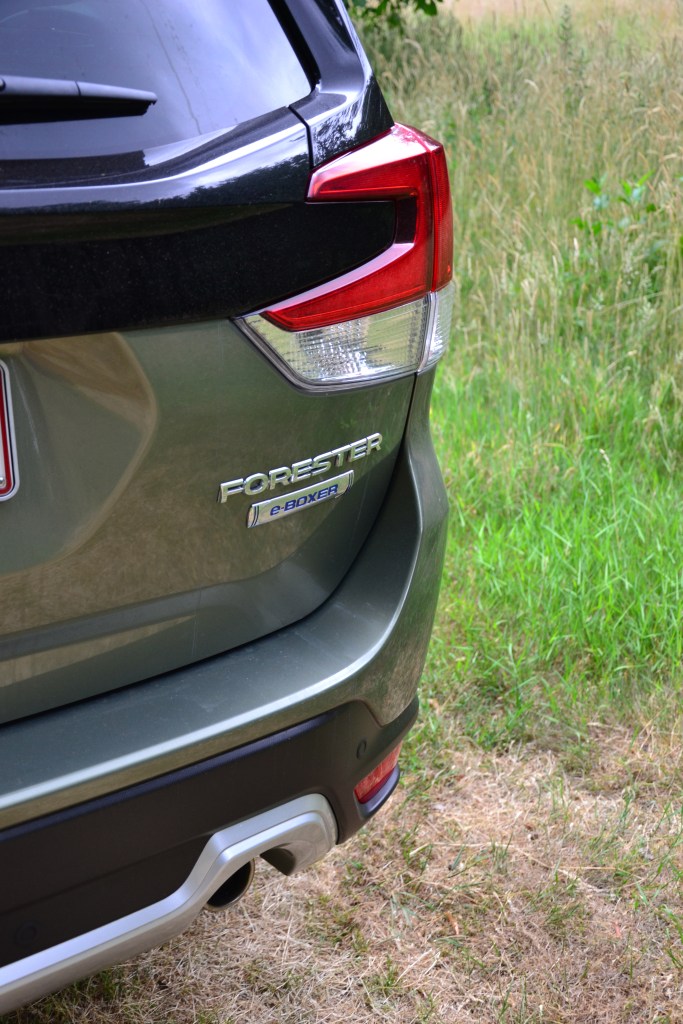
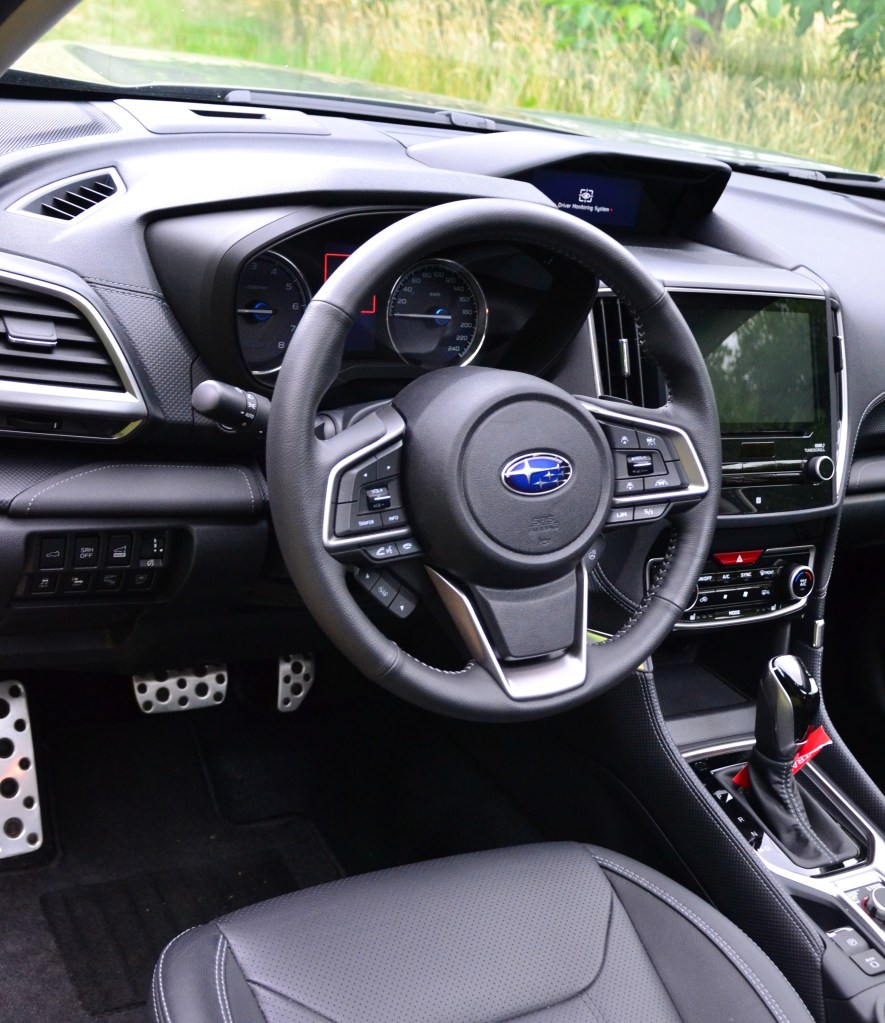
Never (really) change a winning team, the saying goes. This is exactly what the Subaru engineers had in mind when they designed the hybrid drivetrain of the Forester e-Boxer. Indeed, this hybrid Subaru remains very familiar to all Subaru enthusiasts and owners. They will find again the immensely practical and sturdy Forester, which is now roomier than ever, and the familiar sound of the two litre petrol boxer engine will also be music to their ears.
But is has also e-power, albeit rather modest. This has been very cleverly put to use, resulting in a very creditable hybrid. Just read on…
Hans Knol ten Bensel
167 HP at your service…
The e-Boxer Forester has honest punch. The trusty four cylinder boxer puts down not less than 150 HP, and the e-motor a rather subtle 16,7 HP.
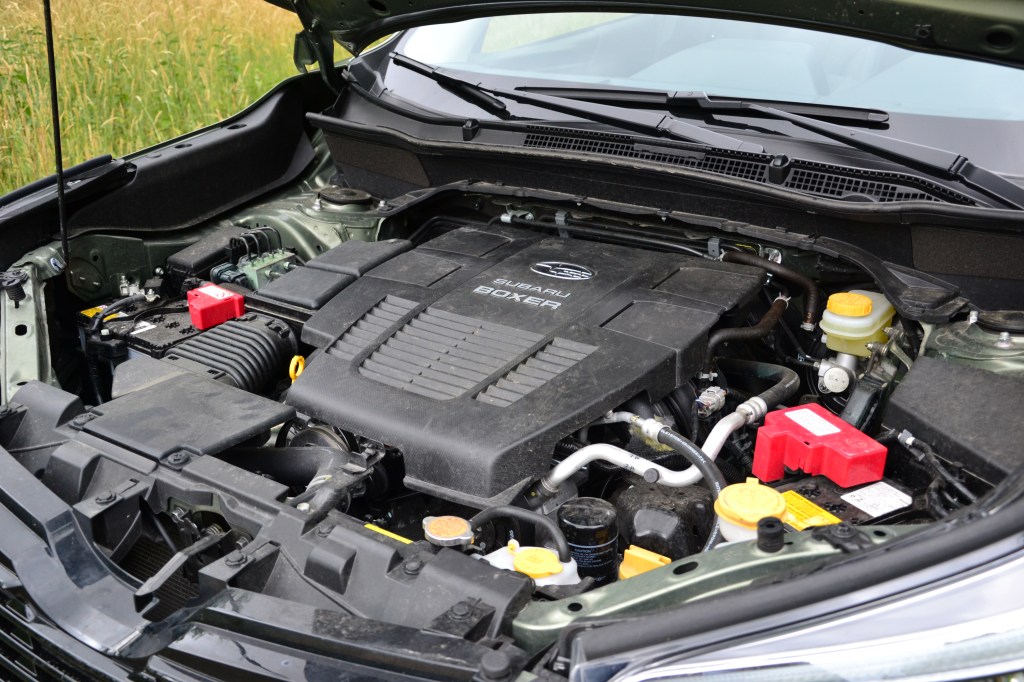
This is more than enough to drive this Forester with spirit, helped by the very responsive CVT transmission, which will let the engine rev eagerly when called for power. As soon as one lifts the throttle only slightly, revs immediately go down again, using the good torque characteristics of this trusty boxer. All this goes with the familiar and typical “Subaru Boxer Sound”, we would say.
Indeed, the moments that the engine is silent and this roomy Forester is propelled on pure E-power, are few and far between. Unless you are taking things more gently, because then the hybrid propulsion system really goes to work, and is very effective at it.
So it all simply boils down to whether you take eco-driving seriously or not. We took things to heart, and drove our test car trough town and on the open road, but with restraint and anticipation, and got rewarded with an average consumption of 6,6 litres/100 km.
This means of course gentle cruising at the 120 km/h speed limit on the open road, avoiding strong accelerations, and also going gently along the traffic stream on urban boulevards, using the kinetic energy of the car as much as possible, and driving gently away from traffic lights. When pulling away or driving at slow speeds in traffic, the battery-powered electric motor alone drives the car in EV Mode. The electric motor power assistance – Motor Assist – is completely automatic. When braking or decelerating, the e-BOXER uses of course regenerative braking to capture energy from the car’s movement to recharge the battery. When you push the accelerator pedal just a bit deeper, the petrol engine sets in too.
In practice, the transition between these two powertrains is never apparent. The Forester e-BOXER’s onboard computers simply work out what’s needed where and distribute the power accordingly.
So it is up to you to keep your Forester in this economical operating range, and achieve these consumption results. There is no EV button, by the way. Subaru believes in the seamless interaction between e-power and engine, to achieve the most efficient progress.
Every bit a true Subaru…
This Forester e-Boxer is and remains the true workhorse you always appreciated. The symmetrical 4WD setup is found here of course, and it is good to know that this new Forester now rolls on Subaru’s new global platform, which allows the stiffness of the body to be increased by not less than 40 pct.
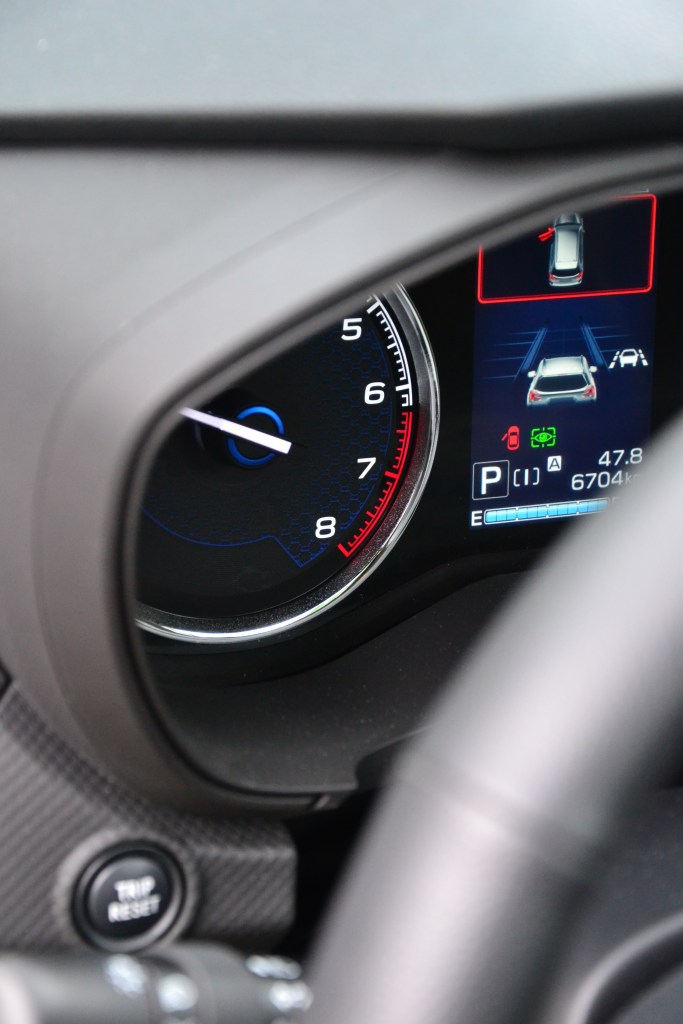
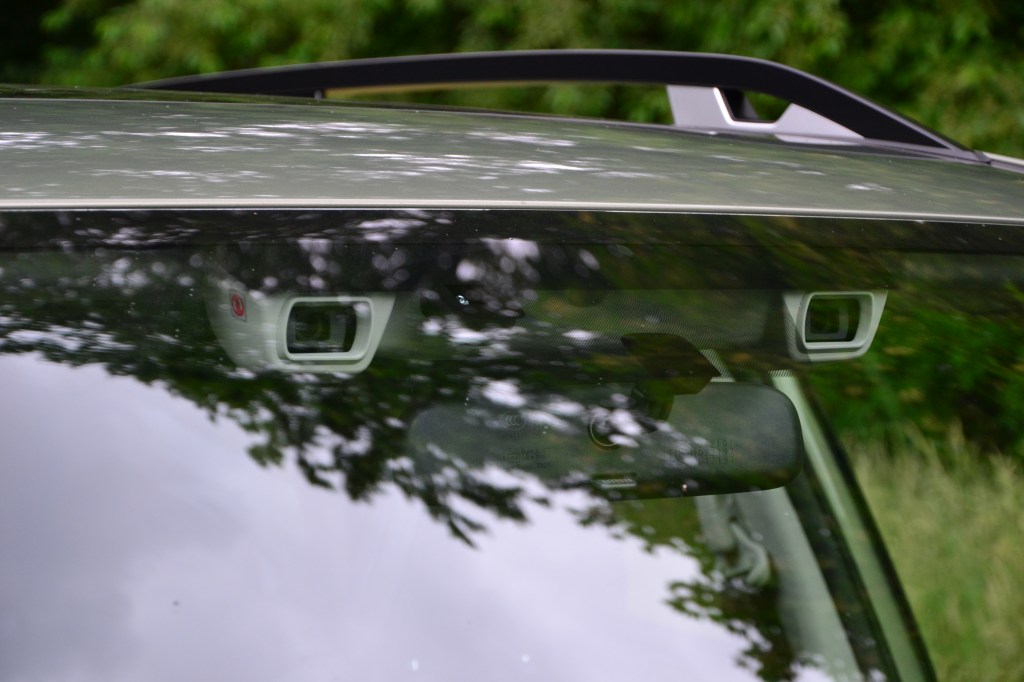
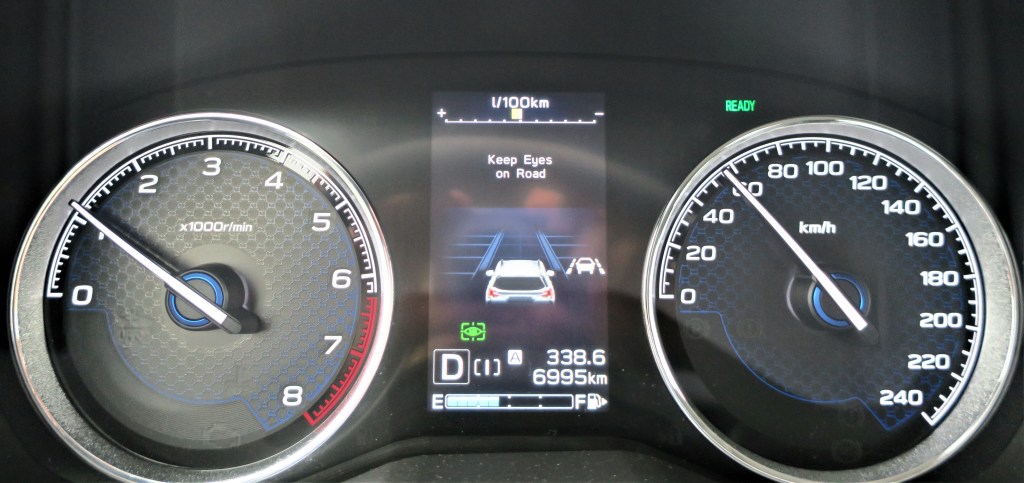
When it comes to safety, it is good to know that a range of passive and active safety technologies are fitted as standard, including: EyeSight Driver Assist Technology (providing Pre-Collision Braking, Adaptive Cruise Control and other functions); Subaru Rear Vehicle Detection (SRVD); Reverse Automatic Braking; Side View Monitor; and Driver Monitoring System, a brand-new facial recognition technology that alerts the driver to re-focus when it detects signs of fatigue or distraction while on the road. We tested it out for you and it really works fine indeed!
This Forester also has been named Euro NCAP’s Best in Class 2019 in the Small Off-Road / MPV class…
Comfort
We were also pleasantly surprised by the comfortable suspension of this Forester. It truly has a very comfortable ride, and also the steering is responsive and precise. It is certainly no punishment to drive this Forester on winding roads. It is also a very comfortable cruiser on motorways. Engine noise and drivetrain vibrations are masterfully filtered out, and all this makes the Forester a brilliant Gran Turismo, with ample head- and legroom for all.
Of course it really comes into its own off the beaten track, thanks to its famous symmetrical AWD system. A prominent X mode dial on the centre console lets you choose between normal, snow/dirt and deep snow/mud modes. On forest roads this Subaru certainly hasn’t stolen its name… This Forester comes of course also with a downhill descent control, and really never lets you down with its comfortable ride height and excellent attack angles fore and aft when you are in heavy terrain.
A pleasant, practical cabin
The cabin is very well equipped and practical, and a lot of thought has gone in the lay-out which is a good example of excellent ergonomics. As said, the Forester has an impressive array of driver’ assistance features, and the beauty of it that they are not obtrusive. You will only notice them when they are needed.
Safety is first and foremost in this Forester, and besides the fact that its Driver Monitoring System warns you when you are not looking at the road ahead. But that is not all: it will also remind you to check whether nobody is sitting on the rear seat when you are going to leave the car.
We also found that all the commands are self-explaining, for instance finding a destination or connecting your phone is the proverbial breeze. Of course all the infotainment is provided, along with Apple play and Google The Forester is also very roomy, with a cavernous boot space and offering also ample room for the rear passengers.
Conclusion
This Subaru Forester remains for those outdoor lovers and those living in remote non-urban places the real all purpose companion for your daily mobility. Cleverly driven in town, this e-Boxer reveals itself as a very frugal boulevard cruiser, letting you park and move under soothing “zen” e-Power, and enjoy this emission-free form of propulsion in driving situations where combustion-engined cars pollute the most.
In the meantime, you chalk up very impressive consumption figures. But you will meet no hassle with recharging, just enjoy a reliable, ever-ready companion. Well, a Subaru!
Generating the right sound is the result of state of the art engineering…
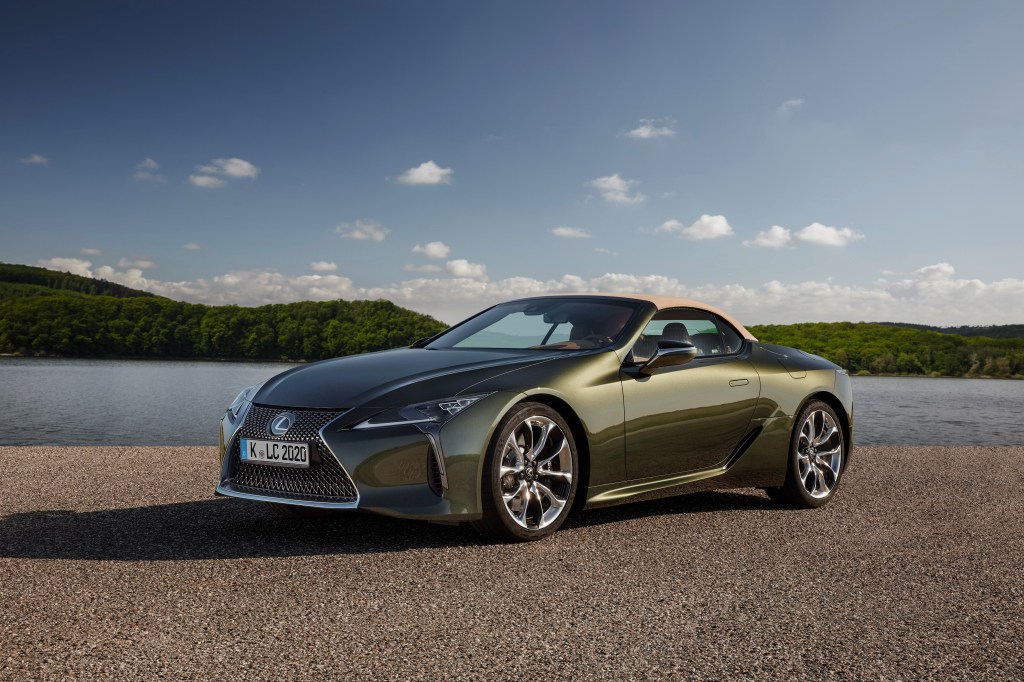
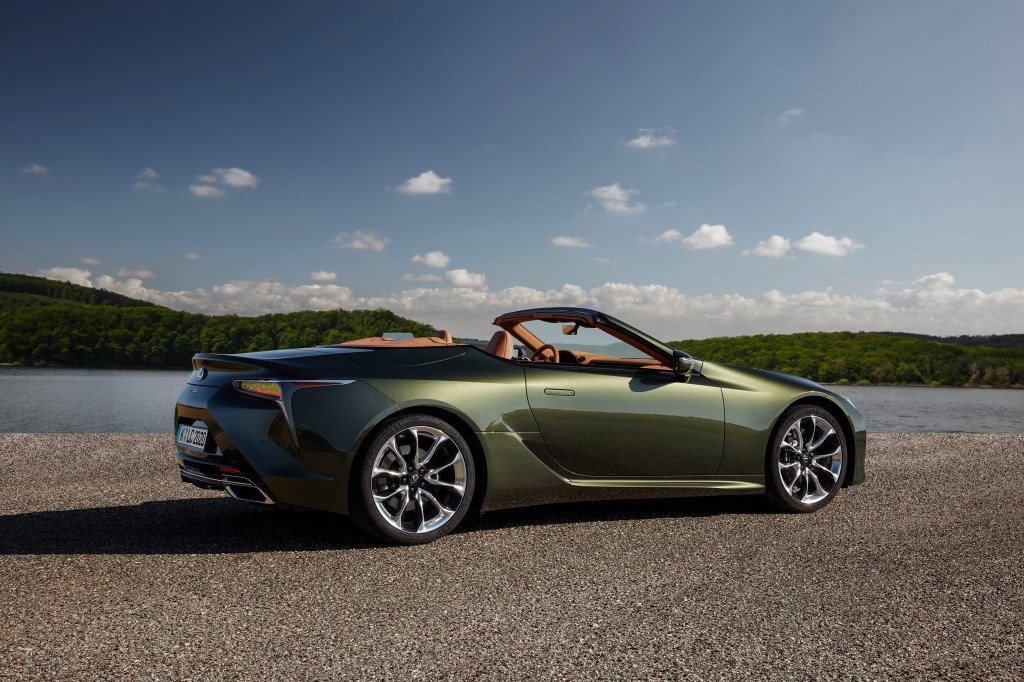
When you step inside the Lexus LC 500 Convertible, we would suggest you lower the roof and blip the throttle. The deep note from its V8 engine tells you immediately that an exhilarating drive is in prospect.
It’s all part of the exceptional sensory quality that Lexus has brought to its first soft-top model: just as much as the styling pleases the eye, the sound of the engine stirs your heart. Generating just the right aural quality was an important goal for the car’s development team, and this required precision engineering to achieve…
Just read on!
Hans Knol ten Bensel
Inspired by the LFA supercar
Lexus’ focus on the importance of the engine sound can be traced back to the LFA, its ultra-exclusive, hand-built supercar. The specialists who worked on its V10 power unit identified the separate qualities that combine to create the ideal sound “atmosphere.”
In the LC concertible, the power of the V8’s engine note had to be balanced with a level of quietness in the cabin that overturns preconceptions about driving in a convertible – an equation Lexus calls a “harmony of opposites.”
To achieve the maximum effect, the sound of the engine changes in line with the rise and fall in rpm, becoming more powerful and urgent in tune with the driver’s use of the accelerator and the sequence of shifts through the rapid-action 10-speed automatic transmission. The exhaust note, too, heightens the effect. By contrast, in gentle cruising, the sound is subdued, so conversation is easy when the roof is down.
Finding that perfect engine sound
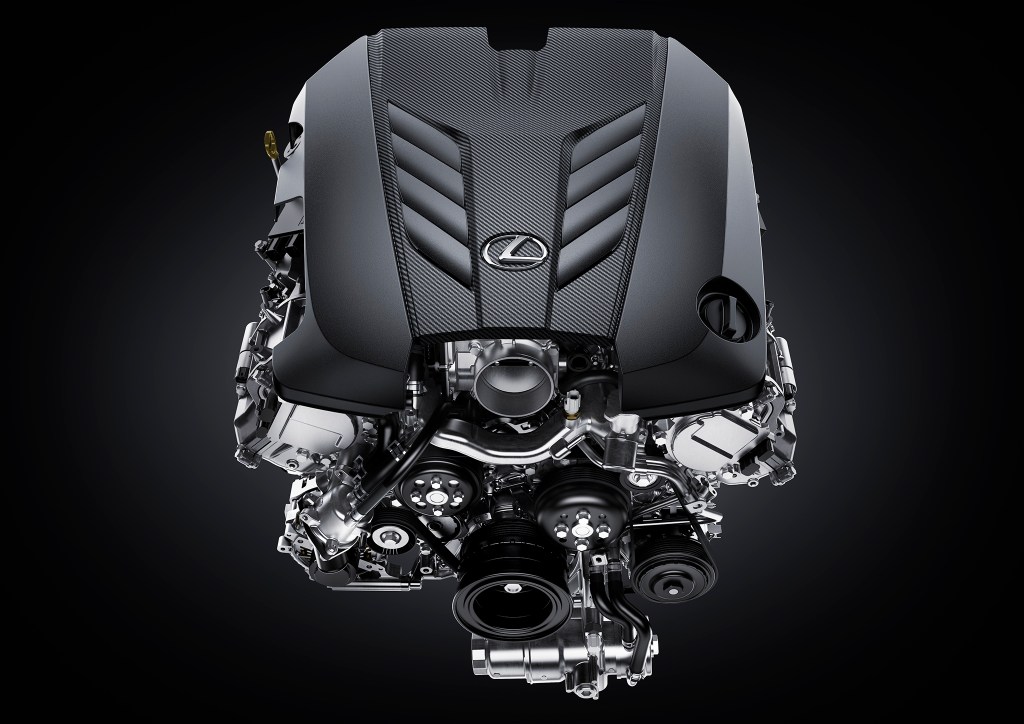
A continuous, pulsating sound is characteristic of a large-capacity, naturally aspirated V8 engine like the five-litre unit which powers The LC 500 Convertible. Lexus has used acoustic technologies to combine this with spectral harmony (perfect sound intervals that are pleasing to the ear), stereophonic sound, to create a depth of sound, and so-called “formants” – qualities that stir the senses and generate a feel-good factor.
Active Noise Control is used to “clean” the sound frequencies experienced in the car. This emits anti-pulse sounds through the audio speakers which counteract any unwelcome low frequency booming sound from the engine and drivetrain.
In the LC Coupe, noise inside the cabin is monitored by a microphone in the roof, but for the Convertible, it had to be relocated inside the driver’s headrest. Being closer to the driver’s ear means it can pick up a wider range of frequencies, but a complex algorithm had to be calculated to make sure it works accurately in any seat position.
The silence of a fixed-head coupé…
Even though the LC Convertible has a soft top, Lexus wanted to secure the same kind of cabin quietness as in the LC Coupe. Acoustic simulations were created to find out where dominant noises were entering the space, so that the amount and location of soundproofing and sound-absorbing material could be calculated.
The storage area behind the rear seats for the folding roof presented a particular challenge, as it was a route for tyre and exhaust noise to enter the cabin. There was not enough room for soundproofing material to be added, so the team looked instead at adapting the trim material itself. By allowing air to pass through the structure and using sound-absorbing material on the reverse, the entire surface of the storage space soaks up noise.
As the area is visible and part of the car’s interior, it also had to look good. Lexus assessed many different materials before choosing one usually used for lining the wings around the wheels. This meets safety standards and, being applied with extra density, has just the right appearance.
We are anxious to enjoy the ride in this formidable Convertible, which will be a feast for eyes and ears…
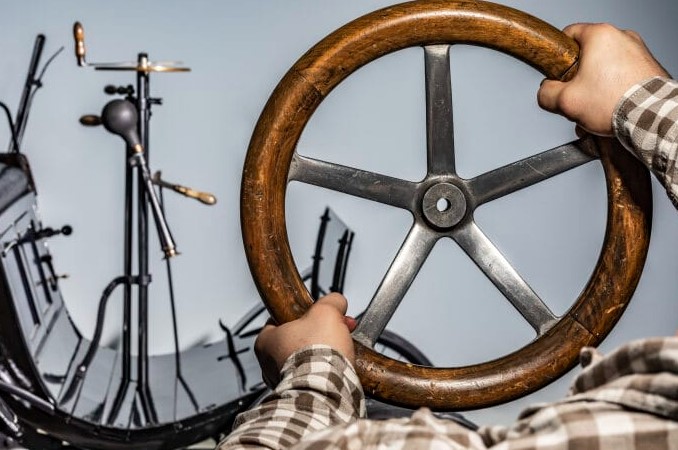
The dynamic PR people of the Mercedes-Benz Museum have recently launched a so-called “33 Extras” exhibit series. These “33 Extras” bring the history of personal mobility and motoring culture to life highlighting details and aspects that are often surprising. Here they focus on the steering wheel, and we found their story interesting enough to present it here to you…
Hans Knol ten Bensel
The world´s first car race from Paris to Rouen, 22 July 1894. Alfred Vacheron´s vehicle with petrol engine. Vacheron was awarded joint 4th place in the contest.
It all started in in 1894: the steering wheel made its debut in the first motorsport competition in history – the race from Paris to Rouen. French engineer Alfred Vacheron equipped his Panhard & Levassor vehicle, powered by a Daimler engine, with a … genuine steering wheel. Compared to the control levers that had been used up to that point, the steering wheel allowed him to steer more accurately – and therefore also to increase his speed. His steering wheel consisted of a circular grip ring connected to the steering column by spokes – a basic principle which is still valid to this day.
Mercedes-Simplex in the Mercedes-Benz Classic Insight Nice-–La Turbie in 2017. The steering wheel was equipped with additional levers for adjusting various engine functions.
The end of the handlebar…
Before the steering wheel became the norm at the turn of the century, there were many solutions, including some that resembled bicycle handlebars. In his three-wheeled Patent Motor Car of 1886, Carl Benz used a rotary crank that transmitted the driver’s steering action to the steering column. Gottlieb Daimler equipped his four-wheeled motor carriage from 1886 with a cross-shaped handle.
In the end, the steering wheel prevailed quite simply because it could be operated intuitively. Along with the pedals and seat, it is the most important interface between the driver and the car. Key advantage: It was possible to determine the exact driving direction much more accurately than with levers because the wheel principle allowed the steering lock to be translated through the gearing into several revolutions.
Additional functions already 120 years ago…
Sectional view of a steering wheel with airbag from 1992. The folded airbag (white) can be seen above the propellant charge.
On the Mercedes-Simplex models, from 1902 on, the steering wheel was equipped with levers that were used to adjust important engine functions ─ in particular, ignition timing and mixture formation. In the 1920s, a steering wheel ring for operating the horn was added – an early implementation of Car-2-X communication, so to speak.
…and now
Today’s steering wheels are used to operate numerous systems, such as the on-board computer, voice control, telecommunications and multimedia. In addition, there are a number of stalks arranged in the immediate vicinity. In the summer of 2020, Mercedes-Benz will be presenting the next generation of the steering wheel as a command centre – the capacitive steering wheel with digital control zones.
Touch, “feel” and emotion…
There are considerable technical demands placed on the steering wheel – and the tactile experience. If the steering wheel is not perceived as pleasant to touch, this can have an effect on the way the vehicle is driven. In addition to the materials, the design also plays an important role.
Steering wheel and instrument cluster from the Mercedes-Benz S-Class, model series 221. Photo from 2005.
Steering wheel ergonomics also includes its position in the vehicle. The Daimler Phoenix racing car from 1900 and the innovative Mercedes 35 hp from 1901 had already proved this point: Their steering columns were inclined much more than before. This made it possible to steer the cars much more effectively and more dynamically. This contributed both to driving safety and also to the overwhelming sporting success of the Mercedes 35 hp in Nice Week in 1901.
Steering wheel from a Formula One Mercedes-AMG Petronas Motorsport racing car. Photograph from 2018.
Size did matter…
The first steering wheels provided a fair guide as to how big and heavy a vehicle was. Trucks and buses initially needed enormous steering wheels. It was not until the advent of power steering that it became possible to make steering wheels smaller in large vehicles. Power steering was first fitted on the Mercedes-Benz 300 saloon car, in 1958. From the 1960s onwards, Mercedes-Benz commercial vehicles were also equipped to an increasing extent with power-assisted steering.
Passive safety started in 1959
As part of the safety concept implemented in 1959 in the W 111 model series, the “tail fin” or “Heckflosse” saloon was the first to feature a steering wheel with a large, padded impact cushion, which reduced the risk of injury. In 1967, Mercedes-Benz introduced safety steering with a telescopic steering column and impact absorber as standard equipment for all vehicles. Then, in 1981, the driver’s airbag fitted in the steering wheel was introduced. This world-first innovation in production cars was introduced by Mercedes-Benz in the S-Class model series 126.
Im Forschungsfahrzeug Mercedes-Benz F 200 Imagination wird 1996 die Fahrzeugsteuerung über Sidesticks erprobt.
The Mercedes-Benz F 200 Imagination concept vehicle from 1996 tested the use of side-mounted joysticks for steering.
Cars without a steering wheel?
Mercedes-Benz has toyed with this scenario at least in test and research vehicles. The F 200 Imagination concept vehicle presented in 1996 was controlled with the aid of side-mounted joysticks. The innovative system worked perfectly. However, the steering wheel remains the preferred option, which applies just as much to production cars as to modern racing cars with their highly complex control systems. Perhaps tomorrow’s autonomous cars will be able to do without a steering wheel completely. Until then, however, the new Mercedes-Benz capacitive steering wheel supports autonomous driving functions more comprehensively than ever before. A brief history of the steering wheel is also given in a press release from Mercedes-Benz Cars.




























 Autoprova - for the Connaisseur