
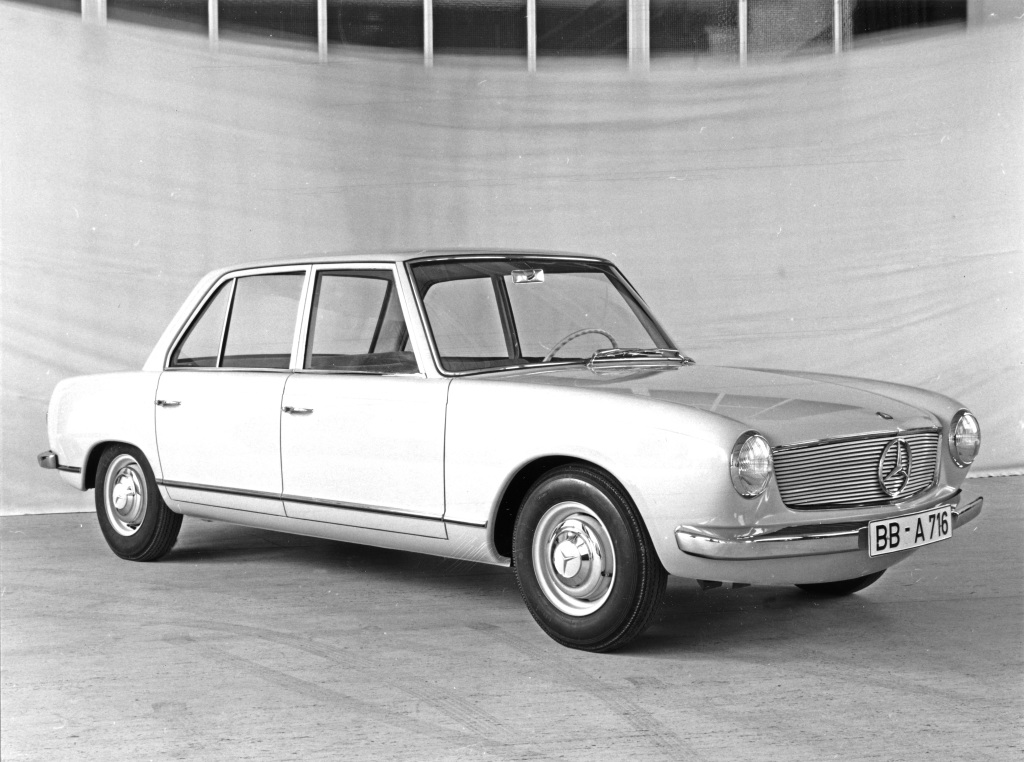
In the spring of 1958, decisive motor history was written: In april of that year, the then Daimler-Benz AG acquired a majority in Auto Union GmbH. All the remaining shares followed on 31 December 1959.
By 1960, Auto Union was therefore a wholly-owned subsidiary of Daimler-Benz. This meant that all the brands of Auto Union, which included Audi, now could be revived.
And so Daimler did, to let the public forget the two stroke image of Auto Union and DKW. Of course, they had one small car adventure with the two stroke engined DKW Junior, wich actually proved quite popular.
But Mercedes rather more loved the four cylinder engines and the nobler Audi image, which would fit perfectly. So they made efforts – which we will explain here further – to bring a revolutionary four srtoke engine into the existing Auto Union/DKW F103, and started work on the development of an all new Audi.
Daimer strategy changed however, and so they sold on 1 January 1965 the majority of the shares of Auto Union to Volkswagen, and offered them Audi on a plate…in the form of a already extensively developed Audi four dour model, and they even sold the engineer who developed this car with it!

The Mercedes-Benz plant in Düsseldorf is the largest van plant of Daimler AG. Around 6,600 employees produce the Mercedes-Benz Sprinter at the plant. Historical photo of T1 van assembly in the 1980s.
In the meantime, from 1961 onwards, the major Mercedes-Benz plant in Düsseldorf was constructed on a site previously operated by Auto Union. With a workforce of some 6600 and an annual output of around 150,000 vans, Düsseldorf is now Daimler AG’s main factory for vans. All the closed variants of the Mercedes-Benz Sprinter – i.e. panel vans and crewbuses – roll off the production line there. Just read further…
Hans Knol ten Bensel








 Autoprova - for the Connaisseur