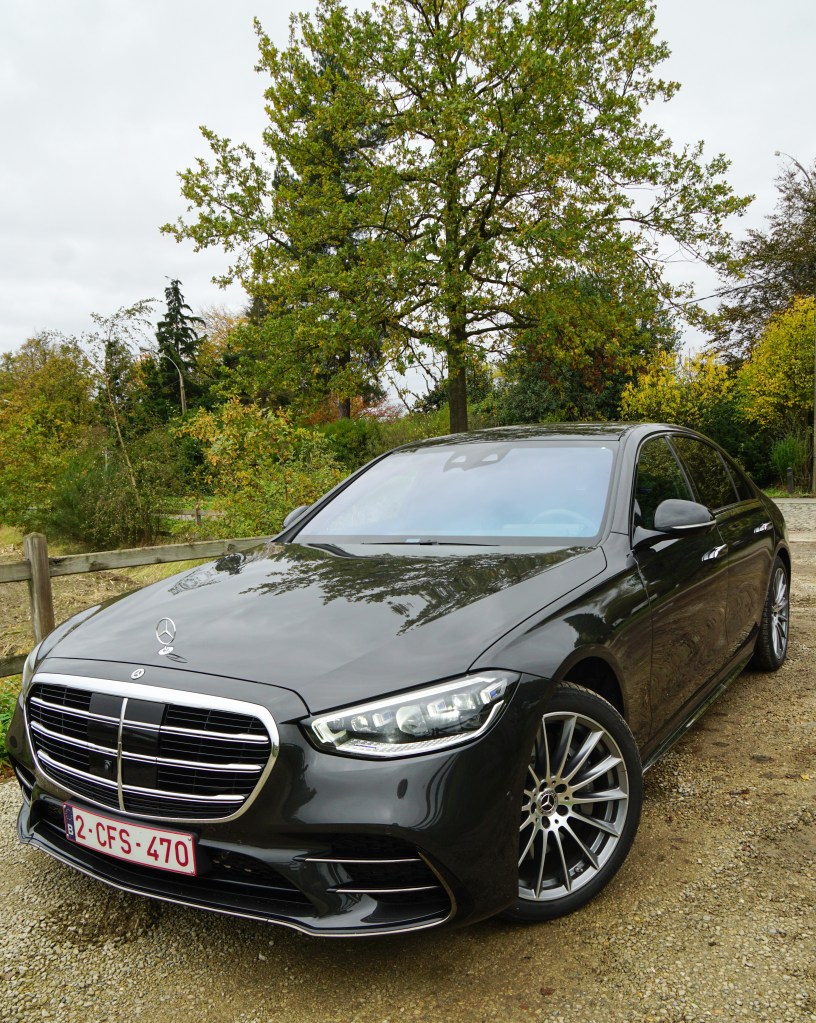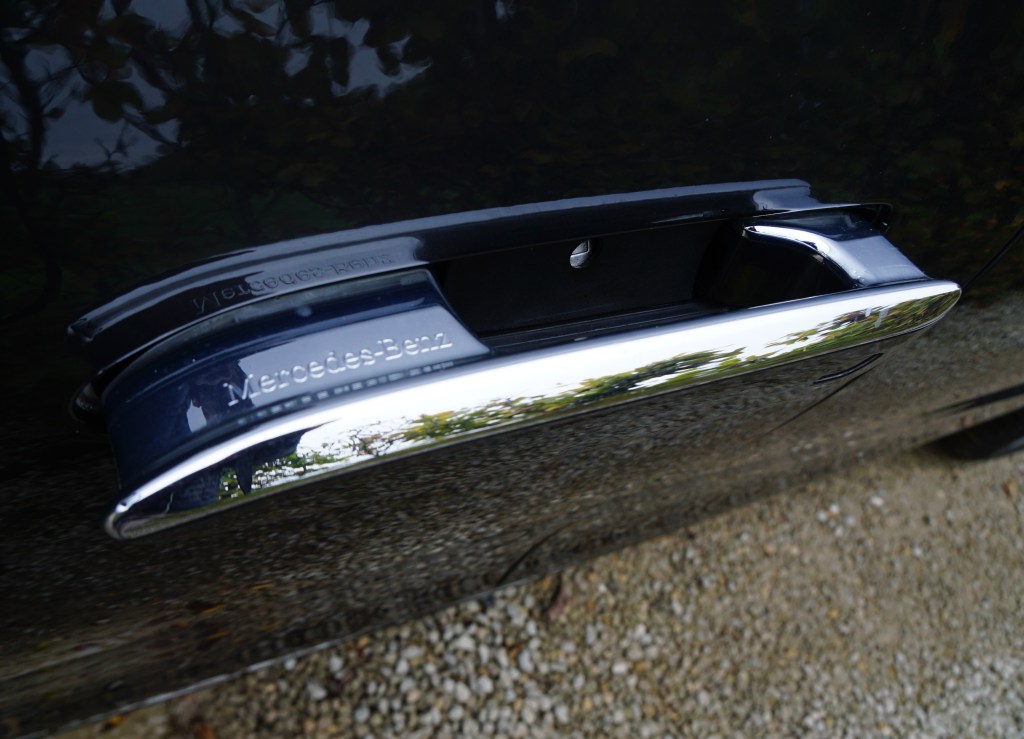
We drove the Mercedes 450e S Class: the pinnacle of luxury motoring…

The Mercedes S-Class has been the benchmark of luxury limousine comfort since 1972. Now we are at the W223 series, and it is still unsurpassed in terms of comfort, workmanship, mechanical and electronic excellence, and last but not least, panache.

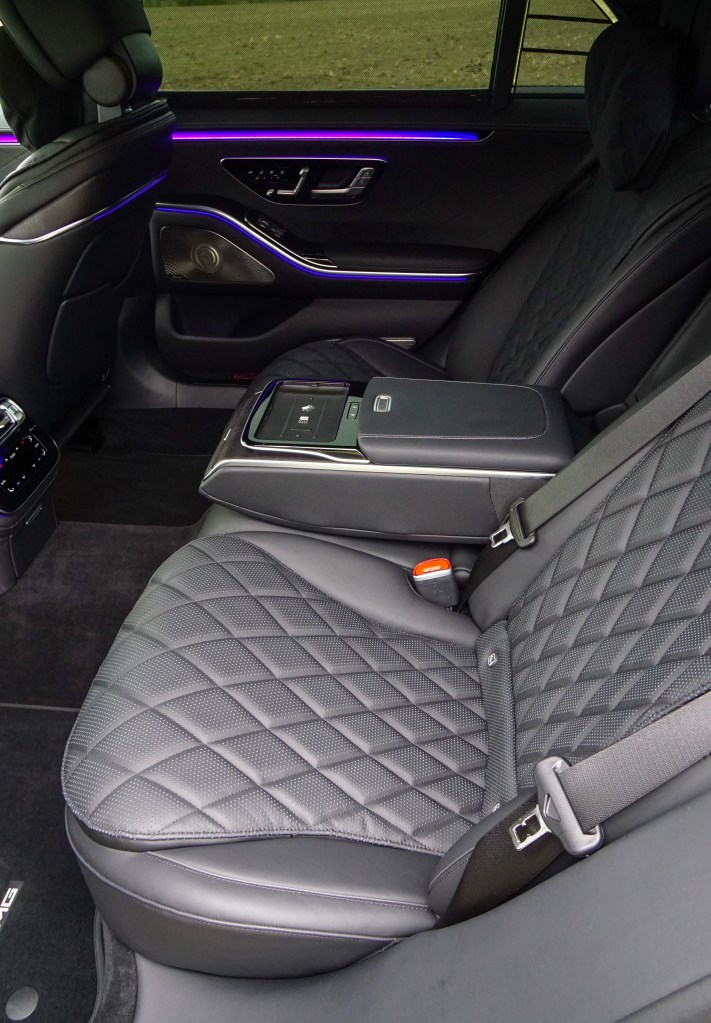
Our test car is the plug-in hybrid version of the S-Class, designated as the S 450 e. Furthermore, we drive the “L” or long version, which, of course gives you totally superb rear passenger comfort.
 

Don’t think that this imposing S Class version will be difficult to drive in town: thanks to the rear-axle steering (optional) the turning circle of the S-Class is reduced by up to two metres. The steering angle at the rear axle goes up to 10 degrees…The steering is also surprisingly direct: only 2 turns are needed to steer from full right to left.   

Stepping behind the wheel in this magnificent limousine will however still require some caution, certainly if you wear a hat. The a-pillar is  raked rather steeply for good aerodynamic reasons, but this means that you will still have to tilt your head slightly…

Once your are sitting down you are enveloped in superb somfort. The front seats have a 4 way back support, electronically adjusted, and of course there is a whole (optional) massage program waiting for you, just touch the “comfort” symbol on the large central control screen and you can choose your favorite session…

You can also opt for an active “multi-contour” package, which gives you extra lateral support when you are cornering at speed.
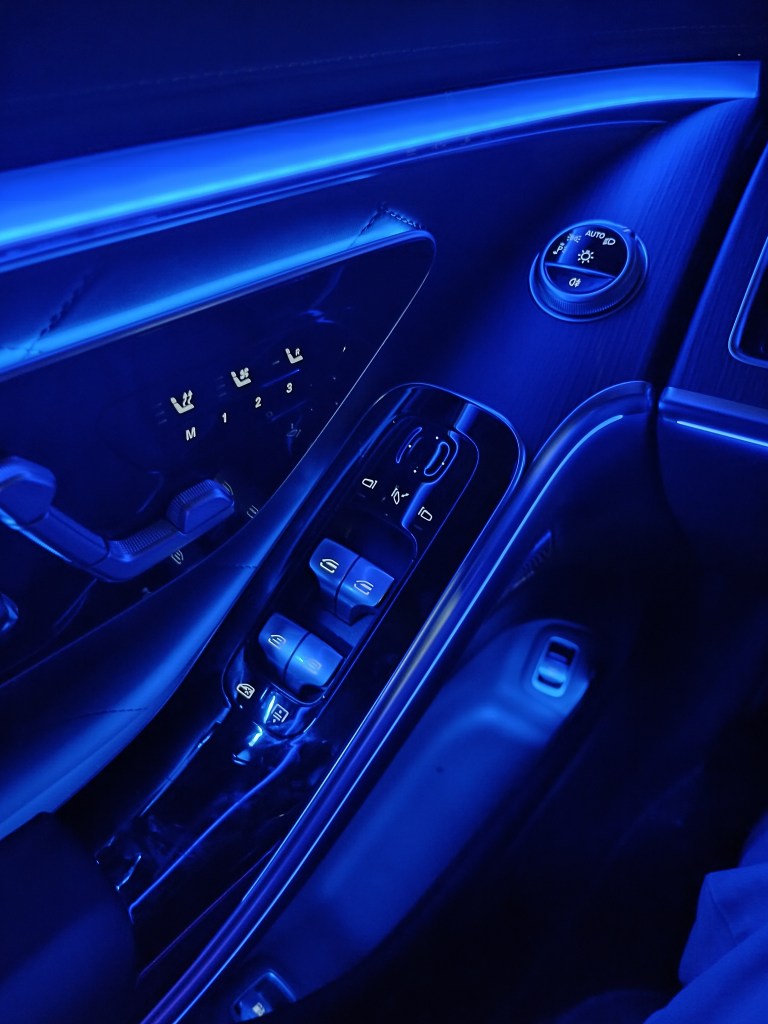
 The cabin bathes you in a wonderful light ambiance, which, of course you can adjust at will.

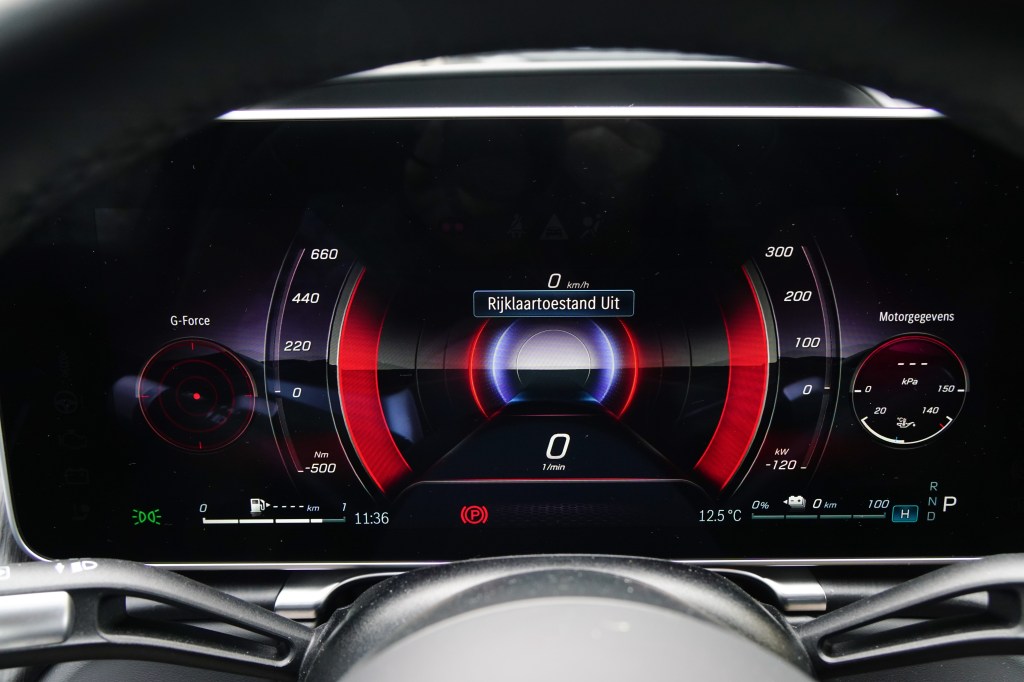
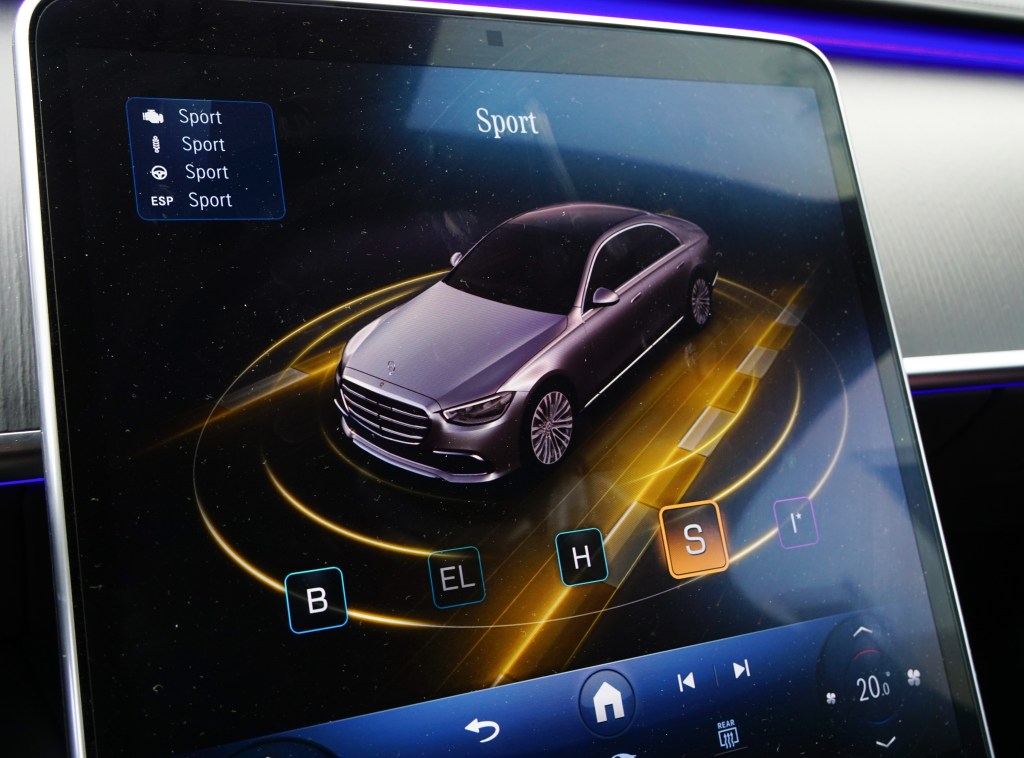
The instrumentation is clear, the immense screens both in front of the driver and the central screen are largely self-explanatory, although we would still suggest that you take some time to get acquainted with all its wonderful features.

Superb and ultra-refined performance…

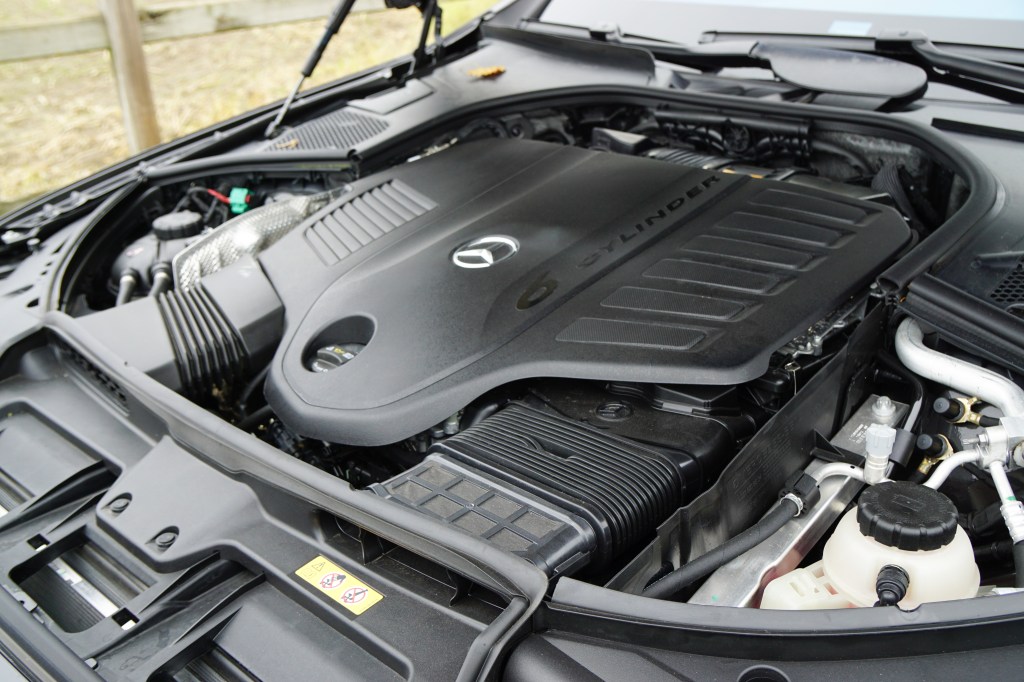
The fourth generation of the hybrid drive celebrated its premiere in the S-Class in 2021. The present 450 e version has a 3 litre straight-six cylinder under the hood, developing 220 kW or 299 hp, combined with a rather powerful 110 kW or 150 hp electric motor. The battery is not enormous with 21,96 kWh, but powerful enough to give the 2,5 tonne “e” S-Class a range between 105 and 70 km.

:

You can calculate it for yourself on the simulator which you can find on the Mercedes website.

We show you it here in two screenshots: assuming 35 % of the trip made on the Autobahn, the electric only range with an outside temperature of 20° is 100 km, when the ambient temperature drops to 10°, the range drops to 77 km. Quite sufficient in our opinion to perform a daily commute on E-power…

You can charge the battery with a maximum power of 60 kW, and on an ordinary wallbox or public charging point (Max 20 kW on DC) you can charge the battery from 10 to 80 pct in merely 20 minutes.

The outright performance leaves nothing to be desired: this S-Class will sprint from 0 to 100 km/h in merely 5,9 seconds. The top speed is electronically limited to 250 km/h.

But the beauty lies of course, in the smooth way all this performance unfolds. The electric engine is totally inaudible, the 6 cylinder 3 litre engine is ideally balanced and vibrationless, and only a soft purr is heard when accelerating hard. The engine is mated to a smooth and alert 9G-TRONIC Plus automatic gearbox, which makes imperceptible gear changes. You have gearchange paddles at the steering wheel, but with 9 gears to choose from, one is soon overwhelmed… and we chose to let the clever gearbox do the work. The 9th gear allows very relaxed cruising at very low revs. At 120 km/h,  the engine exceeds barely 1500 rpm.

Consumption is, of course, very much in function of the battery status, or rather, whether you drive on e-power or not. The WLTP standard consumption is officially quoted at 2,4 l/100km. The manufacturer’s official figure for average e-consumption is 17,4 kWh/100km, which I find a rather more realistic indicator. On the open road, your flagship is still quite economical, due also to its excellent aerodynamics: it has a Cw coefficient of merely 0,22. When you drive at fast cruising speeds, the consumption hardly exceeds 11 l/100 km. Town driving will cost you around 10,5 l/100 km.

Floating carpet comfort…

The S-Class can be considered to be the ultimate standard in limousine driving comfort. It has standard an air suspension with adaptive dampers, and you can opt for E-Active body control, which keeps the car body stable even under very fast cornering. The suspension swallows any road irregularities totally smoothly and this even at very slow speeds, and one truly enjoys a “floating carpet” ride. You can choose between different suspension settings, but even in the “sport” mode the ride remains totally smooth.

Heating and ventilation are also in a class of its own. Two-zone airco is standard, but you can opt for four-zone airco. Of course the rear passengers are spoilt too. You can obtain all conceivable extras, from heated side panels to heated and ventilated seats fore and aft, dark window curtains at the rear; you name it..

Infotainment reaches into the stars…

Mercedes is quite proud of its MBUX infotainment system, and deservedly so. As we said above, the system is quite intuitive, provided you take the effort to study the system and carefully go through all the menus. The indications are chrystal clear and seen on a massive 12,8 inch central touchscreen.  

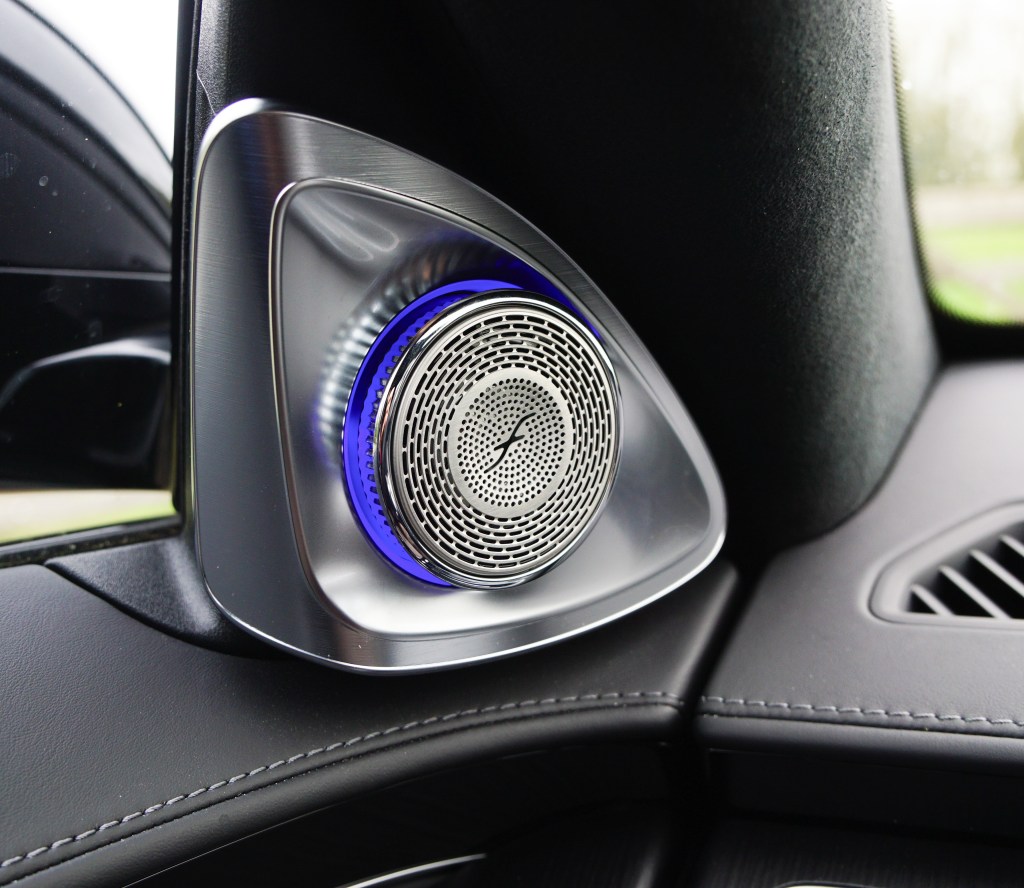
The sliding volume control for the superb Burmeister (31-speaker!) sound system takes some practice, but soon you become a master at it. You can also choose the instrument layout on the screen in front of you, and the overhead display of our test car was also eminently readable. You can also enjoy the optional augmented reality feature on this display, which shows you, with clearly visible arrows, which route to take…

This flagship Mercedes was updated last year, and has further optimized the MBUX user interface: suggestions for assisted parking are now located more intuitively in the menu. The Mercedes-Benz Automatic Lane Change (ALC) function now offers a further intelligent development: if a slower vehicle is traveling ahead, the car can initiate a lane change itself.

Indeed, if the radar recognizes sufficient open space and lane markings are detected, it can overtake the slower vehicle in front… fully automatically(!). The prerequisites are a motorway-like road with at least two lanes and a speed limit as well as a vehicle equipped with MBUX Navigation. The system does not require any further input from the driver to carry out the automatic lane change. Brave new world, we would say…

Let there be light…

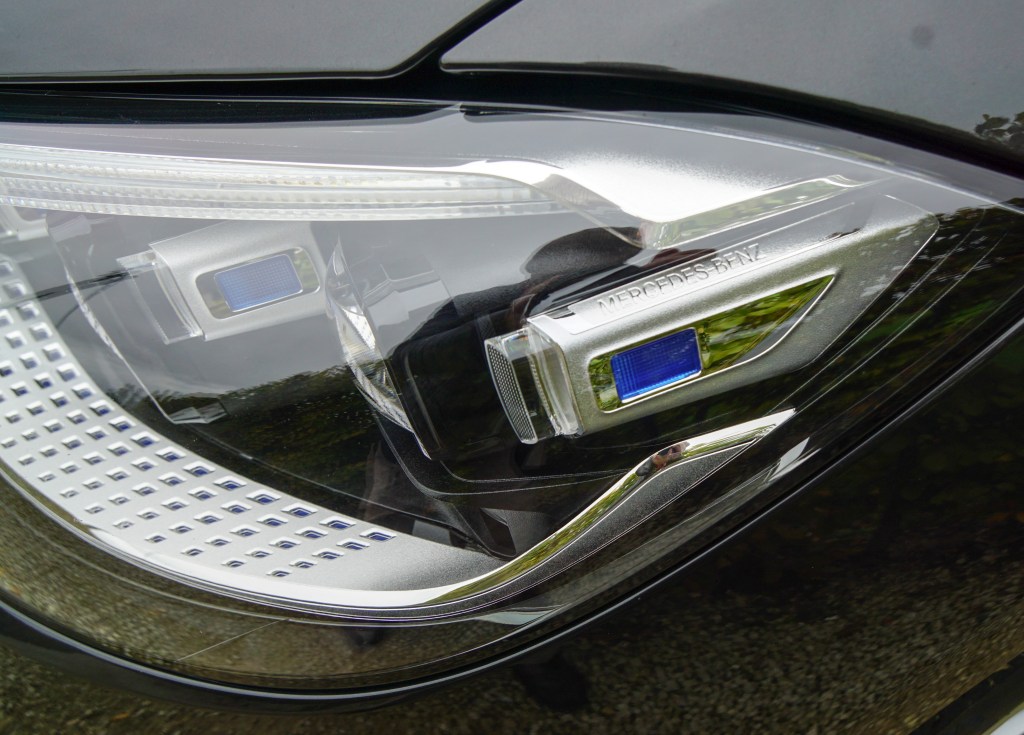
The LED headlights are state of the art, with light shining in bends, combined with excellent long-range visibility with dynamic headlight assistant and extra powerful LED elements. The headlights shine up to a distance of … 650 meters (!).


The Long version of the 450 is as you can expect enormously spacious at the rear. But also in front there is enough head- and legroom for 2 metre tall adults. Boot space is of course also sufficient with 450 liters.
 
 Conclusion

The Mercedes S Class continues to be the absolute benchmark in luxury, mechanical and electronic perfection, comfort and sheer performance. Add to this the legendary quality seen in the perfect fit and quality of the materials used, and you know that this car is built for a lifetime of superb motoring.

Of course, all this doesn’t come cheap, even more so when you take into account the long list of optional extras.

But then, when one reaches the pinnacle of what a series production luxury saloon can embody and represent, it is still quite reasonable when compared with exotic supercars…

Hans Knol ten Bensel

We drove the Fiat Grande Panda Elettrica: EV driving with panache and style…

Italy is the birthplace of style and elegance, and this Grande Panda truly shows it. We personally love it and both the exterior and cabin styling solutions have won our hearts. It truly stands out in character and practicality and shows many competitors how a compact B-segment car can also be designed and built.

The Grande Panda Elettrica runs on the Stellantis compact EV platform, which it shares with the Citroën C3 (Aircross) and Opel Corsa/Frontera.

It has a 44 kW battery, and a 83 kW/113 HP electric motor. Perfect for town driving, where the less ideal aerodynamic boxy bodywork doesn’t spoil the fun. This means that in town, a practical range of some 300 km is quite realistic.

On the open road and certainly on the motorway, you better have a somewhat lighter foot, as the wind resistance pushes the consumption higher into 18-19 kW/100 km, reducing the range below 220 km.

The engineers wisely limited the top speed to some 132 km/h, which is totally reasonable. Cruising around 110 km/h will get you around 250 km useable range. The WLTP consumption is quoted at 16,8 kW/100 km. Charging on an 11 kW charger will cost 4,5 hours from zero to a full battery.

The Grande Panda is very much in its element both in town and on the open road. It steers light and precise, is quite comfortable on city pavés and is also remarkably silent, also at speed.

The electric engine is smooth and inaudible, just a faint whirr is heard when it recuperates energy when slowing down. Wind and tyre roar increase with speed, but it never gets obtrusive.

A model of the original Panda, remembering the banked round curves of the famous “pista” on top of the iconic original Fiat factory in Turin…

Besides the silence and smoothness of the electric engine, one can also enjoy the zest and power offered by the 83 kW motor. It will sprint from 0 to 100 km/h in just over 11 seconds, but actually the intermediate accelerations tell you the whole story: accelerating from 60 to 100 km/h costs slightly over 6 seconds…

Handling is quite good and predictable. This Panda doesn’t mind to drive with speed on winding roads, with good motorway stability also guaranteed.
 

A pleasant cabin

So much for the driving part. Stepping into the car one enjoys the modern and stylish “ambiance” of the interior. Well done! We liked the styling elements and surface texture of the glove box, the square shaped ventilation openings, the layout of digital dashboard screen and the 10,25 inch centre screen. Everthing is simple, yet there is every information you will ever need.

Of course, no navigation is provided, so the apps on your phone will via Apple Car Play or Android Auto will have do the work. It also pays to have an app on your phone which shows charging stations…

There is plenty of room on the dashboard to put your stuff and the centre console has room for your phone. Two USB C slots are provided in front near the centre console.  

We liked the “Panda”lettering on the seats, and the front seats were pleasantly soft and comfortable. We were further seduced by the evident controls of heating and ventilation: three round knobs, which were a child’s play to use… When the battery is charged more than 30 pct, you can even pre-heat your Panda in the morning.

Also in the rear there is enough room for two rather tall adults.  The luggage space is also more than adequate with 361 liters, with the rear seat down this increases to 1315 liters. The charging cables have no separate space, so they occupy the boot…

Conclusion

If you are looking for a B segment car which stands out in style, then this Grande Panda is the one to look at. It offers enough room for four adults and their luggage, is a dream to drive in town and will let you tour through Europe in comfort.

Its personality will let you enjoy EV motoring, that’s for sure, and last but not least, the price will also make you smile…

Hans Knol ten Bensel

We drove the Renault 5 E-Tech: the automotive future now embraces its historic icons..

Indeed Renault is looking back, but then only to inject its unique iconic true DNA into the cars it designs for the E-future. This is a clever strategy of this iconic French automaker. Indeed, in the roaring sixties and seventies, it did put cars on the road which continue to inspire several generations, and this right until this day.

Besides the ”4L” or charmingly called in the Gallic language ” la quatre elle” , there was the Renault 5, lovingly called “la Cinq”.

Another Renault icon is the starting blocks by the way, the new Twingo E-TECH, and all these new characterful cars are based on the same platform which Renault has developed for the new age of very efficient, compact and financially accessible EV’s.

Renault showed a prototype of its electric “5” already in 2021, and we are delighted to see that virtually all the styling elements of this project car are found back in the series production model.

The “5” is indeed an absolute pleasure to look at, it is wonderfully proportioned and stacked with delightful details.

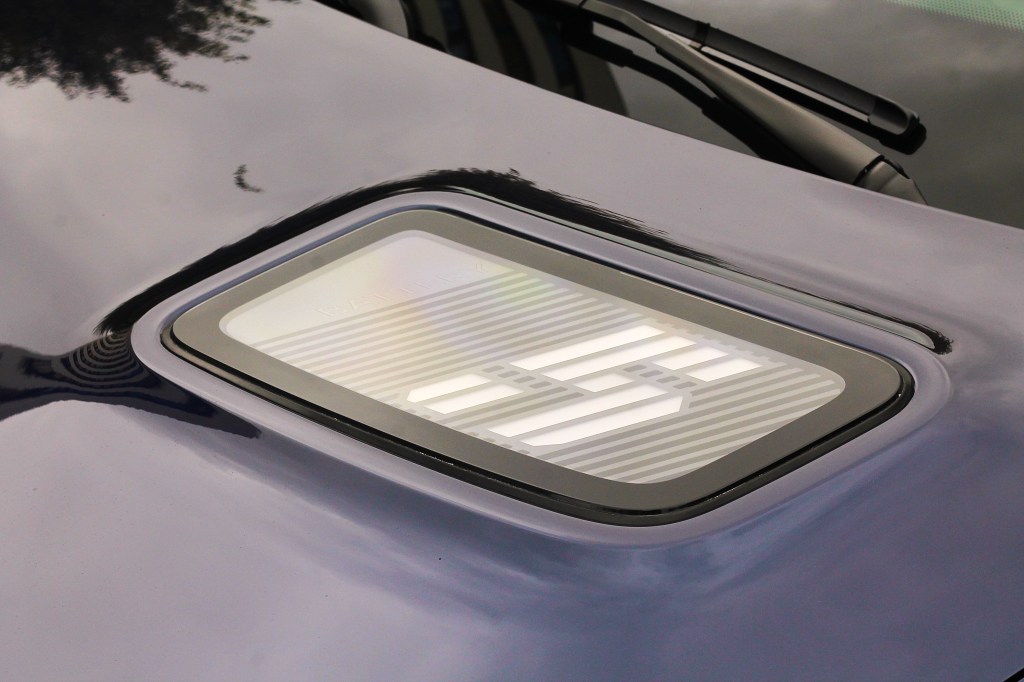
Like the big letter “5” on the hood which gradually lights up when you charge the car, so you can  immediately see how far the battery is recharged. So cool!

The headlamps are also wonderfully styled, and accompanied by square led light patterns below them.

The rear lights are sculpted as on the legendary R5 Turbo. By the way, the power and panache of this Turbo classic is not much more in driving practice than the torque and immediate pulling power of the 150 HP electric motor of our test car. And then there is the 218 HP Alpine Version, which we hope to drive soon…

A wonderful cabin…

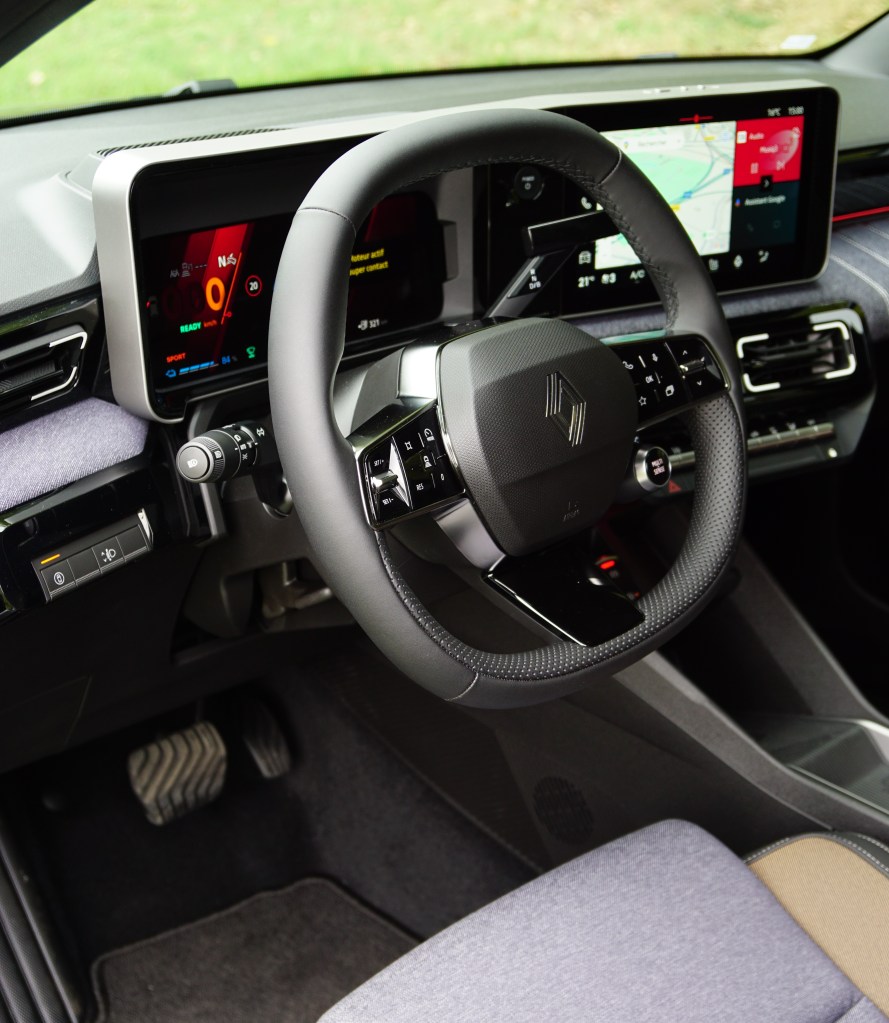
The fun continues in the cabin. We find here the typical square design style of the seventies, which is continued in the yellow colour and graphic patterns of the displays found in front of the driver and the centre.

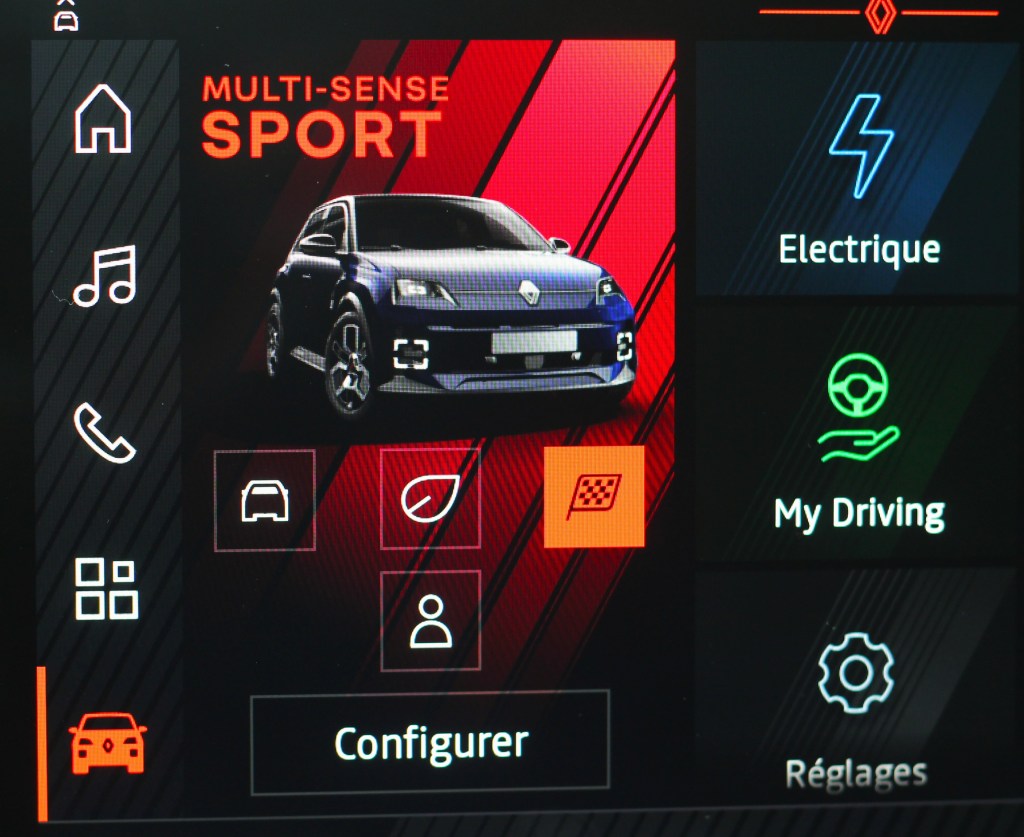
The screens are quite practical after some obvious acquaintance, and we liked the extra row of physical knobs and controls for heating and ventilation below the panels.

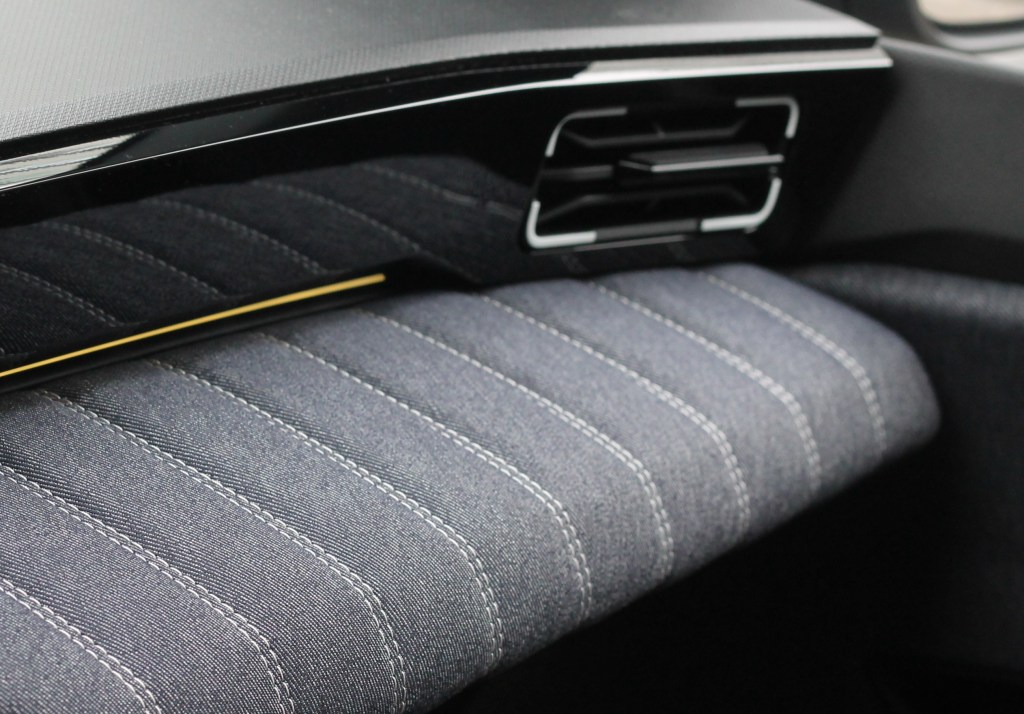
We liked the seventies styling of the seats which are also comfortable and well adjustable. The driver seat is also height adjustable as standard. In the front there is is ample leg and headroom, at the rear the available space is only adequate for adults. But this is a (city) car for young (at heart) adults, so in the rear you will mostly find kids or grandchildren..

The boot space is more than adequate for this compact EV, with 255 liters under the luggage cover. There is no separate stowing space for the charger and cables, just a stylish bag is provided.
 

Rediscovering driving pleasure…with an EV.

This is where this Renault 5 E-Tech really stands out: it gives you TONS of driving pleasure behind the wheel. No small feat for an EV. Not in the least because it steers and handles like a dream. The steering is precise, the suspension is sporting but not too harsh, and it just LOVES winding roads.

The car is wonderfully agile, and when you steer it into corners with abandon, it will even oversteer, which is of course easily corrected. Just great. Straight line and high speed stability is excellent. Does this 5 inspire you always to a sporting driving style as a must?

Not at all, it is whisper quiet, and the excellent sound system (can be optionally equipped with a Harman Kardon sound system) lets you enjoy classical or your preferred music along the route. Wind and tyre noise are virtually absent and this makes the compact “Cinq” a car with the manners and driving refinement of a premium automobile. Fit for long journeys too!

With outstanding performance to match…

What about range and performance you will ask. Our test car was equipped with the 150 HP or 110 kW engine, and this means vigorous accelerations, considering that the weight of the 5 is reasonable with 1450 kg. The 0 to 100 km/h sprint is absolved in some 8 seconds, top speed is reasonably limited to 150 km/h.

The car with this engine version has a 52 kW battery, which results in a average range of some 350 km, based on a consumption of 17 kW/100 km. City driving will easily give you average consumptions around 13-14 kW, corresponding with a range of some 400 km. Brisk motorway driving will limit the range, as the boxy 5 E-Tech with a Cw value of 0,32 is not a champion in aerodynamics. Speed charging up to 100 kW is possible with the Cinq, so within a 30 minute coffee break the battery is easily recharged from 20 to 80 pct.
 

Up to date infotainment

Of course, noblesse oblige, in this day and age the 5 E-tech has Android Auto and Apple Carplay,  also handles voice commands over Google Assistant, offers two USB C connections. The navigation system is based on Google Maps. You can also plot your charging points en route. You can personalise the system via your Google account and of course you can be further informed about your car by using the Renault App. With over the air updates, your Renault can always be kept up to date…

Conclusion

This 5 E-Tech has the looks and offers you pleasure behind the wheel. It is indeed fun to drive and look at, and will also spoil you with the whispering silence of a premium car.

It is also well priced, and its timeless iconic shape will let you enjoy it for many years to come…

Hans Knol ten Bensel

We drove the Opel Mokka Hybrid: the bestseller with lightning style and panache…  

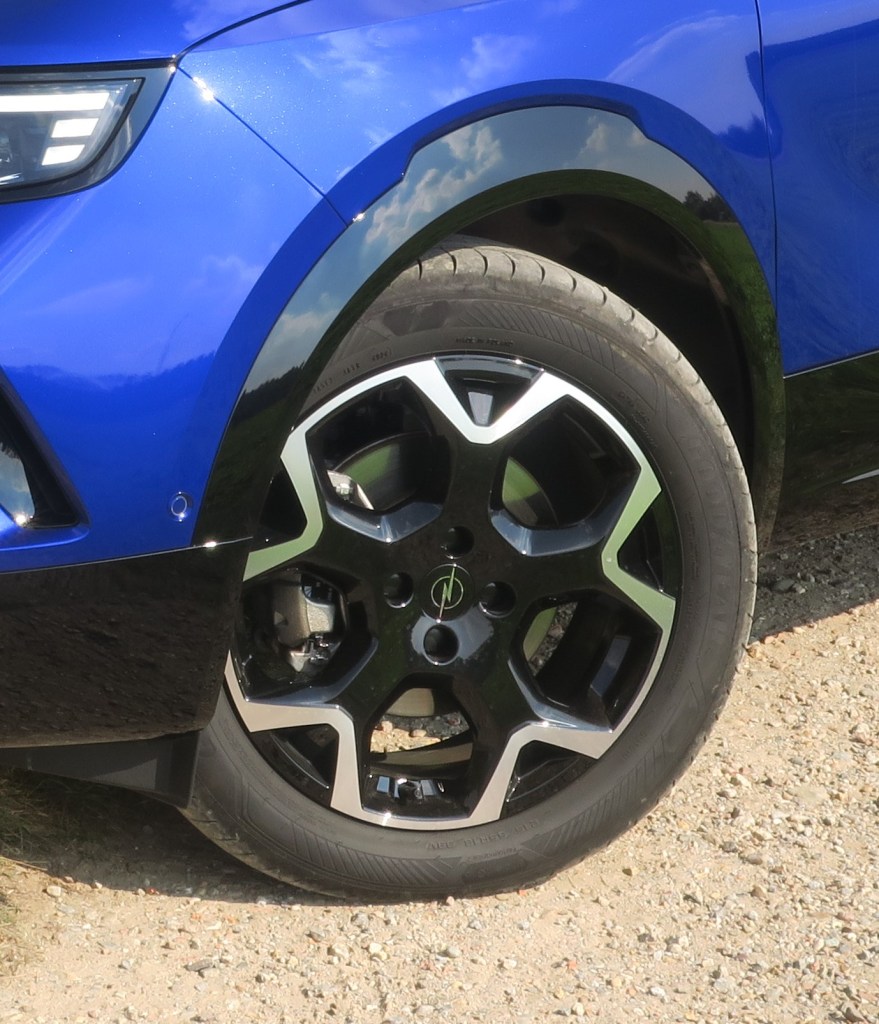
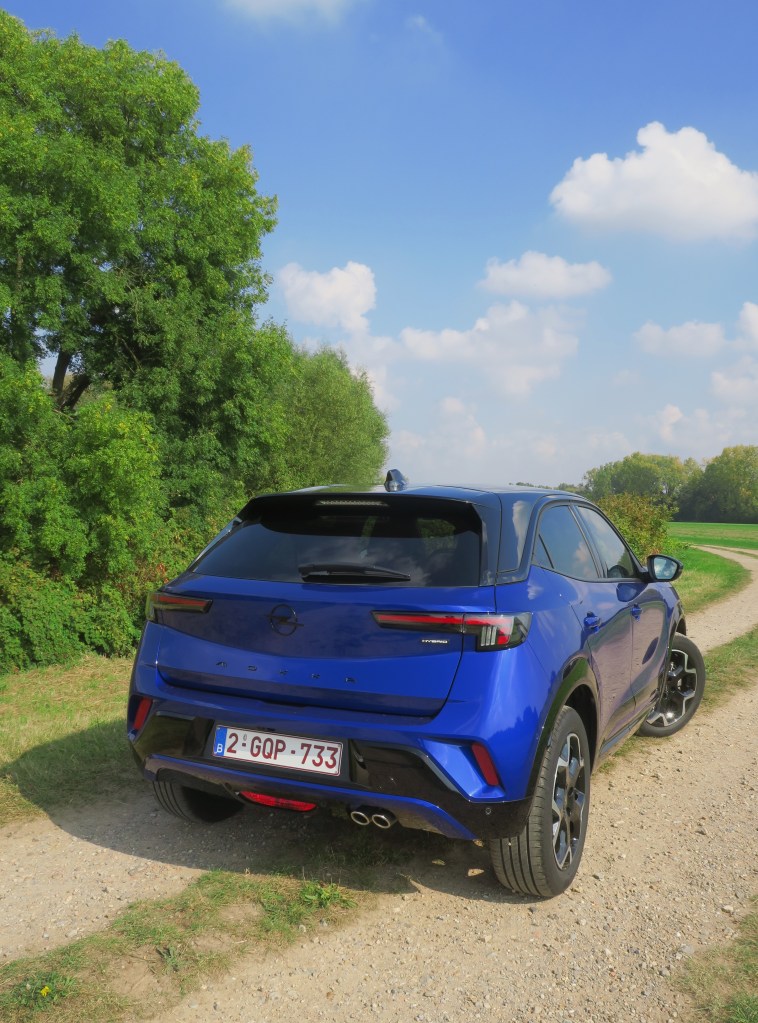
The Opel Mokka, one of the bestsellers in the Opel range, has got a facelift combined with some important technical refinements. More than reason enough to put the hybrid version through its paces for you here.  It was the first Opel to receive the now iconic characteristic brand fascia, the so-called “Opel Vizor”, and now it got even more character: with the facelift the black Vizor visually integrates the new Blitz and the headlights into one element. Black elements are decidedly en vogue: a black design line runs from the bonnet to the rear above the side windows. Black claddings at the front, rear and wheel arches also give a more sporting look.

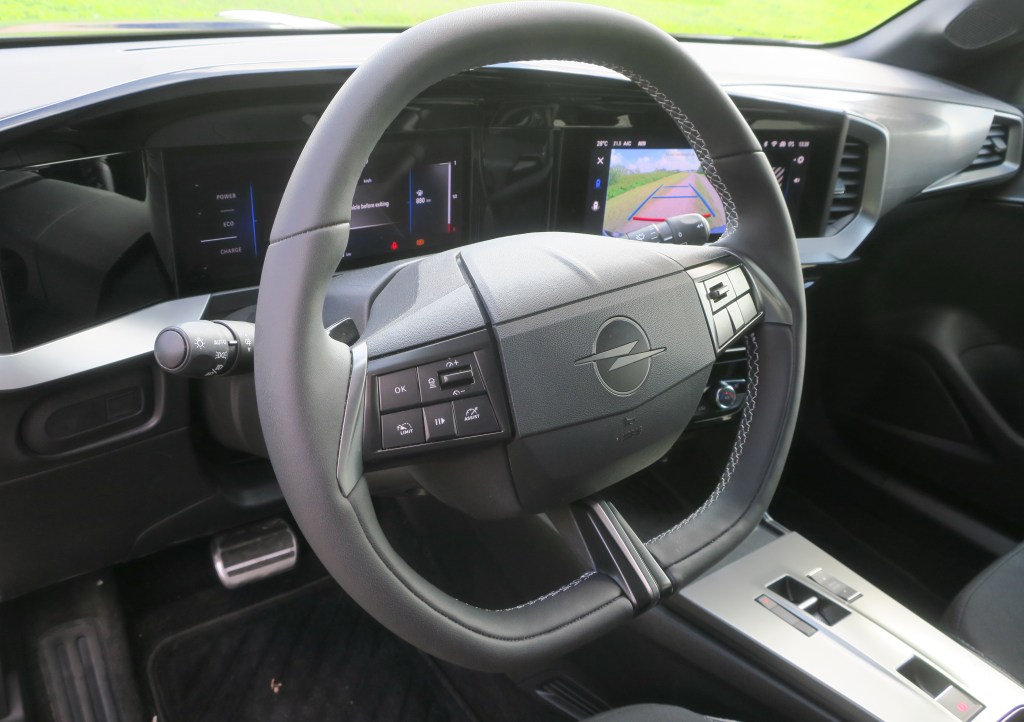
Also in the cabin things have further improved. First of all, there is a new steering wheel, flattened at the top and bottom and made from vegan material, with the new Blitz emblem proudly at the centre.

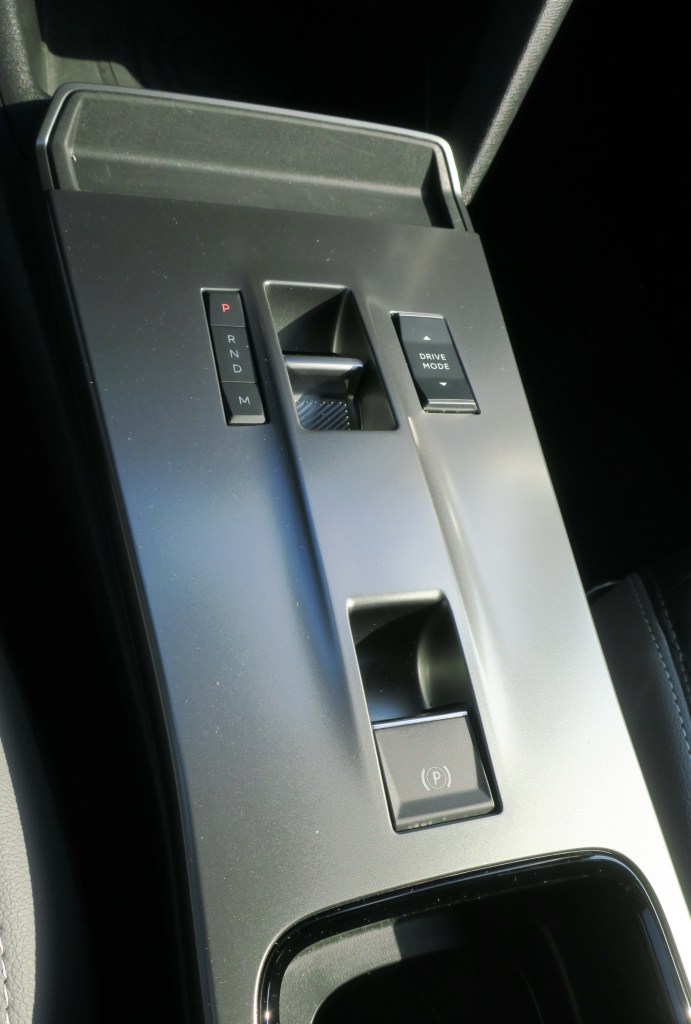
The centre console between the front seats, in a matt silver tone, has a cleaner, upmarket style and the design of the remaining switches for the electric parking brake and the selectable driving modes is identical to the all-new Opel Grandland. The material of the seats consists now of recycled material, but it is good to know that the whole cabin gives now a decidedly more upmarket impression.

A hybrid with 48 Volt technology…

Opel calls it a “modern hybrid”, and it consists of a 100 kW (136 hp) 1.2-litre turbocharged petrol engine with a 21 kW (28 hp) electric motor and an electrified six-speed dual-clutch transmission. The transmission is very smooth, the electric motor assists the engine in accelerations with helpful extra torque and all this results in very pleasant performance combined with excellent efficiency.

When accelerating slowly and driving at moderate constant speeds on city boulevards, the engine will run at very low revs in the highest possible gears, and this without any noticeably noise or vibrations. Pushing the trottle a bit further will cause the E-motor to react immediately and the transmission will intantly choose the correct gear for the engine to step in.

Driven with restraint, you will easily achieve a consumption in city driving at around 6 litres/100 km, and even slightly lower, whereas cruising on the open road will let the consumption drop to around 5,2 litres/100 km. According to WLTP standards, fuel consumption is 4.9 l/100 km, CO2 emissions are 110 g/km; the CO2 label is a C.

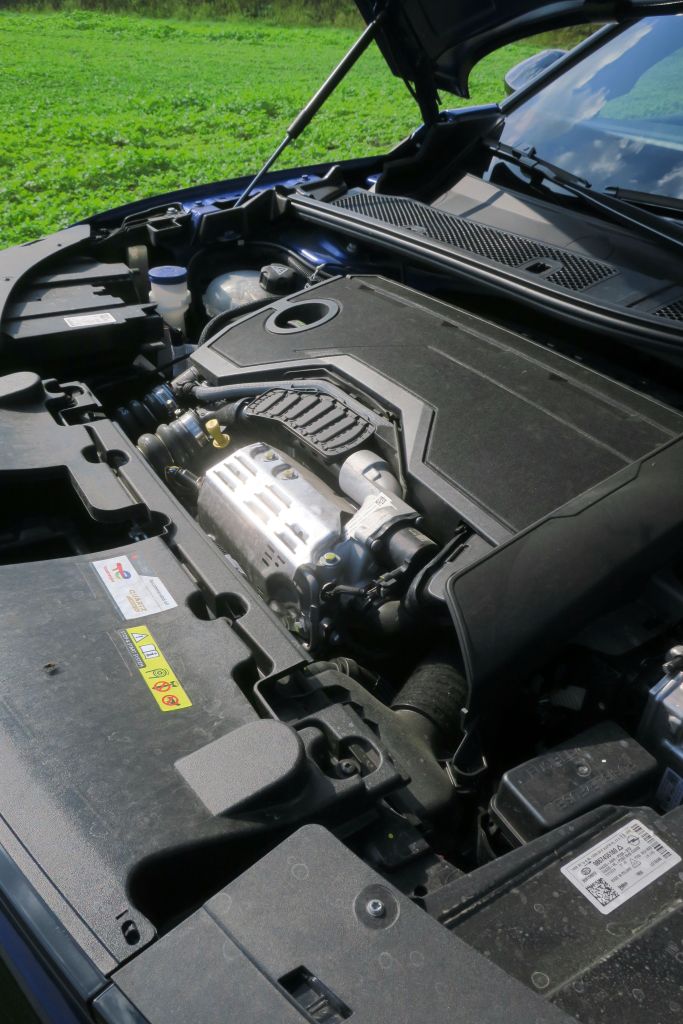
The 3 cylinder engine has now a chain driven distribution system, and the Continetal-developed oil lubricated belt has been abandoned, resulting in improved reliability.

A drivers’ car…  

We find Opels always very attractive drivers’ cars, striking a very good balance between comfort, performance and a predictable, engaging handling. The Mokka again proved this wonderfully. It responds admirably to a brisk driving style, but will never let you feel uncomfortable when you decide to drive smoothly and leasurely.

Seating position behind the wheel is also excellent. The knee room for rear passengers is somewhat more restrained, and boot space is not cavernous either, but with 350 litres is still sufficient for most.

Performance is excellent, with the Mokka proving to be an “Autobahn Meister” with a smooth top speed of 207 km/h and an acceleration from 0 to 100 in just above 9 seconds. This Mokka is a fast GT, let this be said. This performance is almost identical to the original Porsche 2 litre 911, don’t forget!  

… with up to scratch infotainment

The facelifted Mokka also is no laggard when it comes to modern infotainment. The cockpit uses Qualcomm Technologies’ next generation Snapdragon Cockpit Platform and Snapdragon Auto Connectivity Platform3 to enable premium in-vehicle experiences, including state-of-the-art graphics, multimedia and enhanced connectivity capabilities such as Wi-Fi, Bluetooth and 4G, says Opel.

A 10-inch digital driver information display and an equally large colour touchscreen are also standard. The latter can be easily operated via widgets, just like a smartphone – alternatively and in combination with the optional navigation system, a ‘Hey, Opel’ is enough to use the natural voice recognition.
 

Both displays can be personalised. The system recognises the driver’s personal profile on the connected smartphone; the connection is always wireless in the new Mokka. Virtual shortcuts can be set up on the central screen and you can choose between different colour schemes.

When ordered with the integrated navigation system, map updates are made available over-the-air. The system also constantly learns and – based on the habits of the linked driver profile – independently suggests destinations and routes.

The “myOpel” app can also be used to easily send the destination and the corresponding route to your car.  Furthermore, Opel offers ChatGPT4 (available in combination with Connected Navigation) for the new Mokka…

To sum it all up, we liked the Mokka Hybrid very much indeed, having style, performance, offering driving pleasure combined with excellent performance and economy, all this combined with a very reasonable price…

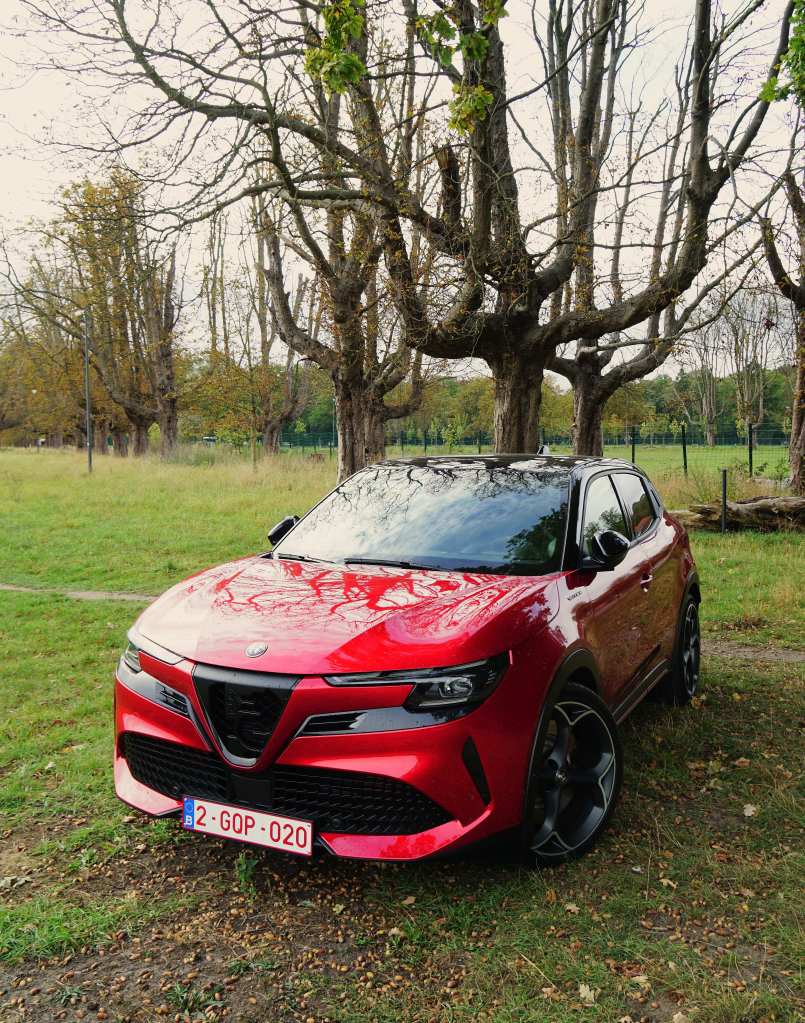
We drove the Alfa Romeo Junior Veloce Elettrica: It makes your heart beat faster…

Alfa’s have always been cars with a heart. They exude a unique aura and panache. How can you translate this into an EV, where you have to miss the characteristic roar of a thoroughbred engine?

Well, the Alfa engineers and designers within the Stellantis family have found a bold answer: the Alfa Junior. The styling of the Junior is appealing, to say the least. Of course, it runs on the Stellantis Electric Common Modular Platform (e-CMP2), which it shares with virtually all the other brands of the group that are present in the B-Segment.

But the Centro Stile Alfa Romeo rolled up its sleeves, and treats your eyes with a new grille, displaying the restyled “Scudetto.” The 20 inch “Venti” alloys are also designed along the DNA of the house, the rear end shines with an aerodynamic “coda tronca”. The well-balanced muscular proportions please the eye.

The same can be said for the cabin: personally I would like to have more “vintage drama” in the instrumentation, with proper dials with “real”arrows, which are now easy to emulate digitally, but the “less is more” philosophy today has its rights these days.

What we liked is overall the dashboard styling and the use of alcantara on some panels. On the central console one now finds the familiar Stellantis selector switches, which Alfisti will find a bit regrettable, and maybe a small tricolore adorned aluminum Alfa lever would have been nice, but there you go.

The central screen is turned well to the driver and not too big and overwhelming, which I liked. Our test car had the beautiful optional “Corsa” bucket seats, made by Sabelt, which are yours when you opt for the Sport Pack. They add not only to the looks and atmosphere in the interior, they also sit wonderfully too…

“Stellar” performance.

Stellantis opted to install in the “Veloce” version of the Junior a 280 HP or 207 kW electric motor, which is also found in the Abarth 600e “Scorpionissma” and in the announced Peugeot e-208 GTI. The performance is nothing short of spectacular: 0 to 100 km/h is absolved in 5,9 seconds, top speed is limited to 200 km/h. The maximum torque is 345 Nm. Of course, in our tested version a limited slip differential allows you to get all this power seamlessly on the road.

Handling is absolutely beyond reproach: it has a widened track and stiffened anti-roll bars…

To enjoy all this, one has to use the “Dynamic” mode on the drive selector, which should be the permanent choice for the Alfa enthusiast.

If you drive with somewhat more restraint using this mode, and adopt an anticipative driving style, the regeneration function when coasting lets you achieve creditable values between 16 and 17 kWh in both city and open road use. Based on WLTP cycle, the consumption is quoted at 17,9 kW.
 

The 54 kW battery (51 kW net available power) gives you an adequate range, the manufacturer quotes – using the WLTP standard – a range between 325 – 315 km. We found a “safe” range of some 260 km more realistic. Hooked on a 100 kW charger, the Veloce will charge up from 20 to 80 % in 27 minutes. The time of a leisurely coffee break.  

The Veloce costs some 10.000 Euros more than the standard Junior Elettrica, and the “sport” version with set you back another 2.000 Euro’s, but then for true Alfa aficionados, love and passion has no price…

Hans Knol ten Bensel

Renault continues to improve its Full Hybrid Technology…

As faithful readers know, your servant is still quite keen on the full hybrid solution to enjoy the benefits of electrified mobility. It ideally combines the smoothness of E-power with economy and total hassle-free practicality, as you can cover any distance without worrying about recharging.

Renault made a very wise strategic decision to build also an important presence in this market segment, and is indeed developing its Full Hybrid Technology always further.

Did you know that Renault has sold over 750,000 vehicles equipped with this full hybrid E-Tech powertrain since its launch in 2021?

Renault developed its full hybrid E-Tech powertrain in 2021. Over 150 patents have been filed for this technology, which taps into Renault’s expertise in Formula 1, particularly in energy recovery and regeneration. Ii is found in many models, from Clio to Rafale. 

More power and full hybrid performance for Captur and Symbioz

In the same way as with the previous generation, the series-parallel hybrid architecture of this new powertrain combines two electric motors (a 36 kW e-motor and a 15 kW HSG – High-Voltage Starter Generator) with a 1.8l 4-cylinder petrol engine of 80 kW or 109 hp (69 kW and 94 hp for the previous engine) mated to a new intelligent multi-mode clutchless dog box and a 1.4 kWh battery. The dog box delivers fast precise gear changes with minimum power loss. It is also simpler from a mechanical standpoint, making it more reliable.

Driveability maintained

The indirect injection of the previous generation has been replaced by a new direct-injection system.

Torque is 25% higher (172 Nm for the combustion engine alone, i.e. +22 Nm) than for the previous version. This means that maximum torque is available at lower revs (around 2,000 rpm), for better performance and response, particularly during acceleration or when picking up speed on fast roads. Acceleration is therefore more dynamic. Captur now takes 8.9 seconds to accelerate from 0-100 km/h compared with 10.6 seconds previously, delivering a better response for a more agile driving experience.

The Symbioz also improves its 0 to 100 km/h acceleration time: 9.1 seconds compared with 10.6 seconds previously.

A new  battery with a higher capacity of 1.4 kWh

The new hybrid powertrain has a battery of 1.4 kWh battery (230V), compared with 1.2 kWh for the previous version. ower fuel consumption and CO2 emissions

Fuel consumption is optimised by a regenerative braking function, combined with the high self-charging capacity of the 1.4 kWh (230V) battery and the efficiency of the E-Tech system.

Under the bonnet of Captur and Symbioz, the new full hybrid E-Tech powertrain consumes just 4.3 litres/100 km, compared with 4.7 litres for the previous version. This optimised system delivers fuel savings of up to 40%, while also reducing CO2 emissions to as little as 98 g/km on Symbioz (99 g/km for Captur).

Smooth gear changes

The dog box transmission has been maintained: the dog clutch system replaces both a sprocket and a synchroniser ring in a clutchless layout with fewer friction parts for high levels of efficiency. The gearbox was then fine-tuned for faster, smoother gear changes. As a result, gear changing is quieter and more responsive, reducing vibration and engine noise for increased driver comfort.

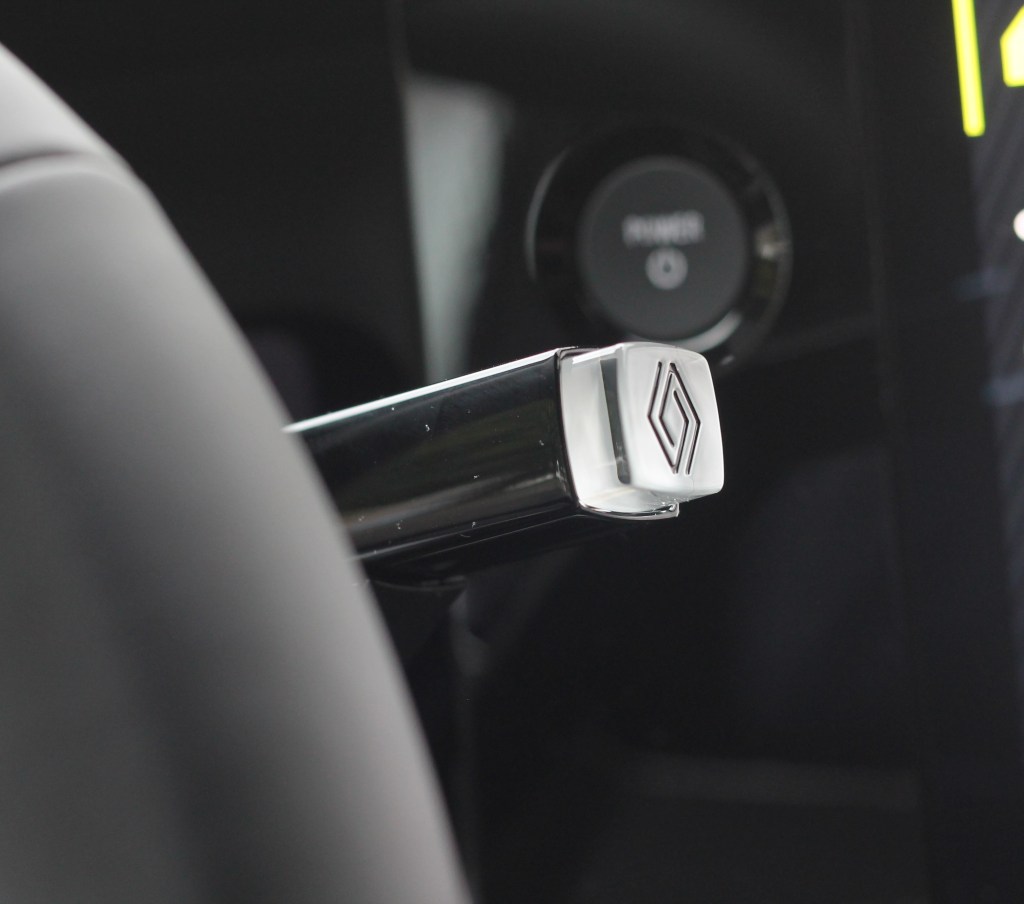
Further, the introduction of a new electronic gear lever (e-shifter) provides greater precision and optimised ergonomics.

Needless to say that we are keen to lay our hand on a Renault with this improved full hybrid drivetrain… stay tuned!

Hans Knol ten Bensel

E-Power for all: the Fiat Grande Panda goes hybrid…

FIAT launches the new Grande Panda Hybrid, marking a significant milestone in its global product strategy:  making the electrified transition possible for all thanks to this affordable, and cool B-segment Panda.This hybrid version marks the brand’s role as a leader in volume and accessibility, says Stellantis, echoing the golden years of FIAT when simplicity, innovation, and emotional design moved millions.

The Grande Panda project is the cornerstone of a new global vehicle family developed entirely under the guidance of the FIAT HQ and Centro Stile in Mirafiori, Turin. Your servant remembers its visit at the Centro Stile a few years ago, when he stood eye to eye with the clay model of the FIAT “centoventi” or 120, which showed already the proportions and styling language of the present day Panda. Technologically, it already incorporated the solutions we see today.

The model sits on Stellantis’ “Smart Car” Platform. At the heart of this model lies the T-Gen3 hybrid powertrain, featuring a 1.2-liter, 3-cylinder turbocharged engine delivering 110 HP, combined with a 48V Li-ion battery and a eDCT 6-speed dual-clutch automatic transmission. This system integrates a 21kW electric motor,an inverter, and a central control unit.

Through functions like e-launch, e-creeping, and e-parking, the Grande Panda Hybrid can operate in full-electric mode during low-speed manoeuvres, allowing for up to 1 km of electric-only driving at speeds under 30 km/h. These features result in smoother acceleration, silent city driving, and less fuel consumption and CO₂ emissions, made possible in part also by the Miller Cycle combustion strategy. The eDCT transmission further enhances efficiency and provides a relaxed, two-pedal driving experience that embodies FIAT’s “easy drive” philosophy.


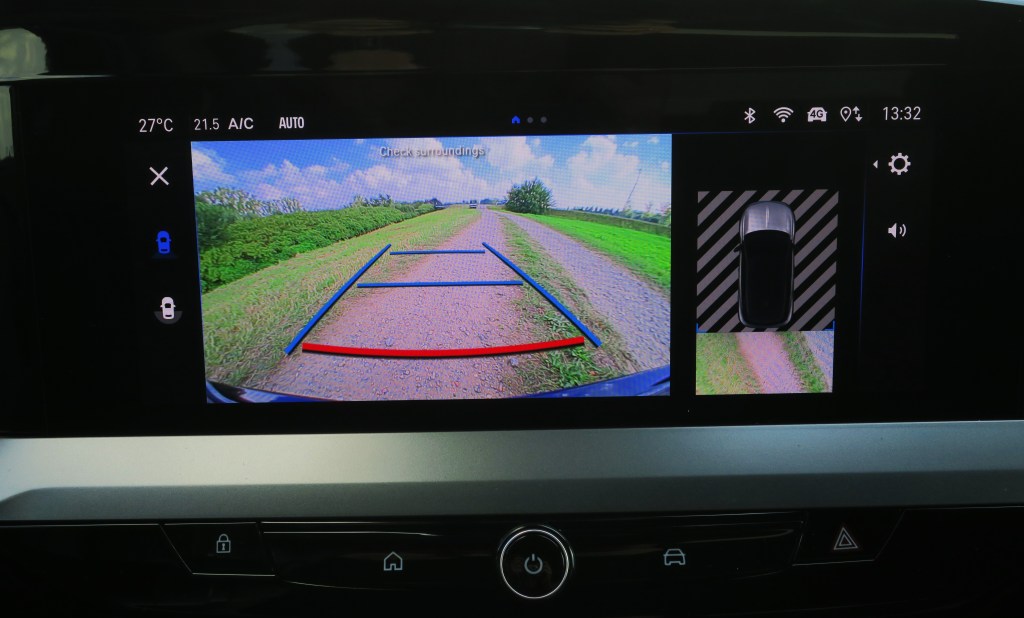
All trims, and one can choose between three levels, notably POP, ICON, and LA PRIMA, come equipped with a comprehensive ADAS suite, including Cruise Control, Speed Limiter, Active Safety Brake, Lane Keeping Assist, Driver Attention Warning, and open-door alerts. The LA PRIMA trim enhances this with front sensors and a rear view camera.
Connectivity is supported through the onboard 10” digital cluster, 10.25” central touchscreen, and wireless smartphone mirroring. Customers benefit from multiple USB-C ports, a wireless charging pad, and seamless digital integration.

Continuing the 4 X 4 tradition of the Panda with a 4 X 4 concept…

The new Grande Panda 4×4 concept model, presented during the Grande Panda Hybrid Media Drive, is the direct heir of the Panda 4×4 from the ‘80s. It has exclusive details, and the unique dark red livery, bringing the 80s Panda’s character into the modern era.


It has an electrified, innovative rear axle that delivers all-terrain versatility.  We look forward to see this concept hitting the road soon…

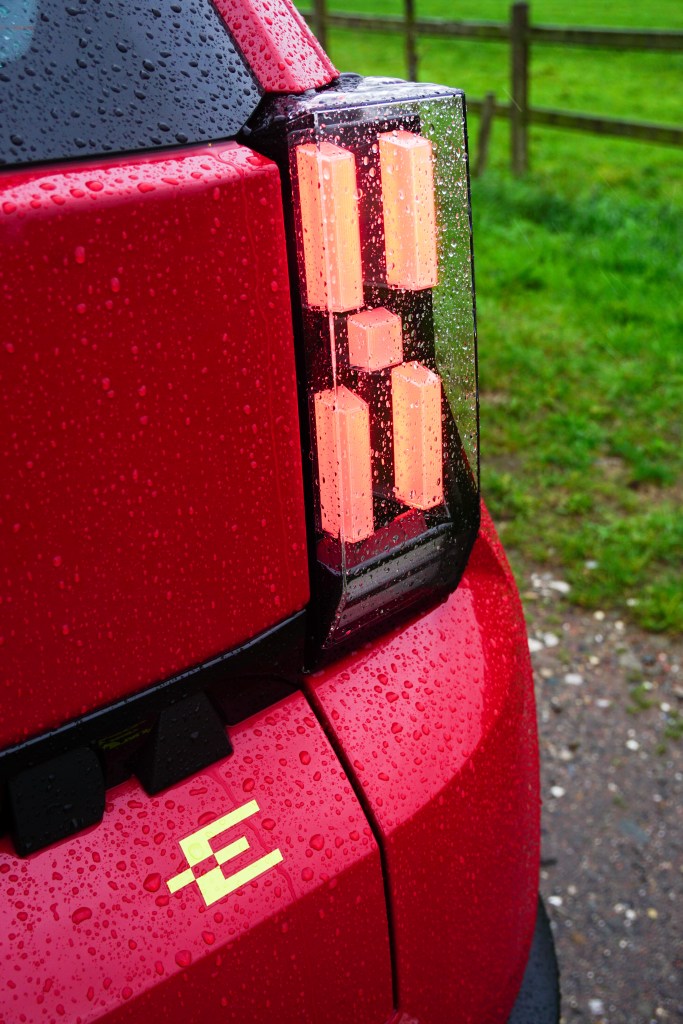
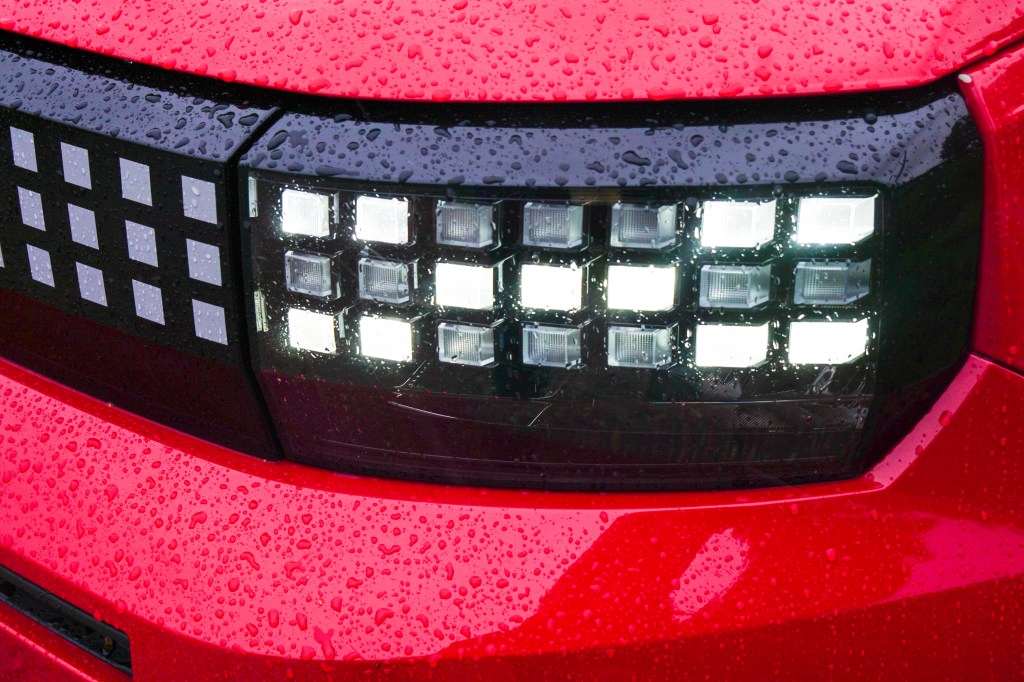
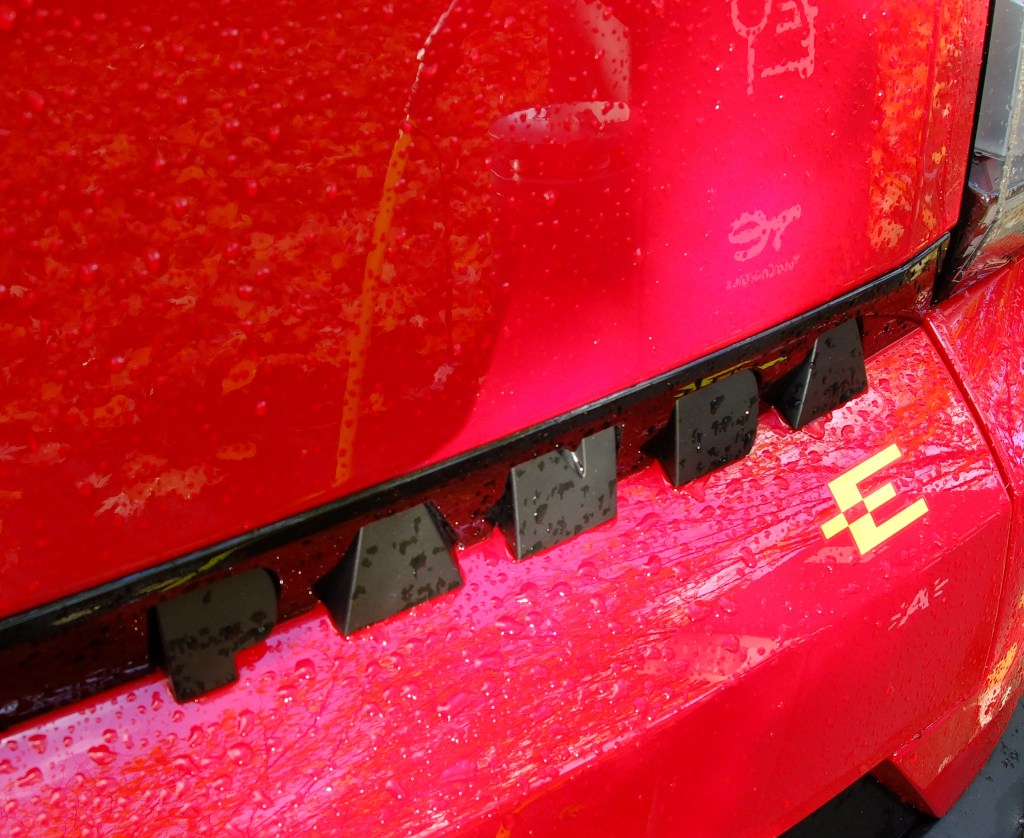
We invite you to look at the accompanying photos for now…

Hans Knol ten Bensel

We drove the new Opel Grandland: a “big” Opel with distinct premium character and style…

The second generation of the big Opel SUV impresses with a stylish makeover which adds further character and panache to the car. The “vizor” front end has received a transparent cover with the Opel lightning badge being now illuminated for the first time.

The rear the letters “Opel” across the boot lid are now boldy styled and illuminated  in red coloured led light. Opel calls this its “edge light” technology.

The styling language is elegant and simple, and this same styling philosophy is found in the cabin, where Opel’s strategy of keeping instrumentation as minimal and clear as possible for driver and passengers is continued under the adage “less is more”. This doesn’t mean that the information provided is incomplete, only that nothing but the relevant information is displayed when asked for it. We love this quiet simplicity. We found also the cabin very well finished and the quality of the materials used add a distinct premium touch.

This second generation Grandland comes after 7 years, and it runs on the Stellantis Platform which it shares amongst others with the Peugeot 3008 for instance.  Nevertheless, the new Grandland was developed in Rüsselsheim and is assembled and built at the Opel plant in Eisenach.

The biggest news is that the Grandland is now also available in full electric form, with a battery package of up to 98 kW. This allows a range of up to 700 kilometers on a full charge, thanks to the new more efficient electric motor and provided the heat pump is installed.

As Opel caters for a wide(r) public, a plug in hybrid version is also offered which offers a 85 km useable “pure” electric range and last but not least a so-called Mild Hybrid which is the subject of this test.

Under the hood of this MHEV Grandland lies the 3 cylinder 100 kW engine which is shared in so many Stellantis group cars.  The MHEV Grandland has a kerb weight of a good 1,6 tonnes, but nevertheless, thanks to the good torque charcteristics, accelerations are still quite brisk with an acceleration up to 100 km/h in just over 10 seconds.

On the autobahn, this Grandland still shows its panache with a top speed of 202 km/h. Consumption depends here greatly on your driving style, where the efficient drivetrain with an electric motor of 28 HP and 51 Nm of torque coupled to the transmission allow you to make good use of the E-power when starting from standstill and driving at slow speeds.

When you really concentrate and use an anticipatory and relaxed driving style, you can cover up to 50 % of urban distances on E-power, and consumption drops to between 5,5 and 6 liters, even  in busy urban traffic.

On the open road, cruising at legal maximum speeds will show the good efficiency of the drivetrain with consumption hardly exceeding the 6,5 litre mark on 100 km.

The six speed eDCT transmission is smooth and responsive, well adapted to the engine’s torque characteristics. We found the engine not overly smooth, also emitting a distinct throb, but this actually adds to the dynamic character of the new Grandland. At constant speeds, the engine is smooth and virtually inaudible.

We liked the way the now 17 cm longer and markedly bigger Grandland steers and handles. It has lost nothing of its predictive handling and responsiveness, and if any, this has even improved. It remains utterly stable at high speeds and is indeed very engaging and pleasant to drive.

Comfort is also very good, and here we have to applaud the overall roominess of the cabin. As said, the Grandland has grown 17 cm in length, and this allows also the rear passengers to really stretch their legs. There is also more elbow room, as the new Grandland is also 6 cm wider…

Luggage space is also abundant with a standard 550 liters.

Driving assistance systems are also well cared for, and adaptative intelligent cruise control with stop and go function is standard, together with emergency collision braking and speed limit recognition. You can opt for Opel’s Intelli-Drive-2.0 system which helps you when parking and offers you also a 360° view of the car’s surroundings. One good note also for the excellent lighting system. Now the Grandland shines (literally) with Intelli-Lux Pixel Matrix HD-Lights, which dispose of not less than 25.000 light elements on each side. The front camera of the Grandland recognizes uncoming traffic and corrects the light beam accordingly. A head-up display lets you keep focused on the road.  

Conclusion

The Grandland has matured to a premium class SUV, with even in its “base” MHEV version offering many qualities, last but not least it pleases with its agility thanks also to its 1,6 tonne weight, which is markedly less than the plug-in and full EV versions. Furthermore there is the excellent finish, the quality of the materials (all recycled) in the interior, the roominess, the stylish details and the overall good proportions of the car. Then we have said nothing about its very good overall performance and efficiency, its roominess and practicality. Last but not least it offers good value for money, certainly in this Mild Hybrid version…

Hans Knol ten Bensel

We drove the Alfa Romeo Junior Ibrida…

The Alfa Romeo Junior series has always been a sporting icon for the Alfa Romeo enthusiast. It stood for pure efficiency, with a somewhat smaller engine and less power, but had the same undiluted sportiness as its faster and bigger brothers in the Alfa range.

So when Stellantis launches today’s Junior again for its Alfa Romeo brand, we expect something special indeed, and we were very keen to drive for you the Alfa Junior Ibrida, which has a 1,2 litre 3 cylinder turbo under the hood and enjoys a 48 volt mild hybrid system. Does this Junoir retain the unmistakable Alfa Romeo thoroughbred qualities with a drivetrain and platform, which it has in common with its many sisters in the Stellantis group?

With this Junior, Stellantis aims also at efficiency and some degree of practicality and comfort, as it wants to attract a wider range of young customers to the iconic Milanese brand. We will find out in this test whether this new Junior fulfills all these high expectations…

Hans Knol ten Bensel.

Sporty looks…

When approaching the new Alfa Junior we are seduced by its good proportions. The front grille has character, the led headlights accentuate things further and the air inlets add an agressive touch. The car looks good from the side, the rear end with its peculiar headlight shapes is somehow a departure from the typical Alfa styling language, and shows us that Alfa is also entering a new era.

But there are Alfa styling icons which remain, like the wheel alloys with circular spokes, which suit the car very well.

The cockpit has also much Alfa Character, although aficionados will miss the typical large gear-change paddles on both sides of the steering wheel column, but then again, the smaller paddles indicate that this Alfa has somehow a different mission, and indeed this Junior wants also to convince the Alfa driver with somewhat different qualities.

But we liked very much here again the digital instrumentation, the 10 inch large central touchscreen which is set in a stylish cluster directed towards the driver, with below it a leaner centre console, which houses the Stellantis-typical drive selector, contributing to an air of sportiness with a large circular start/stop button towering above it.

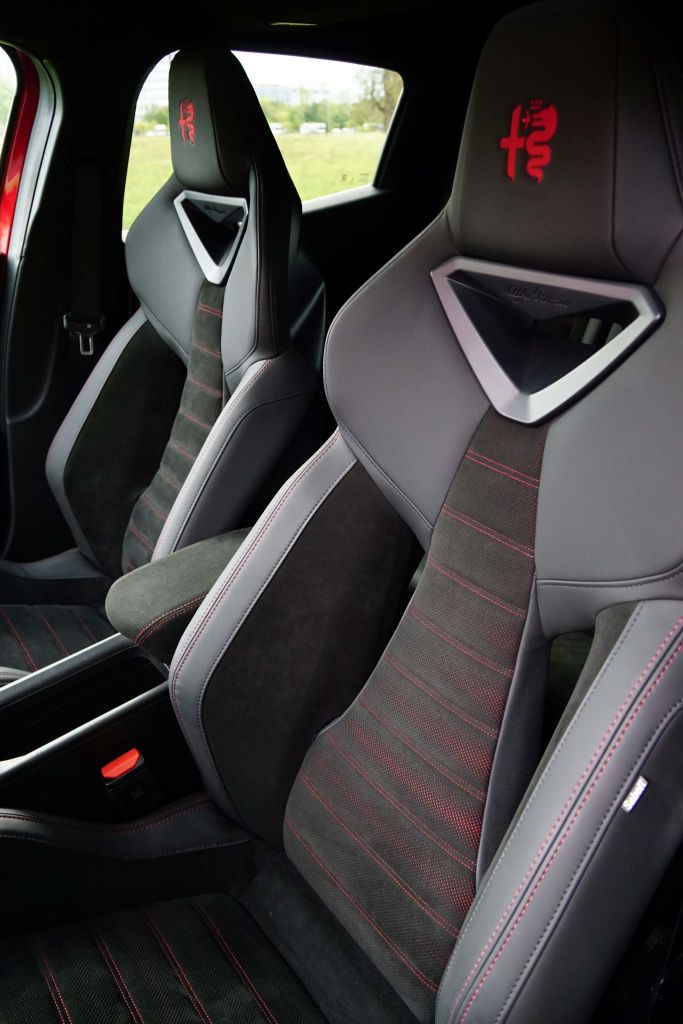
The illuminated ventilation openings adorned with the Alfa symbol also add character. We liked the color pattern of the seats, with a large central red stripe, which gives the distinct optical illusion of a glowing ribbon. The seating position is rather deep, which again accentuates the thoroughbred panache of this Alfa. Note that the seats have heating and massage functions, a distinct plus..

Everything is well finished, some harder plastics are found, but the panel surfaces of the dashboard still exude a distinct premium feeling. The ergonomics are beyond reproach, and below the central touchscreen one finds still a row of “analog” touch buttons for ventilation with, last but not least, the volume control of the radio…


Performance and handling: the DNA of a true Alfa.

The Junior uses a 48V mild-hybrid system that combines a 1.2-litre three-cylinder Miller cycle petrol engine,with variable-geometry turbo and distribution chain for maximum reliability. The electrical component consists of a 48-volt lithium-ion battery and a 21-kW electric motor built into the 6-speed dual-clutch gearbox, which works together with the inverter and transmission control unit to ensure maximum efficiency.  The total power output of the system driving the front wheels is 134bhp, enabling acceleration from 0 to 100km/h in 8.9 seconds.

Indeed, performance leaves nothing to be desired, and thanks to the support of the electric motor the acceleration from standstill is smooth and powerful. The changes of the six-speed dual-clutch automatic transmission are silky smooth under spirited acceleration, and indeed we found the whole drive-train behaving wonderfully when your right foot is somewhat heavier and you engage in a more spirited driving style.

The engineers have worked beautifully to give the 3 cylinder 1,2 litre unit, which is also found in many Stellantis models, this typical Alfa growl, reminiscent of the classic weber carburetted Veloce’s from the sixties and seventies. We just loved it.

So acceleration pleasure is to be had, and this is paired with a low fuel consumption which the classic Alfa’s never had to this extent. Yes, when cruising leasurely and avoiding high revs and (very) brutal accelerations, it is very well possible to achieve average consumptions in the 5-6 litre range, and even less.

The Ibrida is a so-called mild hybrid, this means that the electric motor, which is integrated in the transmission, has 28 HP, and the battery is also rather small with a gross capacity of 0,89 kW/h. But it does the job of giving that extra E-power smoothness and delivering E-propulsion at crawling speeds typical for start/stop situations.

The Ibrida is of course an excellent long distance motorway cruiser, with a top speed of a good 206 km/h. But it is also very much in its element on winding roads, and is both agile and completely predictable in its handling. So is this Junior an Alfa which can be driven with verve? Yes indeed, and it brings joy to motoring…

Practical and well equipped…

The luggage space is standard a good 415 liters, up to a maximum of 1218 liters. Of course Android Auto and Apple Car Play is provided, and the safety features as standard include level 2 autonomous driving, connected navigation, 180° rear camera, a handsfree electric tailgate, and a keyless system with proximity access technology as standard.

Conclusion

Is the Junior offering an attractive proposition for the die-hard aficionados of the brand? Yes it does, for us it breathes the DNA of a true Alfa. On the other hand, it offers ease of driving in town, practical everyday docility and last but not least excellent fuel economy and energy efficiency..

There are still more powerful versions, like the 280 HP Junior 280 Veloce all electric version, which  weighs only 1,590 kg. It emits also a typical “Alfa Sound” during acceleration, it appears. We are very keen to lay a hand on this throughbred EV-bomb in the not too distant future…

Hans Knol ten Bensel

We drove the Leapmotor TO3: a surprisingly adult EV city car…

Things are moving at the bottom end of the EV market. More affordable EV city cars are offered, and Stellantis has also quite literally made a bold leap forward. Last year it took a 51 pct share in the Amsterdam-based joint venture Leapmotor International BV, and now brings the city car TO3 to our shores, as well as a large SUV, the C10.

Needless to say that we were very keen to have a test drive with this TO3, which at first sight looks not unfamiliar, as it resembles a Smart ForFour. It certainly is fit for the city, with its compact overall length of 3,62 meters. But we discovered it has a lot more good qualities. Just read further..

Hans Knol ten Bensel
Roomy, well equipped and comfortable…

The cute TO3 really surprised us. Stepping into the car, we found ample headroom and even the tallest can sit comfortably behind the wheel of this Leapmotor. Even the rear passengers don’t touch their heads and can step in comfortably as the TO3 has wide opening four doors. No cramped mini car feeling whatsoever. Luggage space is also reasonable, with 210 liters with the rear seat backrest up, and up to a maximum of 880 liters with everything folded down.

Don’t expect bare austerity either when it comes to infotainment. One soon notices that the Chinese are masters in the game. The TO3 has a 10 inch touchscreen with a christal clear rear view camera, which indicates even the remaining centimetres when you back up close to another vehicle or wall…

It also has an excellent navigation system, DAB radio and you can choose between not less than three driving modes. On the central display you can choose “vehicle control” and then make your choice. We left it in the ”standard” driving mode virtually all the time.

The ventilation/heating controls take some getting used to, and are not logical at first sight. But soon enough you get around it…

The T03 has a range of some 250 kilometers in practice…

Also fit for the open road…

With its small turning circle and good visibility it is a pleasure to drive in town, where at urban speeds, that is to say up to 30 km/h, you are constantly accompanied by a well audible whine. This disturbs a bit the totally “ZEN” feeling which normally the absolutely silent EV power conveys, but for the sake of safety it is of course very useful.

The standard equipment is lavish: below the central touchscreen one has even two USB C ports, a 12 V plug and room for your phone…

When you enter the motorway, the compact TO3 shows remarkable ”adult” behaviour, staying remarkably silent and stable at speed. It is fully capable of cruising at say 120 km/h, and this means this TO3 is also a perfect intercity motorway commuter…

LED headlamps are standard…

As the range is rather limited, you need to recharge it frequently between commutes, but when a charger is available both at home and the office, this Leapmotor is perfect for the job. The manufacturer quotes a range of up to 265 km, and WLTP consumption is 16,5 kWh/100 km. We found that this figure is easily achieved in practice, and indeed we experienced that a range of around 250 km is very realistic.

Blind spot monitor, cruise control, distance control and lane assist are also standard…

Performance is zesty with a 0 to 100 km/h sprint in 12,7 seconds, top speed is electronically limited to 130 km/h, which is totally sufficient given the vocation of the TO3.

The TO3 is also very keen to keep you safe under all driving circumstances, and constantly warns you when you don’t keep your eyes on the road, ignore speed limits and the like, and is constantly buzzing and chiming to warn you of imminent dangers.

The driver is constantly watched by camera’s, and it warns you to keep your eyes on the road…

This can be annoying at times, and it is good to know that these audible warnings can be muted, although they will reset themselves soon as you restart the car…

The TO3 comes with a warranty of 3 years and 100.000 km, which will satisfy most.

Conclusion

The TO3 impressed us, with its all-round qualities, making it the perfect urban runabout, also fit for faster intercity motorway commuting. It has sufficient room to sit four, and its range is limited,  but still sufficient when charging opportunities are easily available both near home AND office/workplace.


It is well finished, has impressive standard equipment and infotainment. So if you want to step into the EV world with a smaller ”entry” budget, just take a very close look at this endearing Leapmotor…

Hans Knol ten Bensel
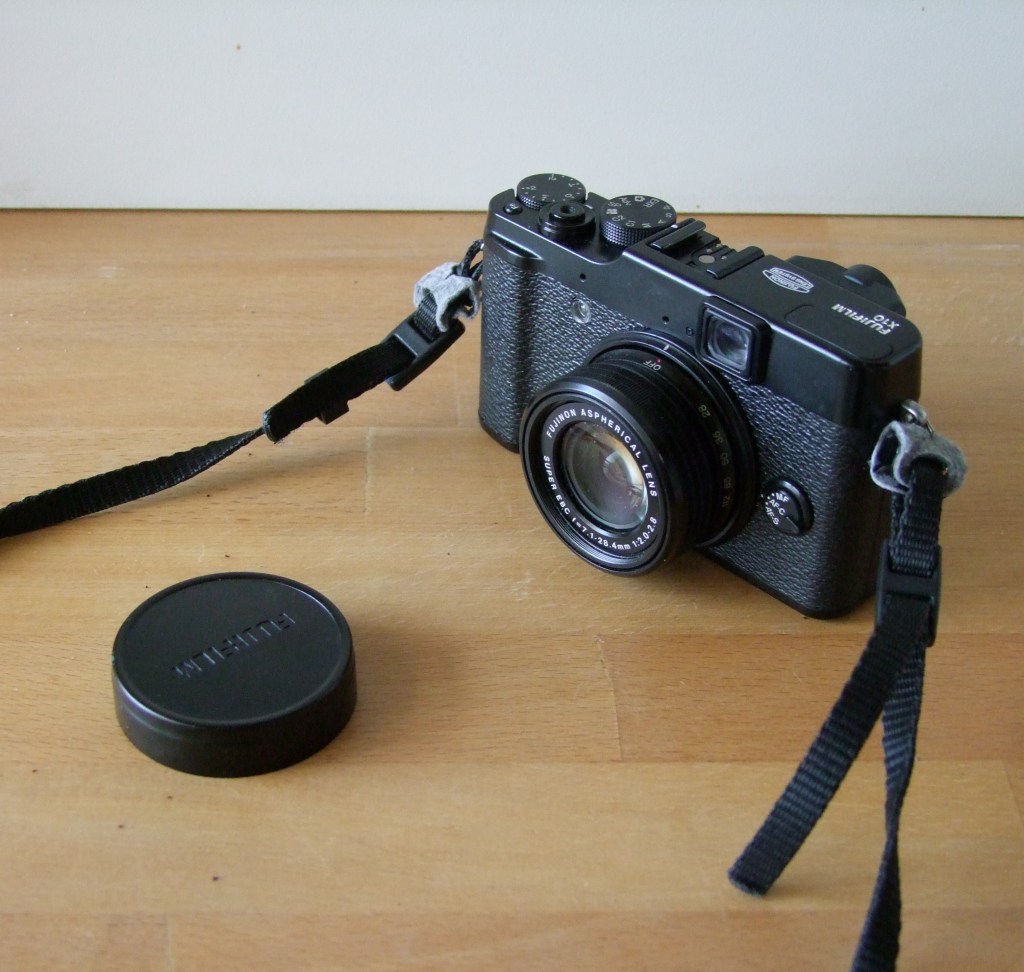
Photographers’ notes: we used again our Panasonic Lumix DMC-FZ1000. Its Leica zoom lens is also ideal for photographing details, as shown above…