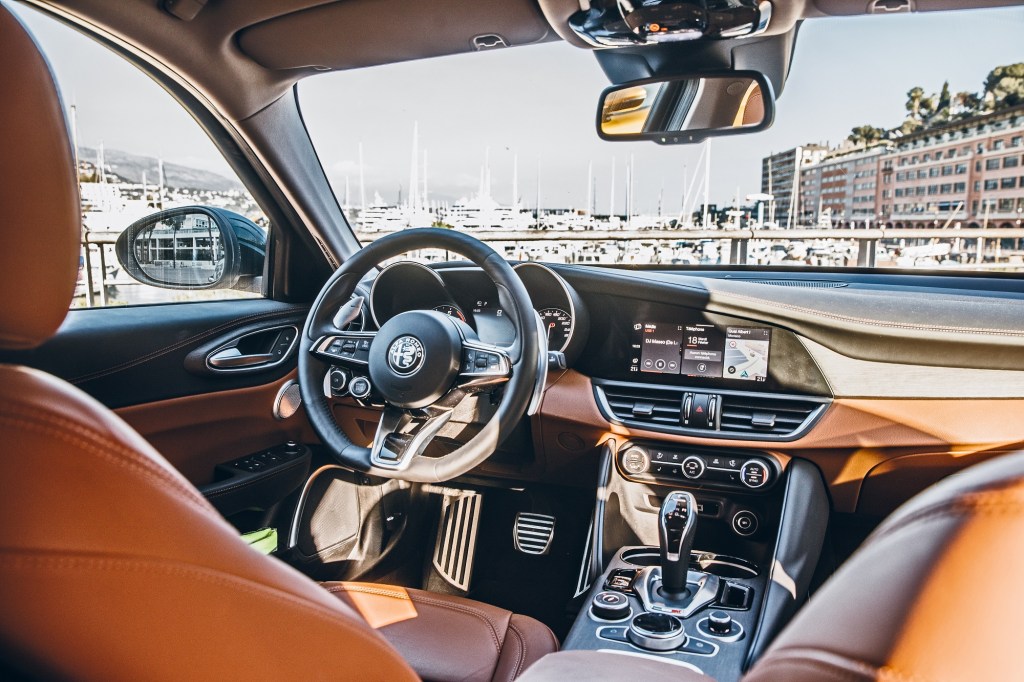
The dynamic PR people of FCA Belgium created a new video to keep in touch with current customers and future prospects in Belgium and Luxembourg, a few weeks before the official celebration of the brand’s 110th anniversary.
To have a look at this new video for sports car enthusiasts who look forward to taking the wheel of their Alfa Romeo again in optimal living conditions, just click https://we.tl/t-hGoEXfwzUA
The video footage was shot on the streets of the Principality of Monaco, which also serves as a prestigious setting for the F1 Grand Prix and where the brand’s latest publicity campaign was shot for the new Giulia and Stelvio MY202. The new models Giulia and Stelvio are equipped with new exclusive content: dynamic driving becomes a real driving experience.
Prices for the New Alfa Romeo MY2020: Giulia from € 34,900 (€ 33,746 in Luxembourg) and Stelvio from € 39,990 (€ 38,668 in Luxembourg).
In Corona times, we all now spend more than enough time behind our laptops and in our homes. A delightful occasion to delve now in our old archives and finally give them a thorough cleanup. Of course, true gems are found. Like a photo my father took when I must have been about 7 years old, behind the wheel of a 1950 MG TD.
I just want to share this with you. It clearly shows that my love for cars started very early on. Actually, at the age of four I surprised my Dutch grandmother in Helmond with my knowledge about car makes. When there was a beautiful British limousine parked in the street of their home, I could whisper to her that this was an Armstrong Siddeley Sapphire. I already appreciated then as a very young boy that this was a very exceptional quality car.
The beautiful radiator of the Armstrong Siddeley Sapphire…
My deep love for British powerful cars with elegance and panache was born then. My grandmother’s daughter was married to an eye doctor Harry Donders, who owned then a black Austin A90 Westminster.
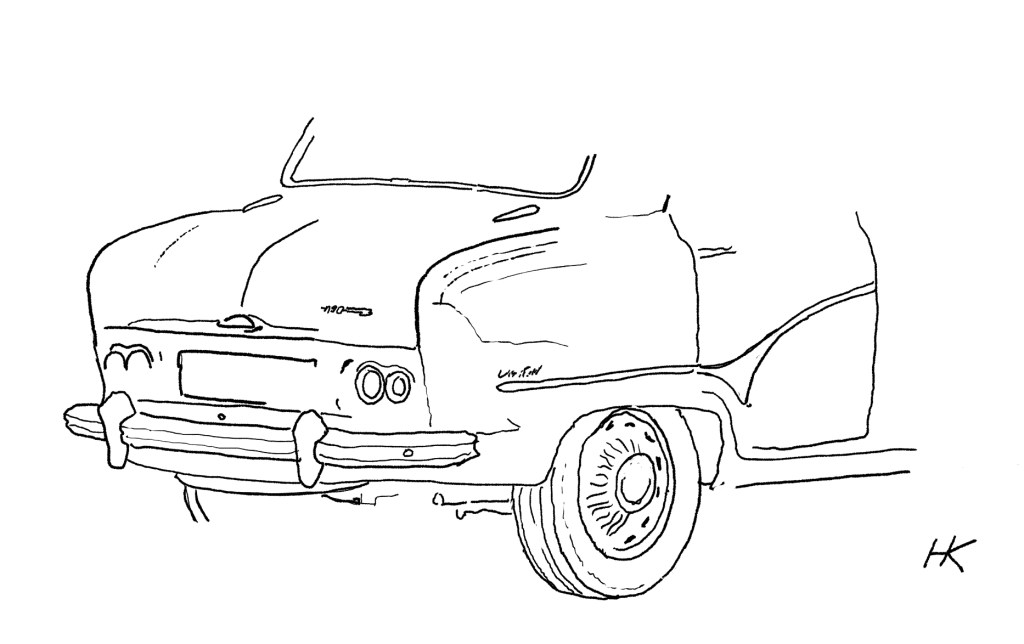
The A90 was remarkably compact and had some modernity about it… just look at the simple rear/indicator lights…
A remarkably austere interior for a British car I found, with Austin definitely having a good throw at some modernity.
The car itself was also remarkably compact.
The Austin logo was beautifully placed on the bonnet of the A 90…
But my heart was then already taken by Jaguar. The Mk 1 Saloon was totally awesome in my mind, and dreams. So as soon as I earned my first money, the Jaguar MK II was bought, as faithful readers know…
On the photo you see me then behind the wheel of this MG TD in front of my parent’s house. My father took the picture with his Rolleiflex with the fast 2.8 lens. I still own the camera, and here I took a photo of it today for this article.
My uncle, the brother of my father, is actually still is in good health and well into his nineties and had hired the car to drive it to our home for a visit. The Belgian cobblestones got the best of it during this trip, as the whole fuse board had fallen on the slender legs of his surprised wife, while speeding along on the Belgian roads!
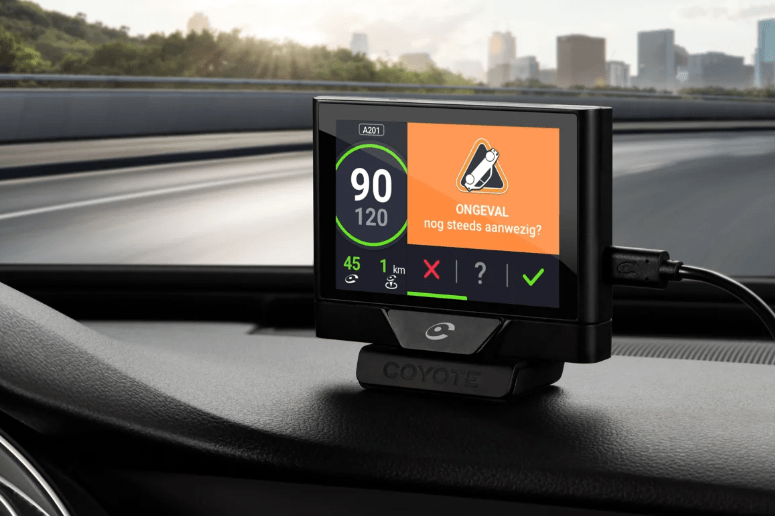
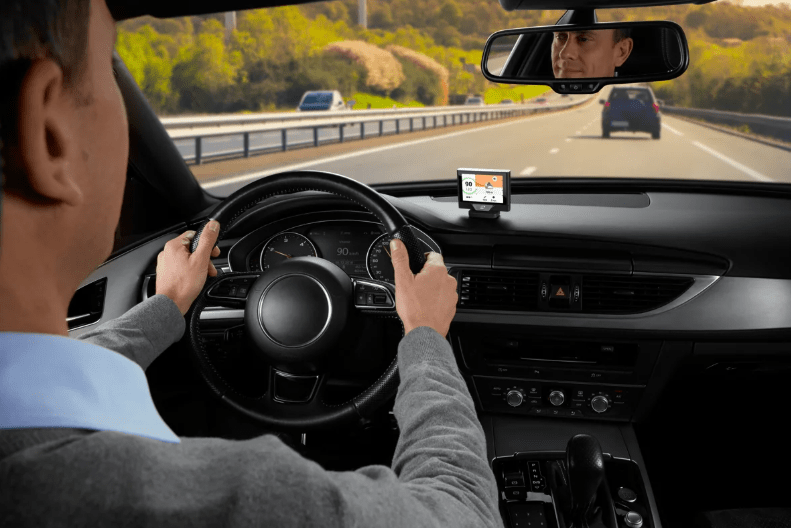
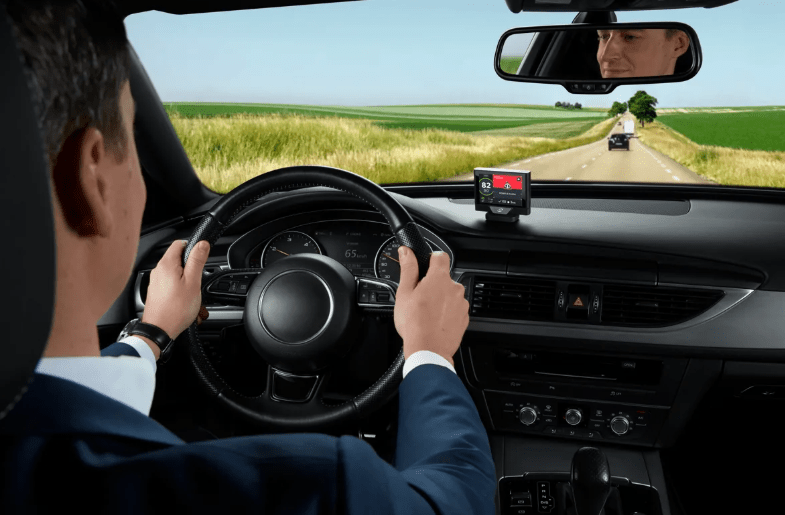
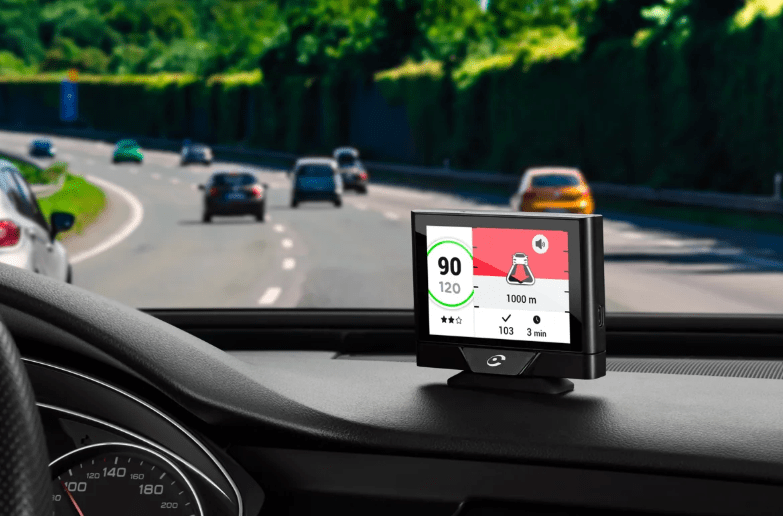
Sitting snugly on your dashboard, the new Coyote UP has an interactive voice assistant… you just say “Hey Coyote!”
Experienced drivers treasure it: the Coyote driver assistant. This unique device, which sits snugly on your dashboard in your live of view, is now better than ever. In the beginning of this year the European manufacturer Coyote introduced their latest model, the Coyote UP, which has two new features: a voice assistant for improved safety behind the wheel, and their patented “Predictive Safety technology”. We explain you here more about it. Just read on!
Hans Knol ten Bensel
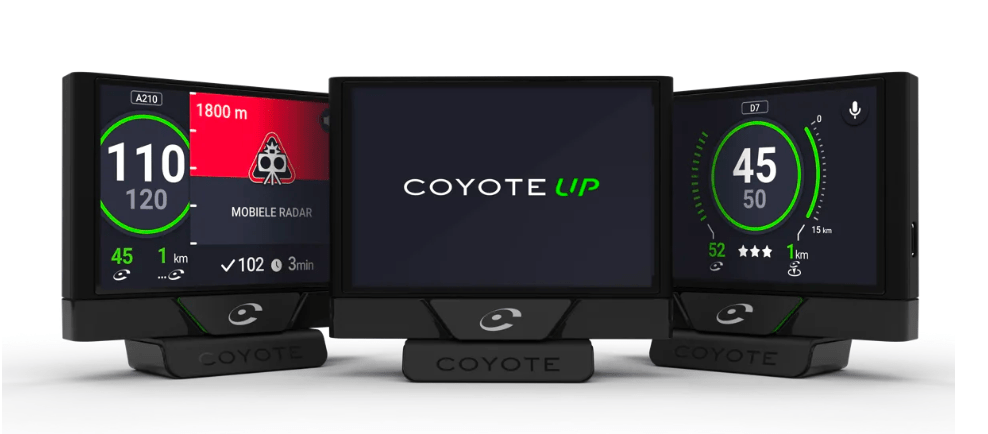
The Coyote UP embodies an new generation…
Times evolve, and the expectations of the customers too. Good reasons for the Coyote engineers to develop unique extra features, such as their own voice assistant which is able to understand requests in ordinary language. This language feature is interactive: it allows drivers to raise and confirm alerts without taking their eyes off the road or removing their hands from the wheel, using the simple phrase ‘Hey COYOTE!’
Your safety-bringing companion on the road…
Other new features have been incorporated into COYOTE UP:
A 3.5 inch touch screen that is discreet and easy to read.
A single physical button that simplifies interactions with the device.
Excellent visibility at night
A new interface that is simple, ergonomic and intuitive.
Automatic mode change between day (white background) and night (black background) which prevents dazzling the driver.
and equally during the day…
Last but not least, there is this so-called “Predictive Safety technology. ”
Based on an algorithm that analyses community data which have been made anonymous, this Predictive Safety feature contributes to better hazard identification and awareness.
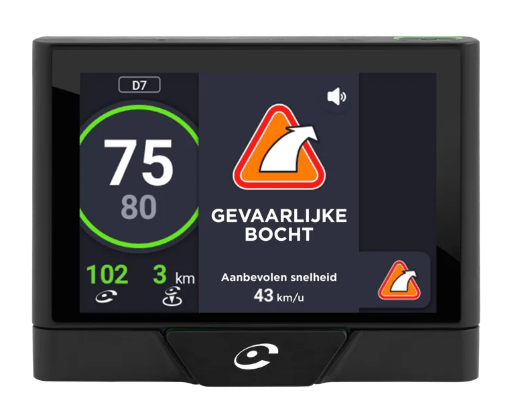
It wars you of dangerous curves ahead and idicates the safe speed…
At each bend in the road that has been identified as dangerous*, the driver receives a contextual alert which provides a recommended speed for taking the bend safely.
Predictive Safety allows members of the Coyote community to:
1.Negotiate bends confidently
2.Drive with knowledge of what lies ahead
3.Manage their speed even better
This free feature will be initially implemented through a software update on all Coyote UP and NAV+ products during the first quarter of 2020.
Coyote’s unique strength: its user community.
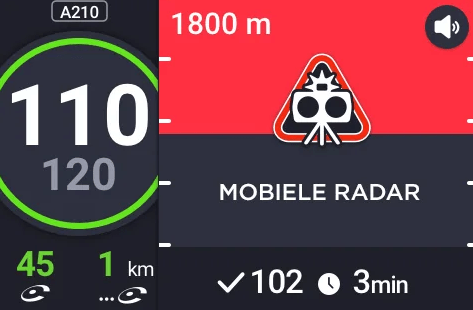
In addition to the new voice functionality and Predictive Safety, the device incorporates all the technology developed by COYOTE. Road alerts and hazards will be reported in real time by the community of over 1.6 million users in Belgium.
The screen displays maximum recommended speed and any disruptions on the route ahead. COYOTE once again offers an ad-free service so as not to distract users. Personal data transmitted by its user community remain anonymous and are not used for commercial purposes.
Coyote aims to contribute to road safety by providing precise, reliable and real-time alerts to its members as well as to its various partners, including the Federal Police. Its information is actually also made available on several platforms: connected devices, applications, on board systems in cars (partnerships with Renault, PSA Peugeot-Citroën and Parrot) and various interfaces specifically developed in the context of public and private partnerships.
Made in Europe, for its European users…
Coyote operates in eight European countries: Belgium, Luxembourg, the Netherlands, France, Italy, Spain, Germany and Poland. The Coyote community has 5.5 million members in Europe, including 1.63 million in Belgium.
The European user community is very important to COYOTE, and has played a central role in the product’s design: through their feedback and the needs they have identified, our loyal customers and ambassadors have worked alongside COYOTE to co-create this new device.
COYOTE manufactures the COYOTE UP in France (it is designed in the Paris region and Bordeaux; assembled in partner factories in Caen and Rennes).
This European user community is very important to COYOTE, and has played a central role in the product’s design.
We unpacked our Coyote UP, further user experiences soon!
The COYOTE UP is available from 13 January 2020 on the website http://www.coyotesystems.be at a price of €229 including VAT. The device is also available in Coyote stores and at all the usual points of sale.
We have now unpacked our COYOTE UP, and will soon report on our user experiences!
We were keen to lay our hands on Did you know that Compressed Natural Gas has a higher energy density than petrol? That it emits almost no small particles? That it brings CO2 emissions down by a good 30 pct? That there are no NOx emissions to speak of? Indeed, nature has some very good things in store…
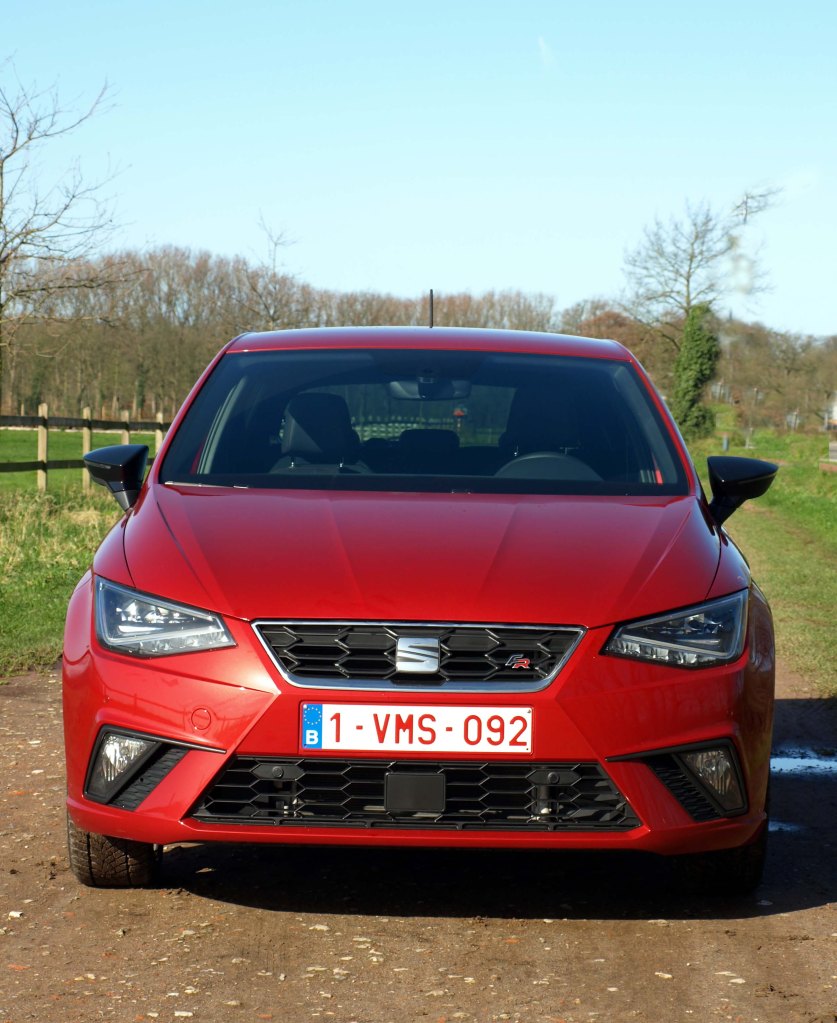
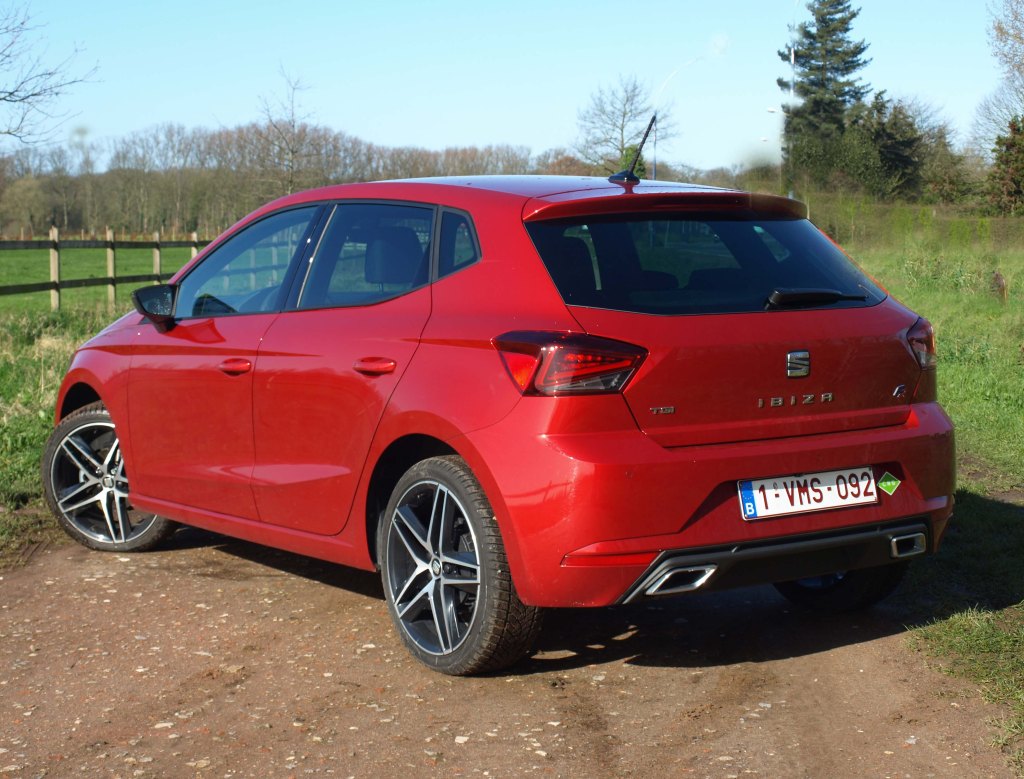
So it is only logical that the VW group has taken a long hard look at CNG and puts it in their cars. The fifth generation Seat Ibiza therefore also has a “dual fuel” car in its range, which runs happily on both CNG and petrol. Just to give combustion engine followers a “green” alternative.
an Ibiza in the sporting FR version, with under the hood a 90 HP “CNG/petrol” version of its well proven 3 cylinder 999 cc engine, and put it through its paces for you. Just read further…
Hans Knol ten Bensel
OLYMPUS DIGITAL CAMERA
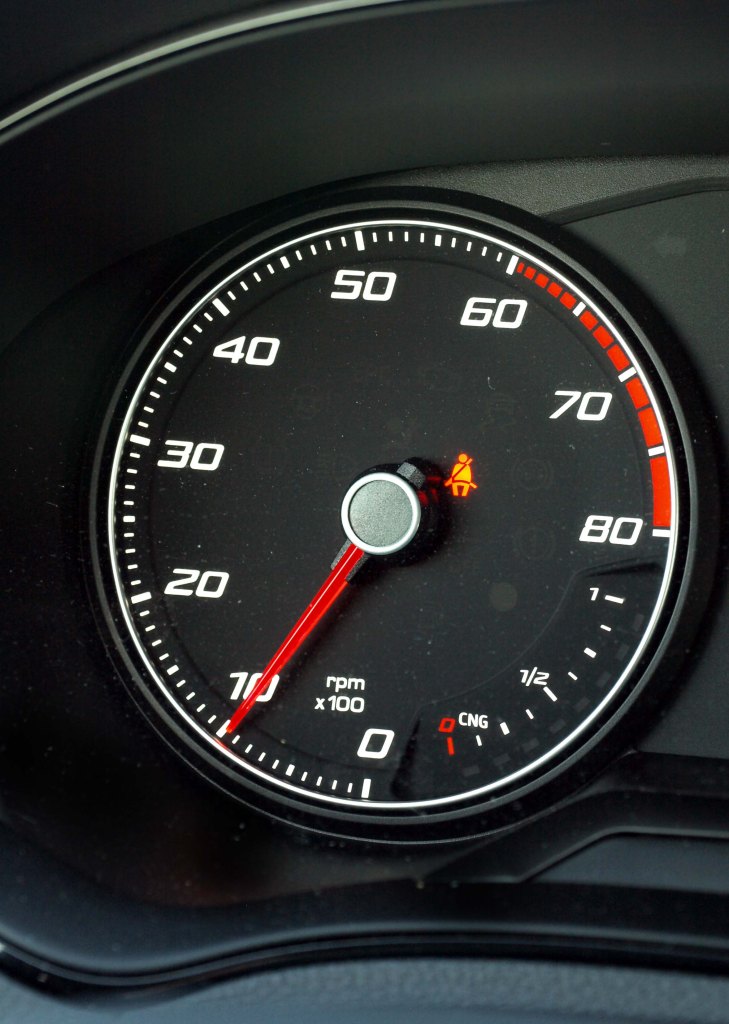
Stepping into this aptly styled Ibiza, one hardly notices any difference when pushing the starting knob. The smooth 1 litre unit eagerly springs to life, emitting its typical pleasant efficient sound when revving up. One is running on CNG, so the instruments tell you, as a green CNG symbol lights up and the content of the CNG fuel tanks are displayed. Actually, this display doubles in the rev counter cluster also as an engine coolant temperature indicator. On the right hand, in the speedometer cluster, the gauge of the petrol tank is placed.
OLYMPUS DIGITAL CAMERA
That’s it really. One doesn’t notice anything further in particular when driving. The engine is utterly smooth, docile and willing. It revs beautifully through the gears, displaying more than decent pulling power and punch once the revs are above 2000 rpm. The consumption indicator tells you how much CNG is flowing through the injectors, and it displays it in… kilograms instead of liters.
One should know that 1 kg of CNG is the equivalent of 1,5 litre of petrol. This puts everything in perspective when you are seeing a consumption of 2,9 kg/100 km for example when driving smoothly with low revs in a high gear, adjusting to a slower urban traffic flow.
OLYMPUS DIGITAL CAMERA
Indeed, this engine has wonderful smoothness and elasticity, and will not protest when you select a higher gear at 1500 rpm , and then cruise along at 1300 rpm or thereabouts, when just driving along with the traffic flow is what you want to do. This will lead to astonishingly low consumption figures, and even when driving in petrol “mode”, the (instant) consumption then drops to around 4 litres/100 km. So remember, small throttle openings and low revs will get you very far indeed.
But substantial pulling power is only to be had above 2000 rpm, as we said before. When you decide to rev it up and really put your foot down, the 1 litre unit shows its mettle, and will let this Ibiza sprint from 0 to 100 km/h in 12,1 seconds under a sporting staccato. The six speed manual is a delight to use with slick and fast changes, so there is some good driving pleasure to be had. This Ibiza also stands very well its own on the Autobahnen, as it has a top speed of 181 km/h and high speed cruising is an effortless affair.
OLYMPUS DIGITAL CAMERA
Turning back to consumption, Seat quotes a combined CNG consumption in the region of 3,3 kg/100 km, with combined petrol consumption boiling down to around 5 liter/100 km. Our consumption was some 20 % higher than this.
The stability and excellent qualities of the platform, shared with the Polo and the A1 Audi come into play here. One is indeed spoilt by the precision of the steering, the very predictable road holding and the ideal compromise between agility, stability and comfort.
OLYMPUS DIGITAL CAMERA
Seamless CNG/Petrol transition…
This CNG powered Ibiza doesn’t take any further attention from your part in daily use. Not only is CNG refuelling a breeze, with the openings of both CNG and petrol tanks sitting neatly next to each other under the tank lid, but also when the CNG tank runs empty, the system will automatically switch to petrol and you don’t notice anything at all. Only the gauges and tell tale lamp will tell you that you are now running on petrol.
OLYMPUS DIGITAL CAMERA
Price differences between CNG and petrol vary of course depending on the EU countries, but it will typically take something between 40 to 50,000 kilometres to recoup the price difference between the normal petrol or diesel and the CNG version of the Ibiza. Note that Seat Belgium offers the CNG version in March at the same price as the petrol version(!).
We also discovered that Belgium has now 135 CNG stations and found one about 1,5 km from our home. Let it also be said that with the CNG Ibiza, you can drive in all underground parkings and have of course accession to all urban Low Emission Zones.
OLYMPUS DIGITAL CAMERA
Practical
The fifth generation of the Ibiza has a stylish and roomy body, with a slightly reduced boot space when compared with the other versions, to make room for the extra CNG tanks. It varies between 355 liters and a quite reasonable 1072 liters when seats are folded. The car we tested had the luxury pack with velvet textile “FR” seats and dashboard panels covered in artificial leather.
OLYMPUS DIGITAL CAMERA
The car also had 18 inch alloys which certainly added to the car’s appearance. With the premium pack came also the big touch screen with excellent infotainment. Last but not least we enjoyed the keyless function as well as the adaptive cruise control.
OLYMPUS DIGITAL CAMERA
Conclusion
Environmental responsibility abounds, and using natural gas as energy, something which millions of European households and citizens are doing in their homes, is a very clever solution. The style, solid VW Group workmanship , the excellent road qualities and superb willing engine are further solid arguments to convince you to take this CNG Ibiza for a spin. You might decide to make it into a drive which lasts a very long time…
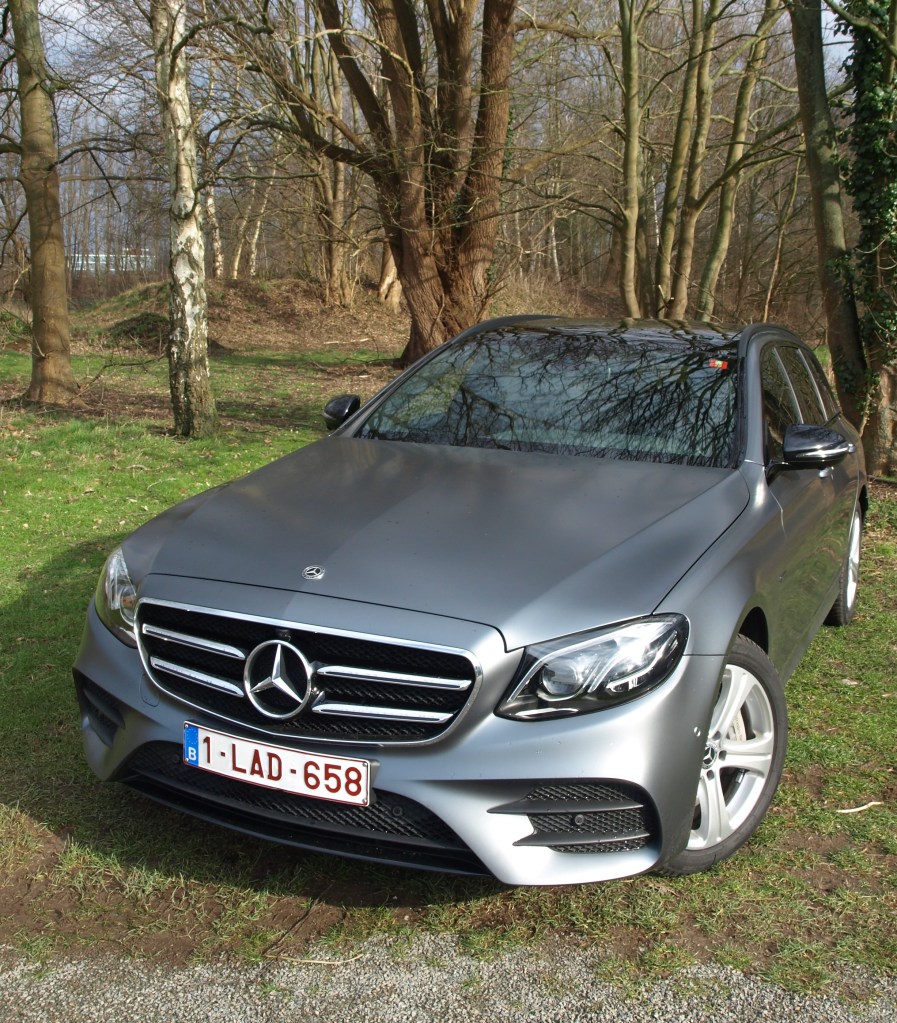
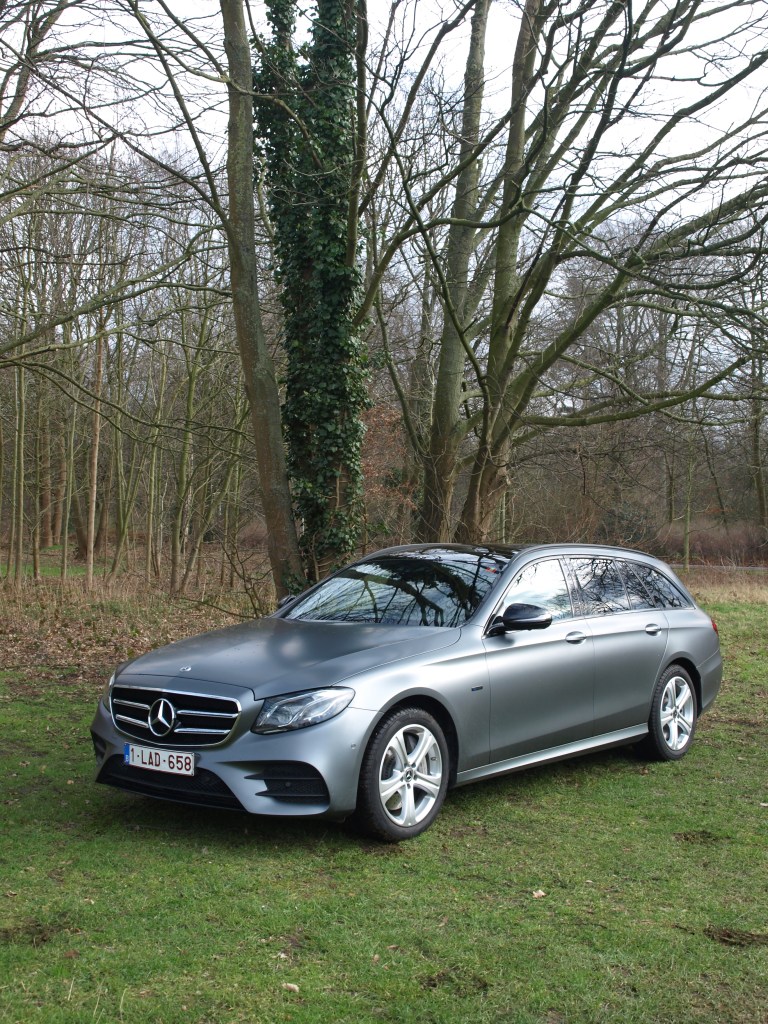
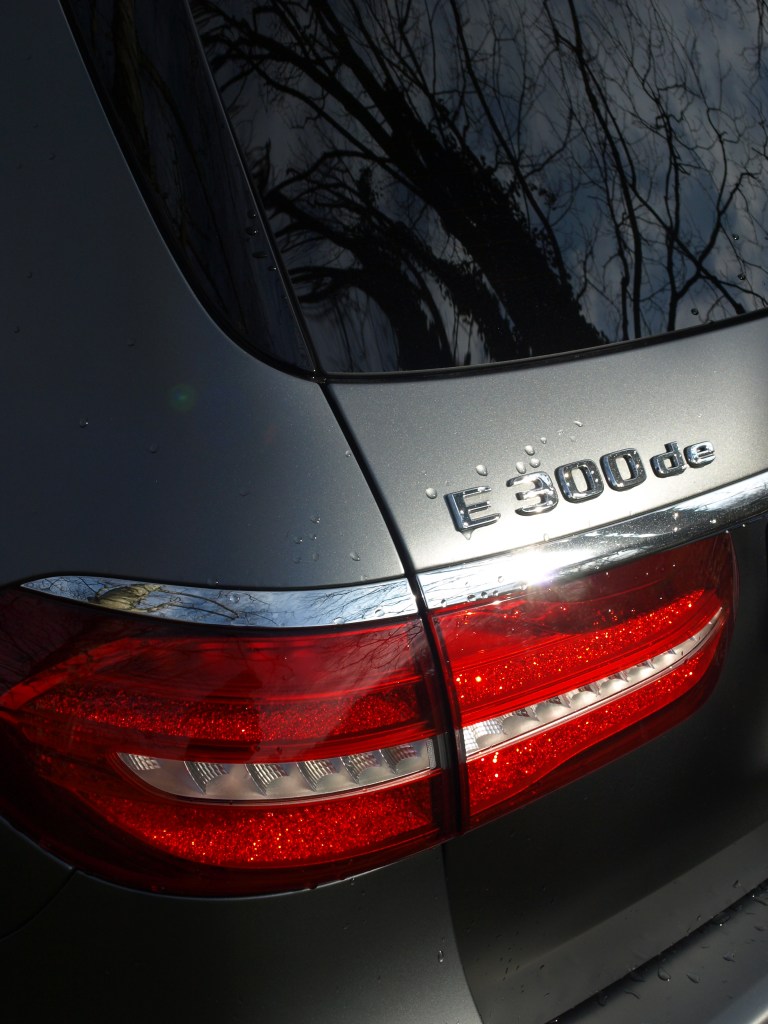
The Mercedes E 300 de is stylish and versatile hybrid. The photos here are shot with our second hand Olympus SLR E-510, f 7.2, 1/160 s, 200 ASA. Up to scratch!
When the oldest car manufacturer in the world goes hybrid, you can expect the best. Indeed, they use the adage in their marketing language: “the best or nothing”. And they use it…not for nothing. This we could experience behind the wheel of a sleek E Class estate, where under the hood the well proven 2 litre 4 cylinder diesel is married in hybrid fashion to a powerful electric engine. The result is indeed the (very) best of both worlds. Impressive to say the least. Just read further…
Hans Knol ten Bensel
The Mercedes engineers and strategists put their heads together and had a long hard look at what a Mercedes hybrid in today’s world has to be capable of in order to respond to the needs of its clients. It is well known that the E class sedans and estates with the good star are driven frequently at long(er) distances, and therefore the diesel engine is a (very) logical choice.
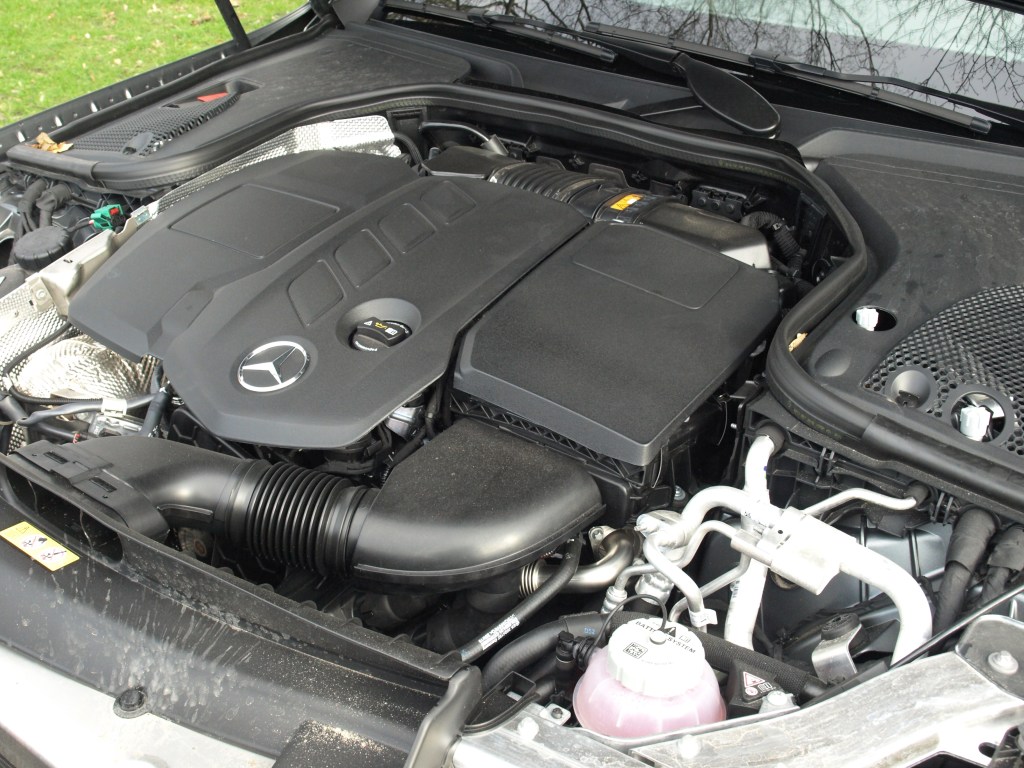
Diesel and E-power are closely married under the bonnet…
It is also a fact that this hybrid Mercedes has to be “city proof” for years to come, and therefore has to be able to drive quite reasonable distances in the city centre on lively E-power. So the choice was obvious: the well proven 2 litre four cylinder 191 HP diesel engine known from the E 220 d is also adopted here, but now alongside it is a 122 HP electric motor, which delivers more than enough zest with its 440 Nm torque.
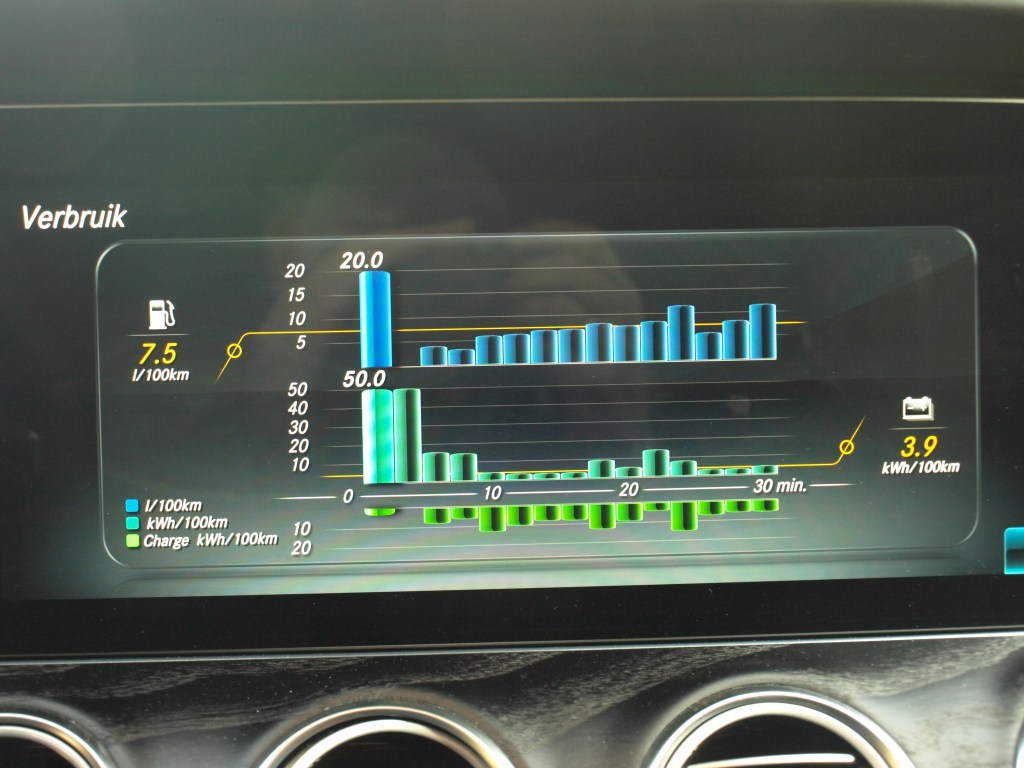
One can monitor the energy flow on the screen…
The diesel unit doesn’t lack pulling power either, and has an impressive 400 Nm of torque. Both engines do not develop their maximum power at the same time, but nevertheless total maximum system power is not less than 302 hp and 700 Nm. You understand that this means excellent performance: your are catapulted from 0 to 100 in 5,9 seconds, and top speed is 250 km/h.
Hybrid power the Mercedes way
But the true panache of this Mercedes is the completely effortless way this performance is delivered, and the excellent comfort it offers to its inhabitants, whatever the distance travelled and the quality of the roads encountered.
The virtual instrumentation lets you choose between displays… we liked this futuristic the most.
A reasonable action radius in urban E driving is therefore a must, and with a 13.5 kW battery Mercedes has done what is needed to achieve this. According to the altogether realistic WLTP cycle, this E 300 de can drive on E power over a distance of about 50 km.
When you charge the battery while driving, consumption goes up, here to an average of 7,5 litres/100 km, whilst gaining 3,9 kWh/100 km…
We did not quite achieve this with the heavier estate version, but came very close indeed. This means that in practice it is quite possible to meet even the strictest urban LEZ standards for years to come, as you can drive solely on E power.
But that is not all. With the push of a button on the central console, you can select between drive modes, and besides «E mode» and «Hybrid» you can opt for “E-save” and “Charge”.
This means you can also opt to keep the battery charged at a chosen level, or even (re)charge the battery partially or fully while driving, so that you can build up enough charge to drive later a chosen distance on electric power in the city. Very clever, this absolute versatility. On top of all that, the efficiency of the diesel engine lets you chalk up very reasonable consumption figures even during this battery (re)charging on the move, staying for instance in open road driving conditions between 6,5 and 7 litres/100 km. This is about 1l/100 km more than in non-hybrid driving, which you achieve when opting for “E-save”. Of course the hybrid mode will still improve this fuel consumption, but it costs you Kilowatts…
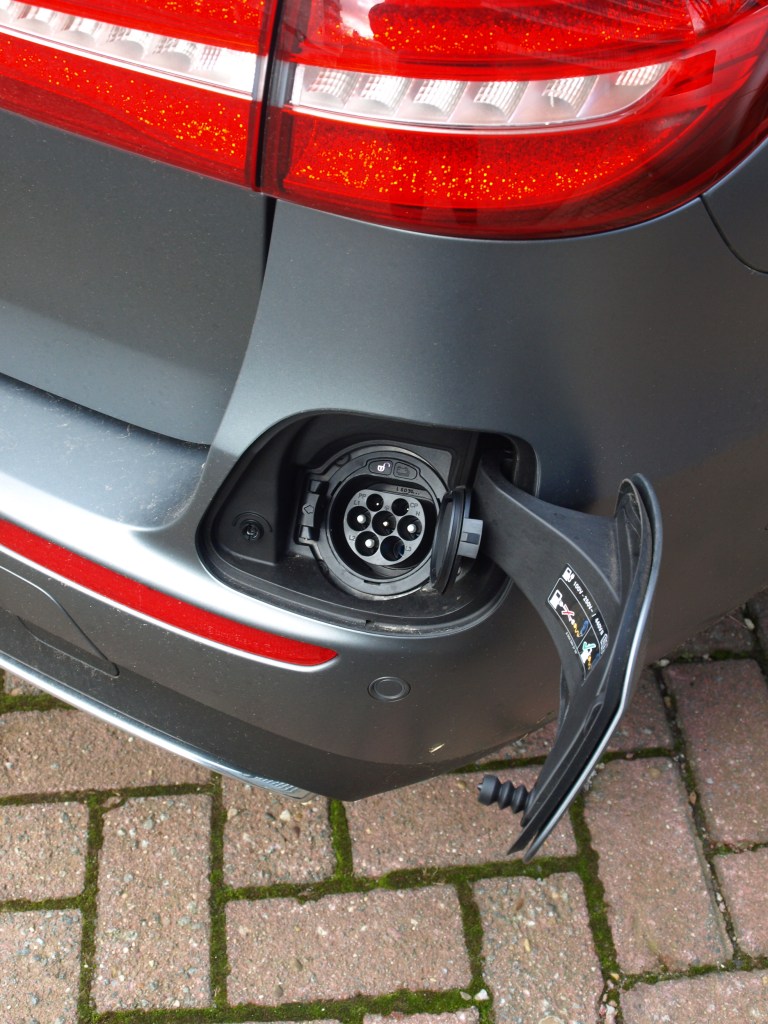
The fuel consumption varies evidently with the use of the plug-in function, and indeed it is in practice quite possible to use this E 300 as an urban electric car in a short distance scenario with frequent plug-in recharging. A neatly placed plug at the right side rear end of the car makes this recharging a breeze. In these driving circumstances, you hardly use the Diesel power, and therefore your fuel consumption will be very low.
CO2 Emissions are as low as 41 g/km, according to the WLTP cycle.
Creature comfort
The E class Mercedes has built itself an enviable reputation as a comfortable and spacious long distance runner, and here only superlatives are called for. The suspension is set up slightly firmer to cope with the 300 kg additional weight. Very good stability is the result, with hardly any noticeable drop in comfort levels. This E Class will still excel in ironing out those frost ridden roads…
State of the art infotainment and driving aids.
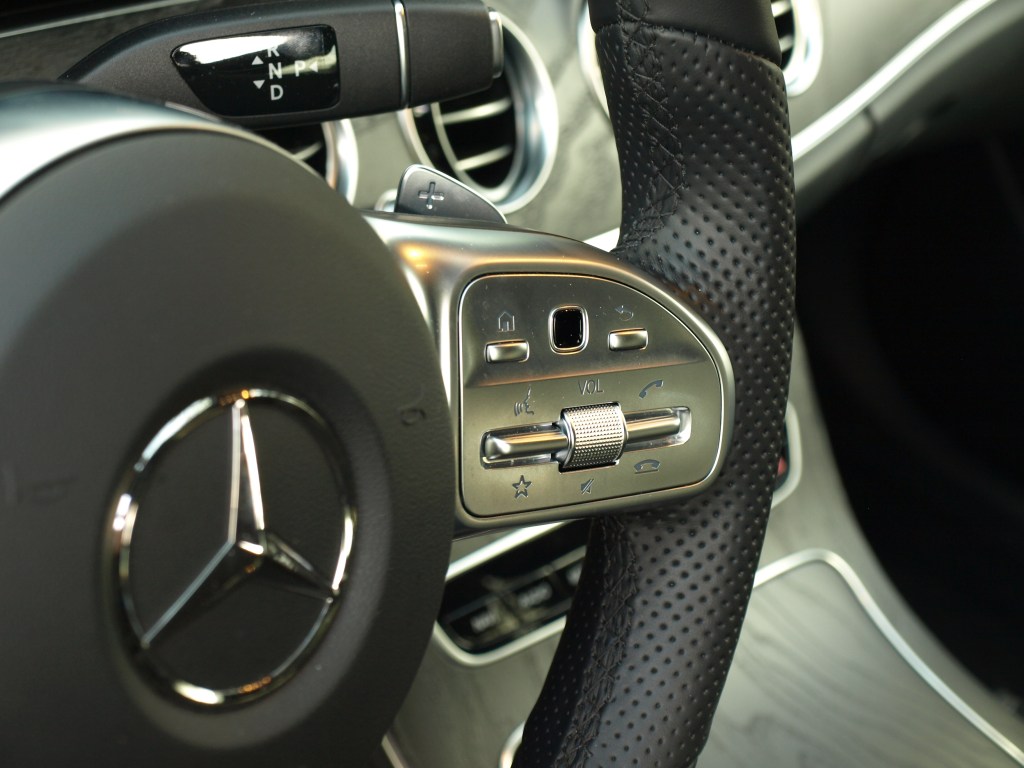
The state of the art digital instruments and panoramic infoscreen across the dashboard are now becoming a hallmark for the three starred brand, as well as the commands on the steering wheel. The host of driving aids are also setting industry standards.
The steering wheel commands have state-of-the art ergonomy…
Our Mercedes came with Parktronic, an excellent head-up display, 360° camera, speed limit assistant, adaptive cruise control, collision prevention assist plus, PRE-SAFE intelligent anticipation for accidents, you name it. Of course adaptive headlight beam assistant is also provided.
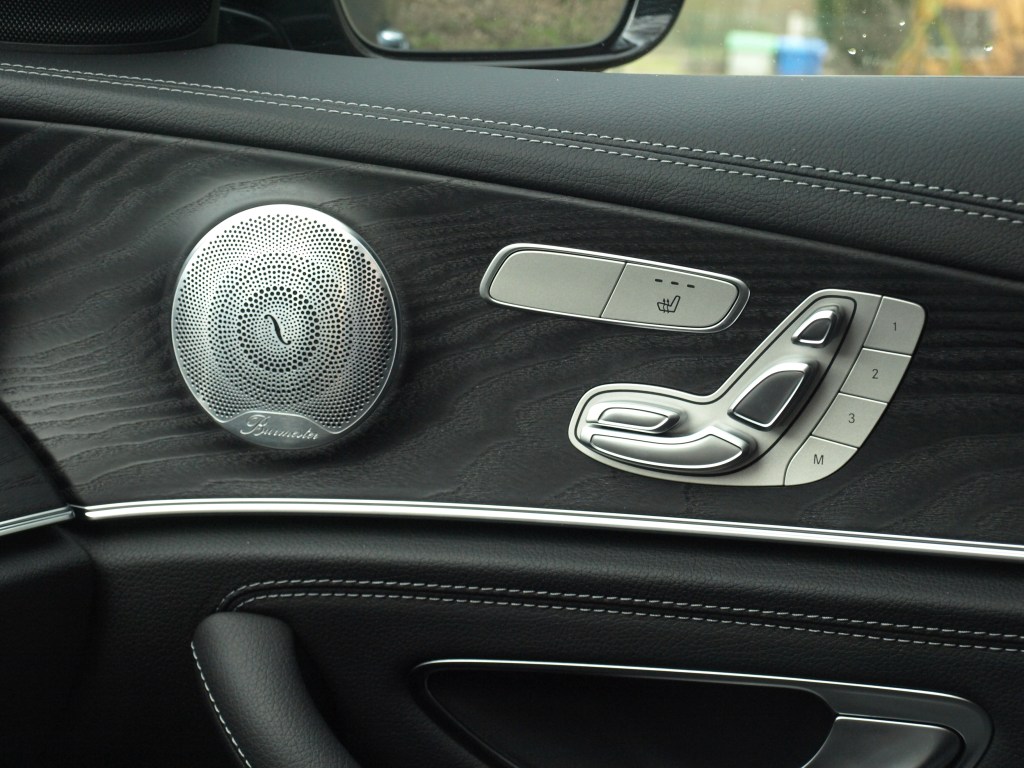
You are also pampered in the cabin: our test car came with the Burmester Surround sound system, Keyless Go, Easy pack electro-hydraulic rear boot lid, Premium ambiente mood lighting of the interior, a panoramic sunroof, and your eyes are spoilt in the AMG line interior with panels of open-pore ash wood and last but not least an analogue clock.The seats in Artico Leather and Dyamica black microfibre have 4-way adjustable lumbar support, and not to forget the dashboard surfaces are clad in Artico leather.
Luxury: an analogue clock on open pore ash wood
GPS and GSM antenna’s are present, Apple Car Play and Android Auto as well as inductive charging of your phone is also included.
The exterior is also adorned with an AMG line package, with a matte Disegno Selenite grey Magno paint, which suited the test car very well.
Unsurprisingly, this puts the all-in price tag of our test car well above 70.000 Euros excluding VAT, but let it be said that a standard, reasonably well equipped E 300 de Break can be had in our country for 56.700 Euro (excluding VAT) at the time of writing.
Conclusion
A very impressive hybrid, which lets you enjoy E-propulsion just where you need it, in urban traffic. On the open road, you are to enjoy the smooth and frugal Diesel power, and this is one of the good reasons you drive a car with the good star. Of course this hybrid is all the more useful and appropriate when you include a fair share of urban driving in your motoring life.
Olympus E-510, F 10, 1/250 sec, 200 ASA
The Mercedes is a quality car built to the most exacting standards with legendary robustness and longevity, designed to move you over short or long distances in comfort and safety, and this is exactly what this break does.
On top of that, it is well styled, roomy and practical. Need we say more?
Hans Knol ten Bensel
Photo comments: we used our “new” second hand E-510 Olympus with its standard zoom lens for these shots, and as you see, the results are quite up to scratch… See the presentation of this camera in our columns… This shot was taken with our Huawei smartphone.
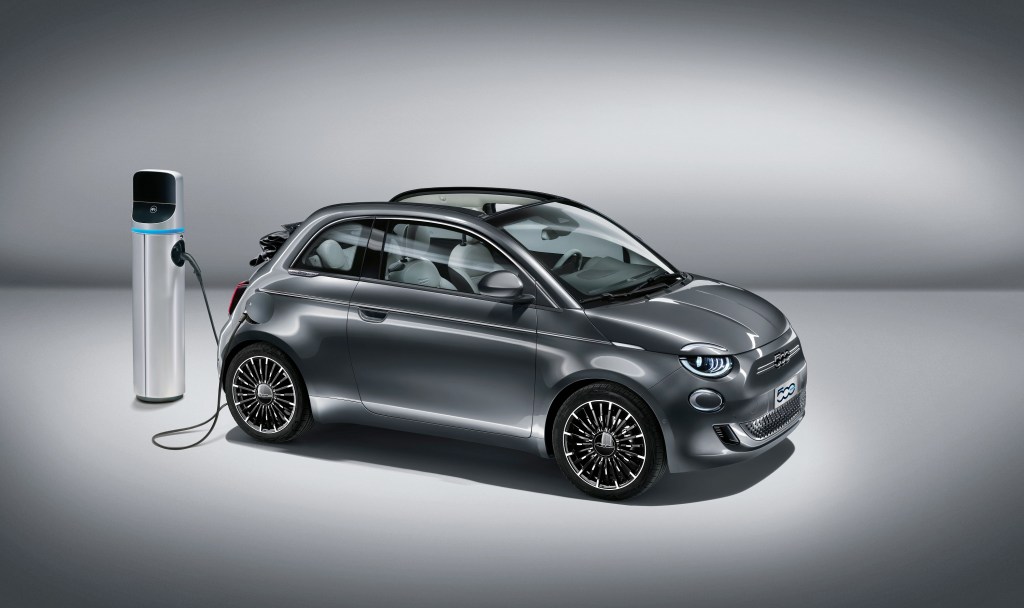
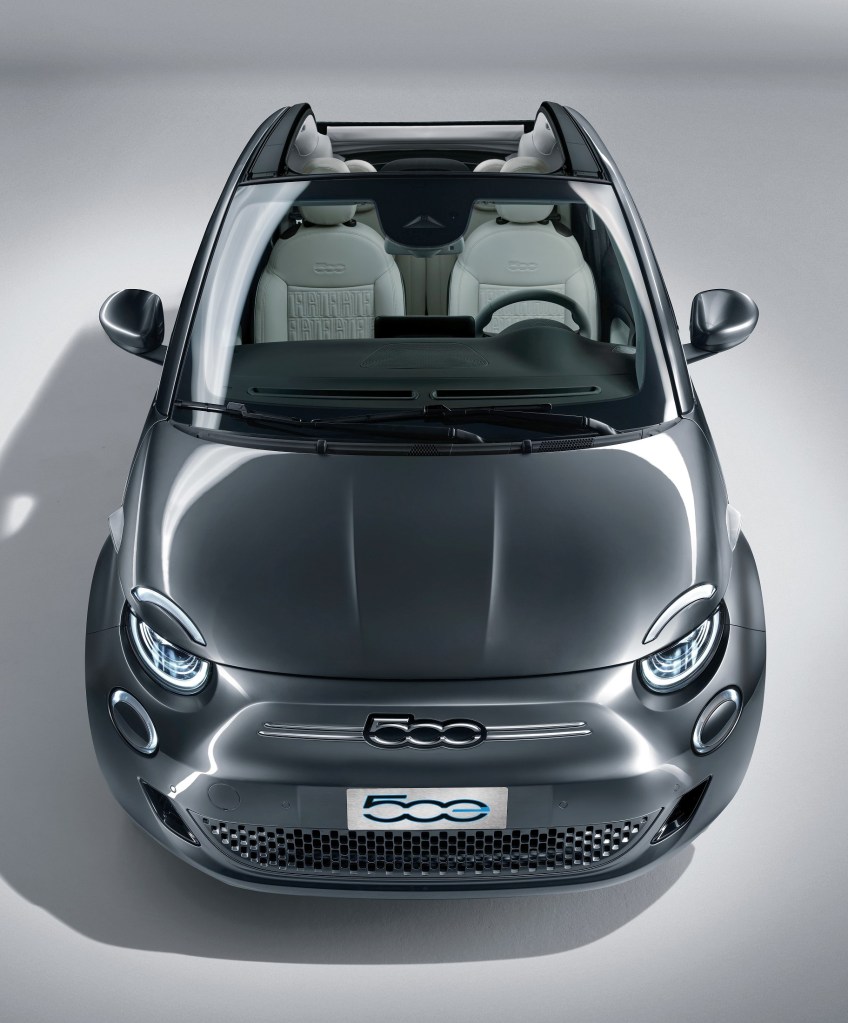
The ever young 500 is now in its third generation, and incarnates as FCA’s fisrt fully electric car. It has more space, top notch E-technology, new styling but remaining a true Cinquecento.
Its range and charging times are what customers nowadays expect. The lithium-ion batteries with a capacity of 42 kWh give the New 500 a range of up to 320 km in the WLTP cycle.
Charging is indeed a breeze: the New 500 is standard equipped with an 85 kW fast charger system to charge the battery very quickly. For example, it takes only 5 minutes to build up a sufficient energy reserve to travel 50 kilometers, more than is needed for average daily use.
The fast charger can also charge the battery to 80% in just 35 minutes. The Combo 2 socket located on the rear right side panel of the car powers the fast charger, for both AC and DC charging.
Home charging solutions are also available. The launch edition of the new 500 includes the Easy Wallbox™, a home charging system that can be connected to a normal home outlet. ENGIE EPS developed this exclusively for FCA, and it will be marketed by Mopar in Europe to coincide with the launch of the model.
It is a simple, accessible “plug-and-charge” solution that can be managed easily via Bluetooth, letting you stabilize your energy load by charging your 500 immediately at home with up to 2.3 kW of charging power, with no need for any intervention by skilled personnel. Moreover, the Easy WallboxTM is ready for a power upgrade to 7.4 kW, providing a full charge at home in just over 6 hours. The model also comes with a Mode 3 cable for charging from the public mains.
A “sherpa” mode gets you home
The New 500 has three driving modes: Normal, Range and Sherpa, which can be selected to match your driving style. In particular, Sherpa mode optimizes the available resources to ensure that you will reach your destination. The “sherpa” mode adjusts various parameters: maximum speed, limited to 80 km/h; accelerator response, in order to reduce energy consumption; and deactivation of the climate control system and heated seats (the driver has the option of activating them at any time).
“Normal” mode is as close as possible to driving a vehicle with a normal combustion engine, while “Range” mode activates the “one-pedal-drive” function. By selecting this driving mode, you can practically drive the New 500 with the accelerator pedal alone.
Lots of (city) zest…
The engine has an output of 87 kW, providing a maximum speed of 150 km/h (self-limited) and acceleration from 0-100 km/h in 9.0 seconds and 0-50 km/h in 3.1 seconds.
Level 2 autonomous driving and connectivity
The car of the future is not just an electric city car, but goes one step further: it literally goes to the next level by being the first car in its segment to offer level 2 autonomous driving, bringing all the associated benefits to urban mobility.
Front-facing camera monitoring technology monitors all areas of the car, both longitudinally and laterally. The intelligent Adaptive Cruise Control (iACC) system brakes or accelerates in response to anything: cars, cyclists, pedestrians. Lane Centering keeps the vehicle in the center of the lane when the markings are correctly identified.
Intelligent Speed Assist reads the speed limits and recommends applying them, while Urban Blind Spot uses ultrasonic sensors to monitor the blind spots and warn of any obstacles with a triangular warning light on the wing mirror. Then there is Attention Assist, which provides warnings on the display, recommending that you stop and take a break when you are tired. Finally, the 360° sensors provide a drone view to avoid any obstacles when parking or performing complex manoeuvres.
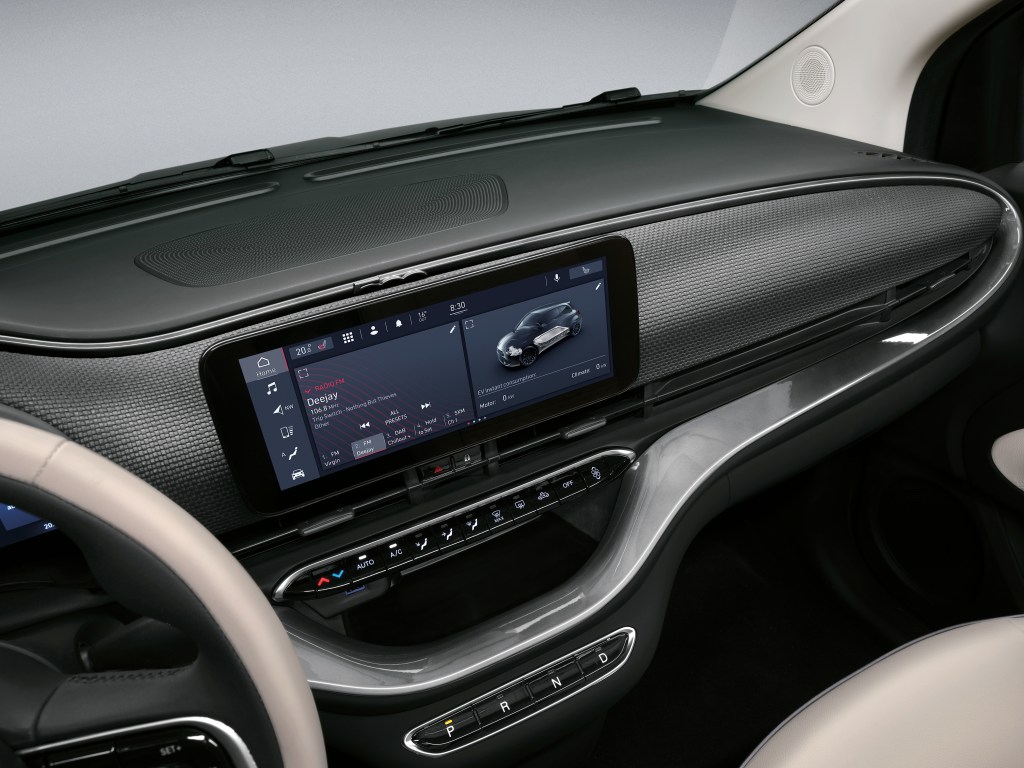
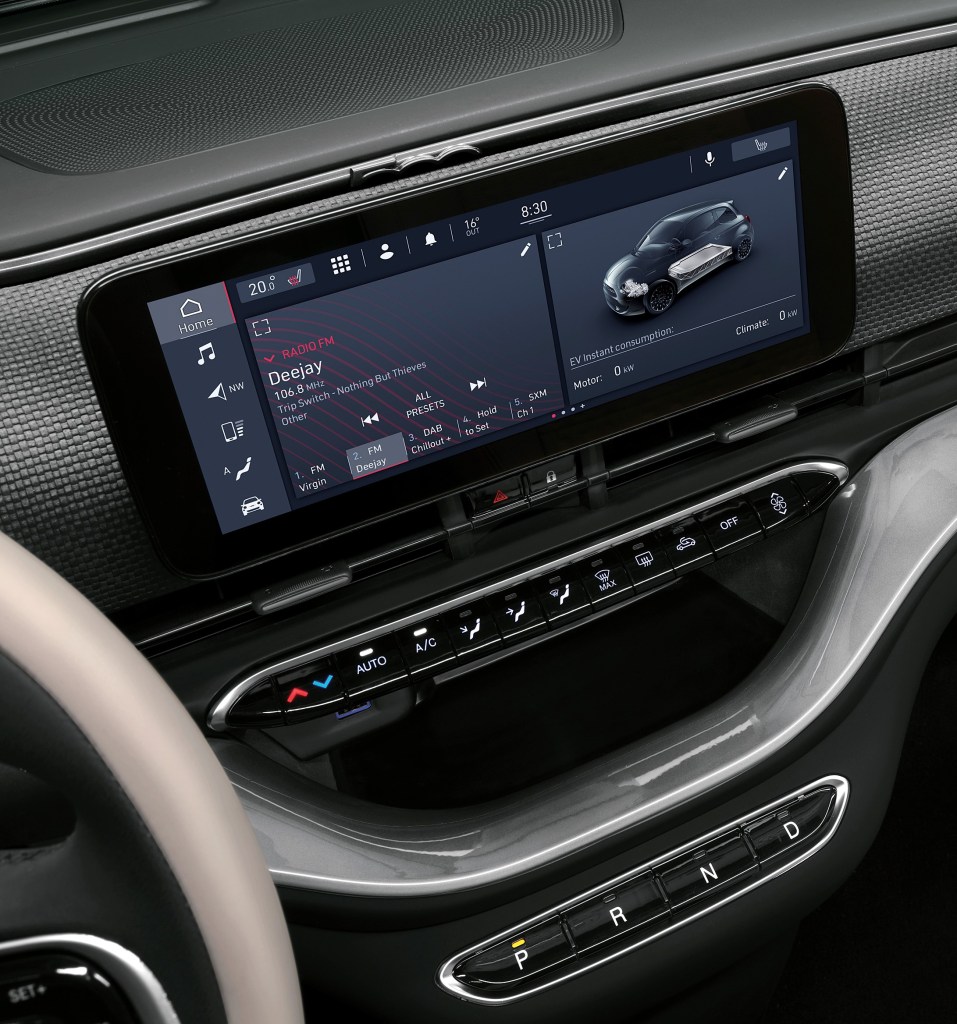
The third-generation 500 is the first FCA car equipped with the new UConnect 5 infotainment system. FCA uses the easy, intuitive and incredibly customizable Android Auto operating system. For example, you can use widgets to configure how functions and apps are displayed. Apple CarPlay is already available wirelessly. The system is also ready to offer the same functionality for Android Auto.
In short, the New 500 offers seamless integration with your smartphone, offering a 10.25” high-definition touchscreen, with a horizontal form factor that fits perfectly into the car dashboard, following its lines.
The launch version also boasts the Natural Language interface system, with advanced voice recognition, so you can talk to the car to control parameters, set the climate control and choose your favorite music.
Style, and then again
The New 500 has all the elements of style, just quieter, cleaner and crisper. The front is vertical as in the 1957 version, making it less elusive, almost facing the road, and the dynamic feel of the profile has been accentuated.
The substance of the new platform has given the third-generation 500 a strong presence: it is 6 cm wider and 6 cm longer, the wheelbase has been extended by 2 cm, and the wheels are larger and further apart, giving it a stronger personality and greater comfort despite its length remaining under four meters.
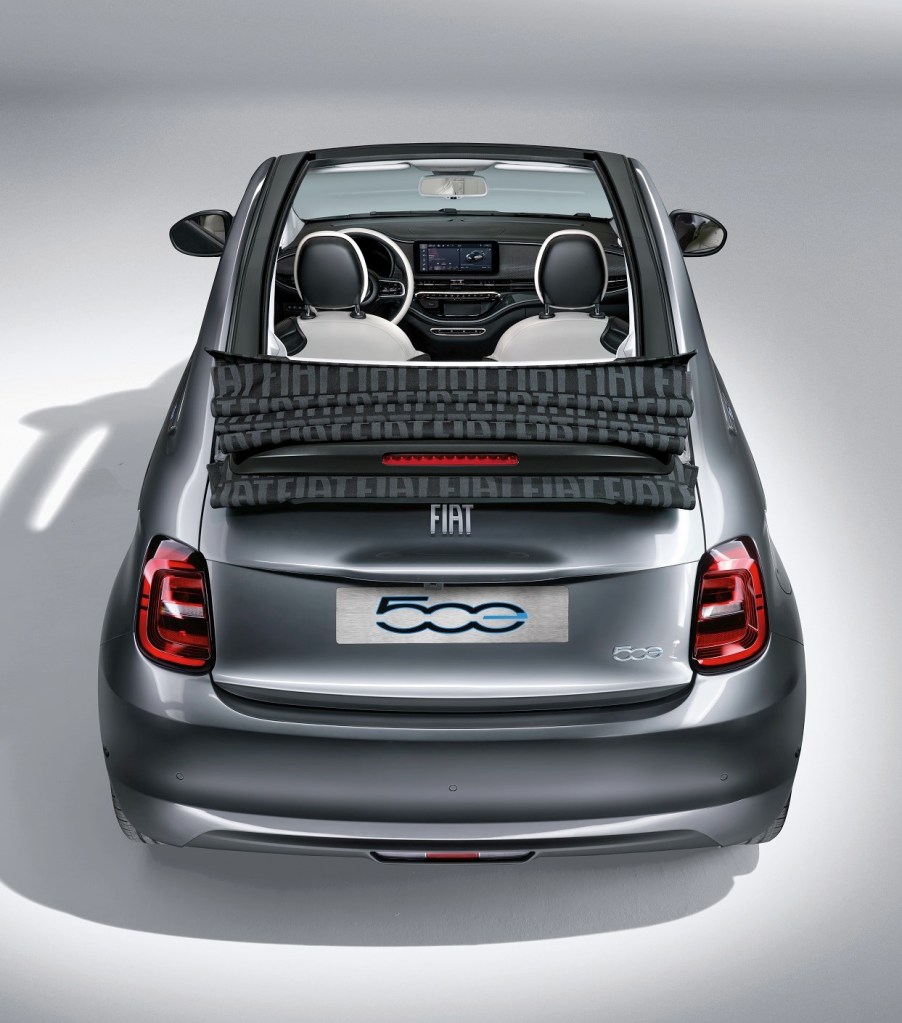
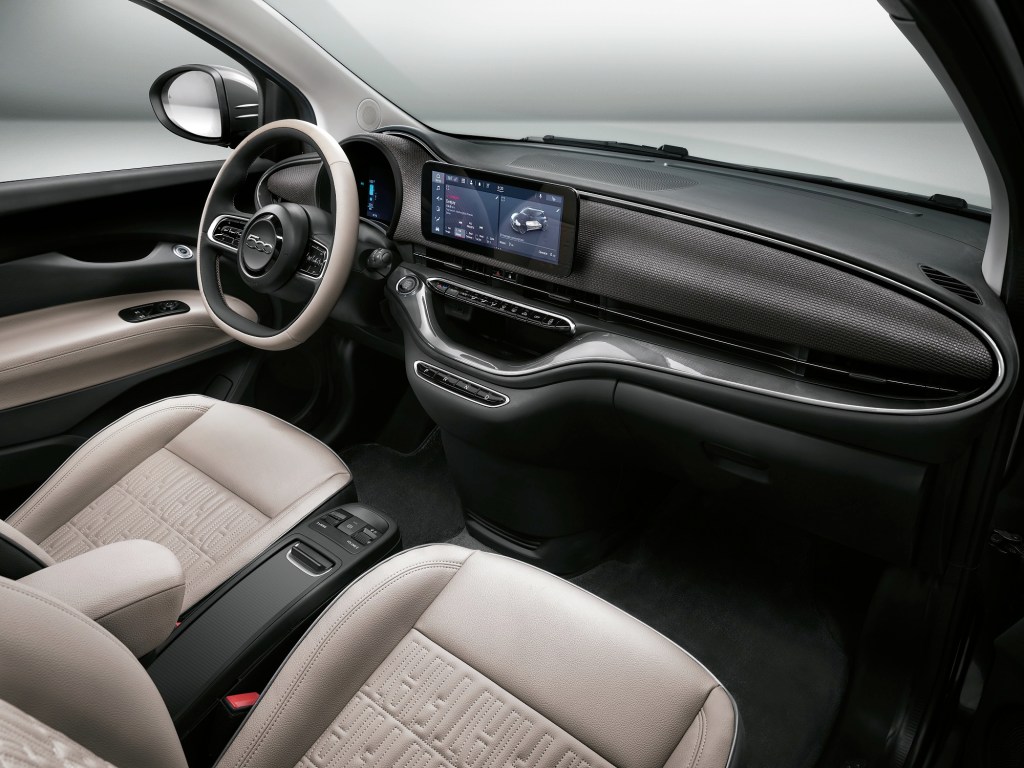
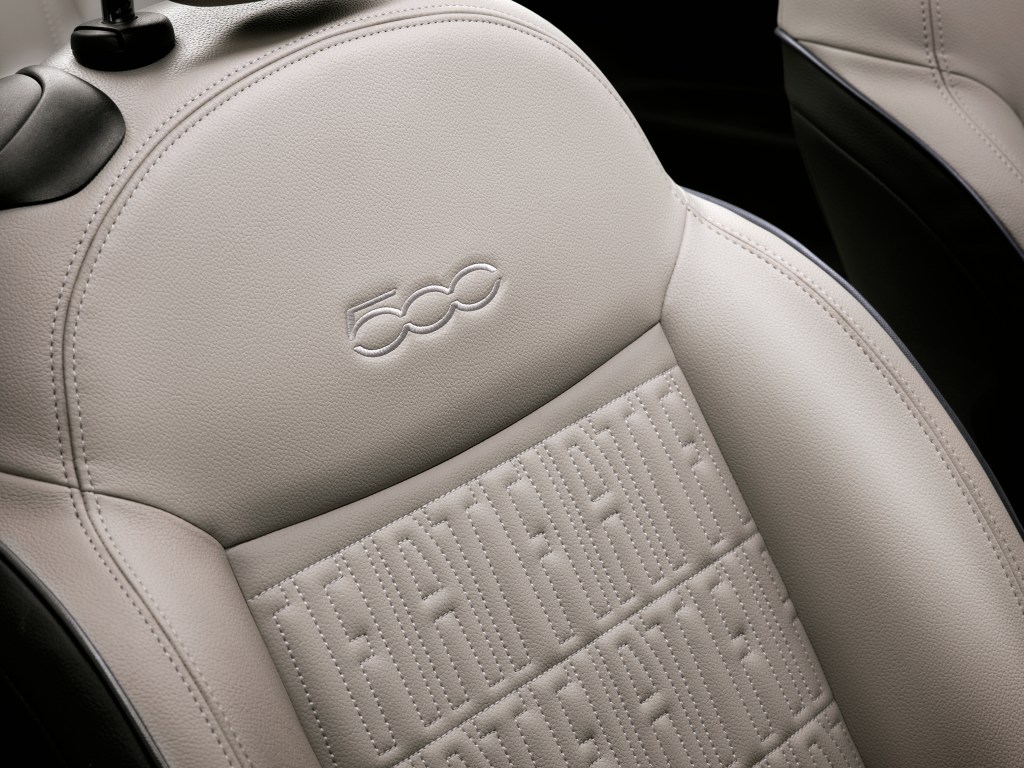
Inside, the electric 500 is completely new and elegant, with clear references to elements of the first generation. As for the Hybrid Fiat 500, including the electric version, some trim levels also have seats made using “Seaqual” yarn, derived from plastic recovered from the sea.
The new 500 debuts in the convertible version: the first open-air four-seater with zero emissions: all open, all electric, all silent. As an icon of La Dolce Vita, it had to be reborn to bring out all the charm of its forms and sounds. And on the subject of sounds, here is another unique feature of the new city car, which will become available later: the Acoustic Vehicle Alert System (AVAS), an acoustic warning for pedestrians that is mandatory at speeds up to 20 km/h; the chosen sound is not a common acoustic signal, but rather the music of Amarcord by Nino Rota, in pure Dolce vita style, an example of the most authentic Italian creativity.
The “la Prima” launch edition is available for pre-booking
A dream is coming true: the “la Prima” launch edition, a limited edition designed for the launch of the New 500, with its own distinct style, exclusivity, technology and connectivity.
From today, March 4, it can be ordered via an online pre-booking system on the http://www.fiat.com* website, by following a simple procedure of just three clicks.
To book the “la Prima” limited edition, simply browse to the http://www.fiat.com* website, and with just three clicks and a deposit of €500, you can become a part of the mobility of the future.
Needless to say that we are keen to get behind the wheel of this New 500, Corona virus protection measures permitting. The date is set, at the digital presentation: the 4th of July…
I will come back on the new 500 with a description of unique one-off versions created by Kartell, Bvlgari and Armani…
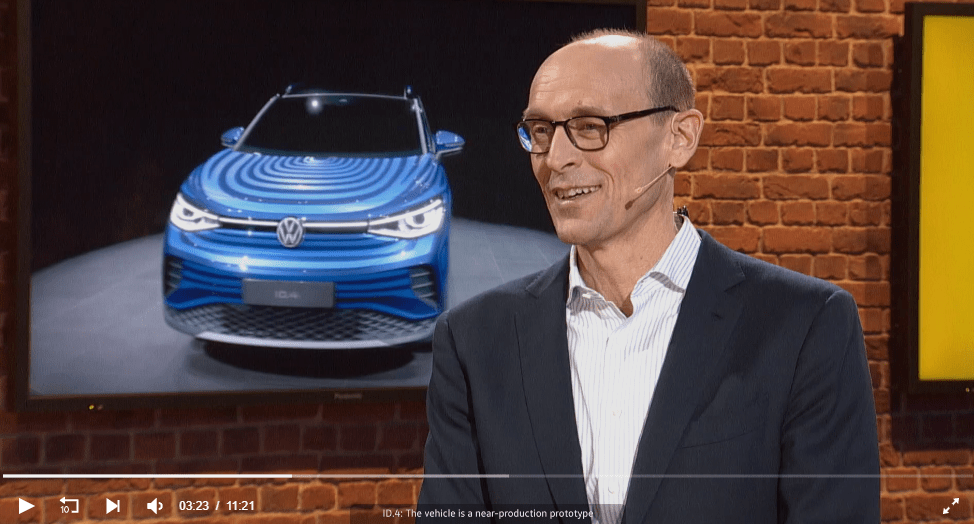
Ralf Brandstätter, Chief Operating Officer of the Volkswagen Brand, presents here the ID. CROZZ showcar
We are living in digital times. So even when the Corona virus limits (temporarily, as we all hope) our present mobility, and led to the cancellation of the Geneva Motor Show, we can still see all the automotive news via our PC’s, Phones, Tablets.
Ralf Brandstätter, Chief Operating Officer of the Volkswagen Brand, presents here the ID. CROZZ showcar, which now evolves into its series production version, the ID.4.
Volkswagen is forging ahead with its electric mobility strategy by providing a detailed insight into the brand’s first all-electric SUV. The new ID.4 will be launched this year. Following in the tracks of the ID.3, the countdown has already begun for the second model based on the new modular electric drive matrix (MEB). “Just like the ID.3, the ID.4 will also come onto the market as a carbon-neutral vehicle”, explains Ralf Brandstätter, Chief Operating Officer of the Volkswagen brand. “We will produce and sell the ID.4 in Europe, China and the U.S..”
Just read on for more VW news…
Hans Knol ten Bensel
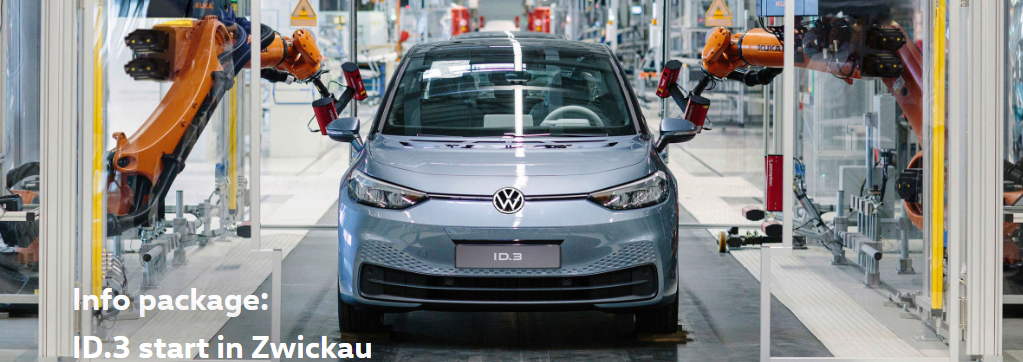
The ID. 3 started production in Zwickau, the ID.4 now follows…
The ID.4 will initially be launched with rear-wheel drive, while an electric all-wheel drive version will be added to the portfolio at a later date. The high-voltage battery is positioned near the center of the underbody to create a low centre of gravity and an optimum in terms of driving dynamics, along with an extremely well-balanced axle load distribution.
Also new mild and plug-in hybrid drives…
For Volkswagen, the ID.4 and ID.3 represent important milestones in the brand’s bid to become entirely carbon-neutral by 2050 – in line with the Paris climate agreement. Plans have been put in place to reduce the Volkswagen fleet’s CO2-emissions by a third by as early as 2025.
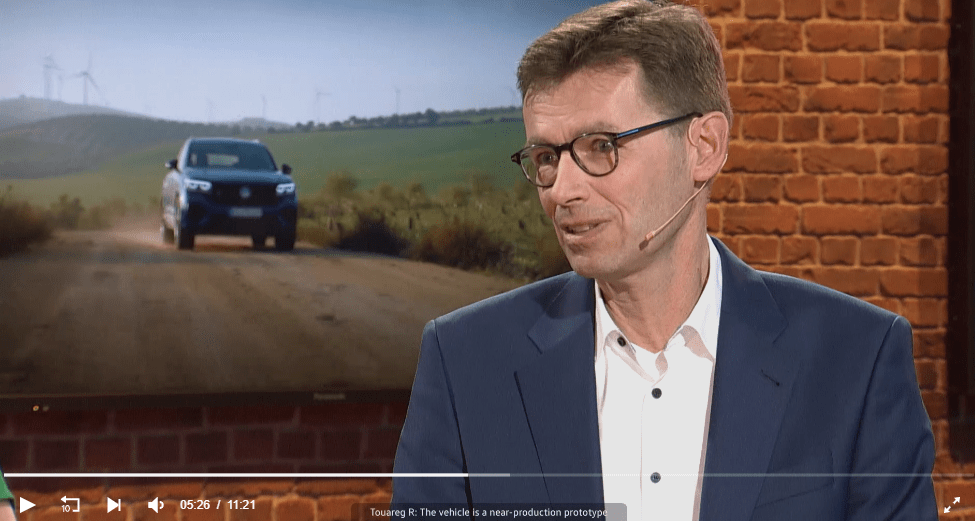
Dr. Frank Welsch, Member of the Board of Management of the Volkswagen Passenger Cars Brand with responsibility for Technical Development, presents in the webcast the new Touareg R
Volkswagen is currently investing one billion euro to electrify its model range while also offering an increasing number of hybrid vehicles. This is based on the fact that, just like electric powertrains, new mild and plug-in hybrid drives in large-scale product lines such as the all-conquering Golf will significantly help to reduce fleet emissions in the future.
New Touareg R
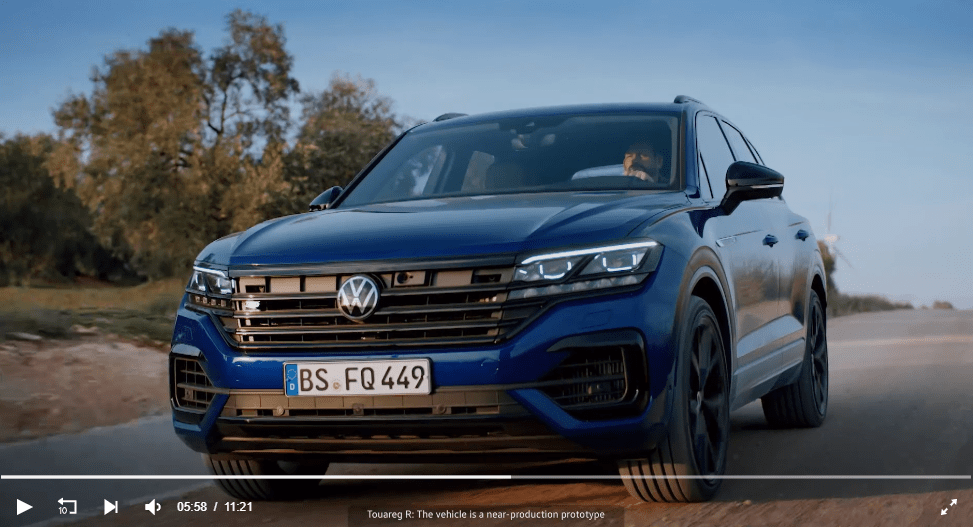
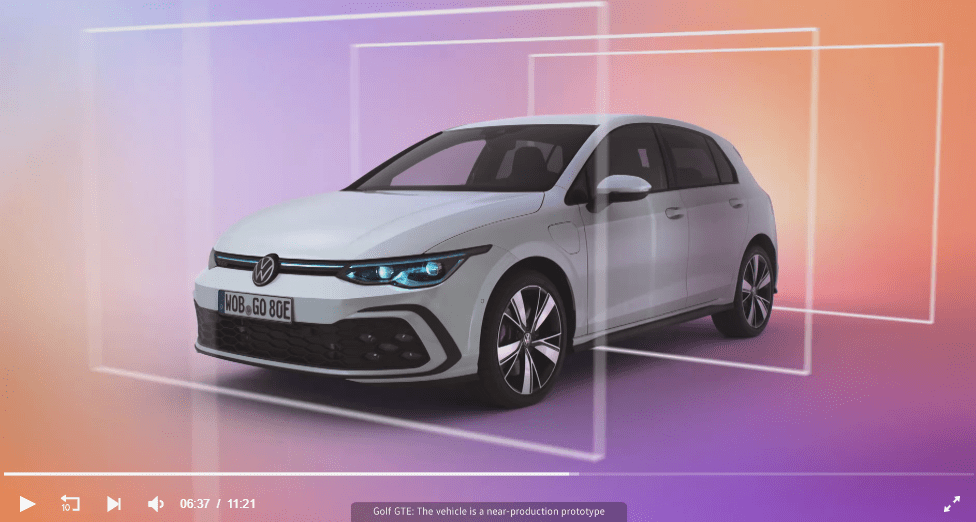
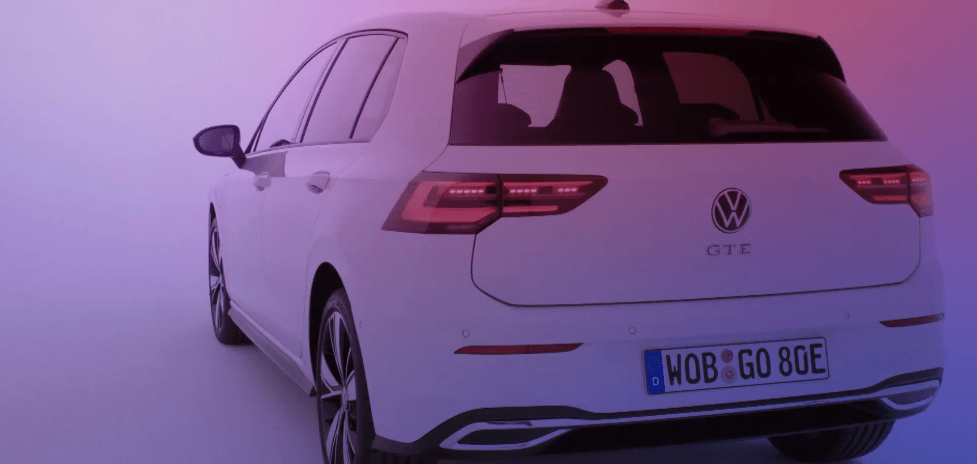
This is why the company’s focus during the webcast is not only on ID. models, but also on new Volkswagen models with hybrid drive. Dr. Frank Welsch, Member of the Board of Management of the Volkswagen Passenger Cars Brand with responsibility for Technical Development, presents in the webcast the new Touareg R with plug-in hybrid technology and the the Golf GTE 2 for the very first time.
The Touareg R,the most powerful Volkswagen model will in future also be powered by an efficient plug-in hybrid system. The alliance between an electric drive motor generating 100 kW (136 PS) and a V6 turbocharged petrol engine (TSI) with an output of 250 kW (340 PS) develops a system output of 340 kW (462 PS). The battery capacity of the Touareg R with a top speed of 140 km/h in all-electric E-MODE has been designed so that most average daily commuting distances can be covered with zero emissions.
Golf GTE with stronger battery…
The same applies to the new Golf GTE – its plug-in hybrid drive has been geared towards performance and consists of an electric drive motor with 85 kW (115 PS) and a four-cylinder turbocharged petrol engine (TSI) generating 110 kW (150 PS). As a unit, the electric drive motor and the TSI develop a system output of 180 kW (245 PS). The new Golf GTE’s top speed in all-electric mode is 130 km/h.
Further Volkswagen highlights include the new Golf GTD, which generates significantly lower nitrogen oxide emissions compared with its predecessor thanks to innovative twin dosing technology, plus the eighth generation of the Golf GTI, produced more than 2.3 million times. The most recent version is powered by a 180 kW (245 PS) 2.0-litre turbocharged direct injection engine. The maximum torque is 370 Nm. The four-cylinder engine is coupled with a 6-speed manual gearbox as standard.
Last but not least, the eight generation of the GTI takes the central stage, presented again by Ralf Brandstätter, Chief Operating Officer of the Volkswagen brand. It is a formidable performer, this GTI, and A 7-speed dual clutch gearbox (DSG) is optionally available.
Digital instruments for the GTI for maximum performance…
We include here some screenshots of the webcast, and stay tuned for more!
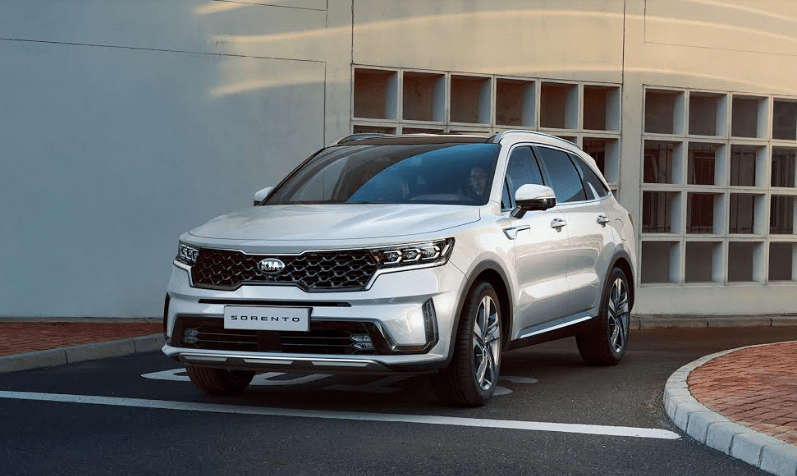
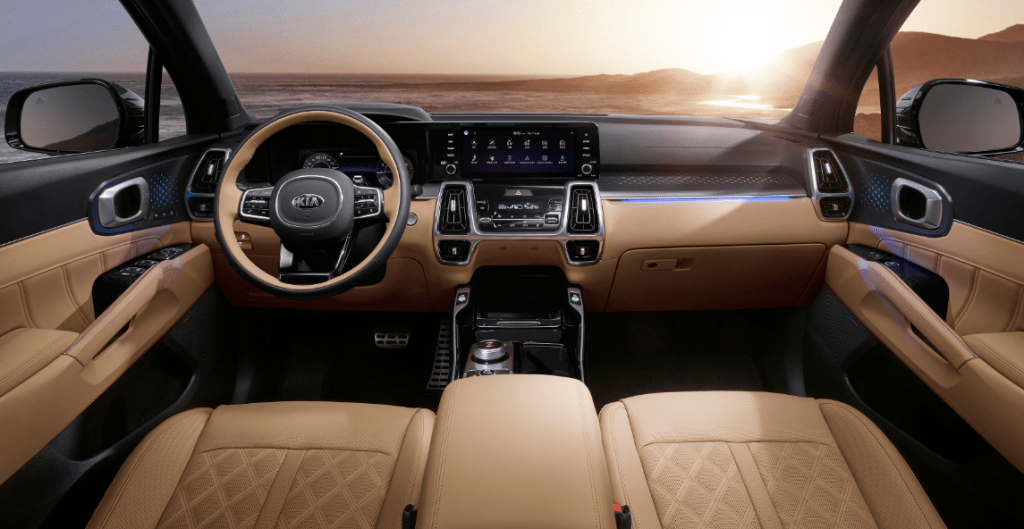
The concept of ‘refined boldness’ inspired Kia’s designers, and they came up with a more confident, mature and desirable exterior design. But that is not all. The cabin is also definitely upscale with premium material quality.
Of course, the new Sorento is crammed with progressive connectivity, driver assist and infotainment technologies. It makes its first public appearance at 2020 Geneva International Motor Show
It is high time that we start talking in our columns about the iconic brand of the “Double Chevron”with some important news…
Citroën has very recently unveiled its New C3, marking a further evolution of the Brand’s best-seller worldwide, a real success with 750,000 sales achieved by the 3rd C3 generation since its launch at the end of 2016.
Did you know that the C3 is sold almost 4,5 million times since its launch? It is the best-seller of Citroën range, belongs to the top 5 in Europe in its segment at the end of December 2019 and the 3rd best-selling car in France.
The new C3 has a proper look. It doesn’t look like any other vehicle. It builds on its differences with a colourful personality and very good comfort. It now stands even more out with new LED headlights, 97 exterior possible combinations, 3 new roof stickers, 2 new wheel rims and 3 interior colour ambiences. It now has new Airbump® designs and up to 12 driving aids, with a lot of connected services: Connect Assist for the SOS assistance, Connect Nav with its 7 “ touch tablet and Connect Play for smartphone duplication. Equipment, completely in the tune of the times, which makes everyday life easier…
New C3 will arrive at dealerships starting in June 2020.
Who doesn’t want a car which is the quintessence of ” less is more “and takes you literally everywhere? Such a car is the Panda Cross we drove here for you. A car which embodies all the “savoir faire” of a great manufacturer who is an absolute genius in making small cars. This Panda we drove is moreover full of unique panache, as it combines the clever two cylinder “TwinAir” petrol engine with a very comptetent 4 WD drivetrain.
This engine with its twin cylinder sound adds to the endearing character of this Panda, as it recalls the original sound of the (also) vertical twin of the fifties Cinquecento.
Of course, this is where the comparison with its iconic predecessor ends. Because the present day Panda has sufficient room for four grown ups, is light years further when it comes to high speed stability, comfort and last but not least passive safety.
But before we take the wheel, just a few words here about the cute looks of this Cross Panda. The front of the car already tells the story. Fog lights are snugly set into the matte black grille, the skid plate suggests clearly that this Fiat is not afraid of hitting rougher terrain. Cute accents are further found alongside this Panda, with impressive side mouldings and further culminate in the rear end, where also a skid plate is found. It also has larger mountain snow tyres, which raises the ground clearance to 161 mm and increases wading depth to not less than 410 mm.
The cabin with its typical rounded contours in the iconic Panda styling language host clearly readable instruments and knobs.
Rediscover (off-road) pleasure…
What has remained in this iconic Panda over the years is the absolute driving fun. Sliding behind the wheel you will find immediately the right knobs and handles, the cute gearlever literally falls into your hand.
The pleasant throb of the eager TwinAir is music in your ears, as it revs up swiftly and gets you going with verve.
Of course, we live in energy conscious times. So you shouldn’t let your enthusiasm get the best of you, and refrain from higher revs. Change up at 1700 rpm or so, which sounds way too low as your ears are used to the typical throb of a four cylinder. But rest assured, you are doing the right thing. You are also well advised to choose the “eco” mode, which shifts the engine management towards efficient combustion at lower revs and partial load. The rewards are impressive. Urban fuel consumption remains below 7 litres, with enough pulling power left for an active driving style. Drive it in “eco” mode on the open road, and the consumption is dwindling to around 5 litres. A remarkable feat for any 4WD! The manufacturer quotes 117 g/km as CO2 emissions.
But Panda driving is also about (re)discovering driving pleasure. If you are in the mood, forget the eco mode, let the thoroughbred twin sing full breasted, and every metre you travel is just epic. You accelerate faster than a 500 “esse esse” Abarth Corsa of yesteryear, as this TwinAir 875 cc unit has not less than 85 horsepower, and the hissing throb at higher revs and full throttle is just about the same as its famous ancestor. Your Panda sprints under your able hand (and foot) in under 15 seconds from 0 to 100 km/h, and soon you hit the top speed of around 160 km/h. The dapper Panda will cruise all day at 130 km/h and therefore is a perfect all rounder which, despite its initial urban and off-road vocation, is also a good companion on longer motorway trips.
Long distance comfort is greatly helped by the good suspension, which admirably swallows rough tarmac and pavés, and also the fine sound deadening and vibrationless drivetrain are just right here.
In our columns you can also read more about our driving impressions of the “Mild Hybrid” version of the Panda and 500, which have a very docile 70 HP three cylinder engine under the hood.
A true master offroad…
Due to its low kerb weight (1090 kg), which gives it about the same power to weight ratio as a Diesel Range Rover and last but not least its compactness this Cross Panda is a formidable mount in snow buried mountain villages and pass roads. Not surprisingly it is an absolute favourite in these regions. The low first gear lets your Panda climb the steepest terrain hills, (Fiat says up to 70 % and slide slopes up to 55 %) and it also has a terrain control device, sitting on a round knob between the front seats. There are three settings. One is for normal road driving, and when the road is good, 98 % of the power will be sent to the front wheels. Then there is the option/position off road, and now the car’s differential locks to offer permanent four wheel drive, and the electronic stability control acts to brake the wheels that are slipping. Of course, you also have to come safely downhill, and that is where the third position, “hill descent”, comes in. This uses the car’s electronic stability and the ABS systems to maintain a constant speed.
Conclusion
The Panda is already endearing in its cute “cross” livery. But there is more. It reveals its pleasant character once you are behind the wheel, and it is not only fun in town, it also excels offroad, and in muddy terrain, it can be more than a match for heavier (Defender) Rovers and the like. Its low weight and nimble dimensions and above all short overhangs see to that.
So to get a truly go anywhere, well equipped, compact, frugal 4×4 for a price around € 17.000 Euro’s, which is already an icon among car enthusiasts, then this Panda is a steal!