We drove the Nissan X-Trail e-Power e-4ORCE : the best of both worlds?

Nissan is carving itself a wonderful niche in the electrified SUV world, with both its popular Qashqai and the all new X-Trail.

It offers a bold technological solution for these two popular models by decoupling the engine entirely from the proper drivetrain, letting it act solely as a generator to one (and in this case two) electric motors.

The idea behind it is obvious: it offers the pulling power and mechanical refinement of the electric motor and at the same time it avoids the inefficiency of the combustion engine when it operates under low charge  situations combined with relatively high revs, like in urban stop start traffic.

It lets the engine do its charging work under ideal thermal working conditions and loads, and uses a small(er) battery to deliver the extra electric energy when needed in specific driving situations, like starting off from standstill or engaging in fierce acceleration. Ideal? Let’s find out…

Hans Knol ten Bensel

Smooth…

The driving impressions are indeed very convincing: progress is silky smooth, and indeed the X-Trail is delightful to drive in town and slow traffic.

The ample torque of both electric motors inspires confidence, and lets you master every driving situation. The combustion engine, a 1,5 litre three cylinder, is well insulated and hardly audible. Its recharging task depends of course on how much e-power you want it to deliver, and therefore the more relaxed your driving style, the less you hear it. Whether it will rev higher depends also on the driven speed, soo clever! The Nissan engineers did a very good job here, as this gives a very “natural” impression to driver and passengers.

Total power of our top op the range e-Power e-4orce X-Trail is not less than 213 HP, and the torque is even more important with 330 Nm at the front and 220 Nm at the rear. Smooth performance is the result: the 1,9 tonne 7 seater will sprint from 0 to 100 km/h in 7 seconds and the top speed is an impressive 180 km/h. Indeed, this X-Trail will never feel underpowered.

Geared for comfort

Does the X-Trail awaken the sporting driver in you? Well, rather not. Its utter smoothness puts you rather in a “Zen” mood, and the comfortable suspension does the rest. The car is well balanced and stable in all circumstances, and this adds to the overall relaxing character of the car.
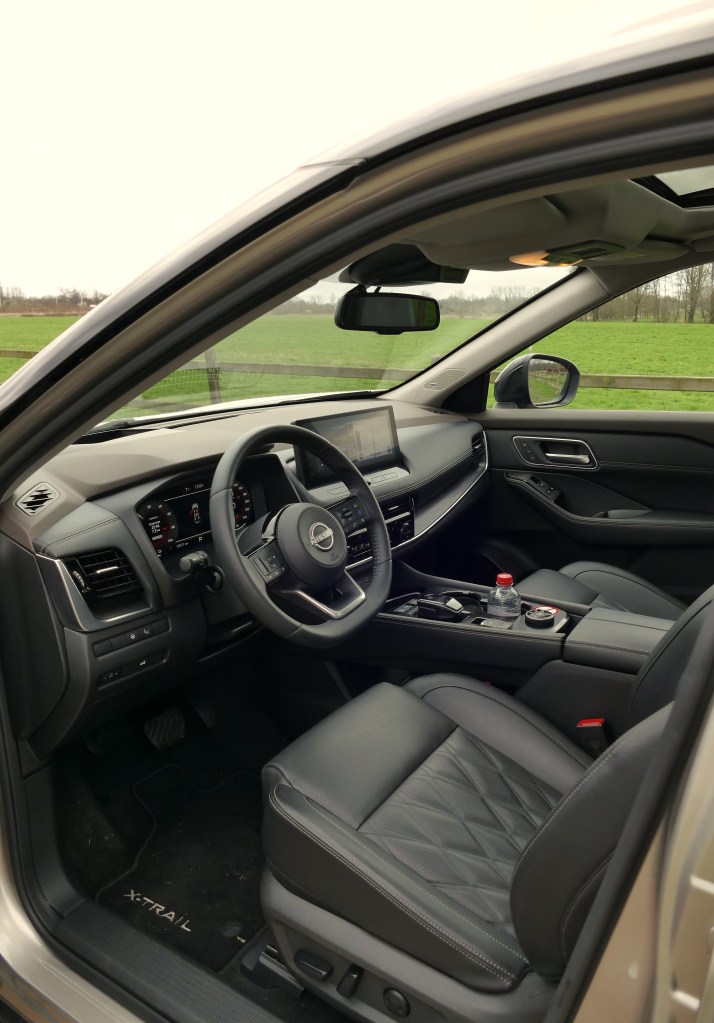
Well being is also found in the cabin. Of course, the top Tekna+ equipment version spoils your senses. The interior is also well laid out, stylish and the designers did keep wisely an array of knobs so you quickly find your way intuitively to all the functions of this X-Trail. We also liked the look of the digital instruments and screen display.

The X-trail e-4ORCE AWD is with its dual motors and 4WD very well at home off- road too…

… but also for economy?

The Nissan engineers had first and foremost the mechanical smoothness of e-propulsion in mind, and combined this with range comfort. Consumption seemed not to be an absolute priority. Nissan opted for a smaller  battery, not least because it would cost room, make the car heavier and pricier. This means that the engine has nowhere to dump its generating power when the battery is full. Of course, the drivetrain software will shut the IC engine down as soon as possible, or let it turnover purely on e-power. Having said this, if you adopt a relaxed driving style, it is quite possible to achieve a consumption between 7,5 and 8 litres, which is quite efficient for a car weighing close to two tonnes. Official figures indicate an average consumption of 6,4 litres/100 km, and 146 g/km of CO2 emissions.

A seven seater…

Indeed, this X-Trail will transport two youngsters on the third row seat, but this is not meant to be for super long trips. But a short run to the supermarket or football club is always in the cards, and this can be quite practical on more occasions than you would expect.

Conclusion

This Nissan X-Trail e-4ORCE is a very well balanced, refined car which offers you all the sophisticated “Zen” pleasures of electric driving combined with the range and long distance cruising panache of IC engined cars. It is very well finished, is lavishly equipped and offers more than adequate space.

We were so seduced by all its good qualities that we decided to join a Nissan e-Power e-4ORCE to our stable of cars, so soon we will inform  you regularly about how it behaves in long term use…

Hans Knol ten Bensel 

Nissan Benelux unfolds her strategy for the Benelux market…

Managing Director Jerome Saigot unfolds the strategy of Nissan Benelux…

We are at the start a new automotive year, and therefore it is a good opportunity for manufacturers to look forward into 2024 and announce to the Belgian press what their strategy, plans and objectives will be in the forthcoming 12 months.

So we were invited at the end of last year by the Melvin Keuter, head of communications of Nissan Benelux at their press conference…and their interesting initiatives are certainly worth a closer look. Just read further!

Hans Knol ten Bensel

Melvin Keuter, head of communications of Nissan Benelux, exposed the electrification strategy of Nissan and its future…

Nissan Belux and Nissan Nederland merged into Nissan Benelux

On the 1st of July last year, this merger was executed in order to improve response to the needs of the Benelux market. Now the two entities are joined in a new so-called Regional Business Unit, led by Managing Director Jerome Saigot. Indeed, the car market is going through a fundamental transition, and Nissan will respond to these challenges by focusing on electrification, digitalization of the customer approach and responding to major changes in the buying behavior of their clients. Mr. Saigot emphasized these points of the strategy in his presentation at the press conference. He sees also in this merger further useful synergies for staff and dealerships.

He exposed the mission of Nissan Benelux, which is to be an innovative brand which offers electrified mobility and a superior service to its customers. Its objectives are to enlarge its volume, raise brand identity and awareness as well as boosting profitability.

The strategy to achieve this will be to focus, as we said, on further digitalization of customer approach, further electrification of the model range, strengthening corporate sales, bolstering brand identity and streamlining distribution.

According to Jerome Saigot, digitalization is a major trend which will strengthen further. In 2020, only 4 % of customers were buying a car online, which has risen to 12 % in 2023. Market surveys show that soon 45 % of the future customers will buy their car online. Of course, Nissan will work further on its electrification, and indeed focus also increasingly on corporate sales.

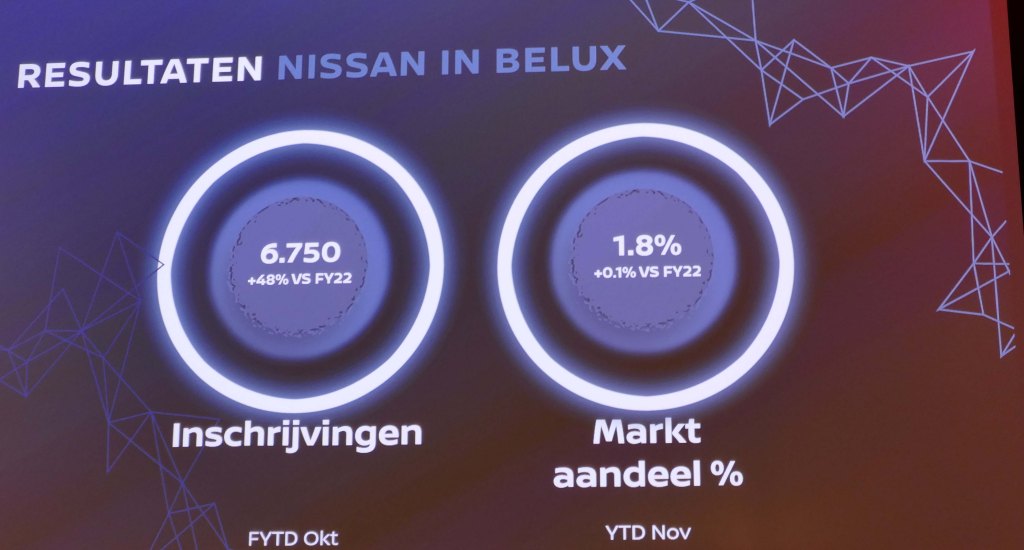
Looking at the results last year of Nissan Belux, 6.750 units were sold, which is an impressive 48 % rise compared to FY 22.

Also in distribution and dealership the focus will be on further developing synergies and tailoring the customer approach on their changing preferences and buying behavior. In December last year, Nissan sent a message to the professionals, small and medium enterprises, craftsmen and the like, pointing out the attractiveness of their increasingly electrified LCV segment.

Decisive steps toward further electrification… or EV36Zero.

EV36Zero is a key part of Nissan Ambition 2030. In this period Nissan will deliver exciting, electrified vehicles and technological innovations while expanding and transforming its operations globally the company announces. The vision supports Nissan’s goal to be carbon neutral across the lifecycle of its products by fiscal year 2050.

In November last year, Nissan announced that the EV36Zero hub in Sunderland, Nissan’s blueprint for future manufacturing, will consist of three electric vehicles (EVs), three gigafactories and up to £3bn investment.

The transformational project includes future all-electric versions of Nissan’s flagship Qashqai and JUKE crossovers, and Nissan also confirmed that the third vehicle planned for UK production will be next-generation Nissan LEAF.

Nissan also announced that that it expects its passenger car line-up in Europe to be 100% electric by 2030.

Nissan is also incorporating in their electrification strategy the latest developments in battery technology. It will adopt Cobalt-free batteries, and towards 2028 there will be a cost reduction in comparison with Lithium-Ion batteries of not less than 65 %. This year Nissan will open a pilot factory in Yokohama to produce solid-state batteries, which can be charged three times faster and cost much less. They will be introduced to the market in 2028…  

Looking into the future…

After exposing the good qualities of the present range, a veil was lifted in this conference about the cars we can expect in the (not so) distant future.

Indeed, the three future versions of the full electric Juke, Qashqai and Leaf will be inspired by three exciting all-electric concept models, two of which were recently unveiled at the Japan Mobility Show:

The Nissan Hyper Urban Concept, a crossover EV characterized by a sleek and modern aesthetic.

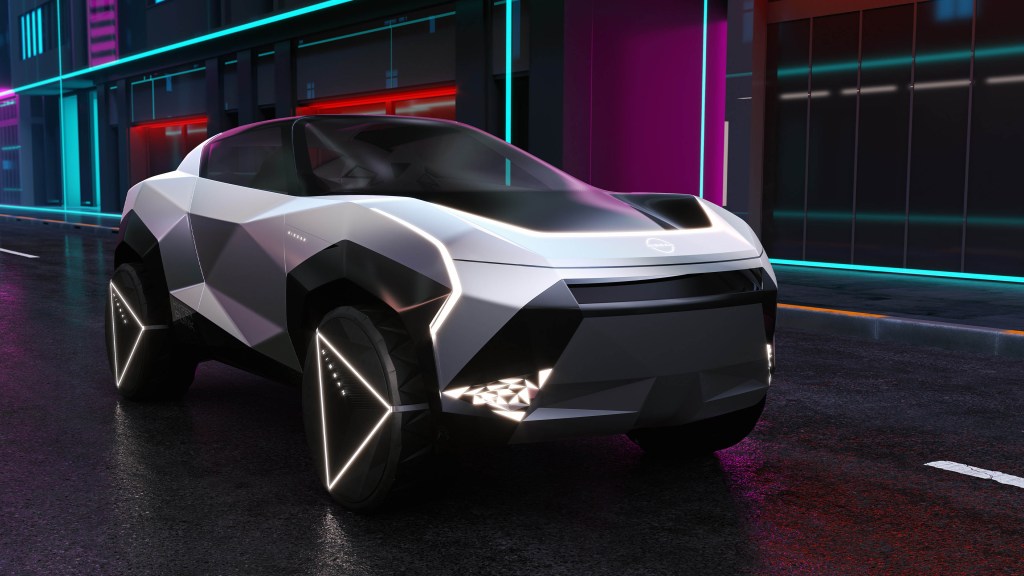
The Nissan Hyper Punk Concept, an all-electric compact crossover with an exterior aesthetic defined by multifaceted and polygonal surfaces.

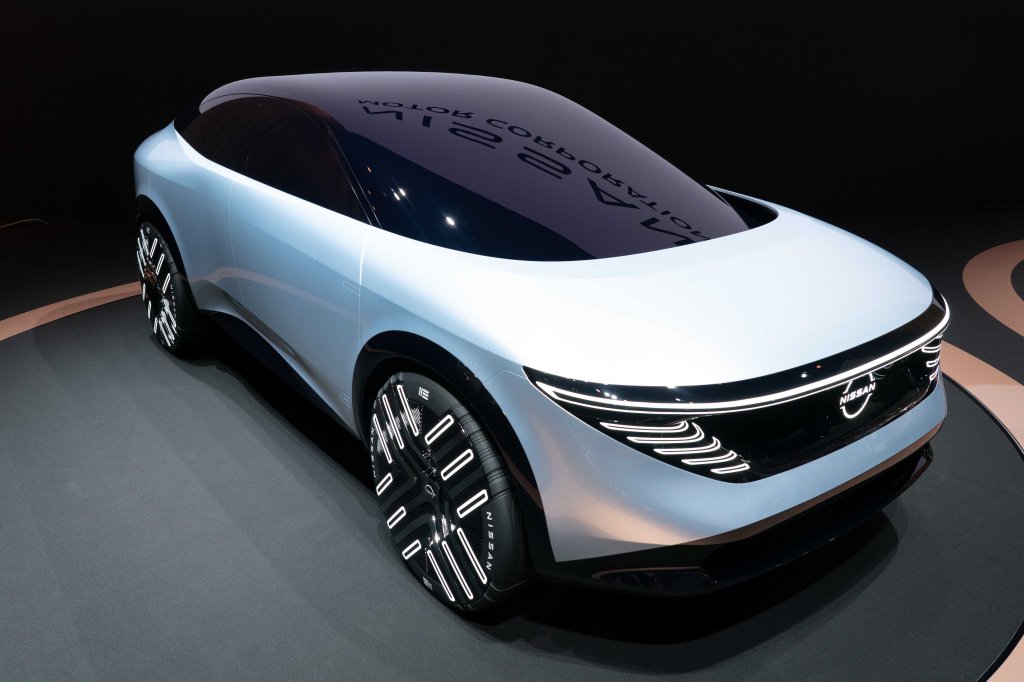
The Nissan Chill-Out Concept, was unveiled in 2021 and previously confirmed as the inspiration for a future EV to be built in Sunderland.

 The car is a compact, sporty, city EV concept with an influence from the world of virtual gaming. Besides the sleek and modern design, advanced safety technology, it has a productive and comfortable interior space.

The Chill-Out, – see photo here above – which looks to us as a very realistic concept car which we might see on our roads in the (very?) near future, utilizes the CMF-EV platform.

The Nissan Hyper Urban Concept – see photo here above – was announced at the 2023 Japan Mobility Show; its styling complements the sophisticated tastes of its target users, such as urban and suburban based professionals who prioritise environmental sustainability.

This all-electric crossover concept is designed to remain up to date for every new owner, ensuring an extended lifecycle through regular software and hardware upgrades, aiming to achieve the utmost sustainability. To maximize this further, the vehicle seamlessly integrates into the electric vehicle ecosystem (V2H/B/G), for power sharing.

Last but not least, there is the Nissan Hyper Punk concept was also announced at the 2023 Japan Mobility Show.

It is positioned as an all-electric compact crossover concept, catering for a dynamic audience seeking self-expression through style and creativity. It offers owners a canvas for self-expression with its polygonal-shaped exterior with dynamic color changes.

Further styling exercises: the Nissan Concept 20-23

To celebrate the 20th anniversary of Nissan Design Europe (NDE) being located in London, Makoto Uchida, Nissan’s President and Chief Executive Officer, visited NDE in September last year to unveil an all-new sporty urban electric concept car called Nissan Concept 20-23.

The car certainly turns heads, as you can see from the accompanying photo. It was designed by a team including some the younger members of NDE, with the simple brief to design a car – with no constraints – which they would like to drive on the streets of the city where they work.

Of course there is the present range of Nissan, with the Juke, bestseller Qashqai and Ariya. Last but not least also the Leaf. Head of Marketing Rémy Le Gall presented them. See photo here below.

Soon we will refresh our driving impressions of these cars for you, and tell you then more about their unique qualities. Stay posted!

Hans Knol ten Bensel