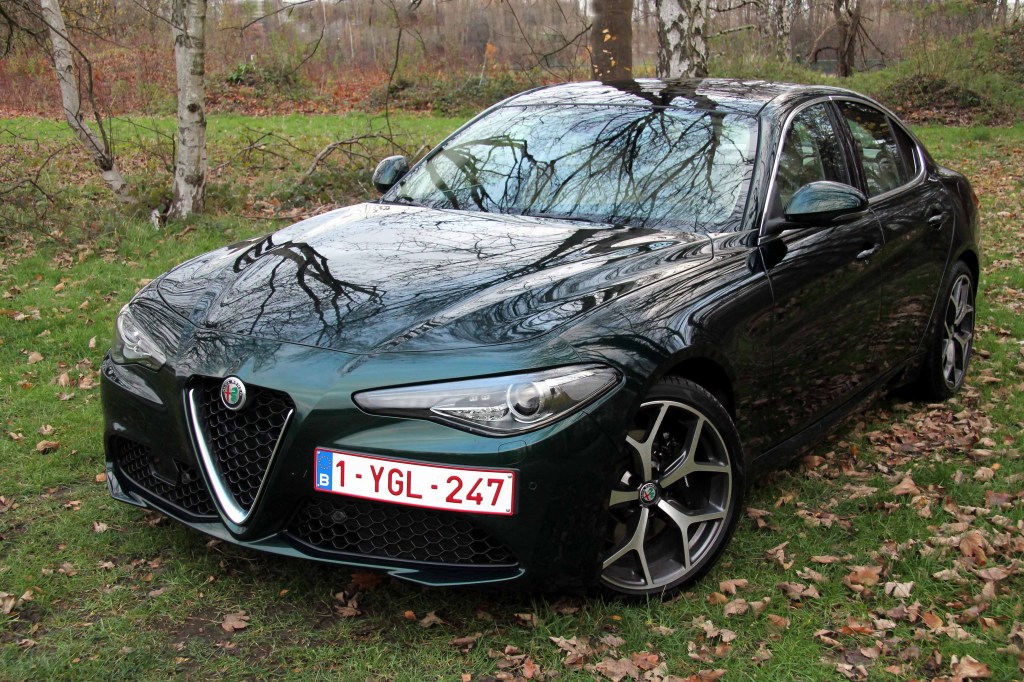
We tested the Alfa Romeo Giulia: driving is believing…

We all know that the Giulia is an absolute champion on the German “Green Hell”, the Nürburgring. That in terms of handling, it really sands out. The Giulia Quadrifoglio has been elected “Sportscar of the Year” by the specialist magazine AUTO BILD SPORTSCARS. After a test with this beautifully proportioned sedan, we can only agree…

We drove here the 2,2 liter Diesel version: does it have the charm, refinement and panache to make the Giulia remain a true Alfa?

Just read on…

Hans Knol ten Bensel

The Giulia is continuously being honed to become the 4-door sedan embodying the absolute pinnacle in sportiness and panache. To start with, let’s just focus about its looks. Our test car came in an absolutely beautiful metallic green, with matching beige interior. This good-looking color combination was further enhanced by light alloy wheels, making this Giulia have the taut and elegant stance it so befits.

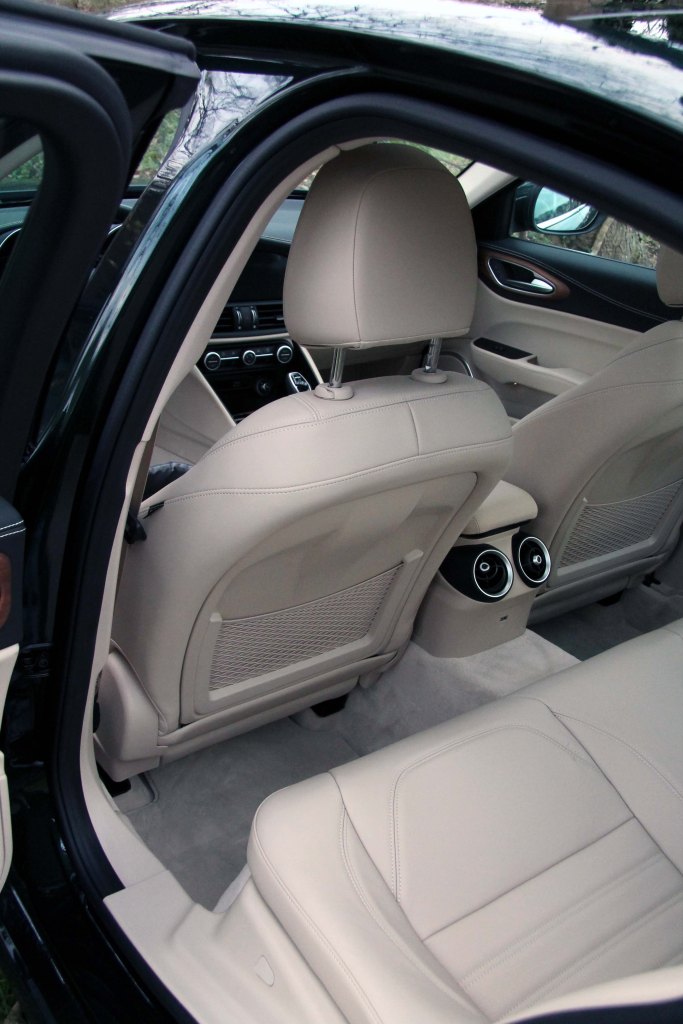
The seats are excellent, really wrap around you and behind the wheel a good seating position is soon found. In the back is enough legroom, and this Giulia is a comfortable four-seater by any standards.

The large and beautiful round dials for speed and revs are still analog, and have timeless beauty. In our opinion, Alfa should never change them. They are classic and are eminently readable. To the eye, they are just perfect. In the center of the dashboard sits a well styled and beautifully integrated touchscreen, with all the state-of-the-art driving aids, infotainment and connectivity. More about this later.

We love the clean styling of the dashboard, with its tasteful wooden panels and a well-shaped center console, with the lever of the 8-speed auto box sitting in an insert which is also adorned by the Italian “tricolore”. Here you find also Alfa’s famous DNA button, letting you select between three driving modes, going from “sporting” to “normal” and then adapted to wintery surfaces and driving conditions.

On both sides of the steering column sit two very long gear change paddles, so characteristic of these pur sang Alfa’s. I like heir long length and width, so you can always easily reach and touch them, even under the most frantic cornering. Moreover, they look beautiful too. 

Diesel power…

We tested the Giulia with the least powerful version of the 2,2 liter four cylinder Diesel unit, which has proven itself totally in the FCA Group, and is found under the hood in many model ranges. The Giulia comes indeed with more powerful Diesel versions of this engine to up to 154 kW, but our 2143 cc engine developed exactly 100 kW at a quiet 3250 rpm. For any engine, and certainly a Diesel engine, it is the sheer pulling power which counts, and this is found in the torque curve. Here one sees that the 100 kW version of this engine produces a hefty 450 Nm at 1750 rpm, and this is exactly as much as its more powerful sisters. So when accelerating from lower speeds, this 100 kW unit produces the same punch, and helped by the alert 8 speed transmission, this Giulia feels and actually is just as agile. All out performance is quite credible with a 0 to 100 acceleration in some 9,5 seconds, and top speed is a good 210 km/h.

When testing the Stelvio, we already told you about the sporting merits of the Giorgio platform and suspension. One has to steer the Giulia through fast and slow curves to believe it. It is so wonderfully precise and totally well balanced and neutral. It is a wonderful Gran Turismo chassis, sits so miraculously well on the road, hugs every corner. Steering around straight urban corners or roundabouts makes you appreciate the nimbleness and light-footed panache of the Giulia. It is a thoroughbred; you feel it every meter you steer it. 

The Giulia is a wonderful companion when you decide on a European trip, taking it through the Alps to its Mediterranean homeland, for instance…

But also, a long or short urban commute will not tire you. The good seats, excellent ventilation/airco, DAB radio and all the driver assistance systems will soothe and relax you even in the tightest traffic.

Level 2 automated driving…

The Giulia is a fully fledged “smart” and connected car, fully tuned in to what modern day customers come to expect from a premium sedan. What to think a complete set of ADAS (Advanced Driver Assistance Systems) features, offering the highest level of autonomous driving which still leaves plenty of room to have pure driving pleasure. This is level 2, achieved by definition of the amount of control the car takes over from the driver, like the accelerator, brakes and steering under certain conditions. This level makes full use of electronic systems which however still require continuous monitoring by the driver, at the same time providing the support of greater comfort on long journeys. As said, the driver always remains in control, and has always his/her hands on the steering wheel.

The main driver assist systems present in the Giulia – and by the way also the Stelvio – are:

•             Lane Keeping Assist: detects whether the vehicle is veering outside its lane without any direction indicators being activated, and alerts the driver using visual and haptic signals. It actively intervenes to steer the vehicle back into lane;

•             Active Blind Spot Assist: monitors rear blind spots, reports any approaching vehicles and corrects steering to avoid a collision;

•             Active Cruise Control: automatically adjusts the car’s speed to maintain a safe distance from the vehicles in front. In conjunction with the traffic sign recognition system, this technology adjusts the speed to within the set limit, for a more comfortable drive;

•             Traffic Sign Recognition and Intelligent Speed Control: this system uses the on-board camera, recognizes traffic signs, reports them on the display, and alerts the driver of the current speed limit.

The system then suggests the driver reduce their speed to the limit detected. If the driver accepts, the cruise control settings are automatically adjusted;

•             Traffic Jam Assist and Highway Assist: To complement Active Cruise Control, these systems monitor lateral positioning, keeping the car in the middle of the lane in heavy traffic (Traffic Jam Assistant) or on the highway (Highway Assist), while also adjusting the speed according to the current limits;

•             Driver Attention Assist: this function constantly monitors the driver’s attention levels, and if necessary, alerts them if they might need to take a break.

Economy, the wonders of a Diesel

The ZF built 8 speed transmission, which is a perfect example of alertness combined with a smooth power flow, comes with a very intelligent, sensitive and subtle coasting function. Lifting the throttle from medium to high speeds, will decouple the engine from the gearbox, which then settles into an idle while the car further coasts along, using its kinetic energy to the full. When you get the hang of it, you can use this feature much to your advantage in urban boulevard traffic with its ever-varying speeds.
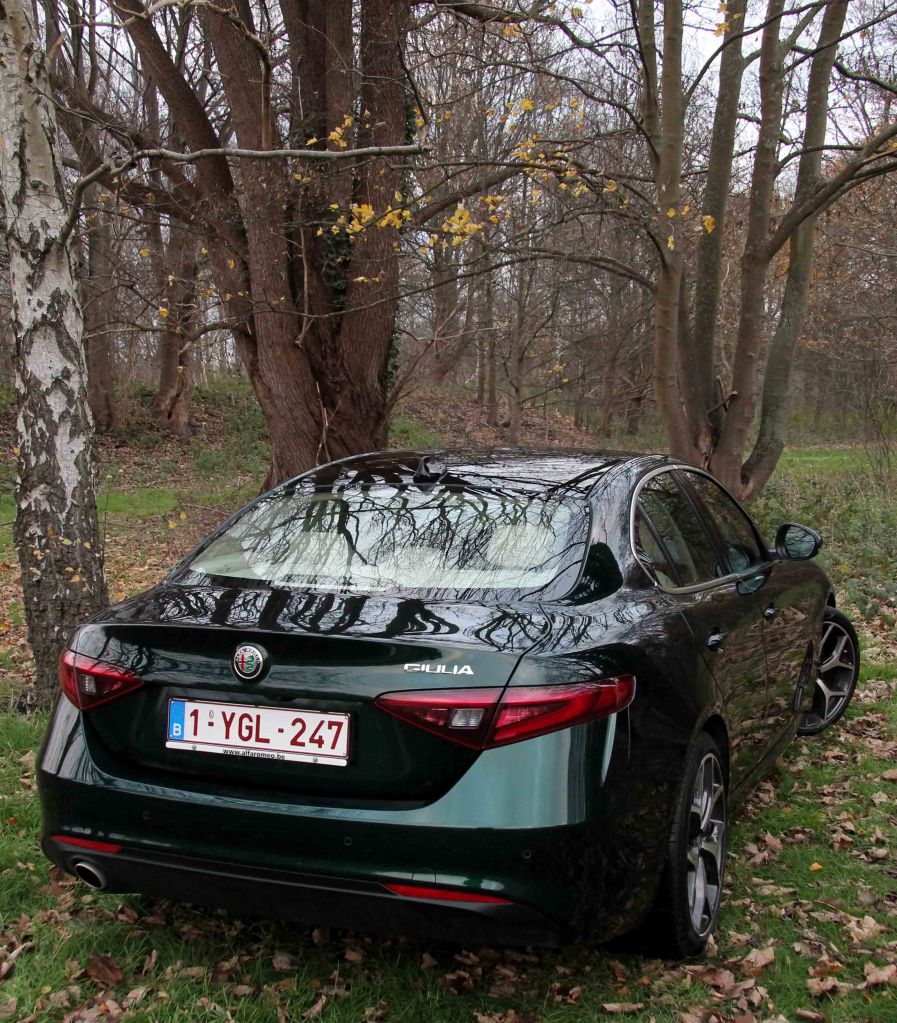
Anticipative driving where you concentrate on coasting instead of braking brings you wonderful consumption figures; around 6 liters/100 km is easily achieved here. Cruising on secondary roads at the legal limits gets the consumption down to 5 liters, motorway cruising at legal limits is below 6 liters/100 km. CO2 emissions are also rather creditable with 127 g/km. Never forget, this is a car with a kerb weight of 1465 kg…

We know, E-cars are all the rage, but then again, just look how good Diesels have become. This Giulia is only whispering at speeds up to 175-190 km/h… and remains then even below 10 liters/100 km, also thanks to its excellent aerodynamics of course.

Conclusion

This Giulia has it all, if you like a car with character. The Diesel engine makes this Giulia also frugal, making it fit for high annual mileages and long trips. This Alfa retains its zest and panache, even in the lowest powered Diesel version, and merits a long hard look from you, if you are opting for a Diesel.
Of course, there are the petrol engined gems, and last but not least the Quadrifoglio, which makes Alfa Giulia driving an absolute dream. We hope soon to lay our hands on one, and tell you about our experiences behind the wheel of this absolute Gran Turismo champion.  But don’t miss this one!

Hans Knol ten Bensel

We drove the Fiat Abarth 595 Scorpioneoro: a golden thoroughbred…

There are cars in our world which are worth their weight in gold. Every bit of it. These cars are called Abarths. Their creator had one principle: build absolute thoroughbreds. Pur sang engines, pur sang suspension, pur sang style and soul. Even when they were born and bred based on mass produced Fiats. Enthusiasts remember them immediately. The racing-ready 850 TC’s for instance. The 500 Abarth’s “Esse Esse”, to stay within the original Nuova Cinquecento theme, now decades ago.

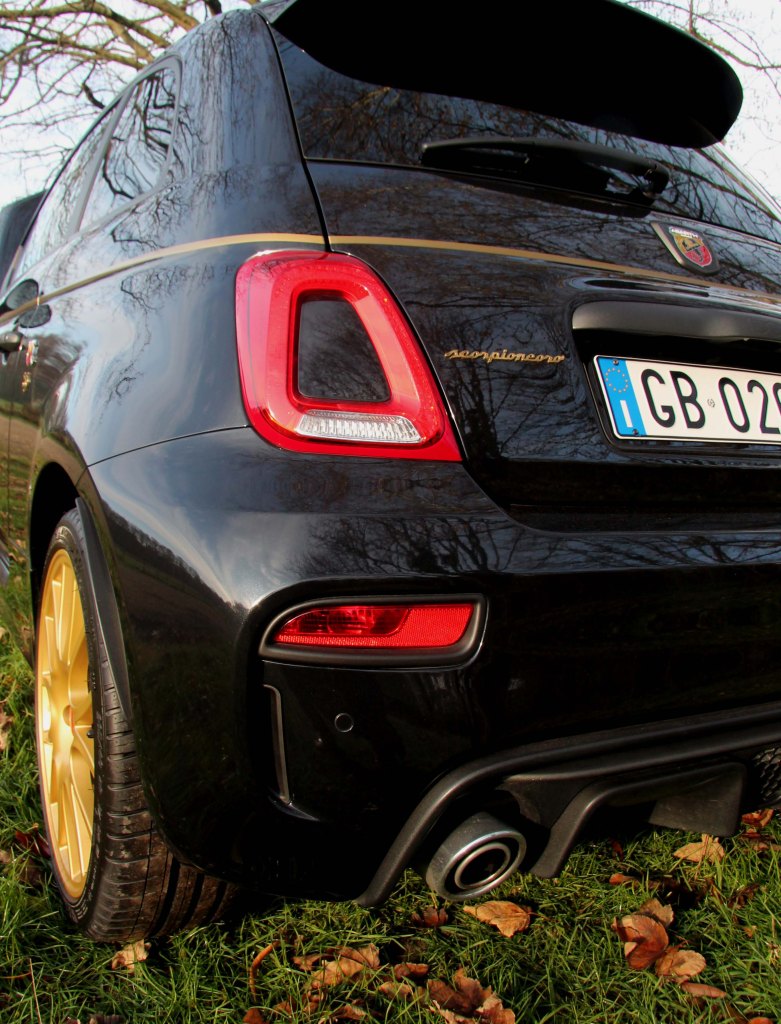
The 595 “Scorpione oro” or “Golden Scorpion” is reminiscent of the exclusive A112 Abarth “Gold Ring”, better known to fans as the A112 Abarth “Targa Oro”. A truly exclusive car, only 150 models of which were produced in 1979, all featuring a black livery, golden details, sophisticated interiors and a wide range of equipment as standard, in line with the Italian tradition of “granturismo” cars.

This dapper front wheel drive transverse engined four seater started life as the Autobianchi 112, which had the 903 Fiat four cylinder under the hood. Already in standard form, it produced a healthy 43 DIN HP at 6.000 rpm, good for 0-100 in some 17 seconds. The Abarth Version actually was dubbed officially as “Autobianchi A-112 5a Serie Abarth.” Its 1050 cc four cylinder was fed with a Weber 32DMTR38/250 2-barrel carburettor, and was good for 70 HP. It already proved a good sprinter, with 0 to 100 km/h reached in 11,4 seconds.

Brilliant performance with panache

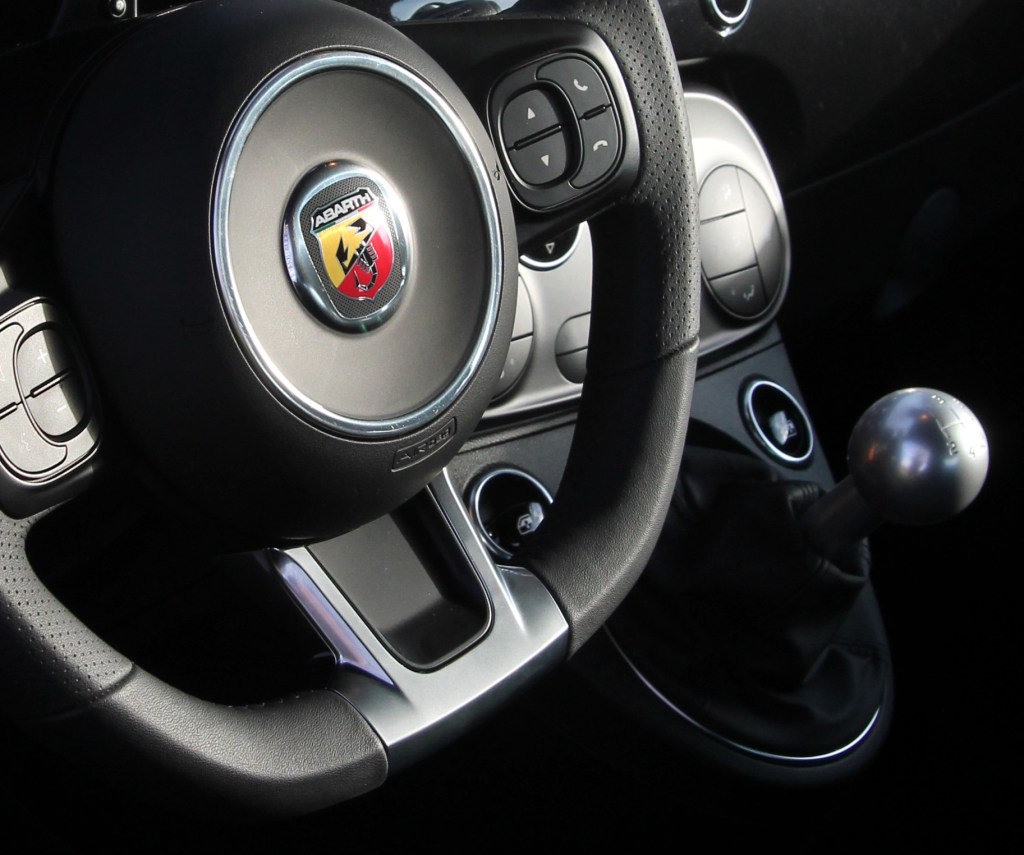
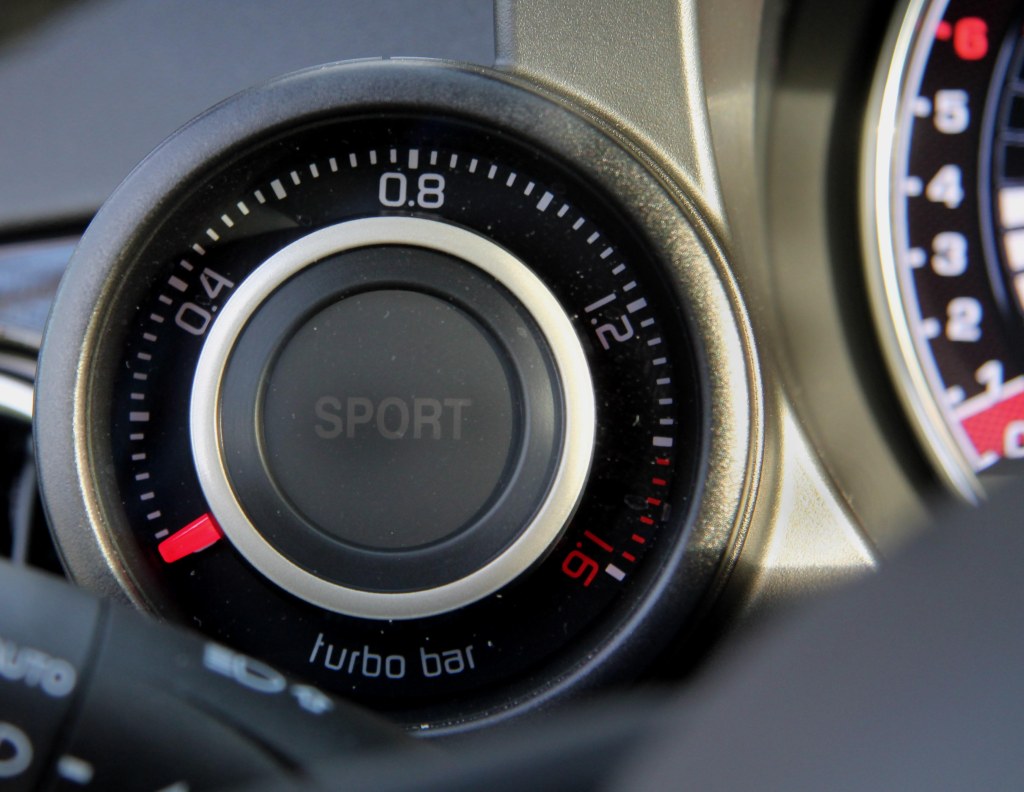
This is where all comparison ends. The actual Abarth 595 is still compact, but then again a lot sturdier with a kerb weight of slightly more than 1 tonne, much heavier than the nimble 700 kg of the A112. The engine is now the well proven double overhead cam 1368 cc unit, developing here 165 HP, and is very characteristic with its deep exhaust roar. It is very civilized in town, ready to pull away without hesitation from 900 rpm onwards, and this proved to be very pleasant in slow traffic. We tested this Scorpioneoro with the 5 speed manual transmission, and it delighted us with its very subtle and slick changes, combined with a very smooth and progressive clutch. With all this, the 595 behaves delightfully smooth and easy in tight urban traffic, and is of course an absolute dream on the open road.

The chassis and stiff and very sporting suspension truly come to their own there, and delight the enthusiast driver with precise, neutral handling and steering, which lets you take all bends and fast curves like a master.

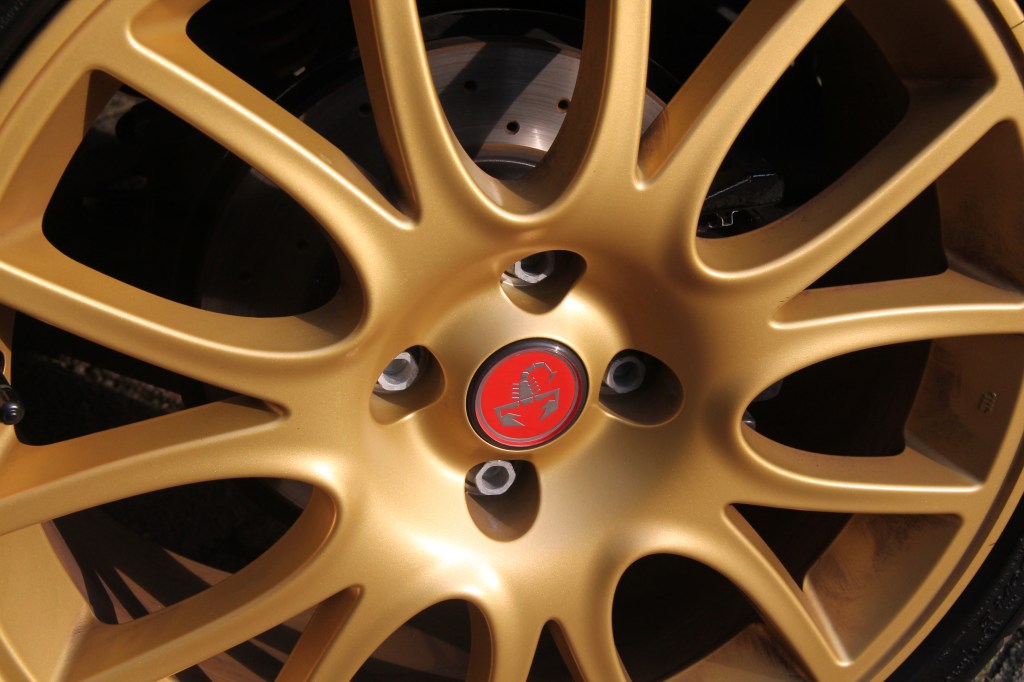
This brilliant experience is made even more dramatic by the wonderful roar and staccato of the willing four cylinder, catapulting you from one corner to another. Suffice to say that this Abarth races from 0 to 100 km/h in merely 7,3 seconds. The brakes are of course quite up to the task, and the 17” “golden” alloy wheels are kept firmly on the tarmac in all circumstances.   

The special Abarth 595 Scorpioneoro series is a genuine “collector’s item”, produced as it is in a limited edition and bearing a prestigious numbered plate in its cockpit.

The new special series is recognizable by its black scorpion livery – available on request in Podium Blue, Racing White and Record Gray – and the matt black chessboard roof is matching the “tar cold gray” finish of the handles, mirror caps, and the front and rear DAM.

To emphasize its “Golden” or “Oro” character, this new special series includes golden details, such as the scorpion on the bonnet, the lining around its bodywork and – we already mentioned it – the 17” “golden” alloy wheels or, on request, 17” “black” alloy wheels with the golden scorpion on the hubcap.

In the interior, everything kept in sporting black, with dramatic looking new Abarth “Scorpionflage” sports seats with black leather upholstery.The centre of the seat is in special material with high friction, to better contain the body during the sportiest driving. On the front seat head restraints, embroidered “Scorpioneoro” lettering alongside the Italian flag and Abarth embroidery. The new seats combine with the Scorpion Black dashboard with matte black details, last but not least with the gold plate on the central tunnel and of course personalized mats.

State of the art infotainment

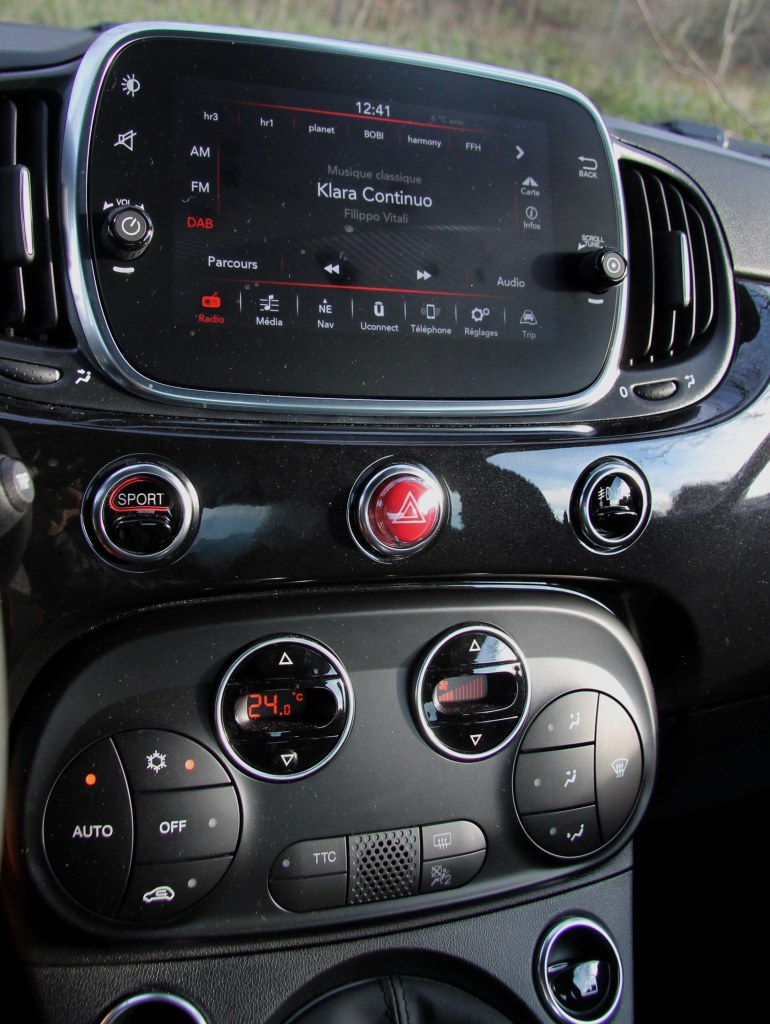
To top everything off, the Abarth 595 Scorpioneoro offers the best infotainment currently available: the 7″ HD UconnectTM system fitted with Apple CarPlay and Google Android AutoTM* – a fast platform with high definition monitor, GPS and DAB digital radio – as well as the sophisticated BeatsAudio™ system with overall output of 480 W and a 8-channel digital speaker including a cutting-edge equalization algorithm capable of reproducing the full sonic spectrum of a recording studio. 

All this to please the ears of the Abarth pilot. But to be honest, during our test we rather listened to the music of the Abarth exhaust, ranging from a deep burble to a staccato roar, which drives more adrenaline in your veins than you ever thought possible.

Modern-day panache

The beauty of these 595 Abarth’s is their stunning everyday useability. Gone are the times when these thoroughbred engines needed regular finetuning of their Weber carburettors, a delicate right foot to avoid fouling the plugs when starting up the cold engine in damp weather.

The days when the good roadholding still needed an expert and sensitive hand or “Fingerspitzengefühl” to drive it on the limit are also to some extent behind us.

To some extent, as this Abarth still will reward a masterful hand when driven as hard as it can. But at least all the electronic driving aids will keep you out of trouble, unless you totally transgress the limits of physics, of course.

This being said, this Abarth teaches you to become a better driver, make you better understand with every ride the kinetics of a motor car, the forces which act upon it. The 595 is a very forgiving teacher, which lets you climb step by step higher into the art of sporting driving and racing.

On the other hand, you can hand the keys with closed eyes to every less experienced driver, he or she will not foul the plugs or do any mischiefs to the drivetrain, the totally predictable and safe behaviour and handling of this car will also see that the car is still in one piece when you get the keys back…    

On fuel economy, this Abarth is of course as frugal or thirsty as you want it. All depends on your right foot here. When it comes to service costs, all the ingedients are well proven and reliable, so it will not be beyond what you expect from any normal compact car…

So when you are dreaming of a totally sporting but also eminently practical everyday urban and Gran Turismo car, this Abarth 595 is totally right for you. And we bet you will cherish it, for years to come.

Hans Knol ten Bensel

We drove the Subaru Impreza e-Boxer: a thoroughbred born for today’s hybrid age…

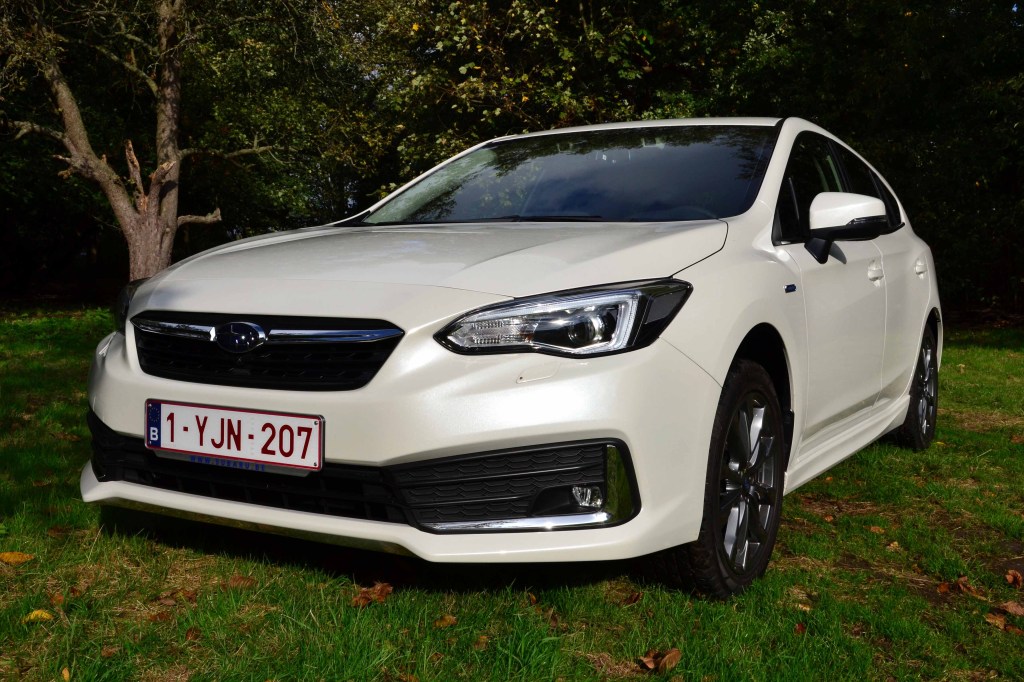
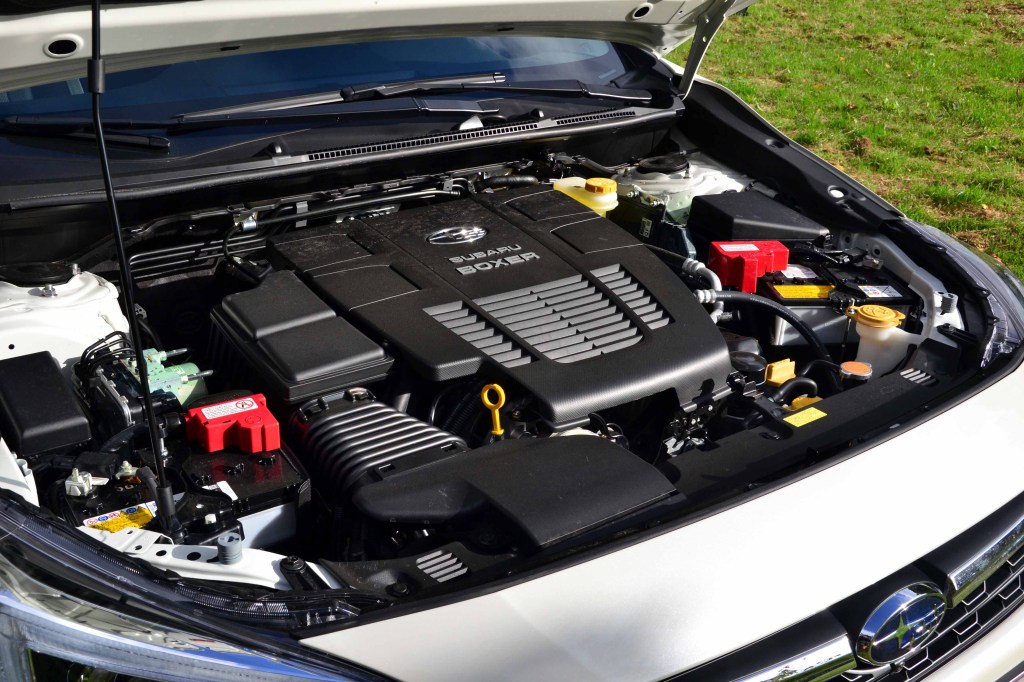
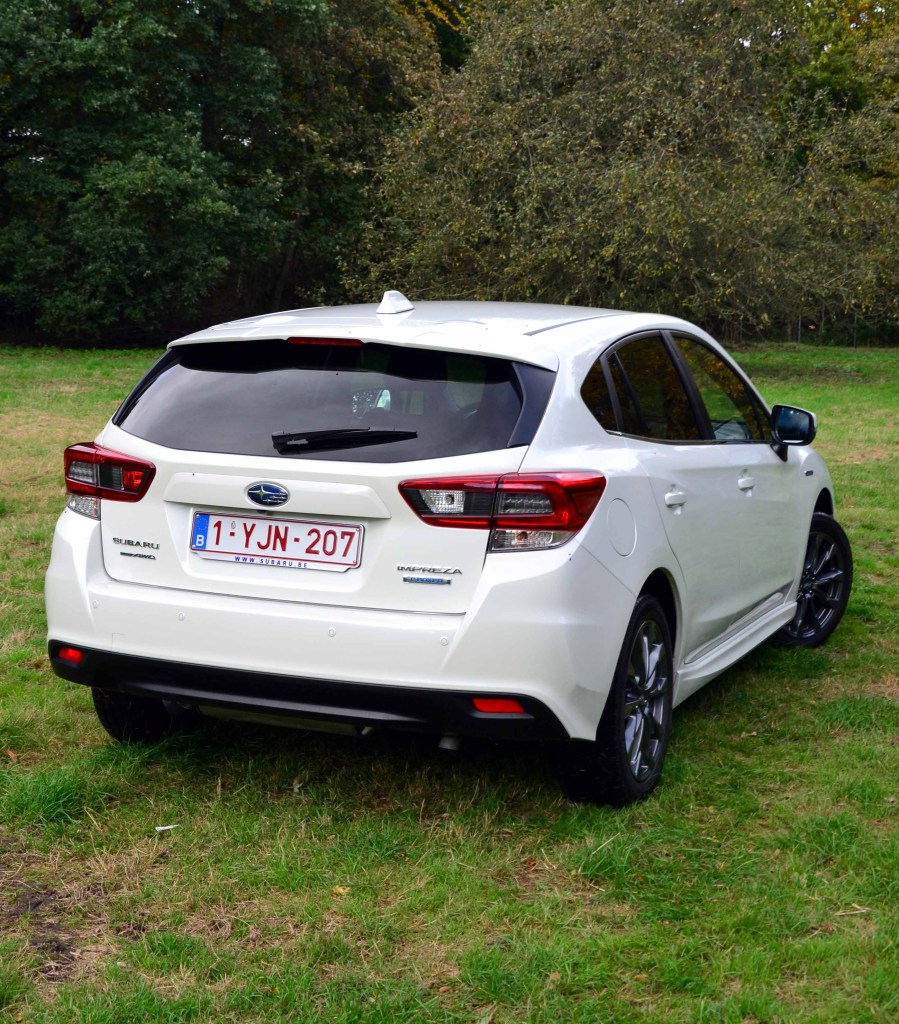
Subaru has always been synonymous with engineering excellence, resulting in truly thoroughbred practice- and rally proven cars, which have since many years won a large number of devoted followers. You can count us among them: we have always liked the cleverness of the boxer engines, coupled to superb 4WD systems. Now Subaru has gone a step further and coupled a modest 16 HP E-motor to its 150 HP Boxer, all this in combination with an excellent CVT “Lineartronic” transmission and its symmetrical 4WD.

We already told you in these columns about the pleasant drive characteristics of the Subaru hybrids. The Impreza follows suit. We were again charmed by the subdued throb of the trusty boxer, and how well balanced the whole drivetrain goes about its task. If you put your mind and right foot to it, this Subaru can truly surprise you with excellent economy.

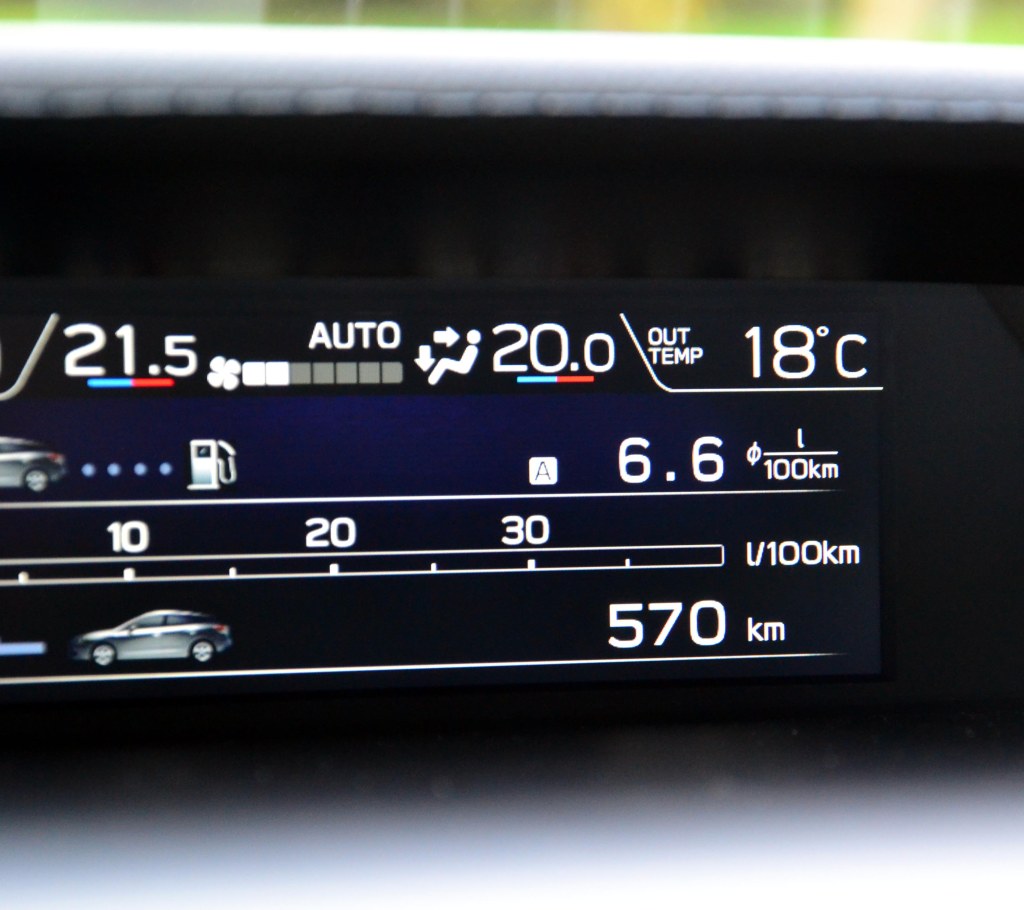
Again it proved easy to achieve an average of 6,6 litres/100 km, as the electric motor cuts in quite often when you move your Impreza with anticipation through tight urban traffic. It will also regenerate kinetic energy under braking, and does all this without any interference from the driver. Very clever and relaxing. Under smaller throttle openings and lighter loads, the CVT transmission will spontaneously choose low revs, and keep the engine running very efficiently. When you put your foot down, the transmission will let the engine rev up eagerly, and this results in adequate sprint performance, in the region of 10 seconds from 0 to 100 km/h.  Top speed is a good 190 km/h, enough to satisfy all of us.

Comfortable and predictable handling

The latest generation Impreza now runs on the Subaru Global Platform, and this delivers very predictable handling, on all roads cand weather conditions. Indeed, you feel very safe in this Subaru, and it is not only engaging, it also makes you a better driver. Moreover, it also converts you in a safer driver. Indeed, the Subaru offers state of the art driver assistance systems. Its EyeSight system with two stereo colour camera’s gives you an additional pair of eyes on the road and steers the adaptive cruise control, lane sway and departure warning, amongst others.

The Subaru has also a clever lead vehicle start alert, which warns you when the car in front of you starts going again. The two eyes will also let you keep your lane and helps you with its pre-collision braking system. Eventually, in the worst case scenario, your Subaru will start braking automatically to limit any damage.

The 4WD is of course an asset in snowy weather conditions, and lets you also tackle many country roads with peace of mind.

Elegant and practical

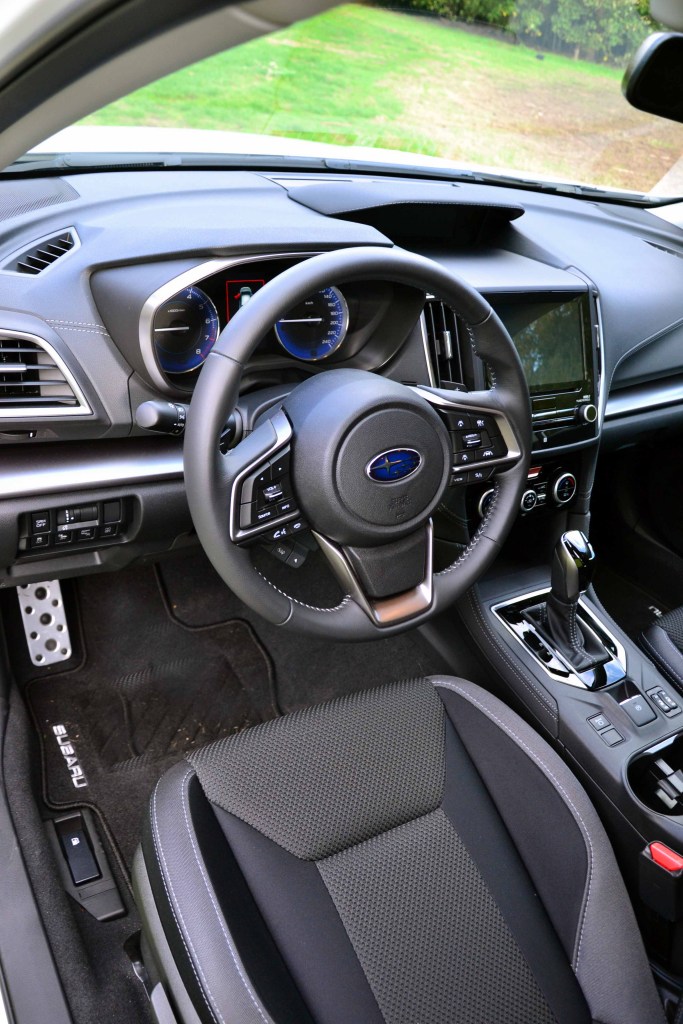
Subaru styling is quite good on this latest generation Impreza, and also the cabin is altogether pleasing. The infotainment and instrumentation is top notch and practical, with everything ergonomically well laid out and a breeze to use.

One feels immediately at home in this Impreza, and this is meant to be. USB and Aux inputs are provided of course, panoramic sunroofs can be had, and this Impreza offers up to almost 1300 liters of luggage space with all seats folded down.

Dual zone automatic airco and the excellent seats provide you with comfort on long and short trips. We also liked the feeling of solidity of the bodywork and cabin of this Impreza, and we all know also that Subaru’s score very high on reliability.

Conclusion

Very well equipped, practical and easy to use, predictable handling, and last but not least superb mechanical sophistication and smoothness combined with good suspension comfort make this Impreza quite endearing. The characteristic boxer sound reminds the aficionado of the legendary sporting heritage of the brand, which is now well adjusted to the “green” eco-times we are living in right now. A reliable companion for any weather, road, with economy and reliability thrown in, this is what you get with this Impreza. Just think of it…

Hans Knol ten Bensel

We drove the new Lexus RX 450h: a favorite star on the SUV firmament…

Did you know that the Lexus RX 450h has been for many years now the absolute top choice in the luxury SUV segment? As Lexus states: “Not only it is the world’s bestselling luxury hybrid SUV and all-time best sold Lexus model, but it is also the world’s first luxury SUV that has created its own segment back in 1998.”

Indeed, it has been popular the world over, and this for all the (very) good reasons. Mechanical perfection, smoothness, performance, economy, superb finish, comfort, reliability, combined with its ease of use, and last but not least ample standard equipment. Need we say more? Maybe, after this test, we might come up with some more good experiences. Just read on…

Hans Knol ten Bensel

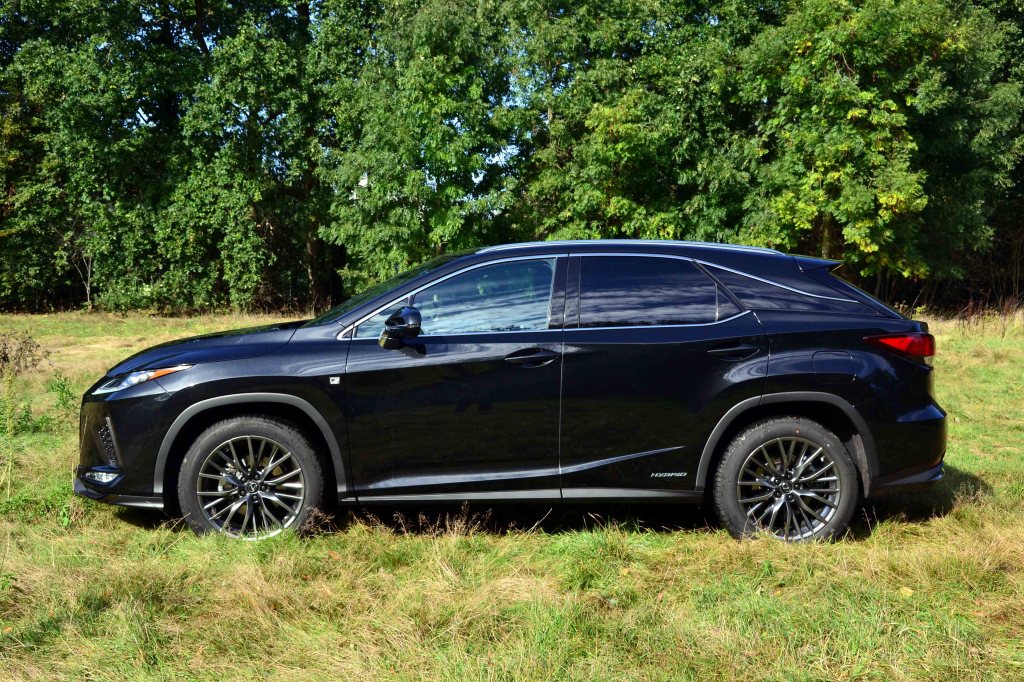
The Lexus RX series SUV is indeed a worldwide winner. Indeed, its looks are good, and hardly needed any changes over de last few years. It breathes the typical angular yet fluent styling language we have grown accustomed to in the Lexus model range, with pleasing proportions and an overall size which many find “just right”.

The RX is not overly generous when it comes to luggage space – but rest assured – Lexus has the right RX for you. More spacious than ever before, the RX “L” has also evolved into a seven-seat model. It is effectively a new model, with body length extended by 110 mm and the back window set at a steeper angle to ensure those sitting in the rearmost seats are as comfortably accommodated as other passengers.

Returning to “our” RX, it does offer enough room for its occupants. It seats easily four, and we can tell you it offers ample legroom in the back, you can even cross your legs effortlessly. The third passenger in the back suffers somewhat from lack of headroom, and comfort is somewhat impaired, as he/she sits on the big central, foldable armrest.

Silk smooth hybrid progress…

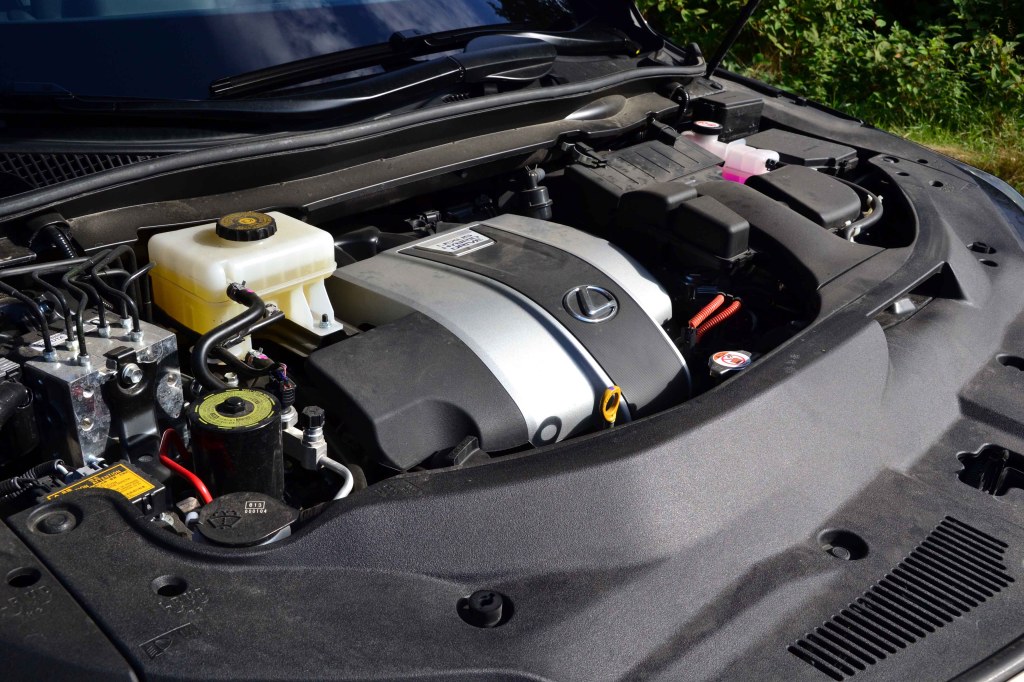
Under the hood of the Lexus purrs a 3 litre V6, coupled with the Lexus Hybrid system. This means a total system power of 312 PS or 229 kW at your disposal, enough to propel your Lexus in some 8,2 seconds to 100 km/h and hurtle further to a governed top speed of 180 km/h. But when you drive and own this car, it is not pure performance you are looking for. It is comfortable, whispering, vibrationless progress. And here the RX delivers. Beautifully. Via the continuously variable transmission both engines deliver the computer calculated ideal mix of power to the wheels, and the result is a smoothness in propulsion which you have to experience to believe it.

On the open road at higher cruising speeds, the efficient V6 gets into its own, and delivers honest economy. But it is in slow and tight stop and go urban traffic that the hybrid system excels. The onboard computer will choose E power more often than not, putting the combustion engine to work to either recharge the battery and/or help the E-motor, but – and that’s also the cleverness of it – doing this at an ideal rpm/throttle opening combination which lets it reach its ideal thermal efficiency.

All this without the slightest shock and with only the gentlest hum being heard when the V6 engine sets in. It is this hybrid system which Toyota has introduced in … 1997 for its first Prius, and which it has perfected ever since.

We have applauded this system already many times in these columns, and when it comes to smoothness combined with slow speed economy, we find it still among the very best.

Depending on your driving style, economy can be truly astonishing when you let the system use the E-power in the driving cycle. Urban errands driving with anticipation and restraint will not cost more than 7 litres/100 km and even less in this big 2090 kg SUV. Driving with verve on winding open roads at varying speeds will let de consumption vary between 7 and 8 litres/100 km. CO2 emissions are quoted by the manufacturer at 134 g/km. All these values are excellent, but it’s the sheer smoothness and refinement of progress which truly stands out.

For those who are interested, we can tell you here that the V6 engine develops 262 PS/193 kW at 6000 rpm, with 335 Nm of torque at 4800 rpm. The electric motor in front develops 167 PS.

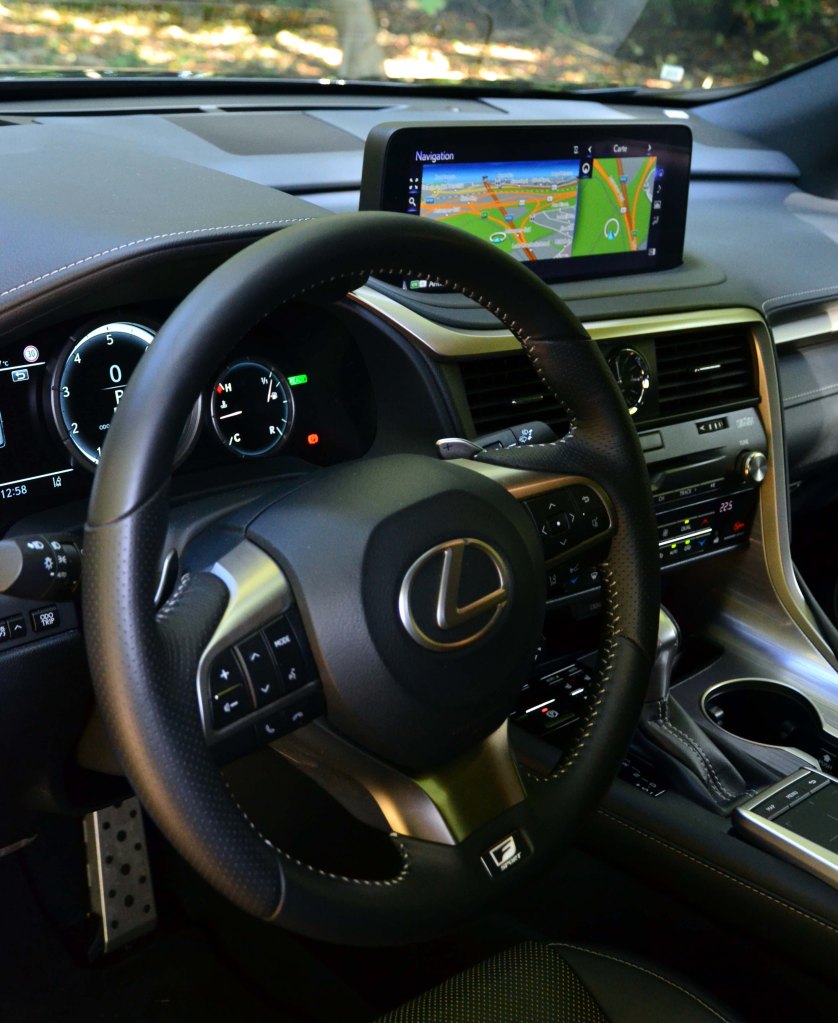
As usual in a Lexus, you can chose between eco, normal and Sport (even Sport+) driving. The virtual instrumentation places then a big rev counter in your central line of vision, and drivetrain/steering responsiveness are up a notch.  

Comfort in the cabin and on the road

The seats are excellent, and will not tire you even after many hours, and the same can be said of how this RX floats over the road. Potholes, ridges, everything is nicely swallowed and hardly reaches the passengers. Add to this the excellent sound insulation and you understand that driving and travelling in this RX is a very relaxing affair. The Levinson sound system is a chapter on its own and lets you make the voyage in the most exquisite sound atmospheres.

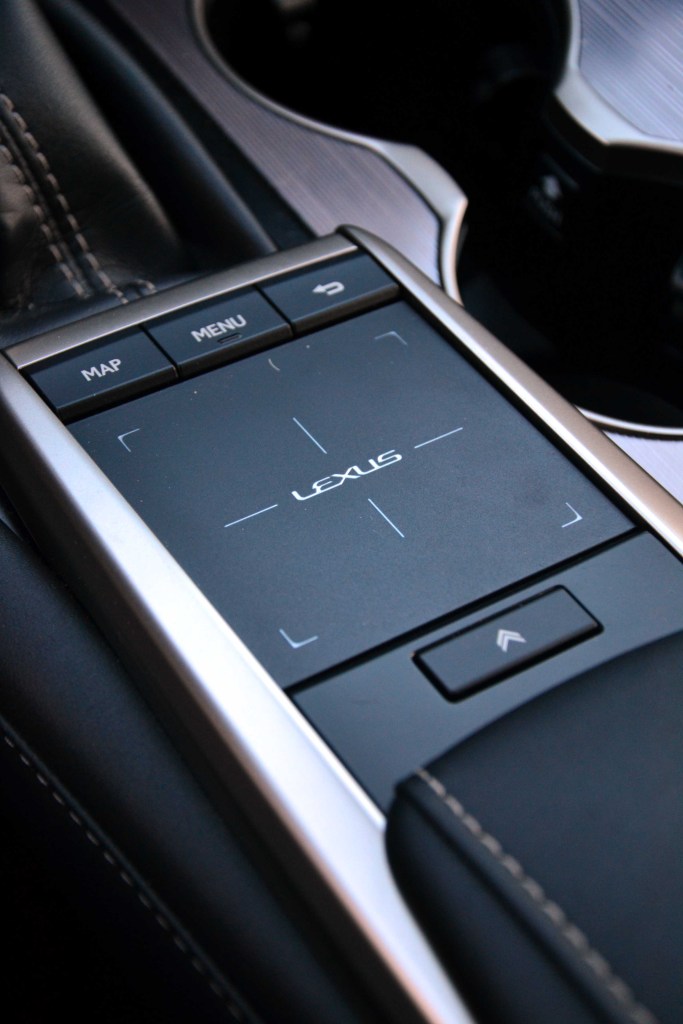
The screen and infotainment system are also honed to perfection, eminently practical and useable. Lexus has left the central mouse knob for a touchpad system, and some find this better. Personally, we are very found of the mouse in our Lexus CT200h, but when the majority of users want another setup, why shouldn’t you change?

The Lexus RX driver gets all road info, driving assistance and infotainment he can wish for, even considering Apple and Android audio are now also thrown in.

For the 2021 model year, the Lexus RX 450h comes with a Blind Spot Monitor (BSM) and Rear Cross Traffic Alert (RCTA) as standard across all vehicle equipment levels. We also found the overhead display also one of the best we have come across…

The RX is eminently practical too, with chargers fore and aft for your electrical equipment, large bins for bottles, beverages and small items, it is all very well thought out to make everyday a joy to drive this RX450h.

Conclusion

We said it, a top car in its segment, and it has everything to stay in this enviable position. It impressed us again, as a gentle, powerful everyday companion, built to soothe and relax you when you move from A to B, be it 5 or many hundreds of kilometers or miles, and this for years to come… with style, reliability and economy to match!

Hans Knol ten Bensel

We drove the Alfa Romeo Stelvio 2.2 Turbo Diesel AT Q4: Thoroughbred panache on any road you go…

When you are looking for a SUV with style and a sporting DNA, look no further. The Alfa Stelvio is the one you want. A true Alfa inside and out, lovingly styled to the last detail, with road manners and performance to match. We drove the 190 HP Diesel version, coupled to a smooth 8 speed ZF automatic and having what it takes for a passionate life off the beaten path: 4WD.

We lived again in the Alfa world, and enjoyed it…

Hans Knol ten Bensel

One should understand the Stelvio. It is an SUV, but with the body and soul of a thoroughbred: the Alfa Giulia. So in every respect, also this Stelvio it is a true Alfa. Undistilled. Straight. No Ice. Understandably, as it rolls on the famous new “Giorgio” platform, designed for the Giulia. 

A stunning platform with a legendary name…

The name Giorgio appeared for the first time in the automotive press back in 2013: the next Alfa Romeo generation was on its way, we were told, and Giorgio was the name of the platform on which it would be built. The romantics think it could be a tribute to Tazio Giorgio Nuvolari. Others imagine a personal choice by Marchionne.

The secret has never been explained. What transpired was that Giorgio would have a layout for both rear-wheel and four-wheel drive cars, and that it was engineered to the very high standards.

The company was planning huge investments on the platform and on the Cassino plant, where the new models would be built. Above all, it was organizing its best technical talents in dedicated “think tanks”. And was asking the planners and designers involved to set aside old rules and habits, to think outside the box.

The Giorgio platform was not only created for the Giulia. The time had also come for Alfa Romeo to prove itself in the Utility Vehicles segment, the most dynamic and innovative area of all. And so, in February 2017, the Stelvio made its debut: the first SUV in the history of the Brand. This would be an Alfa capable of driving with agility on snow and dirt roads, without losing anything in terms of performance, handling and road holding. In other words: a SUV that can be driven like a sports sedan.

Of course it has a higher floor and a higher driving position than the Giulia. But then this means more space available for passengers and luggage. Suspension travel is longer, to ensure the correct ground clearance in off-road driving. In order to increase stability, the axle track is also slightly wider. But architecture and mechanics remain the same, as do the engine range and electronic systems. The result is a car with “an Alfa Romeo soul in a SUV body”.

Driving is believing

We experienced all this behind the wheel. Outstanding steering precision, eager and sharp to direct into short and long bends, excellent stability up to very high speeds. You move swiftly with utter confidence in this Stelvio. No matter the road and the weather. The Stelvio, like the Giulia, has also earned its marks on the “Green Hell”, the Nürburgring.

The potent 2,2 liter Diesel engine is supersmooth, and coupled with the alert 8 speed auto box, it’s a gem. It just shows – or reminds us again – how good modern Diesel engines have become. It is a super silent and vibrationless cruiser at legal motorway speeds, and of course immensely frugal under these driving conditions. 6 litres/100 km are easily reached. Sedate driving lets you use anything between 5,5 (!) and 6,5 liters/100 km, using also the excellent coasting function this ZF gearbox allows you to do. Stunning, to say the least. The manufacturer quotes 5,6 liters/100 km on average and 146 g/km of CO2 emissions.

On top of all these dynamic qualities, true comfort is to be enjoyed in this Stelvio. The excellent seats wrap nicely around you and give you good support and comfort on short and (very) long journeys. The suspension travel is generous and this makes this Stelvio indeed a very smooth mount on potholed secondary roads and picturesque urban streets.

Add to this the panache and elegance of the instruments, the good layout with the center console adorned with a 8.8-inch touch-screen infotainment system offering smartphone-like ease of use. The telematic offer is completed by a suite of Mopar services for remote car management. The innovations in the field of driving technology have become even more important.

The new ADAS (Advanced Driving Assistance Systems) mark the transition from the first to the second level of autonomy: the systems do not only inform the driver, in case of need they also become active, enhancing vehicle safety.

Thoroughbred performance

Of course, this Stelvio gets truly going when you put your foot down. 0 to 100 km/h costs merely 7,6 seconds, top speed is a good 210 km/h. High speed stability is excellent, and as said, the Stelvio is a master on winding roads. Also offroad the Stelvio is very well at home.

The engine delivers its 190 HP/140 kW peak power at a conservative 3500 rpm, with 450 NM of torque already available at 1750 rpm. This means that even a very fast pace is effortless and not accompanied with high revs.

The Stelvio has excellent GT practicality, its cabin is spacious and the standard size of the luggage space is a good 525 liters.

Price winning design

The design of the Alfa Romeo Stelvio convinced recently the readers of the car magazine “Auto, Motor und Sport”.

They chose the model as the winner in the category “Large off-road vehicles/SUV” in the “Autonis” voting. Alongside the Stelvio, “Auto, Motor und Sport” has already awarded  Giulia, MiTo and Giulietta models as the most beautiful cars in their respective classes. And in two years in a row, the prize for “Design Brand of the Year” went to the Alfa Romeo brand.

Conclusion

A very endearing SUV, and very fast and practical too. A beauty with excellent manners, both in town as op the open road or Autostradas. It will guide you with confidence over snowy mountain roads, as its Q4/4WD is totally up to its task and a breeze to use.

The Stelvio is indeed a worthwhile alternative in the SUV segment, and will steal your hart for years to come when you are so lucky to own or lease it. Many financial formulas are devised not least by FCA itself to make a long-term relationship with the Stelvio a very pleasant affair. So in these Corona dampened times around Christmas, to slide behind the wheel of a Stelvio is something to look forward to…

Hans Knol ten Bensel

We drove the VW ID.3: E-power for the millions…

VW takes a big bet on the future of mobility. Europe will – or should be – driving electrified in the (very) near future. So VW got to work on an all-new platform which it will use on all its fully E-powered cars, and there will be many…

Indeed, VW is quite ambitious.  It wants to be the world’s market leader in electric mobility. The Group plans to launch up to 75 all-electric models by 2029.

It also asked its styling department to come up with a totally appealing Golf-sized car with much extra room however for passengers and their luggage, taking advantage of the space gained by the underfloor mounted engine and batteries, the short overhangs and the long wheelbase.

This car, the ID.3 should also be totally connected for the present and future generations, with all the possible driving aids and safety features included.

VW has succeeded. It builds in Zwickau a pleasantly practical, futuristic and good-looking hatchback which does it all. It has not only zesty power (150 kW) and smoothness, but also a very usable range.

We drove here for you the “1ST MAX” edition with a lithium-ion battery with a net energy capacity of 58 kWh. Good for a WLTP range of 426 km. Well, eh, in practice some 330 km or thereabouts, as in practice, one uses heating or airco…

Read further for our findings!

Hans Knol ten Bensel

Pleasing styling with a futuristic touch…

We must admit that VW designers have hit the ballpark. This ID.3 looks (very) good from any angle, with its dual tone paintwork, its nice spoiler and the superb surface treatment of all bodywork panels. The ID.3 has a clean, fluid angularity which has a timeless touch, directed towards the future. Flowing lines are found at the front, with the headlights looking like eyes. The low drag coefficient of 0.27 completes the picture.

This futuristic touch is also found even more in the interior, with its all-digital and well-placed screens, both in front of the driver and on the central console. The zesty atmosphere is further enhanced with the array of different mood lighting’s one can choose in the cabin. The ID. Light beneath the windscreen visually communicates with passengers. The ID.3 is largely operated via the multifunction steering wheel, the central 10-inch touchscreen or the “Hello ID.” intelligent voice control. The whole cabin is airy, welcoming and clean.

Daily interaction with the ID is so easy. Just step in, as the car automatically opens. Put the small handle just beneath the right side of the steering wheel in “D” or “B”, which lets you recuperate the kinetic energy and effectively brakes the car with 0,3 G when you lift the throttle, and off you go. At the end of the trip, just push the “park” button and step out. The ID.3 shuts itself and all its systems off.

All the functions on the 10-inch touchscreen are there. It takes some getting used to in order to navigate and learn all its clever functions, but most of it is very intuitive. The rest you will learn and grow accustomed to in a few days! The buttons on the steering wheel spokes also host an array of commands. The sound command lacked some progressiveness, but everything is quite clever and logical.

Driving the ID.3: a “zen” experience with a sporting touch…

Sliding behind the wheel in the ID.3 sets you in this friendly futuristic world, where you immediately feel at home, having found an ideal seating position in seconds. As said, driving away is the simplest affair. Overwhelmingly pleasing is the “feel” of immediate power under your right foot. Make no mistake: the ID.3 has a 150 kW/204 HP E-motor, with 310 Nm of torque. This means supercar performance, well almost. 0 to 100 km/h is silently reached without any effort in merely 7,3 seconds. This is a full two seconds faster than a ‘70s 911 T 2 litre Porsche Targa, to put anything in perspective…

Driving at legally allowed speeds is a dream in an E-powered vehicle, as it goes so silent and vibrationless.

Especially in urban areas where the new speed limits get ever more draconian, down to 30 km/h in many European inner cities, it is a delight to glide along the boulevards with the cruise control set at this speed.

Volkswagen is also returning to its roots with the electric motor: this is located at the rear and drives the rear wheels – as was the case back in the day with the Beetle. The electric drive motor achieves a maximum speed of 16,000 rpm and is coupled to a one speed gearbox and differential.

The motor is so quiet that it can hardly be heard outside the car. For this reason, a loudspeaker emits a synthetic electronic engine sound up to a speed of around 30 km/h in order to warn passers-by. It is efficient too: the permanently excited synchronous motor (PSM) reaches well above 90 pct efficiency no matter how (hard) you drive.

On winding secondary roads, the punch of the motor makes spirited driving also an undistilled pleasure. Handling and steering precision are also quite up to the mark, and the ID.3 indeed feels quite sporting. The state of the art platform architecture has located the large high-voltage battery between the axles. This means at the lowest point of the car, with also the weight distribution very close to the ideal value of 50:50.  

The suspension as a whole is on the rather firm side without being uncomfortable, but don’t expect a softly sprung car here. Of course, to achieve stable and precise handling with a 1,8 tonne car, the laws of physics command firmer suspension settings.

Suspension-wise, VW has put in the works: the ID.3 has a McPherson front axle and a complex five-link design at the rear. In town, even with the large wheels, its turning circle is just 10.2 metres. This makes the ID.3 quite nimble to drive in town.

Our test car came with beautiful 20 inch alloys.  Disc brakes with a disc diameter of up to 330 millimetres are fitted at the front, with drum brakes at the rear. Their great advantage is their robustness: the pads are designed for the service life of the car. And corrosion is not an issue, even though the wheel brakes are used only rarely in everyday driving, assures us VW.

On the motorways, cruising at legal speeds or even below that is the right thing to do. We  settled to a restful gait of some 105-110 km/h, nestled ourselves in the excellent seats and appreciated the fold-able middle armrest (the same are found in my classic 1963 MK 2 Type S Jaguar) and literally enjoyed the music through the excellent sound system, equipped with DAB+ radio of course. This transforms the ID.3 in a four wheeled, “zen”- moving concert hall. The sedate cruising speed also made the ID.3 reach easily the indicted WLTP ranges. By the way, top speed is 160 km/h, totally in line with the character of this ID.3.

Fast recharging…

Building the charging infrastructure  in Europe is now the greatest challenge ahead for many.

There are rosier times ahead: By 2025, Volkswagen Group will install around 35,000 charge points in Europe itself together with its retail partners. Many of these will be publicly accessible.

These will be complemented by the flexible, fast charging stations from Volkswagen Group Components, which can be set up wherever there is a short-term need, such as at major events. They become fixed charge points through connection to the low-voltage network and can charge two electric cars simultaneously with up to 150 kW thanks to their fast charging technology.

In Europe, ID.3 drivers can use already more than 150,000 public charge points. They benefit from attractive conditions in the IONITY fast charging network.

When you are so lucky to have a garage with electric connection or an individual home, VW has a ID. Charger, the new home charging station from Volkswagen. It is available in three versions, all of which offer a charging capacity of up to 11 kW. This allows an empty vehicle battery to be fully charged again in around six to seven and a half hours,depending on the model. The ID. Charger base model currently costs only 388 euros. The ID. Charger Connect and ID. Charger Pro offer full connectivity and can be controlled with the We Connect ID. app via smartphone.

In Belgium, the VW Importer D’Ieteren offers installation of charging stations to its customers via its EDI (Electric by D’Ieteren) subsidiary. More info on www.edi.be. 

Roomy and connected…

The ID.3 has almost the space and legroom of a VW Passat, and that is no small feat. Also the luggage space is quite adequate, with 385 liters. Wide bins in the doors lets you pack all the bottles and small items one needs.  

The electronics platform of the ID.3 has been newly designed from scratch. Two high-performance computers bundle a large number of functions, and the software is designed to be highly flexible like on a server. This makes it easy to download updates to the car, and in future also function upgrades, via a mobile network. The services of We Connect Start connect the car to the owner’s smartphone, allow control of charging and air conditioning, supply traffic information and also display live data about charging stations on the navigation map. App Connect (standard) permits media streaming via a smartphone.

Conclusion

The ID.3 has it all. It has formidable qualities, able to convince our European drivers to take the EV plunge. It offers good value for money, considering the car’s qualities and size. Driving it has been a pleasant experience, and the “zen” character of EV propulsion and the design and roominess  of the ID.3 are most endearing.

Hans Knol ten Bensel

We drove the Toyota RAV4: the car which invented the SUV…

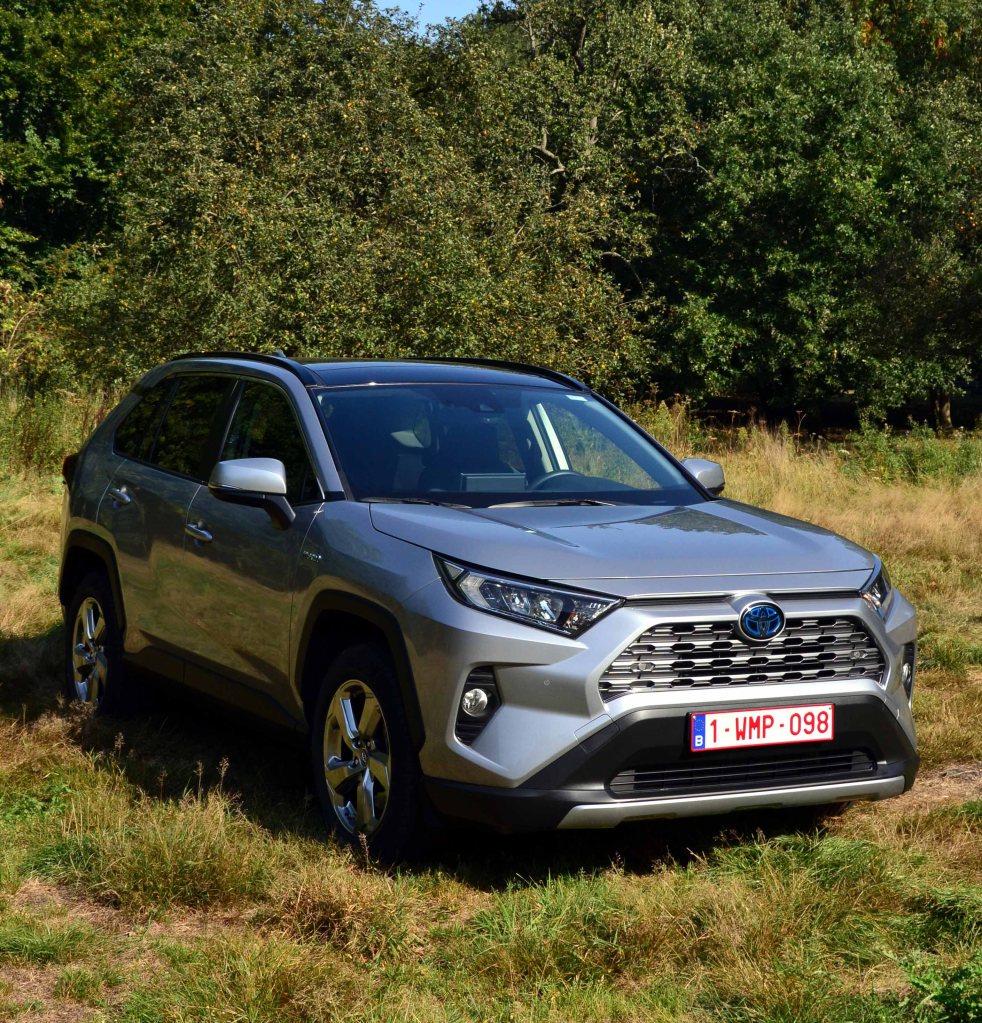
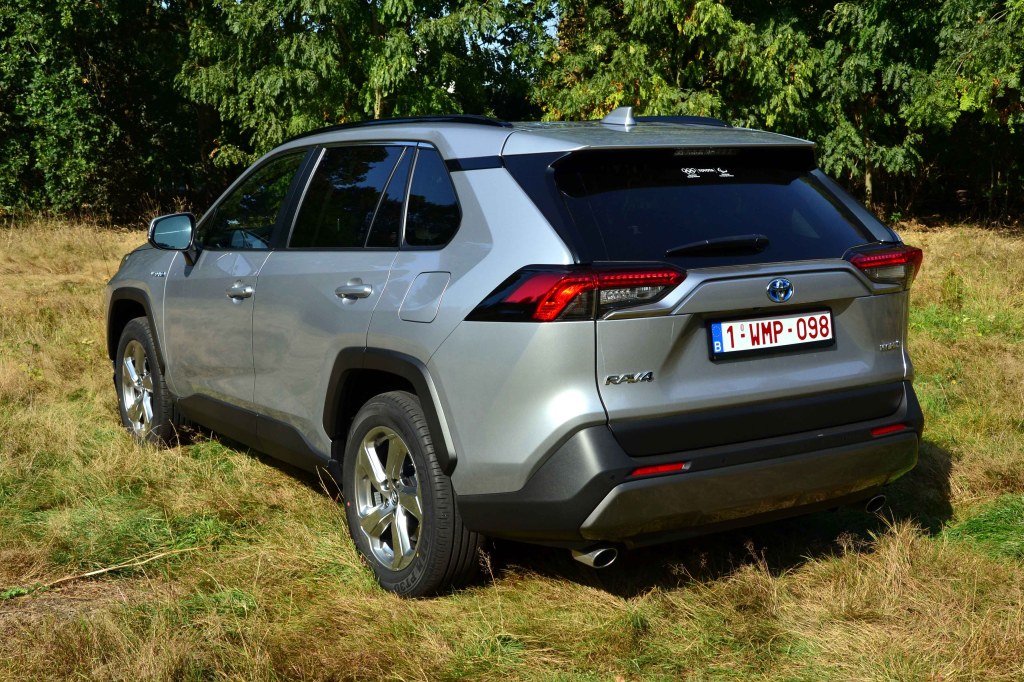
The formidable RAV4 has now some 10 million enthusiast owners, and now enters its fifth generation. It has gained in style, and is as hybrid as ever on our shores: 85 % of the European buyers opt for the self-charging hybrid power drivetrain.

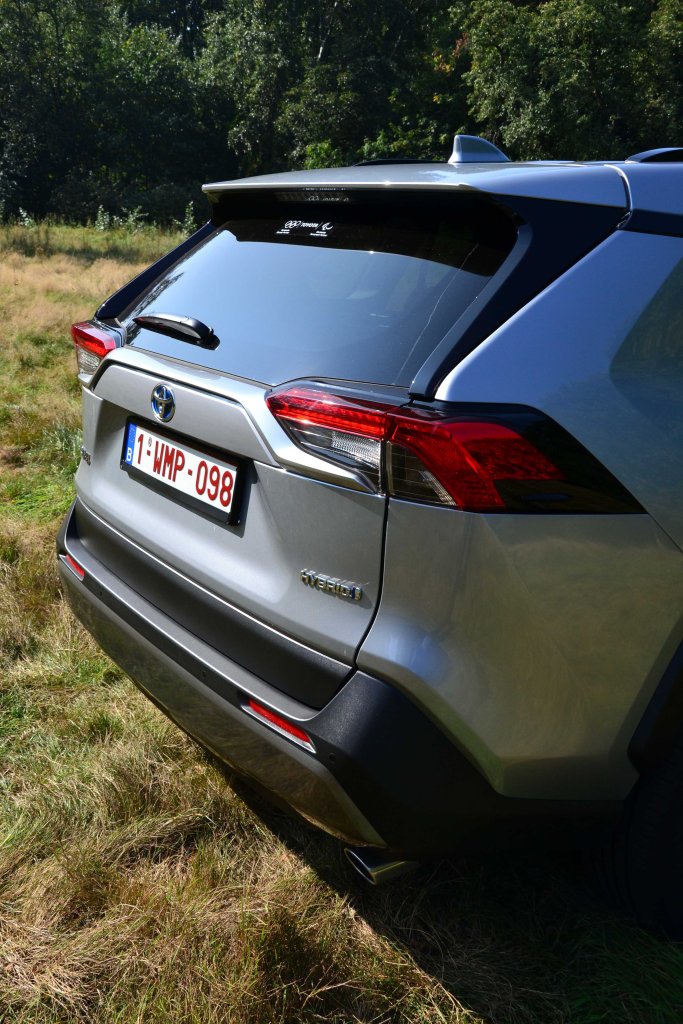
It rolls on the new GA-K platform, allowing the RAV4 to be sleeker with a lower center of gravity and increased body rigidity. This also means both better handling and ride comfort, a more spacious interior, ample load space (580 liters VDA with seats in place) and enhanced styling with lower roof and hood lines in combination with higher ground clearance.

Indeed, the new RAV4 has the looks, and the ride too…Just read on!

Hans Knol ten Bensel

Self-charging hybrid, masterfully engineered…

The RAV4 continues the successful Toyota hybrid story. Under the hood purrs a completely newly redesigned 2.5-litre petrol hybrid “Dynamic Force” engine, offering 218 DIN hp in front-wheel drive form. Indeed, this RAV4 is loaded with state-of-the-art top tech.

What to think of the Atkinson cycle technology and a 14.0:1 compression ratio (compared to 12.5:1 for the previous unit). It comes with D-4S direct and indirect (!) fuel injection and intelligent variable valve-timing – electric VVTiE for the intake and hydraulic VVT-i for the exhaust. The valve-timing range for both intake and exhaust has been increased. There are still more clever solutions put in this engine. Be astonished with us…

The cylinder heads are designed to generate high tumble of the fuel/air mixture, with an enlarged valve included angle and laser-cladded valve seats. A variable cooling system with an electric water pump and electric thermostat is used to improve combustion by maintaining the required temperature. There is also a fully variable oil pump for efficient engine oil pressure management.  

Toyota’s fourth generation self-charging hybrid system makes its debut in the new RAV4, delivering multiple benefits. Key components, including the power control unit (PCU) and the nickel metal-hydride battery are more compact and lighter in weight, and the transaxle and transmission have been engineered to reduce electrical and mechanical losses.

The new battery pack is 11 per cent lighter than before and transmission losses have been reduced by 25 per cent compared to the previous system.

How does all this work in practice? The engine is very docile, and develops 221 Nm between a very large rev range from 3,600 – 5,200 rpm. Admittedly, these are rather high revs, but the low-end pulling power is of course greatly helped by the electric motor, which develops a healthy 202 Nm.

This means that this RAV4 will pull away always with very impressive power, and this we find is the very “zen” beauty of Toyota’s hybrid system. The electric motor alone is good for 88 kW, so you can imagine what happens when you put your foot down.

Acceleration from 0 to 100 km/h is absolved in merely 8,4 seconds. But in the lower speed ranges, the velvety power is overwhelming. The hybrid system carefully manages how both engines participate in the total power delivery, and engine revs are kept especially low at partial throttle openings.

Silk smooth progress is for you to be enjoyed: even at spirited driving the engine hums quietly, and all this contributes to let you relax behind the wheel. What is also pleasant is the total smoothness of the drivetrain, not the slightest jolt or shock will disturb you or your passengers. Not many (super)cars will reach this level of total smoothness.

Besides all this smooth power, the hybrid system warrants also excellent economy. The secret is to accelerate and decelerate smoothly, to drive with anticipation. This lets the hybrid system use the recuperation function fully when slowing down, and use the electric motor as much as possible at constant speeds below, say 70 km/h. This results in excellent economy, also and even more so in slow urban driving and stop and go traffic. It proved no effort to reach averages of 6 l/100 km. Toyota quotes 4.5/4.6 l/100 km as average consumption, with CO2 emissions being 102 g/km. Oh yes, the top speed is a good 180 km/h. More than enough for all, we would say.

Driving pleasure…             

The new platform enhances handling stability and precision. The RAV4 has improved the response of the Electric Power Steering by moving the assist motor from the column to the rack, and indeed this RAV4 steers accurately. The handling is neutral and predictable.

The RAV4’s GA-K platform also distinguishes itself in its use of a double wishbone rear suspension system. What’s more, thanks to the low center of gravity and high body rigidity, the suspension does not have to be rendered stiffer to meet dynamic targets. Indeed, we found the RAV4 quite comfortable too! Its suspension travel is wide, and we know of few cars in its class which takes the many potholes and bumps on our Belgion roads with such ease.

A strong point is also the good visibility. The TNGA platform allows the hood to sit 15 mm lower, adding two degrees to the driver’s forward field of vision, and the external mirrors have been moved to a lower position on the front doors. Luggage space is 79 liters more than in the previous, fourth generation RAV4.

Flexibility is designed-in so that the space can easily be adapted to gain more cargo room when required: with the rear seats folded down, the new RAV4 can accommodate a 29-inch mountain bike without any wheels having to be removed.

Well equipped, also for safety…

The new RAV4 offers generous equipment specifications across its range, with all models equipped as standard with the latest iteration of Toyota Safety Sense and an E call emergency contact function. Quite impressive!

The improved system features a single-lens camera and millimeter-wave radar, both with enhanced performance to expand the scope of hazard detection and functionality. The unit has also been made smaller, so driver gains an even wider field of vision. We found this RAV4 delightful with the wide range of safety features.

The Toyota Safety Sense unit includes Pre-Collision System with Pedestrian Detection (PCS w/PD), intelligent Adaptive Cruise Control (iACC), Lane Departure Alert with Steering Assist (LDA w/SA), Road Sign Assist (RSA) and Automatic High Beam (AHB). In addition, it introduces Lane Tracing Assist (LTA), which provides more advanced driving support.

The system can determine collision risks at speeds from zero to 180 km/h. If it calculates an imminent risk of collision, it will alert the driver and prepare the brakes (PreCrash Brake Assist) for maximum stopping force. If the driver fails to act, it will trigger Autonomous Emergency Braking, which can reduce vehicle speed by up to 40 km/h, potentially bringing the car to a stop and avoiding an impact.

The new intelligent Adaptive Cruise Control (iACC) is also able to work in conjunction with the car’s Road Sign Assist system. When the car is travelling at a constant, pre-set speed, iACC can recognise new speed limits on major roads and let the driver adjust the speed to keep within the limit, simply by using switches on the steering wheel.

The intelligent Adaptive Cruise Control and Lane Tracing Assist work together in slow, stop/go traffic, tracking the vehicle ahead within the traffic lane, maintaining a safe distance and speed, bringing the vehicle to a halt when necessary and moving off seamlessly when traffic flow resumes. We found this feature a delight to use and indeed it takes away quite some stress in urban stop and go traffic.

Roomy cabin and creature comfort

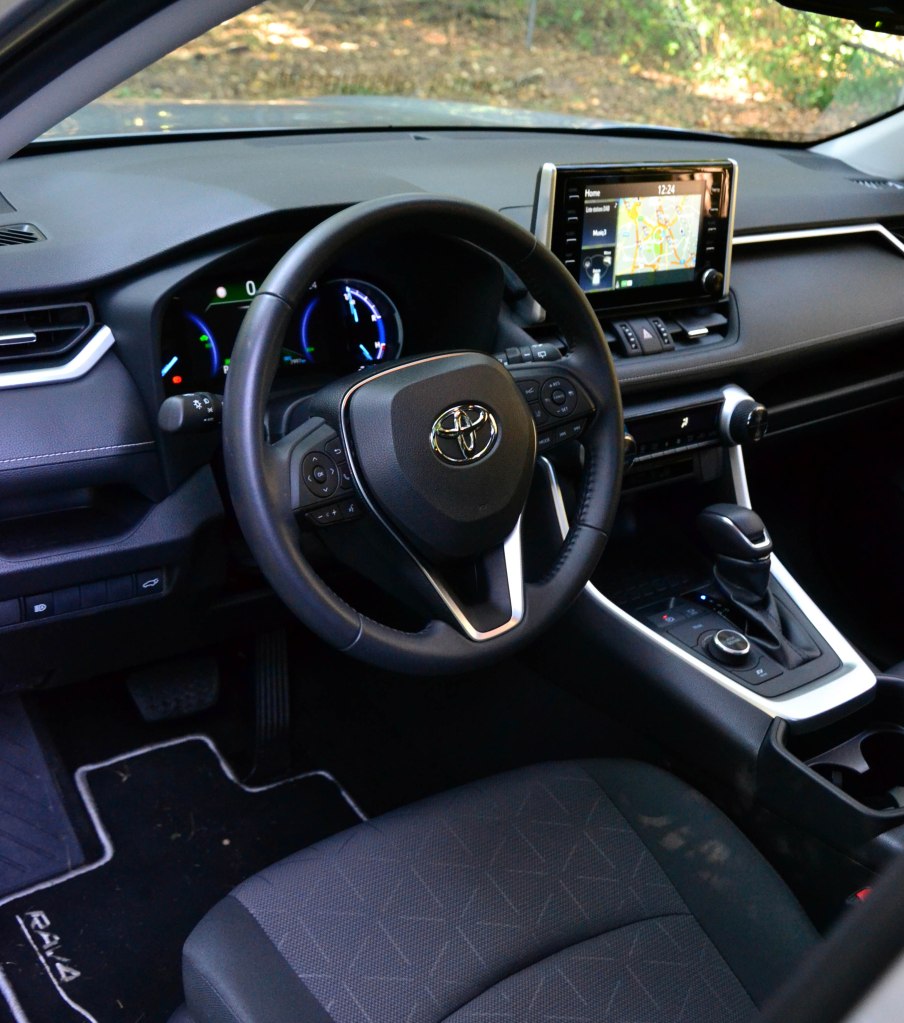
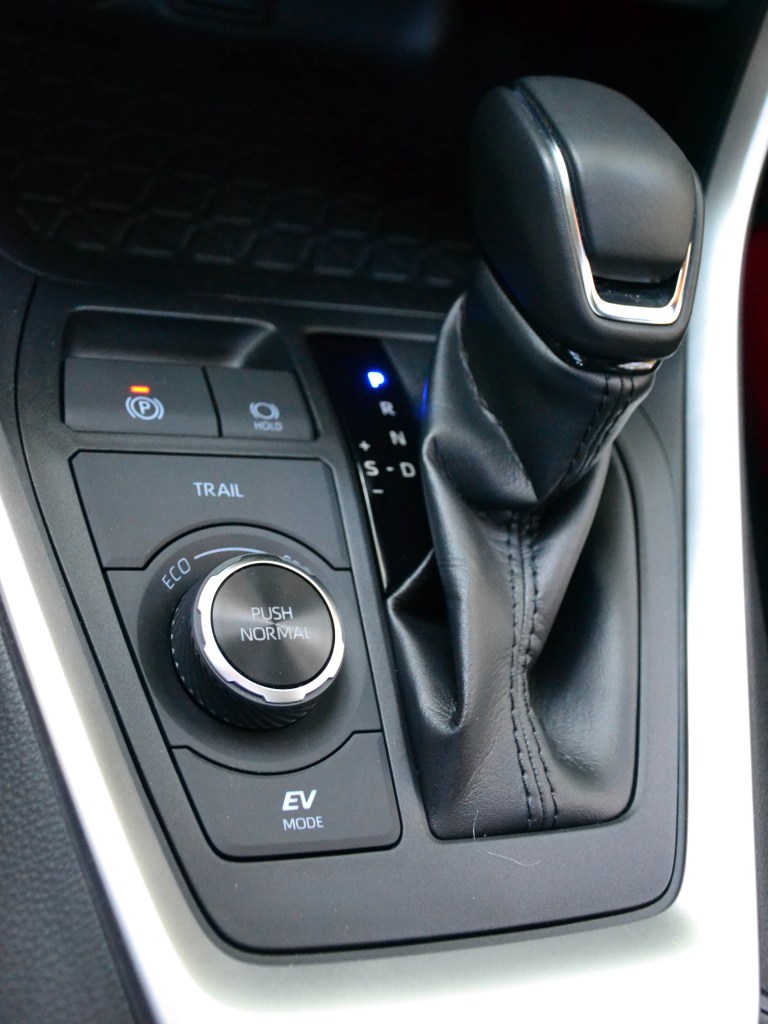
We found the cabin quite practical; it is purpose built with all the knobs and handles in the right places. The gearlever/selector is now totally classical in looks and feel, and this is maybe a good thing for many SUV enthusiasts. Seats are excellent, the lower, more dynamic seating position was appreciated. As said, there is plenty of room inside. Of course, excellent connectivity and an intuitive to use navigation system was appreciated and makes this RAV4 a pleasure in daily use.

Conclusion

A well styled, but above all superbly engineered SUV, which is sturdy, practical, mechanically refined, frugal, and roomy.

It has a very comfortable ride, and the smoothest of drivetrains. This SUV displays lively performance and surprises with excellent economy. Its unique hybrid system makes it truly stand out, and will make it also totally future proof in our ever-greener world. The RAV4 will continue to be a bestseller, and deservedly so…

Hans Knol ten Bensel

We drove the Audi A3 Sedan 35 TFSI: cleverness in elegant motion…

Driving an Audi is always something very special. You are surrounded by German perfection, enjoying the touch of top notch materials and the sight of clean cabin styling and instruments. The steering wheel transmits agility and handling precision into your fingers, the engine responds eagerly to the slightest movement of your right foot. You hear an efficient throb, even if it isn’t the five cylinder anymore. Yes, an Audi. The second generation A3 sedan which was introduced in the spring of this year continues the tradition. It has style, breathes German high-tech panache, feels built to last, and is elegant down to the smallest detail.

Here we drove for you the 35 TFSI 1,5 litre petrol with the 7 speed S tronic, which is assisted a bit with regenerated E-power…

Hans Knol ten Bensel

Slender facelift

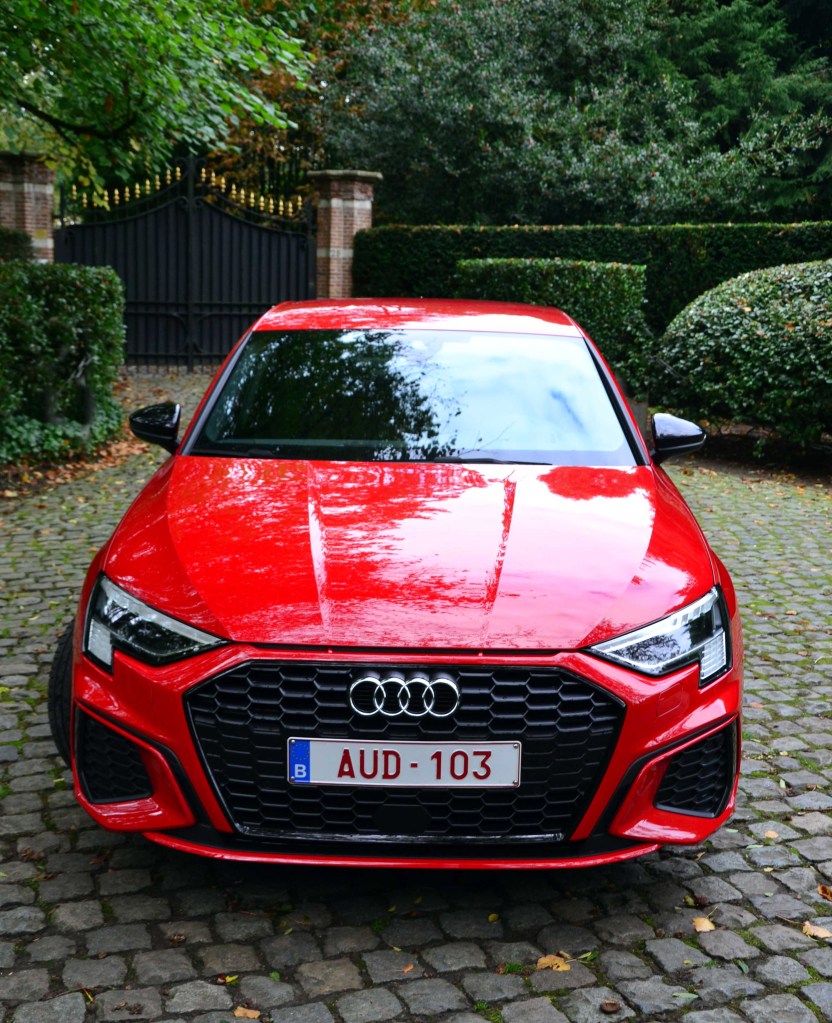
The latest A3 has been upgraded somewhat, remaining however well within the classic Audi styling mold. Its wheelbase remained the same, just the body got now 4 centimeters (1.6 in) longer at 4.50 meters, and it is 2 cm wider. A concave surface under the broad body shoulder make the A3 look more punchy and leaner. The roof line slopes down coupé like from the B- and finishes in a striking spoiler on the tailgate, which is optionally available in carbon.

The new A3 Sedan achieves a Cd value of 0.25 and is therefore 0.04 Cd points better than the first generation. All this thanks to attention to detail: there is a controllable cooling-air inlet with two electrically actuated louver modules behind the Single frame grille…

In the cabin, the instrument panel with the central MMI touch display is inclined slightly toward the driver. It has a 10.1-inch diagonal and includes handwriting detection as well as natural language control that can optionally draw on the capabilities of the cloud. The 10.25-inch instrument cluster behind the steering wheel is digital even in the basic model. Wow! We simply love also the clean instrument styling of these digital displays.

Of course, there is “Audi virtual cockpit plus”. The screen then measures 12.3 inches and offers three different views, including sporty graphics with inclined digits and a particularly dynamic layout. The RPM and speed are shown here as bar diagrams with angular red graphical elements. Upon request, a head-up display is available, we had it on our test car.

Driving the Audi: sharp, alert, precise…

Be inspired behind the wheel. This car responds beautifully when you steer it with verve. The 1.5-liter direct injection engine produces 110 kW (150 PS) between 5 and 6000 rpm, and has plenty of pulling power across the mid rev range. Torque is 250 Nm between 1500 – 3500 rpm. The 7 speed S Tronic makes you a better driver. You hurtle from 0 to 100 km/h in 8,4 seconds, and become a top player on the German Autobahnen: top speed is 232 km/h.

The suspension supports all this sportiness superbly. We left the drive select function in our test car mostly in the “comfort” position, and even then, you steer with precision and uncanny agility. Selecting a dynamic position will influence damper settings, steering and throttle response. But there is also an “eco” setting…

Indeed, with the S Tronic automatic, the car can coast when you lift the throttle. This led the Audi people to adopt here brake regeneration alongside the obvious coasting function. They installed a 48-volt mild hybrid system, which supports the engine with up to 50 Nm (36.9 lb-ft) of torque when driving off and accelerating from low engine speeds. It also allows the A3 Sedan to switch the engine off while coasting. Drive with anticipation, and you will be amazed in how many situations you can put the kinetic energy of your Audi to (very) good use.

We also appreciated the utter smoothness when this Audi switches from shut down coasting to revving engine power. It was not perceptible, and that is no small feat!  We achieved quite creditable consumption figures in sedate town driving, between 6 and 7 liters/100 km. Of course, on the open road, the Audi is efficient, and when driven at legal limits you can achieve anything between 5 and 6 liters/100 km. Audi quotes 4.9 – 4.7 l/100 km and combined CO2-emissions of 113-107 g/km.

You remain highly connected in your Audi…

The top infotainment system in the new A3 Sedan is the MMI Navigation plus, which uses the third-generation modular infotainment platform (MIB 3). The MIB 3 boasts computing power ten times higher than in the predecessor model, connects the car via LTE Advanced speed, and connects the smartphones of the passengers to the Internet via Wi-Fi hotspot. The MMI Navigation plus offers a multitude of Audi connect services as standard, including online traffic information, news, and additional information such as photos, opening times, and user reviews relating to points of interest.

The A3 Sedan is also connected to the smartphone via the Audi smartphone interface, which integrates iOS and Android cell phones with Apple Car Play and Android Auto in the MMI, as well as via Audi phone box. The latter connects the device to the car antenna and can charge it inductively.

Did you know that if the car is switched off, the myAudi app continues navigation from the car on a smartphone? This way, customers reaches their destination directly.

What is more, the A3 Sedan can be locked and unlocked as well as started via an Android smartphone with the Audi connect key. Personalization allows up to six users to store their preferred settings in individual profiles, including those for the seat, climate control and media.

The DAB+ digital radio comes as standard. Options include online radio and the hybrid radio, which automatically switches between FM, DAB, and the online stream depending on a station’s signal strength, thus ensuring optimum reception. We enjoyed the music in this Audi, for sure…

Conclusion

Convincing, if you like superb finish, build quality, clean timeless styling and last but not least an engaging driving experience. This sedan will underline what you stand for, will age (very) well and give you owner and driving pleasure every day you live with it. It doesn’t come very cheap, more so when you delve deeply into the extra’s, but reliability, longevity, high resale value and therefore low depreciation are also things you have to take into account when considering the overall running costs for this quality car. Drive it cleverly in town, and it is there quite frugal too…

Hans Knol ten Bensel

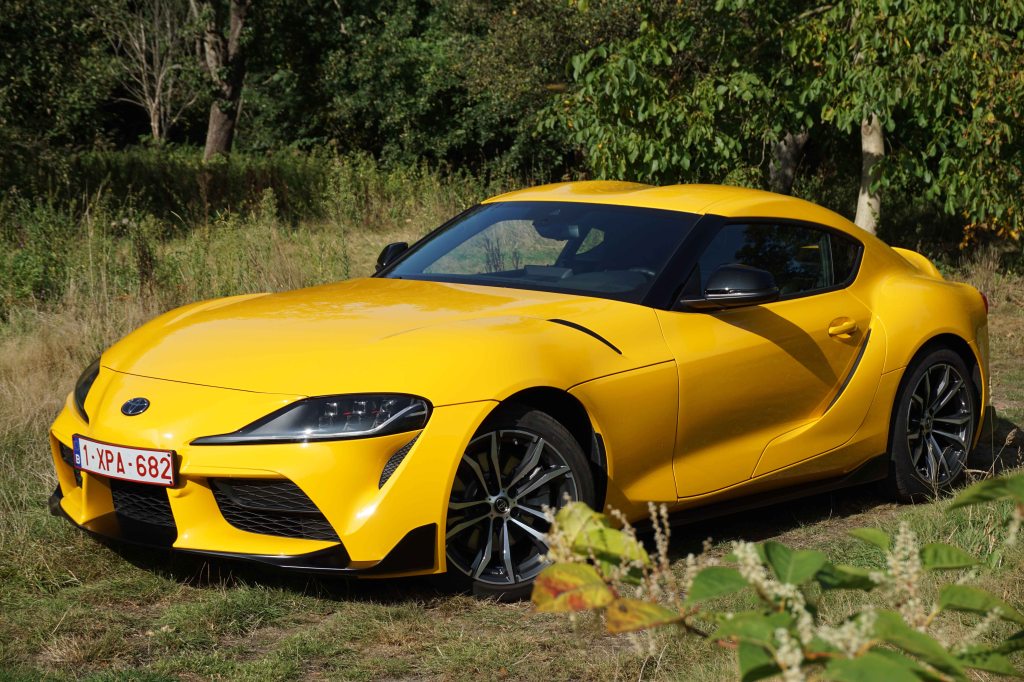
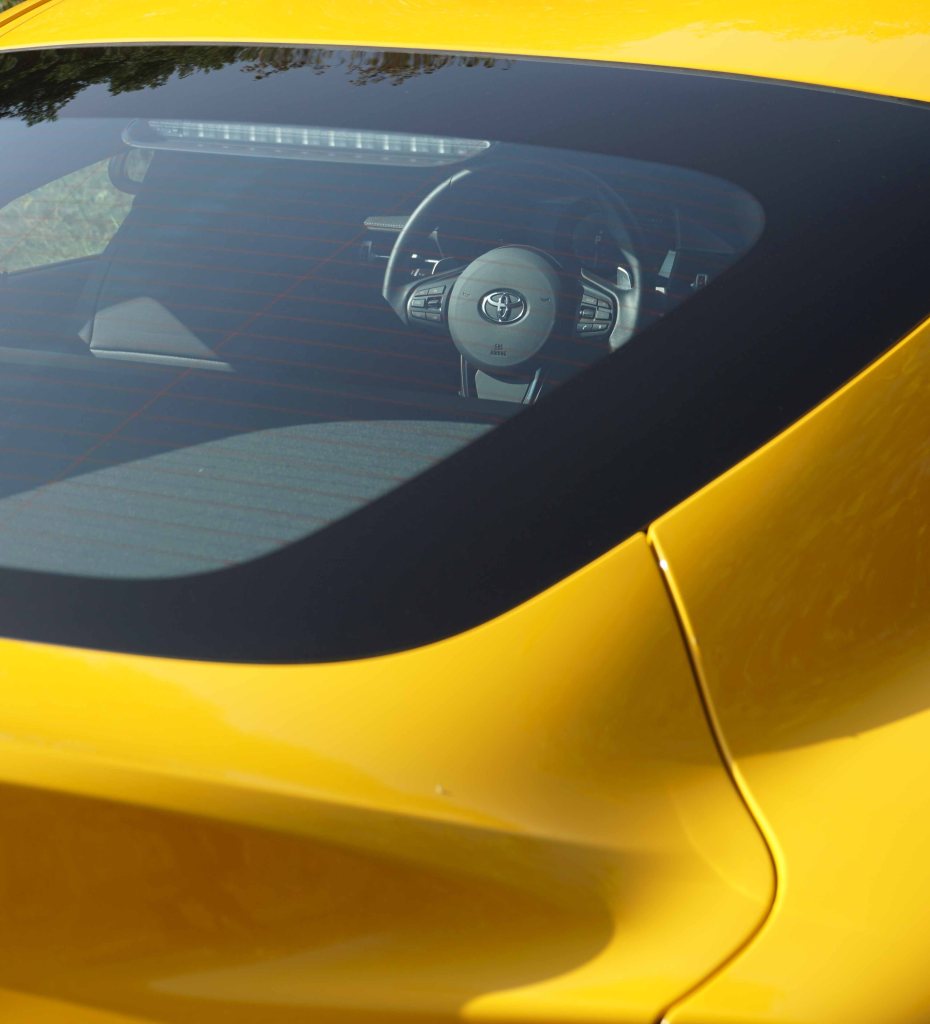
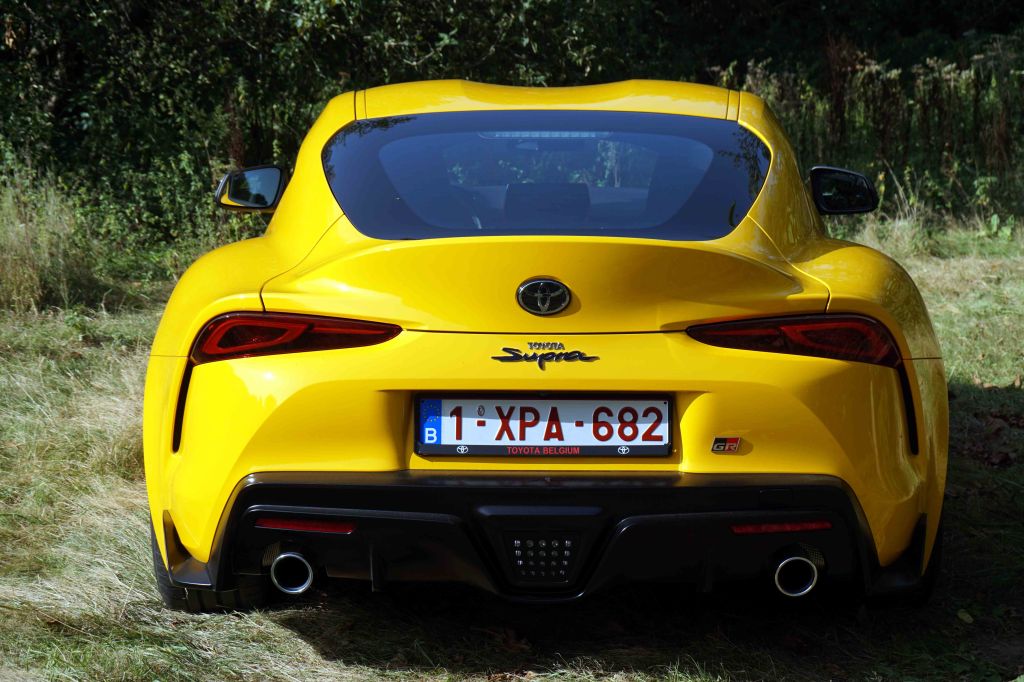
We drove the Toyota GR Supra 2.0L: a thoroughbred sports car gets even more pure…

Who doesn’t dream of a two-seater sports car with flowing coupé lines, a racy cabin, long hood, wide stance and a superb styled rear? A sports car with ideal 50/50 weight distribution, handling from the seat of your pants, equipped with a thoroughbred engine?

Such a car is the Toyota GR Supra. Until now, it came with a 3 litre six engine, being the first global model to be developed by TOYOTA GAZOO Racing. Now this same team has engineered another, even more pure version for the sports car aficionados: a Supra with a double overhead cam, 2 litre 16-valve petrol unit with a twin-scroll turbocharger.

This four-cylinder Supra is 100 kg lighter, and the engine’s shorter length means its mass is located closer to the center of the car. A true driver’s delight with stunning performance? You bet! It proved indeed to be one of the nicest 2-seater “pur sang” bolides we have driven lately…

Hans Knol ten Bensel

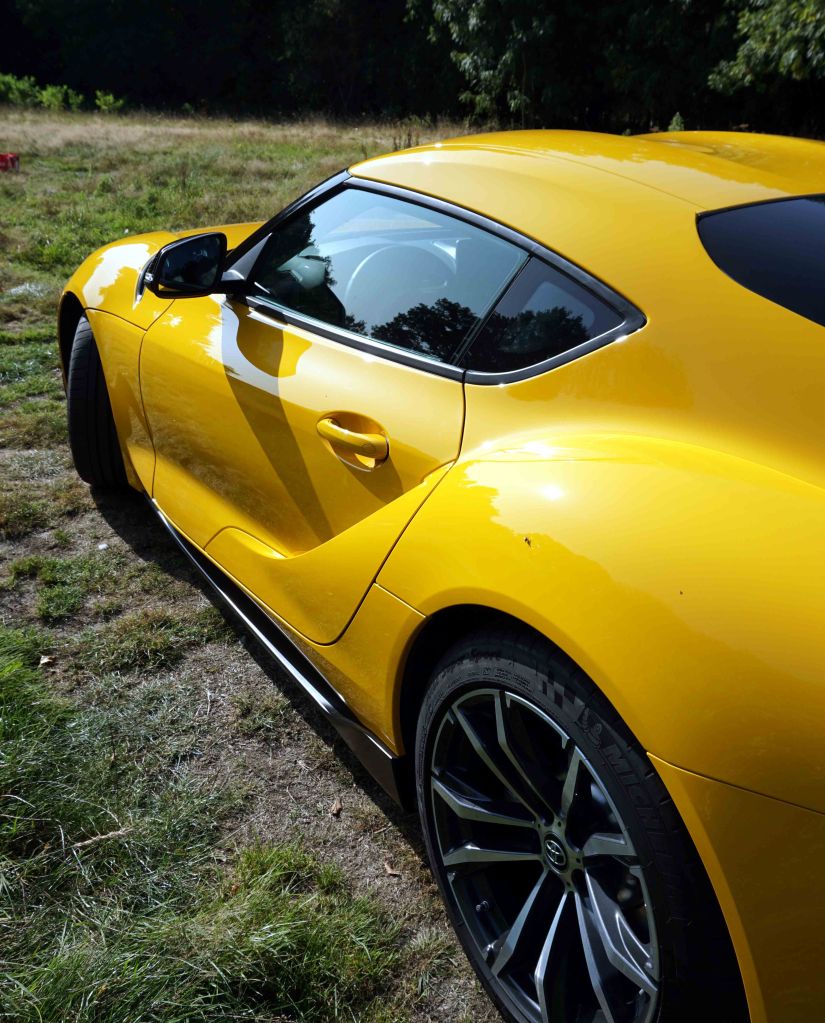
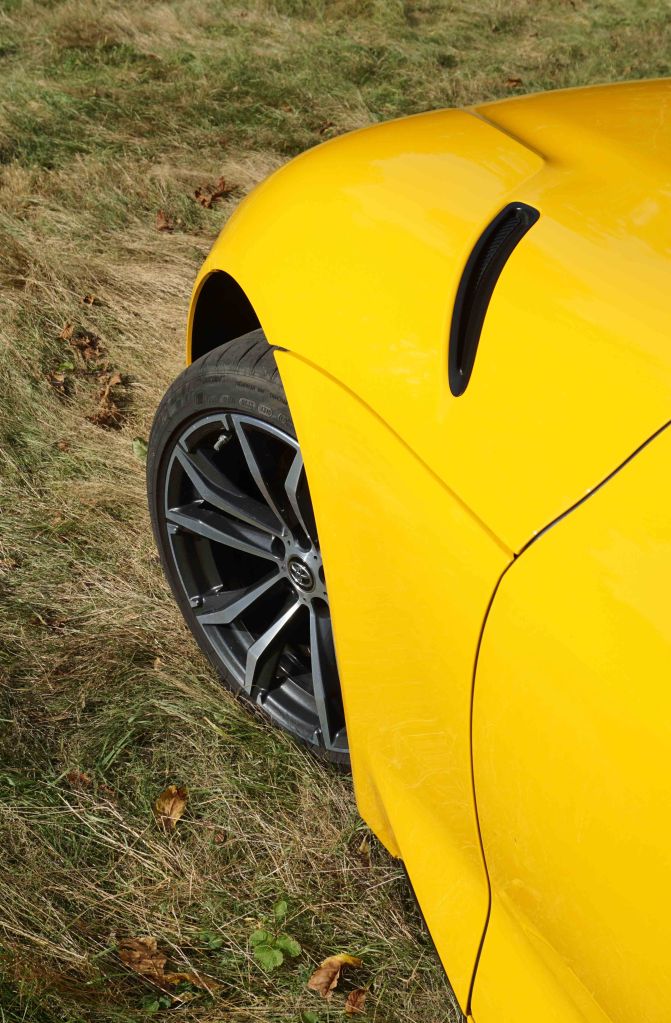
Already its looks are stunning. Chief Engineer Tetsuya Tada adhered to the classic form of a front-mounted engine driving the rear wheels, building on the heritage of Toyota’s past Supra generations and original 2000GT sports car. Indeed, this latest Supra has much of the compact purity of the legendary 2000 GT, which moves the heart of every car enthusiast.  

When it comes to design a top handling car, its wheelbase and track dimensions are the first things to consider. It is widely recognized that the best balance of agility and stability is obtained with a ratio between wheelbase and track of around 1.5 and 1.6. Achieving the 1.55 “golden ratio” was thus the starting point for the GR Supra development team, the key building block on which everything else has been optimized. (For reference: wheelbase = 2,470 mm; rear track = 1,589 mm).

Superb four-cylinder…

The engine sits indeed in the right place. And it sounds and performs right too. Maximum power is 258 DIN hp/190 kW at 5,000-6,000 rpm, while peak torque of 400 Nm is available across the whole mid rev range, from 1,550 to 4,000 rpm. Performance is indeed at the rendez-vous…

What to say of a 0-100 km/h acceleration in 5.2 seconds, with top speed is electronically limited to 250 km/h… The charm also lies in the totally effortless way this performance is achieved. This sports engine is totally civilized, and while it will respond eagerly to the slightest pressure of your right foot, it is utterly docile and flexible in town traffic, and in the “normal” driving mode, it will happily potter along at 1200 rpm at legal speeds. Choose the sports mode, and the excellent 8 speed ZF automatic will spoil you with alert and lightning speed gear changes, and make you a better driver…

The staccato of the engine revving up under full power is a delight to your ears, and all this pleasure is further enhanced by the excellent handling of this Supra.

Economy is not as dramatic as you would expect from such a high-performance car, as the engine is efficient and the car is not heavy. We clocked with a lot of (very) brisk driving an average consumption of some 8,2 liters/100 km.

State of the art suspension

The Supra steers with precision. The high rigidity of the chassis makes a finely tuned suspension possible. The suspension design comprises double-joint-type MacPherson struts at the front and a five-link system at the rear.

The GR Supra 2.0 is fitted as standard with 18-inch forged alloy wheels. To optimize the balance of front and rear grip, larger wheels and tyres are used at the rear. The specific Michelin Pilot Sport tyres are 255/40 ZR18 front and 275/40 ZR18 rear.

The Supra also corners as on rails thanks to its 50/50 weight distribution, and even novice drivers can drive immediately fast with utter confidence on those winding mountain sections of your Gran Turismo trip.

Do not forget that TOYOTA GAZOO Racing was instrumental in honing the new sports car’s performance, working on the famous Nürburgring Nordschleife and surrounding roads in Germany to achieve the most agile, stable and rewarding handling possible. Further extensive testing was carried out on roads around the world.

The Adaptive Variable Suspension (AVS), available as part of the optional Sport Pack, enhances performance with instant response to changes in the road surface, adjusting the shock absorber force at each wheel to maintain a flat vehicle posture, excellent steering response and supple ride comfort. Sensors constantly monitor the way the car is being driven and the road conditions, controlling the damping force accordingly.

The driver can choose between two AVS modes – NORMAL and SPORT – to suit their mood or the driving conditions. NORMAL mode strikes a high balance between vehicle stability and ride comfort, enabling a sporty drive without sacrificing comfort. SPORT mode delivers a flat vehicle posture, reduced body roll and a more agile steering response.

A cabin to dream (and drive) away in …

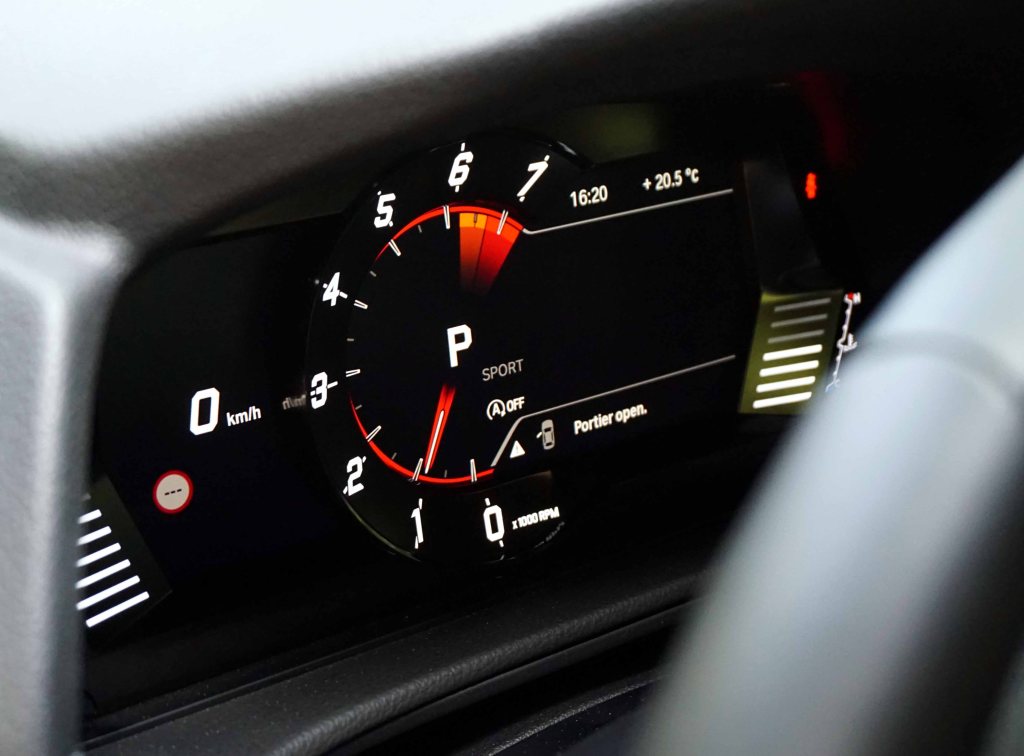
The cabin of this two-seater is a heavenly place for each trip, be it 1 or 1000 kilometers. Soon you have found the ideal driving position behind the wheel, and all the instrumentation is ideally positioned in your line of sight, with the large rev counter of course taking central place.

The low, slim horizontal dashboard maximizes the forward view through the windscreen, and you intuitively keep your eyes on the road.

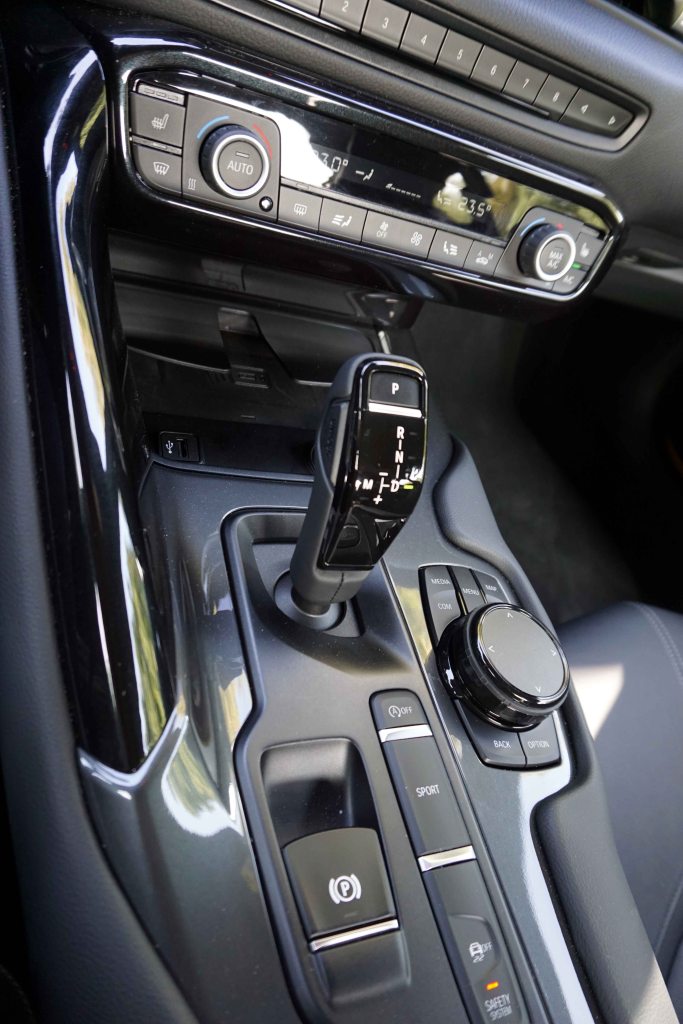
But don’t expect this Supra to be anywhere spartan. The standard multimedia system for the GR Supra 2.0 is controlled via a centrally mounted 8.8-inch high-resolution TFT touchscreen display. This can also be operated using a controller on the center console which has an intuitive touchpad control on its upper surface. It is designed for fingertip control so the driver doesn’t have to change their position at the wheel to operate it.

The package includes a four-speaker audio system with DAB radio reception, Bluetooth, a USB port and wireless smartphone integration using Apple CarPlay.

Conclusion

A formidable sports car, a dream on the track, on the mountain pass, on the motorway, but also well at home in tight and slow daily urban traffic. A stylish companion, which offers you all the practical creature comfort you could wish for, all this makes this Supra a car nice to live with every day. Then also, it’s a Toyota, which means top notch reliability, good economy and reasonable service cost. So enthusiasts, this Supra has all it takes to become an icon, and could be your four-wheeled companion, to cherish for years, if not decades to come…

Hans Knol ten Bensel

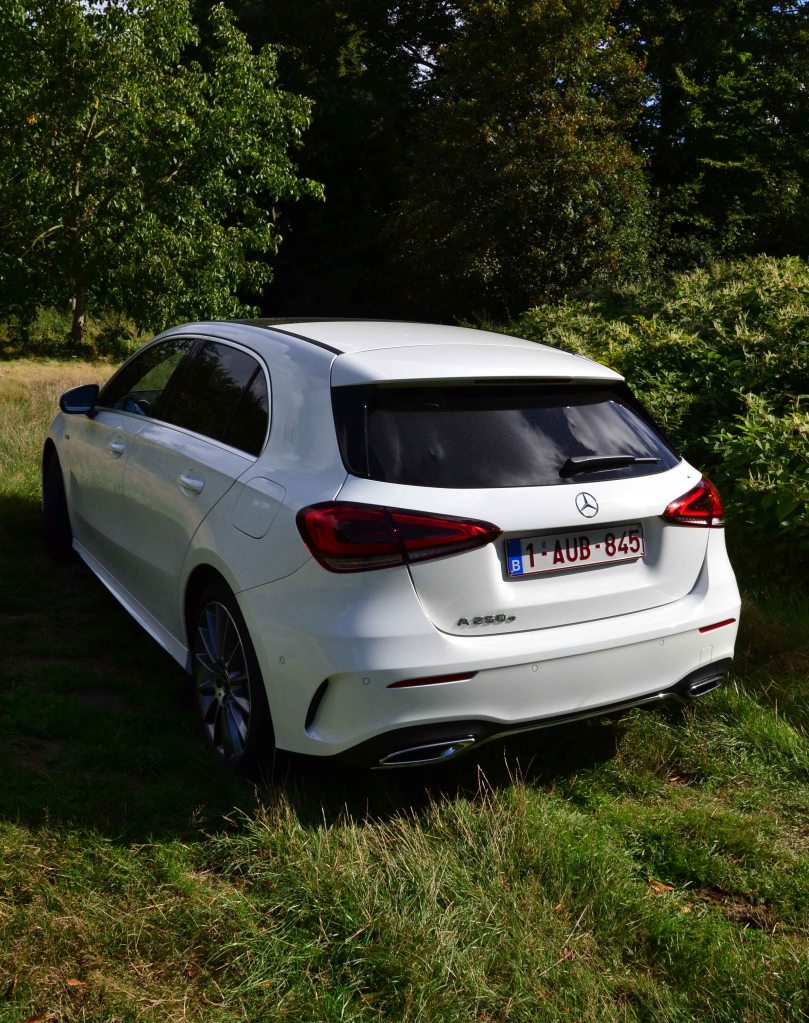
We drove the A Class 250 e: another milestone in plug-in hybrid mobility…

Mercedes is joining the plug-in hybrid trend on the road to zero-emissions driving. It does this with the third generation hybrid drive under its celebrated EQ Power label, with the future-oriented commitment so typical for the brand. Indeed, wonderful times are ahead, so it appears. This A 250 e promises indeed formidable economy and emission values: combined fuel consumption 1.5-1.4 l/100 km, combined CO2 emissions 34-33 g/km, combined electrical consumption 15.0-14.8 kWh/100 km.

All so wonderful, but of course under the condition that you use its plug-in capacity. Otherwise, it is just a zesty petrol engined compact Mercedes with good performance and road qualities… but one which gets you home no matter the distance!

Hans Knol ten Bensel

Electric Charging stations are an absolute must…

Indeed, plug-in hybrids are very much OK if you can charge then every day at home or office. If this is not available, Mercedes helps. Via its “Mercedes me Charge”, you can optionally obtain access to one of the world’s largest charging networks, with over 300 different operators in Europe alone Thanks to its navigation system, Mercedes-Benz drivers can find these stations easily and can gain convenient access to the charging stations via the Mercedes me Charge card, the Mercedes me App or directly from the car.

No separate contracts are necessary for this: apart from simple authentication, customers benefit from an integrated payment function with simple billing after they have registered their payment method once. Each charging procedure is booked automatically. The individual charging processes are clearly listed in a monthly invoice.

The car: top performance…

The A 250 e is fast. We can say, almost superfast. What to think of 6.6 seconds for the sprint from 0 to 100 km/h, and a top speed of 235 km/h? You can drive it in E-power only mode, and even then its electric 75 kW motor will push it to 140 km/h. So with everyday charging, you have a lively E-car under your right foot which is more than powerful enough to give you genuine driving pleasure combined with “zen” electric smoothness.

But if you are faced with an immediate longer trip, with no time to find charging stations for your empty battery, the 1,33 litre four cylinder gets eagerly to work. It smoothens out on the autobahn, otherwise it lets you know it is there, but then with a pleasant touch of sportiness. It develops 118 Kw/160 hp at 5500 rpm, and its 250 Nm torque starts at 1620 rpm, which gives it plenty of punch in the lower and mid rev ranges. Oh yes, total system power is 160 kW/218 hp, and system torque is an impressive 450 Nm.

Charging a breeze…

A lithium-ion high-voltage battery with a total capacity of approx. 15.6 kWh is ingeniously packed in the car. It sits under the rear seat and can be charged with alternating or direct current. A corresponding vehicle socket is located in the right-hand side wall of the vehicles.

This means that the compact plug-in hybrids can be charged at a 7.4 kW Wallbox with alternating current (AC) within 1 h 45 min from 10-100 percent SoC (Status of Charge). For direct-current charging (DC), the battery can be charged from 10 – 80 percent SoC in around 25 minutes.

So if you are a (mostly) urban driver, plenty of charging opportunities!

Driving the A 250 e exclusively on E power in urban situations is the thing to do. If the battery is empty, – it’s useable range is around 55-60 km on a charge – the willing petrol engine gives you plenty of zest, but not the supersmooth progress we have grown accustomed to in our own hybrid Lexus for instance.

Gearchanges by the 8G-DCT dual clutch transmission are noticeable at slow speeds and smaller throttle openings, and economy is in these circumstances what you can expect from a solid Mercedes with a sporting engine. In short urban errands, anything between 8 and 14 litres/100 km could be your sort, but luckily once on the open road the engine gets really into its stride and consumption hovers between 5,5 to 6,1 liters when cruising at legal cruising speeds.

Drive programs to choose from…

But there is more. With the launch of MBUX (Mercedes-Benz User Experience) the previous plug-in operating modes of all EQ Power models have been converted to so-called “drive programs.”

After 52 kilometers, the battery is empty, and the earger 1332 cc four cylinder gets to work… but for better urban driving economy, you are well advised to plug in and prefer e-power!

These new drive programs are “Electric” and “Battery Level”. Maximum e-performance can of course be had in “Electric”. The combustion engine is then only engaged if you floor the throttle. In the “Electric” program, the energy recuperation strength under braking/decelerating can be selected via paddles behind the steering wheel. The paddles on the steering wheel enable the selection of five different recuperation levels (DAUTO, D+, D, D- and D–).

Comfort, ECO and Sport modes are also available.

So you can give priority to electric driving, or choose more dynamic driving in combined drive mode or give preference to the “Battery Level” i.e. the combustion mode to save electric range, for example.

Mercedes remains Mercedes… and more about its future plug-in strategy

When looking at chassis, bodywork, cabin amenities and finish, the good star always tells us a beautiful story. The new A Class scores top marks here. Excellent seating position, ergonomics, MBUX, or Mercedes-Benz User Experience, comfort, handling, looks and practicality, everything is there.

Looking at the future, the new plug-in hybrids of the S-, E- and C-Class with electric ranges of up to 50 km in accordance with NEDC are now more than a year with us. In the C- and E-Class, Mercedes-Benz is the only manufacturer to combine the diesel engine with plug-in technology, offering this set-up in the Saloon and Estate versions of these two model series.

This year, about 20 model variants will have the plug-in layout… so the good star is indeed well plugged in!

Hans Knol ten Bensel
Photographers’ note: All photos were taken with our big Nikon DSLR, which amply shiws in the crispness and balance of the images…