April 26 was already for weeks firmly put in the agenda for all the (Belgian) fans of British cars. After all, that’s when parts specialist Anglo Parts organized its annual “British Car Day”, where the classic car clubs and restoration specialists could put their best foot forward to recruit members or appeal to customers.
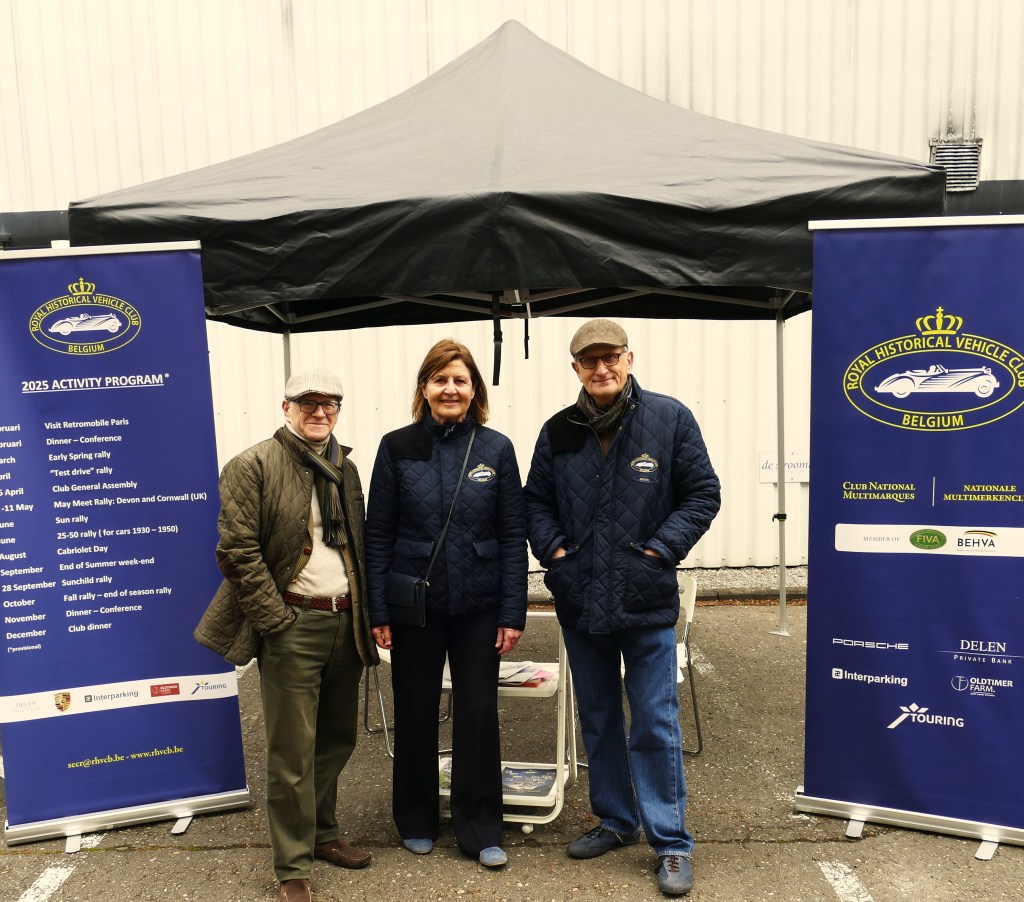
From left to right on our RHVCB stand: your servant, Ingrid De Jonge and Club president Michel Van Eesbeek
As faithful readers already have read in our post about our visit to parts specialist Anglo Parts, (see the post “Lifeblood for your British Classic Car”) your servant has become board member of the Royal Historical Vehicle Club Belgium, and I was present at the event which a stand of our club.
This time the weather gods were better than in the previous edition, and this attracted twice as many spectators.
At the event itself there were a lot of enthusiastic enthusiasts who came up with very special cars. For example, we came face to face with a very rare Marendaz Special, a car designed by DMK (Donald Marcus Kelway) Marendaz and built between 1926 and 1932 in Brixton Road in London, and then until 1936 in Maidenhead in Berkshire. Of this beautiful sports car, whose radiator resembles that of the Bentleys of the time, only 20 to 50 copies were built by the eccentric Marendaz, who fought air battles in France during the First World War as a member of the Royal Flying Corps, in which he was wounded in 1918.
Your servant will make an extensive (photo) report of this very special car on our columns soon…
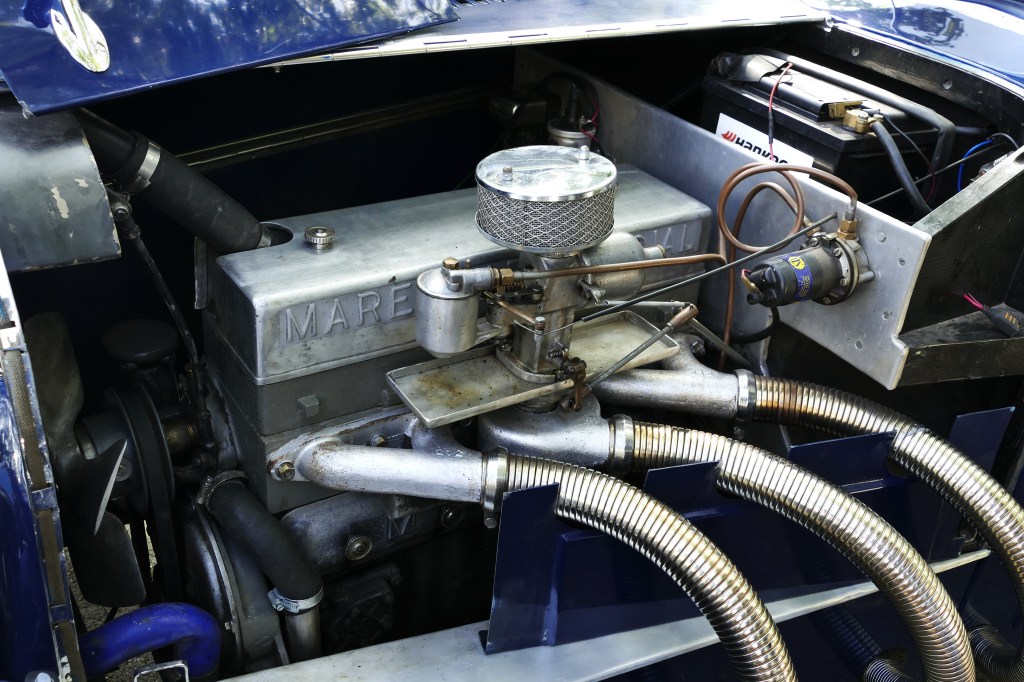
Most Marendaz Specials used Anzani engine(s)…
Also, a very enthusiastic more than 80 year old English enthusiast had arrived with a vintage… taxi. The man’s name is Dirk Harland, and he had left Hemel Hempstead the day before in his 1955 Beardmore London Taxi Mk7, with his grandson in the back.
He crossed the channel from Dover to Calais, and unfortunately got into a massive one and a half hour traffic jam on the Antwerp ring road. But don’t worry, he showed up flawlessly the next morning at the British Car Day with his Beardmore…
Furthermore, there was of course a legion of MGs to admire, Triumphs, Minis in all kinds of tune , Jaguars, in short, something for everyone…
Relatively rare: an MGA Twin Cam
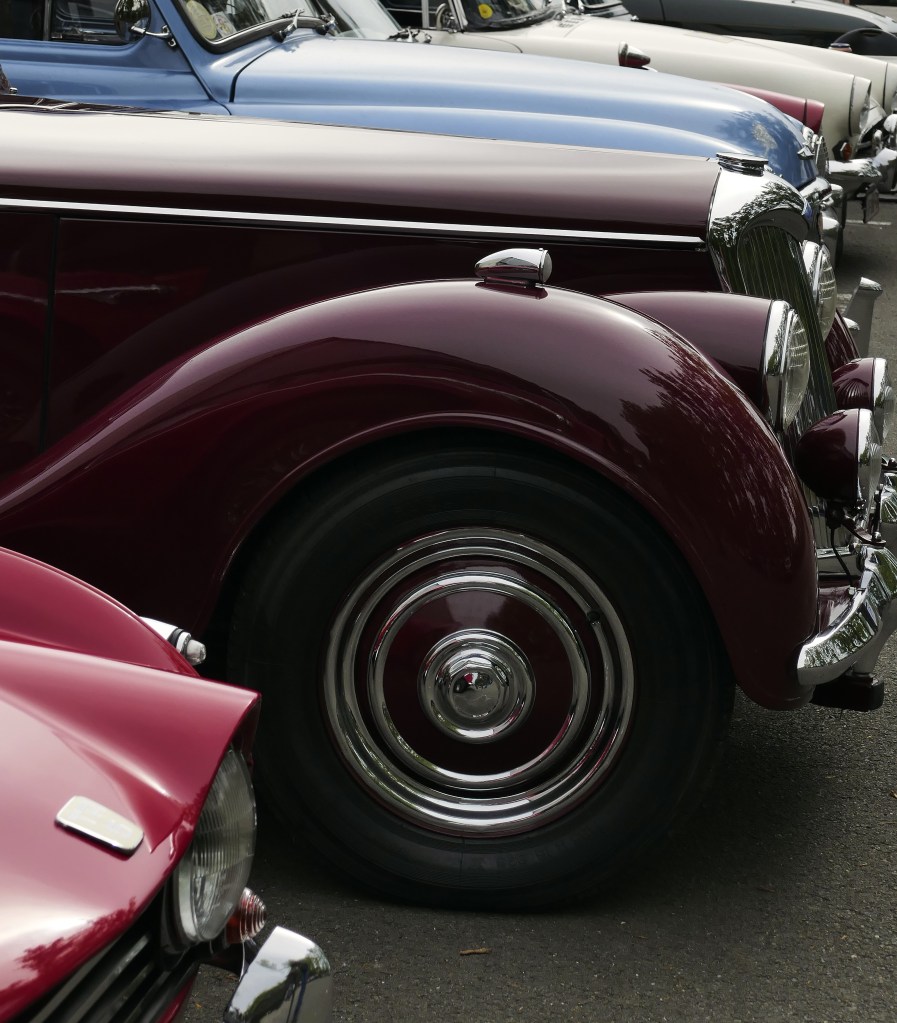
The event was also characterized by the enormous venue of enthusiasts, who all had taken out their British Classic and had it parked on the road and areas around the premises of the organizer Anglo Parts. Just have a look at the photos…
Enjoying and driving an oldtimer means also that you have to take it to the technical inspection in regular intervals.
In Belgium, a car is an “oldtimer” when it has been registered 30 years ago. You can then register your car with an “O” (oldtimer) license plate. This means that you enjoy reduced road tax, but on the other hand the use of the car is restricted. Any commercial and/or professional use is prohibited. You cannot use it as stage prop or décor for film productions for example. Neither can you use it for weddings and other special occasions which involves transporting passengers, even when this is done for free. Nor can you use the car as a daily commuter between home and work.
As Belgium has three regions, notably Brussels, Flanders and the Walloon region, the regulations for technical inspection for oldtimers show some differences.
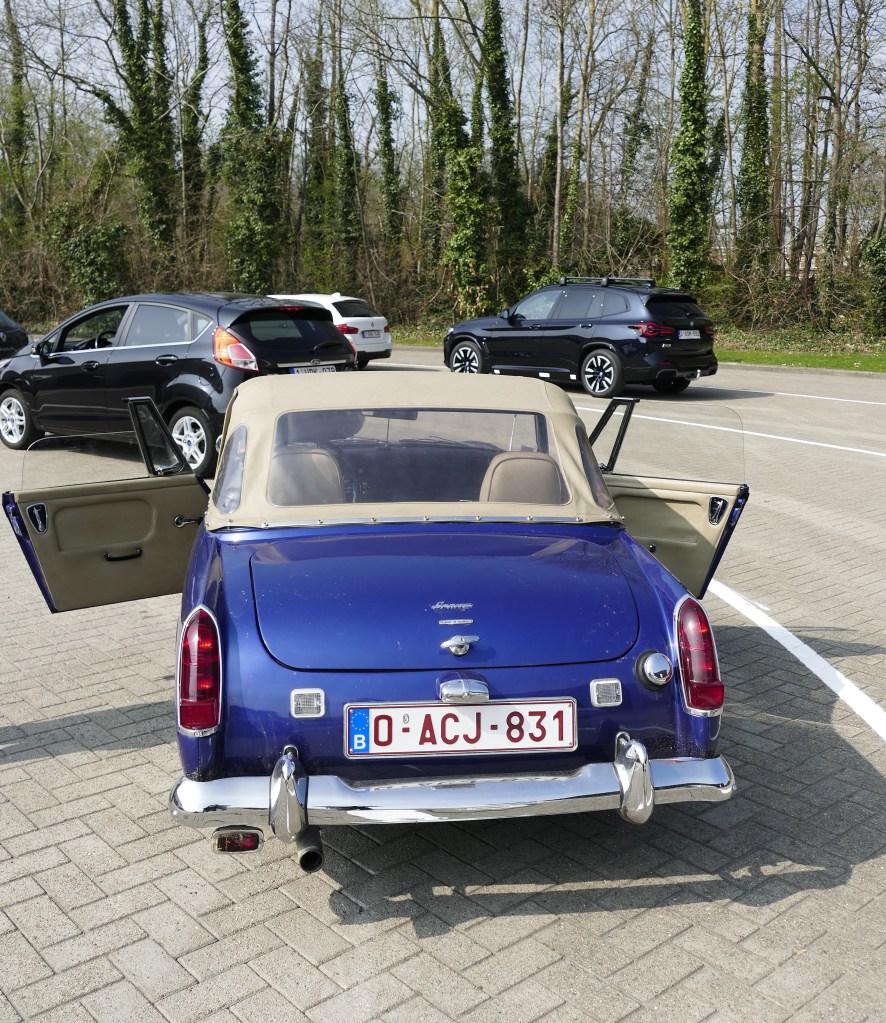
In the Brussels region, cars between 30 and 50 years old have to be taken to the technical inspection every two years. When the car is older, you have to do this only every 5 years. This was the case for our Sprite…
In the Flanders region, the rules are identical. If your car is older than 1st of January 1926, you don’t have to submit the car to a technical inspection.
In the Walloon region, cars between 30 and 50 years have also to be inspected every two years. However, when a car older than 30 years has a “historic value or interest”, it is set free of periodic inspection. The car has to be in original condition and out of production, and no major modifications are allowed, except replacing the chassis when necessary, change to radial tires, and of course all the (safety) changes and improvements which are legally prescribed over the years.
Cars older than 50 years don’t have to be taken to inspection any more.
So we took the Austin Healey Sprite out of its winter sleep two weeks before the inspection. Of course we picked a day when the weather was fine. As the Sprite has been fairly recently fully restored and has enjoyed an extensive mechanical overhaul, we did not expect too many problems. Also the battery had been replaced recently. Starting the engine was nevertheless somewhat hesitant, as it did not fire up after two attempts after having waited previously for the fuel pump to fill the carburettor fuel reservoirs. We had the choke fully out, and were uncertain whether the air/fuel mixture was correct, so to prevent the engine from over-flooding we gently pressed the accelerator halfway on the third attempt and the engine then immediately fired up. We found the engine idling steadily, but nevertheless rather rough, so some tuning of the two SU carburetors might be necessary. We have the impression the air/fuel mixture setting is rather lean for the moment, but only a tune up using mixture measuring instruments will tell.
Oil pressure was OK, which is to be expected as the engine had been totally restored. We took the Sprite for its first spring tour over a distance of a good 35 kilometers, keeping a watchful eye on the cooling temperature and oil pressure gauges and letting the engine and drive train warm up thoroughly. Of course (hand)brake and all the controls were tested.
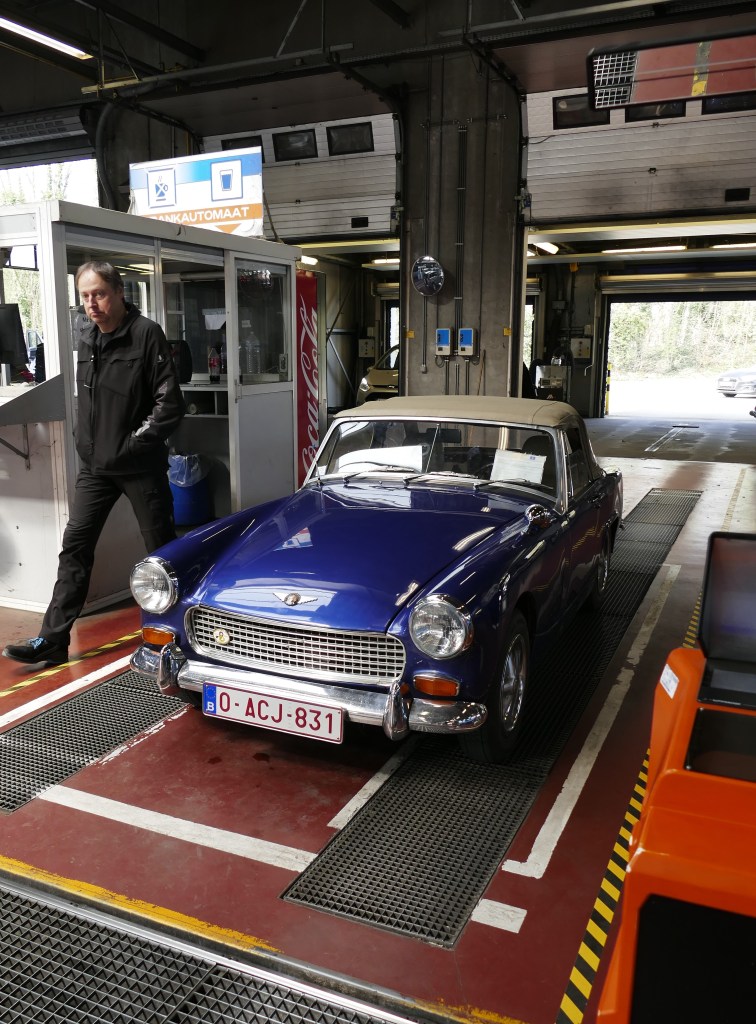
Several weeks later it was time to put it through the technical inspection. We did not expect many problems, and indeed there weren’t any. The inspectors admired the clean engine bay, and the 1275 cc Series A BMC engine, which is basically identical in the Mini Cooper S, save for the tuning. It makes the 714 kg Sprite quite a lively performer, where it develops a healthy 65 HP at 5800 rpm. Mind you, acceleration is rather brisk with 0 to 100 km/h reached in about 12,5 seconds. The engine is a long stroke unit, therefore quite flexible, developing a good torque for its size of 98 Nm at 3000 rpm.
The BMC A series engine is a very interesting and beautiful “classic” engine, and has a very long history. We will come back in more detail about this engine in further posts.
As said, the technical inspection went without a hitch, as brakes, suspension, chassis and all auxiliaries were found to be in perfect working order. The engine’s CO2 emissions were also found to be OK, taking into account the historic emission standards of course. Apparently it was a good idea that we left the carburetor settings unchanged for the time being, although the idle is still rather rough.
So we received a “green” inspection report, which is now valid for another five years.
On the way back from the technical inspection, we used the motorway for most of the trip, and the Sprite was happily cruising along with a beautiful exhaust roar at some 3500 rpm.
We now also filled up the fuel tank, choosing 98 octane fuel, and avoiding the use of Euro E10 95 octane petrol, which contains 10 pct methanol. There is a product “Classic Valvemaster plus” sold amongst others by Anglo Parts, which protects engines originally designed to run on leaded fuel for the negative effects of Methanol. Another product they distribute is EPS Ethanol protection from Millers Oils. We performed a major cleaning and detailing session with the Sprite to bring it to (almost) concours condition before we used it our next sortie , driving it to Mechelen for the “British Car Day” organised by Anglo Parts on the 26th of April, were the Sprite was proudly present on the stand of the Royal Historical Vehicle Club and met wich much interest from young and old…
This year we will turn again more regularly also to classic cars, as their importance starts to grow over the years, and your servant has always had a very keen interest in them. Indeed, I am the proud owner, since now about 47 years(!) of a 3.4 Jaguar Mk II S-Type. Over the years, a BMW Z3 roadster with a fixed hard top in the matching ice blue metallic joined my stable as my favored “Youngtimer”. You read about it regularly in these columns under the category “our cars”.
As a board member of the Royal Historical Vehicle Club Belgium, I will on my site report also regularly about the activities of this club, which will also be present at the “British Car Day”, organized by Anglo Parts at their premises on April 26. We will tell you more about this event in a following post.
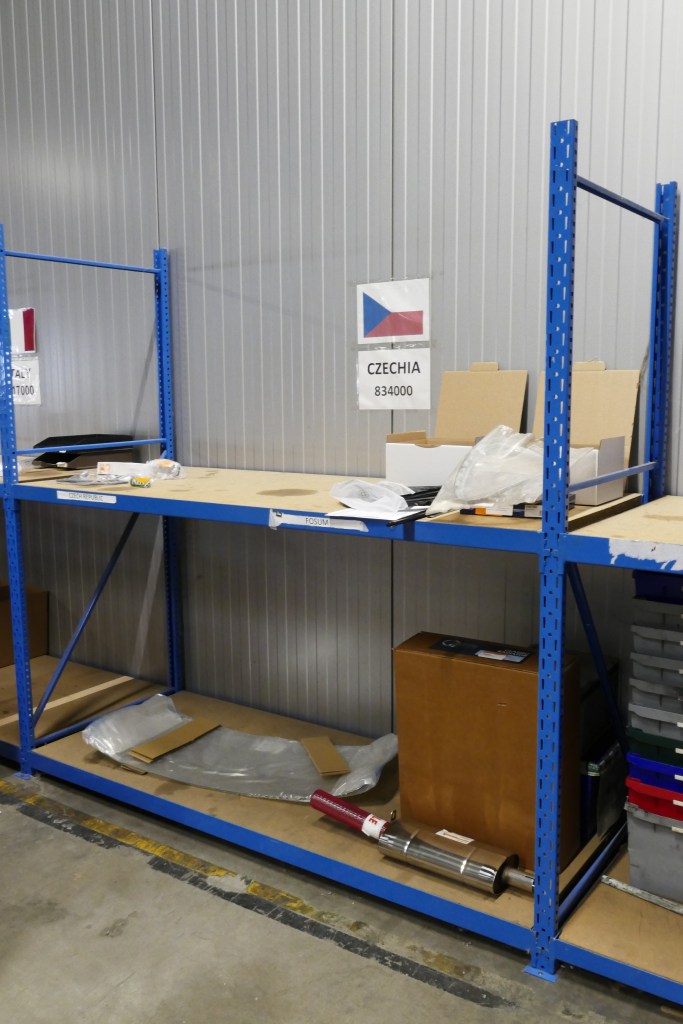
But now let’s tell you more about what I saw and heard on my recent visit to Anglo Parts. It is one of Europe’s largest online British classic car parts suppliers, and is operating in not less than 11 countries. Indeed, it regularly ships parts to the Netherlands, Italy, France, Sweden, Spain, Luxembourg, Finland, Poland, Czech Republic and Hungary. It is situated at Zandvoortstraat 53 B-2800 Mechelen, and its webshop can be reached via www.angloparts.com.
They have about 60,000 parts in stock, specializing in parts for MG, Jaguar, Triumph, Austin Healey, Land Rover, Mini and Morris Minor, actually for over 56 types of British classic cars. They are approved specialists of British Motor Heritage for MG, Mini, Triumph and Morris Minor spare parts and accessories.
Anglo Parts operates as a webshop, and therefore has a user friendly website using the original (factory) drawings as a reference to locate the parts you need. You can easily find the right parts via their index.
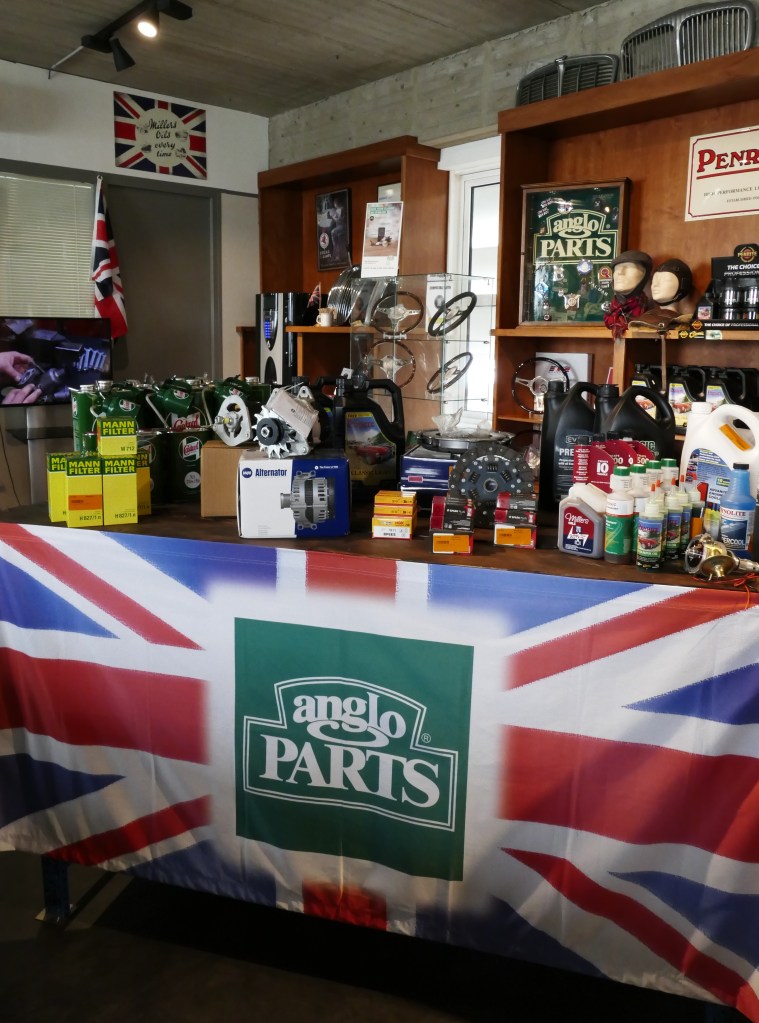
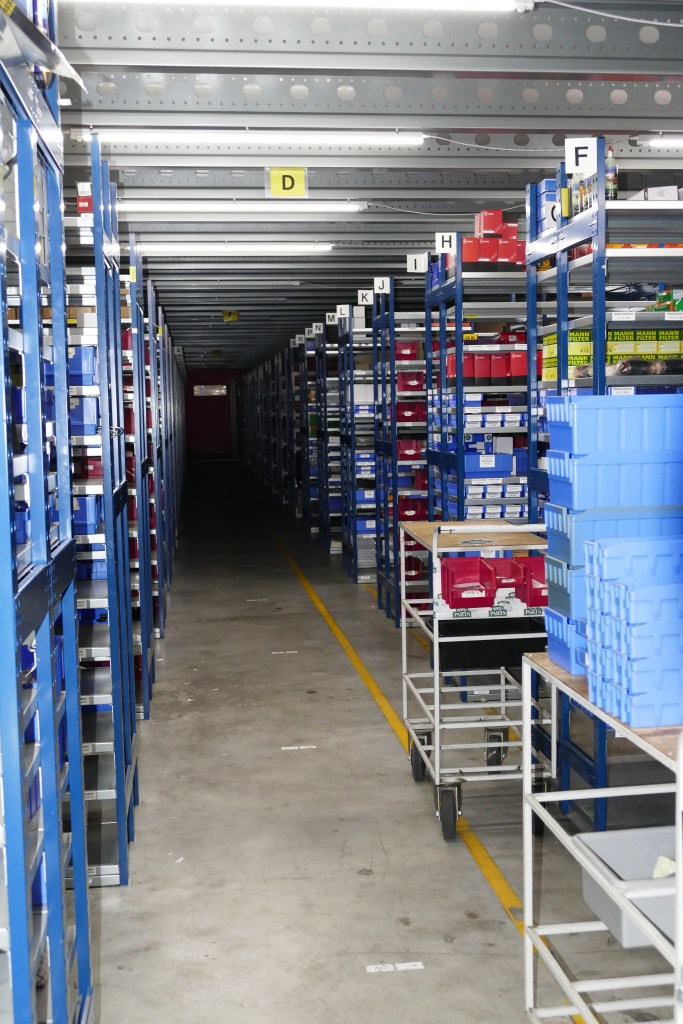
But you can of course visit the company in Mechelen, where it has its vast (2500 m2) parts warehouse and where you can collect the parts you want, and visit its shop with a host of car care products and accessories for your classic. We show you here some photos of their shop and the warehouse.
The Anglo Parts team consists of highly qualified professionals, who will assist you with expert advice in your search for the right part for your car. Many of the staff own a (British) classic themselves, so their experience really counts.
Anglo Parts also offers you products which can upgrade your classic, improve smooth running and increase its reliability. Like the fully electronic Classic Sport Ignition. All CSI systems are installed into a special housing which can’t be distinguished from original, your classic will keep its authentic look…
Anglo Parts will also offer you advice in their blog letter on their website to avoid problems when running your classic. Like for instance avoiding using Euro95 petrol, as it will be replaced by the ‘cleaner’ variant E10. This is petrol with 10% ethanol, made from beetroot for example. Whilst this is good for the environment, it might be a hazard for your classic car.
Anglo parts will also service and repair your dashboard instruments and wiper motors, amongst others…
Ethanol is highly flammable, but it can dissolve in the fuel tank, attract moist and be the cause of rust or blockages. Or, especially in classic cars, combust too soon and cause damage to your engine. The Dutch classic car federation Fehac even recommends never to use this fuel.
Soon your servant will be present at the “British Car Day” on April 26…
Hans Knol ten Bensel
Photographers’ notes:
We used again here our Panasonic Lumix DMC-FZ1000, proving its excellent versatility with its 25-400 mm Leica zoom lens. For the indoor photos, we used a film speed ISO between 1250 to 3200, which still produces no image noise whatsoever, and allowed us to stop down the aperture to F 7,1 for maximum depth of field.
The Alfa Romeo Junior series has always been a sporting icon for the Alfa Romeo enthusiast. It stood for pure efficiency, with a somewhat smaller engine and less power, but had the same undiluted sportiness as its faster and bigger brothers in the Alfa range.
So when Stellantis launches today’s Junior again for its Alfa Romeo brand, we expect something special indeed, and we were very keen to drive for you the Alfa Junior Ibrida, which has a 1,2 litre 3 cylinder turbo under the hood and enjoys a 48 volt mild hybrid system. Does this Junoir retain the unmistakable Alfa Romeo thoroughbred qualities with a drivetrain and platform, which it has in common with its many sisters in the Stellantis group?
With this Junior, Stellantis aims also at efficiency and some degree of practicality and comfort, as it wants to attract a wider range of young customers to the iconic Milanese brand. We will find out in this test whether this new Junior fulfills all these high expectations…
Hans Knol ten Bensel.
Sporty looks…
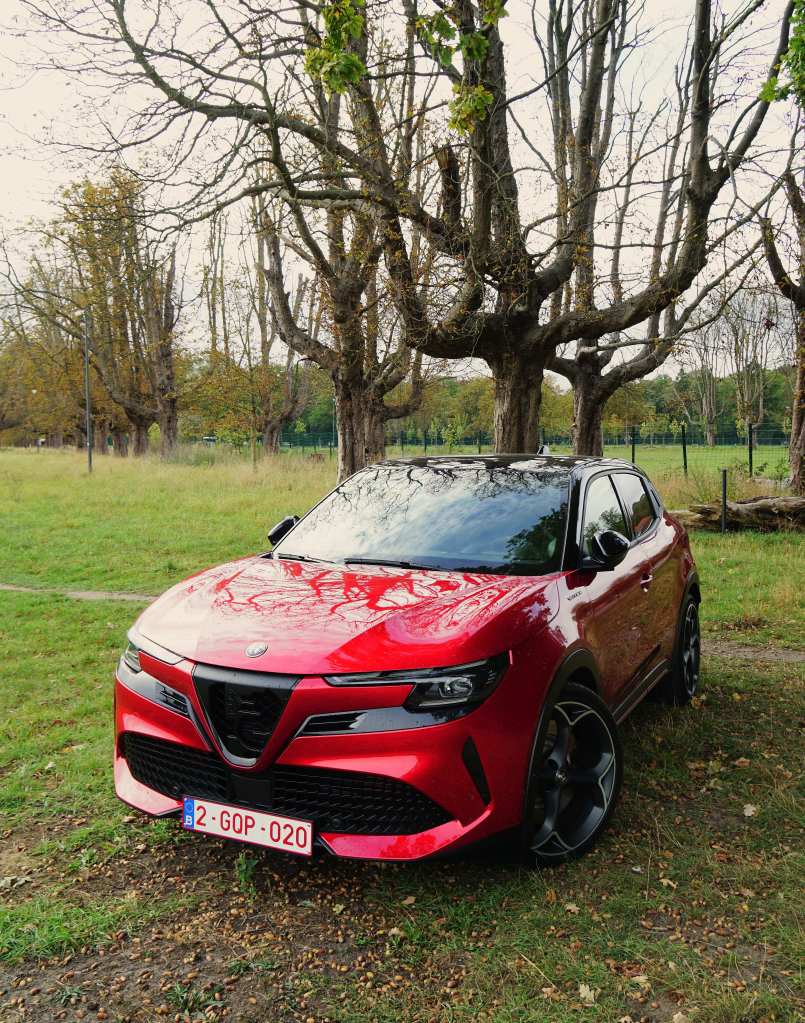
When approaching the new Alfa Junior we are seduced by its good proportions. The front grille has character, the led headlights accentuate things further and the air inlets add an agressive touch. The car looks good from the side, the rear end with its peculiar headlight shapes is somehow a departure from the typical Alfa styling language, and shows us that Alfa is also entering a new era.
But there are Alfa styling icons which remain, like the wheel alloys with circular spokes, which suit the car very well.
The cockpit has also much Alfa Character, although aficionados will miss the typical large gear-change paddles on both sides of the steering wheel column, but then again, the smaller paddles indicate that this Alfa has somehow a different mission, and indeed this Junior wants also to convince the Alfa driver with somewhat different qualities.
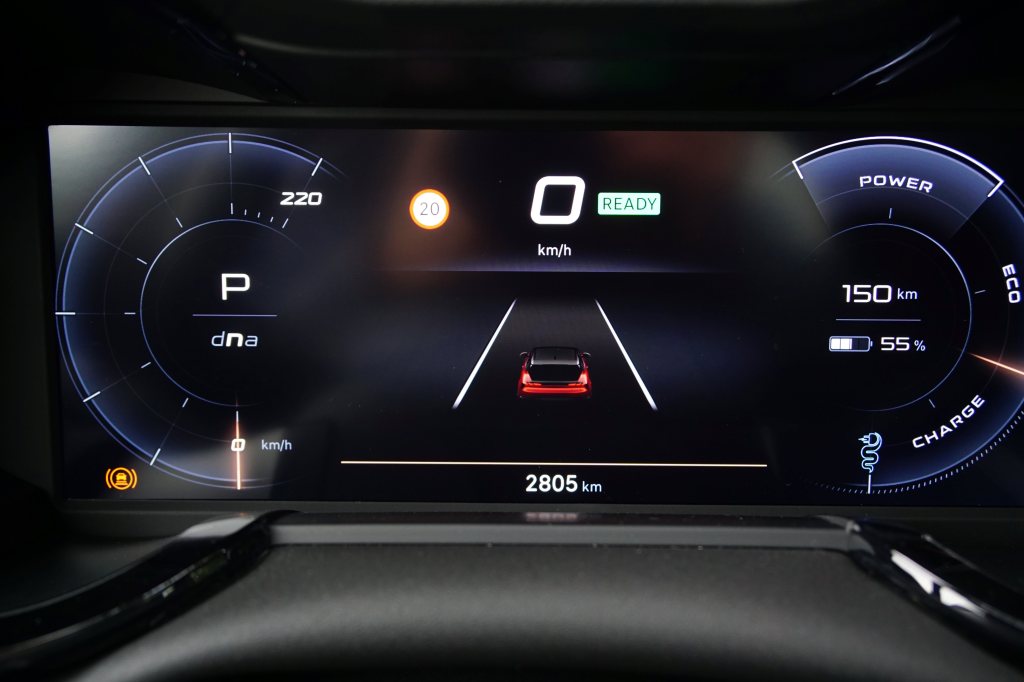
But we liked very much here again the digital instrumentation, the 10 inch large central touchscreen which is set in a stylish cluster directed towards the driver, with below it a leaner centre console, which houses the Stellantis-typical drive selector, contributing to an air of sportiness with a large circular start/stop button towering above it.
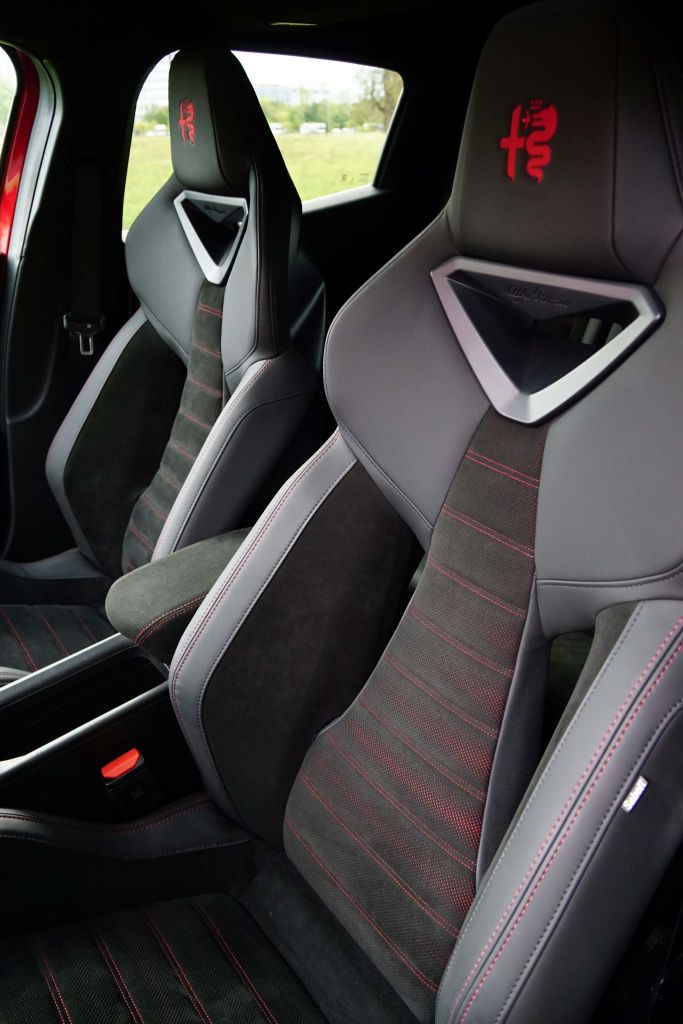
The illuminated ventilation openings adorned with the Alfa symbol also add character. We liked the color pattern of the seats, with a large central red stripe, which gives the distinct optical illusion of a glowing ribbon. The seating position is rather deep, which again accentuates the thoroughbred panache of this Alfa. Note that the seats have heating and massage functions, a distinct plus..
Everything is well finished, some harder plastics are found, but the panel surfaces of the dashboard still exude a distinct premium feeling. The ergonomics are beyond reproach, and below the central touchscreen one finds still a row of “analog” touch buttons for ventilation with, last but not least, the volume control of the radio…
Performance and handling: the DNA of a true Alfa.
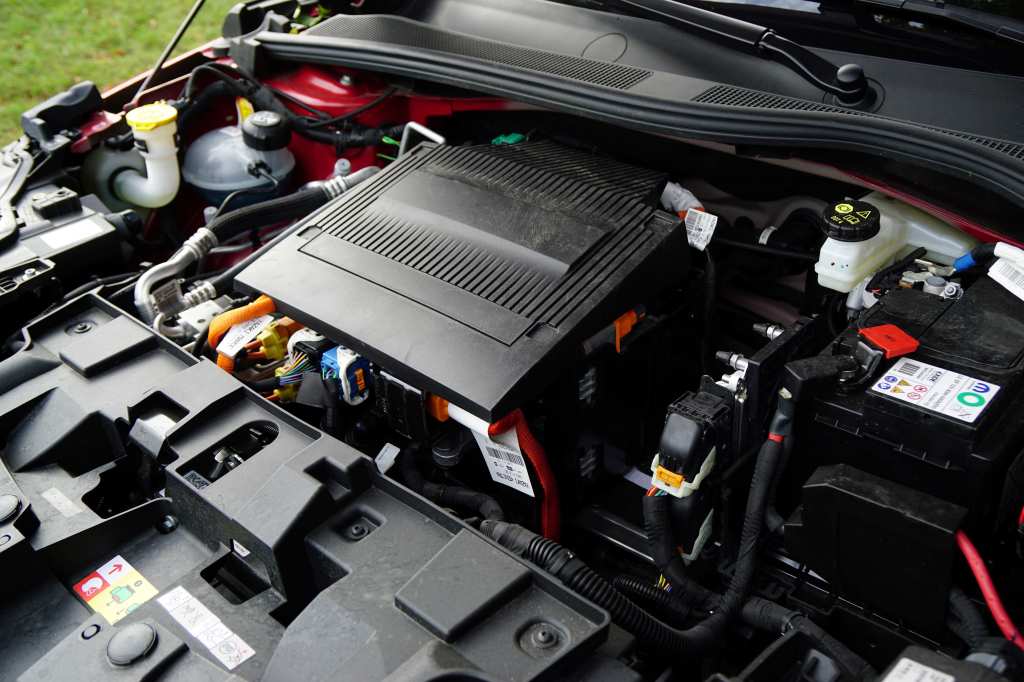
The Junior uses a 48V mild-hybrid system that combines a 1.2-litre three-cylinder Miller cycle petrol engine,with variable-geometry turbo and distribution chain for maximum reliability. The electrical component consists of a 48-volt lithium-ion battery and a 21-kW electric motor built into the 6-speed dual-clutch gearbox, which works together with the inverter and transmission control unit to ensure maximum efficiency. The total power output of the system driving the front wheels is 134bhp, enabling acceleration from 0 to 100km/h in 8.9 seconds.
Indeed, performance leaves nothing to be desired, and thanks to the support of the electric motor the acceleration from standstill is smooth and powerful. The changes of the six-speed dual-clutch automatic transmission are silky smooth under spirited acceleration, and indeed we found the whole drive-train behaving wonderfully when your right foot is somewhat heavier and you engage in a more spirited driving style.
The engineers have worked beautifully to give the 3 cylinder 1,2 litre unit, which is also found in many Stellantis models, this typical Alfa growl, reminiscent of the classic weber carburetted Veloce’s from the sixties and seventies. We just loved it.
So acceleration pleasure is to be had, and this is paired with a low fuel consumption which the classic Alfa’s never had to this extent. Yes, when cruising leasurely and avoiding high revs and (very) brutal accelerations, it is very well possible to achieve average consumptions in the 5-6 litre range, and even less.
The Ibrida is a so-called mild hybrid, this means that the electric motor, which is integrated in the transmission, has 28 HP, and the battery is also rather small with a gross capacity of 0,89 kW/h. But it does the job of giving that extra E-power smoothness and delivering E-propulsion at crawling speeds typical for start/stop situations.
The Ibrida is of course an excellent long distance motorway cruiser, with a top speed of a good 206 km/h. But it is also very much in its element on winding roads, and is both agile and completely predictable in its handling. So is this Junior an Alfa which can be driven with verve? Yes indeed, and it brings joy to motoring…
Practical and well equipped…
The luggage space is standard a good 415 liters, up to a maximum of 1218 liters. Of course Android Auto and Apple Car Play is provided, and the safety features as standard include level 2 autonomous driving, connected navigation, 180° rear camera, a handsfree electric tailgate, and a keyless system with proximity access technology as standard.
Conclusion
Is the Junior offering an attractive proposition for the die-hard aficionados of the brand? Yes it does, for us it breathes the DNA of a true Alfa. On the other hand, it offers ease of driving in town, practical everyday docility and last but not least excellent fuel economy and energy efficiency..
There are still more powerful versions, like the 280 HP Junior 280 Veloce all electric version, which weighs only 1,590 kg. It emits also a typical “Alfa Sound” during acceleration, it appears. We are very keen to lay a hand on this throughbred EV-bomb in the not too distant future…
Hans Knol ten Bensel
Photographers’ notes: for the photos here we used again our Panasonic Lumix with its Leica 25-400 mm zoom lens. Early spring wheather warranted good light conditions, which allowed a low ISO and smaller apertures, enhancing sharpness and detail.
Kia has not only adopted a new logo, it is now building cars with an avant-garde touch and style. Their EV3 has continued this new path with success, as it had been chosen European Car of the Year 2025.
For all the good reasons: not only does it run on the same dedicated, bespoke EV tech platform as its bigger sister, the also award winning EV9, it offers style, practicality, roominess, and range which put it at the top of its segment.
Needless to say,our expectations were high when we crept behind the wheel of this EV3 and admired the clean yet superbly well-designed dashboard… just read further.
Hans Knol ten Bensel
Aiming higher…
We have always believed that this Korean brand would reach the top, when we drove its cars almost a decade ago. They learned very fast, and their commitment towards innovation was unseen, while offering affordable quality, technical sophistication, and style.
Now we drive the result of this strategy, with this EV3. Just look at its overall contours and one sees that it breathes with its angular looks the styling language of today. This is a car for NOW and the years ahead.
We liked its boxy contours, its wheel contours and the styling treatment fore and aft. Also, the angular styling of the LED headlamps and rear lights are adding to a distinct lighting signature. The proportions are well chosen, and even the 19 inch alloys do not disturb the balanced contours of the car. It truly stands out, and the result is that soon the wide public will recognize it as a new generation Kia.
Modern and clever…
The same can be said of the interior. When you step in the car for the first time, you have the distinct impression that you are entering the future. A 30 inch wide display dominates the dashboard, and combines seamlessly instrumentation, infotainment and connectivity functions. Of course you can adjust heating and ventilation via the screen menus, but thankfully there are analog switches and button controls beneath the screen, which let you adjust all the functions manually. We also liked the centrally placed roll-shaped volume control, so that the front passenger can also use it. The driver has of course the same roller-styled volume control on the steering wheel…
Everything is well thought out, and indeed one can find its way and expertly use all the controls and functions of this Kia without having to use a manual, although it is ALWAYS very wise to read it…it is time very well spent!
We also liked the leather-like seat upholstery, which had a very pleasant feel and touch, with the seats also being comfortable indeed. The front seats also fully recline, so you can take a restful nap while recharging the battery.
There are also a lot of nice details on this EV3 Kia. It has aerodynamic door handles, which flip open when you press the remote key to open the car. It has a central armrest with a sliding table underneath which fits your portable PC.
After you have locked the car, you can still move the car fore and aft into tight spaces with your remote key. The sun visors can also be extended when flipped sideways to block lateral sunlight, and the central screen has a small separate cluster of symbols on its left side to make climate control a breeze. The backs of the front seats are styled to be used as coat hanger, which is indeed so practical…
Comfort put first…
The EV3 offers plenty of legroom, and this is thanks to its relatively long wheelbase of not less than 2,68 meters. The luggage space is also more than adequate for an EV, varying between 460 and 1251 liters. No worries about charging cables lying around, they are neatly tucked away in the frunk, which holds 25 liters.
The EV3 has a very comfortable suspension, and this you notice from the first meters you drive it. Its ride feels like a (very) large SUV, one is cocooned in comfort, and well insulated from potholes and rough roads. The whole cabin has also an excellent sound insulation, with virtually no tire noise entering the cabin. This allows easy listening to classical music, even at cruising speeds.
Good driving range…
This Kia invites you to drive in absolute “Zen” mood to your destination, and it is indeed a very restful car. Peace of mind abounds, also when one considers the very good driving range. Consumption according to WLTP standard is 14,9 kW/100 km, which is quite efficient for a car with a kerb weight of a good 1,8 tonnes.
The EV3 has an 150 kW/204 HP electric motor driving the front wheels, and you can choose between a standard 58,3 kW or a larger 81,4 kW battery. This means that in summer temperatures around 20 C°, a motorway range of over 400 kilometer is very well possible. Of course this range shrinks rather drastically in winter temperatures.
Say that you are cruising at 100 km/h, the range then dwindles from 401 km at 20 C° to 341 km at 0 C°. We find this still quite reasonable. When you drive somewhat slower on wintry roads, at 90 km/h, the range is then still a good 378 km at 0 C°. The manufacturer quotes higher ranges, but we consider these figures as more realistic.
When you opt for the bigger battery, the picture gets of course even more rosier. Driving at 100 km/h at 0 temperature will give you a range of 473 km, and in summer conditions at 20 C° this raises to 557 km.
In normal, everyday use, the smaller battery might be sufficient, we would think. Because the EV3 can take up to 100 kW fast charge, and this means that it will cost less than 30 minutes to recharge the battery from 10 to 80 pct, and these figures are almost reached in wintry conditions, provided one pre-conditions the battery.
Lively performance…
The 150 kW of the engine and the ample torque of 283 Nm make this EV3 truly sprint. Accelerating from 0 to 100 km/h costs merely 7,6 seconds, top speed is electronically limited to 170 km/h. More than enough for everyday driving, we would say. Maybe it is good to know that the Kia EV3 can tow up to 500 kg with the smaller battery, and even up to 1 tonne with the larger 81,4 kW battery.
Conclusion
The Kia EV3 has won its accolade as “Car of the Year” for all the good reasons. Spacious, styled for the future, practical and well equipped, with excellent efficiency and range and more than adequate performance, it offers smooth transport from A to B. It is well built and finished, it is attractvely priced and enjoys the 7 year Kia guarantee, need we say more?
The Passat is almost a lifetime with us: some 51 years now. It is now since last year in its ninth generation, and still has many followers, for all the good reasons. It offers massive space, comfort, style and economy. It is the absolute showcase of the expertise Volkswagen has achieved in building “classic” combustion engine cars, now also electrified with (plug-in) hybrid versions. It is nothing less than a benchmark in its class and even beyond. It is a top notch business and family car, and therefore only available as a station car. We drove this Passat with the “base” 1,5 eTSI engine, and Volkswagen proved here again its masterful know-how when it comes to combustion engines.
Just read further…
Space and grace
The new Passat is actually a disguised Skoda Superb, and this means that it is nothing less than a space miracle. It is 4,92 meters long, and that is a solid 15 centimeters more than its predecessor.
The wheelbase is now 2,84 meters, and you know what this means: more rear passenger legroom and premium comfort overall. Load capacity is nothing less than cavernous: from 690 to 1920 liters! Of course, the designers put practicality first, and this results in a very low loading floor height.
These generous overall dimensions of the Passat make it easier for designers to draw long fluid lines, and the Passat “Elegance” version is indeed elegant from any angle.
Stepping behind the wheel, one is impressed by the size of the car, and the aura of opulence which pervades you. Excellent fit and workmanship with soft, padded materials in the upper regions of dashboard and cabin, followed by generous and comfortable ergonomic seats, it all has distinct premium character.
VW has revamped the dashboard and infotainment of its flagship bestseller, and one finds now an optional 15 inch central display (standard it is 12,9 inch). The infotainment/navigation functions are fast and stable, even the touch/slider functions for heating/ventilation below the screen are easier to use and always illuminated.
DAB+ radio, live traffic info, Apple CarPlay and Android Auto are provided of course. Voice command and partly also ChatGPT functions are also built in.
Engine and drive train know-how…
The “base” engine is the 1,5 litre 150 HP eTSI. It carries the “e” letter because it has a 48 volt mild hybrid system. The integrated belt driven starter generator has some 15 kW power and assists the engine when pulling away from standstill or accelerating at very low speeds. It you creep or drive very slow in traffic jams, it will let you run on its E-power. If you lift the throttle at speed, the transmission will also let you freewheel, and the engine shuts completely off only to be smoothly restarted by the starter generator when you push the throttle again, optimizing the use of the kinetic energy of the Passat. It also has the selective cylinder shut off (ACT Plus). In driving situations when little power is needed, it will run on two cylinders, almost totally imperceptible by the driver.
The 7 speed DSG is smooth and reactive, so all this results in excellent economy. Driven with anticipation in urban traffic, consumption between 6-7 liters in town is very well possible, and on the open road, it drops easily between 5-6 liters. The manufacturer quotes an average consumption of 5,4 liters with CO2 emissions at 124 g/km.
Performance is quite sufficient, even with this “base” engine. 0 to 100 km/h is absolved in 9,2 seconds, top speed is a worthy 222 km/h. The beauty is that even high speed driving doesn’t cost you much more than 6 liters/100 km.
Comfort
VW engineers have payed great attention to make the Passat as quiet and refined as possible, and indeed wind, tire and mechanical noises are very subdued. This makes the Passat totally “zen” to drive over long distances. Add to this the comfortable suspension combined with stable and predictable handling, and we can put the comfort of this Passat clearly in the premium segment.
Conclusion
In these SUV times, the elegant Passat surely stands its own. It is very well equipped and finished, honed almost to perfection.
We were impressed by the overall refinement, also of the “base” version engine. Moreover, it is good to know that the Passat can be had with a wide choice of not less than 8 different engines and electrified (plug in hybrid) drive trains. We are convinced it will continue to win many hearts…
Already in 1934, the dream of the goddess of the road began: Citroën designers drew the first contours of a more streamlined body for the “Traction”, which was launched only a few months earlier.
This year we celebrate 70 years of DS, as indeed the iconic DS 19 was launched in October 1955, this year now 70 years ago.
Reason enough to delve into the stunning history of the birth of this goddess, and subsequently also DS Automobiles, who since 2014 carries further the tradition of making superbly styled, avant-garde automobiles offering exquisite comfort and panache.
Your servant started to delve into his archives, and here is a tale, which every car enthusiast can adopt as an exquisite story to be told at a dinner table with friends and family, about the men with a unique “Génie Français” which led to the birth of a truly unique automobile.
Hans Knol ten Bensel
But development work started rather in earnest in 1938, when Pierre Boulanger codenamed the project for a successor of the Traction VGD, or “Voiture à Grande Diffusion”
The man behind it all: Pierre Boulanger...
But first a word about the actors of this unique engineering adventure. It starts with Pierre Boulanger, who was a so-called “Michelin man”. He started working for Michelin in 1918, reporting directly to Eduard Micheli, co-director and founder of the business. Boulanger joined the Michelin board in 1922, and in 1938, he became the company’s joint managing director.
What has Michelin to do with Citroën? In December 1934, despite the support of the Michelin company, Citroën filed for bankruptcy. In that same month Michelin, already the car manufacturer’s largest creditor, decided out of necessity to become its principal shareholder.
Pierre Boulanger then became the assistant of Pierre Michelin, who was already the chairman of Citroën. Boulanger became the vice-president and chief of the Engineering and Design department. He became president in 1937 until his accidental death behind the wheel of a Traction 15 CV . He also jointly managed the Michelin company.
Pierre Boulanger was already since 1936 working on a project to create the TPV (short for ‘Très Petite Voiture’). This led, as you might already know dear reader, to the birth if the 2 CV, affectionately called by the French “La Deuche”.
The driving genius of the project: André Lefebvre …
But let’s go back to our VGD project, which he started with the help of André Lefebvre, the spiritual father of the Traction. Another most important actor in our tale. He was an engineer with unique insight and creativity, with a wonderful talent to think out of the box. He was a lifelong friend of aviator, artist and also car designer and engineer André Voisin. And this is a man who designed and built absolutely stunning cars.
André Lefèbvre in his younger years, a keen racing engineer, working for Voisin…
We show you here a photo of the Voisin which was to be seen in the Brussels Autoworld museum last year. It was also André Voisin who recommended Lefebvre to André Citroën.
The man behind the hydropneumatic suspension: Paul Magès
The genius who invented and developed the legendary hydraulic suspension was Paul Magès. He came to Citroën as a draughtsman at the age of 17 and a half, and made a wonderful career thanks to its practical sense, creativity and entrepreneurship. In September 1940 he was promoted to quality engineer and in 1942 Pierre Boulanger included him in his research team, to create and develop a suspension system for the 2 CV. Here his out of the box thinking and creativity proved crucial.
Already early in the development, he saw the advantages of a liquid that would compress a gas. It was a new idea that Paul Magès began to experiment with in 1944 on a 2 CV with a very crude system comprising 1 gas tank per wheel, which theoretically made it possible to vary the flexibility from one to four, with a gas and a liquid separated by cork. Cork will not withstand high pressure however. This archaic start is refined, perfected, tested a multitude of times, and the results are always more surprising. Paul Magès then created his own team which manufactured all the organs itself. The skills of each person are at stake, in the feverish atmosphere of research. The theory gradually became reality, the concept was simplified, the tests multiplied, the results were refined.
First trials of a hydropneumatic suspension on the 2 CV prototype…
In 1946, Pierre BOULANGER encouraged Paul Magès to continue his research, no longer on the 2CV but this time on a front-wheel drive, because it was necessary to think about the future VGD car. (Mass Circulation Car)
Besides the suspension, the car had to be revolutionary, and Boulanger proposed a monocoque structure in which the centre of gravity would be as low as possible, the roof and bonnet would be of aluminium and the floorpan would support unstressed, lightweight body panels.
The hydraulic suspension found its way on the rear axle of the six cylinder 15 CV Traction…
In 1949, Paul Magès, after multiple tests, finally developed a hydropneumatic suspension that he put to the test in the cold in the Nordic countries, then in Algeria for resistance to high temperatures. It was from this adventure that the idea of a manual height control was born, in order to allow the vehicle to face snow or chaotic terrain. Other trials will be the source of questioning, creations, and multiple improvements. In 1953, the hydropneumatic suspensions were deemed reliable enough to equip the 15 six, then the DS 19…
But soon more about the story of the DS in the following 70 years since its birth…
Lancia is back in Belgium, and was indeed also present at the Brussels Motor Show with the New Ypsilon hybrid & full electric. The Ypsilon Rally4 HF was also showcased, marking the return of Lancia in Rally in 2025. The HF took a central place on the Lancia stand, and as it was developed and fine-tuned by Miki Biasion, the motorsport legend and World Rally Champion with Lancia. Miki was also present at the Belgian event.
The HF Rallye version wans unveiled on the Lancia stand at the 101st Brussels Motor Show…
The renaissance of Lancia is very important for Stellantis, and a well balanced internationalisation process is under way. It is an essential part of of Lancia’s Renaissance, which includes an initial network of 70 new showrooms in 70 major European cities.
Charles Fuster presenting the Lancia Ypsilon HF on September 10th last year in Aartselaar…
The first markets involved are France, Spain, Belgium-Luxembourg, the Netherlands, and, by 2025, Germany. All of these showrooms will feature the brand’s new corporate identity, which reflects the four pillars at the foundation of its strategic plan: quality, electrification, sustainability, and an innovative sales model.
Lancia celebrated its return to Belgium-Luxembourg last September with the inauguration of six showrooms in Aartselaar, Overijse, Kortrijk, Ghent, Gilly and Bertrange, and the recent addition of locations in Drogenbos, Hasselt, Namur and Herstal. as well as 14 service points. Your servant was present at the inouguration in Aartselaar, and you find my report in our columns.
Reason enough for us to have an interview with Charles Fuster, VP Global Marketing and Communication.
Hans Knol ten Bensel
HKTB: My question turns around the strategy of the brand in the coming one or two years.
CF: When we started with saying “Lancia is Back” three years ago, we said that we have three pillars for this comeback. First of all, there is the product line up. And we are keeping our promises, with the introduction of the Ypsilon, and after six months we launched the HF version, which you see here on our stand in Brussels. The return is super positive, by journalists and the public.
Lancia goes with its new Ypsilon from mainstream to premium…
The further product is the Lancia Gamma, which will roll of the production line in our factory at Melfi. It will come in 2026. The second pillar is to build a new brand identity, we have now 160 new showrooms in Italy, all refurbished. Back in the day Lancia was presented in a corner in the showroom, now we have a dedicated showroom and dedicated sales people.
The elegant Ypsilon at the Brussels Motor Show…
The third pillar was then to launch Lancia in Europe. This is our internationalisation process, and in November we have officially relaunched Lancia in Belgium, the Netherlands, France and Spain.
HKTB: What will you do in 2025?
CF: This year, it will be the first full year of the Ypsilon, and the HF which will hit the market this spring and summer. With this car, we are back into Rally Motorsport. We start in Italy in April, with the Italian Cup, next year the European Championship, and at the end of 2025 we start getting ready for the launch of the new Gamma.
HKTB: What do you expect for the Ypsilon in the Belgian market?
CF: The Belgian public loves Italy. They also love cars and motorsport. When you put Italian cars in the rally scene, you end up with Lancia, so our ambition is quite strong here. I think we can do well, 10 years ago we were doing well in Belgium, so we expect the same results more or less.
There are sporting sedans which are engaging to drive. But then there is the Alfa Romeo Giulia. It sets the absolute standard in its class when it comes to balanced handling and panache. And since its introduction in 2017, this Giulia remains unchallenged in its class until this day. We experienced this again at the wheel of the new ”Tributo Italiano” version, equipped with 4 wheel drive and its legendary 280 HP 2 litre direct injection petrol engine. Read further…
Hans Knol ten Bensel
Thoroughbred looks
This Tributo Italiano version certainly makes your car loving heart beat faster. The timelessly well proportioned body is painted either in ’’Rosso Alfa”, ’’Verde Montreal’’ or ’’Bianco Alfa.’’ You guessed it, these are the colours of the Italian flag… this Giulia also has wonderful 19 inch black alloys and red painted brake calipers.
In the cabin the black sports seats are adorned with red stitching, also found in the door panels and the dashboard edges. The front seats are heated and ventilated, your ears are spoiled by a 14-speaker Harman Kardon sound system.
Behind the wheel…
Sitting in the Giulia is low and sporting, with everything beautifully within reach. Certainly the big sized gearchange paddles on the steering wheel, worthy of a supercar, and so easy to reach also when you are making extensive steering movements. Totally Pur Sang, and one asks oneself why not every car with sporting aspirations has this too. The engine starts smoothly by pressing the knob on the steering wheel. A true gem is this 2 litre four cylinder, with ample torque and power. It develops not less than 280 HP, which indeed results in supercar performance.
What to think of a top speed of some 257 km/h, and an acceleration from 0 to 100 km/h in merely 5,5 seconds? Thanks to the ample torque, the pulling power is also quite massive at intermediate speeds, where of course the excellent and alert 8 speed auto box comes also into play. Leaving the lever in ’’D’’, the Giulia sprints from 70 to 120 km/h in just 5,8 seconds.
The Giulia is also reasonably frugal at constant speeds, at a cruising speed of 130 km/h, consumption is around 7,51 liters. In town, with some restraint, one can achieve between 8,7 and 9,5 liters/100 km, cruising at 110 km/h will cost you around 6,4 liters. Our average consumption during a quite extended test resulted in 8,1 liter/100 km.
Beautiful handling
What one feels behind the wheel of this Alfa from the first few meters is its the wonderful balance and handling. It still runs on the Georgio platform, developed long before electrification, and this in collaboration with the chassis engineers from Ferrari and Maserati. This resulted for instance in a truly ideal weight distribution of 51% at the front and 49 % at the rear.
You guessed it, this Giulia has a balance, steering precision and handling which is honed to absolute perfection. Steering this Giulia on winding roads is totally a dream. The suspension set up strikes an ideal compromise between precise handling and comfort, and indeed this Giulia is surprisingly comfortable considering its excellent agility. On top of all that this 280 HP Giulia has 4wd, which sets in when necessary. Normally, the rear wheels are driven.
The engine revs to a beautiful staccato when called for, but this never gets unobtrusive, and also high speed cruising does not unduly raise the noise levels in the cabin, making the Giulia a magnificent Gran Turismo, as we experienced driving it into France.
Practical
The Giulia offers adequate room in the rear, and luggage space is also quite reasonable with 378 liters. Infotainment is now since the latest facelift where the Giulia also received new LED headlights up to the mark, with of course Apple Carplay and Android Auto connectivity installed. The digitalized instrumentation in the cluster in front of the driver is well executed with an excellent rendering of both speedometer and rev counter, and indeed, instrument buffs as we are, we did not miss the previous beautiful analog instruments. We liked to find again the trusted DNA driving mode selector on the centre console.
Conclusion
This Giulia truly stands out, and is nothing less than a true supercar within the Stellantis portfolio. Its engine is a marvel, and it is therefore with good reason that we will see this formidable unit soon in top of the range Peugeots… Then there is the Georgio platform, which breathes the aura of ’’Puro Sangue.’’ Precision, agility and wonderful balance between comfort and superb roadholding and stability is the hallmark of this platform, and it has to be experienced behind the wheel to fully appreciate it.
Last but not least there is the overall styling, the ideal proportions and the panache of the Giulia. It is for many the quintessential Alfa, and this is the best compliment we can give this car…
Hans Knol ten Bensel
Photographers’ notes:
We again used our Nikon D5600 for this photo session. The strong autumn light of the French midi created vivid contrasts, which the camera handled well… We used B & W for one interior photo, to give it a “classic” look…
The breathtaking contours of the award winning Maserati A6GCS/53 Berlinetta by Pinin Farina, presented by the Brussels Autoworld museum on their stand.
The 9th edition of the Interclassics car show proved again a formidable event. The 40.000 m2 spread over several palaces was filled with collectible four wheeled beauties, and lovers of Italian, British, German, French or last but not least American classics could have a true delightful time from Friday 15 to Sunday. Your servant also took his Fujifilm X-A5 camera along, and shares here with you his impressions.
Hans Knol ten Bensel
D’Ieteren celebrates 345 years of heritage…
The dynamic PR department of D’Ieteren invited me to their magnificent stand, where they celebrated the anniversaries of some of the most iconic models of the brands they import into our country.
To present the rich history of its brands, D’Ieteren adopted the theme of the evolution of technology, and so displayed the vintage models of the Volkswagen Golf, Audi 100, SEAT Ibiza, Škoda Octavia and Porsche 911 alongside their current versions. The cute Microlino was also present, next to the iconic BMW Isetta…
What better for me to do than to aim my Fujinon lens to bodywork details of both current and vintage cars, visually telling the story of progress along many decades…
Down to the very essence: the “dashboard” of the BMW Isetta…
The electric Microlino continues this tradition of “less is more…”
In doing this, I found it remarkable how ”modern” the Porsches still look, and indeed a ”classic” Porsche hardly feels out of place five decades later. What’s more, its sheer performance and road manners still are impressive today. Actually, the same can be said of the ”Ur” Golf, its proportions, styling, performance and overall stance are still quite modern.
Porsche celebrated the 50th anniversary of the Porsche 911 Turbo . The Porsche 911 Turbo Type 930 made its debut in 1974. I still have the fondest memories of these early Porsche 911’s. As a young car journalist I drove them to the limit, enjoying their delicate handling, the hiss of the air cooled flat six at high revs, the tout feel and precision of the whole car. Indeed, Porsche’s are unique, and once you sat behind the wheel of them, they make an indelible impression.
Celebrating 50 years of Audi in Belgium , D’Ieteren also put a truly pristine and original Audi 100 L Automatic alongside the brand new A6 e-tron, which has just hit the market. It completed this with an equally formidable 100 Coupé.
The dramatic styling details of the ’74 Audi S Coupé…
And the clean lines of the S6 e-tron…
Bentley showed a recent 2022 Flying Spur alongside a mid ‘80s Bentley Turbo R. This now classic Bentley brings back sweet personal memories, as I was invited to drive this impressive powerful V8 turbocharged saloon personally from Brussels to le Mans to attend the 2003 Le Mans 24 hour race, witnessing the event from the Bentley pit stand, and see the Bentley Speed 8 win the race!
Massive power with style…
Seat celebrated 40 years of the Ibiza, showing an immaculate 1984 model, shown here below.
Automotive technical evolution was most apparent when one compared the 65 year old Skoda Octavia Break 1201 with the present Octavia. Understandable, as in the mid sixties, the styling and technology of the products behind the iron curtain were somewhat lagging behind what was made in the west, and indeed, a time span of more than six decades is also very long indeed.
Last but not least there was the Microlino on the D’Ieteren stand, next to the car which inspired it, the BMW Isetta. Similar in shape, but totally different in technology.
Of course, there were some beautiful American classics on the show. Just look at the 1956 Chevrolet Bel Air Nomad Sport Wagon shown here on the stand of the Royal Historical Vehicle Club Belgium…
Maserati, or the unique magic of pur sang…
The quality of the Maserati’s on display was nothing short of stunning, and the car which was prized best of show was a pale blue A6GCS/53 Berlinetta by Pinin Farina, presented by the Brussels Autoworld museum on their stand. I show you here some photos of this gorgeous coupé. I am totally smitten by its feline stance and wonderful proportions.
It just has tons of character, and it embodies everything the brand with the trident stood and still stands for. This ninth edition of the Brussels Interclassics was certainly a wonderful show, and we are already looking forward to the next edition. Just enjoy the photos…