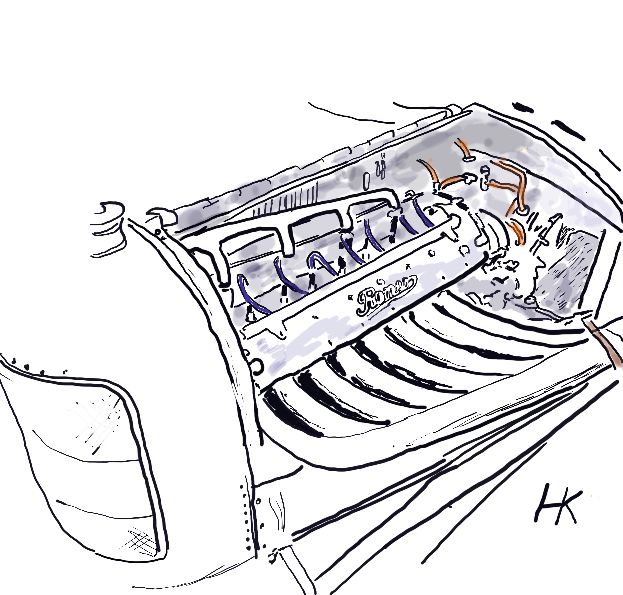
Dear reader, we now take you back to the twenties. To the days where engines counted most in a racing car. Aerodynamics and chassis design, tyres and brakes where timidly starting to develop, the focus was on the engine. A true genius designed it for Alfa Romeo. His name was Vittorio Jano.
Actually, he was born as Viktor János in San Giorgio Canavese, in Piedmont, son of Hungarian immigrants, who settled there several years earlier. He began at the car and truck company Società Torinese Automobili Rapid owned by G.B. Ceirano. In 1911 he moved to Fiat under Luigi Bazzi. He went with Bazzi to Alfa Romeo in 1923 to replace Giuseppe Merosi as chief engineer.
There is also a truly wondrous story to tell about the designers of Fiat and their engineers in the period between the two world wars, and it will be subject of a later series where we will present drawn portraits of the men and women who marked our automotive history.

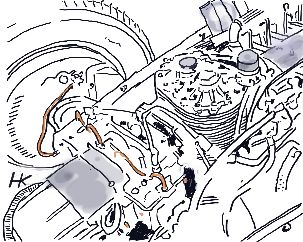
Here one sees the carburettor side of the engine, its architecture being an example for all Alfa engines to follow, right until this day… On both drawings, some watercolor was added.
His first design with Alfa Romeo was the 8-cylinder in-line mounted P2 Grand Prix car, which won Alfa Romeo the inaugural world championship for Grand Prix cars in 1925. But he was going to do much, much more for Alfa. In 1932, he produced the sensational P3 model which later was raced with great success by Enzo Ferrari when he began Scuderia Ferrari in 1933. We will also bring a special about this marvelous engine.
Jano also definitely established Alfa’s engine architecture, and indeed made Alfa technically what is Alfa all about. For the Alfa series production cars, Jano developed a series of small-to-medium-displacement 4-, 6-, and 8-cylinder inline power plants based on the P2 unit that established the classic architecture of Alfa engines, with light alloy construction, hemispherical combustion chambers, centrally located plugs, two rows of overhead valves per cylinder bank and dual overhead cams…
Indeed, this straight 8 engine is the architectural forerunner of what a classic Alfa engine is right until this day.
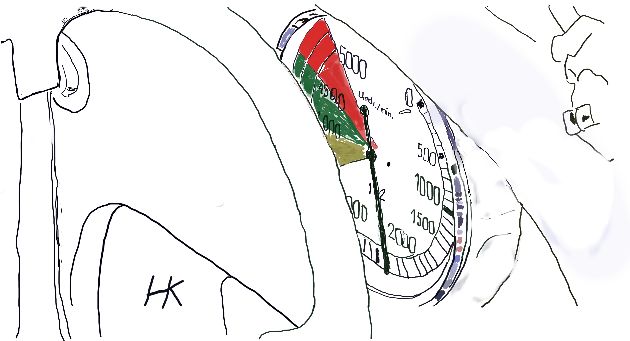
This 1,987 cc engine had Twin Roots Superchargers and 2 Memini carburettors, developed 140 bhp (104 kW) @ 5500 rpm in 1924, and 155 bhp (115 kW) a year later. As the P2 did only weigh 614 kg, it was fast enough to win 14 grand prix until 1930, and embodied together with the Bugatti 35 the most iconic grand prix cars in the twenties.
Its designer Vittorio Jano would in 1937 move to Lancia, and later to Ferrari, where he designed the V6 and V8 engines, which are still a technical basis for the Ferrari’s today…
Hans Knol ten Bensel