Lifeblood for your British classic car: we visited Anglo Parts…  

This year we will turn again more regularly also to classic cars, as their importance starts to grow over the years, and your servant has always had a very keen interest in them. Indeed, I am the proud owner, since now about 47 years(!) of a 3.4 Jaguar Mk II S-Type. Over the years, a BMW Z3 roadster with a fixed hard top in the matching ice blue metallic joined my stable as my favored “Youngtimer”. You read about it regularly in these columns under the category “our cars”.
As a board member of the Royal Historical Vehicle Club Belgium, I will on my site report also regularly about the activities of this club, which will also be present at the “British Car Day”, organized by Anglo Parts at their premises on April 26. We will tell you more about this event in a following post.

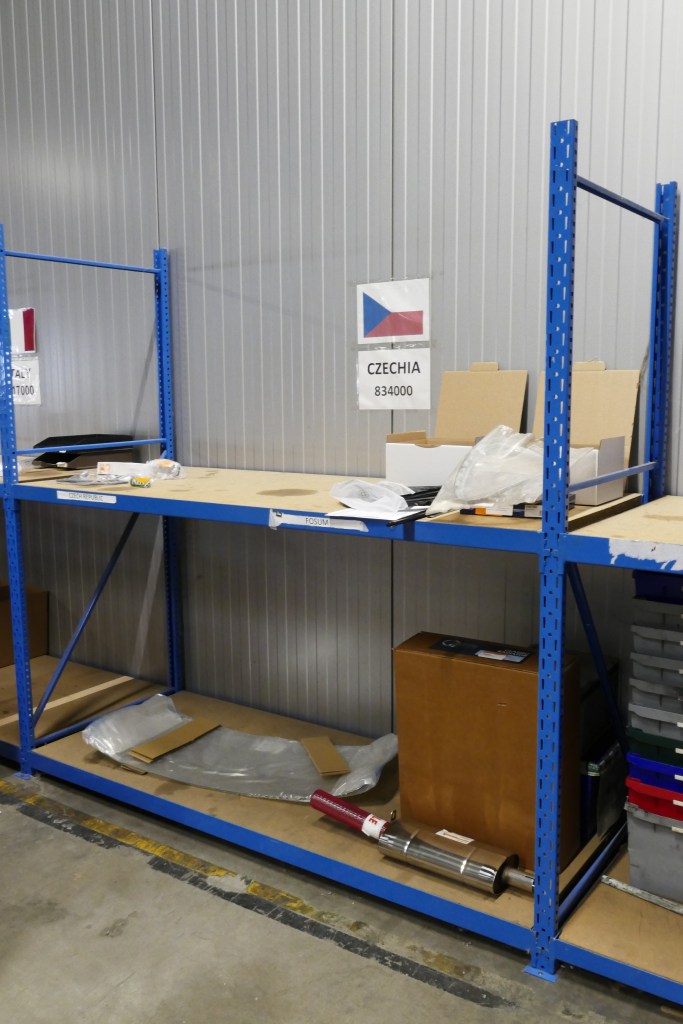
But now let’s tell you more about what I saw and heard on my recent visit to Anglo Parts. It is one of Europe’s largest online British classic car parts suppliers, and is operating in not less than 11 countries. Indeed, it regularly ships parts to the Netherlands, Italy, France, Sweden, Spain, Luxembourg, Finland, Poland, Czech Republic and Hungary. It is situated at Zandvoortstraat 53 B-2800 Mechelen, and its webshop can be reached via www.angloparts.com.
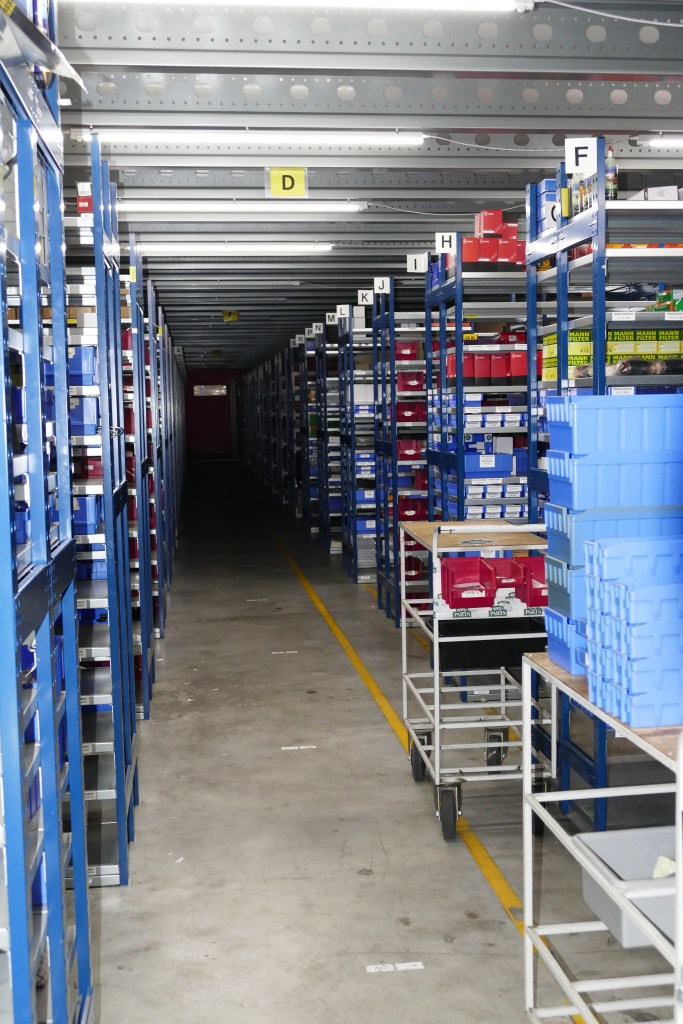
They have about 60,000 parts in stock, specializing in parts for MG, Jaguar, Triumph, Austin Healey, Land Rover, Mini and Morris Minor, actually for over 56 types of British classic cars. They are approved specialists of British Motor Heritage for MG, Mini, Triumph and Morris Minor spare parts and accessories.
Anglo Parts operates as a webshop, and therefore has a user friendly website using the original (factory) drawings as a reference to locate the parts you need. You can easily find the right parts via their index.

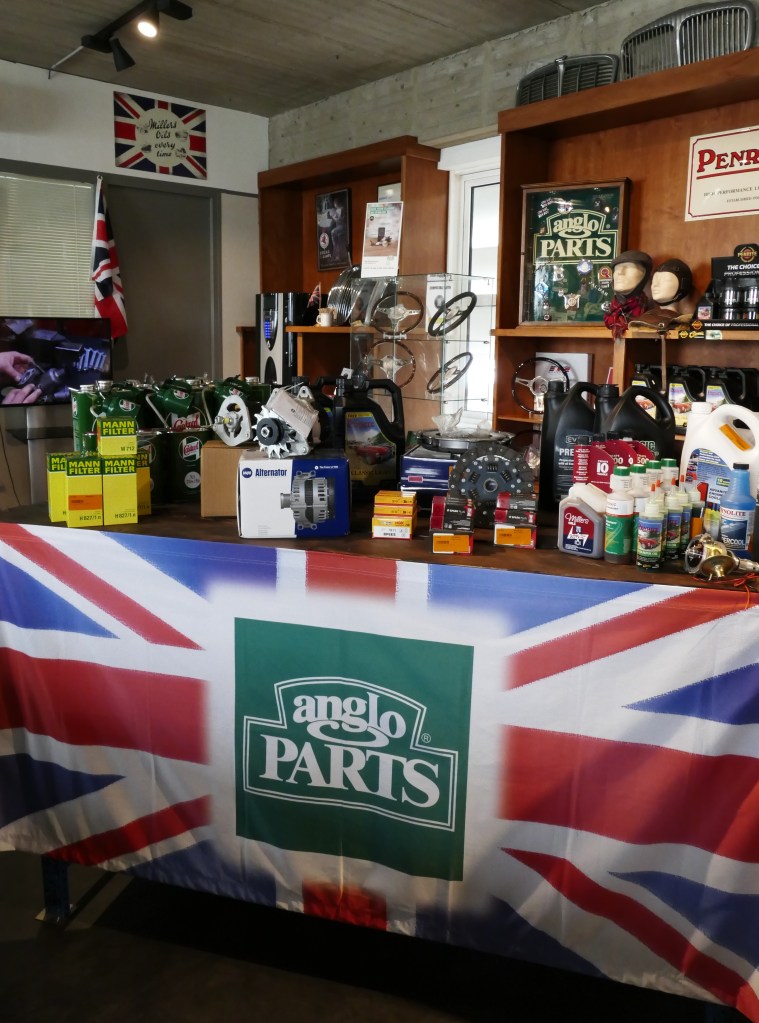
But you can of course visit the company in Mechelen, where it has its vast (2500 m2) parts warehouse and where you can collect the parts you want, and visit its shop with a host of car care products and accessories for your classic. We show you here some photos of their shop and the warehouse.

The Anglo Parts team consists of highly qualified professionals, who will assist you with expert advice in your search for the right part for your car. Many of the staff own a (British) classic themselves, so their experience really counts.

Anglo Parts also offers you products which can upgrade your classic, improve smooth running and increase its reliability. Like the fully electronic Classic Sport Ignition. All CSI systems are installed into a special housing which can’t be distinguished from original, your classic will keep its authentic look…

Anglo Parts will also offer you advice in their blog letter on their website to avoid problems when running your classic. Like for instance avoiding using Euro95 petrol, as it will be replaced by the ‘cleaner’ variant E10. This is petrol with 10% ethanol, made from beetroot for example. Whilst this is good for the environment, it might be a hazard for your classic car.

Anglo parts will also service and repair your dashboard instruments and wiper motors, amongst others…

Ethanol is highly flammable, but it can dissolve in the fuel tank, attract moist and be the cause of rust or blockages. Or, especially in classic cars, combust too soon and cause damage to your engine. The Dutch classic car federation Fehac even recommends never to use this fuel.

Soon your servant will be present at the “British Car Day” on April 26…

Hans Knol ten Bensel

110 years Maserati was celebrated at Interclassics Brussels…and so much more!

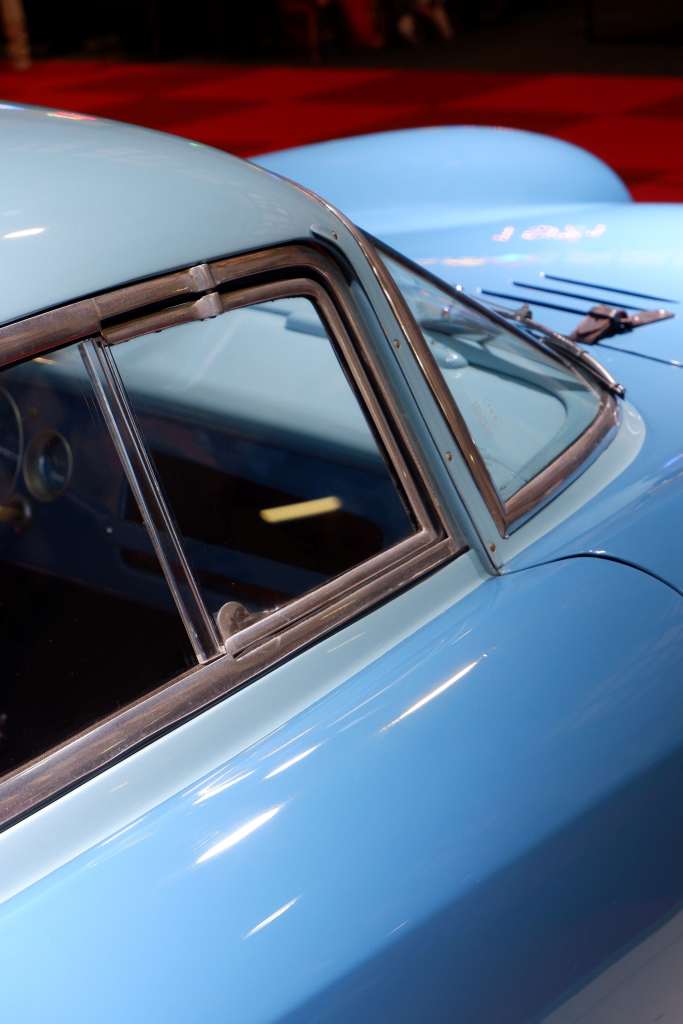
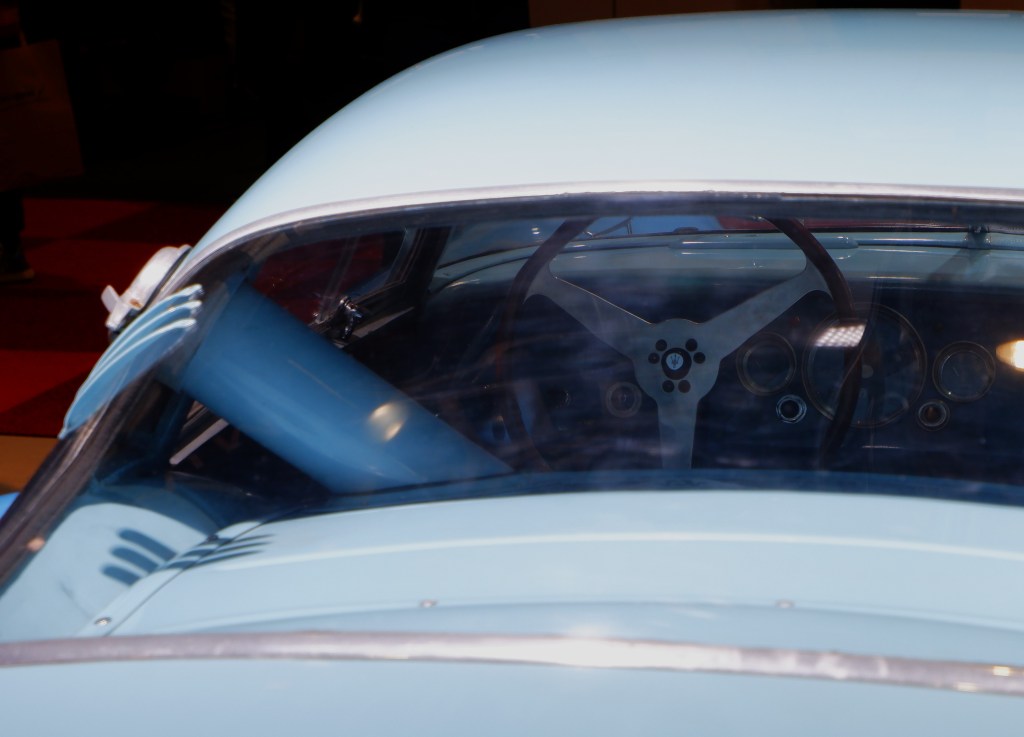
The breathtaking contours of the award winning Maserati A6GCS/53 Berlinetta by Pinin Farina, presented by the Brussels Autoworld museum on their stand.

The 9th edition of the Interclassics car show proved again a formidable event. The 40.000 m2 spread over several palaces was filled with collectible four wheeled beauties, and lovers of Italian, British, German, French or last but not least American classics could have a true delightful time from Friday 15 to Sunday. Your servant also took his Fujifilm X-A5 camera along, and shares here with you his impressions.

Hans Knol ten Bensel

D’Ieteren celebrates 345 years of heritage…

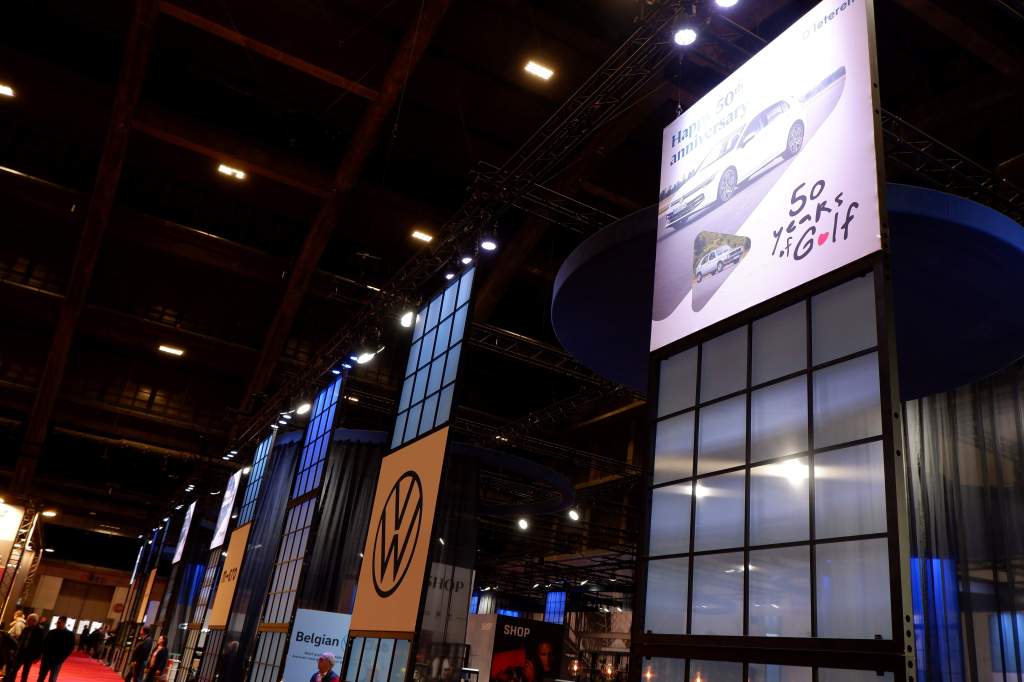
The dynamic PR department of D’Ieteren invited me to their magnificent stand, where they celebrated the anniversaries of some of the most iconic models of the brands they import into our country.

To present the rich history of its brands, D’Ieteren adopted the theme of the evolution of technology, and so displayed the vintage models of the Volkswagen Golf, Audi 100, SEAT Ibiza, Škoda Octavia and Porsche 911 alongside their current versions. The cute Microlino was also present, next to the iconic BMW Isetta…

What better for me to do than to aim my Fujinon lens to bodywork details of both current and vintage cars, visually telling the story of progress along many decades…

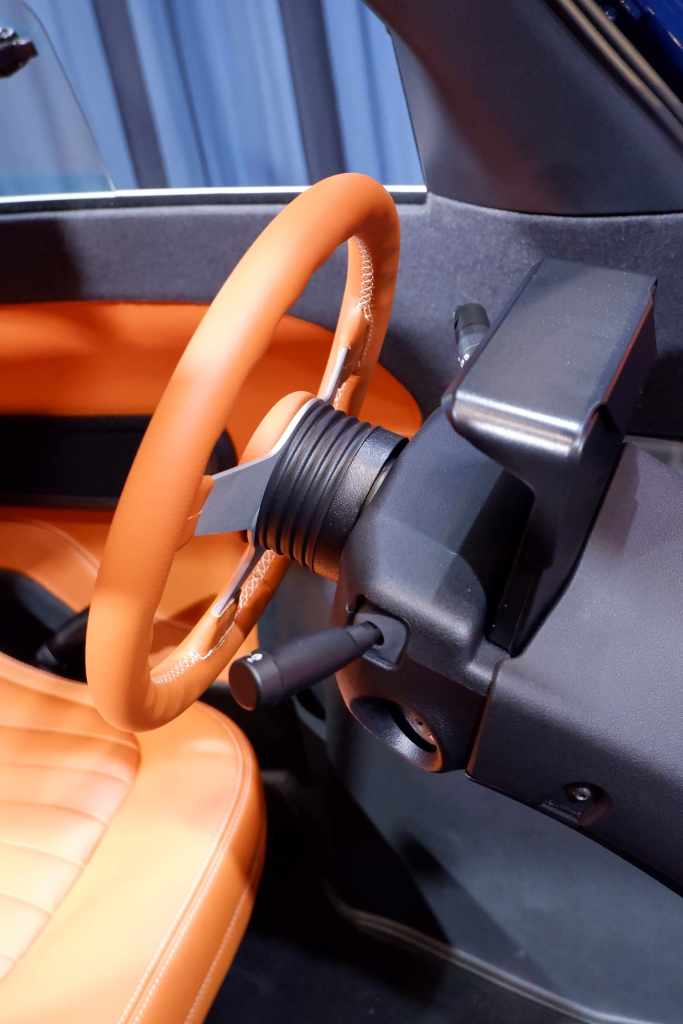
Down to the very essence: the “dashboard” of the BMW Isetta…

The electric Microlino continues this tradition of “less is more…”

In doing this, I found it remarkable how ”modern” the Porsches still look, and indeed a ”classic” Porsche hardly feels out of place five decades later. What’s more, its sheer performance and road manners still are impressive today. Actually, the same can be said of the ”Ur” Golf, its proportions, styling,  performance and overall stance are still quite modern.


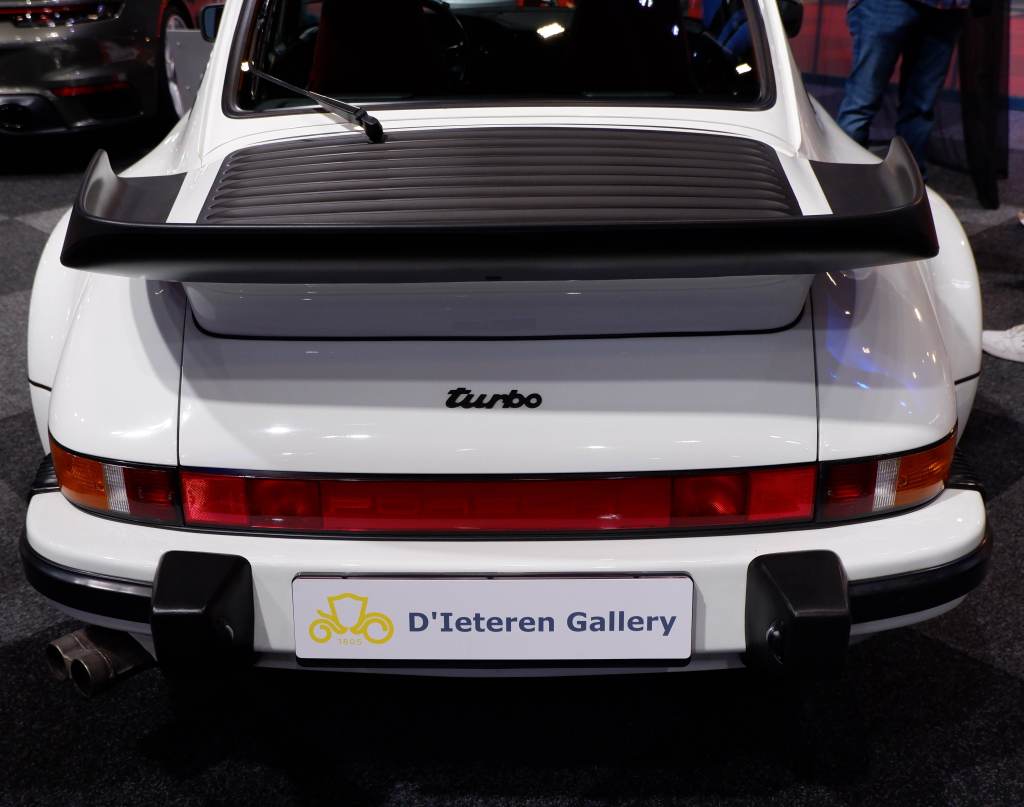
Porsche celebrated the 50th anniversary of the Porsche 911 Turbo . The Porsche 911 Turbo Type 930 made its debut in 1974. I still have the fondest memories of these early Porsche 911’s. As a young car journalist I drove them to the limit, enjoying their delicate handling, the hiss of the air cooled flat six at high revs, the tout feel and precision of the whole car. Indeed, Porsche’s are unique, and once you sat behind the wheel of them, they make an indelible impression.

Celebrating 50 years of Audi in Belgium , D’Ieteren also put a truly pristine and original Audi 100 L Automatic alongside the brand new A6 e-tron, which has just hit the market. It completed this with an equally formidable 100 Coupé.

The dramatic styling details of the ’74 Audi S Coupé…

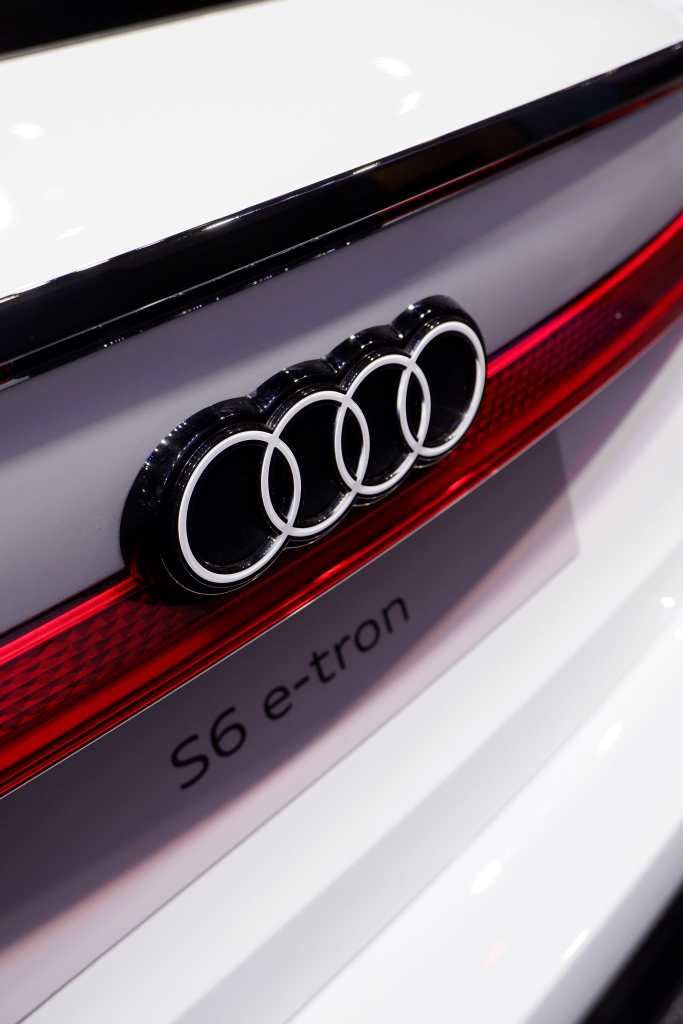
And the clean lines of the S6 e-tron…

Bentley showed a recent 2022 Flying Spur alongside a mid ‘80s Bentley Turbo R. This now classic Bentley brings back sweet personal memories, as I was invited to drive this impressive powerful V8 turbocharged saloon personally from Brussels to le Mans to attend the 2003 Le Mans 24 hour race, witnessing the event from the Bentley pit stand, and see the Bentley Speed 8 win the race!

Massive power with style…

Seat celebrated 40 years of the Ibiza, showing an immaculate 1984 model, shown here below.

Automotive technical evolution was most apparent when one compared the 65 year old Skoda Octavia Break 1201 with the present Octavia. Understandable, as in the mid sixties, the styling and technology of the products behind the iron curtain were somewhat lagging behind what was made in the west, and indeed, a time span of more than six decades  is also very long indeed.


Last but not least there was the Microlino on the D’Ieteren stand, next to the car which inspired it, the BMW Isetta. Similar in shape, but totally different in technology. 

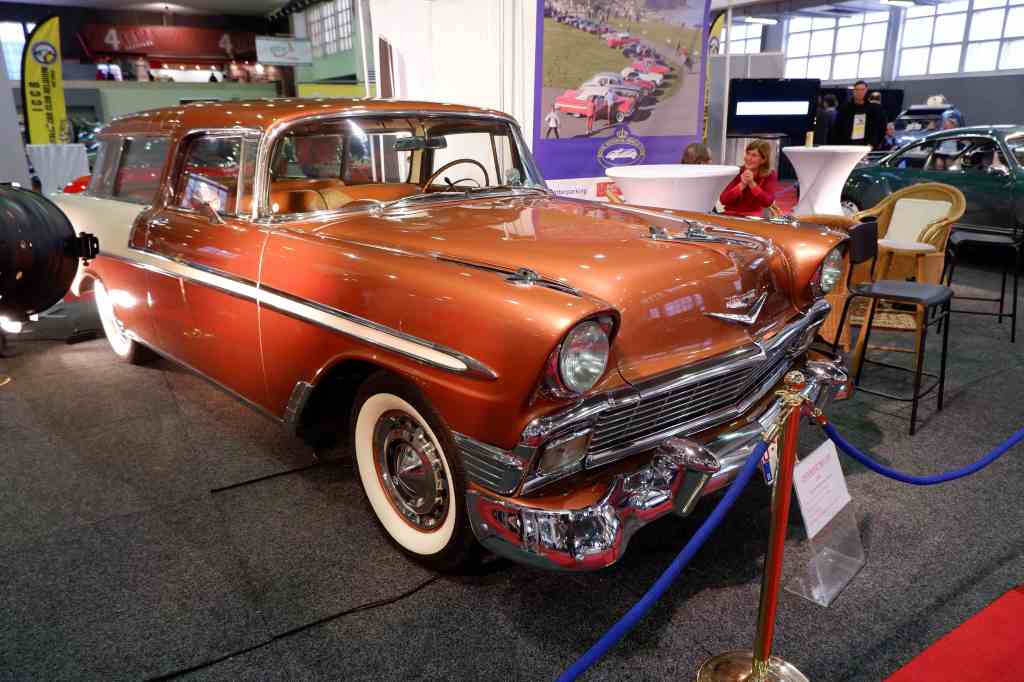
Of course, there were some beautiful American classics on the show. Just look at the 1956 Chevrolet Bel Air Nomad Sport Wagon shown here on the stand of the Royal Historical Vehicle Club Belgium…

Maserati, or the unique magic of pur sang…

The quality of the Maserati’s on display was nothing short of stunning, and the car which was prized best of show was a pale blue A6GCS/53 Berlinetta by Pinin Farina, presented by the Brussels Autoworld museum on their stand. I show you here some photos of this gorgeous coupé. I am totally smitten by its feline stance and wonderful proportions.

It just has tons of character, and it embodies everything the brand with the trident stood and still stands for. This ninth edition of the Brussels Interclassics was certainly a wonderful show, and we are already looking forward to the next edition.
Just enjoy the photos…

Hans Knol ten Bensel

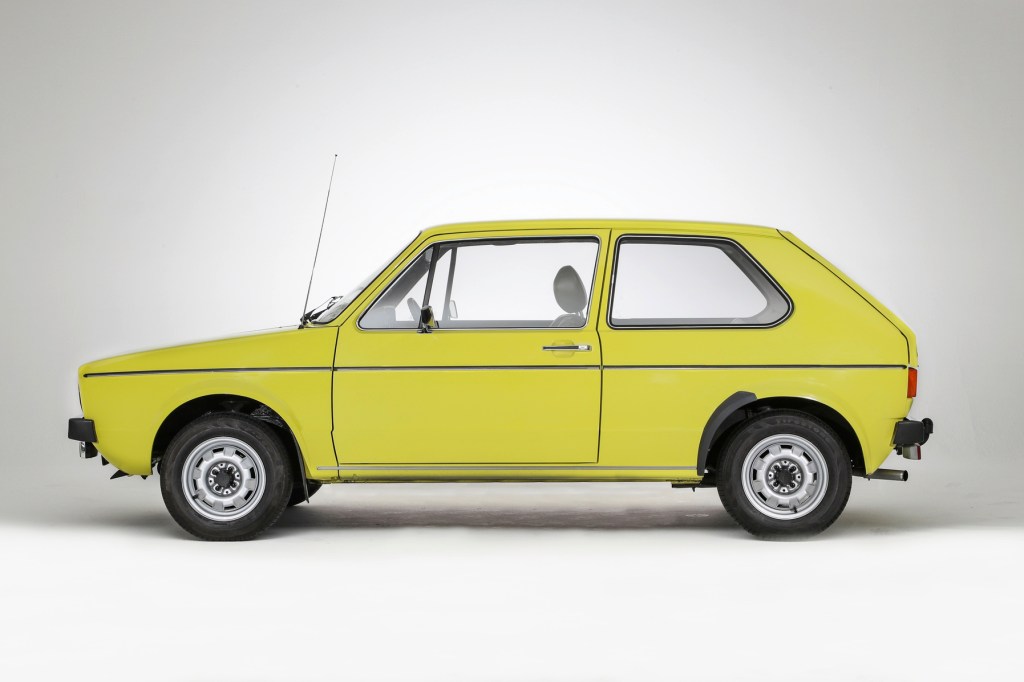
The VW Golf is now 50 years with us!


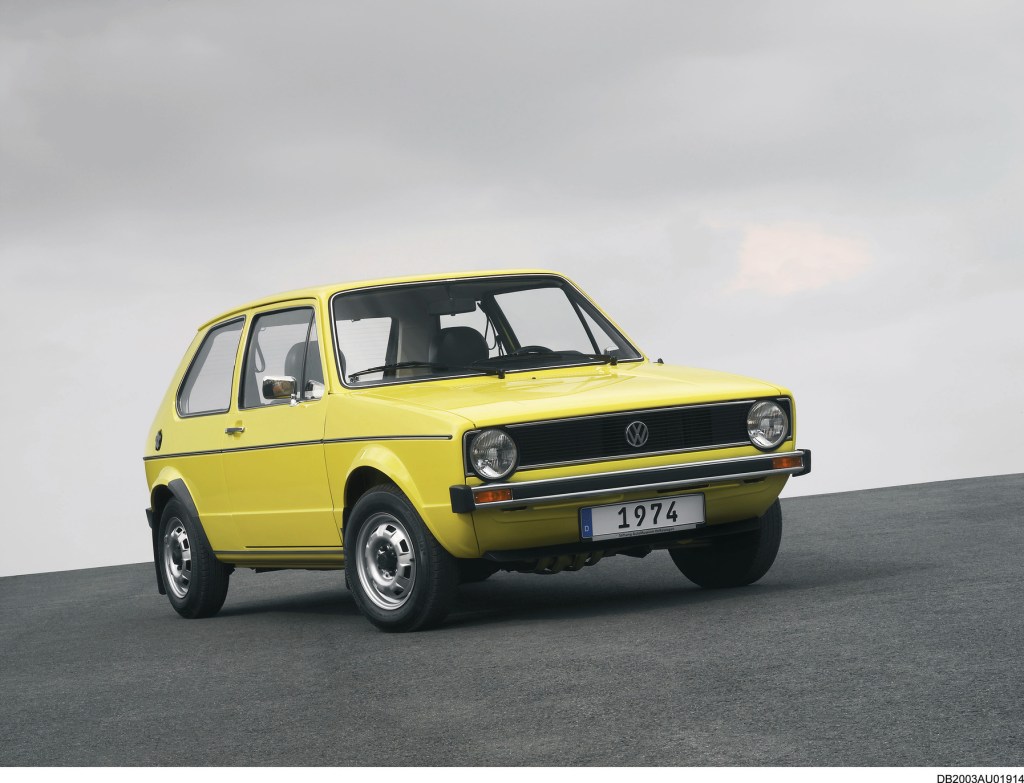
The “Ur” Golf, which looks still quite “modern”, 50 years later.

Many people will say that things are changing rapidly, and many things have disappeared or are not what they used to be. Well, we can be sure of one thing: the Golf, the heart of what Volkswagen as a car manufacturer stands for, is still amongst us.

Indeed, during five decades already, the Golf still accompanies us in our automotive life. Since 1974. Then your servant got married, and drove indeed the first Golf as a test car, and has the fondest memories of this first series, especially when testing the Golf GTI. This sporting Golf created nothing short of a legend. 50 years later, the sporting sound of its 1,6 liter 110 HP engine still seduces, as does its handling and acceleration.

The stuff of eternal legends: the Golf GTI

To me, even this very first series is still a “young” car. The straight-line design created by Giorgetto Giugiaro is timeless, the proportions are just right, the “Ur” Golf still looks good from any angle. Just read further…

Hans Knol ten Bensel

An instant hit…

The Golf set out to win hearts. The Golf quickly became a true “Volkswagen”, and the first million units were sold as early as 1976. Now, more than 37 million Golf’s have hit the road.

Over the decades, the portfolio has been expanded to include further variants: besides the GTI, there was also the Golf Cabriolet or Golf Variant, or many others.

With each new model generation, state-of-the-art technologies, safety concepts and convenience features have been incorporated into the compact class. The Volkswagen Golf has thus democratised not just technologies such as the monitored catalytic converter and anti-lock braking system, but also airbags, cruise control and electronic assist systems as well as mild and plug-in hybrid drives.

In the anniversary year 2024, Volkswagen will present the evolutionary development of the eighth Golf generation. It will impress with visually refined features, new assist systems and powertrains, and also next-generation infotainment systems and software. The world premiere of the new Golf is just a few weeks away, with pre-sales scheduled for spring 2024.

Keeping history alive Volkswagen Classic will also accompany the Golf in its anniversary year and will present historic Golf models from the Volkswagen collection on numerous occasions. First rendez-vous is in Paris. From 31 January to 4 February 2024, the Golf Generations I to VII will enhance Volkswagen France’s presence at the “Salon Rétromobile” show in Paris.

Directly afterwards, from 2 to 4 February 2024, Volkswagen will show a Golf I and the unique EA 276 concept car – the Golf predecessor from 1969 developed in Wolfsburg – at the “Bremen Classic Motorshow”.

A long history… with a touch of NSU

In this first report we will focus on the first series. The concept was nothing less than a complete technical revolution for Volkswagen. They had already acquired NSU in 1969, and so the technology of in-line engines was already present in the group, with the VW K70, originally an NSU design, and the famous Prinz 1000 to 1200 TT’s. The K70 was also a front wheel drive car, and the art of “Leichtbau”, or making light bodyworks, was also already acquired with this car.

Technical forerunner of things to come: the in line 1000/1200 cc four cylinder of the NSU Prinz in the late sixties, still air cooled however…

So the beacons were set in terms of technical product design and manufacturing engineering, to make a mass produced light car with transverse 4 cylinder in line engine.

The new Golf was light, some 165 kg lighter as the Beetle. The styling was done by Italdesign under the direction of Giorgetto Giugiaro. The first Golf is also beautifully compact: only 370 cm long. It had some good power, a healthy 50 HP with the basic 1100 cc engine, and 70 HP with the 1,5 litre engine. So the performance was something the Beetle could only dream of. The chassis, suspension and handling were also in another league. On top of it all, the Golf was cheaper to produce, but cost 600 Euros more than the last Beetle 1303…

In 1976 came the Diesel and the GTI version, and as I said, from that moment on, the “modern” VW was a fact…

More soon about the Golf history…

Hans Knol ten Bensel

We drove the Alfa Romeo Tonale Hybrid: smooth Italian (super)power…

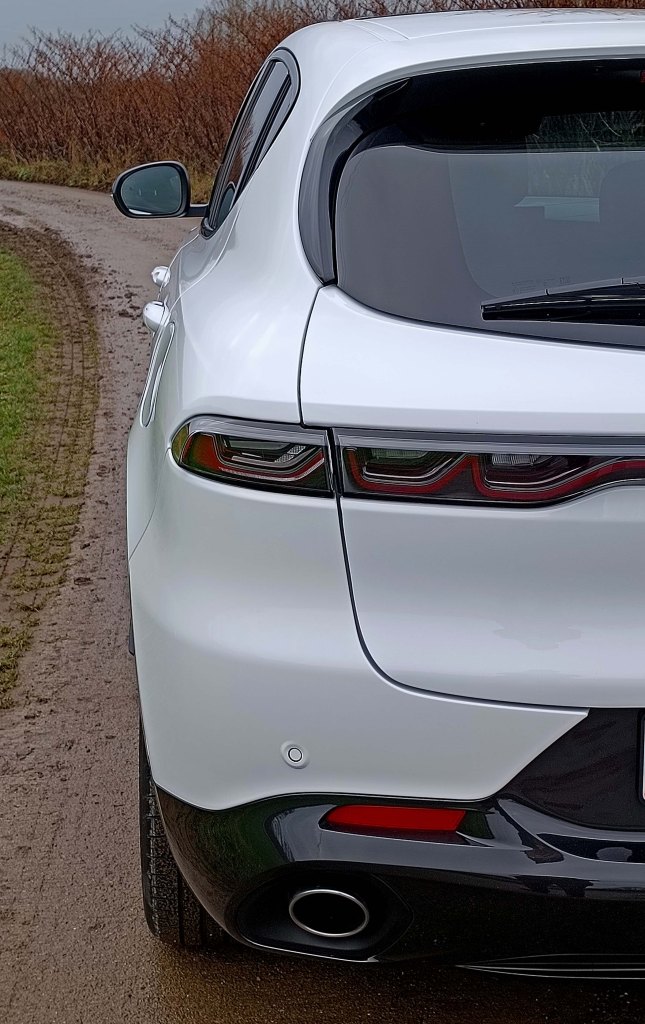
I vividly remember my visit to the Centro Stile Alfa Romeo. Indeed, I sat in the prototype mock up bodywork/interior of the Tonale, and had to be very cautious not to touch anything, as it was made of plaster, clay and wood. I was invited at the Centro Stile Alfa Romeo by Chief designer Klaus Busse and his team, when the plaster and wood prototype of the Tonale was just finished. We admired its typical proportions in tune with the higher stance of an SUV, with a horizontal accent line reminiscent of the styling language of the famous ‘Disco Volante’ two seater, created by Carrozzeria Touring back in 2013 and the original Disco Volante 1900 C52 born 1952, also designed by the Milanese coachbuilder Carrozzeria Touring… I just love the the iconic Scudetto grille and certainly the five-hole 20-inch alloys…

Another highlight was the first acquaintance with the plug-in Hybrid version on the Balocco proving ground. See the whole story on these columns, by clicking the following link: https://autoprova.be/2022/11/17/we-drove-the-alfa-romeo-tonale-plug-in-hybrid-q4-in-balocco-the-wonderful-panache-of-todays-efficient-sportiness/ and https://autoprova.be/2022/11/20/the-alfa-romeo-tonale-plug-in-hybrid-q4-the-full-story-of-a-modern-electrified-thoroughbred/

But now read further…

Hans Knol ten Bensel

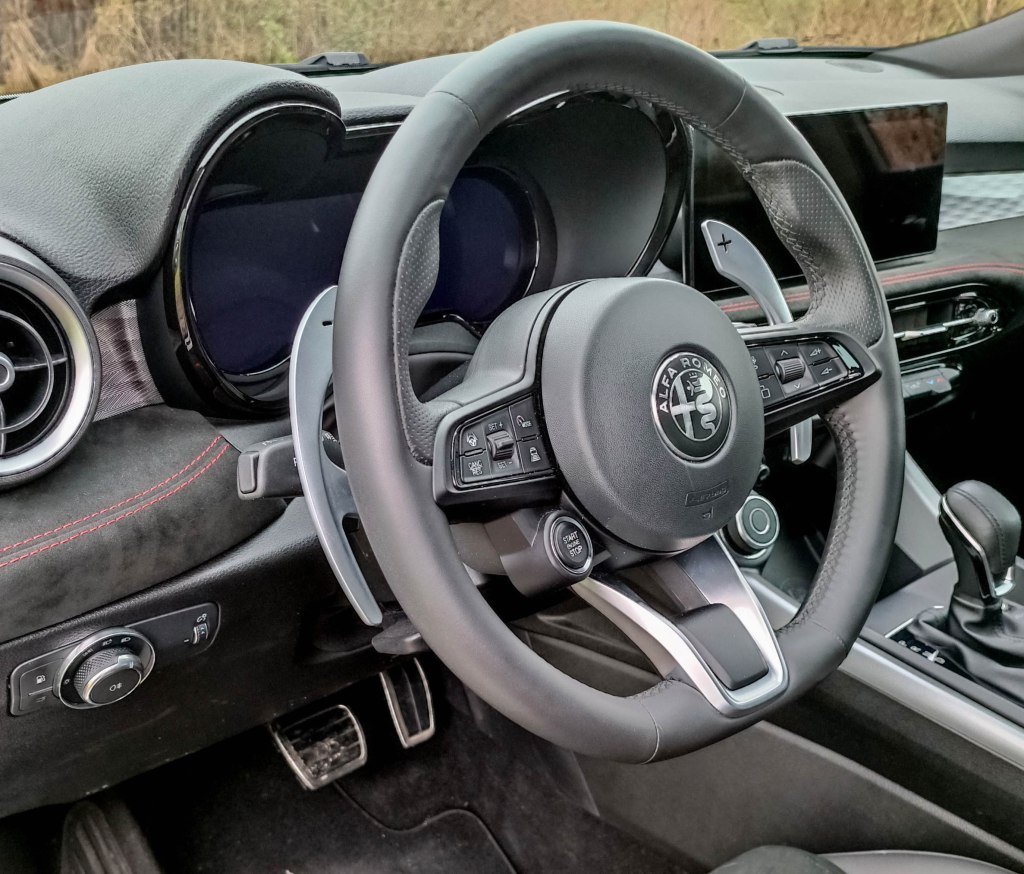
So when we took the wheel of our white Tonale Hybrid test car, the sweet memories came back instantly. The Tonale seduces not only with the right proportions and curves of its bodywork, also in the cabin the iconic Alfa Romeo atmosphere reigns. The round instrument clusters, the big sized gearshift paddles around the classic steering wheel inspire the enthusiast, and it is indeed just how an Alfa Romeo should look. The interior is all black andorned with red stitching on dashboard panels and seats, and this is the only color to choose from for the time being…

A swift turn of the “DNA” drive mode selector lets you choose how you want to drive your Tonale for the day. There are three modes to choose from. Dynamic will reveal all the sporting qualities of this 280 HP Tonale, N means “Naturale” or natural, and then this Alfa will choose for you the right propulsion in each situation, adeptly choosing between engine or E-power. When you want to enjoy more the “Zen” smoothness of battery power, then select the “A” mode, and this Tonale will treat you whenever possible to the delights of electric propulsion. Of course, this happy feeling doesn’t last forever with a 15.5-kWh lithium-ion battery pack, the Tonale has some 60 kilometers in store for you. When the battery is depleted, the Tonale will switch automatically to the “Naturale” mode, and you then can still enjoy the clever smoothness of hybrid propulsion. The battery is recharged fully after some 2,5 hours when connected to your 240 V home charging plug.

Power

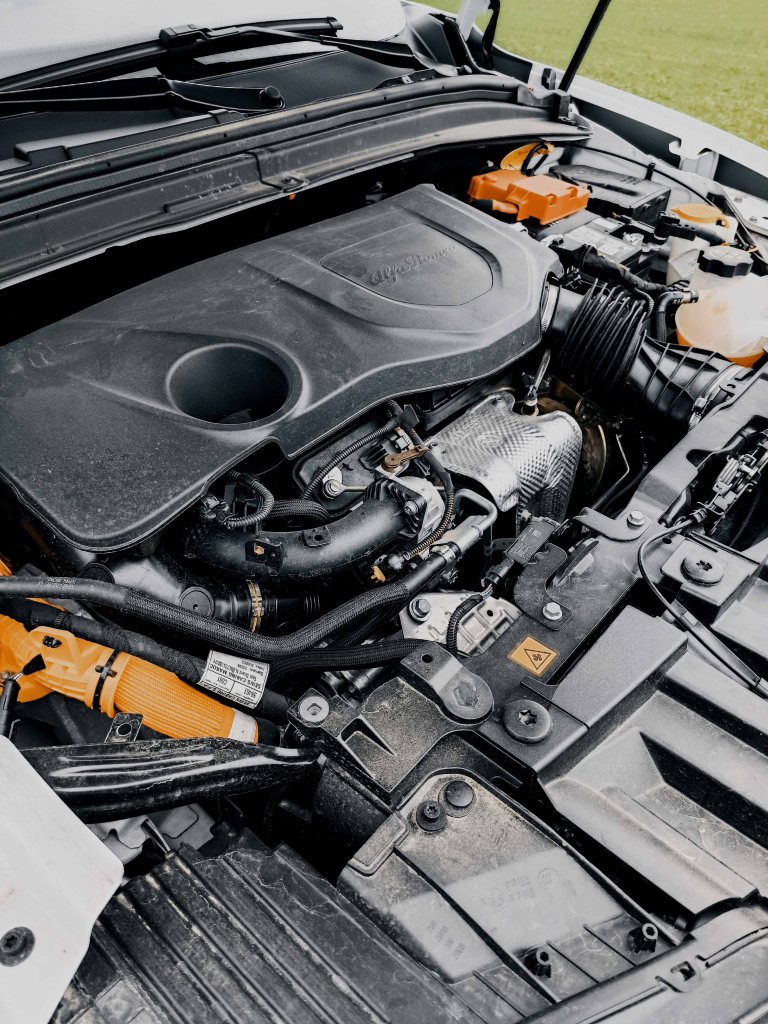
The 1.3-liter MultiAir turbo four and the electric motor produce a total of 280 horsepower, of which 121 are derived solely from the 90-kW electric motor mounted in the rear, as we said, fed by a 15.5-kWh battery pack located under the cabin. All this develops beautiful, smooth punch, which we also fondly remember during our high speed laps on the circuit on the Balocco proving ground. A Giulia Quadrifoglio was then our pace car, and we had no trouble at all following this throughbred beauty, which was driving at 9/10 of its capacities, as the Alfa people  told us afterwards. A smooth avalance of power is yours in this Tonale when you put your foot down. 0 to 100 km/h is reached in 6,2 seconds. This tells the whole story… The top speed is reached at 206 km/h. The MultiAir engine itself develops 180 HP at 5750 rpm, giving it a score of not less than 135,1 HP/L. 

So yes, the Tonale in plug-in Hybrid form is a smooth performer, also thanks to its 6 speed automatic, which reacts nicely to your right foot.  As a bonus, you get four wheel drive thrown in. It is to me a very strong point in favor of this PHEV. When we come to fuel consumption, the official WLTP figure is 1.13-1.48 l/100 km. Let’s say that in pure electric mode, the consumption is stated at 19 kW/100 km, and when you drive solely on petrol, it all depends on your driving style. Anything between 10 and 6 litres/100 km, we would say. Driven with some restraint, an average consumption around 7,3 liters is normally achievable, with some distance driving thrown in, as was proven by our test. Of course, the Tonale scores well on emissions:  CO2 emissions are 26-34 g/km. All these figures are quite remarkable as the Tonale is certainly not a lightweight car with its 1835 kg.

Thoroughbred handling

Despite its all steel underpinnings, the Tonale handles excellent indeed. When you go for the dual-stage valve active suspension, you will find it a smooth companion on pothole filled urban roads. The Tonale feels indeed equally well at home on winding roads when you drive it with abandon, as when you drive it slowly and smoothly in town. The light steering also helps to put a smile on your face, even in tight urban traffic. Stopping power is delivered in the top Veloce version which we tested by Brembo brake calipers, and it is totally beyond reproach.

Infotainment and connectivity

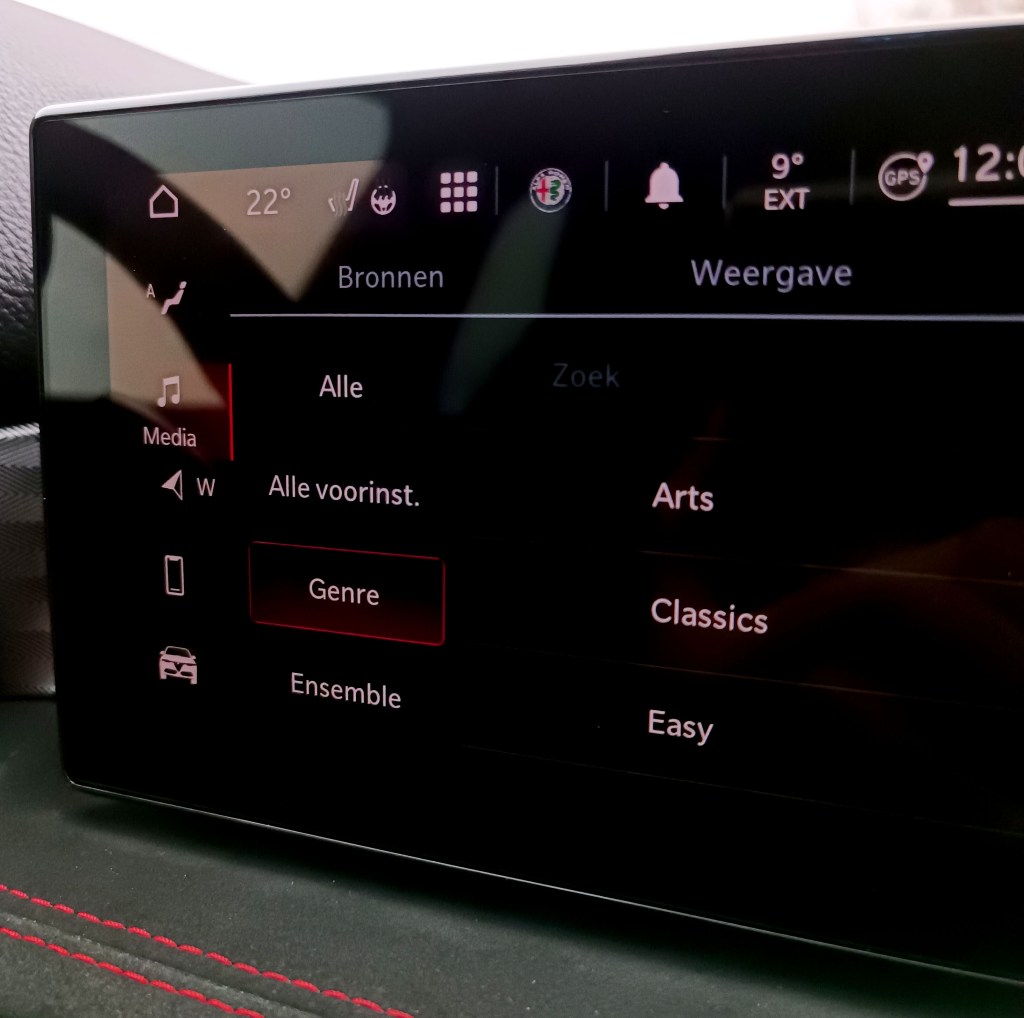
Every Tonale comes standard with a 10.3-inch touchscreen infotainment system. It has the Uconnect 5 software found on other models within the Stellantis group. The home screen can be customized, and you can adapt the interfaces and create not less than five unique user profiles. It has standard Apple CarPlay and Android Auto, as well as of course wireless phone charging. We must say that sometimes we found the touchscreen rather slow and hesitant to react to our finger pressure, certainly awkward when driving and you want just to perform an easy command with one touch of your finger.

Of course the Tonale offers all the thinkable safety and driver-assist features, like automated emergency braking and a very smooth and subtle adaptive cruise control, which I enjoyed very much. Especially the clever refinement of the adaptive cruise control impressed me. Indeed, enormous progress has been made in this field over the last few years.

Practical

The Tonale offers ample comfort for four, has certainly in the top Veloce version everything you could wish for, and with the entire camera supported driving aids, it is a breeze to drive in town and to park in narrow spaces. Boot space is sufficient, with 385 l with all seats up, and to a maximum of 1430 l with everything flat. You can also use your Tonale as a tow car, and it is good for 1250 kg trailer load with brakes, and 700 kg without.

Conclusion

Stylish, full of panache both inside and out, the plug-in version of the Tonale has a lot to please. Enormous performance, with handling to match, it is a true high-performance Alfa, and thanks to the E-power it delivers this performance effortlessly and smoothly.

When you are in the mood, very decent economy is possible, and in normal everyday driving this leaves you smiling all the way.

All these good qualities DO have a price, but then, beauty in this world is never cheap, is it?

Think about this: the timelessness of the styling, the excellent proportions, the emission values thanks to its hybrid configuration make this Tonale a companion for years, if not decades to come, on all the regions and cities in Europe and beyond, so why not fall in love with this Tonale, and set the right tone for your future mobility…

Hans Knol ten Bensel