Audi at the 98th Brussels Car show…

The Brussels Car Show is unique in the world, as it is an event where cars are actually SOLD in large numbers to the visiting public. This has been a “bourgeois” tradition since its early beginnings, now almost a century ago. Understandably, as the Belgian car market is a rather small, but “open” market, with no national brands to distort the picture when you want to assess your possible European market share. So all car makers are keenly looking at our market, and testing it… in a salon or show where they actually sell cars.

Audi is present in “palace” or hall 11 at the show. It shows the Audi e-tron Sportback in European premiere, and a world premiere of the updated

Audi A5 Sportback 40 g-tron. The 2.0 TFSI gasoline engine is specially adapted to run on CNG (compressed natural gas) and develops a power of 125 kW (170 hp). The maximum torque of 270 Nm is available between 1,650 and 4,400 rom. The Audi A5 Sportback g-tron has a combined CNG consumption between 3.8 and 4.1 kg / 100 km and combined CO2 emission between 103 and 111 g / km.

Important is also the new range of plug-in hybrid models: Audi A6 Saloon 50 TFSI e quattro, Q5 55 TFSI e quattro, A7 Sportback 55 TFSI e quattro and A8 LWB 60 TFSI e Quattro.

“25 years of RS” with new Audi RS range: Audi RS 6 Avant, RS 7 Sportback, RS 4 Avant RS Q8 and RSQ 3 Sportback.

We show you here the RS 6 Avant, its 4.0 V8 TFSI twin-turbo engine now boasts 600 hp and 800 Nm of torque, and advanced mild-hybrid technology for superior – and efficient – performance. Its renewed RS design that is even broader and more muscular. Performance has its sprice, starting from 119,950 euros.

The impressive RS Q8 has the same engine and power. This makes the large SUV coupe from Audi Sport sprint from 0 to 100 km / h in just 3.8 seconds and then hurtle to 200 km / h in 13.7 seconds. The base price of the Audi RS Q8 is 130,970 euros.

Last but not least there is the Audi R8 LMS GT2 at Dream Cars Salon. This track car is based on an Audi R8 Spyder, and develops 470 kW (640 hp). This makes it the most powerful customer racing car in the eleven-year history of Audi Sport customer racing.

Your servant has recently tested the stylish Q3 Sportback 45 TFSI, a true gem when it comes to smooth power and driving pleasure, and a report will follow soon. Of course we are keen to test the new hybrids, and end of March we will drive the Audi A7 Sportback 55 TFSI e quattro 367 hp S tronic. We are certainly looking forward to that one, and assess how Audi understands hybrid driving…which comes in plug-in hybrid form. All plug-in hybrid models use the TFSI, or a direct-injection petrol engines, which interacts with an electric motor integrated into the drive. A lithium-ion battery under the trunk floor provides the electrical energy.

More Audi news soon in these columns, as we discuss the new e-tron Sportback and technical facelifts which extend the e-driving range, and look closer at the formidable Q8 RS.

Hans Knol ten Bensel

New Porsche Macan GTS: superb sportiness…

The Macan series is ever more popular, and Porsche now adds a distinctive touch of zest to the range, with a 380 HP GTS version. The 2.9-litre V6 biturbo engine comes with a performance-oriented chassis, characteristic design and enhanced equipment.

The engine is coupled to a newly adapted PDK dual-clutch transmission. Performance is nothing short of exhilarating. With the optional Sport Chrono package, the Macan GTS can accelerate from zero to 100 km/h in 4.7 seconds, three tenths faster than before. It has a top speed of 261 km/h.

The Macan “Gran Turismo Sport”, has outstanding driving dynamics. The Porsche Active Suspension Management (PASM) damping control system has of course been specially tuned. The chassis has also been lowered by 15 millimetres for greater lateral dynamics. Adaptive air suspension is optionally available with chassis lowering by a further 10 millimetres.

Combined with the standard 20-inch RS Spyder Design wheels and the cast iron brakes (360 x 36 millimetres at the front, 330 x 22 millimetres at the rear), the new Macan GTS has the agility and responsiveness of a true sports car. As an option, deceleration can be further improved by means of the Porsche Surface Coated Brake (PSCB) with tungsten carbide coating or the Porsche Ceramic Composite Brake (PCCB).

The 2.9-litre V6 engine sounds not only delightful; it has also plenty of punch. The Central Turbo Layout, with two turbochargers arranged in the inner V of the engine, see to that. The maximum torque of 520 Nm (plus 20 Nm) is available over a wide range from 1,750 to 5,000 rpm. Economy is here more than ever the result of your driving style. Suffice to say here that consumption is 11.3 – 11.8 litres of fuel per 100 kilometres according to WLTP.

Design touches for more sportiness…

The standard Sport Design package with new front and rear trim and striking side skirts lends the car a characteristic appearance. The front apron and front section are characterised by black painted elements – a distinguishing feature of all Porsche GTS models.

The LED headlights with Porsche Dynamic Light System (PDLS) and the three-dimensional rear lights with LED light bar are also darkened. The 20-inch RS Spyder Design wheels in satin-gloss black, the red brake calipers and the trim strips in high-gloss black also emphasise the high-performance appearance.

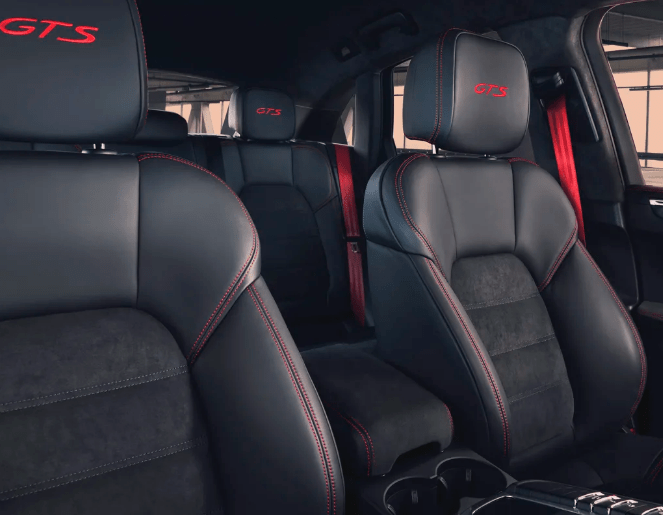
In the cabin, the sports seats catch your eye. They are exclusive to the GTS, with eight-way adjustment and pronounced side bolsters for stable support during dynamic cornering. The GTS leather upholstery in Carmine Red or Crayon with additional Alcantara® features and colour accents, the BOSE® Surround Sound system and the new smartphone tray with inductive charging function are among the many personalisation options.

The new Macan GTS is available to order now. In Belgium, prices start at 81,892.80 euros including VAT. We just let you dream further, and look at the photos…

Hans Knol ten Bensel

We drove the Skoda Scala 1.5 TSI 150 DSG: your stylish and practical friend.

Skoda has an admirable tradition of building cars which fit wonderfully in your daily motoring life. They are dependable, sturdy, practical and roomy. Last but not least, they offer a lot of value for money. Over the years, Skoda’s have also become a hallmark of elegant styling, and indeed the rakish, clean lines of this latest Scala are also quite inspiring. Needless to say that we were quite interested to take the car through its paces in a full test…

Hans Knol ten Bensel

Continue reading “We drove the Skoda Scala 1.5 TSI 150 DSG: your stylish and practical friend.” →

We drove the Mercedes EQC 400 4-Matic: your wonderful electric star.

Electrification is amongst us, and the oldest manufacturer in the world has the panache and experience to come up with a truly stunning vehicle. The EQC 400. An impressive Mercedes in every aspect. Aimed at the higher market segments, and rightly so. It creates first of all an upmarket image for fully electric vehicles, and it targets a well to do clientele which has invariably charging points at home and at the office or workplace, making them less dependent on the public charging infrastructure, which is still seen to be (very) deficient in some EU countries.

A prudent strategy adopted also by other premium car manufacturers, like Audi for instance with their e-tron.

After driving a few days – a full battery charge – with this superb car with the star, we can say that this car sets indeed the standards for what electric driving can be… Just read further!

Hans Knol ten Bensel

Continue reading “We drove the Mercedes EQC 400 4-Matic: your wonderful electric star.” →

The new Renault Clio is voted VAB Family Car of the Year 2020

After the Renault Scénic in 2017 and Renault Grand Scénic in 2018, the new Renault Clio has been elected “VAB family car of the year 2020”. New Renault Clio wins the win in the category up to 20,000 €. VAB is the Flemish Automobile Club, and it organizes yearly a very coveted contest of best family cars in the different categories.  

Now for the third year in a row, Renault has distinguished itself as the top VAB Family Car. In 2016, Renault ZOE won in the “electric” category. Renault Scénic and Renault Grand Scénic won respectively in 2017 and 2018 the first place in the category up to € 29,500.

A closer look at the winner: the Renault Clio TCe 100

The winner of this 33rd edition is the Renault Clio Intens TCe 100. We drove it recently for you, and a test report will follow soon. Needless to say that this Cleo greatly impressed us, and this award hardly comes as a surprise to us.

This is the fifth generation of the Renault Clio.  This latest generation has been designed according to the double principle “Evolution & Revolution”.

On the one hand, it inherits from its predecessor the design that inspired the entire Renault range.

On the other hand, the revolution is mainly in the cabin that is inspired by the upper segments both in terms of quality and available technology.

This year, the winner is equipped with the 1.0 TCe three-cylinder engine. Just as out test car.

This unit is new in the Renault range, offering the latest technologies, such as a turbocharger with electrically controlled relief valve, an exhaust manifold partially integrated with the cylinder head, a double variable hydraulic timing of the distribution and a specific steel coating of cylinders (Bore Spray Coating).

With a power output of 100 hp and a torque of 160 Nm, this new generation engine gains 10 hp and 20 Nm over the TCe 90 it replaces, while reducing fuel consumption and CO2 emissions.

In Belgium, Renault Clio is the second best-selling vehicle, all segments combined, after the VW Golf. In addition, Renault Clio occupies the top spot in the B segment for retail sales…

Read out test report soon!

Hans Knol ten Bensel

A clever breakthrough of Seat: a car that communicates with traffic lights…

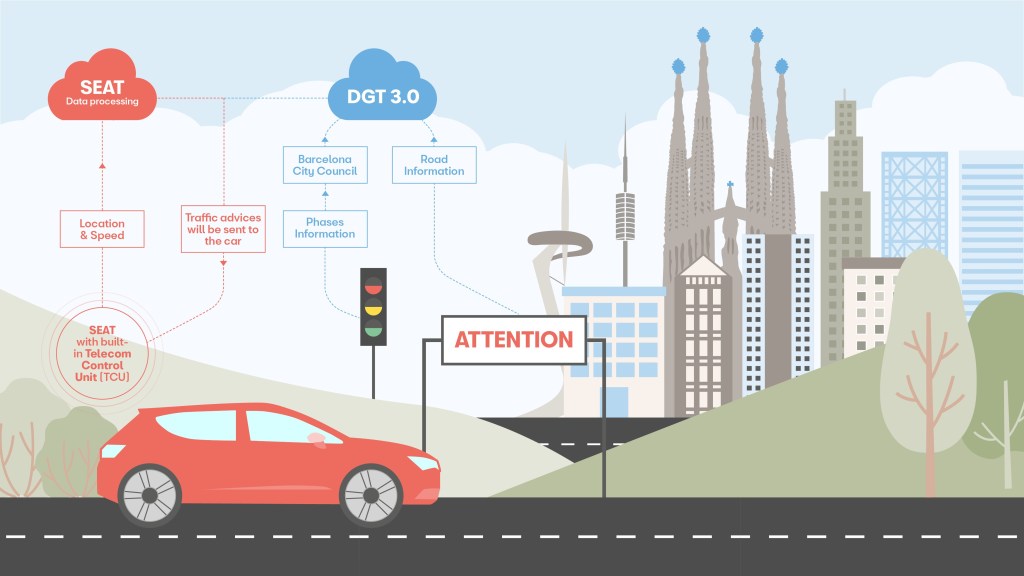
We all know the frustration: however slow or fast you accelerate from a traffic light, the next one will always be red, even if, as it happens so often, this next light is only a few hundred metres away. We all know too well how much energy is wasted with this. Seat now started a project together with the Spanish Traffic Authority, the Barcelona City Council and ETRA.

It successfully connects vehicles with traffic lights and the traffic control centre so drivers can anticipate their upcoming status. This project also enables information on motorway incidents to get sent directly to vehicles without the need for information panels, bringing cars and infrastructure together via the cloud using cellular technology with latency times of 300 milliseconds.

Oh so clever!

Hans Knol ten Bensel

Vehicles connected with traffic lights and road infrastructure.

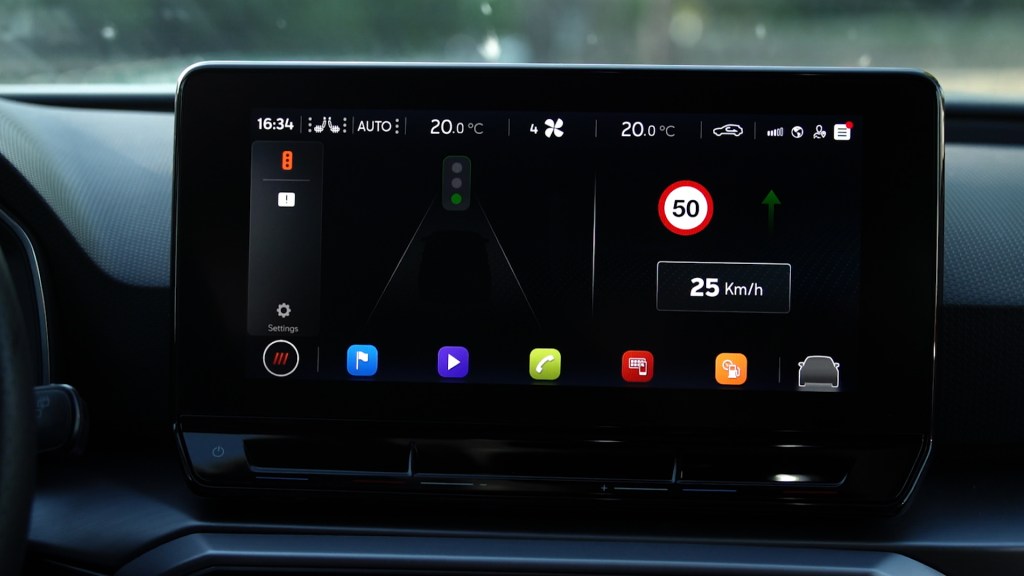
The vehicle used in this pilot project is equipped with the necessary technology to connect with its surroundings and receive information uploaded by the Traffic Authority to the cloud, which in turn enables the driver to anticipate what lies ahead in real time.

“In this project, SEAT’s new connected cars receive real-time traffic information from the Traffic Authority’s central cloud, including information displayed on motorway panels or the traffic light status in cities”, explains Jordi Caus, the Head of Urban Mobility Concepts at SEAT.

How does it work?

When a vehicle is approaching a traffic light, an alert appears on the screen showing whether it will be red, green or yellow when it arrives, as the system performs a calculation based on how far away the car is and the speed it is travelling at. One important note for safety is that it only works as long as the vehicle is not exceeding the speed limit. “The system does not work at above maximum speeds, which is very important for road safety. It wants to be an auxiliary tool that enables motorists to drive more smoothly”, assures Manuel Valdés, the Head of Mobility and Infrastructures at the Barcelona City Council.

Information panels in your car, too.

Today there are 2,000 information panels in Barcelona that provide drivers with traffic and weather conditions or information about road work or accidents. With this system, all this information is displayed directly on the screens of connected vehicles at any point of the road network. According to Jorge, “we can accomplish the same as what we used to do with variable message signs on the motorway, but now directly to the car from any point on the road.”

A future of collaborative information…

In addition, connected cars and users themselves will also be information suppliers. “Anyone with information about what happens on the road can share it,  so other users will know in advance of any incident when they reach the same point”, explains Jorge.

“With this project we’re taking a first step to connect cars with overall traffic infrastructure. We’ve begun with information functions, but with the future autonomous vehicles in mind we’ll be able to act directly on the car in situations of risk”, concludes Jordi Caus.

A harbinger of good things to come, we would say!

Hans Knol ten Bensel

A double readers award for Alfa Romeo…

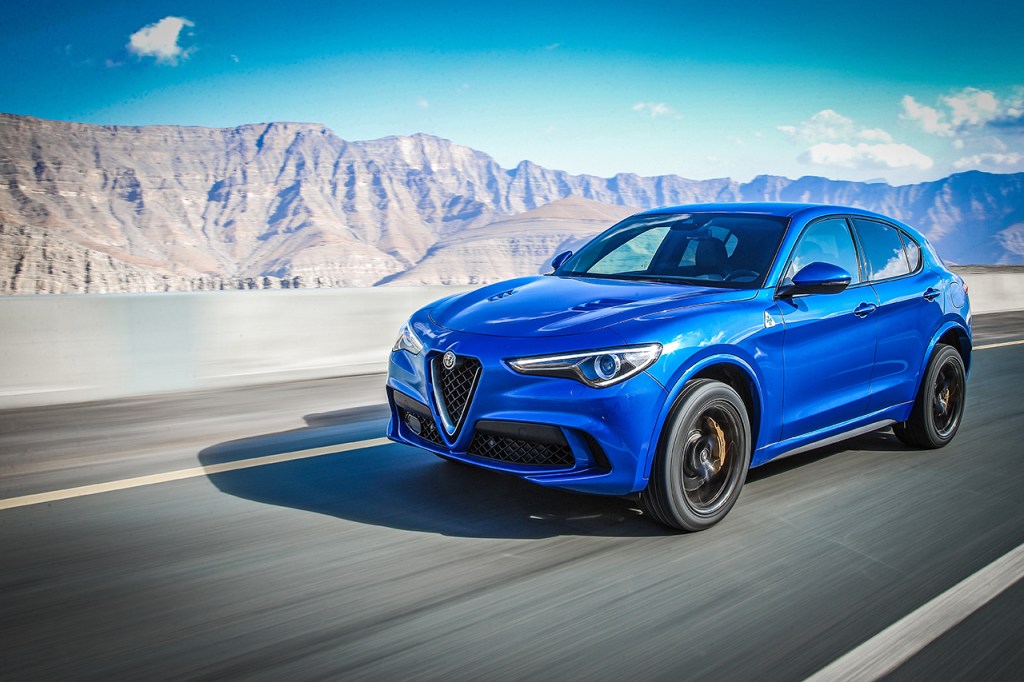
We were totally impressed driving the Alfa Giulia and Stelvio MY2020 for you in Bari. You can read about this in our columns, and we will also come back more in depth about our driving experiences. Suffice to say that we were not only delighted with the sheer performance of these thoroughbreds, we also noticed how refined and “mature” the whole drivetrain has become. One can feel clearly the enormous development and further honing which has gone into these marvelous machines. A truly superb driving experience is the result.

Hans Knol ten Bensel
It is therefore no surprise that both these cars are earning high awards among enthusiasts and car lovers.

Alfa Romeo Stelvio Quadrifoglio is “Sportscar of the year”

Readers of the magazine AUTO BILD SPORTSCARS chose the 375 kW (510 hp) strong top version of the Alfa Romeo Stelvio as the winner of the category “SUV/Import”. A total of 110 candidates in ten classes participated in the competition

The readers of the magazine AUTO BILD SPORTSCARS are seeing the Stelvio as a true sportscar. They chose the 375 kW (510 hp) strong Alfa Romeo Stelvio Quadrifoglio as the “Sportscar of the Year 2019” (issue 01/20 of 13 December 2019). The top model of this model won the SUV/Import category.

The Alfa Romeo Stelvio Quadrifoglio has indeed what it takes to fall in the sports car league. What to think of a V6 biturbo petrol engine with 2.9 litres capacity, whose power is brought to the road by the four-wheel drive AlfaTM  Q4. The excellent traction provided allows an acceleration from zero to 100 km/h in only 3.8 seconds, the top speed is a whopping 283 km/h. Not suprising that the standard equipment of the Alfa Romeo Stelvio Quadrifoglio also includes the limited slip differential with active torque distribution in the rear axle (AlfaTM Active Torque Vectoring). But that is not all. There is also the AlfaTM Chassis Domain Control, a unique central vehicle “intelligence” created by Alfa Romeo with its own algorithms to handle all the electronic devices that intervene on the car’s behaviour harmoniously and in real time, making driving extremely natural, instinctive and safe.

Double awards also for the Giulia…

Alfa Romeo Giulia is also reaping awards. It finished at the top of the list of the readers from the magazine SPORT AUTO. In the survey for the “SPORT AUTO AWARD 2019”, they chose the stylish Giulia as the winner in two categories.

Now for the third year in a row, as also in 2017 and 2018, the top model Alfa Romeo Giulia Quadrifoglio, powered by a V6 turbo petrol engine with 375 kW (510 hp), won the import rating in the category “standard production limousines/station wagons up to 100,000 Euro”.

In the “series cars limousines/station wagons up to 75,000 Euro” the readers of SPORT AUTO voted the 206 kW (280 hp) strong Alfa Romeo Giulia 2.0 Turbo Veloce as the number one import model.

Hans Knol ten Bensel

Nissan unveils the new Juke and looks forward at the Brussels Salon 2020…

At the Brussels press conference, the new Juke was under cover… before its premiere

The Brussels Motor Show approaches at a rapid pace, and in the coming weeks the car world is receiving the automotive media community to have a look at the new year and the models it will exhibit at the show.

Nissan Belux was the first to hold its annual reception, and also took the occasion to present the new Juke.

Just read further!

Hans Knol ten Bensel

Continue reading “Nissan unveils the new Juke and looks forward at the Brussels Salon 2020…” →

Audi e-tron goes Sportback…

Indeed, an extra zest of sportiness is added to the already iconic Audi e-tron. The Sportback version looks and is more dynamic, as it offers up to 300 kW of power and a range of up to 446 kilometers (277.1 miles). A new feature, and for the first offered on a in a mass-production vehicle, are its digital matrix LED headlights.

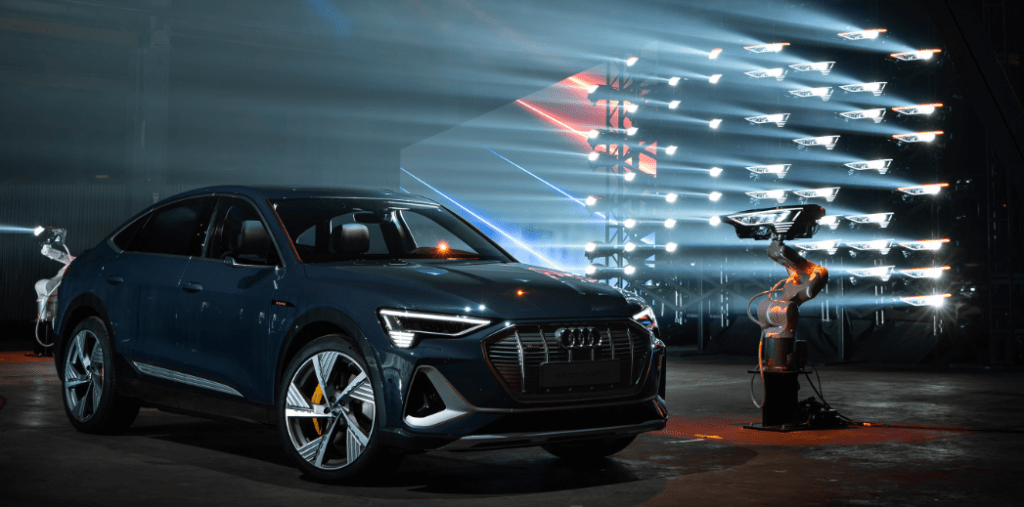
This was also clearly visible at the Los Angeles presentation of this elegant SUV Coupé, where the rakish and elegant contours of the Sportback were lit by an array of LED headlights in the background, and mounted on a robot alongside the car.

Just read on for more details…

Hans Knol ten Bensel

The Audi e-tron Sportback looks very good in the typical Audi design language.  The roof drops down steeply to the rear—in typical coupé style— and is flowing into the steeply raked D-pillars. The lower edge of the third side window rises towards the rear—also a typical Sportback feature.

The designers also varied the signature at the broad diffuser, drawing attention to the absence of exhaust tailpipes. A light strip connects the LED lights to one another.

Announcing even more colour…

A total of thirteen paint finishes are available for the all-electric drive SUV coupé, including the new colour plasma blue, metallic, which is exclusive to the e-tron Sportback. The logo on the electric charging flap features the eye-catching high-voltage signal colour orange, which can also be applied to the brake callipers on request.

The S line model emphasizes the sporting DNA of the Audi e-tron Sportback, and is standard equipped with 20-inch wheels and sport air suspension. At the rear end, the spoiler as well as a striking diffuser which extends across the entire vehicle width, contributes to the outstanding vehicle aerodynamics. In contrast to the basic model, the attachments on the S line exterior are painted in the exterior body colour – including the wheel arch trims, door sills, bumpers and exterior mirrors.

For those who want more contrast, Audi also offers the so-called black styling package that accentuates the area of the Singleframe, the side windows, and the bumper. The exterior mirror housings are also available in black as an option.

A drag coefficient of merely 0.25…

In conjunction with the S line exterior and virtual exterior mirrors, the Sportback achieves an drag coefficient value of just 0.25. This is primarily due to the coupé body shape and the associated lower aerodynamic drag behind the car. The high separating edge of the Sportback minimizes swirl in the air flow in this area.

Global innovation in a production vehicle: The digital matrix LED headlights

With the digital matrix LED headlights as top-of-the range equipment, Audi presents a worldwide first in a production vehicle: Broken down into minute pixels, their light can illuminate the road in high resolution. The design is based on a technology abbreviated as DMD (digital micromirror device) and is also used in many video projectors.

Audi e-tron Sportback: digital matrix LED headlight

At its heart is a small chip containing one million micromirrors, each of whose edge length measures just a few hundredths of a millimeter. With the help of electrostatic fields, each individual micromirror can be tilted up to 5,000 times per second. Depending on the setting, the LED light is either directed via the lenses onto the road or is absorbed in order to mask out areas of the light beam.

Revolution ahead: just follow the light…

These LED lights will be seen on the e-tron Sportback mid 2020, and they can perform multiple tasks. It can generate dynamic leaving- and coming-home animations that appear as projections on a wall or on the ground. This presentation transforms the area in front of the car into a carefully illuminated stage. Not only does the digital light system deliver cornering, city, and highway lighting as versions of the low-beam light with exceptional precision, it also supplements the high-beam light by masking out other road users with even greater accuracy.

Above all, however, it offers innovative functions such as lane light and orientation light. On freeways, the lane light creates a carpet of light that illuminates the driver’s own lane brightly and adjusts dynamically when he or she changes lane.

In this way, it improves the driver’s awareness of the relevant lane and contributes to improved road safety. In addition, the orientation light uses darkened areas masked out from the light beam to predictively show the vehicle’s position in the lane, thereby supporting—especially on narrow roads or in highway construction zones—the safe lane centering assist.

The marking light function is also used in conjunction with the optional night vision assist. The light automatically draws attention to any pedestrians it detects, thereby reducing the danger of overlooking pedestrians in the immediate vicinity of the lane.

Detail

On the second part of this report, we will tell you more about the dynamic qualities, the drivetrain, i.e. batteries and engines, interior and connectivity of this e-tron Sportback…

Stay tuned!

Hans Knol ten Bensel
Kia’s Futuron Concept shows how Kia sees new designs for future electric vehicles…

A tall standing Urban Coupé with fluid, inviting lines…

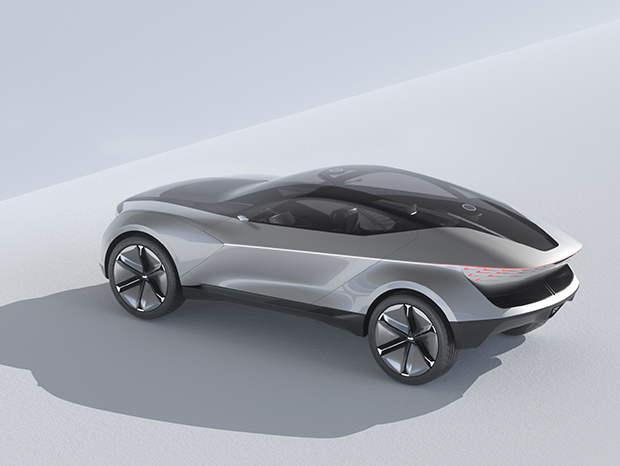
Kia recently showed a stunning electric coupé with novel proportions. This Futuron made its public debut at the 2019 China International Import Expo (CIIE) in Shanghai. Its low-profile SUV coupe body makes a strong statement of intent for Kia’s future cars, which will be – as the manufacturer puts it – confident, sporty and modern, yet also elegant. At 4,850 mm in length, 1,550 mm tall and with a 3,000 mm-long wheelbase, it has an elevated ground clearance is matched with a low, lean body to create a dynamic, confident posture.

It is indeed a sports car… on an SUV platform. Clever. Because this makes – like for instance in the Audi e-tron – room for the batteries to be lodged beneath the cabin floor. The advantage is also that the elevated stance of the car is therefore matched with a low center of gravity.

And that slightly more elevated stance is just what you want in an urban car, even if it has the sleek shape of a coupé.

Just read further…

Hans Knol ten Bensel

This “E”-Coupé is powered by four powerful in-wheel electric motors. This e-AWD system delivers as you can expect lively responses to driver inputs.
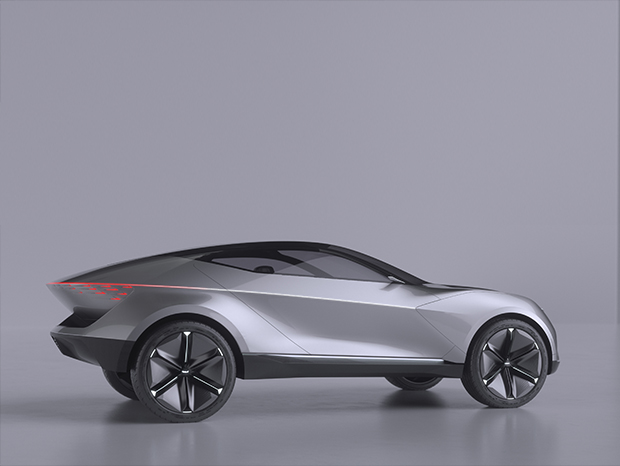
But the important hallmark here is its fluid, intriguing design. The front fender flows backwards from the front of the hood before plunging into the cabin itself, establishing a connection between the driving seat and the road ahead. The concept’s roof is a diamond-shaped panoramic glasshouse which sits atop the 360-degree core, in the best traditions of UFO and flying saucer design. It floods the cabin with natural light, and it also extends down the bonnet to give drivers an unparalleled view ahead. The glasshouse also incorporates a network of LiDAR (light detection and ranging) sensors capable of providing Level 4 autonomous driving features, enabling hands-off and eyes-off driving in most conditions.
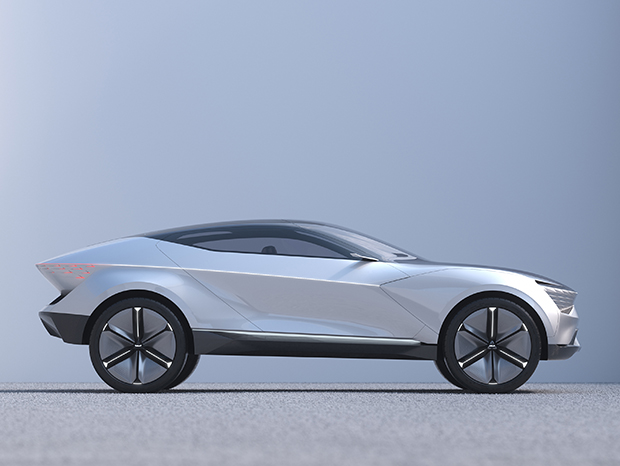
Furthermore, the 360-degree theme is evident in the lighting that illuminates a sharp character line encircling the Futuron’s body.

A new “tiger” face…

The newly-designed front of the car, like that of the Imagine by Kia Concept first revealed earlier in 2019, expresses a new design interpretation for Kia’s future electric vehicles.

With a wider ‘tiger face’ shape, the grille incorporates the Futuron’s headlamps, an innovative ‘Star Cloud’ design which gives the car a dazzling new night-time identity.

Flexible cabin space…

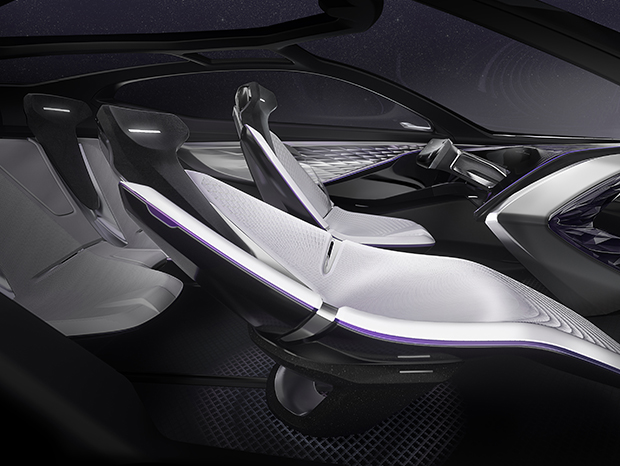
The layout of the electric powertrain and incorporation of Level 4 autonomous driving systems has enabled the creation of a spacious and flexible cabin unlike any other vehicle on roads. The two front seats are created out of flexible materials and can offer an upright ‘driving’ position, or a reclined ‘rest’ position, similar to the flexibility afforded to first-class airline passengers. With the activation of the Futuron’s autonomous driving features, the two front seats recline as the steering wheel retracts. The ‘zero-gravity’ seating position this creates helps to reduce fatigue on long journeys.

One of the most prominent features of the cabin is the ‘cockpit’ area surrounding the driver. The graphical user interface (GUI) of the cockpit flows out of the driver-side door and wraps around the steering wheel in a seamless arc. This merges the instrument cluster directly with the audio-visual display at the center of the dashboard and is linked to the display integrated within the surface of the steering wheel itself.

The GUI is operated by artificial intelligence technologies, displaying useful information about the car various autonomous driving, powertrain and navigation features, which creates a unique user experience.

This is, according to Kia, what driving into the (urban) future is all about. Just look at the photos here…

Hans Knol ten Bensel