Volkswagen’s pursuit of efficiency records spans over two decades, transitioning from ultra-light diesel concepts to electric prototypes.
Their first car was presented in 2002 at the VW shareholders meeting, where I was present, and – as could be expected – with no regular automotive photographers with their cameras being around. It was the surprise which Ferdinand Piëch had in mind, presenting at the shareholders’ meeting also Bernd Pischetsrieder as the new VW chairman, who sat in the back seat of the 1-Liter Concept Car with Ferdinand Piëch driving the car from Wolfsburg to Hamburg.
I was there with my faithful Nikon analog camera, the …. and the ektachrome photos are in my archives. I will publish them soon, but in the meantime here is first some history of the cars…
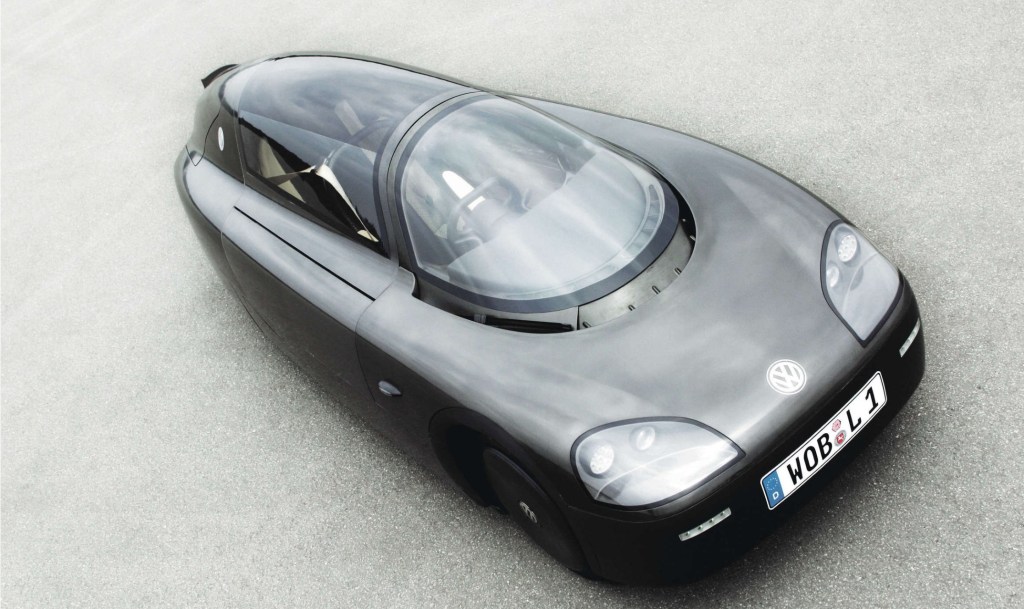
The 1-Liter Car Concept (2002)
The story began with Ferdinand Piëch’s vision for a car that could travel 100 km on 1 liter of fuel. The first prototype, unveiled in 2002, was an extreme exercise in minimalism: a 290 kg tandem two-seater with a 0.99 L/100 km consumption . It was never meant for production but proved the concept was possible. For better aerodynamics, the car seats two in tandem rather than side-by-side. There are no rear view mirrors and it instead uses cameras and electronic displays. Of course, the car is totally light, using an unpainted carbon fibre skin over a magnesium-alloy subframe.
The engine is a one-cylinder 299 cm3 (18 cu in) diesel producing just 6.3 kW (8.4 hp). It drives through a six-speed transmission that combines stick-shift mechanics, weight, and drive efficiency with automatic convenience and efficiency controls. There is no clutch pedal. The gear selection (forwards, reverse or neutral) is made using a switch on the right-hand side of the interior. The engine is switched off automatically during deceleration and stops, and auto-restarted when the acceleration pedal is pressed.
According to Volkswagen, the vehicle consumes 0.99 L/100 km , giving it a 650 km driving range on one tank of fuel.
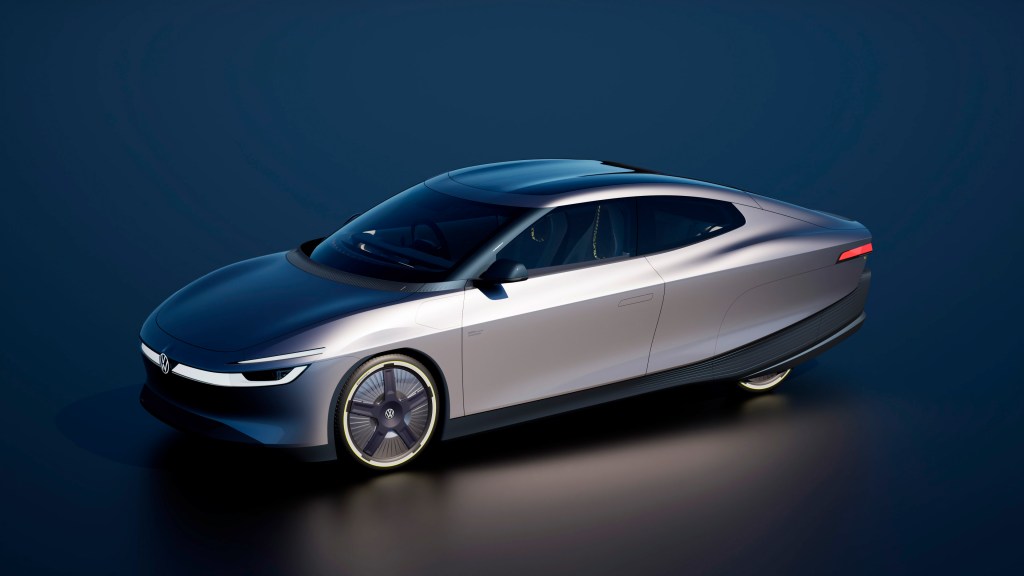
The Mission Efficiency 2 + 2 seater… an aerodynamic engineering marvel, based on ID Polo technology…
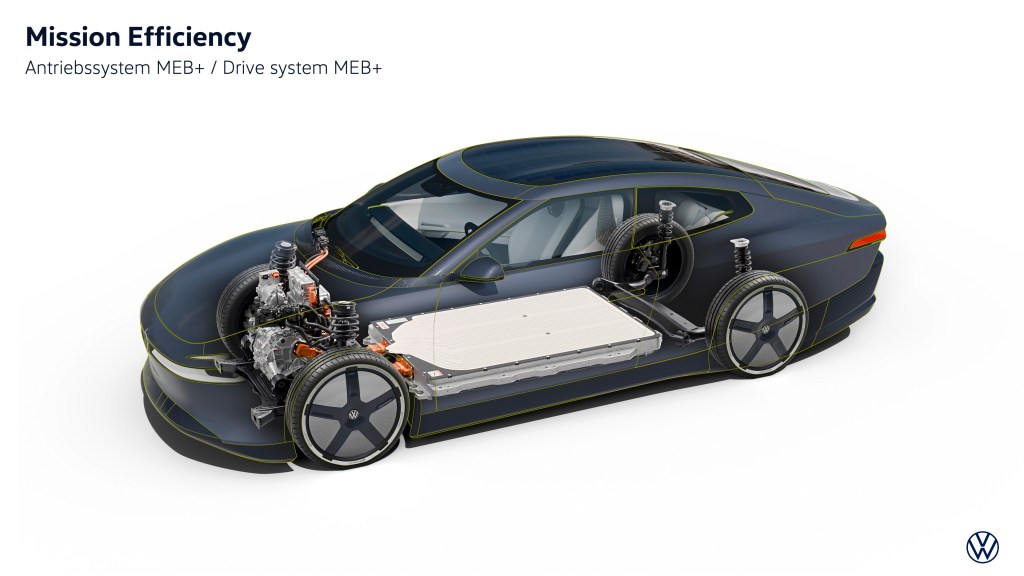
The car was presented in august this year, and besides being able to set a world record, in terms of technology, the Mission Efficiency is based on the MEB+ platform with front-wheel drive, showing the potential of the new ID. Models.
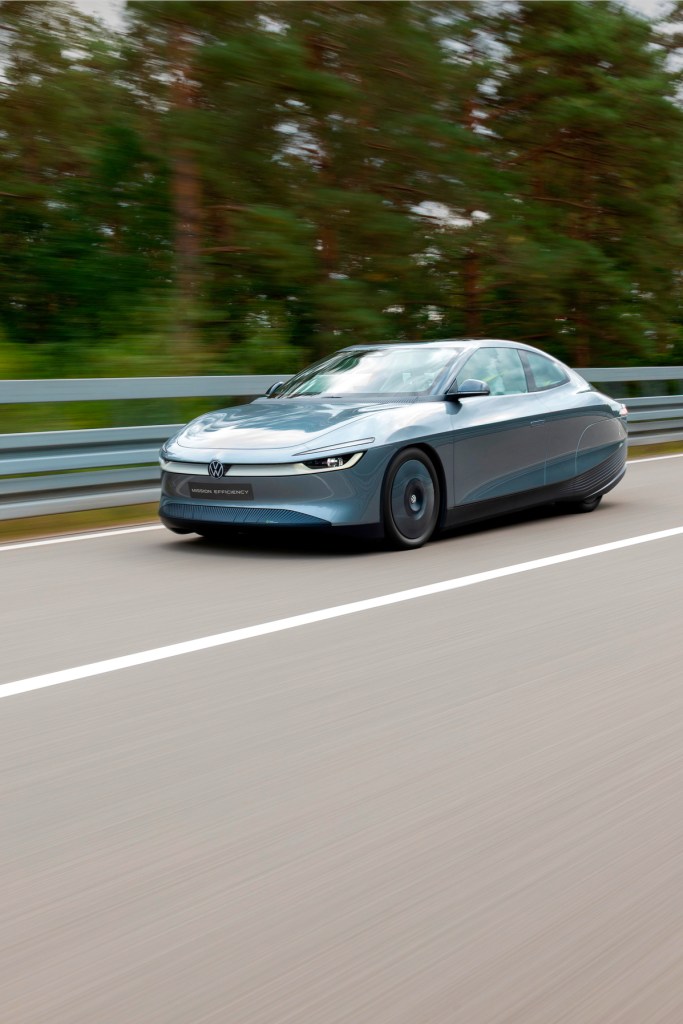
During an officially documented consumption drive over a distance of 1,278.36 km from Volkswagen’s German Research & Development Centre in Wolfsburg via Poznań (Poland) and Olmütz (Czech Republic) to the Austrian capital Vienna, the Mission Efficiency electric drive motor came in at a real consumption of just 7.51 kW/100 km including charge losses (6.89 kWh/100 km without charge losses).
The route was completed at an average speed of 67.72 km/h; the top speed was 138 km/h.
The 54.9 kWh battery was only charged once during the journey. Upon arrival in Vienna, the remaining range was 164.0 km.
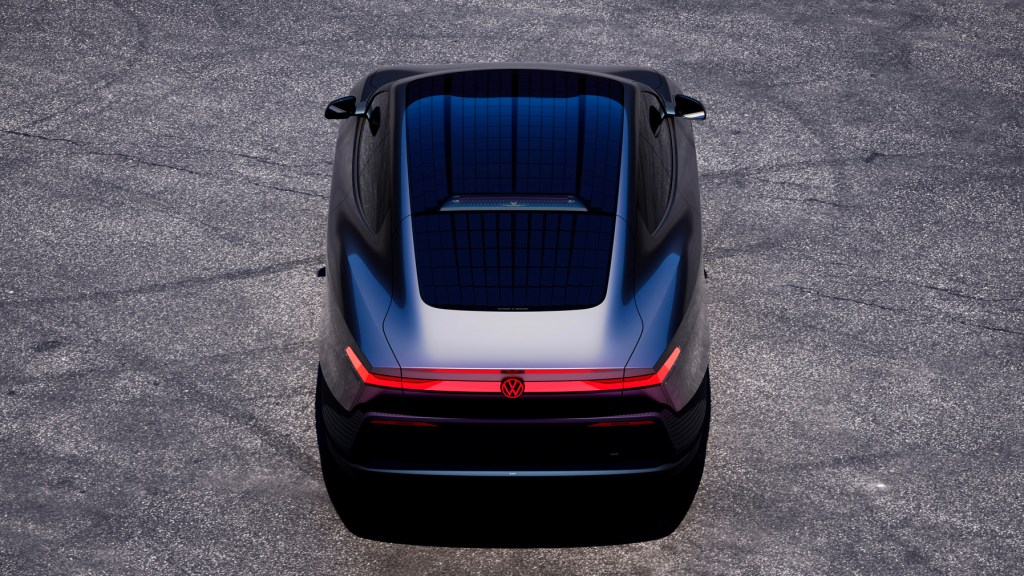
Practical
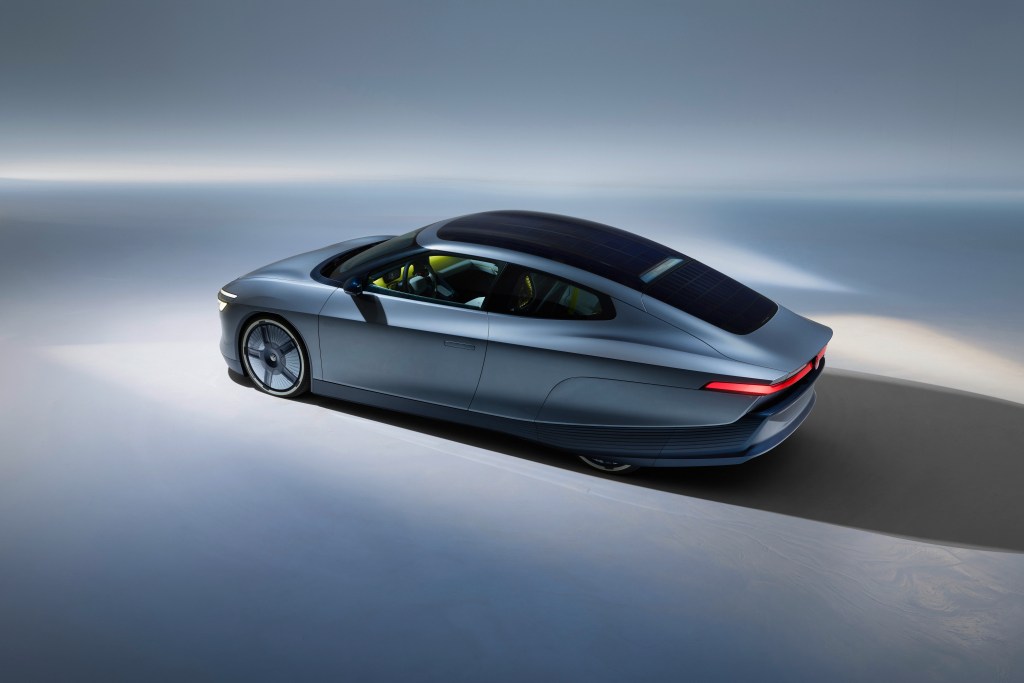
Visually, the Mission Efficiency is based on the new Volkswagen “Pure Positive design” language. It’s a two-door coupé with a large boot lid, 2+2 seats, a variable luggage compartment (481 litres) as well as additional stowage compartments under the rear seats and in the side of the body (e.g. for the charging cable). While the interior can be used without restriction at the front, the two rear seats are intended for passengers up to a height of approx. 1.60 m.
The coupé is nevertheless characterised by extremely good space use for a record-breaking high-efficiency vehicle. The concept car was designed in such a way that it could theoretically be used by a young family of four.
State of the art aerodynamics
The low drag is the result of the drag coefficient (Cd = 0.158) and small frontal area (A = 2.08 m2) is the central aerodynamic feature of the Mission Efficiency.
The Mission Efficiency is 1,392 mm high, 1,744 mm wide and 4,775 mm long. Compared with the ID. Polo, this results in a significant increase in length (+722 mm). This additional length is due to a 100 mm longer wheelbase (2,700 mm) and a large rear overhang, which allowed the technical and design team to realize the teardrop shape of the body and the related pioneering aerodynamics.
Drivetrain and body…
The Mission Efficiency and the ID. Polo share the same drive system, the front axle including steering and the basic design of the rear axle.
When comparing the concept car and the production vehicle, it is clear that numerous components of the ID. Polo had to be adapted to the new proportions and new design of the Mission Efficiency.
The body combines the body structure of the ID. Polo with a likewise self-supporting aluminium structure. The doors, bonnet, boot lid as well as the wings and add-on parts are made of a high-strength CFRP aramid composite.
The prototype also has EU road approval and meets the corresponding protection, strength and crash requirements.
Interior and infotainment: less is more…
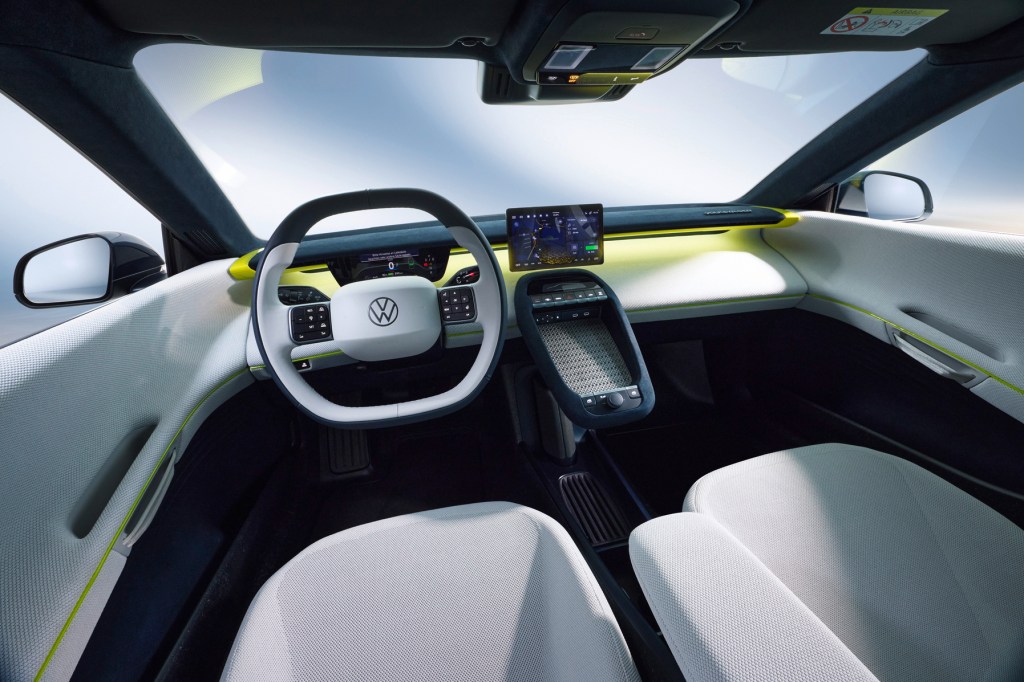
The interior of the Mission Efficiency is largely individually customised – in line with the character of a concept car. Modules such as the multifunction steering wheel, steering column switches, slightly shortened air conditioning block with haptic buttons and the central volume control have been adopted from the ID. Polo.
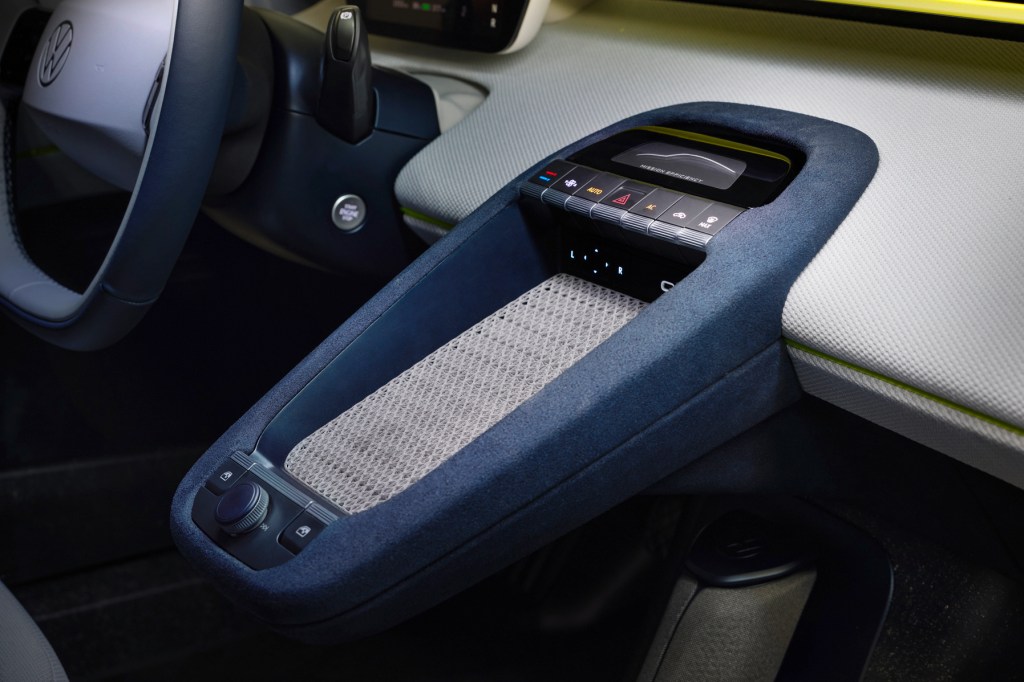
Unlike the ID. Polo, there is no permanently integrated infotainment display. Instead, a concept called ‘Bring your own device’ was developed here. The name says it all: the function of the infotainment screen is taken over by the driver’s own Android or Apple tablet/smartphone, which is locked in position by a clamping rail and connected wirelessly to the vehicle. All of the infotainment system’s functions are displayed on the screen of the paired device.
Brave new world, we would say. The overall design of this car is also typical for the German car engineering philosophy of combining (E-)efficiency with higher speed travel on Autobahnen, where aerodynamics play a predominant role…
Hans Knol ten Bensel

