Peugeot styling has panache and zest, and a short look at this 308 SW will convince you. The 308 SW we tested here for you came even in the GT version, which adds even more flamboyance.
The 308 finds a technical sister in the DS4, and its technology is well proven indeed.
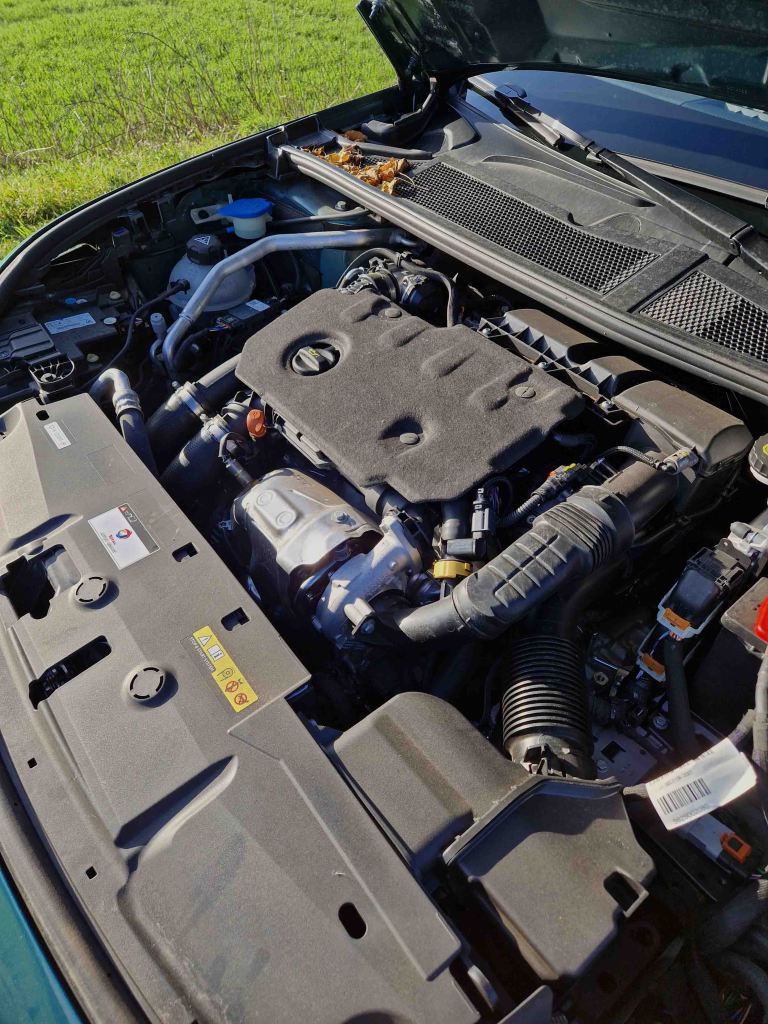
Under the hood of our test car pounded the powerful heart of a 1,5 litre “Blue HDI” Diesel, and it impressed us greatly. Let it be said, modern day diesels have come a (very) long way, combining excellent pulling power with legendary economy. Here it was coupled to the Aisin 8 speed auto box we see also in many other models of the Stellantis group, as does the engine by the way.
We asked ourselves how a diesel would compare with our modern petrol engines and (fully) electrified drivetrains, so read on!
Hans Knol ten Bensel
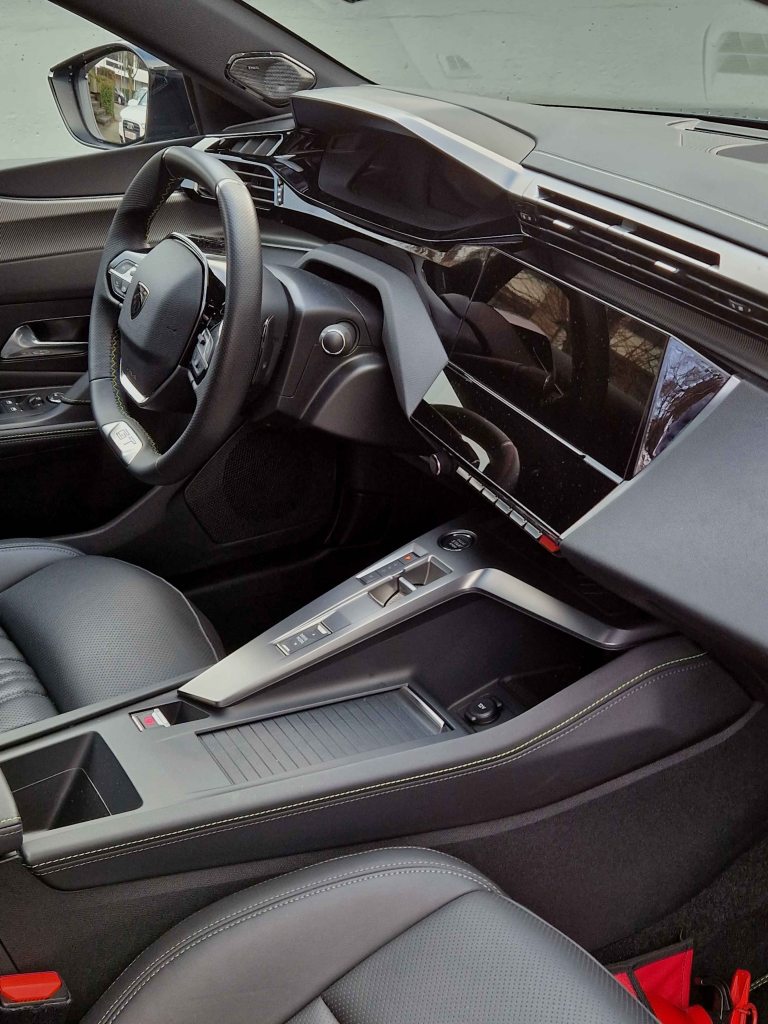
Sliding behind the stylish wheel of this 308 GT, our eyes immediately fell on the beautiful instrumentation. I think personally that the Peugeot stylists did a wonderful job. You have the impression to sit in a sports or racing car, reminiscent even of a formula 1 car, if you let yourself get a bit carried away. It certainly has character. The small steering wheel and the high positioning of the instrument cluster reinforce the feeling to sit in the cockpit of a very sporting machine. The size of the steering wheel also enhances the impression of agility and indeed encourages you to drive this Peugeot in a spirited manner.
Pushing the starting button lets the diesel come to life. It certainly changes from the velvety e-power we are now increasingly becoming accustomed to. Vibrations are clearly felt in the steering wheel, and even at cruising speeds some vibrations are felt. Indeed, the laws of physics inevitably come into play when the engine is very efficient and the gearing is very high indeed.
Of course, this efficiency results in stellar economy. According to the WLTP cycle, this 308 SW consumes merely liters in the urban cycle. On secondary roads, the consumption even drops to 4,5 l/100 km, and a modern Diesel is also absolutely king when it comes to high constant speed runs on the Autobahnen or Autoroutes. The WLTP cycle average quotes here 4,9 l/100 km. Co2 emissions are 129/148 g/km.
Are these figures realistic? Yes, if you drive accordingly. We repeat it time and again, one should drive with anticipation, use the available kinetic energy to the max to obtain decent fuel economy. This means coast as much as you can, instead of using the brakes. Drive in a fluid manner. You will in a few days be amply rewarded at the fuel pump. The average consumption in urban traffic of my Lexus CT 200h? 4,7 l/100 km, smoothly, no sweat. In the present state of affairs with still a fair amount of “grey” electricity, it wins the well to wheel CO2 contest still hands down.
So much for that. The torque of this 130 HP diesel is ample with 300 Nm. The 8 speed automatic takes well advantage of that, and acceleration from 0 to 100 km/h is a brisk 10,6 seconds. Top speed is 207 km, indeed, on the Autoroutes this 308 SW is fast.
Daily life with the 308 SW…
An aura of sporting panache pervades the interior. The quality of the materials and finish is impressive. We loved also the clean yet rather dramatic styling of the centre console and dashboard. Under the touchscreen is a smaller horizontal screen with a fixed layout where you can always select the main menu functions, and below that are manual switches for heating and ventilation, as one finds also in the DS4. This layout is logical, and you find your way soon enough, without having to consult a bible thick manual.
Peugeot wouldn’t be Peugeot if the seats were not excellent and the seating position is also beyond reproach.
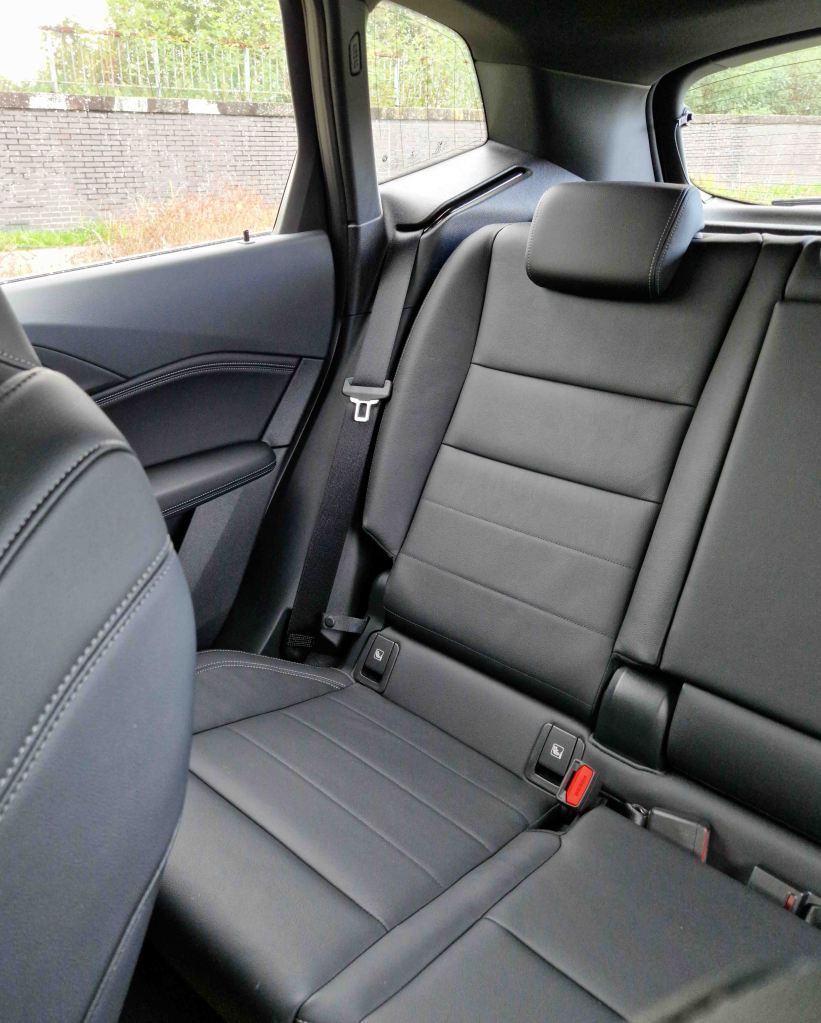
Head- and legroom is good, also at the rear. Our modern cars have a very raked windscreen and when one wears a hat, as your servant invariably does, you have to be careful not to touch the roof rim. The Peugeot is no exception to the rule…
Boot space is more than adequate, 608 litres is available with both rear seat backrests up. Dropping them down expands the available load space to 1600 litres. This is where the longer wheelbase really pays off. Another bonus here is the ample legroom at the rear.
Top notch driving aids and connectivity…
The 308 SW in this GT livery offers a 360° camera, and parking is therefore a breeze. All the usual apps found in the more lavishly equipped cars brands of the Stellantis group are also found here, and of course Android Auto and Apple are available, and the ergonomics of the touchscreen which is slightly tilted towards the driver are also state of the art, as we said earlier.
Conclusion
The 308 SW is a typical modern day Peugeot. Well built and finished, a flamboyant styling language both inside and out, well performing and efficient, offering roominess and excellent everyday practicality. Its diesel engine makes it a candidate for frequent, high speed long distance use, and indeed when you are often on the road over a wider range, this is the version to choose…
Opel cars carry proudly the iconic lightning or “Blitz” badge, and this since the Opel-RAK 1 or rocket record car made an unforgettable impression in March 1928, when it achieved 75 km/h and more than 100 km/h in April of the same year.
The Opel group was also working on liquid-fuel rockets in those days: In a cabled exclusive to The New York Times on 30 September 1929, Duke von Opel is quoted as saying: “Sander and I now want to transfer the liquid rocket from the laboratory to practical use. With the liquid rocket I hope to be the first man to thus fly across the English Channel.” It announced the dawning of a new age: that of rocket propulsion.
But we will stay with both feet on the ground, and enjoy the four wheeled products of the brand. And I must admit, I did already enjoy them massively in my early automotive life. My first Opel I tested as a car journalist was in 1968, actually replacing my father Theo ten Bensel, then Editor of weekly illustrated “De Post”. It was the beautiful Opel GT 1900, driven in the surroundings of Port Grimaux.
In the summer of 1971 we made a high speed trip to the Austrian Grand Prix in Zeltweg, with a Manta 1900, having the same 102 HP engine as the sleek GT two seater, coupled to three-speed TH-180 automatic. The Manta proved to be not only fast, it excelled with a stable, wonderful handling, making it a true Gran Turismo. Since then, my admiration for Opel cars was born.
When I slid behind the wheel of a Mokka, superb looking in its black livery, I immediately was again seduced by the no-nonsense Opel efficiency, build quality and style. Opel adopts in-car connectivity and instrumentation with the philosophy of “less is more”, and indeed the dashboard is an example of user friendliness and simplicity.
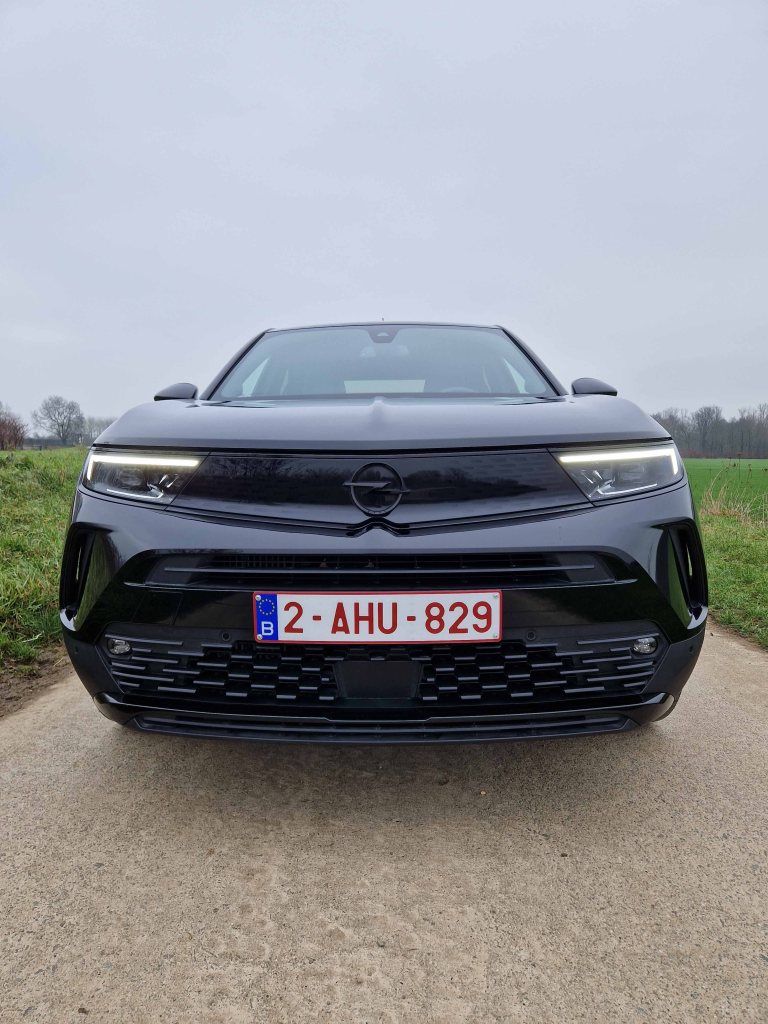
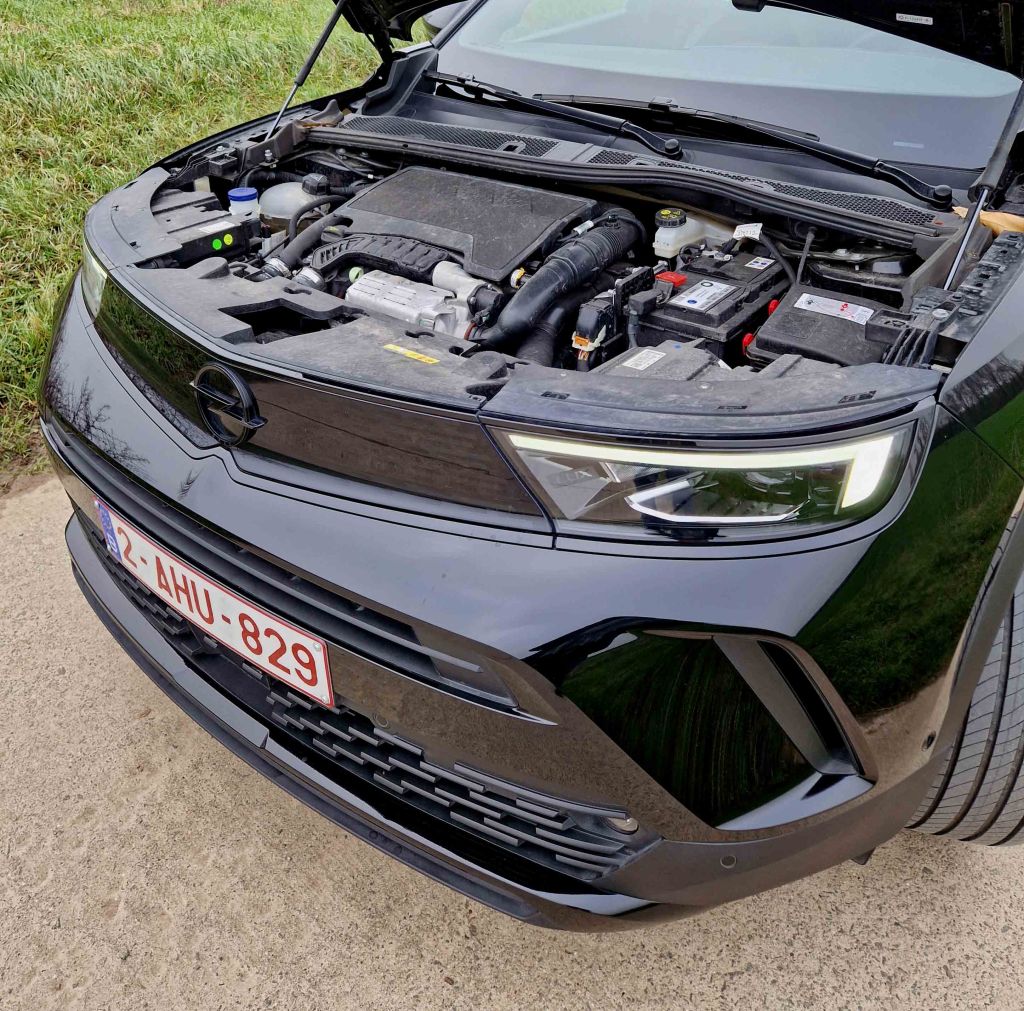
But it is stylish too. The new Mokka was the first model with the Opel Vizor as the future brand face, and indeed it symbolizes very well what Opel this decade wants to look like: pure, precise – reduced to the essentials. Like a full-face helmet, the Opel Vizor organically integrates the grille, the headlights and the brand logo in one single module that covers the new Opel face.
The Mokka is also well proportioned: its bold looks are characterized by short overhangs and a well-planted, wide stance. It’s also is 12.5 centimetres shorter than the predecessor – despite the 2.0cm-longer wheelbase.
We told you about the first generation “A” Opel Manta. It inspired the initial concept of this elegant feature: for the new Mokka, the designers literally reinvented the Manta’s grille with twin headlight-modules on a black surface, framed by a thin chrome bar.
The legendary “Blitz” brand logo we also told you about has been redrawn and will adorn all upcoming models from the German carmaker. The surrounding ring is now slimmer, more elegant, more precise. This emphasizes the “Blitz” even more. All details are super sharp with a very small radius. The ‘Opel’ lettering is integrated in the lower part of the ring.
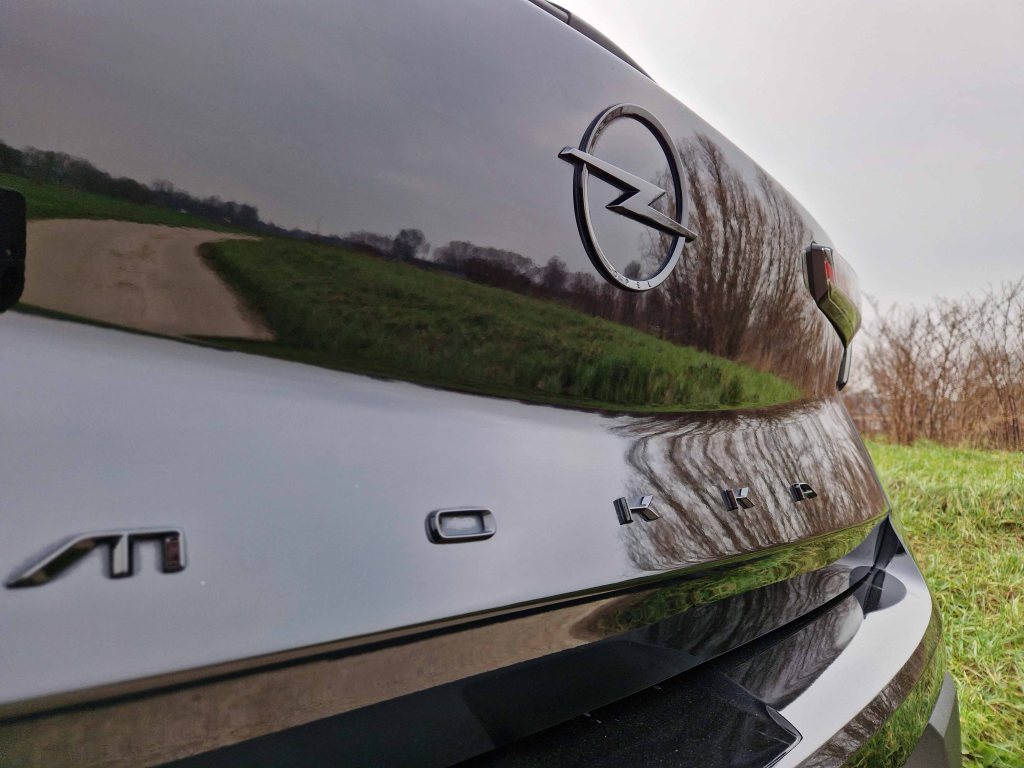
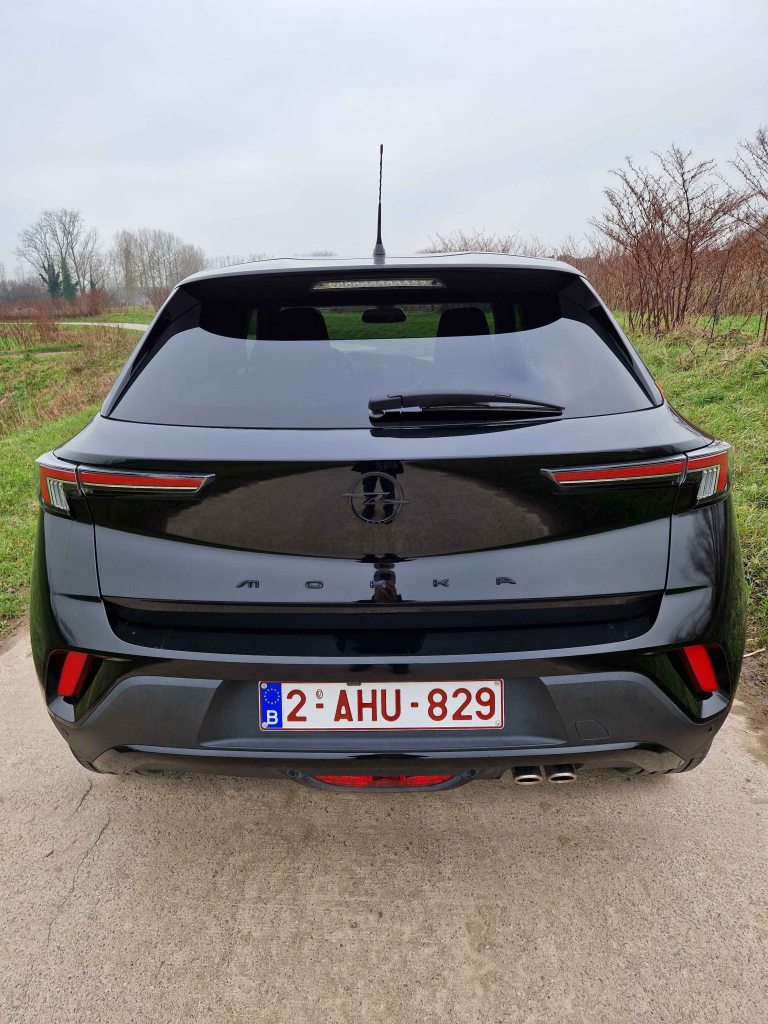
At the rear, The Mokka nameplate, executed in sharply crafted lettering, stretches in a wide landscape format to emphasize the width of the vehicle, “pure”, without irritating additives such as equipment lines or displacement abbreviations. It sits centrally on the tailgate below the legendary Blitz. Nice!
But it there are of course the well proven 1,2 litre three cylinder petrol engines with power outputs ranging from 74kW (100hp) to 96kW (130hp).
This engine family takes centre stage in the Stellantis Group and is found in virtually all brands and models. We tested here the 130 HP version coupled to the equally well proven 8 speed auto box, which we also find in many Stellantis models. Compared with the Citroen C5 X we tested with the identical drivetrain, it made a more sophisticated impression, with less vibrations and generally smoother pickup. Performance leaves also here nothing to be desired, with a top speed of a solid 200 km/h and an acceleration time from 0 to 100 km/h in 9,2 seconds. You guessed it: this is by and large the performance of the original Porsche 911. Not bad…
Of course, very Porsche untypical is the consumption: this is where enormous progress is made over the years: where the 60’s Porsche would consume well over 13 liters/100 km in town, the 1,2 litre Mokka will consume about half, and even less, with an average of 6-5,9 litres. On the open road, the differences are just as large. Cautiously driven, the vintage Porsche would consume 9-9,5 liters on the open road, the Mokka will chalk up merely 4,3 liters… These WLTP figures require a very sensitive foot, and indeed also ask for rather sensitive cruising speeds, but let’s face it, what has been reached over the years is just enormous. This, lets’ not forget, will make our modern petrol engines future proof for many years to come…
We just loved the three cylinder throb of the engine, which was overall quiet anyway, and this made driving this Mokka a genuine pleasure.
Add to all this the impeccable handling, then you understand this Mokka is indeed a driver’s car. It does not have the absolute eagerness of a pure sports car, but is stability and steering precision is certainly inviting you to drive it with spirit. It feels at home in town, as it is smooth at slow speeds, and on the Autobahnen it is a true master. This is a machine built for (very) high cruising speeds, for hours on end. On country roads, its positive handling and stability lets you also tackle the route with verve.
Efficient aerodynamics
Of course, to make this Mokka a smooth Autobahn high speed master, some detailed work had to be done. So the carmaker’s engineers optimised the new Mokka’s aerodynamics in the wind tunnel of Stuttgart University (at the Research Institute of Automotive Engineering and Vehicle Engines).
Depending on the model variant, they cut the drag factor to an excellent 0.32 cD. The basis for the aerodynamic efficiency is the new Mokka’s frontal area of only 2.27 m2.
With the aid of computational fluid dynamics (CFD) and attention to detail in the wind tunnel, Opel’s aero experts then chiseled down to the excellent drag coefficient by fine-tuning every detail that helps improve the aerodynamics. The engineers optimized the design of the new Mokka’s characteristic Opel Vizor, as well as the shapes of the A-pillars and the exterior mirrors. In addition, cladding covering the bottom of the engine compartment and the underside of the body improves the airflow beneath the car.
Other major sources of drag are the wheels, tyres and wheelhouses. The new Mokka therefore features innovative air curtains that increase aerodynamic efficiency in this area. An air curtain is an integrated duct on each side of the front fascia that creates a tall, thin jet of air across the face of the front wheel and tyre. The air curtain directs the flow smoothly across the wheel openings, decreasing the amount of wake and separation from these areas.
Need we say more? Yes actually. The Mokka also has…active aerodynamic shutters!
The new Mokka also benefits from an active shutter that further reduces drag and improves fuel efficiency by automatically closing the frontal opening when cooling air is least needed. Until recently, this innovation has been more common on more expensive cars from higher segments.
When closed, the shutter system enhances aero performance by redirecting airflow around the front of the vehicle and down the sides, rather than through the less aero efficient engine compartment.
The shutter is open or closed depending on engine coolant temperature and speed. For example, the shutter opens when the car is traveling up a hill or in hot city driving. The shutter closes when less engine cooling is required, for example at urban-road speeds.
The results of these efforts are impressive: compared with the previous model, which had a drag coefficient of 0.35, CO2 emissions in the WLTP2 cycle are up to 9.0 g/km lower, while drag at motorway speeds has been reduced by 16 per cent.
High tech LED headlamps and more…
But not only clever physics have been put in the Mokka. It has also a (very) fair share of high tech electronics. All models are equipped with latest generation LED lamps – from daytime running lights in typical Opel graphics to headlamps and front fog lights. The Mokka has adaptive IntelliLux LED® matrix light with a total of 14 elements. Cruise control, a smoothly operating lane assist and forward collision alert with automatic city emergency braking and pedestrian detection operates at speeds above 5.0km/h. Below 30km/h, the system can bring the vehicle to a complete stop. If the speed exceeds 30km/h however, speed is reduced and the driver must actively brake…
Inside: Opel’s “Pure Panel”
As we said, the good design continues. The structure of the Pure Panel, along two widely stretched screens, strikes a balance between digitalization and purely intuitive operation, without needing to navigate into sub-menus. We simply loved it.
The connectivity is also well served: The top of-the-line Multimedia Navi Pro offers a high-resolution 10-inch colour touchscreen; in this configuration, the driver information display covers more than 12 inches. The Apple CarPlay as well as Android Auto compatible multimedia systems have integrated voice control.
The new Mokka also offers the OpelConnect service with a direct link to breakdown assistance and eCall. If the airbags or seatbelt tensioners deploy in an accident, eCall contacts the local Public Safety Answering Point (PSAP) automatically.
Comfort and style…
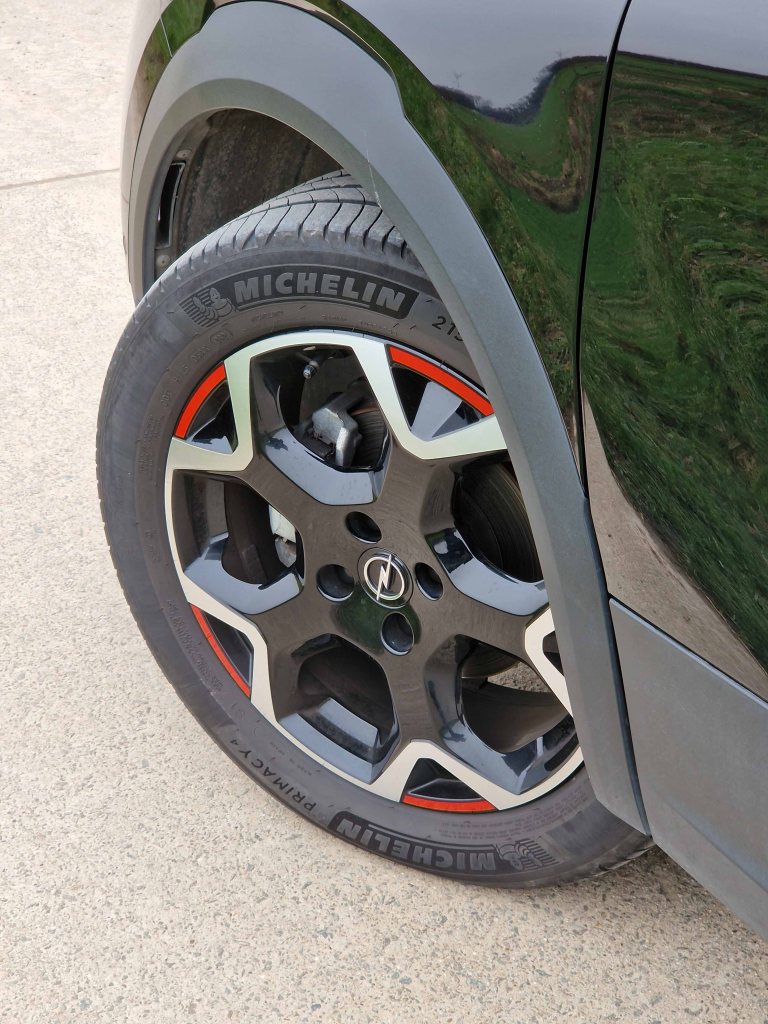
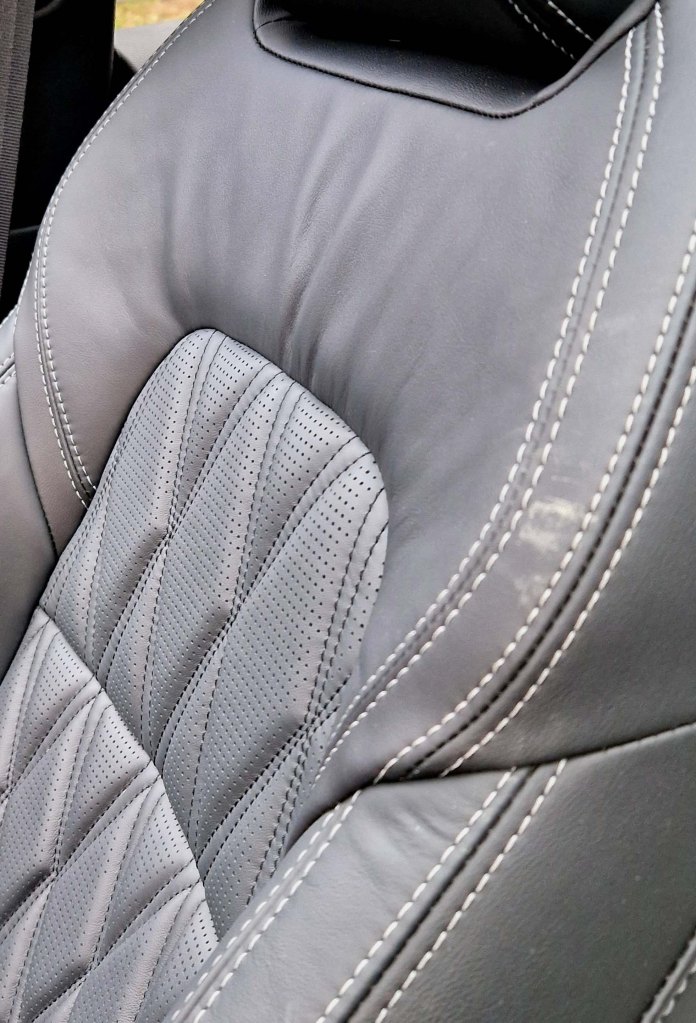
Thorough seating engineering is typical of Opel. Various six-way ergonomic seats are available, which are individually adjustable. You can choose between alcantara or classic leather. What seduced us also was the GS trim of our test car. Alloy wheels in TriColor black, a black roof, black exterior mirrors and skid plates front and rear in SUV design. The Opel Blitz, the Mokka nameplate and the Opel Vizor frame are in high-gloss black. There is a characteristic red signature line across the car. The interior features a black ceiling, aluminium pedals and red décor. The black seats with side cushions in premium leather-look have red stitching and design accents…
Conclusion
This Mokka will wet your appetite. It’s good looking, lively, frugal, a pleasure to drive, well built and finished. It is equally at home on fast Autobahnen for fast cross country Gran Turismo driving as well as urban errands. It’s tough, built for a long life. To sum it up, it’s Opel…
We all know it too well: Battery powered full EV’s are just wonderful to drive, seducing you with their stream of vibrationless, quiet and instant EV power.
We also realize however that at least in Belgium and also in several European countries the public charging infrastructure seems to be still in its infancy, and when you don’t have a house with a driveway with your own charging unit, you can forget about fully enjoying your EV for private use.
Indeed, apartment or condominium inhabitants can also better look elsewhere: beefing up the power circuit in de building meets much resistance from the owners, and they also find the potential fire hazard of an EV car in their underground garage rather too big.
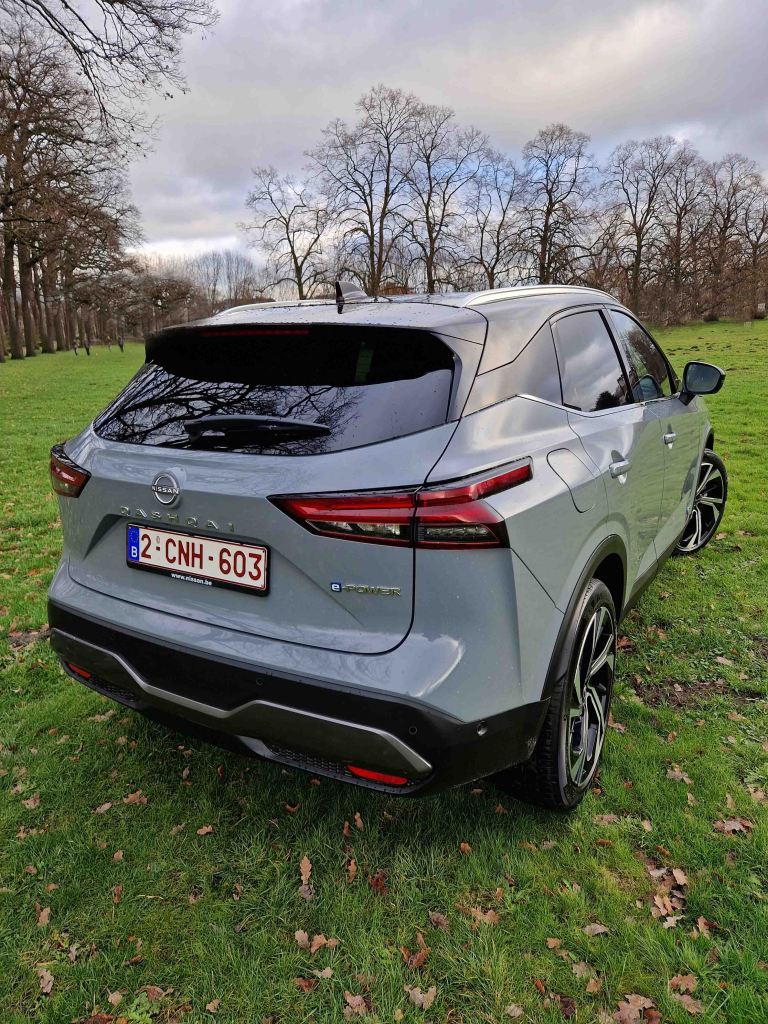
So if you want to sell a car to a wide public which wants to enjoy the EV smoothness, without the recharging troubles, then it is wise to develop a car such as this Qashqai “e-power.”
The Nissan engineers indeed took the hybrid concept a step further: the petrol engine, here a 1,5 litre three cylinder unit, just generates electricity and the wheels are therefore only driven by an electric motor. Does it all work fine? Just read on…
Hans Knol ten Bensel
Full Hybrid the Nissan way…
Let’s tell it right away, this is definitely one of the very smoothest hybrids I have ever driven. Indeed, total EV smoothness is achieved as there is only the electric motor powering the car. This electric motor is good for 140 kW with a torque of not less than 330 Nm. So this Qashqai is indeed well powered, as the performance figures clearly show. This Nissan will accelerate smoothly from 0 to 100 km/h in merely 7,9 seconds, reaching an electronically governed top speed of 170 km/h.
The engine – the Nissan KR15DDT unit , a 1498 cm3 3 cylinder unit with direct injection, DOHC and CVTCS (Continuously Variable Timing Control System), is very well insulated and indeed is almost inaudible, adding greatly to the pleasant feel of driving a fully fledged EV. Just for the record, it develops 116 kW / 158 PS / at 4600 rpm, torque is 250 Nm between 2400 and 4400 rpm.
Nissan also names this engine ‘VC Turbo’, with those first two letters standing for Variable Compression. The engineers went to very great lengths: instead of conventional connecting rods, the pistons are joined to the crankshaft through motor-driven, multi-link devices which vary the top and bottom dead centre positions of the pistons. This allows to adopt a high compression when performance is wanted, or low compression to improve fuel economy. Soo clever!
But how about fuel efficiency and consumption? As there are invariably losses in the drivetrain in the generation of the electric energy, you are well advised to adopt a smooth driving style, driving with anticipation in order to save as much kinetic energy as possible. The less kW the engine has to generate given a certain distance, the better it is.
Of course, the hybrid concept in this Qashqai has also efficiency gains when the urban pace is low and involves many stops.
Simply because under these circumstances the EV motor does all the work, with the combustion engine recharging the battery under ideal load and revs, computer controlled of course. Indeed, only with the advent of electronic management of the drivetrain is this possible, but this has now been the case for many years, and has already been proven millions of times. It is good to note too that the e-power Qashqai has a 2.1kWh battery, which is somewhat larger than most non plug-in hybrids.
Therefore the Qashqai can achieve good efficiency in urban traffic, where we achieved a consumption between 6 and 6,5 l/100 km. On the open road, the engine has to feed rather more the electric motor with electricity, so when speeds are moderate, say up to 100 km/h, it is still possible to stay in the 6 litres/100 km range.
It is only on the motorway at high cruising speeds that things are getting a bit awkward. The motor has then to feed the e-power to the electric motor for real, and this means averages between 7 and 7,8 l/100 km. So, what’s the verdict? EV smoothness and “zen” character of the drivetrain is yours indeed to enjoy fully, and we loved the Qashqai e-power for it. The consumption however will not break records here. You just need a very sensitive right foot and the constant awareness that developing kinetic energy costs money at the pump, and that you have to retain it as much as you can, adopting an anticipative driving style. Certainly in urban traffic the fuel economy is very creditable indeed…
You have many choices in driving this Nissan: The D-Mode lets you select between normal, power and eco, the EV button lets you use the electric motor in urban driving conditions as much as possible, and the e-pedal lets the electric motor act as a generator when you lift the throttle…
The qualities of a bestseller…
Did you know that in the UK the Qashqai is a bestseller in its segment? By the way, it is built in the Nissan factory in Sunderland, UK, where also the Juke and the Leaf roll of the production lines.
We can understand its success, as this SUV, which we tested in the Tekna top equipment version, has all the qualities to put a (broad) smile on your face. It has a very readable head-up display, a 12.3-inch ‘Nissan Connect’ touchscreen infotainment system, a powered rear tailgate and a of course many driver assistance functions. We liked the classic round dials, instrumentation buffs as we are, and also the good mix between touchscreen functions and physical knobs and levers.
It is also practical, offering you a boot space of 505 litres, and it has very wide opening doors, a boon for mothers with toddlers which have to be heaved in the baby seats.
Comfort
This Nissan is very well insulated from engine and road/wheel noise, and the suspension is comfortable at speed. In urban driving situations on our Belgian inner city tram rails and ridges the suspension is rather firm, but feels never obtrusive. Of course the Tekna top equipment level leaves very little to desire indeed, including a very good sound system, which we enjoyed to the full in this marvelously quiet car.
This Qashqai really convinced us by combining the wonderful qualities of EV driving with the limitless mobility a fuel powered combustion engine offers us. We must admit that your servant regretted to part with it…
We all know that the segment of the “grandes berlines” or the bigger saloons is under pressure. But then Citroën has a tradition to defend: making cars which provide splendid comfort, ample space for its passengers and can travel at speed for hours on end, without any fatigue for its occupants. The French call it “une grande routière”, and they whisper this with some respect. The tradition in France has been long, and magnificent. They have had in the ‘30s les grandes Bugatti, Voisin, Hotchkiss, Delahaye, and of course from the mid fifties of last century onwards the Citroën DS 19, Pallas 21. Then came the stylish CX, followed the XM and then by the iconic C6, a “voiture présidentielle” if there was one. So a “grande berline” simply MUST be on the menu. And indeed, there it is: the C5X.
The C5 X comes with different drivetrains, more powerful and electrified, but the dynamic Citroën Belgium PR team reserved for us the “base” version, with the well proven and pretty formidable 1 199 cm3 three cylinder 12 valve 131 HP engine coupled to an 8 speed automatic gearbox. Well proven we say, as this engine/gearbox combination is found in a great many models of the Stellantis group. It is found in Opels, DS Automobiles, Peugeot…and of course other Citroëns’. Does the C5X with this combination still have all the panache of a “grande routière?” Let’s see…
Hans Knol ten Bensel
Impressive stance…
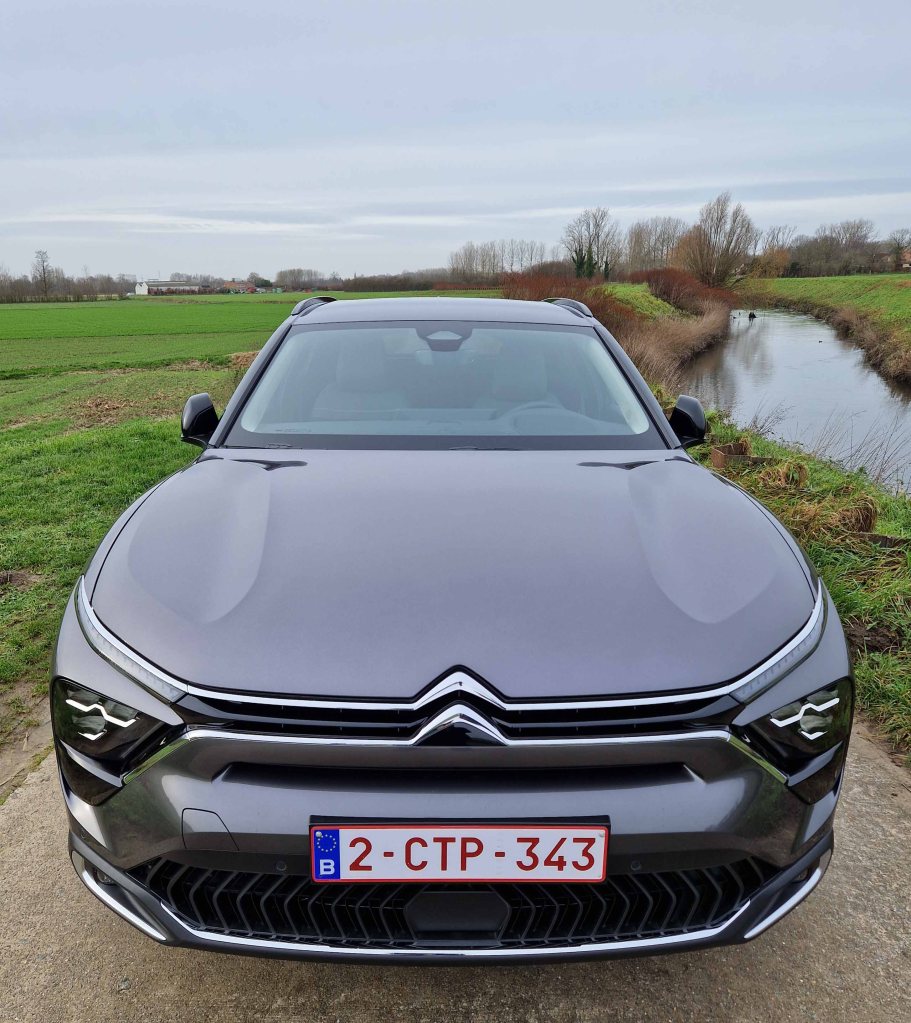
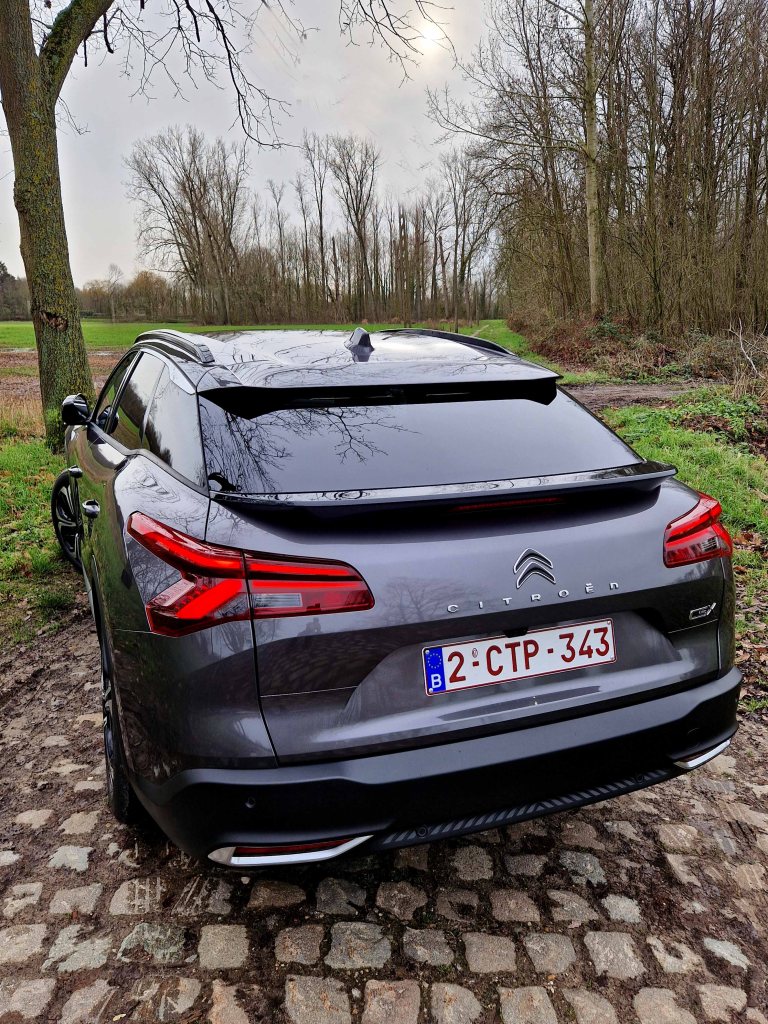
But first let’s have a walk around the car, and have a look at its aesthetics. It stands rather high on its wheels, so you cannot define it as an ordinary saloon. It rather has the looks of an SUV with its up to 19 inch wheels, and protections running around the wheel arches. When you look at its descending roofline, it also has the character of a luxury coupé.
On the front, a long chrome strip with the “double chevron” at its centre runs between the double headlights which are placed one above the other. Citroën describes the body shape of the C5 X typically as a hatchback crossover, and we would agree totally here.
In the interior, the dashboard has a rather classic layout, with small instruments facing the driver, spreading its information also on a clearly legible head up display. Luckily there is a large 12 inch touch screen display in the centre, with all the necessary functions well laid out, including the obligatory Android Auto and Apple CarPlay.
Space
The strong point of the C5 X is of course its legendary interior space. Rear passengers find regal legroom and this puts this car truly in a (more than) premium league. All this space doesn’t come at the cost of boot space, which is in standard form still offering a good 545 litres, which is extendable to a whopping 1645 litres. Despite its higher stance, the loading sill is pleasantly low.
A pounding heart
If one wouldn’t know better, one gets the impression that a big, old school 2 litre four cylinder petrol engine is doing all the work; it is not exactly refined, as vibrations on partial load at lower revs are clearly felt in the steering wheel.
But once you put your foot deeper, the engine runs smoother, and the 8 speed automatic changes also less perceptible. The gearbox can be ultra smooth when accelerating gradually at low urban speeds, and the engine is not too rough either, and even almost inaudible. So the engineers did their homework in slow city driving circumstances. The stop start function can be jerky sometimes, but soon one learns to avoid that with a sensitive right foot. All this behavior lets you think back to the DS 21 and DS 23 Injections in the seventies, and when you have known these cars, it gives you the impression that it is typically Citroën, this engine efficiency with a hint of roughness. Because efficient this engine is. Consumptions between 6 and 7 litres are easy to obtain, given of course an anticipative driving style, avoiding sprint accelerations.
Not that this 1,2 litre, 1,4 tonne Citroën is slow. Remember, 130 HP is exactly what a flagship 1972 DS 23 injection 5 speed was capable of, and its torque with 210 NM was even less than the 230 Nm the 1,2 litre three cylinder puts to the front wheels. Don’t forget, the DS 23 had a 2347 cc engine…The DS5 will sprint from 0 to 100 in 11,3 seconds, the historic DS 23 took 11 seconds to do the same. Top speed of the C5 is 210 km/h, doing honor to the Citroën tradition of “grande routière”. The DS 23 Injection was teasing Porsches in their days with a top speed of 188 km/h.
The good torque characteristics of this 1,2 litre engine and the alert 8 speed gearbox lets you enjoy good punch for overtaking and gaining speed.
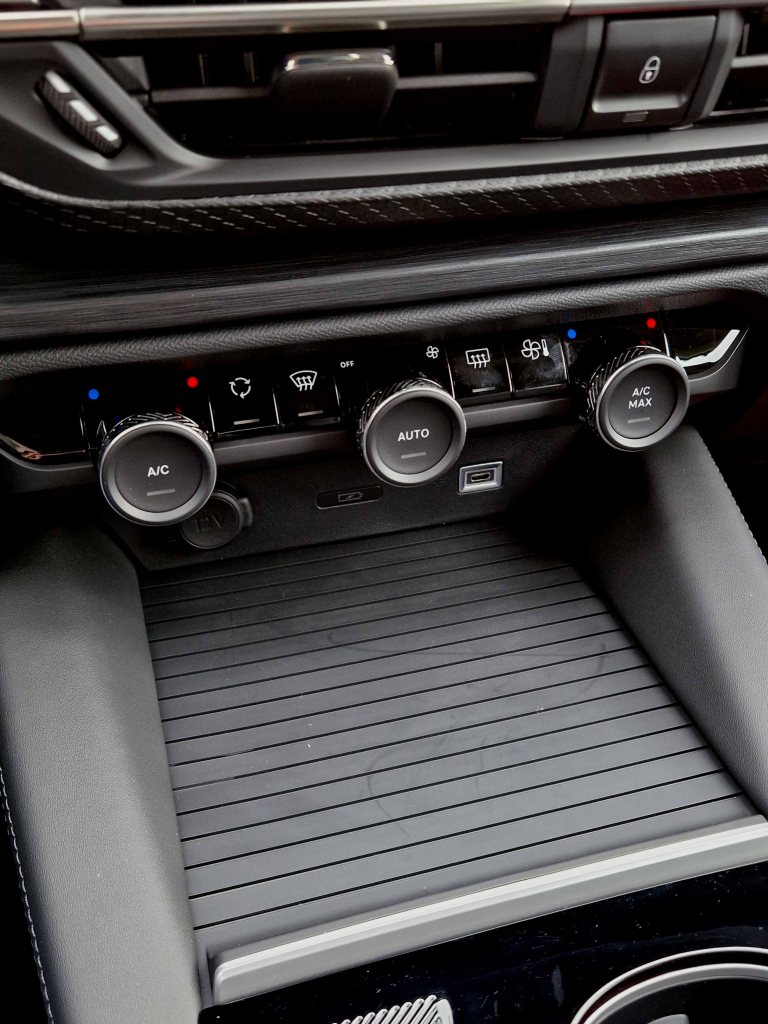
Thankfully the climate controls are analog beneath the touchscreen…
The legendary suspension and comfort…
The strong point of the DS5, and this is where it continues the tradition, is its masterful behavior at (high) motorway speeds. Because here the suspension comes into play, and here, despite the fact that we don’t have an adjustable suspension in this “basic” version, the engineers did a masterful job and succeeded in giving this big Citroën exactly this floating carpet ride which is so typical of them. This indeed makes this car an absolute king of the road, come rain, sleet, slippery surfaces, the C5 always seems to float over it with unerring stability and comfort, and…at speed. Cornering is also no punishment for the driver either, even when you are in big hurry. Of course there is some leaning to be felt in corners, but then again this feels completely natural.
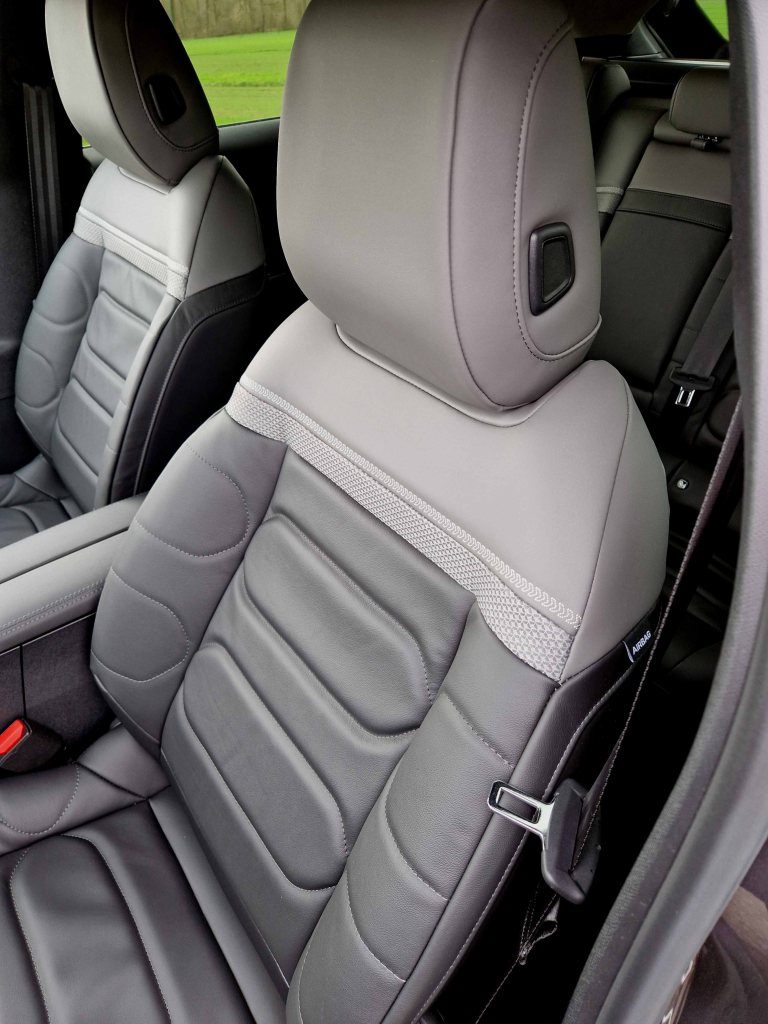
When talking about comfort, we have to mention here the absolutely fantastic Citroën comfort seats, which really stand out.
The pinnacle of mobility…
There is one thing in which this 1,2 litre petrol engined C5 X truly excels too: it has just a petrol engine only, and this does result in mean less weight to carry around, but also, and this we tend to forget in our electrified age, it gives you absolute mobility. After a (very) fast 700 km trip, it just takes minutes to refuel, and you can continue your journey for as long (and fast) as you want. Your formidable “pure” EV than has to rest for AT LEAST one hour, provided you find the proper recharging station…for example in the cute village you entered in the Alpes Maritimes…
Citroën says less is more… the rest you can read on the head up display…
With the abysmal recharging infrastructure we will witness still for years to come, as it cannot keep up with the increasing volumes of EV cars, increasing, this is an element which cannot be stressed enough. The reason also why all manufacturers are offering also (plug in) hybrids…
Conclusion
Is this 1,2 litre C5 X a true “big” Citroën? You bet it is. All the way. We mentioned its strong points, and this indeed makes it a car which continues the legend with panache and unique bravour.
We also like its style, its value for money, its roominess, comfort, safe, unerring, stable handling. Of course the C5 X is also offered with more sophisticated drivetrains, like the 225 HP Plug in hybrid version, but you get already the real taste of what a big Citroën is all about, enjoying as we said absolute mobility with this 1,2 litre petrol engined drivetrain…
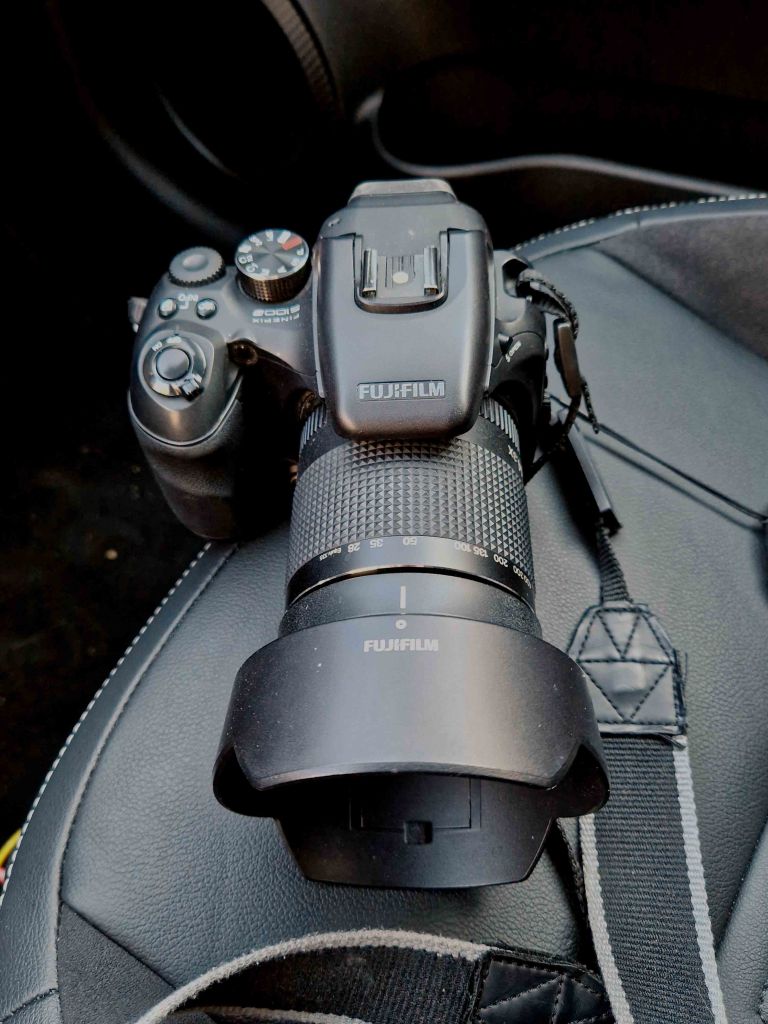
The second generation Kia Niro is succesfully restyled… Photo was taken here with the “vintage” Fujifilm Finepix 100fs: bought recently for merely 59 Euros…
With the second generation, the Kia Niro has decidedly come of age. It is altogether more stylish, and comes with all possible electrified drivetrain options: you can have it as a straightforward hybrid, like the Niro we tested here for you, or as a PHEV, and of course as a fully fledged EV. We impressed by the smoothness, space, comfort and user friendliness of this “pure” hybrid, which can be very frugal too… just read further.
Hans Knol ten Bensel
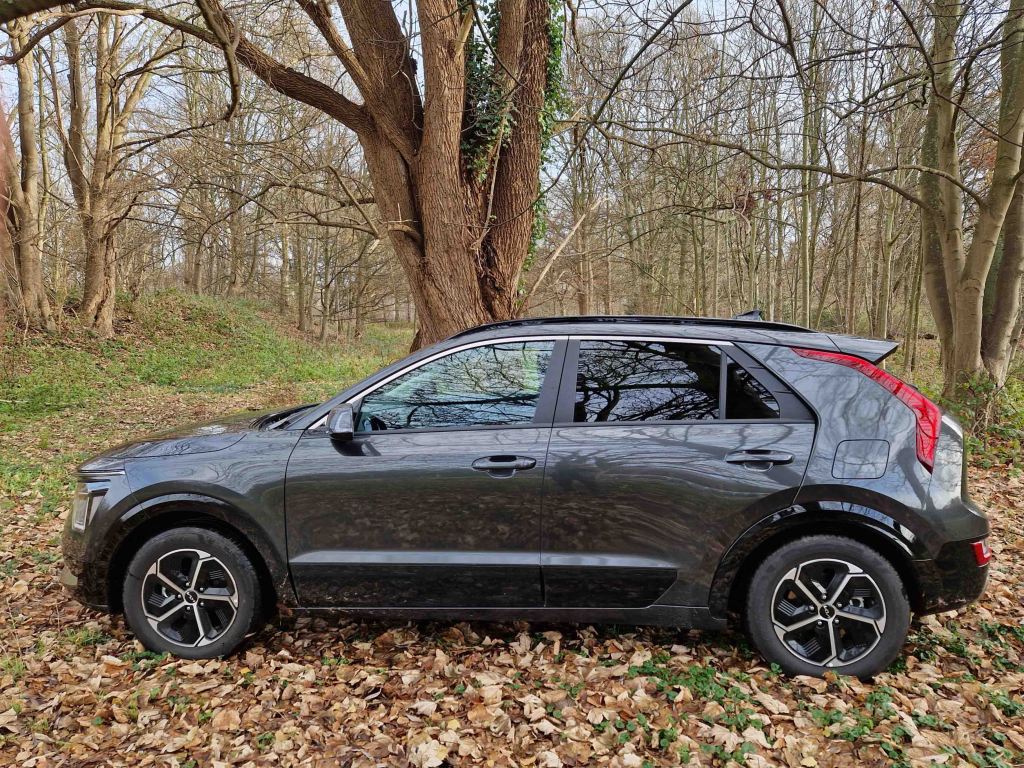
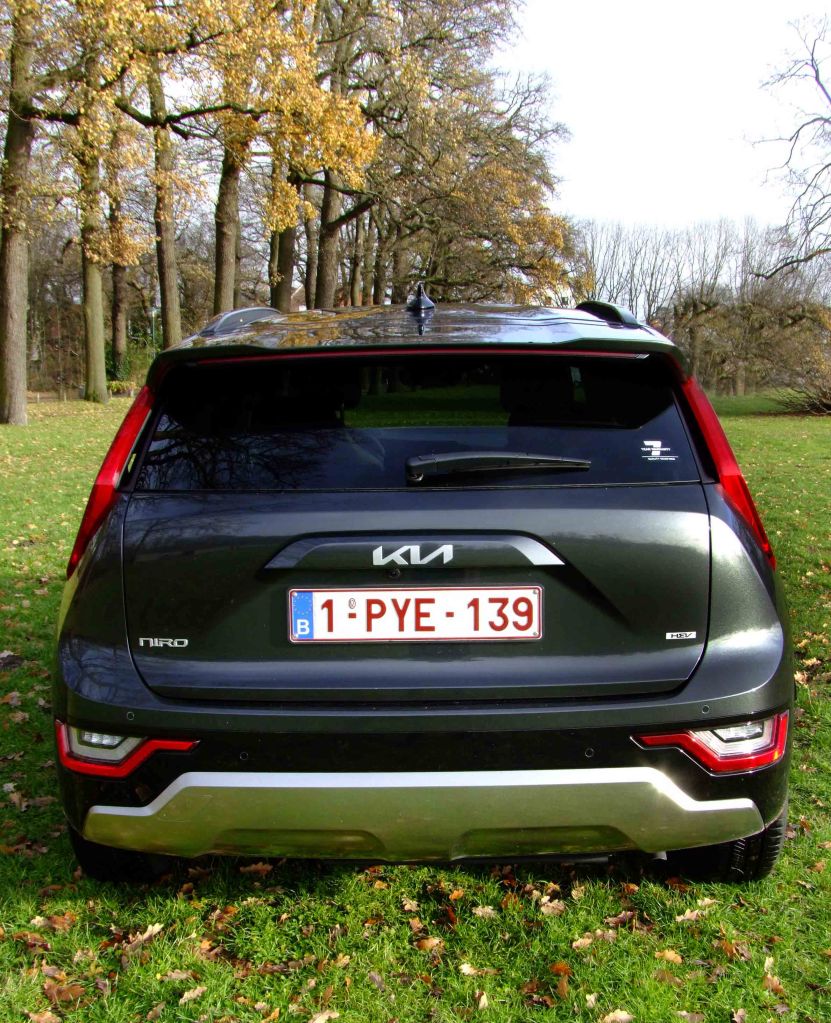
Indeed, the Niro has gained in style. The C Pillar ends with nicely sculpted rear lights, curved like we see on Volvo’s, with a passage between the bodywork and the lamp cluster, to improve air flow along the side of the car.
Photo taken again with the “vintage” Fujifilm Finepix… showing excellent colour balance.
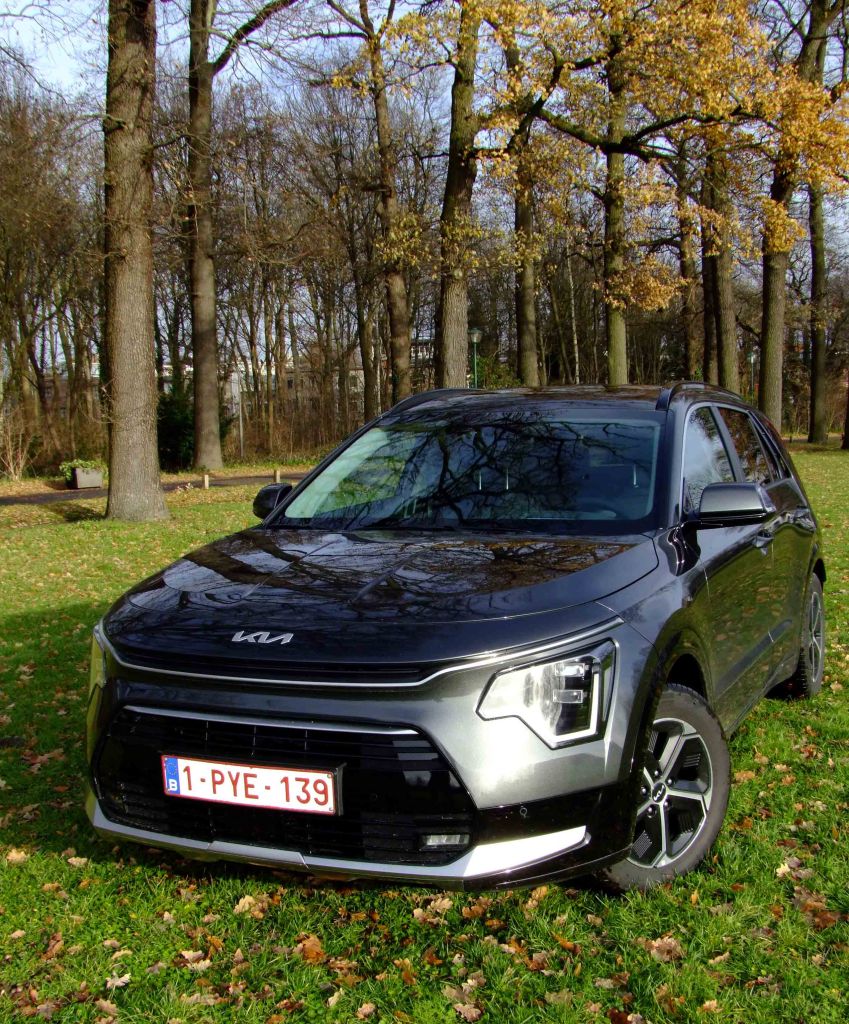
The C-pillar can also be had in contrasting colours. Also the front end has improved in stance and presence with a wide aluminium coloured rim around the hood and its big lights. The same goes for the interior. A sweeping design, good quality materials give you that premium feeling.
Photo here taken with the latest “flagship” Samsung S22 smartphone … wih heavy correction of colour balance and exposure.
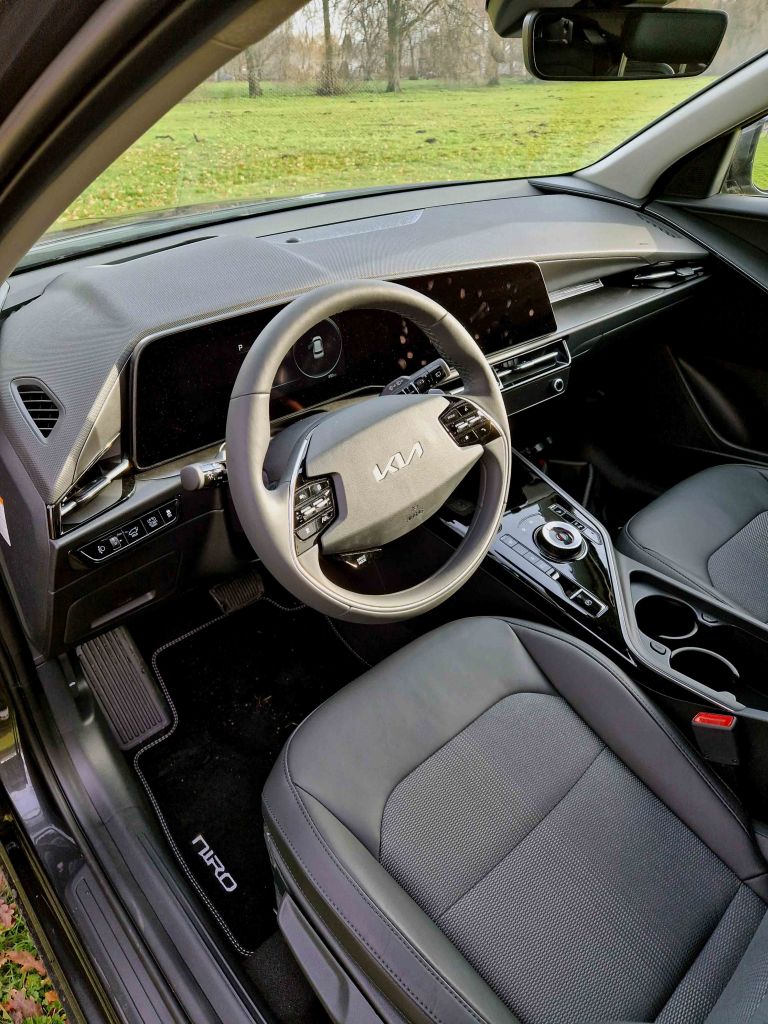
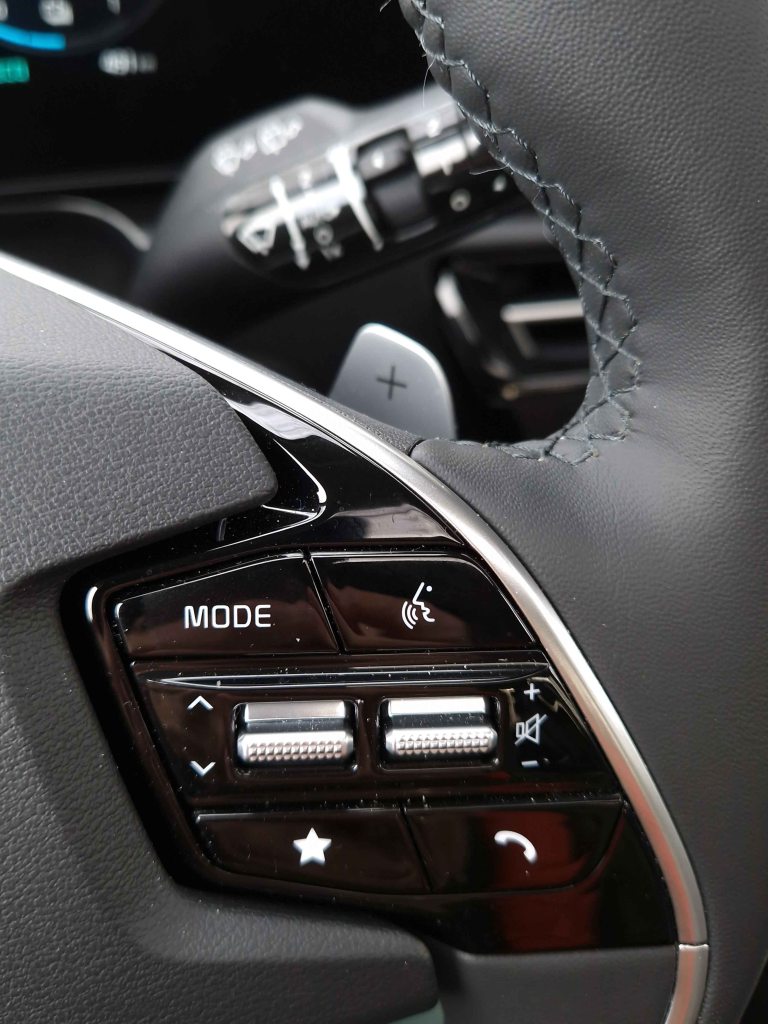
The screen layout is very good, nice to toggle between climate and screen controls to get you swiftly to the commands you want. We like the round control knob to switch between D, N and R, with the P button right on top of it, it’s all very ergonomic and you wouldn’t want it to be otherwise once you are at behind the wheel of this Kia. Many ergonomic solutions and knobs are similar to the flagship EV6, and that’s only to be applauded.
Photo here taken with the latest “flagship” Samsung S22smartphone
The seats are good, with even a relax mode in the front seats depending on the equipment version you choose. There is plenty of storage, and leg and headroom is also quite decent in the rear. The floor in the rear is completely flat, so even three adults can reasonably sit in comfort. Boot space is excellent with a good 450 liters, and there is a separate tray for sundry like spare wheel equipment etc.
Drivetrain: smoothness and efficiency first…
Photo here taken with the latest “flagship” Samsung S22smartphone
The hybrid Niro has a 1,6 litre Turbo under the hood, Kia calls it its Smartstream 1.6-litre GDI (Gasoline Direct Injection) gasoline engine. It is a 16 valve four cylinder, with a compression ratio of not less than 1:14, with Continuously Variable Intake and exhaust Valve Timing, or abbreviated CVVT. To improve torque and thermal efficiency in the mid rev range it is a long stroke unit, 72 x 97 mm, and you understand immediately that this is not the unit that likes to be trashed hard with corresponding high revs. Surprisingly however, it develops its maximum power of 105 PS @ a rather high 5,700 rpm, and its maximum torque of 147 Nm comes in @ 4,000 rpm.
Photo here taken with the latest “flagship” Samsung S22 smartphone. Not the frugal average consumption of 5 l/100 km.
But its torque curve is relatively flat, so indeed there is plenty of pulling power at low revs. It runs indeed very smoothly at low revs, remember, it runs on low-friction ball bearings(!) The hybrid version has a permanent magnet synchronous electric motor of 32 kW, but more importantly, developing a torque of 170 Nm, and that gives you the pleasant liveliness and delightful “EV feel” at low urban speeds. The Niro Hybrid is paired as standard with the brand’s second-generation six-speed dual-clutch automatic transmission (6DCT with gears optimized for transmission efficiency, and the removal of the reverse gear that saves a significant 2.3kg). This improves the overall consumption by 0.62%. Reverse drive comes indeed from the electric motor…
Photo here taken with the latest “flagship” Samsung S22 smartphone. When driving very slowly due to urban congestion, the hybrid relies on the electric motor, and shows its worth: merely 2,9 litres/100 km on the driven distance!
The Niro Hybrid shows its smooth qualities when driven with restraint and anticipation; the engine and transmission then behave supersmooth, and the Artifical Intelligence of the power train will choose the optimum balance between engine and battery power, and manages to achieve optimal efficiency, together with more than enough power combined with excellent acoustic comfort. Consumption even in the busiest of urban traffic will remain well below 6 litres/100 km, and that’s what it’s all about when we talk about environment conscious transport.
Photo taken with the Fujifilm Finepix S100fs again…
Of course, higher speeds on Autostradas will take their toll, but driving at the legal maximum speeds on our European motorways will not set you back unduly. Performance is all you could wish for: 0 to 100 km/h in 10,4 seconds, a top speed of 165 km/h, on 16 inch wheels… The manufacturer quotes an average fuel consumption between 4.4 – 4.7 litres/100 km, and CO2 emissions of 100-107 g/km according to the wheel dimension, i.e. 16 and 18 inch respectively.
Photo here taken with the latest “flagship” Samsung S22 smartphone.
Predictable handling
The Niro uses Kia’s third-generation ‘K’ platform, conceived from the outset to support a mix of electrified powertrains and provide high levels of torsional rigidity. The Kia engineers have tuned the suspension and steering system with an eye to comfort, succeeding in also offering a responsive, confidence-inspiring driving experience.
Photo here taken with the latest “flagship” Samsung S22 smartphone.
State of the art driving aids and connectivity
The usual driving aids are found, like Lane Keeping Assist (LKA), Lane Following Assist (LFA), Highway Driving Assist (HDA), Driver Attention Warning (DAW), High Beam Assist (HBA), Navigation-based Smart Cruise Control-Curve (NSCC-C), Blind-Spot Collision-Avoidance Assist (BCA), Rear View Monitor (RVM) and Rear Cross-Traffic Collision-Avoidance Assist (RCCA). The Niro’s front view camera and in-built navigation system integrate to display the current speed limit. The Intelligent Speed Limit Assist (ISLA) system will display the current speed limit and automatically change the set speed (after confirmation by the driver) by using the information detected through the front view camera.
Last but not least, a clear 10-inch head-up display (HUD) system projects vital driving information, including speed, ADAS data and navigation indications onto the front windscreen, very readable indeed.
Photo here taken with the Fujifilm Finepix S100fs
Conclusion
The current Niro family is Kia’s third best-seller in Europe. Did you know that of the previous generation, Kia has sold 350,000 Niro models (54% HEV, 15% PHEV and 31% EV). So Kia took utmost car to hone this important car for them to another level. It is also reflected in the prices, but then it offers style and top notch technology. It will prove to be a very pleasant and smooth companion, as we said in the title of this report, when you drive it with respect for the environment and the law… indeed, as hybrid cars are meant to be driven to show their sublime qualities…
Hans Knol ten Bensel
Photographers’ notes: we used besides our state of the art Samsung S22 phone also the Fujifilm Finepix S100 fs, which proved a very creditable contender…
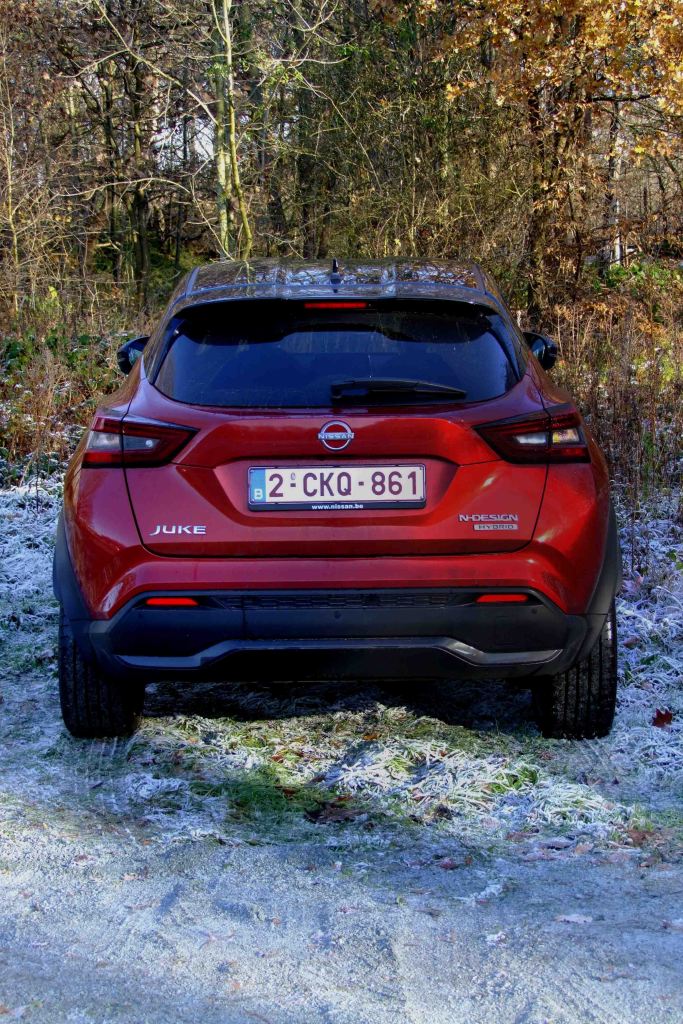
The Juke has invented the compact, urban SUV and indeed has gained many faithful followers over the years. Times have changed, and the reduction of CO2 emissions is crucial now. So when the facelift of the Juke came along, it was time also to launch a hybrid version. Within the Renault group, the drivetrain of the Renault Captur was the obvious choice, and so here we are with a 1,6 litre petrol engine combined with an electric motor, delivering a system power of 105 kW or 143 HP. Nissan engineers have further honed Renault’s hybrid system, and we found it operating very refined indeed. The second generation Juke also underwent some styling changes for the better, but retained its iconic shape. Just read further…
Hans Knol ten Bensel
Pleasing…
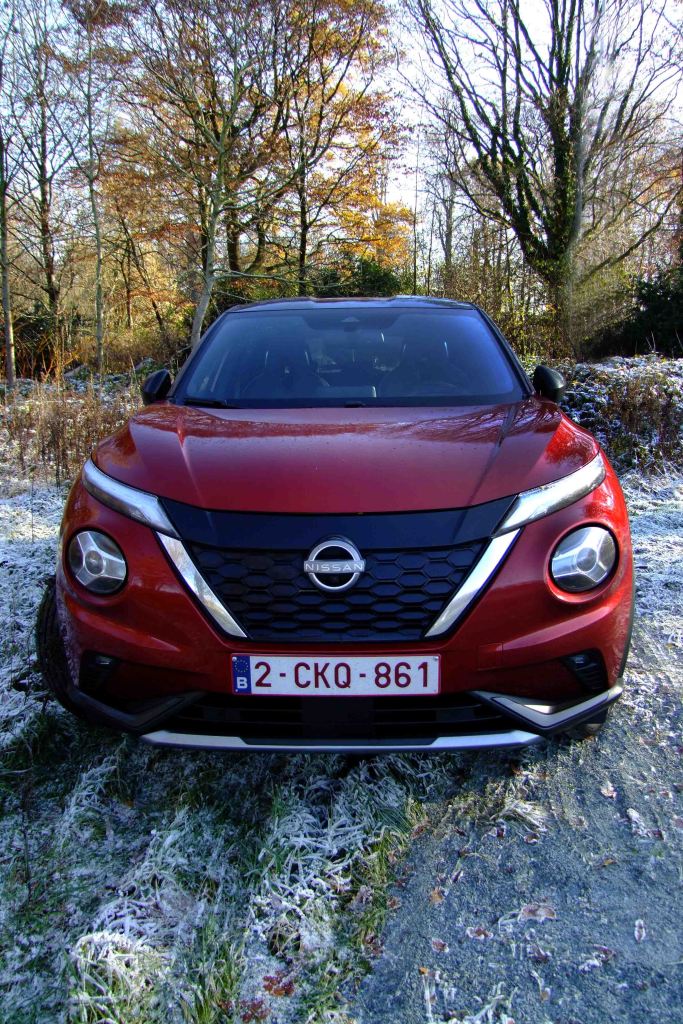
The front end of the Juke now features a honeycomb grille with also the headlamps elegantly integrated in the bodywork with the indicators and running lights stylishly elongated along the bonnet. We already tell you here that the headlamps feature already in the standard equipment full LED, as well as the rear lights.
The interior is also very well finished, with soft padding on the dashboard, door panels and centre console. We like the very readable round instruments, and the touch screen sits nicely high up on the centre of the dashboard. Everything is quite intuitive to handle, and one feels well at home in this cosy, rather dark interior, the latter as a (happy?) result of the typical styling of this SUV.
The steering wheel is eminently adjustable, and the front seats are very comfortable indeed. Thanks to its SUV character one sits pleasantly high, with the front seats being some 52 cm above street level. So getting in and out is a breeze.
Refined, at least when you drive it smoothly…
Driving a Hybrid is also an art, which you have to learn. Ok, the hybrid offers you thanks to its electric motor that added torque and immediate pulling power which is the very charm of EV driving. But the smoothness and silence of the drivetrain will please you even more when you drive it quietly, with anticipation and restraint.
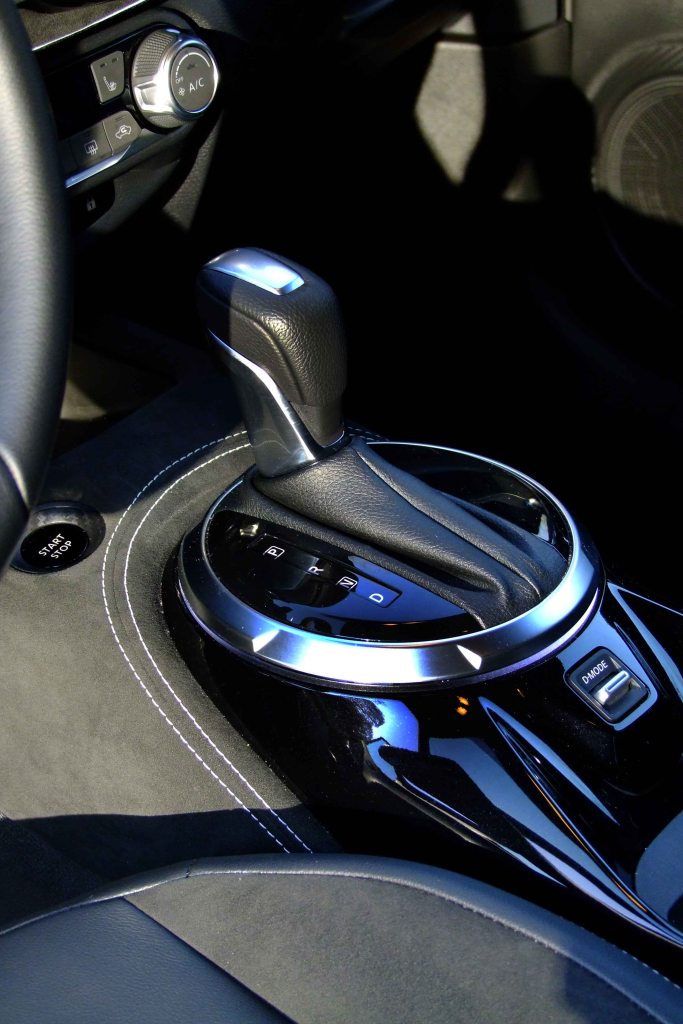
Then the clever (thanks to computer-age Artifical Intelligence) system will manage the power stream masterfully between E- and combustion power, the engine revs will not rise unduly and in urban traffic you will achieve anything between 5 and 5,5 litres/100 km. The hybrid Juke will also let you use the e-pedal function, so you can recuperate kinetic energy via the electric motor, which then acts as a generator. Of course, you set the drive selector on the centre console in “Eco” mode, and leave it there.
When you want more performance of the Juke, you can forget about any extra economy. Logically, as then the combustion engine has to do most, if not all the work, as it has also to maintain a minimum charge in the battery. Only the e-pedal will let you recuperate kinetic energy, so you can use the e-boost of the electric motor when re-accelerating. The engine revs high, one clearly hears that it’s there, and the transmission is very busy choosing the right gears with sometimes a hint of jerkiness.
This is also the reason why high cruising speeds on the motorway are also to be avoided if you want to see decent economy. Diesels can run at high speeds with consumptions remaining between 6 and 7 l/100 km, but NOT petrol engines. The Juke will then set you back with averages between 7,5 and 8 litres/100 km. No miracles, dear readers, just the laws of physics. The Nissan engineers also set the tone already, as the top speed of this Juke Hybrid is “only” 166 km/h. You shouldn’t be doing it, if you think about the earth. Enough zest though, as the Juke will sprint from 0 to 100 in 10,7 seconds.
The Hybrid Juke has a so-called “Multi-Mode” transmission, with 4 speeds for the petrol engine, and two speeds for the electric motor. AI chooses for you not less than 15 gear combinations! The engine is good for 94 HP and 148 Nm, additionally supported by a 15 kW starter/generator. The electric motor has 49 HP and 205 Nm of torque.
Our average test consumption stayed well below 6 litres/100 km, as indeed we drove the Juke Hybrid as it is engineered to be. CO2 emissions are set at 114 g/km according to WLTP standards.
When starting from cold, the engine will at least during the first few kilometers rev quite clearly, as it has to reach its operating temperature as fast as possible and also has to keep the battery (re)charged. When you use EV power extensively in (very) slow and quiet driving, every now and then, the engine will eagerly rev again, but then this is to recharge the battery. It does this even when you hardly touch the throttle or even not at all, which seems a bit unsettling at first, but soon you get used to this.
Enjoy the music…in comfort
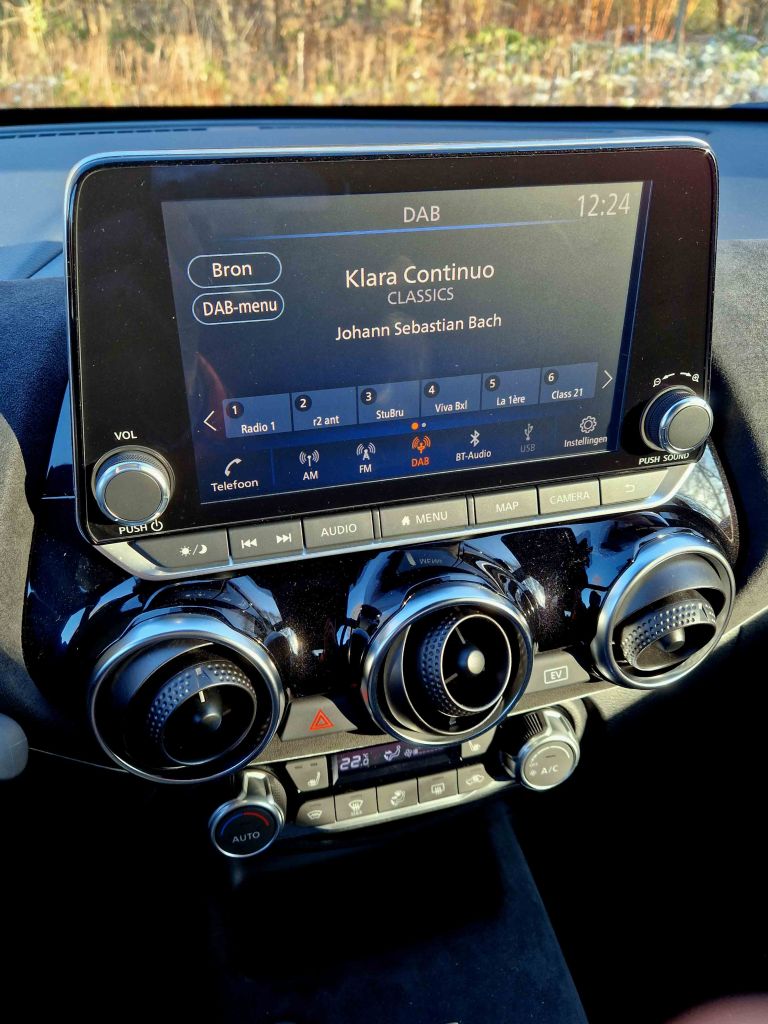
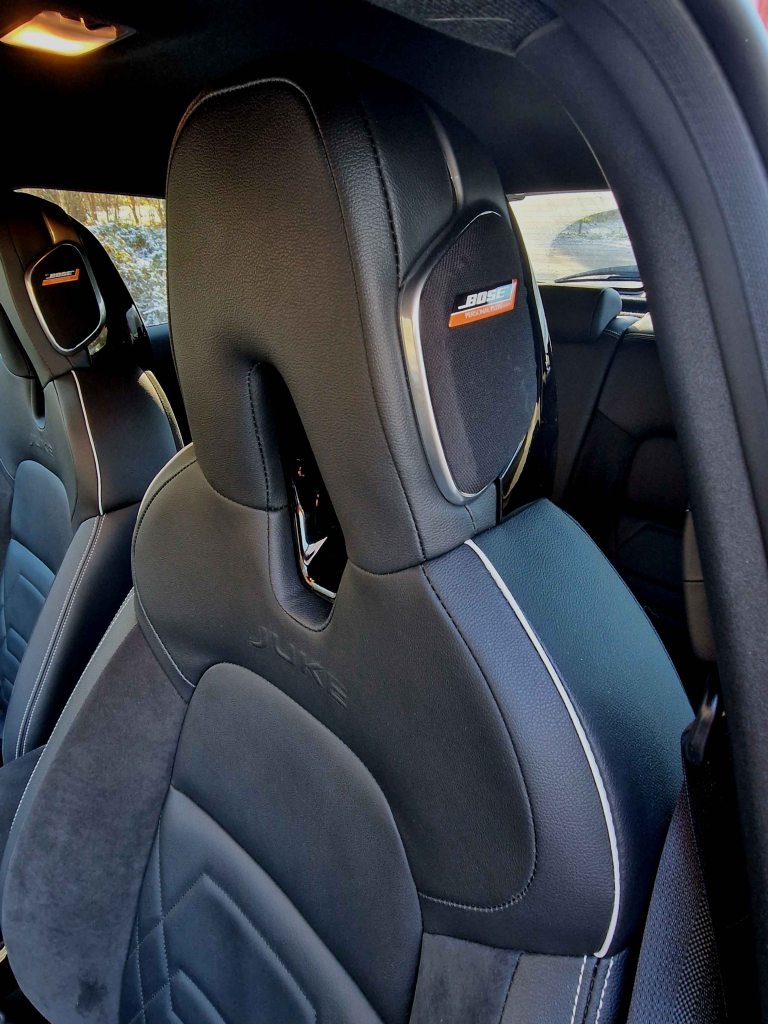
Driven in the right way, the Juke will seduce you with quietness, and this lets you enjoy the DAB+ radio and the excellent sound system. We had a Bose system with speakers integrated also in the headrests, and the sound experience was indeed wonderful. The suspension is comfortable, a bit firmish, but never harsh. Seating is excellent with more than enough headroom in the front. In the back, this is less generous, but legroom is very much OK. There is also enough room in door bins for even 1 litre bottles.
Connectivity is also top notch, with Apple Car play and Android Auto provided.
Stable and predictable handling
The Juke steers precise, has very good stability at speed and is predictable in corners. Even abruptly lifting the throttle in de midst of a curve will trigger the ESP and the Juke will maintain its course. The steering is reasonably direct (2,5 turns from lock to lock) as an urban compact befits. The Juke is quite safe, in the NCAP Crash test it achieved 94 pct of all the achievable points. Brake performance is very good, with the wider tires of course enhancing the deceleration.
Practical
Boot space is adequate for a compact SUV with 301 liters, and there is an under floor tray with an additional 90 l. With all seats folded there is 705 liters available when you load until the rear window base. One has to lift the luggage rather high into the opening however, some 78 cm.
Conclusion
The Juke has its iconic looks further improved, and is certainly a smooth urban performer with its Hybrid layout. On the open road it is also a good travel companion, with high speeds letting the petrol engine work rather hard, which limits economy. But as said above, adopting the proper driving style will let you enjoy fully its “zen” qualities, for years to come…
Hans Knol ten Bensel
Photographer’s notes: we took most of the photos here with the bargain of the year: a still totally pristine Fujifilm Finepix S100fs, with a Fujinon 28-400 mm 35 mm equivalent lens, bought two weeks ago for almost the original price of its sun lens hood: 59 Euros!!
It proved to have excellent color and light balance, surpassing even the Samsung S22 state of the art flagship smartphone, which did not succeed in making a well color balanced photo of the e-pedal button on the centre console. The auto color balance got so completely out of line in the shadowy interior of the juke that I had to print here the photo in black and white here (see photo in the article above) instead of the exaggerated blue the S22 produced.
The Spanish, more ardent version of the Volkswagen ID.3 is the Seat Cupra Born. More, sporting, more zesty, more panache, that’s what the VW group wants to offer here. And indeed, this Fully electric Cupra fills the bill, when it comes to looks, handling and performance. We put for you the 150 kW version through its paces, equipped with the 58 kWh battery. As you already well know, electric motors have formidable torque, and this Cupra surely delivers at the traffic light. It sprints from 0 to 100 km/h in 7,3 seconds, and so the beautiful EV story is again told, performance wise at least. But the Born has also other (dynamic) qualities, just read further…
Hans Knol ten Bensel
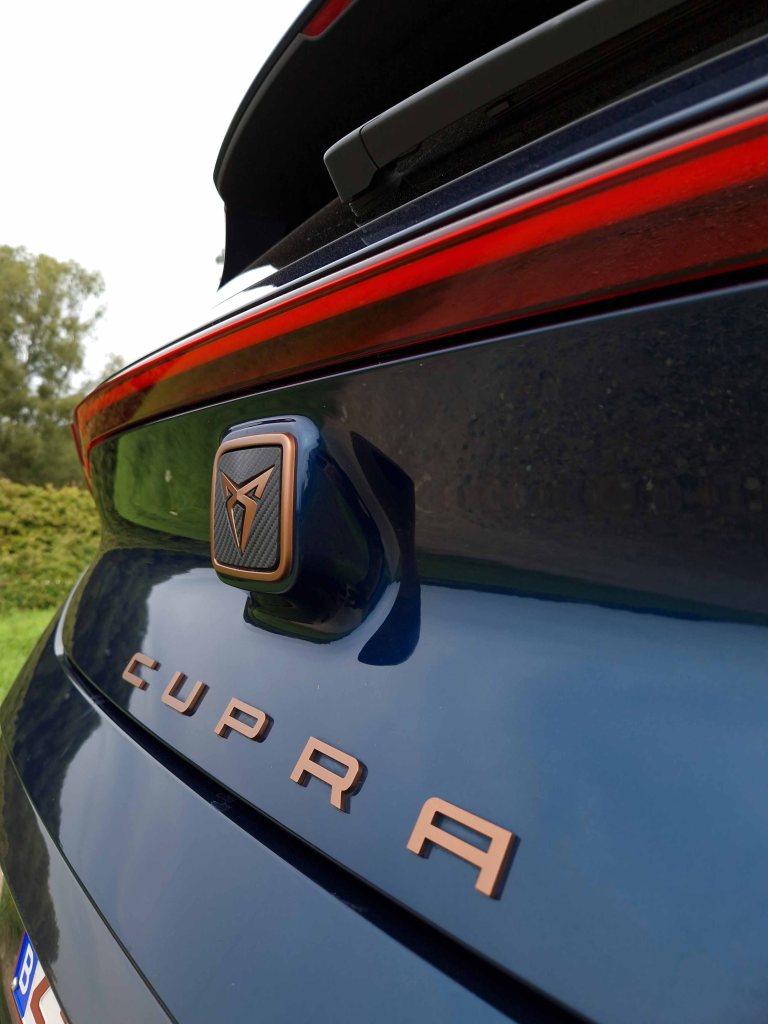
Looking at our Cupra test car, we liked its colour palette very much, and the external sporty styling elements. Also bystanders admired it, so yes it enhances clearly the personality of this car. I like the front end, the copper coloured badging, the big roof spoiler above the rear window, the nice streamlined alloys, the texture on the c pillar.
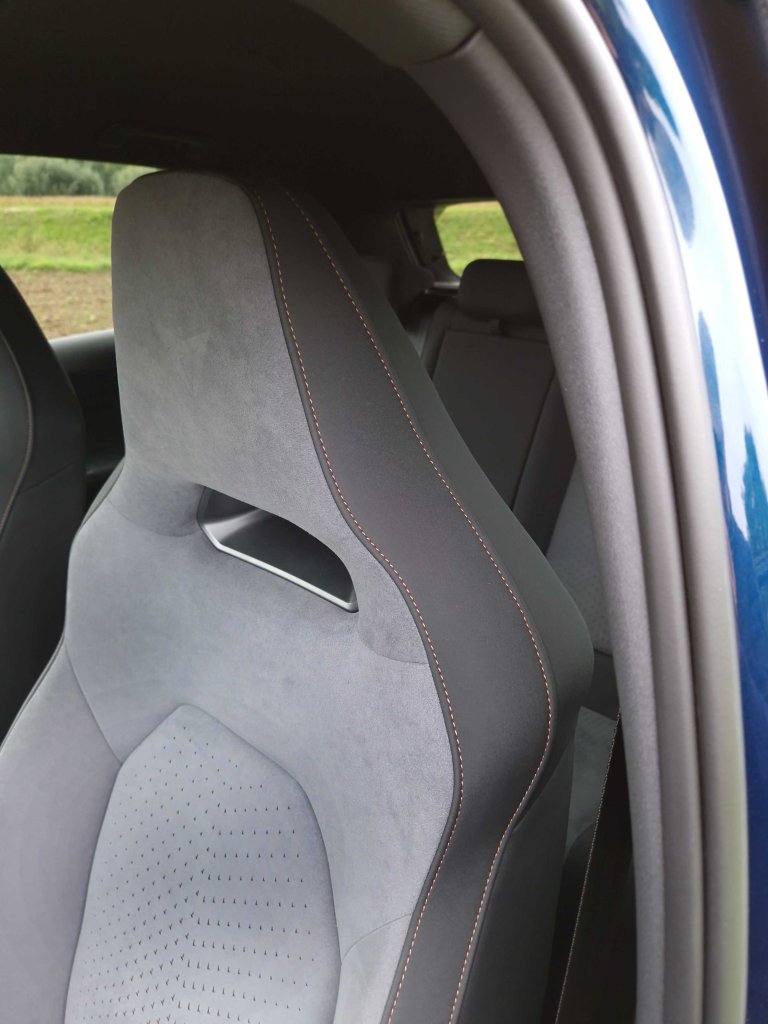
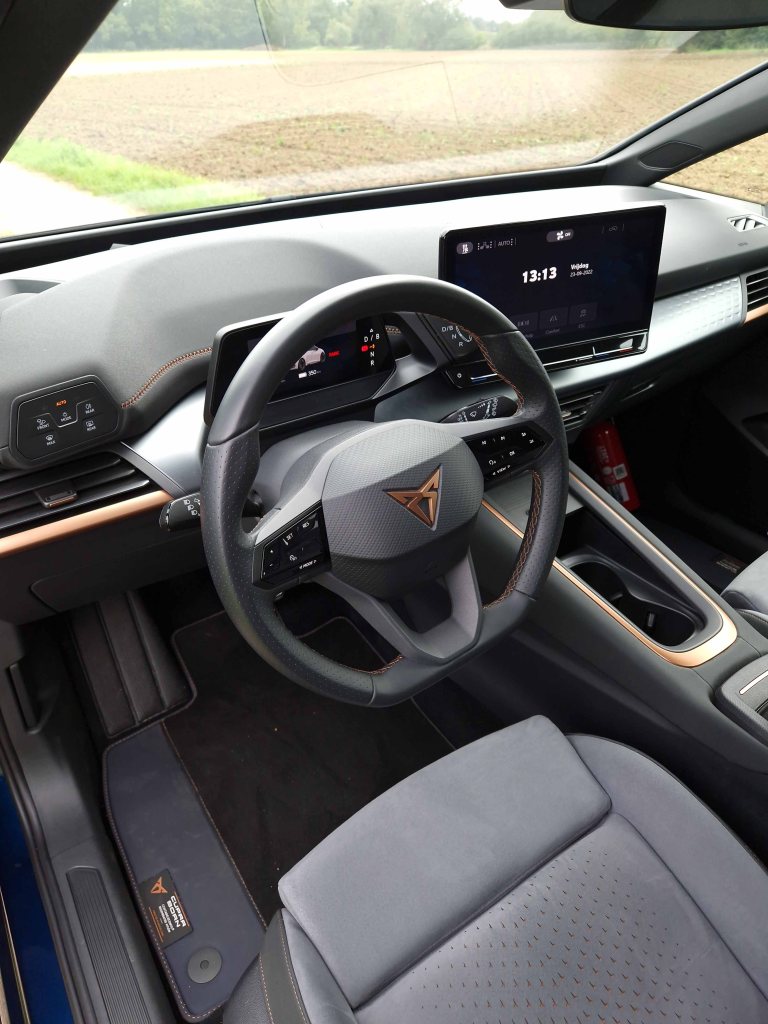
Also the interior breathes this flamboyant sportiness, although what screens, instrumentation and buttons are concerned, it is identical to the ID.3. The design of the dashboard surface does look a bit cooler though, with some added textures and copper coloured surroundings of the centre console for instance. Very nice are also the body hugging front seats.
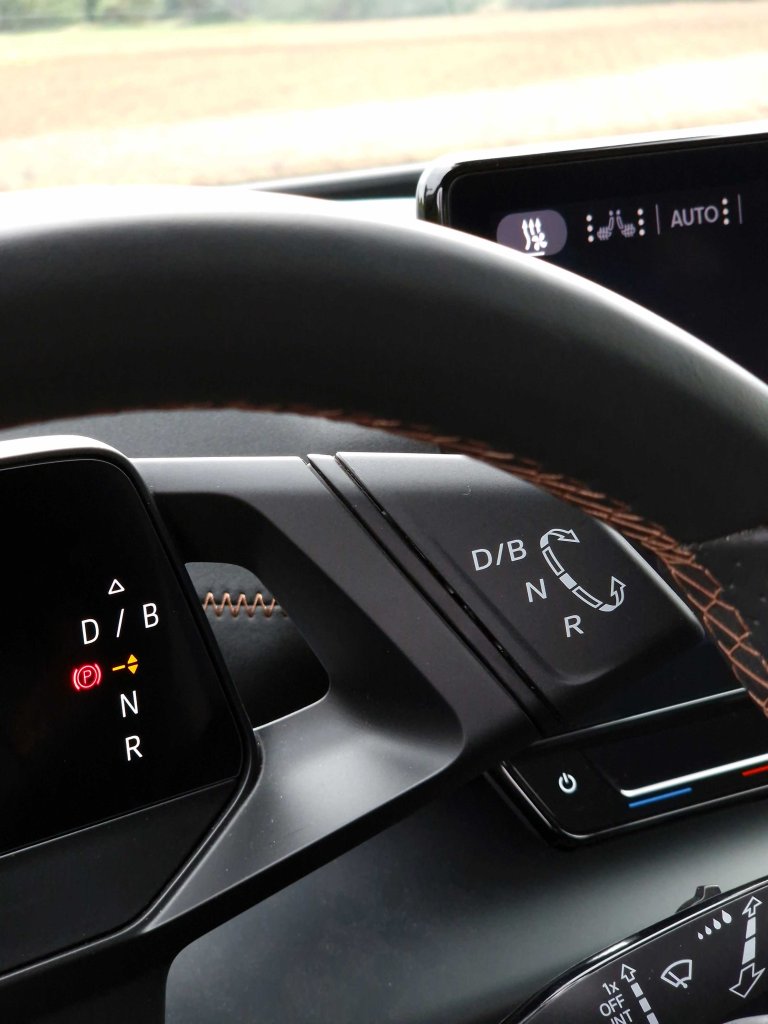
On both sides of the steering column one finds buttons like a Formula 1 driver would use. The right button puts you immediately in the sports mode. Performance galore, but your range will soon dwindle, even more so in winter. With the left button you can click through the available driving modes, from eco to sports.
Given de immediacy and sheer amount of the available power, we found the “eco” mode more than enough for our needs, and it gave us also a more or less reasonable range. Our test car had the 58 kW battery, and this gives you a theoretical range of 425 kilometres. That supposes of course very fair weather and a driving style which even trucks find on the slow side. Under the same driving style, my Hybrid Lexus clocks then 3,9 liters/100 km… indeed, an EV rewards you with a sedate driving style in town, and very moderate cruising speeds up to max 100/110 km on the open road. Then things are truly fine. The simple truth is, the laws of physics apply everyday everywhere, for all EV’s too, miracles just don’t happen. By the way, the top speed of this Cupra is limited to 160 km/h. At higher speeds, you would spend exponentially more time at the charging stations, so there is no time gain and thus no point in going faster.
You can opt for a more powerful Cupra Born with a 170 HP motor and a bigger 77 kW battery, which would give you also a higher range of 550 km, but we found our test car totally sufficient, once you adhere to the philosophy of environmentally friendly EV driving, smooth and sedate, flow the traffic, drive with anticipation and make minimal use if the brakes, letting the electric motor recuperate the energy. We are totally convinced that this is the only way an EV should be driven. Everything else is rather absurd, given that an EV is meant to emit less and protect our world. The Cupra has also the nice “B” position on the drive selector, and that lets you use the regeneration fully so you can really drive and brake this car using one pedal only.
Smoothness is what you go for…
Refinement is your biggest reward when you choose an EV. The Born delivers here too, as you could expect. Utter silence, mechanical smoothness, it is unsurpassed. Abundant torque is always at your disposal, immediate response at the slightest blip of the throttle. Just wonderful.
The handling of the Born is also a notch better than the ID.3. The Born sits lower on its wheels, has wider tyres, bigger brakes, and steers more direct and precise. Just more fun behind the wheel here.
Otherwhis it runs on the same platform as the ID.3, the celebrated MEB platform of the VW group. By the way, it also comes from the same assembly lines as the ID.3…
The Born is well equipped, and has all you could wish for in terms of driver assistance systems and connectivity. The haptic slider controls of the ID.3 are also found on this Born. They take some getting used to, and the new ID.3 will undergo some changes, of which future Borns will also benefit of course. The annoying thing about their sensitivity is that one sometimes turns on the sound volume as you brush the steering heel spokes when taking a corner! The car is roomy enough for four, with plenty of leg and headroom in the back, due to the rather narrow bodywork it gets a bit cramped for three adults in the back. The door bins are large also in the back, and one gets also two USB connections for the rear passengers.
Boot space is adequate with some 385 liters, when you fold the rear seats down, there is still a ridge where you have to lift your luggage over. On the other hand, it prevents heavy luggage items to slide forward…
Fast charging
The Born is of course well geared for the future, and the 58 kW battery accepts fast charging of up to 120 kW. This means that you can charge from 10 to 80 pct in merely 35 minutes. When our infrastructure is up and running, this is good news. It will set you free to use the full EV power more often, provided the energy prices stay reasonable of course.
Conclusion
This Cupra Born has the extra panache which makes it even more attractive to some than the ID.3, which is build rather with a no nonsense futuristic flair, which we happen also to like by the way. Embedded into the VW group with its massive experience and know how, this Cupra will prove to be reliable and (very) long lived, so you will be able to enjoy it for many years to come, with a bit more zest added…
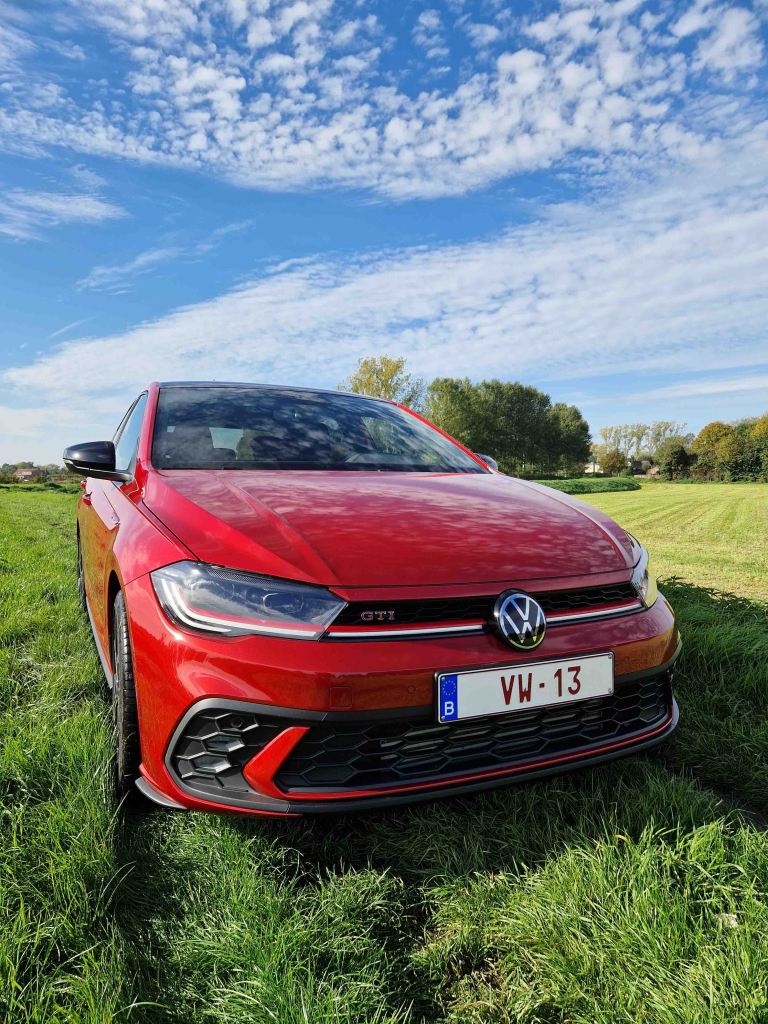
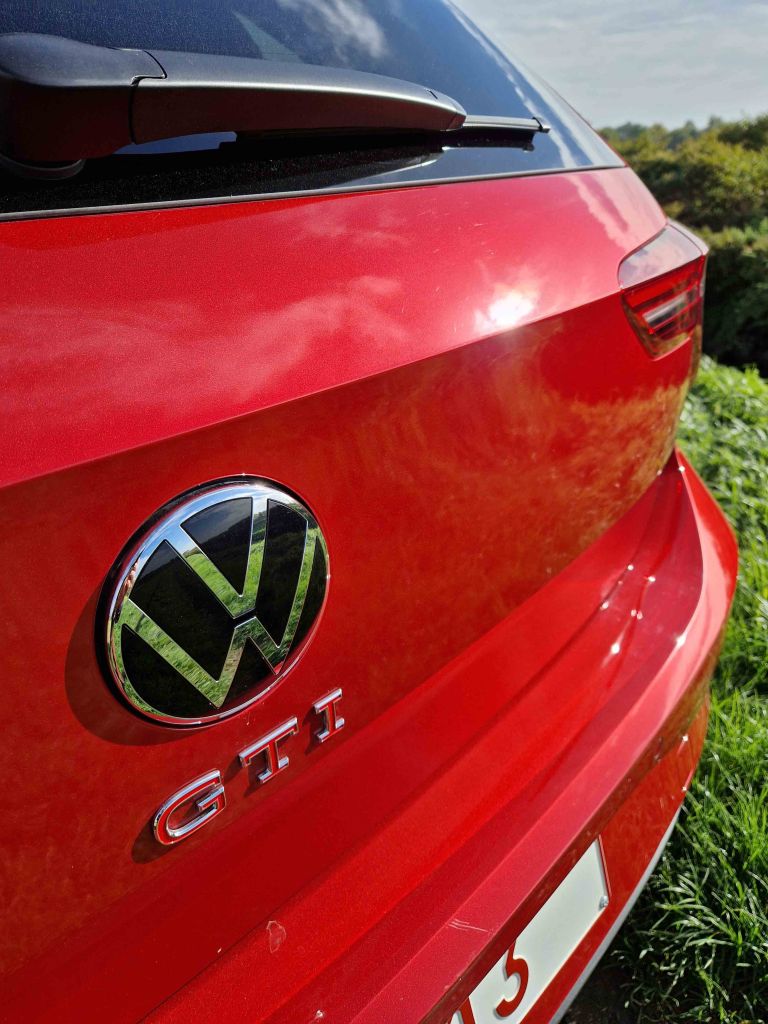
There are cars where even the initials evoke a modern day legend. VW succeeded in doing this with the letters GTI. They created a car which had it all: a Golf a 1,6 lite four cilinder developing a healthy 110 hp. This first Golf had not only an elegant design, it was also light and compact. So 110 hp meant exhilarating performance, certainly in the days and age it was born. But sheer power was not all. The VW engineers also took great care to give the car a superb handling. They also added a few sporting touches to the interior which quickly became iconic, and the recipe for success was made.
Hans Knol ten Bensel
Over the years, VW continued the tradition. The GTI remained the top end, sporting Golf with above average performance and handling.
But with the Golf growing bigger and heavier, there was room in the model range to continue the original concept of nimbleness with extra power. The Polo proved to be an excellent base for this.
Despite its move to fully fledged EV’s, the VW group has of course excellent combustion engines (still) in store, and so it shoehorned its formidable 2 litre four cylinder 200 hp engine into the car, and coupled it to an equally efficient 7 speed auto box. Most pleasant is the pulling power of this engine, with 320 Nm torque being available over a very wide rev range between 1500 and 4350 rpm.
The fun starts as soon as you push the starting knob, and the engine comes to life with a beautiful and very promising growl. Subdued of course, but very pleasing to the sporting ear nonetheless.
Despite all its eagerness, one immediately also feels the mechanical perfection and uncanny docility of it all. This is a well honed and perfected drivetrain, refined despite all its sportiness.
There are different driving modes at your fingertips, and the sports mode will surely inspire you most, but let it be said that the engine power is so abundant that this is a very fast and nimble machine under all circumstances.
The performance figures speak for themselves. The Polo sprints from 0 to 100 km/h in merely 6,7 seconds and hurtles to a top speed of not less than 238 km/h. The engine emits a pleasant growl, but as said, remains refined and also the chassis takes all this very well in its stride.
Consumption is very much dependent on your personal driving style, but let’s say that the relatively low weight of the Polo helps here. We achieved an average consumption of 6,4 liters. Consumption is typically rather more – between 7,5 and 8,5 liters – when runnign at very high speeds on German Autobahnen…
Sporting touches…
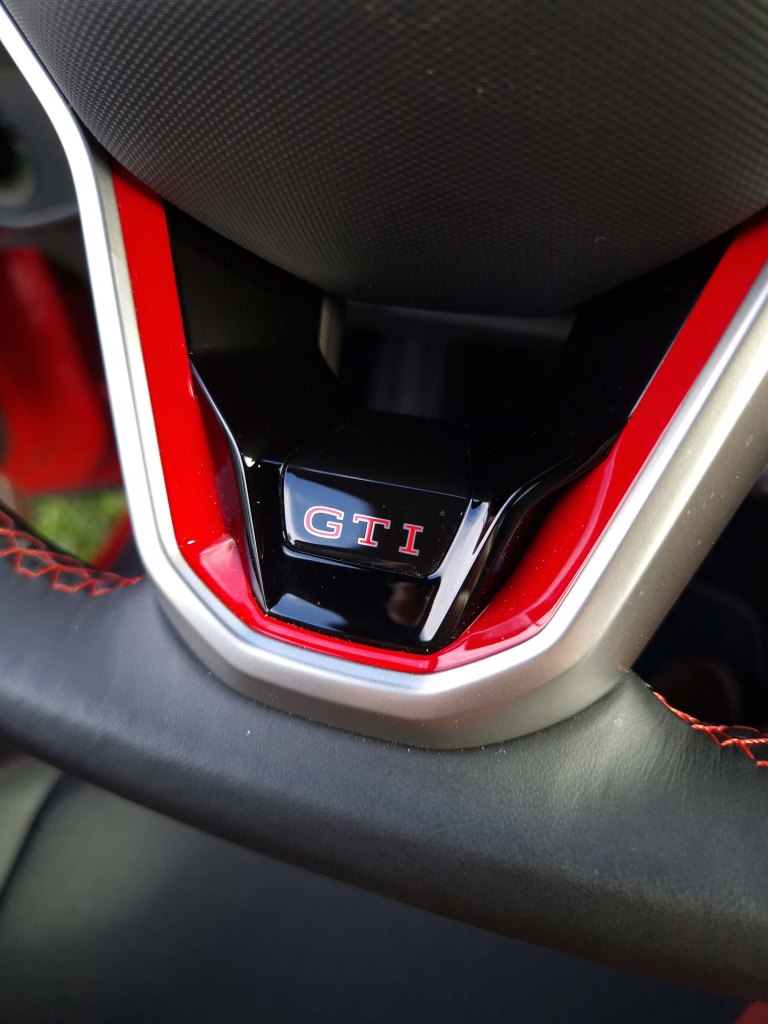
This Polo breathes also the unique aura of the original “Ur” Golf GTI, and is found in details such as the patterns of the seat upholstery, combined with more modern touches such as the contrasting red stitching on the steering wheel amongst others.
The digital instrumentation offers also many possibilities to put you in a very sporting mood. You can measure your lap times for instance, or you can check on the so-called power monitor the oil temperature, turbo boost pressure, engine power in kW or g-force(s).
The layout of the dashboard is good, and one has much appreciated manual controls via a round knob for volume (left) and choosing a menu item on the central touchscreen. The high gloss surface of this touchscreen shows of course every possible fingerprint, which makes frequent use of a microfibre cloth necessary…
Ever so practical
Our test car came with a DAB+ radio and AppleCarPlay, Google Auto and Mirror link, so we could hook up our Samsung S22 and enjoy it all.
On the practical front, the Polo scores. It’s a hatchback, this means you can load up to a good 600 liters of luggage with the rear seat folded down and with luggage height up to the waistline. The Polo is roomy enough to seat four tall adults too.
The truth of a sports car lies in its suspension fine-tuning and handling…
This proverb is again well proven by this Polo GTI. Of course, when one knows that this Polo platform plays a central role in the vast VW group strategy, one can only expect the very best, and indeed, the Polo delivers here. Our test car came with the optional “sport select” suspension, which offers in the “Normal” mode still quite decent comfort at slow urban speeds. This comfort improves the faster you drive, and indeed, when moved with spirit this Polo feels “just right” and puts a smile on the face of its passengers.
The handling of the GTI Polo is also top notch. Straight line stability is excellent, and on curvy roads one can steer with utmost precision. At the limit, the rear wheels start to drift, but are caught reliably by the ESP. Body roll is negligible. All this inspires confidence and gives you indeed tons of driving pleasure. The GTI comes standard with an electronic limited slip differential XDS, which controls the braking pressure of the inner front wheel in curves, which of course adds to the overall agility.
The steering servo is strong at slow speeds, when things go faster, this diminishes so the proper steering “feel” is retained. The brakes have also excellent stamina and are quite powerful indeed. Noblesse oblige…
Conclusion
For those who enjoy powerful and well handling petrol engined cars, the Polo GTI is the one to have and cherish. It will give you tons of driving pleasure, whilst remaining the well built and practical everyday car. Still sensible, but then offering close to supercar panache and punch.
Of course, it doesn’t come exactly cheap. Remember however, this is a well honed performance car, engineered and built to top standards. And given the pleasure it offers to you every day for years to come, its cost – last but not least in driving it – is very reasonable indeed…
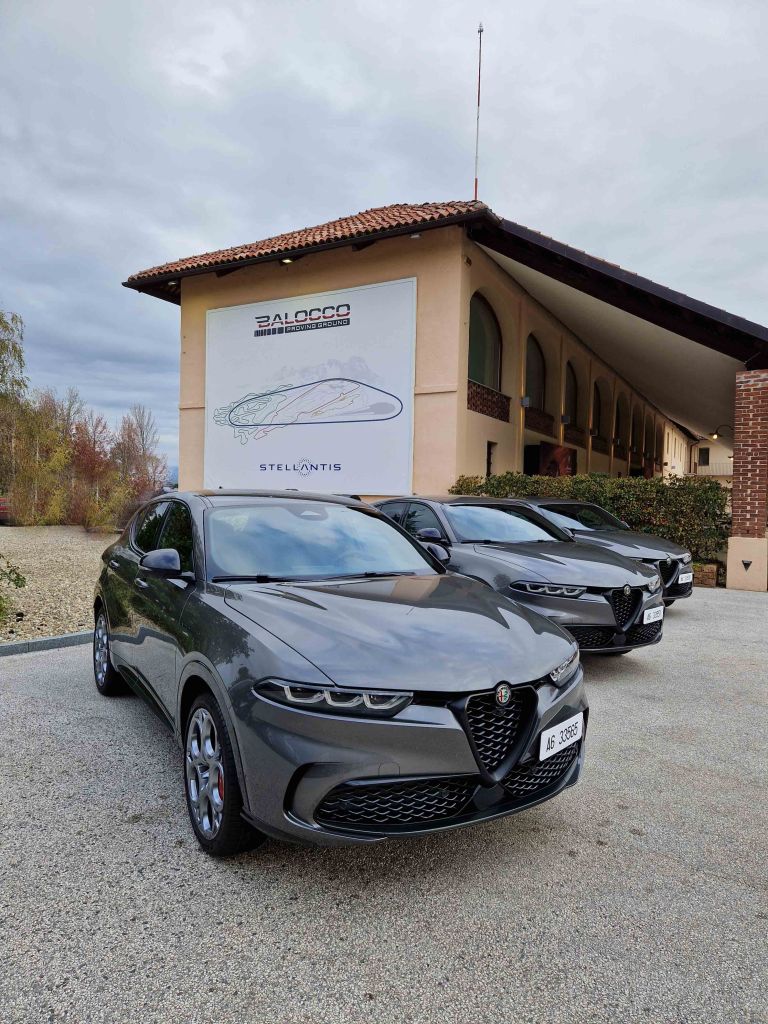
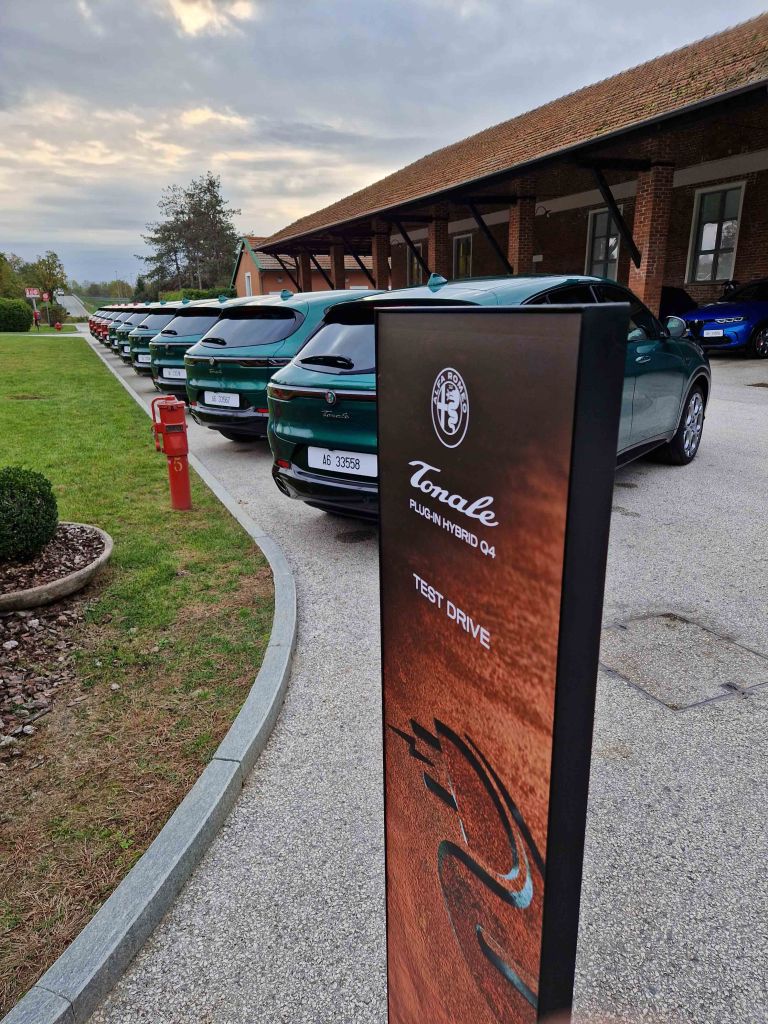
The cars were lined up for us at the Bella Luigina farmhouse, centre and headquarters of the proving ground.
The world famous proving ground and high speed test circuit at Balocco, built in 1962 by Alfa Romeo to test the Giulia’s as well as the racing cars, was the setting for us to get a hands on driving experience of the brand new Tonale Plug-In Hybrid Q4. The Test Track was built at Balocco, in a strategic location between Turin and Milan.
It all proved to be absolutely epic. The handling and driving dynamics of the Tonale on the state of the art test circuit, with its plug-in hybrid 4 WD drivetrain which produces not less than 280 HP, was the stuff of legends to say the least.
In front of the stables of the Bella Luigina farmhouse – the former home of legendary Autodelta racing department – stood these impressive Tonale’s, waiting for a test drive…
We had also a taste of what Alfa calls its “efficient sportiness” and what it understands this sportiness to be in our modern times. This Alfa Tonale indeed displays its formidable performance in a totally effortless, mechanically refined and predictable manner, which has to be experienced to be believed.
The important loan documents for a drive in this wonderful modern day Alfa, including the permission to have a go at (almost) racing speeds on the Balocco test track!
We will of course come back the coming days on this presentation of the Tonale Plug-In Hybrid Q4, a very important car in the new future strategy of Alfa Romeo.
BMW’s have always lightened the hearts of the men and women behind their steering wheel. Their agility, responsiveness, the feeling of being “one” with the car, this pervades you every minute you drive a four wheeled product of the brand, and this always has been with every BMW. I can tell, as I am writing the report of this test while waiting in line to pass the yearly MOT test of my beloved BMWZ3, built in 1997. (For photos of this, see my instagram page autoprova.be). The sensation is just unique.
The BMW 218d Active Tourer we tested recently is no exception. It puts a smile on your face too. The car itself has now front wheel drive, and purists might look a bit worried here, but the excellence of the handling, the way the BMW engineers have fine tuned the suspension is nothing short of astonishing. The car steers with much precision, stays neutral until very high corner speeds and goes into a mild and controlled understeer when reaching the adhesion limit. The overall typical BMW agility is beautifully maintained.
Of course, this (compact?) SUV has what it takes to enjoy the family. There is plenty of room for five, and a luggage space which will satisfy almost everybody, more about this later.
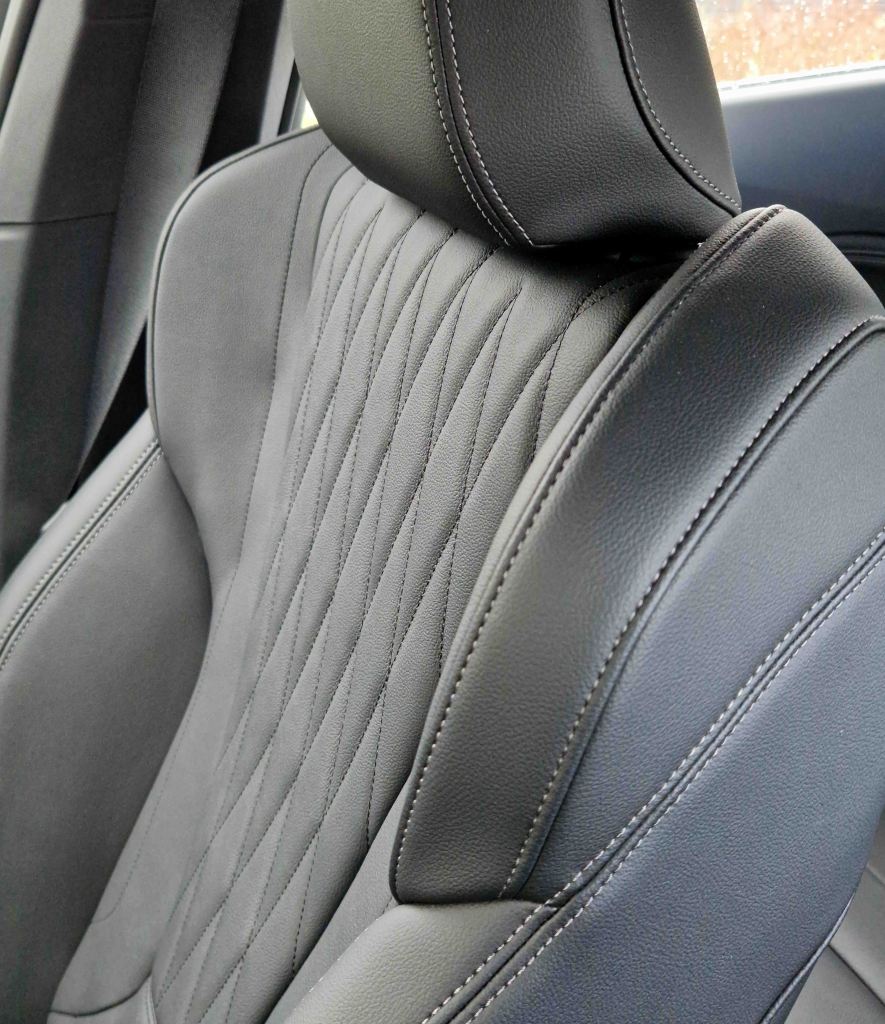
The seats are just wonderful, wrapping you in comfort with a sporting touch.
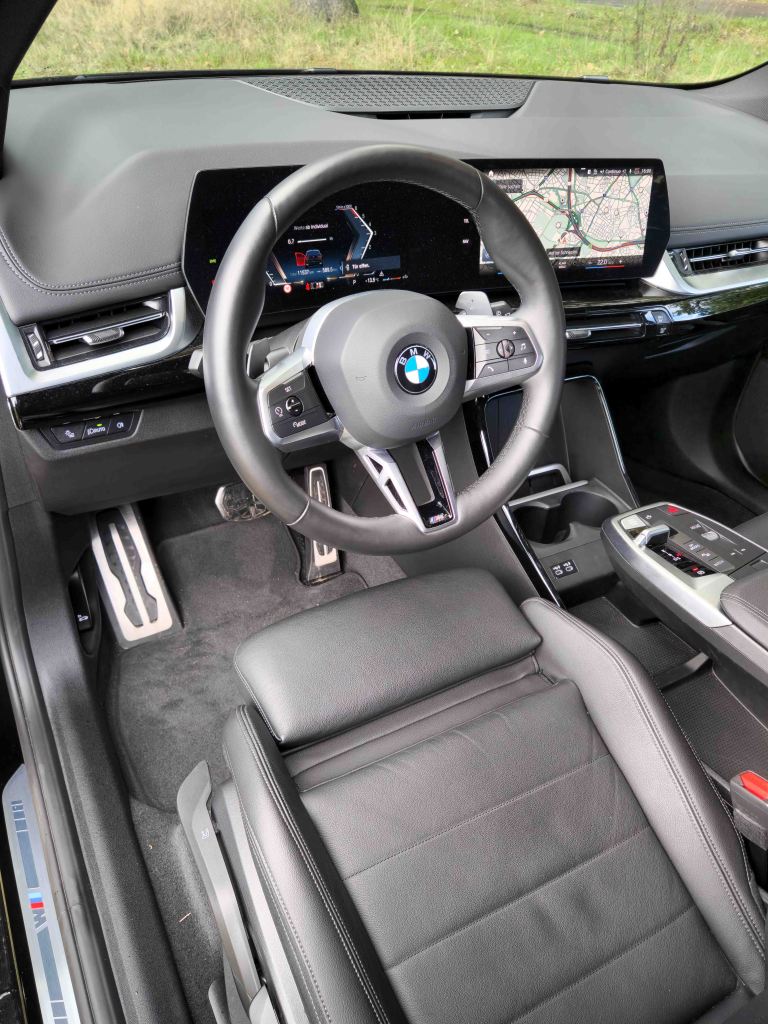
We absolutely love the BMW typical dashboard architecture, and the design and shape of the digital instrumentation, although we still love the iconic BMW styling of the round dials which adorn for example my now 24 year old BMW Z3.
One might regret that the iDrive round control knob in the centre console – which BMW thankfully had pioneered – has disappeared to manage all the functions and settings, and from now on everything has to be selected on the 10.25 inch touchscreen,
but this seems to be the trend of the times, and we have to admit that the functions are very logical and self explaining, albeit sometimes one has to search quite “deep” in the menu.
We very much liked also the gearbox selector neatly placed on a “floating” control pad which leaves space underneath for sunglasses, driving gloves and sundry. It has also a handy rolling control for audio volume, a knob for selecting the different driving modes, parking cameras and auto hold. Of course the start stop button lodges there too. We also liked the charging pad for the phone, which holds the phone upright, and tight so it does not slide around when you indulge yourself in some very spirited driving.
The screen graphics and the screen definition are a joy to behold, and this enhances the high quality feel this BMW gives you. Note that the touchscreen and its functions are the same as you find in the flagship BMW’s… The touch and feel of the upholstery and dashboard surfaces and panels is also top notch.
The magic of Diesel…
We tested the two liter diesel engine version of the Active Tourer, and it proved again masterfully how wonderful modern diesels have become. The four cylinder 1995 cc unit is ultra smooth, coupled to an 8 Steptronic speed automatic, it provided a velvety yet powerful energy flow to the front wheels. It has plenty of power with 110/150 kW/hp, and has ample torque of 350 Nm, which is available over a wide rev range between 1750 – 2500 rpm. You don’t hear it at speed, nor does it emit any vibrations. Performance is excellent we would think, with a 0 to 100 km/h acceleration time of merely 9 seconds. Top speed is a good 213 km/h, and we took our Active Tourer on a trip to Düsseldorf to have a go on the legendary German Autobahnen, and we enjoyed the high speed qualities of the Active Tourer to the full. We have to admit, this is what this (and many other) BMW’s are built for…
A range of 1125 km, makes one dream, isn’t it?
This effortless high speed driving and zesty touring in our cities and highways doesn’t cost you much energy with this marvelous frugal diesel. We clocked an average consumption of merely 5 litres/100 km. According to WLTP norm, the average consumption for the 8 speed Steptronic is quoted at between 5,2-4,9 l/100 km. Need we say more? This means, considering a tank capacity of 51 litres, you have an action radius of a good 1.000 km. This lets you dream, doesn’t it? How we enjoyed this mobility freedom with this diesel…
Good to know that its emission rating is 6D, and still according to WLTP norm it emits between 135-128 g/km of CO2.
Roomy
This is a compact SUV, or crossover, and it offers resulting from its body shape plenty of space also in the back seats. It is practical too. The rear seats slide fore and aft easily via manual locking mechanisms, so you can choose between more luggage space or better legroom. One has 470 liters in standard configuration, extendable to 1,455 liters with the rear seat backrests folded down.
Conclusion
A well made car with a stylish interior and excellent and frugal performance, and of course wonderful, care-free mobility in this diesel version. Refined too, with good comfort, excellent handling (certainly for a SUV). It doesn’t come exactly cheap, but as said, it is built for a very, very long service life, and this will reflect itself in overall very little depreciation. Last but not least, there is the emotional factor: it’s a BMW… made to make you smile behind the wheel.






































 Autoprova - for the Connaisseur