
Dacia is going from strength to strength, winning the hearts of many, as their range offers just what people want.
Also in our age of energy transition, Dacia has a truly formidable car ready for you. The hybrid version of the Jogger 7 seater. Quite frankly, it offers the lot, certainly in the “Extreme” top equipment version we tested.

It is spacious and reasonably good looking, with well proven mechanical underpinnings and a comfortable suspension. Its hybrid drive-train is also found in the Captur and Clio. This Jogger is comfortable, reasonably refined and frugal. It ticks all the boxes, we could say, and indeed, we also liked it very much throughout this test… Just read further!
Hans Knol ten Bensel

Looks and practicality…
The Dacia Jogger is quite frankly in our opinion (almost) all you will ever need in a car. Provided you leave your emotions a bit aside and look more rationally at car ownership and cost.
You don’t even have to abandon looks for that matter, because the Jogger is a rather well looking hatchback estate, with a zest of MPV added, standing somewhat higher on its wheels, which makes it feel also a bit at home on unbeaten paths.

We liked particularly well the shape of the rear lights as well as the front end with the new purist and bold logo. Also the interior could seduce us. In this top equipment version we were even spoiled with several options like integrated sat and media nav, front seat heating, and a good looking khaki green paint. This pushed the price of this Dacia up to 28.650 Euros, but then where do you find a fully fledged hybrid seven seater for this money?

The Jogger is indeed eminently practical. It offers genuine seven seat capability, and even two grown ups have enough head and legroom on the two third row seats. Of course, these third row seats can be easily removed and with the second row of seats folded and tumbled down, this enables the Jogger to function almost as a van with a usable volume of not less than 1,807 liters!

The simplicity of the dashboard controls, instruments and the info screen makes you feel relaxed, and indeed, we have to agree here again, less is more. We find also the unsurpassed typical Renault audio control stick, a stroke of genius Renault introduced several decades ago on its R25 and R30, well into the last century, and it still is delightful to use.

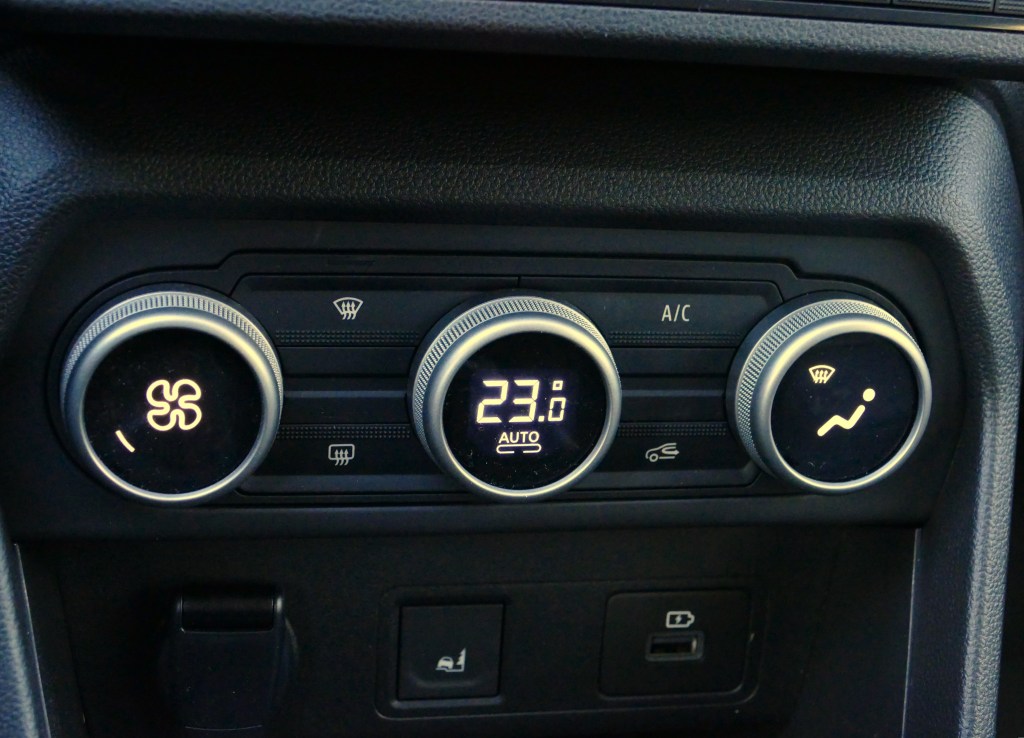
We liked the utmost user friendliness of the “analog” round knobs of heating and ventilation, the logical layout of the touchscreen info and functions.
A convincing hybrid…
The Jogger Hybrid 140 as it is officially called, has a normally aspirated 90 HP 1,6 litre four cylinder, and is assisted by twin electric motors, a (close to) 50 HP one and a starter/generator, which delivers the extra torque when getting away from standstill. The battery, which is housed in the rear where normally the spare wheel would sit, has a rather moderate capacity of 1,2 kW.

You understood it, this battery is designed to feed the e-motor for short bursts, for instance always for driving away. This makes the driving impression in stop start situations always very refined, and one of the very charming points of this hybrid version.
When you accelerate rather briskly, then the battery gets rapidly depleted and the petrol engine will soon step in vigorously and start whirring frantically to recharge the battery as quickly as possible. This is clearly heard, but the noise is never obtrusive.

When you don’t want the engine to step in so often and recharge instead at a lower pace at lower revs, then simply drive more smoothly with a lighter right foot. The computer will let the petrol engine do its (re)charging at lower revs and less nervously, as the battery is not depleted at a rapid pace.
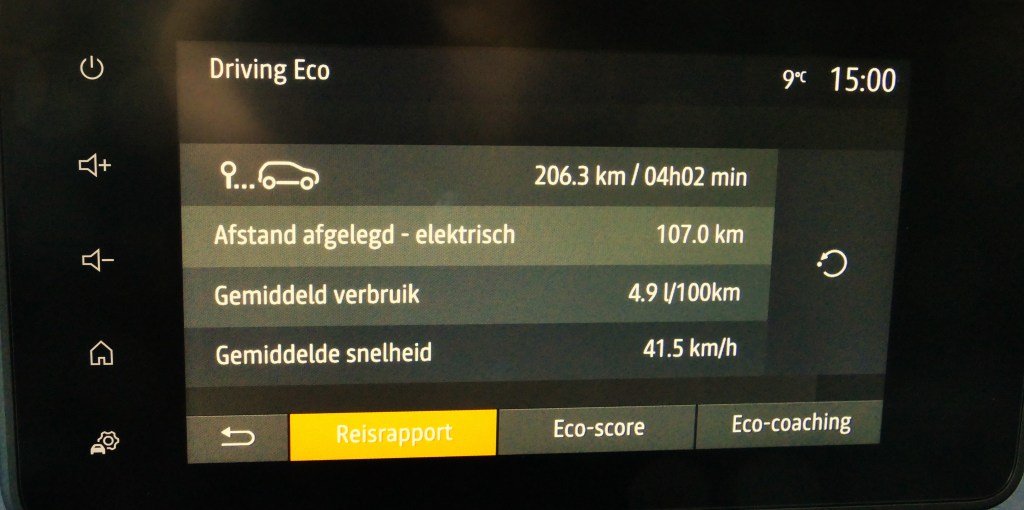
Indeed, a clever right foot and a driving style with lots of anticipation is the key to enjoying EV smoothness in urban traffic. Indeed, it is well possible to “float” along with the traffic flow under silent EV power in town over more than half of the driven distance. This greatly helps of course your fuel consumption in the city. We had no trouble at all to achieve averages between 5 and 6 liters. Look at the results on the photo of the info screen, where indeed over a distance of 200 odd kilometers an impressive distance of 107 km was travelled on E-power(!).
Driving at constant moderate speeds on country roads will also let kick in the e-motor quite often, with the engine starting and revving up from time to time to recharge the battery in short(er) bursts. It takes a bit getting used to the hear the engine suddenly starting to work at these higher revs when cruising at say 60 km/h or so, but when you know that it is to recharge the battery you understand that this is only logical.
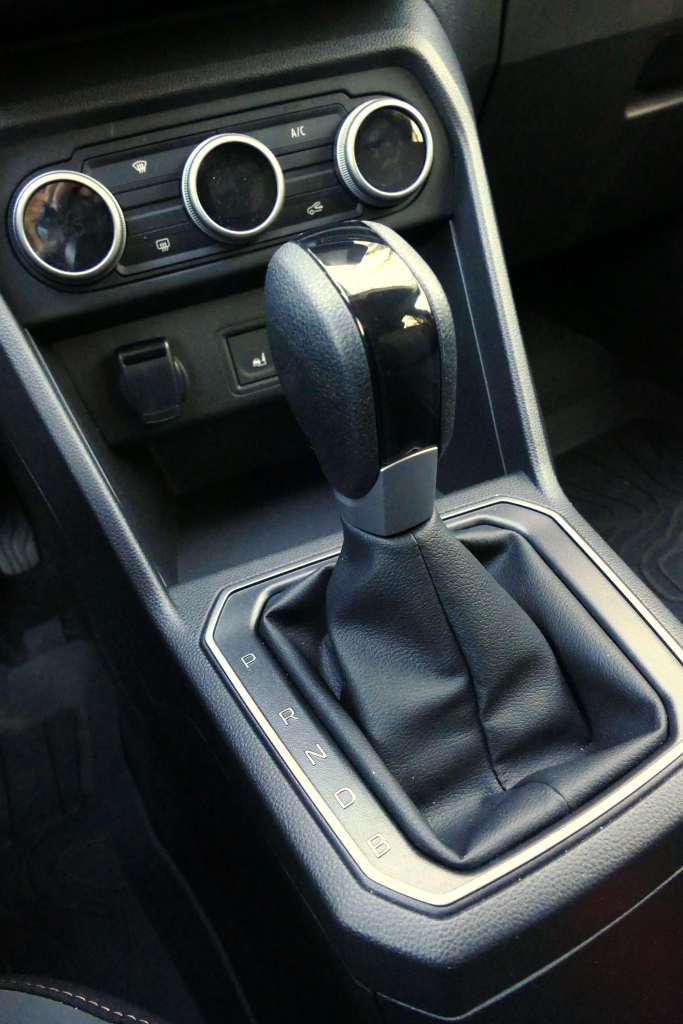
When cruising at motorway speeds, the combustion engine is doing all the work, and is spinning away in 5th or 6th gear of the automatic box, and is then also keeping the small battery fully charged. So the overall “feel” is then of an ordinary combustion engined car. By the way, the Jogger Hybrid has a 6 speed automatic.
The performance of this hybrid Jogger leaves in our eyes nothing, but then really nothing to be desired. It will smoothly sprint from 0 to 100 km/h in 10,1 seconds, and its top speed is close to 170 km/h. A 356 B Porsche Super 90 cannot even accelerate this fast, and reaches only a slightly higher top speed. So, one can’t say that this Jogger is “slow”!!
As said, the consumption is quite reasonable. The WLTP figures tell a maybe somewhat too optimistic story, but here you go: the average is 4,8 liters, with CO2 emissions being officially set at 107 g/km. You see on the photos our average consumption over a single trip of 206 km…

Comfort
French suspension engineers have the talent to create comfortable suspensions with excellent handling capacities, and here indeed, the Dacia truly shines. Its steering is also light and quite precise and responsive, so the Jogger is a pleasant companion on winding roads, with excellent high speed comfort and stability on fast motorways.

Conclusion
This Jogger is, and we only repeat ourselves, a car for all needs, all seasons, all times. Future proof with its low emissions, low consumption and last but not least its moderate kerb weight of slightly more than 1,4 tonnes, (if in the future cars might be road taxed on their weight…) it will provide very pleasant transportation at a very moderate cost. Due to all these good qualities, it is noticed that it holds second hand value very well too…

This car really impressed us, and shows how value for money can be wonderfully combined with comfort, performance and up to date environment friendliness.
Hans Knol ten Bensel
Photographers’ notes: We shot the photos here again with our Panasonic Lumix DMC FZ-1000. The camera tends in its standard ISO setting to render the colours on the rather cooler side of the sprecrum. Especially the interior shots had to be corrected in post production. Again the Leica Vario Elmarit aspherical f 2.8-4 25-400 mm lens delivers excellent sharpness also at full lens openings...
 Autoprova - for the Connaisseur