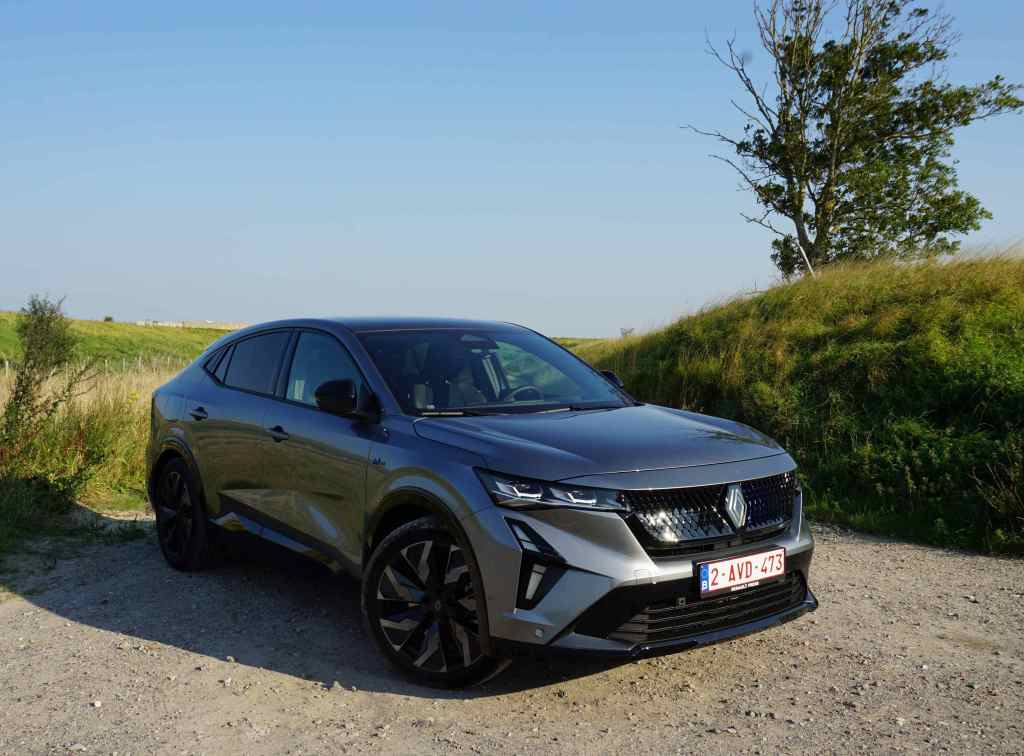
There are days where the life of a car journalist are very bright indeed. For example when sitting behind the wheel of the Renault Rafale, a stylish high tech hybrid full of character and ingenuity.
Renault has poured all its car making know how into their latest SUV Coupé, making it very much in tune with the times: it is a full hybrid, offering electric driving without recharging, and has style too. We drove the 200 HP model in the “Esprit Alpine” equipment version, adding to the unique panache of this Rafale… just read further.
Hans Knol ten Bensel
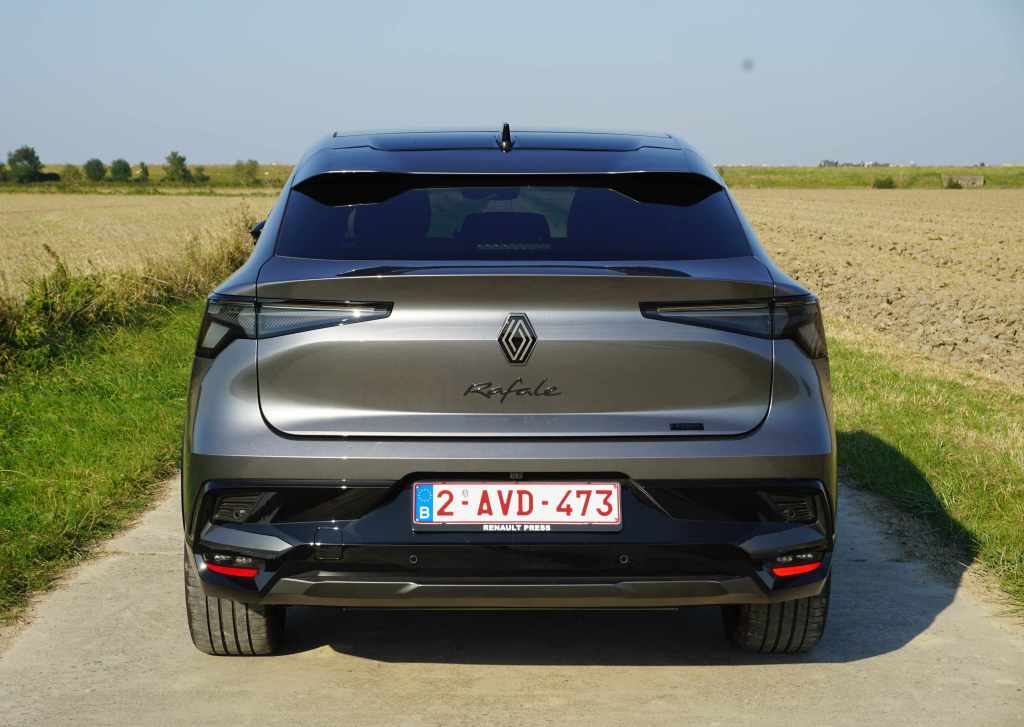
Stylish, inside and out
The Rafale has the looks, now coming from the hand of Gilles Vidal. Surprisingly Renault has abandoned the design language which Laurens van den Acker started in 2009 when he became chief designer and which culminated in the recent Megane E-Tech electric. Now Gilles Vidal is at the designer table, and he comes from the Peugeot stable. He brought the design language of the recent Peugeot C-segment sales hits (3008) to Renault, and this is what Luca de Meo apparently wanted.

This new Renault DNA takes some getting used to, but we understand the strategy, as this styling language is trendy for the C segment and upward. Don’t forget, the Rafale is a D segment car. Renault is also choosing different and highly original styling paths when it comes to the new “retro” 5 and 4, which are indeed amazing and bound to be successful.
But back to the Rafale. I must admit that I like the name. It harks back to the also very stylish and rakish pre-war record plane with a Renault aircraft engine, and did you know that Dassault is still building a ”Rafale” jet fighter?
Renault has also added a touch of “Alpine magic” to it. Your eyes fall on the illuminated “A” with an arrow on the backrest of the front seats. It pulses to the beat of a human heart. Wooww….The colour of the lighting matches the option selected in the MULTI-SENSE settings. Agneta Dahlgren, the design project director on the new CMF-CD platform also used for the Austral and the Espace , sees the illuminated logo when you enter the car as an invitation to experience driving pleasure…

The interior of the Rafale is quite welcoming, ergonomic and spacious. It has a high tech aura about it, accentuated by phasing out the use of leather in its cars. In the Esprit Alpine version we tested, the use of … SLATE is surprising. Renault says that “it evokes the Alps”, an environment where the rally Alpine Berlinettes stormed to victory. Present on the dashboard facing the passenger, these thin sheets of slate mould to the contours as easily as wood veneer.
The interior is also quite spacious. Understandable, as it is built on the same platform as Espace. The Rafale shares its 2.74m wheelbase, allowing not less than 302 mm knee room in the back. The long wheelbase and gently sloping roof line allow a rear headroom of 880 mm, almost the same as on Espace (892 mm). The Rafale has a standard boot space of 627 litres (532 dm3).
A digital cockpit…
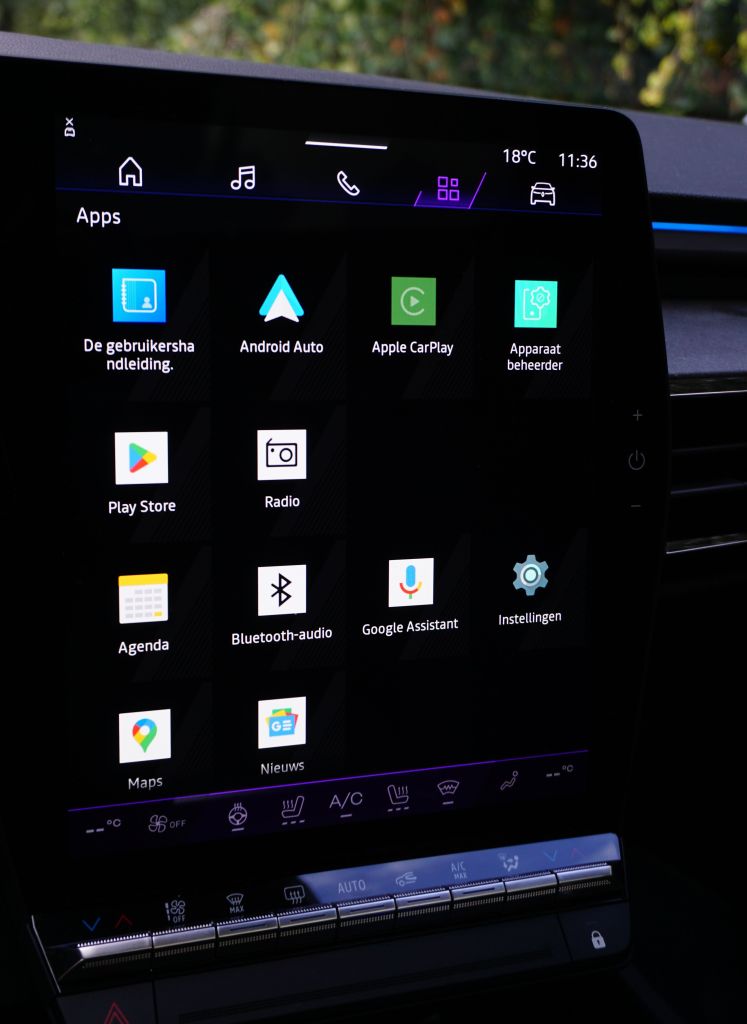
The cockpit offers driver and front passenger Renault’s “Open R” digital instrumentation with two screens forming an L shape. There is a horizontal TFT dashboard display of 12.3 inches diagonally and a vertical touch screen measuring 12 inches diagonally in the centre of the
console. Eminently legible and intuitive to use.
Staying connected…
The Rafale connects indeed seamlessly with your smartphone through its in-car “OpenR” Link multimedia system with Google built-in.
The system provides access to Google Maps, Google Assistant and a host of apps (50 or more depending on the country and version) via the Google Play catalogue. Just like on a smartphone. The interface is also fully customisable and compatible with Android Auto and Apple Carplay.
As it is an open-ended system connected to the cloud, OpenR Link automatically integrates the recommended updates using FOTA firmware over the air) technology.

A clever, full hybrid drivetrain…
The Rafale has a 3-cylinder 1.2 litre turbocharged petrol engine developing 130 hp (96 kW) with 205 Nm of torque underneath the hood, and two electric motors. Let’s start with the engine. It has a Miller combustion cycle, low-pressure exhaust gas recirculation, a variable-geometry turbocharger and a longstroke architecture similar to that of a diesel. The result is an extraordinary efficiency level of 41%.
You guessed it, this engine does not spoil your ears with a thoroughbred high revving staccato, but rather sounds indeed like, well, a lower revving piston aircraft engine when called to duty. Especially as the computer which controls the hybrid system lets the engine rev up to recharge the small 2 kW battery, which it does when you are driving at a (lower) constant speed or coasting, when you are using little engine power otherwise to propel the car. The computer then cleverly takes the opportunity to rev up the engine to recharge swiftly the battery, so it can again deliver its e-power for e-driving in slow urban traffic or to e-boost swift acceleration when called for.

This typically gives the driver the impression that the engine is revving up like the original Rafale record airplane before take-off… one would almost like to sit behind the wheel with leather gloves and a leather flying cap and goggles!
Renault’s full hybrid system is indeed very clever and astonishingly efficient. The two electric motors are respectively a main motor, developing 50 kW or 70 hp, and this is the one fed by the 2 kW 400 V battery. The other one is a starter-generator motor of 25 kW, which starts/stops the engine and performs the gear changes in the clutchless multimode automatic dog box developed using Formula 1 technology. It combines two gears for the main electric motor and four for the internal combustion engine. The motors and engine with this box combine 15 different operating possibilities, to offer te ideal solution in any driving situation. Soo clever!
But there is more. Renault went as far as to introduce on its flagship car so-called “predictive hybrid driving”. This function is meant to maximise the use of electrical energy while driving.

Connected to Google’s mapping data, such as the topography of the road over the next seven kilometers (or the most likely route if no destination is recorded), provides advance information to the battery management system to maximise the use of electric power….
Brisk performance
With a total system power of 200 HP, acceleration of this 1,6 tonne Rafale is quite good with a sprint time from 0 to 100 km/h of 8,9 seconds, and an intermediate dash between 80 and 120 km/h being absolved in 5,6 seconds. Of course, when driving full power for an extended period, the e-power is consumed and the petrol engine has further to do all the work, which translates therefore with its 130 HP in a relatively modest top speed of 180 km/h.
The good thing is that one is driving in urban traffic to a very large extent on e-power, which translates indeed in very good fuel economy. The WLTP figure is 4,7 l/100 km with CO2 emissions being 105 g/km.
The paddles on the steering wheel are not meant for manual gear changes, just let you choose the level(s) of e-regeneration.

Alpine agility…
The Rafale has very good handling qualities, and much testing has been done by Renault people to eke out the very best the CMF-CD platform has to offer.
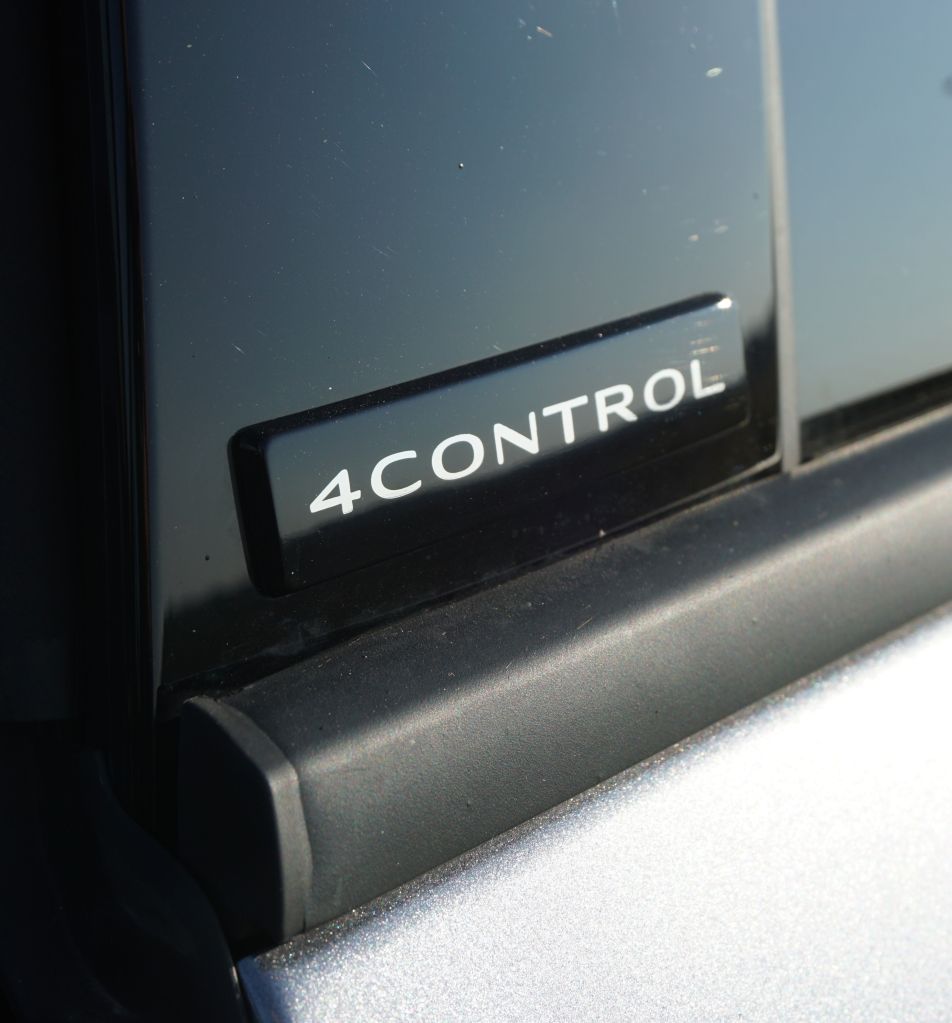
The Rafale has multi-link rear suspension as standard , and the Alpine version we drove has the “4Control” four-wheel steering technology. The rear wheels turn in the opposite direction to the front wheels (by up to 5 degrees), for better maneuverability on city streets. This results in a turning circle of merely 10.4m.
On the motorway, at higher cruising speeds, the rear wheels then turn very slightly (up to 1 degree) in the same direction as the front wheels, improving vehicle stability by reducing the inertia of the rear axle.
We found the Rafale indeed quite agile and stable. Also thanks to the upgraded Vehicle Motion Control (VMC 2), an electronic system controlling the rear wheels, and ESP. All this is further enhanced by the calibration of the steering with a direct steering ratio of 13. A truly sporting D segment car, when it comes to agility and road manners. In line with its French pedigree, it is very comfortable too.
Conclusion
With this Rafale, Renault makes an impressive statement in the D segment, offering a stylish SUV coupé with ample room, excellent handling, convincing performance and surprising economy. Its drivetrain is truly clever, its equipment and finish is full of panache, especially in the Alpine versions.

Soon there will be a 300 hp plug in hybrid 4×4 version, noblesse oblige, but already this 200 HP Rafale was very convincing indeed…
Hans Knol ten Bensel
 Autoprova - for the Connaisseur